SaaS Club
PodcastPlaybooksCoachingFree ToolsJoin Community
saasclub

Helping SaaS founders build and scale profitable businesses since 2014. Powered by real experience from 471+ founder conversations.

Content

  • The SaaS Podcast
  • Founder Playbooks
  • Blog
  • Newsletter
  • Free Tools

Programs

  • Plus
  • Launch
  • Mastermind
  • Accelerate

Company

  • Contact
  • Become a Sponsor
  • Suggest a Guest
  • Terms
  • Privacy

© 2026 SaaS Club. All rights reserved.

Built with ❤️ for SaaS founders

Bootstrapping Series

Bootstrapping a SaaS Business

How founders are building profitable SaaS businesses without venture capital. Real stories of self-funded growth from the trenches.

Real founder strategies. Delivered weekly.

Free weekly newsletter · No spam

Browse by topic:AllBootstrappingFirst CustomersProduct-Market FitEnterprise SalesPLG & Growth
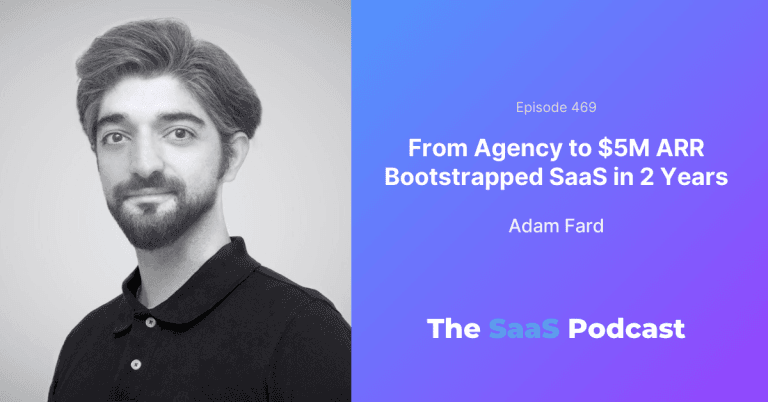
Bootstrapped SaaS: From Agency to $5M ARR in 2 Years - Adam Fard

Adam Fard, UX Pilot

Bootstrapped SaaS: From Agency to $5M ARR in 2 Years

Adam Fard is the founder of UX Pilot, an AI platform that helps product design teams create and ship great user experiences faster. In 2023, Adam was running a successful UX agency when ChatGPT and LLMs started taking off. He began experimenting with ways to apply AI to his team's design processes and built a Figma plugin that helped users work through UX frameworks and activities. Then during a user interview, someone asked a simple question: "I have all these ideas on my canvas, but can I turn them into something visual? Can I create a wireframe?" That question stuck with him. He started looking around to see if any tools could actually generate wireframes from text input. He found a few products claiming to do it. But when he tested them, he realized they were faking it. They were just swapping existing templates and personalizing the copy. None of them could truly generate a layout from scratch. There was a technical reason for that. Creating wireframes with AI was genuinely hard. So Adam started working on it himself. He explored fine-tuning LLMs, hired AI researchers, and tested component-based approaches. He spent four or five months iterating. Slowly, things started working. The outputs became stable enough to use. He added Figma integration so designers could bring wireframes into their existing workflow. Within six or seven months of that original user question, UX Pilot hit $10K MRR. But growth created a new problem. Adam hired too slowly. At $30K MRR, he kept questioning whether this was the ceiling. He added one engineer, waited, added another, waited again. Looking back, he says he should have hired five people at once instead of dragging out the process. Today, UX Pilot generates over $5 million in ARR with a team of 30 and over 15,000 paying subscribers. All bootstrapped. In this episode, you'll learn: Why Adam initially said he didn't want the product to focus on AI generation, and what changed his mind a few months later How he validated the wireframe generation opportunity by testing competitors and discovering they were all faking it What happened when Google suddenly deranked all of UX Pilot's landing pages, and how he recovered Why talking about product updates in his newsletter drove more engagement than traditional educational content How focusing narrowly on design (instead of building another no-code tool) became their biggest competitive advantage

Bootstrapped SaaS to 8-Figure Exit (No VC, No Problem) - James Ashford

James Ashford, GoProposal

Bootstrapped SaaS to 8-Figure Exit (No VC, No Problem)

James Ashford is the founder of GoProposal, a proposal and pricing platform for accountants which he bootstrapped and sold for an 8-figure sum. James didn't have a tech background. He wasn't an accountant. And he'd never built software before. But he noticed something broken: accountants couldn't price their services. They'd guess fees based on what the last client paid. Proposals took days. Deals fell through because people got busy. So he built a simple solution. A digital menu that let any staff member price and close deals in 15 minutes. The first version? A WordPress plugin that cost £4,000 to build. Before writing a single line of code, James did something unusual. He calculated how much money he needed to never work again (£5 million), identified the companies that might acquire his business (Sage, Intuit, Xero), and printed their logos on his wall. This wasn't optimism—it was his bootstrapped SaaS exit strategy from day one. To crack the accounting industry as an outsider, he traded 10% of his software company for 10% of an accounting firm. Instant credibility. Then he wrote a book in two weeks, made it an Amazon bestseller, and used it to build a waitlist of hundreds before launch. His marketing philosophy was simple: market like a celebrity chef. Gordon Ramsay shows you how to cook his recipes for free. You still go to his restaurant. James gave away everything—the methodology, the frameworks, the exact playbook. People still bought the software because they wanted it done faster. The bootstrapped SaaS approach forced creativity. When he realized a single conference cost £25,000, he hired a full-time videographer instead. Twelve months later, the pandemic hit. Competitors who relied on events were stuck. GoProposal dominated online. By the time he sold, GoProposal had over 1,100 customers, a 78 NPS score, and playbooks for every single process in the business. Three potential acquirers approached him within months of each other. The exit price? 8 figures. The multiple? One he still doesn't publicly share because it was "crazy."

Bootstrapped SaaS to $30M ARR: Why Scarcity Forces Focus - Sam Darawish

Sam Darawish, Everflow

Bootstrapped SaaS to $30M ARR: Why Scarcity Forces Focus

Sam Darawish is the co-founder and CEO of Everflow, a partner-marketing platform that helps companies manage their affiliate programs, influencers, and performance-marketing campaigns. Sam started in online marketing in the early 2000s, working at one of the first affiliate and pay-per-click companies in San Francisco. When the iPhone launched in 2008, he and his two co-founders saw a chance to bring what they had learned from desktop to mobile. They bootstrapped Moola Media, one of the first mobile affiliate networks, and built their own tracking platform because there were no good third-party options for mobile at the time. In 2013, Opera acquired Moola Media for $50 million. During the three-year earn-out, Sam kept hearing the same complaint from marketers: no one liked the existing affiliate-marketing software. When the earn-out ended in 2016, the founders invested a few hundred thousand dollars of their own money into Everflow and did not pay themselves for the first couple of years. The first six to seven months of their bootstrapped SaaS journey were spent talking to potential customers and refining ideas. Then they decided to go all in at Affiliate Summit in Las Vegas, renting a booth with nothing more than screenshots of the product. Two prospects from that conference became their first paying customers—even though one made them sign an agreement to take over the software if the company failed. By early 2018, the bootstrapped SaaS hit $1M ARR with just 10 people and turned profitable. Today, Everflow has grown to nearly $30M ARR with 1,200 customers and 120 team members across San Francisco, Montreal, Amsterdam, and Dubai—all without raising external funding.

Bootstrapped SaaS: From $5K to $27M ARR in a Forgotten Niche - Kevin Wagstaff

Kevin Wagstaff, Spectora

Bootstrapped SaaS: From $5K to $27M ARR in a Forgotten Niche

Kevin Wagstaff is the co-founder of Spectora, a modern all-in-one platform for home inspectors that he and his brother Michael bootstrapped from $0 to $10M ARR before raising funding. In 2016, Kevin was a realtor with a knack for marketing and SEO. His brother was a self-taught developer. When a friend mentioned how outdated home-inspection software was, they spotted a niche no one was serving and went all in with $5,000 and a lot of grit. They spent six to nine months talking to inspectors: buying coffee, riding along on jobs, listening. What they found was simple: inspectors were wasting hours writing reports after each job. That inefficiency became their focus. Their first version was a mobile-first app that helped inspectors take photos, label issues, and finish reports faster. Soon after, they expanded into a full business platform with scheduling, payments, texting—everything in one place. But winning trust was the real challenge. Many inspectors were in their 50s or 60s and skeptical of cloud software and monthly subscriptions. So Kevin focused on something most bootstrapped SaaS founders overlook: showing up consistently and genuinely helping people before ever asking for the sale. Kevin started a separate blog called SmartHomeInspector.com 12 months before Spectora launched, writing content on how to market your business as a home inspector. He offered free SEO audits and even built websites for early customers—over 200 of them manually—just to get them talking about the software. Within two years, Spectora hit $1M ARR. They kept building from there. By 2024, the company had grown to $27M ARR, serving over 12,000 customers with a 100-person team.

Bootstrapped SaaS: 5 Years Part-Time to $10M ARR - Jonathan Kazarian

Jonathan Kazarian, Accelevents

Bootstrapped SaaS: 5 Years Part-Time to $10M ARR

Jonathan Kazarian is the founder and CEO of Accelevents, an event management platform that helps organizations run everything from conferences to virtual events. Back in 2014, while working at a hedge fund, Jonathan's 17-year-old cousin got sick. He organized a fundraiser but couldn't find affordable event software with decent support. So he built a solution with someone he knew. It worked so well that other organizations started asking for it. As demand grew, Jonathan started using Upwork contractors to build out the platform while he managed the product side. But Jonathan didn't quit his day job. For five years, he worked 60-hour weeks nights and weekends building this bootstrapped SaaS. He and his co-founder even scheduled date nights on different days so one was always on call. By 2020, after five years of this grind, he hit $1 million ARR and finally went full-time. Perfect timing, right? COVID hit and wiped out every event worldwide. Revenue dropped to zero, and cashflow went negative as they refunded all their transaction fees. A month later, Jonathan borrowed $75,000 from his father's retirement to keep the company alive. But instead of waiting it out, they pivoted hard to virtual events. Jonathan and his team started pre-selling features they hadn't built yet using Figma mockups. Within three months, they hit a million-dollar run rate. By year's end, they'd 10X'd revenue and grown from 10 to over 100 people. But in 2022, the tech bubble burst. Revenue got cut in half. Jonathan had to lay off more than half his team while the company bled customers for 12 straight months. Today, Accelevents serves over 1,000 customers and generates $10 million ARR with 60 people - proof that a bootstrapped SaaS can survive multiple near-death experiences.

Bootstrapped SaaS to $5M ARR With Zero Sales Team - Jared Siegal

Jared Siegal, Aditude

Bootstrapped SaaS to $5M ARR With Zero Sales Team

Jared Siegal is the founder and CEO of Aditude, a monetization platform that helps digital publishers maximize their ad revenue. He got his first customers by converting 30 consulting clients into SaaS subscribers with a 100% conversion rate. Jared Siegal built two companies that sold for massive valuations - and walked away with almost nothing. Determined to control his own destiny, he quit his job and started a one-person consulting business helping publishers fix their broken ad tech. For two years, Jared wrote JavaScript in text files, emailed code snippets to clients, and billed by the hour. It was unscalable, but profitable - he grew to 30 clients and $2 million in revenue. When three companies offered to acquire his consulting practice in the same month, Jared had a decision to make. A former professor turned VC gave him blunt advice: you can keep consulting and make good money forever, or you can pivot to a bootstrapped SaaS and try to sell for real money. To build the MVP without spending a dollar, Jared convinced a client to lend him an engineer for six weeks - for free. Then he gave the SaaS product away to all 30 consulting clients for six months, making them completely dependent on his technology. When he finally flipped the switch from free to paid, every single client converted - 100% became paying subscribers. Four months later, Aditude hit $1M ARR. Jared bootstrapped the SaaS to $5M ARR before raising a $15M Series A from a position of strength, with no sales team, no marketing, and no outbound - just referrals from clients who trusted him enough to write him into their wills.

Bootstrapped to $1M ARR in 90 Days: The TikTok Affiliate Strategy - David Zitoun

David Zitoun, Submagic

Bootstrapped to $1M ARR in 90 Days: The TikTok Affiliate Strategy

David Zitoun is the co-founder and CEO of Submagic, a tool that helps creators and small businesses turn their videos into viral-ready shorts in just a few clicks. David Zitoun had a problem. As a longtime video creator, he wanted captions that looked like Alex Hormozi's viral style - but creating them in Premiere Pro was painful and time-consuming. So he built a tool to solve his own problem. He found his co-founder through Y Combinator's Co-Founder Match platform, and they made a pact: build an MVP in 15 days, try to sell it in 15 days. If nothing worked after 12 months of monthly experiments, they'd move on. Submagic was the first product they tried. With no money for paid ads, David started posting TikTok videos promoting Submagic from a brand new account with zero followers. Ten days later, one video went viral with 100,000 views, bringing in the first 40-50 paying customers. Then he scaled the playbook: he recruited 50-70 young creators as affiliates, paying them 30% lifetime commissions to post daily TikTok videos promoting Submagic. The affiliate army worked. Within 90 days, this bootstrapped SaaS hit $1M ARR. But at $5M ARR, growth stalled for seven months. David's team tried everything - more features, more acquisition channels - nothing moved the needle. The breakthrough came when they lowered prices instead of raising them, and launched Magic Clips to help podcasters and YouTubers turn long-form content into shorts. Today, Submagic is a bootstrapped SaaS at $8M ARR with a 14-person remote team across 10 time zones. SEO now drives 25% of revenue, word of mouth is the top acquisition channel, and David still spends 50% of his time talking to customers - the same thing he did on day one.

Bootstrapped SaaS to $82M Exit: No VC, No Sales Team - Callum Mckeefery

Callum Mckeefery, Reviews.io

Bootstrapped SaaS to $82M Exit: No VC, No Sales Team

Callum Mckeefery is the founder and CEO of Partner.io, a platform that helps companies run smoother partner programs and grow revenue faster. Back in 2012, Callum and his wife were broke. He had two startup ideas and pitched both to a major mobile phone company - neither one landed. As he walked out the door, he asked one last question: Who does your customer reviews? That short conversation sparked a new idea. Within a week, he returned with a rough MVP for Reviews.io. They still said no, but Callum had seen just enough interest to go all in. Callum hustled to get his first customers by cold-calling event organizers, showing up to expos with a foosball table, and running guerrilla marketing campaigns on a shoestring budget. He reinvested every dollar into the product and team. It took 18 months of relentless effort to hit $1M ARR - bootstrapped, profitable, and fighting for every deal against well-funded rivals like Trustpilot. Callum Mckeefery used these 3 strategies to build a bootstrapped SaaS to 8-figure ARR: Positioned Reviews.io as the "friendly alternative" with fairer pricing and no annual contracts Targeted underserved SMBs doing $5M in revenue who were overcharged by Trustpilot Built a logo flywheel where each new customer's badge attracted their competitors Then, over the next decade, he scaled Reviews.io into a global bootstrapped SaaS business with 8-figure ARR - all without raising a cent of outside funding. But just as the business was thriving, his son was diagnosed with a rare genetic disease, and everything changed. Callum made the decision to sell the company for $82 million - not because he wanted to, but to secure his son's future and fund urgently needed medical research. Today, he's back with Partner.io, solving a problem he faced firsthand while scaling his last company - and once again, doing it on his own terms.

Bootstrapped SaaS to 7-Figure ARR With No Sales Team - Onur Alp Soner

Onur Alp Soner, Countly

Bootstrapped SaaS to 7-Figure ARR With No Sales Team

Onur Alp Soner is the founder and CEO of Countly, a privacy-first product analytics platform. Back in 2013, Onur was working at Huawei when he and two co-founders decided to build a self-hosted mobile analytics tool. They did almost no validation - just trusted their gut and started building on evenings and weekends. Six months later, they shipped a basic MVP and released it as an open-source project on SourceForge. A blog post Onur wrote about choosing unfamiliar technologies hit the front page of Hacker News, and suddenly companies like Intel were reaching out asking for an enterprise version that didn't exist yet. Onur quit his job while his co-founders stayed in theirs a bit longer. Those early enterprise deals were messy - no contracts, no pricing strategy, and too many custom requests for too little money. But after the first 10 painful deals, Onur learned to set boundaries and charge for the expertise, not just the software. Their first attempt at a SaaS product failed. Countly Cloud looked just like the competition and had no clear differentiator. It hit a revenue ceiling and couldn't break through, so they killed it to refocus on their bootstrapped SaaS enterprise model. Then came the hardest part. A co-founder dispute that had been building for years finally boiled over. Onur describes an eight-month period where the breakup consumed his time and energy, nearly killing the company. But he stuck with it. He rebuilt the team, relaunched SaaS with a privacy-first dedicated-server model called Flex, and kept growing organically through content and inbound leads. Onur used these strategies to bootstrap Countly to 7-figure ARR: 1. Released the product as open source to attract enterprise buyers who could evaluate the code 2. Used content marketing and Hacker News to drive inbound leads instead of outbound sales 3. Charged for expertise and strategy consulting, not just software licenses 4. Killed a failing SaaS product to refocus on the core enterprise business 5. Relaunched SaaS with a dedicated-server model that preserved the privacy-first positioning Today, Countly is a bootstrapped SaaS with a 40-person team across 12 countries, serving brands like BMW, Coca-Cola, AWS, and Roche.

Selling a Bootstrapped SaaS: Avoid These Mistakes - Andrew Gazdecki

Andrew Gazdecki, Acquire.com

Selling a Bootstrapped SaaS: Avoid These Mistakes

Andrew Gazdecki is the founder and CEO of Acquire.com, the largest marketplace for buying and selling SaaS startups. Before starting Acquire.com, Andrew bootstrapped and sold his own SaaS company. He grew it to $10 million in annual recurring revenue, but when he went to sell, the process was a massive headache - he spent years finding a buyer and had no idea what due diligence or legal terms meant. That painful exit became the inspiration for Acquire.com. Today, the platform has helped over 2,000 startups get acquired, with total deal volume exceeding $500 million. Andrew explains how bootstrapped SaaS businesses are ideal acquisition targets for financial buyers like private equity firms, family offices, and individual entrepreneurs. Andrew reveals the three biggest mistakes sellers make: overvaluing their business, refusing earnouts or creative deal structures, and failing to get their house in order before listing. He walks through the full selling process on Acquire.com - from creating a draft listing, to going live with over 500,000 registered buyers, to using deal schedules that create momentum and drive competing offers. On the buying side, Andrew covers red flags to watch for, why code quality matters less than distribution and customers, and how one buyer turned a $25-50K acquisition into a $2M revenue business by rebranding it as pdf.ai. He also discusses the growing wave of AI-first bootstrapped SaaS businesses and why the barrier to entry for building these companies keeps getting lower.

Bootstrapped SaaS: 50 Failed Sales to $7M ARR - Sameer Narkar

Sameer Narkar, Konnect Insights

Bootstrapped SaaS: 50 Failed Sales to $7M ARR

Sameer Narkar is the founder and CEO of Konnect Insights, a unified customer experience management platform that combines social listening, analytics, and CRM into a single solution for enterprise brands. The company has grown to $7M ARR serving over 500 enterprise customers across 30+ countries, all while remaining completely bootstrapped. Before Konnect Insights, Sameer spent over a decade at companies like Infosys and Persistent Systems, where he saw firsthand how enterprises struggled with fragmented social media tools. When he launched Konnect Insights in 2016, his first 50 sales pitches failed. But each rejection taught him what enterprise buyers actually needed, and he rebuilt the product until it clicked. The company went from zero to $1M ARR in three years, then accelerated to $7M ARR in the next four years by replacing 5-6 point solutions with one unified platform.

Huntress: From NSA Hacker to $120M ARR Security SaaS – with Kyle Hanslovan [429] - Kyle Hanslovan

Kyle Hanslovan, Huntress

Huntress: From NSA Hacker to $120M ARR Security SaaS – with Kyle Hanslovan [429]

Kyle Hanslovan is the co-founder and CEO of Huntress, a cybersecurity platform that helps businesses protect themselves against hackers and cyber threats. Before starting Huntress, Kyle was a hacker for the US government and NSA – not the Hollywood version, but as he puts it, "the real life pasty version behind a keyboard." In 2015, he spotted a huge opportunity. The big companies had fancy security teams, but smaller businesses were left wide open to attacks because they couldn't afford that kind of protection. Kyle had a rough start. He was bootstrapping the business and taking on part-time security work to pay the bills, while pretty much everyone he talked to kept telling him he was going about it all wrong. It took him nearly a year just to get his first three customers. Two of them actually paid. The third one, as Kyle laughs about now, "used my free trial for like seven years before they finally paid me." Their first product was super basic – just an installer that would flag security issues via email. No fancy dashboard, no automation – they were doing all the security analysis by hand because they couldn't afford to build anything more. Things got pretty tough. Multiple seed rounds fell through, investors walked away, and Kyle and his co-founders weren't taking home a paycheck. The equity dilution got so painful that they almost sold the company for $30M. But they stuck it out, taking a bridge round from their early investors. That bet paid off big time – they grew from $1.5M to $5M ARR in just a year, proving all the skeptics wrong. Today, after years of doubling revenue year after year, Huntress generates about $120M in ARR, has raised over $300M in funding, and has grown to a team of 500 remote employees with a valuation of nearly $2 billion.

Teqtivity: From Failed Hardware Pivot to 7-Figure SaaS Success – with Hiren Hasmukh [428] - Hiren Hasmukh

Hiren Hasmukh, Teqtivity

Teqtivity: From Failed Hardware Pivot to 7-Figure SaaS Success – with Hiren Hasmukh [428]

Hiren Hasmukh is the founder and CEO of Teqtivity, an IT asset management solution that helps companies manage their laptops, tablets, phones, and other technology assets. In 2018, Hiren launched a hardware company called TechCube, where he invested $400,000 of his own money to build smart lockers that would help engineering departments loan out test devices. For two years, he and his wife personally assembled these lockers, bootstrapping the business while developing the backend software they needed to manage the devices. When the pandemic hit, companies stopped buying hardware solutions. Rather than give up, Hiren made the difficult decision to pivot and focus on the backend software they'd built, which he believed could become a standalone product. The pivot took six months with just two developers, but they quickly landed their first customer through an RFP bid, which helped them validate their new direction. But competing as a bootstrapped company against well-funded players in the IT asset management space wasn't easy, which meant they had to work harder to build trust and prove themselves worthy of enterprise customers. Then came their biggest challenge yet – a data breach that affected one of their customers and put their entire business at risk. Instead of making excuses, Hiren focused on being transparent with customers and strengthening their security. This approach worked – they managed to keep their customers and continued growing. Today, Teqtivity generates seven-figure ARR with a team of 22 people and remains bootstrapped, despite regular interest from VCs and PE firms.

TeamGantt: Bootstrapping a 7-Figure SaaS with Focus and SEO – with Nathan Gilmore [427] - Nathan Gilmore

Nathan Gilmore, TeamGantt

TeamGantt: Bootstrapping a 7-Figure SaaS with Focus and SEO – with Nathan Gilmore [427]

Nathan Gilmore is the co-founder of TeamGantt, a software platform that helps teams visualize and manage projects using Gantt charts. In 2009, while working as software developers at a commercial roofing company, Nathan and John needed a better way to share project timelines with their team. Frustrated by having to export PDFs every time they made changes, and finding no good web-based solutions, they decided to build their own solution. With full-time jobs and families to support, they could only dedicate 4 hours every Saturday morning to their side project. But they made each hour and week count. Within six months, they had built a basic version ready for testing. They created a simple landing page and used a $100 Google Ads coupon to test interest. It didn't take long for people around the world to start signing up. A year later, they launched paid plans. Their first customer was a video company in California that signed up for their $29 monthly plan. Growth was slow but steady as their SEO efforts started to kick in. A new customer every few days became one every day. When they were making almost $3K in monthly recurring revenue, the co-founders made the leap to working full-time on their business and kept grinding away. Their patience paid off. By 2012, they hit $10K in MRR and two years later reached their first million in annual recurring revenue. Today, TeamGantt serves 6,000 customers across 180 countries, including Fortune 500 companies. They've grown to 21 people and generated seven figures in ARR – all while remaining completely bootstrapped.

Missive: How a Tiny Team Built a $6M SaaS Without VC Funding – with Philippe Lehoux [421] - Philippe Lehoux

Philippe Lehoux, Missive

Missive: How a Tiny Team Built a $6M SaaS Without VC Funding – with Philippe Lehoux [421]

Philippe Lehoux is the co-founder and CEO of Missive, a tool that helps teams work better together through email. In 2015, Philippe and his co-founders were doing well with their Shopify app. But they spotted a big problem with how teams used email and decided to fix it. Using money from the Shopify app, they started building Missive. For over a year, they poured everything into it without making any money. It was a big gamble for the founders. When they finally launched, hardly anyone noticed. Growth was painfully slow. For two long years, they struggled to reach the first $10K MRR. Many would have thrown in the towel, but Philippe and his team kept going. They stayed a tiny team of three, doing everything themselves from writing code to helping customers. And they focused on building a great product instead of marketing, which meant getting new users was tough. But their different way of doing things started to pay off. They came up with an unusual affiliate program that began to bring in more users. Word started to spread slowly but surely. And their commitment to keeping things simple began to resonate with customers. After years of using their own money and staying small, they finally hit a growth spurt. In just the past year, they grew from 3 to 11 team members. Today, Missive helps around 3,700 businesses and generates almost $6M in ARR. They've done all this without taking any outside money and going toe-to-toe with competitors who have big investors backing them.

Dux-Soup: From Side Project to Bootstrapped 7-Figure SaaS – with Will van der Sanden [419] - Will Van Der Sanden

Will Van Der Sanden, Will van der Sanden

Dux-Soup: From Side Project to Bootstrapped 7-Figure SaaS – with Will van der Sanden [419]

Will Van Der Sanden is the founder and CEO of Dux-Soup, a product that helps B2B sales professionals find and connect with potential customers on LinkedIn. Back in 2014, Will was a software developer trying to get various startup ideas off the ground. He was getting frustrated because nothing seemed to stick. Around the time, he also built a simple tool to help his wife find customers for her book-selling business he had no idea this side project would change everything. Will saw an opportunity to adapt the tool for LinkedIn. He built it as a Chrome extension, put it on the Chrome Web Store, and people started downloading it. The tool gained steady traction, and within six months, Dux-Soup was generating enough revenue for Will to quit his other work and focus on it full-time. But the first few years were tough. Will did everything himself writing code, doing customer support, and trying to get the word out. He worked long days and weekends, and even when he took his family on vacation, he always had to bring his laptop along. Eventually, all that hard work started paying off. The Chrome Store helped the tool spread quickly, and Will teamed up with influencers to reach even more people. By keeping the product simple to use and affordable, Dux-Soup hit $1 million in annual recurring revenue (ARR) just two years after launching. But success came with its own problems. LinkedIn eventually found out what Will was doing and threatened legal action, shutting down his personal profile. But Will stood firm, and to this day runs his LinkedIn automation company without having a presence on the platform himself. Now, almost 10 years later, Dux-Soup brings in seven figures in revenue, has more than 80,000 customers, and a team of over 20 people. And they're bootstrapped.

Anaconda: From Bootstrapped Startup to 40M Users – with Peter Wang [418] - Peter Wang

Peter Wang, Ananconda

Anaconda: From Bootstrapped Startup to 40M Users – with Peter Wang [418]

Peter Wang is the co-founder and Chief AI & Innovation Officer of Anaconda, a platform that offers essential open-source Python packages for AI, data science, and machine learning. In 2011, Peter and his co-founder, Travis, saw an opportunity to make Python mainstream in data science and analytics, but they faced a tough road ahead. At the time, Python wasn't widely accepted in enterprise, with most companies heavily invested in Java-based tools like Hadoop. Convincing them to switch to Python for big data analysis was a big challenge. The founders bootstrapped Anaconda by offering consulting and training services while investing heavily in building an open-source community. They also had to take on well-established competitors in industries that had been relying on the same outdated tools for decades, and prove that their modern, open-source solution could deliver better results. In 2015, they launched their first enterprise product, offering corporate clients a more secure, controlled version of their open-source tools. This was great for monetization and revenue growth. However, it also led to internal challenges, as employees struggled to balance the needs of open-source users and enterprise clients, causing confusion around resource prioritization and aligning the company's vision with its business model. Today, Anaconda serves over 40 million users, generates 8-figure ARR from its enterprise solutions, and employs over 350 people. The company has also raised $45 million in funding.

CV Partner: From Developer to $5M+ ARR SaaS CEO – with Erling Linde [417] - Erling Linde

Erling Linde, CV Partner (now Flowcase)

CV Partner: From Developer to $5M+ ARR SaaS CEO – with Erling Linde [417]

Erling Linde is the founder and CEO of CV Partner (now Flowcase), a product that helps professional services firms manage and showcase their team's resumes and project experience to win more bids and proposals. In 2011, Erling was working as a developer and decided to start his own business. After several ideas that didn't take off, he discovered a significant pain point in consulting firms: the enormous amount of time and effort spent formatting and tailoring dozens, sometimes even hundreds, of consultants resumes for large project bids. He built an early version of CV Partner to address this issue but soon realized his developer-designed interface wasn't enough to win over customers. After blunt feedback from a prospect about the poor design, he brought on a UX expert as co-founder to overhaul the product's design and usability. This major design shift became a key differentiator for CV Partner. The early days were difficult. Erling had no sales experience, and his initial demos often dragged on for hours, overwhelming prospects. Over time, he learned how to streamline his pitch and focus on what customers really cared about. And growth was slow but steady. Erling bootstrapped the business for 10 years, relying on conferences, SEO, and word-of-mouth to acquire customers. Today, CV Partner generates over $5 million in ARR, employs 42 people across five countries, and is expanding into North America.

Bootstrapped SaaS: From Zero to $27M ARR Without Raising a Dollar - Martha Bitar

Martha Bitar, Flodesk

Bootstrapped SaaS: From Zero to $27M ARR Without Raising a Dollar

Martha Bitar is the co-founder and CEO of Flodesk, an email marketing platform designed for small businesses and creators. In 2019, Martha and her co-founder Rebecca launched Flodesk to make beautiful email marketing accessible to everyone. They bootstrapped the business from day one, focusing on design and simplicity over complex features. Martha was working in partnerships at HoneyBook when she noticed a pattern: small business owners with massive Instagram followings couldn't get a single newsletter out. The problem wasn't content—it was design. Existing tools like MailChimp were built to solve hardware and software problems from 20 years ago, not the modern design challenges creators face today. Rebecca, a designer who had created templates for Rihanna and Linkin Park, had been sitting on this idea for three years. Her template shop's number one support ticket was customers buying beautiful designs that broke when implemented in other platforms. The validation process was intense. Martha booked 12+ customer calls per day, iterating on Figma prototypes after every single conversation. Their first prototype was a complete failure—users sank in their chairs confused. So they stripped everything down, removing features until only the essential remained. They didn't start building until they made someone cry happy tears. Their unique flat-rate pricing model ($35/month unlimited) helped them stand out in a market dominated by per-subscriber pricing. They deliberately avoided a free tier, which meant every customer contributed revenue. The viral footer strategy—where every email sent displayed "Made in Flodesk"—combined with an affiliate program drove explosive growth. Today, Flodesk generates over $27 million in ARR with hundreds of thousands of customers, proving that bootstrapped SaaS companies can compete with VC-backed giants by focusing on design, simplicity, and unconventional pricing.

ClickFunnels: Bootstrapping a SaaS to $140M ARR with Webinars – with Todd Dickerson [413] - Todd Dickerson

Todd Dickerson, Clickfunnels

ClickFunnels: Bootstrapping a SaaS to $140M ARR with Webinars – with Todd Dickerson [413]

Todd Dickerson is the co-founder of ClickFunnels, a SaaS platform that helps businesses build and optimize sales funnels to sell products and services online. In 2011, Todd replied to a mass email from internet marketer Russell Brunson looking for help with a Ruby on Rails app. That email reply changed the course of his life. After helping Russell and his team with the app, Todd and Russell collaborated on various projects over the next few years. Eventually, they decided to launch ClickFunnels in 2014, with a mission to simplify the process of building sales funnels for online businesses. With Russell's large audience, built over many years, they expected ClickFunnels to attract 10,000 customers quickly. But their initial launch only brought in about 1,000 signups, falling well short of their expectations. Their breakthrough came when Russell created and sold a Funnel Hacks masterclass for $997 at an event and bundled ClickFunnels for free. This strategy became their primary growth engine. Over the next few years, they ran weekly webinars, driving traffic from Facebook ads to live sessions where Russell would teach and then sell the training and software. One of their biggest challenges came when they faced a critical database outage that lasted eight hours. It was a major crisis that threatened both their revenue and reputation, with some customers even sending death threats. Another major challenge was scaling their infrastructure. With only five engineers supporting 10,000 customers, the team struggled to keep the platform stable while adding new features. Today, ClickFunnels generates over $140 million in ARR, serves over 100,000 customers and is still fully bootstrapped.

Lessons on Bootstrapping Three SaaS Startups to $1M+ ARR – with Adam Robinson [411] - Adam Robinson

Adam Robinson, Retention

Lessons on Bootstrapping Three SaaS Startups to $1M+ ARR – with Adam Robinson [411]

Adam Robinson is the co-founder and CEO of Retention.com, a platform that helps e-commerce brands identify and engage with website visitors, and RB2B, a tool that matches anonymous website visitors to LinkedIn profiles for SaaS businesses. In 2014, Adam and his co-founders started their first SaaS company, Robly, an email marketing platform. They bootstrapped the company to $1 million in annual recurring revenue (ARR) in 17 months by using a call center to target a list of Constant Contact customers. But the success didn't last long. The product wasn't competitive outside their niche target list, and growth stalled around $3 million ARR. In 2019, Adam co-founded Get Emails (later renamed Retention.com). This time, they reached $1 million ARR in just 27 weeks using provocative Facebook ads and cold email outreach. But the rapid growth brought new challenges. High churn rates and market saturation meant the team had to constantly find new ways to keep the business growing. As cold email became less effective, Adam turned to building his personal brand on LinkedIn in 2022. After some initial struggles, he found his voice by sharing vulnerable, authentic content about his business experiences. He grew from zero to over 92,000 followers in less than two years. This LinkedIn presence became the launchpad for Adam's latest venture, RB2B, which he launched in March 2023. The product hit $1 million ARR in just 16 weeks. Today, Retention.com generates over $21 million in ARR, while RB2B recently crossed the $2 million ARR mark.

PSPDFKit: Bootstrapping a SaaS $20K to $1M ARR in 8 Months – with Jonathan Rhyne [407] - Jonathan Rhyne

Jonathan Rhyne, PSPDFKit

PSPDFKit: Bootstrapping a SaaS $20K to $1M ARR in 8 Months – with Jonathan Rhyne [407]

Jonathan Rhyne is the co-founder and CEO of PSPDFKit, a software development kit that enables developers to integrate advanced PDF functionalities into their apps. In 2014, Jonathan was working as an attorney, living with his in-laws, and about to start a family when he took a huge risk to join PSPDFKit as a co-founder. The startup was making just $20K in monthly recurring revenue (MRR). Jonathan and his co-founder faced the challenge of growing their business in a market where even Adobe hadn't yet solved the problem. They immediately got to work. Jonathan overhauled their pricing, introduced a new subscription model, and focused on creating valuable content to attract developers. The hard work paid off. In just 8 months, they grew from $20K to $1 million in annual recurring revenue (ARR) a huge win for any startup. But their rapid growth also brought unexpected challenges. They struggled to balance customer demands with their long-term vision, often resorting to quick fixes that risked creating technical debt and future problems Despite their initial success, the next few years were challenging. Their attempts to launch new products didn't work out, leaving them unsure of their direction. Growth slowed down. Market uncertainties and tight finances tested their resolve. But they persevered, steadily growing the business year after year. Today, after overcoming numerous obstacles, their business generates multiple eight figures in revenue, with a team of 150 people across 27 countries.

Vacation Tracker: 60 Waitlist Signups to $2M Bootstrapped SaaS – with Lav Crnobrnja [406] - Lav Crnobrnja

Lav Crnobrnja, Vacation Tracker

Vacation Tracker: 60 Waitlist Signups to $2M Bootstrapped SaaS – with Lav Crnobrnja [406]

Lav Crnobrnja is the co-founder and CEO of Vacation Tracker, a SaaS leave management product for small to medium businesses (SMBs). In 2017, Lav and his team at Cloud Horizon, a services company Lav previously, would often struggle to manage employee leave with an Excel spreadsheet. As their team grew, this manual process became more and more difficult to manage. So during a company hackathon, they decided to build a software solution. They created a simple landing page and spent a bit of money on ads to see if anyone was interested. Lav's partner also talked about the idea at conferences where he was speaking, which helped get more people on their waitlist. But months went by, and Lav and his team still hadn't launched the product. Nine months after creating the landing page, Lav got an email from someone who'd been on the waitlist for ages, asking when they'd finally launch. This wake-up call made Lav realize the potential demand for their product. So they got to work completing the product and getting it ready for launch. Vacation Tracker launched with a six-month free beta period for users on the waitlist. They only had about 60 people on the list, but 20 signed up and 10 of them became active users. Lav personally handled all demos and customer support. One day, Lav was at a restaurant having lunch when he received the Stripe notification: their first paying customer had signed up for $25 per month. It may not have been much, but it was a moment of pure joy for Lav. He celebrated by buying drinks for everyone in the restaurant. But the early days also came with plenty of challenges. At the end of the six-month beta, one of the developers accidentally wiped the production database forcing the team to scramble to recover user data. The team also struggled with creating relevant content at scale. Their initial marketing efforts included articles about summer reading lists and travel destinations, which generated traffic but attracted the wrong type of visitors and leads. Fast forward to today, Vacation Tracker serves 2,500 customers, has a team of 20 people, and is approaching $2 million in annual recurring revenue – all while remaining bootstrapped.

lempire: From $1K Launch to $26M ARR Profitable SaaS – with Guillaume Moubeche [405] - Guillaume Moubeche

Guillaume Moubeche, lempire

lempire: From $1K Launch to $26M ARR Profitable SaaS – with Guillaume Moubeche [405]

Guillaume Moubeche is the founder and CEO of lempire, a suite of products that help B2B businesses grow, including lemlist, lemwarm, Taplio, Tweet Hunter, and lemcal. Guillaume's entrepreneurial journey began with a painful failure. A t-shirt business he started with his father sold only six shirts, straining their relationship for nearly a year. Undeterred, Guillaume joined a B2B lead generation agency, where he learned about cold email prospecting. This experience sparked the idea for lemlist. In 2018, with just $1,000, Guillaume and two technical co-founders launched lemlist. The early days were grueling. They worked tirelessly, with Guillaume often surviving on pasta and isolating himself from doubtful friends and family. To acquire customers, Guillaume provided free services and traded lemlist accounts for essential tools. He personally helped set up campaigns for early users, going above and beyond to ensure their success. His persistence and "build in public" strategy paid off. lemlist's revenue grew 30% month-over-month, hitting $1 million ARR in less than two years after launch. The growth continued at a breakneck pace. By 2021, just three years after launch, lemlist had skyrocketed to $10 million in annual recurring revenue. This rapid success attracted investor interest, leading to a $30 million cash-out at a $150 million valuation. But the celebration was short-lived. Shortly after the cash-out, Guillaume's co-founders unexpectedly left. Suddenly, he was alone, managing all aspects of the business, including unfamiliar technical areas. Despite this setback, Guillaume made a bold move to expand lempire's product suite, acquiring Taplio and Tweet Hunter. Critics called the acquisitions senseless, but Guillaume pushed forward, convinced these tools would create a powerful B2B growth ecosystem. Today, lempire serves tens of thousands of customers in over 100 countries, generating $26 million in annual recurring revenue with a team of 90 people and they're profitable.

OnTheClock: Bootstrapping a $5M+ SaaS Without Talking to Customers – with Dean Matthews [403] - Dean Mathews

Dean Mathews, OnTheClock

OnTheClock: Bootstrapping a $5M+ SaaS Without Talking to Customers – with Dean Matthews [403]

Dean Mathews is the founder and CEO of OnTheClock, a time-tracking software that helps small businesses manage their employees' hours. In 2004, Dean was sitting at his kitchen table with his laptop one day, browsing through small business and accounting forums. As he scrolled, he noticed a trend: people were constantly complaining about not being able to find reliable, easy-to-use time-tracking systems for their companies. Dean, who was working as a software consultant at the time, had a lightbulb moment. He thought to himself, "You know, I can build that for them." Dean spent the next few months building the first version of OnTheClock. He launched it in June 2004, while still maintaining his consulting work. For the next decade, OnTheClock remained Dean's passion project. He'd dedicate about 20 hours a week to it, squeezing in time between client projects to improve the product and learn about marketing. Despite the limited attention, the business grew steadily through SEO and word-of-mouth referrals. By 2015, OnTheClock had hit a major milestone – $1 million in annual recurring revenue (ARR). The following year, Dean took the plunge. He handed off his consulting clients and brought his brother on board to develop a mobile app for OnTheClock. Focusing full-time on the business accelerated growth, but it also brought new challenges. Dean had to shift from being a hands-on developer to leading a team – something he was initially reluctant to do. Along the way, Dean faced other hurdles. Paid advertising didn't work well for them, and he had to learn how to be an effective leader. But he persevered. Today, OnTheClock serves about 18,000 customers. The company generates well beyond $5M in annual recurring revenue and has a team of 22 people. And Dean's business is fully bootstrapped he's never raised any external funding.

Planhat: Bootstrapping an Enterprise SaaS to 8-Figures ARR – with Kaveh Rostampor [401] - Kaveh Rostampor

Kaveh Rostampor, Planhat

Planhat: Bootstrapping an Enterprise SaaS to 8-Figures ARR – with Kaveh Rostampor [401]

Kaveh Rostampor is the co-founder and CEO of Planhat, a customer success platform that helps businesses keep customers and grow revenue. In 2014 Kaveh was working at a SaaS company, dealing with a bunch of challenges around reducing churn. At the same time, his future co-founder Niklas was trying to solve churn and retention issues using technology. The two teamed up and started Planhat. For the first six years, the founders bootstrapped the business. They had to be really careful with their cash, focusing on building a product that delivered real value. Getting initial customers was also tough. It required building a deep understanding of potential customers' problems and relentless cold calling. As Planhat started to grow, the founders faced a new challenge: trying to make both small companies and enterprise customers happy. They had to make tough decisions about which features to build to ensure their platform was powerful yet easy to use. Despite these challenges, they kept pushing forward. There were moments of doubt and financial strain, but Kaveh and Niklas stayed committed to their vision. They constantly improved their product based on feedback and steadily gained traction. Today, Planhat serves hundreds of customers with tens of thousands of daily users, generating over 8-figures in ARR. Despite raising over $50 million, they haven't spent that money yet and continue to operate with a frugal, bootstrapping culture.

saas.group: Scaling Bootstrapped SaaS via Acquisitions – with Tim Schumacher [398] - Tim Schumacher

Tim Schumacher, saas.group

saas.group: Scaling Bootstrapped SaaS via Acquisitions – with Tim Schumacher [398]

Tim Schumacher is the co-founder of saas.group, a company that acquires and operates a portfolio of small and independent SaaS businesses. For bootstrapped SaaS founders who have built a solid product and customer base, selling to an acquirer like saas.group provides two attractive paths forward. Founders who are ready for their next adventure can take a well-deserved exit, while those who want to keep growing their business can tap into saas.group's resources and expertise to accelerate growth. With a current portfolio of 18 SaaS companies generating over $60 million in annual recurring revenue, Tim has a wealth of experience and insights to share.

From Bootstrapping Struggles to a $60M Exit and Beyond – with Bob Moore [396] - Bob Moore

Bob Moore, Crossbeam

From Bootstrapping Struggles to a $60M Exit and Beyond – with Bob Moore [396]

Bob Moore is the co-founder and CEO of Crossbeam, a SaaS platform that helps companies find overlapping opportunities with their partners to drive revenue. In 2008, Bob and his co-founder Jake started RJ Metrics, a pioneering cloud analytics platform, which they bootstrapped for the first three years. Those early years were grueling as the founders struggled with finding product-market fit, acquiring customers, and generating enough revenue to stay afloat. Despite being early to the market, by 2012 they found traction, grew the business, and raised over $20 million in venture capital. However, in 2015, their business model was disrupted and the company stopped growing. Eventually, they sold the company in a deal Bob described as "good but not great". In 2016, Bob and Jake spun out a piece of RJ Metrics' technology used for helping companies move data between systems into a new company called Stitch. In a lightning-fast 18 months, thanks to a stroke of good fortune and timing, they sold Stitch for $60 million, a much more successful exit than their previous venture. But Bob wasn't done yet. In 2018, he co-founded Crossbeam, a partner ecosystem platform to help companies build more valuable relationships with their partners. But to make it work, both parties had to sign up simultaneously, which created a complex "landing two jumbo jets at once" scenario, as Bob described it. Initially, this made it extremely challenging to grow the business, forcing the founders to come up with more creative solutions to onboard companies. Adding fuel to the fire, GDPR compliance became a priority just as they launched, creating even more complexity. Despite the hurdles, Bob and his team persevered. Leveraging their network, they onboarded early adopters, and after two years of hard work, the network effect kicked in, helping to fuel growth. Today, Crossbeam generates eight-figures in annual recurring revenue (ARR) and serves nearly 20,000 companies. Their team has grown to over 100 people, and they've raised just over $116 million in venture capital to date.

involve.me: Bootstrapping a No-Code SaaS to 7-Figures – with Vlad Gozman [386] - Vlad Gozman

Vlad Gozman, involve.me

involve.me: Bootstrapping a No-Code SaaS to 7-Figures – with Vlad Gozman [386]

Vlad Gozman is the co-founder and CEO of involve.me, a no-code builder for interactive forms, quizzes, surveys, and more. In 2018, after spending 2 years building a content management system for virtual reality experiences, Vlad realized there wasn't enough market demand. During that time, Vlad and his co-founders were also doing some agency work to finance their startup. And they realized that there seemed to be a consistent need from clients to create customized web forms. Building the forms manually was often time-intensive. So, they started automating parts, which eventually sparked the idea for a self-serve SaaS product. After validating the concept with a few initial customers, they launched an MVP as a freemium product. And they were able to get to their first 10 customers by switching their agency customers to the new product. But it had taken Vlad and his co-founders almost 2.5 years of trial and error to get to this point. They hadn't paid themselves anything for years and kept investing money from the agency work back into their startup and paying salaries for a small team. And having made the decision to bootstrap the business was adding to the pressure for the founders to grow faster and start generating meaningful revenue. Today, involve.me is a profitable 7-figure ARR SaaS company with thousands of customers. They've grown to a team of 14 people and are still fully bootstrapped.

Walls.io: Bootstrapping Solo  to Over $10M ARR – with Michael Kamleitner [382] - Michael Kamleitner

Michael Kamleitner, Walls.io

Walls.io: Bootstrapping Solo to Over $10M ARR – with Michael Kamleitner [382]

Michael Kamleitner is the founder and CEO of Walls.io, a social media content aggregator, and Swat.io, a social media management platform. In 2008, while working as a software developer, Michael spotted an opportunity to start an agency specializing in Facebook app development. A few years later, after seeing his clients struggle with managing their Facebook communities, he launched Swat.io to help solve the problem. But finding his first 10 customers took nearly 2 years. Around that time, a friend asked Michael to create a tool for aggregating and showcasing social media posts on TV screens at a co-working event. Realizing its broader potential, Michael quickly turned the tool into another product called Walls.io soon after the event. But growth was slow for both products. It took many years and a lot of hard work and persistence to get traction. Then, the pandemic hit, causing big problems for Walls.io as live events suddenly stopped. Michael and his team had to quickly pivot to keep the product alive. Although he believed he could handle everything, the challenge of running the agency and building two products eventually became too much for Michael. That's when he decided to focus mainly on Walls.io, realizing he had to use his time and energy better. And that decision paid off significantly. Today, his two product companies together generate over $10M in revenue.

Pointerpro: A 7-Year Journey  of Perseverance to PMF – with Stefan Debois [376] - Stefan Debois

Stefan Debois, Pointerpro

Pointerpro: A 7-Year Journey of Perseverance to PMF – with Stefan Debois [376]

Stefan Debois is the co-founder and CEO of Pointerpro, a software platform for professional services firms to create online assessments and automatically give personalized advice. In 2012, Stefan was feeling stuck. After working for 15 years in consulting, he wanted to start his own company. But he didn't have a great business idea. While still in his 9 to 5 job, Stefan made an iPad quiz app for his daughter's birthday party. It was just for fun, but it turned out to be a big hit. This gave Stefan an idea what if he made this quiz app better and put it online for free? So he spent his weekends improving the app and then released it, not expecting much. But then, something unexpected happened. The app quickly gained popularity. Teachers were using it in classes, and even AT&T was using it for HR events. Stefan saw a potential business and started interviewing his users to find out what they liked and didn't like. Once he was confident about the app's business potential, Stefan quit his job. He worked hard for three months to add a way to accept payments and was thrilled when some free users converted to paying customers. But despite some early success, business growth was slow. Stefan struggled for seven years to find product-market fit. Eventually, in 2019, Stefan had a significant breakthrough. He realized many customers wanted personalized reports. So, he doubled down on that and changed the app's focus to help professional services firms. Today, Pointerpro has surpassed $3 million in annual recurring revenue and has grown to a team of 28 people. The company is still entirely bootstrapped.

pganalyze: The Unconventional Path to a 7-Figure SaaS – with Lukas Fittl [374] - Lukas Fittl

Lukas Fittl, pganalyze

pganalyze: The Unconventional Path to a 7-Figure SaaS – with Lukas Fittl [374]

Lukas Fittl is the founder of pganalyze, a tool that offers automatic insights for developers to optimize their databases and improve performance. In 2012, after years of painstakingly manual database tuning, Lukas decided to scratch his own itch and build a tool to make database optimization easier for developers everywhere. But this isn't one of those overnight success stories where a founder quits their job, raises money, and is off to the races with a high-growth startup. Instead, for the first two years, this was just a side project that Lukas tinkered with on evenings and weekends while he continued working a full-time job to pay the bills. In 2014, he added a way to accept payments, which was the first step in transitioning to a real business. But traction was slow, and it took another year for Lukas to get the first 10 customers. Lukas continued working part-time on his business for several more years until 2019 when he finally quit his job and went full-time on his business. Today, pganalyze is a multiple 7-figure ARR SaaS company, entirely bootstrapped with over 500 customers, including industry leaders like Atlassian and DoorDash.

GUIDEcx: From 100+ LinkedIn Conversations to 8-Figure SaaS – with Peter Ord [372] - Peter Ord

Peter Ord, GUIDEcx

GUIDEcx: From 100+ LinkedIn Conversations to 8-Figure SaaS – with Peter Ord [372]

Peter Ord is the founder and CEO of GUIDEcx, a client onboarding and implementation platform. In 2017, Peter launched GUIDEcx. He had seen firsthand the problems with customer onboarding at his previous job and wanted to help companies make it better for their clients. He kicked things off by talking to more than 100 people who managed customer onboarding. He wanted to make sure there was a real need for specialized software. Once he was confident that there was, he put together an early version of the product to show to potential customers. In the beginning, Peter made some key decisions that set GUIDEcx on the path to success. For example, he raised his pricing pretty early on, which helped him attract customers who valued what he was offering and were willing to pay for it. But it wasn't all smooth sailing. During the first year, two important team members quit. They were half of his team back then and left because the business was growing too slowly. After losing those two people, Peter had an important decision to make. Was he going to build a lifestyle business and continue to grow slowly? Or was he going to go all-in, raise money, and build a fast-growing startup? He chose the latter. Today, GUIDEcx has hundreds of customers, has hit the $10 million ARR mark, and raised over $40 million.

Text Request: Bootstrapping a $15 Million ARR SaaS Company – with Brian Elrod [367] - Brian Elrod

Brian Elrod, Text Request

Text Request: Bootstrapping a $15 Million ARR SaaS Company – with Brian Elrod [367]

Brian Elrod is the co-founder and CEO of Text Request, a B2B SaaS startup that helps businesses manage text messaging at scale. In 2012, Brian and his wife came up with the idea for Text Request after a frustrating experience at a restaurant where they wished they could text their server. They realized text messaging was becoming the preferred communication channel for many consumers and started exploring building software. However, their first attempt failed because they targeted the wrong customers and didn't have enough technical expertise. In 2014, they tried again, this time bringing on a technical co-founder, and finally launched a product that helped them get initial customers. After five long years of bootstrapping, they eventually reached their first $1 million ARR milestone. Although it hasn't been easy building the business through the ups and downs, Text Request has since rapidly grown to $15 million in ARR. And even today, the business is entirely bootstrapped and has never raised any external funding.

Forma.ai: From Client Pains to an 8-Figure ARR SaaS Company – with Nabeil Alazzam [362] - Nabeil Alazzam

Nabeil Alazzam, Forma.ai

Forma.ai: From Client Pains to an 8-Figure ARR SaaS Company – with Nabeil Alazzam [362]

Nabeil Alazzam is the founder and CEO of Forma.ai, a sales compensation platform driven by collective data models and AI. In 2014, Nabeil was working as a consultant with Fortune 500 companies helping to set up and implement sales compensation plans. He saw firsthand how manual the implementation was. And once live, any changes to compensation would often take 6 to 8 months to implement. It was this experience that sparked the idea for Forma. Two years later, after he'd moved onto another job, an old client contacted Nabeil needing help updating their system. He seized this chance to pitch his vision for a software product that didn't yet exist. The client told him that they would give it a shot if he could get a working product to them within 8 months. This was the opportunity he had been waiting for. Nabeil left his job and incorporated Forma in 2016. With no funding yet, he used his savings to hire a small team and build the initial product out of his dining room. Today Forma is an 8-figure ARR business that has raised $58 million and has grown to a team of over 125 people.

Workforce.com: Bootstrapping a SaaS to Tens of Millions in ARR – with Alex Ghiculescu [346] - Alex Ghiculescu

Alex Ghiculescu, Workforce.com

Workforce.com: Bootstrapping a SaaS to Tens of Millions in ARR – with Alex Ghiculescu [346]

Alex Ghiculescu is the co-founder of Workforce.com, a leading provider of HR and workforce management software. In 2012, Alex and his three co-founders had just graduated from a university in Australia. While they were still students, they had built software to solve a pain they were experiencing. Now, they decided to try and turn that into a business and gave themselves a year to generate sales. By the end of the first year, they were making about $5K monthly recurring revenue (MRR). Although it was not a lot of revenue, it was enough to give them a reason to keep going. It took the team another three years to hit their first $1 million in annual recurring revenue (ARR). During that time, they underwent a lot of trial and error, trying to find product-market fit. The team got a big break when they built one of the first integrations with a leading SaaS product, which helped spread the word about their offering. Plus, they honed their inside sales skills and started closing more inbound leads quickly. Despite their initial success, the team still faced many challenges. They operate in a highly competitive market with many big and well-funded competitors such as ADP, Workday, and UKG. When Covid hit, they faced a major problem because half of their customers were in the hard-hit hospitality industry. Despite all these challenges, they've been able to grow a SaaS business doing tens of millions of dollars in ARR, with over 7,000 customers, and a team of 150. Most significantly, the business is totally bootstrapped.

Visme: Bootstrapping a SaaS to 18 Million Users – with Payman Taei [343] - Payman Taei

Payman Taei, Visme

Visme: Bootstrapping a SaaS to 18 Million Users – with Payman Taei [343]

Payman Taei is the founder and CEO of Visme, an all-in-one visual communication platform for non-design professionals. In 2010, Payman was running a web design agency where he had been building mostly Flash-based websites for his clients. After Apple dropped support for the Flash, Payman had the idea of building a similar tool for designers using HTML 5. Once the tool was built, he organized a local focus group for designers. But not a single designer turned up. But that turned out to be a blessing in disguise because it made him realize that he was building the wrong product for the wrong market. So he set his sights on building an all-in-one design tool for people who weren't designers. Although Visme grew slowly in its early years, Payman continued to focus on his agency business until 2018, when he finally went all-in with Visme. Today, Visme has grown into a successful 8-figure business with 18.5 million registered users and almost 100 employees.

eWebinar: Bootstrapping and the Ups & Downs of Finding Product Market Fit – with Melissa Kwan [338] - Melissa Kwan

Melissa Kwan, eWebinar

eWebinar: Bootstrapping and the Ups & Downs of Finding Product Market Fit – with Melissa Kwan [338]

Melissa Kwan is the co-founder and CEO of eWebinar, a SaaS platform that lets you deliver automated webinars for sales demos, onboarding, and training. Before starting eWebinar, Melissa co-founded Spacio, an open-house check-in solution for realtors, which she sold in 2019 for mid-seven-figures. Two months later, she was ready to start working on eWebinar. As a solo and non-technical founder, Melissa struggled to get the product off the ground. She hired a development shop, which ended up costing her a lot of time, money, and even a friendship. Eventually, she found and brought on a technical co-founder, and the two of them spent the next two and a half years building the product before releasing it to the public. Although it took a long time to build a product, Melissa understood the problem deeply, was determined to ship the best possible product and hoped it would pay off in the long run. When they did finally launch, Melissa was able to find some initial customers through her personal network. But she quickly realized that scaling sales and acquiring more customers was much more challenging than she had anticipated. Despite those challenges, Melissa and her co-founder have grown eWebinar to $750K in ARR with around 700 customers, all while bootstrapping the company.

Alosant: Lessons on Bootstrapping a SaaS to $2M ARR – with April LaMon [335] - April LaMon

April LaMon, Alosant

Alosant: Lessons on Bootstrapping a SaaS to $2M ARR – with April LaMon [335]

April LaMon is the co-founder and CEO of Alosant, a mobile app platform for master-planned communities to create a single destination for their residents and future home buyers.

ProfitWell: How Patrick Campbell Bootstrapped to a $200M Exit - Patrick Campbell

Patrick Campbell, Profitwell

ProfitWell: How Patrick Campbell Bootstrapped to a $200M Exit

Patrick Campbell is the founder and CEO of ProfitWell, a suite of subscription revenue products that help to reduce cancellations, optimize pricing and get accurate revenue reporting. Patrick Campbell originally started ProfitWell (then called Price Intelligently) with just nine months of personal runway after cashing out his 401k. He had no co-founders, no investors, and no safety net. Over the next ten years, Patrick bootstrapped ProfitWell to eight figures in ARR and a team of nearly 90 people. In 2022, Paddle acquired the company in a deal worth $200 million—making it one of the largest bootstrapped SaaS exits in recent years. But the journey wasn't smooth. Patrick made the controversial decision to make his analytics product completely free while competitors like Baremetrics and ChartMogul raised venture capital. He discovered that accuracy mattered more than sexy graphs, and that freemium only works when the free product is better than paid alternatives. Patrick also opens up about one of his biggest mistakes: bringing on part-time co-founders who never fully committed. This decision created four years of conflict, distrust, and what Patrick calls "emotional terribleness"—a cautionary tale for any founder considering similar arrangements. The episode covers Patrick's three key growth strategies: building a media network of eight podcast shows, making the free product reach parity with paid competitors, and creating "automatic" products that require zero configuration. These insights helped ProfitWell compete against better-funded rivals and ultimately led to the Paddle acquisition.

Userflow: Bootstrapping a SaaS to  7-Figures in a Crowded Market – with Esben Friis-Jensen [319] - Esben Friis-Jensen

Esben Friis-Jensen, Userflow

Userflow: Bootstrapping a SaaS to 7-Figures in a Crowded Market – with Esben Friis-Jensen [319]

Esben Friis-Jensen is the co-founder of Userflow, a no-code platform for building onboarding guides and product tours. I originally interviewed Esben on episode 291 shortly after he'd exited his previous startup, Cobalt, an application security platform. Cobalt was a VC-backed company where Esben and his co-founders had raised $37 million and built a team of over 200 people. But with Userflow, Esben and his co-founder Sebastian decided to take a very different approach. They wanted to bootstrap the business and see how far they could get without fundraising or hiring a bunch of people.

Interact: Lessons on Overcoming a SaaS Revenue Plateau – with Josh Haynam [318] - Josh Haynam

Josh Haynam, Interact

Interact: Lessons on Overcoming a SaaS Revenue Plateau – with Josh Haynam [318]

Josh Haynam is the co-founder and CEO of Interact, a platform for creating quizzes, assessments, and giveaways that help build your email list or qualify leads. I originally interviewed Josh in 2015 (episode 57) when he and his college friends at bootstrapped Interact and were doing around $15K in MRR. Today, they're doing around $2.5M in annual recurring revenue (ARR). But there's a lot more to this story than you may think. It took them about 5 years to hit $1M ARR and then they experienced rapid growth during the pandemic. It was looking like the start of the hockey stick growth curve. But then growth came to a standstill and revenue was flat for about a year.

Hard Lessons on Bootstrapping a SaaS Business – with Dave Rodenbaugh [314] - Dave Rodenbaugh

Dave Rodenbaugh, Recapture

Hard Lessons on Bootstrapping a SaaS Business – with Dave Rodenbaugh [314]

Dave Rodenbaugh is the founder of Recapture, a SaaS product that provides abandoned cart recovery and email marketing for e-commerce merchants on platforms such as Shopify, Magento, and WooCommerce. Dave is a solo founder who has bootstrapped his SaaS business to mid-6-figures in annual recurring revenue (ARR). And his product has helped recover over $190 million for merchants of all different sizes across the world. But before that, Dave had several failed attempts to build a SaaS business. He spent $60,000 to acquire an early-stage SaaS product believing that he could grow it. But he ended up shutting it down and barely made back the money he'd invested. He spent 18 months building another SaaS product but didn't talk to customers. And when he finally did start having conversations, he quickly realized that there wasn't a market for his product. About 18 months later, he decided to try again and acquired another early-stage SaaS product which became Recapture. But he didn't understand his market, and it took him almost a year before he could start focusing on growing it.

Street Group: Bootstrapping a SaaS Business to $9+ Million ARR – with Heather Staff [311] - Heather Staff

Heather Staff, Street Group

Street Group: Bootstrapping a SaaS Business to $9+ Million ARR – with Heather Staff [311]

Heather Staff is the co-founder of Street Group, a UK-based B2B SaaS company that's modernizing the real estate industry and the process of moving home. Heather and her co-founder (and brother) Tom founded the business in 2016. When Tom realized how much manual work his father was doing to run his real estate agency in the UK, he decided to build a software solution. The only problem was that Tom didn't know how to code. He bought a book to teach himself PHP and started figuring out how to build a solution. What Tom created for his dad was pretty basic. But it made a huge difference to the business and saved his father a lot of time. After seeing what Tom had built, Heather decided to join him and see if they could sell the product to other real estate agents in their area. Today, their business does over $9M in annual recurring revenue (ARR) and they have a team of 85 people. And the business is 100% bootstrapped. In this interview, you'll learn how Heather and Tom went from zero to over $800K in monthly recurring revenue, some big mistakes they made along the way, what Heather would do differently if they were starting over today and why they chose not to raise funding and bootstrap the business instead. I hope you enjoy it.

Bootstrapped SaaS: How Carrd Hit $1M ARR with Just 2 People - AJ

AJ, Carrd

Bootstrapped SaaS: How Carrd Hit $1M ARR with Just 2 People

AJ is the founder of Carrd, a SaaS platform for building simple and fully responsive one-page websites. After years of building and selling website templates, AJ created Carrd as a side project—a simple one-page website builder that he hoped would pay for his coffee habit. He launched with a freemium model and $19/year pricing, expecting modest results. By 2020, he had bootstrapped to $30K in monthly recurring revenue without any marketing spend beyond building in public on Twitter. Then 2020 happened. COVID drove people online. Political activists discovered Carrd. Kim Kardashian tweeted a Carrd site. Growth exploded. Suddenly, AJ's side project was hosting millions of websites and facing infrastructure that would collapse within months. He had two choices: keep treating it like a side project, or get serious about building a real company. He chose the latter. But there was a problem: AJ had never run a company at this scale. He didn't know how to hire, how to manage infrastructure for millions of users, or how to handle the legal complexity of a platform used by activists. That's when he made the unconventional decision to raise $2M—not because Carrd needed the money (it was profitable), but because he needed a network of advisors who had been there before. In this interview, AJ shares how he scaled from $30K to over $100K in monthly recurring revenue while keeping the team at just 2 people, why he finally decided to hire his first developer, and the lessons he learned about staying lean while growing a bootstrapped SaaS business.

The Dangers of Building a SaaS on Someone Else’s Platform – with Jordan Gal [302] - Jordan Gal

Jordan Gal, Rally:

The Dangers of Building a SaaS on Someone Else’s Platform – with Jordan Gal [302]

Jordan Gal is the co-founder of Rally, a headless checkout that gives e-commerce merchants more control over their checkout experience. In 2014, after running his own e-commerce business for years, Jordan launched a simple abandoned cart app which eventually became a customizable checkout for Shopify merchants. By 2020, Jordan and his co-founder had found product/market fit, built a product that people loved, and were generating about $6M in annual recurring revenue and were profitable. And then everything fell apart. They experienced what every founder fears when building a business on someone else's platform. Shopify suddenly decided that it wasn't going to allow them to offer their checkout to any more Shopify merchants. In this interview, you'll learn how they overcame numerous challenges to grow to over $6M in ARR, how they handled the realization that their dream was crushed, and what they're doing differently now with their new SaaS company. I hope you enjoy it.

Skedda: Bootstrapping a SaaS from $0 to 7-Figures in Revenue – with Jonathan Fagg [296] - Jon Fagg

Jon Fagg, Skedda:

Skedda: Bootstrapping a SaaS from $0 to 7-Figures in Revenue – with Jonathan Fagg [296]

Jon Fagg is the co-founder of Skedda, a reservation, and scheduling system for spaces such as meeting rooms, sports venues, professional studios, and more. In 2013, Jon and his co-founder were running a sports facility in Melbourne, Australia. They were struggling to manage reservations and bookings. They looked around for the right software but couldn't find a good solution. So they decided that they would build a tool and thought they could also sell it to other businesses. But neither of them could code and had no idea how to build a software product. Jon persuaded another friend who was an engineer to join their team. The only problem was that he was doing his Ph.D. in Germany at the time. So they had to work remotely across different timezones to build the product. But the founders had no idea what they were doing. They didn't have a background in starting a software business. So even though they managed to build a product, finding customers was painfully slow. It took well over 18 months to find their first ten customers. Also, it didn't help that they were all working part-time on this side project. They tried a bunch of different things to get customers, including sending handwritten letters in the mail. But nothing seemed to work. It looked like this would be nothing more than a side-project that never went beyond a handful of customers. But a couple of years into working on this business, they made two key changes. And within six months, that opened the floodgates for them. They suddenly had more traffic to their site, more people signing up to try the product, and many of them were converting into paying customers. Today, they have about 4,000 customers, are doing multiple 7-figures in annual recurring revenue (ARR), and are a team of 15 people. And their business has been bootstrapped all the way. In this interview, we cover exactly how they overcame the struggles of finding customers. And we deep dive into the two big changes they made that turned things around for them. I hope you enjoy it.

Userflow: Bootstrapping a No Code SaaS to 7 Figures – with Esben Friis-Jensen [291] - Esben Friis-Jensen

Esben Friis-Jensen

Userflow: Bootstrapping a No Code SaaS to 7 Figures – with Esben Friis-Jensen [291]

Esben Friis-Jensen is the co-founder of Userflow, a no-code platform for building onboarding guides and product tours. Before working on Userflow, Esben co-founded Cobalt.io, an application security platform. In 2013, Esben and three of his friends decided that they were going to build a marketplace for bug bounty programs. Companies such as Google were paying bounties to people who found security exploits or vulnerabilities in their products. The Cobalt founders believed they could build a marketplace to facilitate that process for more companies. But they didn't have any experience in the security space. They managed to launch a marketplace and get a few customers. But the business wasn't a huge success. And before long, they were close to running out of money until they got a request from a customer that changed everything. That one request led them to eventually pivoting and building a completely different security product. And they went on to raise $37 million and build a team of over 200 people. In this interview, we talk about how 4 guys in Denmark who had no experience in the security space managed to pull this off. And Esben and I talk about why this time he's going down the bootstrapped path and wants to see how far they can get with Userflow without any VC funding. He's gone from co-founding a VC-backed company with over 200 employees to a bootstrapped startup where just a team of 2 people are closing in on $1 million in annual recurring revenue. I hope you enjoy it.

Subly: Bootstrapping a SaaS from Zero to 60,000 Users – with Holly Stephens [289] - Holly Stephens

Holly Stephens, Subly

Subly: Bootstrapping a SaaS from Zero to 60,000 Users – with Holly Stephens [289]

Holly Stephens is the co-founder and CEO of Subly, a SaaS product that provides automatic transcription, translation, and subtitles for audio and video content. When Holly was running an online community and marketing agency, she realized how effective video was in attracting customers for both herself and her clients. But she quickly discovered how difficult it was to create subtitles and transcriptions for those videos and then share them across various platforms. Holly wondered if this was also a big pain for other content creators and if there might be an opportunity for her to solve that problem. She knew that the best way to move forward with an idea was to just get it out there and see what happens. So she quickly created a landing page. The page was pretty simple. It described a fictional product that would make it easier to add subtitles to videos and invited people to signup and get notified when it launched. She shared the link to the landing page in different Facebook groups and in a few days, about fifty people signed up. That was enough for Holly and her co-founder Keyvan to move ahead with the idea. For the next year, they still worked their day jobs but would meet in the mornings and evenings to work on their product. Eventually, about a year later they launched their product and had around a hundred people signup. But the product was still free and they hadn't yet figured out how to make money. And it took them several more months to figure out how to get their first paid customer. Currently, Subly is doing around $120K in annual recurring revenue, the team has raised a seed round and have around 60,000 people using the product. In this interview, we dive into how Holly validated her idea with a simple landing page, how she used LinkedIn to generate interest in the product, and how with a very tight marketing budget, they've been able to build a pretty significant user base in a relatively short period of time. I hope you enjoy it.

IPinfo: Bootstrapping a Side-Project to a 7-Figure SaaS – with Ben Dowling [288] - Ben Dowling

Ben Dowling

IPinfo: Bootstrapping a Side-Project to a 7-Figure SaaS – with Ben Dowling [288]

Ben Dowling is the founder of IPinfo, a web service that provides IP address data for thousands of businesses and developers. In 2014, Ben was writing code for a project at work and found himself wasting a lot of time looking up information about IP addresses. So he built a simple API to help make his life easier. He posted about it on Stack Overflow so other developers might also save some time. His API turned out to be quite popular, so a year later, he added a paid plan. And he was blown away when someone signed up for $50 a month. Ben continued working his day job and slowly started adding new customers to his API side-project. Two years later, his API was generating over $100K a year. And that's when he finally quit his job and started working on his business full-time. He figured that without any distractions, his company could grow even faster. But instead of growing faster, his business stopped growing for some time. It didn't make much sense, and Ben struggled to grow his business for some time. He also made some fundamental mistakes along the way. For example, he allowed people to use his API without ever signing up. While that made it easy for people to use the product, he couldn't even market to those people or even contact them about outages. Today, his API project has grown into a multi-million SaaS company with a team of 15 people. The API handles 40 billion requests a month, and its customers include companies like T-Mobile, Datadog, and Demandbase. In this interview, we explore how Ben grew his business, why it stopped growing when he went full-time, and how he overcame some of the critical mistakes he made. I hope you enjoy it.

Paperform: How a Developer Bootstrapped a SaaS to $1.5M+ ARR – with Dean McPherson [285] - Dean McPherson

Dean McPherson, Paperform:

Paperform: How a Developer Bootstrapped a SaaS to $1.5M+ ARR – with Dean McPherson [285]

Dean McPherson is the co-founder of Paperform, a SaaS product that enables anyone to create beautiful online forms, payment, or product pages, quickly and intuitively, without any technical knowledge. It was 2016 and Dean was working as a developer in Sydney, Australia. After doing some work building online forms, he believed there was a gap in the market for a different type of form building product. As a developer, turning his idea into a minimum viable product (MVP) wasn't hard. But getting the word out about his product and finding customers was a whole different ballgame. He promoted his product on Betalist without much success But it did help to his product on AppSumo teams' radar, and he was invited to do a launch with them. After scrambling to get his MVP ready for the launch, he managed to land 3000 customers. But every AppSumo customer paid a one-time lifetime price – so he still had zero recurring revenue. But it did give him enough money to quit his job and work on the product full-time with this wife. They basically operated as a lifestyle business for a couple of years. Eventually, Dean realized that if he wanted the business to grow, he needed to think about it differently, start hiring a team, and getting a lot more serious about marketing – something neither he nor his wife knew much about. Today his company does over $1.5 million annual recurring revenue (ARR) and is still bootstrapped. In this interview, we talk about he's grown his idea into a 7-figure business, how he figured out how to differentiate his product in a crowded market, and how hiring his first employees was a scary decision but turned to be one of the best things he's done for his business. I hope you enjoy it.

The Reality of Building a  Slow Burn SaaS Business – with Michael Kansky [283] - Michael Kansky

Michael Kansky

The Reality of Building a Slow Burn SaaS Business – with Michael Kansky [283]

Michael Kansky is the founder of LiveHelpNow, a customer support platform that provides small businesses with help desk, live chat, and more. In 1997 Michael immigrated to the United States from Ukraine as a refugee. To help himself get a job, he signed up for a computer programming course. As a final project, he built a dating website. And people started using the site. At one point, he had around 1,000 users. When a user asked for an easier way to communicate with other users, Michael built a basic chat feature, which he also started using to support end-users. In 2005, he realized there was a growing opportunity with live chat, so he took what he'd learned and launched a new product. But it was a complete hobby. Michael had no business plan or customers. But he loved building the product and seeing people use it. Eventually, in 2009 in started charging for his live chat product. About a third of his customers switched to a paid plan – which generated around $10K MRR. Today, Michael has bootstrapped his business to over $3 million ARR, but it took him 12 years to get there. And for the last 4 years, revenue has been flat. We often hear stories of entrepreneurs who launch a product, spend no money on marketing, and hit their first million dollars almost overnight. But that's not the experience for the majority of SaaS founders. Michael's story is about the reality and the long hard slog that most founders have to go through to find success. In this interview, we talk about the realities of building a SaaS business, the big lessons Michael's learned, and what he's doing to start growing again. I hope you enjoy it.

Bootstrapping a SaaS in a Market with Well-Funded Competitors – with Michael Cooney [282]

Bootstrapping a SaaS in a Market with Well-Funded Competitors – with Michael Cooney [282]

Michael Cooney is the co-founder of WhatConverts, a product that lets you track phone calls, web forms, and web chats, back to specific marketing campaigns, so you know exactly where your best leads are coming from.

Veed.io – Lessons on Bootstrapping a SaaS to $2M ARR – with Sabba Keynejad [274] - Sabba Keynejad

Sabba Keynejad

Veed.io – Lessons on Bootstrapping a SaaS to $2M ARR – with Sabba Keynejad [274]

Sabba Keynejad is the co-founder of Veed.io, a UK based SaaS startup that provides a simple online video editing platform. I originally interviewed Sabba about 9 months ago on episode 241 where we talked about how he and his co-founder Tim had struggled to get their SaaS business off the ground. They weren't able to raise funding so had to work contract jobs during the day and on their startup in the evenings and weekends. They made it to the final YC interviews, flew out to the US but were rejected because they weren't making any money. And a few months later they were on the brink of shutting down with just about one month's runway left. In episode 241 we talked about how Sabba and Tim dealt with each failure and kept going. And at the time the founders had managed to start generating about $10K in MRR. Recently I was in touch with Sabba and discovered in the last 9 months, they've grown their SaaS business from just over $100K to over $2 million in ARR. So obviously I wanted Sabba to come back on the show and talk about how they've been able to grow their bootstrapped business so fast in less than a year. We talk about the importance of building a great product, how to decide on the right features to build, creating a frictionless experience, the specific growth tactics that helped them grow faster, and one critical ingredient that you must have to make everything else work. I hope you enjoy it.

Chili Piper: How to Pre-Sell and Bootstrap a SaaS to Profitability – with Nicolas Vandenberghe [268] - Nicolas Vandenberghe

Nicolas Vandenberghe

Chili Piper: How to Pre-Sell and Bootstrap a SaaS to Profitability – with Nicolas Vandenberghe [268]

Nicolas Vandenberghe is the co-founder and CEO of Chili Piper, a SaaS platform that helps you instantly turn inbound leads into qualified meetings. Nicolas grew up in France and wanted to travel around the world. He applied to Stanford so he could live in California for a couple of years before continuing his travels. But all his plans changed when one day Steve Jobs gave a talk to his class. Nicolas was so inspired that he decided he was also going to become a tech entrepreneur. Ironically, Nicolas's first startup was co-founded with John Sculley, the guy who became CEO of Apple and eventually fired Steve Jobs. Nicolas's latest startup Chili Piper was founded when he and his wife identified a niche problem with companies losing leads because they couldn't respond quickly to inbound leads. He wanted to be sure he was solving a worthwhile problem, so he told his first potential customer that he could build them a solution for $20,000. The customer paid him upfront. And that's how they got started. But like most startups, when you look deeper you also discover a bunch of problems and challenges. And it was no different for Nicolas. He said most people wake up and check their email every morning, but he used to check his bank account and worry if they had enough pay to pay the bills. And at one point, he ran out of money and couldn't pay his employees. However, despite those challenges, they bootstrapped the company from zero to over $5M in annual recurring revenue (ARR) and recently raised $18 million in funding. It's a great conversation with a serial entrepreneur who shares a lot of useful insights. I think you'll find this story inspiring and entertaining.

Vajro: The Importance of SaaS Founder-Market Fit – with Baskar Agneeswaran [262] - Baskar Agneeswaran

Baskar Agneeswaran

Vajro: The Importance of SaaS Founder-Market Fit – with Baskar Agneeswaran [262]

Baskar Agneeswaran is the co-founder of Vajro, a cloud-based mobile commerce platform that creates instant mobile shopping apps for e-commerce stores. You probably hear about product-market fit all the time and why that's so important to building a successful SaaS company. But what about founder-market fit? In 2015, Baskar and two of his friends set out to build a price comparison app. They wanted to get into the e-commerce space and believed they could help consumers find better deals. Two years later, their startup failed. They'd underestimated how much work was required to maintain the huge amount of data they needed to power their app. And as a bootstrapped business, they just didn't have enough money to keep going. But even though they failed, their experience helped them learn about e-commerce and more importantly about themselves. They knew their price comparison app was a great idea. It just wasn't a great idea for them. They realized that their strength was in mobile app development and that they were more likely to be successful if they focused on that. Soon after they came up with the idea of a SaaS product that helped Shopify stores to quickly and easily create a mobile shopping app. And it didn't take long for them to get traction. Then the pandemic hit and initially, it looked like their business was going to be in trouble. But instead of panicking, they started taking a closer look at what was going. And they saw that mobile usage was increasing and it felt like there was actually an opportunity for them. So they decided to double down and actually hire more people during the pandemic. And in the last few months, they've tripled revenue and are doing 6-figures in MRR and still growing. It's a great story about the importance of founder-market fit. You may have a great idea, but it might not be the right idea for you. So figuring your founder-market fit is just as important if not more important than product-market fit – especially in the early days of your SaaS business. Enjoy the interview.

Bootstrapping a SaaS from Zero to $55K MRR in 2 Years – with Arvid Kahl [259] - Arvid Kahl

Arvid Kahl

Bootstrapping a SaaS from Zero to $55K MRR in 2 Years – with Arvid Kahl [259]

Arvid Kahl is the founder and editor at The Bootstrapped Founder. He also co-founded FeedbackPanda, a SaaS productivity tool for online teachers. Arvid was working as a software engineer in Germany. He had to commute to his office three days a week. The train journey was a 5-hour round trip every day. He didn't have a great cell phone reception on the train, so he spent a lot of that time reading books and listening to podcasts including this show. Arvid is a long time listener of The SaaS Podcast which he's been listening to since 2015. Arvid always wanted to start his own business. He'd worked on different ideas over the years, but never had any success with any of them. So for two years on this train journey, he soaked up as much information as he could about what it takes to build a SaaS business and how to do it successfully. Eventually, he and his partner Danielle came up with another idea in 2017. It wasn't a super innovative or ground-breaking idea. In fact, it was pretty simple. By 2019, Arvid and Danielle had turned that idea into a successful SaaS business and they were able to sell it for seven figures. In this interview, you'll learn how Arvid and Danielle bootstrapped their SaaS business from zero to $55K monthly recurring revenue (MRR) in 2-years. We dig into what Arvid did differently with this idea that made the difference between success and failure. And despite a successful exit, you'll also learn about some of the key mistakes Arvid made and the decisions he regrets that created a lot of unnecessary stress and anxiety for him. I hope you enjoy it.

Trackier: How 3 Guys in India Bootstrapped a $2M SaaS Startup – with Udit Verma [255] - Udit Verma

Udit Verma

Trackier: How 3 Guys in India Bootstrapped a $2M SaaS Startup – with Udit Verma [255]

Udit Verma is the co-founder, and CMO of Trackier, a SaaS performance marketing, and affiliate marketing platform. This is a story about 3 guys in India who were about to graduate from university. They'd started a web development company and they were building websites for clients as a side-project. They started talking about what they were going to do next and decided that instead of getting jobs, they were going to build their own software product. So after they graduated, they started their new company. Their first product idea didn't go anywhere. But as they talked to potential customers, they got an idea for a different product. They spent 9 months building that product and landed a handful of customers. But they didn't have a strategy or plan for growth. They didn't know how to find and acquire customers. They tried a few things like spending $150 on Adwords but got zero leads. Eventually, they decided to focus on inbound marketing. And they did something really simple – they wrote help docs which showed how to use particular features. And then they republished those same help docs as blogs. And they started reaching out to other websites and get them to also publish their content. Each blog post had a simple call to action – try our product. That simple idea and approach helped them to go from zero to $2M in annual recurring revenue in about 4 years. And on top of that, their business is 100% bootstrapped. In this interview, we dig into exactly what they did and how they've been able to bootstrap a multi-million dollar SaaS company. I hope you enjoy it.

Bootstrapping a SaaS to $10K MRR  While Working Full-Time – with Luke Thomas [249]

Bootstrapping a SaaS to $10K MRR While Working Full-Time – with Luke Thomas [249]

In 2013, Luke quit his job at a startup. He'd enjoyed working there, but lately, he didn't feel like he was getting the support he needed from his manager. But rather than having a potentially uncomfortable conversation with his manager, it was easier for Luke to just find a new job. He reflected on that experience and thought, "if my manager had just regularly asked me a few questions, I would have shared my concerns and probably stayed at the company." He began thinking of ways that software could have helped to break down those barriers so employees could give feedback and provide updates regularly. And that's when the idea for his SaaS product was born. But it took him nearly 3 years to start building a product. In late 2015, he spun up a new Ruby on Rails app and hoped his new side-project would make him an extra $1000 a month. He shipped the product in January 2016 and it took 3 months for him to find his first customer. Luke was over the moon that he earning $45 a month. He kept working on his product and doing whatever he could to find customers. There was no plan, he just tried anything and everything to get the word out about his product. He was now spending most evenings and weekends on his side-project. And in three years he took the business from zero to $10K MRR, while still working a full-time job. But it wasn't all smooth sailing. Luke also faced several challenges along the way. For example, he pivoted the product to become an HR tool and it helped grow sales. But a year later he realized he'd made the wrong decision and had to pivot back. He also spent months talking to investors but didn't raise any money. They wanted to know why he wasn't working on his business full-time, but he didn't have any good answers. He also didn't do a good job selling the vision for his business. In this interview, we talk in detail about Luke's story. We dig into how he found customers, what lessons he learned bootstrapping a SaaS business, and how in 2019 he eventually quit his job to work on his business full-time. If you're a new or early-stage SaaS founder, I think you're going to love this interview.

Treehouse: How a Developer Bootstrapped an 8-Figure SaaS Company – with Ryan Carson [246] - Ryan Carson

Ryan Carson

Treehouse: How a Developer Bootstrapped an 8-Figure SaaS Company – with Ryan Carson [246]

Ryan Carson is the founder and CEO of Treehouse, an online school that teaches beginners how to code and do UX design. In 2004, Ryan organized and sold tickets for a one-day workshop in London, where he taught people how to code. The event went so well that he decided to run more workshops. Eventually, his idea for doing a one-day workshop turned into a full-time in-person training company. And he ran that business for around six years. During that time, he created a blog to help web designers and developers. And as he built an audience, the blog became a marketing channel for his in-person training workshops. In 2010, Ryan started looking for a better way to create training that was affordable, scalable, and accessible. His wife gave him the idea to start teaching people online. So he took some money from the events business to hire a freelance web developer and recruited his best friend, who was a web designer, to bootstrap his new company for as little money as possible. The blog that he'd been working on for years helped him find his first online customers. Today, Treehouse does tens of millions of dollars in revenue. And despite an extremely competitive and crowded market, their business growth is continuing to skyrocket. This is a great story about a former developer who's bootstrapped an 8-figure business. But what's even more impressive is how he's done that. Instead of creating lots of content, he's focused on a smaller number of courses and been maniacal about the quality of each course. And he's grown the business by doing the right thing for his customers, even if that meant losing short-term revenue. There's a great example of that in the interview. I hope you enjoy listening to it.

Makerpad: How Ben Tossell Bootstrapped a $240K Side-Project – with Ben Tossell [238] - Ben Tossell

Ben Tossell

Makerpad: How Ben Tossell Bootstrapped a $240K Side-Project – with Ben Tossell [238]

Ben Tossell is the founder of Makerpad, a website that teaches you how to build apps and websites without writing a single line of code. When Ben was working as the community manager at Product Hunt, he came across a lot of products that made it easier to build apps and websites without writing any code. Being non-technical himself, Ben was intrigued by the idea of being able to use these tools to build his own products. He started spending all his spare time tinkering with these tools. Eventually, he launched a website where he published screencast tutorials and charged people for access. He promoted it to his email list and signed up some early customers. He kept pushing to add new features and functionality. But he quickly started to lose focus. He was trying to do too much for too many different types of customers. It was becoming a mess. Eventually, he decided to shut that website down and go back to the drawing board. He'd just finished reading A Company of One by Paul Jarvis. This time he decided that he was going to keep things really simple, focus on a single idea and do less. He relaunched as Makerpad, a site focused on teaching you how to use no-code tools. In less than a year, Makerpad has generated over $200,000 in sales – as a side project while Ben was working as head of platform for Earnest Capital. And now he's working on Makerpad full-time and building a recurring revenue business. Although Makepad isn't technically a SaaS product, I invited Ben on the show for two reasons: 1. There are a lot of parallels with Ben's experience of Makerpad and what new SaaS founders have to go through. I think there are some valuable lessons to be learned. 2. I wanted to talk about how the no-code movement is helping non-technical founders build and launch SaaS products without writing any code. Ben's an extremely down to earth guy and we had a great conversation. I hope you enjoy it.

CinchShare: How a Stay at Home Mom Built a $5M ARR SaaS Company – with Jennifer Johnson [235] - Jennifer Johnson

Jennifer Johnson

CinchShare: How a Stay at Home Mom Built a $5M ARR SaaS Company – with Jennifer Johnson [235]

Jennifer Johnson is the founder and CEO of CinchShare, a social media marketing product for home-based direct sales businesses. In 2013, Jennifer, a stay-at-home-mom was trying to use Facebook to get more sales for her side-business. The more active she was on Facebook, the more sales she seemed to get. But this often meant spending over 2 hours a day scheduling Facebook posts. And as a mom of 4 kids, it was really hard for her to find that much time every day. So she signed up for different social media marketing tools such as Hootsuite, Buffer, and PostPlanner. But they didn't actually save her that much time. She wanted a tool that would simplify and speed up all the repetitive tasks she was doing. Her husband didn't have experience building software but was technical enough to eventually be able to create a simple tool to schedule Facebook posts the way she wanted. And overnight, she went from 2 hours to just 20 minutes a day to schedule Facebook posts. Eventually, they built a website and started selling this tool to other home-based business owners. And their new SaaS business started growing and attracting more customers. Things were looking great. Until one day, the couple rolled out an update to their tool and everything suddenly broke. They had hundreds of people complaining and many of them were really angry. It was a lot of pressure for both of them. Jennifer ended up in tears that day and her husband felt so much pressure on his shoulders that he was hyperventilating. They weren't sure if they could get through this situation or even how to fix it. And suddenly they had a lot of doubts about whether they were cut out to run a software business. But eventually, they did get through that situation. They rolled back to a previous version of the tool and the kept their customers informed and did their best to put things right. Today, Jennifer's business does over $5 million in annual recurring revenue. The business is bootstrapped, profitable and she's taken zero outside investment. It's a terrific story. I hope you enjoy it.

MemberSpace: Bootstrapping a Profitable SaaS Company – with Ryan Bennick & Ward Sandler [232]

MemberSpace: Bootstrapping a Profitable SaaS Company – with Ryan Bennick & Ward Sandler [232]

Ryan Bennick and Ward Sandler are the co-founders of MemberSpace, a SaaS product that lets you easily add membership functionality to your existing website. In 2010, Ryan and Ward were working in enterprise sales for a tax and accounting startup. They didn't enjoy their jobs and often talked about starting their own software company. But they could never find a great business idea. And neither of them knew how to code. So they bought a book about HTML and decided to teach themselves how to code. A year later, they got their first paid gig building a website for Ward's uncle who was an attorney. Over the next few years, they slowly grew their consulting business. And eventually, they focused on building Squarespace websites for clients. One day while looking through a Squarespace forum, they noticed that a lot of people were asking how they could password protect pages on their website. So Ryan and Ward built a simple tool. It didn't do much, but it solved that problem. And people loved it. So they kept listening to their users and making the tool better. About 5 months after releasing their tool, they had their first paying customer. It had taken 6 years, but they finally had a software business and their first customer. In this interview, we talk about how they launched their SaaS product, how they use customer support as a way to differentiate themselves and how they've bootstrapped a multiple 6-figure and profitable business. It's a great story that I think you'll enjoy, especially if you're in the early stages of building and growing your SaaS business.

SaaS Founder Lessons: On Startup Failures, Vulnerability & Leadership – with Dennis van der Heijden [229] - Dennis van der Heijden

Dennis van der Heijden

SaaS Founder Lessons: On Startup Failures, Vulnerability & Leadership – with Dennis van der Heijden [229]

Dennis van der Heijden is the co-founder, and CEO of Convert.com, an A/B testing and website conversion optimization tool. Dennis has grown Convert.com into a profitable multi-million dollar SaaS business. His fully remote team is spread across 9 timezones. And he's built a company culture that he's proud of. But things weren't always like that. When he started out, he faced failure after failure. And he'll be the first one to admit that he did just about everything wrong. He was living in the Netherlands and read TechCrunch every day. His dream was to get VC funding. He wanted the Silicon Valley startup experience. He wasn't thinking about customers. As Dennis told me I wanted to get VC funding and customers were just a way to get there. And when he did raise funding, he celebrated as if he'd achieved his end-goal. But that money soon ran out. And that's when he started to realize that VC funding wasn't the answer. But things got even worse before they got better. He struggled with the business and his personal life for a few years. In fact, it took almost 10 years for things to come together for him. What I loved most about talking to Dennis is how open and vulnerable he was willing to be during the interview. He lays it all out there and shares all his failures and mistakes. And the lessons he shares are powerful and inspiring. It's a great story and he's a great guy. I hope you enjoy it.

What to Do When No One Will  Pay for Your SaaS Product – with Ryan Born [228] - Ryan Born

Ryan Born

What to Do When No One Will Pay for Your SaaS Product – with Ryan Born [228]

Ryan Born is the co-founder, and CEO of Cloud Campaign, a SaaS platform that helps agencies to manage multiple brands on social media at scale. Ryan was working as a software engineer in the San Francisco area. Like most developers, he loved building things. And he was always tinkering on side-projects. His latest idea was a social media management tool. He created a few mockups for a product that didn't exist yet and published a landing page to see if anyone was interested. The next day he turned up at work and heard a big announcement. The company he worked for had been acquired, his office was being closed and he was going to be laid off. As he's sitting in this meeting, his phone's going crazy. It keeps buzzing every couple of minutes. Turns out he was getting notified every time someone signed up on his landing page. He was blown away by how many people were interested in a product he hadn't even built yet. Ryan started building the product and quickly launched the beta. He listed it on sites like Product Hunt and Beta List. And it wasn't long until he had 400 people signed up. That got him even more excited about his product. So next, he added a paid plan and tried to get people to upgrade. But not even one person paid for the product. He tried cold email outreach in the hope of finding customers. But that didn't work. He tried running paid ads. But that didn't work either. His savings were running out fast. And he had a very limited runway to make this business work. But where was he supposed to go from here? It seemed like nothing was working. Fast forward to today, Ryan's business is generating around $25K in monthly recurring revenue. And he's found a scalable marketing channel that's working well for him. In this interview, you'll learn what exactly Ryan did to turn things around. We talk about all the things he tried that didn't work and the important lessons he learned. And we deep dive into exactly how he found customers and how he's grown revenue. If you're bootstrapping or still trying to find product/market fit, I think you'll love this interview. It's jam-packed with some great strategies, lessons, and insights. I hope you enjoy it.

How a Bootstrapped SaaS Hit  $250K ARR in its First Year – with Guillaume Moubeche [227] - Guillaume Moubeche

Guillaume Moubeche

How a Bootstrapped SaaS Hit $250K ARR in its First Year – with Guillaume Moubeche [227]

Guillaume Moubeche is the co-founder and CEO of Lemlist, an automated email outreach platform that uses personalized images to get more replies from cold emails. Guillaume was running a B2B lead generation agency in Paris. He was sending out a lot of cold emails on behalf of his clients. He was getting results but felt he could be doing much better. He knew that highly personalized emails got more replies. But it was really hard to do that at scale. And automated solutions did basic personalization like replacing the first name. So he started looking around for an automated solution that would help him do advanced things like sending personalized images with each cold email. But he didn't find anything. And that's when he realized there might be an opportunity for him to build a software product. He partnered with a couple of developers and they built a very ugly beta' in about 2 weeks. And in that first month, they had about 100 people signup for the product. The product did the job, but the editor almost impossible to use. His users told him they loved the idea, but the product lacked 90% of the features his competitors had. Around the same time, he got an email from someone at Appsumo who had come across his product and told him that they were interested in doing a promotion in a couple of months. It was a great opportunity, but they knew that they had to make the product much better and had some more features. And they didn't have much time to do all that. A couple of months later, their product was promoted on Appsumo and in a couple of weeks they generated around $170,000 in sales and most people loved the product. In this interview, you'll learn how they prioritized the features and development work to get the right product launched on Appsumo. And how generated positive buzz about their product. We also talk about how they've used Product Hunt, Capterra, LinkedIn and Facebook groups to grow sales. It's a great episode, jam-packed with tons of great insights and ideas.

How Carrd’s Founder Turned a Side Project into a Profitable SaaS – with AJ [225] - AJ

AJ

How Carrd’s Founder Turned a Side Project into a Profitable SaaS – with AJ [225]

AJ is the founder of Carrd, a SaaS platform for building simple and fully responsive one-page websites. In 2012, AJ was designing and creating website templates and themes for a living. Around that time, responsive web design was growing in popularity and it was a skill AJ wanted to acquire. So he set out to design and build his first responsive site template. When it was done, he put it on his website and let people download it for free. People liked his template, so he kept building more. And people kept downloading those templates and using them to build websites. Some people started asking if they could pay him for additional features and support. So he started charging them effectively a one-time payment of $19. It wasn't a lot of money, but he'd been doing such a great job creating so many templates and built a loyal following that he was quickly generating 6-figures in annual revenue. But by 2015, AJ was bored of building templates and themes. It had been fun learning a lot of new skills. But he was now ready for a new challenge. He was intrigued by the idea of site building software that made it easy for non developers to create websites. But companies like Wix and Squarespace already had products in the market. He knew he couldn't compete with those companies. So he looked for a different way. And eventually, he narrowed down his idea to a site builder for really simple one-page websites. And it turned out to be a good idea that caught on with a lot of people. Today, his business is doing around $30K in monthly recurring revenue (MRR) and is profitable. In this interview, we talk about how he's built a one-person SaaS company with no marketing. But he's a great guy and I had a lot of fun talking to him. I hope you enjoy it too.

PayKickstart: Bootstrapping a SaaS from Zero to $1 Million ARR – with Mark Thompson [223] - Mark Thompson

Mark Thompson

PayKickstart: Bootstrapping a SaaS from Zero to $1 Million ARR – with Mark Thompson [223]

Mark Thompson is the co-founder of PayKickstart, a shopping cart and affiliate management platform for online businesses. Mark got started as an entrepreneur in 2009 by selling online training and coaching products. A couple of years later he started getting into building and selling software products. Over the next few years, he built a dozen different software products (most of which failed). But a couple of them did well and generated some decent revenue for him. But one thing that he noticed when selling these products was how there wasn't a really good shopping cart solution. He always felt that he was leaving money on the table. He and co-founder Matt tried different shopping cart products, but none of them met their expectations and gave them the flexibility to sell products the way that they wanted. So eventually they decided to build their own shopping cart solution. And once they started using their new internal shopping cart, their revenue started to skyrocket. Before they knew it, they had colleagues and partners asking how they could get the same checkout experience for their products. That was the aha moment when PayKickstart was born. Today the company is to exceed $1 million in annual recurring revenue and is continuing to grow at a fast rate. But the founders also had their fair share of challenges along the way. For example, they wanted to build a product that had a lot of functionality and flexibility. But that resulted in a big customer churn problem for them because after signing up, many customers were overwhelmed and confused about how to use the product. So they also had to figure out how to find the right balance between flexibility and a simple to use product. They also had to figure out a better onboarding process. We talk about how they've grown the business so quickly, the importance of being focused and how they went about solving their churn problem. I hope you enjoy it.

From Getting Fired to Building a $10K a Month SaaS Business – with Reilly Chase [220] - Reilly Chase

Reilly Chase

From Getting Fired to Building a $10K a Month SaaS Business – with Reilly Chase [220]

Reilly Chase is the founder of HostiFi, a SaaS platform that helps IT providers, to manage all their customers' networks from a single server. In early 2018, a listener of this show mentioned me in a tweet. He told me how the podcast was such an inspiration for him and that he was about to start his own SaaS business. He was a single founder, bootstrapping a SaaS business for the first time and he was learning to code as he went. And over the next few months, he started sharing what he was doing. I'd often see tweets or LinkedIn posts from him about what he had just tried, what worked and what didn't work. He was a completely open book and you couldn't help but root for him. Once he shipped his product, he got a few early customers but wasn't making a lot of money. But it was interesting to watch him from the sideline as he tried all kinds of things to grow. Around December 2018, he tweeted that one of his goals for 2019 was to be a guest on The SaaS Podcast. So I told him, get to $100K annual run rate and I'll invite you on the show. He told me that at his current growth rate, he could probably get there in about 2 years time. But I told him that based on what I'd seen of him, I was pretty sure he'd get there sooner. So that was the new year resolution he set on January 1st, 2019. But a week later, his life turned upside down. He was fired from his job because his employer didn't like him moonlighting. And he had some tough decisions to make. Eventually, he decided to go all-in with his SaaS business. He even sold his house to give him a longer runway. Now his SaaS product wasn't just a side-project, it was everything to him. And it was amazing to see how getting fired from his job, gave him even more motivation to succeed with his SaaS. And in 8 months, he achieved the goal that we set together. His business is currently doing over $10K in monthly recurring revenue. And I'm delighted to have Reilly join me on the show. I hope you enjoy the interview!

How to Bootstrap a B2B SaaS Company with 4000 Customers – with Cedric Savarese [215] - Cedric Savarese

Cedric Savarese

How to Bootstrap a B2B SaaS Company with 4000 Customers – with Cedric Savarese [215]

Cedric Savarese is the founder and CEO of FormAssembly, a SaaS platform that helps businesses to create web forms and collect data. In 2002, Cedric moved from France to the USA. And he landed a job as a web developer at a higher education college in Indiana. He found himself spending a lot of time building web forms to capture data. It was tedious and boring work. But he realized how important these forms were from a business perspective. He started spending his evenings and weekends developing a form builder – an automated way for his end-users to create these web forms themselves. It was just a side-project. He shared the project on Hacker News and people started signing up. After a while, he added a paid plan and before he knew it, he was earning coffee money from his side-project. It was slow going, but Cedric kept working on his side-project. He listened to feedback he was getting and kept improving the product. The cost of living in Indiana was pretty low compared to places like San Francisco. And after 2 years, he was making enough money to quit his job and focus on his product full-time. But there was nothing unique about Cedric's product. There were already a number of similar form builders on the market and it seemed like new ones were being created every week. So how big could his little side-project get? And how could he stand out from the crowd? He kept listening to what his customers told him. And eventually, he found one simple thing that helped him differentiate his product. In this interview, you're going to learn what the one thing was. And you'll learn how he doubled down on that differentiator to bootstrap his little side-project into a profitable business with 65 employees. It didn't happen overnight, it's taken Cedric 13 years to get here. But it's an inspiring story on how you can turn a simple idea into a successful SaaS business. I hope you enjoy it.

SaaS Founder: From Client Work to a $20 Million SaaS Business – with Omer Artun [203] - Omer Artun

Omer Artun

SaaS Founder: From Client Work to a $20 Million SaaS Business – with Omer Artun [203]

Omer Artun is the founder and CEO of Agilone, a predictive marketing platform for business-to-consumer (B2C) brands. AgilOne allows marketers to understand and predict customer behavior to deliver automated, personalized experiences across all customer touch points, online and offline. What do you do if you spot a market opportunity for a SaaS product, but you don't have the money or resources to build the product? Well, that's the situation that Omer Artun found himself in. He was working as a consultant and seeing the same recurring issues with his clients. He knew that a machine learning based SaaS product could help these clients use customer data to improve their business strategy and deliver better customer experience. But he didn't know where to start or how to build that product. So he took a different path. He launched his own consulting practice and started solving these problems for clients one at a time. After a few years, he built a productized service' and started charging a subscription for his service. It took him 7 years to finally turn his idea into a SaaS product, which he shipped in 2012. And he bootstrapped his SaaS product from the proceeds of his services business. Today, he's raised over $50 million. His company is doing almost $20 million in annual recurring revenue (ARR) and he employs 115 people. So if you've ever felt like you're being held back because you have an idea, but you don't have the money or skills to build your SaaS product, then this episode is for you. Or if you're currently running a services business and dream about transitioning into a full-time SaaS business, then you might just get some insights to help you get closer to your goal. It's a great story and I hope you enjoy the interview.

How to Differentiate Your SaaS in a Crowded Market – with John Stojka [202] - John Stojka

John Stojka

How to Differentiate Your SaaS in a Crowded Market – with John Stojka [202]

John Stojka is the co-founder and co-CEO of Sertifi, a SaaS product that enables companies to electronically sign contracts and collect payments quickly and easily. You've got a great SaaS product, so why aren't more people buying it? Well, it might be because you're targeting a market that's too broad. Maybe you need to narrow your focus. But how exactly do you narrow down a market without going too small? In 2008, two brothers in Chicago (John and Nick) had the idea of building a SaaS product to let companies electronically sign contracts. They did some research, built a prototype and quickly landed their first customer. Things were looking good for their business, until one day when they turned up to work and were served papers for patent infringement. They were being sued by a big competitor. Many people would have given up at that point, but the brothers decided to fight the lawsuit. And they eventually won, but they had to work on it almost full time for 8 months and it cost them close to $150,000. It was a huge distraction and in those 8 months they did very little to improve the product. The market started slipping away from. Their product was quickly becoming obsolete while their competitors kept innovating and raising lots of money. They knew that something had to change. Eventually they decided to narrow down the market and focus on a really small segment. Instead of competing in a market with millions of prospects, they chose a market with about 300 potential customers. It helped them to get super-clear about their target customers and exactly what problems they had. And that bet paid off. Today, their company generates over $10 million in annual recurring revenue and has 60 employees. And their business is totally bootstrapped. It's a great story with a ton of ups and downs and great insights.

The Single Founder Who Bootstrapped a $50 Million SaaS Company – with Jason VandeBoom [195] - Jason VandeBoom

Jason VandeBoom

The Single Founder Who Bootstrapped a $50 Million SaaS Company – with Jason VandeBoom [195]

Jason VandeBoom is the founder and CEO of ActiveCampaign, an email marketing, marketing automation and sales CRM platform. Jason was doing consulting work as a developer. He decided to move to Chicago and study fine arts at college. He started looking for ways to do less consulting so he had more time for college. At the time he'd been building email marketing solutions for a number of clients. So he decided to package up that work into an email marketing product that he could sell. This was an on-premise product (not SaaS) so clients had to install the software on their own computers. He continued with the on-premise software model. But growth was slow. After 10 years his business was generating a couple of million dollars in revenue and was profitable. And then decided to bite the bullet and switch to a SaaS model. He was potentially risking all his existing revenue. But looking back, he wishes that he'd done it sooner and didn't overthink things. The real growth for ActiveCampaign has happened in the last 2 years — after 13 years of slow growth. The company now has over 60,000 customers and generates over $50 million a year in revenue. And it employs over 300 people. Jason raised $20M in 2016, but bootstrapped and self-funded the business for the first 13 years. And so far, he hasn't used any of the money he raised. And he's a single founder. You've probably heard things like — you can't succeed unless you find a co-founder or jump into working on your business full-time from day one.

How to Bootstrap a SaaS Company with Over 4 Million Users – with Aytekin Tank [186] - Aytekin Tank

Aytekin Tank

How to Bootstrap a SaaS Company with Over 4 Million Users – with Aytekin Tank [186]

Aytekin Tank is the founder and CEO of JotForm, a SaaS product that helps people to create and publish online forms. Aytekin used to work as a developer for a media company. And he was continuously building online forms for the editors e.g. surveys, polls, quizzes etc. He didn't enjoy creating those forms. He thought the work was boring. So he decided to research and find a product that would help him do his job. The only thing he could find was SurveyMonkey. But he didn't just want to do surveys, he wanted to be able to do a bunch of things with online forms. So he thought to himself — if I ever quit my job and start my own business, this could a potential product that I build. And one day, he did quit his job and started building that product. That was 12 years ago. Today, JotForm has over 4 million users and generates 7-figure in annual revenue.

Why Groove Shutdown a SaaS Blog That Helped it Reach $500K MRR – with Andy Baldacci [181] - Andy Baldacci

Andy Baldacci

Why Groove Shutdown a SaaS Blog That Helped it Reach $500K MRR – with Andy Baldacci [181]

Andy Baldacci is the host of The Early Stage Founder podcast and a marketer at Groove. Groove is a simple help desk SaaS product that's used by over 8000 companies. The business was founded in 2011 by Alex Turnbull. Alex bootstrapped the business and had grown it from zero to over $500,000 in monthly recurring revenue. For 2 years, Alex and his team tried to make content marketing work for them. But they were getting nowhere. And at one point, he seriously considering shutting down their blog for good. But after taking a step back, he decided to launch new blog. It was about a startup's journey and sharing everything they learned getting to $100,000 in monthly recurring revenue. At that point they were only making a few thousand dollars a month. It was a unique approach at the time. And it was a big audacious goal. But they worked hard to publish high-quality, in-depth, transparent content every week. And it started to pay off. And over the last 5 years, that blog has been the biggest driver of growth. It's helped them to go from a few thousand dollars a month to a $5 million business. But recently, Alex and his team decided to shutdown the blog — at least for a few months. Growth was slowing down and they realized that what got them here, wouldn't necessarily get them to their next big milestone of $10 million a year.

A SaaS Company That Went from Near Failure to an $8.3 Billion Exit – with Mike Hilton [180] - Mike Hilton

Mike Hilton

A SaaS Company That Went from Near Failure to an $8.3 Billion Exit – with Mike Hilton [180]

Mike Hilton is the chief product officer of Accolade, a healthcare technology platform that partners with large, innovative employers to simplify and improve healthcare for employees and their families. Previously, Mike was the co-founder of Concur, a travel expense and invoice management product. Mike and his two co-founders launched the business in 1993 from an apartment and self-funded it for the first year and. In 2014 (21 years later) they sold that business to SAP for a mind-blowing $8.3 billion. They started out with a Windows product which they sold for $69. And eventually became a SaaS business in 2001. And in order to build the SaaS business, they had to bet the entire company and risk all the revenue they were generating from their existing on-premise product. It's clearly not an overnight success story – the founders put 21 years into the business. And it wasn't all smooth sailing either. They became a public company in 1998 and grew to a market cap of $1 billion and a share price of $60. But within a couple of years, their market cap dropped from $1 billion to $8 million and their share price went from $60 to 27 cents! They were losing money and hemorrhaging employees. And they were written off for dead. But they figured out a way to keep going and eventually turned things around. It's a fascinating story and Mike is a great guest who shares it all. I hope you enjoy it.

Bootstrapping a SaaS Business from Zero to $2 Million a Year – with Oleg Campbell [176] - Oleg Campbell

Oleg Campbell

Bootstrapping a SaaS Business from Zero to $2 Million a Year – with Oleg Campbell [176]

Oleg Campbell is the founder and CEO of Reply.io, a SaaS platform that puts your email outreach on autopilot while keeping it personal. Oleg is a developer who grew his previous startup from zero to $150,000 a year. But sales flatlined after that and he couldn't figure out how to keep growing. He believed that his lack of sales experience was a major factor. So he took a part-time sales job where he basically worked for nothing – just commission. And in the 6 months that he worked there, he didn't make a single sale. But he learned a lot about sales. And that experience helped him come up with the idea for Reply. So he moved back to Ukraine, where he was able to cut his living expenses. That allowed him to hire a developer who could work with him on Reply. And this is when his newfound sales experience really helped him. Not only was he able to close more sales, but he was also able to understand his target customers (who were mainly salespeople) much better. In 4 years, he's gone from zero to $180,000 in monthly recurring revenue. We talk about how he acquired his first customers and what he did to grow the business. And we discuss the lessons learned from bootstrapping a SaaS business doing over $2 million a year. It's a great story with some great lessons. I hope you enjoy it.

A Founder’s Story: Selling a Bootstrapped SaaS Business – with Sri Ganesan [174] - Sri Ganesan

Sri Ganesan

A Founder’s Story: Selling a Bootstrapped SaaS Business – with Sri Ganesan [174]

Sri Ganesan is the Director of FreshChat, a modern messaging software product that helps businesses to have marketing, sales, and support conversations with customers. FreshChat started out as Konotor, a startup that Sri founded with a couple of friends. The founders originally set out to build a Whatsapp competitor. But realized that building a platform like that required a lot of capital. So they pivoted and focused on a mobile user engagement platform for 2-way messaging inside your app. Eventually, that product was acquired by FreshDesk and became FreshChat. We discuss that experience of selling a bootstrapped SaaS business. In this interview, you're going to hear that story and discover some interesting lessons. Firstly, Sri wasn't happy about how the sales guy on his team was pitching the product to customers. Sri felt that the sales guy was under selling the product by pitching just one basic feature instead of communicating the full value of the product. But in hindsight that turned out to be a smart decision by sales guy and Sri shares what he learned from that experience. Another great lesson Sri shares is how many customers kept asking them for a feature, but the founders didn't agree. They had a strong vision for their product and felt that this particular feature would move them away from that vision. So they never built it. But years later, after they were acquired, they did add that feature to their product which resulted in significant revenue growth. We talk about what that feature was and the lesson that Sri learned. It's a great interview. I hope you enjoy it.

The One Person, Million Dollar SaaS Business – with Mike Carson [170] - Mike Carson

Mike Carson

The One Person, Million Dollar SaaS Business – with Mike Carson [170]

Mike Carson is the founder of Park.io, a service that helps you to backorder expiring domain names. Mike is a developer who for many years struggled to find business success. He was working hard on multiple projects. But none of them were working out. And it was a painful time for him. He couldn't understand why he kept failing. And he'd often wonder if he wasn't working hard enough or just doing thing the wrong way. One day he just decided to let go of all that frustration and work on a project that he was curious and passionate about. He wasn't even thinking of it as a business. And ironically, that project turned into Park.io. Mike has built a million-dollar SaaS business. He's currently doing over $150,000 in monthly revenue. And he's a one-person company. He has no employees and continues to run the business by himself. Mike says that he just got lucky with Park.io. And there's some truth to that. We all need some luck from time to time with our business. But I don't think it was all just down to luck. And in this interview, I deep-dive into what exactly he did to build that business, how he's dealt with major problems and competitors and how exactly he's able to run a one-person million dollar company. It's a great interview with a ton of valuable insights and lessons. So I hope you enjoy it.

Scaling Your SaaS Subscriptions and Billing – with Krish Subramanian [167]

Scaling Your SaaS Subscriptions and Billing – with Krish Subramanian [167]

Krish Subramanian the co-founder and CEO of Chargebee, a platform that automates subscription management and billing for SaaS and e-commerce businesses. Chargebee was founded in 2011 and is based in Chennai, India. To date, the founders have raised $6 million in funding but bootstrapped the business for the first year and a half. We talk about the challenges faced by businesses in managing their SaaS subscriptions and recurring billing scenarios. And we explore how Chargebee is solving those problems and helping SaaS businesses to reduce customer churn. The founders knew that they wanted to work together, but it took them 10 years to save enough money and have the courage to finally take the leap and quit their jobs. And then it took them over a year to launch their MVP because they tried to build too many features. We talk about the lessons they learned from this experience and how they'd do things differently now. We also explore what it's like to build a SaaS business in India. You don't have the benefits of being in Silicon Valley and you're trying to convince SaaS and e-commerce businesses around the world to manage their revenue with your platform. And they faced a lot of resistance and challenges along the way. We talk about how they overcame those challenges and what they've done to get over 6000 companies around using their platform.

Business & Productivity Lessons from a SaaS Serial Entrepreneur – with Nathan Kontny [166] - Nathan Kontny

Nathan Kontny

Business & Productivity Lessons from a SaaS Serial Entrepreneur – with Nathan Kontny [166]

Nathan Kontny is the CEO of Highrise, the SaaS CRM app that was originally developed by the 37Signals team, the makers of Basecamp. Nathan is the co-founder of two YC companies – Inkling and Cityposh. One of them is still in business. The other one failed and had to be shut down. We talk about the lessons he learned from both those experiences and what he'd do differently now. Nathan is also the creator of the online writing app Draft. He built that product and business as a solo founder. And he used blogging as a way to build an audience and get customers. That's a lot to do for any founder. And we have a great discussion on how he managed to keep so many plates spinning and get things done without going crazy. A few years ago, Nathan became the CEO of Highrise. We talk about how he met Jason Fried, the co-founder, and CEO of Basecamp and how that led to a job offer. And we discuss the big challenges he's facing in turning things around at Highrise. Nathan is an experienced serial entrepreneur. He's very transparent and shares a ton of valuable insights and advice with me. And is a great guy who I've really enjoyed getting to know better. I think you'll enjoy this interview and get a ton of value from it.

When Your SaaS Content Marketing Isn’t Working – with Josh Haynam [164] - Josh Haynam

Josh Haynam

When Your SaaS Content Marketing Isn’t Working – with Josh Haynam [164]

Josh Haynam is the co-founder of Interact, a SaaS platform that makes it easier for businesses to create online quizzes. You can create a quiz to engage with your online audience or generate new sales leads. I originally interviewed Josh a couple of years ago, where we discussed how he and his co-founders bootstrapped their company from zero to $15,000 in monthly recurring revenue in under 10 months. And they did that with zero outbound sales. It was all through content marketing. You can listen to the original interview on episodes 57 & 58. Since then, the co-founders have grown the business to over $40,000 in monthly recurring revenue. That's almost half a million dollars a year. So it seemed like a great time to invite him back and find out what they've been doing to keep growing. And the interesting thing is that the content marketing that worked so well for them when I interviewed Josh last time, dried up. And they had to find another way to generate traffic because content marketing just wasn't working for them anymore. I hope you enjoy this interview.

Lessons on Marketing a SaaS App with Zero Marketing Budget – with Erik Christiansen [162] - Erik Christiansen

Erik Christiansen

Lessons on Marketing a SaaS App with Zero Marketing Budget – with Erik Christiansen [162]

Erik Christiansen is the co-founder and CEO of Justuno, a SaaS conversion optimization platform which helps businesses to build their email list, drive more sales and reduce shopping cart abandonment. The company was founded in 2010, has been self-funded since its launch and is profitable. Justuno is based in San Francisco and Austin, Texas. Prior to launching Justuno, Erik worked at SierraSnowboard.com where he managed the growth of sales from $0 at launch to $24 million. In 2010, Erik and his co-founder Travis built a widget to make it easier for e-commerce businesses to use coupons on their sites. It was a simple widget that took less than a month to build. And they were able to get some e-commerce sites to be early adopters. But it wasn't all smooth sailing from there. The co-founders were actually working on 3 companies at the same time. They didn't know which business idea would work, so they were trying to hedge their bets. We'll talk about how Erik and Travis had their aha' moment, which led to them finally going all in' with Justuno. And you'll learn how they've built a profitable SaaS business doing over 2 million dollars a year. And you'll learn how they went about marketing a SaaS app with a zero marketing budget.

SaaS Help Desk Software That Doesn’t Want Your Customers to Know It’s There – with Nick Francis [159] - Nick Francis

Nick Francis, Brad Feld & David Cohen

SaaS Help Desk Software That Doesn’t Want Your Customers to Know It’s There – with Nick Francis [159]

Nick Francis is the co-founder and CEO of Help Scout, a SaaS help desk software product designed for small and medium-sized businesses. Help Scout was founded in April 2011 and now powers over 8,000 support teams in over 140 countries. Its customers include companies such as Basecamp, Trello, and Grubhub. Help Scout has raised just under $13 million in funding. The company has offices in Boston & Boulder, but most of its employees work remotely in 40 cities across the world. This is a story about three guys who started a small consulting company in 2006. They were building websites for their clients. And on the side, they were building small products for fun. One of these products, a tool to manage your RSS feeds, got a little traction. It grew to over 200,000 users, but it was free and made no money. But it did generate a lot of support and feature requests. And the founders realized that trying to use a shared Gmail inbox for support didn't work too well. They needed a helpdesk solution. But they couldn't find exactly what they were looking for. And this wasn't an overnight thing. My guest spent about 2 years on this problem. He spent time thinking about the ideal solution. And he also tried out a number different support tools during that time. My guest realized that he wanted to create SaaS help desk software that didn't feel like help desk software. He wanted people to be able to send an email and get a reply, without the need for a support portal, ticket numbers etc. And that's how the idea for their business was born. Today, they have a multi-million dollar business. They have over 8000 business customers in 140 countries. And they've raised $13 million in VC funding to date. But for the first 4 years of their business, they survived on a seed round of a few hundred thousand dollars. They put a lot of focus into becoming self-funded and building an efficient business. And when they did raise money, it was the 'rocket fuel' they needed to help them grow faster. There are a lot of great lessons here. I hope you enjoy it.

Scratch Your Own Itch for SaaS Success – with Janna Bastow [158] - Janna Bastow

Janna Bastow

Scratch Your Own Itch for SaaS Success – with Janna Bastow [158]

Janna Bastow is the co-founder and CEO of ProdPad, a product management tool for product managers. ProdPad helps you to build product roadmaps, uncover the best product ideas to work on next and build what matters most to your customers. ProdPad was founded in 2012 and its customers include companies such as Disney, Automattic and eBay. The company has been bootstrapped since day one and is based in the United Kingdom. Janna is also the co-founder of Mind the Product, an international product community which has grown to consist of 50,000 members and sold out events in 100 cities around the world. This is a story about two product managers, who were looking for software that would help them do their jobs. When they couldn't find what they needed, they decided to build a tool themselves. It started with some very simple functionality. After two years, they had an insight. They realized that there were other product managers who would pay to use their tool. So they finally had the guts to quit their jobs and work on this idea full-time. They had no customers and had raised no money. They figured they could bootstrap the business for 6 to 12 months. They had their first customer in about 6 months. And from there, they kept improving the product and getting more customers. It took a lot of time and hard work to grow their business to around $30,000 in monthly recurring revenue (MRR). Things were looking good until they lost focus. They ended up wasting a year trying to do too many things, instead of doubling down on what was already working. At the end of the year, they started thinking about raising money. It wasn't something they wanted to do but felt they had to. It was around that time that they had another 'aha' moment. They identified ONE metric that could make all the difference for them. They decided to have everyone on their team focus on improving that ONE metric. And that's all they did for the next 3 months. And amazing things started to happen once they focused. And they also did a number counter-intuitive things to get more customers.

How a SaaS Startup Used Engineering As Marketing to Drive Growth – with Randy Rayess [155] - Randy Rayess

Randy Rayess

How a SaaS Startup Used Engineering As Marketing to Drive Growth – with Randy Rayess [155]

Randy Rayess is the co-founder of Outgrow, a platform that lets marketers build and launch interactive calculators and viral quizzes that help engage your website visitors and generate more leads. Outgrow was founded in May 2016 and is based in New York. The company has over 3000 paying customers and has been bootstrapped from day one. Previously, Randy worked in venture capital, private equity and at startups in financial services, transaction processing and machine learning. How do you market and sell a product that your prospective customers don't even know they need? These customers aren't searching for your product or any product like it. But if they knew that your product existed, they'd buy it. This week's episode is a story about two guys who were in that situation. They were running a services business and helping their clients with software projects. And they kept hearing the same question from their prospective customers i.e. "how much does it cost to build an app?"  It was taking their sales team a lot of time to answer this question. So they built an interactive tool and put it on their website. Then they started customizing the tool, so their clients could use it on their websites. And that's how a new SaaS business was born. But marketing the SaaS product beyond their clients proved to be challenging. No one was looking for a solution like this.  So they had to figure out how to reach new customers and help them understand that they needed this product. There are some great lessons here on customer development. And we explore how to market a product that no one is looking for.

The Student Who Built a Million-Dollar Software Business – with Fred Stutzman [154] - Fred Stutzman

Fred Stutzman

The Student Who Built a Million-Dollar Software Business – with Fred Stutzman [154]

Fred Stutzman is the co-founder and CEO of Eighty Percent Solutions, the company which builds the innovative productivity software Freedom. Freedom helps you to get more focused and improve your productivity by blocking your access to websites and apps. The product is used by over 450,000 people and its users report gaining an average of 2.5 hours of productive time each day. Freedom was founded in 2011 and was bootstrapped for the first 4 years. The product has been featured in the New York Times, Wall Street Journal, NPR and other publications. Previously, my guest was co-founder of ClaimID.com and a technology researcher at UNC-Chapel Hill and Carnegie Mellon University. He holds a Ph.D. in Information Science and is currently an adjunct professor at UNC's School of Information and Library science, where he teaches courses about privacy and social media. This is a story about a college student who was wasting too much time on Facebook. He realized that he needed a solution to reduce the daily distractions and to help him focus. So he built a simple tool in a couple of hours which did the job. He also shared the tool with a few people and it just took off from there. A year later with zero marketing, he had over half a million users – just through word of mouth. When he started getting multiple feature requests a day from users and people offering him money to add features, he knew was onto a great business opportunity. So he took a week to improve the product and setup a website with a PayPal button. Today his little tool has turned into a business doing over a million dollars a year.

How Demio’s Founders Overcame Their $100K SaaS Lesson – with David Abrams [153] - David Abrams

David Abrams

How Demio’s Founders Overcame Their $100K SaaS Lesson – with David Abrams [153]

David Abrams is the co-founder of Demio, a webinar platform that helps businesses to engage, communicate and build relationships with their prospects and customers. The company was founded in 2014, but it took them 2 years to develop the beta and launch. And so the product has been in the market for about a year. The company is self-funded and based in Tampa, Florida. This episode is a story about two guys who decided they were going to build their own webinar software. They spotted a gap in the market and believed their idea could succeed. But neither of the founders was technical. So they hired a company to build the first version of their product. They spent almost $100,000 and ended up with a buggy and poor quality product which they had to throw away. Having learned a very important lesson for $100,000, they decided to start again and this time did a much better job hiring the right developer and being more involved in the design and development of the product. It took them a long time to get things right. Their product was in beta for 2 years. But in the end, the hard work and patience paid off. Currently, they're generating about $500,000 in annual revenue and are growing fast.

How Wildbit Became a Multi-Million Dollar SaaS Company on 40 Hours a Week – with Natalie Nagele [143] - Natalie Nagele

Natalie Nagele

How Wildbit Became a Multi-Million Dollar SaaS Company on 40 Hours a Week – with Natalie Nagele [143]

Natalie Nagele is the co-founder and CEO of Wildbit, a bootstrapped software company that builds web apps to help software developers collaborate better. The company was founded in 1999 as a web development consultancy and it launched its first web app in 2005. Since then the company has launched and grown a number of products such as Beanstalk, Deploybot and Postmark which are used by over 100,000 companies. Half of the Wildbit team works out of Philadelphia, with the rest spread out around the world. And the company's culture, communication, and process are specifically tailored around a remote team. This week's interview is a story about a bootstrapped SaaS company that generates multi-million dollars in revenue, is profitable and most of the time, its employees work no more than 40 hours a week. The company was founded by a husband and wife team, who started out with a consulting business and eventually turned it into a product business that now has 3 successful software products and a team of 26 people across the world. The founders do a lot of things that go against the conventional wisdom that we so often hear these days. From private offices for every employee to a standard 40-hour work week, they've shown that you can build a profitable and successful SaaS company. A big part of their company culture was inspired by 37Signals (the makers of Basecamp) and the book Getting Real. My guest is a wonderful woman, who has an inspiring story to share and I love how both she and her husband, have built a people-first company culture. It's easy to talk about something like that, it's much harder to actually do it. I'm sure you'll walk away with at least one great idea from this interview and maybe you'll be inspired to think a little differently about your business.

How to Bootstrap a SaaS Company to $350K MRR – with Laura Roeder [142] - Laura Roeder

Laura Roeder

How to Bootstrap a SaaS Company to $350K MRR – with Laura Roeder [142]

Laura Roeder is the founder of Meet Edgar, a social media scheduling & automation SaaS product. She started her entrepreneurial journey at the age of 22 by launching a web design business and then a social media consulting and training business. And in 2014, she decided to launch Meet Edgar, her first SaaS business. Today, the company generates over $4 million in annual recurring revenue (ARR) and has been self-funded from day one. This week's interview is a story about a first-time SaaS entrepreneur. She didn't have any experience with software and didn't know the first thing about coding. But she was already building a following in the social media space and realized that the way that most people handle social media isn't sustainable for small businesses. She thought there was a better solution and decided to build a software product. And she's done a lot of things that many startup founders would consider counterintuitive. For example, her product's homepage is optimized for email list building and not getting people to immediately sign up for a trial. And her approach to Facebook advertising was deceptively simple. And it went against the advice that most Facebook experts would give you. But it worked. And she's kept her company laser-focused on small businesses. She could have easily started adding more features and higher-level plans for teams and agencies. But she has been very deliberate about not doing that. In fact, her product doesn't even offer multiple plans. There's one plan, one price if you pay monthly and one price if you have annually. That's it. And that approach has paid off her. The business is now doing over $4 million in annual recurring revenue and is continuing to grow quickly. There are some great lessons here and I hope you enjoy the interview.

How Design Pickle Bootstrapped Its Way to $2 Million Revenue – with Russ Perry [139] - Russ Perry

Russ Perry

How Design Pickle Bootstrapped Its Way to $2 Million Revenue – with Russ Perry [139]

Russ Perry is the founder of Design Pickle, a productized service that offers unlimited graphic design support for your day-to-day business needs for a flat monthly fee. Design Pickle launched in January 2015. And in just two years, it's grown it into a business with 45 full-time staff and $160K on monthly recurring revenue (MRR). Russ was running a creative agency but wasn't entirely happy with what he was doing. He thought that the agency business model was dysfunctional and he wanted to run a more predictable business. But he didn't have a clue what that business was going to be. He made a list of what he wanted in his life, both personally and professionally. And he also started to get clear about what type of business he didn't want to build. And then he sat back and waited for inspiration, while he did consulting on the side to help pay the bills. And a few weeks later, he had his 'aha' moment. And it was a very simple idea. He decided to launch a design agency and used a 'productized consulting' model — very similar to how pricing for a SaaS product works. In 2 years, he's gone from zero to $160,000 in monthly recurring revenue (MRR). That's almost $2M annual run rate (ARR). And he now has a team of 45 full-time employees. It's an inspiring story, and he's an energetic and entertaining guy. I hope you enjoy this interview.

How to Develop Your SaaS Pricing Model the Right Way – with Patrick Campbell [134] - Patrick Campbell

Patrick Campbell

How to Develop Your SaaS Pricing Model the Right Way – with Patrick Campbell [134]

Patrick Campbell is the co-founder and CEO of Price Intelligently, a Boston based startup that helps SaaS businesses to come up with the right pricing strategy. The company gathers data from multiple industry sources and uses its proprietary algorithms to help SaaS businesses figure out how much customers are willing to pay for each feature and how to optimize their overall pricing plans. Price Intelligently employs about 30 people and their customers include companies such as Wistia, Big Commerce, Optimizely, Zapier and more. The company was founded in 2012 and has been bootstrapped from day one.

How a Bootstrapped SaaS Startup Made Its First Million Dollars – with Ryan O’Donnell [128] - Ryan O'Donnell

Ryan O'Donnell

How a Bootstrapped SaaS Startup Made Its First Million Dollars – with Ryan O’Donnell [128]

Ryan O'Donnell is the co-founder of SellHack, an online platform for salespeople that helps them find targeted prospects, build email lists and verify email addresses. He started his career on Wall Street as a broker making 500 calls a day prospecting for new clients. He decided to follow his passion for tech and joined Right Media, which was later acquired by Yahoo. After spending 3 years at Yahoo, he left and began his startup journey. SellHack was founded in 2014 and is based in Cleveland, Ohio.

How a Developer Turned a Failing Startup into a Profitable Business – with Jay Gibb [117] - Jay Gibb

Jay Gibb, CloudSponge

How a Developer Turned a Failing Startup into a Profitable Business – with Jay Gibb [117]

Jay Gibb is the co-founder and CEO of CloudSponge, a product that helps businesses to acquire more users via their email referral forms. Most referral forms ask you to type in your friend's email addresses. With CloudSponge it's possible to give users access to their contacts directly from your website. The company was founded in 2010, is self-funded and its customers include companies such as Lyft, Yelp and AirBnB. We discuss how Jay started out with $100K and a small team to build the 'ideal' product. They blew most of that money and still didn't have a product in market. Jay knew that he either had to quit or pivot. They needed a 'plan B'. So they took ONE feature from the product they were building and turned it into a standalone product. They had a crappy website up in less than a week and started charging right away. Today, that startup has an annual run rate of over $500,000 and is profitable.

How This Bootstrapped Startup Went from Zero to $55K a Month – with Mogens Møller [109]

How This Bootstrapped Startup Went from Zero to $55K a Month – with Mogens Møller [109]

Mogens Møller is the co-founder and CEO of Sleeknote. A SaaS product that helps eCommerce sites get more email opt-ins, without affecting bounce rate and sales. The company was founded in 2013 and is based in Aarhus, Denmark. Sleeknote currently has around 700 customers and generates $55,000 in monthly recurring revenue. And the business has been bootstrapped from day one.

How One Phone Call Gave a Bootstrapped Startup Its AHA Moment – with Ryan McKay-Fleming [108] - Ryan McKay-Fleming

Ryan McKay-Fleming, Chalk.com

How One Phone Call Gave a Bootstrapped Startup Its AHA Moment – with Ryan McKay-Fleming [108]

Ryan McKay-Fleming is the co-founder and CTO of Chalk.com, a SaaS product that helps teachers with lesson planning, grading, assessment and attendance. Over 100,000 teachers worldwide is using Chalk.com. The company is based in Toronto, Canada. It was founded in 2012 and to date has raised $500K in its initial seed round. This is a story about two college friends from the University of Waterloo in Canada, who decided to build a startup. They had an idea for a product that would make teachers more productive. They didn't do validation or talk to teachers, they just went ahead and built the product on a hunch. As you can imagine, things didn't go quite to plan when they launched. And we talk about the lessons they learned and how got over 100,000 teachers worldwide using their product and also raised $500,000 in their initial seed round. We also talk about how they were discouraged because nobody was buying their product. And then one phone call changed all that and created that AHA moment, where they figured out how to get teachers (who don't have a lot of money) using their product and still create a business model where they can make money.

How We Bootstrapped Our SaaS Business from Zero to 8-Figures – with Aaron Fulkerson [101] - Aaron Fulkerson

Aaron Fulkerson, MindTouch

How We Bootstrapped Our SaaS Business from Zero to 8-Figures – with Aaron Fulkerson [101]

Aaron Fulkerson is the co-founder and CEO of MindTouch, a social knowledge base product that powers help centers to improve customer engagement and success. Its clients include companies such as Zenefits, Docker & Paypal – Accenture, Charles Schwab. Mindtouch was founded in 2004, is a multi-million dollar business, profitable and has been bootstrapped from day one. Aaron previously worked at Microsoft in the Advanced Strategies & Policies group. He has helped informed national education policy at the White. And he's been a contributing writer at CNN, Fortune and Forbes Magazine.

10 Software Entrepreneurs Share Their Best Business Advice

10 Software Entrepreneurs Share Their Best Business Advice

Dan Norris is co-founder of WP Curve, one of the world’s fastest-growing WordPress support companies. He’s an entrepreneur with an obsession for content marketing and was voted Australia’s top small business blogger by ‘Smarter Business Ideas’, Australia’s largest business magazine. He’s also the author of ‘The 7 Day Startup: You Don’t Learn Until You Launch’. Trevor Owens is an author and entrepreneur. He’s the co-founder and CEO of Javelin.com – the makers of QuickMVP and Lean Startup Machine. QuickMVP is a service that lets you quickly and easily test business ideas. And the Lean Startup Machine is workshop that teaches you how to build something customers want and run the right experiments to steer your business in the right direction. Trevor is also the author of the book, The Lean Enterprise, which details how corporations can apply more innovation and Lean Startup to launching new products. Paul Graham is a programmer, writer, and investor. In 1995, he and Robert Morris started Viaweb, the first software as a service company. Viaweb was acquired by Yahoo in 1998, where it became Yahoo Store. In 2001 he started publishing essays on paulgraham.com, which in 2014 got 12 million page views. In 2005 he and Jessica Livingston, Robert Morris, and Trevor Blackwell started Y Combinator, the first of a new type of startup incubator. Since 2005 Y Combinator has funded over 800 startups, including Dropbox, Airbnb, Stripe, and Reddit. Rob Walling is the founder of email marketing tool Drip and the owner of SEO keyword tool HitTail. He’s also the author of the book “Start Small, Stay Small: A Developer’s Guide to Launching a Startup”. And his blog “Software by Rob” is a top 20 startup blog and is read by about 20,000 web entrepreneurs each month. Wade Foster is the CEO and co-founder of Y-Combinator startup Zapier. Zapier lets SaaS users create integrations that push data between hundreds of best-in-breed web apps without having to write any code or deal with APIs. Peter Coppinger is the Co-Founder & CEO of Teamwork, an online collaboration tool that allows teams to work together more efficiently. Peter and his co-founder Daniel Mackey founded the Irish based company in 2007. Peter and Daniel have bootstrapped the company and to date Teamwork has almost 1.5 million users and $14M in annual revenue. Andrew Wilkinson is the founder of MetaLab and Flow. Metalab is a design agency that Andrew founded when he was just 20 years old and has grown it into a business with over 60 employees. MetaLab is the design team behind Slack which is now valued at $2.8 billion. And Flow is a task management SaaS application for teams which is used by companies like Etsy, Tesla, Adobe, and TED. Tom Leung is the co-founder and CEO of Anthology, a Seattle-based startup that was formerly known as Poachable. Anthology enables employed tech professionals to explore new career opportunities anonymously. The company has raised around $1.8 million to date and its investors include Vulcan Ventures. And companies recruiting through Anthology include Amazon, Microsoft, Netflix, Dropbox, Facebook and around 100 venture-backed startups. Steli Efti is the co-founder and CEO of Close.io, a Y Combinator startup that helps to improve communication and customer management for salespeople. Omer Khan is the founder of SaaS Club and host of The SaaS Podcast.  SaaS Club is an online community for early stage SaaS founders and software entrepreneurs. The SaaS Podcast helps founders to build, launch and grow successful SaaS products. Previously, Omer was director of product management at Microsoft working on the Bing search engine.

How George Palmer Bootstrapped His Profitable Startup with Just $50 – with George Palmer [096] - George Palmer

George Palmer, SendOwl

How George Palmer Bootstrapped His Profitable Startup with Just $50 – with George Palmer [096]

George Palmer is the founder of SendOwl, a platform that makes it easy to sell digital products online. He founded the company as a side-project in 2011 while he was still working as a Ruby on Rails freelancer. And within 2 years was able to start working on it full-time. He spent less than $50 to start the business and has bootstrapped it from day one. Today SendOwl has 4 full-time employees and is profitable.

How a British Couple are on Track to Build a Million Dollar SaaS Business – with Bridget Harris [080] - Bridget Harris

Bridget Harris, YouCanBookMe

How a British Couple are on Track to Build a Million Dollar SaaS Business – with Bridget Harris [080]

Bridget Harris is the co-founder and CEO of YouCanBookMe, a SaaS product that helps you schedule meetings. The product was launched in 2011 and today serves tens of thousands of users and handles almost half a million bookings each month. Bridget started her career in the film and television industry. She then moved into politics where she ended being an advisor to the UK Deputy Prime Minister. And then in 2012, she took on the role of CEO at YouCanBookMe. The company is based in the UK and has been bootstrapped from day one.

Part 1 – How Andrew Wilkinson Bootstrapped a Multi-Million Dollar Design Agency – with Andrew Wilkinson [076] - Andrew Wilkinson

Andrew Wilkinson, Metalab

Part 1 – How Andrew Wilkinson Bootstrapped a Multi-Million Dollar Design Agency – with Andrew Wilkinson [076]

Andrew Wilkinson is the founder of MetaLab and Flow. Metalab is a design agency that Andrew founded when he was just 20 years old and has grown it into a business with over 60 employees. MetaLab is the design team behind Slack which is now valued at $2.8 billion. And Flow is a task management SaaS application for teams which is used by companies like Etsy, Tesla, Adobe, and TED.

How an Entrepreneur Turned Rejection into a Multi-Million Dollar Business – with David Ciccarelli [059]

How an Entrepreneur Turned Rejection into a Multi-Million Dollar Business – with David Ciccarelli [059]

If you've ever watched the TV show Shark Tank you can probably empathize with me. We see aspiring entrepreneurs pitch their business to a panel of 'shark' investors and most get rejected. Today's guest auditioned for Dragon's Den, the Canadian version of Shark Tank. But he was rejected before he even got on the show. The 'dragons' told him that he didn't have a 'real business'. He took that rejection and turned it into a multi-million dollar business. David Ciccarelli is the co-founder and CEO of Voices.com, an online marketplace that connects business people with professional voice-over talent. The company was founded in 2005 and its customers range from small businesses to Fortune 500 including NBC, Comcast, and Cisco. David bootstrapped the company and grew it from nothing into a multi-million dollar business.

How a Bootstrapped Startup Made Content Marketing Work After Months of Failure – with Josh Haynam [058]

How a Bootstrapped Startup Made Content Marketing Work After Months of Failure – with Josh Haynam [058]

Josh Haynam is the co-founder of Interact – a SaaS product that makes it easier to create shareable quizzes for your website.

How a Failed Startup Helped Build a 7-Figure SaaS Business  – with Tim Sae Koo [054] - Tim Sae Koo

Tim Sae Koo, Tint

How a Failed Startup Helped Build a 7-Figure SaaS Business – with Tim Sae Koo [054]

Tim Sae Koo is the co-founder & CEO of Tint, a platform that enables brands to aggregate, curate and display, social media feeds anywhere – including desktop, mobile, retail TV displays, event walls, or jumbotrons at big events. Tint was founded in 2013 and was profitable within 3 months or launch. Today, their platform is used by over 45,000 brands around the world.

7 Lessons I Learned from Interviewing 45 Amazing Entrepreneurs

7 Lessons I Learned from Interviewing 45 Amazing Entrepreneurs

Today’s episode is a little different. I don’t have a guest. It’s just me. And you! Earlier this week, I published episode 50. I can’t believe there are already 50 episodes of this show. So I thought this would be a good time to look back at the last 6 months, reflect on the awesome conversations I’ve had with so many amazing guests and share some of my own personal insights and lessons with you. A year ago, I couldn’t even have imagined that I’d have my own podcast. I think of myself as a pretty introverted guy, so the thought of putting myself out there to the world made me very uncomfortable in the early days. And when I say the 'world', I mean a good part of the world. The show now has listeners in over 100 countries. That just blows my mind! Even though doing this podcast pushed me way out of my comfort zone, I’m so glad that I did it. I’ve learned so much about building and growing a successful software business. And I’ve heard so many inspirational stories. I've interviewed entrepreneurs who bootstrapped their software business and I've met entrepreneurs who've built companies doing over $10 million in annual revenue. And most of them are just normal guys, like you and me. So how come they were able to get that level of success? That was a question that I’ve continued to ask myself and my guests. And now with 50 episodes ‘under my belt’ I’m starting to see patterns and am able to start connecting the dots for myself. So today I’m going to share with you 7 hugely valuable lessons that I’ve learned from interviewing 45 successful entrepreneurs. In case you’re wondering why I’ve done 50 episodes, but have only interviewed 45 entrepreneurs, it’s because some of the interviews were split into 2 episodes. Here are my 7 lessons: I always imagined that entrepreneurs who built multi-million dollar companies had these amazing moments of insights when the big idea just popped into their minds. And then they sketched out a business plan, found investors, and built these amazing businesses. I discovered that in most cases, the reality was quite different. Many of us struggle to find the right business idea – the one idea that feels right. We want to have the reassurance that this idea will help us build an amazing product and business. As a result, we often get stuck. We find ourselves, waiting for that one big idea before we can get started. But when I started interviewing successful software entrepreneurs, I realized that very few of them came up with that killer idea from the start. In most cases, they just spotted a problem and decided that they were going to solve that problem. Some entrepreneurs just wanted to scratch their own itch. They were struggling to get something done and decided that software would help them solve that problem. Some weren’t even thinking about launching a business or making money. It was their desire to solve a problem or natural curiosity that drove them. For example, Brian Gardner the founder of StudioPress (maker of the Genesis theme for WordPress), didn't start out with an idea to build StudioPress. He was curious about WordPress and spent his spare time learning as much as he could. And he eventually released a free WordPress theme with no intention of making money. But then a strange thing happens — people started offering to pay him to customize that template for them and that started him on the journey to building what we know as StudioPress today, which is a multi-million dollar business. For others, they knew that they wanted to work in a certain area such as social media or with a particular group of potential customers such as marketers. And so they started spending time figuring out what problems and frustrations people had. For example, Adam Schoenfeld and his co-founders at Simply Measured, knew that they wanted to build a software business in the social media space but weren't sure exactly what they wanted to build. They started out by launching their business which at the time they called Untitled Startup and started coming up with ideas on how they could solve problems in the social media space. Their first product was very basic, but it solved a problem for marketers. Today, Simply Measured generates well over $10 million in annual revenue. But in nearly every case, these entrepreneurs had to be flexible along the way. They had to listen to the market and pivot until they found the right idea. And the idea that they ended up working on, wasn’t necessarily the idea that they started out with. The key lesson I learned was that ideas are everywhere. And you don’t need an amazing idea to get started. You just need to find a problem that you can solve. And then start small, go and solve that problem – even if it means doing it manually. And once you get started, you’ll figure out a lot of the details along the way. And you need to be flexible and open-minded. The idea you start out with might not be the best idea to keep going with once you understand that market better, but that’s ok. It’s more important to get started than to wait for the perfect idea. Sometimes we have a tendency to be attracted to a business idea because we can see there’s an opportunity to make money. But if you’re not passionate about that product, market or customers, then you will inevitably run out of steam. There were some entrepreneurs I interviewed, who launched and started generating revenue right away or reached profitability in their first year. But in the majority of cases, it took several years for them to get meaningful traction. Most of them viewed their journey and their business as a marathon, not a sprint. They knew it would take them a long time to build a meaningful product and business. And so, if you’re not truly passionate about what you’re working on, then you’ll find it very hard to keep going. Here's a story that Patrick McKenzie, founder of Appointment Reminder told me about a conversation that he had with Peldi Guilizzoni, founder of Balsamiq: I was talking to him [Peldi] about Appointment Reminder a few weeks before launch, at a conference. And I was saying 'this is going to be great, it's going to use Twilio integration, I'm going to be able to charge customers x, y and z! It's going to decrease their no-show rates. It's going to be fantastic!'. He says to me 'Patrick, Patrick, Patrick. Stop for a second! Is what you what to spend the next 5 years of your life on, optimizing scheduling at dentist's offices?' I said 'No, of course not! I don't care about scheduling at dentist's offices, but this is a really great business.' He was like 'Stop now! You're clearly not passionate about this. Do something you love.' 'And I did not listen to his advice. That was a mistake.' The key lesson for me here was, to be honest with yourself. If you’re not truly passionate about what you’re working on today, then it will be even harder to get motivated tomorrow. Can you see yourself waking up year after year and being excited to work on that business? If not, then the sooner you figure that out the better. For those of us who are developers or technically inclined, the first thing we want to do when we have an idea is to build a product. Most of us know that it’s a mistake doing that. We know we should be talking to our potential customers and figuring out what problems they have. But it’s so damn tempting to start building that product. One thing that really surprised me was the number of entrepreneurs who were able to launch a business and start getting paying customers before they even had a software product. Some entrepreneurs started out by building a services business and eventually transitioned into a product business. For example, Jim Belosic, the founder of Short Stack Labs started his business as an agency. And as he learned more about his customers, he was able to get a deeper understanding of their problems and how his company was uniquely positioned to help solve those problems. From there, building a software business seemed like a natural transition and today his software business generates close to 8-figures in annual revenue. There are many other examples of entrepreneurs who launched without having a software product. Brecht Palombo, founder of Distressed Pro started out by selling a PDF document to his customers and built a software product later. In other cases, these entrepreneurs launched a ‘concierge MVP’ product. Here's what Guillermo Sanchez, the co-founder of Publitas told me: Basically, we co-developed the product by initially selling it as a service, and while we were delivering the service, we were automating the tasks to provide the service, which eventually led to the product. And at some point, we even sold them the new product and collected the money, before we had even built the product. So they basically fronted the money for us to and build the product. Today, Publitas generates over a million dollars in annual revenue. As you can see, there are many examples of entrepreneurs who launched without having a software product. They didn’t get hung up on building a product before they could launch their business. They focused on what problems their potential customers had and how they could help those people. The key lesson here is that it’s not about building a product; it’s about solving a problem. We know that we should build a minimum viable product (MVP) before we build a full-blown product with a ton of features. But many entrepreneurs make some major mistakes with their MVP. They either build a product that’s so ‘minimum’ that it’s really not a viable product. And others try so hard to build a ‘viable’ product, that they spend way too much time building that product with too many features. There’s a delicate balance between finding the essential set of features that you’re going to launch with and making sure that those few features work really well. From the entrepreneurs that I interviewed, it became clear that many of them stripped down the feature list of their MVP until they were solving one problem really well. For example, Sahil Lavingia, the founder of Gumroad, had the idea to build a product that would make selling digital products as ‘easy as sharing a file’. He built the first version of his product over a weekend and launched in 2011. Even now, he feels that he's got another decades worth of work he could do to that product. You don’t have to build your product in a matter of days. But you should get it to the market as soon as possible. Focus on solving one problem. You can always add more features later. For example, Paras Chopra, the founder of Wingify and maker of Visual Website Optimizer tried to build an alternative to Google Content Optimizer but realized that he was trying to do too much. When he refocused on just feature – A/B testing, he started to see a real breakthrough. Today, VWO generates almost $10M in annual revenue. The key lesson here is – get your MVP to market as soon as possible. Solve ONE problem,  but solve it really well. The entrepreneurs that I interviewed were also effective at marketing their products. Many of them started to market their product from the day they started building their product. If you start marketing your product after you’ve launched, then you’re probably too late. And marketing doesn’t necessarily mean content marketing or running paid advertising. It simply means getting the word out about your product to your potential customers. For example, Josh Pigford, the founder of Baremetrics just started tweeting and sharing his experiences about building and launching his product. And within 8 weeks of launch, he was generating about $2000 in monthly recurring revenue. Today, the number is closer to $30,000 in monthly recurring revenue. In another example, Rob Walling the founder of Drip started building his email list from the day that he started building his product. By the time he launched, he was able to start generating over $7000 in monthly recurring revenue from the first month. Not bad for a bootstrapped product built with one developer. Today, he’s doing about $30,000 a month. The key lesson here is that your product marketing shouldn’t be an afterthought once you’ve launched your product. Make it part of what you do every day as soon as you start building your product. Most of us know the quote from Reid Hoffman, the founder of LinkedIn — “If you’re not embarrassed of your product then you’ve launched too late”.  But if we’re that embarrassed, how do we charge people to use our product while keeping a straight face? It can be really hard. We know all the flaws of that product. We know how much better it could be. We know how much more value we could deliver to our customers. You need feedback from your potential customers. But the reality is that the only type of feedback that really matters is people being willing to get out their credit cards and start paying you for your product. And then when they tell you that they want your product to do x, y or z, you can listen and act on their feedback. All the other feedback you get from people not paying to use your product is mostly a waste of your time, money, and energy. So start charging from day one. For example, Stu Mclaren the co-founder of Wishlist Member launched his product and started charging right away. He knew the product wasn’t perfect and that there was still a lot of work to do. But he wanted to know if he was really solving a problem for people and the only way to know that was to get them to pay for his product. Today, Wishlist member is doing 7-figures in annual revenue. And also don’t be afraid to charge more for your product than you think it’s worth. Pricing is very subjective and it’s really about how well you’re solving a problem for someone. Ask yourself this – if this person wasn’t using my product, how would they be solving this problem and what would they be paying? So don’t be afraid to charge more if you believe that you’re delivering great value. For example, here's what Rick Perreault the co-founder of Unbounce told me what happened when they removed their lower price plans and started charging more of their product: So even though the volume of accounts went down a little, the value per customer went up. I'm going to say that probably around the time we made the switch and dumped the sub $50 plan, and even today we focus the $50 a month plan towards startups or early stage companies. But when we dropped all those plans, our average revenue per customer per month was sitting at around $30, today it's around $80. The key lesson here is – start charging from day one. That’s the only real way of validating your product. And don’t be afraid to charge more for your product than you feel comfortable with. Focus on the value that you’re delivering and believe in your ability to create great value. We’re often told to be realistic with our goals and that’s fine. If you need to achieve a task this week, you need to be realistic about what you can accomplish given the time, money and resources that you have. But that doesn’t mean you should be realistic with your vision. Many of the entrepreneurs that I interviewed had big bold visions for where they want to take their business in the future. They had a vision that excited them and scared them a bit too. But this is how they were able to challenge the status quo, how they were able to deliver more innovation, how they were able to build successful businesses against the odds. The key was that they thought big (or bigger) but they didn’t bite off more than they could chew. For example, Peter Coppinger and Daniel Mackey, the co-founders of Teamwork were able to bootstrap a $14M SaaS business. They dedicated one day a week (while they ran their services business) to focus on building their product. And kept doing that every week until they were generating enough revenue from their product. And they’re not done yet. They have their eyes set on becoming a $100M business and I believe that they’ll do it. At one point, I asked Peter what would you be doing if you weren’t working on this business. He had a number of ideas, but the two that stood out most for him were transactional email service (he didn't think anyone was doing a particular great job at this) or he'd want to compete with Amazon Web Services, who he thought was doing a good job, but he felt they could do better. Then I asked him why he felt so confident that he could do better: Simply because of the tenaciousness. I wouldn't stop until it is better. I would work night and day on it. I'd plan it, I'd talk about, I'd dream about it, I'd eat and sleep it. Just until we get it to where I want it to be. I try to instill that passion in everyone here. We want to make the best software in the world. We don't want to make mediocre software. We're not going to accept ok. We want to have the best software in the industry. The key lesson here is to challenge yourself to think bigger than you’re currently thinking. Believe in yourself and your ability to solve problems. And then execute smartly in manageable steps. So those are the 7 key lessons that I’ve learned over the past 6 months interviewing 45 amazing entrepreneurs. And I can't wait to interview more amazing entrepreneurs in the next 6 months. And I really hope that you found these lessons and insights useful. But what's the biggest lesson that you've learned so far? I'd love to hear from you. Get in touch with on Twitter or just post your comments below.

How to Bootstrap a Million Dollar SaaS Business Without Selling – with Guillermo Sanchez [047] - Guillermo Sanchez

Guillermo Sanchez, Publitas

How to Bootstrap a Million Dollar SaaS Business Without Selling – with Guillermo Sanchez [047]

Guillermo Sanchez is the co-founder and CEO of Publitas.com, the easiest way to turn your print catalogs and magazines into interactive, shoppable publications on all devices. Guillermo has bootstrapped the business since it was founded in 2006 and currently Publitas.com has over 600 customers including many leading retail companies.

How to Quit Your Job, Build a SaaS Product & Raise a Family in Japan – with Patrick McKenzie [044] - Patrick McKenzie

Patrick McKenzie, Kalzumeus Software

How to Quit Your Job, Build a SaaS Product & Raise a Family in Japan – with Patrick McKenzie [044]

Patrick McKenzie is the founder of Kalzumeus Software. He's best known for two software products – Bingo Card Creator and Appointment Reminder, both which he has bootstrapped. Patrick's also a well-known blogger who has been very transparent and open about his experience bootstrapping a software business. Patrick currently lives in Tokyo with his wife and newborn daughter.

How 2 Guys in Ireland Bootstrapped a $14 Million SaaS Business – with Peter Coppinger [043] - Peter Coppinger

Peter Coppinger, Teamwork

How 2 Guys in Ireland Bootstrapped a $14 Million SaaS Business – with Peter Coppinger [043]

Peter Coppinger is the Co-Founder & CEO of Teamwork, an online collaboration tool that allows teams to work together more efficiently. Peter and his co-founder Daniel Mackey founded the Irish based company in 2007. Peter and Daniel have bootstrapped the company and to date, Teamwork has almost 1.5 million users and $14M in annual revenue.

How a Designer Bootstrapped an 8-Figure Marketplace – with Collis Ta’eed [039] - Collis Ta'eed

Collis Ta'eed, Envato

How a Designer Bootstrapped an 8-Figure Marketplace – with Collis Ta’eed [039]

Collis Ta'eed is the Co-Founder & CEO of Envato, a network of sites used by millions of people for their creative projects. The network comprises Envato Market, Envato Studio & Tuts+. Envato was founded by Collis, his wife and best friend in 2006. The company is based in Melbourne, Australia and has been bootstrapped since day one.

How a Gmail Plugin Built a Profitable 7-Figure SaaS Business – with Aye Moah [030] - Aye Moah

Aye Moah, Baydin

How a Gmail Plugin Built a Profitable 7-Figure SaaS Business – with Aye Moah [030]

Aye Moah is the co-founder and chief of product of Baydin, the maker of email productivity tools such as Boomerang for Gmail, a plugin which lets you schedule emails to send later, get email reminders and track the emails that you send. Baydin was founded in Jan 2010.

How to Use Sales Hustle to Build a Profitable 7-Figure SaaS Business – with Steli Efti [024] - Steli Efti

Steli Efti, Close.io

How to Use Sales Hustle to Build a Profitable 7-Figure SaaS Business – with Steli Efti [024]

Steli Efti is the co-founder and CEO of Close.io, a Y Combinator startup that helps to improve communication and customer management for salespeople.

How a Design Agency Turned Itself Into a 7-Figure SaaS Business – with Jim Belosic [022] - Jim Belosic

Jim Belosic, ShortStack

How a Design Agency Turned Itself Into a 7-Figure SaaS Business – with Jim Belosic [022]

Jim Belosic is the founder and CEO of ShortStack, a tool that helps you build content, sweepstakes, and data collection forms that you can use on Facebook, mobile, and the web to help you convert more of your online followers to leads and customers. Jim founded ShortStack in 2010 and has bootstrapped the company all the way.

How to Build Disruptive Multi-Million Dollar Marketplaces – with Matt Mickiewicz [019] - Matt

Matt, SitePoint

How to Build Disruptive Multi-Million Dollar Marketplaces – with Matt Mickiewicz [019]

Matt is the co-founder and CEO of Hired, a two-sided marketplace that matches high-quality technology talent with the right job opportunities. Previously, Matt co-founded 99Designs, the #1 marketplace for crowdsourced graphic designs. He also co-founded Flippa.com, an online marketplace for buying and selling websites, domains and apps. And if that wasn’t enough, Matt also co-founded SitePoint.com as a teenager and grew it into a profitable multi-million dollar company without any venture capital or outside funding. And in 2011, Forbes nominated Matt to the "30 under 30" list.

How a Non-Technical Founder Bootstrapped a 6-Figure SaaS Business – with Brecht Palombo [018] - Brecht Palombo

Brecht Palombo, Distressed Pro

How a Non-Technical Founder Bootstrapped a 6-Figure SaaS Business – with Brecht Palombo [018]

Brecht Palombo is the founder of Distressed Pro, the home of BankProspector, a SaaS application that provides access to real-time updates for real-estate financials from some 14,000 banks and credit unions. He founded this business in 2009 and today has built a 6-figure business which he runs from on the road while traveling full-time with his wife and kids.

How Paras Chopra Bootstrapped an $8 Million SaaS Business – with Paras Chopra [016] - Paras

Paras, Wingify

How Paras Chopra Bootstrapped an $8 Million SaaS Business – with Paras Chopra [016]

Paras is the founder & CEO of Wingify, which makes Visual Website Optimizer, a market-leading A/B split testing tool. Paras launched and bootstrapped Visual Website Optimizer as a one-man software company in 2010 and within 2 years had over 1000 paying customers.  Currently, Visual Website Optimizer currently has an annual run rate of around $8 million.

How Wistia Turned Video Hosting Into a Profitable SaaS Business – with Chris Savage [014] - Chris Savage

Chris Savage, Wistia

How Wistia Turned Video Hosting Into a Profitable SaaS Business – with Chris Savage [014]

Chris Savage is the co-founder and CEO of Wistia, an internet video hosting and analytics company that enables marketers to track and analyze web video viewers. Chris and his co-founder Brendan founded Wistia in 2006. In 2009 they were finalists in BusinessWeek’s 25 Most Promising US entrepreneurs under the age of 25. Today, over 100,000 companies use Wistia for their video hosting and analytics.

How Balsamiq Bootstrapped Its Way Into a $6M Business – with Peldi Guilizzoni [008] - Peldi Guilizzoni

Peldi Guilizzoni, Balsamiq

How Balsamiq Bootstrapped Its Way Into a $6M Business – with Peldi Guilizzoni [008]

Peldi Guilizzoni is the founder of Balsamiq Studios, which makes Balsamiq Mockups a tool for creating quick and intuitive user interface mockups. Peldi launched Balsamiq as a one-man software company in 2008 and within 18 months, Balsamiq reached $2 million in revenue. Balsamiq is on track this year to hit $6 million in revenue.

Get weekly SaaS insights

Real founder strategies. Delivered to your inbox.

Free weekly newsletter · No spam

←All Episodes