SaaS Club
PodcastPlaybooksCoachingFree ToolsJoin Community
saasclub

Helping SaaS founders build and scale profitable businesses since 2014. Powered by real experience from 471+ founder conversations.

Content

  • The SaaS Podcast
  • Founder Playbooks
  • Blog
  • Newsletter
  • Free Tools

Programs

  • Plus
  • Launch
  • Mastermind
  • Accelerate

Company

  • Contact
  • Become a Sponsor
  • Suggest a Guest
  • Terms
  • Privacy

© 2026 SaaS Club. All rights reserved.

Built with ❤️ for SaaS founders

Product-Market Fit Series

Finding Product-Market Fit for SaaS

How founders validated their ideas and found product-market fit. Lessons on pivoting, customer discovery, and building what people actually want.

Real founder strategies. Delivered weekly.

Free weekly newsletter · No spam

Browse by topic:AllBootstrappingFirst CustomersProduct-Market FitEnterprise SalesPLG & Growth
Product-Market Fit: From Edtech Vitamin to $100M Painkiller - Adam Markowitz

Adam Markowitz, Drata

Product-Market Fit: From Edtech Vitamin to $100M Painkiller

Adam Markowitz is the co-founder and CEO of Drata, a trust management platform that helps companies automate compliance, security assurance, and third-party risk management. Adam never planned to be a founder. He wanted to be an astronaut. That led him to aerospace engineering, and in 2008 he landed his dream job working on NASA's Space Shuttle program. Three years later, NASA retired it. So he taught himself to code and built Portfolium, a platform that helped students prove their skills with real project work instead of resume bullet points. It took years, but he eventually got it into over 500 universities. The company was acquired for $43 million. But it was during those long university sales cycles that Adam experienced a moment he never forgot. A CIO at the largest four-year public university system in the country asked him to prove his company's security posture. He couldn't. His entire company was built on the idea of proving things with evidence - and here he was, asking a customer to just take his word for it. That pain became the seed for Drata. After Portfolium's acquisition, Adam got the band back together - same co-founders, same early engineering team. They spent six months building the first version, talking to dozens of companies and auditors to validate the problem before writing code. Then they did something most founders wouldn't: they refused to sell to anyone until they'd used their own product to get SOC 2 compliant first. When they finally launched, product-market fit was immediate. Adam signed 100 customers in six weeks and 1,000 within the first year. The difference from his edtech days was stark - he'd gone from selling a vitamin to selling a painkiller. Adam used three strategies to accelerate Drata's growth to $100M ARR: Dogfooding before selling - using Drata to earn their own SOC 2 gave instant credibility Building an Auditor Alliance that kept auditors independent while making audits faster A "give before you take" AWS partnership that made Drata a top 5 ISV on Marketplace by bringing thousands of new customers to the platform Today, Drata has over 8,000 customers across 60 countries, more than 600 employees, and crossed $100 million in ARR before its fourth birthday. The company has raised over $300 million.

Product-Market Fit: From a School Project to $20M ARR - Gilles Bertaux

Gilles Bertaux, Livestorm

Product-Market Fit: From a School Project to $20M ARR

Gilles Bertaux is the co-founder and CEO of Livestorm, a webinar platform for enterprise marketers.In 2016, Gilles and his three co-founders built Livestorm as a university project. They had two months to build a product, get some users, and present it to a panel. So they built a browser-based webinar tool.On presentation day, they livestreamed all the student presentations. Hundreds of people watched remotely. And they loved it. Even former bosses from internships told them to skip the job hunt and pursue this full-time.They were young with no real responsibilities. So they went for it.They spent weeks collecting leads and hosted a launch webinar to showcase the product. It was a disaster. Gilles tried to bring a marketing exec from a big e-commerce company on screen. Instead, his CTO popped up and said 'I think there is a bug.' Live. In front of everyone.Growth came slowly through SEO, Quora, and partnering with bigger companies to get in front of their audiences. No outbound. No sales team. Gilles wrote three to four articles a day and answered questions on Quora that nobody else was touching. For five years, Quora alone drove 10-15% of total organic traffic.Then COVID hit.In one year, Livestorm went from $2 million to $9 million in ARR. But it was chaos. Support tickets jumped from 200 to 20,000 per month. Servers crashed for an entire day. They had to throw money at AWS just to keep things running, and their margins got crushed.After COVID, things got even messier. They tried building a meeting product, then a sales demo product. Suddenly Livestorm looked like a smaller version of Zoom. Customers had no compelling reason to pick them instead.In 2022, they tried to raise a Series C. Investors said no. So Gilles had to flip the company to profitability. That meant going after bigger customers who would pay more and stick around longer. But his sales team only knew how to handle inbound leads. He had to replace almost the entire team.There were moments where he wondered if the product could really make the leap. Part of him questioned whether Livestorm's best days were already behind them.Today, Livestorm generates nearly $20 million in ARR with 3,500 customers and has raised $35 million.In this episode, you'll learn:Why Gilles believes a product launch is a timeline, not a single day, and how their buggy first webinar still converted a five-year customerHow Quora drove 10-15% of organic traffic for years by answering questions nobody else was answeringWhat happened when COVID demand exploded and their infrastructure couldn't handle the loadWhy expanding into meetings and sales demos meant customers had no compelling reason to pick them over ZoomHow Gilles rebuilt a sales team from scratch to shift from self-serve to enterprise, despite admitting he is a terrible salespersonI hope you enjoy it.

Product-Market Fit: 2 Years of Almost Nothing, Then Everything Changed - Tito Goldstein

Tito Goldstein, Teambridge

Product-Market Fit: 2 Years of Almost Nothing, Then Everything Changed

Tito Goldstein is the Co-Founder and CEO of TeamBridge, a composable workforce operating system for hourly workers that serves over 500,000 employees across 200+ enterprise customers. Tito Goldstein and his co-founder Arjun were two of the first principal product designers at Uber. After interviewing thousands of Uber drivers worldwide, they realized something powerful: drivers were choosing Uber despite lower pay because of the agency and self-service the app provided. They raised a $3 million seed round to bring that same experience to the 60% of the global workforce who are hourly employees stuck with legacy tools. But after building their initial scheduling product, they hit a wall i.e. two years of near-zero revenue. The problem wasn't the market. It was the product. Customers kept saying they needed to stand out, not use the same cookie-cutter software as their competitors. Their secret sauce lived in spreadsheets and manual processes, not in a fixed scheduling tool. So Tito and Arjun made a gutsy call: throw out the scheduling product and rebuild as composable Legos. Customers could start with a template but configure 20% to match their unique workflows and differentiators. The new product outsold the previous two years of efforts in the first month. Then it 3x'd, and 3x'd again. Today, TeamBridge powers NFL stadiums like the 49ers' Levi's Stadium, medical staffing agencies scaling from zero admin staff to multimillion-dollar businesses, and enterprises managing thousands of hourly workers with self-service automation.

AI SaaS Pivot: From Consulting Trap to $1M ARR - Ibby Syed

Ibby Syed, Cotera

AI SaaS Pivot: From Consulting Trap to $1M ARR

Ibby Syed pivoted his AI SaaS from a consulting trap to $1M ARR in under a year. Learn his playbook for escaping the services treadmill and building a product-led AI agent platform. In 2022, Ibby Syed joined his co-founder Tom right after YC. They built a customer analytics platform and grew it to $150K ARR over 18 months. But something wasn't right. Customers weren't logging into the product—they'd call with a question, get an answer, and disappear. Ibby realized they'd accidentally built a consulting business, not an AI SaaS. Then came the wake-up call. A customer asked them to extract topics from support tickets. Ibby built a data science solution that was slow and clunky. His co-founder Tom tried the newly released OpenAI API instead—and with just 100 lines of code, solved the problem better. That was the pivot moment. They stopped doing services, fired some customers, and rebuilt Cotera as an AI agent builder. The difference was immediate: deals became easier to close. Instead of building custom solutions, they taught customers how to build their own AI SaaS workflows. Today, Cotera has 15 enterprise customers, a team of 10, and generates over $1M ARR. In this episode, Ibby breaks down exactly how to escape the consulting trap, why early revenue can be a dangerous signal, and how to build an AI SaaS that customers actually log into.

SaaS Growth: From Negative Margins to $100M ARR - Pat Kinsel

Pat Kinsel, Proof

SaaS Growth: From Negative Margins to $100M ARR

Pat Kinsel is the founder and CEO of Proof (formerly Notarize), a platform that helps businesses and individuals verify identities and notarize documents online. The idea started when Pat sold his previous startup to Twitter. While trying to close the deal, a notary error nearly derailed the entire transaction. He realized the system was broken, archaic, and ripe for disruption. But instead of building software immediately, Pat spent months validating the idea. He built a simple Unbounce landing page, ran Google Ads, and proved that people were searching for "online notary." Then, he spent years lobbying to change state laws to make digital notarization legal. For the first few years, SaaS growth was painfully slow. The company lost money on every transaction due to high notary costs - negative 110% gross margins. Then COVID hit. Demand spiked 100x overnight. Everyone needed remote notarization. But this blessing was also a curse - many of these customers were just looking for a temporary fix, not a long-term solution. As the pandemic waned, Pat had to refocus the company on enterprise customers and expand the platform beyond just notarization into broader identity verification and transaction security. Today, Proof is approaching $100M in ARR, serves thousands of enterprise customers, and has become the standard for secure digital transactions.

Finding Product-Market Fit: From 2 Failures to $200M ARR - Todd Olson

Todd Olson, Pendo

Finding Product-Market Fit: From 2 Failures to $200M ARR

Todd Olson is the founder and CEO of Pendo, a product experience platform that helps software companies understand user behavior and improve their applications. In the late 1990s, during the dot-com boom, Todd started his first company which eventually led to a promising acquisition offer. But the board thought Todd and his co-founder were too young to handle negotiations themselves. So they brought in someone else. The deal fell apart, the company pivoted to services, and Todd ended up leaving. His next startup struggled from the start. Todd made what he now calls an idiotic mistake. He assumed CEOs had to be non-technical, so he gave the role to a sales guy friend. They couldn't find product-market fit. Rally Software eventually acquired them, which Todd describes as a good soft landing more than a success story. Todd stayed on at Rally as head of product. That's where he discovered the problem that would become Pendo. He had no visibility into how users were actually using their product. He couldn't guide them when they got stuck. So in 2013, he left to build the solution he wished he had. This time, Todd obsessed over product-market fit from day one. He built auto-tracking into Pendo so customers didn't need developers adding tracking code everywhere. But nobody was searching for “product analytics plus in-app guidance.” The category didn't exist. With inbound marketing not an option, Todd went manual. He leveraged his VC network for introductions and started messaging heads of product on LinkedIn. For the first year, he focused on the number of installs as the most important metric. By October 2014, Todd noticed one company using Pendo constantly. He called them and closed his first paying customer at $500 a month. Today, Pendo generates over $200 million ARR with about 880 employees and has raised over $479 million to date. In this episode you'll learn: Why Todd refused to hire salespeople until he'd validated the sales motion himself at $500K ARR How raising prices 10x overnight transformed Pendo's trajectory without losing deals What Todd learned from two failed startups that shaped his obsession with product-market fit Why creating a new category meant abandoning inbound marketing for manual education How for five years Todd refused to build features competitors had and why that became Pendo's biggest differentiator

AI SaaS Positioning: From Broken Product to 7-Figures - Flo Crivello

Flo Crivello, Lindy

AI SaaS Positioning: From Broken Product to 7-Figures

Flo Crivello is the founder and CEO of Lindy, an AI SaaS platform that lets anyone build AI agents to automate workflows without code. In 2020, Flo Crivello was running TeamFlow, a virtual office startup that raised over $50 million. But when people returned to offices, growth flatlined. With no path forward, Flo pivoted to build Lindy, an AI SaaS platform for building AI agents. The idea came from his sales team asking if AI could automatically update Salesforce. Flo kept climbing the "ladder of abstraction" until he realized he was building an AI SaaS agent platform. In March 2023, he launched with a demo video that generated 70,000 waitlist signups. But the AI SaaS product was terrible. It would send emails that literally said "the user wants me to send an email to 50 software engineers." Users were surprisingly forgiving because they understood they were early adopters. Flo's breakthrough came from repositioning. His AI SaaS started as "AI employee" - too futuristic for the broken product. He repositioned as "Zapier of AI," making the AI SaaS accessible by positioning against something familiar. Within months, Lindy hit product-market fit and grew to high 7-figures. This episode covers the brutal reality of pivoting an AI SaaS, why familiar positioning beats visionary messaging for early adoption, and how to know when your AI SaaS has reached product-market fit.

Product-Market Fit: 7 Years of Zero Revenue to $100M - Rob Woollen

Rob Woollen, Sigma Computing

Product-Market Fit: 7 Years of Zero Revenue to $100M

Rob Woollen is the Co-Founder and CTO of Sigma Computing, whose seven-year search for product-market fit led to building a data analytics platform that lets business users analyze cloud-scale data without writing SQL. Rob Woollen's search for product-market fit is one of the longest in SaaS history. He founded Sigma Computing 11 years ago with a clear problem to solve: business users were stuck with spreadsheets while programmers got powerful cloud data tools. The first seven years were brutal. Rob and his co-founder raised $8M, hired a team of five, and built multiple prototypes - each one a "colossal failure." At one point, two founding engineers quit because they felt the company was "just swirling around." The team shrunk to three people for a year and a half. The breakthrough came in 2017 when their investors suggested meeting with Snowflake. In just 30 days before the meeting, Rob's team rebuilt their entire product to integrate with Snowflake's cloud data warehouse. At lunch, Snowflake's CEO said something they'd never heard before: "I want this. When can I start using this?" This was the first real sign of product-market fit after years of "polite feedback." But even after finding early traction and reaching $1M ARR, Rob made a controversial decision - rebuild the product again. He felt the interface still wasn't right, even though the company was finally making money. Rob Woollen and Sigma Computing used these strategies to achieve product-market fit: 1. Stayed laser-focused on the problem for 7 years while pivoting the solution multiple times 2. Cultivated 10 high-touch champion users within walking distance of their office 3. Rebuilt the product to integrate with Snowflake's cloud data warehouse in 30 days 4. Rebuilt again at $1M ARR because the interface "still wasn't quite right" Today, Sigma Computing has crossed $100M in revenue with 600+ employees and 1,400+ customers.

Product-Market Fit in a SaaS Category Nobody Asked For - Sam Naficy

Sam Naficy, Prodoscore

Product-Market Fit in a SaaS Category Nobody Asked For

Sam Naficy is the CEO of Prodoscore, a SaaS platform that uses AI to show companies how work gets done by analyzing data from the cloud tools employees already use every day. Sam's startup journey began in the early 2000s when he built a tech business from scratch and scaled it to $55M in ARR over two decades. But after stepping away from that company, he wasn't planning to start over until a close friend pitched him an idea. Sam came on board as an investor. Then, just months before the pandemic hit, he stepped in as CEO. What he walked into wasn't pretty. The product was still in beta. There was no revenue. And most people thought it was just another employee surveillance tool. Convincing buyers and their teams that this was about helping people work smarter, not watching their every move, was an uphill battle. Finding product-market fit meant creating a new category that needed constant education. But Sam had seen this before. He knew how long it can take for people to accept a new category. So they leaned into customer feedback, kept evolving the product, and pushed through the noise. Prodoscore's product-market fit breakthrough came through three key shifts: 1. Making the product employee-centric with personal dashboards and AI-driven recommendations 2. Narrowing from a massive TAM to mid-market/enterprise companies with 100+ seats 3. Discovering staffing as their #1 ICP - a vertical nobody on the team expected Today, Prodoscore is a high 7-figure ARR business with roughly 150 logos, 135,000 employees on the platform, and customers who now see it as a valuable tool instead of something to fear.

Product-Market Fit: Why Excited Customers Still Said No - Rami Tamir

Rami Tamir, Salto

Product-Market Fit: Why Excited Customers Still Said No

Rami Tamir is the co-founder and CEO of Salto, a platform that helps teams manage and automate the configuration of SaaS apps like Salesforce, NetSuite, and Okta. Rami had already built and sold three startups to Cisco, Red Hat, and Oracle. But building Salto brought a whole new set of challenges for him and his co-founders. The idea came from a problem he kept running into at his last company. Making changes in tools like Salesforce should have been simple, but instead it was slow, frustrating, and full of errors. At first he thought it was his team's fault. Later, he realized almost every company using modern SaaS tools was dealing with the same thing. He and his co-founders self-funded the early product and started showing mockups to potential customers. The feedback was enthusiastic - one prospect even said she wanted to hug him. But when they came back with a working product, the excitement disappeared. It was not what people thought they were going to get. That was a critical product-market fit lesson even for a serial entrepreneur: early feedback can send you in the wrong direction when you are pitching a vague idea. People fill in the gaps with their own imagination, and when the real product arrives, it does not match. Once they had a real product to sell, they hit a new problem. Even though the pain was real, most buyers were not looking for a solution - Salto was creating a new category. Every deal was a grind because there was no line item in the budget for what they were selling. Rami's approach to finding product-market fit was to target discretionary budgets - pricing the product so a director-level buyer could approve it without a lengthy procurement process. This let them land fast and then expand into more applications and teams. Just as they started to gain traction, the 2023 downturn hit. Budgets vanished. Deals stalled. Even happy customers churned. Salto made tough changes - they raised prices, focused on larger companies, and rebuilt their sales motion for a longer enterprise cycle. Eventually, that pivot paid off. Today, Salto is an 8-figure ARR SaaS business with hundreds of enterprise customers and $69 million in funding from Bessemer, Lightspeed, Excel, and Salesforce Ventures.

Product-Market Fit: Why Expert Advice Nearly Killed This SaaS - Sameer Al-Sakran

Sameer Al-Sakran, Metabase

Product-Market Fit: Why Expert Advice Nearly Killed This SaaS

Sameer Al-Sakran is the founder and CEO of Metabase, an open-source BI tool that helps teams quickly turn raw data into charts and dashboards. In 2014, Sameer started building Metabase as a side project - just a simpler way to answer basic questions from a database without needing a complex data stack. It wasn't supposed to be a company. But once he realized others shared his frustration with bloated, over-engineered tools, he spun it out and raised a $2M seed round. Then he did something most SaaS founders wouldn't dare - he waited four years before charging a single dollar. Even when customers tried to pay, Sameer said no. One wanted to embed Metabase in their product, but the deal came with heavy demands. Another required a 50-page legal contract. He turned both down, choosing to focus on building the right product before chasing revenue. When they finally monetized, it wasn't through a polished sales motion. It was a buried CTA deep in the admin panel. No salespeople. No support. Just a credit card form. Strangers started paying $300/month to remove the Metabase logo from charts. That scrappy self-serve flow pulled in close to six figures in ARR without a single sales call. But instead of doubling down on this product-market fit signal, Sameer followed conventional wisdom. He built an enterprise edition, ran sales calls, and hired AEs. The business grew, but the momentum shifted. When they finally added a cloud self-service option, it took off and dwarfed the directly sold portion of the business. The detour through enterprise sales cost years. The product-market fit had been hiding in the self-serve motion all along. Sameer Al-Sakran built Metabase to 8-figure ARR and 70,000+ companies by returning to three core principles: Win the taste test - if users try Metabase alongside Tableau and Looker, make sure Metabase wins Let the product sell itself - put CTAs where users already are, not behind sales calls Accept how customers want to pay - after two years fighting per-user pricing, adopting it simplified everything Today, Metabase has a team of over 100 people and serves companies worldwide with an open-source BI tool that proves product-market fit often looks simpler than experts expect.

Jobs-to-be-Done: Customer Interviews That Drive Growth – with Bob Moesta [423] - Bob Moesta

Bob Moesta, The Re-Wired Group

Jobs-to-be-Done: Customer Interviews That Drive Growth – with Bob Moesta [423]

Bob Moesta is the founder, president, and CEO of The Re-Wired Group and co-creator of the Jobs-to-be-Done (JTBD) framework with Clayton Christensen. In his 40 years working with products, he's helped over 3,500 companies bring their ideas to market and launched eight startups himself. As a dyslexic teenager, Bob couldn't make sense of trhttps://saasclub.io/wp-content/uploads/2025/01/tools-and-materials-used-for-fashion-designing-4XD3MX3.jpgional market research reports. Despite being told to stick to manual jobs, he refused to let his dyslexia hold him back. Everything changed when Bob noticed something surprising many customers weren't just giving incomplete answers in interviews, they were actually lying to themselves about why they bought products. This led him to study intelligence interrogation techniques to uncover what really drives people to buy products. Those insights helped companies like Basecamp, Facebook Marketplace, and Casper solve their growth challenges. Today, The Re-Wired Group helps both startups and big companies build better products and bring them to market successfully.

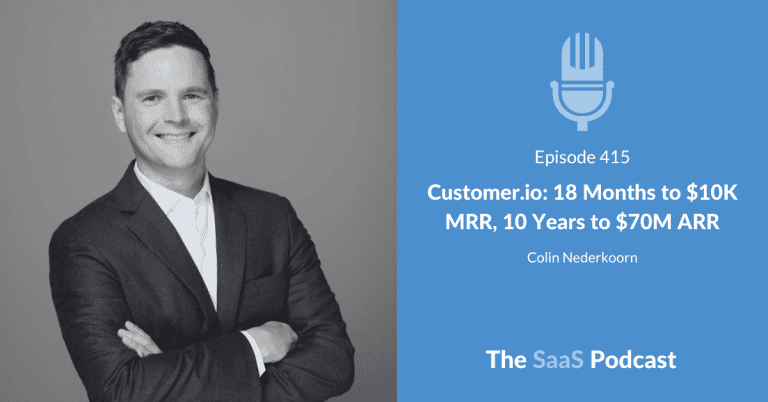
Customer.io: 18 Months to $10K MRR, 10 Years to $70M ARR – with Colin Nederkoorn - Colin Nederkoorn

Colin Nederkoorn, Customer.io

Customer.io: 18 Months to $10K MRR, 10 Years to $70M ARR – with Colin Nederkoorn

Colin Nederkoorn is the co-founder and CEO of Customer.io, a platform that helps businesses send personalized messages to customers based on their behavior and actions. In 2012, Colin and his co-founder John, while working at a startup, decided to build their own product. Their goal was simple: get 5 customers paying $10 a month before quitting their jobs. With limited technical expertise and little knowledge of email marketing, they faced significant challenges. Their first version was basic and required manual effort to setup each customer's campaign. The early days were tough. Growth was painfully slow, and they struggled to gain traction. To make ends meet, Colin and John lived off savings and credit cards for years, constantly worrying about finances. Finding product-market fit was another major hurdle. They struggled with positioning and messaging, making it difficult to attract and retain customers. But they persevered, focusing on educating potential customers through content while continuously improving their product. A pivotal moment came during a meeting with Ramit Sethi, a personal finance expert. When Sethi asked what they were doing with their launch email list, they embarrassingly admitted they weren't doing anything. This realization hit hard. Spurred by this wake-up call, Colin immersed himself in learning conversion copywriting and began sharing valuable insights with their growing email list. By focusing on educating their audience, they built credibility in the email marketing space even before officially launching Customer.io. Despite their efforts, it took about 18 months to reach $10K in monthly recurring revenue – a significant milestone for the struggling founders. But this was just the beginning of their remarkable growth story. Today, Customer.io serves over 7,000 companies, generates $70 million in annual recurring revenue, and has a team of 250 people across 30 countries. They've raised over $30 million in funding to date.

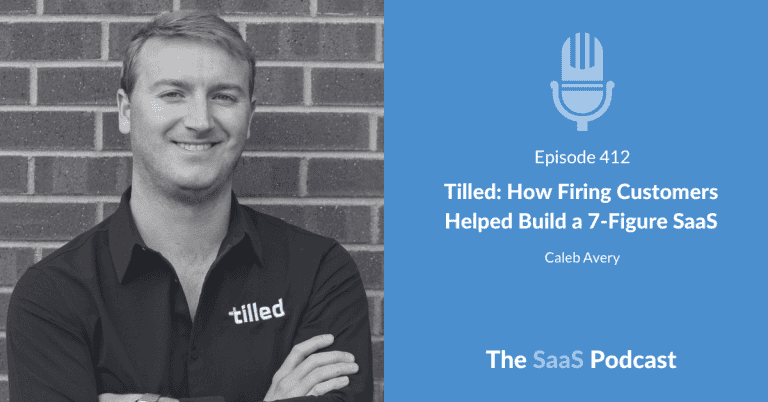
Tilled: How Firing Customers Helped Build a 7-Figure SaaS – with Caleb Avery [412] - Caleb Avery

Caleb Avery, Tilled

Tilled: How Firing Customers Helped Build a 7-Figure SaaS – with Caleb Avery [412]

Caleb Avery is the founder and CEO of Tilled, a PayFac-as-a-Service platform that helps B2B software vendors embed and manage payment processing for their customers. In 2019, after years of angel investing and consulting for vertical software platforms, Caleb spotted an opportunity to help them generate more revenue from payments. He started Tilled as a solo founder, spending 10 months exploring the viability of the business idea before bringing on a team. The initial product launch was far from perfect. It took 18 months and a complete rebuild to create a truly sellable solution that could even attempt to compete with established players like Stripe. When the pandemic hit, their outbound sales and trade show strategy was thrown into disarray. Caleb and his team were forced to pivot to content marketing. Caleb also invested in building his personal brand on LinkedIn, starting with less than 500 followers in 2020. He now has over 17,000 followers. But what's more interesting is that his personal brand on LinkedIn helped drive 95% of their lead flow in that first year and got them close to their first $1 million in ARR. But as the team started to gain traction, they faced new challenges. They struggled with product-market fit and onboarding customers that weren't ideal for their platform which created numerous headaches for the team. Eventually, they had to make the tough decision to fire some customers and refocus on their ideal customer profile, which led to a period of uncertainty. But after a few months, their bet paid off, and they started seeing significant growth. Today, Tilled generates multiple 7-figures in ARR and is approaching eight figures. The company serves around 100 customers and has raised $40 million in capital.

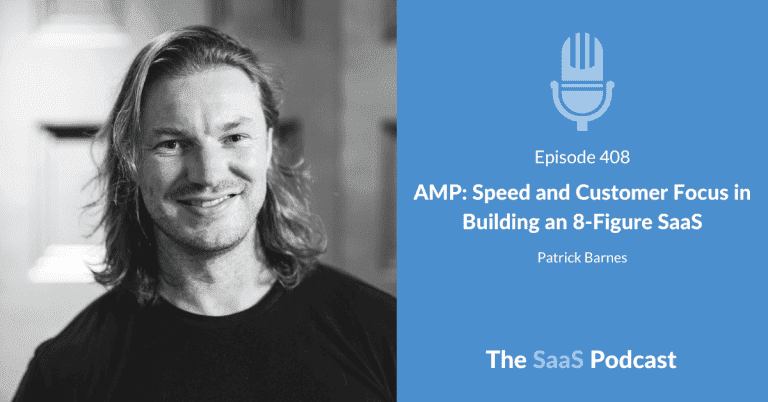
AMP: Speed and Customer Focus in Building an 8-Figure SaaS – with Patrick Barnes [408] - Patrick Barnes

Patrick Barnes, AMP

AMP: Speed and Customer Focus in Building an 8-Figure SaaS – with Patrick Barnes [408]

Patrick Barnes is the co-founder and CEO of AMP, a multi-product SaaS platform that helps e-commerce merchants run their online businesses. In 2016, Patrick co-founded Advocately, a review management platform for SaaS companies. Growth was painfully slow at first, with the team struggling to convince potential customers of the product's value. Undeterred, Patrick and his co-founder persevered, scrapping together 2 to 4 new customers each month. Bootstrapping their startup forced them to be resourceful and laser-focused on customer needs. After nearly three years of hard work, G2 a major player in the software review space acquired Advocately. This experience from struggle to exit taught Patrick invaluable lessons about finding product-market fit, acquiring customers, and the importance of persistence. In 2022, he teamed up with his long-time friend Cameron to tackle a growing problem in e-commerce: merchants were overwhelmed by the need to juggle 25 to 40 different SaaS tools just to run their online stores. To build their initial solution, Patrick and Cameron acquired a small Shopify app with 2,000 customers, which became the foundation of their new venture, AMP. They quickly applied SaaS best practices, redesigning the onboarding experience and implementing email marketing. The results were impressive. AMP hit its first million in ARR soon after the acquisition. But success also brought new challenges. When they launched an Amazon integration, expectations were high. They had 4,000 ideal customers who they were sure would love the new feature. But the launch fell flat, with the email campaign generating only 46 clicks. As their team grew to 50 employees, maintaining their customer-centric culture became increasingly difficult. Patrick's solution? Mandating regular customer calls for everyone from engineers to marketers to ensure the entire team stayed deeply connected to user needs. This relentless focus on customers paid off. Today, AMP serves 20,000 customers, has raised $18.5 million in Series A funding, and generates eight figures in ARR.

A Guide to Buying & Selling a SaaS Business on Marketplaces – with Juan Ignacio García [397] - Juan Ignacio Garcia

Juan Ignacio Garcia, Boopos

A Guide to Buying & Selling a SaaS Business on Marketplaces – with Juan Ignacio García [397]

Juan Ignacio Garcia is the founder and CEO of Boopos, the #1 platform for buying and selling profitable online businesses with built-in financing for qualified buyers. Buying an established SaaS business can be an attractive alternative to starting one from scratch. You get to skip the initial stages of finding product-market fit and start with paying customers and revenue. On the flip side, selling your SaaS business can be an exciting and potentially life-changing event, allowing you to cash out and move on to new adventures. But the process can be complex and daunting, especially for first-timers.

Levanta: From Fiverr Side Gig to $3M ARR SaaS – with Ian Brodie [387] - Ian Brodie

Ian Brodie, Levanta

Levanta: From Fiverr Side Gig to $3M ARR SaaS – with Ian Brodie [387]

Ian Brodie is the co-founder and CEO of Levanta, an affiliate marketing software platform built specifically for Amazon merchants. In 2020, Ian and Rob set out to launch a SaaS company and began talking to investors right away. However, as two recent college graduates with no product or engineering team, they were quickly laughed out of the room. Undeterred, the aspiring founders pivoted to starting a services company, with the goal of generating enough revenue to eventually self-fund their SaaS dream. They came up with a clever way to validate their new business idea by posting their services as gigs on Fiverr. Within days, they'd received over 100 responses and felt confident in launching their affiliate marketing agency. But for the next two years, transforming their agency into a SaaS company proved incredibly difficult. They managed to grow the services business to 7-figures, but it was barely profitable, and they were kept busy just keeping the business going. Eventually, they got a lucky break with an acquisition offer for Grovia for a mid-7-figure valuation. Which finally gave them the money and time to build their SaaS company. Learning from their past mistakes, Ian and Rob spent months rigorously validating the idea through customer interviews before investing in building an MVP. After years of trial and error, they finally got traction. Within 9 months of launch, their SaaS company Levanta hit over $230K in MRR, with over 650 brands and 2,500 affiliates on their platform.

Kumospace: From $1M ARR to a Pivot Driven by Churn – with Brett Martin [384] - Brett Martin

Brett Martin, Kumospace

Kumospace: From $1M ARR to a Pivot Driven by Churn – with Brett Martin [384]

Brett Martin is the co-founder and president of Kumospace, a virtual office platform that helps remote teams to collaborate in real time. In 2020, Brett was running a venture capital fund and hosting monthly in-person networking events. When the pandemic hit, he was forced to use Zoom for these events, which he felt wasn't a great experience and kept thinking to himself that they're had to be a better way. So when long-time friend and former co-founder Yang said he wanted to launch a startup, Brett suggested solving this video meeting problem and initially advised on the concept. After seeing early traction, Brett soon joined as co-founder. They launched in the middle of the pandemic and quickly attracted hundreds of thousands of users. When they started charging money the following year, their revenue skyrocketed to over $1 million ARR in just 2.5 months. But their celebrations were short-lived. Churn spiked to 40% in a month as customers used the product more for one-off events than daily work and so had little reason to renew their subscription. This crisis forced the founders to make the tough call. They scrapped their initial model, losing much of their revenue, and pivoted to a virtual office platform. But growing revenue was much slower and challenging this time around. However, fast forward to today, Kumospace serves millions of users, generates 7-figures in ARR with a team of just 16 people, and has raised $25 million in funding.
Banzai: Pivoting from a Near  Collapse to 8 Figure ARR SaaS – with Joe Davy [371] - Joe Davy

Joe Davy, Banzai

Banzai: Pivoting from a Near Collapse to 8 Figure ARR SaaS – with Joe Davy [371]

Joe Davy is the co-founder and CEO of Banzai, a SaaS company providing data-driven tools for businesses to run webinars and virtual events. In 2013, Joe bootstrapped a small startup from his basement, determined to solve a problem that had irritated him for years. In his past jobs, Joe often had a tough time getting the sales folks to help with one-off requests. Because things like following up with event leads didn't help salespeople hit their quotas. Joe realized he wasn't alone. Lots of marketers also faced the same roadblocks. So he and his co-founder built a barebones solution to help solve that problem. But, they still faced a key challenge: finding a specific use case for their solution. The early days were all about testing ideas and discovering what customers would actually pay for. After tons of cold calls and emails, they found traction with a concept people seemed to care most about, i.e., getting more folks to show up at events. That's when Banzai came to life. Over the next few years, they used outbound sales as the primary growth channel to hit seven figures in ARR and raise a Series A round. Things were looking good for the founders. But a couple of months later, the pandemic struck. Just like that, over 90% of their business vanished. They had been all-in on field marketing, a segment that was hit hard and never fully recovered after the pandemic. Faced with tough decisions and a murky future, Joe had to act fast. Were they going to wait it out, hoping the market would bounce back? Contemplate a major pivot, and to what exactly? Or, worst-case scenario, shut down the business? Fast-forward to today and Banzai is an 8-figure SaaS company that's about to go public.

Parabola: The Journey to Discovering Our Ideal SaaS Customer – with Alex Yaseen [369] - Alex Yaseen

Alex Yaseen, Parabola

Parabola: The Journey to Discovering Our Ideal SaaS Customer – with Alex Yaseen [369]

Alex Yaseen is the founder and CEO of Parabola, a collaborative data automation tool empowering non-technical teams to automate complex data processes. As a consultant, Alex noticed that many non-technical clients often hired analysts to tackle manual data tasks. He envisioned a tool that could help automate this work. In 2017, Alex launched Parabola, but he struggled for years to find product-market fit, even though he attracted initial customers who were enthusiastic about the product. During that time, the business generated little revenue. Alex eventually had a breakthrough years later when he added collaboration features to Parabola. This was when he realized he'd stumbled upon a much bigger opportunity. Focusing on collaboration sounds like a minor pivot. But when Alex repositioned Parabola as a collaborative data automation tool, the business finally got traction, and revenue started growing much faster. Today, Parabola is a 7-figure ARR SaaS business used by thousands of teams. The company has raised over $34 million to date.

Artifact: Overcoming Early-Stage SaaS Scaling Pitfalls – with Nate Sanders [368] - Nate Sanders

Nate Sanders, Artifact

Artifact: Overcoming Early-Stage SaaS Scaling Pitfalls – with Nate Sanders [368]

Nate Sanders is the co-founder and CEO of Artifact, an AI-powered SaaS that analyzes customer data to uncover growth opportunities. While working at Pluralsight, Nate experienced firsthand the frustrating and manual process of synthesizing customer research data across the company's different departments. That experience got him thinking that there had to be a better way. In 2019, Nate and his co-founders set out to build Artifact using large language models to automate these painful tasks. But developing AI products presents unique challenges. One of the biggest obstacles they initially faced was not having the necessary data to train their machine-learning models, which was a critical component for an AI-powered product. They also discovered that the champion persona, on whom they depended to advocate for Artifact, differed significantly across various organizations. This meant they couldn't rely on a single buyer profile and instead had to figure out how to customize their sales approach. Despite those challenges, the founders believe they have found product market fit. Today, Artifact is doing over $1M ARR, and they've raised just over $7 million in funding.
Skyflow: Lessons on Launching a New SaaS Product Category – with Anshu Sharma [363] - Anshu Sharma

Anshu Sharma, Skyflow

Skyflow: Lessons on Launching a New SaaS Product Category – with Anshu Sharma [363]

Anshu Sharma is the co-founder and CEO of Skyflow, a privacy API for securing and managing sensitive customer data. Before starting Skyflow, Anshu was a product manager at Salesforce and Oracle, where he saw firsthand the need for better data privacy solutions. After a decade of watching the problem grow, Anshu finally decided to do something about it and launched Skyflow in early 2019. But creating a new product category is very challenging because you first have to educate potential customers on why they need a different solution. Anshu and his co-founder spent over a year building an MVP before they ever talked to any customers. In hindsight, it was the right approach. In just a few years, they've grown Skyflow to a 7-figure ARR business with over 100 employees and raised $70 million.

Vimcal: Overcoming a 1.5 Month Runway and Getting Traction – with John Li [355] - John Li

John Li, Vimcal

Vimcal: Overcoming a 1.5 Month Runway and Getting Traction – with John Li [355]

John Li is the co-founder and CEO of Vimcal, a calendar app designed to help busy professionals and remote teams. In 2017, John and his co-founder Michael were accepted into YC with an idea for an augmented reality product. However, they soon discovered the market wasn't ready, so they pivoted to a fitness app, which also didn't get traction. After two years of hard work and long hours with limited results, they had only eight months of runway left. The two founders were faced with a critical decision. They could either quit and go back to full-time jobs or they could fight and keep going. They chose the latter and in 2019 the idea of Vimcal was born. But building a calendar app proved more difficult than they'd imagined, and by the time they launched, they had just 1.5 months of runway left. Once again, they were on the verge of shutting down. Yet, despite the odds, the founders managed to keep Vimcal alive and gain traction. Today, Vimcal is a trusted tool for professionals aiming to optimize their calendar management and save time.
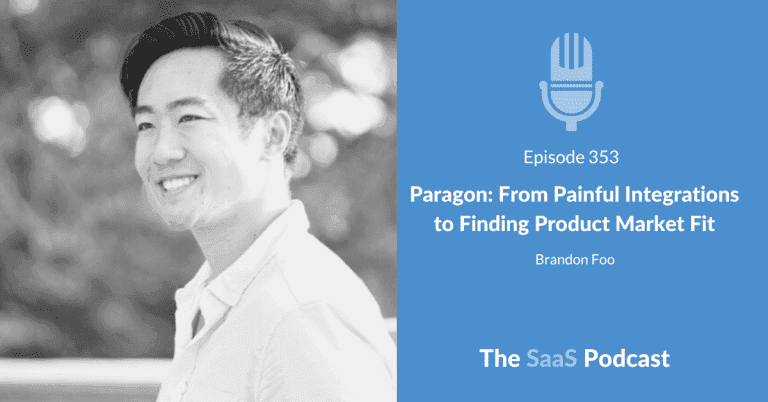
Paragon: From Painful Integrations to Finding Product Market Fit – with Brandon Foo [353] - Brandon Foo

Brandon Foo, Paragon

Paragon: From Painful Integrations to Finding Product Market Fit – with Brandon Foo [353]

Brandon Foo is the co-founder and CEO of Paragon, a platform designed to help software companies create integrations with third-party applications. Back in 2015, while working on a previous startup, Brandon and his co-founder Ishmael discovered how painful it was to build and maintain integrations. This experience ultimately inspired them to start Paragon. At first, they had trouble finding customers for their product idea. After many customer interviews, they realized they were building the wrong product. More importantly, those conversations helped them figure out what type of product their prospective customers actually needed. Today, they've grown to several million dollars in annual recurring revenue (ARR), built a team of over 30 people, and have raised just over $16 million in funding.
Signeasy: A Founder’s Journey from Aha Moment to 7-Figure SaaS – with Sunil Patro [351] - Sunil Patro

Sunil Patro, Signeasy

Signeasy: A Founder’s Journey from Aha Moment to 7-Figure SaaS – with Sunil Patro [351]

Sunil Patro is the founder and CEO of Signeasy, a user-friendly electronic signature and contract workflow platform to sign, send, and manage agreements. In 2009, Sunil was traveling in Mexico and waiting for a new job offer. Faced with the challenge of signing the offer without easy access to a printer, he wondered how much simpler it would be if he could sign the document on his smartphone. This lightbulb moment kicked off Sunil's journey to create Signeasy. With a background in software development, Sunil spent six months researching the idea before launching Signeasy as a mobile app. Within the first year, the app generated around $10K a month. This early success motivated Sunil to keep pushing forward with the product, ultimately hitting the milestone of $1 million in annual revenue. But after five years of concentrating on the mobile app market, Sunil recognized an opportunity for growth and decided to pivot Signeasy towards a B2B SaaS product. Despite facing fierce competition from well-funded competitors like DocuSign and Adobe Sign, Signeasy managed to carve out its niche by emphasizing simplicity, affordability, and great customer support. Today, Signeasy is a thriving SaaS company with millions in ARR, closing in on becoming an eight-figure business. With over 50,000 customers worldwide and a team of 80 employees, Sunil's initial vision has come a long way.
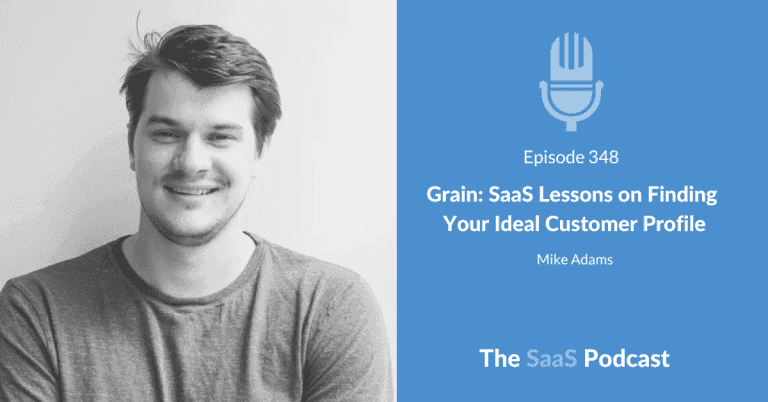
Grain: SaaS Lessons on Finding Your Ideal Customer Profile – with Mike Adams [348] - Mike Adams

Mike Adams, Grain

Grain: SaaS Lessons on Finding Your Ideal Customer Profile – with Mike Adams [348]

Mike Adams is the co-founder and CEO of Grain, a SaaS product that helps you capture and share insights from customer meetings. In 2018, Mike, together with his brother Jake, co-founded Grain. This was Mike's third startup venture after previously co-founding Degreed and MissionU (which was acquired by WeWork). But instead of starting with a problem, the brothers began with a solution in mind and set out to find a problem that it could solve. As you can imagine that approach didn't work out too well. Their first year proved challenging as they struggled to identify their ideal customer profile (ICP). Mike jokingly said that at the time, their ICP was anyone who would talk to them and liked the product.

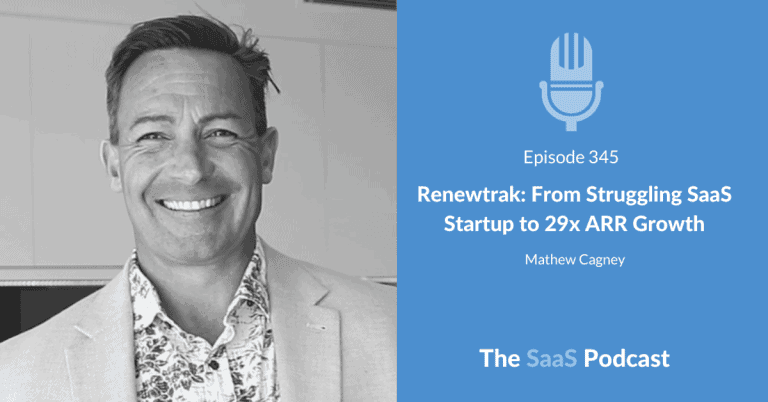
Renewtrak: From Struggling SaaS Startup to 29x ARR Growth – with Mathew Cagney [345] - Mathew Cagney

Mathew Cagney, Renewtrak

Renewtrak: From Struggling SaaS Startup to 29x ARR Growth – with Mathew Cagney [345]

Mathew Cagney is the CEO of Renewtrak, a platform that manages the renewal process for global tech companies like VMware and Lenovo. Mathew became CEO of Renewtrak in 2020, taking over a startup that had been founded 6 years earlier in 2014 but had failed to get any real traction. The original founders had built a beta solution, secured initial funding, and managed to get two small customers. But things had stalled there. Although Mathew isn't technically one of the founders, he still had to think and act like one and figure out how to find product market fit fast. The company had a high churn rate, no new customers, and was quickly burning through the money it had raised. So it was a tough situation. In fact, Mathew told me that the first 2 years at Renewtrak were the most difficult and stressful years of his career. But things eventually paid off. Today, Renewtrak is doing around $6 million in ARR.

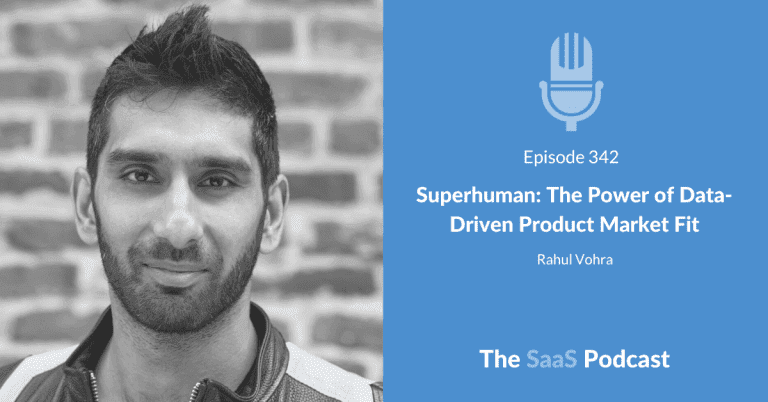
Superhuman: The Power of Data-Driven Product Market Fit – with Rahul Vohra [342] - Rahul Vohra

Rahul Vohra, Superhuman

Superhuman: The Power of Data-Driven Product Market Fit – with Rahul Vohra [342]

Rahul Vohra is the founder and CEO of Superhuman, a blazingly fast email experience that helps you save 3 hours or more every week. In 2014, Rahul set out on a mission to create the fastest email experience. He had sold his previous company Rapportive, a Gmail plugin, to LinkedIn a couple of years earlier, and he'd watched as Gmail continued to become slower and more cluttered over the years. So Rahul decided it was time to change that. But he didn't start building a product right away. Instead, he spent the first year talking to potential customers, doing interviews, writing website copy, and talking to investors. A year later, he put together a team and started building the product. But progress was slow. After two years of coding, the product still wasn't ready. Rahul felt immense pressure to launch. But deep down, he believed the launch would go badly because they didn't have product market fit. Fast forward to today, Superhuman has raised over $125 million in VC funding and is now a team of around 120 people.

Outseta: Finding the Right Target Market for Your SaaS Startup – with Geoff Roberts [339] - Geoff Roberts

Geoff Roberts, Outseta

Outseta: Finding the Right Target Market for Your SaaS Startup – with Geoff Roberts [339]

Geoff Roberts is the co-founder of Outseta, all-in-one membership software that makes it easier to build SaaS products, membership sites, and online communities.

Piano: Pivot or Persevere? How  a SaaS Startup Found Success – with Trevor Kaufman [332] - Trevor Kaufman

Trevor Kaufman, Piano

Piano: Pivot or Persevere? How a SaaS Startup Found Success – with Trevor Kaufman [332]

Trevor Kaufman is the CEO of Piano, a platform that provides paywalls, personalization, and analytics for hundreds of media companies and brands. In 2012, Trevor became a seed investor and CEO of a small 2-person company building a micropayment solution for digital content creators. But about 18 months later, he realized that the economics of their business model didn't work unless they could build a massive customer base. So they pivoted and moved to selling their product to large media companies. But they struggled to find customers. Either those media companies weren't interested in selling subscriptions, or if they were, they often had built their own internal solution. All this time, Trevor was funding the business out of his own pocket.

Seismic: From Struggling with Positioning to Hitting $300M ARR – with Doug Winter [328] - Doug Winter

Doug Winter, Seismic

Seismic: From Struggling with Positioning to Hitting $300M ARR – with Doug Winter [328]

Doug Winter is the co-founder and CEO of Seismic, a sales enablement platform that helps organizations better engage with customers and grow revenue. In 2010, Doug and his co-founders launched their bootstrap business out of a basement in San Diego with the vision of helping companies solve their content management problems. Initially, they decided to focus on a solution for sales and marketing teams, but at the time, sales enablement wasn't a product category, so they really struggle to position their product in the minds of their customers.

Cledara: A First Time Founder’s Guide to Finding Product Market Fit – with Cristina Vila [321] - Cristina Vila

Cristina Vila, Cledara

Cledara: A First Time Founder’s Guide to Finding Product Market Fit – with Cristina Vila [321]

Cristina Vila is the co-founder and CEO of Cledara, a product that helps companies simplify the way they discover, buy, manage and cancel subscription software. In 2018, Cristina quit her job to start her SaaS business. She was a first-time founder, who didn't know how to code and didn't have any sales experience. But she was driven by a life-long dream to one day start her own business. After raising a pre-seed round, she hired a software development company to build the product which she launched at SaaStock in Dublin three months later. But when she tried to sell her product, she got a lot of objections. Some people said that they didn't have a problem managing software subscriptions, others felt they already had a good solution in place (even if it was just a spreadsheet), and a lot of other people just weren't interested at that time. So for a while, things weren't looking good for Cristina. And even worse, she didn't charge for her product for 18 months. In fact, there wasn't even a way for customers to pay for her product – which many would say was a rookie mistake. Despite those challenges, Cristina and her co-founder Brad, have grown Cledara to $2.4M in ARR so far with over 700 customers. And they've raised $7M and built a team of nearly 50 people.

Boardable: Product Market Fit After a Dozen Failed Products – with Jeb Banner [312] - Jeb Banner

Jeb Banner, Boardable

Boardable: Product Market Fit After a Dozen Failed Products – with Jeb Banner [312]

Jeb Banner is the co-founder and CEO of Boardable, a board management SaaS product that centralizes communication, document storage, meeting planning, and everything involved with running a board of directors. In 2016, Jeb was running a creative agency when a client asked if he could build a board management portal for their nonprofit. He and his team scoped out the project but it was going to take a lot of money to build that solution. And the client wasn't ready to spend that type of money. But Jeb had already started two nonprofits at that point, so he was well aware of the problem space and so were his partners. So the three of them huddled and decided that there was an opportunity for them to sell the solution as a product, so decided to run with it. Today that product is a multiple 7-figure SaaS business with a team of 50 people, and the founders have raised $12M in funding. It sounds like a great story of someone who was running a services business and successfully transitioned to a SaaS business because they had a great idea. But the reality of Jeb's story is that he and his co-founders failed 10 times over a period of 12 years with product after product that failed to get any traction. They learned a lot during that time, but it was also extremely frustrating. In this interview, we dig into what they did differently with Boardable and how they were able to find product-market fit this time. I hope you enjoy it.
A Practical Guide to Interviewing SaaS Customers – with Michele Hansen [308] - Michele Hansen

Michele Hansen, Geocodio

A Practical Guide to Interviewing SaaS Customers – with Michele Hansen [308]

Michele Hansen is the co-founder of Geocodio, a SaaS product that provides straightforward and easy-to-use geocoding and data matching for addresses. She's also the author of "Deploy Empathy: A Practical Guide to Interviewing Customers". Whether you're trying to find product/market fit or are figuring out how to scale your SaaS product, you know that doing customer interviews is super-important and can provide tons of valuable insights. But there's a big difference between knowing you should do customer interviews and knowing how to do customer interviews well. "Deploy Empathy" is a book that helps you learn the skills of talking to your customers and learning to truly listen to them so you can pull out their hidden needs, desires, and processes. In this interview, Michele and I have a great conversation and share tons of practical advice and tips that can help you to interview customers and potential customers with more confidence. I hope you enjoy it.

Demandwell: From Concierge MVP to a 7-Figure SaaS Business – with Mitch Causey [303] - Mitch Causey

Mitch Causey, Demandwell:

Demandwell: From Concierge MVP to a 7-Figure SaaS Business – with Mitch Causey [303]

Mitch Causey is the co-founder and CEO of Demandwell, a SaaS company that provides software and coaching to help B2B SaaS marketers turn organic search into a source of repeatable revenue. When Mitch launched Demandwell, it was just a one-person SEO agency. Mitch worked with one client at a time. His main tool was a spreadsheet that he'd create for each client and use to help them improve their organic search traffic. But he quickly realized that this business couldn't scale. And building a software product to replace his spreadsheets seemed like the next logical step to enable Mitch to help more clients. In about 18 months since launching his SaaS product, Mitch has been able to turn Demandwell into a 7-figure business with a team of 16 people. One big reason why he's been able to grow so quickly is that he first spent 18 months providing a service and helping clients manually. He effectively built an MVP without any software – a concept known as a Concierge MVP. It's an approach that can work for a lot of different types of startups. Many founders get stuck figuring out how to build an MVP. And the truth is that your MVP does not have to be software. Your MVP can be a service instead. Your Concierge MVP can help you quickly validate your idea, find customers, learn more about your target market, start generating revenue quickly, and even pre-sell your SaaS product to some of those customers to help fund development. I hope you enjoy the interview.

How to Craft a Sales Narrative for Your SaaS Product – with Pete Kazanjy [279]

How to Craft a Sales Narrative for Your SaaS Product – with Pete Kazanjy [279]

Omer Khan: [00:00:00] Welcome to another episode of the SaaS podcast. I'm your host Omer Khan. And this is the show where I interview proven founders and industry experts who share their stories, strategies, and insights to help you build, launch and grow your SaaS business. In this episode, I talk to Pete Kazanjy.  the co-founder of Atrium, a sales management tool that uses data and smart analytics to help sales leaders and managers improve team performance. Pete Kazanjy: [00:01:59] Hello. Hello. Omer Khan: [00:02:01] So for people who aren't familiar, can you just tell us a little bit about Atrium? What does the product do? Who is it for? What's the main problem you guys are helping to solve? Yeah, so Pete Kazanjy: [00:02:12] Atrium makes software that helps sales managers do what we like to call data-driven rep management, such a use these data and analytics to better manage their, their AEs, their SDRs, their AMs, and CSMs using metrics using continuously monitored analytics that is really super quick to set up out of the box. You know, it takes 90 seconds and then importantly, kind of monitors those KPIs for those managers sits as they don't have to stare at walls of charts in order to figure out what the hell is going on, but this operates just does it for them using, using math. Omer Khan: [00:03:01] Great. So today we're going to talk about your book, Founding Sales, the early-stage go-to-market handbook, startup sales for founders and others in first time sales roles. Pete Kazanjy: [00:03:34] Yeah, so, so the book is really focused on kind of two, two stages, but the way to kind of think about it is it's like the missing manual, if you will, for early-stage go to market. And really the reason why I wrote it was because when I at my last software company, TalentBin when I, when I started TalentBin, when my co-founder Jason. Omer Khan: [00:05:28] Great and then can you just explain why the book is relevant, not just for sales folks and why other people or disciplines in an organization can also get value from this? Pete Kazanjy: [00:05:40] Yeah so the way to think about it is it the primary user of the book is a person who does not have selling like early-stage selling experience. So who could that be? It's called founding sales cause like the primary user for it is a founder. But if you think about who founders, we're kind of like founders come from, if you will. Usually they're like former product managers, former engineers, former designers, what have you. Omer Khan: [00:07:53] Great. So today we're going to talk about building a narrative or a story, and this is kind of like the foundational product marketing stuff. And when you're you're nearly stages and you're going out and selling a product from what I've seen a lot of founders, especially if they don't have experience with sales, they sort of tend to. Pete Kazanjy: [00:09:47] Good goal, good goal. Omer Khan: [00:09:49] All right. So let's start from the top. Tell us about, from your perspective, why is this important? What does it really mean to build a narrative or a story? Pete Kazanjy: [00:09:58] Yeah. So I think this is a little bit of kind of like my product marketing background kind of like peeking out. Omer Khan: [00:12:29] Great. Okay. So the first step is really to identify what the problem is, and that might seem. Obvious it's like you think, well, yeah, the problem is the thing that my product solves. But it's, I think it's going deeper than that really understanding from, from the customer's perspective, what are their pain points? Pete Kazanjy: [00:13:15] Yeah. So the interesting thing, you, you totally nailed it and, you know, spoken like a true former product manager on your back. Cause I think that actually kind of starts even before you're formulating the narrative cause like you can't just like, pull it out of your ear and be like, here's this problem, right? Omer Khan: [00:16:28] Yeah a couple of points on, on that. Like you said, that the sort of like, you know, themes or patterns emerge, and that's a really important point because it's not like you had these interviews and you're like, ah, we've got the answer and this is the thing that if we just are going to go and talk to people and they're gonna be, yes, yes, yes. Where do I sign? But it's, it's more like you sort of start to get, okay. Here are sort of like five or six things that we keep hearing over and over again. Maybe there's going to be some of them that are important enough that. Pete Kazanjy: [00:17:36] Yeah. I mean, in this case, this was before this was pre-product right. We were doing just research. So that's fine. I guess, better to understand that there actually isn't a problem there and it's well solved. And then you solve your, you save yourself from, you saved yourself from spending a bunch of engineering resources, building something to solve a problem that doesn't exist for instance. But yes, you certainly certainly should not be talking about your product at that point, because ideally, ideally you're doing this research before the product, the product exists because it should inform the thing that you're gonna, you're going to end up building, but yes, for sure. Omer Khan: [00:20:09] Great. And then the second part of this is, so we've sort of defined what is the problem? The second part is like, Which you made the point in the book is just as important is like, who has the problem initially when we're thinking about this, it's like, we think of it, like the company has this problem, but then you need to sort of figure out who specifically who's your, you know, your ideal customer profile or your target persona. Pete Kazanjy: [00:20:44] Yeah. So, so oftentimes there's like multiple people who are responsible for solving a problem and in kind of a different, different ways. We've kind of just talked about that a little bit with the TalentBin, but really what it comes down to is like, who's the person that's measured on this, whose success is measured on this result. Omer Khan: [00:25:12] Now the target customer or the person who has the problem, isn't necessarily always the same person who's the decision-maker. Pete Kazanjy: [00:25:24] Yeah. Omer Khan: [00:25:24] And so you might be in a situation where you have identified somebody who is really struggling with the problem, and they would love to have a solution, but maybe, you know, based on the price point of your product, they're not the right person to make that decision, that buying decision that's somebody else, but that's somebody else may not be experiencing that problem or the pain from that problem as much. Pete Kazanjy: [00:26:13] Yeah. And so I think that that's just sometimes what you have is you have messages on a per persona basis, right or narratives on persona basis. You kind of heard me talking about that a little bit in the Atrium example where there's a couple of ways you can kind of skin that cat. One, one thing that you can potentially do is structure your product in such a way that it can be transacted at a lower price point, right? Omer Khan: [00:28:29] Yeah. Yeah. And that leads us onto the next point, which is understanding the costs associated with the problem. And ultimately, I think this is about understanding what sort of value they're getting or not getting today, what's the impact to the organization. Pete Kazanjy: [00:29:00] Yeah. So I think there's, there's kind of two ways of doing that. There's like hard ROI and then there's kind of like more soft ROI and really the, the reason why. Organizations invest in technologies in order to like, make their businesses more efficient and either reduce costs or make more money. Omer Khan: [00:33:21] Yeah. And, and I think to understand that you really need to, I think it leads onto the next point is you, you really need to understand, like how, how are they solving the problem today? And where is that current solution falling short? So one, well, as you dig into that, you're going to be able to understand, okay, what the, what is the cost associated with how they're trying to solve this today? Pete Kazanjy: [00:33:45] Exactly. Omer Khan: [00:33:46] Or if they're not, if they're not even bothering to try and solve it, do they really care that much about this problem and maybe this isn't the right thing to, to be focusing on with your product. Pete Kazanjy: [00:33:57] Yeah. Yeah. So the, the, how they currently solve it usually kind of buckets into a couple of different, like couple of different buckets. Omer Khan: [00:37:02] And you sort of also mentioned like if they're already using a product to solve the solution or some of the problems, sorry. Yeah. But I think you also said something about like, it's, it's also important to understand that that product might not actually be a competitor to you. There may still be an opportunity. Can you explain that a little bit more? Pete Kazanjy: [00:37:28] Yeah, for sure. I mean, yeah, the notion of competitor is kind of tough because things are like, things overlap if you will. Right. And, and so you use like Atrium as a, as an example, there, Atrium, you know, oftentimes organizations try to solve the problem of data-driven rep management via, you know Maybe by Salesforce reporting or business intelligence or what have you, these are like not actually direct competitors with, with us. Omer Khan: [00:39:08] Awesome. Okay, great. So we've, we've sort of covered the importance of doing customer interviews, how that helps you to really start to understand the different themes or get more clarity around exactly which problem matters most to your target customers, that, that you can, your product can solve zeroing in, on your target customers within the organization and understanding. Pete Kazanjy: [00:40:56] Yeah. Well, the one last thing that we didn't touch on just really quickly, of course we teed everything up and then the last thing is like, Hey, how does this new solution work and why is it, why is it better? Omer Khan: [00:43:57] Yeah. I mean, we can kind of go back and forth and wordsmith and, and, and kind of make the email shorter and all that stuff. But what I liked about the way you went through that was you described the pains that. They're most likely having based on the customer interviews that you've already done, you describe it in a way which really resonates with them. Pete Kazanjy: [00:45:04] Right. Exactly. And of course, all of this kind of cascades is you delineated at the beginning of this conversation, all of this cascades from a, like having gotten that narrative set up for success from the get go. Omer Khan: [00:45:27] All right. Cool, Pete, thank you so much for coming back to joining me today. Really great conversation. I think, as I said, we've just unpacked, just a tiny bit of, of what you cover in the book. Pete Kazanjy: [00:46:07] Focusing just find me on, on LinkedIn or Twitter. I'm pretty easy to find I'm the only Peter Kazanjy. On there. Omer Khan: [00:46:14] We'll include the links to those profiles just in case there's any Peter out there. All right. Great. Well, thank you so much. We really appreciate the time and you know, congratulations on getting that book out of your head. Pete Kazanjy: [00:46:59] Thanks so much for having me. It was really fun. Omer Khan: [00:47:02] Cheers.
GoGuardian – The Importance of Founder Persistence & Mindset – with Advait Shinde [277] - Advait Shinde

Advait Shinde

GoGuardian – The Importance of Founder Persistence & Mindset – with Advait Shinde [277]

Advait Shinde is the co-founder and CEO of GoGuardian, a suite of products that provide K-12 schools with content filtering and monitoring, classroom management software, and a suicide prevention tool. In 2014, Advait and his two co-founders built a Chrome extension to help schools with web filtering. But it seemed that no one was interested in their solution and their outreach emails didn't get much of a response either. They were almost ready to give up on their idea. Luckily, one of the co-founders wasn't ready to give up just yet and kept contacting people despite the lack of interest and rejections. Thanks to his persistence they found some early users which helped to start collecting valuable feedback from their target market. Later when the founders tried to raise money, they were rejected by investors. They were told that they were too young and inexperienced. And investors warned them that the K-12 market didn't have money and that focusing on Chromebooks was completely the wrong strategy. Fortunately, the founders didn't listen. Today, GoGuardian is used by 18 million students, which is about a third of all K-12 students in the US. The company now employs over 300 people and generates north of $50M in annual recurring revenue (ARR). In this interview, we talk about: It's a great conversation and a great story. I hope you enjoy it.
Insurmi: SaaS Sales Lessons from a First Time Founder – with Sonny Patel [271] - Sonny Patel

Sonny Patel

Insurmi: SaaS Sales Lessons from a First Time Founder – with Sonny Patel [271]

Sonny Patel is the founder and CEO of Insurmi, a SaaS platform that helps insurance carriers generate leads, streamline claims and deliver customer service through an AI-driven assistant. During his Freshman year of college, Sonny got a job at an insurance agency in Arizona. He was surprised to see how the insurance industry was still operating with outdated technology. He wondered why it wasn't easier and faster for consumers to buy insurance online. A couple of years later, that question was still bugging him so he eventually decided to start Insurmi out of his dorm room. But Sonny didn't know how to code and needed help to get his idea off the ground. He eventually found an accelerator in Arizona that worked with him to develop his MVP for a B2C comparison website where you could shop for insurance. He spent the next year and a half trying to get his idea off the ground. But he soon realized that it was a crowded space and he'd need a lot of money to build a successful consumer product. Around that time, he also started talking to execs at insurance carriers. They were intrigued by what he was building and asked if they could license the software. That's when he realized that pivoting to a B2B product was a more interesting opportunity. In this interview we talk about: As a founder, it's important that you can become your company's first salesperson. Eventually, you can hire your own sales team or VP of Sales, but in the early days, no one is going to be able to sell your product better than you. I hope you enjoy the interview.

Taker: Lessons on Failure & Perseverance from a SaaS Founder – with Abdullah Alsaadi [260] - Abdullah Alsaadi

Abdullah Alsaadi

Taker: Lessons on Failure & Perseverance from a SaaS Founder – with Abdullah Alsaadi [260]

Abdullah Alsaadi is the co-founder and CEO of Taker.io, an online ordering platform and mobile app for restaurants. How many failed startups could you handle before you gave up? Abdullah was working as a security systems engineer in the Kingdom of Saudi Arabia. He had an idea for a cryptocurrency app. He was so excited about it that he jumped into building the product. After writing almost 30,000 lines of code, his app was ready. And that's when he realized he'd built a cool product, but there was no market for it. Sometime later, he had an idea to build an app on the Salesforce Platform. He'd learned his lesson from his last failure and had a clear market and customer in mind this time. But Salesforce wasn't set up at the time to support app developers in the Middle East. So Abdullah wasn't able to sell anything on their platform. He then decided to start a B2B last-mile delivery company. This time he made sure that customers could actually pay for his product. And his solution was a success and he had happy customers. But the business wasn't profitable and there was no easy way to find efficiencies and scale. His perseverance and grit kept Abdullah going. He pivoted to a delivery management software product. He knew this business could be profitable and his prospective customers loved his product. But they used legacy point of sale (POS) systems which were impossible to integrate with. It seemed like no matter what Abdullah tried, or how good his idea or product was, he just couldn't find success. It was failure after failure. Most of us might have given up by now. But Abdullah started working on his next idea. But he was out of money and didn't have the funds to build a new product. And he didn't exactly have a strong track record of success to persuade investors. Yet he found a way to build the product and get it to market. And this time things started to move in this favor. He's grown Taker.io from zero to almost a million US dollars annual run rate (ARR). There are some great lessons on what Abdullah did right with Taker.io and how he funded the development, found customers, and grew the business. But more importantly, he learned far more valuable lessons from all the failures he had over a period of 5 or 6 years. And that's what is really interesting about Abdullah's story. I hope you enjoy it.

SaaStock: Global Events for SaaS Founders, Executives & Investors – with Alex Theuma [256] - Alex Theuma

Alex Theuma

SaaStock: Global Events for SaaS Founders, Executives & Investors – with Alex Theuma [256]

Alex Theuma is the founder of SaaStock, global conferences that bring together SaaS founders, executives, and investors. Alex had been working in sales for many years, but he longed to start his own business and work for himself. But he didn't have any 'great' business ideas. He was interested in what was happening in the SaaS space. So he started writing a blog about what he was learning. And he also launched a podcast. As he started to build a following, he realized that there was an opportunity to connect people. So he organized meetups in London for people interested in SaaS. He really enjoyed bringing people together, but he wasn't making any money. Several people told Alex that he should do a SaaS conference in Europe to bring together more people. But he'd heard many horror stories about people who had done conferences and large events. So initially he was reluctant but then decided to jump in and do what people were asking for. In 2016, his first event in Dublin attracted 700 attendees and launched his business. He had finally found a great idea for his own business. In the next 4 years, he ran SaaStock events around the world every year. And now thousands were attending. But then the global pandemic hit and the event business he'd worked so hard to build came to a standstill. He had a simple choice – go out of business or find a way to pivot. He had to do some hard thinking and make tough decisions. In this interview, you'll learn how Alex has re-invented his business, what he's doing to rebuild, and why he's optimistic about future in-person events. Now I've tried to make this podcast a virus-free place. There are plenty of other places you hear about all that stuff. But it's hard to tell this story without talking about the pandemic. So I hope you'll forgive me. Enjoy the show!

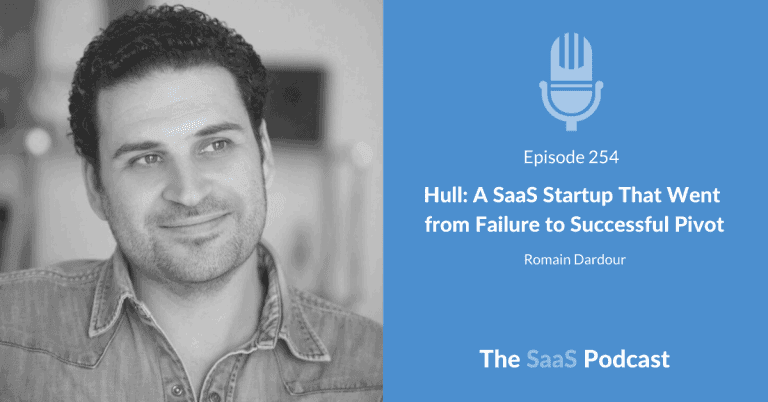
Hull: A SaaS Startup That Went from Failure to Successful Pivot – with Romain Dardour [254] - Romain Dardour

Romain Dardour

Hull: A SaaS Startup That Went from Failure to Successful Pivot – with Romain Dardour [254]

Romain Dardour is the co-founder and CEO of Hull, a SaaS product that collects, unifies, and enriches your product, marketing, and sales data and synchronizes it to all of your tools. In 2011, Romain was running a marketing agency in Paris. He was working with movie studios that wanted him to rebuild online communities from scratch for every new movie launch. He realized that there was a more efficient way to solve that problem and decided to build a product. And for the next 4 years, he and his co-founders struggled to find product-market fit. In 2016, after trying to unsuccessfully bootstrap the business for 4-years, they decided that the market just wasn't there and that it was time to move on. They made the decision to shut down the company. Around the same time, Romain had lunch with a growth marketer friend who wasn't interested in the product but liked how they were collecting and segmenting data. He thought that would be something a lot of companies would be interested in. So in the next 5 days, Romain and his co-founders built a prototype and started getting feedback. And that's how the idea for their new product was born. They went from being a month away from shutting down their company to finding a new opportunity which they pounced on and pivoted the business. Today, they charge at least $1,000 a month for their product and have around 100 customers. They've raised $5M in funding and have found product-market fit. In this interview, we talk about how they struggled in the first few years, how they turned a lunch meeting into a new product idea, and how they've grown their business. I hope you enjoy it.

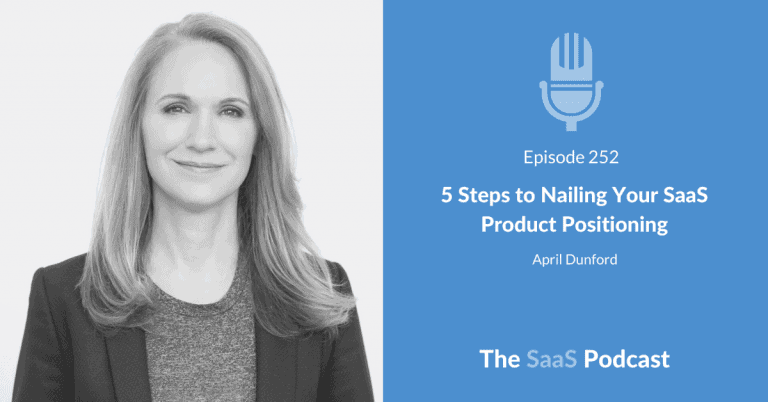
5 Steps to Nailing Your SaaS Product Positioning – with April Dunford [252] - April Dunford

April Dunford

5 Steps to Nailing Your SaaS Product Positioning – with April Dunford [252]

April Dunford is the founder of Ambient Strategy and author of "Obviously Awesome: How to Nail Product Positioning, so Customers Get it, Buy it, Love it." How clear are you on where your SaaS product fits in the marketplace? When you tell potential customers about your product (whether that's on your website, or in-person) do they get it? Do they understand where your product fits? And more importantly, are they clear about what makes your SaaS product unique, and do they understand how it's better than the alternative solutions? Positioning is what helps you get that clarity. And it's not just about writing a positioning statement. Creating your positioning is a process that your company needs to go through to figure out the best way to explain where your SaaS product fits in the marketplace and why your potential customers should choose you.

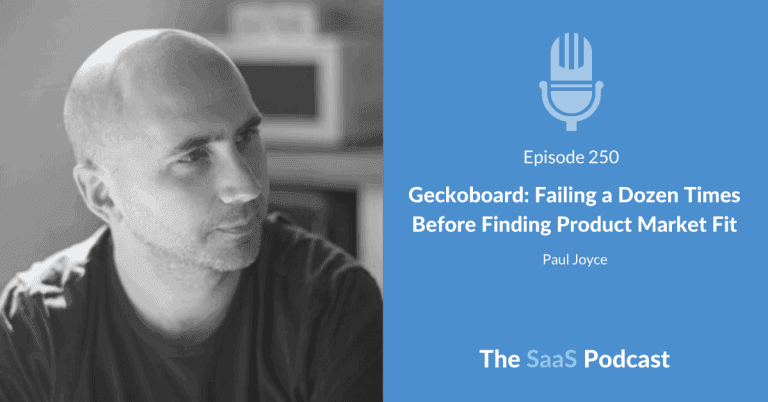
Geckoboard: Failing a Dozen Times Before Finding Product Market Fit – with Paul Joyce [250] - Paul Joyce

Paul Joyce

Geckoboard: Failing a Dozen Times Before Finding Product Market Fit – with Paul Joyce [250]

Paul Joyce is the founder and CEO of Geckoboard, a SaaS product that lets businesses build and display real-time dashboards to help them focus on the metrics that matter. Paul was working at a bank in England. He hated his job and longed to start his own business. But this isn't one of those stories where someone comes up with a great idea, quits their job the next day, and becomes an overnight success. Paul spent four years looking for the right idea. He tried and failed a dozen times. But his burning desire to work for himself, kept him going. And with each failure, he learned something. Eventually, in 2010 he came up with the idea for Geckoboard. He started building his MVP and also posted on Hacker News, which helped him build a waiting list of several hundred people. He launched his MVP a few months later but didn't get any paying customers. But he could sense from how enthusiastic people were, that there was something different about this idea. He decided that it was time for him to "go big or go home". So after talking to his wife, he used their savings to give him a five-month runway and quit his job to work on Geckoboard full-time. It was a huge leap of faith – but Paul's never looked back. Today, Geckoboard does well over $5 million in annual recurring revenue (ARR). The company has around 4,500 customers and a team of 40 people. In this interview, we talk about Paul's multiple failed attempts to start a SaaS company. We dig into why the idea for Geckoboard was different from all the other ideas he had. And we go into detail on how he found customers and eventually built a multi-million dollar SaaS business.

Successfully Pivoting a SaaS Business – with Sandi Lin [245]

Successfully Pivoting a SaaS Business – with Sandi Lin [245]

Sandi Lin is the co-founder and CEO of Skilljar, a customer training platform that helps enterprises improve product adoption and customer retention.

How a SaaS User Experience Can Help Grow Your Business – with Suresh Sambandam [224] - Suresh Sambandam

Suresh Sambandam

How a SaaS User Experience Can Help Grow Your Business – with Suresh Sambandam [224]

Suresh Sambandam is the CEO of Kissflow, the first unified digital workplace for organizations to manage all of their work on a single, unified platform. Kissflow is used by over 10,000 customers across 160 countries, including more than fifty Fortune 500 companies. Suresh was working as an engineer for a startup when he spotted an opportunity for a business idea. He eventually quit his job to launch his startup in 2003. Things looked promising at the start. Before he knew it, he had a team of 40 people. But the product just didn't get the traction he'd hoped for and he eventually had to pivot. With his new idea, he raised $1M from angel investors. But he was too early to market. And by the following year, he was running out of money and had to layoff most of his employees. And then in 2013, a customer helped him see the potential of his product… A UK based design company bought his product for $50K but then spent another $90K on building a great user interface for it. That was when Suresh had his aha moment. He realized that as an engineer, he'd been focusing too much on features and technology. Instead, he had to get his company building great user experiences. And that's when things started to click with his third pivot (which became KiSSFLOW). The more the team focused on creating a great user experience, the more their product resonated with customers. Today his company is doing close to $10M in ARR and has over 200 employees. We talk about his multiple pivots, the 10 years it took to find product/market fit, his strategic approach to search engine optimization and how that now drives over 50% of leads. And we talk about what Suresh calls "Desk Marketing & Selling" which his team based in Chennai, India is using to land B2B customers around the world. I hope you enjoy it.

Doing 300 SaaS Customer Interviews Before Writing a Line of Code – with Alex Yakubovich [222] - Alex Yakubovich

Alex Yakubovich

Doing 300 SaaS Customer Interviews Before Writing a Line of Code – with Alex Yakubovich [222]

Alex Yakubovich is the co-founder and CEO of Scout RFP, a SaaS product that helps companies with their strategic sourcing and procurement. Alex started a web development company when he was still in college. Initially, it was just a way for him and a few friends to make beer and pizza money. But over time, it evolved into an online ordering software product that the team sold to restaurant chains. By the time they graduated the business was making 6-figures in annual revenue. And over the next 5 years, as they all worked full-time on the business, revenue grew to several million dollars and eventually they sold the business. While working on this business, Alex had to deal with hundreds of requests for proposals (RFPs) and quickly became frustrated with how clunky and manual the RFP and procurement process was for most companies. So in 2014 he and his co-founders started working on their next startup. With a successful exit and money in the bank, it would have been easy for the team to feel confident that they could solve the problems and start building a product right away. Instead, they agreed that they wouldn't build anything until they'd talked to at least 200 people who worked in procurement. They actually end up talking to almost 300 people and those conversations helped them to build a much deeper understanding of the space. Although there were a lot of players in the market including some really big companies, the founders decided to focus initially on a really small problem. Their MVP was a one-page application and so minimal that prospective customers would often say is that it?. But once people used the product, they loved the simplicity and how this one feature saved them so much time. And from that simple, almost too minimal MVP, their company now has grown into a business with over 150 employees and they've raised $60M in funding. There are some great lessons in this interview about the importance of listening to your customers, not jumping into building a product straight away and being really focused with your MVP by solving a really small problem at the start. I hope you enjoy it.

Calendly Founder Tope Awotona: Product-Market Fit After 3 Failed Startups - Tope Awotona

Tope Awotona, Calendly

Calendly Founder Tope Awotona: Product-Market Fit After 3 Failed Startups

Tope Awotona is the founder and CEO of Calendly, a scheduling platform that eliminates the back-and-forth emails required to book meetings. Tope Awotona grew up in Nigeria and moved to the US as a teenager. After graduating from the University of Georgia, he landed a sales job at IBM and spent the next seven years in enterprise software sales. But he always wanted to be an entrepreneur. So he spent his evenings and weekends trying to build businesses. First, he read an article about PlentyOfFish.com making millions and decided to build a dating site. He bought domains, created a holding company, and purchased dating software—but never launched it because he lacked the skills and resources. His second startup was an e-commerce site selling projectors. He made some sales, but the margins were terrible and he had zero interest in projectors. His third startup was another e-commerce site, this time selling grills. Same problems: thin margins, no passion, no traction. Tope realized he was focused on "ways to make money" instead of solving problems he cared about. He told himself he wouldn't succeed unless he found a problem he was passionate about solving. It took another year before he found that problem. After wasting an entire day trading emails to schedule a single meeting, he searched for a scheduling tool. Everything on the market was slow, clunky, and poorly designed. He spent six months researching competitors, studying their user communities, and identifying what they did well and where they failed. Unlike his previous attempts, this time he went all in. He emptied his bank account, flew to Ukraine to hire engineers, and committed everything to building a better product. The bet paid off. Calendly launched in 2013 as a free product (not by choice—they ran out of money before building billing). That accident turned into one of the best decisions they never made. The freemium model combined with viral sharing made it easy for users to spread the product. At the time of this interview, Calendly was generating $30M ARR and serving 4 million users, largely bootstrapped. Tope's journey from three failed startups to finding product-market fit offers a masterclass in patience, persistence, and solving problems you actually care about.

Successfully Pivoting a SaaS Business – with Max Kolysh [208] - Max Kolysh

Max Kolysh

Successfully Pivoting a SaaS Business – with Max Kolysh [208]

Max Kolysh is the co-founder of Zinc.io, an eCommerce lab that builds products to help Amazon and eBay sellers. Every SaaS founder knows that finding product-market fit is really tough. You might have to pivot your SaaS business multiple times before you find the right product for the right market. So what can we learn from SaaS founders who failed repeatedly before they found success? When Max and Doug were students at MIT, they talked about building a software product to help eBay sellers. And eventually, they both dropped out of college to start their business. They got accepted into YC but pretty soon realized that their idea wasn't that great after all. So they pivoted and built a product that saved people money when buying on Amazon. They got some good traction and it looked like they were on their way to finding product-market fit. But that all changed when they received a cease and desist letter from Amazon. So they were back to square one again. They needed another idea. One day they received an email out of the blue from an ex-customer who told them that he wanted to use an API but wasn't technical. He asked if they could help him out. That email led to Max and Doug pivoting again and creating a new product. But this time it wasn't just an idea they'd come up themselves — it was something a real customer needed. And the product resonated with the market and helped them get traction. Today, their company generates over $5 million in annual recurring revenue. It's a great story about persistence, flexibility, listening to your customers, and how to successfully pivot your SaaS business. I hope you enjoy it.

SaaS Idea Validation: How to Ask Customers Good Questions – with Rob Fitzpatrick [206] - Rob Fitzpatrick

Rob Fitzpatrick

SaaS Idea Validation: How to Ask Customers Good Questions – with Rob Fitzpatrick [206]

Rob Fitzpatrick is a tech entrepreneur and author. He ran various tech startups for about 10 years, has raised funding in the US and UK and is a YC alum. He's the author of "The Mom Test: How to Talk to Customers and Learn if Your Business is a Good Idea When Everyone is Lying to You" and also the author of "The Workshop Survival Guide: How to Design and Teach Workshops That Work Every Time". One of the biggest challenges you face as a SaaS founder is validating your idea. It might be an idea for a new company or something that you want to change in your existing business. You're excited about the idea. But how do you know if your prospective customers will love it too? And more importantly, how do you know if people will pay money for your idea? Most founders know that they've got to talk to customers to validate their idea. But it's easy to screw up customer interviews and hard to do them right.

How to Sell SaaS When You Don’t Have Any Sales Experience – with Hannah Chaplin [172] - Hannah Chaplin

Hannah Chaplin

How to Sell SaaS When You Don’t Have Any Sales Experience – with Hannah Chaplin [172]

Hannah Chaplin is the co-founder and CEO of Receptive.io, a platform that helps SaaS companies to identify the highest impact things that their team should be working on right now. The platform helps to gather feature requests and feedback from customers, internal customers, and the market and turn that data into clear and actionable insights. Receptive.io was founded in 2015 and is based in Sheffield, England. The founders came with the idea for Receptive when they were running another business and struggling to manage feature requests and feedback from customers. After building an MVP, they joined an accelerator in England and spent about 5 months just doing customer interviews. They learned that they were focusing on the wrong customers and needed to think bigger. But once they'd built the product, they also had a hard time selling to these big customers because they lacked sales experience and know how. They had to learn how to sell SaaS products.

SaaS Customer Discovery:  A Founder’s Story on Learning the Hard Way – with Tukan Das [156] - Tukan Das

Tukan Das

SaaS Customer Discovery: A Founder’s Story on Learning the Hard Way – with Tukan Das [156]

Tukan Das is the co-founder and CEO of LeadSift, a platform that mines publicly available social media data to help B2B businesses generate qualified leads. LeadSift was founded in 2012 and to date has raised $1.8 million in funding. The company is based in Halifax, Nova Scotia in Canada. This is a story about a couple of 'data nerds' who were playing around with the Twitter and FourSquare APIs one day. They discovered that there was a lot of social media data about people who were looking to buy something. So they decided to build a product and sell these 'signals' to automotive brands. It seemed like a winning idea. But they soon realized that it wasn't. First, they weren't solving a customer problem. They were trying to find a market for a 'cool idea'. And that is never easy to do. Second, they didn't understand how automotive brands work. Ford isn't going to have a salesperson call you because of your tweet. After a year of getting nowhere they pivoted. They started selling data to help consumer brands run better advertising campaigns. They started to get customers and revenue. But their product wasn't sticky so revenue was unpredictable and customer churn high. After two more years they decided to pivot again. But this time they interviewed many customers and kept searching for a real problem. They didn't write a single line of code until they were confident that they'd found the right problem. And that approach paid off. Today, they have a business that generates recurring revenue. And they are very close to hitting a million dollars a year. This is a great story about persistence. And there are some valuable lessons on the importance of understanding your market.

SaaS Product Market Fit: Lessons from Klipfolio’s CEO – with Allan Wille [152] - Allan Wille

Allan Wille

SaaS Product Market Fit: Lessons from Klipfolio’s CEO – with Allan Wille [152]

Allan Wille is the co-founder and CEO of Klipfolio, a SaaS application for building and sharing real-time business dashboards on browsers, mobile devices, and TVs. Klipfolio helps you stay in control of your business by giving you visibility into your most important data and metrics, wherever you are. Klipfolio is based in Ottowa, Canada and was founded in 2001. To date, the company has raised over $16 million. And it has over 8,500 customers including companies such as Jet.com, Zendesk, and Ikea to name a few. This episode is a story about 2 co-founders who struggled for 3 years to get their first paying customer. To make ends meet during that time, one of the co-founders even had to sell his car to be able to put food on the table. These guys spent 3 years building a business-to-consumer (B2C) product. And they had almost 300,000 users. But the problem was that they had zero revenue. But they kept telling themselves that they just had to keep going. Then one day they received a call from someone at Lufthansa, the largest airline in Germany. The company had a number of their employees using the B2C product to track soccer game scores. They wanted to know if the app could also be used to display business data in a dashboard. And that was the day that they co-founders pivoted to a business-to-business (B2B) model. They built what Lufthansa wanted. And then went out to find their next corporate customer and then the next one. It wasn't easy. It involved a lot of cold-calling in the early days, which both the co-founders hated. But slowly they started to get traction. And it was really slow growth. After 10 years of being in business, the company had 14 employees. But finally, their persistence paid off and they started to see the elusive 'hockey stick' growth after year 10. The company now has over 90 employees and does over $8 million in annual run rate.

How a Failing 2-Year Old Startup Achieved Product-Market Fit in 1 Week – with Tom Leung [098] - Tom Leung

Tom Leung, Anthology

How a Failing 2-Year Old Startup Achieved Product-Market Fit in 1 Week – with Tom Leung [098]

Tom Leung is the co-founder and CEO of Anthology, a Seattle-based startup that was formerly known as Poachable. Anthology enables employed tech professionals to explore new career opportunities anonymously. Tom and his co-founder originally launched a startup called Yabbly, a consumer-to-consumer advice site. When that business didn't get traction, the team pivoted 8 times to launch Poachable which was later renamed to Anthology. The company has raised around $1.8 million to date and its investors include Vulcan Ventures. And companies recruiting through Anthology include Amazon, Microsoft, Netflix, Dropbox, Facebook and around 100 venture-backed startups.

The Automatic Customer: Creating a Subscription Business in Any Industry – with John Warrillow [071] - John Warrillow

John Warrillow, The Value Builder System

The Automatic Customer: Creating a Subscription Business in Any Industry – with John Warrillow [071]

John Warrillow is the founder of The Value Builder System, a company that helps business owners improve the value of their company. Prior to starting The Value Builder System, John started and exited four companies, including a market research business that was acquired in 2008. John is the author of the bestselling book Built to Sell: Creating a Business That Can Thrive Without You, which was recognized by both Fortune and Inc Magazine as one of the best business books of 2011. His latest book, The Automatic Customer: Creating A Subscription Business In Any Industry was released by Random House in February 2015. John has been recognized by B2B Marketing as one of the top 10 business-to-business marketers in the United States.

Startup Master Class: How to Validate Your Business Idea with Confidence – with Trevor Owens [062] - Trevor Owens

Trevor Owens, Javelin.com

Startup Master Class: How to Validate Your Business Idea with Confidence – with Trevor Owens [062]

Trevor Owens is an author and entrepreneur. He's the co-founder and CEO of Javelin.com – the makers of QuickMVP and Lean Startup Machine. QuickMVP is a service that lets you quickly and easily test business ideas. And the Lean Startup Machine is a workshop that teaches you how to build something customers want and run the right experiments to steer your business in the right direction. Trevor is also the author of the book, The Lean Enterprise, which details how corporations can apply more innovation and Lean Startup to launching new products.

How a Startup Turned the Lean Methodology Into a 7-Figure Business – with Trevor Owens [061] - Trevor Owens

Trevor Owens, Javelin.com

How a Startup Turned the Lean Methodology Into a 7-Figure Business – with Trevor Owens [061]

Trevor Owens is an author and entrepreneur. He's the co-founder and CEO of Javelin.com – the makers of QuickMVP and Lean Startup Machine. QuickMVP is a service that lets you quickly and easily test business ideas. And the Lean Startup Machine is a workshop that teaches you how to build something customers want and run the right experiments to steer your business in the right direction. Trevor is also the author of the book, The Lean Enterprise, which details how corporations can apply more innovation and Lean Startup to launching new products.

How This Startup Pivoted Its Way to a 7-Figure Business – with Ryan Hamlin [035]

How This Startup Pivoted Its Way to a 7-Figure Business – with Ryan Hamlin [035]

Ryan Hamlin is the Founder & CEO of PlaceFull, an online marketplace that allows merchants to offer real-time booking of their spaces, services, camps & classes.

Get weekly SaaS insights

Real founder strategies. Delivered to your inbox.

Free weekly newsletter · No spam

←All Episodes