SaaS Club
PodcastPlaybooksCoachingSponsorFree ToolsJoin Community
saasclub

Helping SaaS founders build and scale profitable businesses since 2014. Powered by real experience from 472+ founder conversations.

Content

  • The SaaS Podcast
  • Founder Playbooks
  • Blog
  • Newsletter
  • Free Tools

Programs

  • Plus
  • Launch
  • Mastermind
  • Accelerate

Company

  • Contact
  • Become a Sponsor
  • Suggest a Guest
  • Terms
  • Privacy

© 2026 SaaS Club. All rights reserved.

Built with ❤️ for SaaS founders

Founder-Led Sales

Founder-Led Sales for SaaS

How SaaS founders sold their product before hiring a sales team. Cold emails, direct outreach, and the hard lessons from doing sales yourself.

Real founder strategies. Delivered weekly.

Free weekly newsletter · No spam

Most SaaS founders didn't start out as salespeople. They're builders, designers, problem solvers. But at some point, every founder has to sell. And the ones who figure this out early tend to win.

These episodes feature founders who did their own selling before they ever hired a sales team. You'll hear how technical founders overcame their discomfort with outreach. How non-sales backgrounds turned out to be an advantage, because customers trusted them more than a polished sales rep. And how the lessons from founder-led sales shaped the sales playbooks they eventually handed off to their first hires.

The tactics here are immediately actionable. Founders share the cold email templates that got responses, the LinkedIn strategies that opened doors, and the demo techniques that closed deals. You'll learn how to qualify prospects fast so you're not wasting time on bad-fit leads. How to handle objections without sounding defensive. And how to follow up without being annoying.

But these conversations go beyond tactics. Founders talk about the mindset shifts that made them better at sales. How they stopped thinking of it as convincing people and started thinking of it as solving problems. Several share the moment they realized that doing sales themselves was the best market research they could do.

If you're the founder doing all the selling right now, or if you know you need to start, these episodes will make that job a lot less painful.

Browse by topic:AllBootstrappingFirst CustomersProduct-Market FitEnterprise SalesProduct-Led GrowthPricing & MonetizationFounder-Led SalesPositioning & DifferentiationChurn & RetentionContent & Inbound MarketingExits & AcquisitionsFundraisingAI-Powered SaaS

Get weekly SaaS insights

Real founder strategies. Delivered to your inbox.

Free weekly newsletter · No spam

←All Episodes
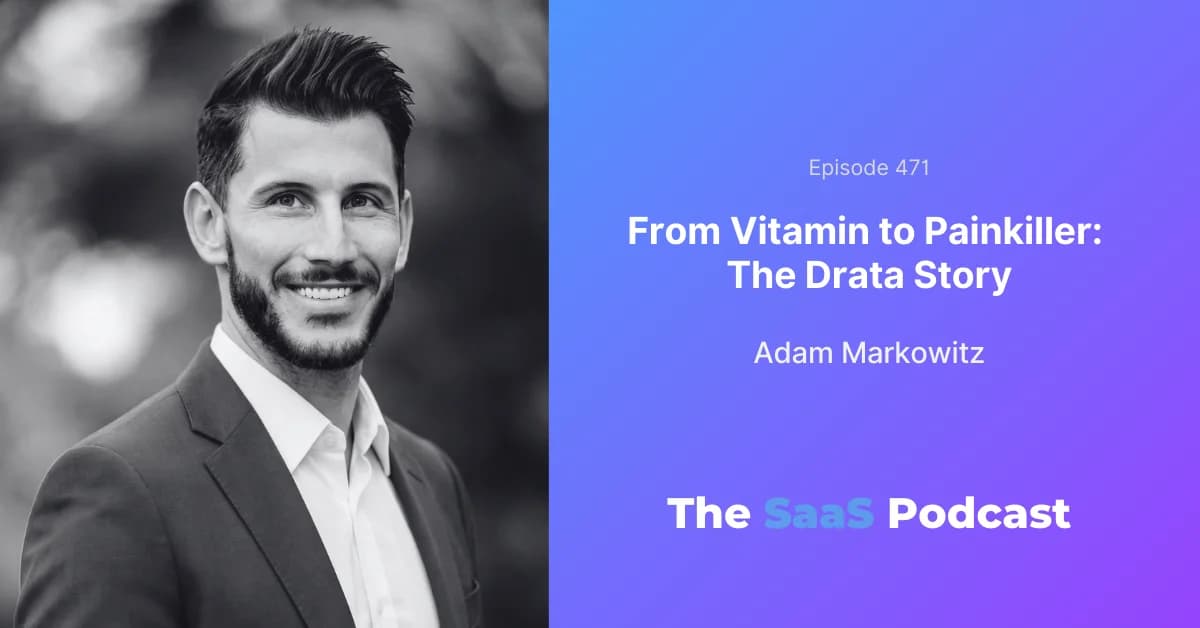
From Edtech Vitamin to $100M Painkiller - Adam Markowitz

Adam Markowitz, Drata

From Edtech Vitamin to $100M Painkiller

Adam Markowitz is the co-founder and CEO of Drata, a trust management platform that helps companies automate compliance, security assurance, and third-party risk management. Adam never planned to be a founder. He wanted to be an astronaut. That led him to aerospace engineering, and in 2008 he landed his dream job working on NASA's Space Shuttle program. Three years later, NASA retired it. So he taught himself to code and built Portfolium, a platform that helped students prove their skills with real project work instead of resume bullet points. It took years, but he eventually got it into over 500 universities. The company was acquired for $43 million. But it was during those long university sales cycles that Adam experienced a moment he never forgot. A CIO at the largest four-year public university system in the country asked him to prove his company's security posture. He couldn't. His entire company was built on the idea of proving things with evidence - and here he was, asking a customer to just take his word for it. That pain became the seed for Drata. After Portfolium's acquisition, Adam got the band back together - same co-founders, same early engineering team. They spent six months building the first version, talking to dozens of companies and auditors to validate the problem before writing code. Then they did something most founders wouldn't: they refused to sell to anyone until they'd used their own product to get SOC 2 compliant first. When they finally launched, product-market fit was immediate. Adam signed 100 customers in six weeks and 1,000 within the first year. The difference from his edtech days was stark - he'd gone from selling a vitamin to selling a painkiller. Adam used three strategies to accelerate Drata's growth to $100M ARR: 1. Dogfooding before selling - using Drata to earn their own SOC 2 gave instant credibility 2. Building an Auditor Alliance that kept auditors independent while making audits faster 3. A "give before you take" AWS partnership that made Drata a top 5 ISV on Marketplace by bringing thousands of new customers to the platform Today, Drata has over 8,000 customers across 60 countries, more than 600 employees, and crossed $100 million in ARR before its fourth birthday. The company has raised over $300 million.

How to Find Your First Customers by Living in Their Basement - Nate Baker

Nate Baker, Qualia

How to Find Your First Customers by Living in Their Basement

Nate Baker is the co-founder and CEO of Qualia, a software platform for title companies that helps coordinate the complex process of buying a home. Today, Qualia generates over $100 million in ARR with a team of 600 and has raised more than $200 million. In 2015, Nate was 21 years old and decided to build software for the real estate industry. He had no experience in that space. He didn't talk to any customers. He just did some research and decided that was the thing he was going to do. Then he started building. Still without talking to anyone. Nate admits this was a mistake. He and his co-founders got key things wrong about how the business would work. They wasted months building things they eventually threw away. It wasn't until they found their first customer that they started making real progress. Their first customer was Barry Feingold, a state senator in Massachusetts who also ran a real estate law firm. Barry believed in the vision, taught them the industry, made introductions, and helped them understand what actually mattered. The relationship was unconventional: Nate and the first 25 employees rotated through living in Barry's basement. New hires would get a call Sunday night: "Your onboarding is in Andover. You're going to live in Barry's basement for two weeks. He's going to teach you title. You have to tutor his kids in math." But then Barry's existing software vendor found out he was working with Qualia and shut off his access overnight. Nate and his team didn't even have the core features built yet. They had to figure it out fast. It became the most productive month in company history. Barry didn't just become a customer—he introduced Qualia to his competitors. Those network-based relationships became the foundation for the first 10 customers. Nate learned that your first customers must come from your network, not cold outreach. In this episode, you'll learn: 1. How to find your first customers through network-based selling instead of cold outreach 2. The multi-year upfront contract strategy that brings cash forward and locks in commitment 3. Why geographic focus beats national expansion in the early days 4. How to embed yourself with customers to truly understand the problem 5. When to hire your first sales leader and how fast to scale

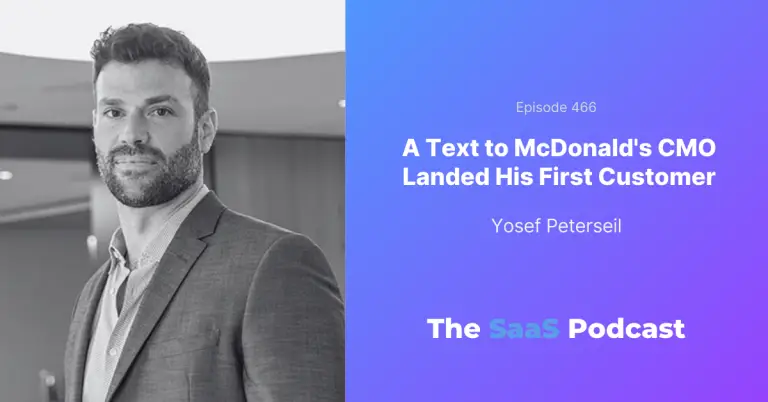
How Blings Landed McDonald's as Their First Customer - Yosef Peterseil

Yosef Peterseil, Blings

How Blings Landed McDonald's as Their First Customer

Yosef Peterseil is the co-founder and COO of Blings, a personalized video platform for enterprise brands. In 2019, Yosef and his friend Yonatan saw a problem that wouldn't go away. Yonatan had worked at a company trying to create personalized videos for customers, but there was no technical way to do it at scale. So they decided to build a solution—a new video format called MP5 that renders personalized videos in real-time on the user's device. But finding customers proved brutal. They interviewed dozens of customer success managers before realizing their target ICP had no budget. After pivoting to marketing where the money actually was, Yosef got lucky—someone sent him the McDonald's CMO's phone number. A few persistent texts and follow-up calls later, he had a meeting. Before the call, they scrambled to put together a custom video for the brand. The CMO loved it. But closing even the proof-of-concept took nearly nine months—all while they were bootstrapping with zero revenue and couldn't afford a real lawyer. Then came more setbacks. They tried events but had no system to follow up. 70 hard-earned leads went cold. They also hired salespeople twice, but even talented reps couldn't close deals since there was no playbook. But they kept at it. Blings now serves companies like McDonald's, Mercedes, Meta, and Rocket Mortgage. They hit $1M ARR in 2023 and have been growing since then with a team of just 19 people.

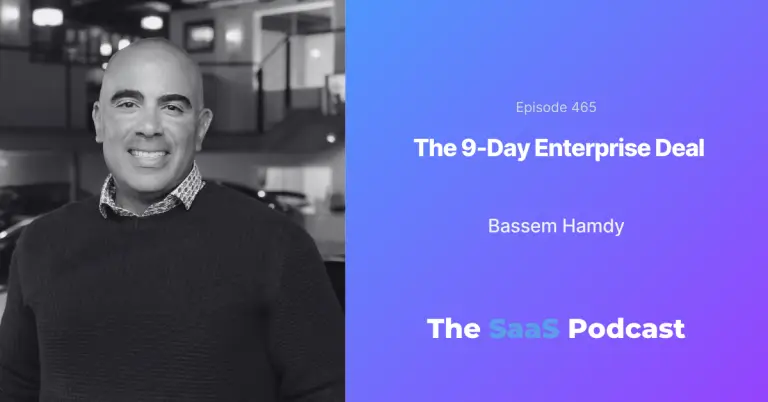
How to Close Deals in 9 Days, Not 9 Months - Bassem Hamdy

Bassem Hamdy, Briq

How to Close Deals in 9 Days, Not 9 Months

Bassem Hamdy is the co-founder and CEO of Briq, an AI orchestration platform for the construction and manufacturing industries. In 2018, after spending nearly two decades in construction tech—including a stint at Procore where he helped scale the company from $10 million to $100 million ARR—Bassem set out to build what he called the "construction data cloud." The idea was to aggregate all project data through APIs, creating a Carfax-like record for physical assets. It seemed like a perfect fit given his experience. There was just one problem. The software systems used in construction were 30 to 40 years old, and none of them had APIs. His entire concept was technically impossible. Bassem was ready to give up and go back to corporate life when a chance meeting with an engineer introduced him to robotic process automation. These bots could log into legacy systems and extract data without APIs. Suddenly, the business had new life. But customers wanted more than data extraction. They asked if the bots could also enter data. This pivot to "digital workers" found product-market fit quickly, and by 2020, Briq had reached $1.5 million in ARR. Then came pressure from investors. VCs didn't like that no users logged into the product. They pushed Bassem to build something with daily active usage. So Briq pivoted again, this time to a forecasting tool. It was a disaster. Customers loved the idea of automated forecasting, but the product couldn't deliver on that promise. Less than two years later, they killed it and returned to their automation roots. As if that weren't enough, Briq had ballooned to 300 employees during the growth phase. The larger team created more problems than it solved, and Bassem says they "lost the plot." Painful layoffs followed in 2023 and 2024, reducing the team to 100 people. Today, Briq generates 8-figures in ARR and is targeting $100 million within three years. Bassem credits their turnaround to a counterintuitive enterprise sales strategy: skip the demos, refuse free POCs, and close deals in 9 days by selling vision and value to CFOs who control the budget.
How He Closed Instacart and LinkedIn - Saket Saurabh

Saket Saurabh, Nexla

How He Closed Instacart and LinkedIn

Saket Saurabh is the co-founder of Nexla, a platform that helps enterprises connect fragmented data across different systems, formats, and data models. Most founders start by selling to SMBs. Saket Saurabh did the opposite—he went straight to Fortune 500 enterprises like Instacart, LinkedIn, and DoorDash from day one. His reasoning was counterintuitive: if you architect for small companies first, you'll never fully understand the depth of enterprise complexity. Enterprises still run mainframes. They have fragmented data across dozens of systems. And that complexity is exactly where Nexla's value shows up. Saket closed the first 15 enterprise customers himself through founder-led sales. His approach was consultative: instead of pitching, he listened. Instead of demoing features, he asked questions. "My first goal talking to someone was not that I'm going to sell you something," Saket says. "I'm really passionate about solving this problem. Do you see this problem as well?" The breakthrough came when his co-founder live-coded a fix during an Instacart pitch. "We ended the session showing them something working," Saket recalls. "They said, 'You guys did this on the spot? It takes us weeks or months to solve the same problem.'" That magical moment closed the deal. Nexla has since grown to over $5M ARR, raised $33M, and serves 50+ enterprise customers with 6-figure ACV deals. But to get there, Saket had to cut founder salaries to zero and downsize the team to reach cash flow positivity before their Series A.

Agency to AI SaaS: Scaling from $1M to $18M ARR in 9 Months - Richard Hollingsworth

Richard Hollingsworth, Fyxer

Agency to AI SaaS: Scaling from $1M to $18M ARR in 9 Months

Richard Hollingsworth is the Co-founder and CEO of Fyxer, an AI-powered email assistant that predicts and drafts emails for busy professionals. Richard and his brother Archie grew up on a farm, but they knew the slow pace of agricultural life wasn't for them. They saw tech as the opposite environment—fast feedback loops, results within your control. They started by building the UK's largest executive assistant agency, bootstrapping it to $5M in revenue. But from day one, they had a bigger vision: turning the service into software. For years, they tried to build "tech-enabled" solutions, but nothing worked to pull the price down enough for the mass market. Then GPT-3 launched. It was the breakthrough they'd been waiting for. Unlike other AI SaaS startups starting from scratch, Fyxer had a secret weapon: six years of detailed logs from human assistants. They knew exactly how an EA organizes an inbox because they had thousands of hours of data on it. They used this proprietary data to train their AI models, ensuring their product was more accurate than a generic LLM wrapper. The growth was explosive. They started the year with $1M ARR and a team of four. Within 9 months, they hit $18M ARR. They moved to San Francisco, joined an AI residency, and shifted their focus from "Tech Bros" to "Professional Services"—real estate brokers, consultants, recruiters—people who actually drown in email. One of their biggest wins came from a single signup via a Facebook ad. That user turned out to be the CEO of a massive real estate brokerage. Within 7 days, Richard's brother Archie flew to Seattle, met the CEO at his lake house, and closed a $1.2M deal to roll Fyxer out to 5,000 employees.

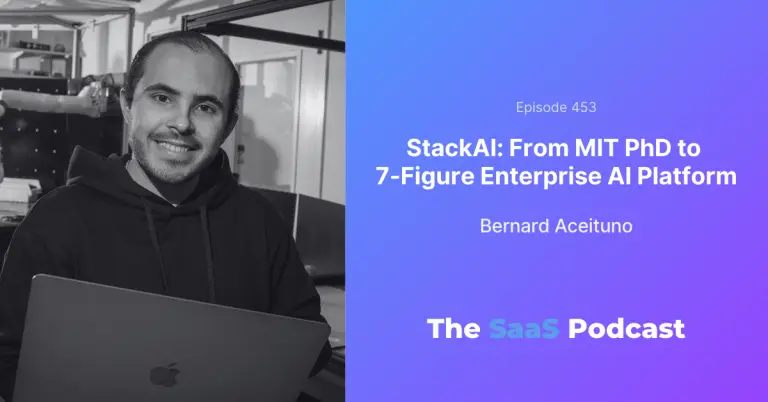
The Enterprise Sales Playbook That Took Stack AI to 7 Figures - Bernard Aceituno

Bernard Aceituno, Stack AI

The Enterprise Sales Playbook That Took Stack AI to 7 Figures

Bernard Aceituno is the Co-Founder and CEO of Stack AI, a no-code AI platform that helps enterprises build AI agents to automate back-office workflows. Bernard Aceituno spent 10 years in academia, researching AI and reinforcement learning at MIT. He was on track to become a professor or join a research lab like DeepMind. But he realized that while research was intellectually stimulating, it wasn't solving the immediate, manual problems he saw in the corporate world. So he dropped out of his PhD program to build a startup. His first idea was a tool for machine learning teams to manage datasets. It got some traction, but he noticed his customers were struggling more with connecting data than managing it. That insight led to a pivot: Stack AI, a drag-and-drop builder for enterprise AI workflows. The launch was scrappy. They posted the MVP on Hacker News and Y Combinator's Bookface. It exploded. In just two days, they booked 20 customer meetings. But that early success created a new problem: everyone wanted it. For the first year, they tried to serve everyone - SMBs, startups, and enterprises. It was chaotic. SMBs churned quickly. Startups had small budgets. Bernard made the hard decision to fire his smaller customers and focus exclusively on enterprise sales in the mid-market segment - companies with 100-1,000 employees. This segment had real budget, real problems, and moved faster than the Fortune 500. The result: an 8x revenue multiplier in one year, with enterprise sales cycles closing in 2-6 weeks instead of months. Today, Stack AI serves over 100 enterprise customers like Nubank, has raised $16M, and is generating high seven figures in ARR with a team of 35.

Finding Product-Market Fit: From 2 Failures to $200M ARR - Todd Olson

Todd Olson, Pendo

Finding Product-Market Fit: From 2 Failures to $200M ARR

Todd Olson is the founder and CEO of Pendo, a product experience platform that helps software companies understand user behavior and improve their applications. In the late 1990s, during the dot-com boom, Todd started his first company which eventually led to a promising acquisition offer. But the board thought Todd and his co-founder were too young to handle negotiations themselves. So they brought in someone else. The deal fell apart, the company pivoted to services, and Todd ended up leaving. His next startup struggled from the start. Todd made what he now calls an idiotic mistake. He assumed CEOs had to be non-technical, so he gave the role to a sales guy friend. They couldn't find product-market fit. Rally Software eventually acquired them, which Todd describes as a good soft landing more than a success story. Todd stayed on at Rally as head of product. That's where he discovered the problem that would become Pendo. He had no visibility into how users were actually using their product. He couldn't guide them when they got stuck. So in 2013, he left to build the solution he wished he had. This time, Todd obsessed over product-market fit from day one. He built auto-tracking into Pendo so customers didn't need developers adding tracking code everywhere. But nobody was searching for “product analytics plus in-app guidance.” The category didn't exist. With inbound marketing not an option, Todd went manual. He leveraged his VC network for introductions and started messaging heads of product on LinkedIn. For the first year, he focused on the number of installs as the most important metric. By October 2014, Todd noticed one company using Pendo constantly. He called them and closed his first paying customer at $500 a month. Today, Pendo generates over $200 million ARR with about 880 employees and has raised over $479 million to date. In this episode you'll learn: - Why Todd refused to hire salespeople until he'd validated the sales motion himself at $500K ARR - How raising prices 10x overnight transformed Pendo's trajectory without losing deals - What Todd learned from two failed startups that shaped his obsession with product-market fit - Why creating a new category meant abandoning inbound marketing for manual education - How for five years Todd refused to build features competitors had and why that became Pendo's biggest differentiator

18 Months of Zero Deals to $7M ARR - Egidijus Pilypas

Egidijus Pilypas, Exacaster

18 Months of Zero Deals to $7M ARR

Egidijus Pilypas is the co-founder of Exacaster, a SaaS company that helps subscription-based businesses grow revenue by turning customer data into actionable insights. As a statistics student, Egidijus worked part-time at a telecom company where he first saw the challenges of managing large customer bases. A university lecturer introduced him to cutting-edge machine learning research, and together they built trading algorithms for financial markets. When the trading experiment failed and Egidijus lost all his money, he pivoted. He called his former boss and pitched using machine learning to predict customer churn. The first company liked the idea but couldn't pay. The second said yes - and with no coding experience, Egidijus and his co-founder taught themselves to build a working platform in three months. What looked like early traction turned into years of painful enterprise sales lessons. Each new customer brought a flood of custom demands that buried their tiny team in delivery work. For nearly a decade, sales and marketing were neglected while they scrambled to stay afloat. When they finally hired an experienced salesperson and invested heavily in outbound enterprise sales, they spent 18 months burning cash and didn't close a single deal. Every RFP they entered, they lost - because by the time they received the request, they were already too late in the buying process. That failure was the turning point. Egidijus realized they weren't selling software - they were selling trust. Here is how Exacaster used three enterprise sales strategies to transform their pipeline: 1. Launched a niche podcast interviewing customer value managers (CVMs) at telcos - people who felt "lonely" in their roles and had nobody to share knowledge with 2. Published the CVM Body of Knowledge book with contributions from 30+ industry professionals across the world 3. Over-invested in enterprise sales pitches with 20-person teams responding to RFPs instead of sending 1-2 people Today, Exacaster is a $7M+ ARR bootstrapped SaaS business serving customers in nearly 20 countries, with close to 100 team members.

850 Meetings to Land His First Customers - Oscar Rubio

Oscar Rubio, Lodgerin

850 Meetings to Land His First Customers

Oscar Rubio is the founder and CEO of Lodgerin, a SaaS platform helping organizations manage housing and relocation services for students and employees moving abroad. The company has grown to over 1.2 million euros in annual revenue with a positive EBITDA margin of around 14%. Before building software, Oscar spent eight years running a traditional relocation services business in Spain. When COVID shut down international travel overnight, his revenue vanished completely. Rather than shut everything down as his COO recommended, Oscar made the bold decision to pivot to SaaS - despite having no technical background. He spent months in an empty office, taping paper to walls and digitizing every process he'd built over eight years of service delivery. He taught himself how software development worked, built a small team, and launched a bare-bones MVP. The first version was essentially an Airbnb for students - a marketplace where they could book housing through the platform. But a critical mistake almost killed the business before it started. They didn't build an availability calendar, so housing owners kept cancelling bookings. In the first quarter alone, they lost revenue from thousands of requests because properties weren't actually available. Then came the truly hard part - finding first customers for the SaaS. Oscar powered through 850 meetings before landing his first paying customer. He flew from Spain to the US, drove from college to college, knocked on doors without appointments, and slept in cheap motels and even his car to keep going. His first customer, Comillas University in Madrid, initially ignored him for months after he visited their office. Then they called back - not for the housing marketplace he'd pitched, but to solve a different problem: managing incidents and emergencies during student stays. That one conversation opened the door to a customized project that became Lodgerin's first real contract. After landing those first customers, referrals started compounding. The university sector is tight-knit, and satisfied clients recommended Lodgerin to peers at other institutions. Oscar grew from 171K euros in 2022 to 420K in 2023 to 1.2 million in 2024 - all with positive margins.

No-Code MVP to 7-Figure B2B SaaS - Paul Holder

Paul Holder, OnRamp

No-Code MVP to 7-Figure B2B SaaS

Paul Holder is the co-founder and CEO of OnRamp, a platform that automates and orchestrates customer onboarding for B2B companies. In 2019, while leading customer success at Troops, Paul and his co-founder Ross kept reflecting on the challenges they'd faced with customer onboarding at their previous companies. They spent several months validating their idea by interviewing customer success leaders to ensure the problems they saw weren't unique to their experience. Both co-founders were non-technical, but that didn't stop them. They learned to use Bubble, a no-code platform, and although their MVP was far from perfect, they still managed to get their first customers - 15 paying companies - using it. Their customers didn't even know the product ran on Bubble. After raising a pre-seed round, they hired their first engineer and began transitioning from their Bubble prototype to a custom-built solution. Initially focusing on startups, they discovered their solution was even more valuable for larger organizations where small efficiency improvements could drive million-dollar impacts. Paul used three strategies to find first customers and grow OnRamp to 7-figure ARR: 1. Pounding personal networks for warm intros - every meeting led to another referral 2. Shifting paid spend from Google Ads (which attracted non-ICP leads) to LinkedIn where their buyers actually live 3. Deploying AEs with a "bear hug" approach combining LinkedIn content, Dripify connections, and strategic calling The journey wasn't without significant challenges. They struggled with trying to build too many features simultaneously instead of going deep on one wedge. Cold email outreach became increasingly ineffective. And making the tough decision to move upmarket meant potentially losing SMB customers. Today, OnRamp serves nearly 100 customers, has raised over $14 million in funding, and generates 7-figure ARR with a team of 25 people.
Pocus: From Founder Pain to First $1M ARR in One Year - Alexa Grabell

Alexa Grabell, Pocus

Pocus: From Founder Pain to First $1M ARR in One Year

Alexa Grabell is the co-founder and CEO of Pocus, an AI-powered sales prospecting platform that helps sales teams generate pipeline more efficiently. In 2019, while building the sales strategy and ops function at Data Miner, Alexa was frustrated seeing sales data scattered across multiple tools and systems. She decided to hack together her own solution. During her time at Stanford Business School, she met her co-founder and they began working on a way to help sales teams spend more time selling instead of drowning in data. Through Stanford's Lean Launchpad program, they interviewed 350 sales leaders and professionals to validate their idea before writing a single line of code. It took them a year to build their first version of the product. But their patience paid off – within their first year of launching, they hit $1 million in ARR. Yet as first-time founders with no enterprise sales experience, they struggled with everything from building business cases to managing complex negotiations. They faced constant pressure to expand beyond sales into other teams, but stayed focused on serving sales teams exclusively – a decision that proved critical to their early success. Today, Pocus is a Series A company with 30 people, generating seven figures in ARR, and helping customers like Asana, Canva, and Miro.

Jobs-to-be-Done: Customer Interviews That Drive Growth - Bob Moesta

Bob Moesta, The Re-Wired Group

Jobs-to-be-Done: Customer Interviews That Drive Growth

Bob Moesta is the founder, president, and CEO of The Re-Wired Group and co-creator of the Jobs-to-be-Done (JTBD) framework with Clayton Christensen. In his 40 years working with products, he's helped over 3,500 companies bring their ideas to market and launched eight startups himself. As a dyslexic teenager, Bob couldn't make sense of trhttps://saasclub.io/wp-content/uploads/2025/01/tools-and-materials-used-for-fashion-designing-4XD3MX3.jpgional market research reports. Despite being told to stick to manual jobs, he refused to let his dyslexia hold him back. Everything changed when Bob noticed something surprising many customers weren't just giving incomplete answers in interviews, they were actually lying to themselves about why they bought products. This led him to study intelligence interrogation techniques to uncover what really drives people to buy products. Those insights helped companies like Basecamp, Facebook Marketplace, and Casper solve their growth challenges. Today, The Re-Wired Group helps both startups and big companies build better products and bring them to market successfully.

Missive: How a Tiny Team Built a $6M SaaS Without VC Funding - Philippe Lehoux

Philippe Lehoux, Missive

Missive: How a Tiny Team Built a $6M SaaS Without VC Funding

Philippe Lehoux is the co-founder and CEO of Missive, a tool that helps teams work better together through email. In 2015, Philippe and his co-founders were doing well with their Shopify app. But they spotted a big problem with how teams used email and decided to fix it. Using money from the Shopify app, they started building Missive. For over a year, they poured everything into it without making any money. It was a big gamble for the founders. When they finally launched, hardly anyone noticed. Growth was painfully slow. For two long years, they struggled to reach the first $10K MRR. Many would have thrown in the towel, but Philippe and his team kept going. They stayed a tiny team of three, doing everything themselves from writing code to helping customers. And they focused on building a great product instead of marketing, which meant getting new users was tough. But their different way of doing things started to pay off. They came up with an unusual affiliate program that began to bring in more users. Word started to spread slowly but surely. And their commitment to keeping things simple began to resonate with customers. After years of using their own money and staying small, they finally hit a growth spurt. In just the past year, they grew from 3 to 11 team members. Today, Missive helps around 3,700 businesses and generates almost $6M in ARR. They've done all this without taking any outside money and going toe-to-toe with competitors who have big investors backing them.

CV Partner: From Developer to $5M+ ARR SaaS CEO - Erling Linde

Erling Linde, CV Partner (now Flowcase)

CV Partner: From Developer to $5M+ ARR SaaS CEO

Erling Linde is the founder and CEO of CV Partner (now Flowcase), a product that helps professional services firms manage and showcase their team's resumes and project experience to win more bids and proposals. In 2011, Erling was working as a developer and decided to start his own business. After several ideas that didn't take off, he discovered a significant pain point in consulting firms: the enormous amount of time and effort spent formatting and tailoring dozens, sometimes even hundreds, of consultants resumes for large project bids. He built an early version of CV Partner to address this issue but soon realized his developer-designed interface wasn't enough to win over customers. After blunt feedback from a prospect about the poor design, he brought on a UX expert as co-founder to overhaul the product's design and usability. This major design shift became a key differentiator for CV Partner. The early days were difficult. Erling had no sales experience, and his initial demos often dragged on for hours, overwhelming prospects. Over time, he learned how to streamline his pitch and focus on what customers really cared about. And growth was slow but steady. Erling bootstrapped the business for 10 years, relying on conferences, SEO, and word-of-mouth to acquire customers. Today, CV Partner generates over $5 million in ARR, employs 42 people across five countries, and is expanding into North America.

PushPress: From CrossFit Passion to 8-Figure SaaS - Dan Uyemura

Dan Uyemura, PushPress

PushPress: From CrossFit Passion to 8-Figure SaaS

Dan Uyemura is the co-founder and CEO of PushPress, a gym management software platform for boutique gym owners. In 2009, Dan was working as a front-end developer at Myspace while also falling in love with CrossFit as a personal hobby. His passion for fitness led him to open his own gym, despite having no prior experience in the industry. As a gym owner, Dan quickly realized the existing software options weren't meeting his needs. Believing he could create a better solution, he recruited two friends – a developer and a designer – to help build his own gym management software. Building the software proved tougher than they expected. As they were working on it, they also talked to other gym owners and realized many shared Dan's frustrations. Seeing the bigger opportunity, they decided to build a product they could sell. But for years, the founders struggled to gain traction. They faced several technical challenges, often having to scrap entire versions of their software and start over. The slow progress was demoralizing – it took them nearly 5 years to reach $1 million ARR. Behind the scenes, Dan was battling personal demons. He struggled with drug addiction, which added another layer of complexity to his entrepreneurial journey. These personal challenges threatened to derail both his life and his business. By 2017, Dan was on the verge of quitting PushPress and returning to just running his gym. In a last-ditch effort, he decided to invest in an accelerator program. This decision proved to be a turning point. The changes the founders made worked. PushPress doubled revenue to $2 million ARR the following year. They teamed up with another company to add features they needed. But then a competitor bought that company. Suddenly, the founders were in crisis mode. They had to race against time to build crucial features themselves or risk losing everything they'd worked for. Today, PushPress generates 8-figures in ARR, serves over 3,500 gym clients, and has grown to a team of 100 people. The company has just $11 million in funding.

Lessons on Bootstrapping Three SaaS Startups to $1M+ ARR - Adam Robinson

Adam Robinson, Retention

Lessons on Bootstrapping Three SaaS Startups to $1M+ ARR

Adam Robinson is the co-founder and CEO of Retention.com, a platform that helps e-commerce brands identify and engage with website visitors, and RB2B, a tool that matches anonymous website visitors to LinkedIn profiles for SaaS businesses. In 2014, Adam and his co-founders started their first SaaS company, Robly, an email marketing platform. They bootstrapped the company to $1 million in annual recurring revenue (ARR) in 17 months by using a call center to target a list of Constant Contact customers. But the success didn't last long. The product wasn't competitive outside their niche target list, and growth stalled around $3 million ARR. In 2019, Adam co-founded Get Emails (later renamed Retention.com). This time, they reached $1 million ARR in just 27 weeks using provocative Facebook ads and cold email outreach. But the rapid growth brought new challenges. High churn rates and market saturation meant the team had to constantly find new ways to keep the business growing. As cold email became less effective, Adam turned to building his personal brand on LinkedIn in 2022. After some initial struggles, he found his voice by sharing vulnerable, authentic content about his business experiences. He grew from zero to over 92,000 followers in less than two years. This LinkedIn presence became the launchpad for Adam's latest venture, RB2B, which he launched in March 2023. The product hit $1 million ARR in just 16 weeks. Today, Retention.com generates over $21 million in ARR, while RB2B recently crossed the $2 million ARR mark.

Yembo: From Cold Calls & Rejections to Scaling an AI Startup - Zach Rattner

Zach Rattner, Yembo

Yembo: From Cold Calls & Rejections to Scaling an AI Startup

Zach Rattner is the co-founder and CTO of Yembo, an AI-powered platform that enables virtual home surveys for the moving and insurance industries. In 2015, while working as a software engineer, Zach noticed that computers were becoming better than humans at identifying objects in images. His wife's experience working at a moving company inspired him to apply this technology to the industry, which struggled with giving accurate quotes and handling logistics due to the complexities involved in each move. However, building an AI-powered product was no easy feat. As introverted engineers, Zach and his co-founder Sid had to force themselves to step out of their comfort zone. They made cold calls, visited moving companies in person, and often faced rejection. In the early days, the founders also handled sales themselves. They attended industry trade shows and conferences to generate leads and build relationships with potential customers. Despite their efforts, the first version of Yembo's product had limitations in its AI capabilities and user interface, which led to some customer churn. The founders realized they needed to focus on finding early adopters willing to work through initial challenges and continuously iterate based on customer feedback. Through their determination and hard work, Yembo gradually gained traction. Today, the company serves customers in about 30 countries, processing hundreds of hours of video daily and generating high seven-figures in annual revenue with a team of 70 people.

LeanData: Overcoming New Category Challenges to 8-Figures - Evan Liang

Evan Liang, LeanData

LeanData: Overcoming New Category Challenges to 8-Figures

Evan Liang is the co-founder and CEO of LeanData, a platform that helps revenue teams manage all go-to-market motions. In 2012, while at Caring.com, Evan faced significant challenges integrating their CRM and marketing automation systems. He built an internal solution to address the pain, which sparked the idea for LeanData. So Evan decided to launch his startup. He brought on a technical co-founder, Kelvin, and as a former VC, Evan was able to raise funding before they even had a product. While raising money was relatively easy, finding product-market fit proved much more challenging. As the solo salesperson, Evan signed LeanData's first 20 customers. But growth was painfully slow. LeanData struggled to educate prospects and close deals as a new category creator. Sales cycles often dragged on for up to three years. If that wasn't bad enough, trhttps://saasclub.io/wp-content/uploads/2025/01/tools-and-materials-used-for-fashion-designing-4XD3MX3.jpgional marketing channels didn't work either. The founders had to get scrappy and creative. Finally, they found some success by attending events and meetups to connect with early adopters. On top of that, Evan and Kelvin were under severe pressure from investors to grow faster. But Evan stuck to his guns. He had to balance the board's expectations with the harsh realities of creating a new category. It wasn't easy, but Evan and his team kept at it. Today, LeanData serves over 1,000 customers, generates 8-figures in ARR, and has raised $42 million in funding.

DoControl: A Founder’s Lessons on Validating & Selling Your SaaS - Adam Gavish

Adam Gavish, DoControl

DoControl: A Founder’s Lessons on Validating & Selling Your SaaS

Adam Gavish is the former co-founder and CEO of DoControl, a SaaS security solution that helps companies protect sensitive data stored in their SaaS applications. In 2020, while working as a product manager at Google, Adam faced the challenge of securely sharing sensitive company data with external partners. The experience made him realize the need for a better way to balance security and productivity. Adam eventually teamed up with a friend to validate their idea. They leveraged their network to connect with 50 security professionals, spending three months interviewing them and digging into their challenges. After building confidence in their idea, the founders traveled to Israel for a week and pitched to 22 VCs. All but one rejected them, but thanks to that one VC, the founders raised a $3 million seed round. With funding secured, the founders formed a small team and collaborated with early design partners to develop an MVP. They also went back to the security professionals they'd interviewed in the hope of landing their first customer. After three months, they reached a point where one company saw enough value to pay $2,000 annually and become DoControl's first paying customer. To grow further, Adam had to take on the role of SDR, even though he had no prior sales experience. He found himself sending hundreds of LinkedIn messages each week, hoping to book customer calls. Despite the challenge of learning sales from scratch, Adam persevered and slowly started to gain traction with customers. But as the company grew, the crowded cybersecurity market made it increasingly difficult for DoControl to communicate its unique value proposition. This became an uphill battle for the founders. However, despite those challenges, the founders have grown DoControl into a multiple 7-figure ARR SaaS company and raised $43M in funding.

Levanta: From Fiverr Side Gig to $3M ARR SaaS - Ian Brodie

Ian Brodie, Levanta

Levanta: From Fiverr Side Gig to $3M ARR SaaS

Ian Brodie is the co-founder and CEO of Levanta, an affiliate marketing software platform built specifically for Amazon merchants. In 2020, Ian and Rob set out to launch a SaaS company and began talking to investors right away. However, as two recent college graduates with no product or engineering team, they were quickly laughed out of the room. Undeterred, the aspiring founders pivoted to starting a services company, with the goal of generating enough revenue to eventually self-fund their SaaS dream. They came up with a clever way to validate their new business idea by posting their services as gigs on Fiverr. Within days, they'd received over 100 responses and felt confident in launching their affiliate marketing agency. But for the next two years, transforming their agency into a SaaS company proved incredibly difficult. They managed to grow the services business to 7-figures, but it was barely profitable, and they were kept busy just keeping the business going. Eventually, they got a lucky break with an acquisition offer for Grovia for a mid-7-figure valuation. Which finally gave them the money and time to build their SaaS company. Learning from their past mistakes, Ian and Rob spent months rigorously validating the idea through customer interviews before investing in building an MVP. After years of trial and error, they finally got traction. Within 9 months of launch, their SaaS company Levanta hit over $230K in MRR, with over 650 brands and 2,500 affiliates on their platform.

Command AI: Mastering Cold Emails to Grow a 7-Figure SaaS - James Evans

James Evans, Command AI

Command AI: Mastering Cold Emails to Grow a 7-Figure SaaS

James Evans is the co-founder and CEO of Command AI (acquired by Amplitude), a user assistance platform that makes your software product easier to use. In 2019, James and his co-founders were working on an EdTech product to help teachers give coding feedback to students. They got frustrated with their product's complexity, so they built a search bar tool to help users find features and complete tasks more easily. And then they realized, the search bar tool was a more interesting product. Despite having no customers, they got into YC. However, they struggled to get traction as they spent most of their time explaining what their product did. The breakthrough came when they made a Chrome extension that visually showed their product working in potential customers' own websites. James made Loom videos for each potential customer, showing Command AI integrated with their app and how it could help. His cold emails had a whopping 30% response rate and helped land their first 10 customers. But the team kept struggling to explain their unique product and its value. James realized they were spending over 80% of meetings with potential customers explaining how Command Bar was different from other options and what exact issues it solved. It made it incredibly difficult for them to grow the business more quickly. Today, Command AI is a 7-figure ARR SaaS business, with over 20 million end-users across hundreds of customers like Hashicorp, Freshworks, and Hubspot. They've grown to a team of 40 people and raised $24 million.
Walls.io: Bootstrapping Solo  to Over $10M ARR - Michael Kamleitner

Michael Kamleitner, Walls.io

Walls.io: Bootstrapping Solo to Over $10M ARR

Michael Kamleitner is the founder and CEO of Walls.io, a social media content aggregator, and Swat.io, a social media management platform. In 2008, while working as a software developer, Michael spotted an opportunity to start an agency specializing in Facebook app development. A few years later, after seeing his clients struggle with managing their Facebook communities, he launched Swat.io to help solve the problem. But finding his first 10 customers took nearly 2 years. Around that time, a friend asked Michael to create a tool for aggregating and showcasing social media posts on TV screens at a co-working event. Realizing its broader potential, Michael quickly turned the tool into another product called Walls.io soon after the event. But growth was slow for both products. It took many years and a lot of hard work and persistence to get traction. Then, the pandemic hit, causing big problems for Walls.io as live events suddenly stopped. Michael and his team had to quickly pivot to keep the product alive. Although he believed he could handle everything, the challenge of running the agency and building two products eventually became too much for Michael. That's when he decided to focus mainly on Walls.io, realizing he had to use his time and energy better. And that decision paid off significantly. Today, his two product companies together generate over $10M in revenue.

Airbase: From Solo Founder to  8-Figure ARR SaaS - Thejo Kote

Thejo Kote, Airbase

Airbase: From Solo Founder to 8-Figure ARR SaaS

Thejo Kote is the founder and CEO of Airbase, a spend management platform for mid-market and enterprise companies. In 2016, following the successful exit of his previous startup, Automatic, Thejo began brainstorming ideas for his next venture. At Automatic, managing company spending had been a major challenge. This led him to explore potential solutions to this widespread problem. But instead of diving right into building a new product, Thejo spent 6 months interviewing CFOs to validate his idea and ensure it addressed a real problem. He hired a freelance designer to create software mockups, which he used to get feedback. After each interview, he iterated and improved the designs. Once his initial product was built, Thejo was ready to start his sales outreach. Despite his previous startup success, he faced struggles as potential customers were still apprehensive about trusting an unknown startup. It took significant persistence and hustle for Thejo to get those initial customers. Fast forward to today, and Airbase has surpassed 8-figures in ARR, grown to around 300 employees, and has raised over $100 million in funding.

Thinkific: From $29 Online Course to $60M ARR SaaS Company - Greg Smith

Greg Smith, Thinkific

Thinkific: From $29 Online Course to $60M ARR SaaS Company

Greg Smith is the co-founder and CEO of Thinkific, a platform for entrepreneurs and businesses to create, market, and sell online courses and other digital products. In 2005, Greg, a law student, began teaching LSAT prep courses in-person, later converting it into a $29 online course that eventually earned him $10k per month. Seeing growing demand for online courses, Greg and his brother Matt launched a basic product in 2012 to simplify creating and selling digital courses. In the first 3 years, they experienced numerous pivots and setbacks, struggling to validate their product and business model and acquire customers. After failing to validate their early product concepts, the brothers shifted their strategy. They started manually building online courses for each new customer. This hands-on, time-intensive approach generated early revenue and gave the founders vital customer insights they needed to develop their software platform. In 2015, after launching their new software, they had a breakthrough moment when a webinar resulted in 20 customers immediately paying $1,000 each. After 5 years of persistence and hard work, the founders hit $10 million ARR, fueled by customer referrals, content marketing, and strategic partnerships. Today, Thinkific, with a 280-person team, generates about $60 million in ARR and has raised over $200 million primarily through its IPO in 2021.

Pointerpro: A 7-Year Journey  of Perseverance to PMF - Stefan Debois

Stefan Debois, Pointerpro

Pointerpro: A 7-Year Journey of Perseverance to PMF

Stefan Debois is the co-founder and CEO of Pointerpro, a software platform for professional services firms to create online assessments and automatically give personalized advice. In 2012, Stefan was feeling stuck. After working for 15 years in consulting, he wanted to start his own company. But he didn't have a great business idea. While still in his 9 to 5 job, Stefan made an iPad quiz app for his daughter's birthday party. It was just for fun, but it turned out to be a big hit. This gave Stefan an idea what if he made this quiz app better and put it online for free? So he spent his weekends improving the app and then released it, not expecting much. But then, something unexpected happened. The app quickly gained popularity. Teachers were using it in classes, and even AT&T was using it for HR events. Stefan saw a potential business and started interviewing his users to find out what they liked and didn't like. Once he was confident about the app's business potential, Stefan quit his job. He worked hard for three months to add a way to accept payments and was thrilled when some free users converted to paying customers. But despite some early success, business growth was slow. Stefan struggled for seven years to find product-market fit. Eventually, in 2019, Stefan had a significant breakthrough. He realized many customers wanted personalized reports. So, he doubled down on that and changed the app's focus to help professional services firms. Today, Pointerpro has surpassed $3 million in annual recurring revenue and has grown to a team of 28 people. The company is still entirely bootstrapped.

Anvil: From Zero Sales Skills to 7-Figure ARR SaaS - Mang-Git Ng

Mang-Git Ng, Anvil

Anvil: From Zero Sales Skills to 7-Figure ARR SaaS

Mang-Git Ng is the co-founder and CEO of Anvil, an automation platform that helps businesses build simple online workflows for cumbersome paperwork processes. In 2017, while struggling through a frustrating mortgage application process that involved exchanging PDF documents over email, Mang-Git had an aha' moment. He realized that moving all this paperwork to online forms could solve a massive pain. Mang-Git and his co-founder, Ben, spent months interviewing people. Once confident that they were solving a real problem, they built their initial product. But then they made a classic founder mistake – trying to sell to anyone and everyone. With no sales experience, Mang-Git struggled with crafting cold outreach emails. He'd obsess over each one, often taking 25 minutes or more per email, but barely got any responses. Adding to their struggles, they also attracted the wrong early customers. Many of them were excessively demanding and created a huge distraction for the founders. Fast forward to today, Anvile is a 7-figure ARR SaaS company that's raised $10M.

Check: Building a SaaS Startup  You’re Not Rushing to Sell - Andrew Brown

Andrew Brown, Check

Check: Building a SaaS Startup You’re Not Rushing to Sell

Andrew Brown is the founder and CEO of Check, a payroll infrastructure startup that embeds payroll directly into other software platforms. In 2015, Andrew sold his B2C startup, Oyster, to Google. But that big win also left a void in his professional life. He decided his next startup would be something he could work on for a decade or more, rather than just aiming for a quick sell-off. After spending years carefully searching for the right business idea, Andrew finally landed on the concept for Check when a potential partner revealed just how complex it was to build payroll functionality directly into their HR platform. Andrew spent several years operating in stealth mode, entirely focused on establishing Check's initial product and early partnerships before ever officially launching. But earning trust was much harder than Andrew expected, with many early prospects questioning why they should trust an early-stage startup with their payroll solution. It took years of relationship building through warm introductions, thoughtful cold outreach, and diligently preparing for every meeting to finally land pilots with initial partners. As Andrew described, payroll is an incredibly complex 50-state problem requiring going state-by-state to ensure proper setup before anyone will trust you with money. Today, Check has grown to a team of over 100 people and raised $119 million so far.

GUIDEcx: From 100+ LinkedIn Conversations to 8-Figure SaaS - Peter Ord

Peter Ord, GUIDEcx

GUIDEcx: From 100+ LinkedIn Conversations to 8-Figure SaaS

Peter Ord is the founder and CEO of GUIDEcx, a client onboarding and implementation platform. In 2017, Peter launched GUIDEcx. He had seen firsthand the problems with customer onboarding at his previous job and wanted to help companies make it better for their clients. He kicked things off by talking to more than 100 people who managed customer onboarding. He wanted to make sure there was a real need for specialized software. Once he was confident that there was, he put together an early version of the product to show to potential customers. In the beginning, Peter made some key decisions that set GUIDEcx on the path to success. For example, he raised his pricing pretty early on, which helped him attract customers who valued what he was offering and were willing to pay for it. But it wasn't all smooth sailing. During the first year, two important team members quit. They were half of his team back then and left because the business was growing too slowly. After losing those two people, Peter had an important decision to make. Was he going to build a lifestyle business and continue to grow slowly? Or was he going to go all-in, raise money, and build a fast-growing startup? He chose the latter. Today, GUIDEcx has hundreds of customers, has hit the $10 million ARR mark, and raised over $40 million.

Kinetik: From Failed Software to a $10M ARR SaaS Company - Sufian Chowdhury

Sufian Chowdhury, Kinetik

Kinetik: From Failed Software to a $10M ARR SaaS Company

Sufian Chowdhury is the co-founder and CEO of Kinetik, a company that's built the first integrated software for non-emergency medical transportation. Back in 2016, while working on a different startup idea, an old buddy of his, who was running a transportation business, came to Sufian in a panic about a database problem, which was really just a huge out-of-control Excel spreadsheet. While trying to fix the 'database' problems, Sufian discovered a whole bunch of problems with the actual transportation business that was helping Medicaid patients get to their medical appointments. Growing up in a low-income family that relied on Medicaid, Sufian felt an instant need to jump in and solve these problems with his friend's business. Together with a couple of other friends (who later became his co-founders), they started hanging out in the back office of the transportation business. They wanted to get a handle on how the business worked and wondered if they could develop software to replace the Excel spreadsheet. In time, they figured they'd also be able to help other businesses dealing with the same issues. But, 6 months later, they realized they'd built the wrong software. Worse still, Sufian had already burnt through $80,000 of his own money on this venture. So, they had to hit reset and start from scratch on the product. But this time they decided to talk to folks in transportation companies, ensuring they got what was needed and could build the right thing. Fast forward 18 months, and they finally launched their product and started getting paying customers. Things were looking up. But then, the pandemic hit and they lost a whopping 70% of their customers. Instead of giving up, Sufian decided to double down on the software business with an even bigger and bolder vision of what they were going to do.

From Zero to a Million: SaaS Founders Share Their Growth Journeys [357] - Jeremy King

Jeremy King, Attest

From Zero to a Million: SaaS Founders Share Their Growth Journeys [357]

In this episode, I’m going to share 5 highlight clips that contain insights and lessons which I believe are going to be super-helpful for early-stage SaaS founders.

Vimcal: Overcoming a 1.5 Month Runway and Getting Traction - John Li

John Li, Vimcal

Vimcal: Overcoming a 1.5 Month Runway and Getting Traction

John Li is the co-founder and CEO of Vimcal, a calendar app designed to help busy professionals and remote teams. In 2017, John and his co-founder Michael were accepted into YC with an idea for an augmented reality product. However, they soon discovered the market wasn't ready, so they pivoted to a fitness app, which also didn't get traction. After two years of hard work and long hours with limited results, they had only eight months of runway left. The two founders were faced with a critical decision. They could either quit and go back to full-time jobs or they could fight and keep going. They chose the latter and in 2019 the idea of Vimcal was born. But building a calendar app proved more difficult than they'd imagined, and by the time they launched, they had just 1.5 months of runway left. Once again, they were on the verge of shutting down. Yet, despite the odds, the founders managed to keep Vimcal alive and gain traction. Today, Vimcal is a trusted tool for professionals aiming to optimize their calendar management and save time.

Automate Your Busywork: A Guide for Early-Stage SaaS Founders - Aytekin Tank

Aytekin Tank, Automate Your Busywork

Automate Your Busywork: A Guide for Early-Stage SaaS Founders

Aytekin Tank is the founder and CEO of JotForm and author of the new book, "Automate Your Busywork: Do Less, Achieve More, and Save Your Brain for the Big Stuff". Aytekin has almost two decades of experience in the SaaS industry, and JotForm has helped millions of users worldwide eliminate paperwork and automate their workflows. During our conversation, Aytekin shares his personal journey as a SaaS founder and how he discovered the power of automation to scale his business. He explains how his "Automation Flywheel" can help SaaS founders and teams reclaim their time, increase their productivity, and shares some practical tips and strategies for getting started with automation. We'll dive deep into the 6 steps of the Automation Flywheel and explore real-world examples of how Aytekin and his team have used automation to simplify their workflows and free up their time.

Upsales: Bootstrapping a B2B SaaS to $13 Million ARR - Daniel Wikberg

Daniel Wikberg, Upsales

Upsales: Bootstrapping a B2B SaaS to $13 Million ARR

Daniel Wikberg is the founder and CEO of Upsales, a CRM solution that helps B2B sales teams to uncover new opportunities and secure more deals. In 2001, when he was 20 years old, Daniel decided to take a sabbatical year before going to university. During that year, he worked as a sales rep and quickly realized that there was a lack of user-friendly software for salespeople. Since he knew how to code, Daniel quickly built a simple customer database and to-do list. Even though he was a bit embarrassed about the software, he got it in front of a prospective customer and managed to close his first sale. That's when Daniel had a lightbulb moment and decided to ditch his university plans and launch Upsales instead. Fast forward to today, Upsales has become a 70-person team, pulling in around $13M in ARR with 1,800 customers, all while being bootstrapped.

How to Turn Rejection into Success for Your SaaS Startup - Richard Fenton

Richard Fenton, Go For No

How to Turn Rejection into Success for Your SaaS Startup

Richard Fenton is a speaker, coach, and author of the bestselling book Go for No!. His latest book is "When They Say No: The Definitive Guide for Handling Rejection in Sales. In this interview, Richard shares his personal story of how he initially failed at sales and how his experience led him to develop the "Go for No" philosophy. He talks about the old and new models for success and failure and how to apply the "Go for No" mindset to achieve your SaaS business goals i.e. how to embrace rejection and turn no into a powerful asset to drive your success.

Wingman: From CRM  Frustrations to 7-Figure SaaS - Shruti Kapoor

Shruti Kapoor, Wingman

Wingman: From CRM Frustrations to 7-Figure SaaS

In this episode, I talked to Shruti Kapoor, the co-founder and CEO of Wingman, a SaaS product that helped sales teams get better results by providing them with real-time insights from every sales interaction. In 2017, Sruthi was working for a FinTech company in India and ended up running a sales team, but she constantly struggled to get the CRM to work the way their team needed. And she couldn't find a good alternative solution, so she and two friends got talking and decided to start their own startup. The following year they launched the first version of their product, but getting customers was a struggle when they started out. Their first 40 meetings with prospective customers resulted in zero sales. Despite the rocky start, they've grown their SaaS company to multiple seven figures in ARR and in 2022, sold the business. In this episode, we talk about the struggles and challenges the co-founders faced while starting and building their SaaS business. What they did after failing to close even a single sale after 40 meetings with prospective customers, how they've used online groups and communities to find customers by getting their existing customers to post and talk. And we talk about how they've used SEO, content marketing and social media to create an inbound marketing engine that drives over 90% of their revenue today. I hope you enjoy it. All right, Shruti, welcome to the show. And I think that's an important lesson in life overall you know, not just for founders. One, get sales folks better coaching feedback to enable them in real time. So as they're going through a call, if you could get the feedback versus, you know, waiting for the manager to review the call a week later and then, you know, maybe have a coaching session two weeks and three, it enables people to get a full picture of what their pipeline looks like, where their deals are so that they can go and, you know, make sure that they're doing everything that they need to win. Decided I wanted to get my hands dirty with startup. Joined a FinTech company called Payoneer and, you know, figured that I would be best suited to figure out their go-to-market strategy right knowing absolutely nothing about go-to-market strategies. And at that point, you know, what that meant was working with the product and the marketing teams and of course creating the sales team, going out and selling myself and trying to get those early customers for Payoneer in India. And through that process I kind of realized some of the challenges you know that I'm trying to solve with Wingman. One of them was definitely not knowing why certain sales reps in my team were doing so well, and some reps who were putting in a lot of effort but still not getting the numbers. So, I think that's kind of where I got curious and said, listen, I want to join your calls, but then it becomes too onerous. You know, one out of every two or three calls will get canceled. You waste so much time. And so, I was like, you know what? If they could just record their calls and then I could go back and review it. But the other challenge was that because we were a distributed team, we have product and marketing sitting in Israel and then, you know, sales sitting in every country that they were selling to. And so, the other challenge that I was frustrated by is getting the voice of customer over to product. So, I think both of those as I thought more and more about it, I was like, you know, if we could only have these calls recorded, archived, searchable that would be a gold mine. And that's where the journey started. Like, how do I get value out of this data? Because we understood that this was valuable data, but you know, this is such a large volume of data. The last thing we wanted was that you have all of these call recordings and then you know, nobody is listening to it. So, I think we spent some time in just understanding what the real challenges were, validating that it wasn't just a problem for me. And then, you know, trying to kind build our own MVP. What would an MVP look like? And so that's the context with which we got together. And you're right, it, it took some time for things to come together. So, you know, we met almost a year and a half before we started up. And so, through that period, you know, we were just hanging out, getting to know each other. Brainstorming on a bunch of ideas, trying to validate, invalidated a bunch of ideas. And Muralid and Srikar have known each other since their first jobs out of college, and they were also at Google together. And so, Muralid was very clear that he would want Srikar to also be part of the team when we started off. And he managed to convince Srikar to also quit his job and moved from the Bay Area to India to start this up, Right? So, what we felt was, one, nobody had a clear thesis or understanding of how to use this data. And we felt that, you know, the winner wasn't just because somebody decides to record calls and transcribe them because, you know, recording of calls has existed for at least, you know, a few decades. Right? We felt that the real innovation or you know, where the business needed to be built was. Identifying the right use case for the data and being able to make sure that you're able to deliver that value quickly. And we felt that was not answered when we started building this out, and you know, when we were trying to validate whether or not that was answered, we went and also spoke to some of the customers who were using the computer competitor's products because we wanted to understand like, Hey, if you're using this today, does it solve everything for you or are there still gaps? Through that process, we identified that there were definitely things people were struggling with. And I think that was also an important learning in just knowing that, you know, what people say they will do in an ideal world versus what people do is dramatically different, right? Like I, I know we are all familiar with New Year resolutions and how they land up. And that was exactly the case with sales coaching where, you know, I think the products were built on a promise of saying that, hey, Sales managers are motivated to do sales coaching, and I will build a tool to help them do sales coaching better. But the fundamental problem was that sales coaching doesn't happen as often as people would like. How long did it take to build that 1.0 version of, or the mvp, I guess, of Wingman? Five months. Yeah, I mean, that sounds great. You know, you ship the product, you already got one customer and you get excited and you're like, wow, we're gonna be closing more and more of these deals. But from what I said, it wasn't that straightforward. When you talk to a lot of potential customers and you didn't close any sales. So, so tell us about that . You know, from our network, right? So, these were not customers who we did not know, and therefore you know, these were really useful customers for, you know, as co building partners and, you know, for giving us early product feedback, et cetera. But what we wanted to do was to, of course, and you know, you need to do that. Is make sure that you actually also reach out to customers who are buying the product for the sake of the product and don't necessarily know you. I think the first challenge that we hit was even with these friendly customers that we had early on, they were not using the product the way we would expect them to. Right. So, we were hitting the same roadblocks in terms of product usage. And you know, that was baffling, but I think that was also our own lesson in understanding that, you know what people say they would do, and what they actually do is different. And so we had to kind of go and really sit down, understand what their workflows look like, tweak you know, the product, understand what is the first, you know, wow moment we could deliver them and you know, how do you make that repeatable, et cetera. So there was some work required there. The second thing we did was, like I said we kind of went and spoke to people who were using the competitor's products and understood, you know, what were the challenges they were facing? Was it a product issue or was it just setting the right expectations? And then what we did was once we felt we were ready to kind of scale up, we you know, at that point we launched. Dramatically new feature for the product, which was this whole idea of being able to give real time feedback to salespeople while they were on sales calls. And we felt that was, you know, going to hit the nail on the head. That was allow going to allow people to actually coach without being there. And we were you know, ready to kind of take it to the market. So we got a sales consultant to help us you know, accelerate that process of reaching out to new customers. And that person set up you know, great meetings for us. He set up 40 meetings with our ICP companies and, you know, we, we sold exactly zero to those 40 customers and we were like, you know, something's not right. And that was really tough because we felt at that point, you know, we had a good product, we had a real differentiation and we were talking to the people that we wanted to be selling to. And so that was the point where we were like, you know, there's something that we need to go back and think about. And I think what we realized at that point is you know what the product does right and what the promise is. Sometimes as founders, we tend to oversell the promise as well. But what we don't account for is, you know, how the customer is thinking about it in terms of. Their implementation costs or effort required to get value out of it. So that was the challenge that we were facing in getting people to, you know, adopt this new real-time feedback mechanism. And so, you know, once that became clear to us we were able to kind of go and make changes to say, how do we make this easier and quicker to get value out of? Give me one example of that. Like what was it that was, that you realized they were seeing as difficult to implement and get started with? Like, what did they have to do that they didn't want to do? Right. So if somebody says you know, talks about discount, then we want like, these three talking points to show up for the salesperson. And that was what we needed sales enablement to do but this wasn't something that they were used to doing because they're used to, you know, creating content either for trainings which is typically long form or, you know, self-service content, which is, you know, these detailed documents. They're not used to writing like three bullet point pieces of content. But the other struggle that they had was they did not, they were also not kind of sure whether they knew what content they. All right. So, so to them it seemed like they needed to invest in something without fully understanding, like, you know, how that would work or how that would get them results. And I think it was also a case of, you know, the stakeholder who was going to be the decision maker versus the person who needed to actually implement the product and get value were different people and, you know, we didn't kind of know how to navigate that well. And I think that was, a reflection of you know, us as founders because none of us had actually worked in SaaS. Right? None of us had actually also worked in a situation of understanding how a multi-stakeholder, you know, product adoption cycle looks like. And you know, how do you kind of navigate that from a sales and post sales point of view. So that's kind of a difficult leap to make. So, so how did you solve that? I mean, that's, I think this is something that a lot of SaaS founders go through that the perceived work, even though the customers might not say it, and it sounds like the 40, or at least the 39 people you spoke to, weren't that explicit about it. But it's, I think it's a common problem. So how did you go about solving it? So in our case, like with the real time feedback and you know, just having a real time note taker there we identified that, you know, giving feedback on behavior did not require any setup. So I could have something that tells them that, Hey, you've been on a long monologue and we didn't need the manager or anybody else to do anymore. Similarly we could, you know, use, get them to bookmark parts of the call in real time without, you know, managers or setup needing to do work. So one was identifying pockets that required minimal setup, and using those as the hero examples in those sales conversations versus, you know, using all these complex things that required a ton of setup as the hero example. So it was easy for somebody to say, oh, I can instantly get value. Without putting in a lot of effort. And then if I wanted to put in effort, you know, this is what I could do. Right? So essentially constantly being very diligent about saying, how do I create a wow moment with minimal effort so that then the person, once they see the value, then they will put in the effort. I think the second thing we did was you know just taking away a blank canvas approach and saying, we will give you enough in the canvas so that you only need to fill in the blanks. So, you know, basically creating all sorts of templates that made it much easier for people to say, oh, okay, I only need to write these three bullet points. I know what the use case is. And in some cases we would even use you know, like different methodologies, different sales information that existed to create you know, that set of templates and initial things for them. So again, trying to get, give them value before we ask them to invest effort. So we are still trying to figure, trying to figure out the positioning value, et cetera. And so at that point we did like a bunch of more you know, larger scale launches. And through that feedback cycle we realized that there were some people who were buying the product and not using it for this specific use case. So we were like, you know, the first thing we did was. Became open to saying that we could have different packages of the product for people who might have different levels of tech readiness. So that allowed us to at least start getting some customers who did not necessarily want this complicated feature and who did not care that there was, you know, maybe not a big differentiation story, et cetera. Right? And in the meantime , thankfully the changes that I talked about weren't so much product changes. They were more positioning and conflict changes that, you know, we didn't need longer cycles for. So we were able to quickly iterate on that and like we spent you know, the next four, five months just saying that, we'll just, you know, customers who are interested in buying, we'll just try to listen to them, understand what they're buying for, what they're using the product for, versus trying to get people to adopt everything that we are trying to build on day one. And I think that really helped in you know, getting to the juicier parts of the product. I think the second point was that we were very clear about what our differentiation was. Yeah. Right? And that was around saying, can we actually help people scale coaching? The third thing was that I think we had also spent time and energy in understanding how we might be able to use our geographic advantage and distribution. To actually deliver better value for the customer. So in our case so, so there were basically things around saying how do we make sure that we are going to continue to be competitive? And it's not just about, you know, one feature versus another. And I think those were things that YC really cares about. Like what is your long-term you know, chances of success and why? All right, so we kind of went from, I said, you know, close to zero to six digits in revenue very quickly at that point. And that was, you know, within the matter of those three months or so. From there on you know, we kind of felt that what was working for us was having you know, some sort of inbound funnel or customers because what had worked in getting some of these was you know, we did like a product hunt launch and some you know, some early P R that happened around Visim. And so, what we realized was that we then wanted to start building on that inbound engine. Because, you know, maybe we were not ready for some larger customers. We needed to still build more trust in the market, but we could still be selling to you know, the smaller end of the customers to start with and then you know, work our way up. Which we then very often you know, even for our inbound funnel and marketing overall. We did also get some customers through the outbound engine early on. But what we realized was that inbound seemed like, what could be much more scalable. Of course, early on it was, you know, me as the only person doing sales and marketing and SDR and, you know, all of those fancy things that we have teams for today. And I think, therefore, my approach was to say how do I spread the message across based on what I understand about the sales leader’s buying behavior. And I think that's something that people miss on sometimes, you know, you kind of reach out to multiple people for advice on, hey, how did you get your first 10 customers or your first 20 customers? And people forget that, you know, if you're selling to a salesperson versus to a developer you know, the way they buy a product, the way they evaluate a product, the way they think about the product is very different. And so what we realized was that salespeople one, are very social right? And they like to talk to each other, and they like to get you know, inputs from each other. And a lot of what happens in sales is through word of mouth. And so we kind of just doubled down on that and we said, Where are people giving each other advice and sharing this, right? And so, this was already you know, by now we are already in the times of the pandemic, and we are beginning to see that, you know, there are all these online communities that are popping up. And I think that landed up being very fictitious for us because we were then able to get you know, spread that word of mouth using those communities, those online selected platforms versus just trying to do Google ads or, you know, G2 ads, et cetera. Yeah, so this was, you know, like lots of revenue leaders, slack communities that existed. You know, there are lots of forums were revenue leaders exchange advice. You know, there were Reddit threads that our customers saw where, you know, people are asking questions around, say, price of a competitor, and they were like, hey, you know, we use this tool and this is why. And so, you know, it was very niche targeted communities through which we then built the word of mouth. One thing that a lot of people do, which isn't particularly well taken, is going into a new community that you just joined and just start pitching your product. So, what was the approach that you took if you were telling people about Wingman, how did you get to that point where you were doing it in a way that you know, people were more receptive to it. And I think when you and I were talking, you were saying that you were also getting customers as well to help with, you know, amplifying this word of mouth. So just tell me a little bit about that because there's a right way and a wrong way to do this, and I want to kind of figure out what you did. Like, they don't even have to say anything else. Even if they say, you know, if there's a thread around, hey, what do you use for doing this task? And somebody says, oh, I'm using this, you're much more likely to go check it out versus saying, hey, I'm the founder of and you know, we also do this. So, I think through that right, what we were really looking to do was just amplify the word of mouth from the customers, right? Like, you know, in the real-life situation, we would've expected this to happen through events and through casual networking, you know, social settings. And you know, what we were thinking of was just, you know, today, nobody can step out because of the pandemic. How do we leverage what exists in terms of still spreading the word of mouth? And so, it literally started out that way. Some of our customers initially found like some threats saying, hey, you know, I saw this discussion you know, would you want me to say something on this? And we were like, oh, that's fantastic. And so, it was not us posting about ourselves, I think, which definitely helps. And I think our role in that was really. Identifying where those discussions were happening at some point, and then nudging our customers if needed to say, hey, you know, do you mind just, you know, sharing what your experience has been? Yeah, and I think that worked. One of the lessons that we, that I overall learned in that journey of getting, you know, the first five customers to try to scale that up through inbound was what you really need throughout that journey. One thing that is common, how do you build trust and as you try to scale, how do you amplify that trust through various ways? And I think that was a big learning also from saying that, hey, we hired the sales consultant early on. You know that person was able to set up meetings for us, but we are not able to close. Partially also because that trust doesn't translate. And especially if you're hiring somebody part-time. I think that was that was a big lesson and therefore as we went through this journey, we were always very conscious about, hey, how do we build trust? And how do we continue to scale the ways for building trust? So, so people listening to this can understand like how much volume and sales you're actually driving through your inbound engine now? You know, today of course, we do invest a ton in content. , our approach to content has been can we do something that people actually laugh at or relate to, versus, you know, some more corporate jargon. And I think that has landed well. So, you know, we do partnerships on Instagram around, you know, fun memes on sales, things like that. Just a bunch of educational and thought-provoking posts on social media. So, I think social media is one channel that helps us build brand and be present in conversations. And I think the other piece has definite, so, you know, the other piece has definitely been SEO as well. As you know, things have scaled up and I think today we have a pretty strong game there. And I think the third piece has definitely been you know, continuing to focus on personal brand you know, for the leaders and for other folks in the marketing team because I think that's super important. And so, we make sure that you know, folks are visible and yeah, I think personally I've probably you know, interacted with a lot more people being on several social campaigns, podcasts, et cetera. And that I think again, helps you know, create that recall and brand. It seemed like sales tech was on a consolidation spree. We were definitely getting that feedback from the investors we were talking to as well. And, you know, within a matter of couple of weeks, we happen to get inbound interest from three different buyers. And you know, we haven't started thinking about it, but you know, I was like, hey, maybe there is something here. Let me just go and dig a little bit deeper. And so that's kind of how that conversation started. And I think you know, as a founder, that was something that I was open to at that point just in terms of you know, the fundraise cycles you know, it always makes sense to consider an acquisition. You know, before you do a fundraise work, you know, you can't really get acquired immediately after a fundraise because your investors won't be very happy about that. So, I think in that sense, the timing was good. And so I decided to take a pause and just, explore that a bit. Fundraising can be pretty distracting. We did you know, try to fundraise. , you know, in 2020 mid of 2020 or so. And then I think what we realized was with the pandemic and, you know, sales teams getting laid off we were seeing like, you know, ups and downs in our own business and in the revenue numbers. And what that eventually meant was it wasn't the greatest time to try and fundraise. And then I think, you know, later a lot of times investor sentiment impacts these things. Right. And then as it happened, and the second time that we tried to fundraise was in the middle of the and you know, when we started things were stable, but then suddenly, you know, the whole Delta variant came about. And like, especially in India, it was pretty bad. And investors were just focused on like, you know, helping people actually survive, and it wasn't, again, the greatest time to fundraise. So what you realize is that, you know, sometimes you can't really control the timing on these things, you know. In hindsight, if it works out, then it's great. Right. Like if you're able to fundraise at the top of a you know, valuation cycle but very often you know, as many things in business, it lands up being a little bit of luck.

Matik: A SaaS Founder’s Journey from Refugee to Series A Startup - Nik Mijic

Nik Mijic, Matik

Matik: A SaaS Founder’s Journey from Refugee to Series A Startup

In this episode I talked to Nik Mijic, the co-founder and CEO of Matik, a SaaS product that helps create personalized Google Slides or PowerPoint presentations using automated data driven content. In 2018, Nik was working as a program manager at LinkedIn. When he came up with the idea for his new startup, he saw that many companies were wasting time and effort manually collecting data from different sources to add to presentations. And he realized that software could streamline and automate a lot of that work, but he wasn't quite ready to quit his job. So Nik and his co-founder, Zach, who met through a mutual friend, spent six months researching the idea and trying to figure out if they were a good fit for each other. Eventually in January, 2019, Nik was ready to quit his job, but the hardest thing for him was telling his parents as refugees from the Bosnia Civil War. His parents thought their son had finally made it by getting a job with the great company, and now he was about to tell them that he was quitting. The co-founder started working out of Nik's apartment and it didn't take that long to figure out how to build the product, but the bigger problem was that neither of them knew anything about sales and how to get customers. In this episode, Nik shares his lessons as a first time founder. We talk about what he did to learn how to sell and get those first 15 or 20 customer. How he went from having no sales experience to selling the product, to eventually building and managing a sales team. We also talk about a technique that Nik uses to deal with the emotional highs and lows of being a startup founder and how he's used a somewhat unusual framework. To build a solid support structure around him. Today, Matik's customers include B2B tech companies such as Asana, Glassdoor, Greenhouse, and SalesLoft. The founders have raised 23 million, including a 20 million Series A round in 2021, so I hope you enjoy it. All right, Nik, welcome to the show. In PowerPoint or Google Slides today, the way that we kind of came up with this idea was I was at LinkedIn prior to starting the company. And before that I worked at a customer success software startup. And that was where the idea initially came from. We had a lot of our customers saying, Hey, we do these things called business reviews renewal decks, where we have these templates and PowerPoint on Google Slides, and there are placeholders that will say, Hey Nik, go to Salesforce to get this data point. Go to Tableau to get this chart. It'd be awesome if there was a one click button that pulled in all that data for a particular account and spit out a presentation and narrative. And so when I was at LinkedIn, I had worked on building out internal tools and narratives and had a opportunity to rebuild an internal tool. And that's really when it kind of got me thinking, Hey, there's probably other companies out there that have a very similar challenge where their sales and customer success teams are putting together this data driven collateral. , whether it's a QBR, whether it's a quarterly business review, an ROI deck, a business case, it's very, very impactful, right? When you share data with your customers and prospects, the likelihood for better business outcomes are there. But it's very tedious and it's very time consuming. And so our hope and our goal with Matik is to help alleviate that problem and, and help automate and streamline the creation of that data driven content within PowerPoint or Google Slides. I, I was really young when the war broke out. And we ended up fleeing the country and going to Hungary for about a year and a half. And then we ended up in Germany for about four and a half years and wanted to stay, but there were so many refugees that were coming up out of the region that we weren't able to get citizenship. And so, you know, parents decided to apply to a variety of places. We applied to Canada, Australia, US, and got accepted to the US and my mom and dad were like, Hey, let's do it. Let's, let's, you know, American Dream. Let's, let's go over there. So we were choosing between two cities. You know, when you'd come in as an immigrant or a refugee they'll ask you, Hey, do you have any friends or family that can help you get on your feet? And so we had some friends or cousins in Chicago, and then we had some family friends who went straight from the war to Salt Lake City, Utah. And my mom and dad ended up picking the cheaper options. So we ended up going to Utah, which was you know, went to school there high school, college, and then ended up coming to the Bay Area after, after college. I've been here for about almost 11 years. We didn't speak any English. And definitely, obviously I think a lot of people say, oh, tough upbringing. But at the same time, I think it's shaped who I am today. And I think it's a lot of those lessons of perseverance that I saw through my parents is one of the reasons why I started Matik, right? Because I don't think I would've had this opportunity to work at LinkedIn or start Matik if it wasn't for the sacrifices that that they made. And picking up, not just once, but you know, we went from Yugoslavia to Hungary, from Hungary to Germany, and then doing it a third time and coming to the US it really kind of showed me the sacrifice that they made. Right? So what was your parents' reactions to that? We have a cafeteria. They saw all the food, they had all these activities. Also, when you're, when you're an immigrant refugee, I think your parents want you to be like one of three things. They want you to be a doctor. They want you to be a lawyer or they want you to work for like a big company like Microsoft or Coke, Coca-Cola, LinkedIn, that they can brag to their friends back home. But honestly, I ended up flying back to Utah because that's where they're base out of right now. And I want to tell them in person. And the feedback I got from them was like, Hey, like do it like you're at the point in your life where you have the ability to go and take this risk. That's why we came to the US was to give you this opportunity. And if we need to sell our house, if we need to do anything, like we're here to support you. And I think that really gave me the confidence to be like, Hey, I know LinkedIn is great. The perks are amazing, the culture is amazing, pay is amazing. But I don't wanna have that regret later on in life knowing that like I, I wanted to try to do something and I never did. Right. And the other turning point for me was not just my parents. I had a nephew that was born right around that time and I remember being in the hospital with my brother and thinking, man, like, it doesn't seem like yesterday we were kids playing in the playground and now we're raising kids. And it was the first time in my life where I realized how quickly time flies, right? Like when you're in, in high school, you can't wait to get to college. When you're in college, you can't wait to become a working professional and time go by quickly, but you don't understand the magnitude of how quickly it goes. And then seeing my nephew born, it just really hit me. And so I think two reasons, right? One, my parents, I wanted to be able to show them that, hey the sacrifice you guys made, this is a sign of me of appreciation for you guys. And then two, I didn't want to have that regret later on in life to be like, Hey, I should have tried to, to start a company and never did. Right? And, and I know how quickly time flies. So him and I just kind of got together. I told him about the idea and I was like, let's just do some research, right? Like, I haven't worked with you, you haven't worked with me. I'm not quite ready yet, to quit my job. And we did that for about five to six months and we really just hit it off. I would say our core values really aligned. The way that we kind of worked together just worked. And so you know, at that point I was ready and I was like, Hey, this is me getting down on one knee proposing, like, let's do it. Let's, let's let's get a joint bank account and you know, start this thing. So that was kind of the, the initial starting point. So it wasn't just something that we thought was cool to solve for, but other people, other companies had this problem, right? So we were, one was just validating that this is a problem we're solving for, right? And the way we did that was a lot of conversations, right? And that doesn't mean that every conversation we had was positive, but majority of the conversations that we had were saying, Hey, Thumbs up, this is a problem that we have and we'd love to solve for. A secondary piece, which is more of Zach's realm, was kind of the technical components, like how are we gonna go and build this? Like what is the tech stack that we would use, right? What are kind of the base requirements that we would start to build a prototype? So that was kind of the, the, the secondary thing. And then I think the third was, I guess, him and I just kind of feeling each other out, right? Because we had never worked together before. We wanted to make sure that we were on the same page and we had the, we had the same goals going into starting a company. I had a roommate, a former roommate of mine who had just sold a company to Autodesk and you know, I caught up with him and I was kind of giving him the idea. I wanted to kind of run some things by him, and he was like, Nik, like I love this idea. Like, our company could use this. Like, I want to invest. And I'm like, well, we don't really have any customers. Like this is just, these are wire frames. Like we're still, you know, building prototype. He's like, I think there's something here. I think you should like, I want to invest. And so we did a safe, we did a small safe. $200,000. It wasn't, wasn't a big, big safe. And that kind of helped us build the initial prototype. And then we got a few companies that were crazy enough to like try out the product, right? Feedback was overwhelmingly positive and that's what led to us raising a 3 million seed round with Menlo Ventures and a few other seed funds. So that's kinda how we, we got our start. This is kinda what we're trying to solve for. We automate, you know, presentation building and PowerPoint, Google, and she's like, oh, our customer success team at our company could definitely use that. I'll send you an intro. And so she ended up sending me an intro to their enablement person and kind of showed them the initial prototype. They really liked it. And I remember them like, okay, great. What, what's next? Where do we sign? And I remember going back to Zach, I'm like, ah, we don't have a purchase order. We don't have like legal terms, like kind of contacted a few folks. I'm like, do I, what do I charge them? So I literally just came up with a number and I said, Hey, $2,500. Right? So it wasn't a lot. And they were like, great send us the DocuSign. And that was really our, our first customer. And then they ended up expanding from there. So they did test the product before they bought, but it was a, it was also, that was a huge milestone for us because now it wasn't just people trying it, people were willing to put their dollars and behind us, right. And actually buy the product. Was, was selling the product fairly easy despite that? We're gonna invest all these resources into implementing your solution and having our teams use it. Like how do we know that you guys are gonna be around? Right? And I think the raising a seed round helped give us some credibility, right? So like, Hey, there's institutional money behind us now. It's not just two guys working out of an apartment or a WeWork. It's legit. Like there are, there's backing here at at, at a VC level. So that was definitely a hurdle early on that we had to overcome. And I think another one is just we connect to data sources, right? So our primary persona that we go after is obviously customer success and sales teams. And for customer success in particular, a lot of the data that they show in these presentations is usage data where you're connecting to a CRM or you're connecting to a database and that's very sensitive information. And people security was really, really important. So we invested a lot in security upfront, whether it was getting certifications like SOC two, type one, SOC two, type two, investing in technologies for monitoring. That was a big part of how we were able to kind of handle that objection up front. How did you learn to sell? Were you just like winging it? Did you go out and find a mentor. Like what did you do? I think all the above. It is going. Yeah, I mean, it is all the above. So I definitely had some folks we had some advisors that had a sales background where, you know, SVPs of sales at, you know, pretty decent size tech companies and I would lean on them quite a bit, right? Like, 9:00 PM at night. Hey, I don't have an order form. Do you have an order form? Or like, Hey, I got this objection. What do I do? How do I respond to it? So a lot of it was mentoring and coaching from our advisors and folks in my network. And the other was iteration and, and just trial by error, right? So I would see what messaging would respond. I would see what messaging didn't respond. And again, you're iterating constantly, just like you're iterating on the product. We were iterating on that go to market process as well. So first basically target group was people in my network. Then I would look at former employees of LinkedIn that are at new companies, and, and that really resonated because they're like, oh, you know, I don't have those same tools internally here. I would love to take a look at your solution and what you guys are doing. What was that experience like? Was it, was it easy finding the right sales people? And what was the transition like to moving from founder-led sales to relying on a sales team to go out and sell for you? So again, leaning on our investors, leaning on our network of, of sales advisors to kind of help us. Made a hire really early on. Great individual wasn't there for very long. It was like right during Covid. And I think the hardest challenge is finding someone who wants to work at an early stage startup where there isn't all this infrastructure, there isn't product marketing, there isn't sales enablement, right? You don't have a ton of resources. But it's not just so junior where they're like leaning on you and that, that's kind of a tough hire to find. And so we ended up hiring someone who was a, had some big company experience but was really eager to get into startups and she did a fantastic job of just kind of building that initial playbook for our sales team. And she did some of that initial hiring on the SDR front and we worked really closely together to, to build that out. So it definitely was a challenge. And you know, like I said, one of the learnings that I had there too was you gotta hire in twos, especially on the sales side. I think a lot of founders are probably wary because it's costly, but at the end of the day, hiring in twos allows you to really see if it is the person that you hired or if it's the process. And having those two is a benchmark. You kind of know like, hey, one person's performing one isn't, or both are not performing. So maybe it is the process or the other way around. Right? So that's definitely a big learning that I had early on was higher in twos on the go to market side. So did you do that with SDRs and AEs? Like everybody was coming in two. Well initially, right? Like I think like your first hires, like hire, make sure that they have somebody that they can compare themselves to. So like when we hire the account executives, yes, hire twos. Same thing with SDRs, hiring twos because also they can learn from one another, right? And you want to build that culture of collaboration and it's hard to do that when you're just on your own. She was kind of, and I was helping out. Right? So still helping out on deals, right? And I think that's one of another key learning is you, you never really remove yourself from selling as a founder. So as you transition from founder-led sales to a more codified process, you're still going out there and selling, whether you're not necessarily managing the end-to-end cycle, but you may be coming in at the end, or you may be coming in at the beginning. And it also helps me kind of get a pulse on the market and the pulse on, on how our prospects are responding to our messaging, how our customers are responding to our products. So I've really enjoyed that aspect of it. Cause you're the founder, right? And especially if you're the tech guys as well, it's like, yeah, we could do that probably, whatever. But once you're then relying on a sales team to do that and they can only lean on a playbook or whatever training they've had, it's not as easy for them to navigate their way through some of the questions that customers may come up with that you haven't addressed so far. So how, how, how long did it take for you guys to figure out a playbook that you felt pretty comfortable with, that was working well? You're still learning. We're still in the early stages. We're still learning from what we're hearing from the market what we're hearing from customers and how we can constantly improve. So it does take time. But I think the key, key thing here is that that growth mindset, that iterative mindset where, and the hope is that the people that you hire, those account executives can embody that type of mentality where they're okay with ambiguity, they're okay with a little bit of, you know, chaos. But they can help provide structure to that chaos and they can help provide structure that ambiguity. And so a big part of it is not just the playbook or the process that you're implementing, but the people behind that, that can constantly go back and iterate and tweak based on the learnings that they're having. Right? And then we also saw a big expansion play as well. So a lot of those early customers that we signed on, we're getting a lot of value in our product and we're now starting to say, Hey, we only bought for a certain segment within customer success. Now we wanna buy for the entire team. Right. Or, Hey, we think our sales team could also use this. Yeah, they're not, their presentations aren't as like data heavy as maybe customer success, but they do business cases, they do ROI calculators. Some of the pitch decks are a little bit more dynamic. We'd love to use Matik to automate that process. So a big part of our motion too was also expansion which we've had a lot of success with this year. You, you brought on the, the sales team to, to start, you know, hopefully starting to scale the, the growth. What, what's, what's been the kind of, what are the hard parts of, of scaling? Right. That, that's what I'm trying to understand is like, it, it sort of, I hear the story so far and it's like the problem resonates with people. You didn't have that much of a hard time selling. Okay. You had some objections and things you had to overcome and, and certainly raising the seed round, as you mentioned, helped to build some credibility and maybe overcome some of the concerns people had. But beyond that, what have been some of the difficulties with trying to scale sales and get to some of these lands, some of these customers that you have today. Right? And so, as you know, this year as we've had the growth that we've had, you know, we raised a Series A last year with Andreessen Horowitz. We raised 20 million, 20 million series. . Now it's like, okay, we made a lot of these hires, but how do we continue to execute on our long term vision of where we want to go and how do we ensure that as a team continues to grow in size, they're not going into their own silos, they're all rowing in the same direction. So that, that's something that's like really top of mind for me, as well as just talent. Like I'm a firm believer that it's not the technology that wins, it's the people behind the technology that wins. And if you can build a great team, right, and you foster a great culture I think that is like one of the main ingredients to success. Like I said, I'm a first time founder, `so I may be naive in that, but from what I've observed in the startups that I've worked at that have been successful, the ones that haven't been successful, you know, I think culture is such a big part of it, and that stems from your core values, your mission, vision, all of that, and making sure that your team really knows where you want to be, not just today, but where you want to be five, 10 years from now. So tell me, tell me a little bit about that. What, what, what's the lesson you've learned? How do you try to be even-keeled as as you run this business? And it's unbelievable, huge milestone in the company. And then those are the days where, you know, maybe you have a bad meeting with a prospect or they didn't really understand what you're trying to say. Maybe at back-to-back meetings where that happened and you just feel like, wow, I'm just, you know. And so you don't really wanna be too high in the highs. You don't wanna be too low in the lows. And I think another. Thing that's been a learning experience is last three years, four years, not just in business but in society. A lot has happened, right? The pandemic, the war, social injustice and all of that is now like, is starting to collide with business. And so having to learn how to cope with that, with your team, how to address that with your team, how do you navigate a business through that type of climate that's outside of work, that's all been something that's been definitely a learning experience. And I think in times like that, you lean on your core values, you lean on your culture. And one of the things that Zach and I first did before we started writing any code, before we did anything was like, we literally wrote down, this is kind of cheesy, but we wrote down the things that were really important to us. Like what are the core values that you want to this company to live by? What are the core values that I want to, and what is that framework that we want everybody else to buy into? And I think that's really helped us navigate the last four years, not just from a business perspective, but also all the stuff that's going on outside of the business. Right? And one of my favorite sayings is like, trust is consistency over time. It's not one of those things that I meet you, you meet me, I hire you, or you hire me. Boom, there's trust. We are, you know it is your actions over time that prove to me that I can trust you and vice versa. The,  second one that we really wanted to really focus on was compassion. And this is something that, that LinkedIn, Jeff Weiner the former CEO, the chairman, now, he would always talk about leading with compassion, and I really took that to heart because we all come from different backgrounds. I'm a refugee. My co-founder Zach grew up in Sonoma, right, and totally different backgrounds. That doesn't mean that his upbringing was better than mine or vice versa, but we may have different ways of looking at a problem. We may have different views on, on how to tackle a problem, and so that's fine. But we should always try to understand and put ourselves in the other person's shoes. You know, let's say you and I disagree on something. Well, maybe Omer had something happen to him over the weekend that I don't know about outside of work, or maybe in his past job they tried to solve for the same exact problem and they went down this route and it led to a disaster. Right? So those are probably the two. Like I said, we have two others. One is quality and the fourth is being customer first. But those are two examples. And you're gonna be testing, you're gonna be iterating, and you really need to have a good support structure. And he told me, he's like, go find a brother or sister. Go find a mom or dad or go find a grandma or grandpa. And so when he told me that, I go, what do you mean by that? And he was like, the brother or sister is the person in your, in your support structure that you can reach out to when you've had a long day and you're like, Let's just go grab a beer or let's go grab lunch or dinner. I just need to vent, right? And they're gonna give you that pep talk, like, Hey, remember why you're doing this? Push through it, right? The mom or dad is someone who is on the same journey, but they're may be two or three years ahead of you. So an entrepreneur that, like I said, is three years ahead of you, that can give you tactical advice. Like, Hey, I don't have a purchase order. What did you guys do here? Hey, I'm hiring for this role. Share some learnings that you had when you were hiring for a similar role. And then the grandma, grandpa is the persona or the person that can give you that 50,000 foot level. They've done it multiple times. Right? And they can kind of help you navigate that, that high level overview. And like I said, set those expectations. And the other is you, you wanna rotate them, right? So everybody has, you know, those friends who come to them constantly. Always complaining. And I, I didn't want to ruin those relationships. So, you know, I try to rotate every, you know, six to 12 months, try to get a new brother or sister, try to get a new mom or dad that I can lean on and a lot of that is just the people the relationships that I've built during my professional career. Things are not gonna perfectly align like you want. You're gonna make decisions. And even if it is a mistake, that is still progress because now you, you've learned something to hopefully not make that mistake again. So I'd probably say that's the biggest thing is don't, don't you know, don't be afraid to, to make mistakes and, and, you know, go, go for the home run. Like really push forward. There is not, you don't have a massive data set that is statistically significant that you can say, Hey, we lead, this is why we should make this decision. And I think this is where we're kind of at. At the life cycle of the company where a lot of the early decisions were gut, it was hypotheses. And now we've gotten to the point where we've collected some data. Now we've gotta change our mindset to now not couple that qualitative feedback and that qualitative data with quantitative data. Right? And so I would say now we're starting to lean more towards, okay, we have historical data, we have a data set that we can use to make decisions. But early on that was not the case. Right? And I think that that was hard, right? . When you're working at LinkedIn or you're working at other companies, you always have that data. You use data to go and make those decisions. And you know, when you're first starting the company, there is no data to lean on. It is all, `you know, research and, and that gut that you're kind of having to lean on. All right. Great. So we should we should wrap up and move on to the lightning round. I've got seven quick-fire questions for you. Just try to answer them as quickly as you can. You ready?

Alosant: Lessons on Bootstrapping a SaaS to $2M ARR - April LaMon

April LaMon, Alosant

Alosant: Lessons on Bootstrapping a SaaS to $2M ARR

April LaMon is the co-founder and CEO of Alosant, a mobile app platform for master-planned communities to create a single destination for their residents and future home buyers.

Piano: Pivot or Persevere? How  a SaaS Startup Found Success - Trevor Kaufman

Trevor Kaufman, Piano

Piano: Pivot or Persevere? How a SaaS Startup Found Success

Trevor Kaufman is the CEO of Piano, a platform that provides paywalls, personalization, and analytics for hundreds of media companies and brands. In 2012, Trevor became a seed investor and CEO of a small 2-person company building a micropayment solution for digital content creators. But about 18 months later, he realized that the economics of their business model didn't work unless they could build a massive customer base. So they pivoted and moved to selling their product to large media companies. But they struggled to find customers. Either those media companies weren't interested in selling subscriptions, or if they were, they often had built their own internal solution. All this time, Trevor was funding the business out of his own pocket.

Attest: Growing a SaaS From Zero to First Million ARR in 7.5 Months - Jeremy King

Jeremy King, Attest

Attest: Growing a SaaS From Zero to First Million ARR in 7.5 Months

Jeremy King is the founder and CEO of Attest, a research platform that enables companies to engage directly with over 125 million consumers worldwide and do market research faster. In 2015, after spending 9 years as a McKinsey consultant, Jeremy decided to build a SaaS product that would make it easier for B2C companies to do market research. He realized that often those companies were guessing what consumers wanted instead of using market research data. And he was convinced he could solve that problem. His wife gave him 6 months to get the business going. So he knew he had to work fast to validate the idea, build a product, and get paying customers. The clock was ticking. But what Jeremy did next was surprising.

Hint: Building Customer Trust as an Early-Stage SaaS Startup - Zak Holdsworth

Zak Holdsworth, Hint Health

Hint: Building Customer Trust as an Early-Stage SaaS Startup

Zak Holdsworth is the co-founder and CEO of Hint Health, a membership management, billing, and payment software for primary care, urgent care, and specialty practices. In 2014, Zak and his co-founder Graham set out to transform the US healthcare system. They were both frustrated with the cost of healthcare and believed they could make a difference. They decided to build software to help direct primary care practices. Despite both of them lacking experience in healthcare, they jumped right in and hit the ground running. Within 30 days, they attended an industry event, talked to potential customers, started building a product, and got their first paying customer. And a few months later, they closed their first 10 paying customers.

Whale: The Realities and Struggles of Building a SaaS Startup - Gary Vanbutsele

Gary Vanbutsele, Whale

Whale: The Realities and Struggles of Building a SaaS Startup

Gary Vanbutsele is the co-founder and CEO of Whale, a knowledge transfer and training platform that helps businesses onboard and train employees. In 2018, a couple of friends in Belgium decided to build a SaaS product to help small business owners monetize courses. Everyone they spoke to told them it was a great idea. So Gary and Bram spent over a year building their product. They were both excited to show their prospective customers what they had built until they realized that no one was interested in paying for it. They hadn't validated their idea properly and had spent almost a year and a half building something that nobody wanted. A few months later, Gary had an idea to build software to help with training and onboarding employees. He had experienced these problems firsthand with the IT company that he owned and knew it was a widespread problem. This time Gary and Bram did things differently. They validated their idea and even pre-sold their product idea to a couple of customers before they started building the product. Things were looking great and everything seemed to be coming together this time. But little did the founders realize that their struggles were just beginning.

Whatfix: From a Failed SaaS Startup to a Potential $1B Unicorn - Khadim Batti

Khadim Batti, Whatfix

Whatfix: From a Failed SaaS Startup to a Potential $1B Unicorn

Khadim Batti is the co-founder and CEO of Whatfix, a Digital Adoption Platform (DAP) that helps businesses simplify training and support. In 2014, Khadim and his co-founder Vara launched a new SaaS business called Whatfix. In 8 years, they've grown their company to multiple 8-figures in ARR, hired over 600 employees, and they've raised $140 million in VC funding. It sounds like another great Silicon Valley startup story, but it isn't. Both these founders were based in India. Prior to founding Whatfix, they spent 3 years building another product that never really got traction. Both founders came from an engineering background, so they spent too much time trying to build a great product and not enough time talking to customers. During those 3 years, there were many times when they wanted to quit and go back to their corporate jobs. At one point, they realized that there was one feature in their product that their customers seemed to be most interested in. In fact, it wasn't even a product feature, but a tool they'd built to help their customers learn how to use their product. So they decided to shut down the product they'd been working on for 3 years and instead focus on turning that tool into a product. But this time they took a very different approach. They spent most of their time talking to customers and validating their idea. And they didn't start building the product until they'd made their first sale. In this interview, Khadim shares his lessons on the mistakes they made in building their first product. And we dig into how they took a very different approach the second time with Whatfix, and how they've gone from zero to a company valued at over $600 million. I hope you enjoy it.

Demandwell: From Concierge MVP to a 7-Figure SaaS Business - Mitch Causey

Mitch Causey, Demandwell:

Demandwell: From Concierge MVP to a 7-Figure SaaS Business

Mitch Causey is the co-founder and CEO of Demandwell, a SaaS company that provides software and coaching to help B2B SaaS marketers turn organic search into a source of repeatable revenue. When Mitch launched Demandwell, it was just a one-person SEO agency. Mitch worked with one client at a time. His main tool was a spreadsheet that he'd create for each client and use to help them improve their organic search traffic. But he quickly realized that this business couldn't scale. And building a software product to replace his spreadsheets seemed like the next logical step to enable Mitch to help more clients. In about 18 months since launching his SaaS product, Mitch has been able to turn Demandwell into a 7-figure business with a team of 16 people. One big reason why he's been able to grow so quickly is that he first spent 18 months providing a service and helping clients manually. He effectively built an MVP without any software – a concept known as a Concierge MVP. It's an approach that can work for a lot of different types of startups. Many founders get stuck figuring out how to build an MVP. And the truth is that your MVP does not have to be software. Your MVP can be a service instead. Your Concierge MVP can help you quickly validate your idea, find customers, learn more about your target market, start generating revenue quickly, and even pre-sell your SaaS product to some of those customers to help fund development. I hope you enjoy the interview.

From Struggling Bootstrapper to $10M+ SaaS CEO - Ryan Fyfe

Ryan Fyfe, Workpuls

From Struggling Bootstrapper to $10M+ SaaS CEO

Ryan Fyfe is the co-founder and COO of Workpuls, an employee monitoring, and time tracking software. Previously, he founded Humanity, an employee scheduling software product. In 2010, Ryan set out to build better employee scheduling software. Early in his career, he had worked in the service industry and experienced the pains of scheduling shifts both as an employee and manager. He believed there was an opportunity to build an easier solution. He targeted the lower end of the market and quickly built a basic scheduling solution. He didn't do customer interviews or much market research. Instead, he trusted his gut that based on his experience, there was a need for his solution. But getting early customers was disheartening. He went from being excited about how his product was going to help hundreds or maybe even thousands of small businesses to struggling to get even 10 customers. People seemed interested in his product but always seemed to have an excuse for why they couldn't or weren't ready to pay for it. And things got worse when Ryan realized that it wasn't working out with his co-founder and decided to buy him out. Suddenly he became a solo founder of a product that he believed in, but one that was clearly struggling to get traction. And now Ryan had to do everything from product, marketing, and sales on his own. But after a lot of persistence and hard work, he figured out how to sell his product. He went from having a struggling product that nobody wanted to bootstrap it to $100K ARR. And then after raising VC funding, he went on to grow the business to over $12M ARR, 150 employees, and 40,000 customers (including companies such as Nike, CNN, and Lyft). In this interview, you'll learn exactly how he did that, what mistakes he made along the way, the lessons he learned, and what he's doing differently with his latest startup. I hope you enjoy it.

SaaS Sales Outreach: Do Things That Don’t Scale to Stand Out - Zandra Moore

Zandra Moore

SaaS Sales Outreach: Do Things That Don’t Scale to Stand Out

Zandra Moore is the co-founder and CEO of Panintelligence, a white-labeled business intelligence and predictive analytics solution for SaaS companies. Zandra and her two co-founders acquired the product they were building at their old company and spun it into a new startup. They packed up and carried a server across a car park to their new office. To get started, they got a list of 500 companies from Dunn and Bradstreet and sent each one a handwritten letter in the mail. It wasn't scalable, but it helped them land customers. Since then, their startup has grown into a multiple 7-figure SaaS business with over 50 employees. They're disrupting the SaaS analytics sector and competing against giants like Power BI and Tableau. And they're doing all this from a city in the north of England. In this interview, we discuss: I hope you enjoy it.

Findigs: Focusing on Progress Not Perfection to Hit $2M ARR - Steve Carroll

Steve Carroll

Findigs: Focusing on Progress Not Perfection to Hit $2M ARR

Steve Carroll is the co-founder and CEO of Findigs, a property rent management software that improves the leasing experience for renters and landlords. Like many people moving to a big city like New York, Steve had experienced firsthand how difficult it can be to rent a place. He realized that the vast majority of renters were still paying their rent offline or mailing checks every month. So he teamed up with his best friend Keith to launch an online payments solution for renters. People told them they were wasting their time because banks were already solving the problem and could send checks for renters. But Steve had found the experience clunky and almost got evicted when his bank stopped sending rent checks for several months. They started their customer research by going to a local bar and asking people how they paid their rent. Some women thought this was a pickup-line until they'd whip out their phones and show them a Typeform survey. Just taking a scrappy approach like this quickly got them about 1,000 survey results, which gave them enough data to move ahead. Today, their business generates around $2M in annual recurring revenue (ARR) with a team of 12 people. In this interview, you'll learn: I hope you enjoy it!

Dover: How to Get Customers without a Product or Website - George Carollo

George Carollo, TopFunnel:

Dover: How to Get Customers without a Product or Website

George Carollo is the co-founder of Dover, an end-to-end recruiting automation platform that helps companies to find and hire top talent. Dover uses advanced matching software to identify the perfect candidates across all recruiting channels and drives the hiring process for companies and candidates. In 2019, three friends teamed up to launch a new SaaS startup. They'd all felt the pain of recruiting in previous companies and decided to solve that problem. They got their first 10 customers without a product or website. In fact, at that point, they didn't even have a company or product name. For the first 9 months, they solved the problem manually for customers. The team would review resumes, create a shortlist of candidates and then connect the right candidates with the right companies. By taking this approach, the founders were able to better understand customers and identify exactly the right problem to solve with software. But growing beyond their initial customers was tough. They sent about 1,000 cold emails to recruiters which turned out to be a waste of time. They hired writers to create content, but they couldn't find anyone who understood the problem, market, and data well enough to create meaningful or useful content. Nothing seemed to be working. And then COVID hit and suddenly things looked even worse. Not only were they unable to acquire customers, but they were also now struggling to keep the ones they had. The founders then made an important but risky decision. They decided to stop selling and instead focus all their time on building a better product. In this interview, we explore why they made that decision and how they turned things around to get the business to $4M in annual recurring revenue (ARR). It's an interesting story, but what I really love about it is the super-simple approach the founders have taken to build this business and how they got initial customers without a product or website. I hope you enjoy it!

How to Craft a Sales Narrative for Your SaaS Product

How to Craft a Sales Narrative for Your SaaS Product

Omer Khan: [00:00:00] Welcome to another episode of the SaaS podcast. I'm your host Omer Khan. And this is the show where I interview proven founders and industry experts who share their stories, strategies, and insights to help you build, launch and grow your SaaS business. In this episode, I talk to Pete Kazanjy.  the co-founder of Atrium, a sales management tool that uses data and smart analytics to help sales leaders and managers improve team performance. Pete Kazanjy: [00:01:59] Hello. Hello. Omer Khan: [00:02:01] So for people who aren't familiar, can you just tell us a little bit about Atrium? What does the product do? Who is it for? What's the main problem you guys are helping to solve? Yeah, so Pete Kazanjy: [00:02:12] Atrium makes software that helps sales managers do what we like to call data-driven rep management, such a use these data and analytics to better manage their, their AEs, their SDRs, their AMs, and CSMs using metrics using continuously monitored analytics that is really super quick to set up out of the box. You know, it takes 90 seconds and then importantly, kind of monitors those KPIs for those managers sits as they don't have to stare at walls of charts in order to figure out what the hell is going on, but this operates just does it for them using, using math. Omer Khan: [00:03:01] Great. So today we're going to talk about your book, Founding Sales, the early-stage go-to-market handbook, startup sales for founders and others in first time sales roles. Pete Kazanjy: [00:03:34] Yeah, so, so the book is really focused on kind of two, two stages, but the way to kind of think about it is it's like the missing manual, if you will, for early-stage go to market. And really the reason why I wrote it was because when I at my last software company, TalentBin when I, when I started TalentBin, when my co-founder Jason. Omer Khan: [00:05:28] Great and then can you just explain why the book is relevant, not just for sales folks and why other people or disciplines in an organization can also get value from this? Pete Kazanjy: [00:05:40] Yeah so the way to think about it is it the primary user of the book is a person who does not have selling like early-stage selling experience. So who could that be? It's called founding sales cause like the primary user for it is a founder. But if you think about who founders, we're kind of like founders come from, if you will. Usually they're like former product managers, former engineers, former designers, what have you. Omer Khan: [00:07:53] Great. So today we're going to talk about building a narrative or a story, and this is kind of like the foundational product marketing stuff. And when you're you're nearly stages and you're going out and selling a product from what I've seen a lot of founders, especially if they don't have experience with sales, they sort of tend to. Pete Kazanjy: [00:09:47] Good goal, good goal. Omer Khan: [00:09:49] All right. So let's start from the top. Tell us about, from your perspective, why is this important? What does it really mean to build a narrative or a story? Pete Kazanjy: [00:09:58] Yeah. So I think this is a little bit of kind of like my product marketing background kind of like peeking out. Omer Khan: [00:12:29] Great. Okay. So the first step is really to identify what the problem is, and that might seem. Obvious it's like you think, well, yeah, the problem is the thing that my product solves. But it's, I think it's going deeper than that really understanding from, from the customer's perspective, what are their pain points? Pete Kazanjy: [00:13:15] Yeah. So the interesting thing, you, you totally nailed it and, you know, spoken like a true former product manager on your back. Cause I think that actually kind of starts even before you're formulating the narrative cause like you can't just like, pull it out of your ear and be like, here's this problem, right? Omer Khan: [00:16:28] Yeah a couple of points on, on that. Like you said, that the sort of like, you know, themes or patterns emerge, and that's a really important point because it's not like you had these interviews and you're like, ah, we've got the answer and this is the thing that if we just are going to go and talk to people and they're gonna be, yes, yes, yes. Where do I sign? But it's, it's more like you sort of start to get, okay. Here are sort of like five or six things that we keep hearing over and over again. Maybe there's going to be some of them that are important enough that. Pete Kazanjy: [00:17:36] Yeah. I mean, in this case, this was before this was pre-product right. We were doing just research. So that's fine. I guess, better to understand that there actually isn't a problem there and it's well solved. And then you solve your, you save yourself from, you saved yourself from spending a bunch of engineering resources, building something to solve a problem that doesn't exist for instance. But yes, you certainly certainly should not be talking about your product at that point, because ideally, ideally you're doing this research before the product, the product exists because it should inform the thing that you're gonna, you're going to end up building, but yes, for sure. Omer Khan: [00:20:09] Great. And then the second part of this is, so we've sort of defined what is the problem? The second part is like, Which you made the point in the book is just as important is like, who has the problem initially when we're thinking about this, it's like, we think of it, like the company has this problem, but then you need to sort of figure out who specifically who's your, you know, your ideal customer profile or your target persona. Pete Kazanjy: [00:20:44] Yeah. So, so oftentimes there's like multiple people who are responsible for solving a problem and in kind of a different, different ways. We've kind of just talked about that a little bit with the TalentBin, but really what it comes down to is like, who's the person that's measured on this, whose success is measured on this result. Omer Khan: [00:25:12] Now the target customer or the person who has the problem, isn't necessarily always the same person who's the decision-maker. Pete Kazanjy: [00:25:24] Yeah. Omer Khan: [00:25:24] And so you might be in a situation where you have identified somebody who is really struggling with the problem, and they would love to have a solution, but maybe, you know, based on the price point of your product, they're not the right person to make that decision, that buying decision that's somebody else, but that's somebody else may not be experiencing that problem or the pain from that problem as much. Pete Kazanjy: [00:26:13] Yeah. And so I think that that's just sometimes what you have is you have messages on a per persona basis, right or narratives on persona basis. You kind of heard me talking about that a little bit in the Atrium example where there's a couple of ways you can kind of skin that cat. One, one thing that you can potentially do is structure your product in such a way that it can be transacted at a lower price point, right? Omer Khan: [00:28:29] Yeah. Yeah. And that leads us onto the next point, which is understanding the costs associated with the problem. And ultimately, I think this is about understanding what sort of value they're getting or not getting today, what's the impact to the organization. Pete Kazanjy: [00:29:00] Yeah. So I think there's, there's kind of two ways of doing that. There's like hard ROI and then there's kind of like more soft ROI and really the, the reason why. Organizations invest in technologies in order to like, make their businesses more efficient and either reduce costs or make more money. Omer Khan: [00:33:21] Yeah. And, and I think to understand that you really need to, I think it leads onto the next point is you, you really need to understand, like how, how are they solving the problem today? And where is that current solution falling short? So one, well, as you dig into that, you're going to be able to understand, okay, what the, what is the cost associated with how they're trying to solve this today? Pete Kazanjy: [00:33:45] Exactly. Omer Khan: [00:33:46] Or if they're not, if they're not even bothering to try and solve it, do they really care that much about this problem and maybe this isn't the right thing to, to be focusing on with your product. Pete Kazanjy: [00:33:57] Yeah. Yeah. So the, the, how they currently solve it usually kind of buckets into a couple of different, like couple of different buckets. Omer Khan: [00:37:02] And you sort of also mentioned like if they're already using a product to solve the solution or some of the problems, sorry. Yeah. But I think you also said something about like, it's, it's also important to understand that that product might not actually be a competitor to you. There may still be an opportunity. Can you explain that a little bit more? Pete Kazanjy: [00:37:28] Yeah, for sure. I mean, yeah, the notion of competitor is kind of tough because things are like, things overlap if you will. Right. And, and so you use like Atrium as a, as an example, there, Atrium, you know, oftentimes organizations try to solve the problem of data-driven rep management via, you know Maybe by Salesforce reporting or business intelligence or what have you, these are like not actually direct competitors with, with us. Omer Khan: [00:39:08] Awesome. Okay, great. So we've, we've sort of covered the importance of doing customer interviews, how that helps you to really start to understand the different themes or get more clarity around exactly which problem matters most to your target customers, that, that you can, your product can solve zeroing in, on your target customers within the organization and understanding. Pete Kazanjy: [00:40:56] Yeah. Well, the one last thing that we didn't touch on just really quickly, of course we teed everything up and then the last thing is like, Hey, how does this new solution work and why is it, why is it better? Omer Khan: [00:43:57] Yeah. I mean, we can kind of go back and forth and wordsmith and, and, and kind of make the email shorter and all that stuff. But what I liked about the way you went through that was you described the pains that. They're most likely having based on the customer interviews that you've already done, you describe it in a way which really resonates with them. Pete Kazanjy: [00:45:04] Right. Exactly. And of course, all of this kind of cascades is you delineated at the beginning of this conversation, all of this cascades from a, like having gotten that narrative set up for success from the get go. Omer Khan: [00:45:27] All right. Cool, Pete, thank you so much for coming back to joining me today. Really great conversation. I think, as I said, we've just unpacked, just a tiny bit of, of what you cover in the book. Pete Kazanjy: [00:46:07] Focusing just find me on, on LinkedIn or Twitter. I'm pretty easy to find I'm the only Peter Kazanjy. On there. Omer Khan: [00:46:14] We'll include the links to those profiles just in case there's any Peter out there. All right. Great. Well, thank you so much. We really appreciate the time and you know, congratulations on getting that book out of your head. Pete Kazanjy: [00:46:59] Thanks so much for having me. It was really fun. Omer Khan: [00:47:02] Cheers.

A Data-Driven Approach to SaaS Sales Management - Pete Kazanjy

Pete Kazanjy

A Data-Driven Approach to SaaS Sales Management

Pete Kazanjy is the co-founder of Atrium, a sales management tool that uses data and smart analytics to help sales leaders and managers improve team performance. He's also the author of Founding Sales, a book on startup sales for founders and other first-time sellers. And he's the founder of Modern Sales Pros, the world's largest sales operations, leadership, and enablement community. In 2009, Pete co-founded TalentBin, a talent search engine and recruiting CRM, which Monster Worldwide acquired five years later. After the acquisition, Pete led new product sales for over 600 sales reps at Monster. Although Pete is known as a sales thought leader, author, and speaker, he doesn't come from a sales background. He started in product marketing, became a founder, his startups' first sales rep, and accidentally became an early-stage sales leader.

GoGuardian – The Importance of Founder Persistence & Mindset - Advait Shinde

Advait Shinde

GoGuardian – The Importance of Founder Persistence & Mindset

Advait Shinde is the co-founder and CEO of GoGuardian, a suite of products that provide K-12 schools with content filtering and monitoring, classroom management software, and a suicide prevention tool. In 2014, Advait and his two co-founders built a Chrome extension to help schools with web filtering. But it seemed that no one was interested in their solution and their outreach emails didn't get much of a response either. They were almost ready to give up on their idea. Luckily, one of the co-founders wasn't ready to give up just yet and kept contacting people despite the lack of interest and rejections. Thanks to his persistence they found some early users which helped to start collecting valuable feedback from their target market. Later when the founders tried to raise money, they were rejected by investors. They were told that they were too young and inexperienced. And investors warned them that the K-12 market didn't have money and that focusing on Chromebooks was completely the wrong strategy. Fortunately, the founders didn't listen. Today, GoGuardian is used by 18 million students, which is about a third of all K-12 students in the US. The company now employs over 300 people and generates north of $50M in annual recurring revenue (ARR). In this interview, we talk about: It's a great conversation and a great story. I hope you enjoy it.

Overcoming Rejection to Build a High-Growth SaaS Business - Suneera Madhani

Suneera Madhani

Overcoming Rejection to Build a High-Growth SaaS Business

Suneera Madhani is the co-founder and CEO of Fattmerchant, a payment technology company that makes it easy and affordable for businesses of any size to accept modern forms of payment, track data, and stay competitive. In 2012, Suneera was working in sales for a merchant services company. She would drive around from one shopping plaza to another in her VW Beetle selling payment terminals out of the trunk of her car to small businesses. She describes it as the worst job she's ever had. As a self-confessed data nerd' Suneera saw all these transactions being processed through the merchant services company and wondered why they weren't turning that data into analytics that their customers could use to increase their sales. She also realized that their pricing was too complicated and customers couldn't understand what they were being charged. She believed that instead of monetizing the transactions, they should monetize their SaaS platform with a flat-rate unlimited processing subscription. Suneera wanted to solve this problem and did a lot of research. But she had zero desire to build a payment infrastructure network and absolutely no idea where to even start. So she pitched her idea to her bosses – who laughed in her face. They thought it was a ridiculous idea. Shortly after that she left the company and pitched her idea to about 12 different payment processing companies. And she was rejected a dozen times. So she borrowed money from friends and family and gave herself 6 months to her idea off the ground. If she failed, she could always go back and get another job. In this interview, you'll learn what Suneera did in those first 6 months to prove her idea and find initial customers. And we explore how she's gone on to build a company with over 7,000 customers and more than 130 employees. She's also raised over $20M in VC funding and last year her company was valued at $140M. I hope you enjoy it.

Insurmi: SaaS Sales Lessons from a First Time Founder - Sonny Patel

Sonny Patel

Insurmi: SaaS Sales Lessons from a First Time Founder

Sonny Patel is the founder and CEO of Insurmi, a SaaS platform that helps insurance carriers generate leads, streamline claims and deliver customer service through an AI-driven assistant. During his Freshman year of college, Sonny got a job at an insurance agency in Arizona. He was surprised to see how the insurance industry was still operating with outdated technology. He wondered why it wasn't easier and faster for consumers to buy insurance online. A couple of years later, that question was still bugging him so he eventually decided to start Insurmi out of his dorm room. But Sonny didn't know how to code and needed help to get his idea off the ground. He eventually found an accelerator in Arizona that worked with him to develop his MVP for a B2C comparison website where you could shop for insurance. He spent the next year and a half trying to get his idea off the ground. But he soon realized that it was a crowded space and he'd need a lot of money to build a successful consumer product. Around that time, he also started talking to execs at insurance carriers. They were intrigued by what he was building and asked if they could license the software. That's when he realized that pivoting to a B2B product was a more interesting opportunity. In this interview we talk about: As a founder, it's important that you can become your company's first salesperson. Eventually, you can hire your own sales team or VP of Sales, but in the early days, no one is going to be able to sell your product better than you. I hope you enjoy the interview.

Zomentum: SaaS Customer Development and No-Code Prototypes - Shruti Ghatge

Shruti Ghatge

Zomentum: SaaS Customer Development and No-Code Prototypes

Shruti Ghatge is the co-founder and CEO of Zomentum, an all-in-one sales product built for IT managed service providers (MSPs). Shruti used to work as an investment analyst at a private equity firm. She noticed that a lot of companies were building great products, but struggled with marketing and sales. She and her co-founder Rahil identified this being an even bigger issue and opportunity with IT managed service providers. But neither of them had any experience with that market. So they spent six months doing customer development and resisted writing even a single line of code. And then they spent another 4 months building the product. When the product was ready, they sent out 2,500 cold emails to prospects. And they got a zero response rate — not even one person replied to their email. Both founders were discouraged and started second-guessing themselves. Maybe the problem didn't exist and they had spent the last year building a solution no one wanted. Their product lacked a lot of features and was unstable. And Shruti often felt embarrassed showing people the product and would worry that things were going to break during demos. But, they just kept going and trying different approaches. Eventually, they found a marketing channel that was working and started attracting some customers. Today, their business does multiple 6-figures in annual recurring revenue (ARR) and they've just raised $4M in funding. There are some good lessons in this interview about doing customer development, why you shouldn't build a product too soon, how you can create a prototype without coding skills, and the importance of trusting your gut. I hope you enjoy it.

PatSnap: Surviving Tough Times as a First Time SaaS Founder - Jeffrey Tiong

Jeffrey Tiong

PatSnap: Surviving Tough Times as a First Time SaaS Founder

Jeffrey Tiong is the founder, and CEO of PatSnap, a connected innovation intelligence platform used by R&D teams and Intellectual Property (IP) professionals. Jeffrey was fresh out of college in Singapore and trying to figure out what he was going to do with his life. A few years earlier, he had interned for a startup in the US where he'd spent a lot of time researching patents and intellectual property. He recalled how hard it was to do that research. And he started thinking about a software product that could help to make that work much easier. He managed to raise around $40,000 from a startup grant through his university. He spent a third of that money on buying servers and the rest of it on hiring developers. But that wasn't enough money to get the product built. In fact, it took two years to ship the product. And during that time, his team had to take on all kinds of projects to help pay the bills. He finally managed to sign his first customer – which happened to be his university library. And he closed that sale by pleading with the librarian to give his product a shot. But even after two years, the product was unstable and full of bugs. And while they found more customers, the team had to deal with complaints and unhappy customers. It was a stressful time for Jeffrey. He was finding customers and closing sales, but at the same time, he and his team were desperately trying to make the product better and more stable. Today, Jeffrey's company employs 800 people and has around 8,000 customers. They've also raised over $51 million in funding, and their customers include organizations like Walt Disney, Tesla, and NASA. I hope you enjoy the interview.

Vajro: The Importance of SaaS Founder-Market Fit - Baskar Agneeswaran

Baskar Agneeswaran

Vajro: The Importance of SaaS Founder-Market Fit

Baskar Agneeswaran is the co-founder of Vajro, a cloud-based mobile commerce platform that creates instant mobile shopping apps for e-commerce stores. You probably hear about product-market fit all the time and why that's so important to building a successful SaaS company. But what about founder-market fit? In 2015, Baskar and two of his friends set out to build a price comparison app. They wanted to get into the e-commerce space and believed they could help consumers find better deals. Two years later, their startup failed. They'd underestimated how much work was required to maintain the huge amount of data they needed to power their app. And as a bootstrapped business, they just didn't have enough money to keep going. But even though they failed, their experience helped them learn about e-commerce and more importantly about themselves. They knew their price comparison app was a great idea. It just wasn't a great idea for them. They realized that their strength was in mobile app development and that they were more likely to be successful if they focused on that. Soon after they came up with the idea of a SaaS product that helped Shopify stores to quickly and easily create a mobile shopping app. And it didn't take long for them to get traction. Then the pandemic hit and initially, it looked like their business was going to be in trouble. But instead of panicking, they started taking a closer look at what was going. And they saw that mobile usage was increasing and it felt like there was actually an opportunity for them. So they decided to double down and actually hire more people during the pandemic. And in the last few months, they've tripled revenue and are doing 6-figures in MRR and still growing. It's a great story about the importance of founder-market fit. You may have a great idea, but it might not be the right idea for you. So figuring your founder-market fit is just as important if not more important than product-market fit – especially in the early days of your SaaS business. Enjoy the interview.

Taker: Lessons on Failure & Perseverance from a SaaS Founder - Abdullah Alsaadi

Abdullah Alsaadi

Taker: Lessons on Failure & Perseverance from a SaaS Founder

Abdullah Alsaadi is the co-founder and CEO of Taker.io, an online ordering platform and mobile app for restaurants. How many failed startups could you handle before you gave up? Abdullah was working as a security systems engineer in the Kingdom of Saudi Arabia. He had an idea for a cryptocurrency app. He was so excited about it that he jumped into building the product. After writing almost 30,000 lines of code, his app was ready. And that's when he realized he'd built a cool product, but there was no market for it. Sometime later, he had an idea to build an app on the Salesforce Platform. He'd learned his lesson from his last failure and had a clear market and customer in mind this time. But Salesforce wasn't set up at the time to support app developers in the Middle East. So Abdullah wasn't able to sell anything on their platform. He then decided to start a B2B last-mile delivery company. This time he made sure that customers could actually pay for his product. And his solution was a success and he had happy customers. But the business wasn't profitable and there was no easy way to find efficiencies and scale. His perseverance and grit kept Abdullah going. He pivoted to a delivery management software product. He knew this business could be profitable and his prospective customers loved his product. But they used legacy point of sale (POS) systems which were impossible to integrate with. It seemed like no matter what Abdullah tried, or how good his idea or product was, he just couldn't find success. It was failure after failure. Most of us might have given up by now. But Abdullah started working on his next idea. But he was out of money and didn't have the funds to build a new product. And he didn't exactly have a strong track record of success to persuade investors. Yet he found a way to build the product and get it to market. And this time things started to move in this favor. He's grown Taker.io from zero to almost a million US dollars annual run rate (ARR). There are some great lessons on what Abdullah did right with Taker.io and how he funded the development, found customers, and grew the business. But more importantly, he learned far more valuable lessons from all the failures he had over a period of 5 or 6 years. And that's what is really interesting about Abdullah's story. I hope you enjoy it.

Geckoboard: Failing a Dozen Times Before Finding Product Market Fit - Paul Joyce

Paul Joyce

Geckoboard: Failing a Dozen Times Before Finding Product Market Fit

Paul Joyce is the founder and CEO of Geckoboard, a SaaS product that lets businesses build and display real-time dashboards to help them focus on the metrics that matter. Paul was working at a bank in England. He hated his job and longed to start his own business. But this isn't one of those stories where someone comes up with a great idea, quits their job the next day, and becomes an overnight success. Paul spent four years looking for the right idea. He tried and failed a dozen times. But his burning desire to work for himself, kept him going. And with each failure, he learned something. Eventually, in 2010 he came up with the idea for Geckoboard. He started building his MVP and also posted on Hacker News, which helped him build a waiting list of several hundred people. He launched his MVP a few months later but didn't get any paying customers. But he could sense from how enthusiastic people were, that there was something different about this idea. He decided that it was time for him to "go big or go home". So after talking to his wife, he used their savings to give him a five-month runway and quit his job to work on Geckoboard full-time. It was a huge leap of faith – but Paul's never looked back. Today, Geckoboard does well over $5 million in annual recurring revenue (ARR). The company has around 4,500 customers and a team of 40 people. In this interview, we talk about Paul's multiple failed attempts to start a SaaS company. We dig into why the idea for Geckoboard was different from all the other ideas he had. And we go into detail on how he found customers and eventually built a multi-million dollar SaaS business.

Bonjoro: Building a SaaS Company in a Bear Suit - Matt Barnett

Matt Barnett

Bonjoro: Building a SaaS Company in a Bear Suit

Matt Barnett is the founder of Bonjoro, a SaaS product that helps businesses to build relationships with their customers at scale using personal video. Matt used to run a small market research agency in Sydney, Australia. Most of his clients were based in other countries. So he decided to use video to help him build relationships with those clients. Every day, he'd check to see what new leads they had and then on his morning commute (which was on a ferry across Sydney Harbor) he'd record personal videos on his phone for each potential client. The quality of videos wasn't great and sometimes there was so much noise on the ferry, that people watching the video couldn't even hear Matt properly. But they all seemed to love getting those videos. One day, a client asked if they could also use the tool that he was using to send those videos. But the truth was that they didn't actually have a 'tool' – they'd just cobbled a few things together with Slack, Zapier and a lot of manual work to record, publish and share those videos. It seemed like an interesting project, so Matt and his team decided to spend a weekend building a basic tool for that client. They weren't able to spend much time on it and it looked awful, but it worked. But that was enough for them to be able to charge the client $15 a month. And that's how Bonjoro was born. Within a year, Matt had completely stepped away from the agency and was working full-time on Bonjoro. In this interview, you'll hear more of that story and we dig into how Matt's acquired over 40,000 users by building a viral product and partnering with influencers and affiliates. I hope you enjoy it.

Turning a Simple Slack Plugin into a Growing B2B SaaS Startup - Darren Chait

Darren Chait

Turning a Simple Slack Plugin into a Growing B2B SaaS Startup

Darren Chait is the co-founder and COO of Hugo, a SaaS product that provides connected meeting notes for teams. Darren used to work as a corporate lawyer in Australia. He became frustrated with how inefficient meetings were and had an idea for improving things. He partnered up with a close friend, and they built a mobile app that helped people prepare for meetings. It seemed like a great idea. And it didn't take the founders long to get a couple of thousand users. But they found it hard to monetize the product, and sales were slow. At the same time, their team was struggling with internal communication. Someone had the idea to build a simple Slack plugin that reminded everyone to share notes after every meeting. It was a simple solution, but within weeks they saw huge benefits and better team communication. So they kept improving their tool and adding new features. One day, during a customer meeting, Darren was using the tool to share notes with his team. His customer was intrigued and asked if their company could also try out the software. That's when the founders started to realize that their internal tool was far more valuable than the mobile app they were trying to sell. So they pivoted and focused instead on selling their tool. It was a simple idea but still hard for people to understand. The founders struggled with their messaging. When you're creating a new product category, people aren't looking for your product. And sometimes they don't even realize they have the problem that you're solving. There are some great lessons in this interview about figuring out your value prop and messaging, how the most straightforward solutions are often the best business opportunities and using product-led growth to drive user adoption and revenue. I hope you enjoy it.

Getting Your SaaS Product Messaging Right - Robin van Lieshout

Robin van Lieshout

Getting Your SaaS Product Messaging Right

Robin van Lieshout is the co-founder and CEO of Insided, a customer success community platform for SaaS companies. What do you do if you've built a great SaaS product, but no one seems to care about it? In 2010, Robin launched a SaaS company in the Netherlands. He was able to pre-sell the idea to T-Mobile for a six-figure annual contract. It seemed like the perfect way to start his business. And in the next couple of years, he grew the business to around 40 customers. But he started seeing a worrying trend. The majority of his customers weren't actually using the product. He knew that it was just a matter of time before those customers churned. So he made the decision to refocus his business on a new customer segment – high-growth SaaS companies. But when he started reaching out to his prospective customers – no one seemed interested in his product. His sales team couldn't even get people to reply to their emails. They wondered if maybe they were trying to solve a problem that his target market didn't care about. Robin had to figure out what was going on and he had to do it quickly. He spent a lot of time listening to recordings of sales calls, talked to a lot of prospective customers and eventually realized that they didn't have a product/market fit issue – they had a messaging issue. He and his team didn't understand their target customers well enough. And so their messaging was off and as a result, their sales efforts were failing miserably. Once they eventually got their messaging right, things started to click. They started making sales and growing the business again. Today, they're doing just under $10 million ARR. In this interview, we talk about how Robin figured out the right messaging, how he optimized his pricing to increase the average contract value and how he's now generating 100% of his leads through inbound marketing. I hope you enjoy it.

A SaaS Founder Shares His Lessons on Overcoming Failures - Sabba Keynejad

Sabba Keynejad

A SaaS Founder Shares His Lessons on Overcoming Failures

Sabba Keynejad is the co-founder of Veed.io, a UK-based SaaS startup that provides a simple online video editor. Sabba and his co-founder Tim were frustrated working with complex and time-consuming video editing software. They realized that for many tasks, these products were overkill. So they set out to build a simple online video editing tool. They failed to raise seed funding so they had to work contract jobs during the day. And then they worked on their business at night. A few months later they applied to YC and made it to the final interview. They flew out to the YC offices in Mountain View excited to be on a cusp of a big break. But they were rejected by YC because they weren't making any money. So 48 hours later, the founders implemented a paywall and had their first 20 paying customers. It was a promising sign that they were solving a worthwhile problem, so they kept going. But by August, they had less than one month's runway left and knew they were going to struggle to make payroll. So they doubled their prices with little to no impact on user growth. Today, they're generating over $10K in MRR and are growing 50% month over month. The key takeaway from this story is that failure is part of life. It's how you bounce back that matters. I hope you enjoy it.

How Mutiny’s Founders Launched a SaaS MVP in 2 Weeks - Jaleh Rezaei

Jaleh Rezaei

How Mutiny’s Founders Launched a SaaS MVP in 2 Weeks

Jaleh Rezaei is the co-founder and CEO of Mutiny, a SaaS product that helps B2B companies personalize their website for each visitor in order to close more sales. As a product marketer at VMware, Jaleh got to work with a lot of salespeople and soon realized one thing that made the difference between great salespeople and average ones. The best salespeople knew how to adapt and personalize the conversation for each customer. And so they were more successful at closing deals, which typically were worth over $100,000. In 2011, she joined Gusto when they only had around 10 employees. With an average deal size of just $500, Jaleh had to quickly become really good at online customer acquisition. She wondered if she could create a more personalized experience for people who visited their website. But quickly realized how hard that was with the tools available to her at the time. So when she eventually had the chance to solve that problem, she jumped at it. Jaleh and her co-founder were accepted into YC and built their MVP in just 2 weeks. It was a simple API and a pitch deck. They didn't even have a demo to show people. It's hard getting prospective customers to use your product – even if you don't charge for it. They have to learn how to use the product – which requires a time commitment. And since you're just starting out, they don't even know if your product will actually help them or not. So the founders decided to get really hands-on with their early adopters. They worked as an extension to their teams to create content, help them launch and measure the results. It wasn't scalable but turned out to be a great way to learn about their customers and find product/market fit. To date, the founders have raised over $3 million. There are some good lessons in this interview. For example, you may have a big idea, but you don't have to take months or years to launch an MVP. Think big, but start small. I hope you enjoy it.

ClickFunnels: The $135 Million Self-Funded SaaS Startup

ClickFunnels: The $135 Million Self-Funded SaaS Startup

Dave Woodward is Chief Revenue Officer (CRO) and Partner at ClickFunnels, a SaaS product that lets you design and create sales pages, landing pages, order forms and more, to easily sell your product or service online. This is the story of a fast-growing $135 million SaaS company which was started in a small town in Boise, Idaho. What's more, the company is self-funded and has never raised any VC money. A couple of internet marketers had built a successful business selling online info products. But they realized they were wasting a lot of time repeatedly building the same sales funnels. Wouldn't it be great if we could use a tool to automate most of this work?, they wondered. So they started brainstorming what the ideal tool would look like. And when they couldn't find a tool like that, they decided that they were going to build it themselves. A few months into development, they realized that this was more than just a tool to help them with their info products business. A lot of people needed a tool like this. And that's when they decided they were going to build a SaaS product. But when they launched, they had a hard time selling the product. They had relationships with a lot of affiliate marketers, so they figured selling through those affiliates would be easy. But it wasn't. And for a while, it looked like this product was going nowhere. Yet, in the space of 5 years, they've been able to go from zero to $135 million ARR.

Torii: A SaaS Platform to Manage All Your SaaS Apps - Uri Haramati

Uri Haramati

Torii: A SaaS Platform to Manage All Your SaaS Apps

Uri Haramati is the co-founder and CEO of Torii, a SaaS platform that helps you discover, optimize and control your organization's SaaS usage and costs. Looking for a SaaS business idea? Maybe you just need to solve something that frustrates you. Uri was having a hard time keeping track of all the SaaS applications that were being used at his company. He talked to his peers in the IT space and realized they had the same problem. He wondered how much demand there was for a solution that solved this frustration. He looked around for solutions, but couldn't find something that really solved the problem well. So he and his two co-founders developed an MVP in 2 weeks. All it did was connect to your bank account and generate a simple report of your SaaS subscriptions and costs. They used their network to find companies that needed their solution. They didn't charge for their MVP. They just kept talking to users, collecting feedback and improving the product. In fact, it took them one year to get their first paying customer. But the real milestone was when they signed Pipedrive – their first unaffiliated customer. This was a real validation for them. The year of relentlessly focusing on their potential customers and their product was starting to pay off. It had taken longer than they'd wanted, but they'd finally found a product/market fit. Today, they have around 50 customers and are closing in on their first million dollars in ARR. I hope you enjoy the interview.

Sell More Faster: A Playbook for SaaS Startups - Amos Schwartzfarb

Amos Schwartzfarb

Sell More Faster: A Playbook for SaaS Startups

Amos Schwartzfarb is a serial entrepreneur, managing director of Techstars in Austin, Texas and the author of Sell More Faster: The Ultimate Sales Playbook for Startups. Sell More Faster is a guide for founders seeking product-market fit, building their sales team, developing a growth strategy, and chasing accelerated, sustained selling success. In this interview, Amos and I discuss some of the key ideas in his book, including: By the end of the interview, you'll have some practical tips you can use to sell more faster. I hope you enjoy it.

SaaS Founder Lessons: On Startup Failures, Vulnerability & Leadership - Dennis van der Heijden

Dennis van der Heijden

SaaS Founder Lessons: On Startup Failures, Vulnerability & Leadership

Dennis van der Heijden is the co-founder, and CEO of Convert.com, an A/B testing and website conversion optimization tool. Dennis has grown Convert.com into a profitable multi-million dollar SaaS business. His fully remote team is spread across 9 timezones. And he's built a company culture that he's proud of. But things weren't always like that. When he started out, he faced failure after failure. And he'll be the first one to admit that he did just about everything wrong. He was living in the Netherlands and read TechCrunch every day. His dream was to get VC funding. He wanted the Silicon Valley startup experience. He wasn't thinking about customers. As Dennis told me I wanted to get VC funding and customers were just a way to get there. And when he did raise funding, he celebrated as if he'd achieved his end-goal. But that money soon ran out. And that's when he started to realize that VC funding wasn't the answer. But things got even worse before they got better. He struggled with the business and his personal life for a few years. In fact, it took almost 10 years for things to come together for him. What I loved most about talking to Dennis is how open and vulnerable he was willing to be during the interview. He lays it all out there and shares all his failures and mistakes. And the lessons he shares are powerful and inspiring. It's a great story and he's a great guy. I hope you enjoy it.

How to Use LinkedIn Social Selling to Grow Your SaaS Business - Brynne Tillman

Brynne Tillman

How to Use LinkedIn Social Selling to Grow Your SaaS Business

Brynne Tillman is the CEO of Social Sales Link and the author of The LinkedIn Sales Playbook, a Tactical Guide to Social Selling. Brynne has been teaching entrepreneurs, sales teams and business leaders how to leverage LinkedIn for social selling for over a decade. As a former sales trainer, Brynne adopted all of the trhttps://saasclub.io/wp-content/uploads/2025/01/tools-and-materials-used-for-fashion-designing-4XD3MX3.jpgional sales techniques and adapted them to LinkedIn. She guides professionals on how to become thought leaders and subject matter experts, find and engage the right targeted market and leverage clients and networking partners for warm introductions into qualified buyers.

From Software Engineer, to  Facebook CIO to SaaS Founder - Timothy Campos

Timothy Campos

From Software Engineer, to Facebook CIO to SaaS Founder

Timothy Campos is the co-founder and CEO of Woven, an intelligent calendar to manage your schedule and get the most out of your meetings. Tim started his career as a software engineer. In almost two decades, he climbed the ranks from engineer to CIO (Chief Information Officer). In 2010, Tim was hired as the CIO of Facebook. He'd only be on the job for 2 weeks when he was summoned to Mark Zuckerberg's office. Tim was excited that his CEO was so motivated to get into the details of IT, that just two weeks in, he was taking time to meet with Tim. But when Tim arrived, there was no sign of Zuck. Instead, he was met by a group of executive assistants who wanted to complain about the company's internal calendar app. They told him he had to get it fixed in the next week or he was done. From that moment, Tim set to work designing creative tools that would help Facebook employees easily find optimal times and places to meet. Tim's experience managing productivity for the entire Facebook workforce helped him realize that trhttps://saasclub.io/wp-content/uploads/2025/01/tools-and-materials-used-for-fashion-designing-4XD3MX3.jpgional calendars are broken. And in 2016, he left Facebook to co-found Woven, an intelligent calendar that helps busy professionals maximize their most valuable asset – their time. In this interview we talk about Tim's experience at Facebook, why he feels the world needs another calendar app, how he tested different marketing channels to acquire users and why we should trust Woven with our data. I hope you enjoy it.

From Getting Fired to Building a $10K a Month SaaS Business - Reilly Chase

Reilly Chase

From Getting Fired to Building a $10K a Month SaaS Business

Reilly Chase is the founder of HostiFi, a SaaS platform that helps IT providers, to manage all their customers' networks from a single server. In early 2018, a listener of this show mentioned me in a tweet. He told me how the podcast was such an inspiration for him and that he was about to start his own SaaS business. He was a single founder, bootstrapping a SaaS business for the first time and he was learning to code as he went. And over the next few months, he started sharing what he was doing. I'd often see tweets or LinkedIn posts from him about what he had just tried, what worked and what didn't work. He was a completely open book and you couldn't help but root for him. Once he shipped his product, he got a few early customers but wasn't making a lot of money. But it was interesting to watch him from the sideline as he tried all kinds of things to grow. Around December 2018, he tweeted that one of his goals for 2019 was to be a guest on The SaaS Podcast. So I told him, get to $100K annual run rate and I'll invite you on the show. He told me that at his current growth rate, he could probably get there in about 2 years time. But I told him that based on what I'd seen of him, I was pretty sure he'd get there sooner. So that was the new year resolution he set on January 1st, 2019. But a week later, his life turned upside down. He was fired from his job because his employer didn't like him moonlighting. And he had some tough decisions to make. Eventually, he decided to go all-in with his SaaS business. He even sold his house to give him a longer runway. Now his SaaS product wasn't just a side-project, it was everything to him. And it was amazing to see how getting fired from his job, gave him even more motivation to succeed with his SaaS. And in 8 months, he achieved the goal that we set together. His business is currently doing over $10K in monthly recurring revenue. And I'm delighted to have Reilly join me on the show. I hope you enjoy the interview!

How a Founder Successfully Pivoted His SaaS Business - Geoff Atkinson

Geoff Atkinson

How a Founder Successfully Pivoted His SaaS Business

Geoff Atkinson is the founder and CEO of Huckabuy, a SaaS platform that takes SEO to the next level by automating the creation of structured data to help search engines better understand your website. In 2015 Geoff started an affiliate website. It was a simple business model — promote other companies' products and get commissions from the sales. So his priority was to do a great job with search engine optimization and drive plenty of traffic to his website. And in order to do that, he needed to create lots of content. So he built a software tool to help him generate content. He struggled with that business for the next two years and he got nowhere. He knew that he had to either shutdown the business or pivot quickly. And he had two interesting insights at this point: So based on those two factors, Geoff decided to pivot into a SaaS business. This was something that he knew nothing about. And it became even more challenging when he had to try and sell his new product. Initially, there was no user-interface, so he was going to sales meetings and trying to explain to prospects what his product would do for them but he had nothing to show them. It was too much of a leap of faith for many prospects, but a few decided to give him a shot. And finally, after three and a half years of working on his business, he started to get sales. Today is business is almost $1.5 million in annual recurring revenue (ARR). So in this interview, you're going to hear Geoff's story and how he went through three and a half years of lean times for his business, how he pivoted into a SaaS business, what he learned about sales and the importance of structured data and how it could help you with SEO. I hope you enjoy it.

Calendly Founder Tope Awotona: Product-Market Fit After 3 Failed Startups - Tope Awotona

Tope Awotona, Calendly

Calendly Founder Tope Awotona: Product-Market Fit After 3 Failed Startups

Tope Awotona is the founder and CEO of Calendly, a scheduling platform that eliminates the back-and-forth emails required to book meetings. Tope Awotona grew up in Nigeria and moved to the US as a teenager. After graduating from the University of Georgia, he landed a sales job at IBM and spent the next seven years in enterprise software sales. But he always wanted to be an entrepreneur. So he spent his evenings and weekends trying to build businesses. First, he read an article about PlentyOfFish.com making millions and decided to build a dating site. He bought domains, created a holding company, and purchased dating software—but never launched it because he lacked the skills and resources. His second startup was an e-commerce site selling projectors. He made some sales, but the margins were terrible and he had zero interest in projectors. His third startup was another e-commerce site, this time selling grills. Same problems: thin margins, no passion, no traction. Tope realized he was focused on "ways to make money" instead of solving problems he cared about. He told himself he wouldn't succeed unless he found a problem he was passionate about solving. It took another year before he found that problem. After wasting an entire day trading emails to schedule a single meeting, he searched for a scheduling tool. Everything on the market was slow, clunky, and poorly designed. He spent six months researching competitors, studying their user communities, and identifying what they did well and where they failed. Unlike his previous attempts, this time he went all in. He emptied his bank account, flew to Ukraine to hire engineers, and committed everything to building a better product. The bet paid off. Calendly launched in 2013 as a free product (not by choice—they ran out of money before building billing). That accident turned into one of the best decisions they never made. The freemium model combined with viral sharing made it easy for users to spread the product. At the time of this interview, Calendly was generating $30M ARR and serving 4 million users, largely bootstrapped. Tope's journey from three failed startups to finding product-market fit offers a masterclass in patience, persistence, and solving problems you actually care about.

SaaS Growth Marketing: Zero to $2M ARR in 18 Months - Chris Ronzio

Chris Ronzio

SaaS Growth Marketing: Zero to $2M ARR in 18 Months

Chris Ronzio is the founder and CEO of Trainual, a SaaS product that helps companies to onboard employees, automate training, systemize processes, and put everything about your business in one place. Paid advertising doesn't work. That's what I often hear from the founders of SaaS companies. They tell me that they tried Facebook and Google ads, but it was too expensive to acquire customers and so they focused on other growth strategies like content marketing instead. And when we hear things like that, it's easy to dismiss a growth channel and do what everyone else is doing. But sometimes, we find success by doing what everyone else is not doing. Chris Ronzio was running a consulting business in Arizona. He realized that many of his clients were struggling with the same issue. So one day he hired a developer to build a simple tool for him. And he started using that tool to help his clients run their businesses better. Some years later, Chris decided that he'd had enough of consulting. He really wanted to build a product business. And he realized that the simple in-house tool he'd been using with his clients all those years could actually be turned into a SaaS product. He decided to go all in with this new business. And he quickly got to a few thousand dollars in monthly recurring revenue by selling his product to his consulting clients. But finding more customers beyond his consulting clients wasn't so easy. He tried a bunch of things that either didn't work or had disappointing results. But he kept looking and trying different things and eventually he found a way to get customers – by using Facebook ads. Initially, it was expensive to acquire customers using Facebook ads. But Chris kept at it and eventually he figured out how to get customers profitably. He knew how much a customer was worth and how much he could spend to acquire a new customer. And once he had that working, he took a calculated risk. He started spending as much as he could on Facebook ads. At one point, he had over $300,000 worth of credit card debt. But it enabled him to grow the business much faster. He went from zero to over $2 million in annual recurring revenue in less than 18 months. In this interview, we talk about the ups and downs that Chris experienced. We explore some of the mistakes he made and what he learned from those mistakes. And we dig into exactly what he did with this Facebook advertising campaign to acquire those customers. I hope you enjoy it.

This Founder Went from Failed SaaS Launch to $10 Million ARR - Christian Owens

Christian Owens

This Founder Went from Failed SaaS Launch to $10 Million ARR

Christian Owens is the founder and CEO of Paddle. Paddle is a SaaS product that helps other software companies sell their products. It provides checkout, subscriptions, taxes, licensing, and insights in one unified platform. Christian learned to build websites when he was 12 years old. He started walking into local businesses and asking them if they wanted a website. Some business owners just laughed at him, but others hired him to do the job. At the age of 15, Christian built an invoicing application for Mac. But he had no idea how to sell software and no money to spend on marketing. So he started contacting other people with Mac products and persuaded them to do a special 2-week promotion where they'd combine all their products into a heavily discounted bundle and promote that to all their existing customers. The promotion was a huge success and they made over $400,000 in sales in 2 weeks. At the age of 16, Christian dropped out of school and focused 100% on this business and kept running these bundle promotions. By the time he was 18, he had already made his first million dollars. In 2012, Christian founded Paddle with his co-founder Harrison. They wanted to make it easier for software companies to sell their products. But they quickly realized that they had a big problem and it seemed like no one wanted their product. Things weren't looking good, but they kept at it. And one day they had a surprising insight about their product. They realized that most of their customers only cared about one feature. They didn't want everything else. And that insight led to the founders throwing away 90% of the product and focusing on that one feature. Today Paddle generates over $10 million in annual recurring revenue. And Christian at the age of 24 has become CEO of a company with over 140 employees. In this interview you'll learn exactly what the co-founders did to take a business that looked like it was going to fail and turn it into 8-figure SaaS business. It's a great story and I hope you enjoy it.

SaaS Success & Failure: Lessons  from a $150M Exit & a Failed Startup - Hampus Jakobsson

Hampus Jakobsson

SaaS Success & Failure: Lessons from a $150M Exit & a Failed Startup

Hampus Jakobsson is a serial entrepreneur, angel investor and venture capitalist. He's currently a venture partner at BlueYard Capital, a VC firm based in Europe and an angel who's invested in over 80 companies. In 2002, Hampus co-founded TAT a company that developed and licensed mobile user interface software to companies such as Motorola, Samsung, and Nokia. TAT was acquired by Blackberry in 2010 for $150 million. In 2012, Hampus co-founded Brisk, a SaaS product designed to make sales teams more productive. That startup failed and was folded 4 years later in 2016. In this interview, we talk about how Hampus and his co-founders built TAT and sold it 8 years later for $150 million. We also discuss the lessons Hampus learned from the failure of Brisk and what he wishes he'd done differently. And we talk about life as an angel investor and VC. And Hampus shares what types of companies and founders he likes to invest in. I really enjoyed my conversation with Hampus and I hope you enjoy listening to this interview.

How to Use Email to Generate More SaaS Leads

How to Use Email to Generate More SaaS Leads

Delamon Rego is, the COO of TOMIS Tech, the first AI-powered marketing intelligence platform for tour operators. He's also the founder of SaaS Ops Factory and the creator of The Win Rates Bible, an online resource that helps SaaS companies to improve their sales win rates. When Delamon was working as director of sales for a previous company, he was having a hard time figuring out how to close more sales. So he decided to take a step back, identify all the reasons why they weren't closing more sales and then come up with a comprehensive list of things they could do to improve sales win rate. And then he started testing all those ideas. And it worked — in the space of a year, his close rate increased from 20% to 45%. He took everything he learned about improving rates and created The Win Rates Bible.

How a Non Technical Founder Built  a SaaS Company with 12,000 Users | Lindy Ledohowski [190] - Lindy Ledohowski

Lindy Ledohowski

How a Non Technical Founder Built a SaaS Company with 12,000 Users | Lindy Ledohowski [190]

Lindy Ledohowski is the co-founder and CEO of EssayJack, a SaaS product that makes it easier for students to write essays and get better grades. It helps to reduce writing anxiety, procrastination and plagiarism. Lindy is a former teacher and research professor. Before launching EssayJack she'd never run a company before, let alone a software business. And when she started out, she had zero technical skills – she didn't even know how to register a website domain. She founded the company with her husband Rueban, who's a law professor. So neither of the founders had a tech or software background. Yet, they've gone on to build a software product that's now used by over 12,000 students and their business is generating around $500,000 in annual revenue. It's a great story.

How to Get Over the Fear of Failure with Your SaaS Startup - Andrea Waltz

Andrea Waltz

How to Get Over the Fear of Failure with Your SaaS Startup

Andrea Waltz is the author of the book 'Go for No! Yes is the Destination, No Is How You Get There'. There's plenty of advice out there on how to get people to say yes. But 'Go for No' recommends just the opposite. And it shows how focusing on increasing your failure rate can accelerate your momentum towards success. So I invited Andrea to discuss what SaaS founders and entrepreneurs can learn from this. In this interview, you'll learn: So if you're currently struggling to get more people on demo calls, or struggling to close more sales or you're having a hard time getting investors to say yes to your pitch, then you might find this episode useful. Or if you don't currently have any of those specific issues, but feel like you need to build your mental resilience, then you might get some useful insights here. So I hope you enjoy it.

SaaS Sales: How to Use Consultative Selling to Grow Your Startup - Oleg Rogynskyy

Oleg Rogynskyy

SaaS Sales: How to Use Consultative Selling to Grow Your Startup

Oleg Rogynskyy is the founder and CEO OF People.ai. People.ai is a SaaS platform that uses artificial intelligence to help sales teams to be more effective by automatically capturing all their sales activities and then giving them clear and actionable insights. People.ai was founded in 2016 and has raised around $7 million in funding. But back in 2010, Oleg was doing the 9 to 5 at another company, when he had an idea for a startup. He realized there was a need for democratized, cloud-based text analysis. So he left his job to bootstrap a startup called Semantria. It took Oleg and his co-founder George about 9 months to build the product and to land their first customer. And Oleg spent the majority of those 9 months talking to prospective customers using a consultative selling approach. He focused on two main things — listening more than he was talking and providing his prospects with real value before even talking about his product. And that approach paid off. The founders went from zero to $5 million ARR in just over 2.5 years. And then did no inbound marketing. They just focused on doing one thing — outbound sales really well.

Single SaaS Founder: Getting it Right the Second Time - Mike Taber

Mike Taber

Single SaaS Founder: Getting it Right the Second Time

Mike Taber is the founder of Bluetick.io, a SaaS product that automates the process of sending follow up emails, while keeping it personal. Mike is also the co-host of Startups for the Rest of Us podcast and he's the co-founder of Microconf, both of which he runs with Rob Walling, the founder of Drip. His last startup was AuditShark, a software product that helped regulate businesses such as financial companies to ensure IT security compliance. He tried for several years to get that business off the ground. It was a long, painful effort trying to make it work, but in the end, the business failed. Mike believes that it wasn't a product market fit issue, but a product founder fit issue. In other words, the business wasn't a good fit for him as a founder. For example, selling to enterprise customers typically involves outbound sales. Mike wasn't comfortable doing that and probably wasted a lot of time trying to acquire customers in different ways such as inbound marketing, that just didn't work as well.

SaaS Growth: How This Startup Went from 0 to 10,000 Customers - Mikita Mikado

Mikita Mikado

SaaS Growth: How This Startup Went from 0 to 10,000 Customers

Mikita Mikado is the co-founder and CEO of PandaDoc, a SaaS product that lets you create, deliver, and manage your team's quotes, proposals, contracts, and other sales collateral. Before launching PandaDoc, Mikita and his co-founder Serge were running another business together in Belarus. They had to send out a lot of sales proposals and contracts. It was tedious and time-consuming for them to create and track all these documents. And after investing hours into putting a document together, they had no idea if their prospective customer had even looked at it. So eventually, they decided to solve this problem, not just for themselves but also for other people running similar businesses. They built a SaaS product called QuoteRoller and launched it in 2011. The product helped to create and track sales proposals. They got lucky when they launched and got some initial traction. But soon they realized that they hadn't quite built the product the right way and that they were spending too much time arguing with each other about features, instead of talking to their customers. That was the wake-up call for them.

Bootstrapping a SaaS Business from Zero to $2 Million a Year - Oleg Campbell

Oleg Campbell

Bootstrapping a SaaS Business from Zero to $2 Million a Year

Oleg Campbell is the founder and CEO of Reply.io, a SaaS platform that puts your email outreach on autopilot while keeping it personal. Oleg is a developer who grew his previous startup from zero to $150,000 a year. But sales flatlined after that and he couldn't figure out how to keep growing. He believed that his lack of sales experience was a major factor. So he took a part-time sales job where he basically worked for nothing – just commission. And in the 6 months that he worked there, he didn't make a single sale. But he learned a lot about sales. And that experience helped him come up with the idea for Reply. So he moved back to Ukraine, where he was able to cut his living expenses. That allowed him to hire a developer who could work with him on Reply. And this is when his newfound sales experience really helped him. Not only was he able to close more sales, but he was also able to understand his target customers (who were mainly salespeople) much better. In 4 years, he's gone from zero to $180,000 in monthly recurring revenue. We talk about how he acquired his first customers and what he did to grow the business. And we discuss the lessons learned from bootstrapping a SaaS business doing over $2 million a year. It's a great story with some great lessons. I hope you enjoy it.

How a SaaS Chatbot is Turning Conversations into $100K MRR - Max Armbruster

Max Armbruster

How a SaaS Chatbot is Turning Conversations into $100K MRR

Max Armbruster is the founder and CEO of TalkPush, a SaaS recruitment platform that leverages the power of messaging and social media to help businesses that need to hire large numbers of employees. Max used to interview hundreds of candidates on the phone every year. It took up a lot of his time and at the end of each day he felt drained. He desperately wanted to use technology to make hiring more productive, but he couldn't find anything that didn't create unnecessary barriers between him and the candidate. So he kept calling. In 2014, he released the first prototype of TalkPush and sold it to a small call center. The product would call candidates and use an interactive voice response service to ask them screening questions. One day during lunch with his team, someone mentioned that Facebook had launched a platform that enabled you to build and integrate chatbots with Facebook Messenger. Max hadn't heard about this before, but immediately he knew that this was what they needed. So before they finished lunch, Max had already told his team that they needed to stop what they were doing and start focusing on building a chatbot. From its humble beginnings in 2014, TalkPush has used its SaaS chatbot technology to develop a business that's doing over $100,000 in monthly recurring revenue. We talk about how he took a pain that he was personally experiencing and turned it into a business. And we have a great discussion on the ups and downs of building a million dollar SaaS business and the lessons he's learned along the way. I hope you enjoy the interview.

A Founder’s Story: Selling a Bootstrapped SaaS Business - Sri Ganesan

Sri Ganesan

A Founder’s Story: Selling a Bootstrapped SaaS Business

Sri Ganesan is the Director of FreshChat, a modern messaging software product that helps businesses to have marketing, sales, and support conversations with customers. FreshChat started out as Konotor, a startup that Sri founded with a couple of friends. The founders originally set out to build a Whatsapp competitor. But realized that building a platform like that required a lot of capital. So they pivoted and focused on a mobile user engagement platform for 2-way messaging inside your app. Eventually, that product was acquired by FreshDesk and became FreshChat. We discuss that experience of selling a bootstrapped SaaS business. In this interview, you're going to hear that story and discover some interesting lessons. Firstly, Sri wasn't happy about how the sales guy on his team was pitching the product to customers. Sri felt that the sales guy was under selling the product by pitching just one basic feature instead of communicating the full value of the product. But in hindsight that turned out to be a smart decision by sales guy and Sri shares what he learned from that experience. Another great lesson Sri shares is how many customers kept asking them for a feature, but the founders didn't agree. They had a strong vision for their product and felt that this particular feature would move them away from that vision. So they never built it. But years later, after they were acquired, they did add that feature to their product which resulted in significant revenue growth. We talk about what that feature was and the lesson that Sri learned. It's a great interview. I hope you enjoy it.

How to Sell SaaS When You Don’t Have Any Sales Experience - Hannah Chaplin

Hannah Chaplin

How to Sell SaaS When You Don’t Have Any Sales Experience

Hannah Chaplin is the co-founder and CEO of Receptive.io, a platform that helps SaaS companies to identify the highest impact things that their team should be working on right now. The platform helps to gather feature requests and feedback from customers, internal customers, and the market and turn that data into clear and actionable insights. Receptive.io was founded in 2015 and is based in Sheffield, England. The founders came with the idea for Receptive when they were running another business and struggling to manage feature requests and feedback from customers. After building an MVP, they joined an accelerator in England and spent about 5 months just doing customer interviews. They learned that they were focusing on the wrong customers and needed to think bigger. But once they'd built the product, they also had a hard time selling to these big customers because they lacked sales experience and know how. They had to learn how to sell SaaS products.

Business & Productivity Lessons from a SaaS Serial Entrepreneur - Nathan Kontny

Nathan Kontny

Business & Productivity Lessons from a SaaS Serial Entrepreneur

Nathan Kontny is the CEO of Highrise, the SaaS CRM app that was originally developed by the 37Signals team, the makers of Basecamp. Nathan is the co-founder of two YC companies – Inkling and Cityposh. One of them is still in business. The other one failed and had to be shut down. We talk about the lessons he learned from both those experiences and what he'd do differently now. Nathan is also the creator of the online writing app Draft. He built that product and business as a solo founder. And he used blogging as a way to build an audience and get customers. That's a lot to do for any founder. And we have a great discussion on how he managed to keep so many plates spinning and get things done without going crazy. A few years ago, Nathan became the CEO of Highrise. We talk about how he met Jason Fried, the co-founder, and CEO of Basecamp and how that led to a job offer. And we discuss the big challenges he's facing in turning things around at Highrise. Nathan is an experienced serial entrepreneur. He's very transparent and shares a ton of valuable insights and advice with me. And is a great guy who I've really enjoyed getting to know better. I think you'll enjoy this interview and get a ton of value from it.

The 4-Step SaaS Sales Process to Hit Your Company Goals This Year - Jim Brown

Jim Brown

The 4-Step SaaS Sales Process to Hit Your Company Goals This Year

Jim Brown is a sales coach, founder of Sales Tuners and the host of the Sales Tuners podcast. He's spent the last 10 years helping lead two companies from $1M to more than $10M in annual revenue. And has a founder he took another company from $1M in funding to zero. Today, he coaches tech companies and salespeople through his Skeptical Selling Method. And on his weekly podcast, he talks with great sales leaders and high performing individual salespeople about the behaviors, attitudes, and techniques that have lead to their success. This interview is a story about a sales guy who spent 10 years helping to lead two companies to over $10M in annual revenue. Then as founder, he took another company from $1M in funding to zero. Yup, you read that right. He shares with me some important but tough lessons he learned from that experience. And we talk about how losing other people's money was one of the hardest challenges that he has faced in his career. There are a lot of stories about how a founder went from zero to a multi-million business. And those stories are great because we can learn from those entrepreneurs and their successes. But it's equally important to learn from business failures. And I'm fortunate enough to have a guest today, who's willing to sharing it all. My guest also shares his sales expertise and takes me through a simple but powerful 4 step process to help you achieve the sales goals for your SaaS business this year. We do a deep dive into that process so you might want to be ready to take some notes.

Lessons on Building a SaaS Sales Mapping App - Steve Benson

Steve Benson

Lessons on Building a SaaS Sales Mapping App

Steve Benson is the co-founder and CEO of Badger Maps, a SaaS sales mapping app that helps salespeople be more successful. The product enables sales reps to map their CRM customer data, integrate with their calendar, plan routes and find nearby leads. Badger Maps is a SaaS product and mobile app. Badger Maps was founded in 2012. The company is based in San Francisco and to date has raised just about $1M in funding. Prior to founding Badger Maps, Steve worked in sales for companies like IBM, Autonomy, and Google. In 2009, he was named Google Enterprise's Top Performing Salesperson in the World. This episode is a story about a sales guy who had an idea for a SaaS startup. He realized that there was a lot of time being wasted as salespeople drive from one customer's location to another. And he figured he could make them more efficient. So he started with a really simple idea — take all those customers that a salesperson has to see each day and map them as points on Google Maps. That simple idea has grown into a SaaS sales mapping app and business with over 6000 customers today.

Think Big, Start Small: Lessons on Starting a SaaS Business - Greg Mercer

Greg Mercer

Think Big, Start Small: Lessons on Starting a SaaS Business

Greg Mercer is the founder and CEO of Jungle Scout, a product that helps sellers on Amazon to research and find profitable product ideas and market niches. My guest launched Jungle Scout in 2015 as a tool to help him find product ideas to sell on Amazon. With just $1000 and no coding skills, he's grown it into a business doing multiple 7-figures in annual revenue and a fully remote team of over 30 people. He and his wife, quit their corporate jobs once the business took off and sold their home. Today, they live in different Airbnb's around the world and manage the business from anywhere and everywhere in the world. This week's episode is a story about a guy who was working as a civil engineer but wanted to become an entrepreneur. But he didn't have a business idea and no business experience. One day he heard about people who were selling products on Amazon. And he decided that he was going to do the same. Over the next year, he built a decent business as an Amazon seller. But he realized that he was wasting a lot of time doing research on what types of products to sell on Amazon. So he hired a developer to build a Chrome extension for him. He figured that this would save him time and if he was lucky, he might be able to sell it to another Amazon sellers too. A few weeks later, he built a one-page WordPress website with a PayPal button. And he had his first sale within a month. He had a modest goal of making 1 or 2 sales a day. Today, he's running a multi-million dollar SaaS business. And it's taken him 3 years from the day he had the Chrome extension idea. He wasn't technical and he didn't have business experience. But he knew the value of starting small and making daily progress. It's a great story which I hope will inspire you. And there are some great lessons that you may be able to apply yourself.

SaaS Customer Discovery:  A Founder’s Story on Learning the Hard Way - Tukan Das

Tukan Das

SaaS Customer Discovery: A Founder’s Story on Learning the Hard Way

Tukan Das is the co-founder and CEO of LeadSift, a platform that mines publicly available social media data to help B2B businesses generate qualified leads. LeadSift was founded in 2012 and to date has raised $1.8 million in funding. The company is based in Halifax, Nova Scotia in Canada. This is a story about a couple of 'data nerds' who were playing around with the Twitter and FourSquare APIs one day. They discovered that there was a lot of social media data about people who were looking to buy something. So they decided to build a product and sell these 'signals' to automotive brands. It seemed like a winning idea. But they soon realized that it wasn't. First, they weren't solving a customer problem. They were trying to find a market for a 'cool idea'. And that is never easy to do. Second, they didn't understand how automotive brands work. Ford isn't going to have a salesperson call you because of your tweet. After a year of getting nowhere they pivoted. They started selling data to help consumer brands run better advertising campaigns. They started to get customers and revenue. But their product wasn't sticky so revenue was unpredictable and customer churn high. After two more years they decided to pivot again. But this time they interviewed many customers and kept searching for a real problem. They didn't write a single line of code until they were confident that they'd found the right problem. And that approach paid off. Today, they have a business that generates recurring revenue. And they are very close to hitting a million dollars a year. This is a great story about persistence. And there are some valuable lessons on the importance of understanding your market.

SaaS Product Market Fit: Lessons from Klipfolio’s CEO - Allan Wille

Allan Wille

SaaS Product Market Fit: Lessons from Klipfolio’s CEO

Allan Wille is the co-founder and CEO of Klipfolio, a SaaS application for building and sharing real-time business dashboards on browsers, mobile devices, and TVs. Klipfolio helps you stay in control of your business by giving you visibility into your most important data and metrics, wherever you are. Klipfolio is based in Ottowa, Canada and was founded in 2001. To date, the company has raised over $16 million. And it has over 8,500 customers including companies such as Jet.com, Zendesk, and Ikea to name a few. This episode is a story about 2 co-founders who struggled for 3 years to get their first paying customer. To make ends meet during that time, one of the co-founders even had to sell his car to be able to put food on the table. These guys spent 3 years building a business-to-consumer (B2C) product. And they had almost 300,000 users. But the problem was that they had zero revenue. But they kept telling themselves that they just had to keep going. Then one day they received a call from someone at Lufthansa, the largest airline in Germany. The company had a number of their employees using the B2C product to track soccer game scores. They wanted to know if the app could also be used to display business data in a dashboard. And that was the day that they co-founders pivoted to a business-to-business (B2B) model. They built what Lufthansa wanted. And then went out to find their next corporate customer and then the next one. It wasn't easy. It involved a lot of cold-calling in the early days, which both the co-founders hated. But slowly they started to get traction. And it was really slow growth. After 10 years of being in business, the company had 14 employees. But finally, their persistence paid off and they started to see the elusive 'hockey stick' growth after year 10. The company now has over 90 employees and does over $8 million in annual run rate.

How to Grow a SaaS Company to $100M ARR - Clate Mask

Clate Mask

How to Grow a SaaS Company to $100M ARR

Clate Mask is the co-founder and CEO of Infusionsoft, which makes sales and marketing automation software exclusively for small businesses. Infusionsoft combines CRM, email automation and e-commerce capabilities into one product. It helps small businesses capture more leads, improve conversion rates and generate more sales. The company was founded in 2001 and has raised over $125 million to date. Infusionsoft has over 125,000 users and so far has processed $3.4 billion of payments for its customers. Clate is also the author of Conquer the Chaos: How to Grow a Successful Small Business Without Going Crazy', a New York Times bestseller which focuses on balancing personal and work life, will becoming successful as a budding entrepreneur. This episode is a story about a guy who always wanted to be an entrepreneur. But he decided to go to law school and got an MBA instead. Then, with $100,000 in debt, he finally decided that to take the leap and become an entrepreneur. He described the first 3 years of working on his business as a 'nightmare'. He was getting deeper into debt every month. But he was determined to make his business work, yet he also had his wife and 4 kids to think about. Eventually, his wife had enough and told him that he needed to find a job. But he had a surprising conversation the next day and decided (with his wife’s support) that he was going to continue working on his business for a little longer. And his determination paid off. Today, his company employs 675 people and does over $100 million in annual recurring revenue. He’s a great guy and very transparent. He shares his story and how he got through those first three ‘nightmare’ years. We explore how he got his first 1000 customers and started to get traction. And we discuss how he’s building a product-driven culture and how he thinks about competition.

How BrightFunnel Went from a Spreadsheet to a 7-Figure SaaS Business - Nadim Hossain

Nadim Hossain

How BrightFunnel Went from a Spreadsheet to a 7-Figure SaaS Business

Nadim Hossain is the founder and Executive Chairman of BrightFunnel, a SaaS product that generates predictive and actionable insights for B2B marketers, and shows what impact marketing is having on revenue. Founded in 2012, BrightFunnel has raised just under $9 million in funding to date. And its customers include companies such as Verizon and Cloudera. My guest has over 17 years of experience in building, marketing, and selling cloud applications. Prior to founding BrightFunnel, he was VP of marketing and sales at PowerReviews which had a $170 million exit. And he was also a product marketing executive at Salesforce.com during their hyper-growth years. This is a story about a marketing guy who was working at a tech company. He was frustrated about how hard it was to understand the impact that marketing was having on revenue. He started creating his own solution by gathering data from different sources and putting it all into Excel spreadsheets. And he thought to himself, someone should really find a good solution for this. Eventually, he realized that he was the one who needed to solve this problem. But he wasn't a developer so needed to find the right technical co-founder. He was also a first-time founder and was trying to build this business while he and his wife were expecting a baby. So there was a lot of pressure on him and a huge sense of urgency. Fast forward to today, he's grown his startup into a company that's generating several million dollars in revenue. He's raised just under $9 million in funding to date. And his company now employs 35 people and that number is likely to double in the next year. He shares some great insights both from the early days of turning his idea into a business. And we also explore lessons he's learned as his role as a CEO continues to grow.

How a Product Manager Quit His Job to Build a $2 Million SaaS Business - Bruno Didier

Bruno Didier

How a Product Manager Quit His Job to Build a $2 Million SaaS Business

Bruno Didier is the founder and CEO of Y-Combinator startup Trackin. The company provides a software solution to help restaurants get better control of their deliveries by connecting managers, drivers and customers. Trackin offers an online ordering system for customers, a dashboard for managers, an app for drivers and a real-time tracking solution for deliveries. The company was founded in 2014, has raised $400K to date and is based in San Francisco. This is a story about a guy who ordered dinner from a restaurant for himself and a few friends through an online delivery service. After waiting for hours and not getting his food, he went and bought a pizza from a local grocery store. He decided that he was never going to order a delivery from a restaurant again. He kept thinking that there had to be a better delivery solution for restaurants that tracked deliveries and helped customers know exactly where their order was and when they were going to get the delivery. He wished that someone would come up with a solution for this. Eventually, he realized that he was the guy who had to solve this problem. He's a solo founder who decided to move away from San Francisco to start his business. In 4 years he's gone from zero to over $2 million in annual recurring revenue (ARR). He also got accepted in Y-Combinator, which helped him to think bigger and grow his business faster. And if it wasn't for a dinner he had with a stranger in France, he would never have even considered applying to YC because it seemed to big of a goal.

How Prospectify Grew SaaS Revenue from Zero to $20K MRR in 9 Months - Matt Ekstrom

Matt Ekstrom

How Prospectify Grew SaaS Revenue from Zero to $20K MRR in 9 Months

Matt Ekstrom is the co-founder of Prospectify, a B2B prospecting platform that helps you to automate your lead generation process. Prospectify uses data search, data enrichment, and verification systems to help you build highly targeted prospect lists. The company was founded in January 2016 and was self-funded for the first year. At the end of 2016, the company raised $1 million in funding.

How a Solo SaaS Founder Built and Sold His Startup for $36 Million - Gregg Pollack

Gregg Pollack

How a Solo SaaS Founder Built and Sold His Startup for $36 Million

Gregg Pollack is a software developer and serial entrepreneur. In 2011, he founded Code School, an online learning platform that teaches you programming and web design skills. And 5 years later, he sold that business for $36 million. He's also the founder of Envy Labs (a web consultancy) which he launched in 2009 and he's also the founder of Starter Studio, a business accelerator that combines mentorship with educational events to help startups in Orlando, Florida. I first came across him, years ago when I watched his Rails for Zombies tutorial to learn Ruby on Rails. And I'm glad to finally have him as a guest on this show.

7 Mental Hacks to Help You Stop Feeling Overwhelmed

7 Mental Hacks to Help You Stop Feeling Overwhelmed

Do you ever feel like there's not enough time in the day to get everything done? Do you start feeling overwhelmed as soon as you think about everything on your plate? If you're an entrepreneur, you probably know this feeling well. You're running on all cylinders trying to build your business. You have a long to-do list that seems to grow longer every day. You just don't have enough hours in the day. Which makes you start to feel seriously overwhelmed. Feeling overwhelmed can result in negative emotions such as anxiety, worry or irritability. And it can increase your stress levels, which could lead to even more serious issues with your mental or physical health. While you can't add more hours to your day, there are a number of strategies you can use to help you stop feeling overwhelmed and get yourself in the right physical and mental state. And I'm going to share 7 of those mental hacks today, which are relatively easy to implement and could potentially make a huge difference to your health as well as your ability to get things done.

How to Find SaaS Product/Market Fit Without a Product - Luke Kervin

Luke Kervin

How to Find SaaS Product/Market Fit Without a Product

Luke Kervin is the founder and co-CEO of PatientPop, an all-in-one marketing automation platform for healthcare providers. The company was founded in 2014 and has raised around $24 million to date. Prior to launching PatientPop, my guest co-founded two companies that both had successful exits and were acquired.

How to Turn Frustration Into a Million Dollar Software Business (Part 3)

How to Turn Frustration Into a Million Dollar Software Business (Part 3)

"I was the opposite of a 'model student'" "Even if you know nothing about entrepreneurship, you are more qualified now than I was." "How do I get hired? I had no idea." "It made me realize how I'd gone from zero to an authority in the niche by being totally obsessed with something." "That business turned out to be the worst decision I ever made." "Eventually, it dawned on me that I need to learn about marketing." "I have a better life now than pretty much anyone I meet – thanks to the hard work I've done over many years." 1. What's the best business advice you ever received? 2. What book would you recommend? 3. What's one attribute or characteristic of a successful entrepreneur? 4. What's your favorite productivity tool or habit? 5. What new business idea would love to pursue one day? 6. What's an interesting or fun fact most people don't know about you? 7. What's one of your most important passions outside of your work?

How to Turn Frustration Into a Million Dollar Software Business (Part 2)

How to Turn Frustration Into a Million Dollar Software Business (Part 2)

"We never hire anyone unless they've gone through a trial and shown us what they can do." "A social network for finding a co-founder is a potential recipe for disaster." "Ask yourself — would I want to work with me?" "Don't build a mailing list, build an audience." "The reason launching Thrive Themes was 'easy' is because we first spent 5 years doing the ground work." "I still want to be here in 5 years and that success will come from long-term value not short term revenue opportunities."

How This Founder Went from a Failed Startup to Product/Market Fit - Zal Dastur

Zal Dastur, Lucep

How This Founder Went from a Failed Startup to Product/Market Fit

Zal Dastur is the co-founder of Lucep, a sales acceleration tool that helps companies increase their lead conversion rate and boosts revenues by providing faster access to interested leads. Lucep's customers include companies such as Starwood Hotels, Jaguar Land Rover and Citibank. The company was founded in 2014 and is based in Singapore. The co-founders actually worked together on a previous startup which failed. But they learned some valuable lessons from that experience and when the time was right, they decided to launch their second startup together. There are some great lessons here, which this co-founder learned the hard way, so hopefully you won't have to make some of those same mistakes.

A Step-by-Step Guide to Generating Business Leads on LinkedIn - Jerrod Bailey

Jerrod Bailey, Tallwave

A Step-by-Step Guide to Generating Business Leads on LinkedIn

Jerrod Bailey is a Partner and VP of Business Development at Tallwave, an Arizona-based business design and innovation agency focused on helping companies build great products and take them to market successfully. Jerrod is a revenue growth specialist focused on getting to that first dollar of revenue and beyond. He helps startups and growth companies to develop their business model, their go-to-market, and launch plans and then structure their company to reach a lot of customers very efficiently, whether they have a hundred sales reps or none. For 12 years prior to Tallwave, Jerrod served as an operator in three venture-backed startups, all having exits between $77M and $2 billion.

5 Steps to Crafting Your Startup’s Online Sales Funnel - Jeremy Reeves

Jeremy Reeves, lempire: From $1K Launch to $26M ARR Profitable SaaS - with Guillaume Moubeche [405]

5 Steps to Crafting Your Startup’s Online Sales Funnel

Jeremy Reeves is a sales funnel expert. He specializes in building strategic and automated online sales funnels that help his clients generate more revenue. He created millions of dollars in additional profits for his clients.

How This Entrepreneur Built an Agency for an Internet of Things World - Marcelino Alvarez

Marcelino Alvarez, Uncorked Studios

How This Entrepreneur Built an Agency for an Internet of Things World

Marcelino Alvarez is the co-founder and CEO of Uncorked Studios, a rapidly growing design and engineering firm that builds connected products for both the digital & physical world – ranging from an app/website to a wearable device or smart home technology. The company also has a history of developing social impact projects e.g. in 2011 my guest and his team developed an open data initiative to help residents of Japan report and understand the levels of radiation following the earthquake and nuclear disaster. The company was founded in 2010 and is based in Portland, Oregon. Its clients include companies such as Google, Adidas, Intel and Lego. Here are 3 reasons why you should listen to this episode:

What We Learned From Sending a Million Cold Emails - Alex Berman

Alex Berman, InspireBeats

What We Learned From Sending a Million Cold Emails

Alex Berman is the head of growth for InspireBeats, a company that does fully manage sales and lead generation for startups and agencies. One of the most common challenges I hear from SaaS entrepreneurs is that they're struggling to generate leads. And many of you may have tried sending cold emails and wished that you hadn't even wasted your time.

How a $400 Startup Got Sold for $43 Million - Stuart Crane

Stuart Crane, Definitive Homecare Solutions

How a $400 Startup Got Sold for $43 Million

Stuart Crane is an entrepreneur and advisor. His previous company, Definitive Homecare Solutions, provided a software product for the home infusion pharmacy industry called CPR+. He and his co-founder started the business with just $400 and went on to sell it for $43 million. But this wasn't an overnight success story. It took them 20 years to build that business. And they had two failed attempts trying to sell the company before they were successful. We're going to talk about the successes, failures, and challenges of that 20-year journey and the lessons learned to help inspire you to keep going with your startup…

10 Software Entrepreneurs Share Their Best Business Advice

10 Software Entrepreneurs Share Their Best Business Advice

Dan Norris is co-founder of WP Curve, one of the world’s fastest-growing WordPress support companies. He’s an entrepreneur with an obsession for content marketing and was voted Australia’s top small business blogger by ‘Smarter Business Ideas’, Australia’s largest business magazine. He’s also the author of ‘The 7 Day Startup: You Don’t Learn Until You Launch’. Trevor Owens is an author and entrepreneur. He’s the co-founder and CEO of Javelin.com – the makers of QuickMVP and Lean Startup Machine. QuickMVP is a service that lets you quickly and easily test business ideas. And the Lean Startup Machine is workshop that teaches you how to build something customers want and run the right experiments to steer your business in the right direction. Trevor is also the author of the book, The Lean Enterprise, which details how corporations can apply more innovation and Lean Startup to launching new products. Paul Graham is a programmer, writer, and investor. In 1995, he and Robert Morris started Viaweb, the first software as a service company. Viaweb was acquired by Yahoo in 1998, where it became Yahoo Store. In 2001 he started publishing essays on paulgraham.com, which in 2014 got 12 million page views. In 2005 he and Jessica Livingston, Robert Morris, and Trevor Blackwell started Y Combinator, the first of a new type of startup incubator. Since 2005 Y Combinator has funded over 800 startups, including Dropbox, Airbnb, Stripe, and Reddit. Rob Walling is the founder of email marketing tool Drip and the owner of SEO keyword tool HitTail. He’s also the author of the book “Start Small, Stay Small: A Developer’s Guide to Launching a Startup”. And his blog “Software by Rob” is a top 20 startup blog and is read by about 20,000 web entrepreneurs each month. Wade Foster is the CEO and co-founder of Y-Combinator startup Zapier. Zapier lets SaaS users create integrations that push data between hundreds of best-in-breed web apps without having to write any code or deal with APIs. Peter Coppinger is the Co-Founder & CEO of Teamwork, an online collaboration tool that allows teams to work together more efficiently. Peter and his co-founder Daniel Mackey founded the Irish based company in 2007. Peter and Daniel have bootstrapped the company and to date Teamwork has almost 1.5 million users and $14M in annual revenue. Andrew Wilkinson is the founder of MetaLab and Flow. Metalab is a design agency that Andrew founded when he was just 20 years old and has grown it into a business with over 60 employees. MetaLab is the design team behind Slack which is now valued at $2.8 billion. And Flow is a task management SaaS application for teams which is used by companies like Etsy, Tesla, Adobe, and TED. Tom Leung is the co-founder and CEO of Anthology, a Seattle-based startup that was formerly known as Poachable. Anthology enables employed tech professionals to explore new career opportunities anonymously. The company has raised around $1.8 million to date and its investors include Vulcan Ventures. And companies recruiting through Anthology include Amazon, Microsoft, Netflix, Dropbox, Facebook and around 100 venture-backed startups. Steli Efti is the co-founder and CEO of Close.io, a Y Combinator startup that helps to improve communication and customer management for salespeople. Omer Khan is the founder of SaaS Club and host of The SaaS Podcast.  SaaS Club is an online community for early stage SaaS founders and software entrepreneurs. The SaaS Podcast helps founders to build, launch and grow successful SaaS products. Previously, Omer was director of product management at Microsoft working on the Bing search engine.

How a Failed Startup Helped Mike Muhney Find a $47 Million Idea - Mike Muhney

Mike Muhney, VIPOrbit

How a Failed Startup Helped Mike Muhney Find a $47 Million Idea

Mike Muhney is the co-founder and CEO of VIPOrbit Software, a company focused on building great contact management products. Their flagship product, Vipor CRM is available on iOS & Mac platforms. The company was founded in 2010 and to date has raised over $4 million in funding. In 1986, Mike co-founded a software business that eventually failed. And with only $15,000 remaining from an angel investment of $100,000, they had to come up with another idea or close down the business. The idea they came up with was ACT! Contact Management Software, which they eventually sold for $47 million.

How a Night Sleeping on an Air Mattress Changed Benji Rogers’s Life - Benji Rogers

Benji Rogers

How a Night Sleeping on an Air Mattress Changed Benji Rogers’s Life

Benji Rogers is the founder and president of PledgeMusic, an online music platform that allows artists to pre-sell, market and distribute recordings, music videos and concerts directly to their audience. He's an independent musician from London, who has been making his own records since 1999. He founded PledgeMusic in 2009 as a way to engage directly with music super fans who drive the bulk of spending in the music industry. He came up with the idea for PledgeMusic while lying on an air mattress in his mother's spare bedroom. Almost 6 years later, the company has over 50 employees and has offices strategically around the world to support artists and fans. In 2013, he was recognized on Billboards 40 Under 40 Power Players list and in 2014 at MUSEXPO International Music Awards he won Digital Executive of the Year.

Part 2 – How to Use Content Marketing to Get SaaS Customers & Consulting Clients - Maria Dykstra

Maria Dykstra, TreDigital

Part 2 – How to Use Content Marketing to Get SaaS Customers & Consulting Clients

Maria Dykstra is an entrepreneur, startup mentor & digital marketing strategist. After a 14 year career at Microsoft, she founded her own company, and in 3 years grew it from a 2 and person consulting firm to a digital agency with offices in 3 countries. She also runs the Seattle chapter of the Founder Institute, the world's largest startup accelerator program. And she's also on the board of Women in Wireless, a non-profit that empowers and develops female leaders in mobile and digital media.

Part 1 – How to Use Twitter to Get SaaS Customers & Consulting Clients - Maria Dykstra

Maria Dykstra, TreDigital

Part 1 – How to Use Twitter to Get SaaS Customers & Consulting Clients

Maria Dykstra is an entrepreneur, startup mentor & digital marketing strategist. After a 14 year career at Microsoft, she founded her own company, and in 3 years grew it from a 2-person consulting firm to a digital agency with offices in 3 countries. She also runs the Seattle chapter of the Founder Institute, the world's largest startup accelerator program. And she's also on the board of Women in Wireless, a non-profit that empowers and develops female leaders in mobile and digital media.

Part 1 – How Andrew Wilkinson Bootstrapped a Multi-Million Dollar Design Agency - Andrew Wilkinson

Andrew Wilkinson, Metalab

Part 1 – How Andrew Wilkinson Bootstrapped a Multi-Million Dollar Design Agency

Andrew Wilkinson is the founder of MetaLab and Flow. Metalab is a design agency that Andrew founded when he was just 20 years old and has grown it into a business with over 60 employees. MetaLab is the design team behind Slack which is now valued at $2.8 billion. And Flow is a task management SaaS application for teams which is used by companies like Etsy, Tesla, Adobe, and TED.

A Marketer Shares Ninja Tactics to Acquire Customers for Your Startup - Rob Rawson

Rob Rawson, Time Doctor

A Marketer Shares Ninja Tactics to Acquire Customers for Your Startup

Rob Rawson is the co-founder and CEO of Time Doctor and Staff.com. Time Doctor is an app that helps you manage your time (and your team's time) more effectively. And Staff.com is a global recruitment platform that helps companies hire talented people from anywhere in the world and track their hours worked with Time Doctor. Rob originally trained as a Medical Doctor and worked in hospitals in Australia for 3 years.

How a Medical Doctor Quit His Job to Build a Million Dollar SaaS Business - Rob Rawson

Rob Rawson, Time Doctor

How a Medical Doctor Quit His Job to Build a Million Dollar SaaS Business

Rob Rawson is the co-founder and CEO of Time Doctor and Staff.com. Time Doctor is an app that helps you manage your time (and your team's time) more effectively. And Staff.com is a global recruitment platform that helps companies hire talented people from anywhere in the world and track their hours worked with Time Doctor. Rob, originally trained as a Medical Doctor and worked in hospitals in Australia for 3 years.

How to Find the Courage to Execute on Your Big Bold Plans

How to Find the Courage to Execute on Your Big Bold Plans

Peter Shallard is known as The Shrink for Entrepreneurs. He's a renowned business psychology expert and therapist gone renegade. He works with all types of entrepreneurs around the world and helps them get measurable results. He's also the founder of CommitAction.com, a service that pairs accountability coaching with cutting-edge digital productivity tracking tools.

How Peter Shallard Teaches Entrepreneurs the Psychology of Success - Peter Shallard is known as The Shrink for Entrepreneurs. He

Peter Shallard is known as The Shrink for Entrepreneurs. He, Peter Shallard – The Shrink for Entrepreneurs

How Peter Shallard Teaches Entrepreneurs the Psychology of Success

Peter Shallard is known as The Shrink for Entrepreneurs. He is a renowned business psychology expert and therapist gone renegade. He works with all types of entrepreneurs around the world and helps them get measurable results. He is also the founder of CommitAction.com, a service that pairs accountability coaching with cutting-edge digital productivity tracking tools.

How a Startup Got Customers to Pay $6000 Each Before Launch - Ruben Timmerman

Ruben Timmerman, Springest

How a Startup Got Customers to Pay $6000 Each Before Launch

Ruben Timmerman is the founder and CEO of Springest, a comparison website that helps you find the right training program or course. Ruben launched the business as a side project in 2008. Today the site has a presence in 4 countries and helps you compare over 160,000 programs and courses. The company is based in the Netherlands.

How This Startup Went from Zero to $400K a Month in 2 Years - Tim Sae Koo

Tim Sae Koo, Tint

How This Startup Went from Zero to $400K a Month in 2 Years

Tim Sae Koo is the co-founder & CEO of Tint, a platform that enables brands to aggregate, curate and display social media feeds anywhere – including desktop, mobile, retail TV displays, event walls or jumbotrons at big events. Tint was founded in 2013 and was profitable within 3 months or launch. Today, their platform is used by over 45,000 brands around the world.

How a Philosophy Teacher Built a 7-Figure SaaS Business - Joshua Parkinson

Joshua Parkinson, Post Planner

How a Philosophy Teacher Built a 7-Figure SaaS Business

Joshua Parkinson is the Founder & CEO of PostPlanner, a Facebook tool that makes it easy for people to find and post amazing content to increase their social media engagement. Joshua founded the company in 2011 and to date Post Planner has over 25,000 monthly active users.

How to Quit Your Job, Build a SaaS Product & Raise a Family in Japan - Patrick McKenzie

Patrick McKenzie, Kalzumeus Software

How to Quit Your Job, Build a SaaS Product & Raise a Family in Japan

Patrick McKenzie is the founder of Kalzumeus Software. He's best known for two software products – Bingo Card Creator and Appointment Reminder, both which he has bootstrapped. Patrick's also a well-known blogger who has been very transparent and open about his experience bootstrapping a software business. Patrick currently lives in Tokyo with his wife and newborn daughter.

How to Launch a 6-Figure Startup in 7 Days - Dan Norris

Dan Norris, WP Curve

How to Launch a 6-Figure Startup in 7 Days

Dan Norris is co-founder of WP Curve, one of the world's fastest-growing WordPress support companies. He's an entrepreneur with an obsession for content marketing and was voted Australia's top small business blogger by 'Smarter Business Ideas', Australia's largest business magazine. He's also the author of 'The 7 Day Startup: You Don't Learn Until You Launch'.

How This Non-Technical Founder Launched Two Successful SaaS Startups - Hiten Shah

Hiten Shah, KISSmetrics

How This Non-Technical Founder Launched Two Successful SaaS Startups

Hiten Shah is the co-founder and president of analytics companies KISSmetrics & Crazy Egg. He founded KISSmetrics with Neil Patel in 2008. The company has raised over $10M in funding and is used by thousands of companies around the world. Hiten is also an advisor and investor who's actively involved in the software industry.

Why Finding the Right Co-Founder is Critical to Startup Success - Martin Novak

Martin Novak, Visidom

Why Finding the Right Co-Founder is Critical to Startup Success

Martin Novak is the co-founder of Visidom, a SaaS tool that records your website visitors' interactions and creates custom heatmaps, so you can see exactly how people are interacting with your website.

How a Marketer Turned His Own Pain Into a 7-Figure SaaS Business – Rick Perreault [025] - Rick Perreault

Rick Perreault, Unbounce

How a Marketer Turned His Own Pain Into a 7-Figure SaaS Business – Rick Perreault [025]

Rick Perreault is the co-founder and CEO of Unbounce, a software platform that enables marketers to create, publish, and test landing pages. The company was founded in 2009 and is based in Vancouver, Canada.

How to Use Sales Hustle to Build a Profitable 7-Figure SaaS Business - Steli Efti

Steli Efti, Close.io

How to Use Sales Hustle to Build a Profitable 7-Figure SaaS Business

Steli Efti is the co-founder and CEO of Close.io, a Y Combinator startup that helps to improve communication and customer management for salespeople.