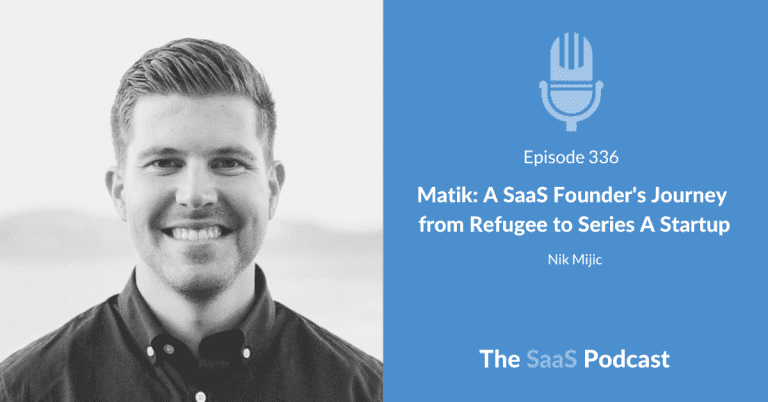
Nik Mijic, Matik
Matik: A SaaS Founder’s Journey from Refugee to Series A Startup – with Nik Mijic [336]
In this episode I talked to Nik Mijic, the co-founder and CEO of Matik, a SaaS product that helps create personalized Google Slides or PowerPoint presentations using automated data driven content.
In 2018, Nik was working as a program manager at LinkedIn. When he came up with the idea for his new startup, he saw that many companies were wasting time and effort manually collecting data from different sources to add to presentations. And he realized that software could streamline and automate a lot of that work, but he wasn't quite ready to quit his job.
So Nik and his co-founder, Zach, who met through a mutual friend, spent six months researching the idea and trying to figure out if they were a good fit for each other. Eventually in January, 2019, Nik was ready to quit his job, but the hardest thing for him was telling his parents as refugees from the Bosnia Civil War.
His parents thought their son had finally made it by getting a job with the great company, and now he was about to tell them that he was quitting. The co-founder started working out of Nik's apartment and it didn't take that long to figure out how to build the product, but the bigger problem was that neither of them knew anything about sales and how to get customers.
In this episode, Nik shares his lessons as a first time founder. We talk about what he did to learn how to sell and get those first 15 or 20 customer. How he went from having no sales experience to selling the product, to eventually building and managing a sales team. We also talk about a technique that Nik uses to deal with the emotional highs and lows of being a startup founder and how he's used a somewhat unusual framework. To build a solid support structure around him.
Today, Matik's customers include B2B tech companies such as Asana, Glassdoor, Greenhouse, and SalesLoft. The founders have raised 23 million, including a 20 million Series A round in 2021, so I hope you enjoy it. All right, Nik, welcome to the show.
In PowerPoint or Google Slides today, the way that we kind of came up with this idea was I was at LinkedIn prior to starting the company. And before that I worked at a customer success software startup. And that was where the idea initially came from. We had a lot of our customers saying, Hey, we do these things called business reviews renewal decks, where we have these templates and PowerPoint on Google Slides, and there are placeholders that will say, Hey Nik, go to Salesforce to get this data point.
Go to Tableau to get this chart. It'd be awesome if there was a one click button that pulled in all that data for a particular account and spit out a presentation and narrative. And so when I was at LinkedIn, I had worked on building out internal tools and narratives and had a opportunity to rebuild an internal tool.
And that's really when it kind of got me thinking, Hey, there's probably other companies out there that have a very similar challenge where their sales and customer success teams are putting together this data driven collateral. , whether it's a QBR, whether it's a quarterly business review, an ROI deck, a business case, it's very, very impactful, right?
When you share data with your customers and prospects, the likelihood for better business outcomes are there. But it's very tedious and it's very time consuming. And so our hope and our goal with Matik is to help alleviate that problem and, and help automate and streamline the creation of that data driven content within PowerPoint or Google Slides.
I, I was really young when the war broke out. And we ended up fleeing the country and going to Hungary for about a year and a half. And then we ended up in Germany for about four and a half years and wanted to stay, but there were so many refugees that were coming up out of the region that we weren't able to get citizenship.
And so, you know, parents decided to apply to a variety of places. We applied to Canada, Australia, US, and got accepted to the US and my mom and dad were like, Hey, let's do it. Let's, let's, you know, American Dream. Let's, let's go over there. So we were choosing between two cities. You know, when you'd come in as an immigrant or a refugee they'll ask you, Hey, do you have any friends or family that can help you get on your feet?
And so we had some friends or cousins in Chicago, and then we had some family friends who went straight from the war to Salt Lake City, Utah. And my mom and dad ended up picking the cheaper options. So we ended up going to Utah, which was you know, went to school there high school, college, and then ended up coming to the Bay Area after, after college. I've been here for about almost 11 years.
We didn't speak any English. And definitely, obviously I think a lot of people say, oh, tough upbringing. But at the same time, I think it's shaped who I am today. And I think it's a lot of those lessons of perseverance that I saw through my parents is one of the reasons why I started Matik, right?
Because I don't think I would've had this opportunity to work at LinkedIn or start Matik if it wasn't for the sacrifices that that they made. And picking up, not just once, but you know, we went from Yugoslavia to Hungary, from Hungary to Germany, and then doing it a third time and coming to the US it really kind of showed me the sacrifice that they made. Right?
So what was your parents' reactions to that?
We have a cafeteria. They saw all the food, they had all these activities. Also, when you're, when you're an immigrant refugee, I think your parents want you to be like one of three things. They want you to be a doctor. They want you to be a lawyer or they want you to work for like a big company like Microsoft or Coke, Coca-Cola, LinkedIn, that they can brag to their friends back home.
But honestly, I ended up flying back to Utah because that's where they're base out of right now. And I want to tell them in person. And the feedback I got from them was like, Hey, like do it like you're at the point in your life where you have the ability to go and take this risk. That's why we came to the US was to give you this opportunity.
And if we need to sell our house, if we need to do anything, like we're here to support you. And I think that really gave me the confidence to be like, Hey, I know LinkedIn is great. The perks are amazing, the culture is amazing, pay is amazing. But I don't wanna have that regret later on in life knowing that like I, I wanted to try to do something and I never did.
Right. And the other turning point for me was not just my parents. I had a nephew that was born right around that time and I remember being in the hospital with my brother and thinking, man, like, it doesn't seem like yesterday we were kids playing in the playground and now we're raising kids. And it was the first time in my life where I realized how quickly time flies, right?
Like when you're in, in high school, you can't wait to get to college. When you're in college, you can't wait to become a working professional and time go by quickly, but you don't understand the magnitude of how quickly it goes. And then seeing my nephew born, it just really hit me. And so I think two reasons, right?
One, my parents, I wanted to be able to show them that, hey the sacrifice you guys made, this is a sign of me of appreciation for you guys. And then two, I didn't want to have that regret later on in life to be like, Hey, I should have tried to, to start a company and never did. Right? And, and I know how quickly time flies.
So him and I just kind of got together. I told him about the idea and I was like, let's just do some research, right? Like, I haven't worked with you, you haven't worked with me. I'm not quite ready yet, to quit my job. And we did that for about five to six months and we really just hit it off. I would say our core values really aligned.
The way that we kind
of worked together just worked. And so you know, at that point I was ready and I was like, Hey, this is me getting down on one knee proposing, like, let's do it. Let's, let's let's get a joint bank account and you know, start this thing. So that was kind of the, the initial starting point.
So it wasn't just something that we thought was cool to solve for, but other people, other companies had this problem, right? So we were, one was just validating that this is a problem we're solving for, right? And the way we did that was a lot of conversations, right? And that doesn't mean that every conversation we had was positive, but majority of the conversations that we had were saying, Hey, Thumbs up, this is a problem that we have and we'd love to solve for.
A secondary piece, which is more of Zach's realm, was kind of the technical components, like how are we gonna go and build this? Like what is the tech stack that we would use, right? What are kind of the base requirements that we would start to build a prototype?
So that was kind of the, the, the secondary thing. And then I think the third was, I guess, him and I just kind of feeling each other out, right? Because we had never worked together before. We wanted to make sure that we were on the same page and we had the, we had the same goals going into starting a company.
I had a roommate, a former roommate of mine who had just sold a company to Autodesk and you know, I caught up with him and I was kind of giving him the idea. I wanted to kind of run some things by him, and he was like, Nik, like I love this idea. Like, our company could use this. Like, I want to invest. And I'm like, well, we don't really have any customers.
Like this is just, these are wire frames. Like we're still, you know, building prototype. He's like, I think there's something here. I think you should like, I want to invest. And so we did a safe, we did a small safe. $200,000. It wasn't, wasn't a big, big safe. And that kind of helped us build the initial prototype.
And then we got a few companies that were crazy enough to like try out the product, right? Feedback was overwhelmingly positive and that's what led to us raising a 3 million seed round with Menlo Ventures and a few other seed funds. So that's kinda how we, we got our start.
This is kinda what we're trying to solve for. We automate, you know, presentation building and PowerPoint, Google, and she's like, oh, our customer success team at our company could definitely use that. I'll send you an intro. And so she ended up sending me an intro to their enablement person and kind of showed them the initial prototype.
They really liked it. And I remember them like, okay, great. What, what's next? Where do we sign? And I remember going back to Zach, I'm like, ah, we don't have a purchase order. We don't have like legal terms, like kind of contacted a few folks. I'm like, do I, what do I charge them? So I literally just came up with a number and I said, Hey, $2,500.
Right? So it wasn't a lot. And they were like, great send us the DocuSign. And that was really our, our first customer. And then they ended up expanding from there. So they did test the product before they bought, but it was a, it was also, that was a huge milestone for us because now it wasn't just people trying it, people were willing to put their dollars and behind us, right. And actually buy the product.
Was, was selling the product fairly easy despite that?
We're gonna invest all these resources into implementing your solution and having our teams use it. Like how do we know that you guys are gonna be around? Right? And I think the raising a seed round helped give us some credibility, right? So like, Hey, there's institutional money behind us now. It's not just two guys working out of an apartment or a WeWork.
It's legit. Like there are, there's backing here at at, at a VC level. So that was definitely a hurdle early on that we had to overcome. And I think another one is just we connect to data sources, right? So our primary persona that we go after is obviously customer success and sales teams. And for customer success in particular, a lot of the data that they show in these presentations is usage data where you're connecting to a CRM or you're connecting to a database and that's very sensitive information. And people security was really, really important. So we invested a lot in security upfront, whether it was getting certifications like SOC two, type one, SOC two, type two, investing in technologies for monitoring. That was a big part of how we were able to kind of handle that objection up front.
How did you learn to sell? Were you just like winging it? Did you go out and find a mentor. Like what did you do? I think all the above. It is going. Yeah, I mean, it is all the above. So I definitely had some folks we had some advisors that had a sales background where, you know, SVPs of sales at, you know, pretty decent size tech companies and I would lean on them quite a bit, right?
Like, 9:00 PM at night. Hey, I don't have an order form. Do you have an order form? Or like, Hey, I got this objection. What do I do? How do I respond to it? So a lot of it was mentoring and coaching from our advisors and folks in my network. And the other was iteration and, and just trial by error, right? So I would see what messaging would respond.
I would see what messaging didn't respond. And again, you're iterating constantly, just like you're iterating on the product. We were iterating on that go to market process as well.
So first basically target group was people in my network. Then I would look at former employees of LinkedIn that are at new companies, and, and that really resonated because they're like, oh, you know, I don't have those same tools internally here. I would love to take a look at your solution and what you guys are doing.
What was that experience like? Was it, was it easy finding the right sales people? And what was the transition like to moving from founder-led sales to relying on a sales team to go out and sell for you?
So again, leaning on our investors, leaning on our network of, of sales advisors to kind of help us. Made a hire really early on. Great individual wasn't there for very long. It was like right during Covid. And I think the hardest challenge is finding someone who wants to work at an early stage startup where there isn't all this infrastructure, there isn't product marketing, there isn't sales enablement, right?
You don't have a ton of resources. But it's not just so junior where they're like leaning on you and that, that's kind of a tough hire to find. And so we ended up hiring someone who was a, had some big company experience but was really eager to get into startups and she did a fantastic job of just kind of building that initial playbook for our sales team. And she did some of that initial hiring on the SDR front and we worked really closely together to, to build that out. So it definitely was a challenge. And you know, like I said, one of the learnings that I had there too was you gotta hire in twos, especially on the sales side.
I think a lot of founders are probably wary because it's costly, but at the end of the day, hiring in twos allows you to really see if it is the person that you hired or if it's the process. And having those two is a benchmark. You kind of know like, hey, one person's performing one isn't, or both are not performing.
So maybe it is the process or the other way around. Right? So that's definitely a big learning that I had early on was higher in twos on the go to market side.
So did you do that with SDRs and AEs? Like everybody was coming in two. Well initially, right? Like I think like your first hires, like hire, make sure that they have somebody that they can compare themselves to.
So like when we hire the account executives, yes, hire twos. Same thing with SDRs, hiring twos because also they can learn from one another, right? And you want to build that culture of collaboration and it's hard to do that when you're just on your own.
She was kind of, and I was helping out. Right? So still helping out on deals, right? And I think that's one of another key learning is you, you never really remove yourself from selling as a founder. So as you transition from founder-led sales to a more codified process, you're still going out there and selling, whether you're not necessarily managing the end-to-end cycle, but you may be coming in at the end, or you may be coming in at the beginning.
And it also helps me kind of get a pulse on the market and the pulse on, on how our prospects are responding to our messaging, how our customers are responding to our products. So I've really enjoyed that aspect of it.
Cause you're the founder, right? And especially if you're the tech guys as well, it's like, yeah, we could do that probably, whatever. But once you're then relying on a sales team to do that and they can only lean on a playbook or whatever training they've had, it's not as easy for them to navigate their way through some of the questions that customers may come up with that you haven't addressed so far.
So how, how, how long did it take for you guys to figure out a playbook that you felt pretty comfortable with, that was working well?
You're still learning. We're still in the early stages. We're still learning from what we're hearing from the market what we're hearing from customers and how we can constantly improve. So it does take time. But I think the key, key thing here is that that growth mindset, that iterative mindset where, and the hope is that the people that you hire, those account executives can embody that type of mentality where they're okay with ambiguity, they're okay with a little bit of, you know, chaos.
But they can help provide structure to that chaos and they can help provide structure that ambiguity. And so a big part of it is not just the playbook or the process that you're implementing, but the people behind that, that can constantly go back and iterate and tweak based on the learnings that they're having. Right?
And then we also saw a big expansion play as well. So a lot of those early customers that we signed on, we're getting a lot of value in our product and we're now starting to say, Hey, we only bought for a certain segment within customer success. Now we wanna buy for the entire team. Right. Or, Hey, we think our sales team could also use this.
Yeah, they're not, their presentations aren't as like data heavy as maybe customer success, but they do business cases, they do ROI calculators. Some of the pitch decks are a little bit more dynamic. We'd love to use Matik to automate that process. So a big part of our motion too was also expansion which we've had a lot of success with this year.
You, you brought on the, the sales team to, to start, you know, hopefully starting to scale the, the growth. What, what's, what's been the kind of, what are the hard parts of, of scaling? Right. That, that's what I'm trying to understand is like, it, it sort of, I hear the story so far and it's like the problem resonates with people.
You didn't have that much of a hard time selling. Okay. You had some objections and things you had to overcome and, and certainly raising the seed round, as you mentioned, helped to build some credibility and maybe overcome some of the concerns people had. But beyond that, what have been some of the difficulties with trying to scale sales and get to some of these lands, some of these customers that you have today.
Right? And so, as you know, this year as we've had the growth that we've had, you know, we raised a Series A last year with Andreessen Horowitz. We raised 20 million, 20 million series. . Now it's like, okay, we made a lot of these hires, but how do we continue to execute on our long term vision of where we want to go and how do we ensure that as a team continues to grow in size, they're not going into their own silos, they're all rowing in the same direction.
So that, that's something that's like really top of mind for me, as well as just talent. Like I'm a firm believer that it's not the technology that wins, it's the people behind the technology that wins. And if you can build a great team, right, and you foster a great culture I think that is like one of the main ingredients to success.
Like I said, I'm a first time founder, `so I may be naive in that, but from what I've observed in the startups that I've worked at that have been successful, the ones that haven't been successful, you know, I think culture is such a big part of it, and that stems from your core values, your mission, vision, all of that, and making sure that your team really knows where you want to be, not just today, but where you want to be five, 10 years from now.
So tell me, tell me a little bit about that. What, what, what's the lesson you've learned? How do you try to be even-keeled as as you run this business?
And it's unbelievable, huge milestone in the company. And then those are the days where, you know, maybe you have a bad meeting with a prospect or they didn't really understand what you're trying to say. Maybe at back-to-back meetings where that happened and you just feel like, wow, I'm just, you know. And so you don't really wanna be too high in the highs.
You don't wanna be too low in the lows. And I think another. Thing that's been a learning experience is last three years, four years, not just in business but in society. A lot has happened, right? The pandemic, the war, social injustice and all of that is now like, is starting to collide with business. And so having to learn how to cope with that, with your team, how to address that with your team, how do you navigate a business through that type of climate that's outside of work, that's all been something that's been definitely a learning experience.
And I think in times like that, you lean on your core values, you lean on your culture. And one of the things that Zach and I first did before we started writing any code, before we did anything was like, we literally wrote down, this is kind of cheesy, but we wrote down the things that were really important to us. Like what are the core values that you want to this company to live by? What are the core values that I want to, and what is that framework that we want everybody else to buy into? And I think that's really helped us navigate the last four years, not just from a business perspective, but also all the stuff that's going on outside of the business. Right?
And one of my favorite sayings is like, trust is consistency over time. It's not one of those things that I meet you, you meet me, I hire you, or you hire me. Boom, there's trust. We are, you know it is your actions over time that prove to me that I can trust you and vice versa. The, second one that we really wanted to really focus on was compassion.
And this is something that, that LinkedIn, Jeff Weiner the former CEO, the chairman, now, he would always talk about leading with compassion, and I really took that to heart because we all come from different backgrounds. I'm a refugee. My co-founder Zach grew up in Sonoma, right, and totally different backgrounds.
That doesn't mean that his upbringing was better than mine or vice versa, but we may have different ways of looking at a problem. We may have different views on, on how to tackle a problem, and so that's fine. But we should always try to understand and put ourselves in the other person's shoes. You know, let's say you and I disagree on something.
Well, maybe Omer had something happen to him over the weekend that I don't know about outside of work, or maybe in his past job they tried to solve for the same exact problem and they went down this route and it led to a disaster. Right? So those are probably the two. Like I said, we have two others. One is quality and the fourth is being customer first. But those are two examples.
And you're gonna be testing, you're gonna be iterating, and you really need to have a good support structure. And he told me, he's like, go find a brother or sister. Go find a mom or dad or go find a grandma or grandpa. And so when he told me that, I go, what do you mean by that? And he was like, the brother or sister is the person in your, in your support structure that you can reach out to when you've had a long day and you're like, Let's just go grab a beer or let's go grab lunch or dinner.
I just need to vent, right? And they're gonna give you that pep talk, like, Hey, remember why you're doing this? Push through it, right? The mom or dad is someone who is on the same journey, but they're may be two or three years ahead of you. So an entrepreneur that, like I said, is three years ahead of you, that can give you tactical advice.
Like, Hey, I don't have a purchase order. What did you guys do here? Hey, I'm hiring for this role. Share some learnings that you had when you were hiring for a similar role. And then the grandma, grandpa is the persona or the person that can give you that 50,000 foot level. They've done it multiple times. Right? And they can kind of help you navigate that, that high level overview.
And like I said, set those expectations. And the other is you, you wanna rotate them, right? So everybody has, you know, those friends who come to them constantly. Always complaining. And I, I didn't want to ruin those relationships. So, you know, I try to rotate every, you know, six to 12 months, try to get a new brother or sister, try to get a new mom or dad that I can lean on and a lot of that is just the people the relationships that I've built during my professional career.
Things are not gonna perfectly align like you want. You're gonna make decisions. And even if it is a mistake, that is still progress because now you, you've learned something to hopefully not make that mistake again. So I'd probably say that's the biggest thing is don't, don't you know, don't be afraid to, to make mistakes and, and, you know, go, go for the home run. Like really push forward.
There is not, you don't have a massive data set that is statistically significant that you can say, Hey, we lead, this is why we should make this decision. And I think this is where we're kind of at. At the life cycle of the company where a lot of the early decisions were gut, it was hypotheses. And now we've gotten to the point where we've collected some data.
Now we've gotta change our mindset to now not couple that qualitative feedback and that qualitative data with quantitative data. Right? And so I would say now we're starting to lean more towards, okay, we have historical data, we have a data set that we can use to make decisions. But early on that was not the case.
Right? And I think that that was hard, right? . When you're working at LinkedIn or you're working at other companies, you always have that data. You use data to go and make those decisions. And you know, when you're first starting the company, there is no data to lean on. It is all, `you know, research and, and that gut that you're kind of having to lean on.
All right. Great. So we should we should wrap up and move on to the lightning round. I've got seven quick-fire questions for you. Just try to answer them as quickly as you can. You ready?