Why Your First 12 Customers Should Pay Almost Nothing
Protect your price. Anchor high, hold firm, and never let your first customers set a cheap precedent you will spend years undoing.
How SaaS and AI founders who scaled got their first customers
One email every Thursday. Unsubscribe anytime.
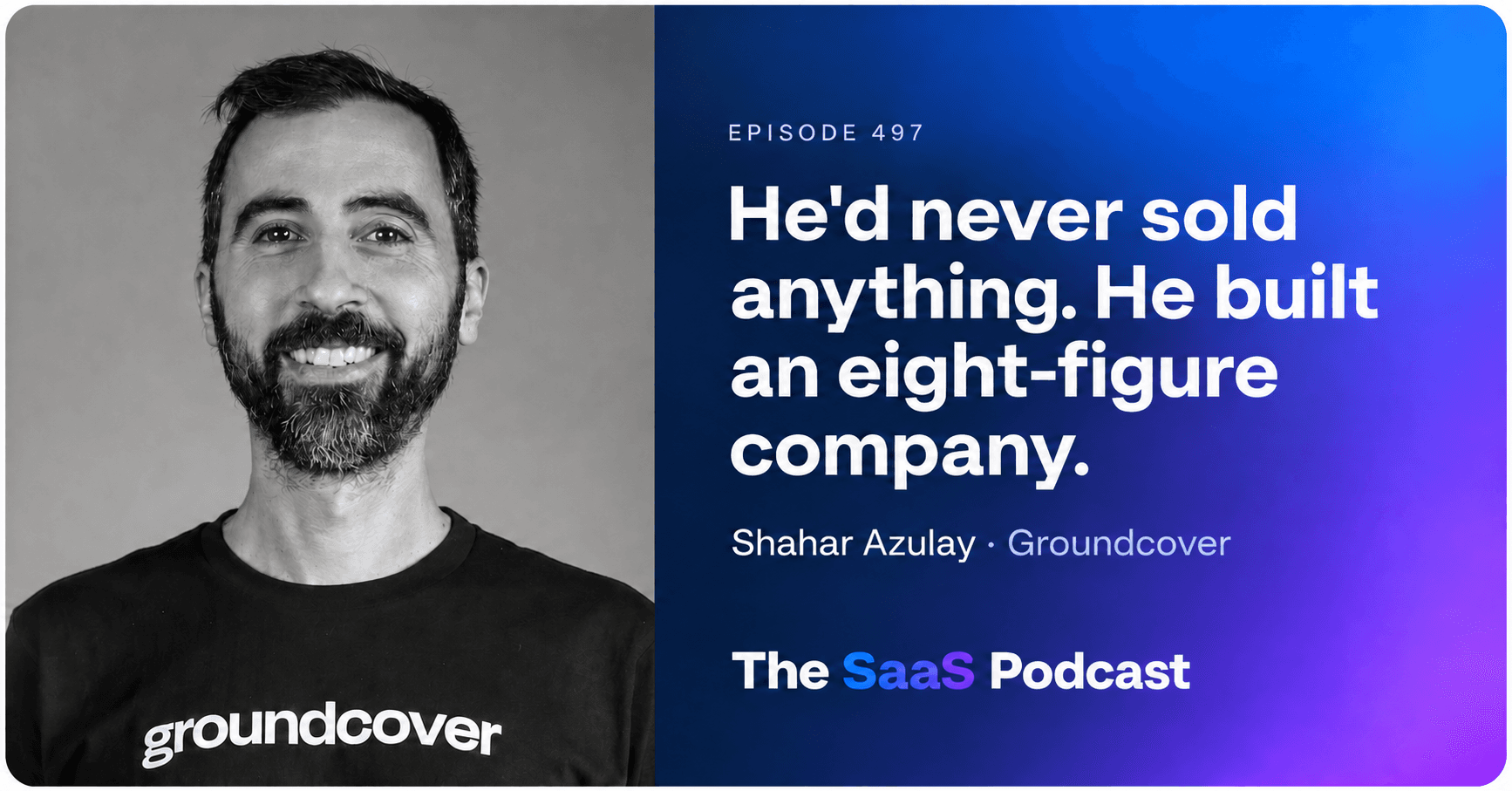
Shahar Azulay had never sold anything before he co-founded groundcover, so he learned by closing his first dozen customers at almost any price they would pay. He asked his first customer for $100,000, got talked down to $10,000 a year, and said yes to a product that had no user interface yet.
He still argues that was the right call. The reps and the confidence matter more than the contract value when you have nothing. This conversation covers how he took groundcover to eight-figure ARR doing every sales job himself, from the first LinkedIn message to the deals that finally replaced Datadog.
Shahar Azulay is the co-founder and CEO of groundcover, an observability platform that helps engineering teams catch problems in production before their customers do. He has built it to eight-figure ARR with more than 250 customers, competing directly against Datadog and New Relic.
He came to it as an engineer, not a seller. Shahar and his co-founder had spent their careers as engineering managers, living the same frustrating cycle: instrument your applications, emit the telemetry you need, then get told the bill is too high and start sampling and switching things off. They set out to solve that with technology rather than a different margin, and bet the company on eBPF, a kernel technology nobody in observability was using at the time.
The selling was harder than the building. Three months in, groundcover closed its first customer through a connection to a head of DevOps. There was no user interface yet, just the sensor and some dashboards. Shahar went into the pricing call asking for $100,000 and came out with $10,000 a year, because neither he nor his co-founder knew what they were negotiating against.
His conclusion from that is contrarian: close your first dozen customers at whatever price they will pay. The learning, the references, and the confidence are worth more than the contract value, and you cannot expect to grow those early accounts anyway.
Shahar also covers how the first 50 to 100 customers came from his own network and a handful of LinkedIn messages a day, why he published list pricing and then discounted it by up to 70 percent, and the moment customers started ripping out Datadog before groundcover was ready for it.
Shahar Azulay co-founded groundcover with no sales experience and won its first customers by publishing a per-host price, discounting it by as much as 70 percent, and accepting almost any deal that would close. He treated early contract value as irrelevant, prioritizing reps, reference logos, and learning to run enterprise procurement.
Protect your price. Anchor high, hold firm, and never let your first customers set a cheap precedent you will spend years undoing.
You close a customer who already uses a competitor. You count the win, move the logo onto your website, and go back to prospecting.
Technical founders tend to wait for a salesperson before they take pipeline seriously. The hire is supposed to bring a process, a playbook, and a pipeline.
Most early founders keep pricing private and quote per deal. It feels safer. You can read the buyer, size the opportunity, and avoid leaving money on the table.
How do you sell when you're a technical founder who has never sold?
Shahar Azulay treated his first dozen deals as training rather than revenue, closing them at almost any price to learn procurement, security reviews and legal. He argues the reps and reference logos are worth more than the contract value.
Why did Shahar Azulay accept $10,000 after asking for $100,000 for groundcover's first deal?
He and his co-founder had no idea what they were negotiating against, and the customer offered a three-year commitment at $10,000 a year. With no other customers, he took it rather than lose the deal.
How did groundcover get its first customers with no brand and no user interface?
Through the founders' own network in Tel Aviv, meeting heads of DevOps in person. The first customer came via a connection and bought a few specific use cases the eBPF sensor could see that their existing tooling could not.
How did Shahar Azulay generate pipeline before groundcover had any sales team?
He prospected himself on LinkedIn, sending 10 to 15 personalized messages a day to heads of DevOps, and worked his existing network. A product-led motion on top of that produced the first 50 to 100 customers.
Why did groundcover publish its pricing publicly instead of quoting per deal?
Selling mostly to mid-market, a published price per host anchored the conversation and let both sides skip a negotiation neither was equipped for. Experienced buyers know an early-stage startup will discount anyway.
How many customers did groundcover need to reach $1M ARR?
Around 50. Shahar did not hire a VP of Sales until a few hundred thousand in ARR, and the first three account executives joined in early 2023 when the company was close to $1M.
Why was Shahar Azulay still running product demos almost five years into groundcover?
Building a technical sales team is slow, and early attempts failed. He kept demoing across Tel Aviv and outside North America into 2025 because he could not yet train others to do it well.
How did groundcover go from a complementary tool to a full Datadog replacement?
Customers decided first. In 2023 a few Tel Aviv customers bought the product and announced they were ripping out Datadog, which forced groundcover to build a migration and post-sale motion it did not have.
Why did Shahar Azulay bet groundcover on eBPF before anyone else in observability used it?
His team came from cybersecurity and already knew how to build a safe, high-scale agent. eBPF gave them kernel-level visibility with no code instrumentation, which incumbents selling SDKs could not easily copy.
Shahar: We were completely scared when they installed the product for the first time. We weren't even sure what they were buying back then. So that was the first customer we had no UI at that point. I came over to the CFO, I said, you know, this is gonna cost 100k. And we ended up with 10k, which is why I'm not the bestseller in the company. Closing at any price is what founders should do at the first dozen opportunities that they have.
Omer: Welcome to the SaaS podcast. I'm Omer Khan and this is a show where I sit down with real founders and dig into how they actually built their SaaS companies. I've had almost 500 of these conversations now, and I put out a new one every week to help you build and grow your startup. So if that sounds interesting, hit subscribe or check out saasclub.io to learn more. My guest today is Shahar Azulay. He's the co founder and CEO of groundcover, an observability platform that helps engineering teams to spot problems before their customers do. And he's built it to over 20 million in ARR. In this episode, Shahar breaks down how he taught himself to sell as a technical co founder and how he asked his first customer for $100,000 and got negotiated down to $10,000. He explains how he got his first 50 customers from his network and sending out a handful of LinkedIn messages every day, and why he was still running demos himself almost five years in long after he'd built a sales team. So I hope you enjoy it. Shahar, welcome to the show.
Shahar: Hey, thanks for having me. Great to be here.
Omer: Yeah, my pleasure. So tell us about groundcover. What does the product do? Who's it for?
Shahar: So groundcover is basically building the AI era observability platform. We're a full stack observability solution, competing with companies like Datadog, New Relic, Grafana, basically selling our products to R and D as a customer, basically helping them make sure that their applications and infrastructure are reliable and up when they serve their customers with different software products in the cloud. So yeah, that's what we do.
Omer: Okay, cool. And what makes groundcover different from some of these other players that you mentioned?
Shahar: I mean, first of all, the observability market is a very mature market. It's been around for 20 years, give or take, in its current form with a few different changes. It's never a greenfield. Everybody's using it. Like every R and D team on the planet has some kind of solution already ingrained in their activity. It's a mission critical tool. You use it to wake up in the morning and making sure that everything went quietly at night and kind of have continuous monitoring as you develop new features or just making sure your customers are getting the adequate service. So it's a very mature market. The solutions are out there for a while. The pain that we're feeling and the hypothesis behind ground cover and why it was formed five years ago ago is that the telemetry required to monitor an active production system is just growing and growing and growing. And this is before even AI, right? Cloud native kubernetes. The cardinality and kind of nature of these infrastructures and application stacks just keep growing and these organizations just need much more data and much higher cardinality and fidelity to make sure there's an issue in production and understand what's going on and kind of help their customers. The structure that vendors like Datadog and others are currently built on is a classical SUS structure which made sense like ten years ago. Right? I will host the data for you. You will pay by data volume, by telemetry volume. And you don't have to be concerned about where you send it or who stores it or how much it's accessible. I'm going to take the toll away, but you're going to have to pay me per gigabyte or cardinality or whatever that is. This is not making sense anymore because basically we see customers just not using significant parts or not covering significant parts of their production because of that pain of I'm paying for that usage. You can think about it as kind of the equivalent of pain by airtime. When you're calling someone like the good old days, it will change behavior. I'm not gonna say the same thing. If I'm calling you before I meet you, I might say, let's meet up in five minutes. I'm kind of close by. It changes the behavior of customers of how they consume telemetry. When we go into AI that gets worse. We need more telemetry and there's more agents relying on this telemetry to make decisions like coding agents and PR agents and so on. So groundcover is very uniquely different because we're built on top of a bring your own cloud architecture. Basically, we're not a pure SAS company. We manage our infrastructure, our backend in the customer's premises. We give them the managed experience, but we keep the data plane hosted on their premises. So we don't pay for the data. They do, but we don't mark it up. That allows us to create A completely different packaging and experience that is completely different in the volume and the fidelity of data that customers can utilize. Right. This is the main differentiator that groundcover is currently built on top.
Omer: So instead of usage based, you are charging effectively per host.
Shahar: That's true. We charge by the size of the infrastructure. You can say, right. How many hosts in the cloud are we actually monitoring? With groundcover, we also have a unique eBPF sensor which is a kernel based technology that allows us to basically collect that high fidelity telemetry with no code instrumentation and almost no effort from the R and D team. So that combined with the bringer on cloud allows us to create very fast time to value and a different packaging with the backend which is different. So if you're covering a host with groundcover, you get everything like logs, metrics, traces, and we charge by dap, not by the volume of data you push into the platform.
Omer: Great. So a lot of stuff there to unpack and we'll get into that. Before we do, give us a sense of the size of the business. Where are you in terms of revenue, customer, size of team?
Shahar: Yeah. So ground cover is about $20 million of ARR.250 customers, give or take. About 150 employees right now globally. R and D and product are in Tel Aviv. The rest of the go to market team is in the States, which is kind of North America is our main focus. But yeah, that's currently the state of the business.
Omer: Great. So before you founded groundcover, you were working, I think at Apple and tell me what was the pain or the frustration you were experiencing or seeing with other people that told you there's an opportunity here to go and build something.
Shahar: So Chaz, our CTO and I, we were kind of in a similar route, right. Engineering managers for, you know, all of our career in different aspects. I spent a significant amount in cybersecurity, like a lot of people in Tel Aviv. That's kind of what we do. And then a significant amount, almost a decade in, it was called machine learning back then. Now it now it has a fancier name. But it was always the same problem. Right. You were, you're, you have, you have a team, you need to monitor application in production and you need to instrument code. And you put all this effort into instrumenting your application, kind of emitting telemetry that you can use to wake up at night or figure out that something's wrong. And then someone comes over and says we can't really pay for that. And then you go about that Cycle again and just sample, reduce, deactivate specific environments. So both of us seen that vicious cycle happening multiple times even before Apple. I've worked in a few startups and Chez is the same. So we kind of saw it firsthand, right? Choosing these technologies for our team, maybe kind of feeling firsthand that trade off that our customers are feeling right now. Right. We're not even saying that datadog isn't a great product or that new relic isn't a great product. I think these companies are great engineering companies. It's just that the way that people consume the product doesn't make sense anymore. And we felt that firsthand, so. So that's kind of why groundcover was formed. We come from deep tech, from cybersecurity as a background. So we thought about how we can solve the problem with tech and not by just a different business model, a different margin or whatever. And that's the foundation of what groundcover is built at that.
Omer: So the moment that the two of you decided we're going to go and start this company, what was the first thing that you did?
Shahar: I think for us it was always kind of just experimenting a bit with the technology and what can actually make a difference. To be honest, when we started, it was kind of the end of 2021. We started a company, we just ran into eBPF. Part of what we did in the past was in cybersecurity. Chaz had a deeper experience than I, even in kernel technologies from a different aspect. But it made a lot of sense when you kind of heard about this technology and no one heard about it, including when we were raising money. Right. No one really heard about that before, but it kind of ticked the box for okay, this could be a very interesting data source for engineers. Right? How they can actually get deep insights on application infrastructure. The relation between the two, we weren't even thinking about bring your own cloud back then as kind of a significant differentiator. It actually happened natively. The first customer ground cover closed, you know, three months into. The company was using a self hosted infrastructure that we created. We kind of created intuitively because we knew that we couldn't really do it differently than datadog. It's not like we were thinking back then, sure, right. We're going to invent a new compression method and compress the same data 10x compared to Datadog. We knew that they were great engineers so we tried to intuitively solve that differently. But the first thing that we did was actually set up kind of a home lab of ebpf we experimented with that for a couple of weeks at the beginning and that was kind of eureka for us. We saw that technology and what it could do and I think it escalated pretty quickly from there to trying to get our seed round back then.
Omer: So I had no clue what eBPF was before I started researching for this interview. And I can barely explain it to somebody now. But can you explained it a little bit earlier? And it was relatively new technology even for you guys. But was anybody else in the observability space using it? And if not, why not do you think?
Shahar: First of all, eBPF is a very kind of ancient technology. From its core, it's actually founded in bpf, which is the foundation of TCP dump and tools like that, which are a lot of developers experimenting with Linux thermal tools and stuff like that that know from the past. Basically what it was supposed to allow as it kind of, you know, evolved was to run heavy logic on traffic of network, for example, in the actual kernel and not the user space. So you can, you know, be more effective at resources. The main application 20 years ago was packet filtering, right? You, you wanted to just route or filter high volume packets. If you would do it in the user space, that will consume a lot of memory and cpu. So you could, you could have rolled some of the logic back to the kernel level and actually tweak what the kernel is doing without writing the kernel code right, which you don't want to do. You don't want to recompile the kernel. eBPF evolved and did a significant step function like five years ago or six years ago, where you can actually load a program, an eBPF program, safely into the kernel, basically modifying kind of in a sandbox the behavior of the kernel to run your logic, where it's very effective. Security and observability, if you want to monitor what things are doing, you can actually put a logic in the kernel that is safe, that says every time a packet or an event happens or a syscall is being called or something is happening inside the kernel, I can observe what's going on. For observability, you can clearly understand what it means. Every time an API goes through the network stack, I can take a look at that and I can observe it and I can create a, a lot of understanding. Same for security. When we started, no one was using it for observability. Security was an initial use case, which is still very attractive. Companies all around the world from a security perspective use eBPF as their main sensor. From the analogy Perspective, you can think about it of some sort of an X ray into software, right? Because instead of being instrumented into software, which all the companies in observability did before, they sold an SDK, basically before OpenTelemetry, Datadog, New Relic, Dynatrace, all these big guys, they sold you an SDK to instrument into your application so you can hook and observe these behaviors inside the software stack. Now you can do it out of band from the kernel without being part of the actual code. Fifteen years ago, when people were writing Java and they were kind of full Java shops and stuff like that, it made less of an advantage. But right now, like in cloud native environments where there's democratization of software tools, right, every team writes differently with different languages and stuff like that. That becomes a superpower, right? I can basically see everything without the need to developers unifying their efforts in instrumentation and kind of making sure they're aligned on the same way. So eBPF is kind of that X ray into what the application is doing by using kernel resources to kind of look into how it's using the network stack and the infrastructure that's running on top.
Omer: You guys basically bet the company on this technology back then. What gave you the confidence that this was the right thing to do?
Shahar: I think we felt that it was so powerful as a technology and that we know how to harness it since it was so early and the original core team in ground cover, I mean, different teams, when they start up a startup, they have different core capabilities. We created again a lot of teams in Tel Aviv that come from cybersecurity. We had that core capability of building an agent. And building an agent is very different than building a SaaS application. You have to run at limited resources on a host and be safe and secured and so on. So that kind of skill or experience from the security domain was suddenly very useful in the observability domain. So we knew that if eBPF can provide the telemetry we needed, we can build an initial team around it to create an agent out of it that is safe, that is secure, that is high scale. And that's exactly what we did at the beginning. So I think that's why we were so interested, because we knew that we can take it to the next level. And even five years after, even though after EBF is proven and there's a lot of interest around it, we still see the big players in observability not going into it yet. Because it is a skill you have to build a team. We saw a few Acquisitions around it to kind of like new relic. Acquired an eBPF company to try and kind of get a hand of this technology. It's not that simple to take a company that used to build an SDK and build an eBPF agent overnight. So I think that's kind of our main draw. We went into it, we knew that we can do it. We knew that we had the skillset to kind of think about it and utilize the technology.
Omer: So you mentioned earlier that it took you about three months to get that first customer. Who was that and how did they find you?
Shahar: So first of all, the original period was very founder led. We were sitting in Tel Aviv with a very small team. We actually started from a couple of weeks from an apartment and then moved to an office. So it was kind of that garage phase even for a few weeks. And we were traveling in Tel Aviv kind of, you know, using our network as much as we can, you know, meeting a lot of head of DevOps which is the Persona that we usually sell to. And we got into a connection to the head of DevOps in of lemonade, which was super interesting company of course back then and even now. And we, we have, you know, the luxury of actually having their original head of DevOps that bought the product working for groundcover now. So for us it's an amazing closure. An amazing guy, very unique person. He was the early adopter of groundcover and we told him that like years after. But we were completely scared when he installed the product for the first time. We weren't even sure what they were buying back then. So that was the first customer. So you had no UI at that point even. We just saw the sensor with kind of telemetry around it and the ability to build dashboards in Grafana open source back then. That was what we sold in the original product. I came over to the CFO said, you know, this is going to cost 100k. And we ended up with 10k, which is why I'm not the bestseller in the company. But it closed eventually. So yeah, that was the original journey.
Omer: So what was your pitch for a product that didn't have a UI and kind of had this thing that was going to help them solve some problem, but the DevOps guy might get it. But how do you explain it to a cfo?
Shahar: Back then the use case was kind of seeing things that they cannot see in Datadog. They were using Datadog heavily across the organization. Clear we're very early. They never really planned to replace Datalog back then, which is Most of what we're doing right now, but they have use case like for example DNS traffic and kind of weird issues in their cloud environment that only eBPF can see. It's very, very hard to do off an agent that isn't running so deep into the infrastructure. So it started with a few kind of interesting use cases and kind of edge use cases that we and the initial Lemony team saw a lot of value in. But they weren't like in a mindset looking back, they weren't in a mindset of this can actually be replacing our observability stack. Right. This is another cool use case we can use eBPF to observe. This was why we're also able to sell it without the UI back then because it was a few specific use cases that meant a lot to the DevOps and platform team. Clearly, as you can understand, the cfo didn't see 100k worth of value in it, which again looking back I understand but it was a fun experience to see a first procurement call. But it was worth a specific amount for that specific use case and I think that's kind of why we saw that to the end.
Omer: So how did it get from 100k to 10k? You pitched it there and he just negotiated you down.
Shahar: I remember it was kind of our first actual pricing call. It was like 10pm and we knew that we were talking to them. The next day Chaz and I were on a call with one of the early investors like how should we price it? What's going to be the price? We knew the datadog was six figures for an organization like that. So we said, you know, let's price it with 100k. It makes sense, right? Let's start, start with that. And that escalated quickly in the first call. Clearly we didn't have ground cover. By the way, is a very clear product. We very early on after that customer, of course we had a list price, you know, open on a website. The product was self served. But that was such an early day when we didn't even know how to price. So the reason it got from 100k to 10k is just we didn't even know how to negotiate back then. What are we negotiating against? And the CFO was like, listen, I'm going to buy it for three years, it's going to cost 10k a year, you know, and we, yes, okay, we'll take it. Just.
Omer: Yeah, I mean you don't have much of a choice then, right? This is like you don't have any
Shahar: customers you don't have any customers. And by the way, I think it's a lesson to a lot of founders and CEOs, right. Some people I meet think that it's the, the holy grail is kind of buried in. Can you actually get to that ACV early on, make sure that you show value from the product and you know, and the product is worth more than 10k or whatever these first deals are. I personally don't believe in that. I think that there's lesson learned and also confidence learned in closing. Right. So you know, if you close your 10, 21st customers, even in floor prices, it doesn't mean anything about the next 20 or the next. And you also don't need to expect that you will eventually turn these customers around. I think your effort should be always pointed forward. Right. So we never expected to take dirty customers and 10x their ACV because once you go there you're stuck. But that's fine, right? Because there's a whole market to kind of go after and you just learn how to run legal and privacy and security questionnaires and what it means to close and how to build quota for your first AES because you already know what you're selling. And there's so much learning being happening in those first customers that I think closing at any price is what founders should do at the first dozen opportunities that they have. But again, it's an opinion.
Omer: What did you do with the next few customers differently? Did you still start out at 100k and try to get better at negotiating?
Shahar: No. So we came up with a price which was eventually a price per host. After a few months we immediately made it public because I think if you can. And it's different per company. Right? Some companies don't have a public pricing and then every negotiation is an experience and you get better at the art of the amount you can get out of the customer, which is a thing of its own. And I think it fits the enterprise. But we were selling heavily to mid market at the beginning. Companies under a thousand employees, give or take, or a few hundred employees were kind of the bread and butter of what we were selling. It was easier to start with a list price of it's going to cost you $30 per host per month. And then when we installed a sensor, we knew how many hosts they had and had that discussion. The bad thing about it is sometimes you're walking into a smaller environment of what you expected and it turns out that a potential 50k deal is actually a 10k deal. But on the other End when there's a significant amount of the unit you're selling, in our case hosts, then the discussion is about discounts and how can you bring the customer into the price point that they see. And early customers, experienced customers, know exactly what the stage you're at. You can't hide. An experienced procurement person knows that you're an early stage startup and that they can get 70% discount. It's fine. Right. But at least you kind of anchor that to something that is out there so they feel they won and you feel that you can kind of close that gap slowly, customer after customer after customer. So this is how we operate. We had a public pricing and we discounted heavily to, you know, to a crazy degree. Looking back, of course, you know, at the beginning and I think, I think we did the right thing because we, we undersold the product, but we sold the product which was kind of, you know, the first year or two years, you know, of selling the product was.
Omer: Yeah, I think you told me it took you about 50 customers to get to the first million in AR and you didn't hire like a VP of sales until you were already past like 500k.
Shahar: Yeah, that was roughly kind of where, when Paul or VP of sales joined us, a few hundred K. So yeah.
Omer: So you were basically the sales team up until then.
Shahar: Yeah, and a lot also after that. I mean at the beginning it was purely founder led. Right. There was almost no leads coming from North America. We were very focused on Tel Aviv and our network and what we could get. And I was also going after people in Europe and North America and LinkedIn and whatever I could do. And so the original sales came from that. Once we had a VP of sales then we kind of started to create some pipeline. It was a very small team at the beginning. We brought in with him like a few months after, which was already kind of the beginning of 2023 when we were close to a million. We brought in the first three AES that was kind of joining him and then the cycle started from there. But even then I was in the rest of the world still demoing the product for another year and a half or two years and being the AE of the product in, you know, Tel Aviv and the rest of the world outside of North America for much longer than that, to be honest. Even until the mid of last year, which we were much more, selling much more at that point. So yeah, I mean, kind of demoing the product, hearing customers, talking to them five times a day, that was a lot of the beginning. You Missed that to some degree, but it's kind of a different profession after a while. But it was a lot of what I was doing back then.
Omer: So you were basically doing sdr, ae, everything in the beginning, and even up until last year, you were still playing
Shahar: the AE role, the AE NDSE role to some degree at the beginning of the year as well. Yeah. Demoing the product, accompanying the customer in the PoC with the help of the R and D as well. That kind of joined me, of course, where I just didn't have the skills. But I was demoing the product, going through use cases, showing to them. Yeah. Deep into the company's life cycle, which I think it puts you on the right heartbeat of what's going on. And of course, you always, I think as a CEO of a technical company, want to talk about the product technically, understand where you're going, understand the competitors, understand the Persona. Right. But yeah, I was doing it for a while.
Omer: Why was that? Was that because you. You just enjoyed doing it or because it was a really hard role to hire for?
Shahar: I think it took time to build the sales engineering team to the degree it is today, which is amazing to see compared to what it was back then. I think it's not an easy tax to create to build a technical sales team. It means, first of all, you don't know how to do it. You don't know how to train the people you join in. It's not even their fault. Right. So how do you bring the first sales engineers, understand what the profession is and how to do that? It's harder than being both of them. In a sense. You kind of demo the product, listen to the pain prospecting into the account, doing discovery, it's easier because there's no clear separation in the beginning between the pitch deck and the product and all that. So that's one reason. The second is that hiring AES wasn't easy at the beginning as well. Right. We. We brought in the few initial AES in North America, but it took us a longer time to bring the. The first AE in Tel Aviv. So I was kind of doing that as well, you know, for. For a longer period of time. And I think it's the same reason you're. You're not always ready to train these people and understand what you expect out of them until you have a bit more clarity into the process and what you're doing, and then things start to accumulate faster. So I think with both AES and sales engineers and even SDRs, we blew it multiple times. It never Worked the first time. I think we learned a lot. One of the first AES that we brought in North America is actually one of the regional directors right now in ground cover. So we had some successes, but it also didn't work out in a lot of cases. We brought in the first SDR in North America, for example, remote under marketing, no one in North America besides him. And we assumed it's going to work. Right. He's going to create some meetings and pipeline. And of course it failed miserably. So I think it's kind of a measure of maturity and also gravity. Can you create that initial core? You can't expect a person to start creating pipeline and selling for you and things like that without some kind of momentum around them or a clear center of gravity in North America, which I think we learned from mistakes.
Omer: Yeah. So take me back to when you just had that first customer, you've closed the deal, you're basically like the sales function. What did a typical day look like for you?
Shahar: So it was, it was always kind of accompanied with, you know, two or three demo meetings which were kind of, you know, new, new potential business demo meetings. Then, you know, going over the current policies that have in the stack. And to be honest, I think throughout the entire, you know, five years in ground cover, I think a CEO does like 50% hiring. You're always hiring, you're always interviewing. I think it's, it's a significant amount of my day till now with different, you know, different levels, different professions, different focuses. It always shifts, but it was always around how can I, you know, build a team in a way that fits the current stage? What, what other functions in marketing? Sales, you know, customer success, whatever we can kind of introduce to kind of move to the next level. So. Yeah.
Omer: So how much time did you actually have to work on sales and generating leads and all that stuff?
Shahar: I mean, much less than what AES and SDRs have today. But I think you also get the benefit of being super personalized and very sophisticated compared to someone that doesn't know the product as well as you and doesn't get the ability to have that onboarding playbook because you don't know exactly what to explain to them. Right. So you get a chance to wing it without, you know, without people seeing what you're doing. So I used a lot of LinkedIn and email, mostly LinkedIn at the beginning. So kind of trying to prospect into a specific Persona, focusing on head of DevOps, which we saw working back then, sending a bunch of messages compared to the scale where we're doing right now, you can say that it was. It was a, you know, a miserable attempt at creating the pipeline. But back then, you know, the conversion rate also that you can kind of pull as a founder is different, right? You have more skills to go back to product and say, guys, we really need to make this happen. I think these guys can be a significant customer, but they're talking about something we haven't even started to build. You have more tools to progress the pipeline, I'd say, compared to the expectations you can have from someone that can't do that and relies on. On a. On a structured process, so much less. Probably like, you know, 30 or 40% of my day was trying to figure out how we can bring more meetings and stuff like that, but with a better toolbox to maybe, you know, push them a bit forward in a funnel.
Omer: So on a good day, how many people would you reach out to on LinkedIn?
Shahar: Say, I think somewhere between 10, 15, like, you know, people that I would try to, you know, connect and personalize message to, stuff like that. No crazy volumes ever, right? Because it's a different take than what, for example, RSCRs are doing right now, but trying to communicate with this in amount, mostly reiterating people that, you know, that you've met in a conference or were interested in the past and just going deeper into specific accounts and utilizing your network as much as possible. Right. Kind of keep going back to a few people that, you know, you can talk. So not a crazy amount, but eventually we did create the initial pipeline mostly from that because there was no SDRs and the NAS at the beginning. So network for me, a few other people, LinkedIn, a lot of kind of stuff like that, eventually created the first 50 to 100 customers. And then on top of that, a product led motion, which was, you know, product hunt and kind of putting the product out there and getting some traction from people interacting with the platform just a bit that we can then talk to. Right? You can see them, you know, getting into the product, maybe logging in, maybe installing, and then, you know, trying to contact them and see if we can show them a bigger demo or kind of, you know, talk to them about it. That was most of what we did in the early days. Nothing sophisticated, nothing to be proud of, in a sense, just, you know, grinding on all these different verticals and without a script. Right. Just kind of trying to figure out what you want to say and using the. The founder. The founder title as well as something that can, you know, gravitates people Into I remember the original days. I felt like people were going on a call to give me feedback. Like I wanted to get out of the friend zone. That was, that was kind of my original feeling of the first few months. You know, I'm pitching a product and you feel that the other side is saying great. So my feedback is, you know, you should do that and that and that. I'm like, I'm kind of selling to you. Right. But people don't see you like that at the beginning. I think that's fine. Right. You still got to get them to hear about you and you know, practice the pitch and then the next guy and the next guy and the next guy see you a bit more. As a sales call, the initial sales calls are actually framed as half feedback calls. Right. We would love to show you what we're building, blah, blah, blah. And it's not always an actual sales call.
Omer: How did you get better at sales? Was it just practice?
Shahar: Yeah, I think, I mean I wasn't selling before, right. I was a technical founder like, like a lot of people, you know, come from, from a technical background. I think that, you know, the passion to the product itself and talking about the product kind of put you in a, in a more comfortable position. But eventually you learn it throughout, right? What are sales metric you should care about? How do you even bring your first AE and measure them based on what? How confident are you to calling that first one mild quota, right. When you haven't even closed a mild dollars as a company in all the year and a half that you're existing or whatever. So you learn that with a lot of experience and kind of making grave mistakes and everything. But if you bring the right people in the beginning to kind of, you know, bounce ideas back and forth with, then it can happen, you know, faster and faster. But the reality is that what I know now is, you know, in comparative what I knew before and probably a year from now it's going to feel the same thing. And there was no shortcuts, just trying to experiment with, okay, we just, we want to bring an sdr. What the heck do we expect? How do we measure them? What do we want to know? What is the sales process? Do we want to demo and do discovery in the same meeting? Do we expect the AE to demo? All these initial questions when you suddenly split yourself into multiple personalities, what do you expect? Because from yourself you expect everything. I can DM someone on LinkedIn and demo the product and then walk them through a POC and then do a pricing call. But when you want to scale it out, how do you actually do that? I think it's decisions you have to make and, you know, you're reading and thinking and consulting with people and just figuring it out.
Omer: Earlier you talked about that first customer and then you guys weren't really thinking of yourselves as a replacement for DataDog. And that first customer wasn't thinking of you that way either. They were like, okay, we're using Datadog. We have, we still have these other issues and this tool might help us resolve those. Tell me about the moment where that changed, where you realized you could actually be a replacement for Datadog and was there a customer that kind of helped you see that?
Shahar: So I think at the beginning, like as I said before, these original 2030, it's hard to say exactly, it's not a binary point, right? But they were looking at us either as small companies looking at a new technology, kind of trying to get into a new observability platform. You can call it a greenfield motion, or companies that had an incumbent like Datadog, and they were thinking about us as a complement to a use case or something that they hoped the eBPF sensor would provide. I think that at some point where the bring your own cloud motion came more and more to the front stage. When we started talking about at the beginning we termed it in cloud, we thought we invented the world, like, you know, no one is, we actually termed the technology. And then a few months later we started to see it popping up as bringing on cloud. Like, okay, we're selling something that people are talking about in databases and data streaming and a few other kind of motions. So I think when that happened and the maturity of the platform at some point kind of hit a significant change. Somewhere at the beginning of 2025, where, you know, the parity with Datadog was significant or our pitch was more substantiated, then we started to see this displacement happening clearly, much more clearly, over and over. We had them before, but we were at that point already pitching against, you know, Datadog as a full displacement and new relic as a full displacement and so on. And it actually made sense to customers. They would actually, you know, we would start see bake offs that we haven't seen before. We would start seeing ourselves going into a time race against the renewal, for example, which we didn't felt before because they were not actually looking at us as a replacement. We started to get more and more complaints about things that were missing from the platform that we had to catch up with. So it kind of happened over Time, we can also see the ACV growing significantly quarter after quarter because of that. We were selling a non mission critical product at the beginning and it turned into a mission critical displacement somewhere along the way. And the ACV grow accordingly. Right. Because we were going up against a very expensive product and we actually replaced that so we could offer significant cost reduction but still raise the value of the product that we were selling. So I think somewhere at the end of 24, beginning of 2025, something with the parody and the packaging and the messaging kind of clicked to a degree where we were more confident saying that. And it's hard to kind of estimate the importance of confidence. I mean, we talk about it even in the sales team internally, even when a new AE joins ground cover measures, for example, the time for the first boc. Because I think that once you see the product in the customer's hand and feel their reactions and see the few stages going through and even winning the deal, you're a completely different person than whatever theory you're convincing yourself in. So it also had to do with kind of the amount of customers choosing ground cover to some degree in some sort, that this confidence put us in a position of saying, yeah, we should replace airlock. If you're not thinking about it right now, you should think about it in a few months. And this is our offering. At the beginning of 2026, we already went into heavy pricing strategies around replacing Daddog. How do we get the customer comfortable in doing that? Three months, six months before the renewal so they can make this decision early? We were already kind of fine tuned into with the pricing, the strategy, into displacement that happened even a year after. So this endless steps. But I think at the beginning you're just not confident enough to say it, to say that you can actually replace the incumbent.
Omer: So all of that was like pretty recent, like about a year ago. But before that, was there one customer, do you remember, who said, char, we're going to replace you guys, we're going to replace Datadog with you guys.
Shahar: Yeah. So it was a few customers at the beginning that suddenly ripped out Datadog. And I think we started at that point building out the understanding of there's a migration process now. I mean, at the beginning it was selling the product, selling the sensor. And somewhere during 2023, when we started kind of doing the first displacement, which we actually were able to call displacements, then the original few customers also introduced migration to us. We were suddenly tasked with, how do I get off Datadog? I just bought the product. What do you need to do now. I mean, we suddenly understood that there's a post sale motion. So it kind of happened somewhere around 2023 with a few customers originally in Tel Aviv that bought the product and declared that it was going to replace Datadog. And for a lot of them, we were actually entering a different phase of the company of, okay, they just bought it, but we haven't finished the task. This is now an ongoing process to make sure the Datadog is out. And we actually failed a few times at the beginning, selling the product but not being able to rip out the incumbent. And I think that these scars were eventually part of how we shape the post sale motion in ground cover right now. But the understanding that it's not enough to sell the process continues. Specifically when you're in a displacement motion going against an incumbent, you sold the product, but you start to understand that they believe something you haven't believed yet. They believe that in two months, three months, they're going to turn off Datadog and you can feel the pressure and the expectations. So that happened with a few customers early on in Tel Aviv in 2023, and from there on we changed the compensation method of the AES. The way we look at migration and all that, started to tune the actual sales method that allowed you to kind of be focused on displacement. But it was the customers that showed us the way because they were expecting us to replace it and putting a lot of pressure after they actually bought the product, which we didn't expect.
Omer: So you said you previously failed on doing that.
Shahar: How did you fail in some cases at the early days? Right. We sold the product and the customers kept using Datadog for a specific use case or blindsided us with the fact that, oh yeah, I mean, we replaced Datadog in a lot of different use cases, but we didn't expect you guys to do that. Right. And you also learned that it's like going back to your dream girl from high school. You will always be the high school guy that you saw back then. Right. Even though you're a successful entrepreneur right now, Whatever, it doesn't matter. So I think that's also an understanding. Right. These initial customers, you get this frustration of why didn't you rip out Datadog like a year after? We support all that. Right. But you don't remember that they saw a different product at the beginning. So we failed multiple times at the beginning, first in replacing Datadog fully and also understanding that we didn't shift the customer's mindset to even the understanding we could actually do a full Displacement, you know, they bought something specifically for half of Datadog or for a specific use case or even replacing, you know, one of the vendors of the couple of vendors they had. And we were kind of, you know, optimistic. Sure. They displaced Datadog without actually, you know, asking and, you know, figuring out that the incumbent was removed. That was an important lesson and also an important lesson in sales, in an evolving product. And you also kind of learn after a few times that it's okay not to move people from their original standing. You can't invest back as much as you invest forward. Right. The next customer, you got a fresh start to reframe yourself the way you want. The customer that saw you a year and a half ago, you have to make them climb off the tree that they're already at of. Yeah, ground coverage is nice, but it's not a data log placement.
Omer: But, yeah, it sounds like the point where you had that confidence that you could be that replacement was the pivotal point where things changed. And you started talking about the product differently. You started pricing it very differently. But that had to happen first.
Shahar: That had to happen first. And I think that it also, at some point during 2025, we actually started. You can see it with how you sell. You start to sell more and more list price and negotiate differently. And it's hard to put a number on. It's like legal negotiations. Someone has the leverage, and both sides know, and that leverage is a moving target. And your task is to figure out when you don't have the leverage and defocus in a good way on things that you know you can't win. Right. If that customer sees you as earlier than you would want to be seen. And you cannot heavily negotiate the deal, it's better to defocus, take the deal, and move on to the next customer that will see you, because you now can use that as another point of confidence and reference and logo that changes the dynamic for the next customer. So you learn to let go. You learn to focus on winning fast and just moving on and trying to, you know, reframe all the time for, you know, the next customer. And. Okay, that's why they didn't buy list price. This is where we failed. That's kind of, you know, keep on going, kind of never looking back. Because if you look back, it seems like a failure, right? Yeah, we had. We had a significant amount of failure. Then if I look back.
Omer: All right, we should wrap up. Let's get on to the lightning round. I've got five quick fire questions for you.
Shahar: Let's Go.
Omer: What's one of the best pieces of business advice you've received?
Shahar: I think one of the most key learnings, maybe that I learned through kind of different advices is that there is no such thing as where for example, a CEO should be involved. Right. The initial days I felt I got conflicting tips on a CEO shouldn't be in a sales call or stuff like that. So the tip that I kind of accumulated from that over the years is that you should be as deep as possible in something that you think is important. Right. So and kind of strip away all the voices and all the, all the should have, you know, advices and be sometimes as deep as the sdr. Right. If you need to kind of do what you need to do. That's one thing that I took from the early days.
Omer: What book would you recommend to our audience and why?
Shahar: I mean I think I've audio heard the hard things about the hard things. The hard things for like 50 times.
Omer: Yeah, probably.
Shahar: I think something about it is kind of, you know, self afflicted pain of knowing that you're not alone. So I definitely recommend that. But it's mostly kind of just hearing how a different CEO deals with, you know, incredibly painful stuff, which I think, you know, it's a lonely position sometimes. So that is a recommendation, not a specific tip from there.
Omer: Just what's an example of some of the best money you've spent on your business?
Shahar: I mean film marketing for sure, which I think, you know, some people say, you know, events don't work and whatever. I think I still think events work very well. And I think that the, the proportion between how early you can be to how successful you could be in an event is the interesting multiplier because it can be a very early company and do a lot of impact in an event also on the mindset of people. So I think investing in heavy brands in the event, you know, going a bit wilder, not trying to pitch the product directly was one of the best spends we had on field events which contributed a lot. And also moving into offices in the U.S. i think I did it too late. Started with a remote team, although the Tel Aviv team is very in office and we've been focusing for, you know, about a year and a half to bring people back into offices. You know, investing in the office, in the culture, in the office, in the office space itself. One of the best money spent from my perspective on the go to market team.
Omer: What's your favorite personal productivity tool or habit?
Shahar: I use everything in the book. Right. But I think that As a person that doesn't communicate over meetings too much, those who know me know that I avoid recurring meetings as much as I can. So clearly slack and huddling slack, which I do a lot because I'm kind of intuitive in how I communicate, even with the people that report directly to me. So less emails and more that. So I kind of use it for everything, right? For tasks, for communication, for chats with people. But, yeah, yeah.
Omer: And finally, what's one of your most important passions outside of your work?
Shahar: I used to work as a cook for about a year and a half before I. I did kind of a break after cyber security. Worked in a, you know, restaurants for a year and a half, literally doing all that, only that, and then came back to tech after that. A huge passion. A very hard profession. I'm not sure. I'm not sure it's. It's not hard on being CEO, but, yeah, I love to cook. I don't get to do it as much as in the past, but for sure, if you took me out for, like, six months right now for time off, that was what I would do all day long.
Omer: You know, I love to cook. I hate to clean up and do the dishes. Like, do you have a secret for that?
Shahar: It's called ocd, which. It's also useful as a CEO, but it's also useful as a cook. My wife hates it at home. She cooks, and I come from behind. Like, move stuff back to the fridge and stuff like that. So that's a secret weapon.
Omer: Love it. All right, awesome. Shahar, thank you so much for joining me. It's been a pleasure. If people want to check out groundcover, they can go to groundcover.com and if folks want to get in touch with you, what's the best way for them to do that?
Shahar: First of all, my LinkedIn, I mean, I'm very verbose in the LinkedIn about how we compete with ADOG, what we do, share facts about the company. So feel free to DM me. We'd love to chat with whoever's interested and just share a few more experiences.
Omer: Awesome. Thank you. It's been a pleasure, and I wish you and the team the best of success.
Shahar: Thank you so much. It was great.
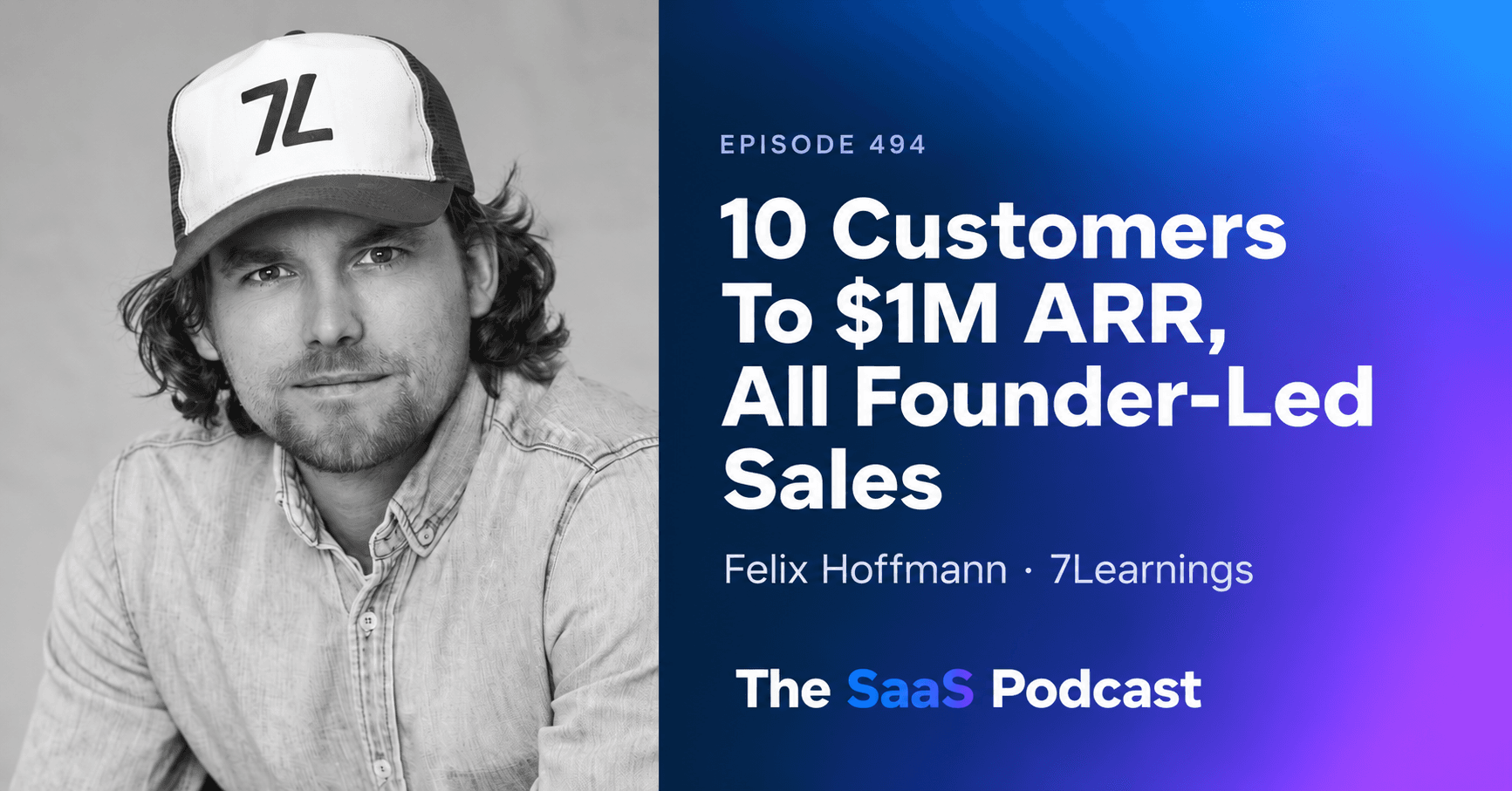
Felix Hoffmann, 7Learnings
Felix Hoffmann is the co-founder and CEO of 7Learnings, a Berlin company whose software decides what a retailer should charge. He spent six years as a pricing consultant at Kearney and two years running price optimization at Zalando, Europe's largest fashion marketplace, where he saw predictive pricing working at scale. From his consulting years he already knew almost nobody else worked that way. Today 7Learnings is at multiple seven figures in ARR, with around 40 customers and 60 people. The hard part was never the idea. A demand forecasting model needs a large retailer's historical sales data, and no large retailer hands that over to a company with no product. Felix also spent the early months trying to recruit two technical co-founders in Berlin, which he describes as close to impossible when engineers can earn well without taking any risk. So the first contract 7Learnings signed was not software at all. It was a consulting project. The retailer got help implementing its own pricing approach, 7Learnings got paid, and it kept the right to use the data to build a product of its own. The first paying software customer came through his old consulting network, structured as an A/B test: the algorithm priced half the assortment, the retailer's team priced the other half. The first run was a disaster. Prices came out far too expensive on high-priced products, and in e-commerce you know within a day. They reworked the models, and a later test came back with a 13% profit uplift. Felix also covers how a pricing company prices itself, why he refuses success-based fees, the objection he still hears from almost every retailer, and why he thinks LLMs do not belong in the pricing decision itself.
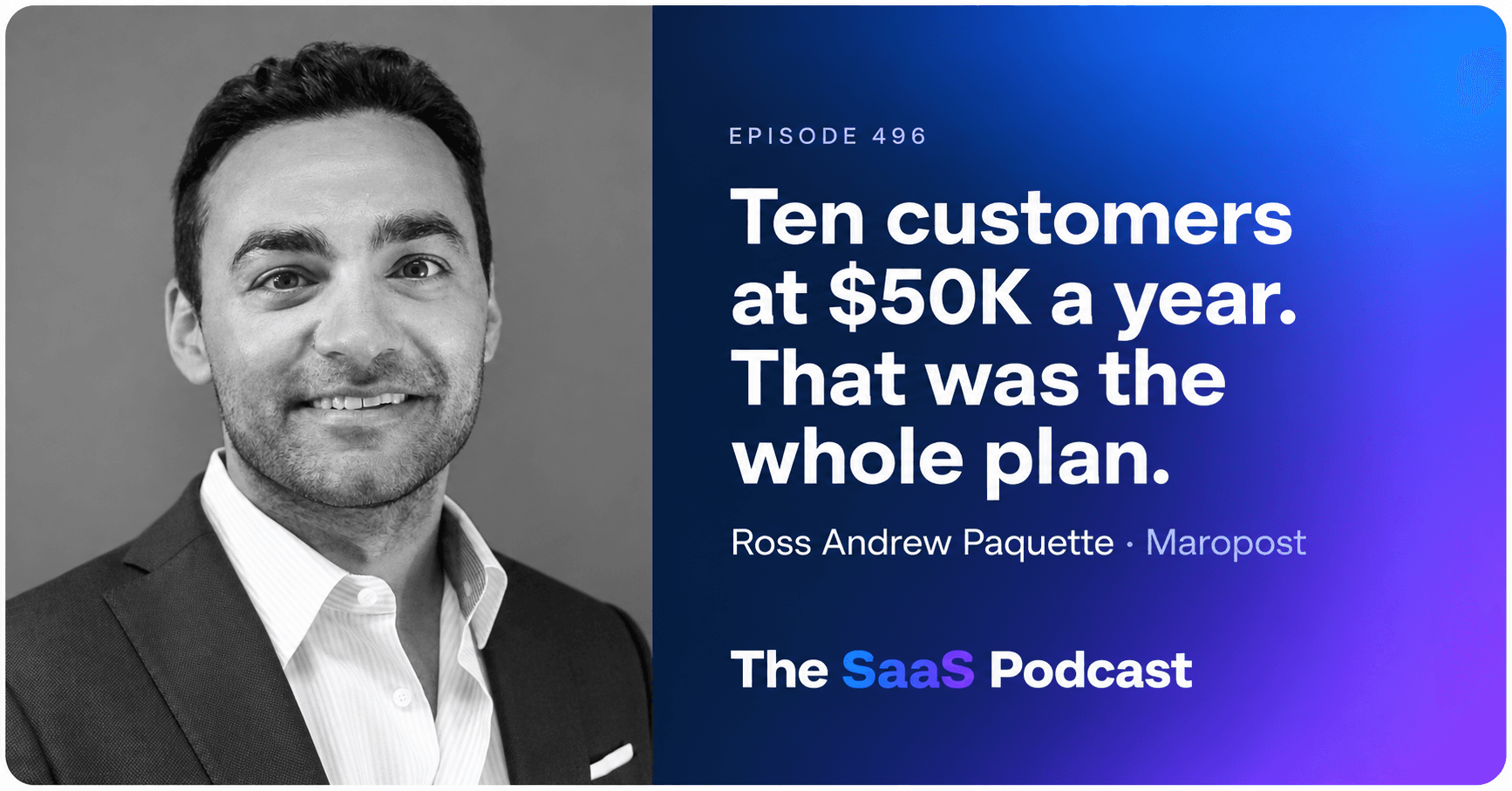
Ross Andrew Paquette, Maropost
Ross Paquette is the founder and CEO of Maropost, a commerce and marketing platform he has bootstrapped to around $50 million in ARR with roughly 300 people and 5,000 customers. He started it in 2011 out of his apartment while still working full time selling Oracle ERP software into the construction industry. The plan was small. Ten customers paying $50,000 a year, about $500,000, and more free time. Ross had spent a few years selling marketing automation and knew the service in that market was poor, so his pitch was simple: 24-hour live chat and a five-minute response time, which in practice meant him. Three or four former customers signed almost immediately. Two of them paid around $10,000 a month. The early build nearly sank it. His developer would disappear for days, and the platform would go down with nobody available to fix it. Ross describes standing on a departing plane holding his phone in the air to hold the signal, maybe ten or fifteen times. His mother suggested he post the job somewhere. The first person who replied on oDesk rebuilt the platform in two or three weeks and is his CTO today. Then it caught. In 28 months the business went from $300,000 to $27 million with six or seven people, largely because Ross was personally closing brands like Rolling Stone and Mercedes off conference floors. He took a secondary round around 2016, gave up about 25 percent, and roughly three years later wrote a $37 million check to buy the investors out. He also gets into why seven or eight experienced sales leaders failed at Maropost, what he hires for now instead, and why he says he would not show up to work if he owned less than ten percent of his own company.
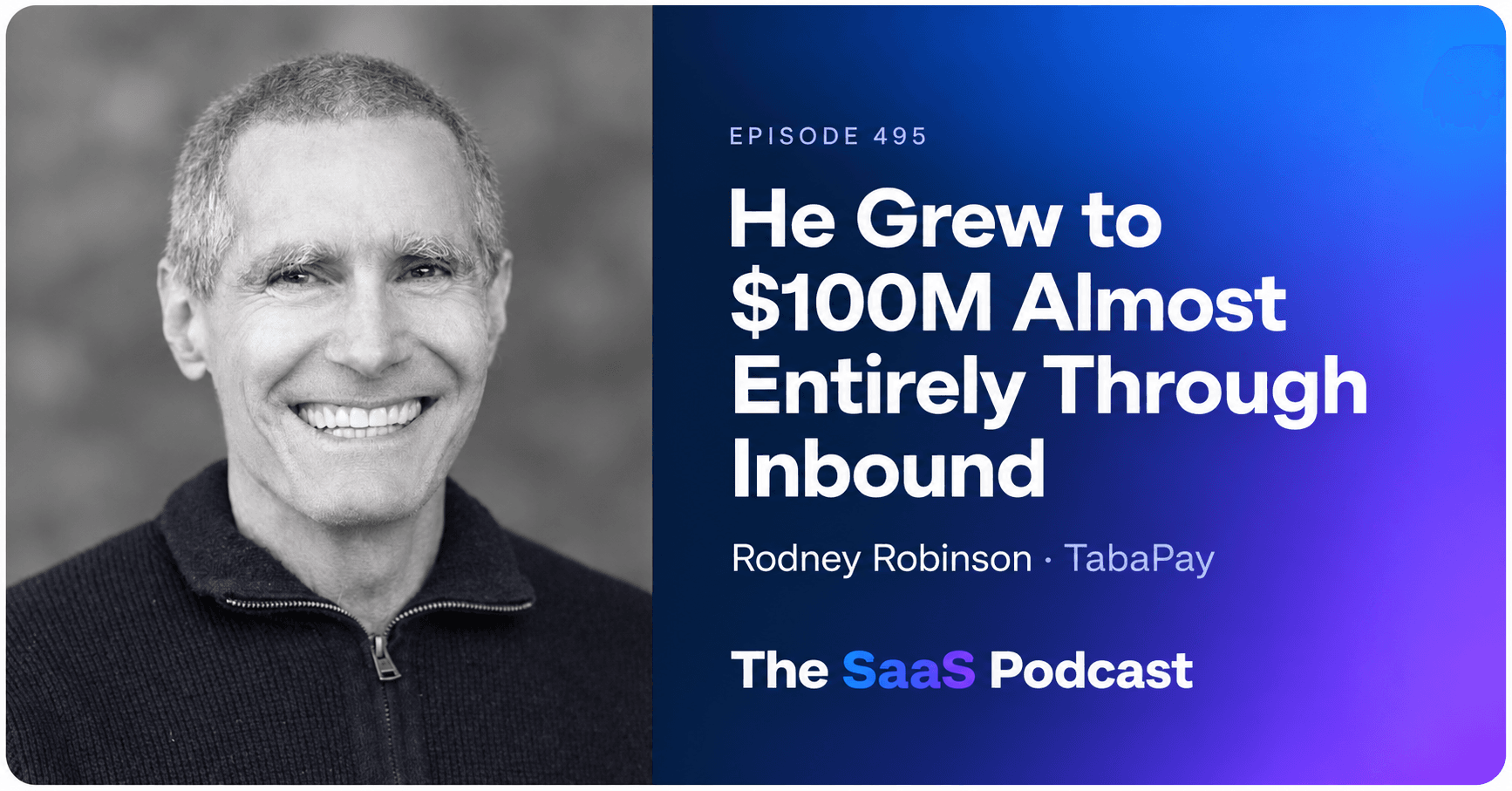
Rodney Robinson, TabaPay
Rodney Robinson is the co-founder and CEO of TabaPay, a payments company that moves money in and out for fintechs. It now runs at $100 million in revenue with about 150 people, profitable, growing 35 to 40 percent a year. On the day this interview was recorded, Rodney announced TabaPay had raised $155 million and acquired a bank. The company started because Mastercard would not build what its own customers kept asking for. Rodney had sold his previous company to Mastercard and spent two years running its instant payout business. Merchants wanted to send money out and collect it back through the same card. Mastercard only wanted the send half, because the collect half would compete with its largest processing partners. Rodney left and built the thing they could not. Getting there took a year and a bank willing to sponsor a startup with no track record. Banks solve for risk by asking for a large deposit, which Rodney did not have, so he signed a personal guarantee and pledged his house. Six months in, another company accused them of stealing its software. TabaPay won, but the sponsor bank dropped them during the fight. The company ran for nine years on a single $2.5 million seed round, its only outside money until this year. Rodney went after small fintechs he already knew, on the theory that minnows become whales, and let banks and the card networks feed him everything after that. TabaPay has never bought a keyword or run content marketing. He also covers why he paid vendors more than he needed to in year one, how three vendors at 99 percent uptime leaves you down three percent of the time, and why he thinks outbound sales is finished in B2B.