Why Your First 12 Customers Should Pay Almost Nothing
What Everyone Says
Protect your price. Anchor high, hold firm, and never let your first customers set a cheap precedent you will spend years undoing.
The logic is seductive because it sounds disciplined. Every pricing article warns that discounts are permanent, that you train the market on your number, that a low first contract caps your entire pricing ladder.
VCs reinforce it. A healthy average contract value is a slide in every deck, and founders learn early that ACV is the metric that gets you funded.
So first-time founders walk into their first pricing call determined not to blink.
Why That's Wrong
The advice assumes your early contracts are worth something. At twelve customers, they are not.
What you actually need at that point is not revenue. It is the ability to close. You have never run a security questionnaire, never survived a legal redline, never built a quota for an account executive because you have never closed enough to know what one looks like.
Holding out for a good number buys you a spreadsheet. Closing buys you the machine.
The hidden assumption is that those first accounts are where your revenue comes from. They are not. There is an entire market still unsold, and it will pay you properly once you know how to sell to it.
What Shahar Did Instead
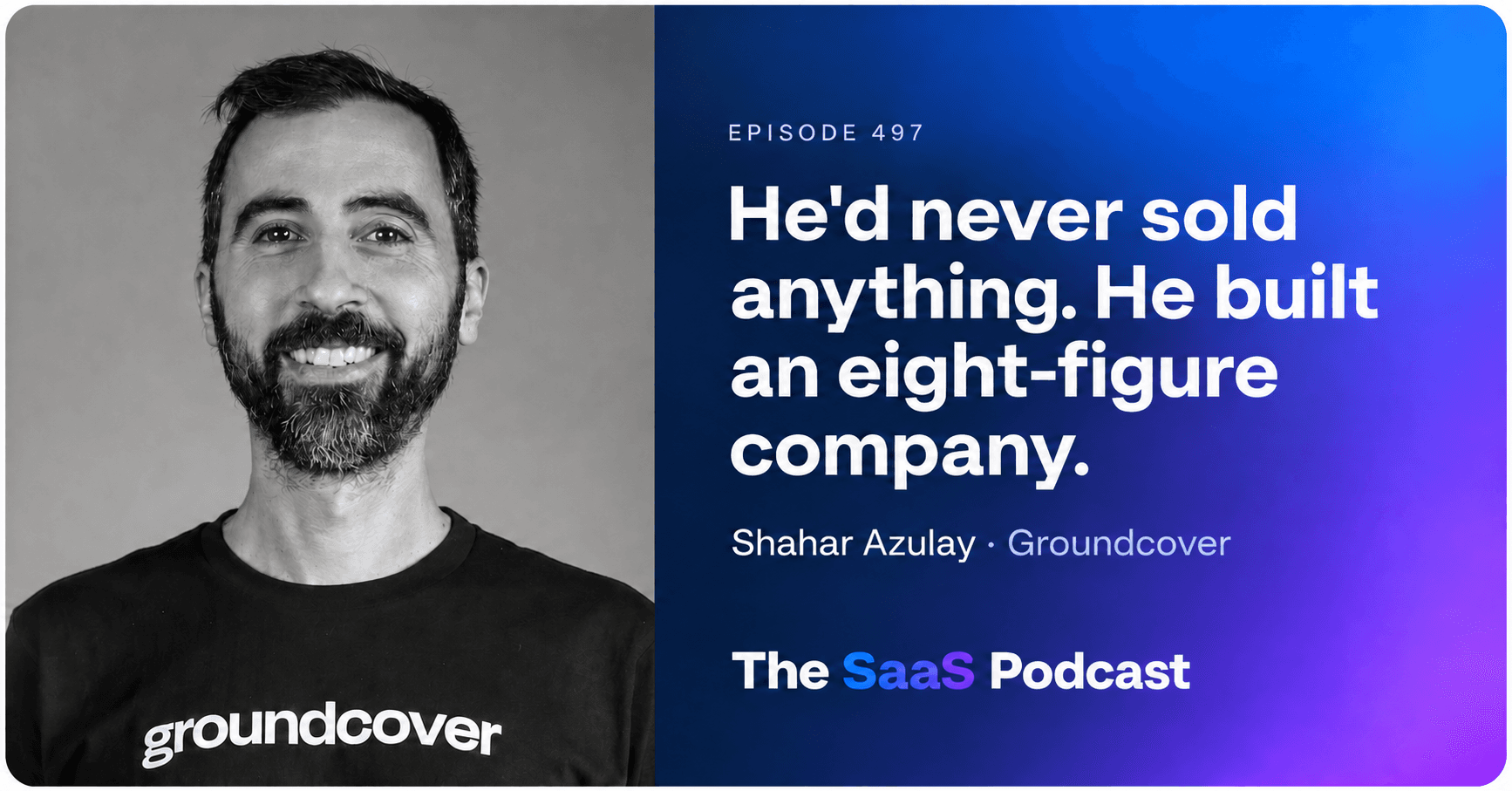
Shahar Azulay co-founded groundcover with no sales experience. Three months in, a connection introduced him to a head of DevOps, and groundcover had its first deal in play.
The product had no user interface. There was a sensor, some telemetry, and dashboards built in open-source Grafana. In his words, "we were completely scared when he installed the product for the first time."
The night before the pricing call he and his co-founder got an early investor on the phone to figure out what to charge. They knew the customer was paying six figures to Datadog, so they picked $100,000.
The CFO countered with $10,000 a year on a three-year commitment. They said yes.
"Which is why I'm not the bestseller in the company," Shahar says. But the deal closed, and groundcover had a live production customer, a reference logo, and a first run through procurement.
His conclusion is blunt: close at any price for the first dozen opportunities you get.
The Principle Underneath
Shahar is explicit that this is not about being cheap. It is about what the first dozen deals are actually for.
"There's a lesson learned and also confidence learned in closing," he says. Closing your first 10 or 20 customers at floor prices tells you nothing about what the next 20 or 30 will pay.
Two things follow from that.
The first is that you stop treating early ACV as a signal. It measures your negotiating position, not your product.
The second is harder: do not plan to grow those accounts. Shahar never expected to 10x the early contracts. "Once you go there you're stuck," he says. Your effort belongs forward, with customers who will meet you at a real price, not backward trying to re-rate people who remember what you used to be.
Should You Do This?
Do this if you have fewer than a dozen customers and no repeatable sales process. The learning compounds and the discount does not follow you, because the buyers who saw your floor price are a rounding error against the market you have not touched.
Skip it if you already close predictably and your pricing is the constraint on growth. At that point a low deal costs you real margin and teaches you nothing new.
One question to ask before your next pricing call: if this deal closed at a tenth of what I asked, what would I learn that I do not know today?
Ready to build your SaaS with founders who get it?
Join thousands of SaaS founders getting weekly insights and proven strategies from real founder conversations.
Free weekly newsletter · No spam