Your First Customers Should Already Know You
Most founders treat launch as a marketing problem. Build the thing, announce the thing, hope strangers arrive.
How SaaS and AI founders who scaled got their first customers
One email every Thursday. Unsubscribe anytime.
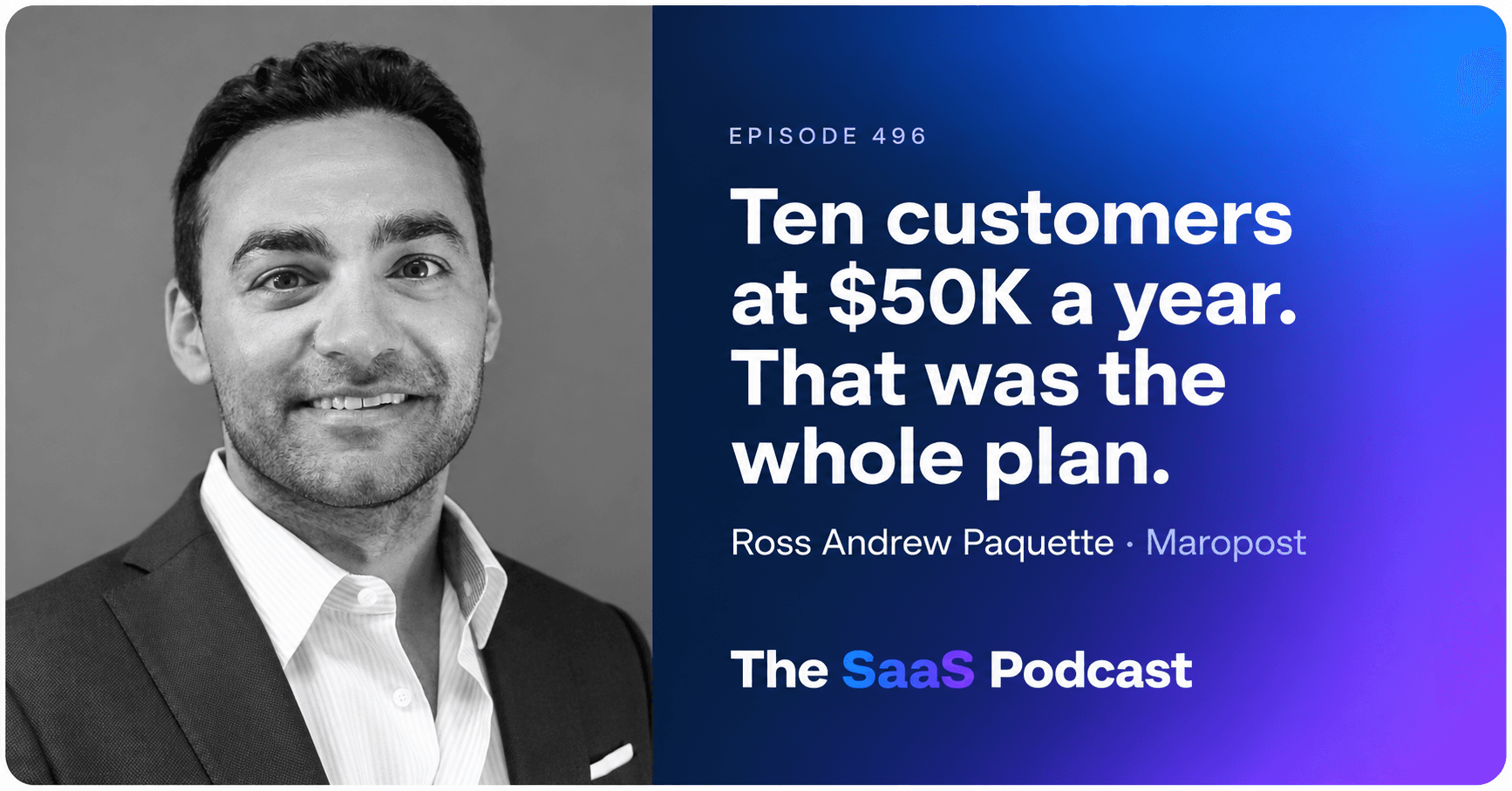
Ross Paquette bootstrapped Maropost to $50 million in ARR by closing most of the deals himself, then spent ten years building a sales organization that could run without him. He was the discovery call, the demo, and the follow-up, and it worked well enough that the business went from $300,000 to $27 million in 28 months with six or seven people.
Then the thing that built the company became the thing capping it. He hired seven or eight sales leaders who looked phenomenal on paper. None of them worked out. He calls the decade it took to move past what he called "Ross and Co" the hardest part of the whole journey.
Ross Paquette is the founder and CEO of Maropost, a commerce and marketing platform he has bootstrapped to around $50 million in ARR with roughly 300 people and 5,000 customers. He started it in 2011 out of his apartment while still working full time selling Oracle ERP software into the construction industry.
The plan was small. Ten customers paying $50,000 a year, about $500,000, and more free time. Ross had spent a few years selling marketing automation and knew the service in that market was poor, so his pitch was simple: 24-hour live chat and a five-minute response time, which in practice meant him. Three or four former customers signed almost immediately. Two of them paid around $10,000 a month.
The early build nearly sank it. His developer would disappear for days, and the platform would go down with nobody available to fix it. Ross describes standing on a departing plane holding his phone in the air to hold the signal, maybe ten or fifteen times. His mother suggested he post the job somewhere. The first person who replied on oDesk rebuilt the platform in two or three weeks and is his CTO today.
Then it caught. In 28 months the business went from $300,000 to $27 million with six or seven people, largely because Ross was personally closing brands like Rolling Stone and Mercedes off conference floors. He took a secondary round around 2016, gave up about 25 percent, and roughly three years later wrote a $37 million check to buy the investors out.
He also gets into why seven or eight experienced sales leaders failed at Maropost, what he hires for now instead, and why he says he would not show up to work if he owned less than ten percent of his own company.
Ross Paquette bootstrapped Maropost to about $50 million in ARR by personally running discovery and demos instead of hiring salespeople early, reaching $27 million with six or seven staff. Moving to a real sales organization took ten years and seven or eight failed sales-leader hires before he changed what he hired for.
Most founders treat launch as a marketing problem. Build the thing, announce the thing, hope strangers arrive.
Ross Paquette has a blunt view of why most bootstrapped companies stall at the point where they need to sell: "I know very few founders who can actually sell. T
You have outgrown founder-led sales. So you hire the most credentialed sales leader you can afford: strong logos, good numbers, ran a team at a company ten time
Build the better product first. You cannot charge serious money until your feature list stands up next to the incumbents, so ship faster, close the gaps, and wi
How do you get out of founder-led sales without losing what made you good at it?
Ross Paquette says the answer is hiring, not process. He kept being pulled into deals for ten years because he hired sales leaders on logos and track record rather than tenacity, and things only changed once he took hiring seriously and brought in help to run that process properly.
How did Ross Paquette get Maropost's first customers?
He had spent years selling marketing automation and several former customers told him they would use whatever he built next. Three or four signed almost immediately when he launched, and two of them were paying roughly $10,000 a month.
How did Maropost charge $10,000 a month with a small early product?
Ross competed on service rather than features, offering 24-hour live chat and a five-minute response time when Maropost had only ten or fifteen customers. The platform also had a drag-and-drop journey builder years before Salesforce and ExactTarget shipped theirs.
How did Maropost grow from $300,000 to $27 million in 28 months?
Ross bought Platinum and Diamond sponsorships at email and ecommerce conferences and worked them with one other person, to the point where one show floor looked like a Maropost event. He signed brands including Rolling Stone and Mercedes directly on the floor.
Why did Ross Paquette buy his investors out of Maropost?
The 2016 round was a secondary, not capital the company needed, and expectations diverged quickly around hiring plans and operational growth. Rather than fight, Ross returned most of the funds about three years later with a roughly $37 million check.
Why did seven or eight sales leaders fail at Maropost?
They came from companies with different engines, lighter products or much lower price points, so the experience did not transfer. Ross argues someone from a $50 million company has little in common with a business trying to get from $1 million to $10 million.
What does Ross Paquette hire for instead of experience?
Tenacity. He says experienced hires over-strategize, over-document and over-train, and that the people who worked out at Maropost were hungry rather than credentialed, with an extreme sense of urgency he can hear in how fast someone talks.
Why does Ross Paquette think most founders cannot actually sell?
He says founders can usually sell investors and partners, but put them on a call to run a real product demo and it falls apart. Because Ross had designed the functionality himself, his demos were personalized and needed no deck.
What happened to Maropost's growth during the investor period?
Growth fell from around 400 percent to roughly 6 to 10 percent. Ross says he stopped sketching functionality and throwing ideas over the fence, and that almost nothing shipped in that three-year stretch.
Ross Andrew Paquette [00:00:00]:
I'll just have 10 customers, you know, paying 50k a year, 500,000. And that was like the business plan. I know very few founders who can actually sell. They can sell investors, but if you put them on the phone to do an actual product demo, it probably wouldn't be that great. Moving from, you know, founder, founder, led founder, Sol, I used to call it Ross and Company, you know, to an actual organization.
Ross Andrew Paquette [00:00:23]:
That's been really hard. Like, we've spent 10 years trying to get there and we're just getting there now, which is quite painful when I. When I look back.
Omer Khan [00:00:31]:
Welcome to The SaaS Podcast. I'm Omer Khan and this is the show where I interview real founders and dig into how they actually built their SaaS companies. I've had almost 500 of these conversations now, and I put out a new one every week to help you build and grow your startup. So if that sounds interesting, hit subscribe or check out saasclub.io
Omer Khan [00:00:49]:
to learn more. My guest today is Ross Andrew Paquette. He's the founder and CEO of Maropost, and he's bootstrapped that business to 50 million in ARR. And for years he closed most of the deals himself. In this episode, Ross breaks down how he shipped the first version of his product from his apartment, running as a one person company, and managed to charge early customers $10,000 a month.
Omer Khan [00:01:15]:
He explains how they grew from 300,000 to 27,7 million in ARR in under two and a half years. He also gets into why he took investor money and then three years later bought them out. And why it took him 10 years to finally build a sales team that could run without him. So I hope you enjoy it.
Omer Khan [00:01:37]:
All right, Ross, welcome to the show.
Ross Andrew Paquette [00:01:39]:
Hey, thanks so much for having me.
Omer Khan [00:01:42]:
Now, we can't start this conversation until we first talk about where you are right now.
Ross Andrew Paquette [00:01:49]:
Funny enough. Yeah, I'm currently on the sea. I've been here for about a month and a half now.
Omer Khan [00:01:57]:
So you're living on a boat in the middle of the ocean and we're having this conversation. Yeah, thank God that's the first for me. Yeah. Awesome. Well, look, tell us about Maropost. What does the product do, who's it for, and what's the big problem that you're helping to solve?
Ross Andrew Paquette [00:02:12]:
Yeah, for sure. So, I mean, originally we started off as a marketing automation solution, so email. So think from mailchimp to Salesforce Marketing Cloud. In terms of the example. And very quickly, back in 2015, since I'm sure we'll get back there, it Became obvious that like we were just, we'd steal a customer from one platform, they'd somebody else would steal one from us.
Ross Andrew Paquette [00:02:31]:
It became very commoditized very quick and I would say is even more so now. But so then we decided, okay, we're going to move into being a multi product solution. So it was E commerce marketing automation, which of course we had and then helped us so really helping to solve that customer life cycle for anybody in the E commerce sphere, I suppose you could say.
Ross Andrew Paquette [00:02:51]:
And back then and including now, we typically add much larger customers. So mostly from the U.S. you know, large databases, millions, tens of millions of subscribers or tens of millions of customers. And so for us we really wanted to, you know, both provide them with a service level that really didn't exist at the time, you know, from a support perspective or from a customer success perspective and then really move that into, okay, how do we expand this now to a much larger client base as opposed to say the you know, 300 or so customers we had back then, now we have about 5,000.
Omer Khan [00:03:23]:
Right. And give us a sense of the size of the business. Where are you in terms of revenue, customers, size of team?
Ross Andrew Paquette [00:03:29]:
Yeah, so around 50 million in revenue. Just around 300 or so people on the team and then customers. Yeah, just around 5,000.
Omer Khan [00:03:40]:
Great. So the business was founded in 2011. Tell me about where the idea came from and what was your big dream at the time?
Ross Andrew Paquette [00:03:55]:
Yeah, I was actually working in the same marketing automation space for a couple of companies prior to Maropost and just before I was working actually for, in a totally unrelated space selling Oracle ERP software into the construction industry, which was actually pretty crazy. I mean it was going from selling like, I don't know, 10 or $20,000 a year deals to like, I think one of the largest ones I was involved in was about 20 million to the US Navy.
Ross Andrew Paquette [00:04:19]:
So quite, quite a different sphere. But anyway, I just thought like our customers weren't getting very good service so people would sign up again for like, you know, two, three, four, sometimes $5,000 a month. And it was like, you know, it was, it was nothing wrong with it, but it was like a mailchimp level service. They had ticketing.
Ross Andrew Paquette [00:04:35]:
Actually it wouldn't even had Chatbot back then. You know, I just thought like we can do this way better. We could have like 24 hour live chat which is basically just me, you know, have a five minute response time because we only had maybe you know, 10 or 15 customers in the, you know, in the early stages and it really was centered around that.
Ross Andrew Paquette [00:04:50]:
I wasn't so concerned with sort of the feature functionality aspect. I was just at the time, again, it's over 10 years ago, but concerned with, you know, what they were, what they were receiving and how. I think software vendors at the time had much closer relationships with their customers than they potentially are likely do today.
Omer Khan [00:05:08]:
And did you do the lean startup thing? Did you start saying, I'm going to go and do customer discovery and interview potential customers? Or was it more about. You already saw the pain first time?
Ross Andrew Paquette [00:05:18]:
I already knew very well. Yeah, that was very obvious because I had spent two years or so, two and a half years already going through that sort of process and really realizing. And at the time I was thinking, you know what? I'll just have 10 customers paying 50k a year, 500,000. And that was the business plan or business model, you know, until obviously it got carried away not so long after that.
Omer Khan [00:05:39]:
Yeah. So you were running this from your apartment in 2011?
Ross Andrew Paquette [00:05:44]:
Yeah.
Omer Khan [00:05:46]:
And how did you get started? Did you like, walk me through from. You've got the idea, you've made the commitment, you're going to do this. Walk me through the steps that you had to take to get to that first sale.
Ross Andrew Paquette [00:06:04]:
That was actually pretty easy because I had a lot of customer relationships already. And when I had left, like both of those companies, there was a number of the customers that said, hey, if you ever build something on your own or wherever you end up going, we definitely want to use whatever platform you're selling. Or obviously they didn't know I was going to end up building something, but when I did, there was three or four of them in particular that were like, we'll sign up right away.
Ross Andrew Paquette [00:06:29]:
And they did, of course, and it was definitely bumpy and rocky. I'm surprised they put up with us so long, but that's how it started.
Omer Khan [00:06:38]:
And how did you go about building the product? From what I understand, you had a partnership with someone to do the development, but that didn't work out, and then you had to go searching again. So what happened there?
Ross Andrew Paquette [00:06:54]:
Yeah, I was working with an individual. He would just disappear for days at a time. I don't know if he had another job or had some challenges or whatever it may be, but he would disappear for days at a time. And this is when we had, you know, again, those three, three or four customers. And again, they were not paying small amounts.
Ross Andrew Paquette [00:07:11]:
They were paying like, I think two of them were paying like 10,000amonth kind of thing. And we were providing everything they needed. And of Course we developed things very quickly after, but you know, like anything, the platform would go down and then he would, wouldn't be available. And you know, there was probably about 10 or 15 times where I would be taking off on a plane, I'd have my phone in my hand, like holding it up in the air, trying to maintain my connection as long as possible because I was so worried that the platform would crash or something like that.
Ross Andrew Paquette [00:07:39]:
And then it got to a point where I was like, this just isn't going to work. I can't work this way. I can't charge somebody, nobody but the charging, but charge somebody that amount of money every month and then platform crashes and then nobody's there to fix it in, you know, within an hour kind of thing. And so then it was actually one of my, it was my mother who has no experience in technology and I was trying to explain to her that the platform is built in Ruby or Ruby on Rails and that there was like very few developers in Toronto or.
Ross Andrew Paquette [00:08:09]:
And even less that I even knew, you know, kind of personally or could get a hold of. She's like, oh, why don't you just like put a job posting up somewhere? And anyway, I put it up on oDesk, which is now Upwork, and Jag, who's my cto, was the first person to respond and basically rebuilt the platform in like two or three weeks.
Ross Andrew Paquette [00:08:26]:
And then we had something extremely stable. I don't think it actually went down like once after that in terms of the product itself, obviously like our hosting provider might or something. But yeah, anyway, that's kind of how we got things started and off the ground.
Omer Khan [00:08:42]:
So JAG was the first person to reply to your oDesk job posting. Turned out to be the right guy because not only did he fix your problems, but he's your CTO today.
Ross Andrew Paquette [00:08:56]:
He is, yeah, yeah, yeah, he is. And he leads essentially like our special projects group, let's call it, it has a specific name, but he builds everything kind of like, you know, 0 to 1 effectively. So anything getting to an MVP level? Not everything, I should say, but some of the core things were like, we need this in a week.
Ross Andrew Paquette [00:09:16]:
He leads that, that group now. That's definitely like his, his strong suit.
Omer Khan [00:09:21]:
Were you, were you still working full time? Like how long did it take from like, you know, work, you're in your apartment, you start selling this product. When did you go full time on it?
Ross Andrew Paquette [00:09:36]:
I was probably about a year in because I was obviously I was generating, yeah, income from my full time job and that was funding the the development and so on and the growth of the business in those early stages. Course, I would work at like nights and weekends and stuff like that to just, you know, keep the development.
Ross Andrew Paquette [00:09:53]:
Not the development, the writing, but like the product development going kind of to what you were speaking to before. So, yeah, it was probably about a year and a half, I suppose, before then. We were. We were making around 300, 400,000 a year. And I was like, okay, I can, you know, supplement everything from there.
Omer Khan [00:10:09]:
Now I want to talk a little bit about those initial customers. You obviously had the relationships, which was great for the initial ones, but when you're charging, when you're a startup and effectively a guy running this company out of his apartment and how do you. How do you charge somebody $10,000 a month for your product when you yourself were telling me earlier, you know, there weren't that many features in the product at the time?
Ross Andrew Paquette [00:10:42]:
I mean, we had, we had a lot though, and we had certain things that, that were just not as common there. So one of the companies I had worked with previously had like a Journey Builder workflow tool kind of thing before anybody else did. This was back in like 20 2009, maybe. Yeah. Or 2009, 2010. Yeah, they, they had like, you know, I think Salesforce or, or Exact Target launched their Journey builder in like 2015, 2016 as an example.
Ross Andrew Paquette [00:11:09]:
So we had like some of those, like, really unique features that, that nobody else really had actually back then. They, you know, things were. It's hard to describe with my hands, but, you know, things were very. Just linear, like putting in fields or stuff like that. And like, that was a journey, but it was like there was no, you know, drag and drop builder connecting things together, you know, none of that kind of stuff.
Ross Andrew Paquette [00:11:28]:
So we had that really early on, and that really moved the needle dramatically. And the other thing was, I mean, one of the unique things, of course, about my co founder Jag, is that he built a feature and implemented in the platform while I was doing a demo one time, this customer, or prospective customer who ended up signing on board, of course had this idea that basically you could do an A B split test, but blend the winning subject line with the winning piece of content.
Ross Andrew Paquette [00:11:56]:
Just merge those together. And anyway, he built that while I was doing the product demo after this guy gave me the idea. So I think it gives you a sense of the pace that we were moving in those early stages to keep a lot of that excitement. To be honest with you, we never really ran into feature functionality challenges outside of probably A pretty big miss.
Ross Andrew Paquette [00:12:17]:
This is way back, but around reporting and analytics, there was this kind of changeover from feature functionality mindset to the analytics mindset. I think that was probably around 2016 or maybe 2017 or so. And that was actually a bigger challenge than just getting a lot out the door early on.
Omer Khan [00:12:38]:
I think I read somewhere that a lot of what you did to differentiate was around customer service. And you mentioned that earlier, like, you know, giving customers fast response time, being online to chat with them, all of this stuff. Tell me, once you move beyond those initial customers that you had relationships with. Yeah. What was the sales process like?
Omer Khan [00:13:02]:
What was your pitch and how. How easy or hard was it to close those deals? Yeah,
Ross Andrew Paquette [00:13:10]:
I mean, it was pretty. To be honest, we were obviously pretty good at sales. That was never our issue. I think it was because we took the approach of focusing on what just like the platform had, as opposed to selling them. Obviously we were selling them the tool. There was no decks or anything like that. It was really heavily focused on the outcomes.
Ross Andrew Paquette [00:13:33]:
And so we were very quick to do, you know, a simple discovery and then move that into the product demo and have that demo be personalized. Of course, like, the person doing the demos was me, which gave me a bit of an edge because I was the one who had designed a lot of the, you know, the functionality itself.
Ross Andrew Paquette [00:13:48]:
So that part was pretty. Was pretty simple for us, I think. I mean, one of the key differentiators that, you know, comes up in this sort of bootstrapping environment is, you know, most people, again, they get a decent idea off the ground, you know what I mean? And by off the ground, I mean just from ideation to, like, product, you know, and then comes the fundraising, you know, aspect.
Ross Andrew Paquette [00:14:08]:
I need to hire a VP of sales, I need to hire a VP of finance or so on. And, you know, the. I know very few. Let me summarize this, actually, in a different way. I know very few founders who can actually sell. They can sell investors and they can sell partners in some cases, but if you put them on the phone to do an actual product demo, it probably wouldn't be that great.
Ross Andrew Paquette [00:14:26]:
So that's. Usually people have just kind of skipped over that. And I find that to be one of the core challenges that we didn't have.
Omer Khan [00:14:32]:
Search and you had been doing sales for, what, how long before you started?
Ross Andrew Paquette [00:14:37]:
It was maybe like two years, but I don't think I was even all that good or three years, sorry, not that good at it. I think I just picked up the phone quite a bit more than anybody else and figured out how to do like a decent product demo and then that turned into a really good product demo.
Omer Khan [00:14:54]:
So you had this weird period where from 20, I guess like the first four or five years where growth was like pretty slow. I think you said you were, I don't like you got to about what 300k in ARR by that time and you had six or seven people on the team and then suddenly in the next two years or like what 28 months you went from 300,000 to 27 million or almost 30 million in ARR.
Omer Khan [00:15:31]:
Yeah. What, what happened? What, what changed?
Ross Andrew Paquette [00:15:36]:
Realistically? We got, you know we kept signing customers as was mentioning and it got to a point where again in sort of like the E commerce publishing space in particular those two, we signed like a few customers and we went to a few conferences that were, you know we signed up as like the Platinum diamond whatever sponsor and it was like just me or me and one other person at the conference where again you had like the salesforces and all the other major players and a couple of them.
Ross Andrew Paquette [00:16:08]:
One was always marketing Sherpa's email summit or something like that. And the show looked like a Maropost show. Like even I was shocked. Like I was like did we pay for this? Like it was, it was Maropost everywhere. You almost could even tell that it was was this marketing Sherpa organization that had put on the show that happened like three or four times with different shows.
Ross Andrew Paquette [00:16:28]:
I mean and we just signed up like we would sign up people at, on the show floor and, and I'm talking about like brand like brands you would know Rolling Stone as an example, Mercedes companies that don't sign up in that aspect. Right. Usually there's a pretty significant process. There's an RFP involved and so on. So that really got us like ahead of the game.
Ross Andrew Paquette [00:16:46]:
And I don't, I don't think like I don't think that exists anymore. I mean I'm sure you go to conferences as well and in a lot of cases like you know it's, it's very rigid and very structured now. Like I've tried to actually revive that kind of approach that we were taking but you know it's just not the same anymore as it used to be.
Omer Khan [00:17:04]:
So you said we were closing those deals but essentially it was just you.
Ross Andrew Paquette [00:17:08]:
Yeah, and I had like a couple of right hand people of course who are assisting in like as it pertained to like the overall process.
Omer Khan [00:17:16]:
And what do you think it was about? Was it the product was it your ability to sell. Like why were you able to close these types of customers?
Ross Andrew Paquette [00:17:27]:
I think it was the, like I said, the timing was just sort of great in all regards. People weren't as skeptical back then. They really believed like and it wasn't, it was truthful. So that was the important part. We really did a great job from a, you know, from a product and service perspective after the fact. So we retained our customers for a long, or have retained our customers for a long time.
Ross Andrew Paquette [00:17:47]:
But I think it was in that time again people weren't as skeptical. Right. You know, now I'm sure that, you know, a lot of the times people are like, no, I want to do a trial or I want to, you know, extensive demo. It takes a lot more because of course people have been, you know, have been burned with other solutions, you know, in various regards, not meeting their needs.
Ross Andrew Paquette [00:18:03]:
So I think in that we were in that sort of just timeframe where everything just went well. The development went well, the marketing messaging went well and the product supported that, you know, like, or where we were, what we were selling. Nothing was ever like vaporware. This, you know, this doesn't actually work as easy as you want or you need an engineer to implement it or so on.
Ross Andrew Paquette [00:18:21]:
It's like what you saw was what you were getting. And so I think that, and you know, combined with the founder selling most of the opportunities or at least being heavily involved with most of the opportunities, you know, really gave us a huge edge compared to anybody else.
Omer Khan [00:18:36]:
So what, what, what did you have to change to deal with this type of growth? Like were you still the guy selling? Did you have to build a sales team? Like did the product stop breaking because you had so much, so much demand or usage?
Ross Andrew Paquette [00:18:55]:
Yeah, that was never a problem thankfully on the product side as you mentioned. But moving from, you know, founder led, founder sold, I used to call it Ross and company to an actual organization. That's been really hard. Like we've spent, I, or I've spent, we've spent 10 years trying to get there and we're just getting there now, which is quite painful when I, when I look back, right, we were talking about, you know, having and partners or investors come in.
Ross Andrew Paquette [00:19:23]:
We've, you know, we acquired some companies and you know, we come back to all that. But the last 10 years is really like not a lot had, had changed from like a company perspective, but a lot, you know, of, of challenges we went through in terms of, you know, hiring our first VP of sales or you know, bringing in another VP of customer Success trying to offload a lot of that wasn't.
Ross Andrew Paquette [00:19:46]:
Yeah, that was the hardest part by far.
Omer Khan [00:19:50]:
So talk about the shift from founder led sales to having a sales team. Let's say if a founder is listening to this today and maybe they have, you know, some form of sales team in place who's doing a reasonable job, but the deals still don't get closed and the founders still getting pulled into every deal, what advice would you offer them?
Omer Khan [00:20:17]:
How, how should they think about it?
Ross Andrew Paquette [00:20:20]:
I mean, if there's sort of two sides to that, if, if you separate those two points. So like if the founder is still being brought into opportunities to help get them over the line, I think that's smart. I think it's like you'll at least continue closing the, you know, the business that you have as opposed to losing it, which I see a lot of the time.
Ross Andrew Paquette [00:20:39]:
And you know, both in the market and quite a bit even internally, you know, people are sometimes afraid to raise their hands in that regard. Like, and sometimes it's like, just tell me and I'll sit in the room. Right, Or I'll sit on the call. It's not even about speaking or doing the demo or doing all that, of course, but back to sort of what you were touching on prior to that.
Ross Andrew Paquette [00:20:57]:
I mean, moving into the sale, like having a sales team or having somebody take over the sales team, that's a much harder task. I mean, sales is undoubtedly in my view the hardest role from a leader perspective, whether it's sales or revenue, Anything tied to that is just becoming more and more difficult. I think it's why most of the companies that I consider to be successful, financially speaking, the reality is it's typically because they raise 200, 300, 500 million and they're really just buying their way to that with headcount, with marketing, with whatever's needed.
Ross Andrew Paquette [00:21:36]:
Whereas the companies I know that are successful on the other side of the coin, let's say in the bootstrapped environment, they put a significant amount of their founder led or founder mindset into the customer acquisition, both process strategy, if it's a PLG type approach as well, you know, and, and just the time of being involved, as you, you, you noted in, in every, you know, every opportunity, but all the opportunities that, Yeah, Being really fucking good at hiring, that's for sure.
Ross Andrew Paquette [00:22:28]:
I would say that like that's the hardest part. I mean I've, we've had, I don't know, 10, I mean not 10, but like seven or eight sales leaders where, where on paper they look phenomenal. They've worked at good companies, they've had good metrics, and then they've come in and it just like, it just hasn't worked. And typically it's because of what I described before.
Ross Andrew Paquette [00:22:51]:
Maybe they're working at like a salesforce or some other organization where, you know, it's a totally different engine, or maybe they're working at somewhere where the product is significantly, you know, lighter weight. It's much, much easier to sign a customer up because the price point is also maybe much, much lower. You know, the changeover in terms of expectations like we were talking about earlier around, you know, customers, now they want a lot more for a lot less.
Ross Andrew Paquette [00:23:18]:
So I think there's like, there's a number of like of challenges there. And where I go with that is, for me, until we took hiring a lot more seriously and, you know, brought in, you know, stronger people to help with regards to the process, things only started to really change then.
Omer Khan [00:23:36]:
And it sounds like in terms of hiring, it wasn't necessarily finding those execs that had the logo backgrounds, but more about people who were really hungry.
Ross Andrew Paquette [00:23:49]:
Exactly. Just the tenacity. I mean, that's the biggest thing because you get people who over strategize things over document, over train. I mean, they're typically like anybody. They're focused on what they've learned and their experiences, of course. And when you're in that sort of, you know, you were talking earlier about sort of sub 10, you know, maybe they had a million in revenue and they're trying to get to 5 to 10.
Ross Andrew Paquette [00:24:13]:
I mean, what would somebody from a, you know, from even a 50 million or definitely not 100, but like even a 50 million revenue company have in common with somebody who's at a million? It's not a lot. And it goes in the same direction. Right? Like we've, we've hired people from companies that were doing under 10 million and they're like, they get their loss in the weeds within, you know, within the first month or two.
Omer Khan [00:24:35]:
Now you bootstrapped from 2011 to 2015 or 16 somewhere around there where you eventually decided you were going to raise some funding.
Ross Andrew Paquette [00:24:47]:
It wasn't really, it was all secondary because we didn't need any money. But we had skipped, you know, we had skipped the investor. So it's like we popped out of the woods with like, you know, effectively in their minds or expose our minds as well. Kind of the 0 to like 13 million in revenue in less than 15 months kind of thing.
Ross Andrew Paquette [00:25:08]:
Using that first kind of segment that really is skipping quite far ahead actually, and definitely back in 2015, 2016. So the biggest piece of that though was we never actually needed any money in the company.
Omer Khan [00:25:25]:
Now I think you gave up around what, 25% of, of the company back then, and then three years later you bought them out and basically had your 100% back. What was the, what was the driver for that? What happened and why did you make that decision?
Ross Andrew Paquette [00:25:49]:
Yeah, I think there was like, there was probably, you know, some, some expectations when bringing in any investor, you know, more around like the operational growth of the business. So, you know, we were just talking a few minutes ago about, you know, out a sales team and you know, every PVC back in those days was like they'd have the spreadsheet.
Ross Andrew Paquette [00:26:09]:
If you hire 20 reps, here's how many, you know, the performance and you're like, oh, this seems so easy. Like that sounds so, you know, I just used that one example. But, you know, I think there was some, some higher expectations and a lack of experience certainly on my side because I didn't come from any kind of like fundraising background or who provided what or what was valuable or so on, you know, that they would help us drive the business, you know, forward in a more meaningful way.
Ross Andrew Paquette [00:26:33]:
And I think there are, you know, there are some of those, right, that have huge organizations, you know, of people to support those types of businesses. But, you know, the bulk of the VC world is, you know, they're small, they're, they're sub, like sub 10 people, you know, orgs. How much help can they really give you? You know, so it just became clear, like this is going to become more conflicting and more exhausting for both sides.
Ross Andrew Paquette [00:26:56]:
And you know, either they're buying me out or I'm buying them out. And so naturally, or obviously chose to buy them out and pretty much paid them back most of the funds. And then we all went on our way. And I think that was definitely the best outcome that could have occurred because if it was somebody else, it might have been five years of lawsuits.
Ross Andrew Paquette [00:27:17]:
Company ends up being worth nothing anyway because you're just fighting all the time. And then what do you have?
Omer Khan [00:27:24]:
So you basically wrote a check for like $37 million. How did you feel that day?
Ross Andrew Paquette [00:27:33]:
I don't really remember it, but I think when I was, I as, like, I've explained it more recently. It's like, I think when I was doing that, I was like, this is my life now. Like, I didn't want to do anything else anyway. But I think it was really just committing to the fact that like Maropost, the vision, you know, the.
Ross Andrew Paquette [00:27:51]:
Yeah, the plan, I suppose you could say overall was what I was going to focus on for the rest of my life.
Omer Khan [00:27:59]:
So basically you took the money, you gave it back. So you've been bootstrapped since 2011 in the business. You didn't raise any more money, right?
Ross Andrew Paquette [00:28:10]:
Since day one.
Omer Khan [00:28:11]:
Yeah. Let's talk a little bit about. So you've kind of come up this other side. You've given the money back. The business is now doing what, eight figures in. In ARR. What. What did you do then? What, what, what was the, the strategy? How did you, you know, decide what you were going to do next with this business?
Ross Andrew Paquette [00:28:38]:
Really not much now that you know
Omer Khan [00:28:40]:
that you don't have the spreadsheet to tell you what to do.
Ross Andrew Paquette [00:28:43]:
Yeah, I mean, not long after that though, Covid occurred. So that was obviously, you know, challenging just in general meaning like from locations shut down. I was in, I was in Sweden at the time and kind of stuck there. My partner is Swedish or was Swedish. Sorry. And so there was a lot that happened in that period.
Ross Andrew Paquette [00:29:01]:
But one of the things that did occur was there was a lot of movement of course in the M and A space within sas at least at the time for us. We were struggling for years before that with regards to building out the E Commerce side of the solution. And I would say that was, you know, stepping back to just our prior chat around the investor side.
Ross Andrew Paquette [00:29:24]:
That was kind of what happened as well. It's like nothing happened in that three year period. We went from like 400% growth to like 6% growth or 10% growth or something like that. And, and I reference that because, you know, all of my sort of like we were talking about founders before and grit and tenacity and you know, and so on.
Ross Andrew Paquette [00:29:44]:
You know, all that just stopped. Right. I wasn't like sketching out functionality. I wasn't, you know, throwing cool things over the fen that I felt like was the future of the company. You know, we didn't. We. For the first time we built, you know, some of those same products I just mentioned, but they weren't like usable. Like they.
Ross Andrew Paquette [00:30:02]:
Somebody didn't think about something that was like critical from a database perspective maybe or from how data was meant to be stored. And so then we started looking at companies to acquire and we ended up acquiring a company in at the end of 2020. And so that was really meant to help us figure out how do we now build the E Commerce component which was probably the biggest piece that we felt we needed.
Ross Andrew Paquette [00:30:27]:
Service was the other element and ticketing, live chat, chatbot that's been around for 15 years or more. And so that was really the main focus was let's just get the vision back on track. And all things considered, I would say we've only been kind of back on track for a couple years now, if that. Which is kind of depressing when I say hella.
Ross Andrew Paquette [00:30:51]:
So hear me out.
Omer Khan [00:30:53]:
Yeah. You know, when you started this business, I read somewhere that your goal was make like 500k a year and you could check the box and be done. That was like a great business to have. And now you are where you are. The business is obviously, you know, significantly different. Over 50 million a year, hundreds of people working in the company.
Omer Khan [00:31:26]:
And people can look, you know, people might look at this and say, oh, you know, yeah, look, Ross is on his yacht, like you know, having this conversation and life is good. But I want to touch on that point. You just, you just said about, you know, it kind of is like depressing was talk. Talk me through a moment that kind of encapsulates what some of the tough times were like because it's so easy to look at all the successes, the big numbers and whatever, but you had to go through a lot of.
Omer Khan [00:32:02]:
To get to where you are today.
Ross Andrew Paquette [00:32:04]:
The investor bit was the hard. It's hard to say, actually the investor. I was going to say the hardest. It's hard to decide which was the hardest. The first acquisition we did was really, really difficult. Not the acquisition. That part was actually very simple and we learned so much because we did it ourselves. We didn't have any kind of bankers or brokers or anything like that involved on our side at least.
Ross Andrew Paquette [00:32:31]:
The, the sort of like, investor journey, especially in your. Call it like the end of it was definitely another because, like, these are, these are, you know, elements where, you know, obviously there's a huge amount of like, interpersonal challenges that are coming up. You know, like. So let me give you an example. The first acquisition we. That we did, you know, which was sizable, it was 50 million or so that we, we paid in Australian dollars.
Ross Andrew Paquette [00:32:55]:
That was an Australian company at the time, I thought, you know, Australia, Canada, where I'm from, you know, very similar Commonwealth and all this kind of stuff. Very, very different. And the irony was I was also living in, in Sweden at the time, as I mentioned, and I would say Australia is actually much more similar to Sweden than it is to Canada.
Ross Andrew Paquette [00:33:13]:
I think Canada, with our proximity to the US Definitely much more you know, business centric mindset, we're here to move fast. We're here to, you know, sell, sell, sell, sell and so on and build, build, build at the same time. And so both of those examples using the investor bid in that those were the two years that I probably could have skipped in terms of my life or my journey.
Ross Andrew Paquette [00:33:38]:
And they were both difficult because of just this very different cultural view or philosophy or so on around how to both build a business or manage a team or expectations around growth and so on. Those were the two, the two hardest now that I think about. I'm sure there's more. But you know, in terms of the actual like direct business, those were the hardest ones.
Omer Khan [00:34:01]:
Now you spend a lot of time traveling as we've discussed, and you're, you're, you're kind of all over the world. If you're not on, on a boat. How do you, how do you manage the, the business? How do you, like, what's, what's your approach to like staying you know, close to what's going on?
Ross Andrew Paquette [00:34:23]:
And yeah, I mean that is actually another differentiator. But I think going back to the early days, like I still struggle. I have probably like a five minute response time on any email, teams message, you know, text message, so on, which is not always a good thing. But yeah, I mean, it's not so difficult, right, to keep track from a, you know, from a marketing revenue perspective, customer, you know, kind of customer happiness scores and so on perspective or that flow between all three in terms of, I mentioned before that we've, you know, it's really been just like the past couple years that things are really, you know, back on track for us.
Ross Andrew Paquette [00:35:05]:
So probably about, you know, seven or eight years of just like not a whole heck of a lot going on and not a, and not a whole lot of, you know, enjoyable experiences occurring as well. And so it's not that hard to, you know, from that perspective to sort of keep that pulse. I think it's the, it's the, the sort of commitment that your other team members or other executive team members or leadership, you know, members that they have to the business as well.
Ross Andrew Paquette [00:35:30]:
So we really try to, you know, use the tools that we all have access to, whether it's like Atlassian or, or Asana or Monday.com as an example from like tasks or project management or so on. If everybody just like contributes to that sort of organization, things tend to go really well. It's when people start floating off and like, you know, you've got, I find with like Legacy leaders, you know, they want to have a lot of phone calls.
Ross Andrew Paquette [00:35:56]:
And I'm like, well, nobody knows what happened on the phone call except for the people on the phone call for the most part. And so for us, like those just two core areas of ensuring that you have a really locked in, you know, or dialed in CRM and you know, having a really dialed in sort of like again, project task, what have you, management solution.
Ross Andrew Paquette [00:36:15]:
Like, those two cover a huge breadth of that need.
Omer Khan [00:36:21]:
Yeah. Are you one of those guys that's always on.
Ross Andrew Paquette [00:36:25]:
Yeah, pretty much. Unfortunately, yeah. I don't have like, I've had to trick weekends off type philosophy. I wouldn't be here if I had that, that's for sure. And my counterparts and friends who are in similar shoes that I am, like, the, you know, the. How do I say this? Like, the profile of ownership that they have within the business, their business and the one that I have are dramatically different.
Omer Khan [00:36:53]:
But what do you mean by that?
Ross Andrew Paquette [00:36:54]:
I mean, like, when you're bootstrapping a business, you own 100 of it. When you're going through the fundraising and, you know, not working evenings and weekends, you end up owning less than 10% usually. Best case, to be honest with you, if I were. I speak about this quite frequently. Like, if I were in those shoes, I definitely wouldn't work.
Ross Andrew Paquette [00:37:12]:
Like, I wouldn't go to work for 6% or 8% of the business. Like, the amount of commitment you need, it's like even 100 sometimes doesn't feel enough, to be honest. Of course it's not 100. Like our whole team has shares and options and so on, but you understand what I mean?
Omer Khan [00:37:29]:
Yeah, yeah, totally. Yeah. I've had to train myself to turn off, switch off. I spent 14 years at Microsoft where you could get an email at 4 in the morning and you're getting chased because you haven't replied by 7am that kind of culture. And now I kind of find myself, I'm always tempted to do that thing, reply in 5 minutes and I have to stop myself like, dude, this is a Saturday morning.
Omer Khan [00:37:56]:
Don't be so sad. Just let it go and wait and delay, just. And not reply. Yeah.
Ross Andrew Paquette [00:38:01]:
I think you have to go through a lot of years though, and successes certainly, or hopefully there are a lot of successes to get to that point. To be honest, that's what I find. Kind of sad is the right word. But yeah, a bit sad when I'm sure we've had tons of founders, of course, both met with and have been on this podcast that have sold their business or have exited their business under circumstances that are unfortunate.
Ross Andrew Paquette [00:38:27]:
And the downside is they probably went through many, many years of what you and I are both describing and, you know, didn't sort of reach that. And I think that's another thing that always drives me back to the, you know, call we want the self funded or bootstrapped approach is because it's like at least if we like this totally goes sideways while like we, we gave it every shot.
Ross Andrew Paquette [00:38:46]:
We did and we, you know, we bet 100% of our, of our energy, of our talent or so on, on, on something that would, you know, would bring in 100% if, and maybe again not 100, but a very high percentage if, you know, if it does go in the right direction. I can't imagine again working this way and lose my company or get kicked out or so on and so forth that we also see quite frequently.
Omer Khan [00:39:10]:
Yeah, yeah, totally. All right, we should wrap up. So let's get onto the lightning round. I've got five quick questions for you.
Ross Andrew Paquette [00:39:18]:
Kind of fire away.
Omer Khan [00:39:20]:
What's one of the best pieces of business advice you've received?
Ross Andrew Paquette [00:39:25]:
Don't have a co founder. Which Quincy? I have a co founder, but he came later.
Omer Khan [00:39:30]:
What book would you recommend to our audience and why?
Ross Andrew Paquette [00:39:33]:
I sadly don't read. Probably not a great component of my growth strategy, but I've not really read any books. Any that I would mention here. I had one, but I wouldn't recommend it anymore.
Omer Khan [00:39:49]:
Don't give us that one then.
Ross Andrew Paquette [00:39:50]:
Yeah, I won't give you that one.
Omer Khan [00:39:53]:
What's some of the best money you've spent on your business?
Ross Andrew Paquette [00:39:57]:
Acquiring even that first company, that was such a challenge. Acquiring it was definitely the best 50 million I could spend. Which sounds crazy when I say that out loud, but yeah, that's definitely it.
Omer Khan [00:40:09]:
What's your favorite personal productivity tool or habit?
Ross Andrew Paquette [00:40:15]:
Oh, good question. I would say it's between HubSpot and Atlassian. Probably leaning more Atlassian because of what I said earlier around keeping the team together and keeping everybody in a cohesive kind of project management or structure.
Omer Khan [00:40:29]:
Yeah, yeah. And finally, what's one of your most important passions outside of work?
Ross Andrew Paquette [00:40:36]:
Anything in. On the water. In the water.
Omer Khan [00:40:39]:
Hence surprise, surprise, surprise, surprise. Yeah.
Ross Andrew Paquette [00:40:42]:
In skiing, I guess you could say those two opposing.
Omer Khan [00:40:45]:
Cool. Well, Ross, thank you, thank you so much for joining me. It's been an absolute pleasure chatting with you. I, I think that your story is hugely inspirational, especially for Bootstrap founders who maybe think to themselves they, they see this kind of glass ceiling that they can never get beyond. You know, maybe I can build a, if I'm lucky, I can build a 5 million or a $10 million business.
Omer Khan [00:41:13]:
And that says about as good as it's going to get.
Ross Andrew Paquette [00:41:15]:
Yeah.
Omer Khan [00:41:16]:
So I think it's really inspirational to, to hear about your story and the journey you've been on where you've been able to take this business without giving up and working for, you know, 6% of the company. Yeah. Yeah.
Ross Andrew Paquette [00:41:30]:
Thanks so much.
Omer Khan [00:41:32]:
Yeah. So if you want to check out Maro post, then go to Maropost.com and if folks want to get in touch with you, what's the best way for them to do that?
Ross Andrew Paquette [00:41:40]:
Probably just email Rosserapost.com awesome.
Omer Khan [00:41:45]:
Thanks, man. It's been an absolute pleasure. I could see all kinds of stuff happening in that window on the water behind you while we were talking. Sounds like a lot of fun. So hope you get a chance to enjoy yourself, too today. Yeah, thanks so much.
Ross Andrew Paquette [00:41:59]:
I appreciate it.
Omer Khan [00:42:00]:
Yeah, my pleasure. Cheers.
Yega Kumarappan, Paperflite
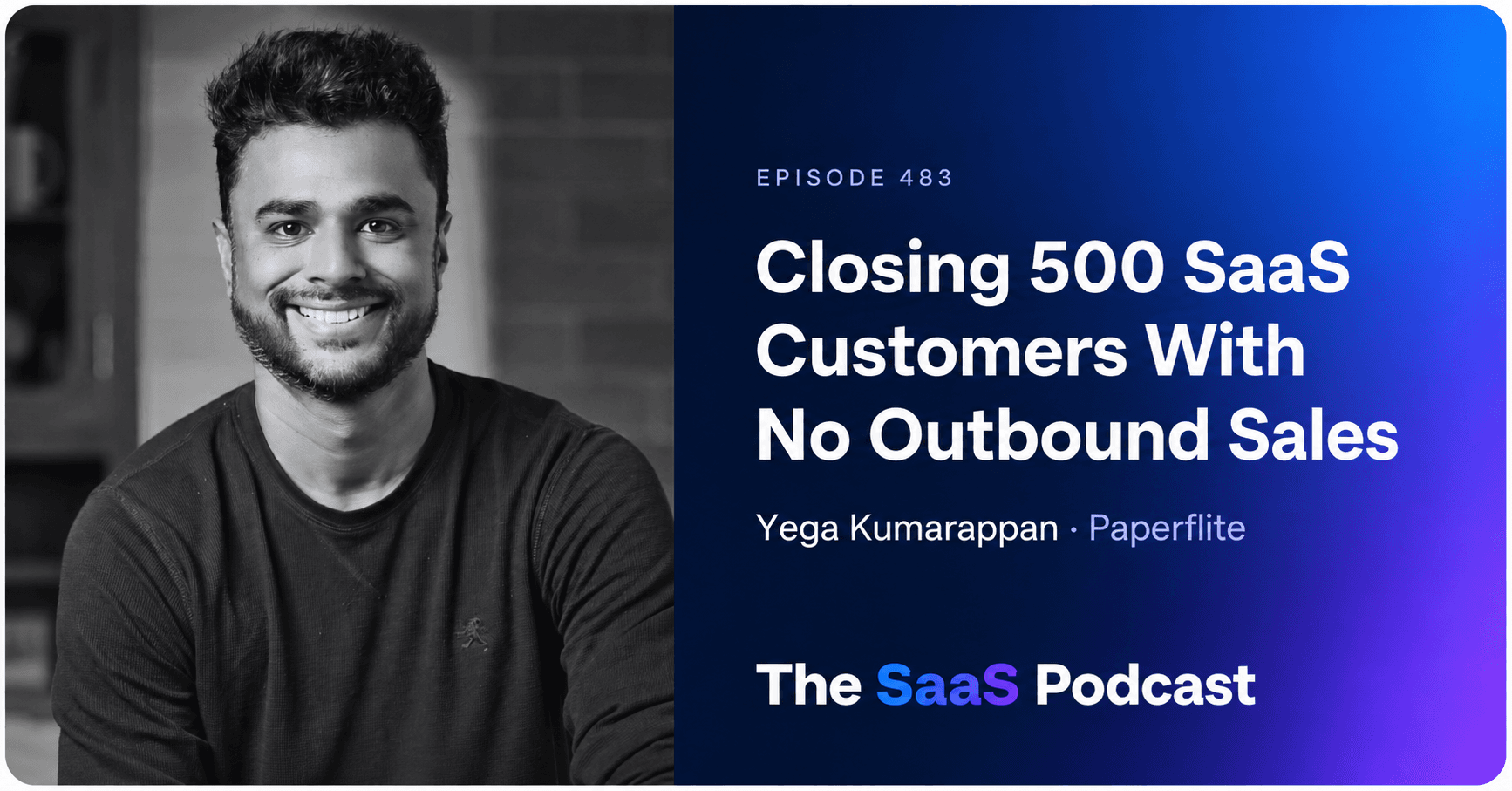
Yega Kumarappan is the co-founder and Chief Product Officer of Paperflite, a content and sales enablement platform that helps B2B marketing and sales teams close deals faster. Back in 2015, Yega and his future co-founders were building an internal venture at Cognizant. They needed to create decks, videos, case studies, and brochures, then get all of that into the hands of sales teams. Every tool they tried was terrible. That problem stuck with them. After more than a decade at Cognizant, all three founders walked away from stable careers with families to support. They had a working prototype when they went to investors. In January 2018, they raised a 400K seed round. Girish from Freshworks put money in. So did the ex-CEO of Cognizant. Paperflite never raised again. A year in, they were profitable. The product was a Netflix-like experience for sales content. Instead of digging through folders in SharePoint and Dropbox, sales reps logged in and saw exactly what worked for their product, their region, and their type of buyer. But selling SaaS without sales experience was harder than expected. Then one day, a message came through their Intercom chat. It was from S&P Global, asking if Paperflite could host research materials for a conference called COP22. The team had no idea what COP22 was. They thought a friend was pranking them. It turned out to be the UN climate change conference. That wasn't luck. For their first couple of years, Yega's team lived on Quora and Reddit, answering every question they could find about sales content and knowledge management. That's how the inbound started. Conversion was the next problem. Generic product tours converted at 2 to 3%. So they tried something almost nobody does. They spent 8 to 10 hours setting up a custom demo for every single prospect. A personalized hub, with their actual content, in their regions, for their buyer segments. Conversion jumped to 20%. Today, Paperflite serves over 500 B2B organizations, does seven figures in ARR, and has 140 employees across India and the US. All on that same 400K. This is one of the cleanest case studies of selling SaaS without sales experience and still building a durable, profitable B2B company.
Oscar Rubio, Lodgerin
Oscar Rubio is the founder and CEO of Lodgerin, a SaaS platform helping organizations manage housing and relocation services for students and employees moving abroad. The company has grown to over 1.2 million euros in annual revenue with a positive EBITDA margin of around 14%. Before building software, Oscar spent eight years running a traditional relocation services business in Spain. When COVID shut down international travel overnight, his revenue vanished completely. Rather than shut everything down as his COO recommended, Oscar made the bold decision to pivot to SaaS - despite having no technical background. He spent months in an empty office, taping paper to walls and digitizing every process he'd built over eight years of service delivery. He taught himself how software development worked, built a small team, and launched a bare-bones MVP. The first version was essentially an Airbnb for students - a marketplace where they could book housing through the platform. But a critical mistake almost killed the business before it started. They didn't build an availability calendar, so housing owners kept cancelling bookings. In the first quarter alone, they lost revenue from thousands of requests because properties weren't actually available. Then came the truly hard part - founder-led sales at an extreme level. Oscar powered through 850 meetings before landing his first paying customer. He flew from Spain to the US, drove from college to college, knocked on doors without appointments, and slept in cheap motels and even his car to keep going. His first customer, Comillas University in Madrid, initially ignored him for months after he visited their office. Then they called back - not for the housing marketplace he'd pitched, but to solve a different problem: managing incidents and emergencies during student stays. That one conversation opened the door to a customized project that became Lodgerin's first real contract. After landing those first customers through relentless founder-led sales, referrals started compounding. The university sector is tight-knit, and satisfied clients recommended Lodgerin to peers at other institutions. Oscar grew from 171K euros in 2022 to 420K in 2023 to 1.2 million in 2024 - all with positive margins.
Shahar Azulay, groundcover
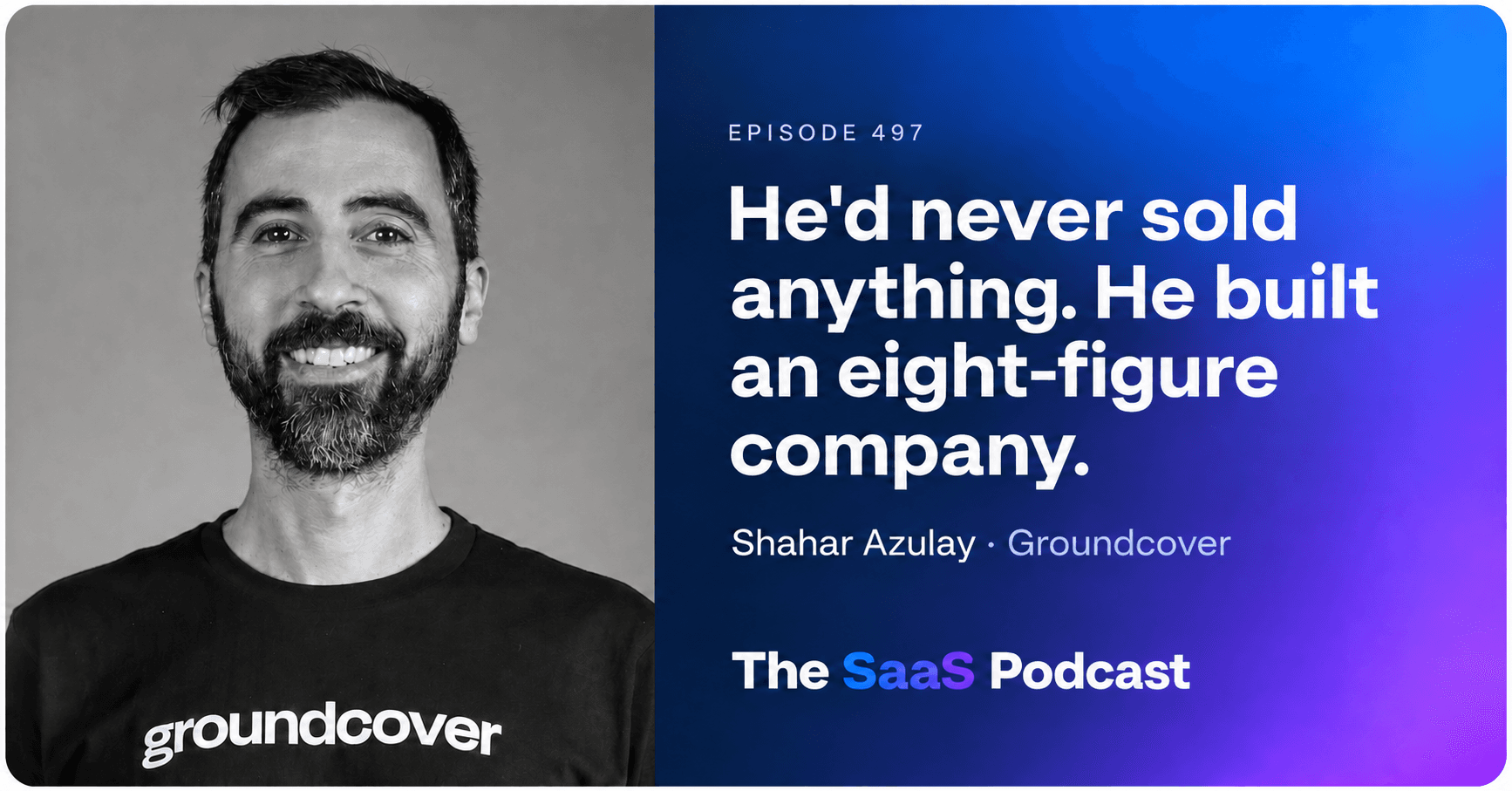
Shahar Azulay is the co-founder and CEO of groundcover, an observability platform that helps engineering teams catch problems in production before their customers do. He has built it to eight-figure ARR with more than 250 customers, competing directly against Datadog and New Relic. He came to it as an engineer, not a seller. Shahar and his co-founder had spent their careers as engineering managers, living the same frustrating cycle: instrument your applications, emit the telemetry you need, then get told the bill is too high and start sampling and switching things off. They set out to solve that with technology rather than a different margin, and bet the company on eBPF, a kernel technology nobody in observability was using at the time. The selling was harder than the building. Three months in, groundcover closed its first customer through a connection to a head of DevOps. There was no user interface yet, just the sensor and some dashboards. Shahar went into the pricing call asking for $100,000 and came out with $10,000 a year, because neither he nor his co-founder knew what they were negotiating against. His conclusion from that is contrarian: close your first dozen customers at whatever price they will pay. The learning, the references, and the confidence are worth more than the contract value, and you cannot expect to grow those early accounts anyway. Shahar also covers how the first 50 to 100 customers came from his own network and a handful of LinkedIn messages a day, why he published list pricing and then discounted it by up to 70 percent, and the moment customers started ripping out Datadog before groundcover was ready for it.