The 10-Hour Custom Demo Playbook That Took Conversion From 2% to 20%
Paperflite spent 8 to 10 hours building each prospect's actual content hub before the demo call. That single shift took conversion from 2-3% to 17-20% across th
How SaaS and AI founders who scaled got their first customers
One email every Thursday. Unsubscribe anytime.
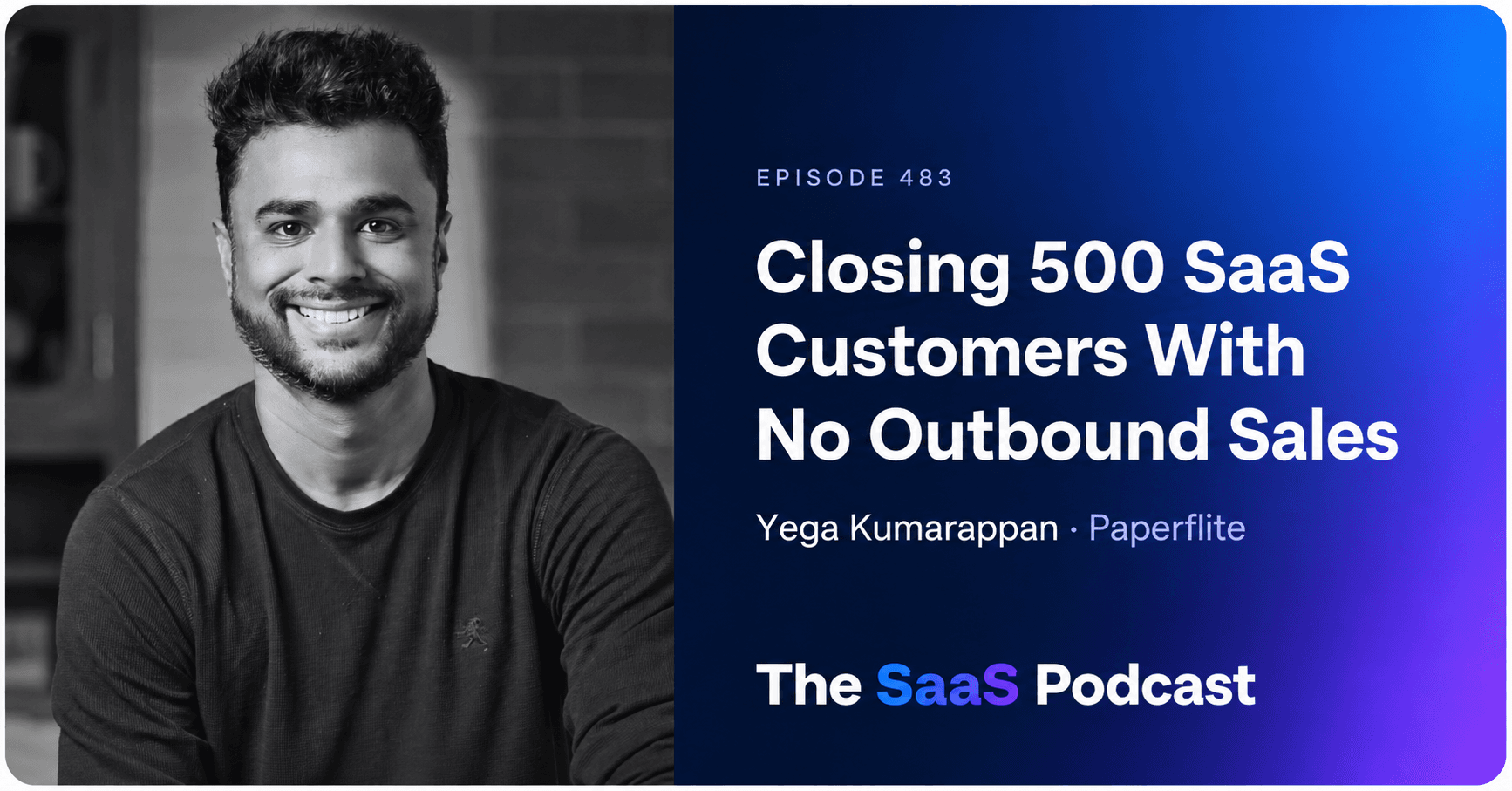
Yega Kumarappan and his two co-founders had zero sales experience and a working prototype. They spent the first two years answering questions on Quora and Reddit because no one would buy from them. Then a Fortune 500 message landed in their Intercom that they thought was a prank.
In this episode, Yega breaks down how Paperflite cracked enterprise B2B without a traditional sales team, why 10-hour custom demos were worth every minute, and how they grew to 500 customers and seven figures in ARR on a single 400K seed round.
Yega Kumarappan is the co-founder and Chief Product Officer of Paperflite, a content and sales enablement platform that helps B2B marketing and sales teams close deals faster.
Back in 2015, Yega and his future co-founders were building an internal venture at Cognizant. They needed to create decks, videos, case studies, and brochures, then get all of that into the hands of sales teams. Every tool they tried was terrible. That problem stuck with them.
After more than a decade at Cognizant, all three founders walked away from stable careers with families to support. They had a working prototype when they went to investors. In January 2018, they raised a 400K seed round. Girish from Freshworks put money in. So did the ex-CEO of Cognizant.
Paperflite never raised again. A year in, they were profitable.
The product was a Netflix-like experience for sales content. Instead of digging through folders in SharePoint and Dropbox, sales reps logged in and saw exactly what worked for their product, their region, and their type of buyer.
But selling SaaS without sales experience was harder than expected. Then one day, a message came through their Intercom chat. It was from S&P Global, asking if Paperflite could host research materials for a conference called COP22. The team had no idea what COP22 was. They thought a friend was pranking them. It turned out to be the UN climate change conference.
That wasn't luck. For their first couple of years, Yega's team lived on Quora and Reddit, answering every question they could find about sales content and knowledge management. That's how the inbound started.
Conversion was the next problem. Generic product tours converted at 2 to 3%. So they tried something almost nobody does. They spent 8 to 10 hours setting up a custom demo for every single prospect. A personalized hub, with their actual content, in their regions, for their buyer segments. Conversion jumped to 20%.
Today, Paperflite serves over 500 B2B organizations, does seven figures in ARR, and has 140 employees across India and the US. All on that same 400K. This is one of the cleanest case studies of selling SaaS without sales experience and still building a durable, profitable B2B company.
Paperflite reached 500 B2B customers and seven figures in ARR by selling SaaS without sales experience - building inbound through Quora and Reddit answers, then spending 8 to 10 hours on custom demos for every prospect, which pushed conversion from 2% to 20%.
🎯 Selling SaaS without sales experience starts on forums: Yega's team spent two years answering Quora and Reddit questions on sales content to build qualified inbound, then converted forum readers via LinkedIn DMs and Intercom.
💰 10-hour custom demos beat generic product tours: Pre-building each prospect's actual Paperflite hub (their content, regions, buyer segments) pushed conversion from 2-3% to 17-20%, validated through A/B testing.
🤝 High-touch onboarding is leverage when selling SaaS without sales experience: Paperflite manually pulled content from SharePoint, email, and shared drives for the first 50 to 70 enterprise customers to lock in retention and learn each industry.
🚀 Profitability buys product freedom: A single 400K seed in 2018 plus year-two profitability let Paperflite rebuild coaching as AI-native and content creation as Canva-like without VC-led roadmap pressure.
🏢 Positioning between giants and point solutions is the bootstrapped opening: Seismic-Highspot consolidation creates one big target above and AI-only entrants leave gaps below - mid-tier with deep industry context wins the middle.
📉 Customer feedback predicts conversion better than commitments to buy: Marketing leaders told Paperflite "we love this, we'll buy it" in early validation calls and then didn't - rely on the conversations to learn, not the verbal commitments.
🛠️ Run A/B tests on your GTM, not just your product: Paperflite split prospects into self-serve vs we set it up for you cohorts and used the conversion gap (2-3% vs 17-20%) to commit to high-touch demos as a permanent strategy.
Paperflite spent 8 to 10 hours building each prospect's actual content hub before the demo call. That single shift took conversion from 2-3% to 17-20% across th
Paperflite spent its first two years answering questions on Quora and Reddit while the website produced nothing. The qualified inbound that eventually closed th
CMOs told Paperflite the experience was great and that they would buy. None did. Yega Kumarappan explains how to use validation calls for learning, not as a for
After the Seismic-Highspot merger, Paperflite reframed its position around two structural weaknesses: giants too slow to re-architect for AI, and point solution
How did Paperflite get its first customers selling SaaS without sales experience?
For the first two years, the team answered every relevant question they could find on Quora and Reddit, tagging Paperflite as a solution. The forum activity built qualified inbound, and the first paying customer pinged them through Intercom.
Why did Yega Kumarappan spend 8 to 10 hours setting up a custom demo for every Paperflite prospect?
Generic product tours converted at 2 to 3%. By pre-building each prospect's actual content hub (their products, regions, buyer segments) before the demo call, Paperflite pushed conversion to 17-20% - validated through deliberate A/B tests.
How did Paperflite reach 500 B2B customers without raising beyond a seed round?
They raised one 400K seed round in January 2018 and turned profitable a year later. By keeping the team in India and front-loading customer success on the first 50 to 70 deals, they hit seven figures in ARR without follow-on capital.
What was the Intercom message from S&P Global that almost died in Paperflite's inbox?
S&P Global pinged Paperflite asking the team to host research materials for COP22. The founders had never heard of COP22 and assumed a friend was pranking them - it turned out to be the UN climate change conference, and the deal became one of their early Fortune-name proof points.
Why did Yega Kumarappan turn down follow-on funding for Paperflite after the seed round?
The business was profitable and growth was tracking to plan, so capital wasn't the constraint. Yega prioritized product freedom - rebuilding coaching as AI-native and content creation as Canva-like - over the strings and roadmap pressure that come with a Series A.
How is Paperflite positioning against the Seismic-Highspot merger?
The consolidation gives Paperflite a clearer single competitor at the top. Yega's pitch is the mid-tier sweet spot: industry experience (eight years of building for sales enablement) combined with the speed of an AI-native team that can re-architect faster than a billion-dollar incumbent.
What kind of inbound pipeline did Quora and Reddit produce for Paperflite in the early years?
Forum threads about sales content and knowledge management surfaced high-intent leads. Paperflite responded to questions, tagged the platform, and followed up on LinkedIn DMs - converting forum readers into trial requests that fed the Intercom inbox.
Why did Paperflite skip self-serve onboarding in the early days of selling SaaS without sales experience?
The product was still evolving and enterprise buyers expected hand-holding. The team set up every prospect's content repository themselves - pulling assets from SharePoint, email, and shared drives - to learn how each customer worked and lock in retention before automation existed.
How does Yega Kumarappan think about competing as a bootstrapped SaaS against AI-native point solutions?
Many AI-only entrants solve one narrow problem (role plays, deal rooms, Outlook plugins) without enterprise-grade scale or security. Paperflite's bet is that the durable winner is the platform that combines real industry experience with AI rebuilds (coaching 100% AI-native, content management 50%, content creation 70%).
Omer Khan [00:00:03]:
Welcome to the SaaS podcast. I'm your host, Omer Khan. AI has changed the playbook for building and growing SaaS. Every week I talk to founders who are writing the new one.
Omer Khan [00:00:12]:
For the first two years, they couldn't close a single customer, so they spent their time on Quora and Reddit answering questions from people they were trying to sell to. And eventually that's how they landed their first customer.
Omer Khan [00:00:26]:
My guest today is Yega Kumarappan, who, along with his two co founders, built Paperflite into seven figures in ARR with 500 B2B customers.
Omer Khan [00:00:37]:
In this interview, he breaks down how spending 8 to 10 hours on every custom demo helped them push their conversion rate from 2% to 20%, how they signed 26 enterprise customers in one year with zero sales experience, and how a Fortune 500 deal almost died in their intercom inbox. All right, Yega, welcome to the show.
Yega Kumarappan [00:01:02]:
Thank you, Omer. Nice meeting you.
Omer Khan [00:01:04]:
Same here. So tell us about Paperflite. What does the product do? Who's it for?
Yega Kumarappan [00:01:09]:
Paperflite helps marketing teams reap ROI for their content. And all of this private knowledge is also used for sales enablement from a sales. From a sales revenue standpoint, in terms of closing deals faster and scaling up revenue.
Omer Khan [00:01:25]:
Great. Give us a sense of the size of the business. Where are you in terms of revenue, customer size of team?
Yega Kumarappan [00:01:32]:
In terms of revenue? We're in seven figures. ARR. We've got around 500 odd organizations, B2B enterprises that use our platform across the world, and We've got around 140 employees, primarily headquartered in India, and there's a small team based out of the US.
Omer Khan [00:01:51]:
And so from what I understand, you guys founded the business in 2018, you raised a seed round of around 400,000, and then after that you haven't raised any more money and the business is profitable.
Yega Kumarappan [00:02:06]:
That is correct. That is correct. So we raised a seed just for us to get us off the ground. And then a year into year in, we turned profitable and our Runway was clear and we did not have the need to raise capital after that.
Omer Khan [00:02:21]:
Okay, great. So tell me, like, where did the idea for Paperflite come from?
Yega Kumarappan [00:02:27]:
So before, before we started Paperflite, one of my experiences was we built a crowdsourcing platform back in 2015, which was entirely new for the industry at that point in time. A completely new product that we were trying to take to the market. This is part of a larger organization. I used to work with Cognizant before.
Yega Kumarappan [00:02:47]:
This was a venture that was running back then, and this was entirely new product that we're taking to the market. And which means we had to build a lot of awareness. So we had to create a lot of collateral. And distributing all of this collateral to the GTM teams was very important.
Yega Kumarappan [00:03:04]:
And we did look at every single product that was available in the market back then. None of that would do justice to the kind of collateral that we had built, like videos and brochures and case studies and white papers and everything. So there was a problem that we already knew.
Yega Kumarappan [00:03:18]:
But then we split ways, went in different directions as founders, and at some point when we wanted to start something, we did experiment with multiple possibilities of what we could work on. But this was a problem that was at the back of our hand.
Yega Kumarappan [00:03:33]:
We really knew what was there, what the market had to offer and how different we could solve as well. So it was, that's how we started Paperflite.
Omer Khan [00:03:44]:
Okay, so you and your two co founders, you guys were all in full time jobs at the time. And so what was the moment where you said, yeah, let's leave the comfort of all of that and let's go all in and start building this business.
Yega Kumarappan [00:04:03]:
So after the venture that I just described right now, I moved to New York. I was heading technology prototyping and we were working with brands like, like Ford and Lego and Nike of sorts.
Yega Kumarappan [00:04:15]:
And we were building technology feasibility assignments for how these brands would look like, like 15 years from now and 20 years from now, what kind of technology would they need to put on the field.
Yega Kumarappan [00:04:27]:
So that kind of exposed us to a lot of startups, the entire world of what's possible, the technology that was available, and how different each of these solutions are coming across.
Yega Kumarappan [00:04:39]:
If you put these two together, the problem that we already knew and the exposure for how these, how the startups are being built put together was kind of a good motivation for us to look at. If we were to solve a problem that we really knew well about, could it be solved in a different way?
Yega Kumarappan [00:05:00]:
Could it be solved in a more effective way? And we were excited when we landed on how Paperflite solved the problem to start with. We were really excited and that's what got us to starting something on our own.
Omer Khan [00:05:14]:
So did you guys go and raise the seed round first? I'm trying to figure out like when, what was the order? Did you kind of like self fund, try to build the initial product, then later raise a seed round?
Yega Kumarappan [00:05:29]:
We had the prototype, we had the idea, we had a prototype, a working prototype. Not something that's scalable, I'd say, but working prototype that we could demo and that's when we raised the seed capital.
Omer Khan [00:05:40]:
And what was that demo based on? Did you go out and talk to prospective customers and get feedback? Did you validate the idea or was this just more based on. This is our own experience and we're going to solve for that.
Yega Kumarappan [00:05:57]:
It was our own experience that I think is very important because you need to be rooted to the problem and the solution and you need to be. You need to have that conviction to how you're solving. That's just start. But then validation is very, very important.
Yega Kumarappan [00:06:11]:
So when we solved the content problem we picked up on before we solved it was all in folders and SharePoint and Box and Dropbox and that's the best way to distribute content at that point in time.
Yega Kumarappan [00:06:23]:
When we started Paperflite, we went after the heavy content platforms like Netflix and Amazon of sorts, and we said when you log into the platform, you will have a Netflix like experience, which kind of gives you the content depending on the product that you're working on, the region that you're working on, the segment of customers that you're selling to, so you don't have to drill down through folder structures and figure out what's new, who's uploaded what, what's working and all of that.
Yega Kumarappan [00:06:50]:
So that was the experience that we built. And when we validated this solution, the prototype with actual users in marketing, head of the CMOs and head of marketing, the response was pretty good. So everybody was like, we've not seen something like this. The experience is really good. We will buy it. That was the start.
Omer Khan [00:07:14]:
Did they buy it?
Yega Kumarappan [00:07:15]:
No.
Omer Khan [00:07:18]:
Why do you think that was in the early days?
Yega Kumarappan [00:07:20]:
There are multiple reasons. One is they're possibly leaders in marketing in much larger organizations and they wouldn't want to subscribe to a platform that is just coming off the ground just now. They'd want us to watch for some. Would they want to watch us for some time before they could pick us up?
Yega Kumarappan [00:07:44]:
The other reason was, I mean, I think always there are promises and when you do hit the ground, it's harder. It is 100 times harder for you to convert. I think everybody will agree with that. The reality is maybe they did not.
Yega Kumarappan [00:08:04]:
But the good side to it is the conversations were very good because we were able to ask them, why would you buy it and why do you think this is better? Why do you think this is solving your problem? We could get some hard responses for why we are building this solution.
Yega Kumarappan [00:08:18]:
That was reassurance for us and that support and that level of commitment at that point in time fuels you. It kind of drives you to build what you want to build. So that's a good side of it. Irrespective of what the conversion percentages are, you still should do it.
Yega Kumarappan [00:08:35]:
But I'd say just don't rely on it 100% because it might not convert, but it's still good. You still should do it.
Omer Khan [00:08:46]:
Now, I want to make sure that I want to get specific enough that people understand what we're talking about here. So when you described a Netflix type experience, I'm not sure everyone would understand that. So why don't we just explain it in the context of sales enablement?
Omer Khan [00:09:06]:
And the typical scenario, if they're not using a product like Paperflite, would be that sales folks are figuring out, okay, these are the customers I'm going to go and pitch to. These are the deck, the decks or the assets that I have to create to show them, to send them proposals.
Omer Khan [00:09:30]:
All of this stuff, as you mentioned, they're sharing it over Box or Dropbox or whatever, and they've got no idea if anybody is actually looking at this stuff. Right. And so describe, when you say that Netflix experience, describe how that is different for that sales team when they're using something like Paperflite.
Yega Kumarappan [00:09:52]:
The first problem here is easy access to content or easy access to knowledge. The first problem is making sure that you land all of the knowledge and content with your sales teams. That's the first problem. The second problem is for your sales teams to land that information with your buyers.
Yega Kumarappan [00:10:11]:
If you talk about the first problem of landing with your sales teams, when it's in folders, it's just not possible to figure out where's the most recent, most latest, what works, what does not work.
Yega Kumarappan [00:10:23]:
But if I'm going to serve that to you in a Netflix like interface, you really have, if you work on a specific product in a specific region for a buyer segment, let's say enterprises, and you're selling product A and you're operating in the European region, I'm going to serve you content which is very specific to the product and the region and the industry that you're serving.
Yega Kumarappan [00:10:48]:
And at the same time, this will also be content which is carrying a lot of telemetry around it in terms of what really works with a customer of this type, if the intent is of a certain order, what kind of content really works.
Yega Kumarappan [00:11:03]:
So I'm able to, when you log in, you really see those, see all of those pieces of content, like, here's the new video on the product that you're Working on. Here's what helped us close most of the revenue for this product in this region.
Yega Kumarappan [00:11:16]:
Most successful sales reps use this content or this is what you should share at this point in time and in this deal stage. So that's landing with your sales with a field in itself. The second stage is for the sales reps to land this with, with your buyers, with your prospects.
Yega Kumarappan [00:11:32]:
In most cases, like I said, it's an absolute blind spot for what really works. And when do I share what kind of content, how long has it been since I interacted with the prospect? So based on all of this metadata, we're able to recommend, you know what, it's been a week and you are in the negotiation phase.
Yega Kumarappan [00:11:53]:
And you sent over material which includes pricing. And in the last three days, I've seen your prospect interact with the pricing page and multiple stakeholders in your prospect organization are interacting with the pricing page.
Yega Kumarappan [00:12:06]:
Maybe this is the right time for you to reach out and talk about, you know, if you're concerned about this, here's some discounts that we could offer, here's some tiered pricing models that could change how this could work. So we kind of establishes that they're interested in the product, but they're working on the pricing.
Yega Kumarappan [00:12:22]:
So it gives you a lot of signals around what should your next conversation be about. So that's. Those are the two stages that we deal with from a. Primarily from a content and knowledge standpoint. Omer.
Omer Khan [00:12:33]:
Great, Great. Now, when you were going after the first 10 customers, the product was a lot more basic back then, obviously that was like eight years ago. Walk me through what it took to close that first customer. Like, how did you find that first customer? You were obviously having conversations and getting feedback on the prototype.
Omer Khan [00:12:58]:
But how did you find that first customer, the one that paid, and how long did it take for you to close that deal?
Yega Kumarappan [00:13:05]:
I'd say the first customer was still inbound, was somebody who pinged us on intercom, came through, they looked at the product just for somebody who clearly knew what the problem was and exposed to what solutions exist in the market.
Yega Kumarappan [00:13:25]:
Yes, our solution was kind of in its early stages, but someone who was willing to work with us to build this further as well. Now, in the first 10, one of the most interesting instances I could quote is one of those. One of the leads that came through voids was from S and P center and floor.
Yega Kumarappan [00:13:48]:
And this was an intercom ping. And we were too early and we really thought that somebody was playing a prank on us, like maybe one of our friends from Somewhere or somebody within the team trying to reach out to us, asking.
Yega Kumarappan [00:14:07]:
We are working on this conference called copy cop 22 and we need all of our research materials to be distributed at the conference. And we're looking for a product that does justice to all the work. And we were like, what really is. We didn't Even know what COP22 was.
Yega Kumarappan [00:14:23]:
Later, it turned out to be the climate change conference, very early stages.
Yega Kumarappan [00:14:26]:
And again, for a brand like S and P to come through and for us to convert that, and we were the platform that was used to distribute the content for the, at the climate change conference, kind of reassuring, pushed us forward to build a lot more.
Omer Khan [00:14:45]:
You know, before we started recording, I asked you about your GTM and you know, how you had grown the business to where it is today. And you said, it's all, it's all inbound. And I said, okay, great, what about getting to the first million? And you said, yeah, it was inbound.
Omer Khan [00:15:03]:
And I said, okay, what about the first 10 customers? And you said, inbound? And I was like, how is that even possible?
Omer Khan [00:15:08]:
Like, you know, most founders would build, you know, launch, they'd have a website, they'd be like praying for any kind of SEO traffic and having like, you know, if they were lucky, having one or two people trickle in. So what, what did you guys do? What do you think you did differently?
Omer Khan [00:15:28]:
Why were these people finding you and reaching out through intercom?
Yega Kumarappan [00:15:33]:
Very valid question. Just the website would not cut it for sure, especially when you're just starting off the ground. The first couple of years, we spent a lot of time on forums, on Quora, on Reddit, responding to questions, tagging the platform. This was the primary responsibility of small team within, within the organization.
Yega Kumarappan [00:15:56]:
So that way there was a lot of traction which we were able to identify. I'd say more qualified opportunities. And these are because when you get to a discussion forum and when you see a bunch of people discussing about a specific content problem or a distribution issue or any of that, these are very highly qualified leads.
Yega Kumarappan [00:16:20]:
Now it's about how do we get to them and how do we engage with them. So the team would go after responding to all of these questions, connecting with them on LinkedIn, DMing them again.
Yega Kumarappan [00:16:30]:
So we started running multiple threads around these smaller community of high quality leads is what I'd say, which kind of got us the first bunch of customers to work with us. And then the inbound engine got a lot more effective because you have a set of customers working with you already.
Yega Kumarappan [00:16:53]:
And over a period of time, Google kicked in and we were able to snowball that whole path.
Omer Khan [00:17:00]:
Who was your ICP in those first couple of years?
Yega Kumarappan [00:17:04]:
Head of marketing, cmos.
Omer Khan [00:17:07]:
Okay. And were you targeting a specific vertical or type of company or just anybody who was doing some kind of marketing?
Yega Kumarappan [00:17:16]:
We did not. Interestingly, we did not at that point in time. We are now, but back then we did not also because we wanted to play it by how things move. So we were open to start with. Our focus was on the marketing industry as such, because marketing was more concerned about what's the ROI of my content?
Yega Kumarappan [00:17:40]:
What revenue is it bringing? How much is my content influencing a deal? These were very important questions for them to have a seat at the table from a revenue standpoint. And they were investing in tools and products that will help them create the awareness for the products that these organizations are working on.
Yega Kumarappan [00:18:00]:
So that was a sweet spot for us when we started.
Omer Khan [00:18:04]:
And then once you have that inbound lead, what does the process look like from that first contact to closing a deal? Is it like they go in through self serve and stick in their credit card? Is it kind of more like a sales led process? What did you have to do?
Omer Khan [00:18:28]:
Let's talk about getting from zero to the first million. When you were closing those deals, what did that process look like?
Yega Kumarappan [00:18:36]:
Early stages, again, self serve was harder because the product is also. Usually the product is also under evolution and you have customers who are going to come to you with newer requirements, feature sets that you might not have. This is a common problem that we see. So what we did was we worked with them.
Yega Kumarappan [00:18:58]:
We wouldn't pass the bottom on the other side and ask them start using the platform. We worked with them. We actually did a lot of heavy lifting also in those cases. So there's a lot of investment that goes from our end.
Yega Kumarappan [00:19:08]:
Like for example, if you were to set up the whole repository, we work with them to figure out what are all the different content sources that you have today. You've got, let's say you've got some of your content on emails, on shared drives, in SharePoint or wherever it is. We pick all of that content.
Yega Kumarappan [00:19:23]:
We worked with them to clean them up, sort them, organize, tag them, and then bring them into the platform. And they loved it because that's the investment from our end, to understand how their businesses and processes work and work alongside them, to make sure it is successful on both sides.
Yega Kumarappan [00:19:43]:
And it's very important, especially when you're getting off the ground. Let's not look at it as a product that I've built I'm just handing it over to you versus can I work with you to make this successful? Because that learning at that window of time is very crucial.
Omer Khan [00:20:01]:
Yeah. So you were providing a high touch onboarding experience for those customers, which makes a lot of sense and is probably lowers the risks when your product is still kind of evolving and you don't really know what about before that point before you.
Omer Khan [00:20:20]:
They've reached out to you and they say, we're interested and you haven't got as far as. Yeah, they've given you money and you're onboarding them. What did that process look like?
Omer Khan [00:20:30]:
Would it be you would then do demos, you would then go back and do more demos, and then how long would it take before you would get to a point where they would actually, you know, close the deal and give you money?
Yega Kumarappan [00:20:43]:
Very interesting question. So I was just thinking about how did we really do this is. For every prospect that reaches out to us, we would set up the entire platform very specific to that organization.
Yega Kumarappan [00:20:59]:
Because the team figures out what business are they in, what kind of content is already available over the Internet, how do they distribute it, how much of a sales team do they have, which regions do they sell to? We pick up all of them. This is a lot of work, by the way. I mean, it's unpaid work.
Yega Kumarappan [00:21:13]:
Nobody's paying you for that. But. But when I build the entire Netflix like experience and on the demo, call when we get in and when we show them, here's how your hub can look like, here's how all of your knowledge can look like. That's the first aha moment. That's actually when you tip them.
Yega Kumarappan [00:21:32]:
That's actually when the conversion happens. And from then on, it gets into subsequent questions about do you guys still do this? Can you offer this? Do you integrate with this platform? And I think those are. I mean, it was easier to say yes back then.
Yega Kumarappan [00:21:50]:
It is a lot more easier to say yes right now because building has become so simple.
Omer Khan [00:21:56]:
Were you doing that for the first 10 customers, like building these custom experiences for the demo, or is that something you do today?
Yega Kumarappan [00:22:05]:
We still do. Depending on the size of engagement, depending on the brand that we are working with, we still do that. But I'd say up until the first 50 or 50 or 70 of those first set of enterprises that we onboarded, until that mark, we would do for every prospect. So that's.
Yega Kumarappan [00:22:25]:
You can imagine, even if you do a 20% conversion rate, you're really looking at 500, 600 prospect experiences or applications that the team would have Built and.
Omer Khan [00:22:37]:
How much time or man hours were going into preparing for each of these demos or experiences? Like, what was it like, a couple of hours I built something? Or this was like. No, it took days.
Yega Kumarappan [00:22:51]:
It took like a day, maybe eight or 10 hours. Because there's so much of research work that you will have to do. Pull all of it together. Setting up on the platform could be two hours, but there's at least six, seven hours of work that you'll have to do before you consolidate everything.
Omer Khan [00:23:06]:
That is a lot of work for a demo call that you Basically, at a 20, there's an 80% chance they're not going to sign with you and then do that for like hundreds of customers. But what was the point where you guys said, no, this is working. We need to keep doing this.
Omer Khan [00:23:33]:
Like, there must have been something must have happened in terms of closing a deal or a type of customer, which gave you enough confidence to say, okay, this is a lot of work. This is a lot of time for every single demo call. But we need to keep doing because of this reason.
Yega Kumarappan [00:23:52]:
I think in most cases, it's the feedback, it's the excitement that we've seen, especially if we were able to do the first 10 customers, if we are able to convert them, and this is what has worked. I think that's the best lever we have from a product standpoint.
Yega Kumarappan [00:24:11]:
But at the same time, Omer, we've run a B testing kind of stuff. We've kind of put this into two different sets of prospects. And we evaluated what happens when. When we distance ourselves from the prospect and tell them that, you know, here's the product, go ahead and use it versus we work with them.
Yega Kumarappan [00:24:33]:
It was night and day. It was just absolutely visible. From a data standpoint, the conversion rates were way less when I say way less. So the conversion rates were like some 2%, 3% on this side and 17 to 20% on the other side. So it was equals apparent. And so I think we should run these experiments.
Yega Kumarappan [00:24:53]:
It's not like you figure it out and you just go on that path forever. Once you have to, at the right intervals, we run these experiments to see if we are on the right track.
Omer Khan [00:25:04]:
Got it. Okay. So basically you had the data to say, if we don't put this level of effort or if we put this level of effort into doing a demo, the chances are we're going to get a 20% or something around that ballpark conversion rate. And if we phone it in and do a very basic.
Omer Khan [00:25:23]:
Deliver a very basic generic experience for the demo, the conversion rate is going to be significantly less.
Yega Kumarappan [00:25:29]:
That is right. Yes, that's what we saw.
Omer Khan [00:25:32]:
Now you guys raised, I think we mentioned earlier like 400,000 as a seed round and then you didn't raise any more money after that. Now given where you guys are right now in terms of multiple seven figures in ARR, the playbook would be raise a series A right? Go and put some fuel on this, grow faster.
Omer Khan [00:26:00]:
You're playing in a space with some very big, very well funded competitors out there. So there's a lot of the time is pretty sizable and there's always an opportunity to even move more up market if you guys wanted to. So why, why did you decide not to raise any more money beyond the seed round?
Yega Kumarappan [00:26:24]:
I'd say up until now we've, we had a trajectory and we, we, our growth was, was falling in line with the trajectory that we had and we had the Runway for it. We had the, had the money to spend on what we wanted to spend on. So it was not a dire need to raise.
Yega Kumarappan [00:26:44]:
But at the same time I think we'd always questioned about the good and the bad like one end in terms of scaling the product in the direction that you would like to.
Yega Kumarappan [00:26:59]:
I'll give you an example of how where Paperfly is a flagship product and at some point the, the industry was heading towards coaching and coaching was still stuck in, stuck out in the age of how where it was 20 years ago where you have like slides that you would go through and at the end of it you will have a survey, questions and then you have a certificate at the end of it that was coaching.
Yega Kumarappan [00:27:23]:
While we, as much as the industry was going after that, we wanted to look at content creation. So we went into the CANVA kind of a mode where we wanted to build a completely different platform which would help you create content, interactive content, intelligent content.
Yega Kumarappan [00:27:38]:
And then up until as early as two years ago when you had AI kicking in and there's a lot of LLM access coming in, which is when we decided that's the right time for us to get into coaching.
Yega Kumarappan [00:27:52]:
Because as much as we disrupted the content space and also the content creation space and this is, this is the right time for us to disrupt the coaching space. So we would build role plays and simulations and podcasts and microlearning and self learning and video bytes and all of that and tie that along the entire sales lifecycle.
Yega Kumarappan [00:28:15]:
So there were a lot of product directions and decisions that we could take and there was a lot of freedom for us to decide on how we'll operate, what we'll build and what we'll change, rather than any kind of influence in those. And we love that freedom.
Yega Kumarappan [00:28:31]:
At the same time, as long as it doesn't restrict from a commercial standpoint, from a capital standpoint, as long as we're not tight, we were fine. So that was the decision that we took.
Omer Khan [00:28:45]:
Was there ever a point where you guys almost decided, okay, let's go out and do try to raise another round, and then you sort of pulled back?
Yega Kumarappan [00:28:56]:
Not really. I mean we've had interest for investments we did pursue for a little while and then we figured out. And then we pulled back as figured out. Maybe not, maybe not now. Maybe when you build the next product, when you build the next product of sorts. But I don't think it has constrained us in any form.
Yega Kumarappan [00:29:18]:
But I do agree that moving forward as much, because distribution muscle is the key, because building as much as we've built so much, as much as we have an understanding of the depth of how this industry operates, as much as we have all of that distribution has become key and we are working to see how do we build on that muscle.
Yega Kumarappan [00:29:39]:
That is something that we've been thinking of now. Yes.
Omer Khan [00:29:44]:
Yeah.
Omer Khan [00:29:44]:
I mean, essentially I think what I'm hearing is you can look at this business and you guys raise the seed round and the playbook might be to go and raise the Series A or whatever, but fundamentally you guys are more like bootstrappers and you like having that freedom to build the kind of product and business that you want with as little interference as possible and go as far as you can down that road.
Yega Kumarappan [00:30:13]:
True, true. But again, I do agree that times are changing and then we still have to look at distribution. The challenges evolve. Until now it's not been a critical factor.
Omer Khan [00:30:25]:
Tell me about competitors, how you guys think about that in this space. Obviously the biggest players in the market, like the Seismic and recently the Seismic high spot merger, it's kind of pretty massive, I don't know, billions of dollar type kind of merger. How do you guys see yourself fitting in that market?
Omer Khan [00:30:49]:
What's the kind of niche that you've carved out for yourself and how much time do you spend looking at some of those bigger companies?
Yega Kumarappan [00:30:58]:
A lot of time off late. Earlier we felt, let's say eight years back or five, six years back when we started, when we were working with small medium customers, Seismic and Highspot would always look at, I mean we would always look at them as, you know, a little too far off, far fetched for us.
Yega Kumarappan [00:31:16]:
But what's happened in the last couple of years is we've converted quite a bit of Seismic users and Highspot users into Paperflite. So it kind of gave us the confidence as to what we've. The journey that we've come through. I mean, it was never a question of features or capabilities because we were always on par.
Yega Kumarappan [00:31:37]:
We were really competing, but at the same time, the way we solve the features. I'm sorry, the way we solve these problems were very creative, innovative and also based on the very technology heavy. In that case, we were always ahead of all the names that you just mentioned.
Yega Kumarappan [00:32:00]:
But purely from a distribution muscle and from positioning standpoint, the market would still look at sitelink and high spot from a. From sites of engagement that they work with. But considering what's happened in the recent the way I'd say is the consolidation. Again, there's so much of consolidation that's happening in the market, especially this one.
Yega Kumarappan [00:32:22]:
Between high spot and Seismic is key, is crucial because we were looking at converting either from a high spot or a Seismic and now that they're together, it's good and bad. One is the fact that consolidation helps.
Yega Kumarappan [00:32:38]:
The market is coming together as a much stronger product and also for us, it's one brand to look up, to follow and to be the next best to start with at this point in time. Kind of clears the air for us, gives us a really good sweet spot for us to position ourselves.
Yega Kumarappan [00:33:00]:
That's how I'd look at the consolidation.
Omer Khan [00:33:03]:
And what's the bad bias side of it?
Yega Kumarappan [00:33:06]:
The bad side of it is not about the consolidation. The bad side of it is what's happening on the opposite. On the flip side, which is there's a lot of pointed AI solutions that are coming up which solve a very specific problem.
Yega Kumarappan [00:33:23]:
I'd say generic because they're very new in the market, but they want to solve one specific problem. Let's say you want to solve role plays, only role plays, or you want to. Or you'd like to only create a deal room and then manage just the deal room.
Yega Kumarappan [00:33:38]:
Or I have an Outlook plugin that kind of helps you fetch content depending on what email you're writing. So you have all of these pointed solutions and the market is really cluttered, which is the other side. Kind of there's a lot of noise is what I'd say. But that clarity has to.
Yega Kumarappan [00:33:57]:
It's going to take some time for that ad to clear off for us to really see who's able to sustain who's not able to or how do they grow their roots is something that we are yet to see.
Omer Khan [00:34:09]:
Yeah. Okay, so on the one side you've got these big players, like Seismic Highspot. On the other side you've got a lot of these new AI first entrants.
Omer Khan [00:34:24]:
And you guys obviously weren't an AI company when you started eight years ago, but you've rebuilt a lot of the product and become AI is much more a native integrated part of what you do today. But how do you think about your positioning? Like for example you mentioned, hey, we have, from a product perspective, we're on par.
Omer Khan [00:34:52]:
We have features, maybe some that are better than what these big players are doing, but we don't have necessarily the distribution, the mindshare, et cetera, which is super important because these days building a product has become so much easier.
Omer Khan [00:35:10]:
And even if you build an amazing feature that doesn't necessarily mean anything, which is the same thing with vibe coding, you can go and build an amazing product that does what, I don't even know what Seismic features are, but does a whole bunch of stuff that Seismic does, but you don't have any distribution.
Omer Khan [00:35:32]:
So just tell me about, like how do you guys think about navigating that and what do you think is the most important differentiator? Like if you're talking to a customer, why? And they ask you why should I pick Paperflite versus all these other things that I have available in the market? What would you say?
Yega Kumarappan [00:35:55]:
You need a combination of both. You need somebody who's had the industry experience but not too old for it to be difficult to change. You need, for example, the products that I talked about, let's say content creation or content management or the coaching.
Yega Kumarappan [00:36:12]:
The coaching part of it is, is 100% AI native, the content management part is 50% AI native and the content creation is like 70% AI native. So that's how the products have actually evolved.
Yega Kumarappan [00:36:24]:
Now I really say it's a sweet spot or the best blend of expertise and experience in the industry and the advancement from a technology standpoint and the capability to move faster forward.
Yega Kumarappan [00:36:41]:
So if I look at the two sides in between to my left, I have the white coded platforms that are entirely new and I don't know if they will be able to scale.
Yega Kumarappan [00:36:55]:
So the problems is from a security standpoint, from a scale standpoint, from data management, from concurrency, and these are areas where even maintenance is a big problem. And what I'm hearing is also that when we talk about pure play AI revenue, that's a challenge.
Yega Kumarappan [00:37:15]:
We're still not able to see a Credible dollar figure out there for the wide coded platforms yet. And on the other hand, you have larger massive organizations. Again, what is how flexible are they, how fast or how swift are they? How swift can they move? Can they change, can they rearchitect? It is going to be harder.
Yega Kumarappan [00:37:40]:
I mean, it's going to be hard to move a truck versus a bicycle. So it is harder on the other side. Now you're somewhere in the sweet spot where you've got the experience, you've built, built this for the industry for a good number of years.
Yega Kumarappan [00:38:00]:
But at the same time, the team is also moving forward really fast and you're ahead of the curve when it comes to technology. It's a nimble team that can help you adapt everything faster. So your organization, the buyer, buyer's organization can grow faster and you will be ahead of your peers. That's what we have seen.
Yega Kumarappan [00:38:20]:
They are ahead of their peers in the industries that they operate in. So that is our sweet spot, that is our strength.
Omer Khan [00:38:27]:
All right, we should wrap up, so let's get on to the lightning round. I've got five quick fire questions for you. You ready?
Yega Kumarappan [00:38:36]:
Yes. Okay.
Omer Khan [00:38:37]:
What's a common piece of startup advice that you disagree with?
Yega Kumarappan [00:38:42]:
You build a product and. Meaning you build a really good product and you watch and the product will make the sale. Or that's going to help you just do everything? I don't think so. You've got to have an amazing team.
Yega Kumarappan [00:38:53]:
You got to have a structured approach and you need to know what, you need to have a plan for what you've got to do.
Omer Khan [00:38:57]:
What is a recent great book that you read?
Yega Kumarappan [00:39:01]:
Not really a book per se, but this is an essay, Dario Amodei's essay on Machines of Loving Grace. I think that was really insightful. It brought out the human side of AI and how AI would really be put to use, rather than everything that we see in the news right now. I felt it was really deep.
Omer Khan [00:39:22]:
Cool. What is something that you have had to learn the hard way as a founder?
Yega Kumarappan [00:39:28]:
Again, Products. When we roll this out, it's very difficult for you to split the view between how you look at the product versus how your users look at the product. We've always built it when we know this is a solution, this is what, this is how it's going to work.
Yega Kumarappan [00:39:48]:
And in most cases, or rather in times where we have not watched out for how the how whatever we built is being used, we've lost time, we've lost revenue, we've lost time. So it's not just about how you look at it.
Yega Kumarappan [00:40:06]:
But the harder thing is that for you to continue looking at how the users perceive whatever you've built or how the problem is actually being solved on the ground.
Omer Khan [00:40:15]:
What's a tool or habit that saves you the most time?
Yega Kumarappan [00:40:18]:
Notion. I've got a lot of notion boards.
Omer Khan [00:40:21]:
And finally, what do you do for fun when you're not working?
Yega Kumarappan [00:40:24]:
I run. I love good design. I want tracks. That's what I do.
Omer Khan [00:40:30]:
Cool. Well, Yega, thank you so much for joining me. It's been a pleasure. If people want to check out Paperflite, they can go to Paperflite.com. That's f, l I, T E. And if folks want to get in touch with you, what's the best way for them to do that?
Yega Kumarappan [00:40:44]:
LinkedIn. I'm quite responsive on LinkedIn.
Omer Khan [00:40:47]:
Awesome. We'll include a link in the show notes. Thanks, man. And I wish you and the team the best of success.
Yega Kumarappan [00:40:52]:
Thank you so much. It was really nice talking to you. Same here.
Omer Khan [00:40:55]:
Cheers.
Ross Andrew Paquette, Maropost
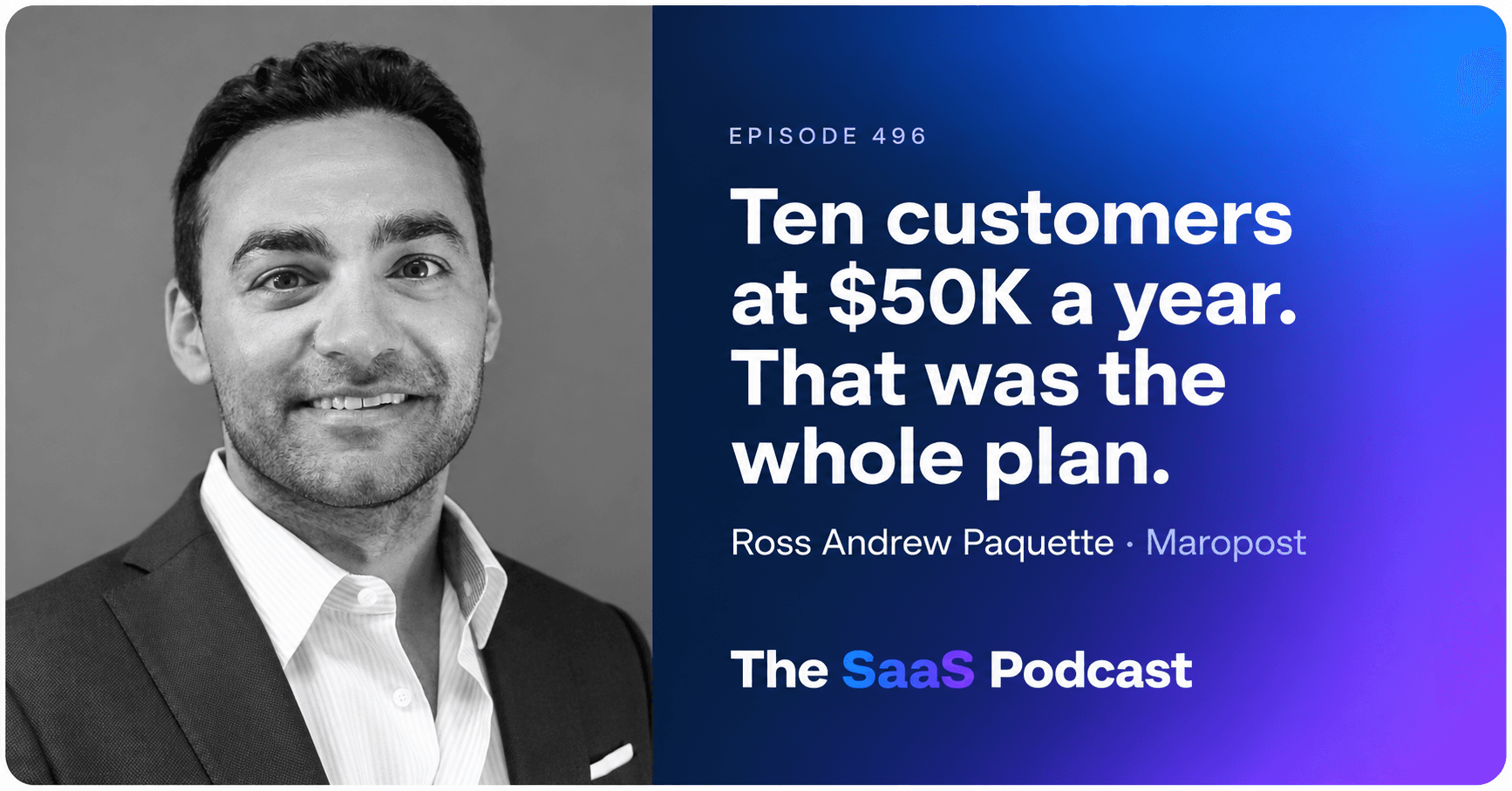
Ross Paquette is the founder and CEO of Maropost, a commerce and marketing platform he has bootstrapped to around $50 million in ARR with roughly 300 people and 5,000 customers. He started it in 2011 out of his apartment while still working full time selling Oracle ERP software into the construction industry. The plan was small. Ten customers paying $50,000 a year, about $500,000, and more free time. Ross had spent a few years selling marketing automation and knew the service in that market was poor, so his pitch was simple: 24-hour live chat and a five-minute response time, which in practice meant him. Three or four former customers signed almost immediately. Two of them paid around $10,000 a month. The early build nearly sank it. His developer would disappear for days, and the platform would go down with nobody available to fix it. Ross describes standing on a departing plane holding his phone in the air to hold the signal, maybe ten or fifteen times. His mother suggested he post the job somewhere. The first person who replied on oDesk rebuilt the platform in two or three weeks and is his CTO today. Then it caught. In 28 months the business went from $300,000 to $27 million with six or seven people, largely because Ross was personally closing brands like Rolling Stone and Mercedes off conference floors. He took a secondary round around 2016, gave up about 25 percent, and roughly three years later wrote a $37 million check to buy the investors out. He also gets into why seven or eight experienced sales leaders failed at Maropost, what he hires for now instead, and why he says he would not show up to work if he owned less than ten percent of his own company.
Oscar Rubio, Lodgerin
Oscar Rubio is the founder and CEO of Lodgerin, a SaaS platform helping organizations manage housing and relocation services for students and employees moving abroad. The company has grown to over 1.2 million euros in annual revenue with a positive EBITDA margin of around 14%. Before building software, Oscar spent eight years running a traditional relocation services business in Spain. When COVID shut down international travel overnight, his revenue vanished completely. Rather than shut everything down as his COO recommended, Oscar made the bold decision to pivot to SaaS - despite having no technical background. He spent months in an empty office, taping paper to walls and digitizing every process he'd built over eight years of service delivery. He taught himself how software development worked, built a small team, and launched a bare-bones MVP. The first version was essentially an Airbnb for students - a marketplace where they could book housing through the platform. But a critical mistake almost killed the business before it started. They didn't build an availability calendar, so housing owners kept cancelling bookings. In the first quarter alone, they lost revenue from thousands of requests because properties weren't actually available. Then came the truly hard part - founder-led sales at an extreme level. Oscar powered through 850 meetings before landing his first paying customer. He flew from Spain to the US, drove from college to college, knocked on doors without appointments, and slept in cheap motels and even his car to keep going. His first customer, Comillas University in Madrid, initially ignored him for months after he visited their office. Then they called back - not for the housing marketplace he'd pitched, but to solve a different problem: managing incidents and emergencies during student stays. That one conversation opened the door to a customized project that became Lodgerin's first real contract. After landing those first customers through relentless founder-led sales, referrals started compounding. The university sector is tight-knit, and satisfied clients recommended Lodgerin to peers at other institutions. Oscar grew from 171K euros in 2022 to 420K in 2023 to 1.2 million in 2024 - all with positive margins.
Shahar Azulay, groundcover
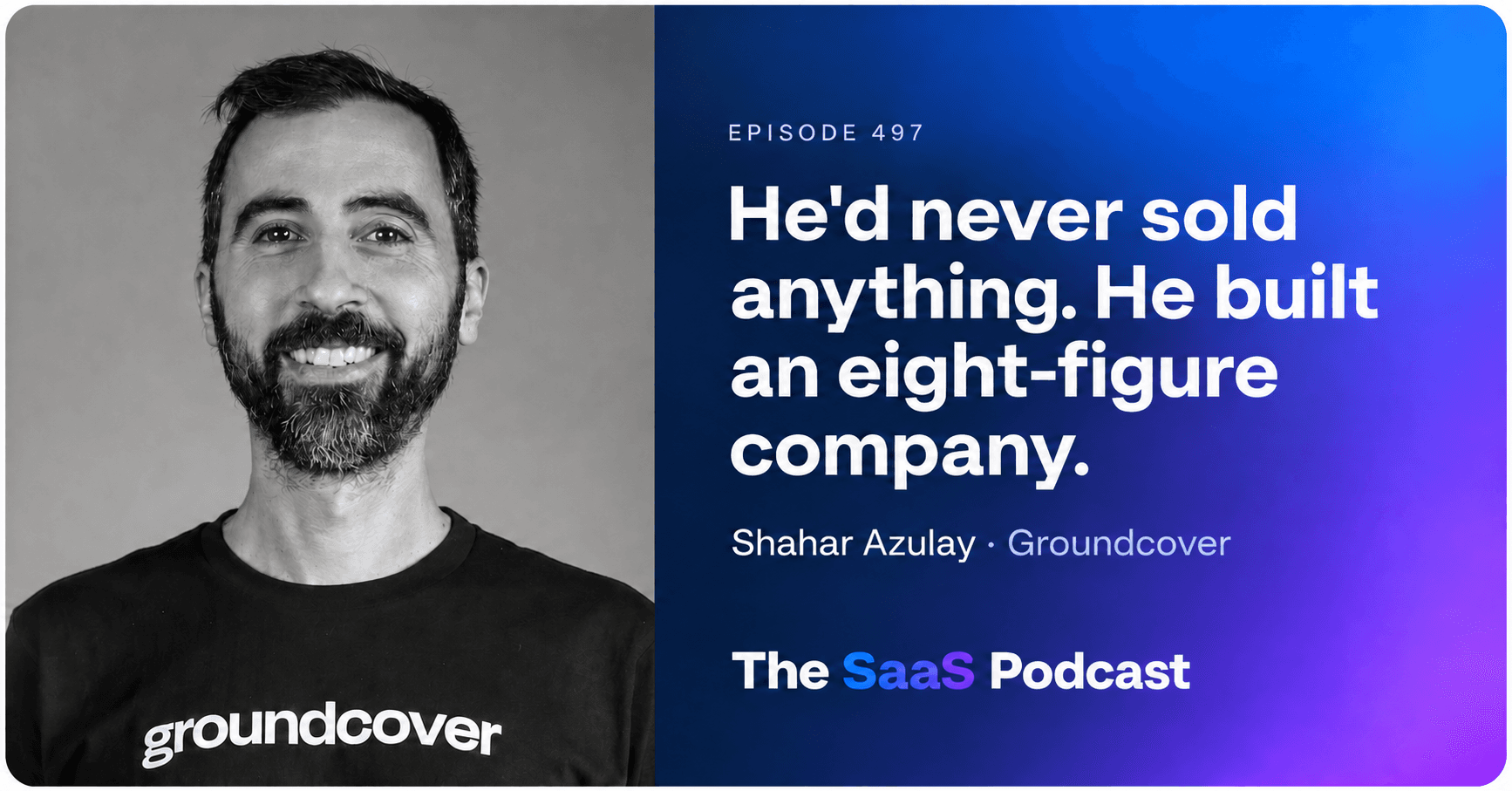
Shahar Azulay is the co-founder and CEO of groundcover, an observability platform that helps engineering teams catch problems in production before their customers do. He has built it to eight-figure ARR with more than 250 customers, competing directly against Datadog and New Relic. He came to it as an engineer, not a seller. Shahar and his co-founder had spent their careers as engineering managers, living the same frustrating cycle: instrument your applications, emit the telemetry you need, then get told the bill is too high and start sampling and switching things off. They set out to solve that with technology rather than a different margin, and bet the company on eBPF, a kernel technology nobody in observability was using at the time. The selling was harder than the building. Three months in, groundcover closed its first customer through a connection to a head of DevOps. There was no user interface yet, just the sensor and some dashboards. Shahar went into the pricing call asking for $100,000 and came out with $10,000 a year, because neither he nor his co-founder knew what they were negotiating against. His conclusion from that is contrarian: close your first dozen customers at whatever price they will pay. The learning, the references, and the confidence are worth more than the contract value, and you cannot expect to grow those early accounts anyway. Shahar also covers how the first 50 to 100 customers came from his own network and a handful of LinkedIn messages a day, why he published list pricing and then discounted it by up to 70 percent, and the moment customers started ripping out Datadog before groundcover was ready for it.