Your Market Already Trusts Someone. It Isn't You.
Most founders treat distribution as a channel problem. Pick SEO or ads or outbound, then optimize it.
How SaaS and AI founders who scaled got their first customers
One email every Thursday. Unsubscribe anytime.
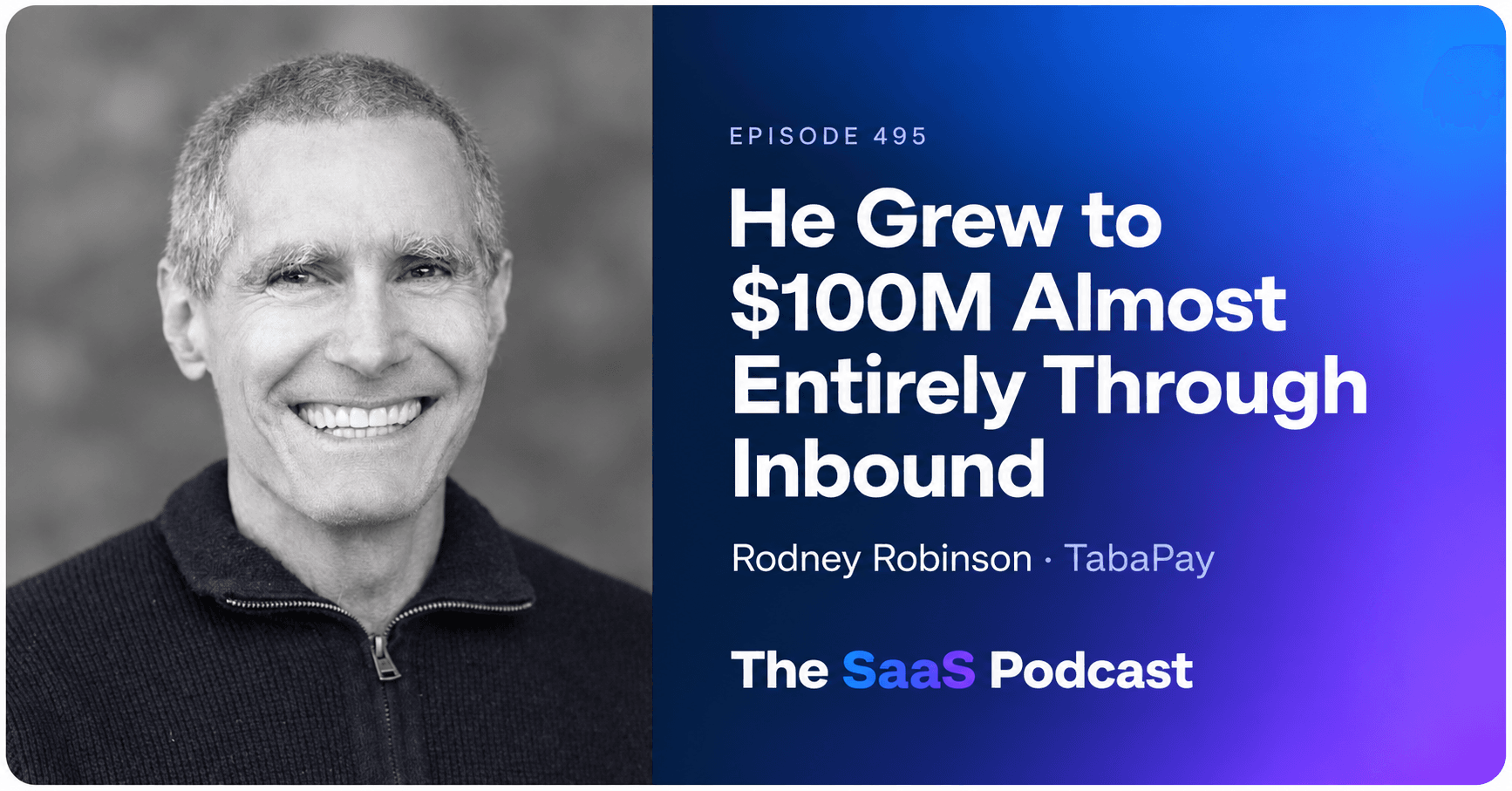
Rodney Robinson grew TabaPay to $100 million in revenue almost entirely through inbound, by making banks and the card networks his distribution channel instead of hiring a sales team. TabaPay processes payments for fintechs like Dave, and it got there on a single $2.5 million seed round that was the company's only outside money for nine years.
Six months in, a company accused TabaPay of stealing its intellectual property. The sponsor bank walked away. Rodney had pledged his house to get that bank. He explains how he picked a problem Mastercard could not solve, why he paid vendors above market to reach revenue faster, and why he believes outbound sales no longer works in B2B.
Rodney Robinson is the co-founder and CEO of TabaPay, a payments company that moves money in and out for fintechs. It now runs at $100 million in revenue with about 150 people, profitable, growing 35 to 40 percent a year. On the day this interview was recorded, Rodney announced TabaPay had raised $155 million and acquired a bank.
The company started because Mastercard would not build what its own customers kept asking for. Rodney had sold his previous company to Mastercard and spent two years running its instant payout business. Merchants wanted to send money out and collect it back through the same card. Mastercard only wanted the send half, because the collect half would compete with its largest processing partners. Rodney left and built the thing they could not.
Getting there took a year and a bank willing to sponsor a startup with no track record. Banks solve for risk by asking for a large deposit, which Rodney did not have, so he signed a personal guarantee and pledged his house. Six months in, another company accused them of stealing its software. TabaPay won, but the sponsor bank dropped them during the fight.
The company ran for nine years on a single $2.5 million seed round, its only outside money until this year. Rodney went after small fintechs he already knew, on the theory that minnows become whales, and let banks and the card networks feed him everything after that. TabaPay has never bought a keyword or run content marketing.
He also covers why he paid vendors more than he needed to in year one, how three vendors at 99 percent uptime leaves you down three percent of the time, and why he thinks outbound sales is finished in B2B.
TabaPay grew to $100 million in revenue almost entirely through inbound leads by processing payments for about 20 sponsor banks and becoming a major Visa Direct acquirer. Those banks and card networks refer fintechs directly, because the market trusts them more than an unknown vendor. TabaPay has never bought keywords or run content marketing.
Most founders treat distribution as a channel problem. Pick SEO or ads or outbound, then optimize it.
Land a marquee logo early. One recognizable name on your site does the selling for you, the thinking goes.
Founders looking for an opening usually hunt for gaps. A feature the big player forgot, a segment they ignored, a workflow they never polished.
Every company that grows eventually tiers its customers. Top accounts get a named manager and quarterly reviews.
How did TabaPay grow to $100 million in revenue almost entirely through inbound?
Rodney made banks and card networks his distribution. TabaPay processes for about 20 sponsor banks, and those banks plus Visa refer fintechs directly, because the market trusts them rather than an unknown processor.
Why did Rodney Robinson leave Mastercard to start TabaPay?
He ran Mastercard's instant payout business and heard the same request repeatedly: merchants wanted to push money out and pull it back on the same card. Mastercard declined the pull side because it would compete with its largest processing partners.
How did Rodney Robinson get a bank to sponsor TabaPay as a startup?
Banks manage risk by requiring a large deposit, which he could not fund. He signed a personal guarantee and pledged his house, so the bank had recourse if the company caused a loss it could not cover.
How did TabaPay land its first ten customers?
Rodney and his co-founders called small fintechs where they already knew the founders. His rule was to chase minnows rather than whales, because a small company cannot win a whale, and those minnows later became whales.
Why does Rodney Robinson say outbound sales does not work in B2B?
He tested it twice, a Mexico expansion run as a side experiment and a large outbound sales force, and shut both down as low efficiency and expensive. He now staffs salespeople to handle inbound calls instead.
Why did TabaPay deliberately overpay its vendors in year one?
Rodney solved revenue before expense. He bought vendor infrastructure at whatever it cost to reach market in twelve months, charged what the market would bear, then displaced those vendors over time to reach his target cost.
How does TabaPay avoid a race to the bottom on processing fees?
Rodney assumes price drops as customers grow and says expecting to hold margin on large clients is foolish. He protects total account revenue by layering value-added services, mainly fraud and risk, on top of commodity processing.
What fraud data does TabaPay give its fintech customers?
TabaPay settles about 82 million transactions a month and holds over 100 million cards on file, so it can flag a name or geography change on a card across merchants before a client accepts that card.
Why did TabaPay acquire a bank?
Regulatory pressure on partner banks blocked new clients and products, and large banks were verticalizing into processing. Buying a federally chartered bank lets TabaPay control the client experience and pricing end to end.
Rodney Robinson [00:00:00]:
In B2B sales, I don't think outbound works at all. We have inbound from the networks, inbound from banks, and that's how we win. We don't do a lot with outbound sales because again, it's very low efficiency, very expensive. That's the only money we took into this company for, you know, for the first nine years of the company, $2 million. And we grew this from zero to $100 million in revenue.
Omer Khan [00:00:24]:
Hey, welcome to the SaaS podcast. I'm Omer Khan and this is the show where I sit down with real founders and dig into how they built their SaaS companies. I've had almost 500 of these conversations now, and I put out a new one every week to help you build and grow your startup. So if that sounds interesting, hit subscribe or check out SaaS Club I.O. To learn more. My guest today is Rodney Robinson. He's the co-founder and CEO of Tabapay and he's grown that to $100 million in ARR on just a single two and a half million dollar seed round. So in this episode, Rodney breaks down how he spotted an opportunity in a market where you'd assume giants like MasterCard and Visa already had it covered. He talks about how he's grown the business to 100 million in ARR almost entirely through inbound. And he shares why he's convinced that outbound sales is dead in B2B. So I hope you enjoy it. Okay, Rodney, welcome to the show.
Rodney Robinson [00:01:23]:
Hey, thank you. Appreciate you having me.
Omer Khan [00:01:26]:
So tell us about Taba Pay. What does the product do, who's it for, and what's the big problem you're helping to solve?
Rodney Robinson [00:01:32]:
So TabaPay is almost 10 years old now. And so I'll start with where we started and what we solved and where we are today because it's been evolution. Ten years ago, I worked for MasterCard and I sold the company to MasterCard. And MasterCard Money Send or MasterCard MasterCard Send came from a company we sold to them, which is instant push payments. And this was one of the early instant payment products in the US we can get money into bank accounts instantly. So drivers, Uber Lyft drivers today receive payouts instantly if they want to. You can move money to your accounts instantly. MasterCard bought a company from us that did that. I worked for MasterCard for two years and I noticed that all of our customers, all of our merchants wanted to both disperse instantly and collect instantly. And I discussed it with MasterCard. I ran the MasterCard group that did this Instant payout business and told them all of our customers want two ways. They want to be able to disperse a loan and collect it. They want to be able to fund a bank account and transfer out. But this two way payment concept did not resonate with MasterCard. They didn't want to compete with their biggest distributors, the biggest processors that did all the pull payments. They just want to do push. So I told MasterCard we're going to go start this company that does both instant payments as well as instant collections because all of my customers want it, all my clients wanted it. And so 10 years ago, we left MasterCard myself, a founder that has been with me for 35, 40 years doing all these companies. And then one of the salespeople that we worked with a lot and we started this company that was focused on solving ease of instant money to instant bank accounts as well as collections. So lenders could disperse money and then collect it instantly. Banks could fund money and unload it instantly. So this two way payment concept, making it easy, that was where the company started and that resonated in the market for a number of years and that's where we started. Today it's evolved and we can discuss that if you'd like to.
Omer Khan [00:03:34]:
Yeah, sure. Well, give me a sense of the size of the business. Where are you in terms of revenue, customers, size of team, whatever you can share with us. Yeah, great. And 2017, you founded the business and you raised a seed round. Was that like right out of the gate?
Rodney Robinson [00:04:25]:
So when I was at MasterCard and we decided to do this, I called one of the investors that had invested in the company. We sold the MasterCard. Okay, just a quick story. When we started that company, right, I went to an investor and she invested two and a half million dollars in our company. Okay. We sold that company 11 months later after her investment. So she made a lot of money for her funds. So when I was doing Master, when I was doing this new business, I called her and she invested again and she put two and a half million dollars in her fund. Did. And so that's the only money we took into this company for, you know, for the first nine years of the company. Two and a half million dollars. And we grew this from 0 to $100 million in revenue. We've grown it from zero profitability to, you know, pretty high EBITDA margins and profitability. We had two and a half million dollars. So, you know, she's over the moon, ecstatic with the performance. But we recently had a need for capital and so we recently we announced today that we closed a Fairly large round, $155 million. It's public. We just announced it. And we also decided that we wanted needed to acquire a bank. And so we're announcing today that the company has gone from a pure payment processor that started two and a half million dollars of investment, zero revenue, three people, to 150 person company, $100 million in revenue, quite profitable. And we decided we process payments, we need a bank as part of our ecosystem. And we raised $155 million to fund a large part the capital, not to buy the bank, but to capitalize the bank to make all this work. And so anyway, you're the first person that I've told. How about that?
Omer Khan [00:06:14]:
Thank you. I feel special. You know, that is wild. And, and I think people listening to this might be like, what the heck? Like you went and bought a bank and you and I were talking earlier, and despite that and the announcement, for me, the real story is that you started with Xero, essentially a seed round, got this to over $100 million before any of this happened. And so I think that is something that's very relatable to other founders. And I want to, you know, talk about that, obviously with your previous startup and selling that to MasterCard. Some, some people listening might think, well, Rodney had it easy, right? He had money in the bank, he had his network, his reputation, and it made everything easy with Taba pay. And so today I want to make sure that we, we help share the story of what it actually took for you to build the business and all the ups and downs, not some of the ups and downs that you sort of experience.
Rodney Robinson [00:07:18]:
There's plenty of downs. Plenty of downs. Yeah.
Omer Khan [00:07:22]:
Yeah. So, okay, great. So tell me about what happened next. So you decide. Well, first of all, tell me, like, why did you believe that this was the problem worth solving? Like, yeah, you're hearing your customers talking about it. But what was about this? MasterCard didn't want to touch this. There was already somebody handling kind of a partial solution. So what drove you towards saying, I'm going to invest the next 10 years of my life on this?
Rodney Robinson [00:07:58]:
So human beings have two ears and one mouth and they should listen twice as much as they speak. And so I learned that a long time ago. And so listening to your customers is the most important part of, I think, figuring out the big problem to solve. And so we listened and they told us what they had problems with. If you look at our businesses that we serve, a lot of them that are regulated businesses, 10 years ago, we solved instant push payments, instant money to U.S. bank accounts. But they told us that they're regulated and they pay a lot of money for card processing. And you guys do the push side. Can you also help us with the pull side? Because the problems we have is in lending and in banking and in even money transmission. If you want to move money to, say, England, to do that on a card 10 years ago was expensive. A money transmitter or a lender had to pay a lot of money. So we solved the push side. Then they say, well, we, we deal in money. A lender lends money. So if they pay a lot in card processing to collect, they don't. There's no margin on money. If you're a money transmitter sending $100 to England, there's no margin on that money. Every fee you charge, the customer sees. So they need cheaper card processing. They want to push money and pull money, they need to do it cost effectively. Because every, every penny of markup, every penny of money I make, they have to charge their customer. So they came to me with this problem, right? We solved the push, but I think these regulated companies needed inexpensive, highly reliable ability to pull money, to collect money back. I listened, my founders listened, and we said, we can solve both problems really well. So we created this unified system, established some banking partnerships, and a year after we started, we were live, and we actually started making Money, I think six or 18 months after we went live. Because it was a unique problem we solved in the market by listening to our customers.
Omer Khan [00:10:01]:
Okay, can you explain a little bit about how things are set up? I know many of your customers, fintech companies. Where does this all fit in? So they use you as sort of in between the credit card companies and banks. Is that how it works? Yeah.
Rodney Robinson [00:10:20]:
Let me give you examples. Right? And so our, our customers, our clients are fintechs, right? They, they're regulated, they deal in money and take Dave. Dave is a large client of ours, right? Dave.com. They're a public company. They went public over the last few years. They offer a checking account where a consumer can withdraw money from it or deposit money into it with cards. Right? So if you have a debit card, you can instantly withdraw money from the Dave account to another bank account in the U.S. additionally, you can take money from that bank account and actually move it to your Dave account. So you can fund instantly, withdraw instantly. Or the folks behind the scenes connected to the card networks in what we call an acquiring bank, to let Dave do this. Okay, so Dave connects to us, the consumer Gives the card to Dave they want to fund. From, for example, a Bank of America debit card to the Dave account. We process that payment, taking money from B of A through Visa and depositing it to the Dave account. We do all that behind the scenes so the consumers don't know who we are. Okay. Does that answer your question, Omer?
Omer Khan [00:11:34]:
Yeah. Yeah, it does. Thank you. Appreciate that. Okay, so how did you get, how did you get started? Did you have to, like, how long did it take to build the first version of something you could sell?
Rodney Robinson [00:11:47]:
This was a year. Right? This is actually very complex. And if you. Look, we decided to solve revenue before expense in the card processing world. That means I went out and hired a bunch of vendors. When we first started, I told my founders, my co founders, look, the hardest part of this business is finding revenue. And so we have to get to market. I don't care what we pay for services, but we're going to, we're going to put this system out there that's unique. Instant push pull, low cost. We're going to charge with the market will bear. We're going to pay what the vendors want and over time, squeeze the expense side so we can, we can meet our vision of low cost, instant payments. That's what we did. It took us a year to assemble all the pieces, including getting a bank to sponsor us, which is important in payment processing. Banks are the only ones that can be members of Visa MasterCard. So we signed up bank that let us process Visa and MasterCard payments. We went out and hired a bunch of vendors, paid them a lot of money behind the scenes. We delivered a market and product that solved the problem. Instant push, instant pull at a price that people are willing to pay that we knew we could get to eventually. But we paid vendors before we were able to displace vendors. So that's how we did it. We knew what our venture cost would be, but we solved revenue first.
Omer Khan [00:13:14]:
What's involved in persuading a bank to partner with you like that?
Rodney Robinson [00:13:19]:
Banks listen to money, right? They have to trust you, right? So trust is huge. But you. But in the end, banks solve for risk. And the way you solve for risk, and the way banks do it is they say, put a ton of money in my bank as a startup, I couldn't do that. So I literally had to pledge my house. My wife doesn't know this, but seriously, I had personal guarantee on the company. Bank said, look, we trust you, Rodney, but your company could do something crazy by mistake and your company can't pay. But the bank has to pay. And so I pledged my house that this company's not going to do something crazy. And if it does, I'm going to have to pay out of my pocket. So that's how you make a bank and a new company support you.
Omer Khan [00:14:07]:
Okay, well, I hope your wife isn't going to listen to this.
Rodney Robinson [00:14:11]:
Yeah, she'll listen to this. She'll kill me. But seriously, look, banks have to. Banks can't lose money, period.
Omer Khan [00:14:19]:
Okay, so let's talk about that first customer. How did you find them? And what did the journey look like from that first conversation to getting paid?
Rodney Robinson [00:14:32]:
So the first customer came in. I knew a lot of people in the industry. So did Manoj, one of our founders. And so we called people we knew and that were present to companies that had the problem. And so we convinced them to do business with us because of personal relationships. So we made our first penny about a year after we went live. And the companies were very small back then. And so, hey, if you're a small company, go after the minnows and eventually you get the whales. Small company, don't go after whales first because you never get them. So we called small fintech companies where we knew the founders and convinced them, hey, we can solve these problems for you. We, our first 10 customers were people we knew and they were small fintech companies. Now they have since grown to be whales. Right. Now we can whale hunt, where when we first started, it was minnows. Right. But they paid the bills. Okay,.
Omer Khan [00:15:30]:
So knowing the founders there, obviously that helps, but from their point of view, what kind of risk were they taking on by partnering with you that early?
Rodney Robinson [00:15:42]:
Yeah, so I did not understand this 10 years ago. Payments are fundamental to a fintech's business. Fintech cannot operate unless they can move money. So, look, these people are really smart founders, but they may not have understood that either. Right? In that they need payments to work all the time for their business to work. And so the risk they took on us is that if we had a problem, they could not serve their customers. Right. Because if you look at our businesses, they lend money, they disperse wages, the payment system has to work for them. So they took a big risk with us, but it may have been that maybe they didn't know that I didn't know it. Right. They were betting their business on us, but now I do. So the system has to work all the time. That's another piece of learning that we learned over the years.
Omer Khan [00:16:39]:
And the first 10 customers, how smooth was the adoption of the product. Did everything Work perfectly. If not, what broke when you got this product up and running with real customers?
Rodney Robinson [00:16:56]:
Yeah, as I said, we went with vendors initially. We paid them money, so we were able to ride on their availability, which was very helpful. So we didn't have availability problems initially. We wrote our software on top of vendors and that actually was a lucky, wise decision. I'll call it lucky. Okay. But the focus on revenue versus cost, I think helped a lot. But then we learned, right. Some of the times the vendors would go down. If you have three vendors and they are 99% available, you're going to be down 3% of the time. That's a lot. And so when you base your business on vendors, you're taking their availability as part of you. And so over time, we had a mission to both reduce cost but also improve our availability. Because some of our vendors, while they're good companies, they had availability even down for an hour over a year is a big deal. And so we wanted to control the whole experience. And so we offered good service. Every now and then a vendor go down. So it hurt, but we learned and displaced over time. Does that answer your question, Omer?
Omer Khan [00:18:01]:
Yeah. Yeah. And so how do you do things today? Is it. Do you own the. The end-to-end now or you still have a dependence on. On vendors?
Rodney Robinson [00:18:10]:
We don't have a dependence on vendors now. We own the end to end. We have the obvious vendors, Amazon. Right. And so our vendors more are call it infrastructure versus actually payment processing. And we're about to actually move to a redundant service. So you have Amazon, we have another one. Right. And so we're going to go to a redundant cloud provider as well. We're still dependent on banks. Right. One, and that's fine. Banks are great. Our partner banks are great. But one of the reasons that we bought a bank was to vertically integrate. Right. There are markets we can't serve today just because maybe the bank is not big enough or doesn't have all our products there. So one of the reasons we did this is so we can verticalize, control the client experience. Right. In the end, what your difference is, technology is being eroded by AI. Your differences are how you service customers, what you can deliver the service, the cost and the availability of the thing. Right. And so you have to figure out how to differentiate beyond software. Verticalizing your business is a way to control every aspect of the experience from the pricing, which is one of the reasons we're doing it. Okay.
Omer Khan [00:19:21]:
Yeah, got it. Let's talk about acquiring customers beyond those first 10 and working your Network. I asked you earlier, we were chatting and I said, hey, early days, you got a lot of inbound. And you were like, well, we're still inbound at 100 million. I was like, wow. Before we talk about that and how that, I guess that inbound engine got working, tell me about, were there other channels that you tried that turned out to be a waste of time or.
Rodney Robinson [00:19:56]:
Plenty? So we experimented on a few things. We thought, hey, let's go to Latin America, Mexico. Great market, right? You either go big or you go home. Right. We decided to try to experiment as a hobby in Mexico with outbound sales. Waste of time, right? Again, you go big, you go home. Unless you're willing to pour a lot of money into something and really develop the channels, there's no point. Okay, I. I think we tried a big salesforce at one time with a lot of outbound sales. I'm not sure that works. I think outbound sales are obsolete today. So we've experimented in different areas on the sales side, and what we find has worked time and time again is establish distribution channels, get your message in the market. What problem do you solve, what market do you solve for? And then wait for inbound. The way to sell is get the vision in every of your addressable markets, companies heads, and then when they have the problem that matches your vision, they're going to give you a call. Additionally, your market trusts certain participants in our market, fintech. They trust banks and they trust networks. Right. They don't know me from Adam. And so they call banks and networks and we acquire for 20 banks. So I have this big inbound flow from those banks we acquire. I think we're the largest independent Visa Direct. Right? It's a network transaction. Visa loves us because we pay them a ton of money and grow. We're giving them net new business. Right. Our transactions are new to Visa, relatively new. And so when we bring new fintechs onto their network, this is net new revenue for them they'd never seen before. So we have inbound from the networks, inbound from banks, and that's how we win. We don't do a lot with outbound sales because again, it's very low efficiency, very expensive. So we want our salespeople to be able to speak super intelligently to inbound calls. Okay.
Omer Khan [00:22:12]:
I mean, someone listening to this who's doing outbound sales is going to say, wait, what? Rodney just said, it doesn't work.
Rodney Robinson [00:22:18]:
Anyone in B2B sales, I don't think outbound works at all. Okay. B2B is about getting your message out. Marketing is critical. Right. And then establishing channels. Right. There are. Right. Online, every company looks the same. So establish the channels, let people call. And that's what we've done.
Omer Khan [00:22:42]:
And tell me about that progression. What were some of the early channels that helped you to do that?
Rodney Robinson [00:22:48]:
Certainly the networks, the payment networks and banks were critical for us. Right when we started, we had one bank and that, that bank was new into fintech. And so we were able to get some of their customers as the processor at their bank. Visa Direct was new and nascent back then. This is pushing money and even doing debt repayment. And so we, we picked transaction segments that were emerging. Right? Right. They were not overserved, they were underserved. And so the networks were looking for any company that had banking that could serve those segments, go underserved market, get distribution channels. And that's what we did. And so we were able to get the flywheel going with those things.
Omer Khan [00:23:30]:
Okay, were there other things, did you, did you invest in content marketing or stuff like that?
Rodney Robinson [00:23:37]:
Never have. So we've never done any sort of keyword buys, any sort of B2B business is very different now. It's not, you know, payment processing. Used to be someone would knock on your door, put a terminal on your counter, and you'd have geographic support. It's not like that anymore. The Internet is where you go. And when you enter a Google search, no one pays attention to the buy. You know, who bought the top a hit. This is about calling people you trust, Visa or your bank, and saying, who can help me solve this problem? Or this is about, hey, this is what we do. We help regulated businesses push and pull money instantly and then regulated businesses get that message. Target your market, target your message.
Omer Khan [00:24:27]:
So when you started the business, there was an unmet need and no one providing the push and pull solution or doing it. Well, how has that changed today? Is the market more crowded? Do you have more competitors? And if so, how do you differentiate Taba pay? When someone is asking who should they pick, why pick Taba pay?
Rodney Robinson [00:24:55]:
So the market has changed, the needs of the market have changed. You still have this need of making it easy to push and pull money, finding regulated businesses like lenders and banks and brokers and banking, right? So you have to solve the basic problems. But as we discovered, as you inst, as you increase the speed of money, risk increases. And so, right. Thieves love instant money movement because they can steal a lot of money quickly. So we layered value added shares on top of this thing so as customers get Bigger and more sophisticated, the price goes down, right? Anyone's a fool that thinks they can maintain margin on super big customers, right? What we try to do is maintain the overall revenue from a client by dropping processing fees and increasing the value. We deliver value added services. And so that's what we've done. We changed the business price. Processing is commodity. So that price has come down as clients get bigger and we've delivered additional value-added services. Risk in particular, on top of what we do. Managing risk.
Omer Khan [00:26:03]:
Can you explain that a bit more? Because I think the processing fee people get, and if you're just dropping that on its own, what's the cliche? Like race to the bottom, right? But the value-add service, that's a really interesting way to offset that. So security as an example, what does your solution look like? How does it help a customer? What can they do more easily?
Rodney Robinson [00:26:30]:
So again, as payments speed up, risk increases. So our ability to manage risk so that they don't lose money, right? And in the card world, that's called a chargeback, okay? And so we do a really good job of squeezing charge back off. So imagine today we have a, we do 82 million settled transactions a month. A third of our clients serve a third of American households. So we see cards from a third of American households. Imagine if you're a regulated financial technology company today and we go to you and go, look, processing is a commodity. We're going to make it cheaper than anyone. Well, everyone says that that's how you sell, right? But if we say we're going to give you visibility to over 100 million transactions, 82 million settled monthly across all the merchants. So if we detect a name change or a geo change on a card, we're going to tell you about it, Mr. Merchant, Mr. Client. So that you can go around and say, we don't want that card from you because. Because our processors tell us they saw it in California today and now it's in New York, or we've seen Rodney on the card and not Omer. So we can give them this cross client view of all these debit cards, right? We have over 100 million cards on file. There's only 300 million, 340 million Americans right? Of adult age, probably 204. We have, I don't know, 40% of all U.S. debit cards on file in our system. So we can give them this cross merchant view. And that's just one example of what we do. Does that make sense, Omer?
Omer Khan [00:28:15]:
Yeah. Yeah, it does. I want to talk a little bit about or understand that journey you took the building from building the product, getting Those early first 10 customers, getting that traction. When you look back at that, what were still some of the hard moments? Because it sounds like a great story, right? That it's like, hey, I had this idea, built this solution through our network, we found those first 10 customers, we were off to the races.
Rodney Robinson [00:28:53]:
Yeah, well, it's never that easy, right? I remember we started this company in April and we, you know, every startup company goes, hey, call us, we can help you. Even though we had nothing, right? No software. So you know who called me was someone that says, you stole all intellectual property. We're going to sue you. Just what I need, right? Just what we need. So we had this six month battle with this company that thought we had taken all their software. We didn't do any of it, but it cost me a lot of attorneys fees. We eventually 1. But regardless, when you get stuff like that, it takes time. It's distract. It happened to us, right? And so we had to prove to an independent person that this is our software. But any company that, that you know, just tries to disrupt the market is going to get all sorts of arrows thrown at them. And it's up to the company to always do the right thing. So you can sleep at night and you're going to get the call that, hey, you did this and I want some money, you need to shut down. And if you did the right thing, you can sleep at night, you can then say, I'm going to fight you because we're right. I really feel sorry for the company that did it wrong and then loses sleep. And then in the end you're going to lose. Okay.
Omer Khan [00:30:11]:
And this was in the first year,.
Rodney Robinson [00:30:13]:
This is the first six months I'm there. It was tough. We've had other moments. I remember we had a bank that when that happened, our bank said, we don't want you anymore. You're getting sued. So you lose your bank, you're getting sued for something you never did. So you have to just move, right? You have to react. Today's world, today's world, your employees have all this pressure and AI companies, they're going to go. Or so you have to, you know, you lose some employees, you don't lose some others, right? You have to establish a mission, make them feel part of the company, but you have to react when things happen. We've had plenty of events like that, Plenty.
Omer Khan [00:31:00]:
I think one of the challenges of being like an infrastructure solution for your customers is that if you do your Job well, the product just works. There's nothing to see. It's just all happening. Right. And so I often wonder, has that been a challenge where you have to constantly sort of figure out how to remind people the value that you're delivering? Has it been an issue for customer retention? Just generally. What are the dynamics when you're just when you're doing your job well, they don't think of you.
Rodney Robinson [00:31:43]:
Payments you want to not think about. Right. And so what we do is we want every customer. So the challenge of any business that grows is how do you make your smallest customer feel like your biggest customer? Right. Everyone has to feel like they're the most important and they are. Right. Because one customer with a bad experience pollutes the market for you. And so our challenge is we want to stay top of mind in a good way with our customers. We want every customer to feel like they have a high-touch relationship with us. That's a very expensive model, but we managed to do it. And so, you know, you do your quarterly business reviews. You're constantly telling the customer, in their words, how they can be more successful with what you're trying to sell them. Because in the end we're trying to sell and we want them to buy. But if you say it like that, they're never going to buy from you. You have to be. We're going to improve your liquidity. You know, you have to park 30 million in a bank account so you can disperse money. What if you didn't have to park any money in that account? Right. So you always put it in your clients terms. You always give them the high-touch experience. So every customer feels special. If you do that, I think you're going to win. We've had our retention rates. Our gross retention rate's in the high 90s. Right. Our net retention rate's 130, 140%. And I think the reason for that is we deliver really good customer service.
Omer Khan [00:33:08]:
You know, I never thought I would ever ask this question on this show. Why did you buy a bank?
Rodney Robinson [00:33:18]:
Yeah, you know, if you look, everyone told us we started the journey two years ago, more than that, probably two and a half years ago. And you have to look at the history. And two and a half years ago, a lot of banks had regulatory pressures, right. A lot of them were under consent orders or whatever you want to look at. Additionally, some of the larger banks in the country were starting to verticalize. So I had this. These two problems. I couldn't serve my clients because bank regulatory pressure right it was hard to serve new clients or even new products with my existing clients because the banks were frozen from the regulators. Then I had this pressure from these big banks verticalizing that were getting into our market. And so you could throw. It's like the IP lawsuit. Oh my God. The end of the world is here. Right? I got the biggest banks with tons of money coming at us. I have my banks, it's today are under regulatory pressure. I can't get new merchants on. And so we decided to take the long view of this and go, well, we want to control aspects of client experience. We want to serve new clients that we can't serve today. And I want to be able to fight the verticalization of this industry. The big banks getting into processing. Right. With their own APIs. And so those decisions drove us two and a half years ago to pursue again. You don't fall off a truck and decide to buy a bank. You give it a lot of thought. Right. And then one other comment. If you look at bank valuation versus fintech valuation, it was a big decision. Two and a half years ago, banks were valued at book value plus a multiple. And so you were a high-growth fintech company with good PE and good valuation. Buying a bank, getting investors to buy into that vision of getting into a industry valued by book versus growth was hard, but it was worth it. And I think now there's been a sea change. A lot of fintechs have announced banks, either acquisitions or they're doing it. And so unfortunately we were at the tip of the spear two and a half years ago. Now 30 other FinTechs have done it before us, but we have a better bank. We're a federal charter. Right. And we'll be a federal charter versus a state bank. So there's advantages to what we did. Took longer though.
Omer Khan [00:35:45]:
Awesome. All right, we should wrap up. So let's get onto the lightning round. I've got five quick-fire questions for you. What's one of the best pieces of business advice you've received is major in.
Rodney Robinson [00:35:59]:
The majors, not the minors. And pour money onto something you know works. Don't pour money on it.
Omer Khan [00:36:05]:
It's.
Rodney Robinson [00:36:05]:
You don't know. Okay. And so as a business, you always want to focus on the problems that matter. Not, not small stuff. That. That's probably the best business advice I've ever been given.
Omer Khan [00:36:17]:
Okay, what book would you recommend to our audience and why?
Rodney Robinson [00:36:23]:
My. One of my favorite books, I like the the Hail Mary, I like the Martian. And the reason is in both of those cases you had people in these impossible situations that just figured out how to do it. And if you look at starting a company, there's no one you can call except yourself. And if you, if you can't rely on yourself and your partners to figure something out, don't do a startup company because there's no one to call. Okay, Good question. When I started the business, I did not spend a lot of money on people. And I've evolved to that where you need any sort of company that grows, you need great people. And so I've opened the pocketbook and started spending money on great people. And we have really smart people here because we spend money to get them and retain them.
Omer Khan [00:37:22]:
What's your favorite personal productivity habit?
Rodney Robinson [00:37:27]:
I get up at 3am every morning and I go on a run and I've done that for, since I've had kids, 40 years. And I gotta tell you, it is the only way to start a day. You're under the stars, you can think of whatever you want to think about and you get your energy right at the start of the day and it's awesome.
Omer Khan [00:37:48]:
What time do you go to bed?
Rodney Robinson [00:37:49]:
I'm not going to tell you that, but I go to bed. I go to bed before nine. Okay. It's great.
Omer Khan [00:37:55]:
And finally, what's one of your most important passions outside of your work?
Rodney Robinson [00:38:00]:
I run and I love to do it. And with my wife I bike and so I love to exercise outside of work and that's what we do.
Omer Khan [00:38:08]:
Awesome. Great. Well, Ronnie, thank you so much. It's been a pleasure. I really appreciate you taking the time to share the story and some of the lessons you learned along the way. If folks want to check out TabaPay, they can go to tabapay.com that's T. And if folks want to get in touch with you, what's the best way for them to do that?
Rodney Robinson [00:38:26]:
They can just email me rodney@tabapay.com I generally answer my email.
Omer Khan [00:38:30]:
Okay, awesome.
Rodney Robinson [00:38:31]:
Omer, thanks for having me. Appreciate it.
Omer Khan [00:38:33]:
Yeah, it's been a pleasure. Wish you and the team the best of success.
Rodney Robinson [00:38:36]:
Thank you.
Omer Khan [00:38:37]:
Cheers.
Shahar Azulay, groundcover
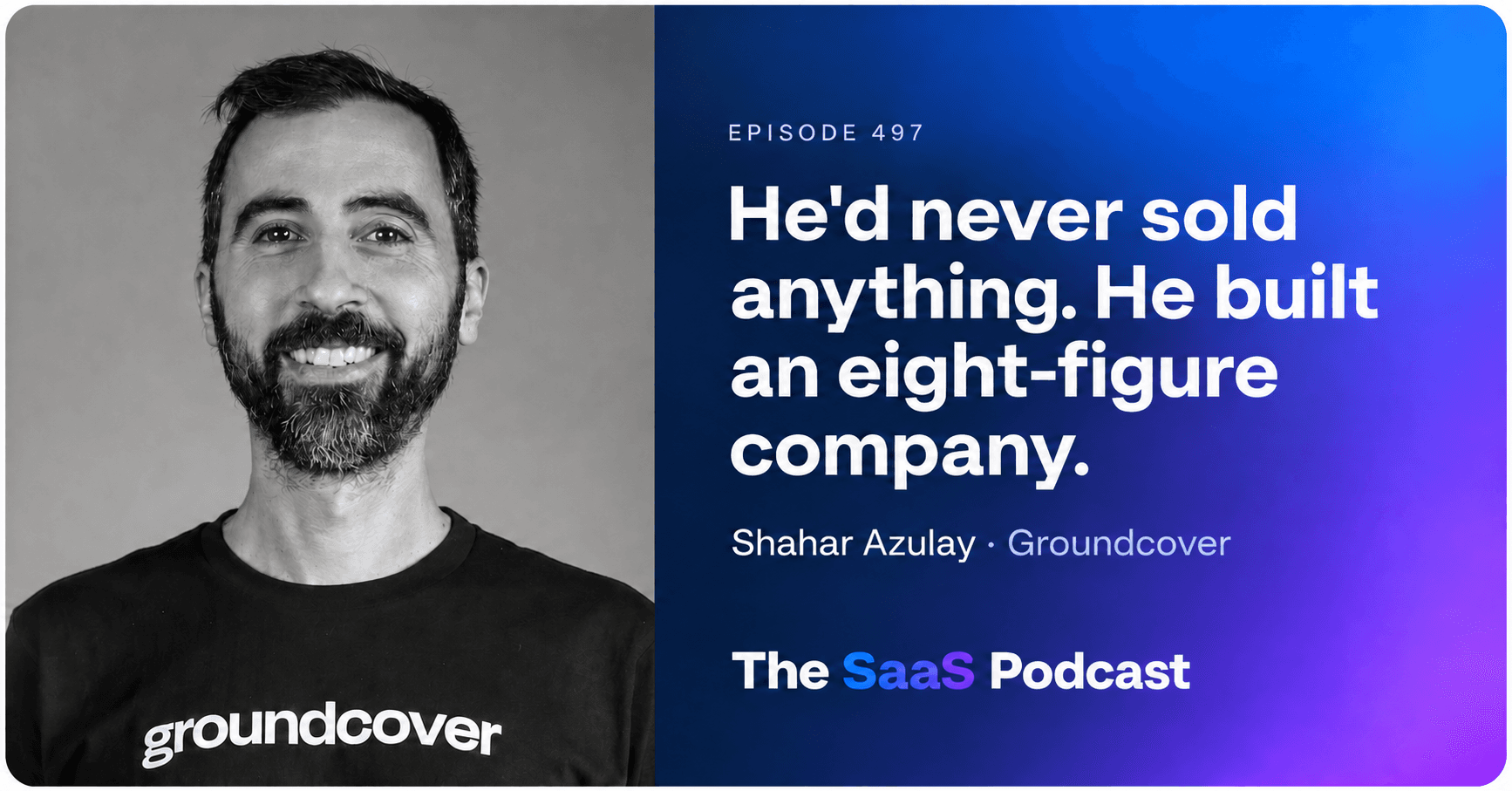
Shahar Azulay is the co-founder and CEO of groundcover, an observability platform that helps engineering teams catch problems in production before their customers do. He has built it to eight-figure ARR with more than 250 customers, competing directly against Datadog and New Relic. He came to it as an engineer, not a seller. Shahar and his co-founder had spent their careers as engineering managers, living the same frustrating cycle: instrument your applications, emit the telemetry you need, then get told the bill is too high and start sampling and switching things off. They set out to solve that with technology rather than a different margin, and bet the company on eBPF, a kernel technology nobody in observability was using at the time. The selling was harder than the building. Three months in, groundcover closed its first customer through a connection to a head of DevOps. There was no user interface yet, just the sensor and some dashboards. Shahar went into the pricing call asking for $100,000 and came out with $10,000 a year, because neither he nor his co-founder knew what they were negotiating against. His conclusion from that is contrarian: close your first dozen customers at whatever price they will pay. The learning, the references, and the confidence are worth more than the contract value, and you cannot expect to grow those early accounts anyway. Shahar also covers how the first 50 to 100 customers came from his own network and a handful of LinkedIn messages a day, why he published list pricing and then discounted it by up to 70 percent, and the moment customers started ripping out Datadog before groundcover was ready for it.
Ross Andrew Paquette, Maropost
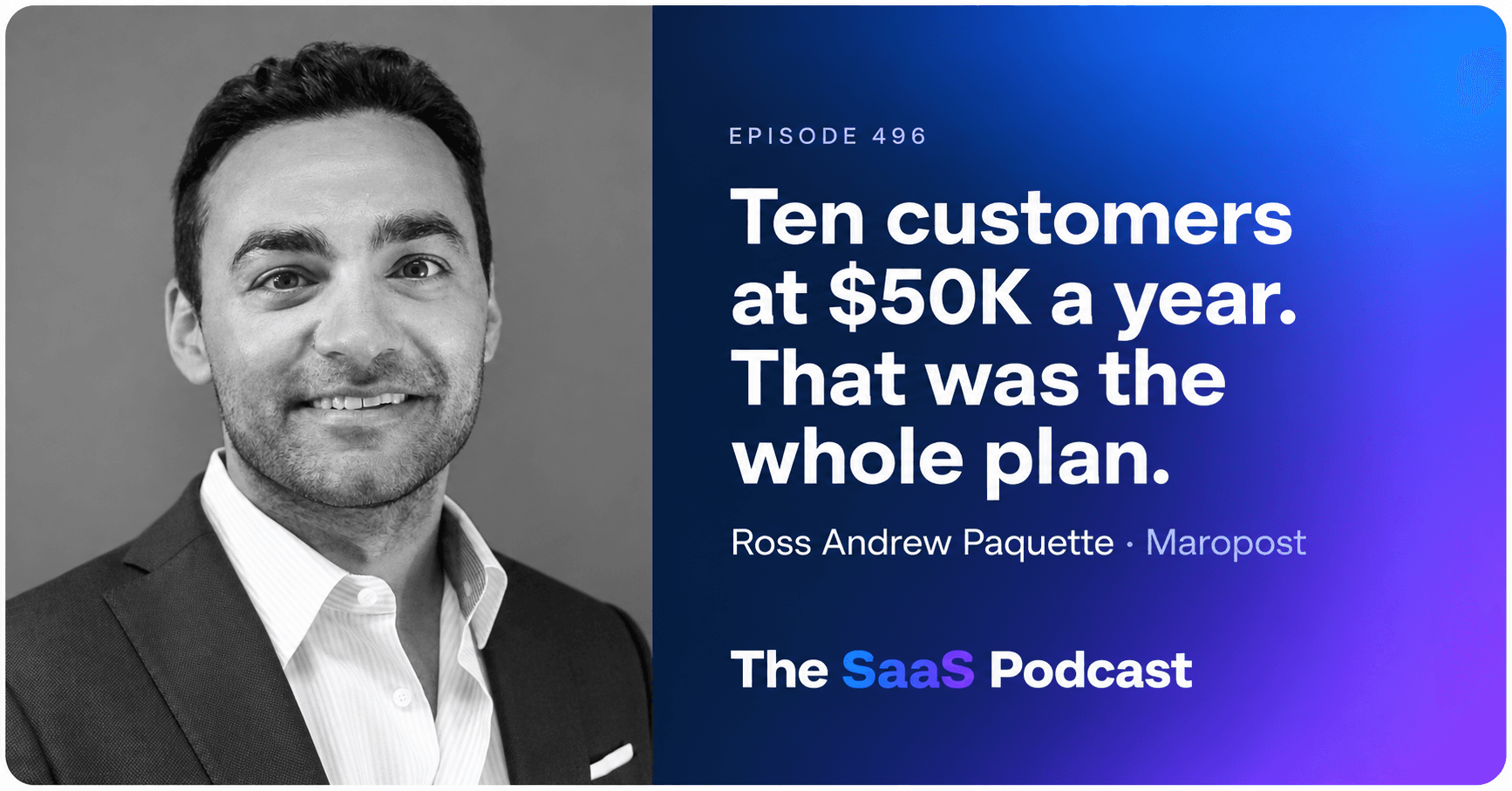
Ross Paquette is the founder and CEO of Maropost, a commerce and marketing platform he has bootstrapped to around $50 million in ARR with roughly 300 people and 5,000 customers. He started it in 2011 out of his apartment while still working full time selling Oracle ERP software into the construction industry. The plan was small. Ten customers paying $50,000 a year, about $500,000, and more free time. Ross had spent a few years selling marketing automation and knew the service in that market was poor, so his pitch was simple: 24-hour live chat and a five-minute response time, which in practice meant him. Three or four former customers signed almost immediately. Two of them paid around $10,000 a month. The early build nearly sank it. His developer would disappear for days, and the platform would go down with nobody available to fix it. Ross describes standing on a departing plane holding his phone in the air to hold the signal, maybe ten or fifteen times. His mother suggested he post the job somewhere. The first person who replied on oDesk rebuilt the platform in two or three weeks and is his CTO today. Then it caught. In 28 months the business went from $300,000 to $27 million with six or seven people, largely because Ross was personally closing brands like Rolling Stone and Mercedes off conference floors. He took a secondary round around 2016, gave up about 25 percent, and roughly three years later wrote a $37 million check to buy the investors out. He also gets into why seven or eight experienced sales leaders failed at Maropost, what he hires for now instead, and why he says he would not show up to work if he owned less than ten percent of his own company.
Felix Hoffmann, 7Learnings
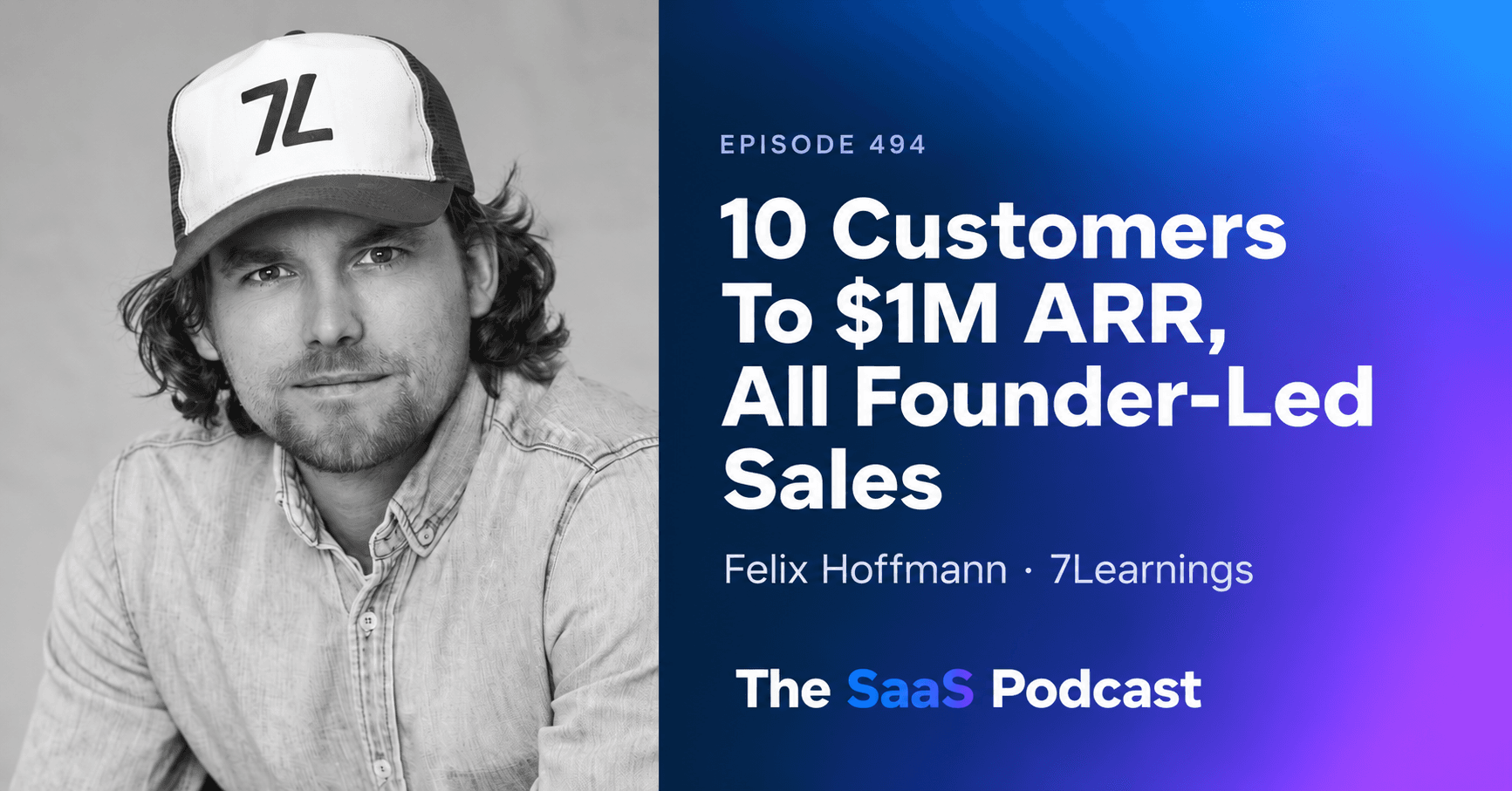
Felix Hoffmann is the co-founder and CEO of 7Learnings, a Berlin company whose software decides what a retailer should charge. He spent six years as a pricing consultant at Kearney and two years running price optimization at Zalando, Europe's largest fashion marketplace, where he saw predictive pricing working at scale. From his consulting years he already knew almost nobody else worked that way. Today 7Learnings is at multiple seven figures in ARR, with around 40 customers and 60 people. The hard part was never the idea. A demand forecasting model needs a large retailer's historical sales data, and no large retailer hands that over to a company with no product. Felix also spent the early months trying to recruit two technical co-founders in Berlin, which he describes as close to impossible when engineers can earn well without taking any risk. So the first contract 7Learnings signed was not software at all. It was a consulting project. The retailer got help implementing its own pricing approach, 7Learnings got paid, and it kept the right to use the data to build a product of its own. The first paying software customer came through his old consulting network, structured as an A/B test: the algorithm priced half the assortment, the retailer's team priced the other half. The first run was a disaster. Prices came out far too expensive on high-priced products, and in e-commerce you know within a day. They reworked the models, and a later test came back with a 13% profit uplift. Felix also covers how a pricing company prices itself, why he refuses success-based fees, the objection he still hears from almost every retailer, and why he thinks LLMs do not belong in the pricing decision itself.