He Sold Consulting To Buy The Dataset He Couldn't Get
Some products can't be built until someone hands you something first. Data. A logo. An integration. A reference customer. And the people who have it won't give
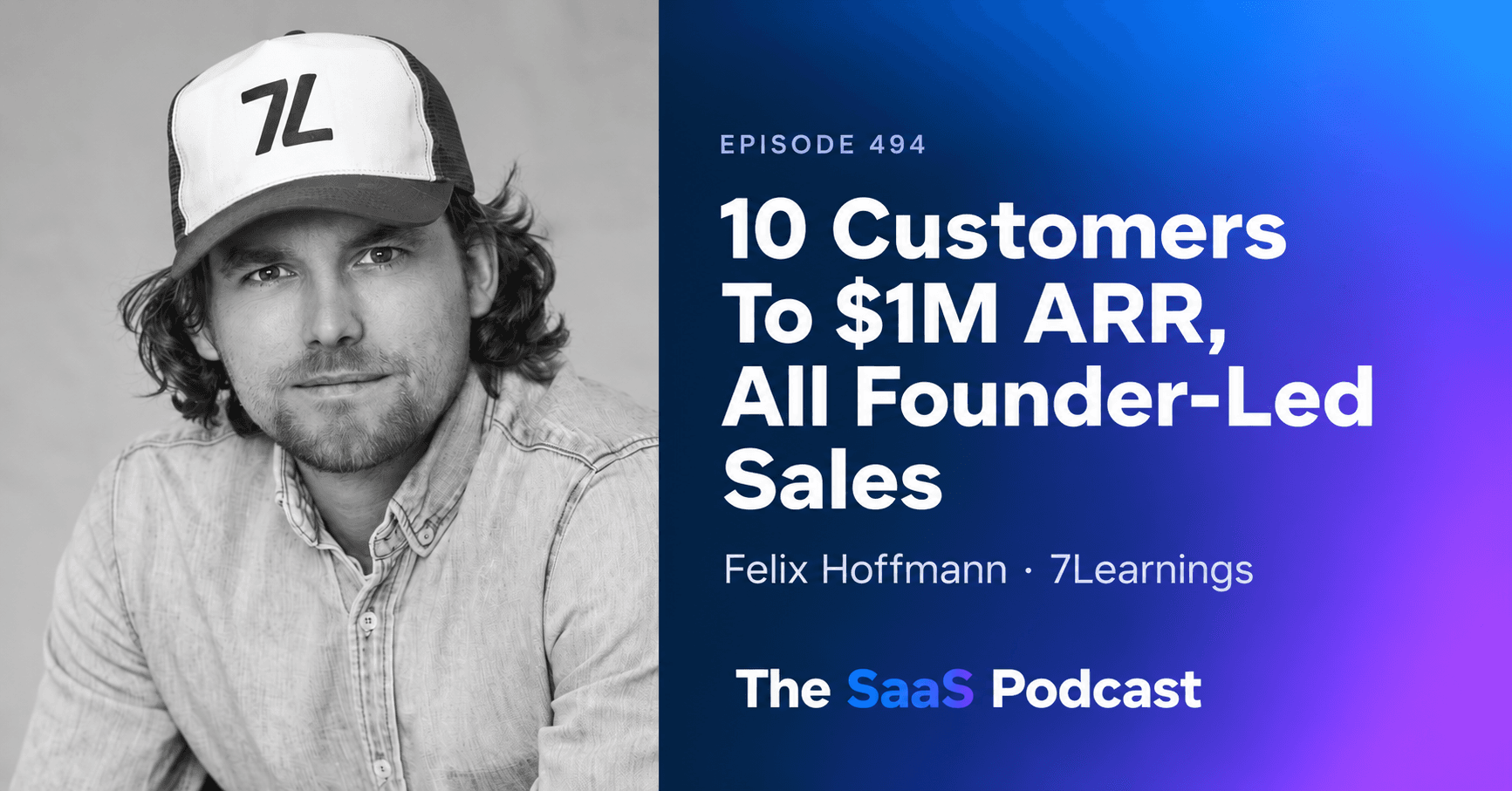
How SaaS and AI founders who scaled got their first customers
One email every Thursday. Unsubscribe anytime.
Felix Hoffmann needed a large retailer's sales data to build a demand forecasting product, and no large retailer hands that over to a company with no product. So 7Learnings sold a consulting project instead, kept the right to use the data, and built the product with it. They got paid to do it.
Then the first customer went live and the prices came out far too expensive. In this episode, Felix breaks down the A/B test that made an algorithm safe to trust, how 10 customers took 7Learnings to its first $1M ARR, and why he still won't put an LLM in a pricing decision.
Felix Hoffmann is the co-founder and CEO of 7Learnings, a Berlin company whose software decides what a retailer should charge. He spent six years as a pricing consultant at Kearney and two years running price optimization at Zalando, Europe's largest fashion marketplace, where he saw predictive pricing working at scale. From his consulting years he already knew almost nobody else worked that way. Today 7Learnings is at multiple seven figures in ARR, with around 40 customers and 60 people.
The hard part was never the idea. A demand forecasting model needs a large retailer's historical sales data, and no large retailer hands that over to a company with no product. Felix also spent the early months trying to recruit two technical co-founders in Berlin, which he describes as close to impossible when engineers can earn well without taking any risk.
So the first contract 7Learnings signed was not software at all. It was a consulting project. The retailer got help implementing its own pricing approach, 7Learnings got paid, and it kept the right to use the data to build a product of its own.
The first paying software customer came through his old consulting network, structured as an A/B test: the algorithm priced half the assortment, the retailer's team priced the other half. The first run was a disaster. Prices came out far too expensive on high-priced products, and in e-commerce you know within a day. They reworked the models, and a later test came back with a 13% profit uplift.
Felix also covers how a pricing company prices itself, why he refuses success-based fees, the objection he still hears from almost every retailer, and why he thinks LLMs do not belong in the pricing decision itself.
7Learnings reached its first $1M ARR with 10 customers, every one closed by co-founder Felix Hoffmann himself, after solving a cold-start problem by selling a paid consulting project to obtain the retail sales data its demand forecasting model needed.
Some products can't be built until someone hands you something first. Data. A logo. An integration. A reference customer. And the people who have it won't give
Some products ask the buyer to hand over something they're frightened to lose. Pricing. Payroll. Outbound email to their whole list. The demo goes well, everyon
Most founders treat founder-led sales as a phase. You do it because you have to, then you hire someone and get your calendar back.
Build on LLMs. That's where the capability is, that's where the funding is, and that's what buyers are asking for by name. Start with the model, find a workflow
How did Felix Hoffmann get the data to build 7Learnings' product before he had a product to sell?
He sold a consulting project to a large retailer, helping them implement their own pricing approach, and negotiated the right to use their data to build 7Learnings' product. The retailer paid for the consulting, and 7Learnings kept the dataset.
Why was 7Learnings' first contract a consulting project instead of a SaaS deal?
A demand forecasting model needs large datasets, so a small local retailer is useless as a first customer. Felix had no software to sell yet, so consulting was the only way to get both revenue and the data at the same time.
How did 7Learnings structure its first pricing pilot so a retailer would agree to it?
As an A/B test. 7Learnings optimized roughly half the prices while the retailer continued its own method on the rest, so the two approaches could be compared directly and the retailer could stop at any point.
What happened the first time 7Learnings set live prices for a customer?
It was a disaster. The prices came out far too expensive on high-priced products, and in e-commerce the impact is visible within a day. The team had to rework the models before it worked.
How many customers did it take 7Learnings to reach $1M ARR?
Ten. Felix closed all of them himself, and says he stayed heavily involved in the next forty as well, because externalizing enterprise sales is far harder than most founders expect.
How did Felix Hoffmann find customers after his personal network ran out?
Mostly industry events, which he calls expensive but effective, plus speaker slots, masterclasses for leads, and customer referrals. He recommends writing joint trade-fair or webinar appearances into the contract itself.
Why does 7Learnings charge a monthly fee instead of a success-based fee?
The A/B test already creates enough discussion, and a success-based fee would put even more pressure on it. Customers also want low-complexity pricing, since an unclear bill reads as risk.
What is the most common objection Felix Hoffmann hears from retailers?
That price matching is enough. Most retailers crawl competitor prices and follow, which Felix calls the blind following the blind, and he points out that matching only makes sense if your supply is unlimited.
Why does Felix Hoffmann say LLMs don't belong in pricing decisions?
Enterprise decision automation has to be deterministic, cheap, accurate and explainable. His system predicts an intermediate layer, like sales and margin, that a retailer can check the next day, rather than generating an answer nobody can account for.
Felix Hoffmann [00:00:00]:
So we decided to start with a consulting project. It's a bit strange maybe, but yeah. So we. The first contract was not a SaaS contract. We didn't have any SaaS. So we started with a consulting project. We got the data set and then we built the product using that data set actually. And I remember we did. The first upload was a disaster.
Felix Hoffmann [00:00:18]:
We saw that it wasn't working at all. We worked far too expensive. I think it was 13 profit uplift, then later on in the next step or like in the next uploads at some point. And so it was quite successful. In the enterprise decision automation, there's a lot of things that has to be deterministic, has to be kind of cheap, it has to be accurate.
Felix Hoffmann [00:00:38]:
And for these reasons alone, these three reasons, LLMs don't make sense for something like pricing or marketing optimization.
Omer Khan [00:00:46]:
Hey, welcome to The SaaS Podcast. I'm Omer Khan and this is the show where I sit down with real founders and dig into how they actually built their SaaS companies. I've had almost 500 of these conversations now and I put out a new one every week to help you build and grow your startup. If that sounds useful, hit subscribe or check out SaaS Club I.O.
Omer Khan [00:01:06]:
To learn more. My guest today is Felix Hoffmann, co-founder and CEO of 7Learnings. He got to his first million in ARR with just 10 customers and he sold every one of them himself through founder-led sales. In this interview, Felix breaks down the consulting project he took on just to get the data he needed to build his product.
Omer Khan [00:01:27]:
The first time he pushed live prices for a customer and it turned out to be a disaster. The channel that brought him most of the next nine customers and why he thinks LLMs don't belong anywhere in his product. I hope you enjoy it. All right, Felix, welcome to the show.
Felix Hoffmann [00:01:46]:
Thanks for having me.
Omer Khan [00:01:48]:
My pleasure. So tell us about 7Learnings. What does the product do? Who's it for? What's the big problem that you're trying to solve?
Felix Hoffmann [00:01:56]:
Yeah, things are becoming more and more complex for people who are selling products online. And we're helping these people, like brands and retailers, big retailers, to improve their decision-making with regards to their prices, their marketing decisions, but also their ordering decisions. You can think of it as like a Google Maps tool for retailers. Right. When you're going from New York to Boston, you're not deciding on every corner whether you want to go left or right.
Felix Hoffmann [00:02:27]:
You actually just say, okay, I want to go to Boston. And then Google Maps tells you where to Go left and right. And we are building the same thing for retail businesses. Basically, you just tell us how much you want to grow, how aggressive you want to grow, and then we decide for you or help you make the decisions- which product-specific decisions get you there in terms of pricing, marketing and how much you need to order.
Omer Khan [00:02:54]:
Awesome. And give us a sense of the size of the business. Where are you in terms of revenue, customers, size of team?
Felix Hoffmann [00:03:01]:
We just crossed 5 million ARR, I think last week in booked revenue. So that was an important step. We're like 40 customers at the moment and 60 employees.
Omer Khan [00:03:14]:
Great. So let's talk about where the idea came from. Now you have a background in pricing which probably helped you understand the market pretty well and figure out where the problems were. But just give us kind of a summary of that. Like how did this all start for you?
Felix Hoffmann [00:03:30]:
Yeah, so I worked in a consulting company called Karni and did a lot of pricing projects in retail, but also in the industry for six years, actually. And then after that I worked two years for Zalando. It's a big fashion marketplace in Europe, the biggest one actually. And yeah, and I discovered that the way they are doing it is kind of this predictive decision-making approach.
Felix Hoffmann [00:03:55]:
And I kind of fell in love with that approach and thought, okay, that could be. And knowing that from my consulting background that a lot of companies are not doing it like that at the moment, I felt, okay, that's really cool to that would help many companies to have that approach implemented. I also had a lot of ideas how to improve this approach actually.
Felix Hoffmann [00:04:17]:
So we're not really just doing what I saw at Solano. It's really kind of a completely new tech stack. Much better I would say. But that's where the idea definitely came from.
Omer Khan [00:04:31]:
Great, okay. And then how did you get started? Did you spend time going out and saying we're going to talk to customers, do X number of interviews or were you more like let's go build a product? How did you go about it?
Felix Hoffmann [00:04:45]:
Yeah, I think the most difficult part for me was to find co-founders, actually. So I was initially looking for like four people and I wanted two technical co-founders, which was impossible to find in Berlin actually because tech people earn a lot of money without taking any risks. So difficult to convince them to not earn any money for like a year.
Felix Hoffmann [00:05:10]:
Yeah, I found one in the end, a friend of mine. Yeah, but that was difficult and that was the starting point.
Omer Khan [00:05:18]:
How did you persuade him?
Felix Hoffmann [00:05:21]:
I think he is more risk-taking anyway than other tech founders. And then he knew me and I knew him. Yeah. And I think he also liked the idea. That was eight years ago. Right. And that was just the beginning of AI. I mean, LLMs were not actually there. And I think he was just also interested literally, in the topic of decision automation- making decisions with AI.
Felix Hoffmann [00:05:51]:
And he was just from a content perspective, that's really an interesting question: how to improve human decisions with AI. And I think that was interesting for him. Interesting enough to start working on it.
Omer Khan [00:06:05]:
So you said you were looking for four co-founders. Why for.
Felix Hoffmann [00:06:09]:
Yeah, because there was a program here in Berlin that funded for co-founders for a year and we got into that program and it funded for co-founders. Basically, that was the only reason. Yeah, got it.
Omer Khan [00:06:22]:
Okay. And then so what happened next? Was this good to talk to customers or.
Felix Hoffmann [00:06:29]:
Yeah. So for the product, you felt like.
Omer Khan [00:06:30]:
You knew enough about building the product?
Felix Hoffmann [00:06:32]:
Yeah, I think I felt that I knew more or less what I wanted in terms of product. But the difficult part there was to get actually data and a customer who talks to you because. Yeah, and for this type of product you cannot work with a small retailer from your street, from the corner of your street. That doesn't work.
Felix Hoffmann [00:06:58]:
You need really big data sets to develop such a product. So we decided to start with a consulting project. It's a bit strange maybe, but. Yeah, so we. The first contract was not a SaaS contract. We didn't have any SaaS. So we started with a consulting project. We got the data set and then we built the product using that data set, actually.
Felix Hoffmann [00:07:19]:
And yeah, that because AI products, they tend to take some time because it's not only. You don't only need a front end, you really need. Yeah. All the magic that happens in the back of the front end as well. That takes time to develop.
Omer Khan [00:07:34]:
So without getting too technical, the product basically used machine learning. You were getting training data to help feed that and figure out how to advise the customer on if these are your goals and this is what demand might look like and this is where pricing would fit and that sort of thing. So that first one was like a consulting project.
Omer Khan [00:08:00]:
Tell me how you fit it in the SaaS.
Felix Hoffmann [00:08:02]:
Yeah, because we are also. We helped on how to implement such a decision optimization service in your company. And in this case they wanted to implement it on their own. Also, we didn't have any to sell. Right. But at the same time they agreed for us to use their data to develop a product on our own. So they, they developed that thing on their own, but then we developed it on our own.
Felix Hoffmann [00:08:27]:
And we used the data and we got paid for it for the consulting itself. Yeah.
Omer Khan [00:08:33]:
So why were they so generous to let you use their data to go and build a product that you were going to sell to other companies?
Felix Hoffmann [00:08:43]:
This is not something that it's, it's not an easy topic and it's like, it's not. There's not so many people who know how to do this and how to build great. Because what you need for this decision optimization is you need a very accurate forecast. This is what it's all about. It's like almost a weather forecast, you know, it can never be perfect and it's never perfect.
Felix Hoffmann [00:09:03]:
It's getting better every year somehow, but it's not fully accurate. And the same is true for like article sales forecasts for retailers or brands. Right. I mean, who can predict what you're going to sell on Black Friday? Nobody really. And we are like in 2026. Right. So why is that not possible? Why are so many companies losing money on Black Friday?
Felix Hoffmann [00:09:27]:
I mean it's, it's a strange thing that it's still not solved this old problem. Right. And, and this is what you need. You need a very good, accurate prediction mechanism to predict what happens if I do this, what happens if I do that. If you have a good understanding of what happens in all these cases, if you do 20% coupon, if you do, I don't know, up to 40% discount if you double your Google Ad spend.
Felix Hoffmann [00:09:54]:
What happens in all these cases? If you know that, then you can optimize your decisions based on data.
Omer Khan [00:10:01]:
So you'd finished this consulting project. You now have training data that you can use to build your SaaS.
Felix Hoffmann [00:10:14]:
Yeah, a bit of build a forecast. We have that. We developed that how to build a forecast. And then we also developed the first optimizer. And these are the two core technologies that we needed. A good forecast mechanism and a good optimization mechanism. And then you also need to build a front end. And that also took us like a year or so, I think.
Felix Hoffmann [00:10:36]:
And then we got a first customer for whom we and started to actually optimize in the beginning prices for their business. And then they started to upload the prices and we checked how much better or worse we were doing with that methodology.
Omer Khan [00:10:55]:
That first customer, how did you find them?
Felix Hoffmann [00:10:59]:
That was also actually my background. So like that was a customer that also Carney worked on and that was looking for an improvement in their pricing. And then we kind of got into that project as well as part of the solution of that project. It wasn't the only thing they did, but we were part of the implementation.
Omer Khan [00:11:19]:
And so how did that come about? Were you just reaching out to my contacts?
Felix Hoffmann [00:11:24]:
Yeah, basically there. So that's personal, that's founder-led sales. And I think that continues in the beginning for your first 10 customers. But it continues for a while because externalizing sales is a very difficult thing to do. And yeah, it's not easy and it's not going to happen for your first 10 customers. I think the first 10 you have to sell on your own and to be honest, also on the next 40 you're also quite involved.
Felix Hoffmann [00:11:52]:
So it's not something that is easily delegated.
Omer Khan [00:11:58]:
So tell me what that initial deal looked like with that first customer. Was this starting with a pilot? How did you sort of structure that?
Felix Hoffmann [00:12:09]:
So I think one topic that is important is that if you have an expensive SaaS product like we do then or something that costs more than €1 per seat or something like that, right. Then you have to think about how to showcase the value of your product. And so what we are doing typically is doing an A B test.
Felix Hoffmann [00:12:32]:
We are, we are optimizing half of the prices on our own, I mean together with the customer of course. And then they are continuing their own method on their end and then you can compare the two methods and can decide okay, this looks like an improvement or it has some problems for this product category. Yeah.
Omer Khan [00:12:56]:
So did you charge for that initial pilot?
Felix Hoffmann [00:12:59]:
Yeah, yeah, we needed like, like a monthly fee or something like that. We already charged that. Yeah. And you also need some time. You need to have be lucky to have a customer who is kind of patient and kind of also accepts that it doesn't work in the first week. And I remember we did the first upload was a disaster.
Felix Hoffmann [00:13:16]:
So that is like, tell me about that. We like stories like in like one room office and we, we kind of uploaded the prices and then like one day, that's a ugly thing in E commerce or maybe it's good but it's like one day later you know if it's working or not. Basically it's very visible and then you already see what the impact is very fast.
Felix Hoffmann [00:13:42]:
And then yeah, we saw that it wasn't working at all. We work far too expensive on I think on high-priced products and yeah had to rework our models again to make it work.
Omer Khan [00:13:58]:
I'm curious like you're in that room, what was the customer reaction to that?
Felix Hoffmann [00:14:03]:
Such a long time ago, but yeah, I think they were just kind of a patient type of customer who really wanted A better solution. And it's not like they had a. Yeah, I think it is also one of the things. They are patient. If it's a really big problem for them and they don't have any other solution, then they are patient.
Felix Hoffmann [00:14:26]:
And then they also say okay and they understand that you were a startup. Right. And it's not like everything will work and that's the early days. But yeah, you need to find that customer which is a bit more patient than the normal customer. Maybe in the beginning.
Omer Khan [00:14:44]:
Yeah. I mean these type of early adopters are so valuable founders because they have that mindset of they don't expect things to be perfect. They know they're going into sort of new territory and maybe that's where the patience comes from.
Felix Hoffmann [00:14:59]:
And part of this is also that you as a founder have to be quite close to that buyer who buys your product in the beginning and to explain personally why it wasn't working. And then yeah, you can't sit back and not communicate yourself. That's also one of the things in the beginning.
Omer Khan [00:15:19]:
Yeah. So, okay, so a disaster at the start, you quickly fix that, get things back on track. What were the results of the initial A B test?
Felix Hoffmann [00:15:31]:
I think it was 13% profit uplift, then later on in the next tests or like in the next uploads at some point. And so it was quite successful. And that's a general thing until now. The. It's a quite impactful improvement actually if you compare it to most current, current state solutions. So and that's I think the. Where we were lucky that or like lucky.
Felix Hoffmann [00:15:57]:
I don't know. Yeah, if your leverage is really high and you have a big impact then then of course you can also price your product at a higher price point which, which you can live off. And that was the case for us.
Omer Khan [00:16:14]:
Okay, great. So the first customer through your network, early adopter patient, helps you, give you the time to work this through and overall the initial pilot turns out to be a success. I'm curious, you were helping these businesses figure out their pricing. How are you pricing and charging these customers?
Felix Hoffmann [00:16:39]:
Yeah, so we still do it similar than we did in the early days. We price like a monthly fee which is like agreed on and depends on how much revenue we're optimizing. So yeah, it's not a success-based fee because it's already a lot of discussions around the A B test. And if you do a success-based fee, then there's even more pressure on that A B test I feel.
Felix Hoffmann [00:17:06]:
And also customers, they want a lower complexity pricing Structure. And the more unclear it is what it's actually costing, the more risks you're facing actually. So I would opt for Zas Co. To have a low complexity pricing, but certainly for a complex product like what we're doing, it cannot be too low. If you're not losing customers because they feel that you are too expensive you are too cheap, I would say.
Felix Hoffmann [00:17:40]:
Yeah.
Omer Khan [00:17:40]:
And so what did you do? I think you just said this like it was like a monthly fee based on revenue and sort of like a sliding scale. You're optimizing more revenue, you're charging more for that monthly fee.
Felix Hoffmann [00:17:52]:
Yeah, it's basically a value-based pricing approach. Right. You're checking what is the value that I'm adding. So if you are increasing profit in dollars by 15%, then you can calculate what the value it is you're adding. You can prove it with the A B test and then you can say, okay, I'm taking like a certain cut. And that gives you also like a certain return on investment then for the, for the user.
Felix Hoffmann [00:18:16]:
For the, for the company. Yeah, right.
Omer Khan [00:18:19]:
You, you told me earlier, before we started recording that it took you about the first 10 customers to hit a million in ARR. How did you find those next nine customers?
Felix Hoffmann [00:18:33]:
Yeah, so one channel that was working well, I mean of course is like personal network, but I think even more important was the event channel. Going through these events. Very expensive, but it's working well. Customer referrals are of course super nice if they can happen. Yeah. Because if you have a successful customer, I mean also the new customer, they always want to talk to the existing customers.
Felix Hoffmann [00:19:01]:
Right. So they anyways need to be kind of supportive for you and then recommend you. Even if they don't directly recommend you, they need to talk to the new customers who come in. So you need these champions on the customer side who are supporting you. I think later on that's maybe also a recommendation for others. You can also try to put that into the contract.
Felix Hoffmann [00:19:23]:
The fact that they come with you to a fair, for example. So the customer comes to a fair with you or, or they make a webinar with you or something like that.
Omer Khan [00:19:36]:
Nice. Yeah. I mean, yeah. I mean a customer telling other customers is always going to be more believable and powerful than a founder telling people how great they are. Right? Yeah, it's. It's interesting because you know, a lot of founders in the US would start out and maybe look at their network and then lean a lot on cold email outreach.
Omer Khan [00:20:03]:
And I know in Germany and Europe, particularly with gdpr These days you can't just start sending cold emails to anybody that you like. So you have that constraint there. So once you felt like you had kind of exhausted the personal network and you were looking at events, what were you doing there? Were you, were you setting up a booth there?
Omer Khan [00:20:25]:
Or was it more about let's just attend these events and get into the right places and meet people. How did you approach it?
Felix Hoffmann [00:20:32]:
I mean, we did also try outreach and in the beginning it was working to some extent as well. I think cold outreach just gets worse and worse every year. So because people, I mean, spam filter become better and better. And then also if you have a small amount of potential customers, I mean it depends how many you have.
Felix Hoffmann [00:20:53]:
Right. But if you have a small amount of potential customers, there is a risk that you are sending out messages to that customer and then they block you and then that's it. Right. So. So it's really the question like if, if not like a more account-based marketing approach makes more sense that you say, okay, I know I want to connect to these exact customers because I know those are the best fit and then you can kind of make a plan how to get to that customer.
Felix Hoffmann [00:21:20]:
I think that was one of the learnings that we have these mass market outreach strategies that don't work for us at all because we are more interested in very specific customers. And that makes sense to even if you're sending out an email, really think about what you're writing in that email and maybe spend one day on that email might be worth it and then send a really customized email rather than this generalized outreach.
Felix Hoffmann [00:21:48]:
The same story for everybody.
Omer Khan [00:21:50]:
Who is your ICP in those early.
Felix Hoffmann [00:21:53]:
Days hasn't really changed that much actually. So I think it was always the, the bigger, like mid, mid, mid market, I would say mid market to bigger retailer. Because this approach, I mean it requires a certain size to make sense. Right. We have a certain amount of cost and if I'm optimizing 1 million in revenue, it doesn't work.
Felix Hoffmann [00:22:16]:
It just doesn't in terms, doesn't pay off basically. Right. So you have to have a certain size for the, to use that advanced approach. And the bigger the size, the more value you generate, basically. So we're starting at like 25 million turnover, annual turnover. That's basically the minimum.
Omer Khan [00:22:35]:
And were there particular verticals that you focused on?
Felix Hoffmann [00:22:39]:
Yeah, I mean we have a lot of fashion customers, but there's also the furniture, pharmaceuticals. And quite early on it was not only fashion because it doesn't matter for the model what Product you're selling basically. So everything that is non-food, I would say. And online, I mean we're mostly an online player at the moment. Everywhere it's fast to make decisions.
Omer Khan [00:23:04]:
But when you go that broad, how did you decide where to put your energy or did you find that the types of events you were going to like, were they like pricing related events or were they like fashion related online?
Felix Hoffmann [00:23:20]:
No, e-commerce online, like that kind of events. I think that was the best fit for us. Yeah. And yeah, one thing that I also like always is if you have a speaker opportunity and you can send. Yeah. Maybe a founder there that works well I think as well. Or do like they often have these masterclasses that's called in Europe where you can kind of explain certain part of your technology to leads and then they can sign up for these masterclasses that also works well.
Omer Khan [00:23:59]:
Was there one objection that you heard the most from those early customers when you were trying to sell the product?
Felix Hoffmann [00:24:07]:
Mm. On upset and.
Omer Khan [00:24:12]:
Like you guys are, you know, you're an unknown startup. Okay. You've got sort of one customer bold claims that we're going to fix your pricing. I'm sure there were some customers out there who were skeptical.
Felix Hoffmann [00:24:25]:
Yeah. I think the, one of the biggest objections is that everybody's doing like price matching at the moment. Right. Even now today most people are doing just price matching. They are crawling competitor prices and then they match. Yeah. And they don't, they don't know what they're doing actually. And they think there is no alternative to that. And they don't understand where there could be a benefit out of that.
Felix Hoffmann [00:24:52]:
They think, okay, there is no other world than that. We can just not do anything else. But kind of the blind following the blind. That's the reality at the moment. Right. So they don't know what they're doing. The others also don't know what they're doing and they just follow each other. That's what what happens right now. And yeah, there is another way.
Felix Hoffmann [00:25:11]:
You just have to understand when you follow. You can follow, but then you have to understand what happens when you follow. What happens to your margin. What, how much more are you selling? What about your sample? What about your stock at the season end for example? Right. There are so many things you can, you can predict really.
Felix Hoffmann [00:25:30]:
And then you can still follow, but you should not just follow blindly. Basically, that's what I would say. And that's a discussion I have a lot up to this point.
Omer Khan [00:25:41]:
So these guys were more like why do I need the prediction on pricing when I can just.
Felix Hoffmann [00:25:47]:
When I can just follow. Yeah, they crawl Amazon price and then they follow the price because they say Amazon knows what they're doing. So I'm just following that price.
Omer Khan [00:25:56]:
And were there cases where you were able to work with customers and actually tell them to charge more than competitors and actually sure, it works. Pay off.
Felix Hoffmann [00:26:07]:
I mean, if you're. For example, right. Why is there like during COVID for example, in Germany, like all bikes were sold out, all of them. And I'm like, why is that happening? Right? And people were still doing discounts at some point and not realizing that they're selling out. And every winter, like these, some of the winter products are sold out.
Felix Hoffmann [00:26:26]:
Like climate control was sold out this summer in Germany. Because people don't check actually they don't predict how much of it they have, how much they can reorder. And I mean price matching only makes sense if you have an unlimited supply, which many don't have. And then it doesn't make sense if you don't have enough stock to sell out on a low price point.
Felix Hoffmann [00:26:47]:
And that alone is a big potential. And it's a very logical one. And the other one as well, it's more complicated. But if you have too much stock, let's say you're producing products on your own and ship them from China. And if it's a seasonal product and you cannot store it over, you don't want to sell it next season, let's say you really want to sell it out and you have to throw it away after a certain point of time, then there is even more than you have to think about.
Felix Hoffmann [00:27:19]:
How much should I discount? Is it better to discount more now or should I just get rid of the product and throw it away later on? Right. This trade-off is very difficult to make. You need to predict like how much are you selling until the end of that seasonal product. What does it cost you to throw it away and what is the cost of discounting it now?
Felix Hoffmann [00:27:37]:
More or making more advertisement for it? And of course for next year, how can I order a better order quantity so I don't have that same problem again? Yeah. And that and all that situation with the tariffs, especially in the US right now, is kind of a, is a nightmare. It's like nobody's doing a good job at this, at none of these three things actually, and they all know it.
Omer Khan [00:28:01]:
Actually, the tariffs is a good example; it's like are you able to help customers with that or are you also in a position where you feel like you need some new Training data to help you make the right.
Felix Hoffmann [00:28:16]:
Part of the solution is like not to predict only sales, right? We're not only predicting sales, we're also predicting cost. Like so. And that's what's happening there. If you are buying something and then you have 100% tariff, your purchase cost is going up by 100%. And the question is then like, first of all, if you are like, are you reacting with your price to the purchase cost increase?
Felix Hoffmann [00:28:40]:
Yes or no, that is one thing you have to decide. And then if you are, let's say you go up with the price, then the question is how much less should you order? Right? So and both of these questions are difficult to answer because all sort of depends on the rest of the market and where these guys are sourcing their products and if they are also going up, yes or no.
Felix Hoffmann [00:28:58]:
But those are difficult questions. And yes, the idea is really to say, okay, how can you most accurately predict what are your strategic options in your business? What can you do? And then predict these options. And if you make a good job at the predictions, then you also make a better job at your decisions. Less of these kind of belly-feeling decision-making meetings where everybody's shouting out their opinions, but more like meetings where you kind of look at data and say, ah, okay, if we go up at the price, we're selling 20% less, but our profit goes up by 5%.
Felix Hoffmann [00:29:36]:
Should we do that or should we just keep the price and then lose money and then you can make a decision.
Omer Khan [00:29:44]:
So you have the product, you're getting these early customers, generally you're delivering results for them. But I also remember you told me earlier that in the early days it was one of the challenges you had was demonstrating the value of the product. Can you explain what type of challenges you were dealing with then?
Felix Hoffmann [00:30:11]:
Yeah. So I mean it's great if you have a way to implement, like to showcase the value of your product. Right. Especially in AI because people are more interested now in the return of investment on their AI spending. So having an A B test is great. At the same time, it's also a big load on your operational team.
Felix Hoffmann [00:30:30]:
Right. So it's not like a front end, you just simply ship and then it works. And no, it's like you actually promising like profit. Right. It's kind of profit as a service. Almost not only software as a service, it's kind of profit as a service. You're delivering an uplift in profit. And of course that puts a lot of pressure on your, on your implementation team and they will need A lot of support on how to run these tests, how to evaluate these tests, how to do a B splits for the test, how to communicate the test.
Felix Hoffmann [00:31:07]:
Right. And that is. So there's a lot of. There's like a lot of software needed for that itself. And that is definitely a struggle. And you need to know, like, it's great if you have it, but at the same time, that's also a challenge for the ops team.
Omer Khan [00:31:25]:
Yeah. So looking back at that, what did you learn about demonstrating value to the customer?
Felix Hoffmann [00:31:37]:
Yeah, we're still debating if it's really the best way of selling with that a B test or without it, to be honest. Yeah, because it's really the straight off, it's great for the sales team if they can say, yeah, we were demonstrating that in the onboarding. And then, yeah, that's a great thing to say during sales. It makes sense easier, but it makes ops more difficult because you then have to also deliver during the implementation.
Felix Hoffmann [00:32:04]:
I tend to think that it depends to some extent on the customer. Like some customers, they're not only in it for the profit because of course, you're also automating something, it's also a software. Of course, it's not only profit as a service, but also software. And for these. So for those customers for whom it's also about just automating things, it's not necessary to do an A B test, but then there's a specific type of customers that you won't close if you're not offering an A B test.
Felix Hoffmann [00:32:35]:
And I think then you should offer one if you have a setup that allows you to do that.
Omer Khan [00:32:44]:
When I was researching for this interview, one of the interesting things I came across was, you know, I got this impression, you guys are deep in machine learning, and these days everyone is doing something with AI. And then I came across something where you said, LLMs don't belong in pricing decisions. Tell me more about that.
Felix Hoffmann [00:33:05]:
Yeah, so I almost feel like every. All founders are digging in the same part. I don't know. I don't know if they're digging their grave, but they're digging. They're digging in the same technology space at the moment. Like, I feel like almost all of them are building a wrapper, more or less, basically, and I think that's missing out on that.
Felix Hoffmann [00:33:32]:
I don't think the ZAS is dead at all. This is something that obviously OpenAI and Traffic want you to believe, and of course they want you to build with their products, and that's why they're saying these things. But it's just not true. Like there's in the enterprise decision automation, there's a lot of things that has to be deterministic, has to be kind of cheap, it has to be accurate.
Felix Hoffmann [00:33:56]:
And for these reasons alone, these three reasons, LLMs don't make sense for something like pricing or marketing optimization. Right. So I'm not saying they're not useful for other use cases, but like not all decisions in your company will be optimized by LLMs. I think even Anthropic has, in their office they have a vending machine which is run by Claude and it's kind of constantly losing money.
Felix Hoffmann [00:34:21]:
It doesn't work, it's not even able to run a vending machine. And it's like. And imagine the cost of it. Right. So it's like, because it's constantly building something weird in the background and. Yeah. And I think it's important for the founders who are listening to think openly about what technology they want to use. It's not shouldn't be a given what technology you're using for your startup.
Felix Hoffmann [00:34:48]:
It should be an open thing. You should think about, okay, what is the customer problem? And then when you know that problem, you should think about what is the best solution for that problem and not know that you want to use LLMs in the first place as a solution. Because many say, okay, we're, we have an agentic workflow for, I don't know, xyz.
Felix Hoffmann [00:35:07]:
Well, why is that? Why does it have to be agentic? I mean, I never understood that really. I don't think software is that. I think it's, it's a phase people. And I think the most successful LLM products will be software products. Basically every software will use LLMs to some extent. That's what's going to happen. It's not like LLMs will replace software.
Felix Hoffmann [00:35:30]:
That's this bullshit. All software will use LLMs more like that. And so people will go back later on and kind of say, okay, I'm just using LLMs, it's part of the technology stack, but that's it. But in general they are still software companies. Yeah.
Omer Khan [00:35:47]:
So it's really interesting about the ML versus LLM sort of trade off and even for me on a very tiny, tiny scale where I started going all in with Claude code and using it to help with my production workflows for the podcast and publishing and all kinds of things that previously would have taken a lot more manpower to do.
Omer Khan [00:36:16]:
One interesting thing I've noticed is that even though I went super deep and built all These workflows and skills and stuff. I've realized that I'm leaning more towards now using Python scripts which are more deterministic and give me more predictable results than just relying on an LLM. And I learned to do that.
Felix Hoffmann [00:36:38]:
Exactly. That's the thing that enterprises have. They also want to understand. And also that kind of explainability is very important also for our product, by the way. So yeah, if you make, if you're automating a decision, you have to explain why you come to that conclusion that you want to make that decision. If you don't have that implemented, then it's very difficult and Nobody knows why LLMs do what they do.
Felix Hoffmann [00:37:01]:
Right. They come up with something and that's it. And nobody can explain why they come up with it. So having this prediction as a step in between. Right. That's what we're doing. Right. We're not predicting the next word of the answer, we are predicting an in between step, like data, raw data which you can check up on.
Felix Hoffmann [00:37:20]:
Right. We're predicting sales and you can check the sales on the next day. We're predicting profit margin. You can check the profit margin actually. Right. So it's nice to have that in between step of machine learning predictions and before you go into the decision-making, because then you can check up that thing. And so I'm 100% convinced this is how it's going to be done in the future.
Felix Hoffmann [00:37:43]:
Like enterprise decision-making, most of it will come from machine learning, learning less from LLMs. That still doesn't mean that it's easy. And it could also be that some part of the predictions could be improved by LLMs. For sure, that will definitely happen. So there might be some open source model which helps make better sales prediction based on some LLM tweak for sure.
Felix Hoffmann [00:38:08]:
But that doesn't really change the point that it's important to have an in between prediction layer because of explainability.
Omer Khan [00:38:17]:
You touched on this earlier and there's often a debate I hear about software products and SaaS and if it's not SaaS is dead. It's like, okay, the UX is dead because everything is going to be agentic and you won't even need to build that agent because people will be doing everything in Claude or whatever. What's your view on that?
Felix Hoffmann [00:38:43]:
I still think that is having a very good front end is still like that is very specific to a use case is a big advantage. And yes, you can build kind of a boilerplate first version very cheaply and fast with LLMs. Yeah, but that's not really the point. I think that doesn't help really. I mean, I still believe that kind of because this explainability.
Felix Hoffmann [00:39:16]:
Yeah. It requires probably some visualization of your predictions as an example. And yes, you can try to come up with something on the fly when customers have questions, but I think they would want also there some continuity. So if they ask a question once or twice per day on the same area, they would want to have the same similar response.
Omer Khan [00:39:42]:
I've heard that argument a lot where people say, well, UX will be fine because in Claude customers will be able to generate these visualizations and dashboards and everything. But it's like do you want to just click a button and see a dashboard or do you want to type in show me the dashboard every time and then burn all those tokens while you're doing that.
Felix Hoffmann [00:40:04]:
Exactly. Because there's also costing. Exactly. It's also very expensive and I think it's. There is a use case for kind of. For some less important use cases or for questions that they come up maybe once per month, you are okay to just query that and get something completely new and you are kind of trying to figure out what it says.
Felix Hoffmann [00:40:22]:
Well, kind of. Maybe. Hopefully it answers your question. But like for the normal workflow, generally you want to have a consistent front end that looks the same every day in the company. I guess. Yeah. And therefore again, I'm not against LLMs. Not at all. They are great. They're also making my company more productive. But I think there's this trap for new founders, right.
Felix Hoffmann [00:40:48]:
Who kind of already say, oh, I have this problem, I'm just going to build the next wrapper and that's going to. I think it's quite the opposite. The rappers, they were super successful, like lovable or so. Right? Super successful in the beginning because they were the first ones to do that. But now it's almost exactly the opposite.
Felix Hoffmann [00:41:06]:
If you're now building a wrapper now, it's already far too late. These days are over. Basically now we are going back to really real software again. So if you figure out a software, for example, that does programming super well, or agentic programming, for example, that could be super useful, right? Something that is. That's really better or cheaper.
Felix Hoffmann [00:41:34]:
Yeah, but that's most likely not just going to be a wrapper. It's going to be much more complicated than that.
Omer Khan [00:41:40]:
We could do a whole episode just on this topic, right?
Felix Hoffmann [00:41:43]:
Yeah, it's a super interesting question. I think it's clear already by now that that's how it's Going to be to me like ZAS is not that, but we'll see. I think some types of SaaS, some of these like really like low value SaaS products, they are definitely, they will have difficulties, I think. But yeah, the type of SaaS I'm mostly interested in is the decision optimization SaaS.
Felix Hoffmann [00:42:08]:
And that I don't see how LLMs will alone solve that problem. Always on the fly from a prompt line. I don't think that's going to happen.
Omer Khan [00:42:20]:
Yeah, I think on both ends of SaaS, I think there's these struggles. You've got the low end, the products that aren't really solving particularly meaningful problems and maybe they're just an LLM wrapper. And then the bigger products who maybe had more of a pricing value issue, like they were kind of overcharging and they could get away with it.
Omer Khan [00:42:44]:
And now it's this realization that hey, value-based pricing actually means the customer has to get value too.
Felix Hoffmann [00:42:51]:
Exactly. And I think LLMs also increase visibility in the team. Right? I mean, who's using it, for example? Right. What is the cost of that? I mean people, companies just don't know what they're spending on these little tools which don't add much value actually. Yeah, I think that is definitely a problem. But yeah, I think there is so much more than that.
Felix Hoffmann [00:43:10]:
And I think again I think the biggest risk I see is that everybody's digging at the same technology space at the moment. And this, you should not be focused at all on technology. On a specific one, you should be focused on the customer problem in the beginning and then be open for any technology. Actually that's how any problem should be solved there.
Felix Hoffmann [00:43:32]:
And I'm not sure founders are doing it like that today.
Omer Khan [00:43:39]:
All right, so yeah, definitely we could talk more about this, but we should wrap up. So let's get on to the lightning round. I've got five quick fire questions for you. Okay. What's one of the best pieces of business advice you've received?
Felix Hoffmann [00:43:54]:
Yeah, I think management by objectives is very important. Think about like also for start hiring people, like what is really how you measure if they are good or bad? If you're doing well. Yeah.
Omer Khan [00:44:06]:
What book would you recommend to our audience and why?
Felix Hoffmann [00:44:10]:
Meister and Margarita from Bulgakov. Because yeah, I think it's also important to calm down in the evening and not be just focused on the business.
Omer Khan [00:44:21]:
Love it. What's the best money you've ever spent on your business?
Felix Hoffmann [00:44:26]:
We hired a senior backend engineer in the very early days. I think it was the second or not even the first one we hired. Yeah, that was the best decision.
Omer Khan [00:44:35]:
Is that person still with you?
Felix Hoffmann [00:44:37]:
Yeah.
Omer Khan [00:44:38]:
Nice. What's your favorite personal productivity habit?
Felix Hoffmann [00:44:45]:
I'm trying to prioritize things that I can finish. So I think about, okay, what can I finish today? And then I try to finish them, and then I work on other things.
Omer Khan [00:44:56]:
And finally, what's one of your most important passions outside of your work?
Felix Hoffmann [00:45:02]:
Beach volleyball, I would say.
Omer Khan [00:45:03]:
Beach volleyball. You get to play that a lot in Berlin.
Felix Hoffmann [00:45:07]:
Yeah. We have Beach Mitte. It's. It's quite central and. Yeah, it's almost like a small vacation if you manage to spend time there. Yeah, we also spend some time there with the. Yeah. With the company, sometimes with the team. Yeah.
Omer Khan [00:45:24]:
Very cool. Love it. Well, Felix, thank you so much for joining me. It's been a pleasure. If people want to check out 7learnings, they can go to 7learnings.com. That's seven with a numeral. And if folks want to get in touch with you, what's the best way for them to do that?
Felix Hoffmann [00:45:39]:
I would say LinkedIn.
Omer Khan [00:45:41]:
Okay. We'll include the link in the show notes to your profile. So, thanks, man. It's been a pleasure, and I wish you and the team the best of success.
Felix Hoffmann [00:45:50]:
Thank you for having me.
Omer Khan [00:45:52]:
Cheers.
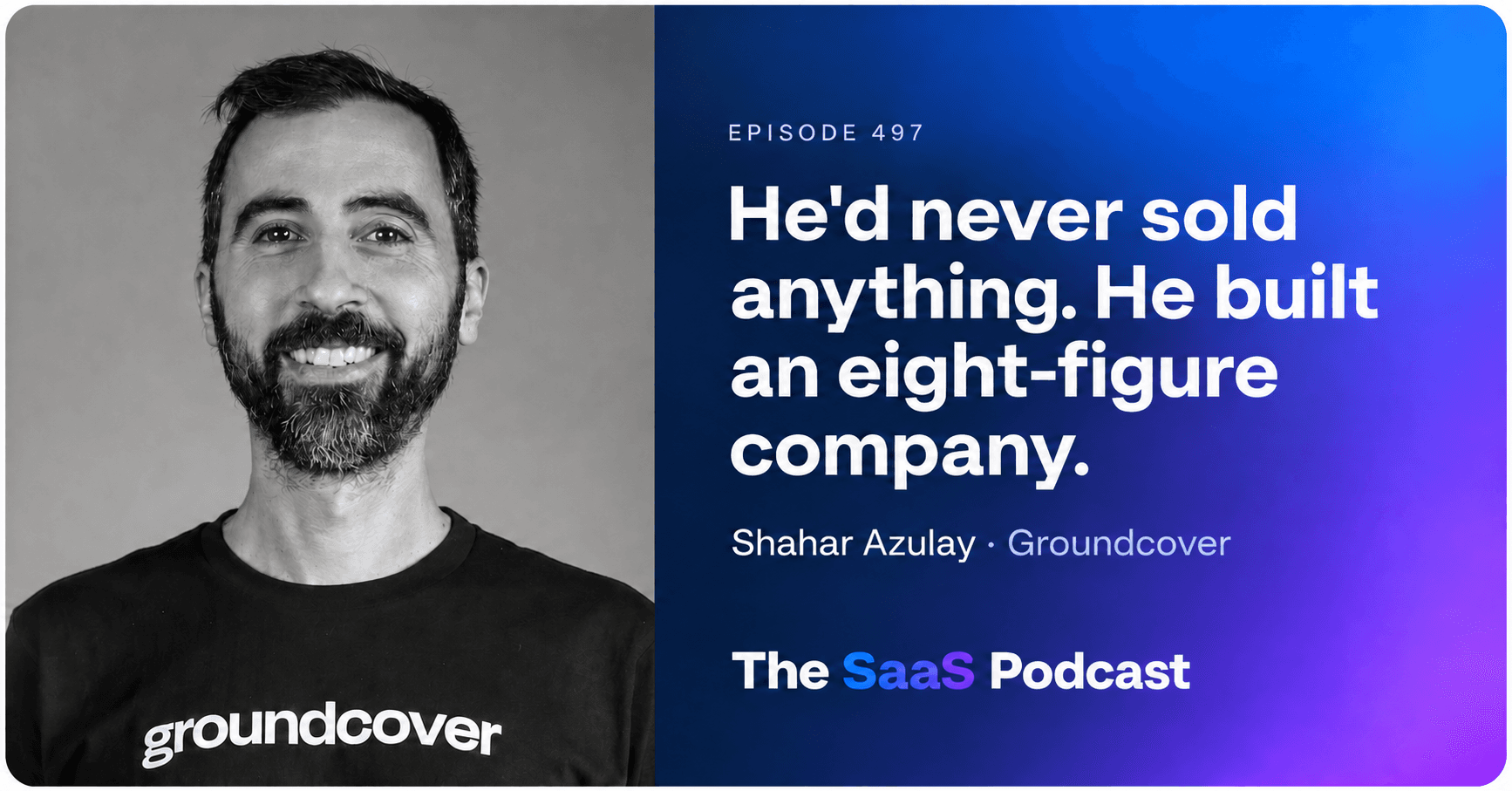
Shahar Azulay, groundcover
Shahar Azulay is the co-founder and CEO of groundcover, an observability platform that helps engineering teams catch problems in production before their customers do. He has built it to eight-figure ARR with more than 250 customers, competing directly against Datadog and New Relic. He came to it as an engineer, not a seller. Shahar and his co-founder had spent their careers as engineering managers, living the same frustrating cycle: instrument your applications, emit the telemetry you need, then get told the bill is too high and start sampling and switching things off. They set out to solve that with technology rather than a different margin, and bet the company on eBPF, a kernel technology nobody in observability was using at the time. The selling was harder than the building. Three months in, groundcover closed its first customer through a connection to a head of DevOps. There was no user interface yet, just the sensor and some dashboards. Shahar went into the pricing call asking for $100,000 and came out with $10,000 a year, because neither he nor his co-founder knew what they were negotiating against. His conclusion from that is contrarian: close your first dozen customers at whatever price they will pay. The learning, the references, and the confidence are worth more than the contract value, and you cannot expect to grow those early accounts anyway. Shahar also covers how the first 50 to 100 customers came from his own network and a handful of LinkedIn messages a day, why he published list pricing and then discounted it by up to 70 percent, and the moment customers started ripping out Datadog before groundcover was ready for it.
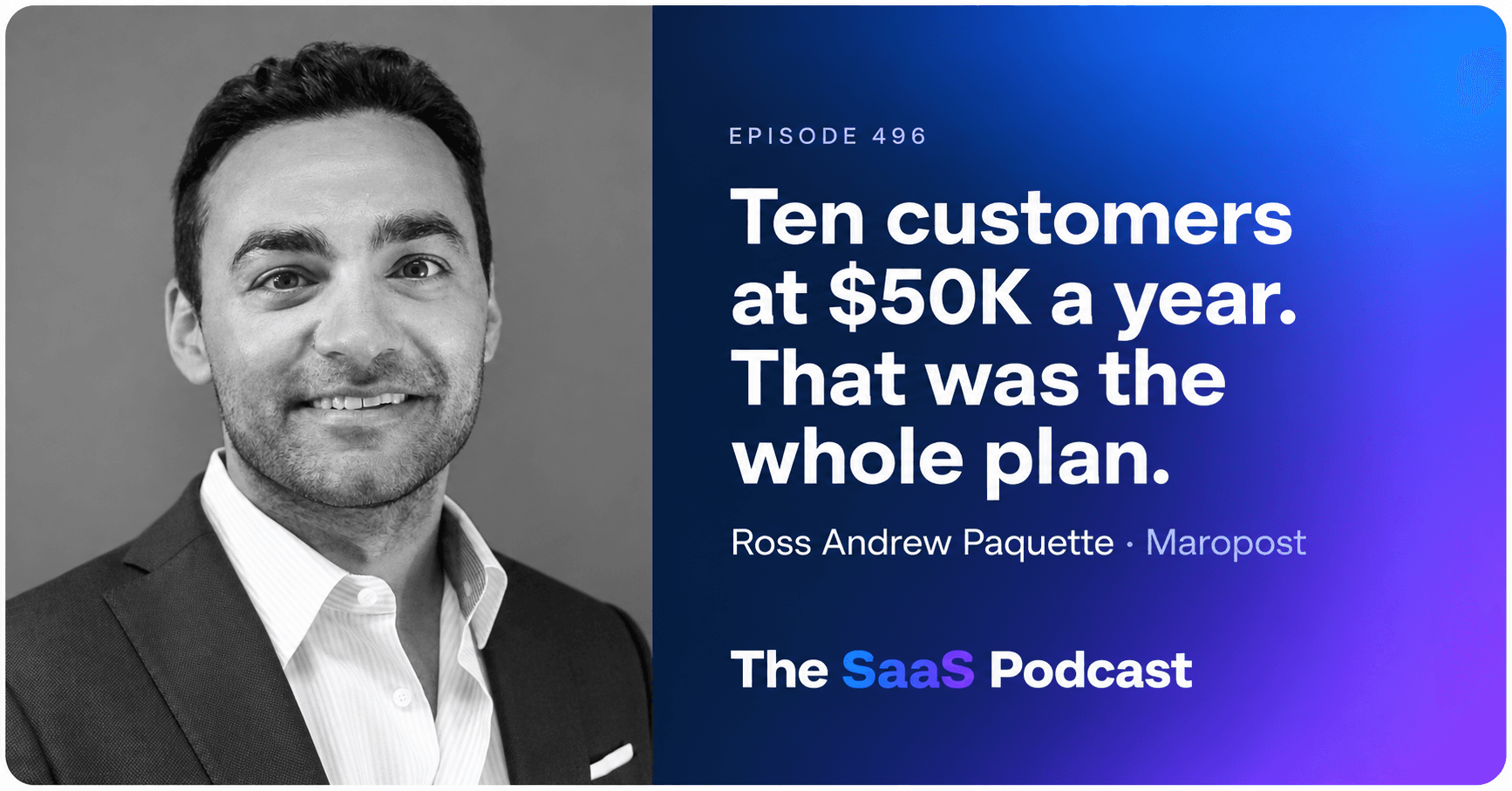
Ross Andrew Paquette, Maropost
Ross Paquette is the founder and CEO of Maropost, a commerce and marketing platform he has bootstrapped to around $50 million in ARR with roughly 300 people and 5,000 customers. He started it in 2011 out of his apartment while still working full time selling Oracle ERP software into the construction industry. The plan was small. Ten customers paying $50,000 a year, about $500,000, and more free time. Ross had spent a few years selling marketing automation and knew the service in that market was poor, so his pitch was simple: 24-hour live chat and a five-minute response time, which in practice meant him. Three or four former customers signed almost immediately. Two of them paid around $10,000 a month. The early build nearly sank it. His developer would disappear for days, and the platform would go down with nobody available to fix it. Ross describes standing on a departing plane holding his phone in the air to hold the signal, maybe ten or fifteen times. His mother suggested he post the job somewhere. The first person who replied on oDesk rebuilt the platform in two or three weeks and is his CTO today. Then it caught. In 28 months the business went from $300,000 to $27 million with six or seven people, largely because Ross was personally closing brands like Rolling Stone and Mercedes off conference floors. He took a secondary round around 2016, gave up about 25 percent, and roughly three years later wrote a $37 million check to buy the investors out. He also gets into why seven or eight experienced sales leaders failed at Maropost, what he hires for now instead, and why he says he would not show up to work if he owned less than ten percent of his own company.
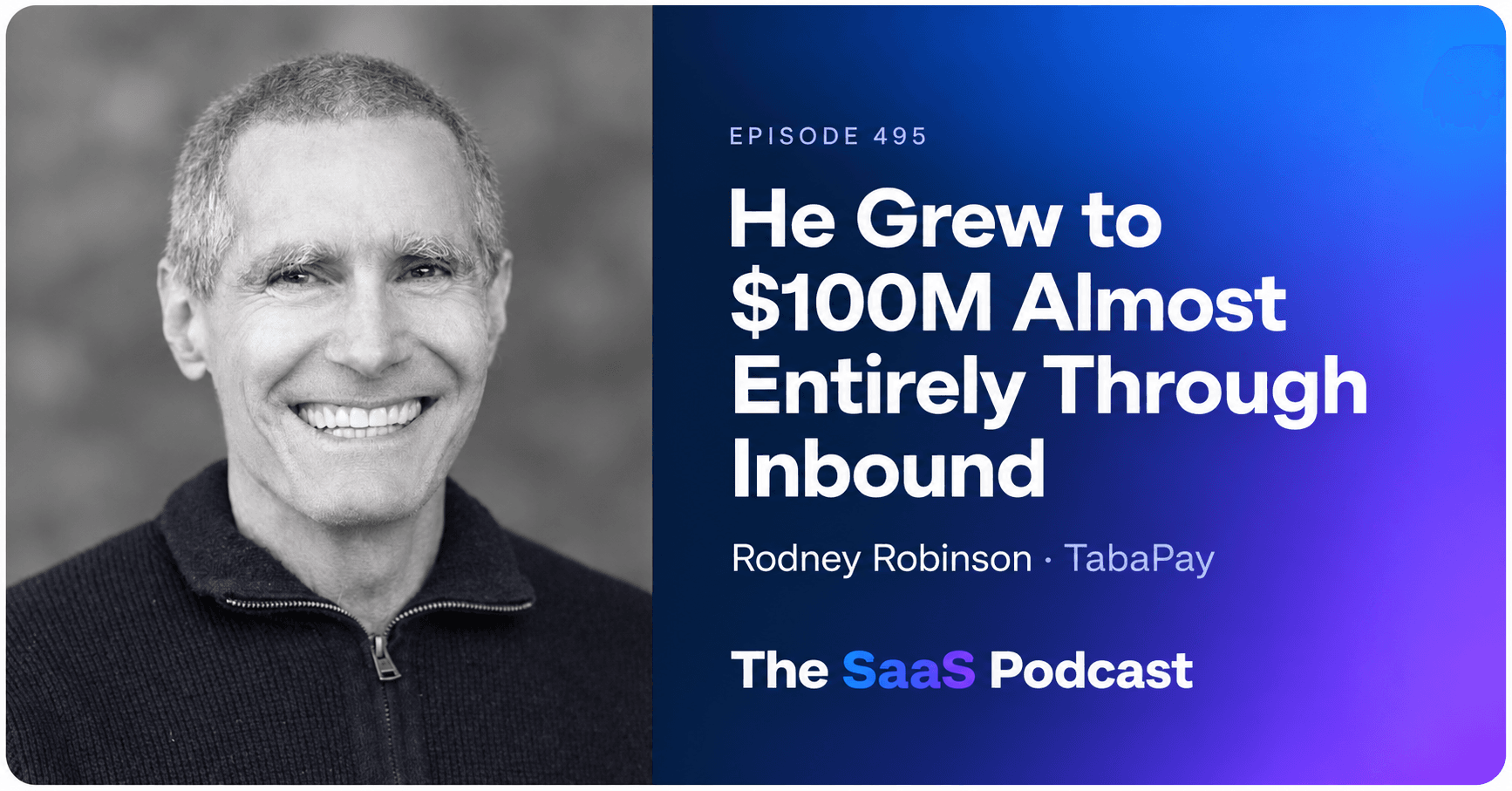
Rodney Robinson, TabaPay
Rodney Robinson is the co-founder and CEO of TabaPay, a payments company that moves money in and out for fintechs. It now runs at $100 million in revenue with about 150 people, profitable, growing 35 to 40 percent a year. On the day this interview was recorded, Rodney announced TabaPay had raised $155 million and acquired a bank. The company started because Mastercard would not build what its own customers kept asking for. Rodney had sold his previous company to Mastercard and spent two years running its instant payout business. Merchants wanted to send money out and collect it back through the same card. Mastercard only wanted the send half, because the collect half would compete with its largest processing partners. Rodney left and built the thing they could not. Getting there took a year and a bank willing to sponsor a startup with no track record. Banks solve for risk by asking for a large deposit, which Rodney did not have, so he signed a personal guarantee and pledged his house. Six months in, another company accused them of stealing its software. TabaPay won, but the sponsor bank dropped them during the fight. The company ran for nine years on a single $2.5 million seed round, its only outside money until this year. Rodney went after small fintechs he already knew, on the theory that minnows become whales, and let banks and the card networks feed him everything after that. TabaPay has never bought a keyword or run content marketing. He also covers why he paid vendors more than he needed to in year one, how three vendors at 99 percent uptime leaves you down three percent of the time, and why he thinks outbound sales is finished in B2B.