Do the 2-Page PBC Conversion Before You Take a Cent of Investment
Most founders skip a 5-minute legal filing that protects everything they spend the next decade building. Eric Ries walks through the Public Benefit Corporation
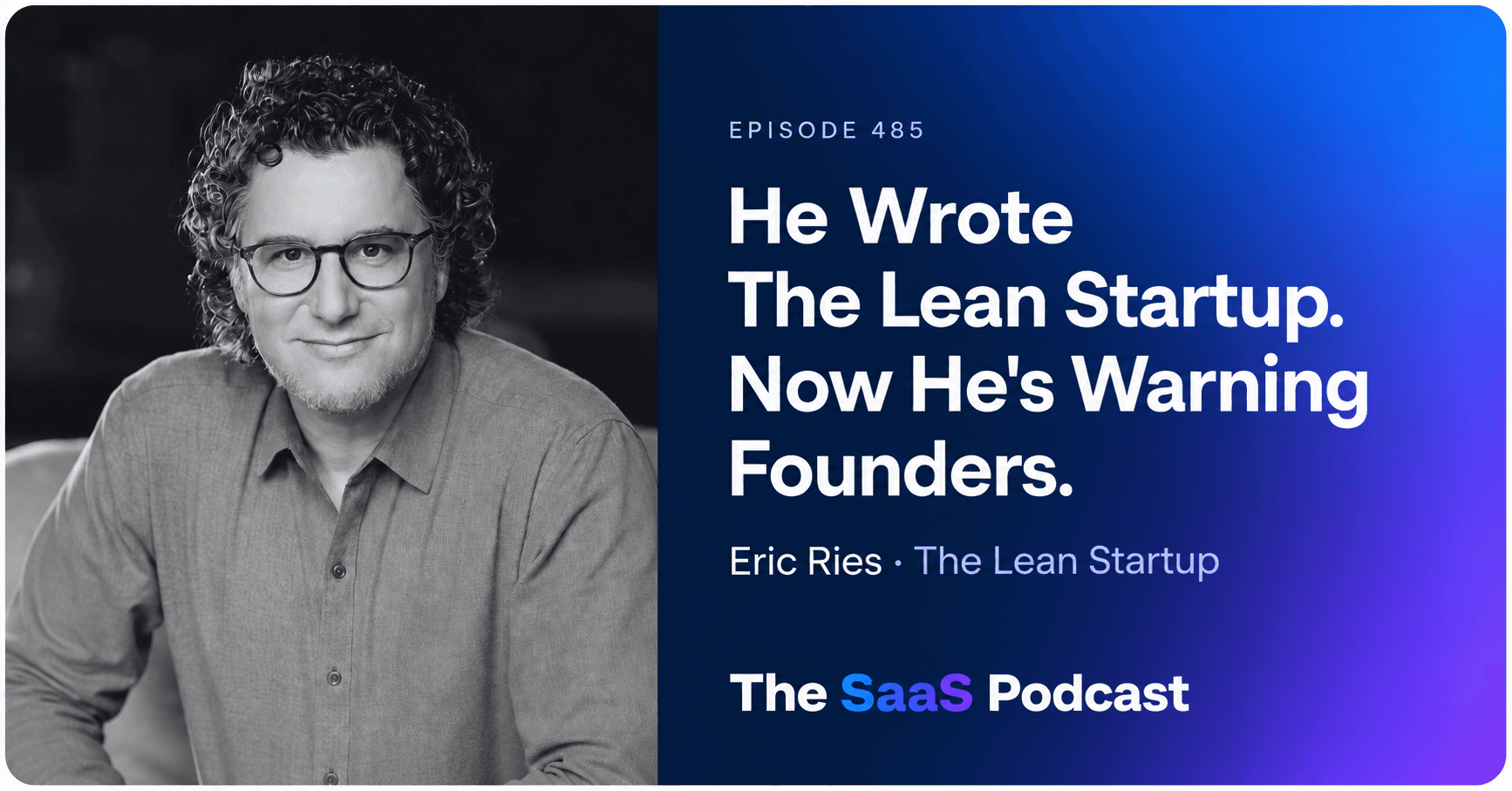
How SaaS and AI founders who scaled got their first customers
One email every Thursday. Unsubscribe anytime.
He wrote the startup playbook. Then he watched founders who used it lose control of what they built. He says he felt like he was feeding one company after another into a meat grinder.
Eric Ries, author of The Lean Startup, breaks down what really happens the moment one customer becomes half your revenue, how to tell real product-market fit from slow drift, and why the standard paperwork your lawyer hands you is quietly working against you.
Eric Ries is the author of The Lean Startup, the book that shaped how a generation of founders builds products. His new book, Incorruptible, is his answer to a problem he says he helped create: founders who use the Lean Startup playbook to build successful companies, then lose control of them.
Eric tells the story of advising a SaaS founder who landed a customer worth half their revenue. The roadmap quietly bent around that customer over six months. Nobody chose it. The product just drifted. He says this is what financial gravity looks like in the wild, and it is one of the biggest threats to founder control at the moment a startup starts working.
Eric also breaks down what happened to Jeff Lawson at Twilio. Lawson negotiated a seven-year sunset on his dual-class shares at IPO. Activist investors removed him 199 days after that control expired. Eric cites a Harvard Law School study showing only 20% of venture-backed founder CEOs are still CEO three years after going public.
The conversation gets concrete fast. Eric shows why most charters say "any lawful purpose" and why Delaware courts read that as "maximize shareholder value", which is how the British inhaler company Vectura ended up sold to Philip Morris for an extra 10 pence per share. He walks through the Public Benefit Corporation conversion, a two-page filing that takes about five minutes for a Delaware company, and explains why it is one of the cheapest ways to protect founder control before it is too late.
This episode is for early-stage SaaS founders deciding what to sign in their first term sheet, and for six-figure founders who already feel one customer pulling the roadmap.
Topics: Fundraising|Bootstrapping
Eric Ries argues most founders lose control of their company not through a hostile move but through financial gravity bending the roadmap around their largest customer, investor or buyer, and a Harvard Law School study he cites shows only 20% of venture-backed founder CEOs are still CEO three years after IPO.
Most founders skip a 5-minute legal filing that protects everything they spend the next decade building. Eric Ries walks through the Public Benefit Corporation
A founder at 30K MRR lands a customer who pays half their revenue. The roadmap starts bending. Eric Ries calls it financial gravity and explains why willpower n
The standard governance documents your lawyer hands you are not neutral. Eric Ries shows the data: 20% of venture-backed founder CEOs still run their company th
Most founders run governance backwards. They start with legal documents and end up signing whatever the lawyer drafts. Eric Ries flips the order with one questi
How does Eric Ries say founders lose control of their company?
Eric Ries says founders rarely lose control in one dramatic moment. They lose it slowly through financial gravity bending the roadmap, the board and the culture around whoever controls the next dollar of revenue or funding.
What does Eric Ries say happened to Twilio founder Jeff Lawson?
Lawson agreed to a seven-year sunset on his dual-class shares at IPO. Activist investors ousted him from Twilio 199 days after that control expired, which Eric Ries uses as proof that delayed governance protection is no protection at all.
What is financial gravity according to Eric Ries in The Lean Startup follow-up Incorruptible?
Financial gravity is the unconscious pull a founder feels toward whoever controls their resources, customer, investor or board, that reshapes decisions and eventually values without anyone choosing it.
How can an early-stage SaaS founder protect founder control this week?
Eric Ries says the single highest-leverage move is a Public Benefit Corporation conversion, a two-page Delaware filing that takes about five minutes when you only have a few co-founders and no outside investors to negotiate with.
Why does Eric Ries say "any lawful purpose" in a charter is dangerous?
Delaware courts and the Revlon doctrine interpret "any lawful purpose" as a fiduciary duty to maximize shareholder value, which can force boards to accept a sale to a buyer the founders would never choose.
What does Eric Ries say a founder should do if one customer becomes 50% of revenue?
He says treat it as a governance moment, not just a sales win. Without structural and cultural safeguards the product roadmap will quietly bend around that customer's hints within months, even when they make no explicit demand.
How does Eric Ries tell real product-market fit from drift?
Real product-market fit is an absolute tornado where you cannot keep up with servers, hiring and demand. Drift is when the roadmap is full of features one big customer "might" want and nobody has actually been asked to commit.
What did Eric Ries learn from the LTSE bathroom floor moment?
A coalition of hedge funds gave LTSE a capitulate-or-die ultimatum. His team unanimously refused. Eric Ries says principled mission-aligned decisions cannot guarantee a win but consistently produce the asymmetric outcomes that protect founder control long term.
What is the Vectura and Philip Morris example Eric Ries uses?
Vectura made asthma and COPD inhalers and was profitable on the London Stock Exchange. Its board unanimously sold to Philip Morris for 165 pence versus a private-equity bid of 155 pence, citing fiduciary duty for the extra 10 pence per share.
Omer Khan [00:00:03]:
Welcome to the SaaS podcast. I'm your host, Omer Khan. AI has changed the playbook for building and growing SaaS. Every week I talk to founders who are writing the new one. He wrote the startup playbook, then he watched founders who used it lose control of what they had built.
Omer Khan [00:00:19]:
He says it felt like he was feeding one company after another into a meat grinder. My guest today is Eric Ries, author of the Lean Startup. His new book, Incorruptible, is about something most founders never see coming. How you lose control of your company and how to protect it before you do.
Omer Khan [00:00:38]:
In this interview, Eric breaks down what happens the moment one customer becomes half your revenue. How to tell real product market fit from slow drift, and why the standard paperwork your lawyer hands you is quietly working against you and what you can do about it this week. So I hope you enjoy it. Eric, welcome to the show.
Eric Ries [00:01:01]:
Thanks for having me.
Omer Khan [00:01:02]:
My pleasure. So it's been, what, 15 years since you wrote the Lean Startup?
Eric Ries [00:01:09]:
How time flies.
Omer Khan [00:01:10]:
Yeah, it does. And so many founders have used that playbook to build companies, successful companies, and. And people still use it and talk about it today, but a lot has changed since then. So what would you do differently if you were writing the book today?
Eric Ries [00:01:26]:
Oh, it's impossible. You can never go back in time. You know, I remember someone at the time that I was writing the book said, hey, you should have more stories of failed startups in here. And I was like, I do. We just don't know which ones yet. You know, that's the nature of being around startups.
Eric Ries [00:01:39]:
You know, a lot of the principles have held up really well. Obviously, many of the specific tactics are really different. And in particular, we're living through a time now where the economics of building an mvp, of experimenting with a new product direction, has obviously really fundamentally changed.
Eric Ries [00:01:54]:
But the core insight and the thing I tried to emphasize as much as I could in the book, that if we work from principles, timeless principles, we can then derive the right tactics to use, no matter what happens with technological disruption. I think that's held up pretty well.
Omer Khan [00:02:07]:
Yeah. So, I mean, AI has basically made the cost of building products or software for free. So what does that mean? How should founders be thinking about using the Playbook and the principles today?
Eric Ries [00:02:24]:
Well, I would not use the word free to describe it in two ways.
Eric Ries [00:02:28]:
Obviously, it's very interesting time to be doing this, but first of all, someone just calculated that the cost of running, if you ran the latest models year round in thinking mode, had an agent that actually could be using tokens every second of every day for a year. It would cost you $750,000 a year.
Eric Ries [00:02:45]:
Actually a very highly paid employee. Okay. So yes, it is true that we can build things without the same human intervention, but also there's a difference between a prototype and an mvp.
Eric Ries [00:02:57]:
And we're seeing vibe coding creating massive numbers of prototypes that look amazing but that are actually not deployable or when deployed into production, have all these huge problems that require a lot of human scale. Debuggin. I would hesitate to call it free, but I do think the economics of software is changing in really profound ways.
Eric Ries [00:03:12]:
I think ultimately that will have a democratizing effect on entrepreneurship. So I think in the long run it's probably a good thing, although we're going to have a lot of turbulence in the short run.
Eric Ries [00:03:20]:
And I think what's happening is simultaneously we are opening up the tools of programming to more people, which is great, but also at the same time we are changing software from being effectively a zero marginal cost business to a token consuming business, which means we all of a sudden have to start thinking about cost of goods sold when we develop software businesses, which most software people don't even know what that phrase means and have never had to encounter it before.
Eric Ries [00:03:45]:
And you know, it's funny, people, I've done work in manufacturing and pharmacy pharma stuff and all kinds of areas where the physical plant, the manufacturing costs, the margin is a huge, huge part of the economic question that has to be tested. And those entrepreneurs, I think have a big advantage.
Omer Khan [00:04:01]:
Yeah, it's like when you see those P and L templates and it has the cogs line and these days nobody knows what that actually means. It's like, get rid of that.
Eric Ries [00:04:10]:
Yeah, yeah. It's funny, I mean, I remember people talking about it's so hard to apply management best practices in a startup because on your P and L everything's zero. Just everything's zero. You have nothing, you don't have goodwill, you have no balance sheet, no nothing. It literally all these zeros. And most.
Eric Ries [00:04:26]:
If you read like almost any business book that's written for a normal business, not for a startup, it'll be like, look at the data. And then if your cogs is too high, reduce your cogs. If your this is this and it's like it presumes that you have non zeros to work with.
Eric Ries [00:04:40]:
What do you do if you have zero? And I mean that's a big part of Lean Startup and all of its attendant books and movements and all that stuff is that we have had to figure out, like, how do we develop a management system for the extremely high uncertainty reality of building a startup?
Omer Khan [00:04:54]:
Yeah, I mean, that's a good point. Great point, actually, that software, it's not true that it's free and you've kind of explained that well, but building software, building an MVP or prototype has become a lot faster than it ever was before. And so where does the focus shift for founders? Is it about running 10 times more experiments?
Omer Khan [00:05:16]:
Is it about being 10 times more thoughtful about each experiment? Where should they be focused more on today?
Eric Ries [00:05:22]:
It's really funny that in the old days of two years ago or earlier, when I would tell people, so, first of all, the fundamental speed factor of startups is never changed. The ultimate constraint is our ability to learn, right? Because the unit of progress of a startup is validated learning.
Eric Ries [00:05:39]:
And until you can outsource all the learning to some agent, maybe someday in the future, at the end of the day, how fast you can learn what customers want where you are is the ultimate limiting factor. Now, if you're in a hyper growth industry, sometimes you have hypergrowth just because you catch the wave.
Eric Ries [00:05:55]:
But then progress is in figuring out how to catch the wave. And think about all the people that failed to catch the wave. Even though we're standing just in the same spot as the people who did, there's usually some learning loop that allowed them to do that.
Eric Ries [00:06:07]:
In the old days, people would say, like, I would say, look, we got to get this MVP out right now. We got to learn faster. We got to go like, were you sitting around planning? And they'd be like, well, but I got to hire somebody or my team doesn't want.
Eric Ries [00:06:17]:
They would use the human delays as their excuse why they couldn't go faster. And so now I feel like with LLMs, that has gone. So what's your excuse? What is your excuse? Honestly? Like, like, am I waiting for my designer to make the mvp? Like, I could be unlovable right now. I could be on Vercel right now.
Eric Ries [00:06:33]:
If you can't use cloud code, okay, I can use cloud code like this MVP for, for a huge percentage of the economy. If you have an MVP idea, you can get it out today. Like, what are you waiting for?
Omer Khan [00:06:43]:
Yeah, so let's talk a little bit about, like your, your new book, Incorruptible. One of the interesting things in there was that you, you talked about the lean startup and said, hey, I was helping all of these founders figure out how to build successful startups, but not preparing them for what came next.
Omer Khan [00:07:07]:
And I think you sort of described it as like feeding them into this meat grinder, which is a pretty dark picture. So can you just explain that? What did you mean by that?
Eric Ries [00:07:18]:
I feel like I have witnessed the best and worst this industry has to offer. I mean I've helped people, so many people create companies, created literally billions of dollars in personal wealth. I've watched numerous people go from obscure hackers in a garage to like titans of industry and multi billionaires.
Eric Ries [00:07:35]:
So I've seen it up close and I've also seen the misery that this system can create not just for customers and for society at large. Look at Free the newspaper. Good God.
Eric Ries [00:07:46]:
What is our culpability in the fact that the world is literally on fire right this minute, but also the mental health toll on the founders themselves, on the leaders themselves, who have created a lot of wealth but often don't sleep very well at night, who have lost control of the thing that they made.
Eric Ries [00:08:06]:
And I think I bought into the same best practices as everybody else. I fell for the same story everybody else. So that if you have success, you'll gain leverage. With leverage, you'll have the power to make things the way you want them to be.
Eric Ries [00:08:20]:
And what I didn't understand is that for mission driven organizations in particular, success is a source of power, but it is also a major liability. Why? Because the more golden the goose, the greater the temptation will be to butcher it.
Eric Ries [00:08:35]:
These companies create tremendous value when you find product market fit, when you figure out some way to make customers lives better, to make employees feel like they're part of a mission that they really buy into. When that magic combination comes together, you create this asset, this incredible asset, the most underrated and most valuable asset in the world.
Eric Ries [00:08:54]:
Trustworthiness. You think of those companies you've met where you're like, if they say they're going to take care of me, I know for sure that they will. I trust them. That asset is insanely valuable. And unfortunately I was naive, we were all naive about this.
Eric Ries [00:09:08]:
If you create a vault with this massive pile of this incredibly valuable asset, people are going to try to take it away from you. Obviously like I can't believe we were so blind to this.
Eric Ries [00:09:19]:
But that unfortunately most best practices that you, that your lawyers, that your bankers, that your VCs tell you to like, they're all designed to make organizations weak and easy to take over, easy to redirect, easy to control.
Eric Ries [00:09:33]:
And so yeah, I think it's time to say that we have the evidence now that these so called best practices destroy value. And time to replace them with a new set of best practices that do not.
Omer Khan [00:09:42]:
Was there a specific founder who did seemingly everything right, but still ended up in trouble?
Eric Ries [00:09:51]:
So many. I mean, I tell a lot of the stories in the book anonymously because I was there. And I don't want to be too obvious about it. But one story that I had permission from the founder to tell is the story of Jeff Lawson, who built Twilio into a massive, massively successful company.
Eric Ries [00:10:09]:
He did all the things you would want a founder to do. And when he was going public, he agreed to a seven year sunset on his dual class shares. So he had kind of unquestioned control over the company for the ipo, plus seven years.
Eric Ries [00:10:24]:
And anyone want to guess how many days elapsed between the expiring of his dual class control and the time that activist investors ousted him from Twilio? It was 199 days. They couldn't even wait one year. And we see that over and over and over again.
Eric Ries [00:10:40]:
And tell another story of a founder who came to me for advice with his ipo. I told him to be worried about all these different things, just like we're talking about now. He came away very upset and worried. He went talk to his bankers, his lawyers, his cfo, everybody in his orbit.
Eric Ries [00:10:53]:
They all told him the same thing. Man, Eric's such a downer. If he really believed in you and your vision, he'd realize that you're the exception. That's not going to happen to you. That's for other people. He was fired from his company within five months of taking it public. And this is not unusual.
Eric Ries [00:11:08]:
Harvard Law School published a study that among venture backed companies, only 20%. 20% Of founder CEOs will still be the CEO three years after going public. 20%. And everyone's like, well, I'm in the 20%. Like, okay, it's your life, man. You're the bet in your life on this.
Eric Ries [00:11:27]:
And even if you don't get fired, there's so many ways to lose control of your company. Airbnb founder Brian Chesky gave an incredible interview to. I think he gave it to Jessica Livington. You can find it on YouTube. He talks about how he lost control of his company to his own employees.
Eric Ries [00:11:41]:
He felt like he had lost his agency. You know, people talk about founder mode, but why did he have to go into founder mode? Who set up the organization that he had to go destroy via founder mode? He set it up himself. So we're just, we're doing this over and over and over.
Eric Ries [00:11:54]:
Again, without realizing that we as founders, we as leaders, we as, even as engineers, as board members, we have a lot of agency over this system. And it doesn't have to be this way.
Omer Khan [00:12:04]:
But I think it's also personal, Right? In the book, you talk about a time when you were on the bathroom floor at three in the morning after your team had basically told a bunch of hedge fund managers to go away. Yeah. So tell us that story. That's an interesting one. Oh, sure.
Eric Ries [00:12:22]:
I built this thing called the Long Term Stock Exchange. And to be clear, I don't run the Long Term Stock Exchange anymore. Has a new and really exceptional professional management team. But I helped create it and got it through its regulatory approvals and its first listings.
Eric Ries [00:12:36]:
It's the first new stock exchange designed for corporate listings since the creation of NASDAQ 50 years ago. So it's quite an extraordinary thing to have worked on and very hard thing. But it's the first project I ever worked on that wasn't just hard for normal startup reasons. It also was vigorously opposed.
Eric Ries [00:12:52]:
And you're telling the story that I tell in the book we went through. The version of LTSE that exists today was a second or third version, depending on how you count. But these are not ordinary pivots, like, oh, we realized we didn't have product market fit.
Eric Ries [00:13:04]:
No, these were pivots where someone comes to you in a dark room and says, listen, capitulate or die. And what was interesting, I look back on it now, I tell these stories, people say, oh, your competitors, were they really ruthless? No, competitors actually were lovely. That wasn't the problem. These were not competitors.
Eric Ries [00:13:18]:
These were regulators, policymakers, corporate governance experts, hedge funds. Like a kind of a weird coalition of people who came to us and said, listen, just to be super clear, if, if you'll just conform your listing standards to the best practices that everybody else does, all these problems can be made to go away.
Eric Ries [00:13:36]:
And if not, we will kill you. They weren't subtle about it. They didn't feel the need to hide it. They invited me to call into one of their strategy sessions to listen in. They were very clear that they like that they were going to win and we were going to lose. And I was sick.
Eric Ries [00:13:51]:
I had never experienced anything like this before. You know, it was like I was so out of my depth. And in retrospect, I can't really be mad at them for the fact that their ambush worked. They knew what they were doing and I really didn't.
Eric Ries [00:14:04]:
And they timed the ambush in such a perfect way that you Know, they brought unbearable pressure on all of our partners, and they got us killed.
Eric Ries [00:14:12]:
And at the time, my team, I assembled my team, it was the middle of the night because I was in London, they were in the U.S. it was the middle of the night for me. Get everyone on the phone and say, I finally understand what's going on here. We've been given an ultimatum. Capitulate or die.
Eric Ries [00:14:25]:
And I need every person on this call to tell me what you want to do, because it's easy for me to say, of course we're going to go down in flames. Come down in the sink. I'm the captain. Come down on the ship with me.
Eric Ries [00:14:35]:
But all these people, they left lucrative jobs and careers to go on this crazy quest with me. And I just. I wouldn't have blamed them if any of them had been like, you know what? Why don't we take half a loaf, you know? And every single one of them said, no, we'd rather die than capitulate.
Eric Ries [00:14:52]:
Now, that's how I wound up on the bathroom floor. It wasn't like my genius leadership that got us through that moment. I just think it was the ethos of the company that is ultimately what powered us through Now. I thought we were dead. I really thought we would go bankrupt as a result of this failure.
Eric Ries [00:15:07]:
But I was wrong. In retrospect, I can see how that failure was the best thing that ever happened to us.
Eric Ries [00:15:11]:
And that really is, to me, the recurring story of mission driven leadership is you find yourself in these situations where circumstances force you to make the harder choice, to make the principled choice or betray what you stand for. And you can't know in advance what the benefits or costs of making the principal choice will be.
Eric Ries [00:15:29]:
You have to make it and then bear the consequences, good or ill. Now, it turns out there's a lot of evidence that if you're consistently principled in defense of a mission that is aligned with human flourishing, a lot of good things will happen to you, including a lot of good financial things.
Eric Ries [00:15:41]:
But it's not a promise, it's not a guarantee. This is not a Disney movie. The good guys don't always win. But in this case, anyway, the company's still alive.
Omer Khan [00:15:48]:
Yeah, that's great. So there's this pattern that you talk about. Founders build something great, and then forces that they can't see start to come into play and often push the company into a direction that nobody chose. And you call this financial gravity in the book. Can you explain that a bit more?
Eric Ries [00:16:12]:
Yeah. So financial gravity is this phenomenon that I've observed in my own life and career many times I couldn't give it a name. I didn't understand it, and it took me a long time to figure it out. And then eventually found out that there's actually a lot of good academic research that backs it up.
Eric Ries [00:16:27]:
And the idea is that whenever we have a status, resource or economic disparity between people. Have you ever watched a normal person interact with a celebrity for the first time? Or like, I'm around a lot of billionaires these days. Billionaires, they have a gravitational wake and people just trail them all the time.
Eric Ries [00:16:46]:
Everywhere they go, people are pitching them and subtly trying to be like, what do I have to say to get something from this guy? It's super gross. And I think it affects people's behavior. As far as I can tell, completely unconsciously, nobody. It's an automatic reflex.
Eric Ries [00:17:02]:
You can't control it any more than you can control your pupils dilating in the dark. So, yeah, as a result, your behavior changes. But also, we know from the psychological research, consistently changed behavior eventually becomes internalized as values. So your own values shift because you're always thinking about, what do I have to do to get ahead?
Eric Ries [00:17:23]:
What do I have to do to get what I want? And unfortunately, we have financialized our whole economy. So all organizations, no matter how big, are tiny compared to the scale of our financial system, which exerts this tremendous gravitational pull. So generally speaking, how many meetings have you been in your life?
Eric Ries [00:17:37]:
Life, or people are like, okay, that sounds a great idea, but investors might not like it. The market might not like it. It's like it becomes a de facto veto over anything that could. Could be perceived as hostile to the investment class. It's just not a good. Not a good way of making decisions.
Omer Khan [00:17:53]:
So let's make it a little bit more real for people who are listening to this. Let's say there's a founder who's at maybe 30 or 40k in MRR and they suddenly sign a customer who now represents like half their revenue. And maybe this customer is asking for features that nobody else is.
Omer Khan [00:18:16]:
Just walk me through, like, what happens in that type of situation if there isn't any kind of structural protection in place.
Eric Ries [00:18:24]:
Yeah, yeah. I actually went through this. Gosh, I can remember so crystal clear. A SaaS company, one of the first SaaS companies, actually, I ever. It was like helping as an advisor go through the kind of like, series A and beyond scale.
Eric Ries [00:18:35]:
And I will never forget, they had this mega customer, they landed, and they were like, this is the greatest News ever. We got this awesome customer, and every day, their product roadmap was just getting worse. Every time I would check in with them, I'd be like, what happened to your product roadmap?
Eric Ries [00:18:49]:
And there'd be all this crap stuff on it. And they were like, well, Company X might like that. Company X might like it. And I only really understood this years later that the word might is so dangerous in these situations.
Eric Ries [00:19:02]:
I'm like, wait, did you sit with Company X and they told you they won't buy your product unless they do? You're like, no, but they kind of hinted. And we kind of think it's just like this desire to please them was overwhelming everything because the company had no structural or cultural safeguards against that behavior.
Eric Ries [00:19:18]:
Now, what's funny is Company X a public company? If I go meet Company X, why are they behaving in this way? Probably they're sitting there being like, I think that's what we got to make the quarter. I think our. I think our investors might like this.
Eric Ries [00:19:30]:
And you're like, well, did you sit with any investors and ask them if that's what they want? No, but I saw the other day we did this thing and our stock went down, so we don't want that to happen again. And it's like, and if I go meet with their investors, you know what they're going to say?
Eric Ries [00:19:41]:
I don't know. Our LPs might not like it. We're trying to raise more money. We got to get our next fund. Like, everyone is caught in this, in this web, and it's kind of gravity all the way down.
Omer Khan [00:19:51]:
In many ways. A founder might be saying, look, I'm kind of just. Isn't this just product market fit? I'm following the money. I'm trying to build the right product for my icp, and I've got this great customer, and it's going to make my product better.
Omer Khan [00:20:07]:
So when you're in the middle of all of that, how do you determine is this product market fit, or is this drifting into something that was never part of what I wanted to do?
Eric Ries [00:20:18]:
So the product market fit part of this question is actually easier to answer than the drift question. Product market fit is easy. And I get this call from founders every once in a while. They'll be like, I'm trying to figure out if I have product market fit. I'm like, my friend, I don't know you at all.
Eric Ries [00:20:31]:
I have no idea what your product is, but I can already tell you don't have product market fit. Why Is that if you had product market fit, you would not have time to call me and ask me this philosophical question. You would be like, I need more servers. Where do I rack them? What do I do? Okay.
Eric Ries [00:20:43]:
Like, I've. I'm drowning in this thing. Product market fit is an absolute tornado. And if you've experienced it, you know what I'm talking about. And if you haven't, just wait. You'll one day be like, oh, that's what he was talking about. Holy bleep. Okay, but the drift part is much, much harder.
Eric Ries [00:20:58]:
I think most organizations do not have a process for reflecting on where they're going. Very often, board meetings are just compliance affairs. Just a check the box, best practice bullshit. Okay. But I think it's very important to ask yourself, are we actually. Here are the questions I would ask. Do we all.
Eric Ries [00:21:18]:
Does everyone in this organization know what the mission actually is? Do we have what I call mission drive? A lot of companies say they're mission driven, but I would call them more mission hopeful. Mission drive means the company has aligned its business model with its mission so tightly that it has no way of making money.
Eric Ries [00:21:34]:
It can't even be tempted to make money except by accomplishing the mission. And then third, are we making decisions in a principled way? Like, is there a principled ethos that guides decision making? Even when I'm not in the room? And in the early days, the answer is going to be no.
Eric Ries [00:21:47]:
That's what founder mode's all about, is like, if you have the personal ethos, you got to be in the room to make sure everybody knows this is what we need to do. You got to show through your examples.
Eric Ries [00:21:56]:
But over time, what you want is people learn from you how to make those kinds of decisions and make the right decision even if you're not there. It's what Mary Parker Follett, very famous management theorist, called the invisible leader. The common purpose that guides people's actions even when no leader, no manager is present.
Eric Ries [00:22:16]:
So those are the things we have to work on. And what I would do is I would treat that as fundamental to a company as your product roadmap. And just like you periodically ask yourself if your product is still on your roadmap or not, you want to ask yourself, is the company still on the mission or not?
Omer Khan [00:22:32]:
You know, in the book, you also talk about that putting this, you know, it's not about willpower, it's about putting structure into place to protect what you're building. And you describe that as governance. And I know we were talking about this earlier that a lot of founders just hear that word and they probably.
Eric Ries [00:22:52]:
Already clicked off the video right now they're just like, oh no. Why could there be anything more boring in the world? I know, I hear you, man, I hear you.
Omer Khan [00:23:00]:
So for a founder who's like, maybe got like five, you know, team of five or 10 people, like, why should they be paying attention to covenants now?
Eric Ries [00:23:07]:
Yeah, it's like the most fundamental thing. It's like imagine you're like, I'm starting a new country, I only have five citizens. But like, I'm like, well, did you read the constitution or you didn't? Like, I have a Constitution. Like, yeah, you're going to need it. And yeah, you better know what it says.
Eric Ries [00:23:22]:
This is such a common fallacy that it was parodied in the HBO show Silicon Valley. There's actually a scene where an investor is sitting with the guy and is just like, you don't know how your own effing company works. Just incredulous, right? Most founders have never read their founding documents. They sign them without reading them.
Eric Ries [00:23:38]:
I don't understand. And I want to be sympathetic because even if they had read them, they wouldn't understand them. Because unfortunately, modern governance is full of this incomprehensible jargon that no normal person can understand. It's full of words like entrenchment and classified boards and all this stuff.
Eric Ries [00:23:56]:
And unfortunately, the biggest problem of all is if you do read your charter, hopefully if there's a founder listening to this and you've never read your charter, you're going to go, this could be your homework. You're going to read your charter and the first sentence of your charter is going to say something like this.
Eric Ries [00:24:10]:
The Acme Corporation is hereby incorporated to pursue blank, any lawful act or purpose. And you're like, oh, that doesn't sound too bad. That means pretty much, I can do whatever I want, right? Wrong. This is why governance is so bizarre. In our modern world.
Eric Ries [00:24:29]:
Any lawful act or purpose is widely interpreted by courts and governance experts and board members to mean maximize shareholder value. You're like, what? I thought it was. Any act or purpose. No, any act or purpose that will maximize returns for your shareholders that leads founders into so many problems, it's unbelievable.
Eric Ries [00:24:48]:
So, yes, I definitely would say, especially if you consider yourself to be a mission driven company, you've got to have the mission of the company has to be written into the charter. You got to insist that your lawyers do that for you. It's the most foundational, important thing. And you never know. This is the problem.
Eric Ries [00:25:05]:
You can always put it off till later. People are like, I can just do it later. You can, but it's always too early until it's too late.
Eric Ries [00:25:11]:
Because when the day that the evil company comes knocking and tries to buy you and you find yourself bound by this stupid interpretation of corporate governance, at that point it's too late to change. So why should you do it when you have only five people? Because when you only have five people, there's no one.
Eric Ries [00:25:24]:
You don't need to ask anybody's permission. You don't have to get any shareholder consents, you have to go through any rigor. Just, you could just file the thing you want to file. You can do what's called a public benefit Corp. PBC conversion. It is literally, if you're a Delaware incorporated company, it is a two page legal filing.
Eric Ries [00:25:37]:
It takes five minutes. It could be the easiest thing you'll do. You could do it today and the benefit won't accrue to you that day. I don't guarantee that anything good one doesn't mean you're guaranteed to make product market fit or anything like that.
Eric Ries [00:25:49]:
But you may come a day when you're like, wow, I'm awfully glad I did that.
Omer Khan [00:25:53]:
So just explain a little bit more. How would that filing that help a founder? How would that give them protection?
Eric Ries [00:25:59]:
Yeah. So in the book I describe what I call a governance fortress, or like you can think of it like a sheet of a suit of plate mail armor. There are many of these protections that you need.
Eric Ries [00:26:08]:
A whole bunch of them that's like overlapping plates to protect against all the different kinds of outside attacks that can cause you to lose control of your company. This one is for a very specific situation. And the specific situation is I always ask people to imagine the most evil company in the world.
Eric Ries [00:26:23]:
And not just morally evil, but the one company where you would say if someone asked you, would you ever go work for that company, the answer is no. You don't need to know. No matter how much money they offered you, no matter what, you would never do it. And people's values differ widely.
Eric Ries [00:26:36]:
So you pick in your own mind to pick whatever one you want. My father was a pulmonologist. So in the book I say I always think of Philip Morris International, the purveyor of cigarettes, as the most evil company in the world. But I grant that it's a competitive field and you might pick somebody else. Okay, no problem.
Eric Ries [00:26:50]:
So just imagine that your personal corporate devil shows up and is like, I would like to buy this company from you for $1 more per share than it's worth. Would you sell? I've never met a founder in the world who would say yes. Everyone's like, hell no.
Eric Ries [00:27:03]:
Actually, what they say is not the kind of thing I should repeat on this podcast. It's very colorful. And I did one time, literally one time, I had a founder say, well, what are they going to use it for? I'm like, oh, they're going to use it to sell cigarettes to children. Does that change your answer?
Eric Ries [00:27:16]:
And they're like, no. Hell no. Okay, great. But did you know that if you have this charter that says any lawful purpose according to what's called the Revlon doctrine, under Delaware law, you would have to say yes. You would have a fiduciary duty to say yes. Most founders think I'm bullshitting them. They're like, that can't be right.
Eric Ries [00:27:36]:
My guy set me up with best pract practice documents. He wouldn't do this to me. And I'm like, call your guy and ask him. Just say, if this happened, would I have a fiduciary dude? And they call me back and they're so betrayed. Like, he did this to me.
Eric Ries [00:27:51]:
Like, he thinks he was doing you a favor, my friend. This is why you need to understand your corporate governance. Can I give you an example that this is not hypothetical?
Omer Khan [00:28:01]:
Yeah. I mean, you talked about Philip Morris, but that wasn't a hypothetical example, right?
Eric Ries [00:28:05]:
No, it's not hypothetical because it was funny. I've used this example of Philip Morris for many years and people would sometimes say, dude, you're exaggerating. So before you accuse me of exaggerating, I want you to just listen to this one story. They were the founder scientists of the Vectura Corporation in the uk.
Eric Ries [00:28:20]:
They were scientists who were working at the University of Bath and they did like a university spin out for inhaler therapeutics, like asthma medicines, COPD medicines. They built a company out at called Vectura. They took it public on the London Stock Exchange. It was like a profitable company doing fine.
Eric Ries [00:28:37]:
And one day the actual Philip Morris international shows up and decides they would like to buy the company. Which like that is already like such a bizarre story. I can't believe this is real, but this is real. You can look it up. And they basically had the situation where the board of Vectura had to make a choice.
Eric Ries [00:28:51]:
They had three options. Option one was just stay independent, company was doing fine. There was really no reason it needed to be sold. A giant private equity firm had offered them 155 pence per share and Philip Morris had offered them 165 pence per share. So three options.
Eric Ries [00:29:08]:
Sell the private equity, stay independent or sell to Philip Morris and earn an extra 10 pence per share. 10 Pence is about 15 cents. You know, I wouldn't be telling you this story if you didn't know the outcome. There was a huge revolt in the uk. They got terrible press.
Eric Ries [00:29:22]:
The British Thoracic Society begged them not to do this. Just the public was so outraged at the idea that a tobacco company would own a health care company. It's so illogical. But the board unanimously voted to sell to Philip Morris, citing their fiduciary duty to shareholders. So, yes, I was in fact exaggerating in my hypothetical.
Eric Ries [00:29:39]:
It was not a dollar per share, it was only about 15 cents. And if you feel like, wait a minute, someone's going to betray me for 15 cents if I don't sign this two page piece of paper, is that really how the world works?
Eric Ries [00:29:51]:
You are now a character in HBO Silicon Valley because you don't know how your own effing company works. Yes, that's today. That is the law today. As insane as it sounds, that is how it works. So, yes, of course we should change the law. Of course.
Eric Ries [00:30:02]:
This idea, which is called shareholder primacy, I show in the book why it is, why it has become such a dominant idea and why it is an idea that is poised for intellectual collapse. But meanwhile, we better protect ourselves from it.
Omer Khan [00:30:14]:
And potentially what would have happened to that company if they had said, no, we're not going to sell to Philip Morris?
Eric Ries [00:30:20]:
Yeah. So what's interesting, and the law in the UK is slightly different than in Delaware, but for all intents and purposes, it's same basic issue. You actually do have the power to say no under a bunch of circumstances. This is not one of them boards. You would be sued by a shareholder.
Eric Ries [00:30:35]:
It would have been sued by Philip Morris and said, look, you've breached your fiduciary duty. And the courts have said, sorry. They literally have a quote that says, like in the context of a sale, change of control boards switch their job from guardians of the company to auctioneers designed to get the best price.
Eric Ries [00:30:51]:
They're not subtle about this. Okay? They think this is a good thing. This is considered a best practice. Now, there are other situations where it's not as clear cut and where what the board believes about their own responsibility is the critical controlling factor. So actually shareholder primacy is dangerous.
Eric Ries [00:31:07]:
Not so much because it's the law, because actually it was never democratically passed. So if you go looking for, like, what statute established shareholder primacy? There isn't one. It's actually crazy. It's a mass delusion. A bunch of people just decided this is how it's going to be starting in the 1970s.
Eric Ries [00:31:22]:
But boards have been indoctrinated to this idea. So you say, well, what would have happened if they said no? First of all, they would have been sued for sure. So boards live in terror of being sued, but more importantly, the board members themselves. I'm sure this is how they saw the situation.
Eric Ries [00:31:36]:
Whether it's true or not is interesting, but the way that if you talk to boards, say, why did you do this thing? They always say, well, it's for my career. I need to be seen as someone who's a good steward of investor resources.
Eric Ries [00:31:49]:
If I buck shareholder primacy and I get sued by the shareholders and I'm pilloried for having done this, it's going to be bad for my career. And that career equity is actually even more important than the fact that the shareholder primacy idea is the law.
Eric Ries [00:32:04]:
It is considered by most board members now to be a natural law that they must follow. And if you press them, they'll be like, isn't this one of the pillars of capitalism? And I'm like, no, this idea, if I.
Eric Ries [00:32:14]:
If you look out the window and you can see a tree, you're looking at something older than this idea. So why is it running? The. Why are we letting it run the world? I think it's time for a change.
Omer Khan [00:32:24]:
So I want to bring this all together with a story that I think hopefully Everybody already knows. OpenAI. So it started off as a nonprofit. Then they wanted to raise money and get billions of dollars, and Microsoft puts money into it.
Omer Khan [00:32:40]:
And then suddenly, at some point, you know, Sam was fired and the board lost complete control after the. Or at least it seemed like that. If. If Sam Altman was reading your new book, I don't know, 10 years ago, what could or should he have done differently?
Eric Ries [00:33:00]:
Yeah, look, I don't like to get too much into the, you know, OpenAI thing because it's such a crazy story, and there's aspects of that situation are idiosyncratic to Sam and Elon and the specific things. But I do advocate for nonprofit control of companies is one of the techniques in the book that we talk about.
Eric Ries [00:33:19]:
And people sometimes say, oh, that sounds superficially very similar to the setup that OpenAI had, but it really isn't. And if you Study the story of OpenAI. There's a couple things you can learn. First of all, one of the big mistakes from what I can tell again from the outside, is the board of OpenAI.
Eric Ries [00:33:35]:
OpenAI has only ever had one board, just the nonprofit. The nonprofit and the fort have the same board. And the more stable structure, according to the research, is when there's two boards, when there's like a nonprofit board of trustees that have an oversight responsibility for a for profit, you know, operating board.
Eric Ries [00:33:51]:
And so what happened was they got themselves into a situation where they just didn't have the skill set they needed to figure out what to do on that, on that board. Now, is that the board's fault? Is that Sam's fault?
Eric Ries [00:34:00]:
Obviously, there's a lot of accusations that fly both ways, but I think that's one important thing to look at. But the second thing I think is even more important lesson from OpenAI. People think governance means whatever the documents say, and that is not true. Governance is a study of power relations between people.
Eric Ries [00:34:17]:
And I argue in the book for what I call the new governance. Not just seeing governance as a legal set of legal formalities or a checklist, but as a combination of four essential questions. The question of compliance, the question of purpose, the question of coherence, and the question of integrity.
Eric Ries [00:34:34]:
And it's really the coherence and integrity pieces that fractured OpenAI. From press accounts, again, speaking from press accounts. First of all, the board had become divorced from the employees. So what the interpretation I talked about, the invisible leader, the interpretation of what the company's purpose was, had become fragmented. Different people had different ideas about it.
Eric Ries [00:34:55]:
And secondly, the company had lost its structural integrity. And here's what I mean. On paper, the board had the absolute unilateral power to fire Sam Altman. He bragged about this many times before it happened.
Eric Ries [00:35:08]:
Like, he would go before Congress, he would look at his testimony, he'd be like, listen, one of the reasons you can trust me is I don't have any equity in this company. I'm accountable to a nonprofit board. Our mission is to benefit all of humanity.
Eric Ries [00:35:17]:
But when they actually tried to exercise this power, Microsoft, their largest shareholder, outside shareholder, and their largest supplier, more important, aligned with their employees to say, we want this reversed.
Eric Ries [00:35:30]:
And the board had probably the worst timing in all of corporate history in doing this because they tried to do this action in the middle of a corporate tender offer. So, of course, think about financial gravity.
Eric Ries [00:35:39]:
The employees were in the middle, a bunch of them in the middle of about to make millions of Dollars personally, that was tied to Sam's involvement. So it was going to unwind this whole transaction. So in that moment of maximum transactional pressure, the investors, Microsoft and the employees were all aligned around wanting Sam back.
Eric Ries [00:35:56]:
So although the paper governance said Sam's in charge, the actual governance allowed these outside actors to be in charge. So because as far as I can tell, the board was blind to these dynamics, they were utterly blindsided by what happened. So, yes, I don't think that again, that situation is very idiosyncratic. And I don't know how many.
Eric Ries [00:36:16]:
I don't think we should draw too many broad lessons from it, but those are two of the lessons that I take away from it.
Omer Khan [00:36:20]:
So for a founder who's listening today, hopefully we've convinced them that you should pay attention to governance now rather than in a few years time. What's the most actionable thing they could do this week?
Eric Ries [00:36:39]:
This week? Okay, I'll give you one. So in the book I have something I call the blueprint, which is like the two parts of this solution and you gotta study both. One without the other is not gonna get you where you wanna go, in my humble opinion.
Eric Ries [00:36:52]:
But I promised every individual technique in this book is useful in itself. So if you're gonna do one thing, I'll give you one thing in each category. Though we already talked about the structural thing. You're gonna do one thing, Just do the PPC conversion.
Eric Ries [00:37:05]:
Honestly, if you don't do anything else, that is by far the easiest thing in the whole book. Just do it. Get your co founders together and just ask yourselves, what is our mission? And call your lawyer and just be like, hey, can we write the mission into the charter? Do you mind?
Eric Ries [00:37:18]:
Your lawyer's gonna say, you know what, it's better to keep your options open. And you're like, come on, even the option to turn our customers into Soylent Green, like, how about we just take that one off the table? You know, like, how are we asking them to trust us?
Eric Ries [00:37:28]:
And we won't even commit that we won't do something bad. Like, let's just do it. So just your lawyer works for you. Do it on the ethos side of it. That is also something you want to talk about. And I would start with asking your co founders, just get together, just ask quickly this question.
Eric Ries [00:37:49]:
Who would we rather die than betray? Is there anybody Today? Most organizations have a fiduciary duty only to their investors formally. Is that how you feel? You do anything for your investors but your employees? Eh, maybe your customers under some Circumstances. Most founders are like, no, that's utterly backwards.
Eric Ries [00:38:08]:
Saul Price, the famous founder, the father of modern retail, basically said it very succinctly. He said that priority should be customers first, employees second, shareholders third. Peter Drucker thought it should be employees first, customer second, shareholders third. The Johnson and Johnson famous. Our credo is patients first, doctors and nurses second, employees third. Always shareholders last.
Eric Ries [00:38:30]:
So like the titans of industry have repeatedly shown that you make the most money if you have shareholder. You see shareholders as a recipient, like the beneficiary of the financial prosperity created by making what are called fiduciary commitments to others.
Eric Ries [00:38:43]:
So just before you get into the legal nonsense and all this other stuff culture, there's a lot of stuff in the book that you have to get you to really work through. But first question is, is there anyone you actually care about their well being?
Eric Ries [00:38:53]:
And if you could answer that question in the affirmative, then you're already a business revolutionary, you just don't know it. You are so at odds with our dominant business culture.
Eric Ries [00:39:01]:
You may not think of yourself as a reformer or a social activist, but you are, you are actually about to have a monumental confrontation with our financial system who simply doesn't see it that way. So let's start by finding out, is there any turbulence up ahead?
Eric Ries [00:39:18]:
And if there is, then we can learn how to fly the plane through turbulence.
Omer Khan [00:39:22]:
And hopefully, if we've done our job right, there are a bunch of founders who are going and reading their charters right now to figure out what's going on. All right, we should wrap up. So I've got five quick fire questions for you. You ready?
Eric Ries [00:39:38]:
I'm ready.
Omer Khan [00:39:39]:
What's a common piece of startup advice that you disagree with?
Eric Ries [00:39:44]:
Really common? One is to not have advisors on the common side of your cap table. The advice goes like this. If someone's prominent enough to be your advisor, then they're rich enough to be your investor. And if you think about that, this is an act of tremendous class solidarity on behalf of investors.
Eric Ries [00:40:00]:
They want everyone you get your advice from to be economically aligned with the preferred side of the cap table. I think that's a mistake. I think you want to have people who are economically aligned with you.
Omer Khan [00:40:09]:
What's the last great book you read?
Eric Ries [00:40:12]:
Oh my God, I've read so many great books. I just, I just made my way through the Dungeon Crawler Carl series, which, like, I don't know if I should call it a great book.
Eric Ries [00:40:21]:
It's not like we're not talking about Moby Dick here, but it's Actually, like a part of a genre of books that have come out in recent years that are on the surface, like, really fun, like, light reads that are full of action and drama and whatever, but are actually a very incisive social and economic critique of our society.
Eric Ries [00:40:36]:
So I found it to be surprisingly interesting.
Omer Khan [00:40:39]:
Cool. What's something you had to learn the hard way?
Eric Ries [00:40:42]:
Everything. I'm so stubborn. I didn't learn anything the easy way. Yeah, everything. Everything. The hard way especially. I thought that entrepreneurship was just about being smarter and more prepared and, you know, having more data than the next guy. And my first business plan was like 50 pages long.
Eric Ries [00:40:59]:
It was an absolute work of art, and it was complete. It was completely bogus. So, yeah, it took me a while to realize that there's more to entrepreneurship than just being a smart guy.
Omer Khan [00:41:07]:
What's a tool or habit that saves you the most time?
Eric Ries [00:41:11]:
I'm a delegator. And not because I don't want to get into the details. I don't care about the details. I just really believe in people. So I just don't understand the idea of hiring someone and then not utterly and completely trusting them to crush it. And so I'm often disappointed because, of course, that doesn't always happen.
Eric Ries [00:41:31]:
But my general default idea is to find extremely talented people, find out what they really care about, and just give them as much of that thing as I can think of to do.
Omer Khan [00:41:39]:
And finally, what do you do for fun when you're not working?
Eric Ries [00:41:42]:
Oh, man. I have young kids, so that's mostly what I do. I mean, I love music and I love writing music and recording it. I love learning instruments and that kind of stuff. I love playing, like, strategy games like go and chess, stuff like that I find really enjoyable. And I love reading. So, yeah, if I.
Eric Ries [00:42:00]:
If I had any. If I had any extra time, I'd be doing things like that.
Omer Khan [00:42:03]:
Love it. Awesome. Thank you, Eric, for joining me. It's been a pleasure. Where can people find you and the book?
Eric Ries [00:42:09]:
Wonderful. I'm on all the social channels like you'd expect. I'm probably most active on Bluesky right now for the book. You can get it at Incorruptible Co, or absolutely anywhere that books are sold. It is available in hardcover, in ebook, and in an audiobook that I read myself, including a bunch of bonus content.
Eric Ries [00:42:24]:
So I'm actually very excited for people to see the audiobook. And if you go to Incorruptible Co, not only can you get all kinds of cool bonuses, including a secret chapter that got cut out of the book and a bunch of other implementation guides and super cool stuff.
Eric Ries [00:42:36]:
But you can also find all of the local bookstores all across this country that are carrying the book. And if you feel like it, if you feel like supporting your local community, local bookstores are incredibly important community institutions that are under tremendous pressure. Why not buy the book there?
Eric Ries [00:42:53]:
So, of course, I appreciate anyone who buys the book. I appreciate in whatever form is more convenient to you, for sure. But if you want to go to a local bookstore, we have a massive list of the ones that are carrying the book on the website.
Omer Khan [00:43:02]:
That is awesome. Thank you so much. It's been a pleasure. Really appreciate you taking the time. And best of luck with the book.
Eric Ries [00:43:10]:
Yeah, I really appreciate it. Thanks for taking the time.
Omer Khan [00:43:12]:
My pleasure. Cheers.
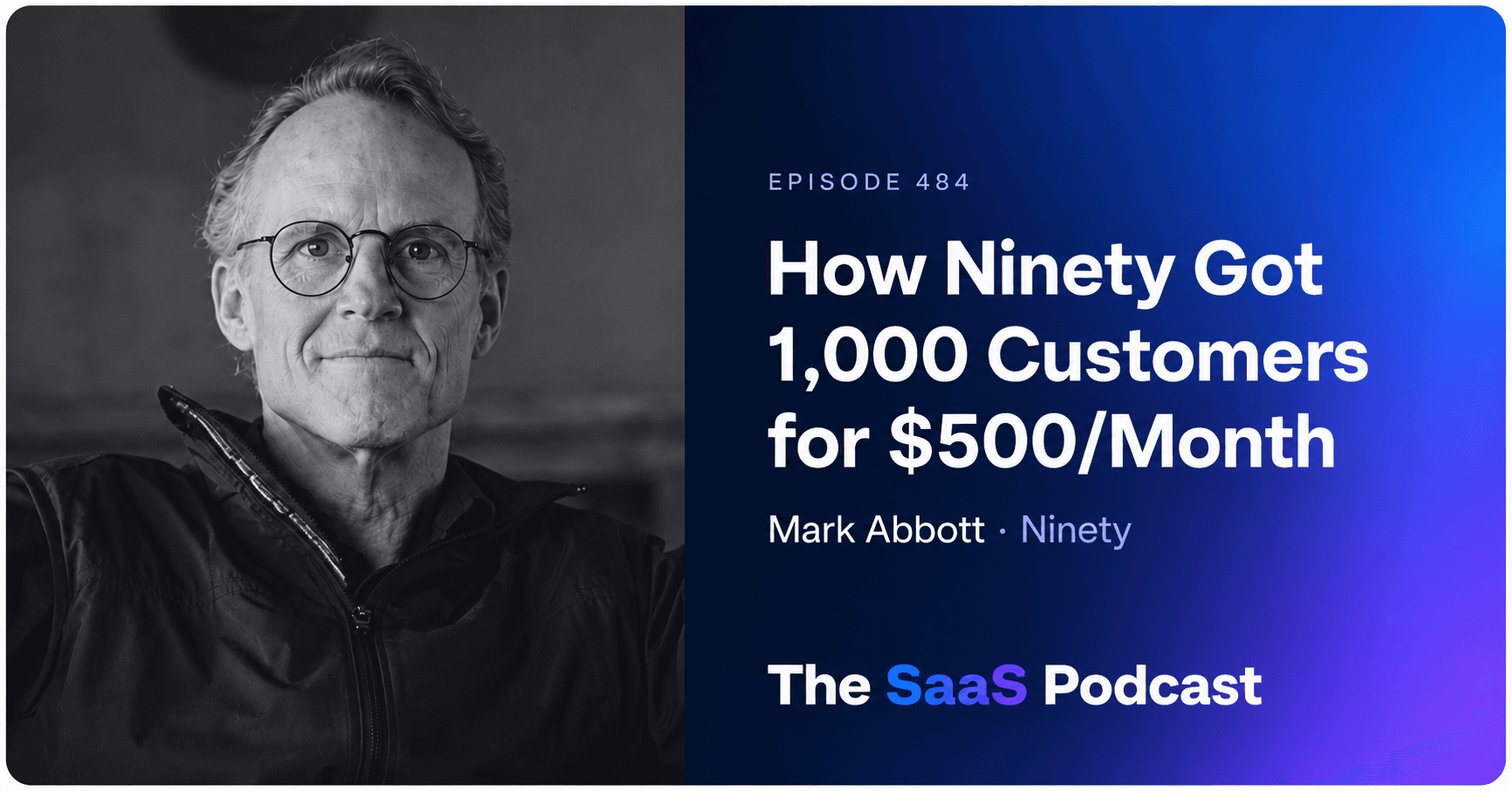
Mark Abbott, Ninety
Mark Abbott had the idea for Ninety back in 2005, sitting on private equity boards watching the same leadership problems repeat across 100+ companies. He wanted to write a book and build software. Then he discovered Gino Wickman had already written the book - Traction - and trademarked the EOS framework around it. So Mark pitched Gino in 2012. Gino's answer: "We tried it, it's not in our DNA." Most founders would have raced into code. Mark did the opposite. He spent four years embedded in B2B community building - becoming EOS implementer #33, attending quarterly coaching gatherings, and slowly earning the trust of the people who would eventually become his distribution channel. While he played the long game, he openly shared his vision with the community. One of the implementers passed the idea to a software client, and Traction Tools launched first in 2016. Mark started laying code that same year as "EOS compatible," landed his first customer in 2017, and only signed the official license in late 2018. What followed was a masterclass in patient B2B community building. Mark spent $500 a month on Facebook ads targeting self-implementing EOS companies, leaned into relationships with the implementer community, and built a 24/7 support culture that outflanked the first mover. He bootstrapped past 1,000 customers and hit a $100M+ valuation before raising a dollar. Then in 2021 he raised a $20M Series A from Insight Partners. Insight later returned for a $35M Series B led by Blue Cloud Ventures with Catalyst Ventures coming in - $55M total across three institutional investors. The Series A is where things got harder, not easier. Mark hired fast, brought in seasoned executives who arrived with their own playbooks, and lost grip on culture. He explains why the lessons that worked in private equity didn't translate to scaling a SaaS company, what he wishes he had known about hiring for stage, and how AI is reshaping Ninety's product roadmap two years into a serious AI build. This is a candid conversation about taking the slow path, the cost of oversharing, and what B2B community building actually buys a founder.
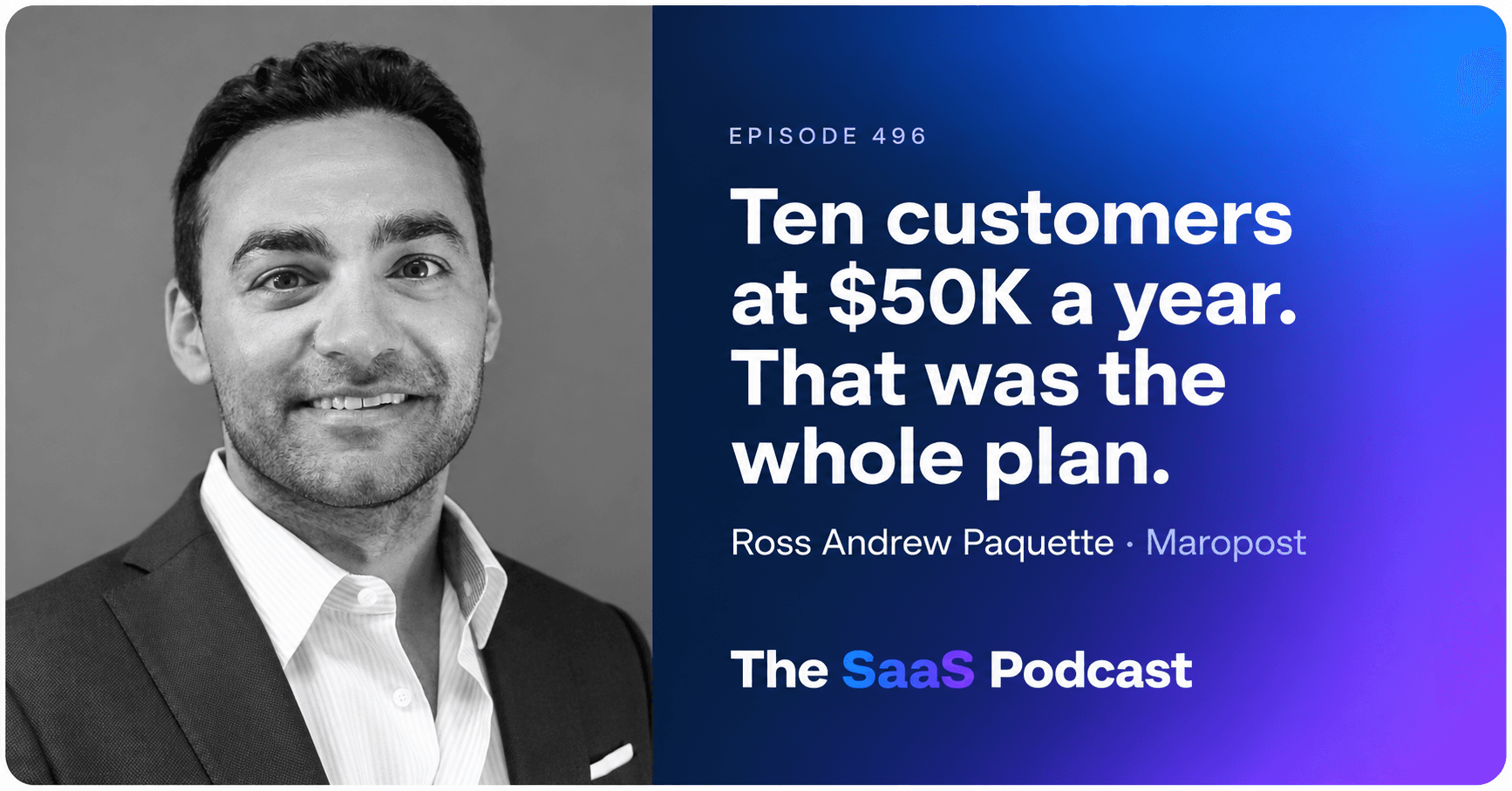
Ross Andrew Paquette, Maropost
Ross Paquette is the founder and CEO of Maropost, a commerce and marketing platform he has bootstrapped to around $50 million in ARR with roughly 300 people and 5,000 customers. He started it in 2011 out of his apartment while still working full time selling Oracle ERP software into the construction industry. The plan was small. Ten customers paying $50,000 a year, about $500,000, and more free time. Ross had spent a few years selling marketing automation and knew the service in that market was poor, so his pitch was simple: 24-hour live chat and a five-minute response time, which in practice meant him. Three or four former customers signed almost immediately. Two of them paid around $10,000 a month. The early build nearly sank it. His developer would disappear for days, and the platform would go down with nobody available to fix it. Ross describes standing on a departing plane holding his phone in the air to hold the signal, maybe ten or fifteen times. His mother suggested he post the job somewhere. The first person who replied on oDesk rebuilt the platform in two or three weeks and is his CTO today. Then it caught. In 28 months the business went from $300,000 to $27 million with six or seven people, largely because Ross was personally closing brands like Rolling Stone and Mercedes off conference floors. He took a secondary round around 2016, gave up about 25 percent, and roughly three years later wrote a $37 million check to buy the investors out. He also gets into why seven or eight experienced sales leaders failed at Maropost, what he hires for now instead, and why he says he would not show up to work if he owned less than ten percent of his own company.
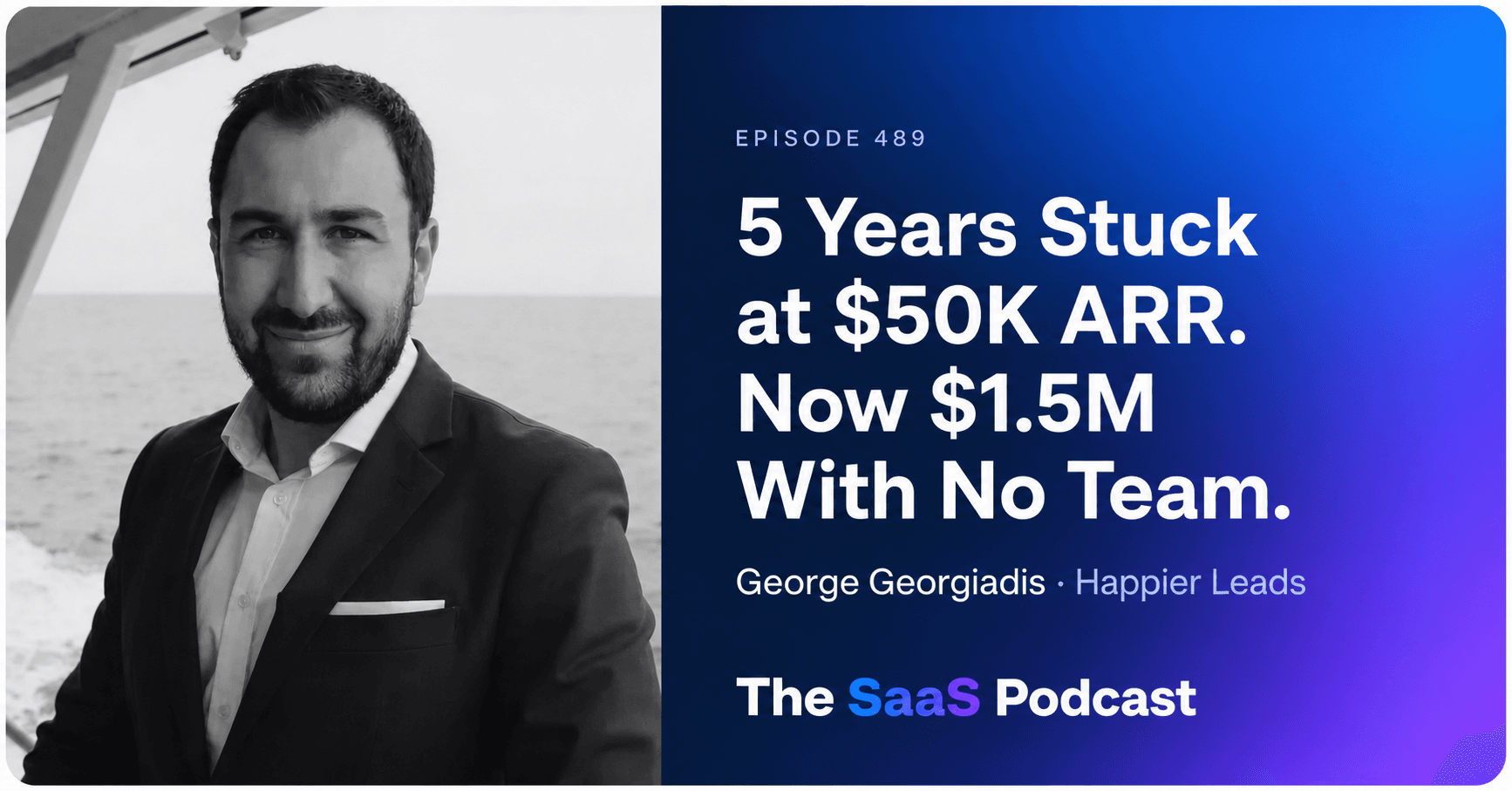
George Georgiadis, Happier Leads
George Georgiadis grew up in Greece, studied IT, and did a master's degree in education because he wanted a government job paying around $600 a month. He ended up in London instead, working through roughly ten different projects before landing on the one that stuck. The idea for Happier Leads came out of his own frustration. He was spending money on ads for an earlier product and watching 95% of his visitors leave without ever identifying themselves. He looked for a fix, found Clearbit, and got quoted $20,000 a year. So he bought a data source and built his own version on top of it. An AppSumo campaign brought in his first $50,000 and funded the early product. Then the business went flat. For five years, Happier Leads sat at roughly $50K ARR. George was splitting his attention between building and a fundraise that never closed, spending about 80% of his time on software development and 20% on marketing and sales. Multiple times he thought about quitting. At one point he started borrowing money to the business from his own personal accounts. What finally moved the number was going deep instead of wide. He owned a 175-million-contact database he had been selling to other people and never used himself. He built his own mailboxes and email infrastructure, drove the cost per send down, and started sending millions of cold emails. Once the unit economics worked, revenue compounded. The other half of the story is how he operates now. Happier Leads runs on a set of AI systems George built himself: his own CRM, his own chatbot, his own session recording, all connected to a single AI brain that reads the data, spots bugs, fixes them, and emails stuck customers without him. He calls it 100 people working 24/7. And yet he is now hiring. His view is that a one-person business makes you an operator, not an owner, and an operator has nothing to sell. So after proving he could get to seven figures alone, George is building a team again. In this episode, George breaks down the AppSumo lifetime deal math, why he turned down a $1M acquisition offer, what actually makes cold email work at scale, and how he assembled the AI agents that replaced a whole team.