Churn Is an Onboarding Problem
When customers cancel, most founders reach for features. Add more, make it stickier, plug the gap the churned customer named on the way out.
How SaaS and AI founders who scaled got their first customers
One email every Thursday. Unsubscribe anytime.
Ron Hash cold-called a stranger he found in the Yellow Pages to validate his idea. The guy said "the paper game is killing me," and that one sentence was enough. Ron went all in and priced his pool service software at 50 cents a pool, using usage-based pricing when every competitor charged per seat.
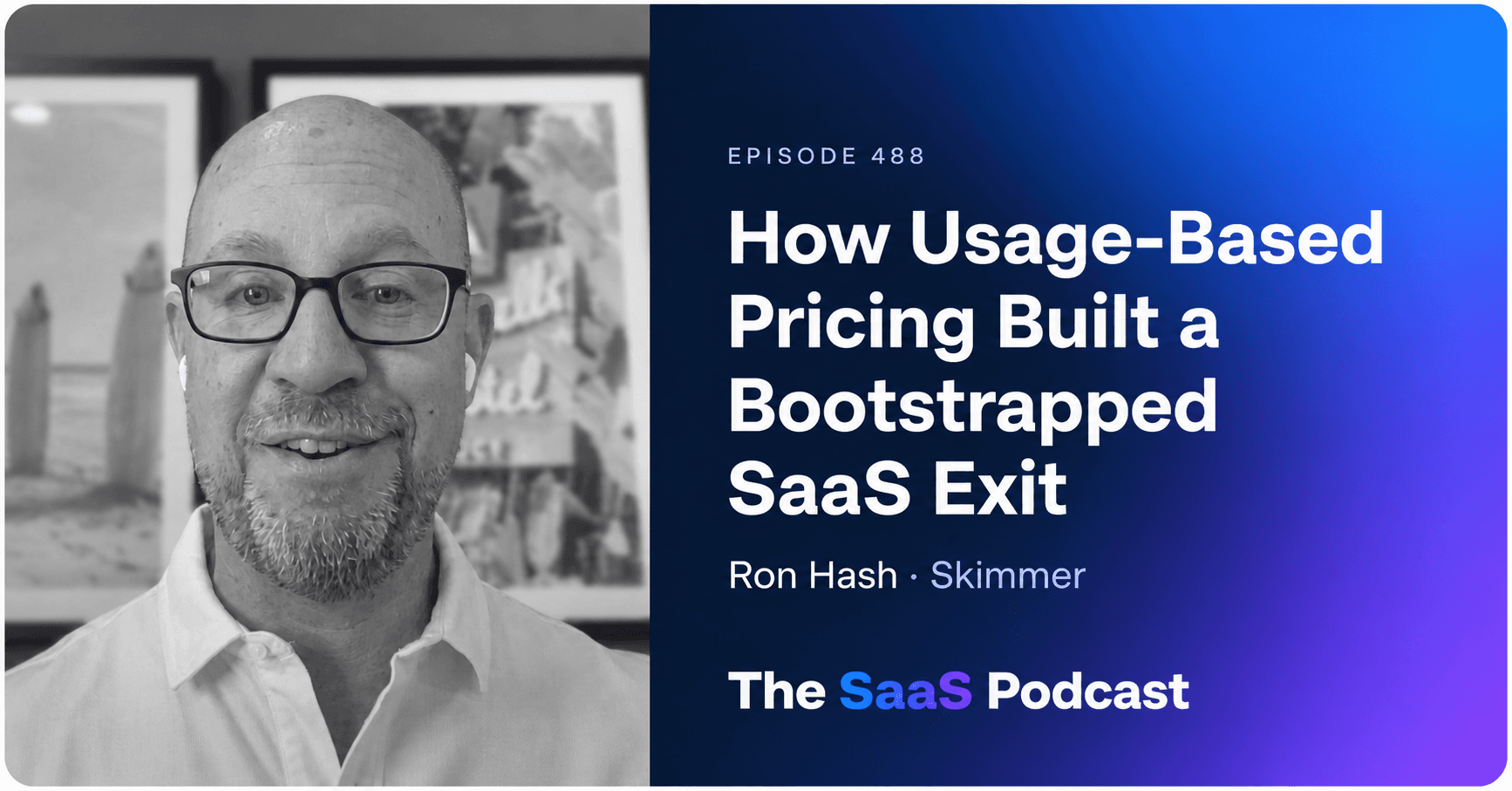
In this episode, Ron shares how he bootstrapped Skimmer to over $1 million in ARR and 1,500 customers with zero ad spend, cut churn from 6% to 2% by fixing onboarding instead of the product, and eventually sold the company.
Ron Hash is a software developer who had never built a SaaS before Skimmer. He wasn't chasing a big idea. A friend with a pool service company mentioned there was no good software to run his business, and months later Ron cold-called a random pool pro in Texas to see if the problem was real. When that stranger said "the paper game is killing me," Ron went all in, building the first version on nights and weekends.
Skimmer grew slowly at first, 76 customers in the first year, then compounded to 1,500 customers and over $1 million in ARR with no paid marketing. The engine was SEO Ron taught himself and word of mouth from pool pros who loved the product. One of his most important early decisions was usage-based pricing: 50 cents per serviced pool with a $29 minimum, instead of the per-seat model everyone else used. That choice aligned Skimmer's revenue with each customer's growth and helped push churn down to 2%.
In 2020, Ron sold Skimmer to Unbundled Capital. Under new ownership the company went on to raise $79 million and grow past 100 employees. In this conversation Ron breaks down how he validated the idea with one call, why usage-based pricing beat per-seat, how he fixed churn through onboarding, and why he has never regretted the exit.
Ron Hash bootstrapped Skimmer, software for pool service companies, to over $1 million in ARR and 1,500 customers with zero paid marketing, then sold it in 2020. He priced at 50 cents per serviced pool with a $29 minimum instead of charging per seat, which aligned pricing with each customer's growth, helped keep churn near 2%, and made the business acquirable.
When customers cancel, most founders reach for features. Add more, make it stickier, plug the gap the churned customer named on the way out.
Founders think validation means volume. Talk to 30 customers, run a survey, tally the results, then decide.
Most SaaS founders copy the pricing they see everywhere: charge per seat, per user, per login. It feels safe because it's what everyone does.
Once you have a product and a little revenue, turn on paid ads. Buy your way to customers, measure CAC, scale the spend.
How did Ron Hash use usage-based pricing to grow Skimmer?
He charged 50 cents per serviced pool with a $29 monthly minimum, so a customer's bill rose only as their own business grew, which made adding customers feel good instead of costly.
Why did Skimmer charge per pool instead of per seat with its usage-based pricing?
Ron read Price Intelligently and realized per-seat pricing punishes customers for adding users and drives churn. Charging per serviced pool tied the price to the value metric and encouraged unlimited team usage.
How did Ron Hash get Skimmer's first customers with no ad budget?
He taught himself SEO and ranked for "pool service software" and "pool service app," then relied on word of mouth in Facebook groups where pool pros recommended Skimmer without any prompting.
How did Ron Hash cut Skimmer's churn from 6% to 2%?
He treated it as an onboarding problem, moving off iPad-only, adding welcome calls, and building a five-step onboarding flow with the first step pre-completed to pull new users to their first win fast.
How long did it take Skimmer to reach its first customers?
It took a full 12 months to reach 76 customers, 370 by the end of year two, and about 906 by year three, before crossing 1,500 and drawing acquisition interest.
Why did Ron Hash sell Skimmer and what happened after?
A cold outreach from Unbundled Capital led to a sale in 2020. Ron never regretted it; under new CEO Jack Nelson the company raised $79 million and grew past 100 employees.
What made Skimmer stand out from other pool service software?
It was mobile-first with a fast, low-tap interface for techs in the field, and it worked fully offline in areas with no cell signal, unlike the web-based tools competitors offered.
What does Ron Hash say founders should build today?
Instead of chasing TAM analysis, find a small problem that annoyed you and build a simple solution, especially now that AI lets non-programmers ship products quickly.
What pricing lesson does Ron Hash have for SaaS founders?
Make your pricing scale with a value metric close to the customer's money, so customers feel good when the bill goes up because it means their own business is growing.
Traction: How Any Startup Can Achieve Explosive Customer Growth
by Gabriel Weinberg and Justin Mares
Ron Hash [00:00:00]:
It got to a point in the conversation where he ended up saying, the paper game is killing me. And at that point I knew, okay, this is. This is a real issue for people. It was $0.50 per serviced customer with a minimum of $29. No one else was doing that pricing. Everyone else was charging per seat.
Ron Hash [00:00:21]:
I remember I had this one guy, he called me and he said, man, I get happy every time I see my Skimmer bill go up because that means my business is growing.
Omer Khan [00:00:30]:
Hey, welcome to The SaaS Podcast. I'm Omer Khan and this is a show where I sit down with real founders and dig into how they actually built their SaaS companies. I've had almost 500 of these conversations now, and I put out a new one every week to help you build and grow your startup.
Omer Khan [00:00:47]:
If that sounds useful, hit subscribe or check out saasclub.io to learn more. My guest today is Ron Hash. He built software for pool cleaning companies, charged them just 50 cents a pool, and grew it to over $1 million in ARR with around 1500 customers and zero ad budget. Then he sold it.
Omer Khan [00:01:08]:
The company went on to raise $79 million and now employs over 100 people. He'd never built a SaaS before, and he validated the whole thing with one cold call to a stranger that he found on yellow pages.com in this interview, Ron breaks down why he charged per pool when every competitor was charging per seat.
Omer Khan [00:01:30]:
How he cut churn from 6% down to 2% by fixing onboarding instead of fixing the product, and the one channel he taught himself that kept customers coming, and why he's never regretted selling the company. So I hope you enjoy it. Tell us about Skimmer.
Omer Khan [00:01:46]:
What does the product do, who's it for, and what's the main problem that it solves?
Ron Hash [00:01:52]:
Yeah, so it's for pool service companies. I'm not sure how many in the audience where they live throughout the states, but especially in states like California, Arizona, Texas, Florida, places with a lot of swimming pools, you have lots of pool service companies.
Ron Hash [00:02:10]:
And it could be, you know, you know, just a one man show, a one polar as they call them. Or it could be a company with literally 50 people in the field. And so Skimmer is software for those companies to help run their pool service business. Basically everything they need, all in one.
Ron Hash [00:02:29]:
And one of the big things it solves is most of these guys were just running their business on paper. Literally three ring binders and sheets of paper all over. And so this is software that brought it all in one place for Them.
Omer Khan [00:02:43]:
Great. And so you bootstrapped the business. Zero paid marketing, you grew it to over a million in ARR. Over 1500 customers. And then eventually you sold the business and stepped away. And since then it's gone on to become. You were telling me the business is over 100 employees, has raised $79 million.
Omer Khan [00:03:11]:
And I was just like, you look at something like pool cleaning and say, is it big enough for me to build a SaaS? And it's really amazing how much opportunity there is out there.
Omer Khan [00:03:25]:
So we're going to talk about that, we're going to share the story and how you came up with the idea, and then we're also going to talk about what you decided to do after the acquisition and what you're working on now, which is kind of a fun product that you're building and sort of very different to Skimmer.
Omer Khan [00:03:46]:
So why don't we start by like, where did the idea come from? What were you doing at the time?
Ron Hash [00:03:51]:
Yeah, so I'm a software developer by trade, Basically been programming since I was 17. And I had always wanted to do something of my own, build my own type of product. I was interested in things, but I just didn't know what product to build.
Ron Hash [00:04:08]:
And so there was this point where the iPhone came out and once smartphones came out, I knew that there was an opportunity there. I just honestly didn't know what that opportunity was. I saw lots of people building mobile apps and there was kind of this gold rush on the App Store, but I didn't think that was it.
Ron Hash [00:04:27]:
And so I was just kind of keeping an open mind, looking for something that might benefit from that. And as a software developer, I had started to learn mobile development in addition to web development skills. But I had this buddy, I was living in Phoenix and that's where I am now as well.
Ron Hash [00:04:47]:
But he had a pool service company. And one day he asked me, how hard is it to learn to program? And I said, well, I mean, it's not easy. Of course, this was well before AI and all the stuff that's come out now. But I said, I mean, it takes time, it's doable.
Ron Hash [00:05:06]:
But I asked why he was thinking about it. I wasn't sure if he was wanting to get out of pool service. And he said, no, I've looked for some type of software or something to help me run my business and there's just nothing good out there.
Ron Hash [00:05:21]:
And I thought about that and, you know, I just told him some things about learning to program. And honestly, I forgot that conversation for quite a While for like six months. And then I heard another podcast episode where someone happened to talk about pool service.
Ron Hash [00:05:37]:
And it made me think back to that conversation and wonder whether or not there was an opportunity there. And I also wasn't sure if my buddy was the only one with the same problems. He had, you know, finding a good solution, trying to run his business on paper.
Ron Hash [00:05:58]:
So to sort of validate it, I went on YellowPages.com and I searched for pool service companies in Texas. And I randomly cold called this pool guy and I said, look, I'm a software guy. I'm thinking of building something for pool service professionals. Would you mind if I just ask you a couple questions about your business?
Ron Hash [00:06:23]:
And he said he'd talk to me. And so I was really just trying to see, how do you run your business? He ran it using paper as well. And he had multiple, they call them techs that go out and service the pools. He had multiple guys in the field.
Ron Hash [00:06:39]:
And it got to a point in the conversation where he ended up saying, the paper game is killing me. And at that point I knew, okay, this is a real issue for people trying to run a business like this while relying on paper. There's just so many drawbacks.
Ron Hash [00:06:57]:
And so from there, I started looking more into, actually, I went all in on building it.
Omer Khan [00:07:05]:
So were you looking at other ideas as well or just kind of happily getting on with, you know, your day job? And this pool thing was kind of coming back and forth and eventually you decided to pursue it?
Ron Hash [00:07:21]:
Yeah, that's it. There really was no other idea I was pursuing at the time. One of the interesting things to me about this one, this idea was it was guys in the field, and I knew that mobile devices could work out in the field and it was going to be an opportunity to do something there.
Ron Hash [00:07:41]:
And when I looked at the time at the other competitors, because there were at that time other people in the space, but it was all web based and they were responsive. But it really was not a great experience for the guys in the field.
Ron Hash [00:07:56]:
And so I understood that making a great user experience for the person actually out there doing the work in the field, not just the person in the office, but a great mobile experience, I understood that that could really be something unique in the market.
Omer Khan [00:08:16]:
So how many people did you talk to before you were convinced that this was the idea that you were going to work on? And when you said you went all in, what did that mean? Did you go full time? How quickly did that happen?
Ron Hash [00:08:30]:
Oh, yeah, good questions, really. It was after that One conversation where the guy said, the paper game is killing me. That was enough for me to know that the problem was real. And so at that point, kept my day job. It was nights and weekends and coding away and trying to build the first version.
Ron Hash [00:08:50]:
And at the time, I had only learned how to build apps on iOS, not on Android. And so I made it an iPad app because I figured, okay, well, everyone can buy iPads for their guys in the field. And of course, it wasn't too long.
Ron Hash [00:09:07]:
There was a lot of customer feedback that, no, we don't want iPads, we want phones. And so ultimately ended up developing it for both iPhone and Android. And that was a real turning point as well. But no, it was nights and weekends and trying to figure out, okay, how am I going to grow this thing?
Ron Hash [00:09:29]:
How am I going to get the word out there? And again, at the beginning, had no idea because I had never built a SaaS before.
Omer Khan [00:09:36]:
When you said you started building the product, how did you figure out what features to build? This is not an area that you know that well. You haven't had a huge number of conversations if that one guy was enough to convince you.
Omer Khan [00:09:51]:
So how did you figure out these are the things that I need to have initially that's going to persuade my early customers to sign up. You can't build everything right. There's always trade offs. So how did you figure that out?
Ron Hash [00:10:07]:
Yeah, so it was just conversations, you know, conversations and asking questions and really trying to understand how those businesses work and run. And, you know, the early, the first version, of course, as you said, you can't build everything all at once.
Ron Hash [00:10:25]:
But once we got, once I got version one out there, then it was really about talking to customers, like really talking to them and asking questions. What's working, what's not working? And even with a day job, I would make welcome calls.
Ron Hash [00:10:46]:
I had heard a founder interviewed on a podcast, and he said that he was able to cut his churn by a third by making welcome calls. I thought, all right, I can do that.
Ron Hash [00:10:57]:
And so on my lunch break, I'd be in my car after work, I'd be in my car making these phone calls to people who had newly signed up. And I had built a little dashboard for myself where I could see what they had done in the app so far.
Ron Hash [00:11:14]:
So I'd know if they had started or if they had put customers in, if they'd built any routes, if they had actually used it or not. And then based on that, I could ask them questions. And if they were stuck, I Could try to get them unstuck.
Ron Hash [00:11:28]:
But those conversations really helped me to learn the parts that were working and the parts that needed help.
Omer Khan [00:11:36]:
Tell me about your first customer. Who was it? How did you find them?
Ron Hash [00:11:41]:
Yeah, so first customer is someone in Phoenix.
Omer Khan [00:11:45]:
And.
Ron Hash [00:11:47]:
Yeah, so we just were able to build. Ultimately, I got good at one thing for acquiring new customers, and that was search engine optimization. I hadn't known how to do it before, and I certainly wasn't an expert, but I was able to learn enough to be dangerous.
Ron Hash [00:12:10]:
And I started ranking for pool service software and pool service app, and that became the way of getting customers. And so as those customers would come in, you know, as I said, there'd be welcome calls. Did my best to give great customer support.
Ron Hash [00:12:30]:
I had this idea from the start mostly because I had had some bad experiences with customer support of other software companies, software that I was paying for, where it was just very difficult to talk to someone and ask questions and get, like, real help. So I had the idea that if someone.
Ron Hash [00:12:49]:
And so I actually had a phone number front and center on the website. And if someone called, I answered. If someone sent an email, they got a response within 30 minutes. So, like, really giving great customer support became super important.
Ron Hash [00:13:06]:
So basically, that little bit of traction with SEO, we'd start to get people in, we treat them great. I worked to make the product better and better over time and communicate that. And anytime they were having issues, they knew that they could call or email.
Ron Hash [00:13:26]:
And that ended up leading to a lot of really good word of mouth for us.
Omer Khan [00:13:32]:
So the first 10 customers, how many of those were inbound versus people you had been talking to before you built the product? Your friend that started this off, the guy in Texas, these people that you kind of had randomly cold called, Were you able to close any of those?
Omer Khan [00:13:51]:
Or was it just really waiting for SEO and inbound?
Ron Hash [00:13:55]:
A lot of it was waiting for SEO and inbound. I mean, this is early, early days. I don't quite remember all of those early days, but really the traction came from SEO. Once we started getting in there, it became the predictable way, the predictable way of getting customers.
Ron Hash [00:14:12]:
And as we continued to climb in the ranks, you know, it ended up the number of new customers just kind of kept growing. And because the word of mouth was so good, for example, I wasn't even on social media at all with this, but there were Facebook groups where these pool professionals would go.
Ron Hash [00:14:33]:
And in those Facebook groups, from time to time, people would ask, hey, is anyone aware of any software or anything that can be used and because people were having such a nice experience using Skimmer, they would actually do the marketing for us in there.
Ron Hash [00:14:49]:
Even though I wasn't on Facebook, I wasn't promoting anything online or on social media because the customers were having a good experience. They talked about us.
Omer Khan [00:15:00]:
So I'm guessing it took a while for you to get those first customers. Then it's not like you were doing SEO and the next week you were getting people turning up to use the product. So just how long did it take to start acquiring customers? What did the first 6 to 12 months look like?
Ron Hash [00:15:26]:
Yeah, it was slow. There's that expression, the long slow SaaS ramp of death, which in the early days, you know, even if you're compounding, it still feels small. It took 12 months for us to get up to 76 customers. So a full 12 months for 76 customers. After the next 12 months, we were over 370 customers.
Ron Hash [00:15:54]:
And then after the next 12 months we were, I think 906 customers. And then about halfway into that next year, we were over 1500 customers. And then that's where the interest started to come in about the business of Skimmer, you know, people wanting to either invest in it or think about acquiring it and things like that.
Ron Hash [00:16:18]:
So it was pretty slow in the early days. It was kind of interesting because we got to the point where we were growing more in a single month than it took the entire first year to grow. And that was just a matter of the compounding effect of the word of mouth and the SEO.
Omer Khan [00:16:39]:
How much were you charging in that first year?
Ron Hash [00:16:42]:
Yeah, so it was 50 cents per serviced customer with a minimum of $29. So everyone would pay 29 bucks at a minimum. And then so it was basically usage based from that point. So if you had 100 customers on your pool route, you were going to pay 50 bucks a month.
Ron Hash [00:17:06]:
And the pricing was interesting because no one else was doing that pricing, that, that model of pricing everyone else was charging per seat. But there was at the time a blog called Price Intelligently, if you remember those guys.
Omer Khan [00:17:23]:
Patrick Campbell.
Ron Hash [00:17:24]:
Yeah, yeah, right. And like I, I decided when it was time to figure out the pricing, I read every blog post on his blog at that time and just went through and you know, he talks about value metrics and making sure. The truth is I was going to do what most developers do.
Ron Hash [00:17:44]:
I was going to charge like a one size fits all flat fee price. But after reading his blog, I was like, oh, I can't do that. You need to have pricing that scales. The other thing that was interesting that he said is you want your pricing to be as close to the money as possible.
Ron Hash [00:18:03]:
And so some people could think from that, well, that means you should charge per seat because when a company pool service company has techs in the field for each tech is making them money, but in actuality, each tech kind of cost them money too.
Ron Hash [00:18:21]:
And so you're still not quite as close to the money as you can be. And so I thought, all right, well, how do you get the interest completely aligned?
Ron Hash [00:18:32]:
And another thing that Patrick Campbell had said about per seat pricing was that it actually contributes to churn over the long run because people have to think about, do I want to add this person onto my account or not? And instead what you want is unlimited users. You want your software product to be pervasive in the company.
Ron Hash [00:18:56]:
You want every single person in the company to use it and for them not to even think about it. And in that way, it becomes stickier. And so by changing the pricing model and charging based on the number of customers that they actually serviced, it put everyone in alignment.
Ron Hash [00:19:16]:
It made everything good because they felt good about adding new customers into Skimmer and they felt good about growing their business. I remember I had this one guy, he called me and he said, man, I get happy every time I see my Skimmer bill go up because that means my business is growing.
Ron Hash [00:19:35]:
So yeah, that was what I went about. Pricing.
Omer Khan [00:19:38]:
Yeah. I mean, it's interesting. I mean, you talked about like yellow pages at the beginning and it kind of makes it sound like you were doing this decades ago. But, you know, you founded the business, I guess it was 2017. Patrick was very active at the time, and there was a lot of common sense there.
Omer Khan [00:19:55]:
And the chickens have come home to roost. Right. With how much pressure that SaaS companies are seeing with per seat pricing these days, they were able to get away with it for a long time.
Omer Khan [00:20:09]:
But a lot of things that he said and you just described are kind of a harsh reality for a lot of companies these days.
Ron Hash [00:20:17]:
It's true. I think especially with AI and what's going on right now. Usage based pricing is becoming. Even in industries that were heavily per seat, I think a lot of them are seeing the advantages of more figuring out more of a usage based value metric.
Omer Khan [00:20:32]:
Now, a usage based value metric makes a lot of sense for the reasons you explained, but it can also become very confusing for customers if you don't present it in a easy, clear, concise way. How did you get around that? Because the $29 minimum. Great, I get that the 50 cents per customer. Okay, how does that work?
Omer Khan [00:21:04]:
What does that mean in reality? How did you explain it to customers and how did you execute on that?
Ron Hash [00:21:13]:
Yeah, so it would come up, the questions would come up. Some of the bigger questions were, is that like $29 plus 50 cents a customer or. And so we'd have to explain, no, it's a minimum. So, you know, if you have 20 customers, you're going to pay the minimum of 29amonth. You know what it came down to?
Ron Hash [00:21:35]:
In the conversations we'd have with people, I just ask, how many customers do you have? And they all know, like, and a lot of them, they'll say pools, like, how many pools do you have? And pools are sort of synonymous, synonymous with customers. So I'd say, how many pools are you running right now?
Ron Hash [00:21:54]:
And so they might say 100 or 150 or, you know, 300. And whatever it was, it was just so easy because it was 50 cents per. You just cut the number in half. It's like, okay, you're doing 150 pools a month.
Ron Hash [00:22:09]:
That means Skimmer would only be $75 a month for you, $75 to help you run your entire pool service business. And if we ever got pushback back then, I'd just say it's a drop in the bucket that because for at the time, many of them were charging at least 100amonth for pool service.
Ron Hash [00:22:30]:
And of course that number's gone up, you know, recently, you know, over the last several years, but. And different markets are different, but it was easy for them to do that math.
Omer Khan [00:22:41]:
I'm curious. You mentioned there was some other products in the market already, but they were web based. Your biggest differentiator was coming in with a mobile product. And then all the other things that you talked about doing the welcome calls and just trying to focus on great customer service to drive the word of mouth.
Omer Khan [00:23:04]:
Were the majority of your customers coming from pen and paper or were they coming from these other products that didn't actually work as well for them as they want it?
Ron Hash [00:23:19]:
Yeah, mix of both. I would say, especially in the early days, it was mostly people coming from pen and paper because the other software products had not gained like a tremendous amount of traction themselves. So most of our early customers were coming from pen and paper then.
Ron Hash [00:23:40]:
It was one of those situations where as more people came to market, you know, there's different ones, you know, different software products that people were trying to launch in the space.
Ron Hash [00:23:51]:
Over time, we started getting definitely more switching over from other software as well, but it was very interesting because the, the pen and paper crowd, like, it was so easy to talk about the differences. It was so easy to talk about, you know, the, the pitfalls of pen and paper.
Ron Hash [00:24:16]:
Obviously there were some great aspects to it because paper is infinitely adjustable to your own needs. And so everyone could do whatever they wanted on paper. And then switching over to software, well, you have to figure out how that fits. But there were so many downsides to using paper.
Ron Hash [00:24:38]:
Just as an example, many of them will bill extra for chemicals that they put in a pool. And so what that process would look like is a pool tech goes out, services a pool, and he has to then manually write down on a sheet of paper what chemicals were put in that pool.
Ron Hash [00:24:59]:
And then he does that week by week. And then at the end of the month, all the binders, all the papers would have to come back to a central point and you'd have to go through page by page, customer by customer, manually total up all the chemicals, and then figure out what to invoice for for each customer.
Ron Hash [00:25:21]:
You just think about that. And I mean, software just immediately fixes all of that.
Omer Khan [00:25:28]:
Yeah. You know, you and I were talking earlier and I said to you that, you know, I get emails every week from Skimmer from my pool cleaning company.
Omer Khan [00:25:40]:
And I kind of looked at, you know, and the email like, the pool guy will arrive at the pool and literally like as he's walking away, I've got an email and there's a photo of the clean pool and the chemicals and the ph levels and all of this stuff that I can see.
Omer Khan [00:25:59]:
And I was like, oh, I wonder who built this software? And I never actually followed up. So it was interesting when I got your email and I was like, ah, finally tracked him down.
Ron Hash [00:26:08]:
That's incredible. Yeah, I love hearing that.
Omer Khan [00:26:13]:
And actually I would say I switched pool companies and the company I was using previously was also sending emails in Skimmer. So it's all over the place. I wonder what do you think led to your. You having so much more traction? And I know the first year was slow.
Omer Khan [00:26:34]:
76 Customers doesn't sound that bad if you're working full time and you're bootstrapping a business. But at $29 a month, averaging out is probably only 2 or 3k in MRR. What do you think led to Skimmer getting so much traction around the country compared to some of these other products?
Omer Khan [00:26:58]:
And I'm sure as you got more success, there were more copycat products as well sort of appearing.
Ron Hash [00:27:05]:
Yeah, I asked myself that question. Early on as well. And I mean, I was very happy. I think it's because of a couple of things. One, it was really focused on creating the best user experience that we could. I had this idea that the software should get out of your way.
Ron Hash [00:27:34]:
And when you're talking about guys in the field that are used to being able to maybe quickly write down like you talked about the chemicals that, the readings as well as the chemicals they put in it, doing that needs to be fast. I mean, these guys need to move, they need to go from customer to customer.
Ron Hash [00:27:56]:
They need something that makes it easy for them to do that and gets out of their way. And I'll just give you an example.
Ron Hash [00:28:02]:
When it comes to entering the chemical readings and the chemical dosages and if you looked at all the other software that was out there, again, web based, and some of those things like you would be putting in, like how many, how much chlorine did you put in, how much acid shock? You know, just different things.
Ron Hash [00:28:22]:
And each of them would have different types of numbers. It wasn't just 1, 2, 3, 4, 4. All of them, Some of them were wildly different ranges and numbers that you would need to enter.
Ron Hash [00:28:33]:
So the way that most other software handled that was they either just gave you a bunch of text boxes and you had to plug in those numbers manually, which was a tap to get in the box, a tap for each, for the digits and then a tap to accept it, or they would have drop down list of values.
Ron Hash [00:28:52]:
But for everything it was scrolling taps, multiple taps just to enter one thing, and it was slow. Well, we came up with a unique way of entering those things so that they didn't have to type anything. And it was literally just a tap per value.
Ron Hash [00:29:12]:
And there was a slider that would come down and they could move values just in a quick slider to get to the exact value they needed. And they could just tap, tap, tap, done. And so it just got out of their way. We understood the context and that's just one example.
Ron Hash [00:29:31]:
But the idea was give them the information they need to make good decisions in the field. Give them the ability to record what they need in the fastest possible way, faster than what they had before, and then just be out of their way.
Ron Hash [00:29:48]:
And I will say I've never been a designer by trade, but I always enjoy looking at good UX UI.
Ron Hash [00:29:56]:
And so I really spent a lot of time, like with the colors, the layout, the white space, and thinking through how to make it visually appealing, but always trying to reduce the number of taps, the number of Things that they manually had to type or do so that they could just get the work done and the software got out of the way.
Ron Hash [00:30:20]:
And so I think that level of focus there was something else as well. We were the only ones that worked offline. And some of these folks even, like in the Phoenix area, there's areas where there's no cell signal. And so you could have these texts on site with absolutely no cell signal.
Ron Hash [00:30:40]:
So if it's web based, you can't enter anything. But with Skimmer, it would work offline, it would just like normal, they wouldn't be able to tell the difference at all. And then when they were back in an area where they had cell signal, then it would be able to reconnect and sync up to the cloud.
Omer Khan [00:31:00]:
That's cool. You told me previously that churn was around 2%, which is awesome. Was that, was that just how where things landed, like organically, just people went from pen and paper, started using Skimmer and never went back. Most of them, or was churn higher at some point and you had to figure out how to get that down?
Ron Hash [00:31:29]:
Definitely had to figure out how to get it down. It was, I would say in the earlier days it was around 6% and then gradually got that down to around 2% and it was. Yeah, so it was a few things. One, no surprise we had more Churn when it was iPad only.
Ron Hash [00:31:51]:
But when switched over to phones where people could just use the iPhones and the Androids they already have, of course that helped. But then from there, you know, continuing to give the great customer service the welcome calls, that certainly helped. And there was something that I had.
Ron Hash [00:32:10]:
I don't know if I read it or heard it on a podcast, but they said, you don't have a churn problem, you have an onboarding problem. So I really worked on a very simple onboarding flow, but it used sort of a little piece of psychology that it's been out there, it's written.
Ron Hash [00:32:32]:
There was like car wash companies where if you get a free car wash after so many car washes, they'll like punch a ticket, punch a card.
Ron Hash [00:32:42]:
And they found that if you give a card that already has one or two punches for the people, they were far more likely to continue to completion, to actually keep coming back to fully fill out that card and get a free car wash.
Ron Hash [00:32:59]:
So what I did was once people signed up, I took them to just one of those standard kind of onboarding screens where there was a little flow and there were five steps for them to complete. But the first one was already marked complete, which was essentially sign up.
Ron Hash [00:33:18]:
And then I understood there was a Stanford series where Y Combinator folks came in and they taught a lot.
Ron Hash [00:33:29]:
And some of what there was a lesson from Facebook and they said, you want to get people to that, like, magic moment as quickly as possible, figure out what is the point where they just, they go, aha, I get it. This makes sense. This is cool. Get them there in the fastest possible way.
Ron Hash [00:33:48]:
So my little onboarding flow, the steps that I gave them, it was like putting blinders on them and just getting them to enter the customers that they needed to service the next day, building their route for that next day, and then that next day actually running the route and seeing what it looked like.
Ron Hash [00:34:08]:
And because I knew if they would get in the app and see what it was like to use it in the field, they'd love it. So working with that onboarding flow and continuing to make the product better got into kind of a cool cadence. I mean, early on, you know, resources were heavily constrained.
Ron Hash [00:34:30]:
It's not like we had a team of programmers. It was me, I was the programmer. That's it. And then eventually I was able to, to bring on more help. But resources were always constrained.
Ron Hash [00:34:44]:
And so I found this cadence where if I worked on one kind of big marketable feature, something that, you know, customers had been asking for, potential customers had been asking for, I would get that one big marketable feature done, email people, you know, let. Let the world know about it.
Ron Hash [00:35:09]:
And then after that, I would do a little stint of working on smaller projects, quality of life projects, where I would take all the feedback we had been getting from customers and fix the little paper cuts, the little things that were annoy the little things that could just make it smoother and better.
Ron Hash [00:35:27]:
And we take time and like knock a batch of those out and then email existing customers about those things. And what's interesting is we got as much good word of mouth from that as from the big, more splashy marketable features. And so we just did a cadence.
Ron Hash [00:35:47]:
And then I also found that if I had a big feature to release at the beginning of every calendar year, it worked out really great. Because as it turns out, pool service companies, new year starts, they're thinking, what can I do different with my business this year instead of that, that I didn't like about last year?
Ron Hash [00:36:09]:
And if you can show up with, you know, on their radar again, hey, here's Skimmer. And oh, they just released this new thing then, now it's top of mind. And that really helped to Kick off our growth every calendar year.
Omer Khan [00:36:25]:
So you founded the business in 2017, bootstrapped it to seven figures, got SEO working eventually. Now, a founder who's struggling right now might listen to this and say, Ron hadn't built a SaaS before, didn't look at any other ideas. This was his first one, didn't raise any money, bootstrapped, and then ended up having a successful exit.
Omer Khan [00:36:55]:
Tell us about some of the difficult times. Give me one example of a tough moment that you had to go through. Because in every journey like this, it's never all easy, smooth sailing.
Ron Hash [00:37:08]:
As an entrepreneur, you are on that emotional roller coaster. And when you have customers that churn out, especially ones that you thought were going to be big and helpful to your company. Yeah, I mean, it's just not easy. It's very hard at times to detach your emotions from the success or failure of the business.
Ron Hash [00:37:35]:
And so I would say it was just those ups and downs of what's happening. Are we growing this month? Are we not? If days would go by and you weren't getting the same number of signups, has something changed? Is something broken? And of course, there's always technical stuff, right?
Ron Hash [00:37:53]:
There's technical hurdles that you have to deal with and different points. It's like, man, are we going to be able to figure this out? Are we going to be able to solve this and be able to provide this next thing or overcome this thing? And you're right, it's not all sunshine and rainbows.
Ron Hash [00:38:16]:
There are tough days for sure. But I would say looking back on it, there were definitely more positive days than negative days for sure. And it was, it's a very satisfying thing to be able to build software that people are using to run a business.
Ron Hash [00:38:39]:
And I really enjoyed pool service companies because they're entrepreneurs, they're building their own businesses, they're really trying to carve something of their own. And so they ended up becoming great people to work with, but you didn't want to let them down.
Ron Hash [00:38:57]:
And so if there were something where you got something wrong or you put out an app update that broke something, now you got to apologize, you got to email everyone. Those days aren't fun. But certainly the positive days and the positive feedback you get more than make up for it.
Omer Khan [00:39:17]:
So you went from zero to the first million in ARR in about four years, I think. And then you said it was around that time, as you got to 1500 plus customers, that you started getting interest and eventually you sold the business. Tell me about the acquisition. How did that Happen.
Omer Khan [00:39:44]:
And why did you feel it was time to sell?
Ron Hash [00:39:49]:
I had no idea at the time that, like, how business. I mean, I, I was aware of some brokers out there, like FE International. That was the main one I was aware of at the time.
Ron Hash [00:40:01]:
And I would always kind of, I. I had started a relationship with them, talking to them to kind of understand what Skimmer was worth by all of their, you know, metrics and accounting and everything. And so I knew basically what it was worth.
Ron Hash [00:40:19]:
What I didn't know is that there are people out there actively looking and searching for SaaS businesses to buy and they will reach out to you. And I just had no idea that that was a thing. And somehow as you grow and get bigger, you end up on their radar.
Ron Hash [00:40:38]:
I still couldn't tell you to this day how they all find out, but they do. So it was, it was really a pretty cool experience. I ended up getting this cold call from someone from Unbundled Capital, and his name is Pete Freeland. And it was a cold email wanting to, you know, talk about Skimmer.
Ron Hash [00:40:58]:
And I looked at the email, I thought, I don't know, I don't know this guy. I'm not sure if I should respond, but something told me I should respond. So we, I ended up responding to his email and we ended up talking.
Ron Hash [00:41:11]:
And at the same time, there were a couple other companies that came and wanted to talk about acquiring Skimmer. And it ended up being sort of like a little bit of a shark tank moment. It was kind of cool having multiple interested parties and, you know, seeing, because, I mean, all the metrics were super healthy.
Ron Hash [00:41:34]:
Skimmer, I mean, everything was, was looking quite good for it. So it was, it was a good time and I knew what I wanted to get out of, of the business if I were to sell.
Ron Hash [00:41:46]:
And so for me it became if, if the number was correct, then it was a good time for me to the right buyer. So ended up having more conversations with Pete at Unbundled Capital, and ultimately there was an acquisition there. It was an interesting process. You know, there ends up becoming a letter of intent.
Ron Hash [00:42:10]:
You know, you agree on all those terms and then once that happens, you go through this due diligence period, which for me was about three months. That is not an easy time for sure because you're fully opening up everything about the business and you're, you know, hoping everything goes through and everything continues to be good.
Ron Hash [00:42:34]:
It was definitely a stressful period, but ultimately it worked out. And Pete was colleagues with someone named Jack Nelson who came on to be the new CEO. And man, I tell you, it's incredible how they've been able to take the business and move it forward. It's just been so cool to be for a while.
Ron Hash [00:43:00]:
I stayed on for a little bit for a transition period, about six months to transition things out. Stayed on a little longer as an advisor, and then fully exited a couple years ago. But they have continued to grow the business. Jack as CEO now the company has over 100 employees and they've just continued to grow.
Ron Hash [00:43:23]:
I mean, it's incredible. Incredible.
Omer Khan [00:43:26]:
What a story. I mean, did you. If you had known how big, how much bigger the opportunity was, do you think you would still have sold?
Ron Hash [00:43:39]:
It's a fair question. I will say I have never looked back with any regret on selling it. For me, it was the right time and it was the right buyer. Like I've said, I built a business. Jack built a company.
Ron Hash [00:43:55]:
So to scale it to the next level, where you're really building up the team much more than I ever had, and you start really transitioning into company things. You need company values, you need HR. You need so much more infrastructure to support a healthy and growing company, which was certainly well outside my skill set.
Ron Hash [00:44:21]:
And I was able to be along for the ride and offer input and advice where I thought it would be helpful. But no, they were the right ones to take it from there. And, yeah, it turned out better than I could have thought.
Ron Hash [00:44:38]:
My pie in the sky idea was if Skimmer could ever get to 1,000 customers, it was a huge success. And, you know, I, well, passed that. And of course it's, you know, gone on and continued to progress much past that at this point.
Omer Khan [00:44:53]:
Yeah. So what are you doing with yourself now?
Ron Hash [00:44:58]:
Yeah, so I have another little lifestyle software startup that I got. It's kind of keep me in the software arena a little bit. It's QuickFax.com for online faxing. So been spending a little bit of time with that.
Omer Khan [00:45:17]:
I think we've all been there. I read your story on the site that you wanted to send a fax, and every service out there wanted you to sign up for a subscription or something. And you're like, I just need to send this one document. And there wasn't an easy way to do that.
Omer Khan [00:45:37]:
So you decided to build something yourself. I've been in that situation, so I know what I would use now.
Ron Hash [00:45:45]:
Great.
Omer Khan [00:45:45]:
It's like no account, $50 to send a fax. When I looked at that, I thought, do people still fax? And then I did a little bit of digging And I was blown away by how much faxing is still going on right now.
Ron Hash [00:46:04]:
It's quite surprising really. Literally, like thousands and thousands of people have to fax every day. And of course a lot of that can be business related. Medical industry is pretty notorious on the faxing front. But individuals like, for me it was I needed to fax something to a title company for some real estate transaction.
Ron Hash [00:46:29]:
And there's a lot of people that just from time to time, like I said, just need to send a single fax. And it's early days with it. And it's interesting because it's so different from Skimmer. It's also not B2B, it's B2C which I had never done anything in the B2C space. But it is interesting.
Ron Hash [00:46:55]:
Some of the things that still come over, like working on SEO and getting early customers through SEO and Google Ads as well, but a focus on the user experience.
Ron Hash [00:47:12]:
And I think the most enjoyable thing for me is we get reviews like on trustpilot and just seeing how people are delighted because they expect it to be a negative experience. They expect upsells, they expect getting forced into a subscription, subscription or a free trial that they'll have to remember to cancel.
Ron Hash [00:47:38]:
And when none of that's there and it's just kind of a delightfully simple experience, they're like pleasantly surprised and they leave us a great review and say they're so glad they found us. So it's been an interesting, completely different business from Skimmer, but also an enjoyable one to work on.
Omer Khan [00:47:56]:
Yeah, I love that. And I think that it is very different to what you built with Skimmer. Maybe it will trickle along, maybe you'll grow it into something much bigger, who knows? But I think the biggest lesson here, I think for me, people listening, is I often get asked by people who want to get into software.
Omer Khan [00:48:26]:
You know, they don't. It's easy to build software these days, right, with AI and everything, but what should I build? What kind of product, which market customers, all of this stuff. And I think the simpler answer is this problem's everywhere. And sometimes it's just about finding something that annoyed you, frustrated you, and just building a simple solution.
Omer Khan [00:48:53]:
And instead of wasting time trying to figure out the TAM and the opportunity and researching and competitors, it's just like just go and solve tiny problems and see if you can make them better.
Ron Hash [00:49:11]:
I agree. Yeah, and you're right. I mean, we're especially living in a very interesting world right now with AI and what can be built and by so many people.
Ron Hash [00:49:21]:
And there's, I think, a better opportunity now for everyone to do that, even if you don't have a background in computer programming, to be able to start solving some of those just nagging little issues that you've dealt with.
Omer Khan [00:49:35]:
Yeah. All right, let's wrap up. Let's get on to the lightning round. I've got five quick fire questions for you. Ready? Ready. What's one of the best pieces of business advice you've received?
Ron Hash [00:49:50]:
It's from my mom when I was building Skimmer. She said you got to toughen up because going back to one of your questions, you know, there's good days, there's bad days. It's certainly not as easy as just working a normal full time job, but she said you got to toughen up.
Ron Hash [00:50:07]:
And she was one of my biggest supporters and helpers through the whole business. But. But that was some of the best advice that I got and came at a time when I needed it.
Omer Khan [00:50:16]:
What book would you recommend to our audience and why?
Ron Hash [00:50:19]:
Yeah, there's a book called Traction. I think it's Gabriel Weinberg, which for me at the time it was just really helpful thinking about what are the different traction channels for Skimmer or for SaaS in general for startups.
Ron Hash [00:50:36]:
And the first few chapters kind of lay out what those different growth channels channels can be and gives you a framework for figuring out what to focus on. Something else in that book that helped was that it said really focus on one thing until that's no longer moving the needle enough. And so that was really helpful advice.
Ron Hash [00:50:56]:
Good book.
Omer Khan [00:50:57]:
Yeah. Gabriel's been on the show and Justin Mears I think is the co author. And a lot has changed since then, but I think a lot of the principles in that book still apply today. So good recommendation. What's the best money you've ever spent on your business?
Ron Hash [00:51:18]:
You know, since I was the only one programming in the early days, I think I'd have to say is being able to bring on people to help with the programming.
Ron Hash [00:51:27]:
That was some of the best money I spent at the time with growing Skimmer because that allowed me to start to focus on other parts of the business and not be the only one responsible for the code base.
Omer Khan [00:51:41]:
And your first hire was.
Ron Hash [00:51:42]:
A first hire was customer support. But the first in terms of computer programming, there was a contractor that I found.
Omer Khan [00:51:54]:
What's your favorite personal productivity habit?
Ron Hash [00:51:58]:
I have to say now I'm really enjoying using Lovable. Lovable has just been so awesome. And wipe coding things that I've wanted to build for myself easily I actually have stopped all the manual writing of code, letting AI do it.
Ron Hash [00:52:17]:
And to me, as someone who has been programming for years, the idea of being able to chat with AI and have it produce code is still, to me, incredible. So I'm loving, love and lovable right now.
Omer Khan [00:52:33]:
Awesome. And finally, what's one of your most important passions outside of your work?
Ron Hash [00:52:37]:
I have to say travel. Absolutely love travel. I. I've been to most of the continents. I've been to six of them. Still got to get to Antarctica at one time to get the seven of seven, but absolutely love travel.
Omer Khan [00:52:51]:
Awesome. Well, Ron, thank you so much for joining me. If people want to check out Skimmer, they can go to. I think it's get Skimmer.com and QuickFax.com is the other one. And if folks want to get in touch with you, what's the best way for them to do that?
Ron Hash [00:53:06]:
Yeah, they can go to QuickFax.com and you can email me@ronquickfax.com it's the best way to get in touch with me.
Omer Khan [00:53:13]:
Awesome. Thanks for joining me. Thanks for sharing your story. It's been a pleasure and I wish you the best of success.
Ron Hash [00:53:19]:
Thanks, Homer. Really appreciate it.
Omer Khan [00:53:22]:
Cheers.
Ron Hash [00:53:22]:
It.
Andrew Gazdecki, Acquire.com
Andrew Gazdecki is the founder and CEO of Acquire.com, the largest marketplace for buying and selling SaaS startups. Before starting Acquire.com, Andrew bootstrapped and sold his own SaaS company. He grew it to $10 million in annual recurring revenue, but when he went to sell, the process was a massive headache - he spent years finding a buyer and had no idea what due diligence or legal terms meant. That painful exit became the inspiration for Acquire.com. Today, the platform has helped over 2,000 startups get acquired, with total deal volume exceeding $500 million. Andrew explains how bootstrapped SaaS businesses are ideal acquisition targets for financial buyers like private equity firms, family offices, and individual entrepreneurs. Andrew reveals the three biggest mistakes founders make when selling a SaaS business: overvaluing their company, refusing earnouts or creative deal structures, and failing to get their house in order before listing. He walks through the full selling process on Acquire.com - from creating a draft listing, to going live with over 500,000 registered buyers, to using deal schedules that create momentum and drive competing offers. On the buying side, Andrew covers red flags to watch for, why code quality matters less than distribution and customers, and how one buyer turned a $25-50K acquisition into a $2M revenue business by rebranding it as pdf.ai. He also discusses the growing wave of AI-first bootstrapped SaaS businesses and why selling a SaaS business in this market is changing fast as barriers to entry keep dropping.
Tibo Louis-Lucas, TMAKER
Tibo Louis-Lucas is the founder of TMAKER, a bootstrapped portfolio of 5 SaaS products doing over $1M a month with a team of 10. His flagship product Outrank crossed $200K MRR on its own. But the road to TMAKER ran through two bankruptcies, 250,000 euros of personal debt, a $8 million exit Tibo publicly regrets, and a complete rethink of how SaaS distribution channels actually work. Tibo raised 200K euros for his first startup in 2015 and another 500K for his second in 2017. Both went to zero. The second left him with 250K in personal debt. He took a corporate CTO job for stability. Then his first child was born, got severely sick at two months old, and he and his wife quit their jobs to travel the world. Three weeks later, COVID hit. They were stuck in Paris with a sick baby, no income, and no plan. Most people would have crawled back to a salary. Tibo went the other way. He partnered with co-founder Tom and shipped 11 products in 4 months on unemployment benefits. The kill criteria was revenue, not downloads or feedback. Ten products flopped. The eleventh, Tweet Hunter, hit $1K MRR in its second month. Then Twitter influencer JK Molina asked for 25% of profits in exchange for promoting it. Revenue tripled from around $3K to $20K MRR in three weeks. They forked the same model into Taplio for LinkedIn and sold both to Lempire less than two years in for $2M upfront and an earnout that closed at $8 million. After the earnout ended, Tibo experienced what he calls a void. He publicly regrets selling. Now he runs TMAKER as a portfolio studio with the opposite playbook. Instead of being the maker, he is the SaaS distribution channel. He partners with co-makers who build the products while he handles audience, SEO, ads, and influencer pipelines that get reused across every product. Outrank is the flagship at $200K MRR. Revid does over $600K a month. The portfolio crossed $1M a month a few weeks before this conversation. In this episode, Tibo unpacks why SaaS distribution channels matter more than the product itself in the AI era, the exact signals that told him Tweet Hunter was the one after 10 failures, the structure of his JK Molina equity deal, why he regrets the $8M exit, the co-maker model that powers TMAKER, and how he uses SEO as the most durable SaaS distribution channel of all.

Hewitt Tomlin, TeamBuildr
Hewitt Tomlin and his co-founder James started TeamBuildr as a social app for college athletes. A single conversation with a campus strength coach changed everything. The coach didn't want a social experience for his players. He wanted better tools for his actual job - building and distributing training programs. That pivot turned TeamBuildr into a vertical SaaS company built around one job function: strength and conditioning. Hewitt worked a full-time job for the first three years while moonlighting on TeamBuildr, growing revenue from $20K to $100K. When he went full-time, revenue jumped from $100K to $500K and then to $1M. Today TeamBuildr is a $10M ARR business with 45 employees. They've never raised funding and still use the same operating agreement from 2012. About half their customers are high schools, and they deliberately charge pro teams the same price as everyone else. Hewitt's reasoning is pragmatic. As a bootstrapped company, they couldn't afford to build different products for different verticals. By keeping pricing flat, they got NFL and college logos as social proof that drove volume in the high school market - the segment that actually moves the needle for growth. On AI, Hewitt is taking the opposite approach from his main competitor Volt, which is building AI-generated workouts to replace coaches. Hewitt believes AI should enhance the coaching profession, not replace it. He's focused on using AI internally to help his team work better and building AI features only when coaches actually ask for them - which they haven't yet. In this conversation, Hewitt shares how he built relationships with early customers instead of just handing out logins, why he thinks founders who plateau at $500K have a product-market fit problem, and how building for a job function instead of a vertical unlocked every segment from high schools to pro sports.