Don't Try to Raise Money and Run the Business at the Same Time
You cannot raise money and run your business at the same time. Not well.
Like this episode?
Get real founder strategies for the AI era. Delivered weekly.
Free weekly newsletter · No spam
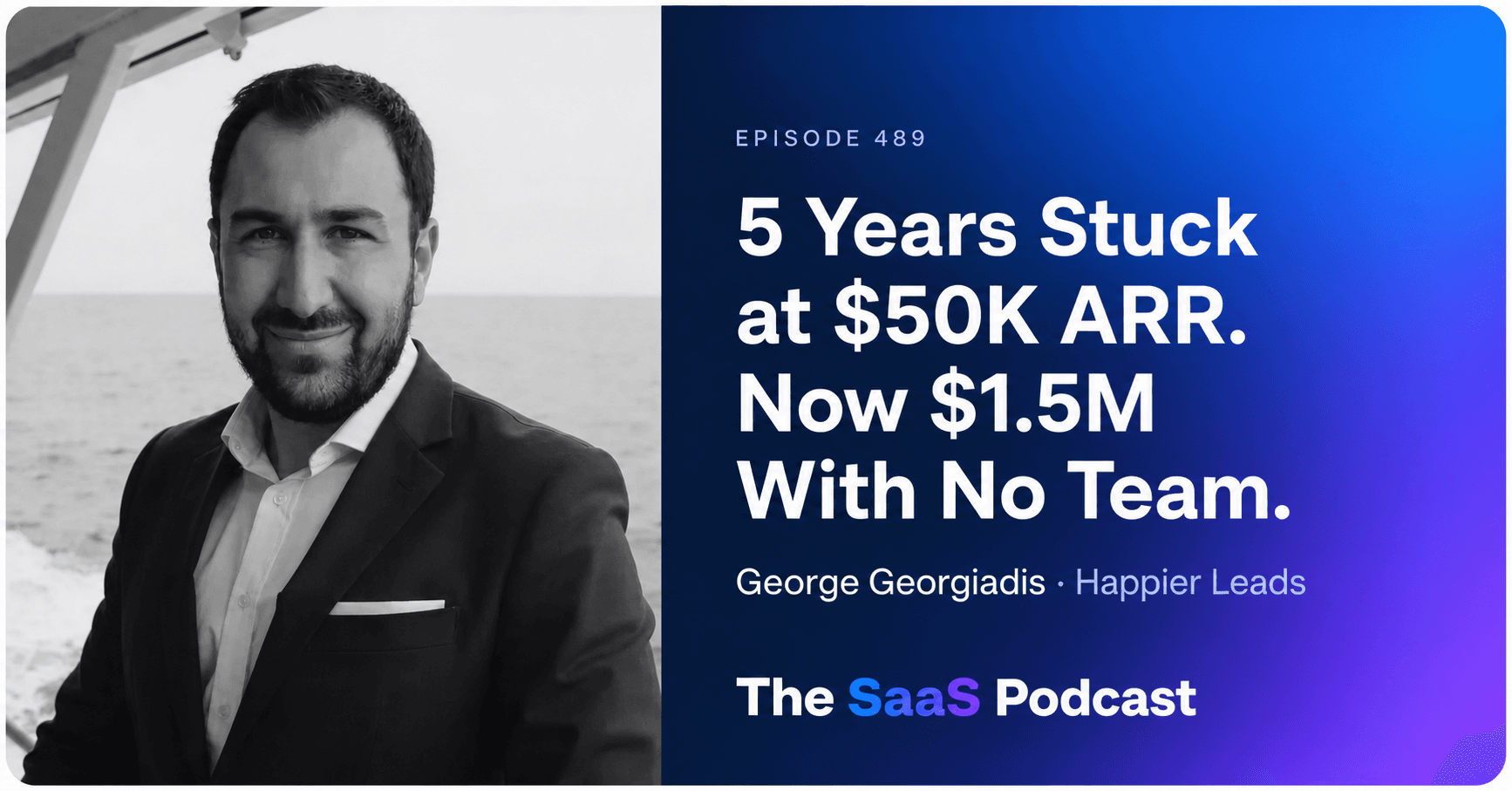
George Georgiadis spent five years stuck at $50K ARR before Happier Leads reached $1.5M ARR with zero employees, by replacing a narrow point tool with an end-to-end platform, making cold email his main acquisition channel, and building his own AI agents to run support and bug fixing around the clock.
Before that, he had ten failed projects behind him, a failed fundraise, 88 people who came and went, and a stretch where he was lending the business money out of his personal account to keep it alive.
George Georgiadis grew up in Greece, studied IT, and did a master's degree in education because he wanted a government job paying around $600 a month. He ended up in London instead, working through roughly ten different projects before landing on the one that stuck.
The idea for Happier Leads came out of his own frustration. He was spending money on ads for an earlier product and watching 95% of his visitors leave without ever identifying themselves. He looked for a fix, found Clearbit, and got quoted $20,000 a year. So he bought a data source and built his own version on top of it.
An AppSumo campaign brought in his first $50,000 and funded the early product. Then the business went flat. For five years, Happier Leads sat at roughly $50K ARR. George was splitting his attention between building and a fundraise that never closed, spending about 80% of his time on software development and 20% on marketing and sales. Multiple times he thought about quitting. At one point he started borrowing money to the business from his own personal accounts.
What finally moved the number was going deep instead of wide. He owned a 175-million-contact database he had been selling to other people and never used himself. He built his own mailboxes and email infrastructure, drove the cost per send down, and started sending millions of cold emails. Once the unit economics worked, revenue compounded.
The other half of the story is how he operates now. Happier Leads runs on a set of AI systems George built himself: his own CRM, his own chatbot, his own session recording, all connected to a single AI brain that reads the data, spots bugs, fixes them, and emails stuck customers without him. He calls it 100 people working 24/7.
And yet he is now hiring. His view is that a one-person business makes you an operator, not an owner, and an operator has nothing to sell. So after proving he could get to seven figures alone, George is building a team again.
In this episode, George breaks down the AppSumo lifetime deal math, why he turned down a $1M acquisition offer, what actually makes cold email work at scale, and how he assembled the AI agents that replaced a whole team.
Happier Leads founder George Georgiadis sat at $50K ARR for five years, then reached $1.5M ARR with zero employees in roughly two years by consolidating a fragmented point tool into an end-to-end platform, switching his main acquisition channel to cold email he could run at near-zero marginal cost, and building his own AI agents to handle support, diagnosis, and bug fixing 24/7.
You cannot raise money and run your business at the same time. Not well.
Founders try to do everything at once. Sales, marketing, development, support.
Most founders see lifetime deals as a liability. You sell once, then support those customers forever while they never pay you again.
Build a solo business. Stay lean.
How did George Georgiadis break out of a five-year revenue plateau and reach $1.5M ARR with no employees at Happier Leads?
He stopped spreading himself thin across every function and went deep on one channel: he used the contact database he already owned, built his own email infrastructure to cut cost per send, and let the unit economics compound. AI agents he built himself absorbed the support and engineering load a team would normally carry.
Why was Happier Leads stuck at $50K ARR for five years?
George Georgiadis was spending about 80% of his time on software development and 20% on marketing and sales, while also chasing a fundraise that stalled the business every time he stepped away from it.
What did George Georgiadis do instead of paying Clearbit $20,000 a year?
He bought a reverse IP lookup database and built the UI, filtering, qualification, and email automation layers himself, which became the first version of Happier Leads.
How did AppSumo lifetime deals actually pay off for Happier Leads?
The first campaign brought in $50,000 to fund development, and George Georgiadis says buyers burn through that value in server and data costs within about two years. The bigger return was hundreds of early reviews and thousands of users who spread the product by word of mouth.
Why is cold email the cheapest acquisition channel for Happier Leads?
George Georgiadis says paid ads give you worse leads at lower bids, while email inverts that: you pick the exact company and job title, and because he owns the mailboxes and verified contact data, he can send millions of targeted emails at very low cost.
What does George Georgiadis say makes a cold email get a reply?
Get the technical setup right (SPF, DKIM, inbox deliverability), keep the message very short and benefit-focused, skip fake personalized compliments, and hold the link back until after the prospect replies so you avoid spam flags.
How do the AI agents at Happier Leads handle customer support and bugs?
George Georgiadis built a central AI brain connected to his own CRM, chatbot, session recordings, database, code base, and knowledge base. It reads a support question, checks the data and code, identifies and fixes the bug, and emails the stuck customer, with filtering in place to block prompt injection.
Why did George Georgiadis turn down a $1M offer to sell Happier Leads?
A mentor told him to take the money and build something else. He refused, kept going through the plateau years, and the business is now at $1.5M ARR.
Why is George Georgiadis hiring after reaching $1.5M ARR with zero employees?
He says a one-person company makes you an operator rather than an owner, and an operator cannot exit or step away. He wants people who can use AI well so the business can run and eventually sell without him.
George Georgiadis [00:00:00]:
I was stuck on the 50k ARR for a long time and multiple times I thought I'm going to quit because that gives me much less money that I'm having as a full time employee. Right now it's zero team. So it's just myself and AI and I am on 1.5 million ARR.
George Georgiadis [00:00:21]:
It's like 100 people working for the business right now or 24/7 self healing things that can break.
Omer Khan [00:00:29]:
Hey, welcome to The SaaS Podcast. I'm Omer Khan and this is a show where I sit down with real founders and dig into how they actually built their SaaS companies. I've had almost 500 of these conversations now and I put out a new one every week to help you build and grow your startup.
Omer Khan [00:00:45]:
If that sounds useful, hit subscribe or check out saasclub.io. So to learn more, my guest today is George Georgiadis. He runs a software business doing $1.5 million in ARR and he does it with zero employees, just him and AI. But it took him seven years.
Omer Khan [00:01:05]:
For five of those he was stuck at 50k in ARR, putting in his own money just to keep the business alive. In this interview, George breaks down what finally got him unstuck.
Omer Khan [00:01:15]:
Why early on he turned down a million dollars to sell how he now runs his entire business, even the bug fixes with the team of AI agents he built himself and why he's now convinced he can't build a real company on his own with just AI. So he's hiring and building a team.
Omer Khan [00:01:33]:
So I hope you enjoy it. So tell us about Happier Leads. What does the product do, who's it for, and what's the main problem that you're solving?
George Georgiadis [00:01:39]:
Happier Leads identifies your anonymous website visitors. We identify them on your website, we qualify them using AI and then we engage with them. Essentially what we do. Imagine someone goes to your website and you have no idea who they are. Before they fill any form, we can identify their identity. We know exactly.
George Georgiadis [00:02:00]:
For example, is John from IBM. And then what we do, we pass them through a qualification scenario. So we check if IBM is a good company for you or not. And if they pass those qualification checks, then we add them to an email campaign and.
George Georgiadis [00:02:15]:
And we send them emails to try to bring them back to your sales funnel so you can contact them and book a demo with them.
Omer Khan [00:02:21]:
Great. And tell me about the size of the business, where are you in terms of revenue, customers, size of team?
George Georgiadis [00:02:27]:
Right now, it's very interesting. Zero team. So it's just myself and AI and I am on 1.5 million ARR. This is something that didn't happen immediately, as you already know. This happened over the last seven years. And when really this became a big business for me, it was the last 2 years.
George Georgiadis [00:02:50]:
Until then I was stuck on the 50k ARR for a long time and I did some magic and then I managed to bring this to 1.5 and.
Omer Khan [00:02:59]:
The business is bootstrapped as well. You haven't raised any money.
George Georgiadis [00:03:03]:
Exactly. So I tried to raise money. I failed and that's why I am where I am right now.
Omer Khan [00:03:09]:
Let's start with your background. It's interesting, kind of where your story starts. You grew up in Greece. Tell me about how you got into tech.
George Georgiadis [00:03:20]:
Yeah, so I studied it initially and then I did a master's degree in education. I wanted to get a government job and get a salary of €800, which is in US dollars, I think is around just for the audience to understand, probably around $600 a month, something like this.
Omer Khan [00:03:38]:
So you were in a place where you were basically, hey, if I could get a government job and €800amonth, I'll be settled. I'll be, I would do great. So you moved to London at some point after your master's degree and how did you get to a point where you, you decided to, to, to start this, this business?
George Georgiadis [00:03:56]:
I did 10 different projects until we end up with Happier Leads. And fast forward to today. This is a 7 years or 70 year old business that passed through a lot. Right. So you know my story. I started looking for funding. I failed. I had 88 people that came and gone.
George Georgiadis [00:04:22]:
I had a lot of failures during this, those years and I managed to figure it out over, you know, over experience. And I, I never had an mba, you know, I never had a degree in knowing how to run businesses. But I always like that and I always try to figure it out myself how to do it.
Omer Khan [00:04:47]:
We'll talk about that and we'll break down some of those things that you just mentioned. So you basically had like 10 failed attempts at building some kind of business before you landed on Happier Leads.
Omer Khan [00:05:02]:
Tell me about like where that idea came from, why you decided you were going to work on that and why this one was different.
George Georgiadis [00:05:11]:
One idea before Happy relates. I was building a software for cms. So imagine, I don't know if you know, there is something called headless CMS, which is essentially an API. So I was building that at some point.
George Georgiadis [00:05:24]:
It was called CMS Driven and I was selling like 1, 2, 3 licenses at the point it was a terrible MVP because the way I was approaching it, it was completely different. I don't want to go to go there. But it was a terrible business to be.
George Georgiadis [00:05:42]:
But while I was running this business I had a need to see who is coming to my website because I was spending money on ads.
George Georgiadis [00:05:49]:
People were coming to my website and then they left and then say okay, what can, what can I do with 90 if 95% of people coming to my website and I don't know who they are, right? It's super hard.
George Georgiadis [00:06:03]:
Imagine you have a coffee shop, 95% of people open the door with the go in and they don't buy the coffee and they leave. And you don't even able to get their, you know, email so you can email them some offers later on so you can bring them back.
George Georgiadis [00:06:18]:
So 95 people coming in and left and only five, they buy the coffee. That is a terrible business to be, right? So this is how everybody is running the business right now. They get 95% of people coming to their website and they leave. And that was the idea. And I started looking for solutions.
George Georgiadis [00:06:34]:
I found Clearbit at some point, but Clearbit was a huge enterprise vendor back then. So they quoted me US$20,000 for a yearly annual subscription always because those enterprise deals. And I said, you know, that seems to be very, very crazy. I don't have that much money to spend on, on just identifying, you know, the visitors.
George Georgiadis [00:07:02]:
And what I did is I built my own. So I like the idea. So okay, how can I build this my own and I start building it on my own. And at some point I built the very first website. The website was terrible.
George Georgiadis [00:07:17]:
If you go to with a time machine you can, you can find the initial version of the website was very bad. But fast forward what happened back then.
George Georgiadis [00:07:30]:
I found AppSumo and what happens in Appsumo is that a lot of people willing to try your software and pay for, for the software and become loyal customers long term because they buy a lifetime deal and they willing to fund your own project.
George Georgiadis [00:07:50]:
So I made my first 50,000 from my first campaign with Appsumo and it was money I used to further develop and build the appsumo and then I did another campaign and another one with them. So I did multiple campaigns to self fund in a way the business without getting external capital.
Omer Khan [00:08:12]:
So how this was the day before the days of AI, You're a solo founder. How did you build something like, even if it was like a super, super basic version of Clearbit, how did you go about Doing that so you don't.
George Georgiadis [00:08:29]:
Have to build everything yourself. So not, you know, the, there is lot of different layers there. So let's talk about the initial technology because what we use today is not what it used to be before. What used to be before it was called reverse IP lookup.
George Georgiadis [00:08:47]:
So this is a technology that is just a database that matching an IP with a company. Right. You don't have exact visual identification there. So that is a quite simplified version. Right.
George Georgiadis [00:09:01]:
Obviously there is a lot more going on there but what I managed to do is I managed to buy a database and try to use build up everything else. I built up the UI part, I build up the mail campaigns, automations. So you build the business on top of the data.
George Georgiadis [00:09:20]:
So there is nobody out there that builds the data, right? It's super hard for you to build all the data like the huge database, right? So you have to buy from somewhere. Even the big players, they buy from some of their own data.
George Georgiadis [00:09:34]:
Then you build up the business on top of this you add some filtering layers, some qualify, you know, to qualify the quality of the data. So you build up your proprietary technology on top of this. But behind the scenes the data, it's usually database that you can buy as one off.
Omer Khan [00:09:54]:
So it's not that different from these days where people are trying to build on top of the LLMs and put their own special sauce on top of something that's being shared. Right, let's go back to that first version or the early version of the product. So you explain how you put it together.
Omer Khan [00:10:11]:
Basically the core was reverse IP and then what you were building on top of that. The appsumo launches can be great because you get access to early adopters. It's a good way to basically raise money.
Omer Khan [00:10:28]:
But you're also selling lifetime deals which can potentially become crippling because all those people that you sold to six, seven years ago, you still have to support them today, right? Even if they're not paying you any more money. So how has that worked out for you?
George Georgiadis [00:10:45]:
Here's the truth, I worked this out and every two years they make all their money back. So what I mean with this, all the servers costs, all the data costs I do for them, right? So in two years time all this investment is gone in their own usage, right?
George Georgiadis [00:11:05]:
So the people that using the tool, they, they evaporate this money that they gave me, right, this, this 50K that I got from my first launch, those people, they used those credits in just server costs on employees, you know, everywhere. So I'm not Getting back something immediately.
George Georgiadis [00:11:26]:
But what this gives you is a period where you can ramp up. So it's like if you never raise money, right, so you get this 50k and you can start developing stuff and you have to do it fast.
George Georgiadis [00:11:42]:
So you have to build things, things faster so you can escape the velocity and then you start selling to people monthly. And by the time you're doing this, if you, if you do it right, right, then you can get the money that comes monthly or so, so you can keep making more money from this.
George Georgiadis [00:12:01]:
Obviously it can become a debt, but I figured it out a few ways how you can convert this debt into an investment. And I will tell you right now how I did that. So I use them for multiple reasons. It's not only about the money, is about reviews.
George Georgiadis [00:12:20]:
So I get hundreds of reviews from them on the early days that nobody else would give you a review for the software. So you build in the first day something that is not super amazing, right? It's something that there is no enterprise that will come and buy for it because they buy the dream.
George Georgiadis [00:12:37]:
They pay you because they know your platform might become, after two, three years, Lemlist or something big. And then they can also exchange the coupon because the coupons, they have these coupons, they can exchange this for money, right? So if you have now a Lemlist, Lemlist was also an option, I think. I think so. Yes, it was.
George Georgiadis [00:12:57]:
And a lot of people back then, they keep exchanging the coupons later on because now they see that this coupon has a value and it's something like this or people invest and they, they feel that something can become better later. And yeah, it's an investment for them and for you.
George Georgiadis [00:13:16]:
Because now you have hundreds or thousands of people. Actually I have thousands of LTD's that they spread the world as well. So I got sales indirectly because they talk to someone and that person talks to another person. Then if you see on YouTube, I have a lot of videos that other people talking about my brand.
George Georgiadis [00:13:37]:
So I just see videos from, you know, from appsumos that they just talk about hyperlites, right?
Omer Khan [00:13:45]:
So there's other upsides beyond just the initial revenue of using something like Appsumo. And as long as you understand what you're getting yourself in for now after the appsumo launch, you got some needed capital to reinvest in the product, make it better. You got some initial traction.
Omer Khan [00:14:06]:
You're doing about 4k in MRR or you said like 50k in ARR and then you got stuck at that the revenue just plateaued there. And it wasn't just for a few months. It turned out to be for five years.
George Georgiadis [00:14:20]:
It was years. Yes, it was years. And many, many things was why this happened. So, number one, it was because I was a solo founder, so I didn't have anybody else while I was going to the VC to ask for money, the business was going down.
George Georgiadis [00:14:42]:
Then I was coming back to the business, the business was going up, then I was living again to start raising again. So it was like this back and forth and nobody was in the business to actually push the business forward while I was trying to raise money.
George Georgiadis [00:15:00]:
That's why my recommendation is if anybody want to raise money, one guy is running the business day to day like nothing happens. Like if we don't raise any money, we continue running the business and the other guy is just focusing on raising money full time because you cannot do both.
George Georgiadis [00:15:18]:
And what I'm doing here is very rare, even for a bootstrapped. Right. So what I'm doing right now is I'm having marketing and sales and development all run by myself. Right? So only very few people can do that. And I don't say this to brag, it's just that you have to know what you're getting into. Right.
George Georgiadis [00:15:40]:
If you try to do what I'm doing, you need to understand that how difficult this is. Because the moment I imagine you have two levers, I start delivering more stuff and more people screaming on the other side to get the, you know, to get the tool and get sales. And then I have to push sales.
George Georgiadis [00:15:59]:
And the more I sale, the more I sell of my software, then I get more people want more development, more features, more things. Right. Or bugs that keep coming. So you, you need two people normally to keep pushing both levers at the same time. Otherwise you keep doing this.
Omer Khan [00:16:16]:
Now tell me about what happened over those five years. Were you. Was it more like you kind of felt like the product was in maintenance mode and you were doing something else, or were you still like fully involved and just trying to break through, but just not finding any way to do that?
George Georgiadis [00:16:35]:
I developed a lot. I was more, I can tell you, I was doing 80% software development, development, 20% marketing and sales. So that was the problem. That's why I was stuck there, because I should do more marketing and sales and the less software development. And I will tell you why I did. I did fail there.
George Georgiadis [00:16:57]:
I didn't try to build something super small initially, something super focused. I tried to build all different tools around the software. Because my idea Was. And it's something that works right now because you know I spent seven years to build this, right?
George Georgiadis [00:17:15]:
But if I was looking back then I wouldn't do all this like prospector enrichment email campaigns. I wouldn't do all of this stuff, right? But if you think about this, it was making sense back then because you identify the visitors.
George Georgiadis [00:17:31]:
And what most of my competitors do right now, and this is my competitive advantage is these people, they send them to clay, they send them to other platforms and now you have to buy additional software for enrichment, you have to buy additional software for sending the emails and you have to glue them together.
George Georgiadis [00:17:47]:
So there is a lot of cluttering there. And what I've said is I want the solution to do the whole end to end path, right?
George Georgiadis [00:17:56]:
I want a solution where you identify, qualify, engage and you do this in a very quick way where you can buy the mailboxes from me so you don't have to go to buy from mailforge or whoever, right? So you can buy everything within one tool. And why is that?
George Georgiadis [00:18:13]:
Because if I have everything within one tool, I can support my customers because I can have 360 view. I know what is wrong, I can fix it very quickly. My white label users, they love it because they can do the same. Like they have everything in one place and they can set up clients very quickly.
George Georgiadis [00:18:33]:
So essentially you drop the tracking pixel, you identify the visitors and then you can send email campaigns within one day. Imagine how cool this is, right? When usually takes weeks to build email campaigns.
Omer Khan [00:18:46]:
Are you talking about what the product is like now or what you were trying to build in those five years?
George Georgiadis [00:18:51]:
Right now it is like this. It took me seven years to build that. That's why I stuck building and building and building. If I was back then, I wouldn't do that, right?
George Georgiadis [00:19:02]:
Because if I was back then I would just develop the identification tool, let it connect with third parties for days, then I will just grew up the marketing and sales and at some point if I have enough resources I will build everything else around. So that was a mistake I did.
George Georgiadis [00:19:21]:
But that mistake that I did today really works because none of my competitors have the ability to send their mails directly and provision mailboxes as well. There is no platform right now can do 360° of what we actually do.
Omer Khan [00:19:42]:
You're basically trying to give your customers a full end to end solution rather than having to pull together a whole bunch of different tools.
Omer Khan [00:19:51]:
It makes sense now, but during those five years where you're trying to build, you know, a Much bigger product and you already identified how you would do it differently and, and build a more lightweight product and focus more on sales and marketing.
Omer Khan [00:20:07]:
But was there a time in those five years where you just said look, this business is never going to get beyond 50k ARR.
George Georgiadis [00:20:15]:
Multiple times, multiple times. And I thought I'm going to give up multiple times on this.
George Georgiadis [00:20:21]:
If, if I was looking back right now I will do something much more focused just looking into one business and full time try to not raise money because I right now, I know that I'm not able to raise money under this right now. Maybe I am but you know, I don't want right now.
George Georgiadis [00:20:40]:
But back then when I was trying to make this to, to work, I was trying to figure it out what I need to do and I didn't know what, what I need to do.
George Georgiadis [00:20:51]:
I stuck on the 50k and multiple times I thought I'm going to quit because that gives me much less money, you know, that I'm having as a full time employee.
George Georgiadis [00:21:03]:
And actually I start at some point even pouring money from my personal accounts into the business because it, it came in into a situation when I start borrowing money to the business from me personal. And it was many times that I said I'm going to quit but I figured out how I'm going to make this to work.
George Georgiadis [00:21:26]:
I'm not a quitter, you know, because I said if I do this not work then I don't want to start another business after this I did 10 different projects.
George Georgiadis [00:21:37]:
I figured it out that you know, either I'm, you know, I'm very bad as an entrepreneur or there is something that I didn't figure it out yet and it was finally was something I didn't figure it out back then and it just, that's the thing is it takes you years to learn and there's nobody, even if you watch a video on YouTube that someone will tell you all the best tips if you don't experience them yourself.
George Georgiadis [00:22:06]:
You don't really believe what people say. Like I heard so many times the right things that people said on YouTube or any of these podcasts and then I never implement them because if you don't experience the problems then you don't know.
Omer Khan [00:22:21]:
It's very easy to hear advice. It's very difficult to internalize it and know what you should actually go and do. So very turbulent times over those 5 years. Revenue also is very flat. 50K. ARR. Tell me what changed what happened at the end of those five years that started, you know, the business started to grow.
Omer Khan [00:22:45]:
What did you do differently?
George Georgiadis [00:22:47]:
So was mostly around. I never went into one of the departments deep enough, right? I was wearing a lot of hats. I was doing sales, marketing, I was doing, you know, development, software development, customer support, I was doing everything. But that didn't give me enough time to go into one layer and go deep enough.
George Georgiadis [00:23:11]:
For example, Google Ads, I was running Google Ads but I built a campaign, I throw it there. It came with the worst cost per click. Very bad, you know, negative keywords that I never clean up. You know, when you do that you're in unit economics, they don't work out at all, right?
George Georgiadis [00:23:31]:
Because in the very first days and the first year if you, if you don't train the algorithm, I didn't have this pixel right to give all these negative signals to Google. I didn't do any of this stuff. So I start burning money. I was giving a lot of money there, but I didn't get my unit economics.
George Georgiadis [00:23:48]:
And without your unit economics you cannot grow the business right. You have to have, for every $1 you put in, you have to make 1.2 or you know, 1.3 to start grow.
George Georgiadis [00:24:02]:
And yeah, so I had to go deep enough and I didn't do any email campaigns and that was my worst thing because I was owning all of this data. I was having this 175 million contacts database and I didn't use it, I was selling it to other people.
George Georgiadis [00:24:22]:
People were buying this data but I never used the data. So I start sending millions of emails over, you know, the last two years now and it actually, you know, it materialized. I tried to drive the costs down and how I did it and I know that not everybody can do this right?
George Georgiadis [00:24:43]:
And I will tell you why. Because I owned the email infrastructure myself. I built up mailboxes. I didn't buy the mailboxes from elsewhere because I'm selling mailboxes right now. So I built the mailboxes and I'm getting them right now with a very, very, very low price per mailbox.
George Georgiadis [00:25:00]:
The leads, the emails, verified emails, I'm getting them with a very, very low price. Every single layer, right from how you're going to send the emails, how you're going to monitor the emails. I don't have a real person right now monitoring. I have automations everywhere and how obviously how cheap it gets for me to get an email.
George Georgiadis [00:25:23]:
The unit economics work and when the unit economics work, something really magic happens. You start getting the money back, you reinvest them back and you keep growing.
Omer Khan [00:25:31]:
And you keep growing Is most of your acquisition coming through cold email?
George Georgiadis [00:25:38]:
Most of the acquisition is cold email. It's the cheapest channel right now. And when I say cheapest, sometimes people misunderstand me because cheapest doesn't mean you don't get a good leads. You actually get a very good leads. And hear me out.
George Georgiadis [00:25:55]:
When you go to Google, if you give to Google or Facebook or whatever, you give them a small bid, they throw you to you. The worst leads, you have to give a very big bid to give you the good leads, the people that can spend more money with your better budget, right?
George Georgiadis [00:26:11]:
In email, it's the other way around. You choose who, who you want to contact. So you do the ICP ideal customer profile filtering initially. So you see I want to contact this company and I want to talk to this specific job title and you send the email.
George Georgiadis [00:26:30]:
So you, you pay too little to get the email, especially myself and, and too little to send the email because I'm getting those cheap mailboxes. And I can do that in scale. So I can send millions of emails over the year and I can do that in a very specific targeted start, very targeted initially.
George Georgiadis [00:26:52]:
And then I expand. I have like a strategy there where I prioritize the my ICP and then obviously I can expand to more to other territories. But the way it works is you can get exactly who you want to talk to and at the same time you can do it at scale very cheaply.
George Georgiadis [00:27:12]:
When if you do advertisement and I still do advertisement but mostly around the high intent. So if someone search for website identification or someone says my competitors, that's my strategy there to steal from my competitors. I'm not doing it in a way that gives me cold leads, right. And then I try to convert them.
George Georgiadis [00:27:33]:
I'm doing it more in a way that someone right now looking for the solution and can go either looking to look for my competitors or they look for a software right now, those are still good leads to be targeted through Google Ads.
George Georgiadis [00:27:49]:
But then when you go to you say I want to talk to this specific company, the best tool is the email campaigns.
Omer Khan [00:27:57]:
So these days with AI, it's become like too easy to send email campaigns at scale. And I think there's just so much noise out there that many people are just tuning out. So what is it different about what you're doing that's enabled you to get results?
Omer Khan [00:28:20]:
Is it just been a volume thing as a numbers thing in terms of.
George Georgiadis [00:28:24]:
First of all, it's a numbers thing. Number two, you have to do everything right. So email campaigns Is a huge, like we can talk about ours, about this, but just to give you an example, spf, dkim, all of this stuff needs to be settled, right? So you need to have mailboxes that deliver your message to inbox.
George Georgiadis [00:28:46]:
That's the number one thing you have to do. Then you have.
Omer Khan [00:28:48]:
As opposed to spam folders.
George Georgiadis [00:28:49]:
Yeah, so, yeah, exactly. So you have to set up, you have to do some technical setup to make sure you don't send. And then, then there's a lot of principles like you don't want to send pictures or links inside.
George Georgiadis [00:29:01]:
So you initially send an email, you try to get the reply back and then you send them the link only after they reply back to you because you don't want to send millions of links that will be a massive spam issue. So you have to do all of these things, right?
George Georgiadis [00:29:15]:
And your message should be very, very simplified. Not, not like Zarcons. You don't have to people right now, they, they are smart, they are going to understand even if you try to personalize and say something, you know, you know, I get this emails every day.
George Georgiadis [00:29:31]:
It looks like so stupid when people tell you, oh, George, congratulations in this, you know, 1.5 million we saw, you know, the article. You know, obviously I know that nobody typed this right manually. I know that they did it using AI.
George Georgiadis [00:29:46]:
So for me personally as a founder, receiving all of this emails in my mailbox because I'm reading all my mails. I don't, I don't treat, oh, this is a cold email. I'm not going to read it. I'm reading everything right?
George Georgiadis [00:29:59]:
And I do it because I want my mailbox to be clean and tidy and I don't want to, to be any opportunity someone. I don't, I don't want to lose an opportunity, right? I don't want someone to send me an email and tell me come to my podcast or you know, I have a huge audience come.
George Georgiadis [00:30:14]:
And I didn't look into the email just because I thought that this is spam. So I'm opening the email anyway. And you know what that means is that a lot of other founders and executives, they open the email regardless, right? And the read the email.
George Georgiadis [00:30:31]:
So what the worst thing for you to do is to write a paragraph giving them compliments that you don't mean, right? So people like me that I respect my time.
George Georgiadis [00:30:41]:
I want to see if something very, very short, straight to the point, tell me how this can benefit me in a, you know, very, very tiny paragraph and then I will tell you. I Will send you a message back. This is, this is what I do. If I say, okay, that is interesting.
George Georgiadis [00:30:57]:
I will message back if I see something huge like complimenting me and all of this stuff, you know, it doesn't, it doesn't make any sense.
Omer Khan [00:31:04]:
Let's talk about how you've got the business set up today. So when you were at 50k ARR, you talked about a lot of people coming through the company, a lot of turnover, and then now you're at 1.5 million in ARR, you have zero employees. So how are you running the business today?
George Georgiadis [00:31:24]:
So mostly on autopilot AI. So I will explain how this works. So I have built a brain, which is the AI brain. It's everything built in house. I don't use anything else, obviously, I use cloth and all, or OpenAI the APIs and.
George Georgiadis [00:31:43]:
But when I say I don't use anything else, I mean I haven't used the intercom chat. I had this at some point and then I completely quit. I removed the subscription. It was costing me US$500 per month. Completely removed them. I built my own chatbot.
George Georgiadis [00:32:02]:
And why I did that because from intercom you don't need all their features, you just need the features that match your specific scenario, right? So I built using vibe coding, the chatbot I connected to my system.
George Georgiadis [00:32:19]:
Now I have a CRM built by myself, connecting to AI chatbot built by myself, session recordings that can see what people do. Like similar to hojar build my myself all connected together, right? AI that analyzing those session recordings and what people do and analyze the behavior. If they stuck, if they stuck somewhere, if they found, if they.
George Georgiadis [00:32:46]:
If for example, they there is a bug and they cannot move forward. AI can realize this and can build because I have all of these items connected together, can send emails to people, right? To unblock them. I have the library that I built where I have all these small video tutorials, help centers, everything in one place.
George Georgiadis [00:33:09]:
So now imagine, let's just take a scenario, you stuck somewhere and you ask the customer support. My account has 3,000 credits. Why it has 3,000 credits? It should have 2,000 credits.
George Georgiadis [00:33:22]:
What it does, it sends a signal through AI to look into the database and the code base and the code and they can find problems, identify bugs, fix the bugs. I have a lot of filtering in the middle, so I can avoid something called a prompt injection.
George Georgiadis [00:33:44]:
Because a lot of people might go to the chat and try to, you know, delete the database or anything. So the AI just push back. So I have all of these procedures that, that the software can self heal itself. I'm not developing new features on Autopilot, but I automate the, the fixing of the software. The fixing part.
George Georgiadis [00:34:07]:
I have a list of KPIs, right. I have a huge. I'm going to share all of this stuff over the next months with people on YouTube by the way. So I have like a huge KPIs for every single element of like I look at my metrics, my, you know, MRR, my churn rate, everything from that perspective.
George Georgiadis [00:34:27]:
Then I'm looking on how is my uptime, my website is it up and running every single element. And then I have a reactive system using AI that when something goes wrong and outside within the healthy range automatically read this and fix self healing the system.
George Georgiadis [00:34:47]:
So it's like 100 people working for the business right now or 24/7 self healing things that can break.
Omer Khan [00:34:56]:
So your customers are interacting through this chatbot when they have issues and on the back end you basically running these agents that are able to diagnose, troubleshoot and fix bugs and even deploy.
George Georgiadis [00:35:16]:
Yeah. And doing much more than this. Everything is built in house because I can have full control of this. I know that this, this is not an advice that anybody can do. You know, it's not something that I'm telling people, okay, go and build your own software.
George Georgiadis [00:35:30]:
Because you know, even Vibe, vibe coding, it's a lot but for me it was an investment. It was an investment because I, I start for multiple years, I was keep changing software. Every time was something different. Like imagine I had HubSpot at some point. Then I moved from HubSpot because it was very expensive for me.
George Georgiadis [00:35:50]:
After, after a while they had like a huge jump into the pricing. And then I start moving to Intercom and from Intercom then I did like a pipe drive and I was trying to figure it out how to connect all of this data together.
George Georgiadis [00:36:03]:
And how can I, you know, because you don't have the data together connected with a AI brain and they are all over the place. This is why you need people to make sense of them. Open to windows, try to figure it out what is here, what is there.
George Georgiadis [00:36:19]:
So right now I have everything in one place, all the data in one place, all the AI in one place. I explained to the AI I have given them giving, giving it a personality. So I explained to the AI you are George, right?
George Georgiadis [00:36:33]:
You are replacing me and you are, you know, your way of thinking is this, this and this, this is all the KPI metrics you need to take care of every day. And those are all the different tools. Like you're giving them a palette of tools.
George Georgiadis [00:36:49]:
You're giving them, you say you have access to chat, you have access to the app, you have access to the database, you have access to the code base, you have access to session recordings, you have access to knowledge base, you have access to all of the systems.
George Georgiadis [00:37:04]:
So now if anybody asks for anything, you know, figure it out. And either, you know, from sending them a calendar invite or I have auto follow ups in a process where if people, you know, I send the first message, right, Then I don't have to do the follow up and follow up, follow up.
George Georgiadis [00:37:23]:
Like the follow up process is very simple because you just say, did you read my message? You know, do you have this kind of simple stuff? Right? So all of this is automated.
Omer Khan [00:37:34]:
You're in many ways in quite an extreme case of you've like basically vibe coded everything in house where I think some people try to go down that path and then realize that you can build stuff quickly and then the honeymoon period dies and then you have a lot of time that you need to put in to maintain and run and operate these kind of things.
Omer Khan [00:38:00]:
But I think it's more interesting with you is that you went from a place where you were hiring people and rehiring and so on and the business wasn't growing, you got to a place now where you have zero employees. It's just you and AI helping you run the business and you've got to seven figures in ARR.
Omer Khan [00:38:25]:
But then you told me, actually I'm going to start hiring people now. So tell me about why you're going back there.
George Georgiadis [00:38:33]:
So I did two realizations, right? And that's why when I say I don't want people to just copy me, right? I'm not the guy that you have to copy.
George Georgiadis [00:38:45]:
What I'm saying here is to just, you know, if you're in the similar situation with me and you don't have any money and you start something new and you, you, you, let's say you think that this is not the right route for you for XYZ reasons or you think that you don't want to spend so much time and energy doing, following this path and you want to, to follow a different path, the path I chose to follow later on, then this advice might be for you.
George Georgiadis [00:39:15]:
If you don't willing, if you don't will to, you know, to spend a lot of your personal money, you want to do something yourself. So that advice only works if you are solo founder, you are not going to raise any money. You don't want to spend a lot of money on external software.
George Georgiadis [00:39:29]:
You want to build everything in the house and you don't expect a lot of employees anytime soon. Right? Because the way I built all of this in one place, it helps me as a solo founder. It might not help me when someone else comes in and says, let's say I hire a marketer.
George Georgiadis [00:39:50]:
And the marketer says, okay, let's see your LEM List account or whatever, you know, to send the emails or send in blue. I don't know, I'm just throwing some names of newsletters. And I say, no, no, no, you have to go to Happy List and do it from there.
George Georgiadis [00:40:03]:
And then people say, okay, how we can send an email with this HTML template. I'm just telling you an example. You will have to vibe code it. This is what, what will be my reaction. So you have the guys will say, but I don't know how to vibe code it right?
George Georgiadis [00:40:19]:
Because not everybody will know how to do it. Like vibe code the software. Right. That will be hard job for everyone to do. So that might not work for anyone. That's why I'm saying, you don't have to copy me. It was my situation where I found the path for me because I knew how to code as well.
George Georgiadis [00:40:37]:
And I used my skill and I used the opportunity of AI to marry those two and get a way out for different people. That might be something different for my situation. Back to this. Now I'm looking to hire.
George Georgiadis [00:40:51]:
And the reason why I'm looking to hire is because I know that the business is not going to be one person. If you are one person, you are an operator. You're not a business owner. You don't own the equity.
George Georgiadis [00:41:05]:
And definitely, if you want to exit after 10 years, let's say you will not be able to exit the business if you are an operator, if you are the business. If something happens to me tomorrow, I will not be able to operate right. So I have to.
George Georgiadis [00:41:23]:
Although I have a lot of help from AI, I still need to bring people into the team. And those people have to be very smart, intelligent people that can use AI and prompt and all of these nice technologies to move the business to the next level.
Omer Khan [00:41:39]:
All right, well, I'd love to keep talking, but we should wrap up. So let's go on to the lightning round. I've got five quick fire questions for you. You ready? Yep. What's one of the best pieces of business advice you've received?
George Georgiadis [00:41:53]:
At some point, someone offered me 1 million to exit hyperlites. And I refused. And when I went to one of my, I don't want to call them mentors because I didn't have a lot bigger relationship with him. But I see him as a mentor because he gave me one good advice. He said to me, exit.
George Georgiadis [00:42:13]:
Take the money, George, take the money. Go build something else. Or you know.
Omer Khan [00:42:18]:
You didn't listen.
George Georgiadis [00:42:19]:
Yeah, I didn't listen. And my mentor back then told me, you should take the money. I didn't took the money. And here we are today.
Omer Khan [00:42:26]:
What book would you recommend to our audience and why?
George Georgiadis [00:42:30]:
Book all of the books of Alex Hormonzi. 100 Million. Offer all of them from him. I think they are very practical. I don't really like books that they just talk about theory. I like books that they can teach you something that you can apply.
Omer Khan [00:42:49]:
What's the best money you've ever spent on your business?
George Georgiadis [00:42:52]:
Oh, sales coaching. So I spend money to become a better salesperson and that was huge for me because I was losing so much money, I was not able to sell. And when people were coming to the call and I was not able to identify the pain and pressure, their pain. And no, because this is a strategy.
George Georgiadis [00:43:18]:
You don't have to become, you don't have to born salesperson. You, you just have to to know the strategy, how this works. And when I learned that I didn't only increase my, you know, the revenue I was bringing to the table, I learned a lot about how to deal with my offers and, you know, sales.
George Georgiadis [00:43:42]:
Also touching a little bit with marketing. So everything that I learned about sales, I applied them back to the website. So it was a great asset.
George Georgiadis [00:43:50]:
I just learned a very, very nice skill that I can use for all my life because even if I quit happily today, I can go in and still if I'm a good salesperson and I know how to identify the pain of the client and know how to put a pressure on it and then give clarity to them.
George Georgiadis [00:44:12]:
Right. Because this is what you do as a salesperson. You just make them talk and make them sell to themselves. Right. So when you know how to do that, this is a great skill for anyone.
Omer Khan [00:44:22]:
What's your favorite personal productivity tool or habit?
George Georgiadis [00:44:27]:
Oh, to be organized in general. When. When I say organized from your calendar, getting your calendar. My calendar is my extension of my hand. Right. So I want to see everything in there. If it's not there is not going to happen.
George Georgiadis [00:44:46]:
And it helps me prioritize a lot about where I'm spending my time and how I Spend my time. So I want to have a calendar. It doesn't really matter what time you wake up in the morning, what time you go for sleep. I'm not into this, you know, rituals.
George Georgiadis [00:45:04]:
I just think that if you start, let's say, 9 o' clock, and you finish, I don't know, 10 o' clock or whatever, you have to have an organized day. And you need to know from the day before what you're gonna do the next day.
Omer Khan [00:45:16]:
And finally, what's one of your most important passions outside of your work?
George Georgiadis [00:45:21]:
I'm doing reenactments. I'm doing some Wild west stuff and yeah, I'm doing some Vietnam War stuff. A lot of reenactment guy. And then I play music. I like videography and many others. Many, many hobbies. I like to always learn something new.
Omer Khan [00:45:41]:
All right, well, George, thank you so much for joining me. It's been a pleasure. If people want to check out Happier Leads, they can go to Happier Leads dot com. And if folks want to get in touch with you, what's the best way for them to do that?
George Georgiadis [00:45:54]:
They can talk to me on LinkedIn as well. Although it's a little bit too noisy nowadays, but yeah, reach out on LinkedIn or go to their website and just text. If you gonna see the AI bot, just say agent and then I will.
Omer Khan [00:46:08]:
Appear after to say agent.
George Georgiadis [00:46:11]:
Agent will be the AI bot talking to you. But then if you say agent, the real George will appear.
Omer Khan [00:46:19]:
All right, that's good. Good insider tip. Great. Well, thanks, man. It's been a pleasure and I wish you all the best.
George Georgiadis [00:46:25]:
Thank you so much. It was a pleasure as well.
Omer Khan [00:46:28]:
Cheers.
Ross Andrew Paquette, Maropost
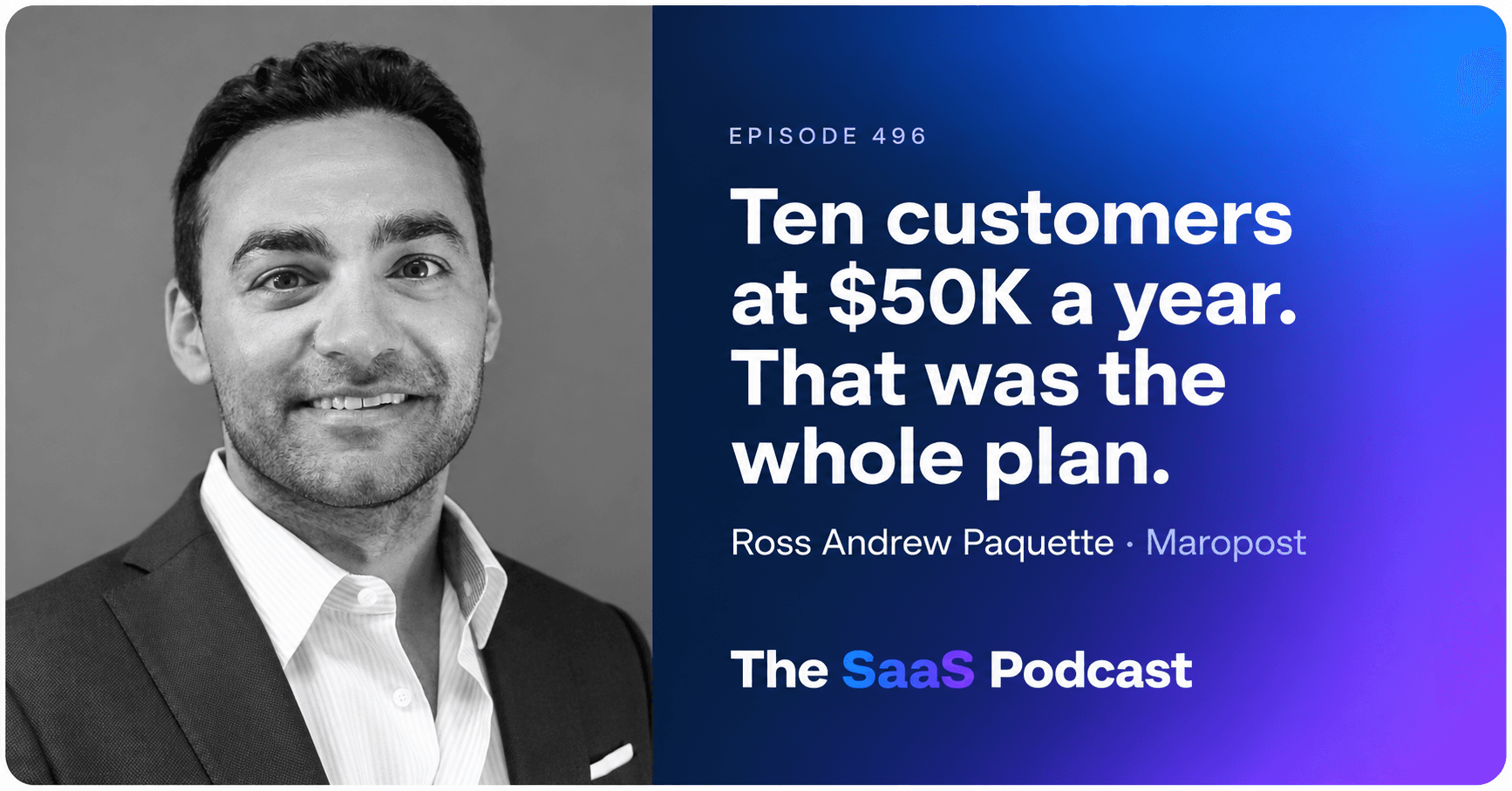
Ross Paquette is the founder and CEO of Maropost, a commerce and marketing platform he has bootstrapped to around $50 million in ARR with roughly 300 people and 5,000 customers. He started it in 2011 out of his apartment while still working full time selling Oracle ERP software into the construction industry. The plan was small. Ten customers paying $50,000 a year, about $500,000, and more free time. Ross had spent a few years selling marketing automation and knew the service in that market was poor, so his pitch was simple: 24-hour live chat and a five-minute response time, which in practice meant him. Three or four former customers signed almost immediately. Two of them paid around $10,000 a month. The early build nearly sank it. His developer would disappear for days, and the platform would go down with nobody available to fix it. Ross describes standing on a departing plane holding his phone in the air to hold the signal, maybe ten or fifteen times. His mother suggested he post the job somewhere. The first person who replied on oDesk rebuilt the platform in two or three weeks and is his CTO today. Then it caught. In 28 months the business went from $300,000 to $27 million with six or seven people, largely because Ross was personally closing brands like Rolling Stone and Mercedes off conference floors. He took a secondary round around 2016, gave up about 25 percent, and roughly three years later wrote a $37 million check to buy the investors out. He also gets into why seven or eight experienced sales leaders failed at Maropost, what he hires for now instead, and why he says he would not show up to work if he owned less than ten percent of his own company.
Yega Kumarappan, Paperflite
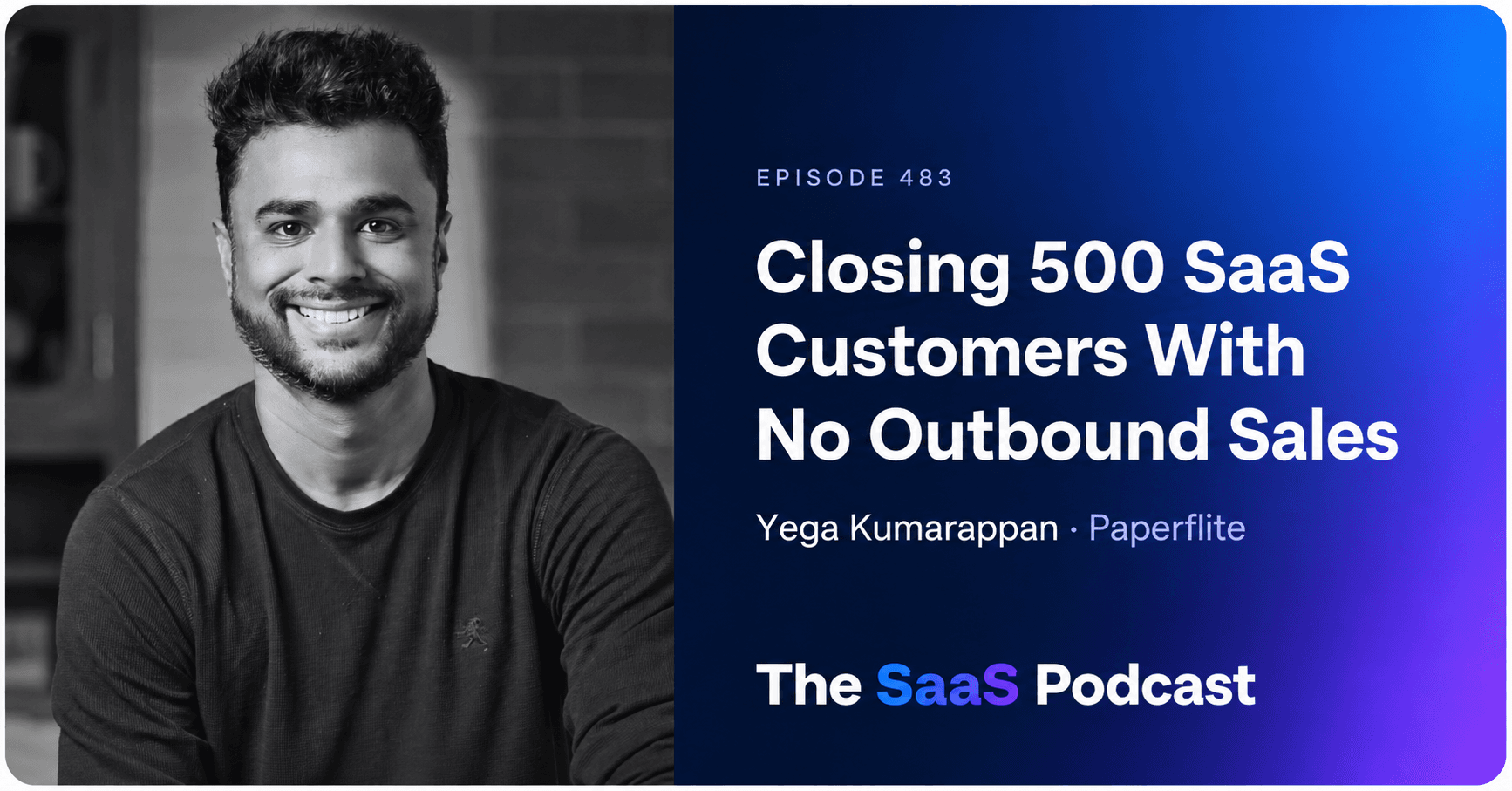
Yega Kumarappan is the co-founder and Chief Product Officer of Paperflite, a content and sales enablement platform that helps B2B marketing and sales teams close deals faster. Back in 2015, Yega and his future co-founders were building an internal venture at Cognizant. They needed to create decks, videos, case studies, and brochures, then get all of that into the hands of sales teams. Every tool they tried was terrible. That problem stuck with them. After more than a decade at Cognizant, all three founders walked away from stable careers with families to support. They had a working prototype when they went to investors. In January 2018, they raised a 400K seed round. Girish from Freshworks put money in. So did the ex-CEO of Cognizant. Paperflite never raised again. A year in, they were profitable. The product was a Netflix-like experience for sales content. Instead of digging through folders in SharePoint and Dropbox, sales reps logged in and saw exactly what worked for their product, their region, and their type of buyer. But selling SaaS without sales experience was harder than expected. Then one day, a message came through their Intercom chat. It was from S&P Global, asking if Paperflite could host research materials for a conference called COP22. The team had no idea what COP22 was. They thought a friend was pranking them. It turned out to be the UN climate change conference. That wasn't luck. For their first couple of years, Yega's team lived on Quora and Reddit, answering every question they could find about sales content and knowledge management. That's how the inbound started. Conversion was the next problem. Generic product tours converted at 2 to 3%. So they tried something almost nobody does. They spent 8 to 10 hours setting up a custom demo for every single prospect. A personalized hub, with their actual content, in their regions, for their buyer segments. Conversion jumped to 20%. Today, Paperflite serves over 500 B2B organizations, does seven figures in ARR, and has 140 employees across India and the US. All on that same 400K. This is one of the cleanest case studies of selling SaaS without sales experience and still building a durable, profitable B2B company.
Tibo Louis-Lucas, TMAKER
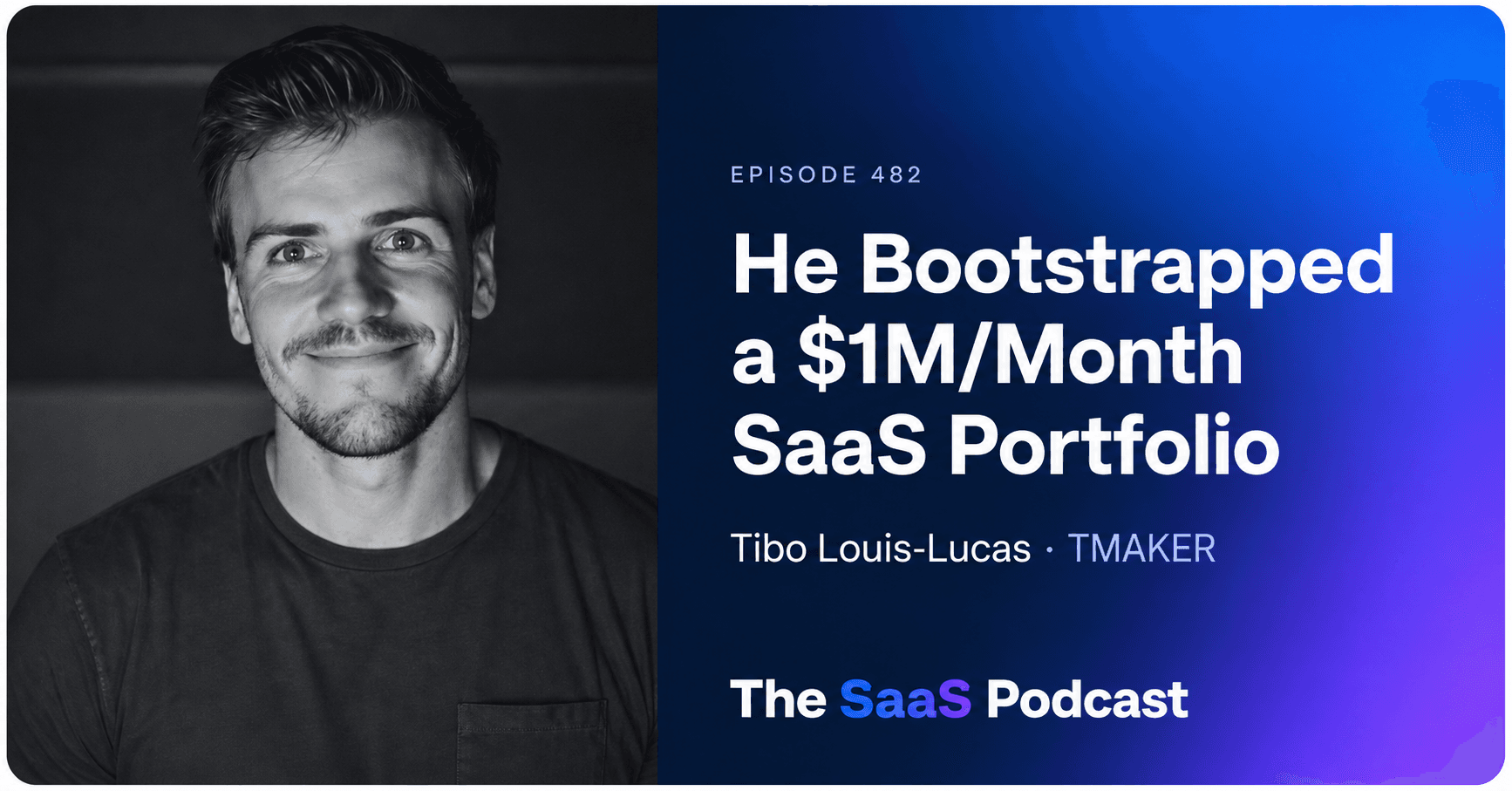
Tibo Louis-Lucas is the founder of TMAKER, a bootstrapped portfolio of 5 SaaS products doing over $1M a month with a team of 10. His flagship product Outrank crossed $200K MRR on its own. But the road to TMAKER ran through two bankruptcies, 250,000 euros of personal debt, a $8 million exit Tibo publicly regrets, and a complete rethink of how SaaS distribution channels actually work. Tibo raised 200K euros for his first startup in 2015 and another 500K for his second in 2017. Both went to zero. The second left him with 250K in personal debt. He took a corporate CTO job for stability. Then his first child was born, got severely sick at two months old, and he and his wife quit their jobs to travel the world. Three weeks later, COVID hit. They were stuck in Paris with a sick baby, no income, and no plan. Most people would have crawled back to a salary. Tibo went the other way. He partnered with co-founder Tom and shipped 11 products in 4 months on unemployment benefits. The kill criteria was revenue, not downloads or feedback. Ten products flopped. The eleventh, Tweet Hunter, hit $1K MRR in its second month. Then Twitter influencer JK Molina asked for 25% of profits in exchange for promoting it. Revenue tripled from around $3K to $20K MRR in three weeks. They forked the same model into Taplio for LinkedIn and sold both to Lempire less than two years in for $2M upfront and an earnout that closed at $8 million. After the earnout ended, Tibo experienced what he calls a void. He publicly regrets selling. Now he runs TMAKER as a portfolio studio with the opposite playbook. Instead of being the maker, he is the SaaS distribution channel. He partners with co-makers who build the products while he handles audience, SEO, ads, and influencer pipelines that get reused across every product. Outrank is the flagship at $200K MRR. Revid does over $600K a month. The portfolio crossed $1M a month a few weeks before this conversation. In this episode, Tibo unpacks why SaaS distribution channels matter more than the product itself in the AI era, the exact signals that told him Tweet Hunter was the one after 10 failures, the structure of his JK Molina equity deal, why he regrets the $8M exit, the co-maker model that powers TMAKER, and how he uses SEO as the most durable SaaS distribution channel of all.