Bootstrap to a $100M valuation before you raise a dollar
What Everyone Says
Raise as early as you can. Seed rounds are cheap dilution. You need capital to hire, to market, to compete. Speed is the moat. Bootstrapping is for founders without options, not for the ones who could close a round.
That story is repeated by VCs, by every other founder on stage, and by the media that covers them. It feels safe because it is what everyone around you is doing.
Why That's Wrong
Early capital pays a tax most founders never count. The tax is dilution at the valuation when you have the least leverage. A seed round at a $5M cap can take 20% before the product is in market. By the time you actually have signal, you have given away a quarter of the company for runway you could have bought with revenue.
Capital also accelerates the wrong things. It lets you hire before you know what to build. It funds paid acquisition before you understand the channel. It rewards activity over learning.
What Mark Did Instead
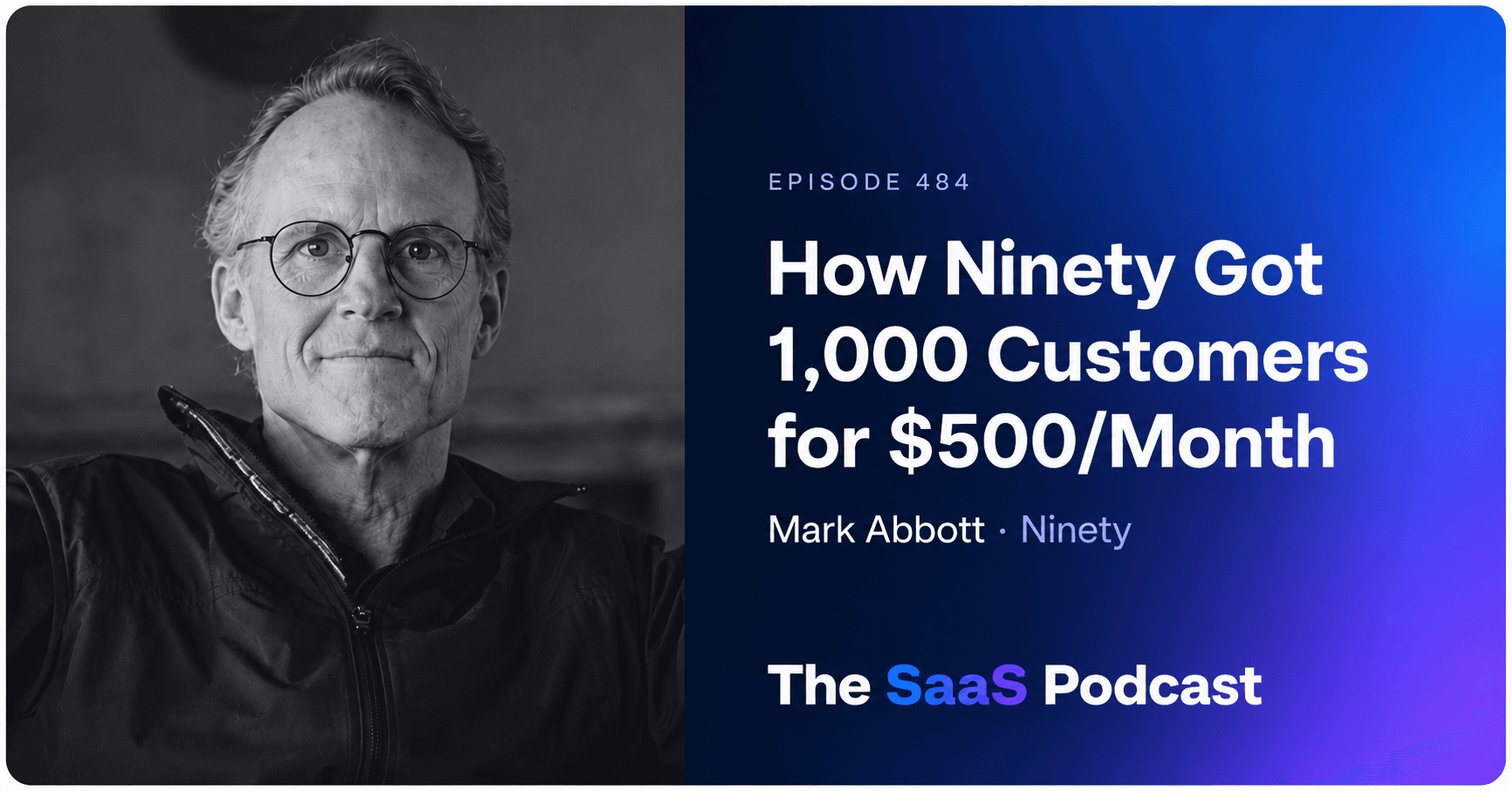
Mark Abbott built Ninety to a $100M valuation before raising a dollar. He did not stumble into it. He set the number on purpose. "My perspective was that I was going to bootstrap it until I got the thing to a valuation of $100 million and then I'd raise $20 million."
He charged $12 per seat from day one and still charges $12 for the entry tier. He spent $500 a month on Facebook ads. That was the entire paid acquisition line for years. The product got to roughly its first 1,000 customers self funded, with the coaching channel doing most of the selling.
When he finally raised the $20M Series A with Insight Partners, the first round diluted him by about 17%. After the Series B (another $35M led by Blue Cloud) he was still over 50%. Most venture-track founders are well below that by the same revenue, because they sold equity at every prior milestone.
The Principle Underneath
The dilution math only works in your favor if you raise after the value inflection, not before. Mark waited until he had product, channel, and 1,000 customers proving the model. At that point the $100M valuation was not a story, it was a multiple on revenue.
Bootstrapping also forced discipline. With $500 a month on Facebook, you cannot waste a dollar. You learn which audience converts. You learn which positioning lands. By the time the Series A money arrived, Mark knew exactly what worked, even if the post-raise execution was its own challenge.
There is one other thing. Bootstrappers get to choose when to raise. Founders who took early money do not. They raise on the next milestone or die. Mark raised because he wanted to go faster, not because the bank account demanded it.
Should You Do This?
Do this if you have a channel that converts without paid (Mark had the EOS coaching community), a price point that supports unit economics from the first customer ($12 per seat at low CAC works), and personal runway to wait. Skip it if your product needs a network effect that only money can buy, or if a fast follower can lap you on distribution while you save dilution.
Ask yourself: do I need capital to learn, or do I need capital to scale what I already know? If it is the first, raising now will compound your mistakes. If it is the second, raising at a real valuation will compound your wins.
Ready to build your SaaS with founders who get it?
Join thousands of SaaS founders getting weekly insights and proven strategies from real founder conversations.
Free weekly newsletter · No spam