The Credit Card Wall That Slowed Render's Growth
You ask for a credit card before anyone can try your product. A trial with a card up front feels like the responsible choice.
How SaaS and AI founders who scaled got their first customers
One email every Thursday. Unsubscribe anytime.
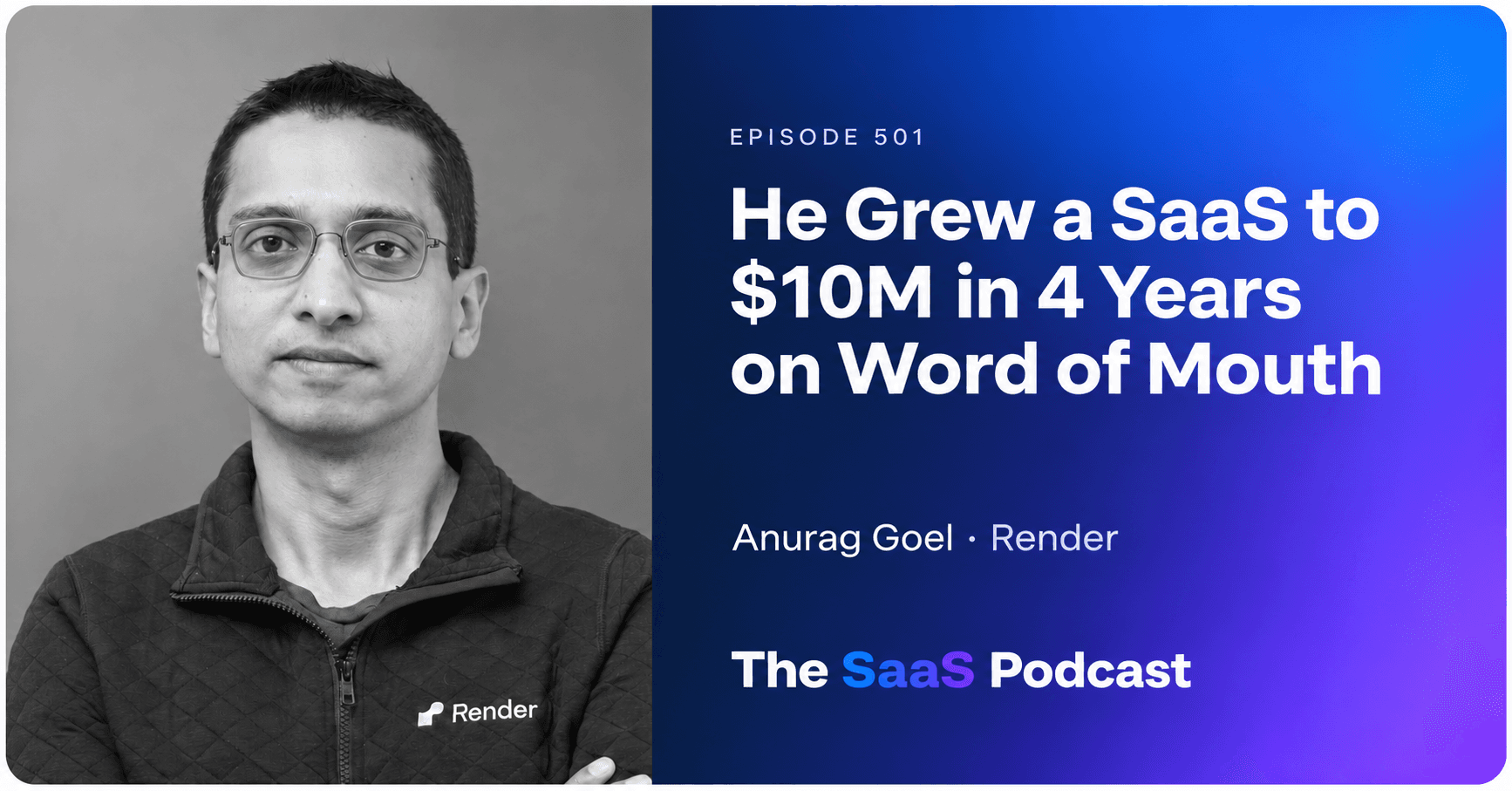
Anurag Goel took Render from zero to $10M ARR in roughly four years and spent nothing on paid marketing. Render grew on word of mouth. Developers who liked deploying on it told other developers, then kept adding apps as their companies grew. And Render did that after launching with no free tier, one of the most expensive mistakes Anurag made.
These days a lot of that word of mouth comes from AI. Chatbots and coding agents recommend Render, and signups went from 5,000 a month in July 2022 to almost 500,000. His advice for founders starting now: "If you can do one thing, focus on marketing to LLMs."
Anurag Goel is the founder and CEO of Render, an application cloud where developers, and more and more AI agents, deploy and scale their apps without having to manage AWS. He was one of the first engineers at Stripe, and he built the first version of Render on his own over the 2017 holidays.
Render launched at TechCrunch Disrupt in October 2019 with a team of four. The first users were friends Anurag pushed into trying it, and there was no billing until months later. There was also no free tier, just a weeklong trial that asked for a credit card. A lot of developers wouldn't give one to a company they'd never heard of, so they never even started the trial.
Render added a free tier when it announced its Series A in late 2021. A few months later, Heroku ended its free tier, and Render's signups roughly tripled. In July 2022, Render signed up 5,000 developers a month. Today it's almost 500,000. Anurag took Render to $10M ARR in roughly four years with $0 paid marketing, through word of mouth and customers who kept expanding on the platform.
Now chatbots and coding agents send Render a lot of those developers. Signups through its MCP integration convert four to five times better than its other channels. Anurag explains how to make your website easy for LLMs to read, and why he thinks nothing else in marketing matters as much early on.
He also talks about the team seat fees his own team pushed back on, and why Render later dropped them.
Render founder and CEO Anurag Goel grew Render to $10M ARR in roughly four years with $0 paid marketing. Growth came from developer word of mouth, customers expanding onto more of the platform, and a free tier added in late 2021. Today LLMs and coding agents recommend Render, and Anurag tells founders to make marketing to LLMs their first priority.
You ask for a credit card before anyone can try your product. A trial with a card up front feels like the responsible choice.
When early users don't show up, founders tend to blame their network. Wrong city, no ex-colleagues, nobody who owes them a favor.
Early marketing advice hasn't changed much in a decade. Pick a channel.
In late 2022, Render's margins were too low. Anurag Goel decided to add a fee for every team member on top of compute.
How did Render grow to $10M ARR with $0 paid marketing?
Anurag Goel grew Render to $10M ARR in roughly four years on word of mouth: happy developers told other developers. Customers who stayed also kept expanding, putting more apps on Render as their needs grew.
Why did Render launch without a free tier?
Free compute costs an infrastructure company real money, so Render offered a weeklong trial that required a credit card. Many developers wouldn't give a card to a company they'd never heard of, which made it one of Anurag Goel's most expensive mistakes.
What happened to Render's signups after Heroku ended its free tier?
Render had added its own free tier in late 2021. When Heroku ended its free tier in 2022, Render's signups roughly tripled, and they have grown from 5,000 a month in July 2022 to almost 500,000 a month.
How did Anurag Goel get Render's first users?
He pushed friends who were building apps to try Render and sat with them until their app was online. He believes any founder can get five users in their ICP, and if you can't, you should change the product.
How did Render raise prices without losing customers?
To fix low margins in late 2022, Render added team seat fees on top of compute. It tested the change by talking to customers first, and most said they wouldn't be happy but would pay. They did.
Why did Render remove team seat fees?
Render dropped seat fees completely in 2026. Anurag Goel says AI agents are now team members on infrastructure, and you can't charge $20 a month per agent.
How does Anurag Goel recommend founders market to LLMs?
Get LLMs to recommend you, even alongside competitors, then work out how to get picked over them. Make your website, pricing page and features page easy for agents to read, and fix anything LLMs say your product lacks.
Why should SaaS products be operable by AI agents?
At Render, signups through MCP OAuth convert about four to five times better than other channels. Developers already build apps with Claude and Codex, so an agent will pick the product it can operate without a human stepping in.
How did Anurag Goel decide to build Render after Stripe?
After leaving Stripe he spent about a year and a half looking for a problem he could work on for a decade. He kept coming back to infrastructure, sold his GPU notebook company Crestle through a tweet, and went all in on Render.
Omer Khan [00:00:00]:
You took Render from basically 0 to 10 million in ARR in roughly about 4 years with 0 paid marketing.
Anurag Goel [00:00:09]:
Marketing was just word of mouth. People using Render were really happy and they told other people about Render. If you can do one thing, focus on marketing to LLMs, nothing else matters. Literally nothing else matters.
Anurag Goel [00:00:25]:
In the early stages, they've built an internal agent for coding, and they asked the agent where they should deploy this thing, and it picked Render. It didn't pick Vercel, it didn't pick other providers.
Omer Khan [00:00:37]:
Hey, welcome to The SaaS Podcast. I'm Omer Khan and this is the show where I sit down with real founders and dig into how they actually built their SaaS and AI companies. I've had more than 500 of these conversations now, and I put out a new one every week to help you build and grow your startup.
Omer Khan [00:00:53]:
If that sounds useful, hit subscribe or check out saasclub.io to learn more. My guest today is Anurag Goel, founder of Render, a SaaS company that lets developers put their apps online and scale them without managing servers. He grew Render to its first 10 million in ARR in about four years without spending a dollar on paid marketing.
Omer Khan [00:01:15]:
In this interview, Anurag breaks down why he talked himself out of the idea for about a year, why he says if you can't get at least 5 users for your product, you should go get a job.
Omer Khan [00:01:26]:
The free tier decision he calls one of the most expensive mistakes he made, and why he was right to raise prices when his team pushed back. So I hope you enjoy it. Anurag, welcome to the show.
Anurag Goel [00:01:40]:
Thank you for having me. It's great to be here.
Omer Khan [00:01:42]:
Yeah, my pleasure. So tell us about Render. For people who don't know, what does the product do and who's it for?
Anurag Goel [00:01:49]:
Yeah, Render is an application cloud for developers and increasingly agents who want to deploy their applications online. But not just simple ones, even really ambitious ones for which they would have needed AWS in the past.
Anurag Goel [00:02:07]:
Now they can deploy and scale those applications indefinitely on Render, and they get the power, the reliability, the control that they need as they scale. And we have almost 8 billion developers on the platform, and we're adding nearly half a million developers every month. So things are going well.
Omer Khan [00:02:27]:
That's awesome. So your background. I think you were one of the very early employees at Stripe. Just briefly, just tell me how you went from Stripe to coming up with this idea and deciding you were going to build Render.
Anurag Goel [00:02:43]:
Yeah, Stripe was an amazing experience. I learned so much. As the fifth engineer back in the day, I joined before we launched. And it was a great experience to go through the launch and then see the demand for a product that developers loved so much and see how it grew organically.
Anurag Goel [00:03:08]:
But the one thing I learned throughout my journey at Stripe was just how much work we had to do to keep the platform up and running on AWS. And it wasn't fun work for anyone.
Anurag Goel [00:03:22]:
It was just, you know, managing VMs and managing networks and all these other things that you have to do, because AWS does not give you higher level abstractions or primitives. And then after I left Stripe, the company had done well, so I had time to figure out what my next thing was going to be.
Anurag Goel [00:03:45]:
And I wanted it to be something really big and ambitious so I could ideally spend the rest of my career working on it, because it's very hard to find a problem to get really excited about, at least one that you would be excited about solving for the rest of your career.
Anurag Goel [00:04:05]:
And so I took almost one and a half years figuring that out. I actually built a small company while doing that and got 10,000 data scientists on it. And then I realized that I was actually. I kept getting pulled into developer productivity and I kept getting pulled into infrastructure.
Anurag Goel [00:04:27]:
And those two things became such a major marker of founder market fit for me that even though I thought that rendered the idea of building an entirely new cloud from scratch, but at a much higher level of abstraction, it just felt too big. But I had to do it.
Anurag Goel [00:04:47]:
And eventually I started the company by building the first version of Render on my own at, I think, during the holidays, 2017, 2018. And the journey continued from there.
Omer Khan [00:05:01]:
Yeah, so we were talking about this earlier that many founders get stuck in that place where they want to work on something big, and then the problem is the idea seems too big.
Omer Khan [00:05:12]:
And you went through that as well, and you were kind of, I think, at some point, point, doubting whether this was the thing that you could go and do. So just walk me through how you came to that decision and how did you turn this into something more manageable that you felt you could tackle?
Anurag Goel [00:05:31]:
Yeah. So a year before I started Render, I knew that something like Render needed to exist. And at the time, it just felt like it was going to be a really big thing, which I was kind of looking for it, but then I talked myself out of it.
Anurag Goel [00:05:50]:
In hindsight, that was not the right call, but I talked myself out of it, assuming that AWS would just fix it. And here we are ten years later, and nothing's really changed. So I'm glad that I decided to take it on.
Anurag Goel [00:06:04]:
But I was building an infrastructure platform, funnily enough, something that got you a jupyter notebook backed by a GPU in a single click. And this was, I think, one of the first GPU platforms on the Internet.
Anurag Goel [00:06:17]:
And people really liked it because otherwise it would have taken them weeks to configure all the libraries and have had them run well on a gpu. And so it just grew through word of mouth.
Anurag Goel [00:06:31]:
And I kept, like I said, kept coming back to this idea of doing this at a larger scale because right now, or at the time, I was helping data scientists, but I actually wanted to help. I'm not a data scientist.
Anurag Goel [00:06:45]:
I wanted to help people like myself, application developers who cared about getting things up and running reliably and then making their applications faster and more secure. All of that being take, all of that undifferentiated work being taken care of by the platform itself.
Anurag Goel [00:07:05]:
And so I actually ended up deciding that while this thing was still growing, I just had to do Render. And I sold this company, it was called Crestle, through a tweet. I said, look, I'm not looking to grow this anymore. I'm working on Render. I need someone to take this over.
Anurag Goel [00:07:30]:
And somehow another company came in and bought the company from me. But then I was completely free of and could just focus on Render. And the important thing to take away from that is founder market fit is just really crucial.
Anurag Goel [00:07:49]:
And if you aren't excited about the space you're in and you just think that it's a good business idea and it'll work, but you're not, like, you're not excited about working on it for a decade, then your chances of actually succeeding with that idea go down significantly. You might still succeed, but the chances go down.
Anurag Goel [00:08:09]:
Because every startup, no matter how successful it might look from the outside or even the biggest public companies now, they always go through tough times. It is a given.
Anurag Goel [00:08:23]:
And if you don't love the problem that you're trying to solve, if you don't wake up and start thinking about that problem day in and day out, then when those hard times hit, you're going to give up too easily.
Anurag Goel [00:08:38]:
And what you need to do, the successful companies, really, the thing that differentiates them from the unsuccessful ones is that they find creative solutions to dig themselves out of the holes that they find themselves in. Because the founders or whoever's at the helm of the company, they keep wanting to do the thing.
Anurag Goel [00:08:57]:
And so for me, that was really important for myself, obviously, competing with AWS is insane, but there are a lot of, we're not competing head on with AWS, we're building for a different audience. We're building, started building for application developers who were underserved by AWS and still are.
Anurag Goel [00:09:18]:
And now we're building increasingly for agents who also want higher level deterministic interfaces and that's why they prefer Render to AWS.
Omer Khan [00:09:27]:
So tell me about how you got started and this big problem. What was the first thing you decided to tackle?
Anurag Goel [00:09:35]:
Oh, the first thing was simply let's deploy a Python backend online like a Python web service. Let's just do that, let's start there. So if the platform, if you have something written in Python, you have a GitHub repo, Render is going to build it, deploy it and you'll get a web URL.
Anurag Goel [00:10:01]:
And that was the very, very first iteration. And then since then, we've been adding thousands of features to the platform to make it enterprise grade, to make it really flexible and powerful. But that was the one place to start.
Anurag Goel [00:10:21]:
And it's funny because doing that back then was not as easy as it is today to build that platform. Today you ask Claude or Codex to build something like that, it's probably going to build something. And this is why we see a lot of much smaller companies trying to do something similar.
Anurag Goel [00:10:43]:
What's harder, something that we realized over the course of the last eight plus years is the hardest part is scaling reliably when you have lots of users on your platform and we see that our competitors fail on that axes over and over again while Render doesn't, which is why we've grown faster than they have.
Omer Khan [00:11:08]:
Yeah, I remember trying to deploy a Python or flask app like 10 years ago and it was a real pain in the ass, like, especially compared to how easy it is today.
Anurag Goel [00:11:20]:
Yeah, yeah, it was really annoying.
Anurag Goel [00:11:23]:
And then when you wanted to make it more ambitious, if you wanted to auto scale, if you wanted custom domains, if you wanted Wildcard domains, if you wanted a Docker container, if you wanted private networking with your database database, if you wanted a worker, if you wanted a Redis thing, it was all like really painful.
Anurag Goel [00:11:39]:
And I think Heroku by then had already kind of stopped innovating and launching new things and it was on its way out. And you know, earlier this year we heard from their team that they are effectively on maintenance mode.
Anurag Goel [00:11:58]:
And I think we're, I mean, I foresaw that when they stopped their free tier, it was clear to me that this is a platform that is not designed to grow and we had just introduced our free tier and we definitely benefited from that in 2022.
Omer Khan [00:12:18]:
Yeah, we're going to talk about that, definitely. But tell me about, like, the first 10 customers, where did they come from?
Anurag Goel [00:12:26]:
They came from people I could arm twist into using the company. People who I knew personally and was like, you need to use Render. And they were like, well, okay, let me try it. And they're like, oh, this is pretty great.
Anurag Goel [00:12:42]:
But just to get them over that initial hump, I had to be like, no, you have to try this. Like, I need you to try it and I will sit with you to make sure you get online until they did. And so you just have to be really persistent.
Anurag Goel [00:12:56]:
You cannot be coy, you cannot, you know, be shy. You just have to go out there and force people to try something out. Like, you know, there's this quote, if you.
Anurag Goel [00:13:06]:
If you've come up with really great stuff, and I'm only paraphrasing it, but if you've come up with something really innovative or really useful, you'll have to shove it down people's throat. And I think it's true, I've lived through it.
Omer Khan [00:13:23]:
So I'm curious. So initially it was just Python and it was limiting. Oh, you were doing Node as well at the time as well?
Anurag Goel [00:13:32]:
Well, it depends on when. But we launched publicly on stage at TechCrunch Disrupt in, I think it was October 2019. And by then we had. So at launch, then we had Python, Ruby, Node, Elixir, we also had Rust, and then we had Docker support. So really, any language that you could Dockerize, you could run on Render.
Omer Khan [00:14:04]:
And how big was the team at the time? I know you raised about just over 2 million seed round,.
Anurag Goel [00:14:10]:
Right. And so by then, yes, we had raised 2 million and the team was four people.
Omer Khan [00:14:16]:
Okay. I think some people might listen to this and say, oh, Anurag had it easy because he's X Stripe, he's got friends in Silicon Valley, and so he could find these people and persuade them to start using the product.
Omer Khan [00:14:33]:
I'm curious, what are some of the transferable lessons that a founder who doesn't have that network could still learn from what you went through with those first 10 customers?
Anurag Goel [00:14:42]:
Yeah. So I've always believed that it is possible to get five users for literally any product. It's true. There is no excuse. If you're a founder who wants to do this, you can get five users who are in your ICP to try it out.
Anurag Goel [00:15:03]:
If you can't, then this is not for you, you should go get a job. And if you can't, then you have to think about whether what you're building is actually useful, right? And so that in itself is a signal. And so then you think about, okay, well, let me build something that I can get five users for.
Anurag Goel [00:15:26]:
And so it doesn't matter. Yes, I had a Stripe network, but a lot of people at Stripe were not building personal apps. They were just working on Stripe. And Stripe was not going to move to Render with the backend and Python. That was not a thing. So what I did was I just asked my friends.
Anurag Goel [00:15:50]:
Everyone hopefully has friends who are building apps. And these days that's even more true. So think about, well, certainly your own problem. And so this was a problem I had. I identified with it deeply and so I knew what the experience had to be like. This is why, again, founder market fit is so important.
Anurag Goel [00:16:11]:
So you have to build intuition for what good looks like. If you have no idea, say what great looks like for crypto and you're just like, well, oh, crypto is going to be a great thing. I'm going to go into crypto.
Anurag Goel [00:16:30]:
Well, either you develop an insane passion for crypto and really understand why it's great, assuming it is, or you move to a different field. And I don't think that you should build a company to get rich, because chances are you won't. Like all probably probabilistic math points to you not making too much money from your startup.
Anurag Goel [00:17:01]:
So you have to do it because you want something to exist in the world so badly that you're willing to grind until it starts working and then you have to make it work because that's the only way you're going to get investors. It's the only way you're going to get customers who pay you.
Anurag Goel [00:17:26]:
And venture funding is no longer the only path because now you as a solo founder, you can do a lot more yourself and you don't need to hire right away and you can build something that you can get paying customers for and then, you know, as it grows, you can decide what you want to do.
Anurag Goel [00:17:43]:
But to go back to your original question, if you don't think you can get 5 users or 10 users for a product in your own network, then solve that problem first by changing the product.
Omer Khan [00:18:01]:
So tell me about when you went from the arm twisting to for them to try it out to, hey, pay me for this thing as well. Now, once they actually used it, did they immediately see enough value to get their credit cards out or was there still some work you had to do.
Anurag Goel [00:18:21]:
So the first thing was just to get people to use it and give us feedback. And we hadn't even built billing, so we didn't build billing until months after people started using the product.
Anurag Goel [00:18:32]:
In fact, when we hired our second engineer, Ralph, who's still with the company, we said, look, your job is to build billing so we can start charging these people who've been using Render for free for months. And we had billing in place when we launched in October 2019.
Anurag Goel [00:18:52]:
But then when we did introduce billing, people were very willing to pay because they're getting enough value out of it. We were somewhat underpriced, but again, when you're really new, I think you have to, like, try a bunch of stuff.
Anurag Goel [00:19:07]:
And so we ended up with a product that had great pricing, had a great user experience, it was easy to use, but also it allowed you to do complex things, even back then. And so we just started growing through word of mouth at that point.
Omer Khan [00:19:31]:
Do you remember what you were charging back then?
Anurag Goel [00:19:33]:
Oh, so it's funny, we charge $7 for our lowest tier web service. It was the same price back then for the same compute. We haven't actually changed that part of our pricing. We might still, but in many ways our compute pricing has not changed since we launched.
Anurag Goel [00:19:58]:
And I think we should be doing more experiments with our compute pricing. But we've introduced more tiers, we've introduced more ways to run your applications, but our goal is to also keep things simple as much as possible. And somehow I think the $7 price point seems to work for our audience.
Anurag Goel [00:20:27]:
I want to try reducing it to five bucks, but we also want to run a sustainable business. We have competitors who will try to gain market share at the cost of incredibly low margins, and we don't want to build that business.
Omer Khan [00:20:42]:
You also decided not to add a free tier in those early days, and later you described it as one of the most expensive mistakes that you made. Tell me a little bit about, like, the thought process.
Omer Khan [00:20:57]:
I think many founders are in sort of in this place where it's like, you know, do I have a free tier or not? And,.
Anurag Goel [00:21:03]:
Yeah, so I think the best way to think about it is what do your developers or your users hesitate about the most when they want to try a new product.
Anurag Goel [00:21:22]:
And we thought that just, you know, having a great onboarding experience and starting with a low price point would allow people to get over their hesitation, especially because they've heard about Render from someone else through word of mouth. But fundamentally, Render was unknown back then, and people just don't want to give your credit card.
Anurag Goel [00:21:55]:
They don't want to give their credit card to a company that is that they haven't heard of, even if they've heard of it from a friend. And so we had to come up with a way for people to try Render without putting their credit card in.
Anurag Goel [00:22:09]:
And I think it's slightly difficult for infrastructure companies that are offering compute because the free tier really costs you a lot. But if you're a SaaS company, I think a free tier is just a given.
Anurag Goel [00:22:30]:
But these days, if you're selling intelligence and tokens, you still need to give out a free tier, I'd say, because it's one of the biggest issues that anyone has with trying a new service. And we wanted to make sure that we were growing sustainably even in the beginning, and that people like the product enough to pay us.
Anurag Goel [00:22:54]:
Because the simplest thing to do is to give away free or cheap compute.
Anurag Goel [00:23:00]:
It will get used, people will find a way to use up all the free and cheap compute you can throw at them, and you grow really fast and, and then you realize that you don't have a real business, you're just selling a dollar for pennies.
Anurag Goel [00:23:18]:
And so having said that, you need to build a free tier that is sustainable as well. So we took our time to build something that allowed us to offer a generous free tier without draining the bank. And we've continued to think about how to make it more capable since.
Anurag Goel [00:23:42]:
And I suspect that we'll have some big improvements coming to the free tier over the next few months.
Anurag Goel [00:23:48]:
One of the biggest things that it's missing right now is when people use a free tier and when there's no request coming in, it goes to sleep and then it takes a little bit of time to come back up when the next request comes in. We want that time to go instant.
Anurag Goel [00:24:04]:
And so we already have some internal implementations of that and our goal is to make even the free tier experience really, really great.
Omer Khan [00:24:15]:
So compute costs were like the biggest driver for you deciding not to have a free plan initially?
Anurag Goel [00:24:22]:
Yeah, we used to give out a trial. So we gave people a week long trial and they could use compute. And despite that, I think a lot of people didn't even take the trial because they just didn't want to give us their credit cards.
Omer Khan [00:24:42]:
So tell me about like how long you didn't have a free plan and what led to you finally introducing one and then just what happened?
Anurag Goel [00:24:51]:
Yeah, so for as long as we were a seed stage company, we did not have a free plan. But then we raised our Series A in, I believe it was March of 2021.
Anurag Goel [00:25:05]:
And then we realized that we could actually take a little bit of a financial risk in offering a free tier, sort of seeing where it took us, how much money we would actually end up spending on it. And so we rolled it out when we announced our Series A in late 2021.
Anurag Goel [00:25:30]:
And it turned out to be really good timing because In July of 22, Heroku ended their free tier. So in many ways, we got lucky because when Heroku ended their free tier, everyone was like, okay, where can I launch all of these apps that I had on Heroku?
Anurag Goel [00:25:46]:
And even the people who weren't just running free apps on Heroku started looking around, because they might have 19 paid apps, but they had maybe one or two free apps. And that was really the first time Render came on the map in a sort of somewhat meaningful way.
Anurag Goel [00:26:04]:
And it was again, all word of mouth, all because Heroku decided to end their free tier.
Omer Khan [00:26:10]:
Do you remember what happened to signups when you had the free tier?
Anurag Goel [00:26:15]:
Yes. Signup started going up much faster after we announced the free tier. And then when Heroku paused their free tier a few months later, our signups more or less tripled and just never sort of looked back from there.
Anurag Goel [00:26:37]:
And so to give you a sense of, In July of 2022, we were signing up 5,000 developers a month, and these days we sign up almost half a million.
Omer Khan [00:26:54]:
Every month.
Anurag Goel [00:26:55]:
Every month, yes. So things have changed a bit from then.
Omer Khan [00:27:01]:
Were you prepared for that? Because I know the reason you held it back was because of how it was going to hit you in terms of cost per user. And were you prepared for that volume and what that did to your costs?
Anurag Goel [00:27:16]:
Yeah. So we made sure that our feature implementation was actually somewhat cost manageable. So in the sense that it was a reasonable percentage of our revenue. And that never changed. And in fact, over the years, the free tier has continued to become a smaller and smaller percentage of our total revenue.
Anurag Goel [00:27:51]:
And the problem, though, that we found in late 2022 was it wasn't the free tier, it was our overall pricing, which was leading to lower margins, especially because we had expanded from being just on GCP to also being on AWS.
Anurag Goel [00:28:12]:
And because of that, we had to pay a lot of money for the traffic between those two clouds, and we just had to come up with a better architecture. But also we had to update our pricing so our margins were enough for someone to invest in our next round.
Anurag Goel [00:28:35]:
Basically, for an infra company, these days, things are a little bit different. People invest in companies with much lower gross margins. And yesterday we learned that Anthropic is losing $82 billion a year.
Anurag Goel [00:28:50]:
I don't want to be that company either, but I do think for what we do, margins dictate how much value you are creating that people are willing to pay for, or how much value you can capture from what you're offering to folks. Right?
Anurag Goel [00:29:10]:
And so if you're building a long term generational business, you really can't build it with low margins or lower than the industry average. Every industry has a different margin structure, so yours need to be around the industry average. And so that was when we had to change our prices.
Anurag Goel [00:29:33]:
And one of the biggest changes we made, probably the only big change we made when we decided to change our pricing, was to introduce team seat fees. So in addition to paying for compute, you also paid for every member in your team who had access to Render. And that was controversial.
Anurag Goel [00:29:56]:
Now, we weren't the first ones to do it. Our competitors were doing it. Vercel, I think, still makes you pay for team seats, which is, in this day and age, not the best thing to do. But we had to do it at the time to bring our margins up to a respectable level.
Anurag Goel [00:30:17]:
And there were a bunch of people in the company who understandably did not want to go through with it.
Omer Khan [00:30:26]:
What was the concern they had?
Anurag Goel [00:30:28]:
Well, like any developer, they were thinking about it like, you know, we've trained everyone to think about it from a, think about everything from a customer lens. And all these folks at Render have built tremendous customer empathy.
Anurag Goel [00:30:43]:
And so when we end up doing something that feels hostile because you're charging effectively just for membership, you're not charging for usage. I think it created a feeling of like we're being unfair to our customers in some ways. But what I realized we were actually doing, if the change worked, either it would work or it wouldn't.
Anurag Goel [00:31:11]:
And if it worked, that means people were still finding enough value in Render. We weren't capturing it the way we should have captured it in a usage based context. And so even though we went ahead with the change, that was still a risk. Turns out it was fine.
Anurag Goel [00:31:32]:
People were actually getting enough value from the platform that they were willing to pay that increased seat member fees, although they were never happy about it. And earlier this year we finally got rid of seat fees completely.
Anurag Goel [00:31:48]:
And so it doesn't matter how many people you have on your team, you can add them, you can add as many agents as you want. Especially with agents, it becomes even More important, because now it's not just humans, it's also agents who are your team members when it comes to infrastructure.
Anurag Goel [00:32:05]:
So you really can't be charging $20 per month per agent.
Omer Khan [00:32:09]:
Yeah, yeah. So what's the takeaway there for a founder who probably intuitively knows that they need to raise prices and is concerned, maybe has the same concerns that some of your team members had? The biggest one always is, I'm going to lose customers. And so what's a good way to think through that?
Anurag Goel [00:32:31]:
I think the way we thought about it was it was always going to be an experiment and we did test the change with some of our customers, just sort of verbally, so make sure you run real research. And everyone said, well, I'm not going to be happy, but I'll pay it.
Anurag Goel [00:32:59]:
So when you hear that, then you know that you're onto something. And Render's never wanted to be the cheapest compute provider, the cheapest cloud provider. We've always wanted to be the one that gives you the most value out of what you get. And I think we're doing a great job there.
Anurag Goel [00:33:24]:
But that means that if you simply compare CPU prices to CPU prices, then you might go towards a platform that doesn't give you everything else that you need as you build and scale your company, and then you're sort of left hanging when that time comes.
Anurag Goel [00:33:43]:
And so our goal is to make sure that you stay with us from the point when you first build your prototype all the way to when you go public and beyond. And so the advice for people who are thinking about this price change is if you're thinking about it, you're probably not charging enough right now.
Anurag Goel [00:34:07]:
And it has to come down to, like, how do you. First, you have to understand the margin structure for your business, for your category, and you have to get really into the weeds of what's driving that. And then you have to come up with creative ways to solve for how you can get your margin to industry levels.
Anurag Goel [00:34:31]:
And you don't have to get there tomorrow, you can get there over time, but you should have a path to it. And if that path doesn't exist without you raising prices at some point, then you have to raise prices.
Omer Khan [00:34:45]:
So one of the things that really struck me when I was researching for this interview was how you took Render from basically 0 to 10 million in ARR in roughly about four years with zero paid marketing. So what did marketing look like inside Render during those years?
Anurag Goel [00:35:10]:
Marketing was just word of mouth. People using Render were really happy and they told other people about Render. But the other piece that helped us get to 10 million is once you got someone, they were able to continue to expand.
Anurag Goel [00:35:27]:
So when you put up your first app, if your business is doing well, you'll, or even if it's not doing well, you have the need for other applications. And if you like your host, you'll keep using the same host, you'll keep using the same cloud to build out more things.
Anurag Goel [00:35:42]:
And so we have always made a huge chunk of our money every month, every year from companies expanding on the platform. And companies do that because they see the performance, they see the reliability, they see the security, they see the improvements.
Anurag Goel [00:36:06]:
And our goal is to continue to do that so that it doesn't matter how large you get, you can always stay on the platform. So, A, word of mouth because of the ease of use. B, make sure that you hang on to your customers.
Anurag Goel [00:36:23]:
And especially for compute, if you can have them hang on, they will use more of your platform just automatically.
Omer Khan [00:36:32]:
Okay, so one part of it is like the expansion, but in terms of word of mouth, there's one thing building a great product that people really like using. And there's another thing building a product that people love so much that they keep telling other people about it.
Omer Khan [00:36:50]:
And it sounds like you nailed the ladder in some shape or form. So what was it about what you were doing with the product that drove that type of word of mouth?
Anurag Goel [00:37:03]:
I'd say we're also a bit lucky in that we're in the developer space and developers love to tell other developers about products, new products that they like. It's just a thing we all do.
Anurag Goel [00:37:16]:
And I also think that we were genuinely the best option for a lot of people who were looking to run these products reliably with a fundamentally easy user experience. And there were a bunch of other product things that we obsessed about and still obsess about.
Anurag Goel [00:37:38]:
And I still think that we, we can do so much better with our ux. But you just keep working at it and people see that you're improving. You add features that no other platform has, but in doing that you make your customers lives much simpler.
Anurag Goel [00:38:00]:
And so we did a lot of that and I think that we built over time a really strong lead in the space of clouds that can help you run complex multi service applications with minimal management. And so a lot of startups ended up on Render and they told other startups about it.
Anurag Goel [00:38:31]:
And now we're at a point where more than 35% of the YC batch is using Render or is like asking us for credits and that number has gone up significantly even the just last few months and even now.
Anurag Goel [00:38:52]:
I'd say that a lot of our marketing is word of mouth, but we're also heavily focused on marketing for LLMs. And so these days, if you're a founder, that is, if you can do one thing, focus on marketing to LLMs, nothing else matters. Literally nothing else matters.
Anurag Goel [00:39:17]:
In the early stages, figure out a way to get LLMs to recommend you, even if they recommend other competitors, you should be in the mix and then figure out how they recommend you over your competitors, because that is how products get selected.
Anurag Goel [00:39:36]:
The other day, Jason Lemkin from SaaStr was on the 20VC podcast and they've built an internal agent for coding. And they asked the agent where they should deploy this thing and it picked Render. It didn't pick Vercel, it didn't pick other providers.
Anurag Goel [00:39:56]:
And Jason was amazed by the fact that it picked a thing that he had barely heard of. And then he decided, well, the agent says this is the best. Because the agent knows about his repo, it knows about what Render has. And that has become a massive acquisition channel for us.
Anurag Goel [00:40:16]:
And for a lot of people asking queries about our space, Render is often the top choice by LLMs, because I think in the world of agents, you can actually win by building the best product. It's no longer just purely marketing and how many ads you can throw up and how many credits you can give out.
Anurag Goel [00:40:39]:
Agents are somewhat impartial to all of that and they focus on the fit of a product to what you are doing. And they don't know that vendors spending almost nothing on paid search like we, you know, so.
Anurag Goel [00:41:01]:
So what they see is they've crawled the web, they've built this into their index, and they know that even on every search, they search for what's appropriate. They look at your pricing page, they look at your features page. So you really had to make sure that your website is visible and legible to agents.
Anurag Goel [00:41:22]:
And there's a lot of guides on the web. You don't need to pay someone, at least not in the start. This is not something we did when we started Render, but if you're starting a company now, this should be your first, top and perhaps only priority when it comes to marketing.
Omer Khan [00:41:37]:
Yeah. And so you mentioned getting half a million developers signing up every month. Are they mostly coming from LLMs now?
Anurag Goel [00:41:45]:
A lot of them are. And now it's sort of a combination of word of mouth. There's this great cycle of people find us through LLMs and they really like the product and they talk about it and they tell other people about it.
Anurag Goel [00:42:00]:
And so the circle, the cycle keeps repeating and so our signups keep increasing as a result. But also as newer models have come out, I think the models have gotten smarter and they've started recommending Render more over some older providers.
Anurag Goel [00:42:20]:
And that has led to things like, I think Brex released just this morning they released a list of the fastest growing companies according to their user base. And I think they have obviously tens of thousands of customers who spend money on all kinds of vendors.
Anurag Goel [00:42:42]:
And Render is in that top 15 list of vendors who are the fastest growing and I think the only vendor in our category for fall this year, which is really great to see. I mean, we see those numbers ourselves, but then October's turning out to be even better.
Anurag Goel [00:43:01]:
So the LLM gods are certainly shining their light upon us. It's also weird because sometimes you just don't know why LLMs say what they say. So you have to keep working on the best product.
Anurag Goel [00:43:14]:
You have to make sure that you dig deep into LLM recommendations and try to like fix your product so that the things that LLMs say the product doesn't have or doesn't do as well, like make them non issues. But also, I mean, you can't just build a business around LLM recommendations either.
Anurag Goel [00:43:38]:
And so you have to build out your own channels and your own brand awareness. But I also think LLMs are going to define for better or for worse, they're going to define a lot of winners and losers.
Omer Khan [00:43:53]:
Yeah, I mean the LLMs are one aspect of that in terms of customer acquisition. You touched on the AI agents and them being probably a huge opportunity. Is that also something that every founder should now be, should be table stakes for everyone now?
Anurag Goel [00:44:15]:
Yes. So we started working on making Render agent operable last year and decided that we would focus a lot of time on making that happen. And so turns out that our MCP OAuth signups convert at maybe four or five times than our other channels.
Anurag Goel [00:44:44]:
So it is by far the best converting channel for us to go from free to a sign up to paid. And that tells us, look, if your product cannot be operated by agents, then make it so that it can. Because everyone is using Codex and Claude and other things, especially in our space.
Anurag Goel [00:45:08]:
They're already building apps with these things. The next logical thing for them to do is ask the thing to deploy it and manage it.
Anurag Goel [00:45:18]:
And if your agent cannot deploy or manage on a cloud provider because it doesn't have agent operable services and it requires human intervention, then it's probably not going to pick that product and it's going to pick a product that it already has a plugin for, it already has a skill for Render.
Anurag Goel [00:45:42]:
Now we found out Render's OpenAI plugin is in the top five plugins in developer tools for Codex. And our GitHub Marketplace app is the most popular marketplace app in GitHub, and honestly, that's taken years.
Anurag Goel [00:46:04]:
So I've been at this for a long time, but it's just been a constant march towards continuous improvement, learning more from our customers, making sure that we do the right thing by them, really focusing on reliability and scalability and security while continuing to add features, while continuing to think about what else is needed for new modern applications to work well with minimal intervention from the users or agents.
Omer Khan [00:46:39]:
Well, it's time to wrap up, so let's get onto the lightning round. I've got five quick fire questions for you. Ready?
Anurag Goel [00:46:46]:
Let's do it.
Omer Khan [00:46:48]:
What's a popular piece of startup advice that you think is wrong?
Anurag Goel [00:46:52]:
That more growth is always better. So this is especially true for our industry, where you can give out a lot of compute for free and get a bunch of growth, but that doesn't tell you anything about how good your product is.
Omer Khan [00:47:10]:
What book changed how you run your business?
Anurag Goel [00:47:14]:
Most recently a book called Founders Keepers. It was written by one of my coaches and it tells founders how they can become great CEOs by making sure that the things that make them amazing founders don't get in the way of them becoming great leaders of their companies as they scale.
Omer Khan [00:47:40]:
If you had to start over today on a tight budget, what would you spend money on first?
Anurag Goel [00:47:46]:
I mean, isn't it coding tokens for everyone?
Omer Khan [00:47:52]:
What's one thing that you stopped doing that freed up most of your time?
Anurag Goel [00:47:57]:
Very recently I decided to cancel all of my one on ones recurring one on ones. And I'm still available for ad hoc one on ones. I still do them, but only when the need arises. I think having a weekly standing meeting just because you should have one is a bad idea.
Omer Khan [00:48:21]:
I'm sensing a trend with those recurring one to ones. I've heard of that one before. I mean, when you think about it, it makes a lot of sense. And plus, I hate meetings. And finally, what's one of your most important passions outside of your work?
Anurag Goel [00:48:36]:
Outside of work, I think pretty hard about just how to live a good life. What does that mean? And who you should be, Who? Everyone has their own journey, but it's a pretty big decision and you can go in so many different paths, but how do you contribute and how do you be a good human?
Anurag Goel [00:49:09]:
At the end of the day, it doesn't matter to me if Render's tens of billions or trillions of dollars if I'm not a human I respect or that the people I'm closest to respect. And so I think deeply about that.
Anurag Goel [00:49:27]:
And I care about what I do, what kind of friendships I make and what my values are and how they evolve. Work is work, business is business. But there's more to life than that.
Omer Khan [00:49:44]:
Completely agree. Well, Anurag, thank you so much for joining me. It's been an absolute pleasure. If people want to check out Render, they can go to render.com or just ask their Claude or Codex to help them get set up. And if folks want to get in touch with you, what's the best way for them to do that?
Anurag Goel [00:50:04]:
It's my email. It's my first name. Anurag, A-N-U-R-A-G, at render.com.
Omer Khan [00:50:11]:
Awesome. Thanks so much. And I wish you and the team the best of success.
Anurag Goel [00:50:16]:
Thank you, Omer. This is a great conversation.
Omer Khan [00:50:19]:
Yeah, I agree. Cheers.
Karel Papik, Product Fruits
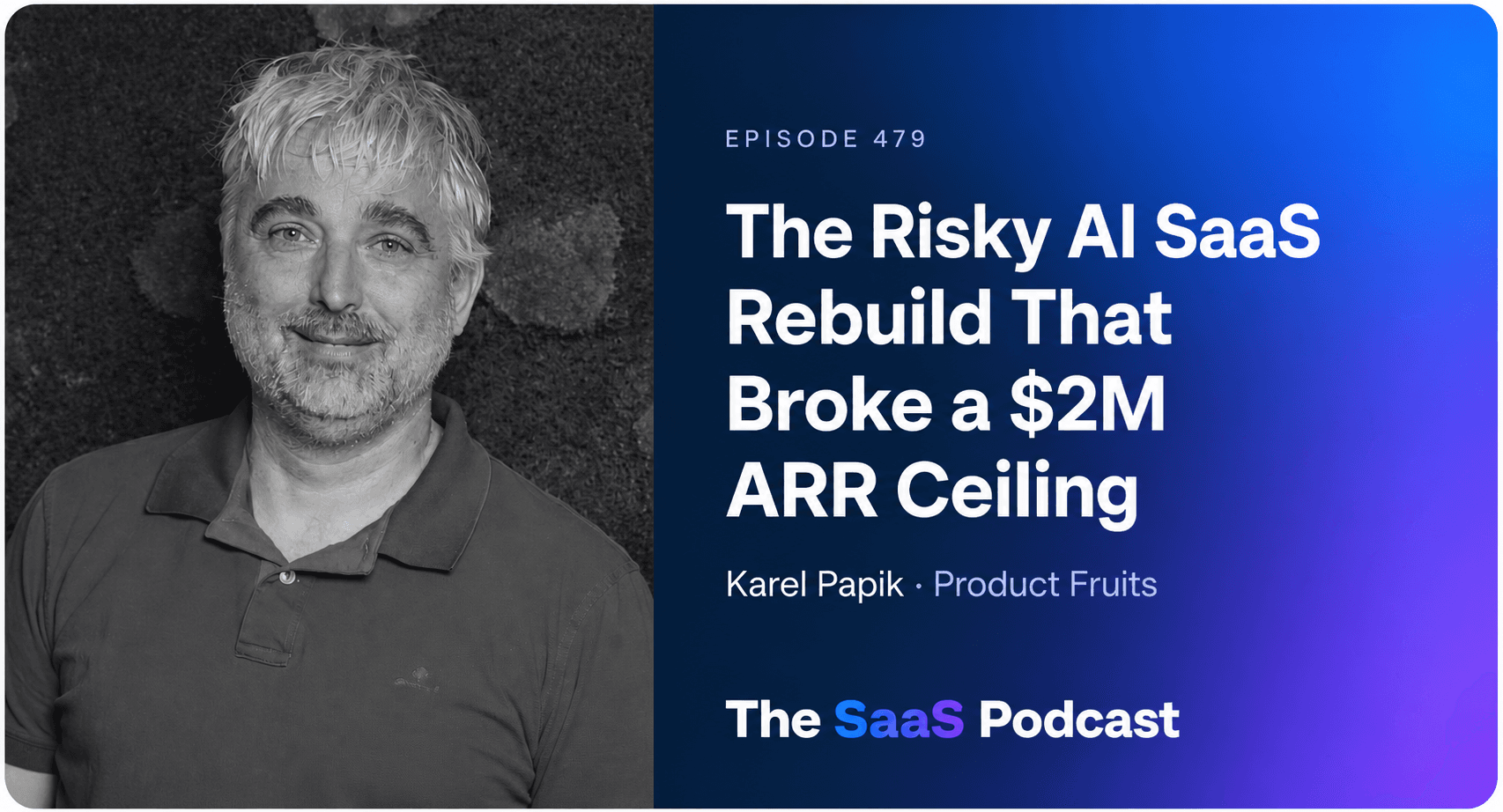
Karel Papik is the co-founder of Product Fruits, a digital adoption platform based in Prague, Czech Republic. Before SaaS, Karel spent 15 years building video games - shipping 16 titles, many of them for women - where he mastered the art of SaaS onboarding and user engagement through psychology rather than tutorials. When Karel met his co-founder Ladislav Salom, Product Fruits had just six customers. Within 12 months of their first investment from Lighthouse Ventures, they grew to $50K MRR using paid search as their primary acquisition channel. They achieved a 24-25% free trial conversion rate by applying product-led growth principles and gaming psychology to their own SaaS onboarding experience. But around $2M ARR, growth hit a wall. The product had become too complex for self-serve SaaS onboarding, and PLG stopped being effective. Meanwhile, AI-powered competitors were emerging fast. Karel describes this as the moment they stopped "riding the horse" and started "riding the tiger." In a gutsy move, Karel emailed investors to say they were pausing feature development on the existing platform to rebuild it from scratch around AI. The investors responded by asking how much more money they needed. The result is an AI copilot that handles discovery calls, tailors onboarding flows, prevents churn, and resolves 80% of support tickets automatically. Today Product Fruits has over 1,300 paying customers - including KPMG, universities, and stock exchanges - with a 25-person team generating millions in ARR. Karel shares lessons on why PPC worked when most founders say it doesn't, how gaming psychology applies to SaaS onboarding, and why he believes talking to customers too much can hold you back.
Bilal Aijazi, Polly
Bilal Aijazi is the co-founder of Polly, an engagement platform that brings polls, surveys, and feedback workflows into the tools teams already use like Slack, Teams, and Zoom. In 2015, Bilal was working at a consumer messaging company, watching apps like WeChat evolve from simple chat tools into full-blown platforms. He figured the same shift would happen at work. So he and his co-founder Samir started experimenting with simple solutions to collect feedback. Their first attempt was an email-based tool, but engagement was terrible. People just treated it like another survey to avoid. Then Slack opened their API. And Bilal noticed people on Twitter asking for Slack polls. So the founders quickly ported their product over, becoming one of the very first Slack apps ever built. But the installation process was clunky. Five manual steps that required copying and pasting tokens between different screens. Yet 80% of people still completed the setup. So they were clearly providing something people wanted. Then one day someone posted Polly on Product Hunt and they went viral overnight. They were getting thousands of new signups every month and struggling to keep the servers running. Yet they had zero revenue. Their first paying customer spent $8 a month for a fantasy football league. Then came the real challenge of building a freemium SaaS - figuring out who would actually pay. Most freemium SaaS users just wanted to do something casual with polls like pick lunch spots. But through hundreds of conversations, they found where the real money was. They focused on company all-hands, sales kickoffs, and other high-stakes meetings where feedback actually mattered. Just when things clicked, Slack threw a spanner in the works. Polly had built a workflow feature for automating feedback. They were signing five-figure deals. Six months later, Slack launched their own solution. The founders had to make a choice. Stay on Slack and hope for the best, or take a massive risk and rebuild everything for multiple platforms. They expanded to Teams, Zoom, Google Meet, and embedded directly into presentations. Rebuilding their entire infrastructure was a huge undertaking, but they had no choice. Today, Polly is one of the most successful freemium SaaS products in the collaboration space, serving millions of monthly active users and generating multiple seven figures in ARR with just 20 people.
Sergiy Korolov, Mailtrap
Sergiy Korolov is the co-CEO of Railsware, a product studio that helps companies design, build, and scale successful software products, and the co-founder of Mailtrap, an email testing and delivery platform trusted by developers worldwide. Back in 2011, Sergiy's team made a massive mistake. They accidentally sent 20,000 test billing emails from their staging environment straight to real customers. The chaos was immediate. Customers were confused and upset, wondering if they'd actually been charged or not. To make sure it never happened again, they built a small internal tool to stop test emails from reaching real inboxes. When they shared it with the Ruby on Rails community, something unexpected happened. Developers loved it, and Mailtrap spread purely through word of mouth, eventually attracting more than 200,000 users. For the next five years, Mailtrap stayed free. It was a side project until 2016, when Sergiy finally decided to turn it into a real business. Instead of guessing, his team ran over 100 customer interviews and dug into usage data to guide pricing and product decisions. It took another four years to reach $1 million in ARR. Growth was slow and steady, not the overnight success story people imagine. And just as things started to pick up, a new challenge appeared. Customers wanted Mailtrap to handle production email sending too. That meant turning a product built to avoid sending emails into one that had to deliver them flawlessly. It was a risky move. The shift created a whole new set of problems, from dealing with spam attacks and deliverability issues to fighting brand confusion about what Mailtrap actually did. Suddenly, a product known for blocking emails had to prove it could deliver them reliably. Sergiy and his team spent months rebuilding their infrastructure, tightening security, and designing tools that gave developers more visibility and control. It wasn't glamorous work, but it paid off. Mailtrap evolved into a trusted, full-stack email platform used by teams around the world. Today, Mailtrap generates seven-figure ARR with a 40-person team and more than 100,000 monthly active users.