Omer Khan [00:00:00]:
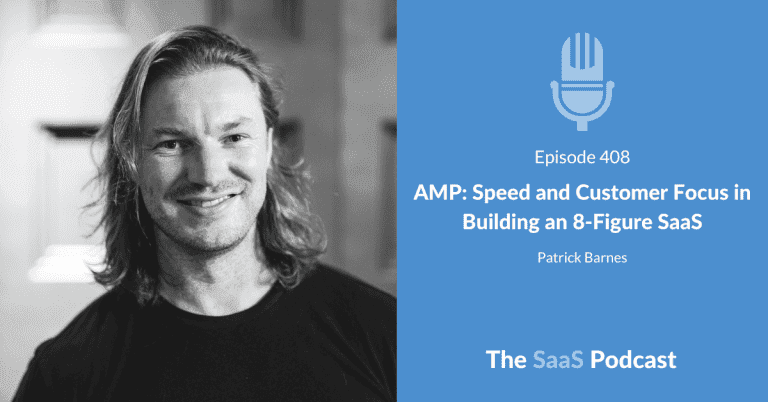
Welcome to another episode of the SaaS podcast. I'm your host Omer Khan and this is a show where I interview proven founders and industry experts who share their stories, strategies and insights to help you build, launch and grow your SaaS business. In this episode I took to Patrick Barnes, the co founder and CEO of AMP, a multi product SaaS platform that helps e commerce merchants to run their online businesses. In 2016, Patrick Co founded Advocatly, a review management platform for SaaS companies.
Omer Khan [00:00:39]:
Growth was painfully slow at first, with the team struggling to convince potential customers of the product's value. Undeterred, Patrick and his co founder persevered, scraping together two to four new customers each week. Bootstrapping their startup forced them to be resourceful and laser focused on customer needs. I, after nearly three years of hard work, G2, a major player in the software review space, acquired advocate lead. This experience from Struggle to Exit, taught Patrick invaluable lessons about finding product market fit, acquiring customers and the importance of persistence.
Omer Khan [00:01:11]:
In 2022, he teamed up with his longtime friend Cameron to tackle a growing problem in e commerce. Merchants were overwhelmed by the need to juggle 25 to 40 different SaaS tools just just to run their online stores. To build their initial solution, Patrick and Cameron acquired a small Shopify app with about 2,000 customers, which became the foundation of their new venture. They quickly applied SaaS best practices, redesigning the onboarding experience and implementing email marketing. The results were impressive. AMP hit its first million in ARR soon after the acquisition, but success also brought new challenges.
Omer Khan [00:01:50]:
When they launched an Amazon integration, expectations were sky high. They had 4,000 ideal customers who they were sure would love the new feature. But the launch fell flat with the email campaign generating just 46 clicks. Also, as their team grew to about 50 employees, maintaining their customer centric culture became increasingly difficult. Patrick's solution? Mandating regular customer calls for everyone from from engineers to marketers to ensure that the entire team stayed deeply connected to users needs. This relentless focus on customers paid off.
Omer Khan [00:02:27]:
Today, amp serves around 20,000 customers, has raised $18.5 million in Series A funding and generates eight figures in ARR. In this episode you'll learn how Patrick's past startup failures shaped his strategy for AMP and why these experiences were crucial to his current success, why Patrick Barnes speed is the ultimate business strategy, and how this philosophy drives AMP's rapid growth and product development.
Omer Khan [00:02:52]:
The specific tactics Patrick uses to maintain a customer obsessed culture as the company scales from a small team to over 50 employees, we talk about how AMP effectively balances Product led and sales led growth strategies to acquire and retain customers in a competitive E commerce market and why Patrick emphasizes the importance of clear priorities and and how he uses the V2MOM goal setting framework to align the entire company. So I hope you enjoy. Patrick, welcome to the show.
Omer Khan [00:03:23]:
Thanks Omer, do you have a favorite quote, something that inspires or motivates you that you can share with us?
Patrick Barnes [00:03:29]:
Yeah, I've got two. One is speed is the primary business strategy which we also say internally going super fast. Like we like to go fast. Uh, you make mistakes faster, you learn faster, your feedback loops are tighter, you can even do the wrong thing as long as you're doing it really, really fast and tracking everything.
Patrick Barnes [00:03:49]:
So speed is the primary business strategy and the second one is related to something I think will come up a few times throughout of our conversation is related to co founders and that is there's this film called the Town with Ben Affleck and this was one scene where he walks into a room and he says something to the effect of hey, I need your help. We're going to go out tonight. We've got to hurt some people. I can't tell you what it's about. We're never going to talk about it again.
Patrick Barnes [00:04:18]:
And the other character in the scene says whose car are we going to take? Which is something my co founder and I reference a lot. It's probably slightly different to some of the quotes you get at the start of shows, but I think that having that partner that you can work with and have that mentality with and that openness with is really especially. Yeah, it's important throughout the cycle of the business. So yeah, that's the second one. Whose car are we going to take?
Omer Khan [00:04:46]:
I love that one. So tell us about amp. What does the product do, who's it for and what's the main problem you're helping to solve?
Patrick Barnes [00:04:52]:
Yeah, so we help E commerce merchants run their online business businesses. We're doing what we talk about being like almost like a HubSpot for E commerce. What does that mean? Multi product SaaS, deeply integrated but we're doing it for the E commerce vertical. Right now we have two products. We have Analytics, a BI specific E Commerce specific BI tool and a conversion product that helps with upselling automatically on their websites.
Omer Khan [00:05:22]:
And is there a specific type of Shopify customer that you focus on?
Patrick Barnes [00:05:27]:
No, from the largest. Where? Fine. I would say we typically work more with brands. What do I mean by that? You know, so if it's an online store selling loads of different parts that it buys from loads of different people or they're selling AirPods, they buy from somewhere else. We typically work with brands like Ridge Wallet or Hexcloud or True Classic or something like that.
Omer Khan [00:05:49]:
Cool. And give us a sense of the size of the business. Where are you in terms of revenue, customers, size of team?
Patrick Barnes [00:05:55]:
Yeah, so we have 20,000 paid customers plus another say 10k on our three plans, 50 employees thereabouts. And yeah, we raised eight and a half million Series A about nine months ago.
Omer Khan [00:06:08]:
And revenue?
Patrick Barnes [00:06:10]:
Eight figures.
Omer Khan [00:06:10]:
Eight figures. Okay, so you founded the business in 2022 with your co founder Cameron, but the story starts probably back in 2013. So why don't we start there and just set the scene for us? Like what were you doing at the time and why is 2013 relevant to this story of building AMP?
Patrick Barnes [00:06:39]:
Yeah, so in 2013 I joined a company called Trade Gecko. It's a company my co founder started. It did something related to what AMP does now. It provided software for e commerce merchants to help them run their online stores. It did inventory and order management. Before that I was at Oracle, which is. You typically focused on internal systems.
Patrick Barnes [00:07:01]:
That was my first experience with SaaS where you could ship something to production and see customers using it immediately, or you could log into a dashboard at 6am and you'd see 39 people were online using the tool during the free trial. So I loved working at Trade Gecko with Cameron. I stayed there for three years. The first year was amazing. We were at say 70,000 in ARR in 2013.
Patrick Barnes [00:07:29]:
But we had all these leads and there was an amazing team and I think we went from 70,000 to 1.1 million in ARR in 12 months, which like a lot of people do now, but in 2013 in Southeast Asia was pretty, was pretty good. I left Trade Gecko. I. I didn't leave that far though. I co founded a company with one of the software engineers from Trade Gecko, amazing guy called Lachlan, who also happened to be Cameron's little brother. And we worked from the Trade Gecko office quite a lot.
Patrick Barnes [00:08:05]:
What we founded was a company called Advocately. It did review management for SAS companies, websites like Capterra and G2 that I'm sure your audience is familiar with. We actually bootstrapped that company. We bootstrapped that company for nearly three years. And then right when we were looking to go for that next stage of growth, we actually were acquired by G2, which was great. And then I had my own out at G2 with Lachlan.
Patrick Barnes [00:08:39]:
Learned loads working at G2, Trade Gecko was actually acquired by Intuit, which was specifically their product QuickBooks Online, which again, I'm sure your audience is familiar with. And then, yeah, Cameron and I were getting to the end of our earnouts and it was time to figure out what we wanted to do next. So we got back into the customer development for a couple of different SaaS ideas, one of which was E commerce related. And yeah, just couldn't stay away from helping merchants.
Patrick Barnes [00:09:09]:
We thought it was cool in 2013 and in, you know, Shopify was probably doing 30 million in revenue at that time and now they're doing 8 billion in revenue. And we still think it's a great time to serve, to serve that audience.
Omer Khan [00:09:25]:
So what I love about your story is that with amp, you didn't take the traditional route of going and building a product. You actually acquired Shopify app and then you grew that and you grew that pretty fast. And one of the reasons you were able to do that and avoid a lot of mistakes along the way was because of all the struggles and mistakes you made with Advocately. And the lessons you learned there helped you guys with, with amp.
Omer Khan [00:09:53]:
So that's why as you and I were talking, we just said, hey, like the story of Advocately is, is just as important because that's where you kind of, you know, got your stripes, right? So why don't we start there? So you, you're at Trade Gecko. Where does the idea for Advocately come from?
Patrick Barnes [00:10:15]:
Yeah, the idea for Advocately came from one of the best lead sources at Trade Gecko was the software review sites. They are very bottom of funnels. Let's say I'm going to San Diego in a month or so because we're sponsoring an event there for merchants. If I'm looking for hotel rooms in San Diego on a review site, I'm in buying mode. If I don't find a hotel room in San Diego, I'm on the street or whatever. But one of the challenge was making sure our team responded to all reviews, asking happy customers to write reviews.
Patrick Barnes [00:10:54]:
So that's where I just saw if merchants could manage their reviews on those sites. Where SaaS companies can manage their reviews on their own sites better. I'd say that comes with the own challenge. Right? That's basically a version of building a better mousetrap. If you compare it to say, payroll software, everybody needs payroll software. Everybody knows they need payroll software. There is a budget in mind for payroll software, not. The review sites then were actually kind of nascent, you know, in 2016. I think G2 was probably at 10 million in revenue or something.
Patrick Barnes [00:11:26]:
If a founder came to me today and they're like, hey, I'm going to build an add on a 10 million business. I'd be like, build on Shopify, build on Salesforce, build on Zero. Like that's a crazy idea. So it was. Or even because those review sites had lower levels of adoption, you know, you'd even talk to people and they'd be like, well, why do I need a review? I've never had reviews on this site before. I'm at 30 million ARR. Everything's kind of fine for me.
Patrick Barnes [00:11:59]:
Yeah, so that was one of the challenges of building a meta mousetrap, essentially.
Omer Khan [00:12:04]:
Okay, great. So you see this, you've got this idea. Did you do any of the customer development stuff? Did you go out and talk to potential customers, validate your idea?
Patrick Barnes [00:12:14]:
Yeah, I did all of the customer development. This is a challenge as well though, because the first, because we were in the SaaS industry, we did. The first few customers were my friends, you know, like Trade Gecko bought it. A bunch of. A few other Aussie SaaS companies bought it in the zero ecosystem. And then we needed to figure out. And then the product was just getting started. So it's not like they were all the happiest, healthiest customers getting value from the product.
Patrick Barnes [00:12:46]:
They were amazing because we could pump their feedback back into the product to make sure it worked for them. But I do remember the first customer who was not my friend was Krish from chargebee. I was in Singapore at the time. Chris was close by in Chennai in India. But that was the first person I, I'm sure it wasn't the first person I called DM'd on LinkedIn, but he was the first person to get back, do a trial and actually pay for it. Yeah.
Patrick Barnes [00:13:16]:
And Chris is still a really good friend and I've gone to see him in Chennai since and seen him in Barcelona and San Francisco and, and wherever else at various events too.
Omer Khan [00:13:26]:
Krish has been on the show. He's a great guy.
Patrick Barnes [00:13:28]:
Has he. Great. Cool.
Omer Khan [00:13:30]:
So, okay, I want to understand this a little bit because you, what I'm hearing is you basically built the product, the customer development was basically talking to your friends who were running SaaS companies.
Patrick Barnes [00:13:43]:
Not quite, but we definitely did customer development cold as well. It was more just. There was, it was great quitting your job and starting with seven customers. But what was not great is then having to, you know, having. It's not like there was any, any Real pipeline or anything.
Omer Khan [00:14:02]:
So you got those seven customers pretty quickly. And then what happened to growth tanked?
Patrick Barnes [00:14:07]:
It was terrible. It was. Yeah. Well, the thing is, I think I really. You go from a trade gecko. We were growing super fast. I loved working there. You're working with your friends every day. You know, even though I left Cameron and I still doing stuff on the Internet, 10, 11 years on now, I guess. And then you, especially in your mid-20s, you always have this idea of how well everything is going to go. And I remember I actually read two books. I was reading.
Patrick Barnes [00:14:37]:
I read two books in close succession, and it made me realize that reading the right book at the right time is really important. The first book was called behind the Cloud by Marc Benioff, where he talks about all these playbooks he used to grow Salesforce. And one of them's like, how he hired the CEO of Oracle Japan to launch Salesforce in Japan. And I'm like, I can't even pay rent. Like, what is this about? But the second book was Ego is the Enemy by Ryan Holiday.
Patrick Barnes [00:15:07]:
And I think to date, that's still like the best book I've read in the context of reading the right book at the right time. So, yeah, it was definitely. You always think it's going to go better than it actually goes.
Omer Khan [00:15:20]:
So you said growth tanked, it just stalled. But how long were you in that situation?
Patrick Barnes [00:15:26]:
No, look, we weren't in that conversation very long, my co founder and I. And that's one thing that made it not that tough is I always had a great friend and co founder in Lachlan, and we were always in it together. Back to the first quote. No, I think we were pretty quickly able to hustle around and start adding two to four customers a month or something. Wasn't. Yeah, we were able to figure that out pretty quickly.
Omer Khan [00:15:52]:
So I want to pick up on one of the things you said earlier. You said one of the struggles you had was you would talk to potential customers and they would say, why do I need this? Right. It was like this. I had this over and over again where founders will say, you know, I get the thing about the vitamin and the painkiller, and it feels like I'm solving a problem, but it feels like a vitamin. It's like a nice to have. They tell me they.
Omer Khan [00:16:19]:
They kind of get why they need it, but there's no sense of urgency. There's just they could happily live without it, and that's not a great place to be. But you figured out how to turn that around. So how did you do that? Was this about repositioning the product or was it about building features into the product that they cared more about?
Patrick Barnes [00:16:40]:
It wasn't one specific thing. I think one, the market did grow. We were probably just a little bit early. Now, Capterra and G2 are pretty standard industry practice, so I think the market did come to us a little bit. We were just. We didn't realize how early adopters we were in caring about it. I think the. We continued to flesh out the product and made sure it meet people's.
Patrick Barnes [00:17:11]:
Yeah, we offered great free trials where we'd almost do like a free proof of concept, not like a 14 day free trial, but make sure everything was set up, let it run for a month. And then when people saw, you know, new reviews coming into a public Slack channel every day, and then, you know, maybe the CEO or the CMO was in that channel and they're like, oh, we probably don't want this to stop. Yeah, it was, it was not.
Patrick Barnes [00:17:34]:
It was probably a bunch of 1 or 2 20% things like the market coming to us. And then, yeah, actually I'd say on the positioning thing, on the messaging, one thing was it always comes back to ideal customer profiles. And what we just realized was, hey, our ideal customer profile is somebody who's spending money on G2 and Capterra already. Like, they're already spending pay per click dollars on Capterra. They're already spending $70,000 a year on G2. Who cares about paying us $500 a month if you're paying G2 7, $70,000?
Patrick Barnes [00:18:09]:
Like, you can spend an extra $6,000 a year to make sure that that profile is tended to like a vegetable garden. You know, it needs to be looked after. So that was, that was the main. I would actually say that was probably bigger than all the other things put together.
Omer Khan [00:18:24]:
And how did you figure out who those leads were? Were you like going on G2 and Capterra and just looking at the ads? Like, who's advertising there?
Patrick Barnes [00:18:32]:
Yeah, you can, you can tell. There are characteristics on both sites that enable you to tell if they're paying for the product or not. Like in this premium listing features.
Omer Khan [00:18:45]:
Got it, got it. Okay, so the, the other thing I want to pick on that you said was part of this was growing because the market started to grow and you. This, this kind of proof of concept that you were doing, it sounds pretty pivotal because the way I'm. I'm hearing it, you went from like telling them what the product would do to actually Showing them and getting it to a point where we talk about this, get people to the aha moment.
Omer Khan [00:19:22]:
And I think that aha moment was these reviews showing up on Slack where they're like, okay, I get the value of this thing. Why would you want that to stop? And then it becomes, I guess, a much easier sale, right?
Patrick Barnes [00:19:35]:
Correct. That was the first thing. And then the second thing was how do we get more of these proof of concepts started? Like how do we. We didn't call them proof of. It's more just like an actual free trial. And we take on as much of the burden as possible to make sure it goes through. And it doesn't really matter what time the trial starts, it matters when it goes live. So we didn't really worry about an arbitrary 14 day free trial or anything like that.
Patrick Barnes [00:20:06]:
So the question would be, Omer, how do we get more people to that point? So what we did is we launched a free Slack tool. We said, hey, anytime you get a new review, we'll pump it into a Slack channel for free. And we ran this outbound. It was very successful at the start. It was actually like too successful because we made the onboarding like three or four clicks. Again, it was 2016. I think the permissions on Slack were a little bit more lax. Like most people could install a public app to a channel.
Patrick Barnes [00:20:36]:
I don't think anybody lets you anyone do that anymore or any organization of size. But we even had HubSpot using it and stuff. And so what the product did, it worked a little too well in that people would install the app and then we'd be like, hey, do you want to talk about this other software product we have and just would never get back to us. So what we did is we then, which is fine, like for free, but what we did do is we said, hey, we've got this free Slack tool.
Patrick Barnes [00:21:06]:
It will do this. I think it may be, yeah, it will do this and that. It will put all your new reviews in Slack so people can see it or put them in your customer support tool so your support reps could see it. Do you want to set it up on a quick call? We'd schedule the call and then we would just help them set it up. And it would all be done in the first two minutes of the call.
Patrick Barnes [00:21:26]:
And then we would say, hey, while we're here, do you mind if we tell you about this? That product is free, it's yours forever. We can end the call right now. It's not a bait and switch. It's not like it's not timeshare. It's not at the end, it's right at the start. We say, hey, we've got a few more minutes. Can I tell you about this other product we have that helps drive more reviews? And then that's where I don't think anybody ever said no. And it was always a very gentle, gentle, softly, softly thing.
Patrick Barnes [00:21:55]:
And everybody still had that free Slack product forever. Love it.
Omer Khan [00:22:01]:
Okay, so you figured out who your ICP was and this basically were companies who were spending money on capture or G2 with ads. And then you were able to build a prospecting list by basically researching and finding who was paying for ads on those sites. And then you were sending them cold emails or LinkedIn messages, trying to get them to like, did the tool come as a result of the outbound not working very well, or was this the tool, like always a part of the outbound strategy from the start?
Patrick Barnes [00:22:43]:
I think the tool was just a flyer idea. I think actually loads of people were. We probably just saw other companies launching free Slack tools and we were like, oh, what if we do it? Yeah, I don't remember, but I don't think it was. I think it was a natural evolution.
Omer Khan [00:22:59]:
And who, who was it in these companies that you were targeting?
Patrick Barnes [00:23:03]:
So we would typically target the director of demand gen or VP of marketing, depending on the size of the company, the person who actually owned the budget. What we did at the start is we would target customer success, but it's just not the same as owning the budget in the same way the demand gen person does.
Omer Khan [00:23:26]:
Okay, cool. So once you've got that going, you said you were generating, what were you generating two to four leads a week? Or were you closing or getting two to four customers a week?
Patrick Barnes [00:23:37]:
Maybe we closed 10 customers a month or something.
Omer Khan [00:23:40]:
And how many, roughly what volume of outbound or emails were you having to send? And just kind of getting an idea of how much volume we're talking about here.
Patrick Barnes [00:23:56]:
Every list we ever sent was significantly less than 500 people. These were highly tailored, highly personalized. We'd even include examples of reviews in the outbound email, like reviews from their site. Like, hey, imagine this review from April 16th going into your Slack channel and then a screenshot of the review or something. So I think our. I've talked about this publicly before. I gave a talk at SAS Doc a few years ago because yeah, we were doing all sorts of stuff.
Patrick Barnes [00:24:27]:
We would pre target the people on Facebook because back then you could upload a email list to Facebook so they would see our ads before they. Even before they even got the first email. But I think we were rocking. Maybe, you know, like, if it was 300 sends, 30 meetings type thing. I. Yeah, I don't. I don't really remember, but it was very highly converting. But also it was. I was doing calls. I mentioned I was in Singapore. I was. So most of the customers were in the us So I was doing calls.
Patrick Barnes [00:25:02]:
My calendar was open till 2 or 3am Monday to Thursday. So there was no. You want to convert meetings. Like, there is a. There is a method. It's not that fun, but it can be done.
Omer Khan [00:25:15]:
You did that. You did that for two years?
Patrick Barnes [00:25:18]:
Yeah.
Omer Khan [00:25:19]:
Wow.
Patrick Barnes [00:25:20]:
Yeah. And then we were acquired by G2. And actually, even at G2, I did still quite a lot of evening. Evening work.
Omer Khan [00:25:26]:
So roughly where were you in terms of revenue when you got acquired?
Patrick Barnes [00:25:30]:
Yeah, we were in the, like, hundreds of thousands of ARR.
Omer Khan [00:25:35]:
And how did the acquisition come about?
Patrick Barnes [00:25:36]:
Well, G2 was a key partner of ours. You know, it was the main integration everybody used. And I had met. It was actually the VP of Sales, Olivier LaBelle, who I'd formed a bit of a relationship. And then he introduced me very quickly to Godard, who's the CEO, who. Who is an amazing, amazing SaaS leader. Like, such a huge supporter of Lachlan and I, and we got to know one another quite well. And then I flew out to. Yeah, I think he just sort of slowly brought us into the fold.
Patrick Barnes [00:26:14]:
He's like, you know, it's like, hey, I'm coming to San Francisco. Can I work from your office for the week? He's like, yeah, absolutely. You know, and then we'd spend hours. We'd spend. Oh, he'd always. He was always very. We'd spend a lot of time together. He really was very focused on how we were helping their customers and how we could help them at the enterprise with, you know, old. On prem software, like Software AG, through to HubSpot, through to smaller, smaller SaaS companies.
Patrick Barnes [00:26:41]:
And then he'd be like, yeah, well, why don't you come to Chicago? Well, I'm actually in Chicago next week, so why don't you stay another week and come to Chicago? It was very much a natural progression, but I think it was because the overlap in our customers was key. And I think it was because the. The. There was the overlap now customers was there. And that was the connection we had with the many people at the G2 team, from the CTO through to the sales team.
Patrick Barnes [00:27:10]:
And then I think there was a conversation I had with Godard, where I just said, you know, I just kind of explained, I said like, hey, look, like one thing I did want to ask you about is if, you know, Joining up with G2 would be, you know, like offering advocately, formally to G2 customers as part of G2. Alluding to an acquisition would be something possible at any stage.
Patrick Barnes [00:27:34]:
Like I wasn't trying to say it has to be now because I'm just like we might then expand at a second product that does Google reviews for hairdressers. You know, like we might expand the scope beyond SaaS if you're, if this is always going to be a part of the thing, but if it's something that could happen in the future, maybe that's something we spend more time building towards.
Patrick Barnes [00:27:53]:
So I did just have a very friendly, frank conversation with him around that then sort of became like, oh, if it is a possibility, maybe a good time to do it is, is sooner.
Omer Khan [00:28:04]:
Cool. Okay, so that happened in 2019. If you were doing several hundred thousand in ARR or whatever, that was probably the acquisition. You know, it wasn't like, you know, some life changing number that you're never going to have to worry about money again. Right.
Patrick Barnes [00:28:28]:
Yeah, we got a strategic multiple on. Yeah. So it was, it was, it was, yeah. It wasn't, wasn't the same as when Trade Gecko was acquired by Intuit, but it was still pretty good for two bootstrappers in their 20s who'd worked on it for two years and three quarters.
Omer Khan [00:28:50]:
Yeah, totally. And then. So you were at G2 for two or three years.
Patrick Barnes [00:28:55]:
Two years, yeah.
Omer Khan [00:28:56]:
And then in 2022 the stars aligned and you and Cameron were able to team up again. And so what happened? How did the, the idea for AMP come about?
Patrick Barnes [00:29:13]:
During COVID Cameron and I would go for these long walks and talk about what we wanted to do next and talk about these different ideas we had and areas we'd start researching and doing the customer development in. And then we started. One of those areas was E Commerce. We had a background there. We loved helping merchants. It's like a area we both genuinely enjoy and care about and we think is significantly growing. And then through talking to the merchants, you know, HubSpot is now at 8 billion or so in revenue thereabouts.
Patrick Barnes [00:29:50]:
And we spoke to the merchants and they're having to use say 25 to 40 SaaS products that maybe I might say politely, I'll say are varying in quality. Like having to use 40 different SaaS products to get their website running the way they want. That doesn't include QuickBooks or Payroll or anything. These are the SaaS apps. Yeah. That people were using. That was kind of the first thing we observed. Secondly, the market for SaaS products for this specific set was very fragmented. You know, there was something like 10,000 different SaaS apps.
Patrick Barnes [00:30:29]:
And we noticed there were some real diamonds in the rough as well. Like the first company we acquired, like really high quality product, really high quality founder. And that's why we thought it would be a good opportunity to combine doing what we love, which is building software products for customers. That was one thing that was tough at the start that led to the first acquisition as Cameron and I were so used to having customers who cared about our product and the team to build.
Patrick Barnes [00:30:55]:
So that's where the first acquisition came about because yeah, it was really not having any customers was really painful for both of us to help drive the innovation. So that's where the first acquisition was in part driven by, hey, we have 2,000 customers now who will scream at us if this product goes down or if anything goes wrong with it. And angry customers are really beautiful thing. Like if your product, if people aren't upset if your product is down, that's a real problem.
Patrick Barnes [00:31:22]:
They're like, if they, hey, I'll come back tomorrow then and use it, then you do not matter and you should work on something else. So that's where that's part of what motivated. I'd say we definitely have a major in building and a minor in buying. And what the first acquisition allowed us to do was have customers to talk to, come up with ideas, ship, ship to prod and take it from there.
Omer Khan [00:31:49]:
So I want to talk about how that acquisition came about, how you found that app and ended up acquiring it. But before we do that, I want to talk a little bit about customer development. And this was a conversation I was having with some founders just a few days ago that when you, when you're, when you're starting out and trying to get, you know, your startup off the ground or you're doing the customer development, I guess there's like two ways you can do this.
Omer Khan [00:32:15]:
You, you either start with a problem and then you find people who have that problem, which in many ways is what you did with advocate Lee. Right. You already knew. Like this customer review thing, it can be fixed, we can do it better now let's find people who care enough about it, or there's kind of like a market approach which is, okay, I want to work in this space. You identified E Commerce and let's go and find a problem that we can solve. And both of those approaches work.
Omer Khan [00:32:50]:
But from your experience, was one or the other kind of easier to get to a point where you felt like you'd identified a problem that was painful enough and a customer who was happy to pay for a solution?
Patrick Barnes [00:33:07]:
Yeah, my personal approach is the market one because I think it helps you find the largest pain point. Yeah. So personal approaches being market. But you always have a combination of both. Right. Because customer development happens naturally. Even one of the, you know, we launched an Amazon integration for our BI product. How did that came up? It came up through a combination of talking to the customers around, finding out their challenges.
Patrick Barnes [00:33:42]:
And one of the challenges was that they were doing their analytics for Shopify in us and they were doing the analog analytics for Amazon in a spreadsheet. And I'm like, well that's not good. We don't have product market fit. Right. We have to. Eventually the tolerance for that is going to deteriorate. So I would say, is that a market? Yeah, so yeah, our approach this time was market. I tend to skew market, but I think also amazing companies have built through being like, hey, this is the. I think both work.
Patrick Barnes [00:34:17]:
As long as there's somebody there saying, hey, there's the hill, we're going up that hill and we're going to do it super fucking fast and we're going to figure it out, I think you can get there. But yeah, we did market this time and that's where so the whole idea of amp being single, unified, brand, multi product, focused on, you know, conversion and analytics, that was very much driven by this market understanding of the challenge in having so many varying quality SaaS products. Nobody wants 40 SaaS company providers. Right. That's where we landed on this.
Omer Khan [00:34:48]:
So you, you found this app that had about 2,000 customers at the time. And from what you were telling me earlier, this was like a, you know, a one man company. It was a developer who was bootstrapping and he'd kind of got enough traction, had to get to 2,000 customers, not a huge amount of revenue.
Patrick Barnes [00:35:09]:
Amazing founder.
Omer Khan [00:35:11]:
So was he looking to sell the the app or did you just reach out to him and kind of explore the idea of acquiring?
Patrick Barnes [00:35:20]:
Yeah, so we met, we met in sort of like a online developer community and then he was thinking about selling it. I think he just had a few other things he wanted to work on. And I think, you know, when you start building something, it's great. You can ship code to prod. It doesn't matter if it really Works or breaks something because there's no customers on it anyway. And then when you're a one man band with 2000 customers, eventually your job just becomes doing customer support.
Patrick Barnes [00:35:49]:
And so I think, I think he had thought about wanting to sell it and then sort of chilled off. And then he just, I think six months after we first spoke, he sent me a message on telegram and you know, we put an offer together for him pretty quickly. I think, you know, a day or
Omer Khan [00:36:08]:
two before we get into that. Like, why did you and Cameron decide that you wanted to go the acquisition route? Everyone wants to build their own product, right? You get to start from scratch. It's your vision, everything. Yeah, sure, you don't have any customers, but what was your rationale for saying let's go down the acquisition route here?
Patrick Barnes [00:36:33]:
Yeah, well, the thing is we still do both, right? We, we released a product in April this year that was totally built from scratch by us, so. So we do both. I think it was just at the start we just wanted to. Yeah, we just, like I said at the start, we like to go fast. So we, there was nothing precluding us from buying this and then three months later being like, this ain't it, let's do something else that didn't. Yeah, I think it was more just that velocity customer centricity element.
Patrick Barnes [00:37:11]:
And that product is now unrecognizable. Right. Like I would say 90 plus percent of the code is new code since the acquisition. We've got a full time team on it now that we hired. Like I would almost look at the fact that that started as this. You know, it's just a kernel or the front end add on this now. Yeah, it was just a Skip. That first six or 12 months in the desert.
Omer Khan [00:37:38]:
Do you remember what the growth trajectory was like of that app at the time when you acquired it? Was it like growing really fast? Was it kind of just, you know, stable, acquiring a handful of customers here and there? Like what was the situation at the time?
Patrick Barnes [00:37:53]:
It was growing, so it had been growing very, very fast. Right. But then it sort of naturally tapered out with a self serve SMB SaaS product. But it was still, it was still growing. I don't remember any specifics though.
Omer Khan [00:38:09]:
Okay, so the reason I want to, I'm trying to set the scene here is because once you and Cameron acquired this app, you guys hit the first million in ARR pretty fast. And I want to talk about the things that you did to, to turn that around and drive that growth because those, the lessons from what you two did are just as applicable to a founder if they're building their own product or they've acquired something. Right. That doesn't change. Right. It was just in terms of best practices.
Omer Khan [00:38:44]:
But like, tell me, tell me about like where did you start? Like how did you go about saying, okay, we got this thing, it's kind of growing, but we want to grow faster. What did you do?
Patrick Barnes [00:38:57]:
So the first thing we did is we talked to all the customers as many, not all of them, there's so many, but we talked to so many different segments to just really understand the beauty is it was product led already. It was all self serve, all coming through naturally. So we wanted to understand the new customers who were signing up. Why are you signing up? What are you actually looking to do? Why is this important to your business?
Patrick Barnes [00:39:19]:
Why instead of doing something else, are you starting a trial of this SaaS product through to talking to the customers to cancel talking through to talking to the customers that stayed and then just the open market customer development with them. It's like, hey, what SaaS product are you looking to add after this? Like really that customer centricity to understand the mindset of the customer and what they were going through in what was already what we used to call self serve or freemium and we now call product led growth.
Patrick Barnes [00:39:50]:
And I'm sure we'll call it something else. You know, I'm sure there'll be other people who are inexperienced on Twitter now it's claiming they're experts. So we really did that with the customer. And then just frankly we just had a bunch of playbooks from the last 10 years that we could just layer on right around redesigning the onboarding flow to drive more adoption. Yeah, just some SaaS best practices. There was no, no one had ever received an email. There was no email marketing.
Omer Khan [00:40:19]:
No way.
Patrick Barnes [00:40:20]:
No way. Yeah, indeed. And we weren't even capturing the right email. We were just capturing the. With Shopify, there's a default store email address which is typically something like orders, app or help at. If you email that address as a SaaS provider, that is never get, you know, if you think SaaS companies get a lot of support customer support tickets, imagine an E commerce brand, how many customer support tickets they get. They get a literally a thousand X, maybe 10,000 X number.
Patrick Barnes [00:40:53]:
You know, if we think about a G2 around that 100 million ARR mark, I would guess that an E commerce brand doing 100 million in revenue would get 10,000 times as many tickets as maybe more. So yeah, we just there was just a bunch of optimizations that we could run out as well as then build more product. I would say it was all the product velocity was the biggest thing.
Omer Khan [00:41:22]:
I want to dig into the product piece and what started to drive the growth. One quick question on reaching out to customers. Was it hard to get customers to say yes to talking to you?
Patrick Barnes [00:41:35]:
I mean it's always hard to a degree. Right. It's a volume game. I think personalization is the key. Typically what I would do is I would send them a loom video of me on their site. So even when you see the preview of the loom video, it is their website. So there's no chance that it's anyone, anyone else. So I'd say there's. Being authentic is the most important thing. So what's more authentic than being like, no, it's me, I want to talk to you is. Here's where I'm curious. I love where you've done this.
Patrick Barnes [00:42:05]:
We want to see if we can help or. Yeah, you already used the product. We're not here to sell you anything. The pricing is exactly the same. So I would say that was a key thing.
Omer Khan [00:42:16]:
I mean, it blows me away how so many companies or people doing lead gen still send these generic, what do they call it, like spray and pray type emails with no personalization other than the first name or something silly. And it's like you're never going to get a great response rate with that. And I think people avoid doing what you just described because it's hard.
Patrick Barnes [00:42:51]:
Right.
Omer Khan [00:42:51]:
And so it's just easier to take the simple route where you can just upload a CSV and have a bunch of templates and click a few buttons and it goes out to thousands of people. But I think the same applies also with talking to customers. Like we were chatting earlier, it's like people really avoid talking to customers. Right. And that was your experience as well when you started kind of growing.
Patrick Barnes [00:43:16]:
Yeah, I think I was joking before the call that it's like, yeah, the amount of work people will do to not talk to a customer. It's like the amount. Yeah, it's just something we need, need to. And that's not targeted to anyone specific at amp. It's just as you grow there, there are two natural. The two cultural things that you have to drive forward the most is to always talk to the customer, start with the customers and walk backwards, which everyone at the company now is amazing at.
Patrick Barnes [00:43:50]:
But you know, I think I hired 16 people in Q2 of last year. So there, there is sometimes A natural tendency towards documentation and internal meetings, which are all important. And yeah, there's always a natural resistance to going super fast. Like, people want to talk about stuff next Tuesday. It's like, what are you doing right now? If it's actually the most important thing, which it is. We have to. Not with customers. They can talk to us next Tuesday. But I mean, internal meetings or moving projects forward.
Omer Khan [00:44:24]:
Yeah. Okay. So I think in terms of avoiding talking to customers, I agree with you. I don't think it's an individual thing. I think if you go and look at a lot of teams or companies and you ask people, like, when was the last time you talked to a customer? Like, there will be people there who haven't ever talked to a customer. Right. And so if you're coming from that kind of environment, you just think it's the norm. Right. It's not like anything else.
Patrick Barnes [00:44:56]:
We, we have individual contributor software engineers running their own customer development calls.
Omer Khan [00:45:01]:
Wow.
Patrick Barnes [00:45:02]:
Yeah. I have a call with my VP of engineering and a customer tomorrow morning. Our marketing team does all their own customer calls. We're good at record. There's libraries and libraries of calls. Yeah, we. They're all segmentable and. Yeah. So, yeah, it's a huge part of our organization.
Omer Khan [00:45:21]:
That's part of your culture.
Patrick Barnes [00:45:22]:
Yeah, that's the number one value is customer obsession. Starting with the customer and working backwards. And then speed is the primary business strategy.
Omer Khan [00:45:32]:
Yeah. So let's talk about the speed. Like, you know, going super effing fast. A lot of people don't want to do that.
Patrick Barnes [00:45:39]:
Right.
Omer Khan [00:45:40]:
It's like, I'm going to screw up, I'm going to make mistakes. Customers are going to think I'm an idiot. They're going to think my product is crap.
Patrick Barnes [00:45:48]:
It was going to be crap anyway. You know, now you just know, like. Yeah. So I think it's really important. The second layer is, is it does require prioritization. You know, I think we typically. I want like one to three priorities in the whole company at any given moment. And there's 50 of us with 20,000 customers. Yeah. So it does. There is a layer of prioritization it advocately actually had blocked in my calendar from 7pm to 9pm every day.
Patrick Barnes [00:46:22]:
I think the quote is something to the effect of what is the one thing that would make everything else irrelevant. You know, whether it's like, oh, if we just had a thousand inbound leads a month, we know our funnel would just skyrocket because we have 98% net retention. We have, you know, like, whatever it is for any given business. If I had two more engineers, I could do, you know, like, okay, let's go hire two engineers.
Omer Khan [00:46:46]:
There's one thing when you're a solo founder or, you know, a couple of founders going super fast, right. You can, if you start to do that and things don't work out or break, you can, you know, you can adjust course, you can make changes quickly, you can keep going. When you start building out a team, I mean, you've got like 50 plus people. But even with a team of 10 people, if everyone's moving at that speed, things can break.
Omer Khan [00:47:14]:
And you might not even know something's broken or how it broke until you look at the numbers and just say, what happened to our whatever number? Right, A performance number or a revenue number or whatever. So how do you make sure that you give people the freedom to be able to move fast but still have like some bumpers in place to make sure that you can manage risk?
Patrick Barnes [00:47:40]:
Yeah, I think there's a couple of things there because, yeah, you definitely want decentralized decision making. Like, people should be able to make their own decisions and they shouldn't have to be checking stuff all the time. I think being clear about prioritization is important. So we use a framework called B2MOM. It's from Salesforce. It's very similar to okr where you have the two day to day components are the methods and the metrics. They're the equivalent of the OKRs. And I think as long as they are the focus, I, I don't know.
Patrick Barnes [00:48:17]:
In my experience with clear prioritization, clear prioritization, documentation and communication, the only things that break by going really fast are the things that don't matter. Like, it's not like going really fast and focusing on the MQL number has ever like dropped the MQL number and no one has noticed. Like, I've just never seen that. I've never seen that happen. I've never seen obsessing over customers and my culture of talking to customers all the time, I've never seen that result in customer support getting really slow or engineers not fixing customer bugs.
Patrick Barnes [00:48:55]:
It builds the culture, you know, so the things that get left behind. I don't know stuff. Yeah, yeah, I hear where you're coming from, but it's typically stuff breaks and stuff gets less behind, but it typically things that probably maybe shouldn't have been there to start with. Stuff will break by getting really fast, but you notice. You don't not notice.
Omer Khan [00:49:21]:
Yeah, I think it goes back to having clear Priorities across the company.
Patrick Barnes [00:49:25]:
Yeah.
Omer Khan [00:49:25]:
You know, I want to talk about. There was another example you shared with me earlier about the Amazon integration and sending out that email. I'd love for you to tell that story because, you know, I think sometimes when people hear these kinds of interviews and they think, oh yeah, once you get to like seven figures or eight figures, you've made it and, you know, things are kind of easy after that.
Omer Khan [00:49:54]:
And that example you gave me there was just so real, the kind of thing that every founder who's even trying to get their first 10 customers kind of experiences. So why don't you just share that story about the number of clicks and stuff?
Patrick Barnes [00:50:07]:
Yeah, so what I was talking about in broader context, I was talking about even after all these years, every new thing takes longer to hit than you think it will. So the example I was sharing is we launched an Amazon integration, which I expected to have. We'd done all this analysis, we'd spoke to loads of people that they were using us for the BI tool for Shopify and they were using a spreadsheet for Amazon. And you know, 60% of our ICPs in North America sold millions a year on Amazon.
Patrick Barnes [00:50:40]:
And we just thought this thing was going to explode. And we have 4,4000 customers that fit this perfect profile and we launch it and it gets like 46 clicks. Like, it just doesn't, it just does not take off at all. And then now, and I think I thought it would get to, you know, 500,000 ARR in the first month. And we got there, it just took more like a few months than I think it took more like six months than a month. And even again, last week we launched, we launched.
Patrick Barnes [00:51:14]:
I do want to get better at product launches. Some people are amazing at it. It's just not something I'm as good at. I'm better at retention, I think, which I would still choose over launch launches. But yeah, last week we launched something. We have a BI tool that can predict things like propensity for repurchase. And we enabled the upselling tool we were talking about, which is, you know, when you go on Amazon, it's like you add a basketball to your car. It's like, hey, do you want to pump? Do you want some shoes?
Patrick Barnes [00:51:48]:
This sort of natural upselling, we do this for decentralized non Amazon businesses. So we launched this thing where the models from the BI tool could intelligently upsell products with say, the highest repurchase rate, the highest propensity to repurchase, to help drive greater ltv. And again the verbal response was very incredible. It was amazing. But the actual, the actual numbers, who, number of customers who set it up and started doing these machine learning based upsells was lacking. But I know we will. Yeah.
Patrick Barnes [00:52:31]:
I always expect to launch to like raucous applause and sometimes I launch to silence slash the sound of 46 people clicking a mouse out of 4,000.
Omer Khan [00:52:42]:
The struggles don't go away, they just cool. All right, we should wrap up. Let's get onto the lightning round. So I've got seven quick fire questions for you. Ready?
Patrick Barnes [00:52:53]:
Yeah.
Omer Khan [00:52:54]:
What's one of the best pieces of business advice you've received?
Patrick Barnes [00:52:57]:
I think no one will be surprised. Talk to customers, start with the customers and work backwards. Go really fast. And then I think to the original quote have you know, do. Especially if you're right at the start of the journey, focus on, on finding a co founder who can really build together.
Omer Khan [00:53:15]:
What book would you recommend to our audience and why? And you can use the same book again if you want. You mentioned earlier.
Patrick Barnes [00:53:21]:
Oh no, I think that was, I think the. Yeah, I think Seven Powers by Hamilton Helma, the Outsiders by William Thorndike to me are the two best business books. Keeping in mind the audience though, I might be breaking my own rule of the right book at the at the right time. Anybody who's sort of getting to that first 10 person team read amp it up by Frank slipman. 10 person team to 10,000 person team. I literally called my company amp. It's an amazing book.
Omer Khan [00:53:56]:
What's one attribute or characteristic in your mind of a successful founder?
Patrick Barnes [00:54:01]:
So people often conflate. There are two categories. You know, working really hard, talking to customers. These are table stakes. That's like you haven't even arrived at the start line. If we're not doing those two things, they're not attributes of successful founders. They're like small blind, big blind. You cannot play poker if you, you, you don't, you don't do those. And then I think the second one though, I would say especially right at the start, the number of people who succeeded without a awesome co founder is restrictive. Again, I'd have that as like a table stakes.
Omer Khan [00:54:33]:
What's your favorite personal productivity tool or habit?
Patrick Barnes [00:54:37]:
So in general I hate this category. Like people are like oh, I use this to do list app or I just find it all kind of ridiculous. But my personal one though would just be having a routine and being active is important. Important for me. I find it compounds into my performance.
Omer Khan [00:54:55]:
You mean in terms of like just working out energy? That kind of stuff.
Patrick Barnes [00:54:59]:
Exactly, exactly.
Omer Khan [00:55:01]:
Yeah. What's a new or crazy business idea you'd love to pursue if you had the time?
Patrick Barnes [00:55:06]:
I mean, I don't. I'm so uninteresting that I don't really have one. I. We were just so deliberate about this. And Also you have two years on the sidelines at G2. You're just on the bench. I love my time at G2 because you are obviously thinking about what you want to do next and you can't. So yeah, I'm not one of those ones people that want to start a space company or anything. Yeah, I'm focused.
Patrick Barnes [00:55:32]:
And this is a long term bet because whilst the G2 exit wasn't the biggest exit in the world, I'm sort of fine. So yeah, if I wanted to do something else, I just would.
Omer Khan [00:55:45]:
What's an interesting or fun fact about you that most people don't know?
Patrick Barnes [00:55:49]:
I actually play quite a lot of video games. Yeah, I play a pretty significant amount of video games. That's something I really enjoy. Not as much as I used to, but yeah. Basically during COVID I started playing for the first time since Halo and Tony hawk Pro Skater 2. And yeah, I love it. It's a great way to keep in touch with my friends.
Omer Khan [00:56:11]:
Cool. And finally, what's one of your most important passions outside of your work?
Patrick Barnes [00:56:19]:
Surfing. Surfing's the outside of work. Surfing's the number one non family related passion.
Omer Khan [00:56:25]:
Love it. Patrick, thank you for joining me and kind of unpacking the, I guess the last 10 or 11 years of your journey. Hopefully. I think we covered a lot of things and a lot of really useful lessons that I think. I hope that people listening to this can get some insights or something that they can take away and apply in their own business. So I appreciate you doing that.
Omer Khan [00:56:52]:
If people want to check out amp they can go to useamp.com and if folks want to get in touch with you, what's the best way for them to do that?
Patrick Barnes [00:57:01]:
Yeah, I'm PCBarns on Twitter.
Omer Khan [00:57:05]:
Cool. We'll include a link to your profile in the show notes.
Patrick Barnes [00:57:09]:
Cool.
Omer Khan [00:57:09]:
That was awesome, man. Thank you so much for joining me.
Patrick Barnes [00:57:12]:
Thank you for having me, Omar. I appreciate it.
Omer Khan [00:57:14]:
My pleasure. And given the time difference, we still made this work and it was fun. So I appreciate you.
Patrick Barnes [00:57:21]:
No, it got a lot easier when I moved. So I just moved to Sydney from Singapore in the last two weeks. So I think it's being in Sydney made it a lot easier.
Omer Khan [00:57:30]:
Cool. All right, man. Thanks so much. I wish you and the team the best of success.