Omer (00:09.760)
Welcome to another episode of the SaaS Podcast.
I'm your host Omer Khan and this is a show where I interview proven founders and industry experts who share their stories, strategies and insights to help you build, launch and grow your SaaS business.
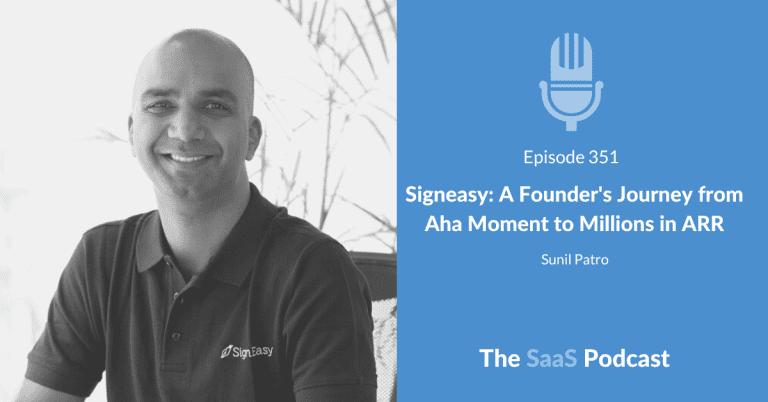
In this episode I talk to Sunil Patro, the founder and CEO of SignEasy, a user friendly electronic signature and contract workflow platform to sign, send and manage agreements.
In 2009, Sunil was traveling in Mexico and waiting for a new job offer.
Faced with the challenge of signing the offer without easy access to a printer, he wondered how much simpler it would be if he could sign the document on his smartphone.
That was a light bulb moment that kicked off Sunil's journey to create SignEasy.
With a background in software development, Sunil spent six months researching the idea of before launching SignEasy as a mobile app.
Within the first year and with a bit of luck, the app generated around $10,000 a month.
This early success motivated Sunil to keep pushing forward with the product, ultimately hitting the milestone of a million dollars in annual revenue.
But after five years of concentrating on the mobile app market, Sunil recognized an opportunity for growth and decided to pivot SignEasy towards a B2B SaaS product.
Despite facing fierce competition from well funded competitors like Docusign and and Adobe Sign SignEasy managed to carve out its niche by emphasizing simplicity, affordability and great customer support.
Today, SignEasy is a thriving SaaS company with millions in ARR closing in on becoming an eight figure business.
With over 50,000 customers worldwide and a team of around 80 people, Sunil's vision has come a long way.
In this episode you'll learn how Sunil discovered an unmet need in the E signature market and created a product basically to address his personal pain point.
The evolution of SignEasy from a mobile app into a thriving B2B SaaS solution.
The obstacles SignEasy encountered in a highly competitive landscape and the strategies it employed to stand out from major competitors and the unique challenges faced by Sunil as a solo and bootstrap founder and how he overcame them.
So I hope you enjoy it.
Okay, Sunil, welcome to the show.
Sunil Patro (02:19.180)
Hi Omer, thanks for having me.
Omer (02:21.290)
Do you have a favorite quote?
Something that inspires or motivates you that you can share with us?
Sunil Patro (02:25.370)
Yeah, I try to take lessons from founders outside of tech.
Sometimes we tend to lose sight of those.
There are great businesses out there.
One of the core beliefs or philosophies is based around the quote of J.W.
marriott.
The founder of the Marriott Hotel and Restaurants Group.
And he had said something like take care of your employees first and they will make your customers happier.
So I think I've always believed in the company is there to of course serve the customers at the end, but along the way you need to make sure your employees are thriving, growing and supported for what they do.
And if you can keep them happy, your customers would always be happy.
Omer (03:14.720)
Love it.
So tell us about SignEasy.
What does the product do, who's it for and what's the main problem you're helping to solve?
Sunil Patro (03:23.040)
So SignEasy is a contract workflow platform that helps businesses to simplify and automate their contract workflows so that they can improve their team's productivity and also accelerate their business operations.
Right.
The platform is used by businesses in over 100 countries around the world to prepare, send, execute and manage digital contracts.
We are known for our ease of use, our long term value for money or the budget, the affordable budget that we provide, a great solution and also the customer satisfaction and delight.
Omer (04:01.850)
Can you give us a sense of the size of the business?
Where are you in terms of revenue, number of customers, size of team?
Sunil Patro (04:08.380)
Yeah, we're in a high digit, high single digit or seven figure annual recurring revenue at this point.
Probably be getting to 8 figure ARR number pretty soon.
The company has close to 50,000 business customers who use the platform in over 100 countries.
And we have over 10 million users who have signed or processed a contract with us.
Omer (04:35.180)
And the business is bootstrapped and it
Sunil Patro (04:37.500)
is bootstrapped with a little bit of external funding from some strategic advisors as part of a small round.
Omer (04:44.900)
Yeah, but you raised that money recently in the last few years, isn't that right?
Sunil Patro (04:48.620)
Yeah, just a couple of years ago.
After we grew the company profitably and healthily, we decided to take some advice and along with that, some financial investment.
Omer (04:59.570)
So let's talk about where the story begins.
Where did the idea for SignEasy come from?
Sunil Patro (05:04.770)
So the original idea came when I was traveling in Mexico where I was waiting for a job offer from a Bay Area based startup.
And I was excited to receive the job offer while I was traveling in Mexico.
It was in the Riviera Maya region of Mexico.
And I went through that pain point of being able to not being able to find a easy way or in the sense I had to look around for a printer and then print those pages out and then sort of sign them and then either fax or scan them back.
And that pain point sort of stayed in my mind.
For a long time, even though.
Even though I could do this on paper, I just thought, hey, what if there was a simpler and easier way for you to do this from your smartphone?
And iPhones had just come out maybe a year or two years before that.
So that sort of was sort of the light bulb moment.
You know, maybe I could do something about this to enable executives and business people who travel for them to sign documents on the go.
And, yeah, that was back in 2009, sort of a time frame, and I ended up joining the job.
But this idea sort of kept playing in my mind, and I thought I should do something about it, because I always wanted to build a product with a pain point that I can correlate to or I can feel very close to.
Omer (06:33.430)
So when you sort of had that epiphany, did you look in the market, were there for other products?
What was going on at the time?
And what.
What did you see from your research that encouraged you to move ahead with the idea?
Sunil Patro (06:55.360)
Yeah, so it took me like six months to do my research.
I was still, like, playing around, hey, is this something I want to spend a lot of time on to build.
Build a product for?
So at that time, I think few years before that, Docusign had started and there was another company, Ecosign.
But Docusign was sort of one of the first players in this space.
But after my research, what I realized is that they were solving it.
The problem statements were very similar, but they were solving it for the sender.
In a business, who needs to send a contract out using a web interface, and then the end user or the signer or the consumer can sign it.
But I was solving it from the signer's perspective.
You still receive an email attachment or maybe a link to a cloud, maybe most common scenarios, an email attachment.
So from the signer can.
Do you have the power, do you have a way to just take the document, use an app, and then sign it and send it back?
So I sort of solved on the other spectrum of the use case, one is sending a contract for signature.
The other is receiving a contract and just.
And signing it and sending it back.
So I sort of started from this end user focused pain point.
And that was the core differentiation for our mobile app that we built.
And that sort of took off from there because of the unique value we provided to this innovation that we provided to end users.
Omer (08:22.580)
Okay.
So in those early days, it was.
The idea was, if anyone sends you a PDF or something, it should be easy for you to sign that and send it Back.
Sunil Patro (08:33.730)
You should have the power.
You should not rely on somebody using a E Signature platform to send it to you here.
It's just you have the power to install the app and upload the document and sign and fill and send it back.
Yeah.
Omer (08:48.250)
Okay, great.
So about six months of research and then assume you started building the product, you have a background, you're a developer by.
By trade.
Being able to code as a founder is a blessing, but it can also be a curse because we tend to build things too quickly sometimes.
So what did you do and how long did you spend building that first version of the product?
Sunil Patro (09:11.780)
Yeah, that's right.
You know, like, since I have the, since I have the experience to build software at that time, but I needed somebody who I could pair up with specifically for the iOS side of things.
I knew how to do web programming and server programming and I wanted to, instead of me spending the time to learn on my own, I wanted to fast track it.
So basically I hired a developer through a friend's network.
I was in the US and this person was based in India at that time.
So I hired him and we sort of started working on different pieces of the software and took us close to 9 to 10 months to launch the first version of our app.
We were basically working remotely on the side and the app launched in 2010.
Omer (10:00.620)
So I know for context, for people who are listening to this, the first five years or so of SignEasy, it was really just an app.
And then beyond that, I guess around 2015 is when you started to build out the web version and, and also sort of pivoted a little bit on the, on the sort of the target customers.
So tell me a little bit about what was the experience.
So you, you build a product, the app, get it into the App Store and what happens?
Millions of people are downloading it.
Sunil Patro (10:32.920)
Yeah, exactly.
So it was all organic.
Right.
Within few weeks or maybe a month of launching the app, we were one of the first mobile E signature apps at that time.
Even DocuSign didn't have one at that time because we were innovating for the end user.
Right.
So we sort of saw some recognition from Apple themselves where they featured the app on their app stores as new and noteworthy apps.
And that sort of started giving us thousands of downloads to tens of thousands of downloads on a monthly basis.
And we started seeing the traction.
People are uploading PDF documents and then inserting a signature or initial or putting a date on it and then sending it out.
That sort of instantly validated, even though I knew it's a pain point that I have faced myself.
And of course there will be a lot more users like this.
But this was the real validation from Apple and also the users on App Store.
And I think within few years we sort of just expanded to even Android.
We launched our iPad app, so it was sort of iPhone, iPad and Android and Android tablets.
And across all these platforms, the user experience and the uniqueness of the feature that we are providing, it was sort of attracting a lot of attention from our partners like Apple.
So we started seeing ourselves getting featured in countries outside of us.
The app was originally launched in the US but we localized the app.
We were able to monetize because in app subscriptions it was very self served.
You try the free version, you like it, you want to sign more documents or you want an advanced feature maybe and people would buy the higher plans.
So the first four or five years, basically it was working closely with Apple and Google to make sure we are the best E signature app for end users, professionals and consumers and small businesses.
Omer (12:31.120)
So presumably if you're targeting consumers or prosumers, as you said, they're probably a little bit more price sensitive than charging an enterprise business.
So what were you charging?
Was it a one time thing?
Did they buy credits?
Was it monthly subscription?
Sunil Patro (12:49.030)
So it started with the one time thing you buy once and then you can use it a lifetime.
Right.
To give you some examples, we started charging somewhere around $10 for lifetime.
You buy for $10 and you can sign as many documents how long you want it.
Right.
But then we realized after a few years of this monetization, we're actually providing a cloud based application where today you are using iPhone, but tomorrow you might use an Android device.
So you want your documents to be saved and be retrieved and being able to use it across any mobile device.
Right.
So we started then switching to a subscription model where that $10 lifetime became $10 annual.
And then as we added more and more capabilities and we learned the value of the product to the customer base, we started charging $10 per month.
And now we have plans on the App Store which can charge up to $25, $30 per month per user.
So this sort of has been a learning around the pricing and packaging, not only on the mobile app stores, but hopefully we can talk about that even for the most recent web products and other packages.
Omer (14:01.930)
Yeah, I think we should jump into that because I think the app story is interesting, but I think when you made that shift is even more interesting and kind of relevant to people listening here.
You said you Started to build a Web version around 2015 16.
Do you remember roughly like what you were doing in terms of revenue with just the App Store at the time?
Sunil Patro (14:28.190)
Yeah, we were doing already a few millions at that time.
Just based on app stores.
Just to note, right, we were featured on in all the Apple retail stores around the world on the demo devices because of you walk into 400 stores around the world, see signage on the iPad devices.
We are in two of the Apple's global commercials for iPhone and iPad for small businesses.
So based on that we sort of became one of the top 100 grossing apps.
And that helped us to monetize without any effort build the best product and then people are downloading and they're buying for you.
That gave us, made us basically reach few million dollars of ARR we without any marketing team, just product.
Right.
Omer (15:13.010)
So I want to ask you about that before you go on.
What does it take for someone to get Apple to promote your product like that?
Was this like you going out and finding people at Apple and trying to make a case for your product or was it just based on what they were seeing with the activity in the App Store and reviews that that kind of led to this?
Sunil Patro (15:34.610)
Yeah, I think we were one of the, one of the first pioneers in the mobile e signature world.
Right.
And they saw, you know, Apple wanted, you know, Apple wanted to see productivity apps.
You know, it was always meant for, you know, it was always around games and utility and lifestyle and all of that.
But business apps or productivity apps were not as many around those times.
And we were on the first to build, you know, like they were looking at downloads and they were looking at number of reviews they were looking at in app monetization, you know, subscription based monetization or all those signals kind of put us in front of their App Store editorial team.
And once the App Store editorial team noted us, they saw us.
We started talking to Apple's partnership managers who are handling business productivity apps.
Right.
And then we started working closely with them to hey, let's improve the user experience.
What sort of features would be helpful for the customer base?
The latest Apple, every year when they release an annual Upgrade, a new iOS version, there are new capabilities.
So how can SignEasy leverage those capabilities to be ready on day zero of the launch of the new iOS version?
Right.
So that sort of commitment to the platform gave a lot of confidence to Apple that hey, signezy is doing something great for the business customers and let's work with them and let's make it one of the Best apps on the ecosystem.
And it was all luck, I would say it was all organic, a lot of luck, a lot of timing, all of that sort of played to get what we got from those partnerships.
Omer (17:10.070)
Yeah, that's awesome.
I think it just goes back to.
Yeah, marketing, sales are very important, but build a great product, really focus on the end user, the customer experience.
And that on its own, with a bit of luck, can take you a long way.
So when you move to this web version of this, was this driven by what you said earlier in terms of.
Well, we realized we were kind of building this cloud solution anyway, so why not have a web interface as well?
Or was this part of kind of a move to pivot and focus on a different customer more kind of B2B type.
Sunil Patro (17:52.520)
So there are a couple of regions.
Of course it was a cloud based service so we can provide a web based interface, the same functionality.
Right.
Of self signing.
But we were also seeing a pattern of usage or feedback from our customers.
Right.
Most of these users were already business professionals.
Right.
So they're happy with our mobile app.
But somebody in their company also needs to be, whether they're in HR or maybe in sales or operations, they're not on the go.
They are desktop, they're office based professionals and they started looking for, hey, do you have the capability to send a contract out for signature?
You're doing it great for receiving a contract and signing it.
What about the other side of the pain point?
So these two sort of feedback, hey, we are a cloud based solution, let's anyway do web.
But we also need to go up the value chain and solve for other use cases that are needed within an enterprise or a business.
We already have great affinity or great recognition among our mobile user base, customer base.
So that sort of led us, hey, we need to invest in expanding the product capabilities of being able to send contracts out for signature and manage those contracts in a single repository.
Various folks will be sending sales contracts or employment contracts or NDAs, but you need a single repository or interface for you to organize and retrieve and give visibility.
Right.
And that sort of meant that hey, we need to also provide a web based platform.
And then that sort of started the journey for where DocuSign was coming in from the enterprise use case to the end user case.
And we were going in from end user case to the business use case.
So web to mobile, they were coming and we are going with mobile to web.
Right.
So a convergence will happen with the sort of pain points and use cases we are solving for.
Omer (19:51.680)
Yeah.
So with the app, it seems pretty clear cut.
It's like they focus on the people sending the contracts.
We're optimizing more for the people who are signing these documents.
And now when you move into the web version, the lines get blurred and you're now competing with some of these companies like Docusign, Echosign and so on.
What happened in terms of the focus on your icp?
Did that ICP change or did you still say app first?
We focus on consumer prosumer, et cetera.
As you said web, we focus on a different type of target customer.
Sunil Patro (20:30.120)
Yeah.
So I would say our product market fit expanded.
Right.
Initially, for the first five years, our product market fit was mobile users, mobile executives, mobile signers.
But we as a business, we are looking for, as a founder, we are looking for how can you add more value to the same customer segment or can you solve for a different customer segment?
The segment could be adjacent segment or maybe just higher up in the value chain.
So we thought of this evolution of the company when we built the web based platform as an expansion of our original focus.
Right.
What are we focused on?
We are focused on helping people be more productive at their work instead of chasing paperwork.
Right now it's granted to office based professionals.
Maybe they're in HR or sales.
They have to do a lot more paperwork because they are hiring all the time, they're closing customer deals all the time, they're signing partnership agreements all, all the time.
And you need to be able to do that in a standardized fashion across the employee base in the company.
Right.
And that sort of excited us.
Hey, I think we already know the domain and if we can use our skills and expertise to solve a larger problem statement that will make us, that gives us a bigger meaning and a bigger challenge and let's go after it.
And that's how we thought of this, as the ICP expanded.
It didn't pivot it just as a company, we said this is one type of customer segments we should also solve for.
And it's a different feature set, it's a different monetization, different go to market motion.
While App Store can run on its own because it is organic, it is reviews driven, it is app store driven, self serve sales.
So we can kind of treat these two businesses in terms of they're related, but we don't have to dilute one for the other.
Omer (22:29.880)
Got it.
Okay, so you've got this web version of the, of SignEasy in market.
Now you presumably the people, some of the people who are asking you to address that Use case of sending contracts, existing customers presumably convert and you know, start using that.
Beyond converting existing customers, how did you find new customers for this product?
Sunil Patro (22:59.060)
So the initial seeding of our customers for our business product using the web, it came from our mobile users because they happen to be working in companies.
Right.
One person talked to another colleague or to the department head and we saw sort of, you know, we got like probably hundreds of customers just through referrals from our existing customers base into their organization.
For buying as a team license instead of a single mobile license buy as a team license on the web.
Right.
Of course, for more use cases, not just signing contracts, but sending contracts and setting up templates and being able to create visibility of status of reports, state of the contract to someone else, to a manager maybe.
Right.
The salesperson might send a contract, but the manager wants to be looked in for what is the status of where is it standing right now.
So those use cases kind of made it very easy for referrals to happen.
But we also started looking at, okay, now that we are a web based platform in a B2B SaaS world, you have to do a lot of SEO, you have to do a lot of content marketing because that's how you can validate what customers are looking for and can you use those signals to do your messaging properly?
Right.
You think there are three pain points you're solving, but if you see customers who care about one pain point a lot more, the feature is the same, but the pain point you're talking about is more specific to the largest intent.
So we started investing in digital marketing, which is look for keywords around E signatures, you know, signing contracts, converting PDFs to words, you know, sales templates or HR employment, HR employment templates, NDA templates.
So we did a lot of SEO around these, you know, core keywords and also long tail keywords.
Then we started investing in content marketing.
Right?
We are not solving for signature, we are solving an organization to become more digitally efficient in traditional paperwork.
Right.
So there are pre signature and post signature steps.
What are the pre signature steps we're talking about?
Prepare, then set up, then execute, then manage, then automate.
So we started talking, picking up specific topics about what does a target Persona or target customer profile think of in their day to day business and start talking about the overall value of the solution, not just E signatures.
So probably the first few years we spent a lot of effort and time in SEO and content marketing to give us that additional channel of acquiring customers.
And we also participated in a lot of review sites G2 and Capterra.
You have to recommend, you have to ask your customers to leave a review and talk about what's good, what's bad, and why did they choose us.
And that also made a lot of impact in customers discovering us organically.
Omer (26:05.100)
Yeah.
I think what you said about content marketing is a great tip.
When you explain it, it sounds obvious, but when you're in the middle of the trenches trying to figure out what type of content to create for customers, it's very easy to kind of get lost.
And in that scenario, you could easily have been in a situation where it's like, well, we want to do content marketing, but how much content can you write about sending and signing contracts?
Right.
So just the idea of moving up a level, thinking a little bit broad more broadly about, you know, what are the benefits to the business beyond just sending and receiving these contracts, I think is really smart and, and something hopefully that.
Sunil Patro (26:43.140)
Yeah.
I mean, one example I can talk about, if it helps, is why do people use electronics?
Why do businesses use electronic signatures?
Right.
But they want to appear professional and more modern to their, to their prospective customer or a partner that they want to, you know, engage with.
Right.
You using electronic signatures means that your time to closing is faster.
The customer thinks you are a more modern business, so they would want to work with you instead of somebody who is asking them to mail and scan the contract.
And there's a lot of errors that happen.
It's cumbersome.
You could leave out certain fields.
It could be expensive, it could be time consuming, and these are the topics you want to talk about.
A business always wants to appear more professional, to be competitive in front of in their industry.
And electronic signatures or digital contracts can go a long way in forming that perception.
Omer (27:39.930)
Tell me a little bit about how you think of competition.
I think in the first five years in the App store, building the apps, you had a great start, built a solid reputation, got some traction there with some help from Apple.
When you move into web and you kind of said, like B2B SaaS, you're now competing against the people that you said, we're not competing against for the first five years.
So just as a founder, how much time do you put into looking at competitors, thinking about competitors, and how much of it is just focused on your customers and what they're telling you?
Sunil Patro (28:26.260)
Yeah, I mean, it's both.
Right.
I think you get inspiration for sure because there are great companies out there who are solving for a similar problem statement.
And you need to learn from the industry.
Right.
So you're learning from your own customers.
You're learning from your customers.
Feedback about your competitors that you can find in G2 crowd and Capterra and other review sites.
Some people will talk about.
You can always scan their reviews and find out what are they not doing correctly.
But customers care about can we solve it better for these customers so that we can be the go to choice for them?
And also looking at competitors, it's sort of like it's part of our awareness.
Hey, we have our own thinking around what should be the product strategy that that sort of aligns with our target customer Personas or customer segments.
And also our go to market motions.
Right?
Our go to market motions are more inbound.
That means we have to build products with features that seem easy to work, but they're sophisticated.
But they seem easy because we don't want them to go through a salesperson all the time.
They should be able to try the product, buy one seat and then expand to more seats or more teams if they want.
So when we track competitors, you cannot ignore them, but at the same time you cannot be fixated on them.
Customer is the king.
And competitors can help you inform in terms of just a broader market sentiment, market patterns that we should be aware of.
Omer (30:04.470)
How did you figure out how to differentiate the product when you're competing against the docusigns of the world?
Sunil Patro (30:12.970)
Our namesake sign Easy.
We always felt if our mobile apps are so easy, which is why Apple promoted us or featured us heavily and they recognized us, we need to bring that same experience into a bigger real estate.
Right.
In a mobile, you're working with a limited screen space and if you have done a great job there, you should not lose sight of that when you add more features or more functionalities to your web product.
Because now you're handling the sending side, managing side, organizing side of the contracts, right?
So we sort of kept, we sort of took it to our heart very seriously.
Our namesake.
We must be easy to use.
We must be easy to do business with.
That means easy to buy with easy to do customer service with.
And we must be easy to set up.
The setup should not require professional services or a trainer, an organization trainer to come in and set up the system for the employees to use.
So that was one of our first differentiations is can we do this thing really well?
Easy, but sophisticated.
In fact, recently I talked about, I blogged about how making something easy is the most difficult part of any product.
And it should be so easy that people don't even notice it.
They always take it for Granted, because design is behind the scenes, right?
So we took that very seriously.
Omer (31:35.690)
Can you give me one example of that, Sunil?
Something that SignEasy, you know, an example of somewhere that was easy to use or easy to set up that at the time your competitors weren't doing a great job with.
Sunil Patro (31:50.490)
I think one example that I could come up with is probably a few years ago a lot of companies, a lot of customers in our industry use it for real estate, right?
Real estate buyers and real estate sellers, right?
And when you use like a 40 page document, right.
For signing and initialing, every page needs an initial signature, signature on few pages, but initially needed multiple every page almost at the same location, right?
So we saw that our senders preparing an initial field for the signer on every page.
Let's imagine adding 40 initial fields and we know it is the same field that needs to be repeated, duplicated.
So we added a feature.
You add one field and you just single click on it and you just say copy to all the pages.
So in one click you avoided 40 steps to prepare the document.
Similarly, on the signer side, if once he fills the initial, he could also see that hey, I see there are 40 initials to be filled in.
If he can click show on it, he could say fill the same information in all the pages of the same field type.
So we called it like, you know, copy and duplicate fields to more than one page.
That could be an example where it is powerful but just one click interaction that makes it really easy for the signer and the sender, right?
Omer (33:12.820)
Yeah, I think that's a great example.
So when you, when you identify something like this and then you implement it, how do you measure the effectiveness of it?
Like does it, you know.
Yeah, we spotted this opportunity.
We think there's something, you know, we can do a better job, make it easier, you build it, ship it, et cetera.
But then at the end of the day, did it actually make the user's life easier?
So how did you do that?
How did you measure that?
Sunil Patro (33:42.040)
We track like time to complete a document both on the time to prepare a document and also time to complete a document.
And when we see that the same field is in a given document, signature field or initials field is more than a certain count.
Obviously we could segment the time to complete of documents with single fields versus time to complete a document with single fields on all pages and the time difference would be multi and it will be order of magnitude difference.
So that's how we'll use our analytics to cohort to split it into different cohorts of documents or types of preparation or types of completion and we could compare the time.
So those would be some ways we measure the effectiveness.
Now, some of the features that we build are not necessarily monetizable.
We build it to increase the delight.
So if it is a delight, focus functionality, then you use it through usage or repeat usage or time to complete.
But if you add a differentiating feature, which is easy and you want to monetize it, then you look at how many people upgraded to a higher plan because they saw a paywall.
Hey, I want to use this feature, but there's a paywall on it.
So they have to upgrade to that plan and you can track the conversion path to know that the effectiveness of that particular feature.
Omer (35:09.160)
So I think you said once after the first five years of building the app, you moved to the web version and you were doing seven figures or
Sunil Patro (35:19.240)
they were doing few millions already.
Omer (35:21.400)
Did you at any time in those five years or so think about raising money?
Sunil Patro (35:27.640)
You know, it's sort of a serendipity that once you, you know, once you get the taste of profitability, right, once you're profitable, you sort of know, hey, you feel like you have more choices, right?
To decide what the success criteria of your company should be.
Right.
And I felt that, you know, once you.
And this is, this is my thinking at that stage, right.
You know, we have a small team of around 20 people by that time we're talking about 2015, 2016, we have a small team.
We are extremely passionate about solving this mobile app use case and Apple and Google are recognizing us and we are just happily solving, listening to customers feedback, looking at support tickets and looking at what else can we build.
Because I was the first user, the good thing in my case is I'm the first user of the.
It's like a perfect founder problem fit.
Now there's product market fit and then there's a founder problem fit.
So I always had a vision of what else can we do to make my life easier?
Because I'm running a business, I have a 20 member team.
So I should be looking at more use cases that's needed at SignEasy and hopefully that applies to other small businesses which are using our mobile app.
Right.
So that the choice of learning at your own pace, I could afford it being bootstrapped.
Once you raise money, sometimes prematurely, I think there's a time for raising money.
The business needs to be ready to raise the money and deploy it, not just raise money because of everyone else is raising money.
So I could afford that.
I would like to learn at my own pace.
Being an entrepreneur as a solo founder or as a bootstrapper, I think it's a lot about your personal journey along with what your customers are seeing, along with how the company is doing.
So I felt I didn't want to spend a lot of time to talk to investors.
I did speak to some investors, but the company was bootstrapped, mostly out of India.
Even though we launched the app in the US but the team was based in India.
I felt the investors were not ready to see this problem statement being solved when the customer segment was mostly in North America.
But now people have warmed up to B2B SaaS in India, one of the fastest growing B2B SaaS markets, right?
But at those times, 2015, 16, there were not a lot of B2B SaaS companies made in India and built for the world.
So we just stayed focused, kept our heads down and just we are profitable.
So let's not worry about raising money.
Let's just make the best mobile app on Apple and Google platforms.
Omer (38:09.980)
Now you're also a solo founder and the conventional wisdom or advice is don't build a SaaS business as a solo founder, have a founding team.
I don't necessarily agree with that because I've talked to so many people like you who have been able to kind of break that mold and, and prove it is possible.
Obviously I think it's a lot harder sometimes when you're the only guy you know and you don't have a co founder to lean on.
What, what has that journey been like for you in terms of the challenges?
But also why do you feel that you were able to still succeed?
Sunil Patro (38:52.700)
So I think in the beginning it was just perseverance, right?
I was like, I know exactly what I want to build and if I can hire a team and I can inspire and motivate them, I have the vision, I have the strategy, I need help in execution.
I think as a solo founder you can go a long way to a certain extent to a meaningful scale, right?
And if you are not able to get to a meaningful scale, of course you need to question do you need to bring in a co founder or some executives early on, maybe founding members, right?
You don't need a co founder all the time.
As long as maybe you have people, you have people who act like founding members.
And I was very fortunate that as a bootstrapper we were able to hire young talent who had the right attitude, hungry for learning, hustling for success.
And many of those folks Stayed with us for more than four or five years as the company grew from a mobile app to a cross platform web and mobile and a real B2B SaaS business.
But I did feel challenges at some point where you are constrained by not just your skill set but your attention.
Where is your mind space being occupied?
And those were times where.
Those were times where I sort of recognized my hey, I wish I had somebody like a co founder or maybe a real co founder who could think as much as about the business and people and challenges and competition and all sorts of dimensions as me.
And over the last few years I think the company has reached a scale where we were able to attract some senior talent and have started trusting them more.
Not just for execution, I've started trusting them more in terms of their ability to influence or inform the strategy, inform our culture.
What culture should we build at this stage?
How should we differentiate?
How should our product market fit evolve?
Because like I said, product market fit is.
It's very hard for founder for one person to think about product market fit all the time because you need to validate your blind spots.
Maybe you should be thinking about a different product market fit.
You should be thinking of a different customer segment.
So I feel fortunate that we have folks now where I'm trusting them more and they are sort of like real founder like mentality.
And yeah, if you could start at the right time in the phase of your entrepreneurship or as a founding journey, you need to kind of watch out for those signals and be more conscious and be more aware.
Right.
There is a time when you'll feel it and if you respond to that, then I think it's probably better.
Omer (41:45.870)
Yeah, I think as a founder and especially once you get some traction and you have multiple seven figure business, it's important to hire the right senior talent around you that you can start to delegate more to.
And it sounds like you've had some success with that.
You've also had some struggles with hiring senior people.
Can you give us an example or two?
Sunil Patro (42:12.080)
Yeah.
So I think the difference is when you hire senior people without any expectations, Right.
They should not have any expectations that they will come in and only do strategy, not do execution.
Because you have to be hands on, depending upon the stage of the company.
Right.
So when I hired and I tried to hire, let's say chief marketing officer to think about marketing and sales because I'm a product centric founder, you know, product and customers is my first nature and sales and marketing is a muscle I'm building as a founder needs to so when I hired, when I tried to hire very senior people who are maybe, who could be the right fit maybe two stages later or one stage later, maybe 24 months later, they would be a good fit.
But if you hire them early enough, then you're not enabling them with the right resources.
You're also not taking advantage of, you know, their strengths anymore.
Right.
You're asking them to do hands on work, which they may not, they may not, they may have been out of touch.
Or you may be asking them to hire people of hire a lot more mid level people but not hire directors and VPs below them.
Then that just creates additional layer of, I would say management overhead where they are far removed from what's going on in the execution level.
So I think those were tough lessons.
And we hired during the pandemic time where we didn't even have a chance to, in the first three to six months, we didn't have a chance to set the right expectations.
It was all remote hiring.
And on paper they were great and they were good folks.
They were good folks.
But somewhere we felt like, hey, maybe it's an expectation mismatch, maybe they are the right fit two years later, not today.
Because some executives are really good at having a process already in place and then scaling the process and refining the process.
But some executives can actually start from scratch right now.
You give them a blank slate and they can solve.
They can basically unlearn what they have done before and think of it as a new canvas.
Yes, your past experience and skills could be leveraged, but they are not always the right solution for a company, a new domain or a new stage.
So things where it has worked is when I say senior executives that have worked for us where I've able to trust them, they had the experience for the right stage where we needed them and they were willing to go through the hands on work and go through the grueling phases of finding those answers.
Only questions are given answers.
You have to figure it out.
While executives, where it didn't work out is they sort of needed some sort of a basic process and set up already in place for them to scale it.
Omer (45:11.790)
Yeah, I think it boils down to hiring the right person for the right stage of where you are with the business.
You can find people who can do the hands on the execution.
You can hire people who can do the senior people who can come in and do strategy only, which ultimately might be the right thing to do at some point when you want to have that kind of person.
But it's also like, and I think the most difficult hire to make is having somebody who can do the strategy but also is comfortable doing the hands on work.
Right.
And that's a kind of critical gap
Sunil Patro (45:44.270)
for a meaningful amount of time.
Like some people can hire great VPs and directors below them, but as a company, you may not have the resources at this stage to hire those.
So that executive has to do strategy and execution maybe for six months or maybe for 12 months before being ready with more resources to hire for.
Omer (46:02.970)
Okay, we should wrap up.
We're going to go into the lightning round.
I've got seven quick fire questions for you.
Sunil Patro (46:08.730)
Oh, okay.
That's the fun part.
Omer (46:10.130)
Okay.
Just try to answer them as quickly as you can.
Sunil Patro (46:13.130)
Yeah.
Omer (46:13.570)
All right.
What's one of the best pieces of business advice you've received?
Sunil Patro (46:17.770)
This is what I've heard from Simon Sinek.
Right.
I didn't hear from him directly, but through his books and all he's like, play your own game, make your own rules, right?
This infinite game, right.
I think entrepreneurship is something where you define the horizon, you define the success criteria and you define the rules of the game.
Right.
And there are no fixed rules in any other competition.
You are playing with certain number of people, certain number of rules, certain number of time frame you have to win it.
Here you decide what is your winning checkpoint and what are the environments for that.
Right.
So I think that's Play the infinite game is something I feel I resonate really well.
Omer (47:00.370)
I really like that I haven't heard that before.
What book would you recommend to our audience and why?
Sunil Patro (47:04.930)
Yeah, so there are many books, but most recently I think I did a.
And I basically did a rereading of Ikigai.
This is the book about the secret, the Japanese secrets to a long and happy life.
As an entrepreneur you need to still have some balanced few things outside of your company.
And it just talks about how to live a balanced life, happy and a long life.
So I think that's a great book to be grounded when you are having big ambitions and big plans.
But things don't always go as per the plan.
You need something to ground you.
So that's a great book.
I would recommend.
Omer (47:48.770)
Do you remember the author?
Sunil Patro (47:51.410)
It's a very famous.
They have two editions now, Volume one and volume two.
Ikigai is spelled as I K I G A I Ikigai.
Omer (48:01.410)
It's actually because I have a ikigai book as well and I liked it so much I bought the Kindle book.
I bought the hardback book because it's just it's one, it's one of those books that feels appropriate to read on paper.
I don't know why.
Sunil Patro (48:15.580)
Yeah, I think the author's name is Hector Garcia, the Spanish author who lived in Japan and sort of studied the Japanese folks.
Omer (48:28.620)
We will include a link to that.
What's one attribute or characteristic in your mind of a successful founder?
Sunil Patro (48:36.310)
Yeah, I was thinking about that.
I think there are two perseverance you need to get through day to day and optimism.
Right.
You just have to be optimistic at all times to get to success at some point in your entrepreneurial journey.
Omer (48:53.510)
What's your favorite personal productivity tool or habit?
Sunil Patro (48:57.430)
It's a hack that I use.
I don't think it's a big hack, it's a small hack.
I use WhatsApp, WhatsApp group where it's a group with just me as a member.
I use and I write down my ideas, thoughts, I leave voice notes related to work, related to life, just as a message to myself in WhatsApp.
Right.
So it's a one person group group chat and I think that's a great productivity hack for me.
Omer (49:23.760)
Yeah, that's a great idea.
What's a new or crazy business idea you'd love to pursue if you had the time?
Sunil Patro (49:29.120)
I think I'm happy doing what I'm doing.
I haven't thought about anything else.
There's a lot to solve in our space of SignEasy and probably it's going to stay like that for a meaningful future.
Omer (49:41.920)
A committed founder.
What's an interesting or fun fact about you that most people don't know?
Sunil Patro (49:47.360)
I have insane amount of curiosity.
So I have a habit of picking random videos from Ted Ted or YouTube just to learn some on random topics just to kind of feed my curiosity.
And I do that very, very regularly.
Omer (50:03.240)
And finally, what's one of your most important passions outside of your work?
Sunil Patro (50:07.720)
I love to ski and a few years ago I started flying a drone.
So those are the two things I do to take off my mind off of work.
Omer (50:17.880)
Sunil, thank you so much for joining me, sharing your story, unpacking the last 12, 13 years of of building this business and some of the ups and downs along the way.
If people want to check out Sign Easy, they can go to SignEasy.com and also find you in the App Store, I'm sure.
And if folks want to get in touch with you, what's the best way for them to do that?
Sunil Patro (50:43.540)
They can reach out to me on Twitter.
Twitter handle is S P A T r o s pathro I also have a LinkedIn newsletter where I talk about, you know, lessons of building building a company or a startup in a healthy and a sustainable manner.
It's called the Signature Startup.
It's a newsletter on LinkedIn.
Omer (51:05.150)
We'll, we'll try to include a link in the show notes to that.
And before you go, tell me how you got that sign up in Times Square saying that SignEasy had celebrating 100 million contracts that you've handled.
Sunil Patro (51:23.120)
So it was a great milestone we were waiting for to kind of celebrate for our own team and also for our partners and investors who have supported us.
Right around December of last year, we reached officially 100 million contracts milestone where a customer has either have them processed with our platform or they have sent it for a signature.
And the way we went about is we have seen a lot of startups make funding announcements, but we wanted to talk about something else and this felt like a great way to talk about the trust and the credibility and love that our customers have shown with their most important or critical business or sensitive business contracts.
So, yeah, so we reached out to.
I think there are.
We worked with an agency and that agency connected us with some slots.
We.
In house.
In house.
The entire creative was created in house.
And we also put up a billboard in 101 Bay Area just as part of the same campaign.
Yeah, so that was a really good one for to get our brand out through a Times Square placement.
Omer (52:42.170)
That's awesome.
A great milestone by the way.
Congratulations.
Great.
Well, thank you so much for joining me.
It's been a pleasure.
I wish you and the team the best of success for the coming years.
Sunil Patro (52:52.090)
Thank you, Omer.
And thanks for giving us the opportunity to share our story and learnings.
Omer (52:57.050)
My pleasure.
Cheers.
Sunil Patro (52:58.970)
Take care.
Bye.