Omer (00:09.280)
Welcome to another episode of the SaaS Podcast.
I'm your host Omer Khan and this is the show where I interview proven founders and industry experts who share their stories, strategies and insights to help you build, launch and grow your SaaS business.
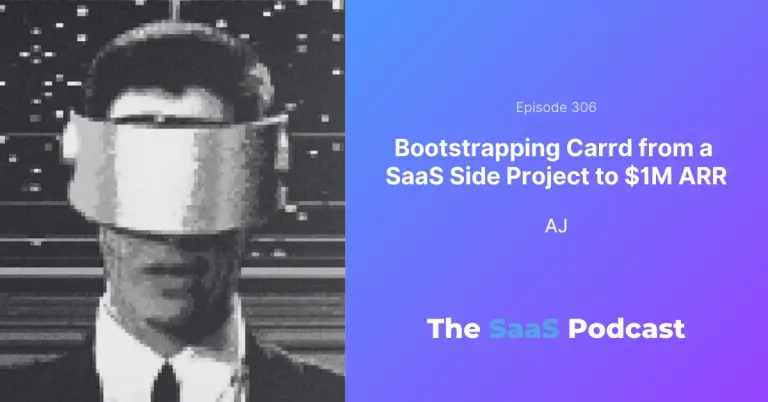
In this episode I talk to AJ, the co founder of Carrd, a SaaS platform for building simple and fully responsive one page websites.
After building and selling website templates and themes for several years, AJ created a website builder for really simple one page websites.
He didn't have high expectations for the software and thought of it more like a vanity project that hopefully would help pay for his lattes.
But the product turned out to be a lot more popular than AJ had expected, even though it was a freemium product.
With just a $19 a year paid plan, he managed to bootstrap to around 30,000 in monthly recurring revenue by 2020.
I interviewed him that year and you can listen to that interview on episode 225 where we talk about how he went from 0 to 30k in MRR.
In the last 18 months his business has grown to over a million dollars.
In ARR, he's raised $2 million in funding and is now hosting over 4 million websites.
So I invited him back to update us on his story.
In this interview, we pick up on where we left off in episode 225.
We talk about how he's been able to grow to seven figures with a team of just two people.
It's a great interview and I hope you enjoy it.
Aj, welcome to the show.
AJ (01:51.920)
Hey, thanks for having me back.
It's been a while.
Omer (01:53.680)
Yeah, I think it was the summer of 2019, so at least 18 months and a lot has happened since then that we're going to talk about.
So I always ask people if they have a favorite quote, something that inspires or motivates them or gets them out of bed.
I can't remember what you said last time.
You probably can't either.
AJ (02:09.160)
No, I don't.
Omer (02:09.880)
Anything you can share with us?
AJ (02:11.589)
No, I don't know.
I think just knowing I get to work on something that actually is starting to make a difference and really kind of people enjoy, I think that's motivation enough for me at least.
Omer (02:23.509)
So just tell people who aren't familiar with carrd what does the product do, who is it for and what's the main problem you're helping to solve?
AJ (02:30.229)
Sure.
So carrd is a one page site builder meant for basically anyone and the problem it's meant to solve is if you need to build a one page site there's the tool to do it, which is probably not the most marketing friendly explanation of it.
But that is essentially it in a nutshell.
It never started out with a specific customer base or user base that it was targeting.
It was sort of a side vanity project that I suppose people ended up finding and finding ways to use it in their own interesting ways.
And I've been keeping up with them ever since.
Omer (03:03.350)
So when we talked last time, which was episode224.
5.
So if we want to go back and listen to the story of how you got started and built this business, they can go back and listen to that.
You were doing about 30k mrr.
The business had been bootstrapped.
I can't remember how many users or sites you were supporting at the time, but just give us an overview of like where are you right now in terms of revenue, users, number of sites that people have built on Card?
AJ (03:28.290)
Sure.
So we're at about 100k mrr.
So about 1.2 million ARR, 2.6 million users.
And I think as of today we're about to cross the 4 million site mark.
So it's a pretty, pretty decent bump over where we were back then.
Omer (03:44.840)
Wow.
Yeah, That's a lot of growth in the last 18 months.
And you also raised some money, right?
Yeah.
How much did you raise?
AJ (03:52.520)
We did just a small, I guess it's relatively speaking.
Right.
It was a 2 million raise from about a dozen or so separate investors.
And I've mentioned this numerous times, but Card was and still is profitable.
But that raise was very much a kind of a response to how we were feeling about where this thing was going and the fact that we lacked the network and expertise to handle certain things that were coming our way or at least things that we anticipated.
Happy to get into why that that even happened to begin with.
Omer (04:22.560)
Yeah, no, let's do that.
Because I think it's relevant to setting the context for a lot of what we're going to talk about, I think.
AJ (04:28.910)
Sure.
Yeah.
So you and I, we chatted around summer of 2019 and you know, then 2020 happened and that was a whole cluster for everybody.
For us specifically, the beginning part of the year had a lot of people because of the pandemic going online and I think trying to figure out new ways to work, new ways to make a living for various reasons.
And part of that was for some people building a website.
And so us and a bunch of other platforms in the same space or even those kind of peripheral to it all kind of felt a windfall.
From that.
And that, you know, that was kind of surprising because it was a very noticeable bump over what we had been doing previously.
And then specific to us a few months later, with all the political protests that were happening in the US at the time, Card became a tool that a lot of activists had discovered and were starting to use, and in a big way.
And that between that and a. I'm not going to call it an endorsement by Kim Kardashian, but she did certainly tweet out a site that was built on Card, and that literally set our.
Well, not literally figuratively set our servers on fire.
And it gave us, like another huge growth boost, which was really weird because it wasn't something like none of us expected that was going to be a thing.
And it forced us to kind of reevaluate what is this thing we've built, where is it going?
I mean, it certainly can't be a side project at that point because it was used by so many people and it was in play in, like, news articles and stuff like that.
It was a very strange time for us.
But that got us thinking, like, what are we doing?
What are we doing?
Are we going to keep treating as like a side project that just makes us some good money on the side, or are we actually going to try to really take it to where it can really go?
And the problem with, you know, I think we ended up deciding, well, the latter because there's clearly a ton of potential here that we have yet to unlock.
The problem was neither myself nor my now co founder, Donnie, really had any expertise relevant to that, that, like, neither of us had run a product like this.
Neither of us were really expecting to either.
And there were just a lot of questions that we had a lot of concerns about how do we handle different things that may come our way running a platform like this?
Scale issues, if we need to hire, how the hell do we go about that?
It was just a ton of stuff that we didn't know.
And what it led to was we had over time.
I think anyone who's building a product of any kind, you'll probably get some emails, cold emails from VCs or other potential investors kind of interested in talking to you about what you're building and if it's a good investment for them.
And that's obviously been the case with Card for a number of years.
But at this point, we had decided, well, maybe again, up until that point, I was kind of hesitant to go down that path because we didn't need the money.
We still didn't need the money.
But someone told me that there's more to raising than just money.
There's.
When you bring in someone else who is, you know, financially invested in your product, to some extent, they have a stake in it, and they have a personal almost obligation to give you, to share with, you know, share with you advice and anything else they can give you that will help their investment.
Essentially, you know, as they like to say, it aligns.
And.
Oh.
And when I realized that was the case, it was like, okay, maybe we can be open to at least discussing this.
And so we sat down and talked to a few investors, and we ended up going with Rainfall Ventures.
Great guys, they led our round.
And we ended up having another dozen or so smaller investors made up of angels and other VCs hopping on to basically do a very small seed round.
And we, yeah, we ended up basically getting ourselves a network of people who had years of experience working with or even in companies like ours, sharing their expertise and their connections and everything.
And that got us through some, I wouldn't say like, horribly bad times, but it got us through, like, a lot of things that were causing me some level of panic, like scale.
One major example of that was the infrastructure I had kind of built out for CARD up until that point.
Well, really up until the beginning of 2020 was supposed to last us for a good number of years.
Like, I thought, oh, yeah, this is good.
Based on our growth, we'll do just fine with this for a number of years.
After all the stuff that happened in 2020, we were basically looking at infrastructure that would fall over by kind of like April of 2020.
2021, rather.
No, wait, 2021?
Yeah, it basically cut it down from a number of years, so basically like six months or so.
And I was like, oh, crap, what do I do from here?
The connections that we got through RAS gave us access to people at aws.
I actually got a call with a few engineers from AWS who walked me through everything and explained, like, how to use certain things that would benefit us.
And, you know, we ended up coming with a new infrastructure that we ended up migrating to just a few months later that has allowed us to grow to where we are now, which is coming up on 4 million sites.
There's no way we could have done that, what we had before.
So I guess the TLDR is like, we did the raise again, not so much for the money, although that's certainly nice, but especially for the network that we've gotten since doing that.
And we feel so much More confident now going forward and doing things because we know we now have all these people in our corner who are willing to just give us advice and information anytime we need it.
Omer (09:39.080)
That's great.
I didn't even know you had a co founder when we talked last time.
I think it was just you working on the business at the time.
So just.
Can you just explain the co founder relationship and why maybe Donnie was not on the radar when we talked like a year and a half ago?
AJ (09:54.280)
Well, I mean, in general he's kind of like a behind the scenes guy anyway, but he'd been running all the other projects that we'd been working on together years as I was kind of the early stages of building Card and it was sort of around, I want to say, like maybe in 2019 or maybe even 2018, where it started like the day to day of doing support and content moderation.
Everything else was starting to kind of take up more of my time than I wanted.
And so I was like, hey, maybe you should get on this and take all that off my plate so I can actually work on it.
He's like, yeah, sure, whatever.
So he's just been running the day to day for the product ever since.
And you know, as the thing has grown, so has the responsibilities that come with that.
It's been nice having someone who again, equally invested in the product as I am, but also handling stuff that I just don't want to do, which, I mean, I don't mind doing support, but you know, when I'm trying to also do, you know, run the product and do development and you know, all kinds of other stuff, it helps to have someone take care of kind of the, the aftermath of having the growth that we've had, which is, you know, support and just staying in touch with the community and that type of thing.
Omer (10:56.330)
So what has driven the growth?
Obviously 2020 with COVID and I think a lot of SaaS, products that sort of enable people to build online businesses saw, you know, spikes in, in traffic throughout that year.
Number one.
Was it similar in 2021 or did you see things, you know, sort of organic traffic start to decline and go back to sort of previous levels or has it stayed pretty high?
AJ (11:22.730)
It's a, it's stayed high, but it's not like the, the very, I guess the hockey stick kind of growth that we had in the middle of 2020.
And that, quite honestly that was, that made me extremely uncomfortable having that much growth all at once.
But the, you know, now that things have kind of settled down, it's not quite that, but it's definitely more than what we used to have.
So we were able to retain some of that boost that we got from 2020.
And in a way that.
And now we're sort of at this point where the growth is very sustainable.
It feels like we're comfortable with it, we're continuing to grow, but not in a way that's potentially making us make rash decisions to keep up with it, which is what I felt like 2020 could have led to had we not done the raise and brought people in who basically talked us off a few ledges, let's just say.
But yeah, yeah, it's definitely stabilized, which is a good thing.
Omer (12:11.480)
So aside from COVID you talked about the protests and how activists are starting to use card, which can be a good thing or a bad thing, depending on what they're active about and what's driven the growth.
I mean, when we talked last time, a lot of it was.
A lot of it was organic.
I guess when I think back, there were two things from a kind of quote marketing perspective that you were doing.
Number one is you were pretty active on Twitter, and I don't think that has changed that much.
And you're kind of basically like just building in public and just, you know, people were able to see what was going on and how you were growing this business and what you were learning along the way, which I think helped you to build a massive following.
Like, how many followers do you have on Twitter now?
AJ (12:54.540)
I think like 55, 56,000 followers.
I mean, nothing ultra massive, nothing Kim
Omer (13:00.220)
Kardashian level, but that's.
AJ (13:01.900)
No, certainly not.
It's interesting you mentioned that though, because, like, I guess in a way, if that I remember back then, yeah, I did actually tweet quite a bit more than I do now.
I mean, the reality is, like, I haven't been as active lately on Twitter and in that way, and yet the growth is still coming.
So I guess the growth has shifted from doing that to something else.
And it's not like.
It's not like I have a problem with Twitter or anything.
It's just simply a function of time.
Most of my screen time now is work related, like straight up, just in code and managing things like that.
So I try to.
When I'm not doing that, I try not to be in front of a screen just for my own health and whatnot.
So I would say that the.
You could argue that back then, yes, I think that's where much of the growth came from, was just building in public and Kind of sharing that experience with a lot of people so they could see what went into this and what came of it.
I think in more recent years, it's essentially a form of the network effect.
I think the users and the community that uses Card now are the ones perpetuating its growth, more so than anything I'm doing directly.
Yeah, there are certainly, you know, when we add certain new features that catch on really well or things like that.
Yeah.
That obviously we're making some impact ourselves.
But I think at this point we've reached the level where the community is sort of bringing the product forward.
And you know, I talked about this a little bit earlier, but it feels like the product is now the thing that has the momentum and it's pulling us along rather than us trying push it in a certain direction or try to get the momentum going.
Like, I think we've hit that point now where it's sustaining itself and we're just sort of along for that ride and wherever it takes us.
Omer (14:39.020)
Yeah, I think that's interesting.
And one of the other things that I think has contributed to the growth is, number one, it's very easy for anyone to.
To build a site on Card.
Number two, it's free.
AJ (14:51.500)
Yeah.
Quite honestly, I think that is the.
That is by far the biggest thing.
I mean, that's.
I mean, I can sit here and try to pretend that like, oh, we do this particular thing in a very special way or, you know, we're so innovative or whatever.
No, I just think the fact that we're free is probably the biggest contributor.
That's it.
Omer (15:06.560)
Yeah.
And then you also have.
Every free site also has that Made with Card link on it.
Right.
So that's the kind of the built in virality that every time somebody is building a site out, they're also telling other people about Card who can also build their own free sites.
But aside from those two things, what you were doing on Twitter and just the.
Let's just say the Made with Card link is kind of, you know, and the freemium model has helped.
Is there anything else that you've done over the last 18 months to drive growth?
Or you can look at and say, yeah, it kind of loosely falls in the marketing, I think.
AJ (15:39.530)
So my view on marketing in general, especially for Card, is given that we're such a small shop, like literally two people.
Do I invest my time in finding ways to market the product or I just invest my time in the product itself?
And so I generally choose the latter, not because there's anything wrong with the former.
You know, marketing is a very valid thing to do.
I look at my.
The best thing I can do is just keep making the product better, keep doing what users want.
They'll be happier and then they'll tell people about it, and then, you know, we'll just continue to grow as we have.
And so that's really been what we've been doing over the last year and a half or so, is just continuing to work on it.
I actually, recently I did one of the rare tweets I made.
I actually did tweet out just the kind of a breakdown of the number of commits made to cards code base in the last few.
Over the last few years.
In 2021, we did way more commits to the.
Well changes to the code base than previous years, like a pretty.
By a pretty big margin.
And I think that kind of speaks to what I'm describing.
Just the investment of time in the product itself is the marketing in many ways.
And we've seen it.
We've seen the results of that.
I don't know if I can point to one specific feature or change we've done that has kicked off a new wave of growth or anything.
There have been some things like that in the past, but I think it's just sort of like the cumulative effect of showing people that, yeah, we actually give a shit about this thing and we give a shit that you use this and we want to keep making this thing.
The product that brought you to us to begin with.
Omer (17:10.000)
Yeah, that's great.
Let's drill down into that a little bit more.
Maybe people who are listening to this and thinking, how can I do a better job with my product to create that kind of response where word of mouth is helping drive the product.
And if we take out, we say, yeah, the freemium piece, the some kind of branding as a way to get some virality.
Other than that, if you were building a new product from scratch, what are some of the lessons that you've learned from CARRD that you can point to and say, well, these are the three or four things I would definitely do as I start to build this product out to make sure that I was building a great product, that I was listening to my customers, that I was building the right features, not wasting time on things that, you know, take me down a rabbit hole, but don't provide any real impact for the business, because there's a bunch of stuff that you have learned and got better at doing over the last few years when it comes to building a great product.
So what.
What are some of those lessons that you can share or maybe you'd apply yourself if you were going out and doing this.
AJ (18:16.630)
I think the biggest thing I think I've gotten better at is quite honestly just listening to the people who actually use this thing.
And it's funny to, you know, this is going to vary from product to product.
I think Card is one of those products that's relatively open ended in what it's used for.
And so some of the lessons that I've learned won't apply to other more products with more specific, you know, specific customers in mind or specific use cases or what have you.
But at least in the case of products like Card, I mean when it's open ended, the way we've made it, when people come to us with feature requests or ideas, I mean that's in some ways giving us the direction that we didn't initially put in ourselves.
So it's like we're almost like we put this thing out there, it has some kind of general direction as to what you can do with it, but we're leaving it very much.
You know, it's a choose your own adventure type deal.
And so when you do that, you're almost like casting a very wide net and just seeing what it happens to catch or the kinds of people you happen to catch.
And it's.
And once you've actually had, you know, you've actually caught people who.
And people are basically using this thing and they come to you asking, hey, it'd be cool if you could do this or hey, have you ever considered supporting this feature or whatever.
You ought to take that very seriously.
And it doesn't mean just bolt it on haphazardly and leave it at that.
But it is one of those things that should inform you as to what you actually built, at least in our case.
And so I don't know if that makes any sense, but basically like, can
Omer (19:41.780)
you give us an example?
AJ (19:42.860)
Sure.
So one of the biggest features that we ended up implementing that changed sort of how CARRD was used was the ability to do what are essentially virtual pages.
You know, Card starts out as, it's a one page site builder.
That was the whole thing.
But I remember having a guy who was saying, he's like, well that's great, but I need to be able to have like a separate page with my contact information.
Cause I don't want it on the main thing or whatever.
I'm like, well, you know, Card's a one page thing.
I don't know how like we're not going to Turn it into a multi page site builder for something like that.
But I did, you know, that guy requested and then I had someone else request the same thing.
I was like, okay, maybe there is something here we can do that won't necessarily compromise what the product is, but give these particular people a feature that they can make use of and accomplish what they want to accomplish.
And so the idea of sections within Card, which are virtual sort of pages within the same page, that's where that came from.
And not only did it solve their problem, but ended up solving a bunch of other problems for other people that we didn't predict.
And at the same time it added a whole new dimension to the product that we had never anticipated.
And so, you know, it's weird to think about that like a user request ended up kind of changing a good chunk of the product in a way that I never anticipated.
And I guess what I'm saying is like be open to that kind of thing.
Be open to the people using your product actually influencing where it goes as opposed to being extremely dogmatic or strict about what your vision is.
So I don't know, like that's probably one of the biggest examples that we've had.
Omer (21:13.000)
Yeah, I think that's a really good example because you took the requirement and you could have easily turned this into, yeah, you can add multiple pages and then you could have evolved into basically becoming another squarespace or a WIX type product.
But the thing that's always differentiated carrd from those types of site builders is this whole concept of a one page website.
So I think the way you implemented that, which was I'm going to give you a way to meet your requirement without going off the rails on how we think about Card and this one page website sort of philosophy.
So that's a good example.
But you don't have a team of 10 developers.
It's just you doing all of this really.
AJ (21:59.690)
Right.
Omer (22:00.050)
Donnie's helping with the other stuff, but when it comes to building the product it's just you.
And so how do you differentiate between the things that you should invest your time in and maybe other stuff that cause you're going to, you're going to keep, you keep getting lots of requests and people are asking for stuff.
Some of those things are going to be really valuable and they're going to help to improve the experience and grow the business.
And others might be interesting for some people, but at the end of the day you could look back easily and say wasted a couple of months building something that really wasn't really Worth the time.
So when you're thinking about all of these things, I guess it's more of a prioritization question, like how do you decide what's worth building?
AJ (22:37.990)
I mean, that is always the problem, especially when you're basically solo developing something.
Actually, even with a team, I mean, you've got limited resources.
You have to use them in like a very strategic way, whether it's one developer or ten.
That being said, I think the thing I try to do is figure out what feature requests are going to benefit.
You know, can I first I'll, you know, some requests I just have to kind of.
I mean, I hate to say it, but discard offhand because like, I'm not going to do that because that's so far out of what this product is that it's not suitable for that.
And you would almost be better off using a product that was built specifically for that.
Most other things though, I'll look at it and try to figure out, you know, just as the way we handle the multi page thing, it's like, is there a way we can do this in a way that doesn't compromise what the product is, but at the same time, is there a way to do it in a way that avoids that situation where we build a feature and it's only used by 10 people?
Is there a way we can build this in such a way that it solves the problem being presented to us, but also solves it for a wider range of people?
So basically taking the feature requests and generalizing it in such a way that the very diverse user base of Card can benefit from this in some way as opposed to just the very specific niche thing that may have brought that to our attention.
So you kind of have to prioritize that way.
And if I can't figure out that right away, a lot of times I'll just back burner and maybe come back to it later.
And then the stuff that definitely.
Oh yeah, we can totally do that now, that may end up taking priority depending on how we feel about.
Omer (24:11.410)
Yeah, I don't think there's any easy answer to that.
And there's a lot of noise that you have to go through to figure out what are the things that you should spend your limited time on.
Although you are hiring your first employee very soon, right?
AJ (24:24.290)
Yes.
Actually, then that is sort of like a very big step and a big development and not just, you know, any employee.
This is going to be a developer to actually work with me on Card itself.
So that's going to be a very Exciting and very new thing for me because I've never been in that situation before.
But it became clear a few months ago that, so to speak to the, you know, feature request thing, it got to where there were a lot of things that I realized we could do that made sense, but there's no way one developer can do it all.
And I realized that, you know, once I realized that, I was like, oh, crap, I'm the bottleneck now.
Like, we can't have that.
Like, it doesn't make sense to just have one person working on this when there's so much that we could be doing that could be benefiting the community that uses this.
So that was a hard thing to get over.
But when I realized, like, oh, well, you know, there is a way, it's called hiring people, I was like, okay, maybe I should try that.
It's apparently worked out for other people, so surely it could work out for me too.
So that's going to be the next thing that's happening, which is very exciting.
Omer (25:23.330)
Are you getting encouraged by your investors to hire more people your size of doing over a million arrows?
It feels like you should at least have a handful more people on the team helping to grow this business faster.
AJ (25:35.100)
There's two parts to that.
The first is, like, when we were deciding on who to bring a board for this, we were very careful to pick investors who aligned with where we are on a lot of these issues.
So hiring, I've never been a fan of just, let's just hire a dozen people and see what happens.
Because I feel like you would end up just, I think, wasting a lot of people's time, wasting a lot of money without having a clear direction for what you're going to do with these new resources.
Right.
So it was important to bring people aboard who are not going to push us in that direction, because that's not very thoughtful.
And if there's one thing I can say about Card, at least is that it's been in many ways thoughtfully built.
And I'd like to continue that even on the company side.
Right.
So that's one part of it.
The other is so that we did bring on people who weren't going to push us.
And the other thing is, they have mentioned probably not a bad idea to hire, but they've also said, but, you know, it's important that you feel like the time is right to do that.
And that's a very encouraging thing for us because we know they actually have the, you know, the best interest of the product in mind and not Just the, and actually the best interest of us in mind, the, you know, the people actually behind this because I think if they know if we ended up, if they just kept telling us, hey, go higher and we're just like, fine, we'll go higher.
And we end up making a terrible mistake.
Hiring a bunch of people and you know, sinking the product, syncing the company, that's not good for anyone.
So it's encouraging to have people aboard who are aligned with us in that way and who basically said hiring is a good thing sometimes, but don't feel pressured to do it until you are ready to do it.
And so that's been the consensus among all the investors that we brought in and that's given us a lot of breathing room to really think about these issues, whether or not we actually need people.
And in the case of the development side, yes, like as of a few months ago, I decided we need help there as opposed to someone else telling me, just hire some developers and figure it out.
Omer (27:29.710)
Right?
Yeah, yeah.
And I think there's an important lesson there that you brought up that a lot of times founders are so focused on investors and term sheets, how much money they should raise and all of this stuff.
And I think the first, probably the first fundamental question should be is are you working with the right type of investors?
Because maybe you're going to get that money and then you're going to regret it for the next, however, how many years?
Because you're, the way you and your investors look at the company and the philosophy and all of that stuff is so different that it becomes problematic.
And so I think that's a really good place to start, is to make sure that whoever you're considering as an investor, and it's hard in the early days when you're trying to raise money and maybe most people are saying no to you.
When someone says yes, you don't want to then say, well, I don't know, let me see if you're the right person.
But I think it's so important because it's kind of as important as picking the right co founder that you've got a long term relationship with somebody here.
AJ (28:28.270)
That's what it is, it's a long term relationship.
And in our particular situation we were extremely lucky because Card had already been a product that was, it was running for some time, it was already bootstrapped, it was making money, it was profitable.
And so the investors really came to us, we didn't really have to go to anyone and we were able to be a little bit Picky about who would come aboard.
And it is, I will say this, everybody we spoke to, even the people we ended up not going with, were fantastic people.
But it's essentially like dating.
You have to kind of both be into it, right?
So it has like, you have to make sure you're a good fit and sometimes it's just not a good fit.
Like, and I'm not talking just the people, but also the product.
Because I think in our case we brought on investors who are relatively hands off and they're there whenever we need the expertise and insight and things.
And they've been fantastic about that.
There are other products and founders who need investors who have a much more hands on, almost like daily involvement in their product.
There were some investors we talked to who kind of wanted that sort of thing, but that's not what we're into.
And they were totally understanding that that's fine, didn't work out, but that's okay.
But I guess what I'm saying is like there's, there is a good investor fit.
I think for almost any product or company out there.
You just, if you have the opportunity to be a bit more picky, you know, go for it.
Because I think that's going to be ultimately beneficial to both sides.
Omer (29:50.260)
Yeah, yeah, I agree.
When we talked last time, you were in pretty good shape.
You were happy building the product, you're bootstrapped, profitable.
Sounds like you're still happy with where the business is right now and what you're doing.
But things have changed.
You've got investors, you've raised a couple of million dollars, you've incorporated a company, got an official company email address now, which.
So what's it been like making that transition from working on a side project
AJ (30:21.270)
to a business mechanically, not a whole lot has changed.
Like, it still feels about the same.
I think the most of the change has really been in our perception of what we're building.
So yeah, for the most part, we still work on it exactly the same way we did before.
We have more resources now to take care of some of the things we don't really care to do ourselves, like the accounting side and all that.
So we have, you know, professional people handling a lot of that stuff now, which is great.
But the biggest change has been in just our, like I said, perception of this thing.
For a number of years it was a, you know, I didn't.
Again, I said at the beginning, like, this is a vanity project for me.
Like, I literally went into card just wanting to do something different, just wanted to try something I didn't really have high expectations for it.
I didn't have any plans to turn into a business.
And then when it started gaining traction, I was very pleased because I was like, oh, cool.
The side project's actually going to, you know, bring me a couple hundred bucks a month.
That's great.
I can, I don't know, go buy my lattes or whatever.
I don't know.
Like, it was exciting to just have.
And I think anyone who's building a product the first time it's makes them a little bit of money, they get very excited, and I can fully relate to that.
But then when that number starts increasing over time, and then also just the amount of work that goes into it, and then bigger than that is when you see people actually relying on the thing you built, it's not just something that they're messing with on the side.
It's a critical part of whatever they happen to be doing that changes the game for you quite a bit.
For me, that was a level of denial for a number of years about what card was.
I mean, really, I think when you and I spoke, that denial was there to some extent, because that's really when it's starting to pick up on its own quite a bit.
And then 2020 kind of forced me to just come to terms with that entirely because I had no other choice.
But really, 2019 through mid-2020, it was a struggle for me to get over this idea that this thing isn't just a side project anymore.
This is an actual product that people rely on.
It's going to require a certain level of professionalism I've maybe avoided having to engage in up until that point.
And more than that, turning into something that's sustainable, it can run for a long time that people can depend on.
These types of questions I try to avoid asking myself up until the middle of 2020 when shit hit the fan and I had no choice but to come to terms with all those things.
So I guess to answer your question, there hasn't been much of a change in terms of running the product itself or any of that type of stuff.
It's just been purely mental mindset on my part, trying to get over the side project mindset and, you know, get into the mindset of someone who's running a product that people need and depend on and use for business, use for their careers and all kinds of things, and the responsibility that comes with that.
Omer (33:02.020)
What do you think was causing that resistance that was holding you back from accepting that with jumping in with both feet?
AJ (33:09.180)
I Think a lot of folks who get into, you know, building products, they do.
I think they do it with more intentionality.
I didn't like, I just sort of.
I picked this because it made sense, given my skill set at the time.
I was like, yeah, this will be kind of a cool portfolio piece.
I didn't plan for it to go this way.
And so I, I had never really.
It never occurred to me that it could ever end up like this.
And when it started going that way, I guess I just wasn't ready to accept that.
Whereas I know other people who do go into things with more intentionality, like they.
But when it does get to that point, they already have sort of like the right mindset to move to the next level.
I didn't have that, so it took me some time to develop it.
Omer (33:50.540)
How do you think about your customers?
We talked about the activists earlier, but do you segment your customers or do you look at that and say there's.
There are like four or five types of people that mostly use Card.
And so you think about the use cases each of those group has and how to build a better product for them.
Or is it still pretty much where, I think where you were when we talked last time, which was, it's an all purpose solution which can be used in pretty much any scenario as long as you want.
You're okay with a one page website and you leave it pretty open for people to use how they want.
So is that still the case or are you finding that you're getting a little bit more focused on certain user types or thinking a bit more about the product and these use cases in sort of more of a vertical model?
AJ (34:36.200)
So a little bit of both.
I think it's still.
We still look at it as a, as like a general purpose tool for anyone who wants one page website, as you said.
But definitely in the last year or two, we've been a bit more cognizant of the specific ways that Card gets used.
And mostly because it's like, well, obviously you have to cater to who's actually using your product.
It's less about going vertical, more about making sure we're not missing the forest through the trees.
Is that how you say it?
You know, like if.
Because, you know, if like a 90% of our user base is using Card in this specific way, it's like, well, we kind of have to make decisions based on that as opposed to only catering to a very small percentage.
But the other side of that is being a freemium product.
There are situations where we have A number of free users who use card in a specific way or for a specific thing.
And then there may be, like a percentage of users who are much smaller than that other free group that use card for something, but they actually pay.
So you have to kind of like, balance these two things out, because if you only cater to the much larger free demographic who don't.
Who are never going to pay for anything, you could end up being in a situation where you're no longer economically viable, which is a problem.
At the same time, you don't want to only focus on the people who pay, because having that community of users who, you know, a good percentage of which may be free, they're also kind of like your marketing to an extent.
So you have to invest across the board regardless of whether or not they're paying or not.
So it's an interesting balance.
Like, and it's really only, like I said, in the last year or so, we're starting to pay a bit more attention to the specific groups of people who use card and try to, you know, not only cater to that, but at least have that inform some of our decisions as to the features that we add.
We were discussing previously about how you prioritize.
That metric has now kind of factored into how we prioritize certain features.
Omer (36:29.200)
Have you changed much on pricing?
It doesn't look that different from when we.
We talked last time.
You can go on a pro plan and build 10 card sites for $19 a year, not $19 a month, $19 a year.
Have you tried different things on the pricing front, or have you just pretty much focused most of your efforts just on the product and whoever buys, great.
If they don't, they don't.
AJ (36:52.670)
So pricing has stayed largely the same.
And we did, I think, maybe a year ago, we introduced variants of each plan.
So, like, there was the base level plan, you know, Pro Lights standard, and then.
Plus those prices have remained the same.
But we did have situations where people wanted to be on, let's say, Pro Lite, but they wanted to build more than the three sites that it comes with.
So now you can upgrade to a Pro Lite 10 plan, which gives you everything on Pro lite, but with 10 sites instead of just three.
Pricing for us, it's been.
It's one of those things where people are like, you're too cheap.
You need to charge more.
But then at the same time, I'm like, well, at the same time, we're a freemium product, and if we make that bar too high, people aren't going to want to step over it.
And we have a very large contingent of free users who, like.
And we see this every year that we do our Black Friday sale.
When we slash that price down, like, by 40% or sometimes 50%, the conversion rate shoots through the roof.
It's nuts.
So to me, that means, like, if you're almost, like, if you raise the price too high, you're actually going to make less money than if you keep it affordable and, you know, just run sales every once in a while to bring it down even further.
And, you know, I'm no expert on pricing products or anything like that.
I just know that the.
What we have has worked quite well.
And I'd rather focus on just making the product better and kind of increasing the odds that you'll want to convert to a paid user than, you know, kind of min.
Maxing the pricing on our plans.
Omer (38:19.990)
You've been.
I think you've been thoughtful, deliberate about how you built a business.
And that was one of the things I was curious about when I heard that you'd raised money.
Like, how have things changed?
Is it like.
Yeah, we've got a whole bunch of open positions now, and we're spending a whole bunch of time now trying to figure out how to convert more of our free users into paid users and optimize pricing and stuff like that.
And it sounds like most of that isn't really happening or you're not putting a lot of time or effort into any of those.
It's just about business as usual.
But now you have, I guess, a team of advisors who can help you fill in the gaps where the two of you feel that, you know, you don't have the.
The experience or the expertise.
AJ (39:04.700)
Yeah, that's.
That is a perfect way to describe it.
I mean, we wanted it to kind of go this way.
If we brought on investors, we made it clear it's like, we're not going to change what the product is or who we are, how we go about building it.
We will, of course, fill in the gaps that we have with expertise and of course, listen, you know, because we don't know everything.
You know, there's.
The people that we brought on have combined decades and decades of experience with products that are similar or peripheral to what we're working on.
And, you know, it'd be stupid of us to just think that we know everything, but at the same time, like, what got us here, we don't want to lose that.
We don't want to, you know, just become like everybody else.
And they know that we know that.
So it's worked out great.
And as far as like investing time in trying to convert more free users to paid users, I mean, as I said, I mean that's, you know, that is something that you want.
I mean you don't want to be in a situation where like you're not, if you are running a freemium product, you don't want to be in a situation where the paid aspect to it no one pays for because then you're clearly doing something wrong there.
So it's an ongoing thing to always increase the value of that.
But I mean that's basically been our approach though.
It's making the value proposition of going pro on card attractive to more people.
And so that means making it better, adding more features to it, making it almost like a no brainer that yes, if you use card and you enjoy it, why wouldn't you pay the $9 a year or 19 bucks a year to go pro and enjoy the full range of features or many more than you otherwise would have?
Omer (40:33.280)
Yeah.
What's the tech stack, by the way?
I can't remember if I asked you this.
Look what's going on in the backend.
What are you building this on?
AJ (40:39.510)
A large amount of JavaScript.
I mean, I try not to get too deep into the actual tech stack because it's kind of always changing to some extent.
The one very big thing that did change over the last year or so is that migration to aws.
So what we had before was sort of like this, if you can believe it, very like old school bare metal server setup at IBM, cloud like physical servers, which as you can imagine in this day and age it's probably not the best thing to have because there's.
Yeah, like the administration of actual hardware.
If you want to talk about things that take you away from actually working on a product, that's one of those things.
And migrating to something like aws, I mean that made it.
I can't stress how much better things have been.
Even though people have told me that for years that we should be doing that.
It's one of those things where I'll get to it eventually and then I'll sort of.
My hand was, as I mentioned before, our infrastructure plans kind of had to change due to all that growth.
Omer (41:35.070)
Yeah, you had no choice.
AJ (41:36.430)
Yeah, so I had no choice but to learn it.
And I was like, well shit, why didn't I do this sooner?
That is one of the downsides to basically being a solo developer person on a product like this is that having other people around you who have familiarity with stuff, who can kind of push you in different directions and encourage you.
That would have been helpful as opposed to me just putting things off or not bothering to.
Yeah, I'll get to it when I get to it.
Putting.
Putting on the back burner when it could have been extremely beneficial early on.
But.
But yeah, that.
That shift to AWS was something else.
And we were able to.
It took about a month of planning to migrate everything over while keeping all, I think at the time, like two, two and a half million sites online at the time or something to that effect.
How many sites we had at that point without any downtime.
I was able to pull that off.
So I was very proud of myself for doing that.
Omer (42:24.510)
Did you have to kind of re architect the backend in any way or.
It was like you didn't have to change much about how the product worked to move over to aws.
AJ (42:33.360)
There were.
So there were some minor tweaks I had to make.
I mean, luckily, because of the way card works, it was already kind of conducive to being somewhat portable in terms of at least the sites that it would create.
Those are pretty portable.
I did.
Because we're making such a big move.
I did take that opportunity to implement some fairly significant backend changes the way things were structured because if we were moving anyway, I could do all.
And I'm processing sites in bulk.
I can actually make a lot of those changes at that time.
So, I mean, that's actually why it took a month to plan out the move is because I was implementing some upgrades to how we did things internally to kind of get over some of the poor design choices I had made previously that I guess didn't scale quite as well.
Yeah, so there was some of that and I was.
I think I was 99% successful.
There was one hiccup right after I transitioned past the point of no return that required me to kind of stay up until about 4am like figuring out a solution for it.
And then I did.
And then I crashed and woke up sometime in the evening the next day.
But yeah, it went well.
Omer (43:36.990)
What does a bill from AWS look like when you're running a product and hosting 4 million sites?
Just curious.
AJ (43:45.310)
Pretty complicated.
Although I should mention that what really helped us and continue actually help.
Continues to help us is through the aws.
I think it's called the accelerator program or startup program.
You can basically get AWS credits.
And because one of the funds that One of the VCs that worked with us, they had, they're part of that program.
We got like a hundred thousand dollars in AWS credits.
So basically, to answer your question, I bill 0 for a number of months.
Omer (44:12.250)
Yeah, but they'll get you eventually.
AJ (44:13.930)
Yeah, eventually.
I mean, yeah, they go up into the thousands, as one would expect, but for a number of months there, it was free.
And it makes sense on AWS's part because that gives startups and products time to kind of get familiar with their platform, all the products, services that they offer, which is huge.
And you get deep into their ecosystem on their dime and then once you're there, you're not going to really move again unless you really hate their service, which I don't see why you would, because AWS is pretty fantastic from what I've seen of it.
Omer (44:45.610)
Yeah.
Yeah.
All right, we should wrap up.
Let's go on to the lightning round.
I've got seven quick fire questions for you.
You can answer them the same way as last time because I don't remember what you said, or you can come up with something new.
All right, you ready?
What's the best piece of business advice you've received?
AJ (45:01.130)
Delegate.
Learn to delegate.
At least something that I.
A good piece of advice that I ignored for years and it's only really within the last year or so that I've truly embraced it.
And wow, does it make a difference?
Like just accepting that you're not, you know, you're not the be all, end all, nor should you be.
You know, like, let other people take responsibility and you'll be surprised at how responsible they can be.
Omer (45:24.670)
What book would you recommend to our audience and why?
AJ (45:27.470)
None, because I have yet to have any time to actually sit down and read any books lately, unfortunately.
Omer (45:32.510)
What's one attribute or characteristic in your mind of a successful founder?
AJ (45:36.590)
I'd say a willingness to do all of the work.
I mean, you may be, you're not going to be the best at it, but a willingness to at least understand every aspect of your business.
So if you do, you know, if you do end up delegating, as I said, you at least have some understanding of what you're asking other people to do as opposed to just throwing them in willy nilly.
Omer (45:58.490)
What's your favorite personal productivity tool or habit?
AJ (46:01.930)
Lately it's been to do lists, which I know is extremely cliche.
But like, just that, I seem to respond really well when I especially days where I'm just kind of confused.
It's like there's so much that has to happen just sitting down and making a very short, organized list.
Of what needs to happen.
Nothing hyper detail, but just the high points of what needs to happen.
It's almost therapeutic and calming because then a lot of times you realize all the things that you needed to do.
It doesn't amount to more than four items on a to do list.
And it tends to calm me down quite a bit.
Omer (46:35.120)
What's a new or crazy business idea you'd love to pursue if you had the extra time?
AJ (46:39.040)
Oh, man.
Like, I don't know, I think maybe something in the VR space would be fun.
Like, I've always been a fan of VR, and I think it's one of those things that might finally maybe, possibly be hitting its stride.
Maybe.
And so because I know the technology has finally caught up, and I don't know, it'd be fun to do something in that space.
Omer (46:58.080)
What's an interesting or fun fact about you that most people don't know?
AJ (47:02.190)
Fun fact.
I don't know.
I'm not exactly the most fun personally.
Omer (47:05.950)
Well, you and I grew up in the same part of Northwest London.
AJ (47:10.030)
That's correct.
Omer (47:10.590)
Which most people wouldn't care about.
AJ (47:13.550)
But it's interesting.
Both of us.
Yeah, we both grew up Northwest London, Neo, specifically Harrow, which was kind of random that you would know about there.
Anyone know about it?
But I guess if you grew up there.
Yeah.
Omer (47:24.390)
Yep.
And finally, what's one of your most important passions outside of your work?
AJ (47:27.370)
3D printing, which is kind of a weird one.
I got a cheap 3D printer a few years ago just to mess with, and, like, it kind of culminated in this, like, weird side hobby where I've actually, like, designed and built a core XY3D printer from scratch over the last, like, year and a half.
Yeah, I know.
It's.
It was almost like a.
Again, almost like therapy because it's like you're working with physical things as opposed to, you know, purely digital code and everything.
So it was kind of like a nice departure from just doing that all day.
So, yeah, it's kind of weird.
Omer (47:56.120)
I think sometimes it's finding things like that, like you kind of described as therapy.
It's so important.
Like, the other day I was in my car and I noticed, you know, you have those grooves in all kinds of odd places in the car, like between this compartment or whatever.
AJ (48:12.320)
Right.
Omer (48:12.840)
I was just, like, picking at one of those things and removing some dust or some dirt from there, and 20 minutes later I was still doing it.
Right.
It was, like, so sad, but it was like.
It feels really good.
Just mindless stuff to just organize something clean up something.
AJ (48:28.900)
Yeah, I think you have to.
Especially if you work anywhere, even digitally or whatever.
And a lot of people do now because of, you know, remote work and whatnot.
I think you have to really offset it with something else, otherwise you really.
Something bad happens to you otherwise if you don't balance it out.
And for me, that's, you know, tinkering on 3D printers, which is a weird thing I never expected I'd be into, but there you go.
And, you know, for you, I guess it's picking dust out of your dash or something, which is fine.
You know, that's a.
Omer (48:57.010)
It's a thing.
AJ (48:57.970)
It's a thing.
It's good.
Omer (49:00.050)
All right, thank you for coming back and filling us in on what's happened over the last year and a half.
Always a pleasure to chat with you.
If people want to go and check out carrd, they can go to carrd.
C A R R D. And you have the dot com now as well.
Right.
So it's card.com or co. Yeah, dot
AJ (49:18.590)
com or co. Yeah.
Omer (49:20.270)
And if folks want to get in touch with you, what's the best way?
I assume that's Twitter.
AJ (49:23.470)
Yeah, just J, L, K, N. DMs are open.
Yeah, or just email me ajard c a r d co.
Omer (49:32.590)
Awesome.
Thanks, man.
Congratulations on everything that's happened since we last spoke and.
Yeah, let's stay in touch and let's see where you go with the product in the business.
And whenever you and I chat, we always seem to find a whole bunch of weird similarities about our backgrounds and stuff.
AJ (49:49.160)
So, yeah, growing up in the same.
I'd argue some somewhat obscure part of London is kind of strange.
There you have it.
Omer (49:56.120)
Yes.
Yes.
And for people listening, that was just one weird similarity.
AJ (50:00.160)
Yeah, there were a few more to talk about those.
Yeah.
Cool.
Omer (50:04.600)
All right, thanks, man.
It's been a pleasure.
All the best.
And speak to you soon.
AJ (50:07.480)
Likewise.
Hey, man, thanks for having me again.
See you.
Omer (50:09.360)
Cheers.