Omer (00:10.160)
Welcome to another episode of the SaaS Podcast.
I'm your host Omer Khan, and this is the show where I interview proven founders and industry experts who share their stories, strategies and insights to help you build, launch, and grow your SaaS business.
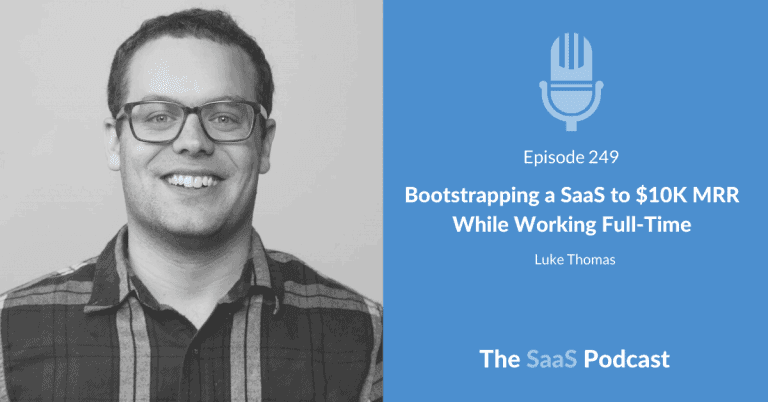
In 2013, Luke quit his job at a startup.
He'd enjoyed working there, but lately didn't feel like he was getting the support he needed from his manager.
But rather than having a potentially uncomfortable conversation with his manager, it was easier for Luke just to find a new job.
And he reflected on that experience and thought, if my manager had just regularly asked me a few questions, I would have shared my concerns and probably stayed at the company.
He began thinking of ways that software could help to break down those barriers so employees could give feedback and provide updates regularly.
And that's when the Idea for his SaaS product was born.
But it took him nearly three years to start building a product.
In late 2015, he spun up a new Ruby on Rails app and hoped that the side project that he was going to start would make him an extra thousand dollars a month or so.
He shipped the product in January 2016 and it took him three months to find his first customer.
He was over the moon that he was earning $45 a month.
He kept working on his product and doing whatever he could to find customers.
There was no plan.
He just tried anything and everything to get the word out about the product.
He was now spending most evenings and weekends on this side project.
And over the next three years, he took the business from 0 to 10k in monthly recurring revenue while still working a full time job.
But it wasn't all smooth sailing.
Luke also faced several challenges along the way.
For example, he pivoted the product to become an HR tool and it helped grow sales.
But a year later, he realized he'd made the wrong decision and had to pivot back.
He also spent months talking to investors, but didn't raise any money.
They all wanted to know why he wasn't working on his business full time, and he didn't have any good answers.
He also didn't do a particularly good job at selling the vision for his business.
In this interview, we talk in detail about Luke's story.
We dig into how he found customers, what lessons he learned bootstrapping a SaaS business, and how in 2019, he eventually quit his job to work on his business full time.
If you're a new or early stage SaaS founder, I think you're going to love this interview.
Luke, welcome to the show.
Guest (02:53.100)
Nice to be here.
Omer (02:54.540)
You Know, I like to ask my guests if they have a favorite quote or, you know, in their own words, like, what drives or inspires them to work on their business.
So what gets you out of bed every day?
Guest (03:03.800)
Unfortunately, I don't have a specific quote that I can share, but the thing that really gets me excited about working on Friday is the fact that for the first 13 or 14 years of my life, I grew up in really, the middle of nowhere.
It was a small town in the middle of Maine, about 900 people.
And I always kind of in the back of my mind, thought, you know, maybe someday I'd like to move back out into the country.
But I'd really like to be able to work on what I consider to be really meaningful work.
And an unfortunate reality is just that when you're out in the middle of nowhere, you have way fewer opportunities.
And so when I first really started digging into remote work, it just seemed like there was such an opportunity to level the playing field and to be able to find talent and to be able to work on meaningful projects, really, from anywhere.
And.
And so that's what gets me excited to work on Friday is just the idea that interesting people can work on interesting things, and it doesn't matter how close you are to a city or a major metro.
So for me, that's really what gets me out of bed in the morning.
And also just, you know, being able to learn and feel stretched and grow while doing it.
Omer (04:16.560)
Yeah, I love that.
Guest (04:17.400)
And.
Omer (04:17.600)
And I think that with what's going on these days, a lot of people who said, you know, my team can't work remotely are finding.
Actually, they probably can.
Guest (04:29.110)
Yeah.
It's definitely been a very fascinating last couple months, to say the least.
You know, there's certainly.
And clearly, as we record this, we're in the middle of the COVID 19 crisis, and, you know, everyone's working from home right now.
But, you know, I don't anticipate everybody to work from home in a month or two from now when people go back to work.
But the.
The idea that it's possible, and I think there's so many more companies that will be willing to try it, there's a lot of statistics and data that certainly seem to indicate that as a function or as a byproduct of this craziness, you know, people are more willing to try it.
So I. I think that really, it's great to see despite the circumstances.
And so my hope is that, you know, the opportunities continue to present themselves.
Omer (05:18.010)
Now, I came across you on Twitter when you, I saw a tweet where you said, you know, I bootstrapped my SaaS company to 10k mrr while working full time on, you know, on a day job.
And that's kind of what started the conversation for us.
So let's maybe just set the scene here a little bit.
Why don't you just explain to the audience what is Friday, who is it for, and what's the big problem that you're helping to solve?
Guest (05:52.080)
Yeah, so great questions.
The way I think about Friday is we're trying to build the easiest way to share regular updates and communication at work.
This is something that's just so critical when you are distributed in particular.
So when you're in the office, you can learn a lot.
Throughout body language osmosis, there's all these data points flying at you.
Whether you know you're walking down the hallway and you run into someone else in the office, or you see people waltz in and out of a conference room, you're constantly processing this data that helps you stay aware of what's going on at work.
And when you go remote, you all of a sudden you have like, call it 2/3 fewer data points.
And so you instantly feel disconnected because you don't have this awareness and this visibility into what's going on.
And so in order to make up for that kind of gap in awareness, remote teams have really, like at least the high performing ones have kind of learned oftentimes the hard way, that you need to think about your communication in a way almost like someone in operations thinks about any other process at work, whether it's hiring or onboarding.
The idea is that you're trying to create repeatable habits in a structured way so the information and updates flow on a regular basis.
So the analogy I like to use, which may or may not be a good one, is that, you know, there's so many tools out in the market right now that improve the efficiency of your communication.
And so it's really easy to chat on Slack.
It's really easy to jump on, zoom and have a, and have a call.
But.
And in many ways what they've done is they've laid the pipes right.
It's more efficient to have to communicate these days when you're remote.
But the issue is that you need some type of, like, pump to make sure that this happens on a repeatable and predictable basis.
And so that's how Friday helps, is that we help you automate routine communication and updates, whether it's a daily standup, a weekly check in, status update, or some type of top down communication from an executive or the CEO.
And we bundle it all together in one tool so that you can create process and systems to the way that you communicate so people feel aware of what's going on at work.
So that's kind of the spiel.
Omer (08:04.240)
Okay, so you started this business in 2016.
Where did the idea come from?
Guest (08:12.080)
Yeah, so the idea, it's a bit of a fun and winding story.
The idea.
I originally started it after a few jobs that actually one of my first jobs out of college, you know, I mean, the long story short is I experienced a few different management styles and some of them worked and some of them didn't.
One didn't work so well.
So I ended up leaving the company and I reflected on that experience.
It was like, there's gotta be a.
Like, if I would not have left this company, if my boss would've just done a basic thing and checked in and asked how things were going.
Right?
But he didn't.
So I ended up leaving the company because I didn't feel comfortable bringing up these very, like, basic things about my work experience.
And so I reflected on that experience and it was just like, why can't a computer or technology just help you break down the barriers so that you can give feedback and updates on a regular basis?
Initially, I started the product, or I started thinking about the product in a employee to manager context.
What I did between the idea and actually writing code was I started talking to friends who are founders and said, hey, why don't you just set up a Wufoo form and ask your team at the end of the week, like how their week went, asking for feedback.
And so one of them, a good friend of mine, he, he set up a Wufoo form and he would incentivize his team with cookies if they filled it out.
And he said, you know, this is a very basic process, but it actually like gives me some really great insight.
And so I started pitching it to more and more people, but still sat on the idea and.
Yeah.
And then finally I decided, you know, I was looking for kind of a little side project or something, you know, oh, wouldn't it be nice if I could make, you know, $1,000 a month?
And I decided, well, why don't I just build this tool that I've been thinking about literally for years.
And so that's really how Friday started.
It was originally geared towards employee to manager communication.
And I can get into how we evolved it, but that's really where it started.
Omer (10:18.540)
And so this went on for several years.
Right.
I mean, the idea was probably a few years before you sort of officially launched the business.
And I know that you kind of had thoughts of like, I'm going to spin up a Rails app and build something here, but you didn't.
And then this kind of this wu foo form idea, which probably is a simpler way to sort of validate it, sort of came around.
But that was probably about three years before you got to actually launching the product, Right?
Guest (10:48.530)
Yeah, I started thinking about this in, like, the end of 2013.
And so, yeah, I was percolating on the idea for, yeah, about three years.
And I just decided, gosh, I keep thinking about this idea, and the thing that's been holding me back is that I knew how to write code, but it would conflict with my weekends and hang out with my wife and all this stuff.
And so it's just like, I need to find a way, like, I just need to pursue this idea, and I need to do it at, like, I just need to find creative ways to make this happen.
Because I had validated the idea idea enough to know that it was at least worth investing some of my own personal capital into.
Omer (11:31.620)
So you built the product.
Was it 2015?
How long did it take you to get that first customer?
Guest (11:38.900)
So I launched it as a side project, January of 2016, after building things out for a couple months.
And the first customer rolled in about two, two and a half, three months later.
Omer (11:51.980)
How did you find that customer?
Guest (11:53.820)
I literally just started emailing everyone that I knew that might even remotely be interested in the idea.
And one of them tried it out.
He liked it and he paid.
So that's initially how I got some early beta testers was just, like, begging friends to try it and, you know, making it very, like, reducing the barrier as much as possible.
Omer (12:16.860)
And how much were you charging for it?
Guest (12:18.860)
I think it was like $5 a person per month at the time.
Omer (12:21.900)
Did you ever have a freemium model or did you start charging right away?
Guest (12:26.860)
Yes.
So the freemium model story is interesting.
I originally started it as a freemium product, and I was able to convert a few people, but what was happening was there wasn't really a lot of predictability around when someone would convert.
And, you know, because someone could use a product for, call it six months before paying.
And while some people flipped, I knew that I felt kind of like I was giving away a little bit too much.
And I kept, you know, spending my own money to continue some product development was just like, I really need to get a little bit of money in the door right now.
And so I flipped it to a three week trial and, you know, unfortunately I had to email some early users and it was just like, hey, we're turning off the free product.
It's going to be a trial based model.
And lo and behold, when, towards the end of that, I got, I don't know, it was three or four, maybe five new customers when the freemium model, you know, wound down or whatever you want to call it.
So, yeah, it was that.
At that point I was like, okay, I need to keep a trial model because I need some money coming in the door, so I'm not paying for all of this myself.
And up until October of last year, it was a three week trial.
Yeah.
Now we're doing back to the freemium play because we have a little bit of flexibility, but, you know, freemium versus free trial is a discussion I could probably talk about for an hour.
Omer (13:54.490)
Yeah.
But I would say when you're bootstrapping, having a freemium model is a really difficult thing to do because the majority of your users aren't going to pay you.
That's the whole nature of a freemium model.
And can you sustain that?
Can you kind of have the sort of the infrastructure to support that many free users in the hope that some of them will become paying customers?
It's a tough thing to do when you start.
Guest (14:19.840)
Yeah, you're absolutely correct.
I've been trying to keep like a running log of companies who have been able to do that.
And I. I honestly don't know of really any software companies who have started off with a freemium approach in a bootstrapped manner.
It's just, it's more capital intensive and it takes time to get it right.
And so I don't know if I was bootstrapping again.
I'd probably just go back to the.
To the trial model.
And, you know, some people will start off with a trial model, they'll grow their customer base, and then they'll roll out like a freemium product.
But that's a totally different ball game.
Going freemium from day one when bootstrapped.
Have fun.
Omer (15:05.020)
Yeah.
Okay, so you're building this product evenings and weekends.
You've got a day job.
How long did you keep doing this by yourself?
And at what point did you hire someone to start helping?
Guest (15:21.340)
Yeah, so I brought on someone to help write code, really from day one.
That's how I was able to get the product off the ground.
Was working on it and recognizing that if I was the one writing the code, I would run into a roadblock and, you know, something that would take me six hours to figure out would take someone else, call it 20 minutes.
That was really something I thought about way too much.
I should have just, like, I should have just paid someone else to help out earlier or, or maybe I would have launched it back in, like, 2014.
And so, yeah, so that really unlocked for me, that unlocked being able to focus more on, call it, go to market and just like, product development, figuring out if this thing had legs or not.
If I was writing code and trying to do everything else, I just would have burned so much time outside of work that, yeah, it wouldn't have been good.
Omer (16:20.240)
So one of the things that really sort of stands out for me with Friday is that it's a really simple idea.
It's the tool in terms of, hey, you're going to make it easier for basically team to be able to share what's going on.
And I think a lot of people, a lot of founders would be uncomfortable with that because it kind of feels like, is there enough there?
Will people pay for it?
Do I need to add, you know, 100 more features to this product to make it exciting enough for people?
I'm curious, did you also kind of go through that process in terms of thinking about how big or small or how focused this, this product should be?
And, you know, just what sort of advice would you give to somebody who maybe is.
Is sort of going through that right now, where they're kind of thinking like, yeah, I have something, but it doesn't sound like there's a lot there right now, and maybe I just need to add a lot more features to this.
Guest (17:23.700)
It's such a good question, and it's something I feel like is a constant struggle for founders, myself being one of them.
Is the question around kind of simplicity versus complexity?
So the way that I've come to think about this is, yeah, I mean, Friday is, at its core, it's a simple product.
But if you think about a lot of these other products, really any product, especially one that is used by many departments inside an organization, it's actually a very simple idea.
So if you think about, let's say, Dropbox, for example, it's like, hey, store your files in the cloud and share them.
How I've started to really think about this is that there needs.
And this is very much inspired by some great posts I've read by David Sacks, the guy who Early PayPal, he was COO there and he started Yammer, and he talks a lot about kind of this simple product hook, which the way I like to describe that is it's this simple, repeatable behavior that kind of gets people in the door and is generally pretty easy to explain.
And what's really fascinating is like, Friday very much has this simple product hook, but a lot of other products do as well.
And if I were to start another company tomorrow, I would look for this very fast behavioral product loop or product hook that gets people in the door and something that can sustain and gather kind of regular, active usage over time and then layer in complexity.
After you figure that out, it's very, very easy to add more and more features when in reality you just need to double down on figuring out what that behavioral loop actually looks like.
And so this is something I think about a lot.
And yeah, there is absolutely a trap for early stage founders that it's like, I need to make this more complex.
And it's like, maybe, but maybe you just need to start with that simple product hook and then expand after you validated that there's some level of retention in that activity.
Yeah, so it's very much a trap.
Omer (19:33.500)
Was that a deliberate conscious decision you made when you were building Friday, or was this something you learned along the way?
Guest (19:44.460)
Yeah, this was definitely something I've learned along the way.
I knew at a high level that I didn't have a lot of my own money to, to put into this, so it had to be somewhat simple.
I also generally get confused when there's a lot of like, complexity in something.
And so I knew, okay, if I'm gon build this kind of side project has to be simple to explain something that is generally foolproof and something that won't require a huge amount of time or capital to, to pull off.
And so I knew that I wanted it to be a relatively simple product at a high level, but I don't.
I did not fully appreciate how simple it could have been.
Omer (20:26.520)
Yeah, I think there's.
You're right.
It's a challenging situation.
And as a founder, you often kind of put this pressure on yourself by thinking, well, I need to have more and that's going to make it easier to sell.
And then I guess the other pressure also comes from some of those early customers that you talk to who might give you all kinds of ideas, because I guess maybe they've been helpful or maybe they're excited about the product and some of that is great and some of that could take you off in all kinds of weird directions, which I guess we can kind of talk a little bit about, because you Had a
Guest (21:03.550)
similar experience with that.
Yeah, it's really interesting because as a founder, especially when doing customer development, I have a few thoughts on that in particular.
The first is clearly if one person asks for something or says it would be nice if you built this thing, it's an anecdote at that point.
And what you have that your customer doesn't is you have the ability, at least if you have a few customers, to talk to more than one person to start to paint the picture of what problem you're actually trying to solve.
And so one person telling you that they want one thing is an anecdote.
But if you talk to two, three, four people and they all say a similar thing in an unprompted manner, that is absolutely worth unpacking.
And it's your job to kind of collate those stories, paint a picture and build something to help solve a pain.
And so yeah, that also is not very easy.
But the advantage that you have, you know, there's that quote or that saying where it's like the customer is always right and it's like, I don't know if I completely agree with it, but the customer's opinion you should pay attention to.
And it's your job to weave those stories together to come up with something to help.
Ideally, yeah.
Omer (22:23.670)
Now, beyond emailing all the people you knew and your friends and as you said, begging them to use the product, how did you get the word out?
What were you doing to find more customers?
Guest (22:37.030)
Yeah, so there's a few things that I tried.
I'll share what worked and what didn't.
The first thing is I just started writing blog posts about topics that I thought I could rank.
For so long, most of my career I've been, you know, working in growth and kind of product and I knew that I had a bit of an unfair advantage when it came to, you know, writing content that could rank for certain keywords.
And so I just started writing about topics like weekly check ins or you know, one on ones other topics that I knew would be interesting to the target market, which at the time was a manager or team leader and still in many ways is today.
And so I really just invested a bunch of time into writing what I hoped would be like the best content out there.
And you know, I started.
It took time, but you know, clearly when you're working on this nights and weekends and you can kind of let it sit over time, some of that content can really start ranking pretty well.
You earn some backlinks and the process repeats itself.
So I did that and it started working.
So that was kind of part one.
Omer (23:44.500)
How many posts were you writing, Luke?
How often were you publishing in maybe the first year or two?
Guest (23:50.980)
Well, not as much as I should have been, I'll put it that way.
I think I probably posted.
I'd have to look, but it was somewhere in the neighborhood of like 30 or 40 posts.
It wasn't a huge amount.
I instead would just sink more time into trying to write better posts because I knew that, you know, solid long form content oftentimes ranks better than, you know, a 600 word blog post.
Right.
So I was trying to write at least 1500 words.
Omer (24:18.420)
So this was 30 or 40 in the first year.
Guest (24:22.020)
Yeah, yeah.
And, you know, my motivation levels would come and go, so there'd be weeks where I'd write a lot more than other weeks.
And like I said, looking back, I should have written more, but, you know, lesson learned.
So that was part one.
Part two was I knew that team leaders and managers were reading hbr.
And so I would just leave comments on any relevant article I could find.
Omer (24:47.290)
Just for people who don't know, we're talking about Harvard Business Review.
Guest (24:50.010)
Harvard Business Review.
And I feel kind of embarrassed telling the story, but I was just like, hey, I need to go where my audience is hanging out.
Okay, well, leaving comments on HBR posts is one way that I could do it.
And so anytime I would read like an article on leadership or something similar, I would just leave a post saying like, hey, this is what we see.
I'm the founder, this is how it works for us, etc.
And it was so funny because anytime someone would sign up, I'd ask them, how did you hear about Friday?
And they would say, Oftentimes they'd say, oh, I saw you in a comment in an HBR article.
I left so many comments, sometimes I would get banned.
So I'd use a vpn.
Like I said, I've kind of embarrassed telling the story.
Omer (25:41.080)
That's the first time I've heard of anyone using HBR articles as a way to find customers.
But hey, you know, that's, that's the way to do it, right?
Go.
When everyone's zigging, you got to go and zag, right?
As they say.
Guest (25:53.840)
Yeah, yeah, I, you know, I don't, I don't think it'll work these days.
But you just gotta, I guess, get it.
Like get creative and find some feedback loop to validate if your methods are working.
I mean, I did that with SEO as well.
It was like, hey, how did you hear about me.
Oh, I read your blog post about one on ones.
Okay, check mark.
You know, write more about that.
You know, it's.
It's trying to like deconstruct these, like, these things that, you know, may seem very confusing and complex and just trying to deconstruct it into like, fast feedback loops so you can double down on what works and ditch what doesn't.
And speaking of ditching what didn't work, I. I tried a few ads periodically.
So I tried like, sometimes I tried like Facebook ads and other mechanisms.
And the lesson I learned there, like the reason why I did it was, I mean, first I was kind of impatient and for whatever reason I thought that, oh, if I just get a little bit more traffic, you know, I'll be able to, you know, double down on this thing that is kind of sort of working.
Right.
But the reality is anytime you're just driving more people to your website, it just takes any metric you have, right?
Like your signup rate or your activation rate, and just kind of cuts it in half.
To be honest, it depends on the channel, but you can expect that it will not be as effective as someone who hears about it from a friend.
Right.
And so if you have poor retention or a poor activation rate or a low conversion rate to a signup, you should expect more of that.
And so my lesson, I guess, for founders is if you have a downstream metric, retention being probably the most important and it's not working, don't throw money at it.
Focus on that instead.
It makes zero sense to pour a bunch of water into a bucket if the bucket has huge holes in it.
Omer (27:45.720)
Yeah, totally.
Now the product started to evolve.
We talked about how you try to keep this simple and sort of focus on sort of small teams and, and keeping people updated on what was going on.
But at some point, someone reached out to you and they wanted to use this across their entire company.
Was that something that you.
You'd kind of.
The product was able to handle at that time?
Guest (28:11.110)
Not at the time.
My hope, when I.
So a little bit of context, I became very obsessed with kind of product led growth or essentially landing inside of a team with a, with a tool and expanding to multiple departments in a company.
Right.
I, I spent a bunch of time researching that.
I did it in many ways in my day job.
And I knew that that was a superior way to sell a product.
And I knew that my hope was with Friday that the similar thing would happen.
And sure enough, it did.
And yeah, so what happened was one of the early customers was using it for his team, about, I think it was 10 or 12 people.
And you know, I don't know the exact story, but he was sharing it internally.
He was showing up to meetings, really having a strong understanding of what was going on with his team.
This is a fully distributed company of about 150 people at the time.
And yeah, I got an email from, I think it was the COO at the time.
And he was like, hey, one of our team leaders is using your tool and we'd like to try to roll it out to everyone.
It was like, wow, this is really awesome.
But there's also a ton of work that needs to happen.
At the time, we really only had the ability to create a single team inside of your account, so you couldn't do any segmenting by results or any team specific features.
So we knew we had to add more like roles and permissions and teams and kind of big company stuff, for lack of better words.
And yeah, I mean, it took us probably two months to build the first version and onboard that customer.
But yeah, it was one of those really exciting moments when you realize, hey, if I find a few more of these people, like, this is some serious side money.
Omer (30:09.100)
And it was, it was still a side business for you, right?
I mean.
Guest (30:12.380)
Oh, yeah.
Oh, totally.
Yeah, I.
It was a.
It was a side project.
And so I was like, wow, maybe I can just answer customer support emails on my lunch break and before I go into work.
It was very naive.
I mean, fortunately I was able to pull it off, but it was definitely.
I didn't know what I was getting into.
Omer (30:33.970)
Now, I think a lot of founders, when they're sort of starting out and building the product, there's a reluctance to maybe ship things too quickly.
We talk about MVPs and all of that, but there's always this fear in the back of our minds that maybe this thing isn't ready.
Maybe what happens if something goes wrong is just a product ready for prime time.
And you have an interesting story about what you called a very bad day that I think it's kind of worth sharing because, yeah, I mean, yeah, you had a very bad day, but I think there was also some interesting lessons that you'd learned out of that.
And I think that can, maybe it would be helpful for you to share that story and maybe it'll inspire people listening to this just to, you know, get that product out there just a little faster, even if there's a little bit of risk around it.
Guest (31:32.250)
Yeah, so it's a. I'll share the story.
So this Potential customer arrives at our front door and says, hey, like, we'd love to use a product.
We'd like, you know, these specific features to support our, you know, entire company.
And I was like, okay, we can do that.
So we went back.
Like I said, we spent a couple months building it, and I did some testing, but not nearly as much as I should have.
And what happened was we shipped this new feature set.
Like, we were working kind of around the clock as much as we could to make this happen.
We onboarded, you know, 150 people, and at the time, it was just a weekly check in product.
And so most of your interest arrived on one day at one specific time of day.
And so it wasn't like you could ship code in the middle of the week and learn, you know, on Thursday and push a fix by, you know, by Friday.
Instead, it was like, everyone shows up here at your front door at one time of the day.
And so, oh, gosh.
Hate telling the story, but yeah, we.
We onboarded these people.
And Friday morning rolls around and I get an email from someone at the company, and they're like, hey, we're getting emails from other companies.
It was like, so and so just checked in, but the so and so was from a different company.
And then I heard about it from a couple others, and I was mortified.
Like, I remember my wife thought, like, our dog died or something.
Like, I remember this day, like, vividly.
I distinctly was like, okay, step one, I need to rip out, like, the API keys for, like, sendgrid or mailgun or whatever we had.
And so I, like, shushed into the box and was trying to shut down the emails from being sent, because that was the issue.
The emails contained some, you know, pii personally identifiable information.
And I knew that the email is going out.
Like, I needed to stop that asap.
And so I pinged the engineer and I was like, hey, big issue, you know, big red flag, big alarm.
But in the meantime, I was just trying to fix it on my own.
Well, I took the API keys out, but I didn't reboot the server.
And so it didn't.
It didn't take those changes into effect.
And I was just like, mortified.
And so anyway, finally we got the issue fixed, but it was one line of code.
It was literally like, it was one email, one line of code.
And it just threw a massive wrench in.
In this thing.
I had to, you know, I emailed all our customers at the time.
I was like, I am so sorry.
We will do X, Y and Z to make sure this never happens again.
I was super embarrassed.
It very much made me realize at that point I kind of started to realize that this was no longer just this like, passive income project.
This was like a product that people were using and relying on.
And so I, I just, it was a very big wake up call for me.
And so the big lesson that I'd like to share is there are parts of the product where you can ship quickly, and there are parts of the product that really deserve your time and energy when it comes to qa.
And I historically was pretty lax, daisical around qa, but now we are much like we, we learn from our mistakes.
And so, yeah, I guess the moral of the story here is there's a time to ship code and there's a time to be very cautious about shipping code.
And so, yeah, that's just something to really think about because, you know, there's a lot of solo founders out there that will never tell a story like that.
But a lot of them have run into issues like that.
And that's like really the nitty gritty of trying to build your own company, especially during nights and weekends.
It's not all fun, it's not all passive income.
Yeah.
Omer (35:36.800)
And I think the other lesson is that you will screw up.
We all screw up.
And what's more important is when those types of problems come up, how do you communicate that to your customers?
How do you reassure them that you're on top of this?
And how do you do that in a way where you can show humility but also inspire confidence in them to stick with your product?
Guest (36:08.090)
Yeah, it's.
Tell you one thing, it was embarrassing.
It was definitely embarrassing.
But, you know, it's something that I had to learn.
Omer (36:18.180)
So the product sort of continues to evolve.
And you started selling this Friday to sort of HR departments and it sounded like, you know, here's a way to kind of evolve the product and sort of turn it into sort of this sort of HR tool.
But even though you were sort of, you were getting sales, it didn't.
It sounds like it wasn't something that you were totally happy with.
Guest (36:45.940)
Yeah.
So it's a fun little story to tell.
What happened was, I mean, this happens with a lot of companies.
You know, imagine selling like $50 a month plans and then all of a sudden selling one, let's call it 10x that.
Right.
All of a sudden you just start having these big picture, grandiose visions and like, oh, I could find some more people like that.
And so I started shifting the product because there was a bit of a gravitational pull.
Like I was writing content about things like Pulse Surveys and other HR topics.
So it was like this self perpetuating cycle where HR would reach out to me and ask for a demo and ask to learn about the product.
And so I assumed that that was the target market.
So I started building for that use case more and more.
And it took me way too long to learn this lesson, but there was absolutely a gravitational pull towards this.
And I saw in the marketplace there were, you know, competitors that started moving more and more upmarket.
They added performance review kind of tooling, they added these HR feature sets because they felt the pull that I was experiencing.
But what happened was I started to get these red flags and there are a few different red flags that I distinctly remember.
But the first was that I would do demos oftentimes during my lunch break and it was a lot of tire kicking.
So people would kind of be like, oh, this is cool, I'll get back to you.
They never would get back to me.
Or oh, I really love this idea, but I just don't know if my COO or my CEO will be on board with this.
So there was like this hesitation and it was like, why is that happening?
So it was like this fake interest and I ended up closing a couple of them and it was like, wow, this is, you know, I don't know if this is the right decision.
I'm not super excited about it, but the market is, it seemed pulling me in this direction.
And so I, we rolled it out with a couple organizations.
You know, these are 150 person companies and I'm still doing this on the side.
You know, we sold a couple like 10k annual contracts and it was like, wow, this is really cool.
But then they would roll it out.
And the usage, the number of people using the tool is like half as much as some of these other companies and other teams using the tool.
And, and as I dug into was like people were just super skeptical about this idea of a weekly check in that rolls up to HR departments.
Some of these customers were using it almost like it was this employee oversight tool.
And so people would like stop giving feedback because nothing was changing.
And it was like I just became a bit disenfranchised with the whole idea and was like, I don't know if I became very kind of disconnected from the product and kind of the mission and the, and really the problem that I was trying to solve.
And yeah, I mean it, it took me too long to figure it out.
But I just came to the conclusion that I don't really want to sell to hr.
It's very difficult to, and I'm going to be a little bit stereotypical.
But this is the reality for most HR departments.
They exist to de risk things for the company and they in many ways a lot of the processes that they are responsible for keep the company from being sued.
And so if you are trying to roll out this like, brand new product with this new kind of behavioral loop, like, it's going to be a tough sell.
And the more I talk to people about it these days, they're like, yeah, totally, right?
Like when I talk to the investors, which we can get into is like, yeah, we don't, like, we don't get excited about HR tools.
Even though the problem space around helping people do better work is so, so interesting, people run into that issue where it's like, well, if it's sold to hr, it just won't work.
And you see in times like today, one of the first budgets to be cut is hr.
And so I came to that conclusion around this time last year and I was experiencing as a remote employee all these kind of adjacent pain points where I was responsible for submitting like weekly status reports in like a Microsoft Word document.
Half the time I would forget to fill the thing out.
We would walk into our team meeting and we would read off what we wrote in a Word document and we'd like waste like 20 or 30 minutes just talking about what we already wrote.
And I just, my wheels were turning at that point.
It was like, okay, we're a weekly check in product right now.
We added some other kind of communication habit like tools into Friday.
Why can't we reconfigure the product so that it is way more customizable so it can power any routine communication at work, not just a conversation between employee and a manager.
And so when I started thinking about it in that context, I became incredibly excited because I was working remotely.
I felt incredibly disconnected from what was going on.
And I just felt like there had to be a better way to share updates and communicate on a regular basis and do more of what these, you know, great remote first companies are doing.
And so the minute I switched my, my train of thought or when I started thinking about that use case, I had a lot more motivation because it was solving a personal pain point of mine.
And all of a sudden the idea of the product and what the product could be got me incredibly excited.
HR did not get me excited, especially when it was being used as like this Employee oversight tool.
It just felt like so countercyclical or just so against everything I was trying to accomplish.
Omer (42:58.130)
I mean, that is fascinating because it's really about how you're positioning the product and who in the organization you're selling it to.
That if you position this as an HR product and you're talking to an HR leader, there's a whole bunch of baggage that sounded like it was coming along with that versus saying this is a team communication tool, that you're talking to some kind of manager or, you know, leader in an organization.
Same company, same people, different result, just based on how it's positioned and who you're having that conversation with, which is, I think it's why it's so important to do what you were doing, which is to have as many conversations as you can with customers.
It's really tempting for us to say, I want to kind of scale this and I'm going to build a landing page and I'm going to drive traffic there and.
And it's all going to happen kind of on autopilot.
But the reality is that having these conversations helps you uncover these kinds of nuances that are otherwise really hard to figure out.
Guest (44:08.360)
Yeah, it's funny because a couple weeks ago I had a quick conversation with an individual that I know, wonderful woman, but she works in HR and she, I had told her about the product a couple years ago and she circled back with all this, you know, Covid craziness.
So I talked with her about the product and how we've evolved it and you know, she was super excited about it, but, you know, instantly brought up kind of, oh, I'd really like to convince, you know, the CEO or the CEO to do this.
And it was super funny because I had, you know, a half hour conversation about this.
And then I just quickly looked at our recent signups and I saw like a product manager sign up and invite 20 people over the course of that 20 minute call in which no act, nothing happened.
Right.
And so it was like, okay, like I'm so, so happy that I'm selling to a different audience now and that I'm building a product that I want to use.
Like, it's just a night and day difference.
Omer (45:07.870)
So the idea you sort of came up in 2013, it took about three years before you actually built a product and shipped it.
And then from 2016 to, I think it was summer last year, sort of about another three years is how long it took you to get to around 10k in MRR.
And then you decided that you were going to raise funding.
What changed your mind about moving from a bootstrap world into to raising money?
Guest (45:43.960)
Yeah, so it was really based around like this opportunity.
I felt like if we had the dollars to rebuild the product, there was this much, much bigger opportunity out there.
And I don't feel like I would have if I hadn't have been able to pursue it.
I would still be thinking about it to this day or like years later.
So I knew that I had to pursue it because it felt like it was a big idea.
It got me so excited and I started thinking about, oh well, like this core kind of feature set can be expanded in so many ways.
Like we could end up creating this very, very meaningful company.
But in order to get there, I have to like, we need to be able to invest a bit more time and capital into really creating a product that matches the vision that was kind of kicking around, I suppose in my head at the time.
And so meanwhile, also at the time, a good, good friend of mine who I used to work with, he finished up at a previous company and he was looking for contract work and he was, you know, one of the best front end engineers I know.
And I was like, hey man, I might be able to send some work your way.
And so I brought him on as a contractor around this time last year.
And instantly the product, like we made significant strides on the product because at the time the product still looked, it was still like embarrassing.
Like I didn't want to show people it worked, it was functional, but it was still embarrassing.
Wow.
Omer (47:15.520)
Even after all that time?
Guest (47:16.720)
Oh yeah, it was functional, but it wasn't something I was excited to show people.
And it's still, at the time, it was still based around this idea of a weekly check in.
And so I looked at competitors in the market and what they did was they all moved up market and, and what they did was they created a more complex product.
And I kind of came to the conclusion that I needed to actually simplify the product and create some easier on ramps for people.
But in order to do that, we had to be able to invest.
And so that was kind of my rationale.
And I also, I mean, quite frankly was kind of getting bored of working on this nights and weekends and I wanted to be able to more aggressively pursue it.
And so, gosh, I think it was like September of last year.
There's a local non profit up here where I live in Portland, Maine.
And they're like, hey, we picked you as one of five companies to go to to essentially have all expenses Paid and have a booth at TechCrunch Disrupt.
Do you want to go?
And at that point, I knew, okay, I'm sitting on the fence.
I'm kind of trying to passively raise some money without jumping in full time, you know, because I, you know, I have a family.
And I was trying to do what I thought to be, you know, the right thing, which was eliminate some of the risk.
But at that point, I knew, okay, I need to finish up at my day job.
I need to go to TechCrunch Disrupt, and I need to, like, jump in full time, and let's see what happens.
And so at the time, we had raised a little bit of money, maybe like a hundred and one hundred k or so, and maybe that's a little bit more than a little, but we had enough where I was paying some one engineer full time and some other contractors part time.
And I just said, hey, if I can't pay myself, it'll be okay.
Like, I've saved up over these years.
I just have to do this.
And so I went to TechCrunch.
But the Friday before I went, I was introduced by a friend to a firm out of Boston.
We had a call, and, you know, I left the call.
I was like, I felt pretty good about that.
You know, it was probably one of the better pitches I did because I was still trying to figure out how to talk about this thing in my mind, especially with the product not reflecting the reality of where we were trying to go.
And so a lot of people said no, because I tell them about the idea and the vision for the company, but that they'd try to sign up for the product.
It was not that interesting.
And, well, so anyway, Monday morning rolls around, and I was out in San Francisco at the time, and I get a phone call from the partner, and he was like, hey, we'd like to put, you know, we'd like to put X amount into the business.
It was like, whoa, okay, maybe I can actually pay myself and I don't have to go without a salary for, you know, six months or something.
And so, yeah, the round came together within, gosh, probably a month after that point.
And we've been building and, you know, shipping code and.
And figuring out more and more and trying to validate this.
This vision and this product direction and seeing how it latches in the market.
Omer (50:24.690)
And you've been working full time on the business now for what, I guess about six months?
Guest (50:29.250)
Yep.
It's honestly been.
It's so funny because people are like, hey, it must be really hard.
And don't get me wrong, like it's difficult to, to run a company and you know, I'm.
There's a lot of stress but people are like, hey, it must be really stressful running that company.
And I think honestly it was more stressful when I was working a full time job when I had a colic, you know, three month old son.
And when I'm doing customer support at six in the morning and at noon and at night and renovating a house like that was the most stressful time of my life.
And so it's still, you know, it's still stressful.
I still like need to like manage my emotions or whatever or manage my mindset.
But it is so awesome to just think about one thing all the time.
Omer (51:18.710)
That's awesome.
And now you have two full time people on your team and some contractors.
Guest (51:26.390)
Yep.
So it's myself and two others full time.
Right now we have a couple contractors on the side to help.
And yeah, it's.
We spent from October to about January.
We rebuilt the product, improved the UX and we launched really, we launched in a more public way in early February, about a month before the COVID crisis.
And so the timing was really remarkable, I think.
You know, I couldn't have guessed.
I think we launched on product hunt maybe like a week and a half before everyone was forced to work from home.
And so the timing is pretty insane.
I could not have predicted this six months ago when I was talking about remote work and writing about remote work.
Now everybody's working remotely.
It's like our addressable market grew 100x overnight.
Omer (52:16.930)
Wow.
And are you still hiring?
Guest (52:19.250)
We're not hiring right now simply because we're trying to keep the team relatively small while we figure out a few more things, things in the product.
But our goal is to be at 10 people by the end of the year, so we will be hiring in the future.
Omer (52:32.000)
Awesome.
Okay, we should wrap up.
Let's get onto the lightning round.
So I'm going to ask you seven quick fire questions.
You ready?
Guest (52:41.840)
Sure.
Omer (52:42.560)
Okay.
What's the best piece of business advice you've ever received?
Guest (52:46.800)
I really think I keep getting back to the product hook, quite frankly, and I realize it may be a bit nuanced, but the key, I think to a business is to find some repeatable behavior that you can kind of inject your tool or your process into.
And if you can figure that out, you can expand, you can build more features, you can go from there.
But it's so underappreciated how Finding some repeatable behavior, how powerful of an idea that is.
Omer (53:20.450)
What book would you recommend to our audience and why?
Guest (53:23.090)
There's a wonderful marketing book that was written in the early 1900s, I believe it's called Scientific Advertising and it's by this person, Claude Hopkins.
He talks about all these old school advertising and marketing methods that still apply today.
And so it is one of my favorite books on marketing and selling and it's based around these incredibly simple yet timeless principles.
Omer (53:47.620)
Yeah, I think that's a great book.
What's one attribute or characteristic in your mind of a successful founder?
Guest (53:53.780)
Iterative.
Omer (53:55.060)
What's your favorite personal productivity tool or habit?
Guest (53:58.980)
I really like using Friday.
I document every morning.
I quickly outline my current mood.
I talk about what's going on, just briefly documenting it, almost like a journal.
I check off if I read or not that morning.
And I mentioned one thing that I'm thankful for that is an attempt to really help me kind of align my day.
And so I'm building the tool that I really want and desperately need as an individual.
Omer (54:23.600)
So what's a new or crazy business idea you'd love to pursue if you had the extra time?
Guest (54:30.000)
Something related to homeschooling.
Growing up I was homeschooled for probably six or seven years.
And the principles and the downsides that people talk about homeschooling are almost identical to the downsides that people talk about remote work.
And it's a very kind of fast growing but very underappreciated market.
And there's very little competition.
There's a lot less competition than the remote work tool space, I'll put it that way.
So if I was not working on Friday, I'd probably work on something related to homeschooling.
Omer (55:01.330)
What's an interesting or fun fact about you that most people don't know?
Guest (55:04.770)
I have a dog named Steve, I have a father in law named Steve, and a business partner of mine is also named Steve.
And so it's kind of this funny joke that I like to tell.
Omer (55:20.720)
I love it.
And finally, what's one of your most important passions outside of your work?
Guest (55:25.280)
I really like hanging out with my family and reading.
I don't have like any crazy hobbies, but I really like reading a super good book, especially one that's been around for a long time.
There's something super exciting about about finding this old book with timeless principles.
Omer (55:43.100)
Love it.
Thank you for joining me today.
It's been great chatting with you, Luke.
You wrote a pretty detailed blog post on your site about your experience and your story and we'll include a link in the show notes to that.
If people want to go and check out Friday, they can go to Friday app.
Guest (56:02.460)
Correct.
Omer (56:03.260)
And if people want to get in touch with you, what's the best way for them to do that?
Guest (56:06.690)
Yeah, just shoot me an email.
Lukeride App Happy to chat, happy to talk and share remote work tips.
Happy to share and give feedback on product ideas.
I try to help other founders, especially because it's such an important thing to help other founders.
And so I try to do what I can within reason.
So feel free to shoot me an email.
I'd love to talk more.
Omer (56:29.970)
That's awesome.
Thanks Luke.
I wish you all the best.
Guest (56:33.570)
Sounds good.
Thanks.
Cheers.