Omer (00:10.000)
Welcome to another episode of the SaaS Podcast.
I'm your host Omer Khan and this is the show where I interview proven founders and industry experts who share their stories, strategies and insights to help you build, launch and grow your SaaS business.
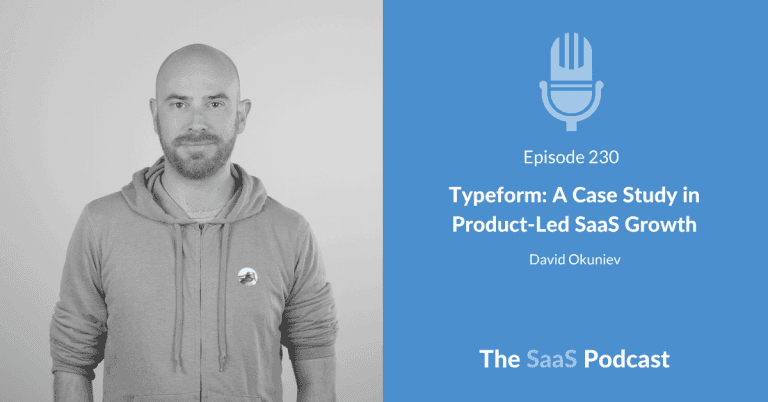
In this episode I talked to David Okuniev, the co founder of Typeform, a Barcelona based SaaS company that specializes in online form building and online surveys.
David and Robert were running a small design agency in Barcelona.
A client asked them to create a form that could be used to collect information about people attending an exhibition.
Instead of building a regular old form, they wanted to do something different.
And Inspired by the 1980s movie War Games, they created a form that was more conversational.
After that project was over, they talked about turning that idea into a product.
But they weren't in a particular rush and they spent the next two years trying to build the right product.
When they were almost ready to launch the beta, they put up a landing page and promoted it on beta list.
And in a few weeks they'd collected around 5,000 email addresses.
When they launched the beta, people started creating and sharing forms.
And when they shared a form, new people discovered the product, signed up and created their own forms.
The product that they spent years trying to get right was quickly going viral.
In fact, when they introduced a paid plan which was about $25 a month, it took them about a year to get to the first million dollars in ARR.
And the interesting thing about Typeform is that the founders didn't start with the niche market.
They built a product that was for everyone, which is counterintuitive to what the majority of startups do today.
Their business is doing around $30 million in ARR and employs around 200 people.
In this interview we talk about why the founders focus so much on building a great product, why design and user experience was more important to them than customer development or marketing, and how they've grown Typeform into an eight figure business.
We also talk about a new product they've recently launched called Video Ask and how once again, they're building a unique online form and survey experience with a very different product.
I hope you enjoy the interview.
David, welcome to the show.
David Okuniev (02:39.460)
Pleasure to be here, Mark.
Omer (02:41.220)
So do you have a favorite quote?
Something that inspires or motivates you or gets you out of bed every day?
David Okuniev (02:47.140)
I wouldn't say it gets me out of bed every day, but one of my favorite quotes is from John Lennon.
It's life is what happens to you when you make other plans.
And to me that's just a really good lesson because whatever happens, your life is just going to be your life and you can either resist it or let it happen.
That's kind of just a philosophy of trying not to like panic too much about what happens is just trust in your path a little bit.
Like I can ride the wave on a surfboard and I can stand straight on the surfboard and try and balance and try to control myself.
Or if I'm always fighting against it and not accepting how it is, then I'm going to fall off.
So.
So, yeah, John Lennon.
Good man.
Omer (03:31.070)
Yeah, I love that.
Did you see the movie?
Was it yesterday?
David Okuniev (03:34.720)
Yeah, I saw that.
Omer (03:35.480)
Have you seen that?
David Okuniev (03:37.360)
That was really good fun.
Omer (03:39.920)
Pretty cool.
Okay, so.
So your background is interesting.
You were born in Belgium, you grew up in England and you live in Spain.
David Okuniev (03:48.240)
And between that, I lived in Bogota in Colombia in South America for three years.
Omer (03:53.200)
Just to mixing up, make things more even interesting.
Okay, so for people who aren't, I mean I, I think most people know Typeform, but for people who may not be familiar, can you tell us what does the product do, who's it for and what's the main problem that you're helping to solve?
David Okuniev (04:09.910)
So Typeform is a data collection tool.
Essentially what we do is help companies or brands connect with their communities, mainly through our forms, which don't really feel like forms, they feel like digital experiences.
And essentially what we've came up with was a more conversational way to ask people questions.
Be it feedback, be it a quiz, be it lead generation, be it some kind of process or another and just get all that data into a system to be able to analyze it or pass it on to a third party.
Essentially we are the kind of the, the interface for many companies trying to ask people questions.
I, I guess the most easy use case for people to understand is like a typical survey or feedback survey.
Omer (04:53.570)
I read somewhere that part of the inspiration for type form and kind of creating that more conversational type of interface was Toilet.
Toilet.
David Okuniev (05:09.810)
Was it?
Was it toilet?
Yes.
Omer (05:13.330)
Okay, tell me about that.
Actually I was, I was going to talk about what was it?
War games.
The 1980s movie?
David Okuniev (05:22.690)
Yeah.
Okay.
It's part of the War Games, is part of the toilet store.
Omer (05:27.170)
Okay.
David Okuniev (05:28.770)
So we came up with Typeform on the toilet, but actually it's more like figuratively speaking, it was actually very related to a toilet.
So a toilet company here in Barcelona called Roca, they originally approached us, myself and my co founder, they came to us just to build a lead generation form which would sit in there.
They have this gallery, this company called Rocca, where they showcase all their best toilets, essentially.
And yeah, so they asked us to build this form to gather emails and some basic information.
And at the time, myself and my co founder, we were running two small digital web agencies and we worked out of the same, out of the same space and we got friendly, we started collaborating on projects.
And then this project came along for this toilet company and they wanted us to build this form.
So we didn't want to build just any other form.
And we got inspired by the film War Games.
It's this film with Matthew Broderick.
And there's this.
I don't know how famous it is, but I think it's pretty infamous where he is.
Matthew Broderick, like hacks into the NSA mainframe and he starts having a conversation with the computer.
And it's basically like one line at a time.
Like the computer asks a question and then just below, like he, he types in his answer.
And there was like this kind of delight about having this like one thing at a time interaction with a computer.
Before Typeform came out, like, most forms were just, you know, laundry lists of questions.
And you still find that today.
So, you know, we kind of challenged that and we got inspired by that film and we thought, yeah, forms don't have to be like a laundry list of questions.
They can be, they can be interactive, they don't have to be boring.
You can put good design into it, et cetera.
Omer (07:13.730)
All right, so we can say that Typeform was inspired by the movie War Games, but it would also be true to say that Typeform was built on a toilet, right?
David Okuniev (07:25.530)
Yeah, you could say that a toilet company sitting on the toilet thought of building a form.
And then a couple of web design companies collaborated, thought of a better approach for their, for their approach to doing a form.
There you go.
Omer (07:44.250)
Yeah, it just rolls off the tongue.
Okay, so you and your co founder, Robert, you, both of you guys are non technical.
You hadn't built a company like this before.
You hadn't built a software company before you guys were, you know, working, running these agencies.
David Okuniev (08:03.370)
We didn't have a clue.
We didn't even know what MRI was.
Yeah.
Omer (08:08.010)
And yet you've gone on to build, I mean, Typeform, just to give people a sense of the size of the business, is that you guys are doing over $30 million.
ARR.
Now you have over two employees and you're still growing.
And I think you've raised what, over $50 million as well now.
David Okuniev (08:32.950)
Yeah, that's right.
Omer (08:34.110)
I mean, that's Massive, right?
Compared to.
Did you ever imagine the business would be this big when you started out with this idea of, of building this, this company?
David Okuniev (08:45.990)
Actually, yes.
Omer (08:47.910)
Really?
David Okuniev (08:49.280)
Yeah.
And it's not because we had an experience or we were being arrogant about it.
Like, just remember when we realized how powerful the idea was that we kind of knew this was going to be really big.
I just remember, you know, in the early prototypes and when we started seeing things coming together, I remember having lunch with my co founder one day and us looking at each other nervously and thinking, oh, this could actually be really, really big.
And like every company in the world would want to do stuff like this.
And actually the thing is, we were breaking the mold of what a form was at the time.
Now many companies are doing something similar to what we do.
For example, if you look at SurveyMonkey, Formstack, a whole bunch of other startups in kind of the same area that we do, they've adopted this kind of more conversational format.
But at the time it was unheard of.
Forms were just this boring thing that you would pay no attention to.
You would use it to really like, really generate interest or generate engagement.
And yeah, I think we just realized if you put, you know, forms are everywhere, you know, people using them the whole time, they're this obligatory thing that people are having to do.
And the fact that we were coming with something really refreshing, we just very quickly realized that this would be quickly adopted.
Omer (10:06.310)
So tell me about the point where you went from working on this client project to deciding that this was a product on its own.
Right.
How did you guys get started?
Was this a side project that you, you guys ran for a while while you were running the agencies?
Like how did you make that transition?
David Okuniev (10:28.250)
So it was quite a gradual process.
I remember before we started that project for Roka, the toilet company, me and Robert had been collaborating on some client work, but we were kind of dreaming that wouldn't it be great to like start, like have kind of like focus product and kind of start a company.
But we, we couldn't really like figure out the idea.
We came across one idea which was this collaborative karaoke.
I think someone later down the line did it where you would crowdsource different bits of video to create like a karaoke video.
We never did that.
So when we came across the project for Roka, we thought this could be, this could be the idea.
So we, we thought, well, let's, let's try and maybe sell this to like some other of our clients that, to try to get them interested but very quickly we realized like, this is going to be the project, so we started working on it.
We had our resources from our own company, so we started kind of running it as a side project.
And actually we ran it as a side project for almost a year and a half.
We were kind of in no rush.
We wanted to do it right.
Bear in mind that what we built for Rokkal was just a prototype of the front end of the interface.
And it was actually, I mean, this is such a long time ago that the original prototype for Rokkow was even done in fl.
We spent the better part of a year and a half building a backend and just iterating on the form interaction to get to the kind of standard that you see more or less today.
Obviously we've iterated a bit more since then, but essentially the core experience is what we worked on a year and a half, for a year and a half back in those early days.
Omer (12:08.510)
Okay, so you're sort of building this product while you're running the agency.
Both of you are sort of very product driven.
Getting the right product and designing the right product is really important to you.
And I know that's been kind of a big part of the reason why you've had the success with Typeform.
But how did you get your first customer?
David Okuniev (12:32.210)
So what we did is about a few months before we were planning to release the beta, which is in 2013.
February 2013.
Sorry, is it 2012?
I can't remember.
Let's say 2012, we put out a landing page with a video of the Typeform experience and we put that out.
I think we launched it on a site called Beta List maybe and through that we garnered like something like 5,000 pre invitations for the launch.
So as soon as we launched we already had like a group of people that we could send emails to and basically they tried the product out, really liked it.
They built type and they shared those typeforms with their community.
People in those communities were exposed to the typeforms, they saw something new and they in turn started building their own typeforms.
And that's basically the beginning of our marketing machine and our main acquisition channel.
In fact, even today, word of mouth and organic and the viral loot that we get from our own forms contributes around 80% of our new business.
So yeah, it's super powerful.
Super, super powerful.
Omer (13:44.720)
Was that deliberate or like did that sort of just happen by accident?
The sort of, the, the built in virality of the product?
David Okuniev (13:51.440)
Yeah, it wasn't deliberate as far as saying, well, let's Find a product that has built in virality so that we can grow.
No, it just happened to be like that.
You know, Typhoon is a product which allows you to build something that you share with people.
Therefore, it's just inherently viral.
This is how SurveyMonkey grew as well.
They were the first company to put like, more or less like forms as a service online, and they grew through their Powered by SurveyMonkey logo at the bottom of their forms.
Omer (14:21.290)
Yeah.
And I think the other thing with Typeform is that the user interface is so unique, or certainly in those days was very unique compared to any other form that you found online.
Yeah, so it kind of, you know, instantly stood out in terms of, hey, this is something different.
David Okuniev (14:37.690)
Yeah.
Omer (14:39.320)
So were you charging for the product at that point?
David Okuniev (14:41.720)
So the first year ran it as a beta, open beta, we didn't charge.
When we finished the beta, we released with a pro plan.
If I remember, it was like $25, something like that.
Omer (14:50.920)
And how did that do?
Were people lining up to pay for it?
David Okuniev (14:55.880)
Yeah, we got to our first thousand customers pretty effortlessly.
Once you get to a thousand customers, then if you can get to 1,000, you can get to 5,000.
If you get to 5,000, you can get to 10,000.
Omer (15:07.960)
How long did it take you to get to that first thousand?
David Okuniev (15:10.360)
I don't remember the customer numbers, but I do remember that after a year of the pricing being live, we reached a million in ARR.
I do remember that.
Omer (15:20.600)
Wow.
David Okuniev (15:22.120)
Yeah, I mean, we're basically on the uniform path, Right?
You grow, like, to a million.
First year of launch.
Omer (15:29.880)
So let's talk about the timeline here.
So the beta was released when?
Like 2012.
David Okuniev (15:36.224)
2012 or 2013.
I've never forgotten this.
I don't know why.
Omer (15:41.680)
Okay, and how long before that?
Because you said you and Robert weren't in a rush to get this product out.
So for how long?
David Okuniev (15:48.320)
I think the original ROKR demo was.
So it's 2012 that we released.
Sorry, it's 2012.
We released the beta because the ROKR project, the toilet company, was about a year and a half, two years before that.
So, yeah, we were in no rush to release the beta, and when we released it, we stayed a year in beta until we officially launched on film.
February 12, 2013.
And it'll be seven years by this February since we launched.
Omer (16:16.620)
Okay, so.
So in terms of timeline, the idea came up around 2012.
You guys worked on it.
Sorry, 2010.
David Okuniev (16:25.420)
Yeah.
Omer (16:25.820)
You guys worked on it for about a year and a half, maybe two years before you launched the Beta.
David Okuniev (16:33.100)
Yeah.
Omer (16:33.820)
And then you hit 1 million, what, by the end of 2013, something like that.
David Okuniev (16:40.870)
February 2014.
Omer (16:43.110)
Got it.
David Okuniev (16:43.550)
So you're later.
Omer (16:44.310)
Okay, so tell me a little bit about like the, the business model here.
And you still offer a freemium.
You still have a freemium model, right?
So you have a free plan.
Tell me a little bit about the thinking behind that.
Like, why did you guys decide that you were going to offer a free product?
David Okuniev (17:04.520)
Well, I think we realized this was, let's say, a mass market product which needed to be adopted by many people.
It wasn't niche.
I mean, every company, every freelancer needs to interact with their customers.
So it was obvious to us that we didn't want to put any barriers on that for people to try the product out.
So freemium just seemed the way to go.
Plus all our competitors were also freemium, so it didn't make any sense for us to not do that.
Omer (17:32.930)
Do you remember at the time, like how many competitors there were?
Because like today, if I think about feels like there are like endless number of companies building some kind of form or data capture.
David Okuniev (17:48.450)
Yeah, there were many at the time and there's many today.
I think what differentiated us more then than today, although I still think we're ahead of the curve in terms of interaction.
We were much more differentiated in the early days because everyone just doing the plain vanilla forms, they didn't treat these companies doing feedback, let's say data collection were always just very focused only on the analysis of data.
The actual collection through the form was just a means to an end.
No company ever thought of actually making that into a great experience.
And remember, this is before the time of chatbots even.
Omer (18:24.990)
Right, right.
And so SurveyMonkey was probably around at that time and I'm sure there were lots of others.
Yeah, apart from the ux, I mean, was that like the main differentiator for you guys?
Like you were saying, like, this is the one thing that we're going to make the big bet on that if we can kind of create a unique enough user interface, people are going to pick this product over our competitors.
David Okuniev (18:50.210)
That's exactly it.
That's why people pick us, because we have the best form interaction experience.
We make them typically what we get out of when we do jobs to be done surveys, the typical phrases, you make me look good.
So they trust us to make their form interaction feel as human as conversation as possible.
Omer (19:11.720)
But the problem with the user interface is that it's also one of the easiest things for competitors or copycat kind of products to Copy.
So was that an issue for you?
David Okuniev (19:23.000)
Well, we always worried about that very early on, but it didn't seem to hinder us.
Growing competitors have adopted more conversational forms as well.
Like we've kind of led the market to that.
But you know, for us it's, you know, we're just, it's our core DNA design.
So we're just trying to stay ahead of the curve always.
Other companies have different core competencies.
They're better on, on other things.
So I don't know, take Qualtrics.
They're better dealing with massive enterprises and their features are kind of orientated towards that.
We pay well with a certain type of customer that cares about design, cares about experience, is a certain size and identifies with our brand.
Omer (20:03.520)
I forgot to ask you, like, how did you build the product?
I'm assuming it was neither of you two doing it right?
David Okuniev (20:08.320)
So like did you know, Basically we, well, in the early, early days, like we had Carlos, which was a front end engineer, we had a backend engineer which worked in.
Actually they were part of Roberts web dev shop and basically they were the ones kind of building out the early builds.
Then later on we just started hiring.
We brought in dedicated resources to just focus on Typeform.
It's actually called Quickiform at the time.
But this was even before that we left our day jobs.
We were still running the companies, but we hired, I think it was a couple of people just to work on the side project.
Omer (20:44.440)
Okay, and then at what point did you guys decide that you were going to stop working on the agencies and this was going to become a full time business for you?
David Okuniev (20:52.260)
Just thinking the timeline, I think it was during the beta.
I think we're still doing some of our, we still kept our agencies going, but close to time we raised our first round which was, you know, right in the middle of the beta period.
You know, we.
I folded my agency and Robert gave his agency to someone else to run.
Omer (21:13.760)
And so I know you raised what it was like about just over like a million euros at that point.
David Okuniev (21:20.480)
Around my first round, we did a couple of seed rounds.
First was 500k, next one was 1.2 million.
Then we did the Series A and Series B.
Omer (21:30.640)
And so had you guys raised money before?
David Okuniev (21:33.600)
No, never.
I mean literally we had no experience as founders.
Our background was just, you know, servicing clients with design and development.
That was our back.
So I even remember we tried to raise money here in Spain and we went to a couple of VCs with the idea.
We had a kind of rough prototype and no One would look at it just because.
Well, they looked at it but they just didn't get it.
We sat down with the two top VCs here in Spain.
So the top business agent, a top business vc, they didn't see it.
I think what they were more focused on is that, and I remember them saying this, you're a bit too wet behind the ears to like run a business like here you say in Spanish, estei sumpoco verdes, like a bit like not mature enough, see this through essentially.
So it wasn't the way we raised money.
We had to go outside Spain and it just, it just all happened really by, by accident.
Some, some guy called Pieter Kulesha, Piotr Kulesha came across the company profile on, on, I think it was even Angellist saw the product was got really excited, set up a call.
He brought in Christoph Jans who was running the 0.9 capital fund, which was the fund which eventually led the first round.
Piotr was an investor in that fund and basically just happened very quickly.
They just saw it, they just thought this was a really, this could be disruptive.
And yeah, they were right.
And the VCs here in Spain were wrong and I'm sure some of them regret it.
Omer (23:08.240)
Yeah, I mean they were wrong, but they were also right in terms of saying you guys are inexperienced and you'd be the first to admit that as well, but they were wrong in terms of not making a bet on you and the company.
David Okuniev (23:20.040)
That's not a criteria for investing in founders experience.
You can get, you can learn how to run a company, how metrics work, especially if you're early stage, but trying to get product market fit and being able to build a product that has that, it's not easy to learn that, right?
At least I don't think so.
Omer (23:43.780)
So how are you guys figuring this stuff out?
Because at the beginning you said, hey, you know, when we started out we didn't even know what MRR was.
And so like was this just a lot of, you know, trial and error on the job.
And so when you look back, do
David Okuniev (23:59.260)
you sort of talked to us about those kind of SaaS metrics, the funnel, all these basic things.
We read up on it, we trial and error, tried things just in conversations, we just picked that up.
I mean it's not rocket science to just do the basics.
Where it gets a bit more complex is when the SaaS business gets more complicated and it's a lot of levers and a lot of micro things you need to change to affect the Top line and does get complex in terms of you have having to manage a lot of things.
But at the beginning, don't think it like really held us back.
I mean, again, the product just spoke for itself and that drove everything.
Omer (24:42.480)
Yeah, I think, I think that was, I mean, in many ways, like, that's one thing that really helped you guys in terms of building a great product, getting the beta out there and having a lot of interest and hitting that 1 million ARR mark, like really quickly, a lot of founders could launch a beta and two, three years later, they might still be trying to figure out how to get to their first 100k ARR.
Right?
David Okuniev (25:12.490)
Yeah, absolutely.
Yeah.
I mean, we were lucky, lucky to stumble across this idea.
Lucky with the timing.
Yeah, 50% luck.
50%, I guess, execution and, and sweat.
Omer (25:24.980)
So when you look back at those, like, you know, we can sort of look at the story and say, hey, you know, David and Robert came up with this great idea, you know, at the right time.
They were great at, you know, had a great vision for how this product should be different from their competitors.
And, you know, it really resonated with the market.
And, you know, before they knew it, they'd hit their first million dollars a year and they'd kind of raising money and all that sort of stuff.
David Okuniev (25:50.980)
But.
Omer (25:51.250)
But was it really that easy?
What were some of the tough parts of going through that journey?
David Okuniev (25:56.530)
Sorry about raising money was easy or.
Omer (25:59.410)
I'm just trying to figure out like how smooth sailing the first few years were.
David Okuniev (26:03.810)
It was very smooth sailing.
It was just all growth, growth, growth.
I don't think this happens to that many startups.
We were just on a tear, basically.
I mean, we'd created a really great atmosphere in the office.
Like, it was very open culture, a lot of freedom, just a lot of motivation.
It's just the early days.
It's just a small group of people, like, really like killing it.
So, yeah, the first three years was just, yeah, very, very smooth sailing.
But, you know, like all things, like to reach new plateaus of growth, you know, you have to get a bit more serious with the business.
And I think this especially kind of like hit home in the last year and a half to whereby, you know, we built, like I mentioned, built a very kind of, let's say people first culture, which meant that, you know, we didn't put a lot of boundaries around.
So it was a lot of, a lot of freedom, a lot of goodwill.
But, you know, you can do that when you're 30.
So people in the company.
But when you start crossing 150 people, it becomes a bit more complex.
And actually, I think we reached a point in the company's size where there was a serious, you know, a significant lack of accountability.
And we were seeing, like, issues with speed of execution and so forth.
And I think that was because we didn't, like, operationalize things well enough because we, you know, everything was fine.
We're just growing, growing, growing, and, you know, we didn't need to worry about those things.
But obviously, like I say, when you start getting further down the line, you have to start really, you know, let's say maturing a little bit as a company and putting some processes in, putting some structure in, bit of hierarchy.
Otherwise, what you have is just many people looking in different directions.
And, you know, it's a hard journey.
It's a lot of ups and downs.
Omer (27:46.810)
So give me an example of, like, when you said, like, you know, there was a lot of freedom and no accountability, and so give me an example of that.
David Okuniev (27:54.250)
At the beginning, it was just a lot of trust that everyone, you know, was just putting their part in.
Omer (27:59.290)
That's a good thing, right?
David Okuniev (28:00.330)
Yeah, it's a good thing.
But, you know, when you grow to a certain size, you know, it's more, you know, what happens, like, and this happens with us, we had a problem with a culture of consensus when there's such a good kind of atmosphere in the company that no one really wants to, like, challenge each other too much.
So what happens is that, you know, when it comes to decisions, everyone that's kind of involved or affected by the decision has to have their input and their voice.
And, you know, in theory, that's good.
You know, people should be heard.
I'm not saying they shouldn't, but it slows down decision making very much.
And it also means, you know, if you don't have one person that's taking a decision, you know, and sometimes against the will of other people, if you have that person that say, no, guys, we're going to be doing this, then what you have is, like, people not buying into decisions.
If a group decides, there's always going to be some people on the side which aren't buying in.
So having a designated person in the team make a decision and is accountable is very important.
Let's say the product manager, for example.
And we just had a lack of that kind of instrumentation, and I think it just made us.
It just made us slower as well.
Combine that with a lot of freedom, you know, unlimited holidays, you know, completely flexible work schedule.
We still have those things.
But we just didn't put enough boundaries on them or like expectations of like what we expect you to do here at Typeform.
And now we're kind of putting those things a bit more in place and making people understand that if we're not as organized or working as hard as our competitors, then how can we expect to really stay competitive in the market?
The best companies managed to get where they are because they managed to get a flywheel of production going.
And that's hard work and that's determination and grit and all these things.
And you don't get that if you just create a laid back culture where you don't have high expectations on standards.
And just looking back to what we had before, we didn't have enough high expectations or put the bar high enough.
We were just riding the kind of the, the wave of just like natural growth and you know, just kind of sit and lay back into that.
Omer (30:17.000)
But that's worked for you though.
David Okuniev (30:18.760)
Yeah, but you know, I have to say, you know, like in the last, let's say year and a half growth has not met our expectations as well.
Now we're seeing a new inflection point.
But you know, you could definitely see that really hyper growth kind of tapering out when we started getting close to like to like 15, 20 million around there.
So you know, we're ambitious.
We want to take this to like as many companies as possible and I think we're doing something really important.
So we really want to see this grow and everyone wants to be on a winning team.
So we have to really put those instruments and boundaries there to make sure that we're really performing to our best level.
Omer (30:57.980)
So you guys are seeing this as a hundred million dollar plus business opportunity at the moment, right?
David Okuniev (31:06.370)
Yeah, I mean it's a massive industry.
I mean if you just look at forms, sorry surveys alone, the market in the US for just surveys, which is just one of our use case, I don't know what the latest numbers are but it used to be like something like 3 billion.
So it's huge.
We're just a blip right now.
We have good brand awareness because we play well with the startup community and so forth.
And you know, if you know tech, not necessarily in a tech company, you'll know Typeform but you know, we haven't reached, let's say that if you look at the product adoption curve, I think we're just, you know, we've definitely like got the early adopters and we're into the next part but we haven't really like Addressed like the later market yet?
Omer (31:45.750)
Yeah.
I'm curious, if you were starting out today, is this market something that you would still want to get into and enter, or do you feel like there's already enough competitors or players in the market, it would be harder for you to, to find that opportunity today than it was back in 2012.
David Okuniev (32:07.090)
It depends how differentiated the product would be.
So actually Typeform is launching a new product.
We've had it in, in beta for a while.
It's called videoask and it's kind of a startup inside Typeform.
So it's kind of that situation.
Right.
So I guess the question is why are we launching a product like videoask?
And it' we're once again trying to disrupt the way people are asking for information.
So what I would say is that would I have done it again today?
In the current market?
Yes, if I had the differentiated product.
But if I would today launch a product like Typeform with more advanced forms, let's say, I think I'd have my work cut out because maybe it wouldn't be differentiated enough.
But with a product like videoask, which is a video driven, let's say, version of Typeform, it's differentiated and it's now addressing again, possibly opening new markets, but allowing people to do this and collect data in a more human and personal way.
So yeah, I guess the point is if you have something differentiated, then you've got a good chance, but otherwise it's pretty competitive out there.
Omer (33:16.760)
So tell me about how VideoAsk works.
If I was setting this up,
David Okuniev (33:22.790)
or
Omer (33:22.950)
maybe from a customer perspective, somebody's filling or responding to this, what does that experience look like?
David Okuniev (33:29.030)
So I could consume it as a widget in someone's website or someone can Send me a VideoAsk link.
And essentially what it does, it loads a video of a person asking me one or a series of questions and I can answer to those questions via video as well, or text or audio if I want.
If you're a bit too shy to answer via video, you can, you can use those and basically you can have several steps in the video so it feels like someone's asking you a question and you answer, then they ask you another question and you can soon put logic into it so that you can have different decision trees and so forth.
So it's really trying to like almost emulate a kind of a conversation, but asynchronously.
And another really cool thing is that.
So you put a video ask out there and you start getting new responses, but you can actually respond to those responses via Video as well actually create like a threaded video conversation which is really interesting.
And for example, I use it for videos to do support.
So I get support tickets sometimes via video and then I can answer via video and it means I don't have to write an email or like waste any time.
So it's super fast.
And we're seeing some really nice adoption in certain communities.
For example, like coaches, people that have personal brands that deal, like to deal face to face with people.
It's a really big time saver because they can just get people to give them, they can put out a question there, they get a video response and then they can continue an asynchronous video exchange.
Omer (34:59.169)
So I'm curious, why did you launch this as a separate brand?
Like, you know, people can go and check it out@videoask.com but like why not just build this functionality into Typeform?
David Okuniev (35:12.449)
Because it's not just a feature.
I think it's just a different mindset.
And like the way you build this, build a video ask needs to be different to the way you build Typeform.
I mean you can embed a video ask question inside a Typeform.
But also actually there's another big reason we wanted to build this product without having any dependencies of the Typeform product so we can move as fast as we could.
Bear in mind it's a very small team working on videoask and had we been building it inside the core product and we would have to do it many different in a different way and we would have been slowed down.
So speed was actually a big factor as well.
Omer (35:53.890)
Okay, makes sense.
Yeah, I mean it looks like a really interesting way to engage with people.
And I'm also wondering if you're seeing higher response rates than sort of a traditional text based survey when people are using this type of interface.
David Okuniev (36:23.620)
Yeah, it's still early days because we probably don't have enough data to really compare it to Typeform.
So I'm gonna just hold back on that one right now.
But definitely people perceive that if they put a video there, it's more engaging.
Typically videos are more engaging.
That said, I think for different cases you might not always want to have a video.
Therefore Typeform is the right solution.
Omer (36:48.400)
How are you promoting the product?
Because like when I go into go to the Typeform homepage, I don't really see any mention of it.
I know, I know there's a link in the footer or something.
David Okuniev (37:00.600)
But we're working on launching that.
So we're going to be launching properly the next month and A half.
So we'll start seeing it much more apparent.
Basically the thing is it's been developed in a.
Just in a small team, separate.
I'm leading this team.
Like I used to be the CEO of the company and I stepped down a year ago and you know, I started working some point after that on this product and I took a developer with me and started building a team around that.
So it's really been like separate to Typeform.
But now people at Typeform are starting to get involved and like the marketing department is also going to start supporting and so forth.
So you know, we want to get it out there because we really think we believe we can build as big business with Video ask as we have with with Typeform.
So it's early days and so how
Omer (37:46.800)
many people worked on video asks so far, like how big has the team been?
David Okuniev (37:52.280)
The team until four weeks ago was just two people, myself and a front end guy.
And we also were working with an external agency that was building the iOS app and was doing the backend.
Now we've hired a backend developer to join the team full time and another front end and just had another kind of engineer product person join the team.
So it's a small team but we're moving fast.
Omer (38:25.220)
Okay.
A lot of people building a product would say I can't build a great enough product because either I don't have money to hire a developer, et cetera, or maybe I've got one guy or one girl working on this product.
You could have thrown a lot more people in at this.
So why did you decide initially it was just like going to keep it so small.
David Okuniev (38:49.550)
I don't think you get more out of having more people at the problem that you need few people doing something really well to start off with.
If you want to accelerate that, then you need people.
But everything has to be very clear.
I think we were able to move fast just by having less people.
It's less conversations, it's more clarity.
So yeah, I wouldn't like bigger companies do this like throw loads of people at a problem.
I mean it depends the size of the problem as well of course.
But in our case, no, definitely wouldn't recommend putting too many people problem.
So I mean in videos we had the key ingredients, so we had.
So I'm, I'm a product, let's say product maker.
So I manage the product, I'm also designing the product and I'm also doing some of the front end work, little bit on the, let's say the lighter front end stuff and Then we have, we had a really good front engineer who's really fast.
And then, yeah, as I mentioned, we had two other people doing stuff externally, so it was just really focused and we could move really fast.
Wouldn't have wanted to add more people into that mix at that stage.
But now, yes, we're slowly putting more people on the product side and then, yes, we need functions such as marketing and customer success to support the product as we start to roll it out.
Omer (40:04.360)
And then is the plan to kind of keep it as a separate company or are you going to kind of integrate it back in.
Into Typeform?
David Okuniev (40:09.420)
It's Video Ask by Typeform.
It's a separate brand, but we're, it's like a sub brand.
It kind of looks like Typeform acquired a company.
Actually.
It says videoask by Typeform on the website.
Yeah, I mean, for now, it's, it's, it's, it's, it's as a separate entity.
Well, actually a business entity.
It's not, it's like run through the same company, but it, it, it seems like it's another thing.
Omer (40:31.460)
Yeah, we'll have to chat about that in a while and see how that's growing.
I'm really curious to see how, how this sort of shapes out.
And you going through this experience of building a, essentially a new product from scratch is, it's kind of interesting, but it's also kind of a really fun time as well, especially if you're a product guy.
David Okuniev (40:49.420)
Yeah, it's, it's awesome.
It's.
I'm having a great time, to be honest.
Better than being CEO.
Omer (40:57.500)
All right, let's wrap up and move on to the lightning round.
So.
So I'm going to ask you seven quick fire questions.
So just try to answer them as quickly as you can.
Are you ready?
David Okuniev (41:07.550)
Yeah.
Omer (41:07.950)
Okay.
What's the best piece of business advice you've ever received?
David Okuniev (41:11.150)
This isn't going to work.
Omer (41:12.670)
This isn't going to work.
What book would you recommend to our audience and why?
David Okuniev (41:16.830)
The God Delusion by Richard Dawkins.
Omer (41:19.710)
What's one attribute or characteristic in your mind of a successful founder?
David Okuniev (41:25.550)
Doesn't accept failure too early.
Omer (41:28.440)
What's your favorite personal productivity tool or habit?
David Okuniev (41:32.040)
Typeform, of course.
Omer (41:35.560)
What's a new or crazy business idea you'd love to pursue if you had the time?
David Okuniev (41:39.160)
Don't have any.
Just to focus on what I'm doing right now.
Omer (41:42.120)
What's an interesting or fun fact about you that most people don't know?
David Okuniev (41:45.720)
I used to be a signed musician.
Omer (41:47.800)
And what's One of your most important passions outside of your work?
David Okuniev (41:51.400)
Don't have any
Omer (41:55.410)
really.
David Okuniev (41:56.370)
I don't do anything but work and I have a family and that's it.
I play the drums.
There you go.
Omer (42:02.450)
There you go.
We found the drums.
David Okuniev (42:04.450)
Yeah.
I like eating food and traveling.
There you go.
Omer (42:07.330)
That's good enough.
All right, cool.
So thank you for joining me.
It's been a blast talking and kind of hearing about what you've been up to at Typeform and Video Ask.
And if people want to check out the products, they can go to Typeform.com or videoask.com and if they want to get in touch with you, what's the best way for them to do that?
David Okuniev (42:30.490)
Yeah, my phone number is 691684 and I won't say the rest.
That's the best way because email is like.
No, actually, if you want to talk about the videos product, we actually have a Videos Slack community and.
And you can join it via.
If you go to our website in the footer, there's a link to it.
More than happy to talk about videoastings.
Please don't chat to me through there.
If you're having an issue with Typeform.
Hopefully you don't.
But if you do, I'm there just to talk about videoast.
But definitely if you want to chat to me about that or maybe any advice on starting up a company, happy to talk to you as well.
Omer (43:10.520)
All right, cool.
David, thank you.
It's been a pleasure.
I wish you all the best.
David Okuniev (43:15.080)
Thanks.
It's been a pleasure.
Thanks a lot, Omar.
Omer (43:17.720)
Cheers.