Omer (00:11.840)
Welcome to another episode of the SaaS Podcast.
I'm your host, Omer Khan, and this is the show where I interview proven founders and industry experts who share their stories, strategies and insights to help you build, launch, and grow your SaaS business.
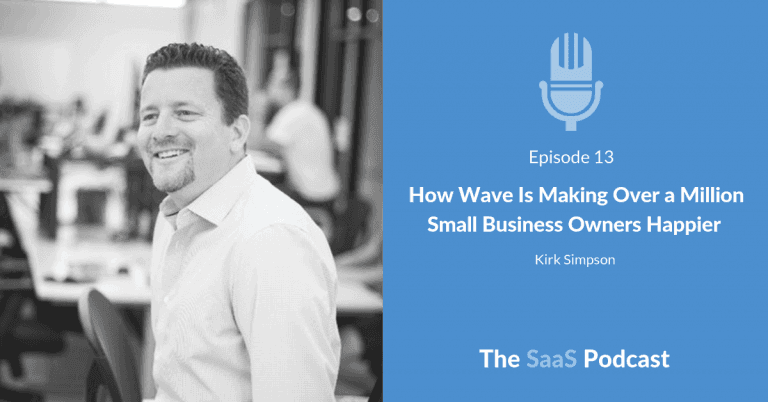
Today's interview is with Kirk Simpson.
Kirk is the founder and CEO of Wave Accounting, an integrated online solution designed for small businesses to manage their financial life.
Wave has signed up well over a million users and currently serves customers in more than 200 countries around the world.
And to date, Wave has raised over $25 million in VC funding.
Kirk, welcome to the show.
Kirk Simpson (00:56.260)
Thanks so much for having me, Omer.
It's good to be with you.
Omer (00:59.700)
So I've told our audience just a little bit about you.
Tell us in your own words a little bit more about you personally, and then give us an overview of your product and business.
Kirk Simpson (01:08.340)
Sure.
So, firstly, I just celebrated my 40th birthday, so I'm in some ways older than most software entrepreneurs.
I have three young kids, nine, seven and four.
So I'm sort of juggling both my professional startup life as well as a young family and trying to find the balance there in terms of Wave.
We're located in Toronto.
We're about 65 team members.
And as you said in the opening, we're really, really focused on micro small businesses, a sector that has been traditionally kind of forgotten about by software providers.
They traditionally focus more on the larger enterprises that have, you know, bigger lifetime values.
And this has been an audience that's been really hard to go after.
And we think that over the last five years, through the cloud, through mobile, through many other, for many other reasons, including just distribution on the Internet, etcetera, that this is the time to go after it.
And we're.
We're all really jazzed about the opportunity to help small businesses be more successful.
Omer (02:19.240)
Awesome.
And happy birthday for the big 4.0.
Kirk Simpson (02:21.880)
Yes, thank you.
I'm not sure if it's a happy moment or what, but I've lived through it anyways.
Omer (02:28.520)
Now, before we dive into more details, we'd like to kick things off with a success quote to better understand what drives and motivates our guests.
What is one of your favorite success quotes?
Kirk Simpson (02:37.720)
Well, you know what's interesting is just the way that my brain works.
I'm not really a quotes guy.
I don't seem to have any memory to remember the ones that I really like.
I'm much more of a person who focuses on having as many conversations as I can with interesting people and just taking from those experiences as Much as I can versus any particular quote.
So when I saw the question, I thought to myself, I could look one up and find one, but it really hasn't been important in my journey.
It's, it's much more important to me anyways, where I have live conversations with people and get inspiration from them every day.
Omer (03:21.950)
And that's a great insight.
I think it's less about the quote, I think it's more about what drives and motivates you.
So it's good to know that, you know, you have a different perspective on that and it works for you.
Kirk Simpson (03:32.990)
Yeah, exactly.
Omer (03:34.990)
So let's start by talking a little bit more about just giving the listeners a better understanding of wave.
You talked about your target customers as being these micro small businesses, these, these companies with nine or less employees.
Why go after a segment which is pretty much super difficult to reach?
Kirk Simpson (03:59.040)
Yeah, I think it's probably, you know, part of the, the entrepreneur's DNA is that when you see those kinds of problems, it kind of sparks that feeling of there's a massive opportunity there.
I think there were two reasons in the early days, you know, one primary reason which was I had done, you know, a couple of startups before that never got very big, so I never really broke through that, that 9 employee threshold.
And so, you know, having been the target market and the only way that I survived during those days was the fact that my sister was an accountant.
And there was certainly no way that I was going to pick up QuickBooks or simply accounting or any other product at that particular time and actually use it.
I knew in my, you know, just as I interacted with the product that this, this was a product that was not built for me.
It was built for an accountant, bookkeeper or a VP finance or somebody with that headspace.
And out of that, myself and my co founder, James Locri, he had been in the business of tax for 15 years in the software side of that business.
And we knew that there was an opportunity to build something that the market could really benefit from.
And then when you looked at the size of the market, there's 30 million of these micro small businesses in North America.
And Intuit's own research at the time said close to 70% of them use Shoebox's spreadsheets and Word docs.
And so out of that we just looked at that and said there has to be a better way of doing this.
Things like bank feeds that Mint pioneered and other automated type tools we felt made this the time for this type of tool to be built.
Omer (05:51.540)
You know, I've never met anybody who's told me that they love QuickBooks.
In fact, I've never met anybody who says they love accounting software 100%.
So what were in your mind, some of the top pain points that you were trying to solve for these people apart from just, I guess they really don't want to use any of this software.
Right?
I mean, it's more of a headache for them.
Kirk Simpson (06:16.610)
Yeah, absolutely.
So the macro sort of thought process was imagine if there was a tool that attempted to do as much heavy lifting as possible.
And, and by that I mean, you know, bring in the bank feeds so that there's no manual entry of transactions, you know, allow for you to take photos of your receipts with your iPhone and OCR them so that they automatically come in, make the invoicing process as seamless as possible, make it easy to get paid.
It's those task based things that typically small business owners think about.
They think about, how can I get paid faster, how can I be better prepared for tax time so that it's not a three weeks of my life that I dread every year?
And knowing through that process that because you've left it all to the last minute, you've probably forgotten or lost some of the receipts or deductions, so you're paying more tax than you're supposed to.
So it was really the macro thinking of, let's look at each of the tasks and try and make them as simple as possible using technology.
And then the thought process that if you could do that, imagine how much better the small business owner would feel and the insight that they would have into their business every single day versus not knowing until the end of the year whether or not you were profitable, how you did, did you make money, did you not?
Do you have a huge tax liability on your hands?
There's a, you know, you're absolutely right that you will never talk to a small business owner who's passionate about, you know, doing accounting, but you will absolutely talk to almost every small business owner who has some degree of fear in their eyes about, you know, am I doing well enough?
Do I owe a huge, a whole bunch of tax that I haven't factored in?
Do I have capital to expand, you know, hire another person, increase the square footage of my shop, you know, all of those kinds of things.
Those are the things that we want to solve for them.
Omer (08:18.990)
Okay, Kirk, let's take a journey back to the early days and talk a little bit more about how you got started.
So you talked a little bit about where the Idea for wave accounting came from what did you do next?
Kirk Simpson (08:34.430)
Yeah, good question.
So we started to build software and it was a very early alpha version of the software that we have today.
And we started to try and find users to use it.
And we really actively watched and talked to those customers to understand how they were interacting with the system.
What did they like, what did they not like?
All of the traditional things that have become so well described now with the Lean Startup and other books of that type of.
But at the time, I don't think there was as much information as there is today about how to do it.
So we made plenty of mistakes and built some software that we had to throw out and all of those kinds of things.
But really through the alpha process, it was about, how are we going to get these people who don't like this type of software?
How are we going to build software that they actually like?
That was really where we were focused for the first probably six or eight months.
Omer (09:41.030)
Did you bootstrap the business or did you seek funding to start things off?
Kirk Simpson (09:47.030)
We bootstrapped it.
My co founder, James, put in most of the money at the beginning, but it was he and I who funded the business well before we did a friends and family raise and then an angel raise.
Omer (10:00.710)
Okay, and so when you started building this first version of the product, did you start hiring people or were you just looking for contractors to help you build the product?
What was the process there?
Kirk Simpson (10:13.210)
Yeah, so we did rely on contractors.
James wrote all of the specs, given his background, but he knew that his engineering skills were not in the new sort of open source languages.
And so he really focused his time on just delivering specs for the developers.
But we used mostly contractors until such time as we had done, our friends and family around and then began to hire people full time.
Omer (10:46.980)
Okay, so you've got this product and you said you had to throw out a couple of versions through that process?
Kirk Simpson (10:54.660)
Yeah, just continuing to evolve it.
Yes.
You know, a lot of our alpha version is not part of what we've got today.
You know, the game really changed with bank feeds, etc.
And so that wasn't built into the initial prototype.
And therefore when we did go to build kind of the beta version, we threw out a lot of the early alpha product.
Omer (11:19.870)
Okay, and what did you learn when you started getting feedback from people?
Kirk Simpson (11:25.720)
Yeah, good, good question.
I mean, the, the first thing that I can say is that I don't know whether every entrepreneur suffers from this, but I sometimes have a hard time remembering what, what my world was like 12 months ago, let alone four or five years.
Right.
I should have done a better job of documenting it, but, but I didn't.
So, you know, I think the macro lessons that I do remember are that, that we, we ran up against, you know, head on some of the challenges that we knew going in.
Like how do we get these guys engaged in this, in this tool?
How do we make it easy enough for them to want to use it?
How do we make sure that they find, you know, hidden nuggets of insight on their business very early on in the process so that it justified that they, the work that they were putting in to keep the data up to date.
I think those were the biggest things that we were really trying to combat at that time.
And also we weren't sure whether or not we were going to go free or we were going to go paid.
We ended up deciding that we really believe in the free model and so we were learning about that through the process as well.
So those were the key things I think was how do we onboard these guys, how do we understand how to deliver value from the software with as few entries as possible?
So that they saw a golden path of if they kept this system up to date, what were the insights that they'd get?
It was those kinds of challenges we were really trying to flush out.
Omer (13:00.420)
Now there's no shortage of accounting software out there and as you mentioned earlier, a lot of your potential customers weren't using any accounting software.
So how are you trying to position WAVE in the early days to differentiate yourselves?
Kirk Simpson (13:18.720)
Yeah, great question.
So I think, I think that is, it really comes down to two things.
One is there is a very noticeable difference in everything they do between these micro small businesses that I described at the beginning and even a slightly larger business.
And so getting to know those customers, how they think, what other software they use, you know, what's their day to day look like in their business.
All that kind of stuff was very, very key to building a product that was very specific for them.
The other thing was if you look at the history of most accounting software, not that many people study the history of accounting software, but, but if you did, you would see that most of them start off as being very focused on the business owner themselves and then quickly, you know, and, or over time start evolving to be focused on the accountant, bookkeeper, vp, finance.
And there's a reason for that, because they found over time the majority of their users or the people who were the stickiest were that segment of customers.
And so when an accountant or bookkeeper submits a ticket on something that they want versus versus a typical very small business owner, it's usually the accountant bookkeeper's request that would get prioritized.
And therefore you take what in my view was a racehorse of QuickBooks when it first came out, very focused on the business owner and turns into a camel over time because it starts to have to deliver what an accountant bookkeeper wants, which is very fundamentally different than what a small business owner wants.
And so we early on in our process said we are focused on the small business owner and we will deliver the product that the small business owner needs.
And if an accountant or bookkeeper needs something and it doesn't provide value to the small business owner, we're not doing it.
And so, you know, I think it was those two focuses on really knowing your customer and then having a deep level of prioritization against that customer and not allowing ourselves to be swayed by accountants bookkeepers, who are very traditional in their thinking.
I think those two things have heavily influenced the product development.
Omer (15:42.350)
Now you launched the product in 2010 and from what I understand by the end of 2010 you had your first thousand customers.
What did you do to go and acquire those first thousand customers?
Kirk Simpson (15:58.300)
Customers, yeah.
So to give you the timeline, we launched the product after the early alpha that I described earlier.
We actually launched the product right near the end of 2010 and probably November 15th or something like that, if my memory serves me.
And as we closed out 2010 and started off in 2011, yeah, we had approximately that or more, more initial signups.
And you know, I look at it and I say, you know, how did we get that early, you know, very early traction?
I think we just, you know, because my, my background is in media, because Rob Moran, one of our earliest employees, background was in media.
You know, we, we had, we had years of, of good training around how early media Internet sites got traction through SEO, through being written about on blogs, all of those kinds of things.
Media, how do we get other PR or media write ups to write about us?
So I think we laid a really good solid foundation and got some, some pretty reasonable early traction.
And then I'll tell you a very quick story.
It was early 2011 and I think this speaks to what I believe strongly in, which is some of this just comes down to pure luck.
So in early 2011 we saw that the Google Chrome Store was going to launch and we thought, wow, this is really interesting.
The Chrome browser is getting more and more penetration.
We love the users who are on the Chrome browser versus ie Anybody who's been in web development knows that IE users are not your favorite users because of the browser.
And so we thought to ourselves, well, this new Google Chrome Store looks interesting.
Let's spend the two hours building a very easy integration with the Chrome Store.
Let's pay the $5, literally $5 to put your app on the Google Chrome Store and let's see what happens.
And so we launch it.
And you know, if my memory serves me, it's March 2011 or so.
And at the time, similar to the old Hotmail story, James and I were getting emails every time somebody signed up for Wave.
And you know, on those days where you'd get 20 or 30, you'd be like, all right, this is starting to go.
And all of a sudden I woke up one morning, it was a Saturday morning, I'll remember this for the rest of my life.
I go downstairs, 7 o' clock in the morning, my oldest child now just woke up, I open my computer and I'm seeing reams and reams of signups.
And it turns out that just complete luck that the editor of the Google Chrome Store decided to feature us.
You know, a couple years later we're at, you know, 210,000 installs from the Google Chrome Store and, you know, it was really just, quite frankly, luck that got us there.
Omer (19:13.330)
Now this wasn't you guys doing any development to create some kind of add on for Chrome.
This was.
This was you listing your existing web app within the Chrome Store, is that right?
Kirk Simpson (19:24.930)
Exactly right.
And it was, you know, you had to do a tiny bit of sort of integration, but it was very lightweight.
And so it allowed us to sort of say, yeah, let's take a shot on this, because it's not weeks of development, it's, you know, literally a couple of hours.
Omer (19:41.440)
Now.
I looked at your growth trajectory and so, you know, 2010, a thousand customers, by the end of 2011, 100,000.
By end of 2012, you're approaching 500,000.
And now you're at over a million users.
Now that's pretty impressive growth.
Aside from the Chrome Store, what else were you doing to get that kind of growth so fast?
Kirk Simpson (20:10.660)
We were really focused on being anywhere that our target market was looking.
And what I mean by that is the Chrome Store was a good example, the Google Apps Marketplace, another good example.
Very, very focused on SEO and making sure that we were doing all the best stuff there.
A lot of work on homepage conversion and A, B, C, D, E testing that.
Lots of work at looking at do we want custom landing Pages for different search terms.
We were, we've been through our history, you know, we knew that if you were going to go after the small business marketplace, the micro, small business marketplace, that, you know, the majority of companies that have gone after this market have sort of died on the side of the road because they couldn't figure out an acquisition model that made sense.
And because the lifetime value of these customers is always going to be much lower than a medium sized business, they're going to churn at a higher rate.
And so if you can't figure out how to acquire them at a reasonable rate in a high enough volume that you weren't going to make it work.
And so it was always a core focus of ours to make sure that we were always optimizing the top of the funnel and being where small business owners were looking for our type of software and then managing and nurturing those relationships.
Got it.
Omer (21:49.220)
So with this kind of growth also, I guess comes a lot of growing pains.
Can you give me some examples of the types of growing pains or challenges that you've faced as this business grew so quickly?
Kirk Simpson (22:05.220)
Yeah, absolutely.
So I would point to a couple things.
Number one was we grew the size of the team too fast, too early.
And where it really hit home for me was it got to a point where we were upwards of 80 people, having added probably 50 in a six month type time span, maybe longer, but you get the idea.
And I looked around and I thought to myself, you know, the processes, and process is a bad word for a startup, but it's very important.
I've come to learn our processes of, you know, hiring the right people, communication within the company, communication within the teams, management, management capabilities, all of those kinds of things had not scaled with our hiring.
And I know a lot of companies in the valley have grown a lot faster than we have and I'm sure that they suffered some of this and some of them just powered through it and figured it out.
But we decided we needed to take a step back before we could take another step forward.
And so that process of having grown too fast was painful because you know, there is nothing like sort of a round of right sizing or downsizing to really take some of the steam out of the team.
And so I wish I hadn't done that.
I wish I hadn't have grown that fast.
I wish I had have, you know, focused more on making sure that we were truly in all capabilities ready for that amount of people joining the team.
So that was the first thing.
The second thing is, I think in Hindsight, you know, we, we went too broad with our product too quickly, and I think that's a mistake a lot of us probably make.
You know, it's prioritization is a massive challenge as a startup.
When you have as many customers as we do who are telling you that they need X, Y and Z, it's very hard to prioritize that list.
And I think the natural reaction probably is to listen to too much of it and build out your product too quickly.
So I think those two things were where we ran into sort of growing pains.
And some of the things that, that I've now learned as an entrepreneur are really important to watch for.
Omer (24:55.960)
Okay, Kirk, so we started this conversation by going back to where the idea for Wave came from.
And then we've taken this journey together on how you turn that idea into a successful product.
Let's talk a little bit about the business as it is today.
Now, when did you reach a million users?
Kirk Simpson (25:15.080)
A couple of months ago.
Omer (25:17.240)
Congratulations.
That's a huge milestone.
Kirk Simpson (25:19.320)
Thank you.
Omer (25:20.360)
Are you able to disclose revenue numbers?
Kirk Simpson (25:22.840)
I'm not.
Omer (25:24.360)
Okay, so let's talk a little bit about how you're generating revenue at the moment.
It's a free product, but what are you doing behind that to try and generate revenue?
Kirk Simpson (25:35.640)
Yeah, absolutely.
So on our free product, we have ads in the system, so we generate, you know, a reasonable amount of money through advertising.
But more importantly for both us and for our customers, we are also focused on bringing out products that can generate revenue for Wave and also help our customers.
So an example of that is payroll, where we are helping our customers pay their employees all through the same system.
And the second is on helping them collect payment on their invoices more quickly.
And so we are facilitating the payment on those invoices and generating revenue through that process as well.
So you can kind of think of us as a software plus transactions company, and on those transactions, we generate revenue.
Omer (26:31.480)
And so looking back, do you think that that was the right model for you to have chosen and do you think that that was one of the big drivers for, to help you get to where you are today?
Kirk Simpson (26:43.240)
I do believe that's the case.
I think obviously, you know, anyone who, who chooses to go the free route, you know, they, they need to have a very good sense of how they're going to generate revenue, obviously, especially in the non consumer software space.
And also I think it's important for people who are looking to go free to understand that free is not a pass for a product that's not as good as your Competitors, your best customers who want to use your software, you know, thoroughly are going to put it through its, its paces and they're going to compare you to a paid product either way.
So free is not a, it's, it, it doesn't overcome a bad product.
And I think it's important for people to really understand that.
Omer (27:50.550)
What's the one thing in your business that you're most excited about right now?
Kirk Simpson (27:58.530)
So it very much ties to sort of the growing pains we discussed.
What I'm most excited about is the level of management discipline that we've built into the company in order to really mature the type of company that we are and how we do things.
And that doesn't sound very sexy.
But you know, I can tell you for sure, for me, and this is an opinion of one, I don't know whether or not others are in the same boat, but you know, going into this entrepreneurial journey, I certainly didn't think that I would be excited about, you know, maturing our management processes.
But, but I can tell you that I think it's just absolutely key.
I think it's, it's the, is quite frankly the difference between the companies that make it and the companies that don't.
I mean, obviously there's other factors, but I think one of the most important factors is as a management team, are you good at what you do?
Do you run your business with discipline?
Does everybody clearly understand what success looks like?
All of those kinds of things.
For us, it took us a while to, to sort of mature those processes, but quite frankly, it's the thing that I'm most excited about today.
And the other way of looking at it is it's really the only way that a startup entrepreneur is going to get any sort of life work balance is if there's people around you that you trust and that you can empower to really run key aspects of the business where, you know, whether you're involved or not, the business is going to do great things and that's a great place to be.
Omer (29:48.880)
Yeah, I think there are, there are a lot of studies out there and from my own personal experiences as well, is when you look at, you know, why employees leave companies, the number one reason is often is they hated their manager.
Kirk Simpson (30:02.640)
Yeah.
Omer (30:03.040)
And a lot of the times it's because either that manager was pushed into a managerial role before they were ready or quite often there isn't, there isn't the, the support system around that manager to, to help them be successful at their job.
Kirk Simpson (30:19.610)
I completely agree.
And we have a long way to go on it.
But, but, you know, that's, that's a.
It's such an important journey.
Omer (30:29.770)
Yeah.
Not sexy, but super important.
Kirk Simpson (30:32.250)
Exactly.
Right.
Omer (30:33.290)
All right, Cook, it's time for our lightning round.
I'm going to ask you a series of questions and I'd like you to answer them as quickly as possible.
Are you ready?
Kirk Simpson (30:40.170)
Yes.
Omer (30:40.730)
Great.
Let's go.
What's the best piece of business advice that you've ever received?
Kirk Simpson (30:47.050)
So it's, it's not one thing when I, when people ask me for my advice, I make sure to tell them this is an opinion of one.
I have really focused on having, you know, hundreds of conversations with other startup entrepreneurs and other people that I respect.
And so, you know, I amalgamate all of that, those opinions and sort of form my own out of it.
So it's not really one thing that I can point to, to be honest.
Omer (31:15.220)
What book would you recommend to our audience and why?
Kirk Simpson (31:19.620)
I think what's going around right now and is, and has made the rounds in, in our office in a big way is the Hard Thing About Hard Things by Ben Horowitz.
Phenomenal, phenomenal book in terms of his level of candor in the early stages of the book and then some of the really interesting pieces of advice that he gives through the book.
First of all, a really quick and easy read.
And secondly, I just thought it was a fascinating, well written book.
Omer (31:54.080)
What's one attribute or characteristic in your mind of a successful entrepreneur?
Kirk Simpson (32:00.650)
The ability to pull yourself up from the knocks that will happen every other day, shake yourself off and believe that you can do it despite the world at times telling you it's going to be really difficult.
So, you know, you could almost sum that up as being just, you know, you have to be a very positive person.
You have to be able to take those, those negative aspects of what's going to happen along the way and, you know, find the positive out of them.
Omer (32:34.550)
What's your favorite personal productivity tool or habit
Kirk Simpson (32:41.670)
that when I'm in a funk, I get up, I walk around the office, I talk to people, I feed off of their energy, enthusiasm and innovation and.
And it pulls me out of my doldrum every time.
Omer (32:57.800)
If you had to start over tomorrow, what type of business would you go and build?
Kirk Simpson (33:05.000)
To be honest, I would take on this space because I think it's.
There are so very few large opportunities out there.
I think this is such a huge opportunity.
I really, I think I'd take on this one again.
Omer (33:22.140)
What's an interesting or fun fact about you that most people don't know.
Kirk Simpson (33:28.700)
Well, interestingly, we do this at our town halls when we introduce new people to the company, and it's been fascinating to listen to people's stories.
It's a great icebreaker for me.
I think everybody here in our company views me as being this kind of serious person who's very focused on the goal at hand.
And I think, you know, they wouldn't really be able to visualize the fact that, you know, I like to goof around more than the next guy.
I've got a bit of a.
An adrenaline junkie in me.
So I've.
I've pretty much done all of the adrenaline sports.
And I guess a quick, quick, fun fact is I rolled an ATV off the side of a mountain in the Rocky Mountains and survived to tell the story.
Omer (34:15.870)
Wow.
And finally, what is one of your most important passions outside of your work?
Kirk Simpson (34:23.310)
It's such an overused cliche, I think.
But I think the thing that I'm most passionate about, most passionate about right now is, is just, you know, getting home, being with my kids.
As I said, They're 9, 7, and 4, and really trying to learn how to, you know, leave the day to day behind and be in the moment with them and just enjoy this age.
It's a pretty remarkable age that they're at and sort of get into their headspace because it's very, very different than the headspace I'm at during the day.
But when I get there, it's a great place to be.
Omer (35:04.099)
All right, those are great answers.
Kirk, I want to thank you for joining me today and talking about wave.
I really appreciate you sharing your experiences and your insights with our audience, and thank you for letting us get to know a little bit better.
Kirk Simpson (35:15.760)
Personally, I appreciate the opportunity.
Omer (35:18.400)
If folks want to find out more about Wave or they want to get in touch with you, what's the best way for them to do that?
Kirk Simpson (35:25.360)
Sure.
So wave is@waveappsapps.com or you can find us in the.
In the App Store with our Invoice by Wave product that just came out.
In terms of me personally, I can be found on Twitter @TK Simpson and you can reach out to me on email at Kirk k I r k@waveapps.com awesome.
Omer (35:48.150)
Thanks again, Kirk, and I wish you continued success in the future.
Kirk Simpson (35:51.430)
Thanks very much, Omer.
Omer (35:52.670)
Cheers.