SaaS Club
PodcastPlaybooksCoachingSponsorFree ToolsJoin Community
saasclub

Helping SaaS founders build and scale profitable businesses since 2014. Powered by real experience from 472+ founder conversations.

Content

  • The SaaS Podcast
  • Founder Playbooks
  • Blog
  • Newsletter
  • Free Tools

Programs

  • Plus
  • Launch
  • Mastermind
  • Accelerate

Company

  • Contact
  • Become a Sponsor
  • Suggest a Guest
  • Terms
  • Privacy

© 2026 SaaS Club. All rights reserved.

Built with ❤️ for SaaS founders

Top 0.5% globally · 472+ episodes

The SaaS Podcast

Learn how founders are building, launching, and scaling SaaS in the AI era.

Real founder strategies. Delivered weekly.

Free weekly newsletter · No spam

Browse by topic:AllBootstrappingFirst CustomersProduct-Market FitEnterprise SalesProduct-Led GrowthPricing & MonetizationFounder-Led SalesPositioning & DifferentiationChurn & RetentionContent & Inbound MarketingExits & AcquisitionsFundraisingAI-Powered SaaS
How $6K in SEM Launched an Enterprise Sales Machine - Vineet Jain

Vineet Jain, Egnyte

How $6K in SEM Launched an Enterprise Sales Machine

Vineet Jain is the co-founder and CEO of Egnyte, a content collaboration and security platform for mid-market and enterprise businesses. Vineet arrived in the US with $100 and no connections. He spent four and a half years at KPMG learning to sell to everyone from line managers to CEOs. That convinced him he could build something of his own. In 2001, right after the dot-com bubble burst, he co-founded Valdero, a supply chain software company, and raised $7.5 million from Kleiner Perkins. Revenue grew quickly. Then Oracle and SAP moved in. Pricing pressure crushed them. They sold. Investors made money. The 70 employees didn't. That failure stuck with him. In 2007, Vineet and three co-founders rented a small office. No funding. Two did consulting while the other two wrote code. The idea: move the physical file server to the cloud. When they launched, analysts lumped Egnyte in with Box and Dropbox - hundreds of companies chasing the same market. Everyone told Vineet to do freemium. His board pushed back. Analysts questioned how they were different. Vineet Jain built Egnyte to over $300 million in enterprise sales revenue using three strategies: charge from day one, offer hybrid cloud when everyone said go cloud-only, and keep cost of acquisition low with inside sales offices in cities like Spokane and Raleigh instead of Silicon Valley. In 2016, Gartner named Egnyte a leader - a tiny company standing alongside competitors that had raised billions. Today, Egnyte has 23,000 customers, 1,400 employees, and has raised just $137.5 million with no additional funding since 2018.

He Sold a Vitamin for 7 Years Then Found Product-Market Fit - Adam Markowitz

Adam Markowitz, Drata

He Sold a Vitamin for 7 Years Then Found Product-Market Fit

Adam Markowitz is the co-founder and CEO of Drata, a trust management platform that helps companies automate compliance, security assurance, and third-party risk management. Adam never planned to be a founder. He wanted to be an astronaut. That led him to aerospace engineering, and in 2008 he landed his dream job working on NASA's Space Shuttle program. Three years later, NASA retired it. So he taught himself to code and built Portfolium, a platform that helped students prove their skills with real project work instead of resume bullet points. It took years, but he eventually got it into over 500 universities. The company was acquired for $43 million. But it was during those long university sales cycles that Adam experienced a moment he never forgot. A CIO at the largest four-year public university system in the country asked him to prove his company's security posture. He couldn't. His entire company was built on the idea of proving things with evidence - and here he was, asking a customer to just take his word for it. That pain became the seed for Drata. After Portfolium's acquisition, Adam got the band back together - same co-founders, same early engineering team. They spent six months building the first version, talking to dozens of companies and auditors to validate the problem before writing code. Then they did something most founders wouldn't: they refused to sell to anyone until they'd used their own product to get SOC 2 compliant first. When they finally launched, product-market fit was immediate. Adam signed 100 customers in six weeks and 1,000 within the first year. The difference from his edtech days was stark - he'd gone from selling a vitamin to selling a painkiller. Adam used three strategies to accelerate Drata's growth to $100M ARR: 1. Dogfooding before selling - using Drata to earn their own SOC 2 gave instant credibility 2. Building an Auditor Alliance that kept auditors independent while making audits faster 3. A "give before you take" AWS partnership that made Drata a top 5 ISV on Marketplace by bringing thousands of new customers to the platform Today, Drata has over 8,000 customers across 60 countries, more than 600 employees, and crossed $100 million in ARR before its fourth birthday. The company has raised over $300 million.

How Livestorm Lost Product-Market Fit at $9M ARR - Gilles Bertaux

Gilles Bertaux, Livestorm

How Livestorm Lost Product-Market Fit at $9M ARR

Gilles Bertaux is the co-founder and CEO of Livestorm, a webinar platform for enterprise marketers. In 2016, Gilles and his three co-founders built Livestorm as a university project. They had two months to build a product, get some users, and present it to a panel. So they built a browser-based webinar tool. On presentation day, they livestreamed all the student presentations. Hundreds of people watched remotely. And they loved it. Even former bosses from internships told them to skip the job hunt and pursue this full-time. They were young with no real responsibilities. So they went for it. They spent weeks collecting leads and hosted a launch webinar to showcase the product. It was a disaster. Gilles tried to bring a marketing exec from a big e-commerce company on screen. Instead, his CTO popped up and said 'I think there is a bug.' Live. In front of everyone. Growth came slowly through SEO, Quora, and partnering with bigger companies to get in front of their audiences. No outbound. No sales team. Gilles wrote three to four articles a day and answered questions on Quora that nobody else was touching. For five years, Quora alone drove 10-15% of total organic traffic. Then COVID hit. In one year, Livestorm went from $2 million to $9 million in ARR. But it was chaos. Support tickets jumped from 200 to 20,000 per month. Servers crashed for an entire day. They had to throw money at AWS just to keep things running, and their margins got crushed. After COVID, things got even messier. They tried building a meeting product, then a sales demo product. Suddenly Livestorm looked like a smaller version of Zoom. Customers had no compelling reason to pick them instead. Livestorm had lost product-market fit. In 2022, they tried to raise a Series C. Investors said no. So Gilles had to flip the company to profitability. That meant going after bigger customers who would pay more and stick around longer. But his sales team only knew how to handle inbound leads. He had to replace almost the entire team. Gilles rebuilt Livestorm's product-market fit by narrowing to enterprise webinars for European marketers in banking and pharma - a niche that most founders would run from. There were moments where he wondered if the product could really make the leap. Part of him questioned whether Livestorm's best days were already behind them. Today, Livestorm generates nearly $20 million in ARR with 3,500 customers and has raised $35 million.

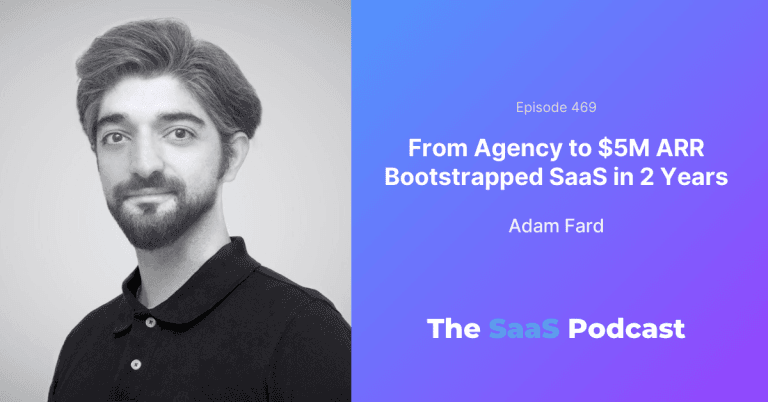
How a Bootstrapped SaaS Hit $5.3M ARR in Under 2 Years - Adam Fard

Adam Fard, UX Pilot

How a Bootstrapped SaaS Hit $5.3M ARR in Under 2 Years

Adam Fard is the founder of UX Pilot, an AI platform that helps product design teams create and ship great user experiences faster. In 2023, Adam was running a successful UX agency when ChatGPT and LLMs started taking off. He began experimenting with ways to apply AI to his team's design processes and built a Figma plugin that helped users work through UX frameworks and activities. Then during a user interview, someone asked a simple question: "I have all these ideas on my canvas, but can I turn them into something visual? Can I create a wireframe?" That question stuck with him. He started looking around to see if any tools could actually generate wireframes from text input. He found a few products claiming to do it. But when he tested them, he realized they were faking it. They were just swapping existing templates and personalizing the copy. None of them could truly generate a layout from scratch. There was a technical reason for that. Creating wireframes with AI was genuinely hard. So Adam started working on it himself. He explored fine-tuning LLMs, hired AI researchers, and tested component-based approaches. He spent four or five months iterating. Slowly, things started working. The outputs became stable enough to use. He added Figma integration so designers could bring wireframes into their existing workflow. Within six or seven months of that original user question, UX Pilot hit $10K MRR. But growth created a new problem. Adam hired too slowly. At $30K MRR, he kept questioning whether this was the ceiling. He added one engineer, waited, added another, waited again. Looking back, he says he should have hired five people at once instead of dragging out the process. Adam built a bootstrapped SaaS that now generates over $5 million in ARR with a team of 30 and over 15,000 paying subscribers. He proved that a bootstrapped SaaS can compete with well-funded competitors by focusing narrowly on one hard problem - AI wireframe generation for professional design teams - and shipping a code-first product that enterprise teams actually wanted.

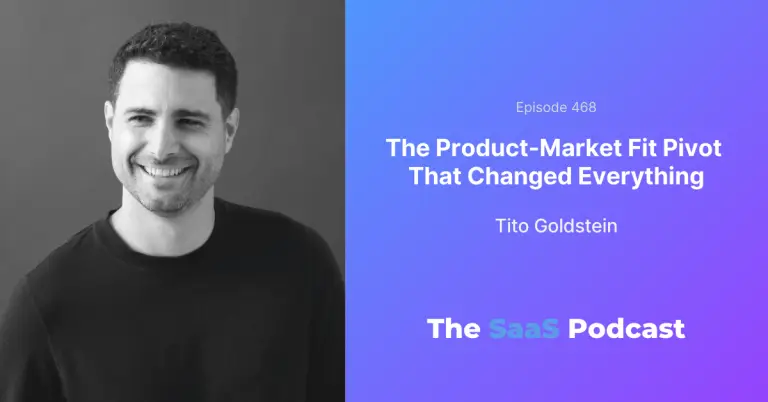
Finding Product-Market Fit After 2 Years of Almost Nothing - Tito Goldstein

Tito Goldstein, Teambridge

Finding Product-Market Fit After 2 Years of Almost Nothing

Tito Goldstein is the Co-Founder and CEO of TeamBridge, a composable workforce operating system for hourly workers that serves over 500,000 employees across 200+ enterprise customers. Tito Goldstein and his co-founder Arjun were two of the first principal product designers at Uber. After interviewing thousands of Uber drivers worldwide, they realized something powerful: drivers were choosing Uber despite lower pay because of the agency and self-service the app provided. They raised a $3 million seed round to bring that same experience to the 60% of the global workforce who are hourly employees stuck with legacy tools. But after building their initial scheduling product, they hit a wall - two years of near-zero revenue and no product-market fit. The problem wasn't the market. It was the product. Customers kept saying they needed to stand out, not use the same cookie-cutter software as their competitors. Their secret sauce lived in spreadsheets and manual processes, not in a fixed scheduling tool. So Tito and Arjun made a gutsy call: throw out the scheduling product and rebuild as composable Legos. Customers could start with a template but configure 20% to match their unique workflows and differentiators. The new product outsold the previous two years of efforts in the first month. Product-market fit had arrived. Then it 3x'd, and 3x'd again. Today, TeamBridge powers NFL stadiums like the 49ers' Levi's Stadium, medical staffing agencies scaling from zero admin staff to multimillion-dollar businesses, and enterprises managing thousands of hourly workers with self-service automation.

How Qualia Found First Customers by Living in One's Basement - Nate Baker

Nate Baker, Qualia

How Qualia Found First Customers by Living in One's Basement

Nate Baker is the co-founder and CEO of Qualia, a software platform for title companies that helps coordinate the complex process of buying a home. Today, Qualia generates over $100 million in ARR with a team of 600 and has raised more than $200 million. In 2015, Nate was 21 years old and decided to build software for the real estate industry. He had no experience in that space. He didn't talk to any customers. He just did some research and decided that was the thing he was going to do. Then he started building. Still without talking to anyone. Nate admits this was a mistake. He and his co-founders got key things wrong about how the business would work. They wasted months building things they eventually threw away. It wasn't until they found their first customer that they started making real progress. Their first customer was Barry Feingold, a state senator in Massachusetts who also ran a real estate law firm. Barry believed in the vision, taught them the industry, made introductions, and helped them understand what actually mattered. The relationship was unconventional: Nate and the first 25 employees rotated through living in Barry's basement. New hires would get a call Sunday night: "Your onboarding is in Andover. You're going to live in Barry's basement for two weeks. He's going to teach you title. You have to tutor his kids in math." But then Barry's existing software vendor found out he was working with Qualia and shut off his access overnight. Nate and his team didn't even have the core features built yet. They had to figure it out fast. It became the most productive month in company history. Barry didn't just become a customer - he introduced Qualia to his competitors. Those network-based relationships became the foundation for the first 10 customers. Nate learned that your first customers must come from your network, not cold outreach.

How a Cold Text to McDonald's CMO Launched Enterprise Sales - Yosef Peterseil

Yosef Peterseil, Blings

How a Cold Text to McDonald's CMO Launched Enterprise Sales

Yosef Peterseil is the co-founder and COO of Blings, a personalized video platform for enterprise brands. In 2019, Yosef and his friend Yonatan saw a problem that wouldn't go away. Yonatan had worked at a company trying to create personalized videos for customers, but there was no technical way to do it at scale. So they decided to build a solution - a new video format called MP5 that renders personalized videos in real-time on the user's device. But finding customers proved brutal. They interviewed dozens of customer success managers before realizing their target ICP had no budget. After pivoting to marketing where the money actually was, Yosef got lucky - someone sent him the McDonald's CMO's phone number. A few persistent texts and follow-up calls later, he had a meeting. Before the call, they scrambled to put together a custom video for the brand. The CMO loved it. But closing even the proof-of-concept took nearly nine months - all while they were bootstrapping with zero revenue and couldn't afford a real lawyer. That's the reality of enterprise sales when you're a two-person startup with no logos on your website. Then came more setbacks. They tried events but had no system to follow up. 70 hard-earned leads went cold. They also hired salespeople twice, but even talented reps couldn't close enterprise sales deals since there was no playbook. But they kept at it. Blings now serves companies like McDonald's, Mercedes, Meta, and Rocket Mortgage. They hit $1M ARR in 2023 and have been growing since then with a team of just 19 people.

How to Close Enterprise Sales Deals in 9 Days - Bassem Hamdy

Bassem Hamdy, Briq

How to Close Enterprise Sales Deals in 9 Days

Bassem Hamdy is the co-founder and CEO of Briq, an AI orchestration platform for the construction and manufacturing industries. In 2018, after spending nearly two decades in construction tech - including a stint at Procore where he helped scale the company from $10 million to $100 million ARR - Bassem set out to build what he called the "construction data cloud." The idea was to aggregate all project data through APIs, creating a Carfax-like record for physical assets. It seemed like a perfect fit given his experience. There was just one problem. The software systems used in construction were 30 to 40 years old, and none of them had APIs. His entire concept was technically impossible. Bassem was ready to give up and go back to corporate life when a chance meeting with an engineer introduced him to robotic process automation. These bots could log into legacy systems and extract data without APIs. Suddenly, the business had new life. But customers wanted more than data extraction. They asked if the bots could also enter data. This pivot to "digital workers" found product-market fit quickly, and by 2020, Briq had reached $1.5 million in ARR. Then came pressure from investors. VCs didn't like that no users logged into the product. They pushed Bassem to build something with daily active usage. So Briq pivoted again, this time to a forecasting tool. It was a disaster. Customers loved the idea of automated forecasting, but the product couldn't deliver on that promise. Less than two years later, they killed it and returned to their automation roots. As if that weren't enough, Briq had ballooned to 300 employees during the growth phase. The larger team created more problems than it solved, and Bassem says they "lost the plot." Painful layoffs followed in 2023 and 2024, reducing the team to 100 people. Today, Briq generates 8-figures in ARR and is targeting $100 million within three years. Bassem credits their turnaround to a counterintuitive enterprise sales strategy: skip the demos, refuse free POCs, and close enterprise sales deals in 9 days by selling vision and value to CFOs who control the budget.

How Founder-Led Sales Closed Instacart, LinkedIn, and DoorDash - Saket Saurabh

Saket Saurabh, Nexla

How Founder-Led Sales Closed Instacart, LinkedIn, and DoorDash

Saket Saurabh is the co-founder of Nexla, a platform that helps enterprises connect fragmented data across different systems, formats, and data models. Most founders start by selling to SMBs. Saket Saurabh did the opposite - he used founder-led sales to go straight to Fortune 500 enterprises like Instacart, LinkedIn, and DoorDash from day one. His reasoning was counterintuitive: if you architect for small companies first, you'll never fully understand the depth of enterprise complexity. Enterprises still run mainframes. They have fragmented data across dozens of systems. And that complexity is exactly where Nexla's value shows up. Saket closed the first 15 enterprise customers himself through founder-led sales. His approach was consultative: instead of pitching, he listened. Instead of demoing features, he asked questions. "My first goal talking to someone was not that I'm going to sell you something," Saket says. "I'm really passionate about solving this problem. Do you see this problem as well?" The breakthrough came when his co-founder live-coded a fix during an Instacart pitch. "We ended the session showing them something working," Saket recalls. "They said, 'You guys did this on the spot? It takes us weeks or months to solve the same problem.'" That magical moment closed the deal. Nexla has since grown to over $5M ARR, raised $33M, and serves 50+ enterprise customers with 6-figure ACV deals. Saket's founder-led sales approach proved that technical founders can close Fortune 500 deals by solving problems instead of pitching. But to get there, he had to cut founder salaries to zero and downsize the team to reach cash flow positivity before their Series A.

From $150K Consulting Trap to $1M ARR AI SaaS - Ibby Syed

Ibby Syed, Cotera

From $150K Consulting Trap to $1M ARR AI SaaS

Ibby Syed pivoted his AI SaaS from a consulting trap to $1M ARR in under a year. Learn his playbook for escaping the services treadmill and building a product-led AI agent platform. In 2022, Ibby Syed joined his co-founder Tom right after YC. They built a customer analytics platform and grew it to $150K ARR over 18 months. But something wasn't right. Customers weren't logging into the product - they'd call with a question, get an answer, and disappear. Ibby realized they'd accidentally built a consulting business, not an AI SaaS. Then came the wake-up call. A customer asked them to extract topics from support tickets. Ibby built a data science solution that was slow and clunky. His co-founder Tom tried the newly released OpenAI API instead - and with just 100 lines of code, solved the problem better. That was the pivot moment. They stopped doing services, fired some customers, and rebuilt Cotera as an AI agent builder. The difference was immediate: deals became easier to close. Instead of building custom solutions, they taught customers how to build their own AI SaaS workflows. Today, Cotera has 15 enterprise customers, a team of 10, and generates over $1M ARR. In this episode, Ibby breaks down exactly how to escape the consulting trap, why early revenue can be a dangerous signal, and how to build an AI SaaS that customers actually log into.

How Freemium SaaS Grew to Millions of Users With 20 People - Bilal Aijazi

Bilal Aijazi, Polly

How Freemium SaaS Grew to Millions of Users With 20 People

Bilal Aijazi is the co-founder of Polly, an engagement platform that brings polls, surveys, and feedback workflows into the tools teams already use like Slack, Teams, and Zoom. In 2015, Bilal was working at a consumer messaging company, watching apps like WeChat evolve from simple chat tools into full-blown platforms. He figured the same shift would happen at work. So he and his co-founder Samir started experimenting with simple solutions to collect feedback. Their first attempt was an email-based tool, but engagement was terrible. People just treated it like another survey to avoid. Then Slack opened their API. And Bilal noticed people on Twitter asking for Slack polls. So the founders quickly ported their product over, becoming one of the very first Slack apps ever built. But the installation process was clunky. Five manual steps that required copying and pasting tokens between different screens. Yet 80% of people still completed the setup. So they were clearly providing something people wanted. Then one day someone posted Polly on Product Hunt and they went viral overnight. They were getting thousands of new signups every month and struggling to keep the servers running. Yet they had zero revenue. Their first paying customer spent $8 a month for a fantasy football league. Then came the real challenge of building a freemium SaaS - figuring out who would actually pay. Most freemium SaaS users just wanted to do something casual with polls like pick lunch spots. But through hundreds of conversations, they found where the real money was. They focused on company all-hands, sales kickoffs, and other high-stakes meetings where feedback actually mattered. Just when things clicked, Slack threw a spanner in the works. Polly had built a workflow feature for automating feedback. They were signing five-figure deals. Six months later, Slack launched their own solution. The founders had to make a choice. Stay on Slack and hope for the best, or take a massive risk and rebuild everything for multiple platforms. They expanded to Teams, Zoom, Google Meet, and embedded directly into presentations. Rebuilding their entire infrastructure was a huge undertaking, but they had no choice. Today, Polly is one of the most successful freemium SaaS products in the collaboration space, serving millions of monthly active users and generating multiple seven figures in ARR with just 20 people.

How a £4,000 WordPress Plugin Became a Bootstrapped SaaS Exit - James Ashford

James Ashford, GoProposal

How a £4,000 WordPress Plugin Became a Bootstrapped SaaS Exit

James Ashford is the founder of GoProposal, a proposal and pricing platform for accountants which he bootstrapped and sold for an 8-figure sum. James didn't have a tech background. He wasn't an accountant. And he'd never built software before. But he noticed something broken: accountants couldn't price their services. They'd guess fees based on what the last client paid. Proposals took days. Deals fell through because people got busy. So he built a simple solution. A digital menu that let any staff member price and close deals in 15 minutes. The first version? A WordPress plugin that cost £4,000 to build. Before writing a single line of code, James did something unusual. He calculated how much money he needed to never work again (£5 million), identified the companies that might acquire his business (Sage, Intuit, Xero), and printed their logos on his wall. This wasn't optimism - it was his bootstrapped SaaS exit strategy from day one. To crack the accounting industry as an outsider, he traded 10% of his software company for 10% of an accounting firm. Instant credibility. Then he wrote a book in two weeks, made it an Amazon bestseller, and used it to build a waitlist of hundreds before launch. His marketing philosophy was simple: market like a celebrity chef. Gordon Ramsay shows you how to cook his recipes for free. You still go to his restaurant. James gave away everything - the methodology, the frameworks, the exact playbook. People still bought the software because they wanted it done faster. The bootstrapped SaaS approach forced creativity. When he realized a single conference cost £25,000, he hired a full-time videographer instead. Twelve months later, the pandemic hit. Competitors who relied on events were stuck. GoProposal dominated online. By the time he sold, GoProposal had over 1,100 customers, a 78 NPS score, and playbooks for every single process in the business. Three potential acquirers approached him within months of each other. The exit price? 8 figures. The multiple? One he still doesn't publicly share because it was "crazy."

Showing 12 of 472 episodes

Omer Khan

About the Podcast

The SaaS Podcast features in-depth interviews with proven SaaS founders and industry experts. Hosted by Omer Khan, each episode covers real strategies for building, launching, and scaling SaaS businesses.

Listen on: