Omer (00:11.840)
Welcome to another episode of the SaaS Podcast.
I'm your host, Omer Khan and this is the show where I interview proven founders and industry experts who share their stories, strategies and insights to help you build, launch and grow your SaaS business.
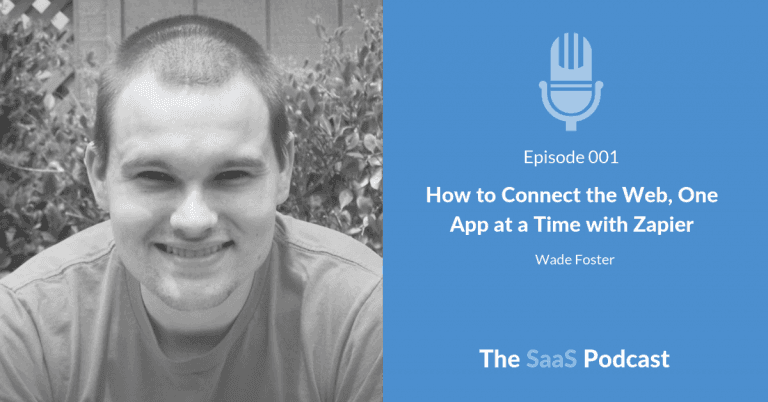
Today's interview is with a guy called Wade Foster, who's the co founder of a software company called Zapier.
And Wade shares with me how he and a couple of college buddies took an idea that solved a problem that they were having themselves and turned it into a successful product with over 300,000 users in less than three years.
Now Zapier is helping solve integration problems for over 350 SaaS applications such as Salesforce Data, Dropbox and Infusionsoft.
So with that, let's bring on Wade.
So I am absolutely delighted to introduce my guest today.
Wade Foster is the co founder of Y Combinator startup, Zapier.
Zapier lets SaaS users create integrations that push data between hundreds of best in breed web applications without having to write any code or deal with APIs.
So Wade, welcome to the show.
Wade Foster (01:25.420)
Thanks for having me.
Omer.
Omer.
There we go.
I got it.
Omer (01:31.100)
So I've told our audience just a little bit about you.
Tell us in your own words a little bit more about you personally and give us an overview about your product and business.
Wade Foster (01:38.940)
Sure.
Yeah.
So I was born and raised in the Midwest, started Zapier in the Midwest before.
A year in, we moved it out here to Silicon Valley.
Zapier.
The idea behind it was that a lot of small businesses are using a ton of SaaS services these days.
They use things like FreshBooks and Mailchimp and Wufu and Gmail and Twitter, all in their business.
But those tools don't talk nicely together.
One of the things we were doing as freelancers, contractors was trying to write code to help tie those together.
And so we thought, hey, how can we productize this work?
And came up with a way to put that power in the end user's hands so that they could create those connections themselves rather than having to rely on an engineer.
Omer (02:21.930)
Great.
So can you give us just an example of how somebody could be using Zapier?
Wade Foster (02:25.930)
Sure.
So say you have a Google form set up that collects contact information.
When someone fills out that form, you could automatically save it to your CRM like Salesforce or Highrise or something like that.
Also you could set up something that every time I get an email that has an attachment, I'm going to save that to Dropbox or Box automatically.
So just like these little bits of automation that you end up doing a lot, every day, manually.
With Zapier, you can replace it with a bit of automation and save yourself quite a lot of time and quite
Omer (02:58.230)
a lot of money as well, because presumably people would probably end up using a developer to do some of these integrations.
Wade Foster (03:05.510)
Yeah, absolutely.
Time is money.
Money is time.
Saves a lot.
Omer (03:11.430)
Awesome.
Before we dive into more details, we like to kick things off with a success quote.
What is your favorite success quote?
Wade Foster (03:19.350)
Be better today than I was yesterday.
Omer (03:22.550)
I love that one.
Can you give me an example of how that quotes helped you in your life?
Wade Foster (03:27.750)
Sure, yeah.
I mean, a lot of times, you know, it's easy to get like bummed out on what you're doing.
You feel like you're not making enough progress, you feel like things aren't going as well as you'd like to.
But the thing I like about this quote is it really helps you hone in on a very small timeframe.
Yesterday I did this thing, today I'm gonna do this thing and I'm gonna be just a little bit better.
And one of the things I've learned from psychology is that we actually overestimate the amount we can get done in a short amount of time, but we tend to underestimate the amount we can get done in a long amount of time.
So if you follow this formula over an entire year, by just being a little bit better the next day than you were today, you actually find out a year from now you'll make quite a lot of progress.
Omer (04:14.130)
Yeah, I love that quote.
I think, you know, we live in a world where everything is about, you know, getting the body you want in 60 days or, or turning your life around in 90 days.
And, and sometimes it's.
We forget that it's about making these daily consistent.
Taking these daily consistent actions over a longer period of time, that really gets the, the results.
Wade Foster (04:35.250)
Absolutely.
You know, we can't all wake up and be, you know, Michael Jordan or LeBron James, you know, in one day, but if you work, you know, to get a little bit better, you know, maybe over couple of years, you can, you never know.
Omer (04:48.190)
Okay, so let's take a journey back to your early days and explore how you get got started.
First of all, can you tell me where the idea for Zapier came from?
Wade Foster (04:59.070)
Sure.
So, as I mentioned, my co founders and I, Brian and Mike, we did a lot of freelance and contract work back in Columbia, Missouri, which is where we all went to school, to university, and one of the things that we found in our contracting work we were working with a lot of small businesses.
They were using Those tools like FreshBooks, Mailchimp, Wufu, Highrise, Gmail.
And they would often ask for things like, hey, can you take my PayPal sales and automatically create invoices and QuickBooks for me?
Or can I get all my Google contacts pushed into a mailchimp list for me?
Which is the equivalent of for developers of grunt work.
That sort of stuff is not all that interesting.
And you can do it, it's fine, but it's very straightforward, not really creative work or anything like that.
What we wanted to do was give them the power to set things up like that themselves so they didn't have to rely on a developer.
So we kind of came up with this a bit of trigger action concept where when something happens in this app, automatically do something over here in this app.
It's a bit like a cron job or Unix pipes for those geeks out there to do this sort of thing.
And now you don't have to be super technical to set up stuff like this with Zapier.
Omer (06:16.910)
So what did you do next?
You've got this idea, you think you're onto something.
Did you go out and try to validate the idea?
Did you start building a product straight away?
What was the next step for you guys?
Wade Foster (06:30.190)
So the very first thing we actually did was we built out a prototype at a startup weekend.
So startup weekend is these global events that happen all over the world in various cities where you come together in over 50 hours, you build like a prototype or a demo of a product.
And, you know, so from Friday to Sunday night we worked, you know, pretty much non stop, slept like maybe two or three hours over the course of the weekend and built out like an initial prototype of Zapier.
It was not good.
It was pretty, pretty bad at the time, but it was just good enough.
It kind of worked.
It was enough to give people like a taste of what this could be.
And so from there we went out and started just talking to all the small businesses that we freelanced and contracted with.
We'd find people that were asking for integrations online.
A great example of that is if you go to forums of these SaaS services, oftentimes people will be asking for integration in their help docs or in their forums.
We'd reach out to them and say, hey, we're working on a project that will handle some of this stuff.
Would you be interested in learning more from there?
We were able to get a sense of how people would interact with the product, what they really wanted and were able to iterate more closely to a solution that was easier for them to get set up.
Omer (07:44.260)
So you weren't trying to sell the product at that point.
You were looking to get feedback from these companies and individuals?
Wade Foster (07:52.100)
Actually a little bit of both.
So one thing that we did that was interesting from the get go is we did sell the product.
We said, hey, if you want to use this thing, it's going to cost money from day one.
So rather than having a free beta like most software companies did, we actually had a paid beta.
So you paid the very first folks, paid $100 to get access to the beta.
A lot of people have asked me why we did that and why, you know, did it work well, and I think the answer is yes, because we got people who are really invested in solving this problem.
It's like this thing is so important for me to figure out that I'm willing to give you $100, sight unseen to solve it.
Omer (08:35.550)
So that is a. I mean, in hindsight, that looks like it was a really smart thing to do.
But when you're starting out and you've got a new product, it takes a little bit of courage to go out there and charge people to use a beta.
What was going through your head with you and your co founders at the time?
Wade Foster (08:56.830)
So, I mean, we were from Missouri, so we knew that if this was ever going to work, it had to be a product that made money from day one.
You know, we weren't from Silicon Valley.
We're in a place where we could get millions of dollars of funding to, you know, try and get a bunch of free users and then hopefully convert them someday.
We needed to be able to charge from day one.
And so that was the approach we took.
And, you know, I mean, it's a bit tough to hear no, like, I don't think this is the right way to do things.
But, you know, we were, we lucked out in that we got a few yeses really relatively quickly.
And those few yeses really fueled us through a lot of no's.
So we heard all the time, you guys are crazy for doing this.
I remember one person said, I'm a certified beta tester for Google products.
How dare you think that you should want feedback from your product at all costs?
I think that really taught us.
It's like, no, we've already seen these other people who are just so genuinely pleased to have our product that I'm really not interested in getting feedback from a tire kicker or someone who's just like, only mildly Interested in the product.
I want someone who is really, really, like, so invested in this problem that they're willing to spend a little bit of money to solve it.
Omer (10:10.750)
Do you remember how many no's you had to get before you got a yes?
Wade Foster (10:16.750)
So it wasn't that many, honestly, I think it was maybe about a dozen or so before we got to a few yeses.
Omer (10:27.990)
And then how many customers did you have in the beta?
Wade Foster (10:31.190)
So across the whole beta, the beta lasted for about nine months and by the end we were around 800 customers, people who paid to get into it.
And then we were also collecting email addresses at the time, so people who were interested but weren't willing to pay at that point.
And we had about 10,000 email addresses of people who are interested in checking out the product once it launched.
Omer (10:55.400)
So initially you started talking to businesses who wanted some kind of integration work done.
You were going out on forums and you were reaching out to people who were talking about problems they were having doing some kind of integration.
And that got you your first few customers in the beta program.
But how did you get to 800?
Was it just doing more of that or did you use other strategies to go and get up to 800 users?
Wade Foster (11:23.980)
So it was a lot of that, a lot of what I call the forum hunting.
Right.
So it's going to these forums, a lot of them get a lot of traffic and they have a very narrow and targeted audience.
Right.
You know, if you go to the Evernote forums, these are all Evernote users.
And if it's an Evernote forum about like Google Calendar integration, everyone looking at that wants a solution to that problem.
So while in the global sense of things, there's not that many people, but the fact that in that thread, the people looking at that page are 100% qualified, any traffic you get from that is going to convert at very, very high rate.
We just did a lot of that manual outreach to these forums, saying, we've got a project that we're working on.
If you're interested in checking it out, here's a link to it.
We would get for every form we went into and posted a link, we would probably get 3, 4, 5, sometimes 10 visitors a day from those and they would convert at over 50% rate.
So it was actually pretty good traffic and really targeted traffic.
More importantly.
Omer (12:30.110)
Nice.
That's really great.
So when did you launch the product?
So you said the beta lasted for nine months and then when did you guys launch?
Wade Foster (12:38.910)
So officially launched in June of 2012.
This was right around the time that we actually moved to Silicon Valley as part of y Combinator's Summer 2012 bash.
And so we launched right at the beginning of that.
Omer (12:54.170)
So let's talk a little bit about Y Combinator.
Now.
From what I understand, you guys applied to get into Y Combinator and didn't make it the first time.
And then again around this time, you applied and you, you got in.
So tell me a little bit about that experience and, and what you, what were the key takeaways or learnings for you from going through Y Combinator?
Wade Foster (13:19.940)
Yeah, so, I mean, we applied the very first time right after Startup Weekend at that very prototype.
We had no customers, no validation, no nothing at the time.
And we were confident in the idea.
We had a good plan for progressing.
However, we'd just not proven any of it at that point in time.
We got the most polite rejection letter from Y Combinator that you can get.
It says things like, you know, we can't accept everybody.
You know, I'm sure your idea is great, like, keep working hard, you know, apply again next time.
Like it's, it's a very, very polite, you know, rejection letter and encouraging one as well.
Though we were still a bit, you know, we had a bit of a chip on our shoulder after that because we knew we were good enough.
And so we just, you know, heads down and worked really hard for the next nine months, applied again, showed a lot more progress, showed that we could, you know, make this happen.
And of course YC let us in that time around.
As for the experience, I mean, it's fantastic.
YC has funded many hundreds of startups now.
I think there's over a thousand founders that have gone through, many of which are work at partners for Zapier.
Companies like Wufoo and Dropbox and Heroku and all these folks are now integrations through Zapier.
So it was really great for us to be able to tap into that network of well connected tech founders.
Omer (14:44.460)
If someone out there is thinking about applying to Y Combinator, what advice would you give them?
Wade Foster (14:53.820)
I would say just do it.
I mean, even if you're not thinking about applying to Y Combinator, going through the application itself is still a helpful exercise for your business because they ask a lot of really core questions that make you think like, hey, am I going on the right track to figuring out if this is going to be a scalable business or not?
And so, you know, I would, I would really, you know, I would just go through those questions and do your best to answer those, Figure out the answers to Those questions don't just spend like, you know, 10 seconds thinking about it.
If you don't know the answer to it, go out and talk to some customers, talk to people, find out the real answers to those questions as best you can, because that's gonna, your business is gonna benefit a lot from you doing those exercises.
Omer (15:38.910)
So looking back at those early days where you went from the initial idea through the beta program and into launching, what do you think was one of the biggest mistakes that you made back then?
Wade Foster (15:51.470)
So we had, I mentioned that 10,000 people who had given us an email address for signing up to be interested in the beta.
Well, one thing that we did really badly is we never actually emailed those people ever until it was time to launch.
So we had people's email addresses from 9 months ago who had signed up to get notified about when they launched, who had not heard about us until nine months later.
And that was just a really poor decision because we could have done a lot better job nurturing that list, staying in touch with them, and then when we did launch, have a much better chance of converting them and getting them to try the product instead of saying, like, who, what is this thing I signed up for again?
Omer (16:35.330)
So if you could do it over, what would you have done differently?
Wade Foster (16:39.490)
I would have sent them an email once a month, just said like, hey, here's the checkup on how the beta is going.
Just something to stay in touch with them.
Omer (16:52.290)
Great.
So let's move on and talk about some growing pains.
You've launched the product, you know, you've got close to a thousand customers and you want to keep growing.
So what did you do then to get even more customers?
Wade Foster (17:10.130)
Sure.
So one of the things after we launched is we had a lot of interest in getting more integrations into Zapier.
You know, we had, when we launched, we had about 30 apps and it was still just the three of us.
And we had a lot of demand for new apps on Zapier.
We didn't know well, it just didn't feel scalable for us to be the ones always building those integrations.
If we were the ones that had to build every single integration, it didn't feel like we would get to the critical mass that was needed.
We built out our developer platform then, which you can find@zapier.com developer, which allows anyone to add apps to Zapier.
So if you have an API or you want to use a third party API, you can hook it into Zapier yourself.
And when we did that, we launched with 13 new partners that did it, including companies like HubSpot, Podio and handful of others that you may recognize.
Which was a great idea because since then we've gone from 30 apps to now over 350, and of those 350, about 250 have come via the developer platform.
So it's a really great way to scale out the number of apps that we support on Zapier.
Omer (18:24.370)
Are you guys spending a lot of your time still developing apps or these days, is it mostly through the developer platform?
Wade Foster (18:31.490)
It's almost entirely through the developer platform and we spend our time working on the platform itself, making sure that it's maintainable, that it has the functionalities that the developers that are hooking apps in need to expose to the users.
So we're thinking a lot about that, a lot about the usability of setting up the integrations and less time building apps into Zapier, though we still build our fair share of apps as well.
Omer (18:57.950)
Let's talk a little bit about the process of getting people onboarding new users and the sign up process and just using Zapier to create their own zaps.
What were some of the lessons that you learned about making that as frictionless as possible for users?
Wade Foster (19:18.020)
Sure.
So in the early days we had this clever idea that one thing we could do to make signing up for Zapier really frictionless is to not actually have people sign up.
Instead of having a sign up button on the homepage, we would put the product right on the homepage.
It used to have two apps at the top and you could just drag this app to the left, drag this one to the right, and that would create your trigger in action and you click continue and you'd be halfway through setting up a zap before we'd actually ever ask you to sign up.
So it's very frictionless in that regard.
However, what we found out is that people actually really just wanted to sign up.
We would get a lot of folks emailing us, say, how do I sign up for your product?
I don't know where to sign up.
And it's like, you don't have to, you can just use it.
So what we ended up doing is moving back to a more traditional signup page where you have a homepage, you have a big headline and you have a sign up button.
And that removed a lot of friction from people.
So it was interesting to me that that signup button has just become so ingrained in everyone's way of working with apps that even making it less, removing friction of signing up was Actually adding friction to the user's mind.
So that was one thing that we learned early on that was a bit mind blowing to me.
Omer (20:36.140)
That's a really interesting insight.
I've never even thought of that.
Wade Foster (20:39.070)
Mm.
Omer (20:40.830)
So let's talk money.
How did you, you know, go about generating revenue?
How did you think about pricing the product?
You know, what were the, what changed for you where, you know, when you think about revenue after you launched?
Wade Foster (21:00.190)
Sure.
So you know, we went from, you know, the, the beta was a one time paid deal.
You're in for the beta.
Then when we launched, we added a freemium component, so there was a free plan.
And then, you know, we added a monthly subscription because, you know, SaaS is a subscription business, are pretty stable way to grow revenue and it compounds over time, which is nice.
One of the challenge challenging things for us is that we didn't have really any comparable companies to look at for pricing.
You know, if you launch an email marketing tool, there's so many email marketing companies you can look out and say like, hey, I can kind of price in this ballpark or I can, you know, fit in this niche to, you know, kind of carve out a space for me in the email marketing space.
But for Zapier, there was really no comparable companies that we could say like, hey, well we'll just like, you know, tweak their pricing like this or we'll mimic them like this or you know, here's the right price point.
So we were really just making it up and you know, we just said like, hey, here's some price points that other products, these, our target customers are paying for.
You know, if you go look at something like wufu, a lot of our customers use Wufoo.
Their price points are like $50, $30, $70 and $150.
So we're like, if we have price points that are roughly in that realm, we'll probably make money.
Then it was just a matter of like finding some tiers.
Right.
So like, hey, we need to have like a zap tier, a task tier or something like that.
And you know, we just kind of slapped some in that felt reasonable and we tweaked them a little bit over time.
And it's mostly worked out.
It's not perfect.
You know, it's funny, we see a lot of competitors now trying to copy our pricing.
That always makes me chuckle because I know the process that went into coming up with our pricing.
And so yeah, we're still learning today, like how people interact with our product and what are the Right tiers and what are the right price points?
But I think the key thing is that we actually just charging itself was the most important thing because we get people to pay.
Even if our price points are perfectly optimized, we're still getting a lot of customers paying because they get value out of it.
Omer (23:07.610)
Now, what was the thinking behind you have sort of standard apps and then you have integration with premium apps?
What was the thinking behind that?
Wade Foster (23:17.450)
Sure.
So, you know, premium apps are basically definitively business apps.
Things like Salesforce, QuickBooks, GoToWebinar.
These are things that every business, they have no free plan.
They have expensive paid plans.
It's just a way of fitting the price to the customer.
If you're using integrations for these tools, it's likely solving a big enough problem that you're willing to pay some amount of money.
That's what we've done, and it's worked pretty well there, too.
Omer (23:48.040)
Great.
Tell me about what you think was one big challenge that you faced in growing the business.
Wade Foster (23:56.840)
Sure.
You know, so I come from a product background, but I've never actually.
This is my first company that scaled any amount.
And so one of the big things that I'm learning is not just how to build a product, but how to build a team and a company around it.
So finding the right people to join in and finding, you know, building culture and, you know, figuring out the type of company I want to run, which is.
It's been a lot of fun, but it's also been, you know, an interesting challenge too.
Like, one of the things I've learned is you shouldn't try and innovate on things like HR practices.
Right.
Payroll and things like that.
Just do what everyone else does there, because that's an area you don't want to mess up on.
Omer (24:37.540)
So we started this conversation by going back to where the idea for Zapier came from, and we took the journey together in how you turn that idea into a successful product.
So jumping back to the present day, can you share any numbers in terms of users or revenue in terms of where you guys are right now?
Wade Foster (24:57.470)
Sure.
So we actually.
The latest public numbers we share is that we've passed 300,000 registered users.
Omer (25:05.390)
Wow.
Congratulations.
That's a huge milestone.
Wade Foster (25:09.790)
Yeah.
In about two years, we made it from zero to 300,000.
Omer (25:16.190)
So what's the one thing in your business that you're most excited about right now?
Wade Foster (25:22.760)
You know, I think it's that we haven't even.
I feel like we've only just started to scratch the surface every day.
We still get feature requests.
We get.
We have conversation with customers outlining things that we haven't been able to solve for them yet.
And so I still think there's a lot of stuff that we're able to provide for customers for people out there that will be able to solve their integration needs.
Omer (25:48.550)
Are you still hanging around on forums or is that less of a requirement these days?
Wade Foster (25:54.870)
Yeah, we don't hang around on forums much anymore, but we actually, a lot of our customers do post things on forums now for us, so that's the thing that we don't have to spend as much time doing.
Omer (26:05.430)
That's great.
Okay, so now it's time for our lightning round.
I'm going to ask you a series of questions, and I'd just like you to answer them as quickly as possible.
So are you ready?
Wade Foster (26:15.220)
I'm ready.
Great.
Omer (26:16.620)
Let's do it.
So, first of all, what's the best piece of business advice you ever received?
Wade Foster (26:23.300)
So this is where my quote comes from.
I mentioned before the call, a guy I used to work for named his company plus one.
And the reason was he wanted to make sure that today was plus one better than the day before.
And so I've kind of adapted that to say, make today better than it was yesterday.
Omer (26:43.430)
What book would you recommend to our audience and why I really love Ben
Wade Foster (26:47.950)
Horowitz is the Hard thing about Hard Things?
If you're running a business and a CEO of a business, it's a really good one.
Omer (26:57.189)
What's one attribute or characteristic of a successful entrepreneur in your mind?
Wade Foster (27:02.390)
I think just resilience.
Just showing up day after day trying to figure out and solve problems for customers.
That really is the defining characteristic.
Omer (27:14.120)
What's your favorite personal productivity tool or habit?
Wade Foster (27:18.120)
Hmm.
So I use what I call top tasks of the day each night, or usually each night the night before.
I write down two or three things that I feel great about if I got done the next day and I try and tackle those first thing in the morning.
Omer (27:37.740)
Awesome.
Those are great answers.
Thank you.
Wade Foster (27:40.220)
Yeah, no problem.
Omer (27:42.460)
Okay, so it looks like it's time to wrap up on this episode.
Wade, I want to thank you for joining me today and talking about Zapier.
If people want to find out more about the product, they can go to zapier.com, which is z a P I E R dot com.
And if folks want to get in contact with you, what's the best way for them to do that?
Wade Foster (28:04.960)
You can find me on Twitter at Wade Foster.
Or you can feel free to shoot me an email Wade at zapier.
Com.
Omer (28:11.840)
Fantastic.
So, Wade, thanks again, and I wish you all the best with Zapier.
Wade Foster (28:16.480)
Yeah, thanks, Omar.