Omer Khan [00:00:03]:
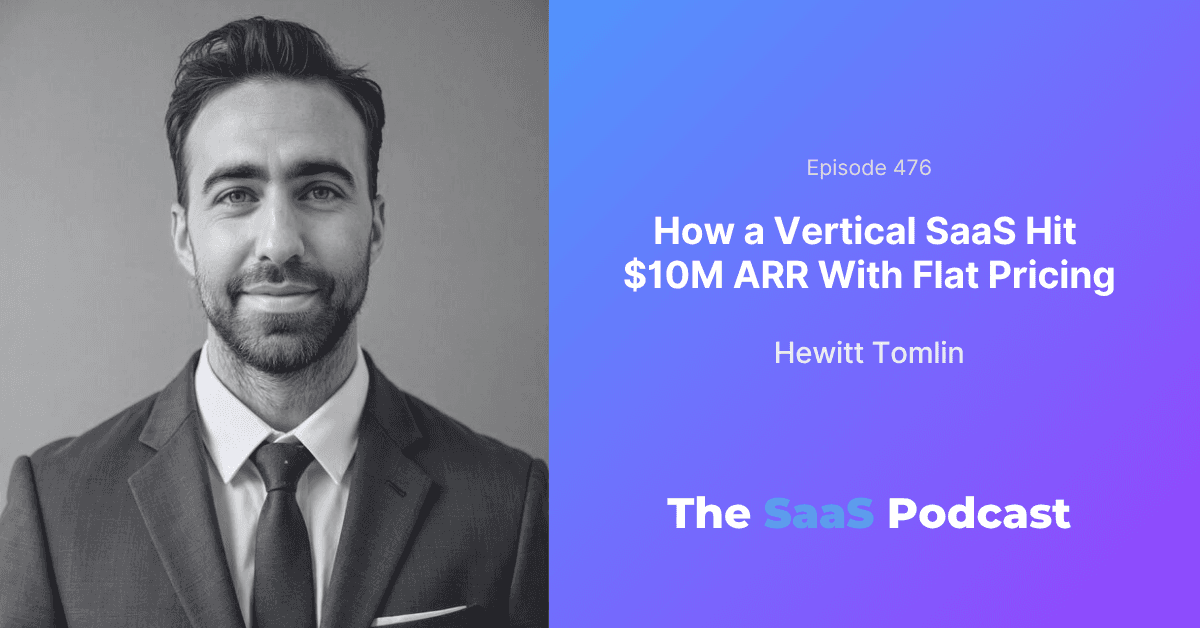
Welcome to The SaaS Podcast. I'm your host, Omer Khan. AI has changed the playbook for building and growing SaaS. Every week I talk to founders who are writing the new one. My guest today is Hewitt Tomlin, the co founder of TeamBuildr. They build software for strength and conditioning coaches.
Omer Khan [00:00:20]:
Hewitt has bootstrapped this business to over 10 million in ARR with a team of 45 people today never raised a dollar, but it took 5 years to get to the first million in ARR and their pricing is a little unique. They charge NFL teams the same price that they charge the local high school team.
Omer Khan [00:00:40]:
Hewitt built software to make coaches better at their jobs, but his biggest competitor is betting on AI to replace coaches completely. Hewitt's betting the opposite. All right, Hewitt, welcome to the show.
Hewitt Tomlin [00:00:54]:
Thank you for having me.
Omer Khan [00:00:55]:
Yeah, it's my pleasure. So for people who aren't familiar with TeamBuildr, can you tell us what does the product do, who's it for, and what's the main problem you're helping to solve?
Hewitt Tomlin [00:01:04]:
Of course, we are a classic post iOS SaaS company. The iPhone came out my freshman year of college and lucky for me, my roommate and my teammate got the iPhone right away because he was a computer science major and he just couldn't help but get it. Remember when the iPhone first came out? Not every.
Hewitt Tomlin [00:01:23]:
It was not as ubiquitous. BlackBerry was a very big thing and other smartphones were out there much more commonly than they are today. So when the iPhone came out, it changed how we thought about distribution. We as college athletes received our training program on a workout card or a paper packet in the summer.
Hewitt Tomlin [00:01:46]:
And we thought that this paper packet in the summer, if it was an app, training in the off season with your teammates, could be a more social experience if we had a mobile app. So originally TeamBuildr was supposed to be kind of a team centric social app.
Hewitt Tomlin [00:02:02]:
And we didn't know it at the time, but we were a product of our environment. Facebook was really big when we were in college and building social apps was like the coolest thing you can do out of college. So naturally we thought about building a social app. And did the world need another one?
Hewitt Tomlin [00:02:21]:
Probably not, but lucky for us, we pivoted pretty quickly thereafter.
Omer Khan [00:02:25]:
Cool. So you've got this idea. How did you get started? What did you do? Have you guys had any experience with building software? Did you just start building? Did you say, we're going to go and talk to people?
Hewitt Tomlin [00:02:43]:
My partner James was experienced in building front end and lucky for us, started building some backend things as we Got into senior year and TeamBuildr is an intensely backend heavy app because of all the data that it stored. So that was a good thing.
Hewitt Tomlin [00:03:03]:
More importantly, we didn't have experience other than building some gimmicky websites, which is good experience to just build things and put them out there. What we did not have experience with is we had working with a customer, an audience, understanding that side of things.
Hewitt Tomlin [00:03:23]:
But lucky for us, a university is a very friendly place to start a business. That's kind of the whole point, right? To put people together to give them access to one another. So when we reached out to our campus dream coach, they took a meeting with us just to hear our idea and explain their process to us.
Hewitt Tomlin [00:03:41]:
And it didn't take very long to realize that this coach was not necessarily interested in a social experience for his players. He was more interested in accentuating or improving his workflow for how he built and distributed these training programs.
Hewitt Tomlin [00:03:59]:
So he didn't know it at the time and we didn't know it, but he kind of pivoted us to being like a true B2B SaaS company, which was a really good thing because I don't know if I have the appetite for being anything other than a B2B SaaS company.
Omer Khan [00:04:12]:
Yeah. So I think that's a really interesting part of the story. Before we get into that, just give us a sense of the size of the business. Like where are you in terms of revenue, customer size of team?
Hewitt Tomlin [00:04:22]:
Today we are almost precisely on the dot, a $10 million a year revenue company. We have 45 employees. And what's unique about us is our structure, our leadership structure. James and I are the two original owners and we use the same operating agreement from 2012 and it's 2026, so that's very rare.
Hewitt Tomlin [00:04:47]:
But that's one of our most unique aspects.
Omer Khan [00:04:50]:
Yeah, you guys are 100% bootstrapped and you've hit 10 million in ARR.
Hewitt Tomlin [00:04:54]:
Yes, exactly.
Omer Khan [00:04:55]:
So tell me a little bit about this journey you went on that you originally built. The product, I think for athletes and this coach conversation that you had eventually got you to this realization point that you were building for the wrong customer. How much time had you invested? What had you built up until that point?
Omer Khan [00:05:22]:
Many founders are in that situation. They sometimes confuse go and talk to customers by validate the thing you've built. And it's really hard to throw away what you've done. So I'm curious, how far along were you and how easy or hard was it to make that decision once you had this Conversation with the coach.
Hewitt Tomlin [00:05:43]:
Well, lucky for us, we were still in school, so we didn't have the capacity to build all too much. So what we had at the time, I think was designs for mobile, what we thought was a very mobile centric experience, but not very much built.
Hewitt Tomlin [00:06:00]:
And when we made the pivot, we essentially pivoted from focusing on a native social app to being a heavy web based portal for the coach. Now back to your point. Yes, many entrepreneurs have an idea, marry it in the words of Brad Feld, and do more faster. He's a techstars co founder, which is a great book.
Hewitt Tomlin [00:06:28]:
Entrepreneurs marry their idea and you can't marry your idea. So if you're validating ideas to people and you've actually started building, you have a very strong incentive built in to fish for what you want to hear. And that doesn't always happen. So I see it a lot, I hear it a lot.
Hewitt Tomlin [00:06:51]:
I sort of like the idea of someone who is publishing and shipping and just seeing what happens. If it's a social app, like when I was back in college, just put it out and see if anyone's on there and what they're posting.
Hewitt Tomlin [00:07:05]:
It doesn't matter if they're doing exactly what you designed it to do, but if someone is doing something on there, that's validation of something.
Hewitt Tomlin [00:07:14]:
Maybe not what you originally intended, but that's what you ought to be looking for is what are people wanting to do, what are they finding a way to do, whether it was my idea or not.
Omer Khan [00:07:23]:
Yeah. So tell me about this, this conversation with this coach. Why was it so pivotal and
Hewitt Tomlin [00:07:35]:
you
Omer Khan [00:07:35]:
know, why did it push you in this direction of a different icp, different customer, a different product? Many people would have had that conversation and said, yeah, that was nice, interesting. Let's go back to the plan. Right? But you guys didn't do that. So what happened in that meeting?
Hewitt Tomlin [00:07:53]:
Well, for one, this coach shared their professional workflow with us. This is their job function. It's part of what they get paid to do. It's necessary to delivering their value. For two 21 year olds, 22 year olds, that was pretty good. That was pretty meaningful to us.
Hewitt Tomlin [00:08:16]:
So I don't think it was difficult for us to necessarily pivot because I think we were honored by the fact that someone was letting us into what a real job looked like. A real job, responsibility with a salary attached. It may not sound like a big deal now, but that was a big deal to two college students.
Hewitt Tomlin [00:08:30]:
So I think we just understood the gravity of what was able to Be optimized was much more important with this coach's professional job than it was to create a social experience that we wish we had. Right? So I think that's number one.
Hewitt Tomlin [00:08:48]:
Number two, James and I have uniquely never brought a lot of ego to the table with each other. I like to tell this sort of like made up story. If James came to me and said, hey, we're getting into pet food, we're no longer TeamBuildr B2B SaaS. I believe that we ought to be doing pet food.
Hewitt Tomlin [00:09:09]:
I would never say no right off the bat because we always make room for each other and give each other time and space and respect for any thought or conviction.
Hewitt Tomlin [00:09:22]:
So I think when we went out on this journey to build this company, we always had a good habit of listening and being very open and less dogmatic about what we thought something ought to be. And we're still like that today. And it's one of the strongest lessons I can teach younger entrepreneurs.
Hewitt Tomlin [00:09:40]:
In fact, even this morning, before we got on, I worked with a young entrepreneur named Jacob. And we were working on a piece of feedback from a prospective customer. And I had to share with him, you know, James and I, we don't think this way about this current situation. I had to sort of rearrange that for him.
Hewitt Tomlin [00:09:59]:
And it takes a lot of reflection, which is sort of counter to an entrepreneur's extreme urge to do right.
Omer Khan [00:10:10]:
Okay, great. So you've now got some clarity. You see a real potential customer in front of you. What type of product? What was that first version of the product that you guys built? And how long did it take for you to have something that you could sell?
Hewitt Tomlin [00:10:27]:
I think we started building towards an MVP in the summer of 2011. We made our first dollar in the summer of 2012. So that's the timeline that first dollar was. The first dollar is always hard to come by, but harder things take place before then because you want people to use your product and not pay for it.
Hewitt Tomlin [00:10:56]:
You really do. If you're out there looking for the first dollar, I think it's great. However, the first users are so much more valuable than cash in the bank. Those first 10 customers, I'm really grateful for them.
Hewitt Tomlin [00:11:08]:
But I had so much more people of value prior to that who were willing to try things and speak to me about it, because people's time is worth money.
Hewitt Tomlin [00:11:20]:
If I'm asking someone to switch off of Excel, which is what I was doing, and asking them to try my brand new MVP product instead, well, this is my time. I have to climb Your software's learning curve. This is money out of my pocket. Right. So the first dollar. Yeah, that's how long it took.
Hewitt Tomlin [00:11:36]:
But it was a lot of arm twisting to get people even to get on the thing and tell me what their genuine experience was.
Omer Khan [00:11:45]:
So sometimes founders give away the product for free initially because they don't want to ask for money, or they don't want to sell the product, or they're scared to do that. I do agree with you. I think that people giving their time is also a fair value exchange and is very, very important in those early stages.
Omer Khan [00:12:15]:
How did you make sure that those people actually used the product and actually gave you feedback? Because when we get stuff for free, sometimes we don't value it as much and we don't put in a lot of time and effort to use it.
Hewitt Tomlin [00:12:33]:
Yes. Giving away your product for free, freemium, private beta, whatever you want to call it, trust me, I know. I think what folks sort of get wrong sometimes is the free product relationship is not passive. It's still very active.
Hewitt Tomlin [00:12:50]:
When I gave away TeamBuildr for free, I made sure that it wasn't just opening a software license, that it was my time and services and consultation in the process. So I was sort of acting as a companion on that as opposed to you try it on your time and I'll wait for your response.
Hewitt Tomlin [00:13:14]:
So a private beta where someone just presses a button to join, you know, too much of the burden is on them. When I did my free period, if you will, I wasn't looking to send over a login and a password. I was looking to build a relationship with the person.
Hewitt Tomlin [00:13:33]:
I was looking for a partnership with them, and I wanted their critical thoughts on what I had built. People just don't give away their critical thoughts because critical thinking takes work and time and effort. So when I first called these coaches, I very rarely emailed and expected a lot over email.
Hewitt Tomlin [00:13:55]:
I would call a lot of coaches and introduce myself and make myself available. I showed up in person to a lot of conferences and clinics. I was more or less building a network while simultaneously giving my product away for free.
Hewitt Tomlin [00:14:09]:
My earliest adopters I still know today, the very first customer, Dr. Steve Smith, is someone that I could call right now, and I send him some gear every once in a while. So he wasn't just a user. Right.
Hewitt Tomlin [00:14:22]:
He wasn't just an early adopter, someone that I was seeking to glean information from in order to cross the chasm. I really was looking for early partners in my business, just a different kind of partner. And I Think that's an important part of it, is that these folks are not just sounding boards for feedback.
Hewitt Tomlin [00:14:40]:
These folks are going to be your early adopters, your early partners, your early collaborators on your business.
Omer Khan [00:14:47]:
This whole idea of having free users, I love the relationship thing. And I wrote down what you said, that I wasn't looking to send out a login and password. I was looking to build relationships. How did you also set expectations with them that the product wouldn't always be free forever?
Hewitt Tomlin [00:15:11]:
That's a good question. I don't think I did. I was too young. 22, 23. I wasn't necessarily thinking that way. I probably thought that rightfully that I was so novice to this profession, this industry, that I had a lot to learn and a lot of people to listen to. That was my prerogative at the time.
Hewitt Tomlin [00:15:40]:
So I think probably the decision to begin charging just sort of came organically. I think intuitively we just knew that we had been doing a lot of listening, a lot of building, and maybe it was time to see if we can get a purchase.
Hewitt Tomlin [00:15:56]:
And that took a little while, maybe call it another six months from the time that we decided on a price and a license. And again, that first dollar in, it's a milestone, but that's when the real work begins. Now, you're contractually obligated to deliver services, and they're relying on you, and they're entitled to your support.
Hewitt Tomlin [00:16:19]:
So it doesn't change anything from the free mode. In fact, the stakes just go higher, that relationship matters even more, and the listening needs to be even more intentional, and the critical thought needs to be very critical. One anecdote, for example, is there's what the customer says, and then there's what they really want.
Hewitt Tomlin [00:16:44]:
And words are mostly inadequate at expressing what they want, and then the context doesn't really allow for it. So customers, because you're a software vendor, will speak within the context of your platform or what it can do and what it can't do. But the outcome they're looking for is a little different.
Omer Khan [00:17:02]:
Different.
Hewitt Tomlin [00:17:02]:
Right. And that's exactly the conversation I was having with this young entrepreneur earlier today. He was thinking, solely within developing the product based on this prospectus customer's feedback. And I said, no, no, no, you got to read between the lines.
Hewitt Tomlin [00:17:16]:
They're only talking about a missing feature because they don't know how to express to you how their problem can be solved. But our job is to peel the layer back and say, look, this person is looking for a specific outcome, and what feature we build or don't build is up to us.
Hewitt Tomlin [00:17:32]:
We're not going to build what the customer wants verbatim. That should never happen. The customer is always right. There's more to it. The customer is not always right when it comes to guiding your product development.
Hewitt Tomlin [00:17:44]:
The customer is right in terms of understanding which outcomes they want to be better at their jobs, have a more successful career, have an easier day to day workflow. Those are the things that you really have to look out for.
Hewitt Tomlin [00:17:56]:
And they're never obvious because if they were obvious, then we would all be really prolific at building SaaS products.
Omer Khan [00:18:03]:
Yeah, it reminds me of that sort of analogy about drilling a hole in the wall.
Omer Khan [00:18:10]:
And you know, if you just focus on that and what the customer wants to do is to make a hole in the wall and we have a drill bit and we can talk about the different types of drill bits and what type of hole they can make and all of this stuff, but ultimately if you take a step back and say, what, what are they doing?
Omer Khan [00:18:29]:
Is it about they, they want to renovate the kitchen and put cabinets up, they want to have a more beautiful looking house, they want to build a better office. Right. Then maybe you have a different type of conversation as opposed to just the hole in the drill. Right.
Hewitt Tomlin [00:18:42]:
It's a completely different type of conversation. And maybe they're willing to have it with you, maybe not. They're much more willing when your relationship looks like someone who is interested in helping them as opposed to interested in perfecting a product or selling a service.
Omer Khan [00:19:01]:
Now, back then, were coaches looking for software like yours and how were they currently solving that problem? Were they using some other software or app? Were they using pen and paper, Excel? How were they doing things?
Hewitt Tomlin [00:19:21]:
The answer is no, they were not looking for my software product because they just didn't know it existed. That category was very, very young back then. So sport was initially impacted with the specific sport coaches. Solving for film, watching film, trading film, that being digitized. And HUDL was the one who did it.
Hewitt Tomlin [00:19:51]:
Hudl, they're like a giant in our field. HUDL did it. So sport coaches were sort of catching the first wave of SaaS. Efficient, real efficient SaaS. Strength coaches were on the back end of it. Also, the profession itself was narrow. It's very narrow and vertical.
Hewitt Tomlin [00:20:08]:
So the people at the top of the profession, the decision makers in charge of the budgets, they had been there a long time and they were using Excel based processes that were more or less refined over years and years and years.
Hewitt Tomlin [00:20:22]:
So when a legendary strength coach with many, many Interns would then put these interns out into the wild to go find their next job or whatever. They were using this Excel system that they learned under this legendary coach and that was very important to them. And the whole industry was essentially that.
Hewitt Tomlin [00:20:43]:
So the hardest thing that I had to do was try to talk someone out of using like a long standing Excel based process because it was like trading in long standing institutional knowledge for a very novel product.
Hewitt Tomlin [00:20:57]:
Now as the years went on and on and on, it got easier because more jobs were stood up for newer, younger coaches. And then SaaS just became more ubiquitous and better understood and coaches became more open to it. To where I think of a trained coach now, took a head job and was starting from scratch.
Hewitt Tomlin [00:21:22]:
They would more or less expect that something existed out there. So now all the inbound traffic is people looking for SaaS tools to do this. However, back in the day it was dominated by Excel.
Omer Khan [00:21:32]:
So how difficult was it to sell the product? And I'm curious, what did you try that completely failed? Like maybe an approach that you thought would work and it didn't?
Hewitt Tomlin [00:21:48]:
Oh, it's a good question. Well, I remember the biggest pain always was and it was also the opportunity, right? You had a number of athletes that were being served in a program, right? A very small high school looks different than a big professional program.
Hewitt Tomlin [00:22:09]:
And then you had sort of different levels of functionality that each coach sort of wanted. So we had variables to work with to sort of comprise these packages. And still today it's not that easy. Like I look at our pricing and you can really slice it up a thousand different ways. It's like a never ending process.
Hewitt Tomlin [00:22:30]:
So right Now I carry 13 years of experience to that conversation where back then it was really kind of the wild west. So one thing is that your market will sort of determine your price point. You ought to know pretty soon how much you're able to charge and how little you can charge to keep a viable business.
Hewitt Tomlin [00:22:48]:
And that's your ceiling and your floor. And then within there you have to create a system that. One of my big things when it comes to pricing and packaging is is it easy to understand? If it's not easy to understand, it's just it makes the sales process just a lot harder.
Hewitt Tomlin [00:23:04]:
And I'm not talking about for your icp, because in an athletic budget, the strength coach will probably ask a sport coach and an administrator to pay for it. So there are other stakeholders. All the stakeholders need to find it easy to understand and you have to work through that.
Hewitt Tomlin [00:23:24]:
And if it makes sense to Everyone, then your sales process will be a lot smoother. So did anything prolifically fail? I don't think so. And you know why? Because that giant that I mentioned earlier, Huddle, was doing a lot of the groundwork for us. Huddle was selling a lot of licenses into colleges.
Hewitt Tomlin [00:23:40]:
And we did not want to deviate too much from Huddle because we saw that it was working for them and felt like it could work for us. Now what Huddle did is they, they charged by the team because they were charged, they were selling the sport coaches.
Hewitt Tomlin [00:23:52]:
So if one or two or three sport coaches could get together, they could bundle their school subscription. Whereas for us, we only worked with one strength coach usually. So it was a little bit different, but we really were not in the mood to reinvent the wheel all too often.
Omer Khan [00:24:07]:
Now it took about five years for you guys to hit the first million in ARR. And I'm curious what was happening during those years that maybe didn't show up in the revenue numbers? What were you doing? How were you spending most of your time and energy those first five years?
Hewitt Tomlin [00:24:35]:
If you look at our revenue growth on the way to a million, it was always trending up towards a million. That's a good thing, I think. Call it 20 to 50, 50 to 100, 100 to 500, 500 to a million. That was off the top of my head, what we did, numbers wise. Now our business is bootstrapped.
Hewitt Tomlin [00:24:58]:
0 to 100 took three years and I worked full time. I worked at startups, I was a sales and marketing associate, then I worked in sales and I took a more senior position in a marketing team all in that three year span. So those numbers were mood lighting a business.
Hewitt Tomlin [00:25:15]:
When it went from 100 to 500, I quit my job and I put my full time effort into TeamBuildr and then the full time effort resulted in 100 to 500, 500 to a million. So that's a big part of the puzzle is what does your current situation look like?
Hewitt Tomlin [00:25:33]:
If I was full time and I was doing 20 to 50, 50 to 100, it still could have worked, would have worked. But that's a lot of time on your hands to understand why did I only grow this business 30k this year? Why did I only grow it this, this much?
Hewitt Tomlin [00:25:52]:
So I, you know, I'm really trying to think back. It's been a little while. I don't want to just make things up for your podcast here.
Hewitt Tomlin [00:25:58]:
You know, I'll tell you what, my most recent experience is with other younger entrepreneurs and they're Not a lot of them are not hitting the same trajectory on the way to a million. I see a lot hovering around 20 or sorry, 200,000 maybe doing half a million back to back years.
Hewitt Tomlin [00:26:15]:
That to me is a problem because if you're going back to back half a million years and you're putting in a lot of hard work in that one year span, you're still unlocking product market fit, right? I don't think it's go to market, I don't think it's a branding issue. It's not a branding issue.
Hewitt Tomlin [00:26:33]:
It may or may not be your capacity, but if you're putting in a full time effort for a year, it's probably not your, you know how effective you are as an entrepreneur. You have a product market fit problem and that is what you have to unlock.
Hewitt Tomlin [00:26:49]:
And we unlocked product market fit at a pretty early stage for our company and we rode it all the way up to a million and beyond.
Omer Khan [00:26:56]:
When did you realize that you had product market fit?
Hewitt Tomlin [00:26:59]:
When people were coming to me when I was no longer the one making the cold calls, sending out the emails, just begging people to do a demo.
Hewitt Tomlin [00:27:09]:
And when people came to the TeamBuildr website and filled out a form asking for a call, a demo, the best one, a quote, that's when product market fit is being achieved. And then I saw in SaaS a period where you were going to get that anyway with enough, you know, elbow grease.
Hewitt Tomlin [00:27:32]:
If you put together a good looking website and you mocked up some really good images of product on your website, then you started getting the inbound. Luckily for us, our product was always much better than our marketing.
Hewitt Tomlin [00:27:46]:
And then at some point I noticed a lot of companies were really good at marketing and they were probably getting inbound. But that's not product market fit.
Hewitt Tomlin [00:27:53]:
I knew that my inbound was product market fit because they were coming in because of our reputation, because of what they were hearing and seeing with our product and not necessarily our marketing apparatus or our go to market apparatus.
Omer Khan [00:28:05]:
So getting to the first million, how much of that was driven by outbound versus this inbound engine that started building up very little.
Hewitt Tomlin [00:28:17]:
My first job out of college, what I would consider my real first skill set that I built out of college was inbound marketing thanks to HubSpot. And as our product was doing better and our customer relationships were becoming really strong and we were having more customers, I was leveraging that for, for inbound.
Hewitt Tomlin [00:28:44]:
I think I was a strong, always a strong storyteller with my customers, a strong storyteller with what we were Doing with our customers and turn that into inbound. TeamBuildr to date, I would say, has never been like a strong example of outbound. I think we've always been a good, strong example of inbound.
Omer Khan [00:29:03]:
But what about in those early days, like getting to the first 500k or beyond? There's probably not a lot of activity unless you were very intentional about building inbound before you start building the product.
Hewitt Tomlin [00:29:18]:
That's a good point. I did mention quite a bit of cold calling and cold emailing as a bootstrap company. James is doing the building. In the beginning, I am doing all outbound. Yeah, you pick up a couple customers.
Hewitt Tomlin [00:29:31]:
Now you're doing some customer support, some relationship building, and you pick up a few more customers, and you're doing a little bit more customer support and relationship building. And eventually, I think it just seesaws over from doing a lot of outbound into service. And then, like I said, somewhere in the middle, inbound marketing sort of took over.
Hewitt Tomlin [00:29:51]:
And inbound marketing is just much more potent when you have a customer base to work with, because HubSpot, to their credit, always instructed their inbound marketers that the best inbound always originates with your customers. Right. So it was just a transition, I think, away from outbound to inbound, and the growing customer base allowed us to do that.
Omer Khan [00:30:16]:
Now, from what I understand, like, about probably about half of your customers today are high schools. And when I read that, I was like, do they even have budgets to spend on software? Especially a business that's now doing eight figures in ARR.
Omer Khan [00:30:38]:
Was that, again, an intentional thing that you did to target that market, or is that something you discovered along the way and how to sell and how to figure out where the budget was that they could use?
Hewitt Tomlin [00:30:50]:
Well, you figure out pretty quickly that at our price point, in order for this business to grow, it has to be a volume business. So one thing that we did is we built a product around what I call a job function, the strength and conditioning job function.
Hewitt Tomlin [00:31:10]:
And in high school, the job function of a strength quotient does not differ that much from when in college. Your athletes are not as sophisticated, not as progressed, but you have seven days a week to train athletes to play a sport that relatively looks the same structurally right. In high school as it does in college.
Hewitt Tomlin [00:31:31]:
So building a SaaS company around a job function as opposed to a vertical are, in my opinion, are two different things. And we always believe that building to the job function that was going to allow us to unlock all the verticals. College, professional, high school, international rugby, Football in Europe, so on and so on, cricket in India.
Hewitt Tomlin [00:31:56]:
So when we built for the job function, I think that we were building towards volume. And in high school specifically? Well, one, there were macro tailwinds. More high schools today have strength coaches being paid to work than they did 10 years ago. We just simply rode a profession that grew in size.
Hewitt Tomlin [00:32:15]:
And then a lot of the high school strength coaches got their start in college. In the US Especially, college is where you go in order to train formally to be a strength coach. And that's where we were born. So there were all sorts of synergies that were there.
Hewitt Tomlin [00:32:30]:
But you know, one interesting thing that you noted before we got started was that we don't necessarily charge colleges more or charge the professional teams more than we charge the high school teams. Well, the fact of the matter is, is that there are not that many pro teams out there.
Hewitt Tomlin [00:32:47]:
We could find a way, sure to go charge more money in the professional ranks and the college ranks and work our way down. However, we were pragmatic with the fact that we're a bootstrap business, James and I don't necessarily want to steward all these different products across all these different verticals for all the different people.
Hewitt Tomlin [00:33:03]:
We didn't really have the time and bandwidth to.
Hewitt Tomlin [00:33:06]:
So we committed to treating our big logo customers as people who were going to get a deal from TeamBuildr, still get value, get an impact and then in return we could use their logos to use as social proof with the market that really matters, which is the high school market and the small college market.
Omer Khan [00:33:24]:
Yeah, because I mean we were talking about this, that what you charge a high school is the same that you charge a customer. Like the Tennessee Titans and NFL team and VCs would probably be telling you you should be going up market, you should be charging them 10 times as much and all of this. But you didn't.
Omer Khan [00:33:50]:
That's right. And was it an intentional thing again that you said, you explained that right.
Omer Khan [00:33:57]:
One, it adds complexity when you go up market, maybe a different type of product, but also maybe, maybe the logo was the most, one of the most valuable things to get out of that because it helped drive sales with your core market, which was high schools.
Hewitt Tomlin [00:34:16]:
Yeah, the progression was, number one, we had to be pragmatic being a boo shop business. Number two, we understood that there is this dynamic of social proof with bigger coaches and logos giving us validation with the larger market.
Hewitt Tomlin [00:34:33]:
And then number three is, and I only learned this in retrospect, it was the absence of an investor and the inclusion of a customer As a stakeholder in the room that allowed for this. My business is me, my employees and my customers. That's it. When there's an investor in the room, they have a mandate.
Hewitt Tomlin [00:34:57]:
They have to return the fund to the partners and it's their job. I get it. But that is very different than my job as an entrepreneur. I have a family. I've got to make a living for my family. That's different than returning a fund. Let's be honest. It's a household, it's not a fund.
Hewitt Tomlin [00:35:16]:
And what ended up happening was, is when we work with big colleges, big professional teams, and they see our price point and they, and they see the level of service that we give in exchange for that price point, it feels like there's integrity there. And I'm not using like integrity in the context of moral or ethics. Right.
Hewitt Tomlin [00:35:37]:
The coaches don't necessarily think it's nice that TeamBuildr is not charging the Tennessee Titans the most that they can get from the Tennessee Titans, but they feel like there's integrity because it's whole in the fact that the strength coach problem that the Tennessee Titans need to solve is very similar to the strength coach problem that this high school needs to solve.
Hewitt Tomlin [00:35:56]:
Therefore, the solution looks pretty similar and the price point looks pretty similar. And that I think feels integritus. Again, not morally, ethically, but just in terms of being whole. And that, that has been really good for our reputation. So that's.
Hewitt Tomlin [00:36:12]:
I think those last part of the progression is that TeamBuildr now reputationally is important in the space because it's been proven to solely solve this one profession's problems and it will only do so in an economically viable way, not just a.
Hewitt Tomlin [00:36:32]:
Not a way that also is economically viable and creates a positive return for an investment vehicle.
Omer Khan [00:36:40]:
So let's talk about AI. I think what I think is interesting about your story is that you have a competitor, vault, who from what I understand, is building this whole brand around this idea of AI generated workouts and this sort of stuff.
Omer Khan [00:37:01]:
And they seem to be basically building a product which is saying you don't need a human coach. Whereas you with TeamBuildr are betting on the human coach as the solution. So just tell me a little about how you think about that and what's happening in this space.
Hewitt Tomlin [00:37:23]:
Well, first things first, know your place. Google and the like need to have been building AI a long time ago, understanding it, building it incorrectly. It's always important for them to do that with any new novel technology that potentially has large impact and own the infrastructure around it. I run a small SaaS company.
Hewitt Tomlin [00:37:51]:
My job as the CEO, as a steward of this business, is not to go out there and just start building on top of novel technologies to be first to market. It just doesn't work that way in small niche markets. My job is to listen. So right now I'm very keen on listening and watching.
Hewitt Tomlin [00:38:11]:
If Volt wants to build AI, I think that's great. If the coaches want AI, I think that's great. And eventually I'll be faced with the decision to build something with AI. But I am only building with conviction in my company. I cannot build AI for the sake of building it.
Hewitt Tomlin [00:38:30]:
I just don't build anything for the sake of building it. So so far, I love being really decisive with where I listen to things about AI. I think anyone listening to this podcast read Derek Thompson at the Atlantic. There are other good sources too. But start with Derek Thompson and take out a subscription and support the Atlantic.
Hewitt Tomlin [00:38:53]:
And there's a lot of talk about it and it's a lot of noise. And if I spend a lot of time listening to all the noise, then I don't know how I would have turned out. I like watching my industry talking to my customers and I like listening to a few selective voices.
Hewitt Tomlin [00:39:10]:
And this is where I've arrived with it. It's been around for a little while now, a couple of years, and the time has come for every company to take advantage of AI internally, I think that is, you know, getting close to being table stakes.
Hewitt Tomlin [00:39:25]:
So I'm very enthusiastic about my employees learning how AI can make them better at their jobs. And I don't just mean faster, I mean faster and better. Right. We still want to produce quality work.
Hewitt Tomlin [00:39:40]:
So Microsoft Copilot for the developers, we're not going to let them use AI to write code, but if they can write a little bit better code a little bit faster, we're very happy with that. And when it comes to my customers, again, I want to know what outcomes they're looking for. I'm not slapping an AI chatbot.
Hewitt Tomlin [00:39:58]:
And remember, AI is large language models. Right, Language models.
Hewitt Tomlin [00:40:03]:
If my coaches are looking to do some very, very critical thinking about tweaking training programs or modifying training programs technically, AI may or may not be able to do that right now, but what we can do is we can bring and synthesize large amounts of information to inform decision making processes, I'm really keen on building AI as something that really enhances the profession.
Hewitt Tomlin [00:40:30]:
I am not interested at all in understanding how AI can take away from the profession or replace it Right. I've built this business for 13 years is way more than a business at this point for me. I am like a lifelong supporter of the strength and conditioning industry in that job function, that profession.
Hewitt Tomlin [00:40:50]:
So I will do anything I can to support it with or without AI. And now it becomes a matter of principle as opposed to a matter of can I be Machiavellian with the leverage that AI provides me as a SaaS owner? I just won't go there. I've been building a business for too long now.
Omer Khan [00:41:10]:
Yeah, I think there's this temptation right now of people just adding something with AI, throwing a wrapper around an LLM and just saying, okay, we have some AI functionality here with a lot of great innovation happening as well. It's not just these things. But are your customers even asking for AI features today?
Hewitt Tomlin [00:41:35]:
Nowhere near close. What I would consider a critical mass. Yeah. In fact, I think my customers expect me as a long standing vendor, a technology vendor in the space to provide the guidance on how AI is going to impact their profession.
Hewitt Tomlin [00:41:54]:
We've been around a long time now and we are a big stakeholder and a big voice in the room. So I think a lot of them are looking to us to understand how this fits in, which is an honor and a massively exciting opportunity. So I was even going as far as tweaking the homepage on our website.
Hewitt Tomlin [00:42:11]:
Yes, we have 45 employees, but I still tweak the homepage because I'm still a psychotic bootstrap founder at the end of the day. And I look forward to kind of putting out a statement on AI on our page. And again, I'm sort of inspired by this idea of the Industrial revolution and man working alongside machine.
Hewitt Tomlin [00:42:33]:
I just think it was such a great story. And Peter Thiel talks about how technological innovation has been largely flat at a macro scale since I think the 60s, 70s and the industrial Revolution was pretty big prior to that. And what it did for creating jobs and professions was just unbelievable.
Hewitt Tomlin [00:42:55]:
And this is my little corner of the economy. Strength and conditioning. And I just can't wait to see what we can come up with to, you know, make the profession unrecognizable to someone who worked in it 30 years ago because of AI.
Omer Khan [00:43:07]:
It's awesome. Okay, we should wrap up. Let's get onto the lightning round. I've got seven quick fire questions for you. So you ready?
Hewitt Tomlin [00:43:17]:
Great.
Omer Khan [00:43:18]:
What's a piece of business advice that you commonly hear given to founders that you disagree with?
Hewitt Tomlin [00:43:24]:
Start with the end in mind in regarding an exit? No, I'M biased because I didn't there's something really fulfilling about building a business because you love what you do and you love the customer, and that can be way more important than having an exit planned.
Omer Khan [00:43:44]:
What book would you recommend to our audience and why?
Hewitt Tomlin [00:43:47]:
I've always loved Do More Faster by Brad Feld and Cohen. I forget the other author, the tech stars guy. It's so short and it's such a classic and it was really impactful on me at 22 years old.
Omer Khan [00:43:58]:
What's one skill you've gotten significantly better at since you started? TeamBuildr?
Hewitt Tomlin [00:44:05]:
Probably listening. I'm an extrovert to the bone and a salesperson to the bone. Love sales and only to find out that 10 years later good salesmen are the best listeners, right?
Omer Khan [00:44:21]:
What's a tool or habit that helps you stay productive?
Hewitt Tomlin [00:44:25]:
Breathing and Grounding. I work with an executive coach who works on specifically energy hygiene. Whether you know it or not, you emit energy. It can be good, it can be bad, and neutral energy is not always good. They can bring someone down who's riding high.
Hewitt Tomlin [00:44:41]:
So being conscious of my energy, breathing and grounding does that and I use her specifically for it.
Omer Khan [00:44:47]:
If you had the time and money, what's new or crazy business idea you'd love to explore?
Hewitt Tomlin [00:44:52]:
Oh, that is such a good question. I am obsessed with golf and I've always envisioned a second chapter in the golf industry. I think golf is so good as a sport, but the industry has largely looked the same for so long that I just think it's right for some new ways of thinking.
Omer Khan [00:45:15]:
What's an interesting or fun fact that most people don't know about you?
Hewitt Tomlin [00:45:20]:
Well, some people do know this about me, but I am obsessed with cacti. I have probably two dozen real and fake in my room right now. I even have one tattooed onto my body. It's just every time I see one, it makes me happy and that's all I need.
Omer Khan [00:45:38]:
And finally, what's one of your most important passions outside of your work and cacti?
Hewitt Tomlin [00:45:44]:
Well, I have three children. Raising a family is hard. It's not a passive passion or an easy one, but it's very fulfilling. So it's a cliche answer, but I'm giving the answer without the rose colored glasses. It's very, very hard and very fulfilling and it's my passion.
Omer Khan [00:46:05]:
Love it. Well, Hugh, thanks so much for joining me. It's been a pleasure. If folks want to check out TeamBuildr, they can go to teambuilder.com without the E on the end. So it's teambuildr.com and if folks want to get in touch with you, what's the best way for them to do that?
Hewitt Tomlin [00:46:21]:
Well, fortunately or unfortunately, I'm very active on LinkedIn, so that might be the best place.
Omer Khan [00:46:26]:
We will include a link to your LinkedIn profile in the show notes. Great. Thank you so much. Congratulations on everything that you've done so far and I wish you and the team the best of success.
Hewitt Tomlin [00:46:37]:
Thank you so much. Thanks for having me on.
Omer Khan [00:46:38]:
It's my pleasure. Cheers.