[00:00:00] Omer Khan:
Bernard, welcome to the show.
[00:00:01] Bernard Acaituno:
Thank you. Omer. Thank you for inviting me today.
[00:00:03] Omer Khan:
My pleasure. Do you have a favorite quote? Something that inspires or motivates you?
[00:00:07] Bernard Acaituno:
Wow. There's many quotes that are great and you know, something I inspire to motivate you can be many, can come from many places. A particular quote that I like comes from the book Am I being too subtle? A straight fact from a business rebel written by Sam Sell, who is like the ultimate quotesman in the business world and the finance world. Even though I'm not a finance guy or a business guy, you know, I always like his quotes. But what I really like is the following. Risk is the ultimate differentiator. I have always had a deep and complex relationship with it. I'm not a reckless person, but taking risks is the only way to consistently achieve above average performance in life as well as in my investments.
[00:00:48] Bernard Acaituno:
My father proved me that when he left Poland and I am more comfortable with risk than most people. That's because I do as much as I can to understand it. To me, risk taking rest on the ability to see all the variables and identify the ones that will make or break you. And then I think that this mentality when you are in the startup world, it's so critical. You need to be able to really jump the shark. Really jump the shark. And as scary as it can be, is the only way to make progress and to really build something special.
[00:01:19] Omer Khan:
Perfect. Great. So tell us about Stack AI. What does the product do, who's it for? And and what's the main problem you're helping to solve?
[00:01:26] Bernard Acaituno:
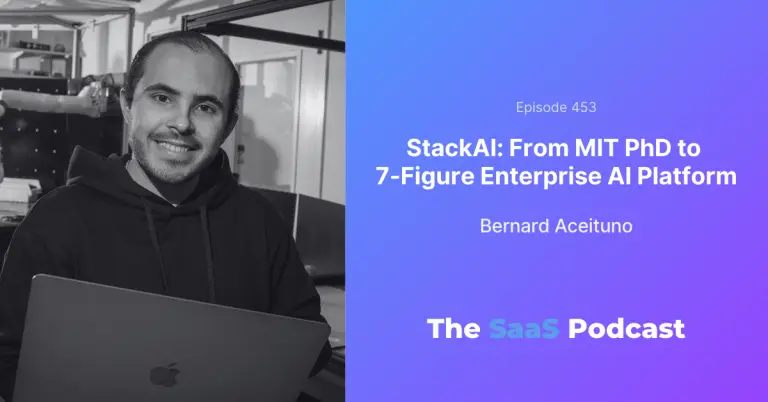
Yeah, absolutely. So at Stack AI, we have developed a local platform that serves as a toolkit for enterprises to build their own AI agents to automate back office workflows. Companies like Nubank, Monster Bank, Ray Faison Bank LifeMD and YMCA Retirement Fund use Stack AI to automate a wide range of back office workflows such as compliance automations, control automations, customer support management, legal review and HR cost, employee onboarding and training all within one single place without the need to build a million dollar team or buy hundreds of different SaaS products.
[00:02:05] Omer Khan:
Great. And give us a sense of the size of the business. Where are you in terms of revenue, customers, size of team?
[00:02:12] Bernard Acaituno:
Yeah. So today the company serves more than 100 customers at scale in the enterprise world. With a team of over 35 individuals, we are relatively small team. We launched the company two years ago after finishing our PhD after spinning up out of MIT. Me and my co founder both completed PhDs after 10 years in the field of AI and machine learning and wanted to build something special to help enterprises really get the most out of this technology. Since then we have raised, we have run three months of funding, raised over $16 million in fundraising, and continue to.
[00:02:48] Omer Khan:
Invest in growing the team and revenue. You're seven figures in ARR right now, right?
[00:02:53] Bernard Acaituno:
Where I get my high six figures. High seven figures, yeah.
[00:02:56] Omer Khan:
Okay, great.
[00:02:57] Bernard Acaituno:
So.
[00:02:59] Omer Khan:
Let'S talk about where the story begins now for you. I mean you grew up in Venezuela and then you moved to the US and the plan was go to MIT, do a PhD. How did that turn into I'm going to become a startup founder.
[00:03:20] Bernard Acaituno:
Wow, that's a long story. Omer as you nailed it. People that come to a PhD rarely go with the intention of beginning a startup for me. I have been a scientist by background, by training my entire life. When I first came to the us I already had about four years of experience doing research in reinforcement learning and optimization algorithms. And my plan was to become an academic, come and become a professor at a university, or run my own research lab, maybe join a big tech AI lab like DeepMind or OpenAI or Facebook AI research where I actually did work for some time. But after a few years in academia and as a short stint in Facebook AI research where I did get the chance to work with world class researchers and individuals, I find myself in a position where I enjoyed the work I was doing, but I didn't feel I was having as immediate of an impact as I could have at the moment. A big realization I had actually through my early experiences working was how much manual work exists in the corporations today at the level of back office, at the level of front office, in compliance and finance, in legal, in every component of it.
[00:04:32] Bernard Acaituno:
My parents were lawyers and my family also had a family business where I got to see front face how much paperwork happens. And for me, AI was always the answer to how this is going to progress and how we're going to really take humanity to the next level of work. After a small thing of API research, me and one of my colleagues from mit, Tony, who is my co founder, Bo, who have been friends for a few years, started having these conversations about where really it made sense to bring all of the expertise we had. Was it in really training more specific language models, foundation models, or was it in taking these very powerful and promising foundation models like GPT2 at the time, which was the latest G foundation model, or bert, and really applying them to solve business problems that we saw were critical in back office processes, in support, in sales, in legal Review and compliance. And we said, hey, there's something special here. After start talking with people, we said to ourselves the best way to do this is to build a product and sell it, so we should do a startup for this. And just that, that one night we decided that we were throwing away our goals in academia and industrial research and going in to build something and take the risk. Of course, both as immigrants in the US wanted to get it done right.
[00:05:52] Bernard Acaituno:
So we set up to wrap our PhDs, started building this product which initially was targeted towards machine learning teams in corporation or in enterprises that wanted to get the best data set for training a model because we found that was a big bottleneck that could help them fine tune an LLM or fine tune a transformer for a particular task. And we got a few customers with that kind of like just by doing LinkedIn outbound consistently every day, saying that we were MIT students looking for advice and whatnot. And with that small traction we had, we applied to Y Combinator almost towards the end of our PhD and got accepted. We wrapped everything up, packed everything in Boston, moved across the country to California and I started working on this full time. And we spent 80 hours per week plus focused on building this platform, which shortly turned into BStack AI. We realized with them, with our early traction, that most of the problems were not in fine tuning language models, but rather in being able to easily connect and ingest data in order to power them to complete tasks and building workflows with them. And that turned to be Stack AI.
[00:06:57] Omer Khan:
How did you figure out what were those signals that told you that know these were like certain workflows that needed to get solved. Because the way what you described there is makes a lot of sense, but when you're starting out, you just see this, this world with millions of businesses and millions of use cases and how, how do you figure out where the problems are and that, you know, are they painful enough for us to go and solve?
[00:07:28] Bernard Acaituno:
Well that's a great question. I When we first started with the idea of data set management as a tool and kind of like data automatic data labeling, this was a problem that we both had faced in the past when training our own models, either for personal projects or for our research. So we both knew that there was work to be done there. And as soon as we started building that product, it wasn't necessarily hard to sell, it was just very early stage. But we managed to get a handful of clients that wanted to test it and pilot it when we started. I would say that the first 5k of MRR that we had at the time. The 50k ARR came from that fine tuning and data management product. But by working with our customers, because your first early customers are people you need to be so close with, we just kept seeing how what they were doing was really like the cherry on top of the cake.
[00:08:17] Bernard Acaituno:
It wasn't where most device was being accrued, they could only come and collect the data set and find to an LLM. After all this infrastructure was already set up even if scaffolded. That was most the effort. And motorsville was setting up a proper RAC pipeline, setting up proper tool use, connecting APIs, being able to craft and test and iterate over good prompts for the language models. And for us. It was obvious two months into almost March 2023 that the direction the market was going was one in which increasingly less technical people would be the ones that would benefit the most from this technology. And we decided that we should build a product for them. And that turned to be this local fashion.
[00:09:03] Bernard Acaituno:
The platform we first built a scaffold and an MVP. Launch it online on launch 1C book face and hacker news. And we got right away 20 customer meetings in two days. So we said okay, there's something here. We weren't really sure who was the ICP or who would be the right people to target. If it would be small businesses would be startups, it would be non technical people in enterprises. That was a more interactive process. That's where most our first year after launching went.
[00:09:30] Bernard Acaituno:
But that pro market fee journey is what took us to where we went, where we are today.
[00:09:34] Omer Khan:
So when you started the MVP was pretty generic, no sort of ICP in mind. You just had this general problem that you felt like AI could solve and let's just go and build a solution for that.
[00:09:46] Bernard Acaituno:
Yeah. And the reason, even though we have a hypothesis for who could be the icp, either IT teams or functional leaders across non technical departments or small business startups. We got inbound from really all these people when people were interested. We got some enterprises that wanted to use it, we got some stars wanted to use it, we got some not quite mom and shop, but really small chains and retailers that wanted to use it. And all of them seem like legitimate buyers for this. There's products that serve all these industries. So we spent a lot of time, I would say honestly perhaps more than necessary, targeting each of them. But we learned a lot through that experience because that's where we found what made it the right product for each of those markets.
[00:10:27] Bernard Acaituno:
Work and inform us into how to build the right product for the icp. We picked in the end, which was these enterprise IT teams that are building tools for their organization.
[00:10:38] Omer Khan:
So for quite a while early on, in those early days, you were getting customers, but they were coming from a whole diverse set of industries and types of companies. Did that make it easier for you to figure out the icp or did it just become more confusing because it was like, hey, this is a solution for everybody?
[00:11:05] Bernard Acaituno:
No, it did bring some challenges. I think all of us had a consistent idea of where it made sense, but we didn't get conviction on picking up our ICP until we really tried and failed on each of these different markets. But we were consistently testing hypothesis both in terms of what's the value proposition, what we're building and what's the right messing over which this gets sold. And I told you this I think earlier, but I think that when you're a founder in the early stages and you're pursuing product market feed, you're pursuing these first sales and go to market strategy, you really have to do everything yourself. You really need to try everything firsthand and get the raw and filter feedback from every customer before you can move things forward. Because otherwise you're just faced with a lot of challenges in truly understanding what works and what doesn't. And you need the raw information and data in order to make a right decision and to honestly get a proper understanding of what the market looks like.
[00:12:10] Omer Khan:
So you had a good start. You've got the mvp, you've got just hacker news and you're getting inbound interest. What did you do to what acquisition channels helped you to get to 100K ARR and eventually the first million.
[00:12:30] Bernard Acaituno:
Yeah. So 100KRR was all our direct, direct email and inbound. We were advertising our product in general advertising, like really posting about our product in common channels, forums, hacker news, book face, all these places. We were also direct outbounding. We were looking for startups or teams that seem similar to the other customers we had. And we were telling them, hey, you probably are thinking about how to use language models for your business. We help. We have built this no code tool that helps you build this.
[00:12:58] Bernard Acaituno:
Click here for a demo and book a meeting with us. And we were just doing this in a very manual fashion to see what performed the best. We managed to get actually some pretty good inbound after some AI influencers like Rowan Chung and Liam Adley saw our product and decided to post about it. The fact that we have such a visual product and we weren't shy about showing it to people, made it so it was very attractive for other people to show it. Like, hey, I saw this cool tool online, recommend you check it out. And that helped us get our first big wave of inbound that took us from 100 to 200k. ARR.
[00:13:34] Omer Khan:
Were there any channels that you tried that didn't work when you were trying to get to that first million?
[00:13:40] Bernard Acaituno:
So for sure, for sure. I think that's something that seemed to make sense for us but really wasn't successful. Was looking for partners or distributors to sell our product. Naturally, by us being this or horizontal platform that helps you design pretty much any customer agent you want. It gets a lot of attraction for people that want to resell it or build on top of it to create products or serve customers with that. But in the early stages, when your product is evolving very quickly and you are figuring out messaging and you're figuring out your icp, it's very hard and I would say almost counterproductive to try to get people to sell it for you. Even if people are asking you to sell it for you because they're not going to know the part of the value proposition. They're not going to know the message, they're not going to know who's the right user.
[00:14:26] Bernard Acaituno:
They're going to know how to use the product and the product is going to change almost every day. So even though we got a lot of interest from these partners in the beginning and we pursue actively, it really didn't work much of a challenge. Most of the opportunities went nowhere and the ones that went somewhere often left to Betty on sticky and unqualified revenue for us.
[00:14:48] Omer Khan:
And the interesting thing is that using partners and resellers is actually an acquisition channel that's working for you now.
[00:14:55] Bernard Acaituno:
Yeah. And today we actually use it a fair amount. We have a much more established customer base. We understand very well who is our customer now and what's the messaging that resonates with them. And we have built a strong brand around it. So if we bring a reseller that works with that customer, knows how to sell to them and uses the right messaging, we can effectively bring out high quality revenue to our company. And when they bring leads that are not really qualified, we can easily discard them and disqualify them.
[00:15:25] Omer Khan:
Now, earlier you told me, hey, one of the challenges we had was we were trying to please everybody and we had some ideas of who our ICP might be, but it was still too broad. Eventually you got to a point where you figured out that enterprise was where your focus needed to be. Can you just explain what the process was that got you to that point?
[00:15:52] Bernard Acaituno:
Yeah, absolutely. And I would say it took us perhaps too long to make this decision and to reiterate this conclusion, but at one point around a year and a half ago, we were looking at our metrics and we had, let's say a subset of small business, we had a subset of enterprise customers that was relatively small, we had a subset of startups and we're looking at the metrics of everyone, how much of our revenue each represented and how much was each one growing. And we were looking at it and we said small business, yeah, there are big shoes revenue. At the time it was probably like 70% of our revenue. Really very unsticky. Small ACVs, they have feature requests that don't really align with where we want to take this product and the viable position we want to build around this. And really it's not clear if there's a long term play in here. Startups were interesting, some of them, especially when they were later stages, were doing interesting use cases.
[00:16:44] Bernard Acaituno:
But also relatively small ACBs for you to build a sales motion and really small opportunities for you to grow as well as fast changing operations so you can really rely on them building something successful with you and then enterprises. Even though at the time we're about 20% of our revenue, we were seeing that this market was consistently buying more of the product. They were getting the most out of it. We could spend the time and make them successful. And we had a relatively fast sales cycle. We were selling contracts in two weeks, three weeks, six weeks. And I was talking about high five figures, small seven figure contracts, six figure contracts, sorry, six figure contracts. And at the time we said, hey, this is worth probably developing more.
[00:17:27] Bernard Acaituno:
After some tough discussions, we decided let's put our efforts here. I think this is where our business should be going and this is where really people are using our product, driving value, getting more of the product, getting more out of it, expanding it further. And since then we just kept seeing expansion quarter over quarter, quarter over quarter, doubling around quarter over quarter until the point where we said, okay, we figured out where ICP is, we figured out more or less what our go to market strategy will be. We have clearly shown that there's product market fit here and that's when we got our most interest into investing in our company, when we raised our CSA about a year ago actually. And since then we have a Eightfold multiplier revenue by investing further in this.
[00:18:09] Omer Khan:
Did you narrow down in some specific Verticals. When you said enterprise and how did you reach those potential customers?
[00:18:17] Bernard Acaituno:
Yeah, absolutely, absolutely. I think that it's something that we said was a big insight for us was that when you look at any horizontal enterprise SaaS provider, they always focus on three or five verticals and they really own the market. There's a. We knew who our ICP was within each company. We were looking at IT leadership and IT stakeholders because of IT CIOs, IT managers, enterprise architecture. When looking at our customer base, we found that the use cases that made the most sense for language models today as the market stands are in places where you have a lot of back office, a lot of manual processes, you have significant amounts of paperwork and unstructured data. And this piece of the operation is critical towards revenue and a big part of their costs. Financial services, insurance and industrials all fit this market.
[00:19:06] Bernard Acaituno:
So we decided to focus on those. We furthermore found out that when you look at the enterprise landscape, enterprises have a big range of scale. You have companies between 100 to 1,000 employees, 1,000 to 1,000, but then 10,000, 10,000 to 100,000, a hundred thousand plus. And each of them really has a different approach to this problem. The problem with AI is that, and I would say also the beauty of it is that it's a very transformational technology, not just in the impact it has, but in how much the company needs to adapt in order to properly get use of it. There's this study that you probably have seen from MIT that says that 95% of AI pilots are not successful. And what happens there is that makes sense. When you go to the average company, you tell them, hey, let's build an AI to collect invoices, okay, he's asking a question.
[00:19:57] Bernard Acaituno:
What email provider do you use to collect those invoices? Does it even have an API? Okay, where do you store those invoices? Do you have a system that is in the web? Is it on prem? Do they have assistant? Can you connect with it via some sort of client library or. No, they have an API as well. Do they have an MSB server? Do you have it? Do you have the ability to run this on the cloud or you need to host it on premises? Can you even connect it to the Internet? So it really asks a lot of companies to transform the way in which they run dozens of processes to achieve one small win. When you go to, let's say the mid market of the enterprise company, between 100 and 1,000 employees, you see companies there that have the exact same problems, have scale and can page money because they have budget but don't have as much process ingrained into them. So it is impossible to get anything done. And that's where the 5% of successful AI pilots lies, in the mid market enterprise. And we said if we go to these three segments in that segment of the market and then as the enterprise evolves we go further up market, we will have winning strategy. And by honing on in that and building our sales team such that we could have messaging for them, we could organize events for them, we could do cold calling for them, we could retarget the kind of things they care about with our content, with our materials and with our overall kind of like pricing that will lead us to green study and that help us to continue growing 15 to 20% month over month for the past year.
[00:21:25] Omer Khan:
How did you figure that out? Now that you explain, it sounds really smart, but how many conversations did you have to have with potential customers and how deep did you have to dig to understand that sort of nuance about how they're running their business and where their struggles are and who is, who is more likely to be able to be that early adopter?
[00:21:54] Bernard Acaituno:
Yeah, no, that's a good question. I think that for us it did come from our experience with early customers more than anything. I think that just talking to people will not get you to this insight. It was us seeing how these two types of companies would work with us and how much they will get things out of it. When we looked at, let's say a large civil engineering firm with 2,000 employees and a large manufacturer with 10,000, it was very clear who was making the most progress. Even if one of them had much more money than the other one and was paying more, who was getting more out of it, let alone when you look at a $500 like a clinic or whatnot, they really move fast.
[00:22:32] Omer Khan:
Yeah, because then I guess when you're actually working with a customer, you're in the weeds, right? Your understanding day to day about what they're trying to do, what they want to be able to do from the product and why. And that's probably gives you a lot more sort of hard data or data points to work with and some random conversations with people who might or might not become customers in the future. So great. So you've got that, you're getting that clarity about the icp, you're getting some traction, but you're still a relatively small team. You're a startup. How did you handle selling to enterprises and what were some of the challenges that you faced?
[00:23:18] Bernard Acaituno:
Yeah, well since the beginning it's doing things that don't scale. You have to really like going hands on. The first dozen enterprise clients were all coming from founder led sales. It was me and my co founder selling to them. We will have people signing up for a demo, or that we will see that we tried the product or that we met in an event or reaching out who we will engage, show them the platform, discuss how they could use it, try to understand what were the places where they could get the most out of AI agents or language model workflows as we call them in the past, and really try to show them how this work toolset could be useful so this toolkit could be used for all these problems. We spend a lot of time navigating those early sales cycles, understanding what pricing had to look for them. And it wasn't until we had, let's say our first 20 enterprise customers that we understood more or less what was repeatable about the way we're selling to them, the way in which the value that resonated with most of these enterprise customers, the pricing that made sense for the way they want to scale and the way in which they would like to be engaged with us as they use the product. I would say that it's not just that first sale.
[00:24:33] Bernard Acaituno:
What we find is that with enterprise the real bulk of the money you make comes post closing and after they continue expanding and growing. Because yeah, you can sell to a team and great, you close a 100k contract. Okay, this company has 30 teams, 40 teams. Why stop there? Why not go further to the other ones and keep growing there? Or why not? Actually maybe this team is using just for just a workflow that is 10% of their back office. And it turns out we have these other three workflows or four workflows that can have a lot more value. And with enterprise, because of the magnitude of the ICVs, you can take the luxury of sitting down with them and figuring out the strategy and bringing forward. And a motion that we developed that helps us now further expand is that we develop this motion of AI strategies and forward deploy engineers who perhaps in a very specific special way to the way our product works, come to companies that sign with us, that become our early customers and sit down with IT leaders and help them explore what use cases for AI are applicable to you, what are the hidden gems you're not looking at and how similar companies to you that are working with us are seeing that. As I mentioned, we work with already more than 100 company organizations and we see very well how they use this technology in all these workflows so we can easily pattern match use cases.
[00:25:50] Bernard Acaituno:
We even have an AI agent today that even a company will tell you how to use it, how to bring AI agents there. And that expansion really it's what it's important to nail gain that not just local retention, but revenue retention as you move forward.
[00:26:05] Omer Khan:
I want to talk a little bit about hiring. When we were talking earlier you said, you know, hey, one of the, one of the mistakes that you feel many founders make is they get some early revenue, like you know, they get to 100 KR and they want to start bringing in agencies and building teams around them. And maybe that's too early. Right. So there needs to be more sort of founder led sales. And as a founder you need to take on more until you feel you're comfortable. You probably started to build that team once you got to a million in ARR and hiring AES and building your outbound motion. But then you also felt that probably you left it a little late with the hiring.
[00:26:50] Bernard Acaituno:
So.
[00:26:52] Omer Khan:
Why do you feel that and sort of what would you have done differently?
[00:26:56] Bernard Acaituno:
Yeah, absolutely. I think that at the beginning you really have to do everything yourself and founder led sales are very important. I think there's a point when you reach product market fit and where you are confident on your messaging, which can happen when you're about 500 and 700k ARR, where it makes sense to bring someone that can outsource some of that outbound for you or that prospecting at the beginning. Because in the end if you're doing founder led sales, half your time will be prospecting, half your time will be closing deals or working with what you prospect it. So you want to spend as much time at the bottom as possible because you are the only person that really understands the product at that level of detail. And if you understand the messaging already most of it, you can outsource ideally to people that work with you and understand your product, your product and your business very well because they're going to have to do it on their own iteration as well. So you cannot really just outsource it to a call center or anything. You really need to put people there to do it.
[00:27:48] Bernard Acaituno:
They can figure out with you. But as you do that, I think that we took, you know, it wasn't until we were in almost 2 million error when we brought our first personal AK to Outreach and you know, when we brought our first ae, you know, it was a very impactful learning. We learned a lot from him because he was a much more senior salesperson. And I think having brought some of that help earlier, after we figure out these things and I think at the point of 500, 700 krr will have helped us accelerate more meaningfully our customer acquisition and figure out a lot of our go to market faster because those people are going to help you is really try things and fail faster. And this is the game of failing fast. You want to try things and see what doesn't work with very informally educated guesses in order to get to success.
[00:28:35] Omer Khan:
Actually that goes back to the quote that you shared earlier about risk, which is related to experimenting and failing fast. And today you're doing a lot of things and you figured out a number of acquisition channels that are working for you and helping to grow the business. And I know you ran a lot of experiments and one of the things that you talked about earlier was I guess a lesson you learned about not doing mediocre experiments. Can you explain that a little bit?
[00:29:09] Bernard Acaituno:
Yeah, very much, very much so. Something important whenever you are iterating and doing this Monte Carlo approach towards sales or product market fit whatnot is that you need to give a fair shot to any idea you think could work. This happens also when you are pivoting and trying different startup ideas. And a fair shot means that you really put the effort to learn how this is done from the people that make it work. You need to really spend the effort to devout time to trying and testing it to measure the results. And if you have doubts being able to clarify those doubts or question, I'm more questions to explore that further. I think in go to market when you're on that stage, when we're going to want to find an ARR, you're at the limit in which you need to really try things and fail fast on them. And but to do, to fail fast properly, you really need to spend one to two months, maybe even three months trying them.
[00:30:08] Bernard Acaituno:
Well, let's say that you want to do something. We try, you know, sending handwritten letters to customers. Okay, do it well, put some time, research how this is done, what are the messages that work. Ask people, you know, how they are doing it, if it works for them or for them as a work, how does it work for them and then dedicate two hours per day to really work on this. And like I really measured it and really I got track, you know, if it's working or not. After three months, say hey, I gave it a first shot and I found out it doesn't work. When I found that it works or maybe usually what happens is that I found it works sometimes but not other times. And it seems like sometimes when this happens, can I get those circumstances under which it works to happen more frequently? And I think that that's the point in which you want to be.
[00:30:53] Bernard Acaituno:
I found something that works and I found the circumstances which is successful. And when you're looking for sales channels, you really want to nail that specific condition and there double down and test it there and spend the next three months. Okay. Going through that and you learn that even within there there's small sub scenarios that are relevant with other ones.
[00:31:12] Omer Khan:
Yeah. There's often this tendency with experiments. Right. It's a tough thing like, you know, do I run it for a couple of weeks, do I run it for a month, do I run it for six months in terms of figuring out what's right. But ultimately I think it's what you just said. It's like you need to have a rigorous process in place and you need to try and do it as well as you can. And even though it may not be an amazing success, it's that other signs of life there that at least give you the signals that there's more that you could be doing. I know you have to run.
[00:31:45] Omer Khan:
So we're going to wrap up on here. So let's get on to the lightning round. I'm going to ask you seven quick fire questions.
[00:31:52] Bernard Acaituno:
Of course, let's do it.
[00:31:54] Omer Khan:
What's one of the best pieces of business advice you've received?
[00:31:57] Bernard Acaituno:
Do things that don't scale right away.
[00:32:00] Omer Khan:
What book would you recommend to our audience and why?
[00:32:02] Bernard Acaituno:
What book? So if you're starting your own sales team and depending on where you are, there are different books I would recommend. If you are in the 0 to 1 million ARR, I say that more than books, I recommend you take a look at the essays of Sam Alban and Paul Graham. I think there are great places to learn about how to run a business when you're good starting out and trying things. Once you're starting to feel you build your first sales team. A really good book is called Predictable Revenue where it kind of walks you through how to assemble a sales team and what works. And really that recipe is something you should stick to. I always like to tell our team we are innovating in AI, not in sales. We don't have to reinvent the wheel.
[00:32:41] Bernard Acaituno:
And essentially the basics of how to solve a CRM composition one are all there and how to set up all the tracking.
[00:32:47] Omer Khan:
So definitely recommend that what's one attribute or characteristic in your mind of a successful founder.
[00:32:53] Bernard Acaituno:
Wow. There's all sorts of things I think people are, you know, a big attribute. You need to be very daring, for sure. And you actually don't. You cannot really care about what people tell you. You know, you can't really like listen to people. You need to like really go in and double down, double down.
[00:33:06] Omer Khan:
What's your favorite personal productivity tool or.
[00:33:09] Bernard Acaituno:
Habit personal productivity tool? Well, I use language models perhaps on a every 10 minutes for something, but I use it for all sorts of tools. I think the best personal productivity tool is time boxing. This is something I learned when I was a PhD student. I used to do a lot of to do lists telling me, okay, sort of fight 10 to do things, the 10 things I need to do today. But that's not helpful because sometimes you spend too much time in one or you don't allocate time properly to that and time boxing to say I want to spend two hours doing this, one hour doing this, 30 minutes doing this, one hour doing this and whatnot does help you allocate much more time. The other thing that is very helpful is to know about the builder and the seller schedule and the business and the builder schedule. Because whenever you are building something, let's say a product, you're coding, you need to have a very different schedule from when you're in a position where you're having very operational work, when you're selling, when you're managing teams, when you are hiring. And being able to distinguish both allows you to be significant more productive.
[00:34:08] Bernard Acaituno:
If you want to spend some time coding or building something on that maker schedule, you need to reallocate six to eight hours to just work on that. No interruptions, no stops. And you want to be in a position where you're going to be having a lot of context with your interviewing candidates, doing sales calls, meeting teams, you're calling out prospects, you're asking for reviews and meeting with existing clients to a problem for them. You need to be able to be in a position where you can easily context between them and not try to mix these two together.
[00:34:31] Omer Khan:
Yeah, I like that. Maker versus seller. Great, great distinction. What's a new or crazy business idea you'd love to pursue if you had the time?
[00:34:39] Bernard Acaituno:
Wow, that's a good question. So I'm a big fan of this notion of fully integrated AI industries. Something that I see all the time is that people are trying to, let's say, sell AI agents to factories or warehouses or let's say banks and to do specific things, let's say to automate their sales, automate their outbound. And something that someone once told me was an investor, he told me one is that, well, if your AI is so great, why don't you begin a competing company to them and take them out of business. And that really resonated with me because it is true that when you look at the most successful companies you have today, for instance Tesla, SpaceX, their companies are really fully vertically integrated with technology. Instead of like Tesla going out to sell batteries to other car providers, really use their better technology to build an overall better product. So I think that either in healthcare or in finance, I see a lot of opportunities to go through like a full vertically integrated AI play what you really take. We take all these insights.
[00:35:38] Bernard Acaituno:
I will take all these insights of wow. These are where AI agents make sense for underwriting, for sales, for compliance, for research, for hiring, and bring them all in and build the most efficient architecture for insurance, credit, healthcare, whatnot.
[00:35:54] Omer Khan:
What's an interesting or fun fact about you that most people don't know?
[00:35:57] Bernard Acaituno:
Interesting or fun fact about me? Wow. So people know that my true passion is applied mathematics. When I have free time, when I have some free time, if any, I very rarely am reading about books or about sales or about startups mostly you'll see me reading about nonlinear dynamics and chaos, stuff like that.
[00:36:17] Omer Khan:
And finally, what's one of your most important passions outside of your work?
[00:36:20] Bernard Acaituno:
Yeah, for sure. As I said, math, physics and computer science. Technical computer science. I think they're so beautiful and elegant that they show you kind of like how all of this foundations put together everything we see around us and just found that so inspiring and beautiful.
[00:36:37] Omer Khan:
Love it. Great. Well, Bernard, thank you so much for joining me. It's been a pleasure. If people want to check out Stack AI, they can go to stackai.com and if folks want to get in touch with you, what's the best way for them to do that?
[00:36:49] Bernard Acaituno:
Yeah, absolutely. So come to our website if you want to learn more about Stack AI, book a demo with us. If not, find me on Twitter, Find me on LinkedIn. Happy to chat anytime. Happy to help. Best of luck's building.
[00:37:00] Omer Khan:
Thanks man. Appreciate it. Wish you and the team the best of success.
[00:37:03] Bernard Acaituno:
Cheers. Bye. Cheers.