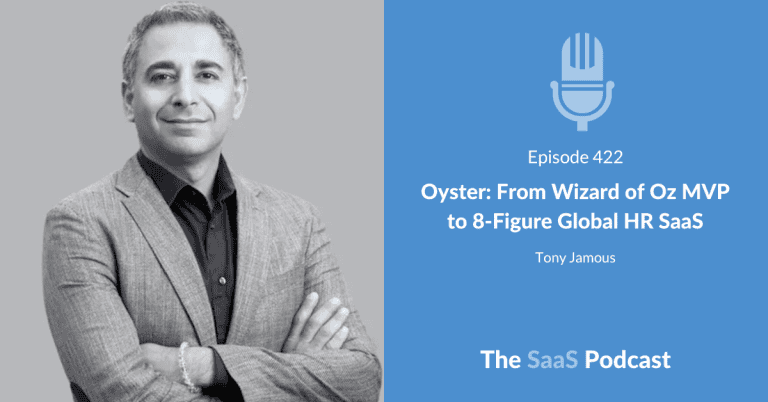
Tony Jamous, Oyster
Scaling SaaS With Zero Product and a Manual Backend
Like this episode?
Get real founder strategies for the AI era. Delivered weekly.
Free weekly newsletter · No spam
Episode Summary
Tony Jamous launched Oyster in January 2020 with $4 million and no product. Two months later, the pandemic created massive demand for global hiring - and his team had nothing built. Instead of turning customers away, they built a front end that looked like software while humans did everything manually behind the scenes. That Wizard of Oz approach became the foundation for scaling SaaS operations across 180 countries.
Before Oyster, Tony had already grown his first company, Nexmo, from zero to $100 million in revenue in five years before it was acquired by Vonage. Now he was doing it again - but this time with a mission to reverse brain drain and make global hiring as easy as local hiring.
Tony Jamous is the co-founder and CEO of Oyster, a platform that makes it easy for companies to hire and pay people anywhere in the world.
Born in Lebanon, Tony had to leave his home country as a teenager and move to France for better opportunities. He didn't know it then, but this experience would shape his entire future - and eventually drive the mission behind scaling SaaS in global employment.
After studying computer science, Tony started his first company, Nexmo, a cloud communications platform. He grew it from zero to $100M in annual revenue in just five years before it was acquired by Vonage in a deal that ultimately led to Ericsson's $6.5 billion acquisition.
At Nexmo, Tony had built teams across 45 countries and saw firsthand how hard it was to hire people internationally. He discovered a $30 billion employer-of-record industry that was fully manual with no software. That gap became the foundation for Oyster.
He launched Oyster in January 2020. Two months later, the pandemic forced companies to go remote, and demand surged overnight. But the product wasn't ready. Instead of turning people away, Tony and his team built a Wizard of Oz MVP - a simple website where customers submitted requests while real people fulfilled them manually behind the scenes. That approach gave them a clear product roadmap and let them start scaling SaaS operations immediately.
Then came the 2022 tech downturn. Companies started cutting headcount, and Tony had to pivot from growth-at-all-costs to efficient scaling. His team doubled down on focus, becoming a pure-play cross-border employment platform. The result: Oyster still grew 60% in 2023 while the overall tech sector shrank 4%.
Today, Oyster has over 2,000 customers and 550 employees spread across 70 countries with no offices. They're approaching $100M in ARR.
Key Insight
Oyster CEO Tony Jamous used a Wizard of Oz MVP - a software front end with humans doing all the work manually behind the scenes - to validate demand and build a product roadmap driven by real customer needs. This approach, combined with pandemic timing and hiring scalable leaders from day one, helped Oyster grow from zero to near $100M ARR with 2,000+ customers across 180 countries.
Key Ideas
- Oyster launched in January 2020 with $4M and no product - the pandemic created demand two months later, and the team used a manual backend to fulfill orders while building software
- Tony hired an executive search firm to find his first 10 hires - leaders who could operate from 0 to 1 and scale from 1 to 10
- The Wizard of Oz MVP eliminated guesswork from the product roadmap because the manual tasks customers needed became the automation backlog
- When the 2022 downturn hit, Oyster pivoted to efficient growth and narrowed focus to cross-border employment - growing 60% in 2023 while the tech sector shrank 4%
- The ratio of employees hired on Oyster's platform in emerging markets grew from 29% to over 40% as customers shifted hiring to cost-effective countries during the downturn
Key Lessons
- 🛠️ Use a Wizard of Oz MVP to start scaling SaaS faster: Oyster built a software front end with humans fulfilling requests manually, turning each manual task into a product automation ticket that eliminated roadmap guesswork.
- 🎯 Hire scalable leaders from day one: Tony used an executive search firm to find his first 10 hires - leaders who could build from zero and scale to $100M, avoiding costly leadership reshuffles later.
- ⚡ Let market pull shape your scaling SaaS strategy: Oyster launched two months before the pandemic and let customer demand sculpt the roadmap, growing entirely through inbound for two and a half years.
- 📉 Narrow focus when markets shift from growth to efficiency: When the 2022 downturn hit, Tony narrowed Oyster to pure cross-border employment, growing 60% in 2023 while the tech sector shrank 4%.
- 💰 Track buyer purchasing criteria to drive scaling SaaS decisions: Tony records customers' buying criteria at the moment of purchase. Thousands of data points now drive Oyster's strategy instead of founder intuition.
- 🚀 Build trust-based culture to enable scaling SaaS across 70 countries: Oyster defaults to assuming best intent, uses asynchronous work, and codifies collaboration through standardized tools and rules for 550 remote employees.
Watch the Episode
Chapters
00:00Introduction
02:57What Oyster does and the mission behind it
04:05Revenue, customers, and team metrics
04:39Tony's background and growing Nexmo to $100M
07:11Validating the idea through customer interviews
08:01Three factors behind scaling to $100M twice
10:18The mission-driven origin story from Lebanon
13:45Raising a pre-seed round to validate with smart money
17:28Building the Wizard of Oz MVP
20:10How the manual backend worked for payroll and contracts
22:39Timeline from front end to real product
24:18Inbound-only growth and social media storytelling
27:43The buyer purchasing criteria framework
29:07Business is numbers with a story told around them
31:21The 2022 downturn and pivot to efficient growth
34:21Why demand shifted to emerging economies
36:30Building a 550-person remote company across 70 countries
41:15The return-to-office debate and future of work
42:34Lightning round
Episode Q&A
How did Tony Jamous use a Wizard of Oz MVP to start scaling SaaS at Oyster?
Tony built a front-end website where customers could submit hiring requests, but behind the scenes, real people executed every task manually - from drafting employment contracts to processing payroll. This let Oyster serve customers immediately while using the manual tasks as a product roadmap for what to automate next.
What three factors does Tony Jamous credit for scaling SaaS companies twice to $100M?
Tony identifies timing, a large addressable market, and hiring the best team as the three critical factors. At Oyster, the pandemic provided timing, the $30 billion employer-of-record industry provided market size, and hiring scalable leaders from day one provided execution speed.
How did Oyster grow 60% in 2023 while the tech sector shrank?
When companies started laying off workers, smart CFOs shifted hiring to more cost-effective countries instead of cutting headcount entirely. Oyster's platform enabled this shift, and the ratio of employees hired in emerging markets grew from 29% to over 40% during the downturn.
Why did Tony Jamous hire experienced leaders at Oyster instead of early-stage generalists?
Tony partnered with an executive search firm to find leaders who sat at the intersection of zero-to-one building and one-to-ten scaling. Because Oyster was mission-driven, it attracted senior talent willing to join an early-stage startup - avoiding the costly leadership reshuffling most startups face.
What is Tony Jamous's buyer purchasing criteria framework?
At the moment of purchase, Oyster asks customers what their buying criteria are and records the responses. With thousands of data points collected, this framework drives corporate strategy and product development by revealing exactly why customers make purchasing decisions.
How did Oyster validate demand before building any product?
Tony interviewed potential customers about their experiences with legacy employer-of-record vendors, spoke with compliance lawyers about the process, and talked to team members about pain points. This data-driven interview process gave him enough insight to envision the software platform before writing any code.
How did Oyster use storytelling and social media for scaling SaaS growth without outbound sales?
For the first two and a half years, Oyster relied entirely on inbound acquisition. Tony's team told the story of the future of work through social media during the pandemic, answering questions about distributed teams and remote hiring. Oyster became the largest brand by share of voice within the HR buyer community.
How does Tony Jamous build trust in a 550-person company with no offices across 70 countries?
Tony built a culture that defaults to assuming best intent, uses asynchronous communication as the foundation, and codifies how work gets done through "tools and rules" - standardized processes for meetings, project management, and collaboration that make every employee successful regardless of location.
Why did Oyster narrow its focus to cross-border employment during the downturn instead of scaling SaaS across all HR use cases?
The downturn forced Oyster to choose. By becoming a pure-play cross-border employment platform, Oyster poured all R&D into the hardest and most lucrative use case - making global hiring as easy as local hiring - rather than competing with local HR tech platforms on simpler problems.
Book Recommendations
Full Transcript
Omer Khan [00:00:09]:
Welcome to another episode of the SaaS podcast. I'm your host Omer Khan and this is a show where I interview proven founders and industry experts who share their stories, strategies and insights to help you build, launch and grow your SaaS business. In this episode, I talked to Tony Jamous, the co founder and CEO of Oyster and a platform that makes it easy for companies to hire and pay people anywhere in the world. Born in Lebanon, Tony had to leave his home country as a teenager and move to France for better opportunities.
Omer Khan [00:00:40]:
He didn't realize it then, but this experience would go on to shape his entire future as a founder. After studying computer science, Tony started his first company, Nexmo, a cloud communications platform. He grew from 0 to 100 million in annual revenue in just five years before being acquired by Vonage. Now, most founders might have taken it easy after that kind of exit, but not Tony. At Nexmo, he had built teams across 45 countries and saw how hard it was to hire people internationally. So after taking some time off, he started exploring solutions.
Omer Khan [00:01:13]:
He found a huge market for international hiring that nobody seemed to have modernized yet. The whole industry ran on paperwork and manual processes and Tony saw a chance to change that with software. He launched Oyster in January 2020. Two months later, when the pandemic forced companies to go remote, global hiring became essential and demand for Oyster surged overnight. But there was a problem. The product wasn't ready for so many customers. Instead of turning people away, Tony and his team got creative.
Omer Khan [00:01:44]:
They built a simple website where customers could submit their requests and behind the scenes, real people did all the work manually. The approach worked and allowed them to improve their product over time. But then came the tech downturn. In 2022, companies started laying off workers and Tony had to shift from rapid growth to efficient scaling. His team found a clever solution which helped them grow by 60% when other tech companies were cutting headcount for the first time ever in 2023.
Omer Khan [00:02:12]:
Today, Oyster has over 2,000 customers and 550 employees spread across 70 countries with no offices anywhere in and they're about to hit $100 million in ARR. In this episode, you'll learn how Tony validated his idea by talking to customers before building anything. Why he hired experienced leaders early even though it was a risky move for an early stage startup. How they turned manual work into an advantage when their product wasn't ready to meet customer needs.
Omer Khan [00:02:39]:
We talk about the Buyer Purchasing criteria framework that has helped Tony understand exactly why customers buy and how you can use it in your startup and how They've made remote work successful across 70 countries without any offices. So I hope you enjoy. Tony, welcome to the show.
Tony Jamous [00:02:57]:
Thank you for having me.
Omer Khan [00:02:59]:
My pleasure. Do you have a favorite quote, something that inspires or motivates you that you can share with us?
Tony Jamous [00:03:04]:
One of my favorite quotes is culture eat strategy for breakfast. You have to have solid, smart strategy in the business, but you have to also remember that culture trump strategy.
Omer Khan [00:03:15]:
I love that. And I think for many people that's going to make a lot more sense after we talk about your story and the way that you have built this business. So for people who don't know about Oyster, what does the product do, who's it for, and what's the main problem that you're helping to solve?
Tony Jamous [00:03:30]:
Oyster is a global employment platform. We enable any company anywhere to employ people in any country without the need of setting up entities, hiring expensive lawyers, finding benefit providers and payroll providers. Essentially, we are making global hiring as easy as local hiring, turning planet Earth into one job market. And we do that because we are a mission driven company. First and foremost. We are on a mission to reverse brain drain and reduce inequality by democratizing access to global job opportunities.
Omer Khan [00:04:05]:
Love it. And give us a sense of the size of the business. Where are you in terms of revenue, customers, size of team?
Tony Jamous [00:04:12]:
Yeah. So we are still sub $100 million, but we're not very far. We are 550 people distributed in 70 countries with no offices. This is how we started the business in January 2020 as a distributed, fully remote business. Great.
Omer Khan [00:04:32]:
And customers?
Tony Jamous [00:04:34]:
We have over 2,000 customers right now in the business.
Omer Khan [00:04:39]:
So let's talk a little bit about your background because I think it's an interesting part of the story and where you are today and why you've built this business. So why don't you just tell us a little bit about your background, like where did you grow up? How did you get into the world of building startups? This is not your first company that you've built. Just tell us a little bit about yourself.
Tony Jamous [00:05:06]:
I was born in Lebanon and I had to leave my country, my home country. In my teenage years. I moved to the west, starting with France, where I studied computer science. And then I started my first Hypergrowth Technology company 14 years ago. It was in the API business. It was called Nexmo. We were building APIs for building communication applications. I grew that business from 0 to 100 million of revenue in the first five years.
Tony Jamous [00:05:40]:
I took it public in mid-2016 by doing a reverse merger with Vonage, who was public at that time on the New York Stock Exchange, which led to their acquisition by Ericsson for $6.5 billion. And then I took some time off after that, that phase in my life, and I realized that I want to build something more purposeful, more impactful. And I knew that whatever I would do, it would be a fully distributed company. Why? Because My previous business, Nexmo, was already in 45 countries. Because we had to, we had to be closer to the customer.
Tony Jamous [00:06:20]:
We built all these partnerships on the ground and I was able to witness the power of distributed hiring. Not only you have access to an amazing talent pool that is so vast, but you can also change people's lives in many countries, specifically emerging economies. So I wanted to start a new business. It was critical for me that that business would be fully distributed. So that was mid-2019. I was looking for a solution for that.
Tony Jamous [00:06:47]:
I couldn't find solutions, but I found this industry called Employer of Record, that was a $30 billion industry, fully manual, no use of software. So I knew that by using software to essentially drop the barrier to entry for companies to employ talent anywhere, we can create a new category and build a business that can be meaningful to this world.
Omer Khan [00:07:11]:
So your previous company, you took that, you just said from 0 to 100 million in about five years. You founded Oyster, I think January 2020. And we haven't hit five years yet, but you are getting close to 100 million in ARR. Again, what is it about you that, what's your secret sauce? Most people wouldn't be able to do this in a lifetime. You've kind of, you're doing this for the second time. Like, why do you think you're able to do that? Is it about your background, the way you build businesses?
Omer Khan [00:07:56]:
What is it that helps you achieve this type of success?
Tony Jamous [00:08:01]:
I found there's three parameters that I've got right in my two businesses. The first one is timing. So you have to time it well. In our case at Oyster, we started in January 2020. We, we knew that remote work will be big, but then we never thought it was going to be that big that quickly. So timing was definitely a factor. And secondly is a large market. You have to be operating on a vast hundreds of billion dollar of market in terms of size, because that enables you to have flexibility.
Tony Jamous [00:08:35]:
You can make mistakes, you can iterate, you can actually, even if you have a very small market share, you still can build pretty sizable business. Thirdly is hire the best team. In the case of Oyster, I've partnered with an executive search firm early on, that helped me design my org and find the top 10 people, the first 10 people that I've worked with that really are scalable leaders. Because you I've seen that many times Businesses lose cycles in reshaping their org structures because they haven't really envisioned they're going to be a big business.
Tony Jamous [00:09:20]:
That helped me to go faster in both cases.
Omer Khan [00:09:24]:
I often hear about founders who say the kind of person I need from 0 to 1 is probably a very different type of person who's going to help me scale this business. But it sounds like you kind of skipped that and said I'm going to find the people who are going to help me scale this business and hire them as quickly as I can.
Tony Jamous [00:09:45]:
There are people that are on this intersection of this Venn diagram. They know how to take businesses from 0 to 1, but they also know how to take them from 1 to 10. And actually 1 of the great things about our business is that because we are a mission driven business, we were able to attract these pearls. These are top talent people that have that experience in scaling from zero, but they've also managed and led teams. That was a critical factor in my hiring process in the early days.
Omer Khan [00:10:18]:
Now, you've mentioned Oyster as a mission driven business a couple of times and you said earlier that you had to leave Lebanon when you were a teenager. Can you just explain a little bit about that? Like why did you have to leave and why was that experience so important and relevant to you when it comes to building this particular business and being mission driven, it's not just a buzzword for you, right? It's actually based on your own personal life and experience.
Tony Jamous [00:10:48]:
Like many people in emerging economies, I had to flee for economical reasons. There were no opportunities. Many of these emerging economies actually are failed states. They don't have enough job opportunities, opportunities for their people and their best talent leaves. And that's why they stay emerging economies. Emerging economies stay emerging because they're looting their best people to the West. That's the reality today. And for me personally, that process was very difficult. To really bet all my life on economical success in that days, I had to go and work really hard to succeed.
Tony Jamous [00:11:27]:
And obviously I'm very grateful for having had that experience. But it was pretty traumatizing to be on my own in my teen years in a new country, knowing nobody and have to build everything from scratch, right? So when I left my first business, I took some time off and I was ready to start another business in Oyster.
Tony Jamous [00:11:57]:
I had the idea, I had the business plan I had the team ready to go, I had investor lined up and it's only after I was doing this retreat, I was really focusing on what really drives me as a human being. This is when I flipped the idea overnight. And actually my therapist told me, don't take any important decisions for the next 10 days. And the next day I went and incorporated Oyster because I knew this is where my heart is. I knew my brain has validated the opportunity.
Tony Jamous [00:12:30]:
It's a big market, it's going to happen, it needs software. But then this is where my heart said, let's do this. And my heart took that decision. And I believe that now, I believe in that the universe is helping me succeed because actually I've taken a step towards giving something to the world and now I'm receiving success from the universe.
Omer Khan [00:12:57]:
I love that, I love that. It reminds me of a quote I read somewhere which said, follow your heart until your brain has a reason to follow it. And it kind of sounds like what you ended up doing there. All right, so you incorporate the business. You've seen, you sort of, you sense the opportunity. What did you do beyond incorporating? How did you validate this idea? How did you figure out specifically what is the problem that we're going to go out and solve?
Omer Khan [00:13:33]:
First of all, because you can't build the product that you have today, that takes time. So you've got to get out there with something. How did you start with just the validation and making sure that the demand was there?
Tony Jamous [00:13:45]:
I spoke to a lot of potential customers. In the beginning I interviewed customers about who they're using today, what is their experience looked like with the legacy non software vendors. And I spoke to a lot of compliance people, like lawyers. How do you do this?
Tony Jamous [00:14:05]:
I interviewed team members about their experience working with these legacy vendors and so I gathered all the pain points and this is where my experience as a software entrepreneur helped because I could take all these data and envision a software platform that can dramatically reduce the barrier to entry for companies to employ people around the world. And that helped me to build the first vision of the Oyster platform in late 2019.
Omer Khan [00:14:40]:
And then did you, were you self funding this business? Did you raise a seed round? How did that sort of side of the business get started?
Tony Jamous [00:14:48]:
Yeah, so to me it was important that I'm not the only one betting on this. I wanted to have smart investors to see what I'm seeing, to validate what I'm validating. And so very early on I raised a pre seed round with a seed fund in London. It Took me a month to really gather that together. And once I received this institutional money, I said, okay, I'm going in because I'm making the biggest investment, which is my time here.
Tony Jamous [00:15:25]:
And I want to make sure that all these smart people, these investors coming in and actually helping me building that. And that's what happened. Actually. I spoke to a lot of investors at that time, just getting advice and I received. Actually, they helped me refine my plans and my strategy. They helped me see things that I could not see before. I really recommend entrepreneurs to talk to as many people as possible and get feedback very early on, because one person cannot see everything.
Omer Khan [00:16:00]:
What would you say to somebody? I think a lot of people now understand that it's not a good idea to protect your idea and not talk to people about it because somebody might steal it and stuff like that. And there's a lot of value in having these conversations. And the reality is no one's going to hear about your idea and say, oh, great, I'm going to go and invest the next 10, 15 years of my life going and building this business. It's not like an overnight thing.
Omer Khan [00:16:28]:
But what would be your response to somebody who's kind of a little nervous about talking about their idea?
Tony Jamous [00:16:33]:
Well, the business is the sum of your idea and yourself. So everybody, it's easy to have ideas. What's very unique is who you are and what you bring to this idea. Your personal energy, your personal drive, your personal history that nobody can copy that. And that's what drives success.
Omer Khan [00:16:53]:
Yeah, I love that. Okay, great. So you've got the idea. You've had a lot of conversations. You bring on investors, they're helping you refine the idea, get more clarity and so on. How did you go about building the product and then like, you know, putting a team together, I guess. And then also like, how did you, you know, this is a. You, you obviously have a big vision for what you want to do here. We've talked about the mission and everything else, but the reality is you can't build everything from day one.
Omer Khan [00:17:28]:
So how did you decide where you were going to focus and specifically which problems you were going to solve first?
Tony Jamous [00:17:33]:
We got lucky that we started this business in January 2020. And this accelerated move to remote work with the pandemic was a launchpad for our business in that year because it changed hiring managers mentality. They knew that they don't need anymore to hire people within 20 mile radius from their office. They can hire people anywhere in the world. But the challenge we faced was that we had nothing. We had a piece of paper, and we had $4 million in the bank.
Tony Jamous [00:18:08]:
And so what you've done very quickly is to create a front end for the customers that they experience, software experience. But behind the scene, it was people manually executing tasks. That was what was a challenge at that time. It was actually a blessing in disguise for us because suddenly our product roadmap was very clear. Our product roadmap was what these customers are doing and what our internal team is doing manually. That drove our customer, our product roadmap, for the next two years at least.
Tony Jamous [00:18:45]:
So we didn't have to do a lot of experimentation to test the market like the market was testing us. And we were shaped like a sculpture. We were sculpted by the market and by the customer needs and the customer demand. And that was amazing to see how we were able to turn that insight and data into product and software. And this is where, going back to the team, the team, I hired my first head of product, Emily. She came from Carta, where she used to take compliance stuff and turn them into software.
Tony Jamous [00:19:23]:
She knew how to turn that. I hired my first general counsel. My first hire was Miranda General Counsel. She came from Trinet, where she exactly turned all this employment compliance stuff into software. So having the right people at the right time is crucial to really accelerate.
Omer Khan [00:19:43]:
Tell me a little bit more about what you just described there with the product. So you have this front end, which is basically like a clickable prototype that they can submit some kind of task, and then the request is going to some human on your team who is doing something. So maybe just give an example of, okay, the customer wanted to do X, and this is what somebody on the back end was doing.
Tony Jamous [00:20:10]:
To fulfill that example, let's say payroll, you have to pay somebody, right? So we show to the customer an invoice. They have, like, three people in three different countries. So they have one invoice. They pay us. They expect that automatically things are going to be paid behind the scene, which is obviously what happens today. But in reality, we had people going and making the payments manually. And then we learned that, hey, paying in Pakistan is very complicated.
Tony Jamous [00:20:36]:
So we have to go and build some local connection to a local financial institution to be able to deliver that. So we start learning and improving, and then suddenly, now we have this amazing global payment infrastructure that can pay anyone anywhere in hours. So another example is generating an employment contract. So you have a small application on the web that can generate employment contract. But behind the scene, you have a lawyer drafting that contract and sending it manually to a team member to sign. So now we have that completely automated.
Tony Jamous [00:21:07]:
We have a builder of employment contract that enables customer to, to dial up or down certain variable, let's say a probation period, how much vacation time within a compliance framework. We are compliant in 180 countries. When it comes to employment laws, we won't let the customer make mistakes. So we built this compliance engine that took us a lot of time. I mean think about it, different employment regulation, different tax laws in every country.
Tony Jamous [00:21:40]:
This is a very complicated software problem to solve that only software and thanks God now we have AI can help us and solve this problem. And by the way, these are man made problems. These are having different employment, labor laws and tax laws, all man made. And there's so much money to be made in creating abstraction layers for man made problems. So I did it with Oyster and my previous company Nexmo, we did the same. We have over a thousand telecom network in the world. Each network has a different protocol to connect to.
Tony Jamous [00:22:17]:
Each country has its own regulation of what's accepted in terms of communication or not. And we plug one API that can abstract the whole world and boom, we created a new market. So dealing, using software to simplify the unnecessary complexity that this world generates. There's trillions of dollars to be made in this markets.
Omer Khan [00:22:39]:
Yeah. Now if you had tried to build this product and built the back end to do all of these things you just described, it may have taken months, years to build that out. How long did it take to build that kind of this front end with kind of the human powered back end. How quickly were you able to get to market?
Tony Jamous [00:22:59]:
So look, the front end, we, the front end took us like six months. But even we started before that because we had customer knocking on our door. Right. We had a website was talk to us, that was how we started. And then I remember the first few employment contracts, I had to sign them myself and I had to talk to the customer myself and get the team member onboarded myself. Everything was done manually in the beginning.
Tony Jamous [00:23:29]:
And even today, after nearly four years into this business, I mean three and a half years of operation, we still have a long tail of manual tasks that are not automated. But we have a roadmap. We know we can automate 90, 95% of the whole employment experience across 180 countries.
Omer Khan [00:23:54]:
Right. So some people might take a product strategy where they'll say we can't do some of these things, but it's on our roadmap and then we'll be able to provide that for you and the approach you took was, well, the software can't do that right now, but we can, and we'll start doing it right away and then we'll replace that human element with software as quickly as we can as we work through our roadmap.
Tony Jamous [00:24:17]:
Absolutely.
Omer Khan [00:24:18]:
Smart. Okay, great. So you, I mean, the, the pandemic, obviously, you know, not a great time, but also, as you said, a blessing in disguise because suddenly there is a lot of demand. You're not having to put as much effort as maybe you would have had to to convince HR and hiring managers and all these people to start thinking about the workforce differently. It's sort of naturally starting to happen. They're being forced into this situation, so there's a lot of demand there. How are people finding you guys?
Omer Khan [00:24:58]:
Because you and I were talking about this earlier and you said, hey, the first two or three years, everything was inbound. We only started doing outbound really a couple of years, 18 months ago. So, you know, typically getting any kind of outbound working takes a long time. One, why did you decide that was the way that was going to be your sort of go to market motion? And how did you get that going?
Tony Jamous [00:25:27]:
The market decided for us because again, the timing was very unique. Context we were in. Suddenly we had to appear, we had to be visible and customer come to us. So the key was how to become very quickly, very visible with very limited resources. So social media was a key component of this storytelling. So we had to tell the story of the future of work. We were living in real time and we were creating with the help of our customers and their team members around the world.
Tony Jamous [00:26:04]:
So that storytelling enabled us to land a very strong brand very quickly in the market because people were ready to listen to what we have to say. People were looking for answers. But how do you do this? How do you build distributed teams? How do you do remote work successfully across countries? How do you lead with empathy in a time where burnout is at all time high and disengagement is at all time high? So we provided some answer to that and we became more visible than we expected.
Tony Jamous [00:26:41]:
Our brand today is the largest brand and share of voice within the HR community, our target buyers. So we're not trying to target everybody. We're very targeted in our brand reach and that's how we built the business. In the first few years, the first two, two and a half years, as we discussed, there was no. It was only inbound as the main acquisition channel.
Omer Khan [00:27:04]:
You talked about some of these questions you were answering and helping them. Your ICP sort of navigate through some of these challenges. How are you figuring out what their struggles were? I mean some people will say, hey, I'm not going to talk to customers, I'm going to go out and do keyword research and see what people are searching for on Google and I'm going to answer these types of things.
Omer Khan [00:27:26]:
You talked a lot about going out and talking to customers earlier, but how are you going about and really trying to get below the surface and really understand what these customers were struggling with?
Tony Jamous [00:27:43]:
Look, in the early days before starting the business, I developed really an interview process and data driven interview process that enabled me to, when I hired my first head of product to give it to them, say okay, this is the problem we want to solve. But eventually when we started having customers, we had data obviously from supporting them and all the issues they're facing with us.
Tony Jamous [00:28:11]:
But what very unique in this business I implemented in a previous business as well, is a framework I call the buyer purchasing criteria framework, which is at the moment of the purchase, you ask the customer what are their buying purchasing criteria before they buy and then you record that. And we have recorded thousands of data points about that and that's today. What's driving our strategy? Our strategy is a data driven strategy. We look at what customers are telling us, why they're making decisions, how their decision making process to buy.
Tony Jamous [00:28:48]:
Our stuff is changing and that feeds into our corporate strategy and our product development strategy.
Omer Khan [00:28:55]:
You said something interesting to me before we started recording. You said, hey, business is really, why don't you say it? It sounds better when you say it. About the numbers and the story.
Tony Jamous [00:29:07]:
Yeah. For me what I'm learning is that business is numbers with story told around these numbers. If you look at what I do as my job, my job is to tell stories around numbers. Whether it's in the early days of the company, I want to convince that there's a market for the stuff. Even at late stage where I'm talking to public market investors or internally to explain why we need to take this strategy and not the strategy. So numbers convince people numbers are non ambiguous source of data we have in our life.
Tony Jamous [00:29:48]:
So then the skill, at least the skill that I needed to develop that I find helpful in my world is to tell stories around these numbers and connect the dots and choose the right numbers that you want to, that can support a specific story that you want to tell.
Omer Khan [00:30:07]:
Do you have a framework or a certain way you think about that when you're trying to tell a story to somebody and it could be very different I guess if you're telling a story to an investor, somebody on your team, a customer, still a story, but it's maybe a very different approach.
Tony Jamous [00:30:24]:
I don't have a specific framework, but I start with the end goal. So what I'm trying to achieve, let's say I want to take the company public. Okay? I want to develop a story for public market investors. So what public investors want to hear, they want to hear that you have a solid business that's, that is growing and that can deliver returns. So I break that down into what are the components of enterprise value creation? Okay, there's three things. Top line growth, profitability and competitive positioning.
Tony Jamous [00:30:53]:
And then boom, take these three things and you break them down even further. What's growth? Inbound, outbound channels. And then you start developing a story that is coherent around these things. And then it builds your trust because suddenly you are in control of that story and you have rehearsed it a zillion times. So nobody knows a story better than you. And you know it's a solid story.
Omer Khan [00:31:21]:
So you talked about timing and in many ways, January 2020 was ironically a great time for you to start this business. And there was so much demand that probably it was hard to keep up with and fulfill. And things moved a lot faster than you had expected. You knew this was going to happen, but you just didn't know it was going to happen this quickly. Right? And then a couple of years later, everything sort of hit the brakes, right? What happened then?
Tony Jamous [00:31:58]:
We had to pivot very fast from growth at all costs to efficient growth, like many technology companies. But in our case, we were planning to become a much bigger business than we are today. So we have built an organization that enabled us to go there. So we had to do two challenging reorganizations in the business and we had to drive the automation levels much higher. We spoke about the automation rate between manual work and software work. So we had to really focus on that.
Tony Jamous [00:32:38]:
And then we had to also, we did not know how long this is going to last. So we had to develop these fine financial controls into the business quarter after quarter to take the temperature to see do we increase here, do we reduce here. And so it's like leading in uncertain and turbulent times. A machine that just been built yesterday was very challenging process. And I have to say we learn a lot in that process. We learn the power of focus. We learn how to focus our strategy on becoming this pure player of global employment.
Tony Jamous [00:33:26]:
We are 100% focused now on this cross border employment use case. And we poured all of our effort, our R and D resources into making global hiring as easy as local hiring. So while we have essentially reduced our vision, we emerged as a stronger player in our category because now we're like the only pure player in our category. Focus on that use case that is the most difficult for the customer, that is the most lucrative market we're in. And it's totally aligned with our mission because this is why we're here.
Tony Jamous [00:34:01]:
We're here to make the world look like one employment market. So the cross border use case is a key use case for us. We don't want to compete with local HR tech platforms. We want to compete with this specific use case that enables customers to employ anyone, anywhere.
Omer Khan [00:34:21]:
What happened in the, when we talked about hitting the brakes, was it that as, as we came out of the pandemic, did you find that demand dropped or it just flatlined or it just wasn't, you know, you were expecting kind of hypergrowth and what, what happened? Because there was different experiences for different startups around that time.
Tony Jamous [00:34:43]:
Yeah, so actually we, we were impacted by the layoffs that were happening in the technology sector and now we were able. So to give you an example, Carta did their analysis last year. 2023 was the first year where the headcount in technology dropped in history. We went down 4%. We still grew nearly 60% last year. And we were able to achieve that because. Because we help our customer employ in more cost effective countries.
Tony Jamous [00:35:21]:
So suddenly smart CFOs out there, instead of just laying off people, decided to shift their hiring strategy into more cost effective countries and kept growing their business. Because it wasn't really a demand crisis. I mean, we had too much demand, we had inflation problem. So it wasn't really a demand problem, it was really an interest rate issue. And so smart companies, some of our customers kept hiring, but they shifted their hiring into more emerging economies.
Tony Jamous [00:35:55]:
And we've seen the ratio of employees hired on our platform in emerging markets went from 29% to over 40% in that period of time. We call that this impact yield for Oyster. And so that's what happened. What happened is a shift in who they hire, where they hire, and they use this capability, this ability to tap into the global tenant pool as a strategic asset for them to keep growing their businesses.
Omer Khan [00:36:30]:
One thing I think is really interesting about Oyster and the business that you've built is you're not just talking about the future of work and helping other companies build a remote global workforce. You're actually walking the talk. The fact that you have over 500 employees across 70 countries, no offices. So in many ways you're your own customer.
Omer Khan [00:37:01]:
What's been kind of one of one of the hardest parts of building a business like that, because to go from like zero to 550 employees in Gosh, like four years, maybe coming up to five years across that many countries, many people you've never met face to face. What's been the biggest challenge for you as the leader of that organization?
Tony Jamous [00:37:29]:
Well, the first challenge is that you as the top of the organization, you need to be the best remote worker in the business. For it to work, it has to come top down. So I had to transform myself how I work and adopt the latest and greatest about remote work, asynchronous communication and collaboration, by the way, which enabled me to move to the island of Cyprus. Now I live in the island of Cyprus. So I'm very grateful for that opportunity to be geography agnostic.
Tony Jamous [00:37:58]:
I can be the CEO of a unicorn and can live anywhere I want in the world, which is great freedom. I appreciate my freedom. So first that's kind of a challenge for me. But secondly, there is a cultural and operational challenges that faces a business like this. So culturally you have to build a culture that, that is built on trust. So trust is one of our core values because then you're not seeing the person in seats. So how do you trust them? They're doing their best.
Tony Jamous [00:38:32]:
And the key for that is to default to assuming best intent. So that was a process that you can train your mind to do. When you get a thought that that person might not be working the way you want them to work, you're essentially assuming not a good intent. You have to drop that thought, you have to let go that thought. And the more you do that, the more you start bringing positive energy into the business. High trusting teams delivers better results than not.
Tony Jamous [00:39:07]:
So that was a forcing function for us to build a culture that is high trusting. And, and secondly, there's operational challenges. So operational challenges are around how do you work together effectively across borders and across time zones. So we default to asynchronous work, obviously, where the foundation is about training people on the way we work, codifying the way we work. We call them the tools and the rules. We use Asana for project management, we use Slack for messaging, we use Zoom for synchronous communication. This is how we do meetings. We do meetings in this way.
Tony Jamous [00:39:51]:
Every meeting I go to at Oyster, usually there's a pre read I have to read before maybe there's a loom video I have to watch. So I'm ready and very effective in doing this meeting. So we can reduce amount of meetings as well, because this is how you scale as a business. So there's an operational aspect of how you work together that need to be codified and scaled.
Tony Jamous [00:40:12]:
And once you do that, once you have a culture that is based on trust and you have a way of working that make people successful no matter where they are, this is where the magic happens. People start recording high level of engagement, high level of satisfaction. You have people that are happy showing up on zoom calls because suddenly you're enabling them to pick up their children from school when they want to do that, while remaining very productive with no compromise.
Tony Jamous [00:40:37]:
You're enabling them to go to their gym at the time that works for them, enabling to go work in another country, closer to their family from time to time if they wish to. So this becomes a gift to your employees, this flexible work, but without the compromise. Because you created a system that enabled people to be successful and grow no matter where they are. And that is the future of work.
Tony Jamous [00:41:02]:
It's a future of work that is fully distributed, that is empathy based in touch with the real needs of humans and leverages the latest technologies to create a way of working that makes people successful no matter what they are.
Omer Khan [00:41:15]:
I love that. And we are going to have to wrap up in a minute and we're going to get onto the lightning round. But I have to ask you one question about just as a follow up on this is lately we're seeing a lot of companies trying to drive people back into the office. Just had this announcement. Amazon and some of these other things that's very different to the vision that you just shared. From your perspective, what do you think is driving that?
Omer Khan [00:41:43]:
And do you think this is just the start of something or do you have a sort of different perspective on what's going to happen with how you see the future of work?
Tony Jamous [00:41:55]:
What is driving that is a crisis of leadership from the top, is these leaders don't trust their people to do their work and treat them like adults and give them the infrastructure to be successful. So it's a question of trust. And what's going to happen is that these companies that are forcing their people to go back to the office and work from the office are going to lose their best people and they're going to lose their best people for companies that do make people successful no matter what they are, and that's the future of work.
Tony Jamous [00:42:25]:
The future of work is going to be supported by the best talent in the world that knows that they can be successful and still have that degree of freedom and flexibility.
Omer Khan [00:42:34]:
Love it. Great answer. All right, let's get on to the lightning round. You ready?
Tony Jamous [00:42:39]:
Let's go.
Omer Khan [00:42:40]:
Okay, what's one of the best pieces of business advice you've ever received?
Tony Jamous [00:42:43]:
The best business advice I received was from my previous coach in my previous business. He told me that you can have built the same amount of success, if not more, by taxing yourself less and taxing the people around you less. And it has driven my strategy at Oyster to create a company where we're removing the unnecessary anxieties and burden on people, such as commuting to office.
Omer Khan [00:43:10]:
What book would you recommend to our audience and why?
Tony Jamous [00:43:12]:
The Infinite Game from Simon Sinek. Because he portrayed the characteristic of businesses that can be very long term, businesses that can be successful. And at the core of his theory is businesses have to have a just cause that is more than just making money. I believe mission driven businesses are the future of business.
Omer Khan [00:43:36]:
What's one attribute or characteristic in your mind of a successful founder?
Tony Jamous [00:43:41]:
Non reactivity. Because founders are going to be faced with a lot of challenges. So how they can stay calm inside the storm.
Omer Khan [00:43:50]:
What's your favorite personal productivity tool or habit?
Tony Jamous [00:43:54]:
Focus Friday we have something called Focus Friday on Oyster where we don't have internal meetings during that day and that enables me to catch up on everything during the week. So during the weekend I completely disconnect and recharge so I'm fully engaged and ready for the next week.
Omer Khan [00:44:08]:
Love it. What's a new or crazy business idea you'd love to pursue if you had the time?
Tony Jamous [00:44:13]:
I think this world needs an infinite, totally sustainable and renewable form of energy. I think fusion is going to be the future and I'd love to dig more into that world.
Omer Khan [00:44:27]:
What's an interesting or fun fact about you that most people don't know?
Tony Jamous [00:44:31]:
I happen to have two birthdays, one for business and one personal.
Omer Khan [00:44:37]:
What do you mean a birthday? Like the business birthday when it was born.
Tony Jamous [00:44:39]:
You celebrate that? Yeah. I have an admin birthday, so I get all my admin colleagues sending me birthday on that day. And I have a personal one, the real one, when I was born. So there's been a mismatch between the two.
Omer Khan [00:44:53]:
Love it. And finally, what's one of your most important passions outside of your work at the moment?
Tony Jamous [00:44:57]:
For the last few years I've been passionate about what I call consciousness development. So how can I expand my consciousness so that I can feel better in my life? I can be a better leader, a better father, and that's been a passion for me in the last few years.
Omer Khan [00:45:13]:
Awesome. Tony, thank you so much. It's been an absolute pleasure talking to you. If people want to find out more about Oyster, they can go to oysterhr.com and if folks want to get in touch with you, what's the best way for them to do that?
Tony Jamous [00:45:26]:
LinkedIn.
Omer Khan [00:45:27]:
LinkedIn. We'll include a link to your profile in the show notes. Thank you. It's been a pleasure and congratulations on everything you and the team have done so far and I wish you continued success.
Tony Jamous [00:45:36]:
Thank you, Omer.
Omer Khan [00:45:37]:
Cheers.