Omer (00:11.840)
Welcome to another episode of the SaaS Podcast.
I'm your host, Omer Khan and this is the show where I interview proven founders and industry experts who share their stories, strategies and insights to help you build, launch and grow your SaaS business.
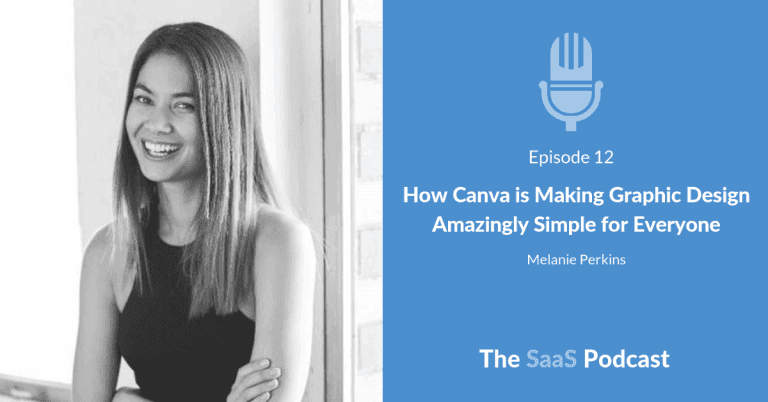
Today's interview is with Melanie Perkins.
Melanie is the 27 year old co founder and CEO of Canva, an online design platform which makes graphic design amazingly simple for everyone by bringing together a drag and drop design tool and a library of more than a million stock photographs, graphic elements and fonts.
Melanie founded Canva in 2012 and to date has raised over $6 million in VC funding.
Melanie, welcome to the show.
Melanie Perkins (00:58.250)
Thank you so much for having me.
Omer (01:00.330)
So I've told our audience just a little bit about you.
Tell us in your own words a little bit more about you personally and then give us an overview of your product and business.
Melanie Perkins (01:09.130)
Yeah, sure.
I actually came up with the idea for Canva when I was at university.
I was teaching design programs and I was so difficult to use and challenging that I realized that in the future design would be entirely different.
And so that was where the idea for Canva was born and I started my first company which actually took that concept to the yearbook market and enabled people to create beautiful designed yearbooks online.
And then a few years ago we started out on the journey to take that technology to the much wider market to enable everyone to design.
And that's where the idea for Canva was born.
And we've launched just over a year ago.
We've now got 800,000 users.
We've created 5.5 million designs.
So it's been pretty crazy.
Omer (01:49.830)
Wow.
Now, before we dive into more details, we like to kick things off with a success quote to better understand what drives and motivates our guests.
What is one of your favorite success?
Melanie Perkins (02:01.410)
I actually have two favorite success quotes.
So one is from Seth Godden.
Persistence isn't using the same tactics over and over.
Persistence is having the same goal over and over.
And another one is from Steve Jobs.
You've got to start with the customer experience and work backwards towards the technology, not the other way around.
I think they're both very important quotes.
Omer (02:22.770)
I love both of them.
Can you give me an example of maybe how one or both of those quotes have helped you in your life?
Melanie Perkins (02:28.950)
Absolutely.
From coming up with the idea for Canva, it was been seven years from then until this moment now, and we're still just unfolding the vision for what Canva is.
And so it really has, you know, it took such a long time to Hire our team.
It took such a long time to raise funding.
It was really having the same goal for many, many years and having just to continuously persist to actually get to that point.
And then with the Steve Jobs quote, really I came up with this idea before I had any business experience experience or any technology experience or marketing experience or any other experience.
I was just at university and so I think that knowing what I wanted to create was definitely the most forefront thing in my mind.
And then we had to work backwards to actually build that with the technology and building an incredible team around it.
Omer (03:15.920)
Now before we talk about Canva, I want to talk a little bit more about you.
Tell me a little bit more about what you were doing before you started Canva.
Melanie Perkins (03:25.490)
I was at university and I was studying communication, psychology and commerce and every school break we travel a lot and I was also teaching design programs as a part time job.
So that was, yeah, that was my background at that point in time.
Omer (03:45.810)
Now when did you start your first business?
Melanie Perkins (03:49.410)
My very first business, I was actually about 14 and I made scarves and sold them to women's boutiques around my hometown in Perth.
But my, my first proper business was Fusionbooks and that was the online design system for school yearbooks.
Omer (04:06.670)
And so how did you get started with that business?
Melanie Perkins (04:10.990)
I came up with the idea and then hired a software development company to help build our first prototype with my business partner, Cliff Obret.
And just we had to become profitable really quickly because if we didn't, we'd have no business very quickly.
And so each year we'd build the company, we turn a profit and then we'd reinvest that back into the company.
And then that just grew very organically.
We had no outside funding.
Omer (04:39.260)
Now when I looked at Fusion Yearbooks, there were elements that reminded me of Canva.
You know, things like simple drag and drop design tools, automatic layouts, headlines that tell you things like design in less than 60 seconds.
You know, it seemed like Canva in the making.
Was that happening as you were building that company or did Fusion Yearbook sort of change to become like that after Canva launched?
Melanie Perkins (05:07.190)
Actually it's quite funny.
In 2008 we're in a program called WA Inventor of the Air Western Australia, which is where I'm from.
And we had the first page that was a multi user online publishing platform.
Not very snappy, but that, that was exactly what we've built now.
So we'd been filing patents back in 2008 based on what Canva is today.
So absolutely the big vision really came into fruition right back then.
And then we applied that to the niche market of school yearbooks.
So Fusionbooks was definitely the catalyst for Canva.
Omer (05:43.330)
Are you still involved with that business or did you sell it?
Melanie Perkins (05:46.930)
No, I'm still part owner in the business.
We have a great team working on that company and that's growing every year too.
Omer (05:54.430)
Awesome.
Okay, Melanie, let's talk about the early days of Canva and explore how you got started.
So you came up with this idea and it sounds like this idea was incubating for a while.
At what point did you decide that you were ready to build this next business?
Melanie Perkins (06:13.070)
Yeah, people kept asking us with Fusion Books, can they use it for other products, can they use it to design their school yearbooks and their marketing materials and their social media?
And even though we had had the idea originally for a much broader market, we had had Fusion Books for a few years and we were like, surely there must be other technology that now offers what we're doing with Fusion Books to the mass consumer market.
And there absolutely wasn't.
And so a few years ago, I set off to San Francisco.
I'd plan on going for a couple of weeks and ended up staying for several months and learning everything I could about startups and venture capital, because I had absolutely no idea what venture capital even was.
We always funded Fusion Books organically.
We had no investment.
And so in that three month period in San Francisco, I started to meet investors and an investor said that he would invest in us if we could find the right tech team.
And so I then spent another year trying to find the right tech team before I eventually found Cameron Adams, who joined us as a co founder for Canva.
And so that was a very long process of trying to find the tech team.
And then once we had the tech team trying to get investment and then, you know, it was a year of building Canva before we actually launched it.
And then, yeah, that's sort of been the journey so far.
Omer (07:33.040)
So it almost sounds like Fusion Yearbooks was almost the first version of Canva in many ways.
Melanie Perkins (07:43.040)
Absolutely.
Omer (07:44.960)
And so, you know, when you, when you went out to build Canva, you, you know, they say, as the saying goes, if you're trying to market to everyone, you're marketing to no one.
And it seems like these days just about, you know, all, all types of people seem to be using Canva.
But who, who was your target customer in those early days?
Who, who were you going after?
Melanie Perkins (08:10.290)
I really like the idea of starting nation and going wide, so starting niche, solving a problem for a specific market.
And then before you start to go to other markets.
And so for us, it was actually using Fusion Books as that first version.
And then with Canva, we've been able to have the luxury of being able to solve a problem for a lot of people.
Our first users of Canva were a lot of bloggers and social media marketers because they have a very regular need to design and they didn't have any tools to be able to do that.
So I think that being able to solve a problem really should be at the crux of any company is being able to solve a problem that really matters to people.
And for us, that happens to be a very big market because a lot of people have a lot of difficulty designing.
Omer (08:59.889)
So what did you do to acquire your first few customers?
What were your key marketing activities at the time?
Melanie Perkins (09:08.290)
We did a lot of blogger outreach.
So we showed bloggers Canva before it even launched, and then we got them in our inner circle, and that really helped as a customer catalyst for Canva to get out there.
I think bloggers are a really great market for Canva because not only do they need to use it very regularly, but they are catalyst for messages.
And so when they get behind something, they're not only using it, but then they're blogging about it.
They've got huge audiences.
So that helped us to get Canva out into the wide world.
Omer (09:36.910)
Now, looking back at those early days, what do you think was one of the biggest mistakes that you made?
Melanie Perkins (09:45.810)
One of the biggest mistakes?
I don't consider anything to be a mistake.
For me, it's like when there's something that you need to do, you just try millions and millions of ways.
Maybe that's a slight exaggeration, but literally hundreds of ways to get to where you want to go.
So finding a tech team, I'd do absolutely everything I possibly could.
I'd go speak at conferences, I'd cold email people on LinkedIn.
I'd network like crazy, just doing whatever I possibly could.
So I guess you could consider the 99 ways that I tried to be a failure.
You know, I think that really you need to try 99 ways before you get to the hundredth, and it actually is a success.
I've never experienced anything in life where you just try something and it's successful.
It really is just setting your mind on what you want and then trying and trying and trying until you actually get there.
Omer (10:36.330)
Now, you didn't go out and look for investors when you started Fusion Yearbooks.
Why did you decide that you were going to Sort of take a different approach with Canva.
Melanie Perkins (10:48.040)
When we started Fusion Books, we didn't even know what investment was, which actually has turned out to be a really.
A great blessing in disguise.
If we had had money in the early days, I think we wouldn't have known how to spend that.
We wouldn't have had all the business experience and product experience that we then had when we were starting Canva.
Why we decided to raise money for Canva was that it's just such a big, big market, such a big opportunity, and we wanted to move very quickly for it.
I feel very fortunate that we got to have five years of building experience in launching a product, making it profitable.
All of the really important things that I think that if you raise money too early in your startup journey, it can actually be a little bit hazardous.
Omer (11:30.330)
Okay, so you've turned your idea into a product, and you've got some people using.
Looks like you're onto something that could become a pretty successful product and business.
What did you do next to keep growing and acquiring more customers?
Melanie Perkins (11:48.280)
I think it really comes down to solving a problem that affects a lot of people.
So with Canva, when it's been, you know, every month is our best month ever.
Every week is our.
Almost our best week ever.
It's growing like crazy.
But I think that really comes down to the problem that we're solving, affects a lot of people.
And the product is something that people like using because it solves that initial problem that they faced.
We have people.
I just stumbled across upon a closed Facebook group yesterday, and they've got hundreds upon hundreds of people who are, like, learning to design.
We've had people doing webinars about Canva.
We have people doing workshops, blogging about Canva.
The community that's been built around it in a very short period of time is quite incredible.
But I think it really comes down to solving a problem that people care about.
Omer (12:34.650)
Are you doing anything to nurture and build that community, or is it purely coming from people just looking at the product and just loving it because it takes those pains away for them?
Melanie Perkins (12:46.250)
Yeah, it really has been very organic so far.
We're actually just about to put in some programs in place to help foster it even further and to give people the materials that they need.
But so far, it's been very organic.
Omer (13:01.220)
Now, you know, often with growth come come growing pains.
Can you tell me about one big challenge that you faced as the business started to grow?
Either either on the business or the
Melanie Perkins (13:11.820)
product side, on every face, we've been growing like crazy.
So we've now got 40 people, whereas when we launched just a year ago, we had 10 people.
So we've grown very quickly in the number of people in our team.
Figuring out how to onboard people, get people into the Canva culture, understanding vision behind Canva.
That's all been a learning curve.
We've got such an incredible team and finding people of the caliber that we need for our company.
It just takes a long time.
Scaling up Canva has also been challenging.
So we've had 5.5 million designs created, but 1 million of those were created just last month.
Yeah, the trajectory is pretty crazy at the moment.
So I think having great people behind the product, having incredible engineers that have had experience with scaling products is really important as well.
Omer (14:05.170)
Now, based on your growth, when do you expect to hit a million users?
It can't be that long now.
Melanie Perkins (14:11.330)
No, it's not long at all.
I mean, we're at 800,000 and a million is only 200,000 away.
So I definitely would guess in the next couple of months at least.
Omer (14:23.810)
Okay, Melanie, so we started this conversation by going back to where the idea came from.
And then we've kind of taken this journey on how you turned that idea into a successful product.
Let's talk about the business today.
Are you able to disclose revenue numbers?
Melanie Perkins (14:39.780)
No, we don't disclose revenue.
Omer (14:41.700)
Okay, so let's talk a little bit about how you're generating revenue at the moment.
Now, from what I've seen, you know, you have this extensive library of images, but then you also have these stock images that are available for a dollar.
Can you tell me more about where that that concept came from and why you took that approach with Canva?
Melanie Perkins (15:01.150)
Yeah, absolutely.
So we found that a lot of people wanted to use imagery and you know, in their social media posts, in their blogs, and they wanted to use a lot of different images.
But the price bracket of, you know, 10 to $50 doesn't suit people to be using new imagery every day.
And so we wanted to bring the price point down to a dollar.
So it just is a no brainer to use beautiful imagery and use different imagery every day.
You're doing a social media post and so we introduced a new license type called a one time use license, which means you can use an image in a design for a dollar.
And so rather than downloading the image and using it over and over again and having your set bunch of images that you have to keep cycling through, we wanted to make it very affordable to be able to use different imagery all the time.
So that's where that license came from.
Omer (15:50.720)
Now, is there anybody else who's taking that same approach in the industry that you know of?
Melanie Perkins (15:55.410)
Not that I know of and we have actually filed a patent around that.
Omer (15:58.610)
Great.
Okay, so how difficult was it to go and structure a licensing deal like that?
I mean, I assume a lot of these providers are very comfortable paying, you know, charging 20, $30 for these images.
And this is game changing in many ways.
Melanie Perkins (16:17.730)
We've actually built our own community of stock photographers and illustrators around the world who contribute directly to Canva.
It's not through any third parties.
I think that for stock photographers and illustrators, it means that their imagery is getting to a whole new market that they've never been able to access before.
Usually the buyers for stock photography and illustrations are people that can access things like Adobe Photoshop and Illustrator because you need that knowledge to be able to design something.
Whereas with Canva, anyone in the world can become a stock photography buyer by literally just having access to the Internet.
Omer (16:51.860)
And how did you get that momentum and that sort of flywheel going with having so many images in there so quickly?
Melanie Perkins (17:01.700)
I think we've spent a lot of time fostering the community, explaining what Canva is giving people pre release demos that's been absolutely paramount, is just bringing people into what we're trying to achieve.
I think.
Long term plan, it's a lot easier to get people on board because they understand what we're trying to do as a company.
Omer (17:26.670)
Okay, let's talk a little bit about Guy Kawasaki.
Melanie Perkins (17:30.510)
Yeah.
Omer (17:31.390)
How did you get him to join your team?
Melanie Perkins (17:35.470)
He actually tweeted a Canva design and we picked it up in our Twitter stream and just reached out to him and he said that he loved Canva.
It was actually a very seamless process getting him on board.
We had a conversation and then we went over to San Francisco and he, he joined.
Omer (17:56.170)
And how long ago was that?
Melanie Perkins (17:58.570)
In April, I think.
Omer (18:02.250)
Awesome.
That, that, that sounds just too easy.
Melanie Perkins (18:07.290)
It actually, it was a very quick turnaround from like the initial conversation to having him joining was a very short space of time.
Omer (18:15.200)
But from what I understand, he was already a big fan of the product anyway.
Melanie Perkins (18:18.960)
Right, yeah, that certainly makes things easier.
I think that he certainly would only want to evangelize something that he believes in.
Omer (18:27.600)
Okay, so what's the one thing in your business that you're most excited about right now?
Melanie Perkins (18:33.440)
We've been working on some big projects for the last 11 months and they are launching very shortly.
So there's a lot more of Canva yet to Unveil, and we're going to start to unveil that in the, in the coming weeks and months.
So getting some of these products launches out is going to be very exciting.
I think it'll transform what we're doing at Canva and people's, what people can do within our platform.
Omer (18:58.260)
And sort of looking beyond that, what, what is the future vision for Canva?
Where would you like to take this product and business in the coming years?
Melanie Perkins (19:09.300)
Our vision is to enable people to, to turn their idea into a design as frictionally as possible, to make that process entirely seamless.
And we feel like we've made some really great inroads in that direction, but there is just so much more yet to be done, which we're very excited about.
So we really want Canva to be used by every marketer, every blogger, every person who's putting together a pitch deck for their startup.
Design just taps every single profession, even students.
So we're very excited for Canva to get into a lot more hands.
Omer (19:40.480)
And I'm one of those customers, I'm afraid.
Melanie Perkins (19:42.960)
Excellent.
Omer (19:44.400)
All right, Melanie, it's now time for our lightning round.
I'm going to ask you a series of questions and I'd like you to answer them as quickly as possible.
Melanie Perkins (19:51.840)
Okay, sounds good.
Omer (19:53.120)
Okay, here we go.
What's the best piece of business advice that you ever received?
Melanie Perkins (19:59.120)
So Lars Rasmussen, the founder of Google Maps and Google Wave, became a mentor very early on, and he told me many times that it's worth rating for the right people to join your team.
And we did.
We had to wait for quite some time.
And that was very good advice because we've got an incredible team.
Omer (20:15.760)
What book would you recommend to our audience and why?
Melanie Perkins (20:19.840)
Designing the Obvious by Robert Hochman is an incredible book.
It will really change the way that you think about your product, or if you're already thinking in that line, it's a very good way to think and articulate the a lot of things very clearly.
Omer (20:34.710)
What's one attribute or characteristic in your mind of a successful entrepreneur?
Melanie Perkins (20:40.310)
Determination to see something through, to set a vision.
It's absolutely paramount.
Omer (20:46.950)
What's your favorite personal productivity tool or habit?
Melanie Perkins (20:51.270)
I would have to say Canva.
I spend my entire day planning and wireframing and creating a Canva.
Of course,
Omer (21:00.580)
if you had to start over tomorrow, what type of business would you go and build?
Melanie Perkins (21:04.980)
I would build Canva.
I'm very happy with where we're at.
I think the world is ready for a product like Canva.
Omer (21:14.180)
What's an interesting or Fun fact about you that most people don't know.
Melanie Perkins (21:19.620)
I spent a lot of time traveling during my university breaks.
I spent some time in India and Africa and a lot of time in Asia.
So, yeah, that.
That was a big passion.
Omer (21:32.640)
What is one of your most important passions outside of your work?
Melanie Perkins (21:37.920)
Adventure.
I think that life is just about having, you know, having an adventure and trying to push everything to its absolute limits.
And so I've done that in every aspect that I possibly can, I think.
Omer (21:51.760)
All right, you made it through the lightning round.
Those are great answers.
Thank you.
Melanie Perkins (21:55.820)
Thank you.
Omer (21:57.020)
I think one of the things that I think that Canva and what you and your team have done is a really great example of is, as you said, is finding a problem that really needs to be solved and then just focusing on building a great product.
And from what I'm seeing by taking that approach and just continuing to do that, you know, everything else seems to be sort of falling into place.
And I'm sure that behind the scenes, you know, there are a lot of challenges and ups and downs, but it seems that that seems to be the core of what your business is about.
Melanie Perkins (22:35.390)
Absolutely.
I think that I couldn't stress enough that the length of time between having the idea and getting the product out.
It was like six years, so, absolutely.
It seems like everything falls into place.
But pursuing the vision takes a long time.
You know, it's certainly not.
I have an idea in a weekend, and I'm able to push it out by the.
By the Monday.
It takes a very long time and a lot of determination to see things through and things go wrong 99 times before they go right.
But being committed to what you're trying to achieve is absolutely important, and I
Omer (23:08.380)
think that's great advice.
Melanie, I want to thank you for joining me today and talking about Canva.
I really appreciate you sharing your experiences and insights with our audience, and thank you for letting us get to know you a little bit better personally as well.
If folks want to find out more about Canva or they want to get in touch with you, what's the best way for them to do that?
Melanie Perkins (23:27.150)
On Twitter?
My handle is Melanie Canva.
Or our company is obviously Canva, or.
Yeah, I think Twitter is a great, great way to get in contact.
Omer (23:40.350)
Awesome.
Thanks again, Melanie, and I wish you continued success.
Melanie Perkins (23:43.950)
Thank you so much, Omer.
Omer (23:45.390)
Cheers.