Omer (00:11.840)
Welcome to another episode of the SaaS Podcast.
I'm your host Omer Khan and this is the show where I interview proven founders and industry experts who share their stories, strategies and insights to help you build, launch and grow your SaaS business.
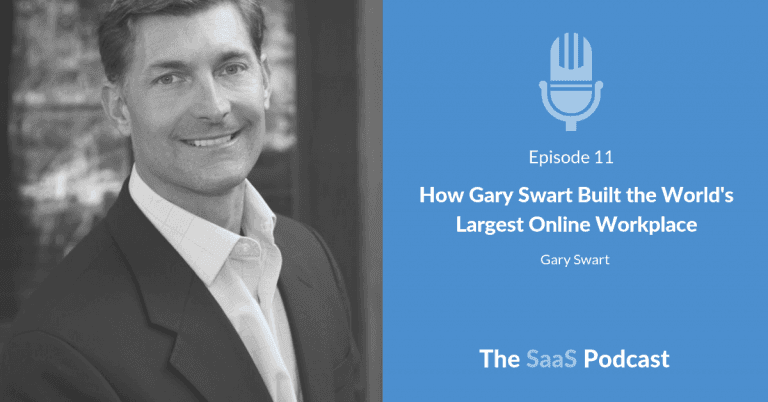
Today's interview is with Gary Swart.
Gary is a venture partner at Polaris Partners, an 18 year old venture capital firm.
Gary is also the former CEO of oDesk, the world's largest online workplace with over 1 million clients and 5 million freelancers.
He joined the company as its CEO back in 2005 and has guided the company to industry leadership and through their recent merger with Elance.
Gary, welcome to the show.
Gary Swart (00:55.680)
Thanks Omer, it's a pleasure to be here.
Omer (00:58.000)
Now I've told our audience just a little bit about you.
Tell us in your own words a little bit more about you personally and then give us an overview of your product and business.
Gary Swart (01:05.280)
Sure.
How much time do we have?
I'm kidding.
There's the abbreviated version.
So yeah, as you mentioned, I'm now at Polaris Partners, 18 year old venture capital firm, about $4 billion under management, investing in both technology and biotech companies and I'm thrilled to be joining them here on the San Francisco office.
Prior to was the CEO of Odesk for the last eight plus years and as you mentioned we guided that company to industry leadership merging with Elance.
Prior to that I was at a little company called intellibank and that was quite a character building experience and a lot of lessons learned there with a startup that wasn't successful.
And prior to that I was at a little company called IBM and I got to IBM via the acquisition of Rational Software where I led global sales teams.
Bit about Odesk now Elance Odesk, the world's largest online workplace, essentially helping companies to hire, manage and pay talent from anywhere in the world.
So we were not too unlike E commerce where you find the right good, get delivery good and pay for the good via the web, we did the same thing for online work.
Find the right worker, get delivery of the work and pay for the work all via the Internet.
Omer (02:26.210)
Now before we dive into more details, we'd like to kick things off with a success quote to better understand what drives and motivates our guests.
What is one of your favorite success quotes?
Gary Swart (02:35.410)
And I can only have one.
A good friend of mine once said that experience is what you get when you don't get all the other things that you want.
And I think there's a valuable lesson there about never squandering a good crisis.
To learn as much as you can so you don't repeat the same mistakes twice.
Omer (02:56.450)
Awesome.
Now before we talk about Odesk and Polaris, I wanted to talk a little bit more about you.
Tell me more about your experience at IBM and then through to intellibank.
And from doing my research about you, one thing that stood out for me was when you described intellibank as Dropbox gone wrong.
And so I'd really love to dig a little bit more into that and just find out what that was all about.
Gary Swart (03:20.600)
Sure.
Well, let me tell you about IBM and my thought process as to why I left IBM.
IBM is a phenomenal company.
I was employee number 131,000 or thereabouts and it was really exciting to merge Rational Software, a company of about 800 people, into the IBM environment.
And I had a big role in doing that and learned a ton in the process.
But as time went on working for a very large company, I started thinking about my impact and really what impact could I have at Big Blue and as employee number 131,000 it's really hard to have a massive impact at such a big company.
The second thing was growth and development.
You know, I started thinking about what was my career trajectory and how much could I learn and was I learning enough for my time.
The third thing was financial reward.
And while IBM pays very well, it wasn't game changing wealth, it wasn't the opportunity to make a bigger impact and get rewarded for that.
And then the fourth thing was balance.
And balance I describe as what keeps you busy outside of work and do you have time for the things that your passions outside of work, assuming you have passions outside of work.
And I have to say that those four things were not necessarily in balance for me.
I felt like I could use a little bit more on the growth and development, an impact and maybe even a little less on the balance.
So I decided to leave IBM and go join some early founders of a company called intellibank.
And essentially intellibank was an intelligent bank of your knowledge on the web.
So think of it as a folder where you could share artifacts with friends, colleagues, associates, partners, whatever, and go ahead and share different artifacts with different constituents, essentially like Dropbox.
And when I say gone wrong, what happened was one, it was early.
This was nine or 10 years ago and arguably it was early for the market.
But also we didn't execute well.
We tried to be all things to all people.
Documents with workflow and provisioning and check in and check out and version control and workflow.
And all kinds of security permissions.
And while those things may be important now, they weren't then.
And so I like to say we had a massive opportunity.
One, we were early, and two, we didn't really execute on the opportunity.
Omer (05:54.130)
So looking back at those days, if you went back to those intellibank days, what do you think you would do differently?
Gary Swart (06:01.730)
Well, I think first and foremost, we probably should have picked a major.
And what I mean by that is, you know, you go to college and you can't have five majors.
You can have one major and maybe two minors, but we should have declared a major and said, you know, we're going to pick one of these things and we're going to do that one thing really well.
And I think, you know, to Dropbox's credit, that's what they did exceptionally well.
They picked document sharing and they didn't worry about all the other stuff.
It was elegant, it was simple to use, it was easy, and it made it really simple for you and I, via the web, to share artifacts.
And by doing that one thing exceptionally well, I think you have an opportunity to do a lot of other things well.
So I would say picking a major and then focusing on that one thing as opposed to trying to be all things to all people.
Omer (06:52.590)
Okay, Gary, let's take a journey together back to your early days and explore how you got started at Odesky.
First of all, tell me a little bit about how you got involved with Odex.
Because even though you're not a founder of the company, you joined very early on, didn't you?
Gary Swart (07:12.190)
I did, yeah.
And I joined two brilliant technical co founders and a small team that really was executing quite well.
They just needed a little bit of leadership.
And I was lucky enough to get introduced to Odesk by one of their investors.
I'd like to say I had the vision from the beginning that this was going to be a very large, successful business.
I did not.
Luckily, one of the investors talked me into it and I was lucky enough to believe him and take the job and never looked back.
It turned out to be a really phenomenal choice, one that wasn't entirely obvious to me for about three to six months after I got there.
But once I was there and started working with the team, I realized that this was a massive opportunity and one that we could win.
Omer (08:00.880)
How big was the company when you joined?
Gary Swart (08:03.360)
The company was only about 15 people.
And it was 15, but we actually took it down to even less than that because there were some people on the bus that were on the wrong bus.
They weren't really excited about where the company was going.
And so I don't think it's fair to keep people around that don't really want to be there.
So it's not fair for us and it's not fair for them.
So we actually made the team even smaller before we built it up from there.
Omer (08:30.570)
And how many employees does Odesk have today, excluding the Elance merger piece of that?
Gary Swart (08:38.170)
Well, prior to the merger, we had right around 150 employees.
But we were also using our own service to hire, manage and pay workers from all over the world via the web.
We were doing that through Odesk and.
And we were doing that to the tune of about 2 to 1, meaning we had two contractors for every one employee.
Omer (08:56.850)
Wow.
Wow.
Okay, so what was the business strategy at the time when you joined the company?
Gary Swart (09:03.010)
Well, the business strategy was pretty simple.
It was attract great workers who could deliver good work for clients who needed work done.
And in turn, those clients would post more jobs for great workers.
So it was workers will bring clients and clients will bring workers.
And it's not too unlike a typical marketplace business with supply and demand.
Our supply was workers and the demand was jobs, things that needed to be filled.
And it turns out that there was a pretty massive market for work to be done.
If you think about why or how is this a large market?
You know, companies are struggling to find great talent.
And even if they can find great talent in their local geography, they have to compete for it.
They have to compete with bigger companies with more resources, all people, time and money.
And small companies just couldn't compete, so they were looking for a different way.
And if you think about what are the ways you can get work done, you can hire on premise, you can outsource to somebody else, maybe overseas, you can hire local temps.
And hiring via the Internet was a new way of working.
And so our strategy really was to reach the customers who had an explicit need to get work done and really let them know that this was an option and then of course, deliver a delightful experience so they would tell their friends and get more work done.
Omer (10:38.910)
Now, from what I understand, the early version of Odesk, the business and the product wasn't really a scalable model.
Can you talk a little bit about that?
Gary Swart (10:49.710)
Sure.
In the early days of a marketplace, you have to think about delivering such a great experience so that your clients will be motivated to come back for more and tell a friend.
Right.
If you can get every client to tell a friend, well, there's some virality in your business where People will come for free.
And so we, in order to control the quality, in the early days, we did a lot of hand matching.
You would tell us what your job requirements were, we would screen you and make sure that you were motivated and qualified to get work done.
And similarly, we would do the same type of screening for the workers themselves.
And this high touch, arguably high friction model, really enabled us to not only control the quality, but also to charge more for our service in the early days.
And while that was a very exciting business, that was one that we viewed as likely to be a small business or one that was going to require high touch and therefore slower growth in order to scale.
And so we decided to shift our business a little bit, become more of a no touch marketplace and put the mechanisms in place to enable companies to hire, manage and pay workers without all of that touch or handholding in the middle, without the friction, if you will.
And that turned out to be a very significant move at that time.
We also lowered our price, which was a bold move.
And that enabled us to grow and scale the business much more quickly and effectively.
Omer (12:23.500)
Do you remember how many clients and freelancers were using Odesk in that first year when you joined?
Gary Swart (12:31.480)
I don't remember the exact number, but I'll tell you this, in the early days, we would screen every single worker that came onto the platform.
And we had team of interviewers.
I remember there was a woman, Olga, in Russia, who happened to be a great screener.
And on her best day, if she were taking 30 minutes to an hour to screen a worker, you could only screen eight workers a day.
And if you had four or five recruiters that can only screen eight workers a day, that was only 40 people a day that you would add to your service.
And that's with a full time large group of people doing the screening.
And then you have to ask yourself, what are the chances, despite the fact that they're excellent people, what are the chances that they get all of that screening right?
Meaning they let the absolute right people in and keep the people that shouldn't be in out.
And while this was happening, we had a queue of about 5,000 workers that wanted to join our service.
And we realized at that point that we were actually blocking our own growth.
So we had probably about 1,000 workers in the system, adding no more than 20 a day.
And we had 5,000 that were trying to get in.
And we said, you know what, we have to get out of the way of ourselves here and really let the market mechanisms work.
And hopefully that'll be A good move,
Omer (13:49.060)
but that must have been a big change because, you know, you're in a place where you're doing very high touch.
Presumably the quality of the freelancers was very high.
And then once you open these floodgates, you're inevitably going to have to lower the quality bar to get more of these people through.
Did that raise concerns for you and the company at the time?
Gary Swart (14:10.240)
It did, and it was really a point of friction.
But at the end of the day, we looked at the multiples on staffing businesses, even ones with an Internet front end versus marketplace businesses, and we realized that in order to grow this business big and really capitalize on the opportunity, we were going to have to shift our thinking and our business strategy.
And yes, it was constant point of friction, you know, quality versus versus scalability.
But there's nothing like a forcing function of having to deliver quality to force you to do the right things for your clients and your.
Omer (14:49.530)
So looking back at those early days, what do you think was one of the biggest mistakes that you made?
Gary Swart (14:55.170)
Oh, my gosh.
And I can only have one.
I would say that in the early days, we threw a lot of stuff at the wall, really, to see what would stick.
And I would say it was a bit of the shiny object syndrome.
You'd see a new shiny object and say, oh, let's run in this direction, as opposed to just sticking to our core.
And it's a really hard thing for an entrepreneur to do, especially one that I like to say puts everything in the window as opposed to leaving some things in the store, just enough in the window to get people in.
And so I think we arguably were a little bit distracted.
And it's not what you say yes to, it's what you say no to.
Omer (15:36.210)
Right.
Gary Swart (15:36.930)
Requires a lot of saying no, because again, back to my intellibank days, you can't be all things to all people.
Omer (15:44.930)
So as most of us in this industry know, building a marketplace is an incredibly difficult thing to do.
What advice would you give to somebody out there who's either thinking of doing just that, or maybe already is in the process of trying to build out a marketplace, but just isn't getting enough traction?
Gary Swart (16:04.260)
Well, the first thing I would say is get ready for the long haul.
These businesses take a long time to build.
They're incredibly hard and they're complex.
On the surface, you think, oh, I just need a little supply and demand and a couple of tools to get them connected and we'll be all set.
But there's so much that goes into a Marketplace business.
I'm shocked to hear that even years after being in business, Netflix is a bit of a marketplace, more of a reseller.
But they're just now entering Europe.
That's a long time.
That's a good 15 or 16 years after they started.
So you have to think about a methodical approach, one that I would say is focused.
And the narrower you can focus your marketplace while still having a large business, the better off you are.
And if you think about some successful businesses, like ebay, for example, in the early days, they weren't everything.
They were Beanie Babies and Pez dispensers, and then collectibles and then Rolexes and then cars.
And I'm sure we could think of a number of examples.
But the narrow focus enables you to really get known for doing an exceptional job at that one thing.
And then you can expand horizontally from there.
Omer (17:27.460)
Okay, Gary, so you've got some paying customers, you've got a good balance with clients and freelancers, and this flywheel is starting to get going, and you want to keep scaling this business.
What kind of things did you do next to acquire more customers?
Gary Swart (17:48.350)
Well, Odesk was fortunate in that a lot of our customers came from referrals.
We always said the best customer is one that a friend brings along because they're kind of already sold.
They're looking for a PHP programmer, and a friend says, oh my gosh, you should go to Odesk.
And not only should you go to Odesk, you should use this guy over here that I use because he's exceptional, and let me show you how to use it.
So they not only would bring the client, but in many instances, they would help onboard the client.
So friends were the best mechanism we had.
And we were always trying to make our product and service better in order to give people a reason to tell a friend.
And then we would look for embedded accelerators to give them a way to tell a friend.
Now, in addition to that, we always focused on SEO and SEM.
Of course, both paid and unpaid.
Search is a good way to acquire customers.
PR was good for us.
If we could get mentioned where small businesses were hanging out, that was always a good thing.
Blogs and forums.
Content is not a bad strategy, although it's one that's hard to do to get people to come to your site for exceptional content and then stay to buy your product or service.
But we did all of these things.
We were constantly trying to get more customers, as well as remarketing to our existing client base to remind them that we did other types of work and that they should.
We were always looking to cross sell and upsell to our existing base as well.
Omer (19:24.070)
Now, as you started to get more customers, what type of growing pains did you experience with the product?
Is there maybe an example you can share of a particular challenge that you faced and maybe tell us about how you overcame that?
Gary Swart (19:39.120)
Oh, we had so many challenges.
In a marketplace business, you're constantly trying to balance both sides of your ecosystem and you have to ask yourself fundamental questions like which one do you favor?
An example on Odesk is you could say, come to Odesk for high quality work.
We have the best quality and reasonable prices.
But now are you sending a message to your workers that the prices are so reasonable that you can't make any money?
Or do you say to workers, come notice because you can make a ton of money.
And then clients think, well, if workers can make a ton of money, then it's at my expense.
And so you're constantly in this balance of which side of the marketplace do you favor?
Do you guarantee the work to the clients and no matter what happens, the client is right, or do you pay the workers no matter what?
Or do you get in the middle of every single discussion or debate about whether or not the product was as spec'd and so constantly balancing both sides of the marketplace without being what I call the one throat to choke.
Because as soon as you're in the middle and you're the one throat to choke, you're more of a reseller, not a marketplace.
So ebay didn't take possession of every Rolex watch and validate that it was a real Rolex before they passed it on to the client.
They merely created the platform and the mechanisms for a buyer to purchase a Rolex with the confidence that it was a real Rolex.
Omer (21:11.820)
So tell me a little bit about how the merger with Elance came about.
Gary Swart (21:16.870)
Well, you know, if you think about businesses like ours, you know, Elance was a very formidable competitor.
We had very similar businesses.
We used to be going to a similar destination, taking different routes, but over time we ended up merging onto the same road.
So here are two businesses going to the same place and arguably we're getting there in very similar ways.
It becomes harder for you to distinguish your businesses while there's a clear number one and number two, it's not going to be a winner take all market.
And if you think about there's a lot of marketplaces where this is the case.
Grubhub and Seamless, for example, HomeAway and Vrbo, Zillow and Trulia who just agreed to merge a lot of marketplace businesses decide that it makes sense to join forces and, and Odesk and Elance looked at each other's businesses and said, we're going to the same place.
Arguably we're getting there in very similar ways.
Could one in one really be an opportunity to create something more?
We decided to put the businesses together.
Not too unlike Zillow Trulia, VRBO, HomeAway, Grubhub, Seamless, etc.
Omer (22:35.680)
But the businesses are still operating independently.
I mean, did you guys.
Are we going to see at some point an Olance or an Edesk or something as they come together?
Gary Swart (22:46.950)
I think that both brands have their own constituents.
There's people that love Vlance, there's people that love Odesk.
And we expected very little overlap or switching in the beginning.
As a matter of fact, the strategy was to put the companies together.
There were 40 open RECs between the two companies.
The demand for more talent to help the companies to come together was there and, and really to start getting synergies on the back end, take the best of both platforms and start offering it to each of the respective clients.
Whether or not there's one brand moving forward.
I'm not the CEO, I'm not leading the company, but I certainly think that one brand would make sense, whether it's a combined brand, whether it's either Elance or Odesk, or whether it's a completely different brand.
But I have full confidence in the executive team at Elance Odesk to figure that out and come up with the right answer.
Omer (23:42.710)
Okay, Gary, so we started this conversation by going back to where the idea for Odesk came from.
And we took this journey together on how that grew into this successful product and business.
Can you share some numbers in terms of revenue, in terms of where the business was prior to the Elance merger?
Gary Swart (24:01.270)
Well, Odesk was a little bit bigger than Elance.
Businesses were growing roughly at the same pace.
Combined, it's a billion dollars of work through the platform and more than 10 million freelancers, more than 2 million clients growing very fast.
And so I think it's together truly is a powerful company and one that is the the dominant leader in the space.
Omer (24:36.780)
Okay, so let's talk about your new role at Polaris Partners.
At what point did you decide that it was time for you to move on and do something different?
Gary Swart (24:47.740)
Well, you know, not to.
Unlike my decision to leave IBM, my criteria haven't really changed much.
Although the weighting and the definitions have changed a little, I'm still interested in impact growth and development, financial reward and balance.
After being a CEO for eight years, I have tremendous respect for the entrepreneurs out there who are going into work every day and making lots of decisions and forging on despite all of the challenges in front of them.
And after successfully merging the companies, I couldn't get excited about doing that on a daily basis, at least at this point.
And so I was looking to do something where I could learn, grow, and develop, where I could make a big impact and have a little bit more balance.
As the CEO of Odesk, I missed out on a lot of kid and family events.
And so while I'm not necessarily looking to coast or not work as hard, I am looking to be in control of my own time.
And so venture capital actually fit those criteria for me.
From an impact standpoint, I can impact many companies as opposed to one from a growth and development standpoint.
I'm learning new skills that I didn't already have in my toolkit.
And my career has been about learning new skills and different roles and really stretching myself in order to get that growth.
And I may decide that I want to go back and operate something 6 months, 12 months, 18 months from now, I may decide that operations or, you know, running a business is a better fit for my skills and something that I enjoy more.
But right now, I am.
I'm thrilled to be at Polaris and learning a new set of skills and hopefully making an impact.
Omer (26:38.040)
So what's the one thing in your current role that you're most excited about right now?
Gary Swart (26:43.560)
Well, I'm seeing some phenomenal companies.
I'm meeting some incredible entrepreneurs.
I'm already leaning in on some of the Polaris investments companies and playing the role of a coach or a mentor and helping to guide companies.
And I love that.
I mean, I love meeting entrepreneurs, helping entrepreneurs, and really just getting out in the community.
I'll be speaking tonight at a Marketplace event here in San Francisco with a few hundred attendees.
And I love that kind of stuff.
Right.
There's this experience gained from running a business like Odesk, and I wish there was somebody like me around eight years ago who could have imparted some of this wisdom on me.
I'm excited about all of those things.
I know you said the one thing, but it really is just connecting and helping entrepreneurs.
That's exciting to me.
Omer (27:36.760)
I think it's great that after all of this experience that you have that you're now going out there and and spending time with other entrepreneurs and helping them.
I think that's a hugely valuable thing.
Just not for them, but for the industry as a whole.
Gary Swart (27:51.010)
Yeah, well, I truly enjoy it.
So, you know, back to my motivation to do this job.
I'm pinching myself that I get to do this, that I get to do this on a daily basis and call it work.
Omer (28:04.210)
Okay, Gary, it's time for our lightning round.
I'd like to ask you a series of questions and just answer them as quickly as you can.
Are you ready?
Gary Swart (28:11.440)
I'm partially ready, but let's give it a shot.
Let's give it a shot.
Omer (28:15.920)
Okay.
What's the best piece of business advice that you ever received?
Gary Swart (28:20.400)
Oh, my gosh.
I guess it was around the marketplace business.
It was get ready for the long haul and focus again.
Back to that reinforcing that message about not trying to be all things to all people.
Omer (28:37.290)
What book would you recommend to our audience and why
Gary Swart (28:42.090)
so many good books?
You know, I love the Steve Jobs book.
You know, one not.
Because after reading it, I wanted to be like Steve, but it really shed a lot of light on his customer centricity and the fact that, you know, they built a business that was all about making the customer successful.
Omer (29:04.400)
What's one attribute or characteristic in your mind of a successful entrepreneur?
Gary Swart (29:11.840)
Tenacity.
That's the first one that came to mind.
You know, you just have to have this unwavering determination to break through the wall or find a way around it.
Now, there's a caveat to that, which is you also have to know when to fold them and not try and break through the wall, but to turn and maybe go in a different direction.
But you have to be tenacious about your approach.
Omer (29:36.730)
What's your favorite personal productivity tool or habit?
Gary Swart (29:40.890)
Oh, my gosh.
You know, I read a book a while ago and I can't remember the name of the book, but essentially the premise was deal with it, delegate it, or delete it.
And I try and get through my inbox with that premise.
So from a productivity process standpoint, not belaboring emails, but deal.
Dealing with it right then and there and getting it out of the way, delegating it, that's another way of dealing with it or deleting it.
Just saying this isn't important and I'm.
I'm just going to get rid of it.
But leaving it there to deal with later, I find it can be.
Can be soul crushing.
Omer (30:14.770)
Yeah.
One of the things that worked really well for me was David Allen, the.
The creator of getting things done with this concept of the two minute rule.
Gary Swart (30:23.580)
Yes.
Omer (30:23.860)
And, you know, if you can get something Done in two minutes.
Do it instead of putting it on a to do list.
That's really been a powerful thing that for me.
Gary Swart (30:30.700)
Yeah, I read that book as well and that's that similar philosophy.
And I think it's that, that thematic that really works for me.
Omer (30:39.900)
Now, if you had to start over tomorrow, and from what you've been saying, you may be starting over sometime soon in the future, what type of business would you go and build?
Gary Swart (30:50.550)
I would build one like Uber or like Instagram or like Facebook.
Oh my gosh.
Some of these businesses are just so enviable that Uber as a marketplace, the fact that they solve this time and space problem, you need a ride, you need it now, and you hit a button and magic happens behind the scenes.
And I know there's a lot of businesses out there today that want to be the Uber for X, right, for whatever.
But I don't know, I can't think of one that solves the time and space problem quite like they do.
At the end of the day, I think some good guiding principles around this are I would want to start a business that, one, is at the intersection of something that I'm really passionate about, and two, hopefully something that I'm good at.
And then arguably, I would hope that that were a big market.
It doesn't have to be, but I would start a business, you know, something I'm passionate about, something that I'm reasonably good at, and one that's at the intersection of a big market with a significant need.
Omer (31:58.930)
What's an interesting or fun fact about you that most people don't know?
Gary Swart (32:04.770)
Interesting, fun fact about me.
I am arguably a workaholic.
I am very fidgety.
I like to be doing stuff.
So I'm the kind of person that has to get a lot done in a day.
That can be a blessing and a curse.
I played the saxophone in my early years of high school.
Omer (32:27.920)
And finally, what is one of your most important passions outside of your work?
Gary Swart (32:34.560)
Passions outside of work.
So let's see, there's family.
I have four, count them, four kids, which can keep you quite busy outside of the office.
And family is really important to me.
And then I would also say exercise.
I'm an outdoor enthusiast and I love biking and hiking and surfing and skiing and just being outside.
So I would say between work, family, and outdoors, I have time for little else and I'm quite okay with that.
Omer (33:04.940)
Awesome.
Great answers, Gary.
Gary Swart (33:06.300)
Thank you, Omer.
Thank you.
It's a pleasure chatting with you today.
Omer (33:10.380)
Okay, so I really appreciate you sharing your experiences and insights with our audience and also thank you for letting us get to know you a little bit better personally as well.
Now if folks want to find out more about Odesk or they want to get in touch with you, what's the best way for them to do that?
Well, the best way forget about Odesk, I think we can talk.
Let's talk a little bit about Polaris as well.
Gary Swart (33:29.750)
Yeah.
Polaris Partners is our website www.polarispartners.com me probably the best way is either Twitter Aryswort where I'm not Super Active or LinkedIn.
I love to connect with people on LinkedIn and my profile is Gary Swart on LinkedIn.
I've written a lot about the subjects we're talking about today so you can follow me on LinkedIn and get more of this hopefully sage wisdom.
Omer (33:59.110)
Awesome.
Thanks again Gary and I wish you continued success.
Gary Swart (34:02.950)
Thanks Omer, you as well.
I look forward to connecting again in the future.
Omer (34:06.230)
Thank you.
Take care.
Cheers.