Omer (00:11.840)
Welcome to another episode of the SaaS Podcast.
I'm your host, Omer Khan, and this is the show where I interview proven founders and industry experts who share their stories, strategies and insights to help you build, launch, and grow your SaaS business.
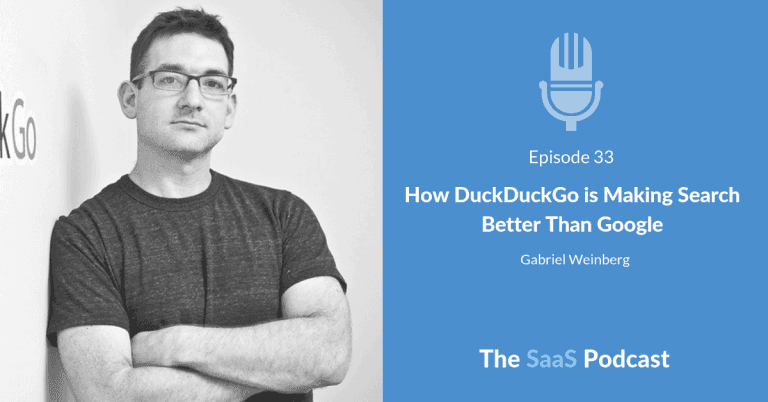
Today's interview is with Gabriel Weinberg.
Gabriel is the founder and CEO of DuckDuckGo, the search engine that doesn't track you with over a billion searches in 2013.
He's also an angel investor and co author of Traction, a startup guide to getting customers.
Gabriel has been featured on cbs, Fox, the Guardian, the Washington Post, and more.
Gabriel, welcome to the show.
Gabriel Weinberg (00:52.570)
Thanks.
My pleasure.
Omer (00:54.540)
Before we talk about DuckDuckGo, tell our audience a little bit about yourself.
Who is Gabriel when he's not working?
Gabriel Weinberg (01:01.820)
Well, I have a three and a five year old, both boys, and I'm basically a dad.
That's what I'm doing.
Omer (01:11.180)
Two boys.
Wow.
That's going to keep you busy.
Gabriel Weinberg (01:14.620)
Indeed it does.
Omer (01:17.020)
I have a boy and a girl, so I kind of feel like we have a little bit more balance in the house.
Gabriel Weinberg (01:21.660)
It's a lot of physical altercations, if you will.
Omer (01:27.460)
Now, we like to kick things off with a success quote to better understand what drives and motivates our guests.
What is one of your favorite quotes?
Gabriel Weinberg (01:37.140)
Ooh.
So I just came across a new, a relatively new one that really resonates with me and it is by Charlie Munger, who's, you know, a financial advisor in his own right, but known as Warren Buffett's right hand man.
And let me get it right here.
Sometimes I munge it.
Here goes.
I never allow myself to have an opinion on anything that I don't know the other side's argument better than they do.
And it really resonates with me because in terms of like corporate strategy and thinking about what you're doing with your business.
And it's all about making strategic arguments.
And I see a lot of people get caught up in optimism about their arguments but not really understanding the other side.
And so I think it's important to understand all sides of the issue.
Omer (02:25.410)
I've never heard that one before.
I think that's a great one.
Okay, let's start by giving our listeners a better understanding of DuckDuckGo.
Tell me a little bit about who your target customers are and what are the pain points that you're trying to solve for them.
Gabriel Weinberg (02:43.130)
So, okay, so DuckDuckGo is a general search engine, just like Google, and you can switch to it today and really never look back.
And so in that sense, the Target audience is everyone who uses Google, which is basically everyone.
But specifically we're focused on a number of things that we think that Google can't do easily for various reasons.
One is privacy.
So you mentioned up front we don't track users at all.
And the second is instant answers.
So we focus on these answers above the results.
And you've seen some of those on Google if you're a Google user.
But we're trying to do is that whole area is open source and we're trying to get really long tail answers.
So answers for all different areas that for your intricate hobbies.
So if you're interested in like Legos or bioinformatics, we want answers for all that.
And then the third piece is design.
You know, we just focus on web search, we don't have a social network or other things that clutter up the results.
And we try to go for an overall, you know, cleaner design.
And our argument is those things, real privacy, cleaner design and better answers appeal to a significant percentage of people and we think that's 10, 20%.
We're just focused on appealing to that percentage.
Omer (03:55.300)
What were you doing before you started DuckDuckGo?
Gabriel Weinberg (04:00.028)
I35, I started doing startups right out of school when I was 20 and ran some unsuccessful things and then ran a successful startup or mildly successful startup for a few years.
2003, 2006 was like an early social networking company and sold that in 2006 and then that was all in Boston.
Then I moved to outside Philadelphia where I live now and essentially started over.
Said I want to start a new company and I, I took a year and a half off and tried to explore, I don't know if you call it off, but a year and a half exploration of kind of what to do next for the next kind of decade.
And that was in 2007.
So here we are.
I started DuckDuckGo kind of again in 2008, so we're now in 2014.
So I feel like that process went well.
So the immediate thing before doing DuckDuckGo was figuring out what to do.
Omer (04:58.970)
Okay, now before we talk about that, tell me about one of the startups that you worked on before DuckDuckGo that didn't work out.
Right.
I mean, I think quite often we see the successes and we hear those stories, but it's always great to hear about those same people also going through struggles and failures.
Gabriel Weinberg (05:18.330)
Yeah, so I, you know, I have a bunch of those, but my first startup, so you kind of start there right out of school, was a Educational software company called learnextion.
And besides the name, that was one problem, but that wasn't its more fundamental problem.
The general idea was to increase parental involvement in schools by giving parents.
So how old is your son and daughter?
Omer (05:44.550)
So my daughter is six and my son is nine.
Gabriel Weinberg (05:47.270)
Okay, exactly that age group.
So I was hoping in K elementary school to give you more a sense of what's going on in the classroom every day and more direct communication with the teacher and things like that.
That kind of stuff is just starting to happen now.
I'm not sure what it's like in your school district, but with my son who's in kindergarten now, it's like you can't really figure out what he's doing every day.
And the communication with teacher is not great.
Maybe yours is better.
But in any case, back in 2000 it was non existent and I thought all the tools for this were available then just as they are now.
I mean nothing has fundamentally changed there.
It didn't need to be mobile or anything, but for lots of structural reasons that was not going to happen for another decade.
And so that was the major problem there as I was essentially a decade too early on that idea.
Omer (06:43.570)
Yeah, I think we're pretty lucky with our school.
And the communication I think has got better and better and we have a much better view of what's going on with our kids.
And it's funny because when I was at school, my parents didn't have a clue what I was doing.
Gabriel Weinberg (07:01.740)
Right.
Omer (07:02.620)
It was like I was going to a different world and unless they heard about something bad I'd done, they didn't really know what was going on.
Gabriel Weinberg (07:14.120)
Exactly.
Totally blind.
Yeah.
Omer (07:17.320)
Okay, let's talk a little bit about the early days of DuckDuckGo.
So you went on this sort of exploration period.
How did you come up with the idea for building another search engine?
Gabriel Weinberg (07:33.560)
Well, okay, so this process has evolved.
I did the process, the same kind of processor idea before starting the company, before Ducktico, which eventually got sold.
And over time I've, I've kind of changed my advice here for people.
And one thing I realized that basically took me, I guess I was 27 when I started Arctica.
That took me the first seven years to learn was, you know, I really wasn't thinking big enough, which is really hard advice to give people because they can't really internalize it until they kind of have a pity moment.
So I won't dwell on it.
But really what it, what it means is, you know, a lot of ideation and what I had done before, even though I was mildly successful, was kind of trying to think of business ideas and inefficiencies in the marketplace and how that might get you a good software idea that could make a million bucks, right?
Which sounds like the right approach, but I realized that it's not the right approach.
And really the right approach is to say, okay, what are big areas of software that are unfolding big markets, and which ones of those am I particularly passionate about?
And then try to start there and say, okay, I'm passionate about this area.
I could spend the next decade working in this area.
Now let's do an ideation process just around that area.
So that's what I did this last time around.
And I realized I'm interested in data.
And that's the biggest theme of that I was riding on, you know, kind of.
I wouldn't.
I wasn't calling it big data at the time, but the idea of, you know, there's more and more structured data, there's more and more APIs, there's more and more cool things to do with this data coming online all the time, what could I do in that area?
And so I started thinking of projects around that and I started exploring those.
And those.
A bunch of those side projects came in, just kind of.
Some of them were about augmenting Google and saying, oh, Google's not great at this or that.
Maybe I could augment it.
And then I realized, well, maybe I could put these together and just, you know, see if people would be interested in a search engine.
And so that's how it came about.
I didn't really set out trying to build a search engine or get in to that.
I was more thinking broadly, I'm interested in this area.
I think it's going to be a big area in the future.
You know, I'm going to go explore and see what pops out of it.
Omer (09:52.470)
Okay?
So, you know, I think the barriers to entry in the search business are really high, right?
I mean, you need engineering talent, you need servers that can support millions, if not billions of searches.
And you need to have scale to really make the economics of a search engine work.
Didn't all of that put you off from getting into this business?
Gabriel Weinberg (10:18.010)
So my insight on it was slightly different, and that's why I could start it by myself, which was that, you know, you can look at this two ways.
One is the harder problem in search engines, because there's a history of search engine startups that all raised like $50 million and went bust, and they attacked the problem Head on, let's just buy a bunch of servers and start spending money and copy it and stuff like that.
I realized that approach wasn't going to work.
The harder problem is actually coming up with something that people want to switch to because there wasn't much of a necessarily a pain point people were having with Google.
And so I came at it from that angle and from a data angle.
And my thought was, what if you treat the links as commodity and you try to get them from somewhere else?
And so you don't spend all the money crawling the Internet, even though I did start crawling, but you don't try to copy the whole Internet to your servers, which is where the money comes from, where it costs so much money.
Instead you focus on where you maybe could add value and might actually get people to switch.
So in my mind those ended up being privacy.
That's a real differentiator that actually doesn't cost money.
And two APIs, all these other companies were producing more and more structured data.
Think Wikipedia, Yelp, IMDb.
And by using them you're essentially getting, you're kind of leapfrogging Google by getting the best data out there because they're focused on that data and your job is more classification and say, okay, this query is about movies, I'm going to get the best result from IMDb.
I was looking at it from that angle because both of those are things that you don't need that excessive capital to start.
You're right.
If you go head on, you essentially need a billion dollars a year.
That's essentially what Bing has been spending on that crawling piece.
Omer (12:13.020)
How much money did you need to get that first version of the product built?
Gabriel Weinberg (12:19.350)
Essentially nothing.
I mean, on the order of, you know, $10,000 or something.
You know, that's not counting my time obviously, but no one counts their time.
But yeah, basically nothing.
Omer (12:33.750)
Okay, so what did you do to go and start validating this idea?
Gabriel Weinberg (12:40.150)
So I, you know, probably went too far down without validation.
But the initial validation was put something up on tech areas, Reddit, hacker news in this case, and just see what kind of interests there were.
I wanted to know are people fundamentally interested in a new search engine at all or is that such a ridiculous notion that I should just stop?
And so I got to a point where I felt I could at least share with the world.
Now I, I probably went too far down that and did some premature optimization and things like that, which you shouldn't be doing.
But you know, it was still pretty terrible when I launched it.
I mean like really Terrible.
Probably took me under two years before you, you'd actually, somebody would actually want to switch to it.
But that was a validation point and I put it out there and there was a lot of interest.
I mean, I think people are less potentially interested in what I actually developed, but more interested in the idea that there could be an alternative with these properties.
And that was really encouraging and kept me going on the project.
I think if there wasn't that kind of reaction, I would have stopped.
Omer (13:53.160)
So looking back at those early days, what do you think was one of the biggest mistakes that you made?
Gabriel Weinberg (14:01.160)
So, um, you know, it's weird because like I was saying before, I think the bigger problem in search engines is figuring out something that'll entice people to switch.
Right.
It's not a technical problem per se.
You need to know which feature to actually build.
And I probably spent too much time building certain features that ultimately weren't going to work and there probably could have been smaller tests of them.
And so it took me a long time to kind of hit on the array of things that is up to go now that make it a nice search engine to switch to and that probably could have been reduced.
Another mistake was, you know, I self funded and you know, did ran it by myself essentially for three and a half years.
And you know, that could have been compressed a bit quicker if I had put more money into it or raised money to hire people earlier.
I wouldn't have hired people that earlier, but we got, I'd say early product market fit maybe two years in and it was another year before I really raised venture capital and I could have done that earlier.
Omer (15:17.040)
Okay, so you launched DuckDuckGo in 2008 and so you've been at this for about six years.
At what point did you feel like you were getting some meaningful traction with this business?
Gabriel Weinberg (15:30.340)
At the end of 2010, we were named.
It was like Time magazine's top 50 websites of the year or something like that.
And that was the turning point for me where I know that's like a press thing, it's kind of, you know, it's some random author who I like, but it's still one person's opinion.
But in any case, it was like it was an explanation of a moment that was clearly happening where, you know, various features and relevancy and all these things came together where you could see it in the, in the data too, adoption conversion curves off of like press kits and things like that.
You know, there was, it was a point where people are starting to switch and you could call that product market fit, but that's really the point.
Omer (16:20.970)
Okay, so how many people do you have working at DuckDuckGo now?
Gabriel Weinberg (16:25.610)
We have about 30 people.
20.
Around 20 or so are kind of what you probably call traditional employees, but we have a lot of part time people as well.
Omer (16:39.850)
Okay.
I mean, this really blew my mind because when I was doing some research and I got a sense of how many people you had working there.
Now, as you know, I used to be part of the Bing team at Microsoft and you know, there were thousands of engineers working on search and Google has, you know, even more than that.
So what are you doing?
How are you doing this differently?
You talked a little bit about this earlier, but just tell me a little bit more about how are you able to run a search business with just 30 people?
Gabriel Weinberg (17:15.080)
Right.
So I think the main.
So I guess there's two kind of maybe three ways to answer that.
One is there's whole areas that you were doing at Bing that we're not doing.
Right.
And we're essentially using Bing for some of that heavy lifting.
Right.
But I think it's even more fundamental than that.
We're using all sorts of companies for the heavy lifting.
Like I referenced IMDb and Wikipedia.
We actually have over 300 instant answer sources now.
And those basically represent another company with their own employee base who are working day in and day in and night making good structured data that would be useful for a search engine.
And we're using that.
So we're essentially leveraging the open Internet and data and APIs.
And so our effective people working to make DuckDucko better is orders of magnitude greater than the people that actually work for DuckDuckGo.
And that was possible at a moment in time when we started.
And that was kind of my thesis.
And so I think that's the largest part of it.
I think the way we've grown our team, I'd say if you're going to put orders of magnitude, that's probably an order of magnitude difference.
Right, right.
There's probably a factor of two or three difference with the actual people we've hired.
We've been very slow to hire.
We only essentially hire people who are extremely effective, often senior people who don't need a lot of management overhead.
So there's not a lot of, you know, there's a lot of efficiency and not a lot of bureaucracy at dub to go, a lot of autonomy.
And so we're probably getting stuff done with less people, but that's probably a two or three times difference than you know, a 10 or 20 times difference.
I think those are probably the main things.
Omer (19:09.020)
Now, looking back at the last few years, what has been one of the hardest things about building this product and business in your mind?
Gabriel Weinberg (19:18.540)
So, I mean, I'd love your reverse take on this, but mine has been the thing I keep repeating, which is this is not necessarily a technology problem in the search space.
It is a.
The problem may be solved somewhat by technology, but it's more of a psychological slash product problem of what is it?
What do you need to do differently to differentiate yourself and get people to want to switch to you?
And you could, and I think Bing has seen this, you could do amazing at search technology essentially on parity with Google.
That's not enough.
Right.
You need to differentiate in some other way.
And I think that's the hardest problem in search.
Omer (20:10.050)
Yeah, I agree with you.
I think that, you know, it's not, you know, Google has dominated this business so much that the features that you build just doesn't matter.
Right.
I mean, so many people now don't even think about where they're going to go in search.
They just do it.
Gabriel Weinberg (20:31.310)
Right?
Yeah.
Omer (20:32.830)
So, yeah, absolutely.
That is the number one challenge.
I totally agree.
Gabriel Weinberg (20:36.990)
I mean, you could look at it slightly differently from Bing's perspective and say because Bing has access to capital, large amounts of capital, which we didn't.
And you could say, well, that's also a distribution problem, you know, and most people still use the default settings.
And so if you can get, you know, you can see on the latest Yahoo deal you can get default deals that better to take away from Google.
And it was very hard for companies to want to do that because of that decade of people learning and people were scared to maybe change the default to Bing or Yahoo.
But from our perspective, we can't even compete for those distribution deals.
We don't have that amount of money.
So everyone who switched to DuckDuckGo is basically doing it on their own volition.
And so we have in a sense a harder problem.
But in a sense those constraints have led us down roads that, you know, like a Bing wouldn't do.
Not because it's not a good idea, but because Bing's working at a different scale than we are, you know, and so it's been interesting.
But yeah, the hardest problem for us has been just crafting in a search experience that, you know, really appeals to people that they will want to switch their search engine.
Omer (21:48.370)
Tell me a little bit about the size of the business.
How many users do you currently have or how Many search queries are you handling each month?
Gabriel Weinberg (21:55.980)
So we are handling about 230 million search queries a month and so we're about double from the billion last year that you quoted.
And still growing users.
We really don't track the users, so I honestly have no idea.
What's interesting is our user base is probably highly bifurcated in very early adopters who search a lot of, and then more mainstream people you might be familiar with from Bing, who the average person actually doesn't search that much.
And so it's actually hard to tell how many users we have.
I would argue in kind of the lower single digit million, something like that.
And yeah, that's basically the size of the scope of the business.
I would argue that we're getting close to about 1% search, but to the intricacies of the search market, those numbers are actually hard to determine.
I don't know how much you got into that at Bing, but we think that our value proposition basically of real privacy and better answers and cleaner design Appeals to easily 5%.
And our brand awareness is more like around 7% of the country.
So still 93% of us haven't heard of us.
Whereas Bing's brand awareness has got to be close to 3/4 now or something.
And so we feel if we can get a brand awareness up, we think our, our, we think our search share will go up significantly.
Omer (23:23.250)
So do you think you'll get to the 1% market share sometime in the next, sometime next year?
Gabriel Weinberg (23:31.570)
Yeah, I do.
I think we're, we're close to that already.
Again, it's really hard to tell based on various numbers, but yes, I think so, yeah.
Omer (23:43.010)
I mean, and you know, for people maybe who don't know that much about the search business, 1% sounds really small, but that's like that, that's a hugely significant share of the search market.
Gabriel Weinberg (23:53.250)
Right.
Omer (23:53.610)
Especially for a business with so few employees.
Gabriel Weinberg (23:57.170)
Yeah, it's hard to appreciate the scale.
But one way to appreciate the scale is to say you can think of orders of magnitude 10 times your business.
We started at getting around 1,000 searches a month and 10,000.
Then if you think of those, we went from 1,000, 10,000, 100,000, a million, 10 million, 100 million.
And now we're at around 250 million searches a month.
Each one of those was a big difference to us, you know, in various scale metrics.
That's just sense of how big the search market is that you can get at 250 million searches a month and still not even be at 1%.
Omer (24:33.530)
Is there one thing in your business that you're most excited about right now?
Gabriel Weinberg (24:39.130)
Yeah, I'm most excited about this concept of instant answer platform.
So, you know, we launched InstantAnswers.
Everyone's familiar with that.
You type in like, you know, a celebrity name and you get their basic biographical information on Wikipedia.
And you know, Bing started doing it shortly after we did.
Bought like Faircast and those other companies and started doing some cool stuff.
And then Google kind of followed.
And so now it's, you know, that's the ante is you have to have basic stuff.
But what we did is we open sourced the whole thing.
We have an open source instantanestric platform called DuckDuck CAC where any developer in the world can suggest answers and code them and use other people's APIs.
So I'm most excited about getting that to work as a real vibrant community where all this long tail answers start popping up and all sorts of niche hobbies.
In the last year, bitcoin answers.
The bitcoin community had made a bunch of answers for DuckDuckGo and just made the experience for people who are in the bitcoin community very good.
And so I am very excited about that in particular.
Omer (25:47.970)
Okay, Gabriel, it's time for our lightning round.
I'm going to ask you a series of questions and I'd like you to answer them as quickly as possible.
Are you ready?
Gabriel Weinberg (25:56.210)
All right, shoot.
Omer (25:57.250)
All right.
What's the best piece of business advice that you ever received?
Gabriel Weinberg (26:03.920)
Treat your business as a career.
Treat your career as like a career path.
You're not.
So that means if you're thinking long term, you have the ability to invest in skills and resources over time.
You're not just thinking of it as a short term thing.
That was a little long winded.
I'm going to try to do better.
Omer (26:25.200)
What book, apart from your book, would you recommend to our audience and why?
Gabriel Weinberg (26:33.890)
So I recommend this book called Switch.
It's one book I read in the last year that has a framework of how to get people to think about switching anything, really switching their behavior.
But what it comes down to in business is you're always just trying to get your customers to switch something.
They're already doing their behavior to something to your behavior.
And it yields a good framework for doing that.
Omer (27:04.440)
What's that one attribute or characteristic in your mind of a successful entrepreneur?
Gabriel Weinberg (27:11.240)
Analytical thinking.
This gets back to the quote I did at the beginning of this.
I think a good entrepreneur can quickly understand the landscape.
They're not going to analysis Paralysis.
But they can think through all the different kind of decision tree paths and come up with a good kind of choice of action.
Given all those, even though there's lots
Omer (27:36.660)
of uncertain information, what's your favorite personal productivity tool or habit?
Gabriel Weinberg (27:44.020)
Fancy Hands, which is a virtual assistant tool.
And it is a life changer if you commit to it.
Basically, you know, you just send any task you want, especially on when you're mobile, you can just record your voice into it and they'll start doing it.
So I don't make it.
I hardly make any phone calls.
I don't do web research for, like, products and stuff like that.
I'll just send it all to Fancy Hands.
Omer (28:09.060)
If you had to start over tomorrow, how would you go about figuring out that next business opportunity?
Gabriel Weinberg (28:16.260)
So here's what I would do.
I would look at the the big trends that people think are unfolding over the next decade.
Now, Those are cryptocurrency, AI drones, 3D printing.
There's a list of 10 of them.
Figure out which one big data is still there.
Figure out which ones I'm actually personally passionate about that I wouldn't mind spending a decade on.
And then do an ideation process within that piece and try to find, you know, a problem or a secret or a thesis in there and then, you know, start running tests on those ideation ideas.
Omer (28:57.470)
What's an interesting or fun fact about you that most people don't know?
Gabriel Weinberg (29:05.310)
I used to dye my hair a lot.
Does that count?
Omer (29:11.470)
I'll take that one.
Gabriel Weinberg (29:12.910)
All right.
Omer (29:13.820)
And finally, what is one of your most important passions outside of your work?
Gabriel Weinberg (29:21.740)
I would say base.
I cannot say family again because be in trouble.
Omer (29:27.900)
I know.
Gabriel Weinberg (29:28.460)
And if you just go by time allocation, I'm basically just here or with my kids and life.
Omer (29:35.980)
All right, those are great answers.
Gabriel, I want to thank you for joining me today and sharing your experiences and insights.
And thank you for letting us get to know you a little better personally as well.
Now, if folks want to find out more about DuckDuckGo, they can go to DuckDuckGo.com and if they want to get in touch with you, what's the best way for them to do that?
Gabriel Weinberg (29:55.800)
Twitter.
So my handle is yeagyegg.
Omer (30:01.320)
Awesome.
Gabriel, thanks again and I wish you continued success.
Gabriel Weinberg (30:05.240)
Thank you.
It's been my pleasure.
Omer (30:06.680)
Cheers.
All right, I hope you enjoyed that interview with Gabriel Weinberg of DuckDuckGo.