Rajiv Khaneja [00:00:00]:
So the business is an eight figure revenue business. We got an email from someone at Costco and they said, hey, we've been, we put an RFP out for looking for an ad server and we have some certain requirements and we didn't get any responses.
Rajiv Khaneja [00:00:17]:
We like, would you guys like, we found you online, would you want to take a look? And we'd never done anything enterprise. We don't show up with five or six salespeople or 10 salespeople and we don't show up with glossy PowerPoint presentations. We show up with a laptop and a demo.
Omer Khan [00:00:37]:
Hey, welcome to The SaaS Podcast. I'm Omer Khan and this is a show where I sit down with real founders and dig into how they actually built their SaaS and AI companies. I've had more than 500 of these conversations now and I put out a new one every week to help you build and grow your startup.
Omer Khan [00:00:53]:
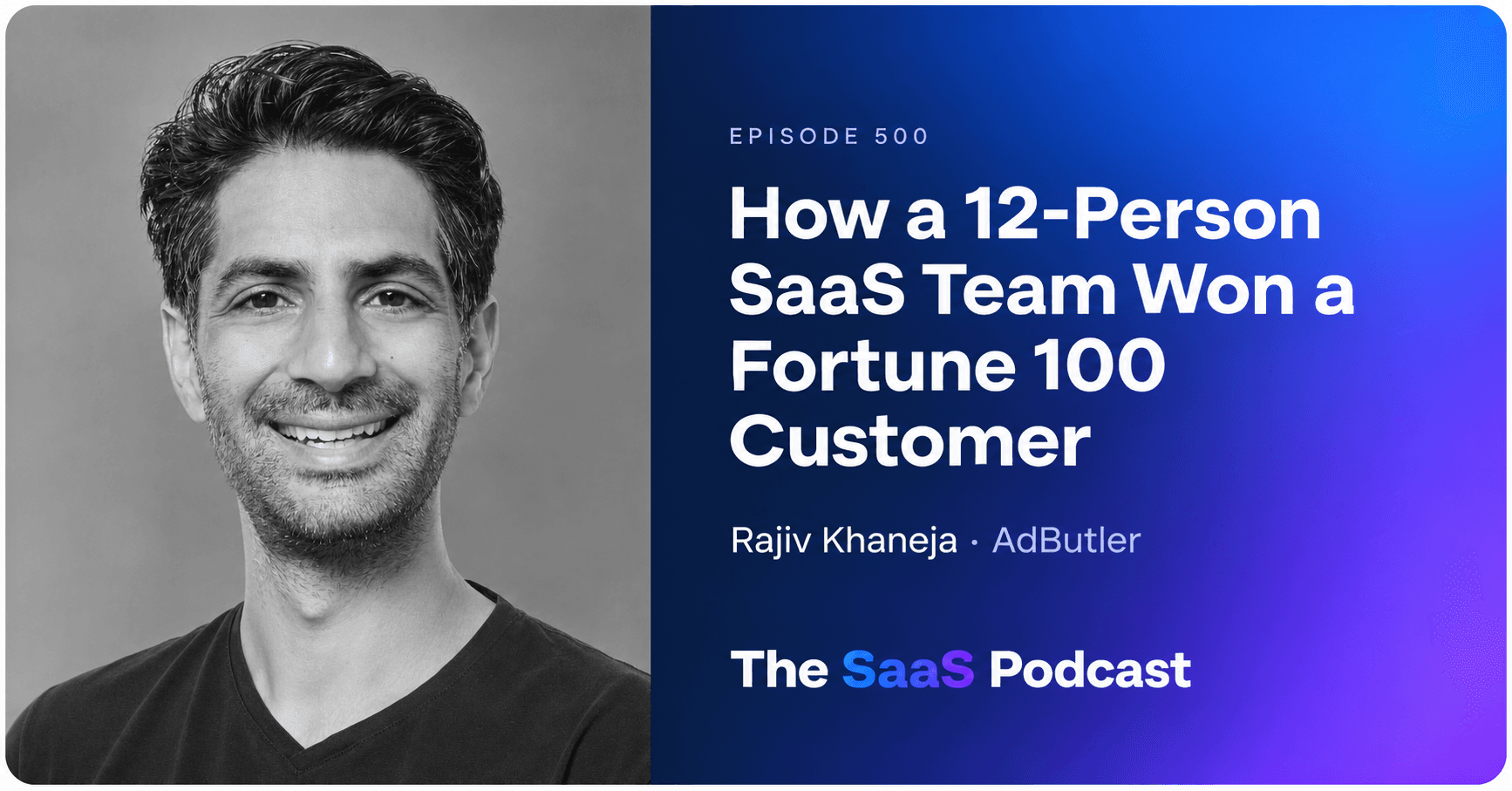
If that sounds useful, hit subscribe or check out saasclub.io to learn more. My guest today is Rajiv Khaneja, co-founder and CEO of AdButler, a SaaS company that runs the ad technology behind sites like Costco and Home Depot. For about 10 years, AdButler was a side project with customers paying less than $10 a month.
Omer Khan [00:01:15]:
Then it grew past 10 million in ARR with a team of about 25 people. In this interview, Rajiv breaks down how a contact form on his website became his enterprise sales team, why he's happy to offer big customers monthly plans instead of locking them into annual contracts.
Omer Khan [00:01:33]:
He explains why he's fine leaving money on the table in enterprise deals and how he thinks AI will give each of your customers their own version of your product. So I hope you enjoy it. Rajiv, welcome to the show.
Rajiv Khaneja [00:01:50]:
Thanks for having me.
Omer Khan [00:01:52]:
So tell us about AdButler. What does the product do and who's it for?
Rajiv Khaneja [00:01:57]:
So AdButler is in a category of software called AdTech. And it's the technology behind all of the advertising that you see online. And we've been around for 20 years, so we're very wide.
Rajiv Khaneja [00:02:14]:
We have solutions for everything from what's called digital out of home, so billboards in Times Square, ads on the back of seatbacks of airplanes, to our Commerce Catalyst offering, which is for retail media. So we have customers like Costco and HEB and Home Depot.
Rajiv Khaneja [00:02:33]:
And when you go to their websites, there's a bunch of technology that decides what ads you're going to see and helps them manage those ads across a bunch of other verticals. And it's all in a category called ad tech that a lot of people don't think about.
Rajiv Khaneja [00:02:47]:
But it's an industry that helps create the ad business models for all of these different companies. Great.
Omer Khan [00:02:56]:
And give us a sense of the size of the business. Where are you in terms of revenue, customers, size of team?
Rajiv Khaneja [00:03:03]:
So the business is an eight figure revenue business. The team is fairly lean for that size. So we're about 20 to 25 people. I can't remember exactly. And what we try and do is leverage a lot of technology to keep the team lean.
Omer Khan [00:03:20]:
Okay, Great. How is AdButler different to something like Google Ad Manager or something?
Rajiv Khaneja [00:03:32]:
Yeah, so what really differentiates AdButler is that we're a completely neutral ad tech solution. So what we do is we provide the technology to companies like Costco and they do all of the ad sales. So a lot of other companies in the ad tech industry, they're involved in the buying and selling of ads. For the most part.
Rajiv Khaneja [00:03:51]:
Adbutler is not involved in that. So we kind of see ourselves as a partner with our publishers clients in, in sort of a buy versus build situation. They could see us as an in house partner, but we're bringing the technology to them.
Rajiv Khaneja [00:04:10]:
Whereas something like Google Ad Manager works really well with Google Ad Exchange and is used by a lot of people who want to have Google buy and sell their ads. And then of course you end up giving Google a lot of data and a lot of your proprietary information.
Rajiv Khaneja [00:04:30]:
So our customers generally don't want to be in that environment.
Omer Khan [00:04:33]:
Let's talk about where the idea came from. You said the business has been around for about 20 years and you were pretty young when you started this. So just take us back to when that happened. Where did the idea come from?
Rajiv Khaneja [00:04:49]:
Yeah, so yeah, it's going back a long ways, back to the 90s. So pre.com 1.0 days where I created what I think might be the world's first SaaS product. I can't find anything earlier.
Rajiv Khaneja [00:05:03]:
And what it was was a company called polit.com and polit.com was really unique because back in that day it was really difficult to add any kind of interactive features to a website. That was kind of a new idea. And I came up with the idea of being able to add a poll to a website.
Rajiv Khaneja [00:05:23]:
And I just did it because I wanted a poll on my own website. And I realized that a lot of other people also wanted polls on their website and they didn't want to learn how to program.
Rajiv Khaneja [00:05:32]:
So I created this way for people to put a poll on any website with the idea that on the results page I would put a banner ad. So I would take the advertising. And that was the initial idea. Eventually I figured out that people will be willing to pay to get rid of those ads.
Rajiv Khaneja [00:05:53]:
So we sort of had both models, but the free version with the ad on it was obviously far more popular. And I ended up having hundreds of millions of ads to manage. And back in that day, it was like advertising online was very simple. And I learned that there was something called an ad server.
Rajiv Khaneja [00:06:16]:
I thought, oh, I need this ad server. And the only one at the time was DoubleClick. So I think I was like 14 years old and I called up DoubleClick and I was like, excuse me, I would like an ad server. And they just didn't want to talk to me at all. Literally hung up on me.
Rajiv Khaneja [00:06:41]:
And then I called back and eventually I got a quote from them. And it was to me, just an insane price. I don't remember what it was, but it was like, you know, seemed like really insane. And I looked at it and said, well, this isn't that complicated. Back then, it wasn't complicated. I can probably program this.
Rajiv Khaneja [00:07:01]:
So I programmed my own ad server, and I thought, well, other people might want this. So I gave it a name. I called it AdButler. And I made a website and I put it up there.
Rajiv Khaneja [00:07:12]:
And the original model for AdButler was that you could use AdButler for free, and we would take seven and a half percent of the ads. So, you know, you go to your website and most of the time it would show your ad. And once in a while we'd slip in one of our ads.
Rajiv Khaneja [00:07:32]:
And because, you know, I didn't really understand business back then, I thought, people aren't going to want to pay for this. It'll be, you know, people were more likely to give me one of their ads. And then over time, people started saying, hey, can we pay? Can we pay and not and get all the ads? Yeah, sure.
Rajiv Khaneja [00:07:53]:
But it was very much off the side of my desk, and it was just a little tiny thing I did off the side of my desk while I focused on other things.
Omer Khan [00:08:03]:
Okay, so hold on. So you're 14 years old, you're. You've built this product and you start to make some money with ads. Initially it was your own banner ad. You mentioned hundreds of millions of ads to manage. I assume that's eventually what it grew to.
Omer Khan [00:08:22]:
But when you're 14 years old and you make that phone call to DoubleClick, how many ads were you having to deal with and where did they come from?
Rajiv Khaneja [00:08:35]:
So I think it was probably, I mean, it's hard to remember way back when, but it was probably tens of millions or something at that point. And at the time, there wasn't a lot of advertisers online, but a lot of the tech companies that were raising huge amounts of VC money, they would buy ads.
Rajiv Khaneja [00:08:56]:
And there was a couple other advertisers. Two Cows was a big one. If you guys know that domain registrar, Two Cows, they were one of the very early online advertisers.
Rajiv Khaneja [00:09:04]:
And oddly enough, there was another one called the Pacific coast down company, who I later learned the owner of that company was friends with Jeff Bezos, and Jeff had pushed him to sell his comforters and pillows and whatnot online. And they were one of the very early online advertisers.
Rajiv Khaneja [00:09:24]:
So it was kind of a smattering of companies like that. Um, and.
Omer Khan [00:09:30]:
Okay, but where did they come from though? Because it's like you're 14 years old. I couldn't go out today and sell 10 ads. Right. And you, you said you didn't have a, you hadn't built your ad server and you were trying to get double click. So like, sure. How, how are you even serving ads?
Rajiv Khaneja [00:09:48]:
So I was also not able to go out and sell ads. These companies had programs online, so if you could search and find their websites, they, they basically had an open program said apply.
Rajiv Khaneja [00:10:04]:
And then later on, a couple years later, by like 1998, 1999, they were the initial ad networks where you would apply and they would, they would do the ad sales. So that's, that's, that's what I was using. I didn't have the wherewithal to go out and find my own advertisers directly.
Rajiv Khaneja [00:10:21]:
I was using ad networks and sort of the early online advertisers.
Omer Khan [00:10:26]:
Okay, okay. So you were going to these existing websites and places applying to be able to serve these ads. And eventually that led to you having to figure out this problem and making that call to DoubleClick, which didn't go well. But I mean, even back then, it wasn't easy to build an ad server, was it?
Omer Khan [00:10:56]:
When I was at Microsoft, there was hundreds of engineers working on ad tech stuff.
Rajiv Khaneja [00:11:01]:
Yeah. So back then, ad servers were relatively simple. Where the main features were, they'd rotate ads. There was some rudimentary geographic targeting. So you could say people in this country, like some advertisers, only wanted to advertise in the United States. So you could kind of figure out where People were by their IP address and do that.
Rajiv Khaneja [00:11:25]:
You know, the big features were being able to start and stop ads on certain days or give certain ads a certain number of views. And then what I also wanted to be able to do is control which polls, results page had which ads.
Rajiv Khaneja [00:11:42]:
So when you created a poll, you'd indicate what kind of category the poll was in and then I would be able to use the ad server to say, okay, this ad performs better on an entertainment related poll. This ad performs better on this poll.
Rajiv Khaneja [00:11:55]:
So it was, you know, back then it was very simple as a feature set. What was difficult and complicated was scaling. So if you only had a few thousand ads to serve, the code was relatively simple. But if you had hundreds of millions of ads, all of a sudden your servers were getting overloaded, things were blowing up.
Rajiv Khaneja [00:12:20]:
And we're talking about computers 25 years ago. And not just computers, but the technology of 25 years ago wasn't as optimized for online, handling online requests and whatnot. So figuring out how to scale and handle high levels of load was really a moat. And for some reason my brain just works really well that way.
Rajiv Khaneja [00:12:48]:
Like I'm able to solve those kinds of computer science, computer engineering problems. And I think that's what really gave Abbott a lot of traction, is we were one of the products that could scale.
Omer Khan [00:13:02]:
So how much money were you making as a teenager running this business, presumably on the side because you were still going to school?
Rajiv Khaneja [00:13:11]:
Yeah, I was in high school and I finished high school early. So in grade 10, I'd finished all of my academics and the principal at the school said, well, look, you only have art class and a couple other things. I'm not going to let you do that. So I've enrolled you at the university.
Rajiv Khaneja [00:13:31]:
And I quickly learned that at university nobody cares if you show up or not. There's no attendance. And now I had a built in excuse at the high school for my art classes and whatnot. I can just say, oh, I have a conflict with the university. So I would just skip everything and stay home.
Rajiv Khaneja [00:13:51]:
And I had this room above my parents garage and I ended up hiring five or six engineers that were working in that room above my parents garage while I would go out and do my, I go to the university exams.
Rajiv Khaneja [00:14:04]:
So I go do the exams or I go to like a couple classes a day and then I'd come back and we were making close to seven figures and I was probably profiting a few hundred thousand and I made enough to buy a house. Um, you know, before I Graduated high school.
Rajiv Khaneja [00:14:21]:
I, I, we rented an office, and then I realized, oh, this office is crazy expensive. So I, I wanted to be all fancy man and stuff. So I got this really fancy office.
Rajiv Khaneja [00:14:32]:
And then I realized, well, it didn't actually make any difference because, no, I'm online and nobody's ever coming to the office, and no one knows who we are, and, and we're in Victoria. And there was no, like, there was no scene. And I just looked, I'm like, this is like double what a house would cost.
Rajiv Khaneja [00:14:53]:
And at the end of the day, I own nothing. Like, I have nothing. It's just, I'm just paying it to the landlord. So I bought a house. So, yeah, it was like, a pretty crazy time.
Omer Khan [00:15:05]:
All right, so didn't you get an acquisition offer as well when you were still at school for the business?
Rajiv Khaneja [00:15:15]:
Yeah. So, you know, there was always people sort of knocking, knocking on the door. And I got this one acquisition offer they ended up taking pretty seriously because they offered to fly me out to California. And, and I'm in Victoria, Canada, so it's a small city up, up the coast.
Rajiv Khaneja [00:15:35]:
And, and I said, okay, a free trip to California. Can I bring my dad? And like, oh, yeah, we'll fly you and your dad out. So we both flew out to California, and they did the whole. Back then I knew nothing, so I was, like, wowed by all this.
Rajiv Khaneja [00:15:51]:
But they picked me up in a Porsche and we went to this fancy French restaurant, which is by far the most expensive restaurant I'd ever been to. I'm a child of immigrant parents. We didn't go to fancy restaurants. We go for Chinese food once a quarter or whatever. Went to this fancy French restaurant.
Rajiv Khaneja [00:16:08]:
And I remember the bill was like, back in the day was like $300 or something. And I was just like, wow, that's crazy. Anyhow, yeah, so they ended up offering me, I think it was two and a half million dollars for A.D. butler.
Rajiv Khaneja [00:16:24]:
And I kind of looked at it and went, well, I think it was like four times profit or something at the time or whatever. And we were growing or five times profit or something that, and I looked at him like, if we keep growing, I'll make that much money in a few years. So it didn't make sense.
Rajiv Khaneja [00:16:43]:
And then, yeah, I flew back and went back to chemistry class and, and the T. And the teachers were like, oh, why are you late? And I'm like, oh, I had a dentist appointment because I wouldn't tell anyone what I was doing. Yeah, very crazy times.
Omer Khan [00:17:03]:
So you turned down this offer, you felt like the business was going to take off and did it.
Rajiv Khaneja [00:17:14]:
Yeah. So this was all Pollo.com right. So AdButler was just still like an interesting side project. And online polls, shockingly they were difficult to put on your website back in the 90s and then it became like relatively easy and commodity. And we kind of went through this idea of what we called at the time webmaster tools.
Rajiv Khaneja [00:17:43]:
So we said, oh, if you have a website and you want to put a poll on it, that's interesting. What else would people want to put on their website? Well, the natural progression from polls is surveys. And then from there we did online forums.
Rajiv Khaneja [00:17:58]:
It was called activeboard.com, where you could host online forums and there's a whole host of other things and it did quite well. There's a bunch of hiccups in a road so we're doing quite well. And then we had the.com 1.0 crash.
Rajiv Khaneja [00:18:17]:
And at the time most of the revenue for all of that stuff was the advertising and most of the advertisers, they were setting sort of the market price for advertising were pre revenue or no revenue venture backed startups. So people talk about an AI bubble today.
Rajiv Khaneja [00:18:37]:
The bubble back then was very different in that 90% of companies had no revenue. Whereas you look at AI today, there's a lot of revenue backing what's happening Back then there was just the future promise of revenue.
Rajiv Khaneja [00:18:54]:
So when the bottom fell out in the dot com crash, all of that advertising demand evaporated and we went from $10 CPM to $0.10 CPM in like a matter of months. And I remember I had these engineers in this room above my parents garage and, and I was paying them all.
Rajiv Khaneja [00:19:18]:
And I remember waking up one morning and opening my email and one of these big ad networks that we used, it was called Flycast, just sent an email and it was like two sentences long. Basically said we've gone bankrupt and we're not paying anyone and they owe and they paid net 90.
Rajiv Khaneja [00:19:37]:
So they owed me three months worth of worth of ad revenue. And I remember just sitting on my bedroom floor with my head in my hands going how am I going to pay these guys? How am I going to make payroll? Like all this money I thought was coming is not coming.
Rajiv Khaneja [00:19:58]:
And that was the first time I still remember vividly. It was the first time I had a physical response reaction to reading something I didn't know that was possible. So these two sentences on the screen made my stomach just clamp up and turn into knots and I Remember just thinking how odd that was.
Rajiv Khaneja [00:20:21]:
Like, I didn't even understand that you could feel like you got punched in the stomach by reading some words on a computer screen. Um, but yeah, I sat there for a while and I realized, well, advertising is online. Advertising is stupid. It was all a house of cards. Nobody's buying anything on the Internet.
Rajiv Khaneja [00:20:44]:
I have to get people to pay for my software. So at the time we had a small program where people could pay $4 a month and not have ads on the polls. And I just pivoted super hard into that. I said, what will people actually pay for?
Rajiv Khaneja [00:21:00]:
And that's when we started creating more of these tools like the online forums, surveys, et cetera. And almost entirely, we basically treated the free model at that point as almost like a demo. So the advertising, instead of being a profit center, was just an annoyance to get people to pay.
Rajiv Khaneja [00:21:23]:
And I was very down on online advertising at the time. Meanwhile, I still had AdButler and put it out in the world and it just kept growing and kept growing and it took me about a decade before I was like, oh, maybe online advertising actually has some value.
Omer Khan [00:21:40]:
Wait a minute. So AdButler was basically the technology that you were using as your double click replacement to serve.
Rajiv Khaneja [00:21:51]:
So it started off, like I said, as very simple feature set. And we put it out in the world and other people were using it. And every so often somebody would write in with a support ticket and say, hey, can AdButler? I really like AdButler, but I need it to do X.
Rajiv Khaneja [00:22:08]:
And some engineer I had would read the support request and go, well, it can't do that now, but we can in two weeks. And then they'd sit down and write some code and it would have that feature and, and rinse and repeat that for 10 years.
Rajiv Khaneja [00:22:27]:
And we ended up just adding every possible feature under the sun, but there was still no real business behind it. It was a product with four or five engineers that would support it. And zero thought into pricing models, zero thought into sales, zero thought into marketing. Well, I shouldn't say zero thought in the pricing model.
Rajiv Khaneja [00:22:52]:
The pricing model was it costs us X to serve an ad, so we're going to charge people some multiple of X. And that was it. We weren't thinking about the value customers were getting out of it. We weren't thinking about future product development.
Rajiv Khaneja [00:23:07]:
We weren't thinking about any of the things you would expect because I was 100% focused on other things.
Omer Khan [00:23:14]:
So how much money was AdButler making and for how long before you felt like there was a serious business there and that's where your attention should go.
Rajiv Khaneja [00:23:27]:
So, I mean, that was a good 10 to 12 year period where it was kind of just growing up the side of my desk with some engine and the engineers weren't even full time on it.
Rajiv Khaneja [00:23:38]:
They were doing other stuff for like active board and pullit.com or whatever or, or whatever shiny object I was into at that time. And I have to think back, but it must have been making like 5, $600,000 a year and most of that was from SMBs.
Rajiv Khaneja [00:23:56]:
So you could, back then you could use AdButler for, I think it was 9.95amonth if you were serving a small number of ads. And I think our biggest customers might have been paying a few hundred dollars a month and we had like 10,000 customers using it. So it was very much just very small SMB type websites.
Omer Khan [00:24:21]:
And how fast was it growing or how slow was it growing?
Rajiv Khaneja [00:24:27]:
I don't actually. I mean, I think it was probably growing like 15, 20% a year or something like that. But like I said, yeah, very much off the side of my desk.
Omer Khan [00:24:39]:
So tell me about the moment that your attention shifted to AdButler and you realized that this was the business where you should be focusing most of your time.
Rajiv Khaneja [00:25:01]:
So there was a couple moments along the way in about 20, I think it was like 2014, 2015, the polo.com had kind of run its course, made really good money on it, but there was no future there. And I was kind of looking around saying like, what should I be digging into and spending my time on?
Rajiv Khaneja [00:25:27]:
And I'd gone on this whole separate sort of business arc with medical clinics and pharmacies and a bunch of other stuff in real estate. And that all did quite well. And I was, you know, looking at AppButler and it had grown pretty significantly. So now it was doing probably like low seven figures or just seven figures.
Rajiv Khaneja [00:25:53]:
And I was like, oh, there's a really interesting business here. And at the same time, online advertising had just grown. You know, it was growing like 30, 40% a year for like 10, 15 years.
Rajiv Khaneja [00:26:05]:
And a lot of people I knew that were doing really, really interesting stuff, people I'd meet at conferences or just friends of mine, 100% of their revenue was online ads. And their main core competency was something else. So they needed help with online ads.
Rajiv Khaneja [00:26:25]:
So, you know, when I tell them about different things I do and I mention adbalter, they'd be like, oh, you know about ads. Can you help me with this? Can you help me with that, and I realized that advertising had really become the currency of creativity online. And I thought, oh, there's something really interesting here.
Rajiv Khaneja [00:26:41]:
I think there's like a lot of opportunity for Adbauler. So that's when I really started to dig in and we started to create more of a company around it. So, you know, executive team, marketing, sales. Not that we've ever had really great marketing or sales. Not really a marketing and sales company, but.
Rajiv Khaneja [00:26:57]:
But we put some effort into it. And then around 2017, we got an email from someone at Costco and they said, hey, we've been. We put an RFP out for looking for an ad server and we have some certain requirements. And we didn't get any responses.
Rajiv Khaneja [00:27:20]:
We like, would you guys like, we found you online, Would you want to take a look? And we'd never done anything enterprise. It was all SMB, you know, these few hundred dollar. I think by then we kind of got the price of people paying us a few hundred dollars a month.
Rajiv Khaneja [00:27:37]:
And we looked at this RFP and it's the first time I'd really dug into like an ad tech rfp. And it was just, I think it was an excel sheet with 29 tabs. And you know, like anyone who's seen an RFP, it's like one of those crazy things. And we thought, okay, well, let's, let's fill this out.
Rajiv Khaneja [00:27:56]:
So we, we spent like however many days filling it out, sent it back in and they said, oh, we'd like to hear from you. When can you be in Kirkland? We're having an on site. And I was like, what, you want us to come in person? This is an online product. This is a SaaS product.
Rajiv Khaneja [00:28:17]:
I can just show it to you over Zoom. We can do a screen share. Why are we going in person? But I just thought, I'm like, oh, I guess this is how these big companies do this. And I had no clue. I'd never done anything enterprise. So I was like, you've
Omer Khan [00:28:31]:
never done anything in enterprise? And then as earlier, you told me you'd never really had a job either. Right?
Rajiv Khaneja [00:28:36]:
I've never had a boss. So, you know, I started when I was 13, right? Like I had a paper out and then I had this. But yeah, so we're in Victoria, Canada, so it's a short hop to Seattle and Kirkland.
Rajiv Khaneja [00:28:52]:
So, okay, we'll go over there and you know, long story short, we went over, got, you know, went to the campus. There's all these big fancy buildings, this huge boardroom with a teleconference thing and they had like, I think they had like 25 people or something in the room and video conference plus the people in the room.
Rajiv Khaneja [00:29:15]:
And I was looking around at the time, I think we had 12 people total. And I'm like, there's more people in this room than our entire company. But something magical happened. We opened the laptop, connected the screen and we demoed it.
Rajiv Khaneja [00:29:29]:
So I clicked through App Butler and for the first time ever, I could actually look around the room and see the faces of people as I went screen by screen, feature by feature. And I could see what was exciting them and when they'd get bored.
Rajiv Khaneja [00:29:48]:
And I realized that they're far more excited than they were bored and that they really, this, this product that we had is really going to help this massive Fortune 100 business. And they were excited by it. And I thought this is really interesting because there's more of these out there.
Rajiv Khaneja [00:30:13]:
So anyhow, we got into discussions with them and we made our first enterprise sale. And, and my goal was that they would be successful. So I just focused all my time saying what does success look like for Costco and what can we do if we move heaven and earth?
Rajiv Khaneja [00:30:34]:
They're going to be successful because they've made a bet on them and I was in a room with those with them and I didn't want to let them down and I thought as long as they're successful then we're good and they're still a customer today, so they're very happy with the product.
Omer Khan [00:30:55]:
What was the size of that deal that first?
Rajiv Khaneja [00:30:58]:
I can't say because if you ever read an enterprise msa, the number one thing is confidentiality. But I can't say it was many orders of magnitude larger than, than our non enterprise deals. But we've never, we're not, and we still aren't super aggressive on pricing.
Rajiv Khaneja [00:31:19]:
I'm always happy to leave dollars at the table where we can have healthy margins and we can, we can have enough margin and charge enough to give customers the absolute best product and experience that exists or that's possible. And we'll never discount to the point where we can't do that.
Rajiv Khaneja [00:31:43]:
But at the same time we don't need to take every last dollar. And the goal is to have long term relationships with customers where they come to us first with any ad tech need and they don't feel the need to shop around.
Rajiv Khaneja [00:32:05]:
And if they do shop around, they're going to come back with sticker shock and be happy with that butler. And that's worked really well, from us. So in the enterprise space since then we've had zero churn customers that once they do sign with AdButler, going back to Costco, it's been, I guess almost 10 years with them.
Rajiv Khaneja [00:32:27]:
But yeah, we basically have very little churn in that. Yeah, what that did, what's really interesting is that sort of pivoted the business to having an enterprise offering and that changed everything about the business. So now we play in the enterprise space.
Rajiv Khaneja [00:32:51]:
We consistently win deals in enterprise space, especially once we're not really good at like sales or marketing. And I'm always straightforward with customers. Without like we just look, we don't have salespeople, we have product people that will show you the product and if you like the product, that's our sales process.
Rajiv Khaneja [00:33:10]:
So as long as you give us a chance to show you the product, then if you like it, then we're a good partner for you. But you know, like when we go and pitch people, we don't show up with five or six salespeople or 10 salespeople and we don't show up with glossy PowerPoint presentations.
Rajiv Khaneja [00:33:34]:
We show up with a laptop and a demo and that's worked really well for us.
Omer Khan [00:33:42]:
Okay, so you don't have any real sales or marketing expertise. You get one enterprise client which was inbound and then the only enterprise sales experience you have is the RFP process and closing this one deal.
Omer Khan [00:33:59]:
So how do you go from that, which sounds like a pretty luck was on your side and things just worked out well to then saying, okay, we're going to find Enterprise Customer 2, 3, 4, 5.
Rajiv Khaneja [00:34:15]:
So the first thing we do is we update the website and we add an enterprise tier with a contact us form and shockingly people start filling this thing out. So you know, the next, let's call it like one to ten enterprise customers were also all inbound. Wow. And they're all product led demos was their entire sales process.
Rajiv Khaneja [00:34:46]:
Because we'd been building App Butler for 20, 25 years and had created such a comprehensive platform that was so wide that we had the ability to support all sorts of different enterprise customers needs. And we also had, I think in our category with our peers, the most efficient development pipeline of any of our peers.
Rajiv Khaneja [00:35:19]:
Because we started as a software company with an engineering background and most of our peers started from the advertising industry and then they went and hired CTOs and the engineering side. And because we kind of did it backwards, we had the ability to turn capital and customer requests into software more efficiently than anyone else.
Rajiv Khaneja [00:35:51]:
And I think probably like an order of magnitude more efficiently. So when enterprises always want certain customizations or certain things to support their business, they're not a big fan of altering their business to work with your software. SMBs will do that. So they'll say, oh, I really wish this software could do xyz, but it can't.
Rajiv Khaneja [00:36:15]:
So we're going to kind of change our business model or change whatever so that this software will work for us. You know, do these configurations or do this workaround. Enterprise isn't a big fan of that. They want the software to support their business model.
Rajiv Khaneja [00:36:30]:
So in anything complicated like a large end ad advertising business, and some of our customers are doing hundreds of millions of dollars worth of ad revenue through the platform, I think maybe over a billion for some of them. And they want to make sure that the software supports that revenue and supports that business line.
Rajiv Khaneja [00:36:52]:
So there's always some customizations that they're going to want. ADButler, you know, we always say is, you know, we're going to show you the demo. We expect Adbutler. We're going to have 95% or 98% or 99% of what you want out of the box.
Rajiv Khaneja [00:37:07]:
But anytime as we go through this demo, if you see something or there's a gap there, we're going to talk about that at the end and we're going to show you how we can fill that gap. And. One of our superpowers, we're able to do that. And we can do that more now with AI than ever before.
Rajiv Khaneja [00:37:28]:
So we can talk about that in a bit. But even back then we were able to do that much more efficiently in terms of timelines and cost than some of our competitors. And that's what really won us sort of our first 10 enterprise clients.
Rajiv Khaneja [00:37:42]:
And we would absolutely kill ourselves to make sure that if we said you can have this particular capability that our competitors said would take six months to get onto the roadmap, say like you know, a Google Ad manager which wouldn't even, wouldn't even listen to the other customers, but maybe six months and we said we can deliver it to you in three weeks.
Rajiv Khaneja [00:38:08]:
We would then kill ourselves to give it to them in two weeks. And that, that paid huge dividends in terms of being able to sign those clients for longer term. And we, we also something really unique in the enterprise space for the most part we don't have lengthy contracts. We're happy to do month to month.
Rajiv Khaneja [00:38:34]:
The only cases where we have longer term contracts is where our clients came to us and said we want a Longer term contract because we're not comfortable with month to month. We want to make sure that you're serving us for three years or five years or whatever it is.
Rajiv Khaneja [00:38:48]:
But we never push for them, we never ask for them. Because the idea is the product should be so good that there is no one else to switch to and we don't need to lock you in with lawyers and contracts and all that.
Rajiv Khaneja [00:39:05]:
If a customer wants to leave, but there's some legalese written and some MSA signs saying that they have two more years on the contract but they want to leave today, then we've already lost. It's like, yeah, we can get two more years of revenue out of them, but. But that's not a business.
Rajiv Khaneja [00:39:21]:
That's just, we don't ever want to be in that spot.
Omer Khan [00:39:26]:
You have to be really damn confident about your product to be okay with saying to an enterprise customer month to month is fine.
Rajiv Khaneja [00:39:37]:
Yeah. And that's the goal. I mean, at the end of the day we want the product to be so good that they would just never think of leaving. And we don't need legalese and we don't need to tie people up in contracts.
Omer Khan [00:39:51]:
Okay, but you're not the only player in the market. There are other solutions. What do you think you were doing differently to be able to build the product that would keep people around just because it was so good?
Rajiv Khaneja [00:40:15]:
So yeah, I think one of the things that we do is we are incredible. So we kind of see ourselves as the in house ad tech team for every single one of our clients.
Rajiv Khaneja [00:40:30]:
So just the same way that they would have an in house product they can rely on AdButler for, for that level of coupling and customization. So a lot of our enterprise clients have Slack channels in our Slack with our engineers so their engineers can talk directly to our engineers in Slack.
Rajiv Khaneja [00:40:57]:
And then also like for the annoying ones that use like Ms. Teams or whatever, we have that too. But no one likes using Ms. Teams as much. But yeah, they talk directly to our engineers and we have a system which is now entirely changing because of AI.
Rajiv Khaneja [00:41:18]:
But pre AI we have a system of creating software which is something I came up with, which I think is for this type of software is significantly faster and better than what most other people do. So what we do is we borrowed a lot.
Rajiv Khaneja [00:41:40]:
It's going into the engineering nerd world, but we borrowed a lot from how UNIX systems work with small modular tools that can be combined together to create a bigger system.
Rajiv Khaneja [00:41:53]:
And what we do is we break up every single, every single feature Every single capability we want to add into the smallest deployable units that one engineer can work on at a time, because you waste a ton of time and effort when you try and sync brains.
Rajiv Khaneja [00:42:14]:
So if you and I were working on something together, we both have to be on the same page. And that means meetings, that means a bunch of information is to flow. And now if we add a third person in or a fourth person in, or 10th person in, everything can get slower.
Rajiv Khaneja [00:42:32]:
But if at the very beginning we decide, hey, we're going to work on this bigger project, you take part A, which you can do in a week, and I'm going to take part B, which I can do in a week.
Rajiv Khaneja [00:42:42]:
So you make these two API endpoints, and I'll make these two API endpoints, and four or five other people are going to make a couple each. And then once we have those 10 API endpoints together, then we can deliver this capability to the client and then we all go off and do our own work.
Rajiv Khaneja [00:42:59]:
That's a very fast way to paralyze a big potential feature set. So we're just very good at doing that.
Omer Khan [00:43:07]:
So this was before AI, right? Yes. You were kind of already doing that sort of stuff. So let's talk a little bit about AI.
Omer Khan [00:43:14]:
And, you know, I think every founder in the last year or so has been trying to figure out to make sense of this, like, how much AI should I be using in my product and how. And should we be letting the engineers loose or letting the LLMs loose with.
Omer Khan [00:43:28]:
With building and shipping stuff on their own, and how much should we use it to run our business? What's your view? How do you make sense of all of that? With AdButler,
Rajiv Khaneja [00:43:37]:
I think AI has entirely changed the game and you have to use it as much as possible.
Rajiv Khaneja [00:43:44]:
So what I tell my team is that for the last 20 years or whatever, we've been farmers and we've been farming with our old trusty ox and plowing the fields every spring, planting our seeds, and now we look over on the next field over and all of a sudden there's something called a tractor, and farmers are starting to use tractors.
Rajiv Khaneja [00:44:10]:
Now, we could sit here and go, well, this trusty old ox has plowed my field for 20 years and it's worked fine and I'm not going to change anything.
Rajiv Khaneja [00:44:20]:
But when we take our produce to market and I'm charging $2 for a bunch of carrots and the farmer across the road who's using a tractor is charging a buck fifty or a dollar, nobody's going to buy my carrots.
Rajiv Khaneja [00:44:35]:
And like it or not, I'm either going to have to adopt the tractor or I'm not going to be a farmer anymore. And that's where we are with software development. So previously with software development, we spent millions upon millions of dollars creating software.
Rajiv Khaneja [00:44:51]:
And because it was so expensive, we created these big monolithic applications that we would sell to multiple companies. And that's the basis of SaaS, right? So we create an application, then we have a Costco or an HEB or whatever, thousands of different companies using the software. And for each one we go in and we configure the software.
Rajiv Khaneja [00:45:15]:
So you go into the settings page and you turn on and off certain feature flags. We all know how that works, right? I think that's all completely dead. That's the old model of software. The idea that you would go and configure settings and stuff is going to be as archaic as a horse drawn buggy.
Rajiv Khaneja [00:45:33]:
I think the future of software with AI is that we're now in a world where the marginal cost of code is approaching zero. So if the marginal cost of code is approaching zero, It costs nothing to throw it away and create new code.
Rajiv Khaneja [00:45:52]:
So I think we're in a future where the software that'll work in the future are software platforms that have robust capabilities behind an MCP or an API. So you have a platform that has a bunch of different capabilities, there's an MCP and API on top of it.
Rajiv Khaneja [00:46:12]:
And obviously we can use AI to really develop and make those features really robust. And then for each client that signs up, and we're already doing this in the enterprise space, and I think it's going to go all the way down the stack.
Rajiv Khaneja [00:46:27]:
For each client that signs up, you can have a bespoke ui, ux, bespoke workflows, bespoke business logic tailored to that particular client that's generated at signup time. So instead of going in and configuring features and whatnot, we actually just rewrite the entire code and say, oh, this particular customer is using these particular features.
Rajiv Khaneja [00:46:52]:
They don't need these other ones. Their workflow and their business works like this. So we're going to set it up, we're going to create these forms, these pages, et cetera, all at runtime. And then when they want something new or things change or something's not working great for them, you're then going to an agent.
Rajiv Khaneja [00:47:11]:
Either the company's doing it. So at Ad baller, either we're doing it or the customer's talking directly to the agent. And that software, because the marginal cost is zero, can be thrown out. New ui, new ux, new workflows can be shown to the client. And I think that's the future of software.
Rajiv Khaneja [00:47:33]:
This idea that you go in and configure software, change feature flags is just going to seem so old and I think it's going to come all the way down to the operating system and the application level. So in SaaS, I think that's what we're going to have.
Rajiv Khaneja [00:47:46]:
We're going to have APIs, MCPs and these dynamic UI UX that can be customized for the clients and we can deliver to them just way better experiences and way better features, very much tailored to them, with all sorts of agentic workflows and stuff that are built in.
Rajiv Khaneja [00:48:04]:
And you know, that's something that you can dig, you can just use your imagination, think like what, what can the software do? But even on the consumer side, all the way down to the operating system, I think even something like a calculator app on the operating system doesn't need to ship with a calculator app.
Rajiv Khaneja [00:48:19]:
It just needs to ship with an agent that knows how to code a calculator app.
Rajiv Khaneja [00:48:22]:
And if you tell it, open the calculator app because I'm doing my taxes, it's going to show you a different calculator that's geared towards taxes versus open the calculator app because I want to dig into some quantum tunneling equations, it's going to show you a different calculator app and I think that's going to be all along the entire stack.
Rajiv Khaneja [00:48:46]:
I don't think the static software existed because it was so expensive to create. So we needed to create it once and distribute it to thousands or millions of people.
Rajiv Khaneja [00:48:56]:
But we're entering the world of bespoke software where the agent can create software for one person and when that software is not needed anymore, it can just be thrown away and new software can get created.
Omer Khan [00:49:09]:
Yeah, I think that's, that's really smart. A lot of times I hear founders struggling to sell their product because customers or prospective customers are telling them, well, I can vibe code this myself. And that's a whole different conversation probably about, you know, how you should sell the product and what they should be doing.
Omer Khan [00:49:33]:
But in many cases when you dig deeper, and even in the AdButler situation, I don't think many customers say, I want to invest a whole bunch of my people's resources and use AI to build a complete ad tech solution.
Omer Khan [00:49:49]:
What they're really trying to do is to say, we have workflows, we work in certain ways and we want the thing we use, the interface we see should work in the way that's best for our business. And so when you give somebody an MCP or, you know, it's kind of one step closer.
Omer Khan [00:50:06]:
It's like, yeah, we've got the MCP there and you can go and vibe code on top of that if you want to go and use our backend. But having this idea of like dynamically and on kind of, you know, on setup, generate a custom UI for each customer.
Omer Khan [00:50:26]:
I mean, it sounds really smart, but it also sounds like, isn't it a headache to manage?
Rajiv Khaneja [00:50:34]:
That's a really interesting thing, is it would be a headache to manage for humans, but it's not a headache to manage for AI. If we have 10,000 customers and they all have their own UI UX and their own code, that would have been an absolute nightmare if we want to roll out a new feature.
Rajiv Khaneja [00:50:53]:
But if we have agents managing all that code, we can tell the agents, oh, these thousand customers are going to want this new feature, go and add it to their UI UX or give them the option to, and they could click a button or tell the agent they want it, then they get that feature.
Rajiv Khaneja [00:51:12]:
And that's kind of the change I think everyone has to mentally shift towards because it. If you've been creating software for a long time like I have, you have all of these paradigms and all these rules that don't make sense anymore. So in the back of your mind you're saying, oh, yeah, that's spaghetti code.
Rajiv Khaneja [00:51:32]:
We taught very early. Don't copy and paste code because you get an unmanageable mess. But with AI, I don't think those rules apply anymore. And I think that a lot of people are struggling to create new mental models to think about how that shifts.
Rajiv Khaneja [00:51:55]:
Whereas young people who haven't had 20 years of coding experience, very easy to make that shift. So that's something we really have to be careful of and not let our old biases limit how we think about software in the future.
Omer Khan [00:52:13]:
Yeah, it's a fascinating discussion. I would love to keep talking more about that, but we should wrap up. Sure. So let's get onto the lightning round. I've got five quick fire questions for you. Ready? Yep. What's one of the best pieces of business advice you've received?
Rajiv Khaneja [00:52:37]:
So I think one of the best, the best piece of business advice is to price based on the value your customer gets versus what you think or what it costs to make something, which is a mistake I probably made for, like, 15 years.
Rajiv Khaneja [00:52:56]:
I just never thought people would pay that much because it was easy for me to make.
Omer Khan [00:53:05]:
What book would you recommend to our audience and why?
Rajiv Khaneja [00:53:09]:
I would recommend Good to Great by Jim Collins. It was the first business book I'd ever read in my entire life, and it just showed me the value of people, and everything is people.
Omer Khan [00:53:24]:
What's some of the best money you've spent on your business?
Rajiv Khaneja [00:53:29]:
That's a really tough one because you don't know the value of something. It's hard to quantify the value of certain things, but certainly the best money I've ever spent is on great people. It's way better to pay a great person what might seem like a ludicrous amount of money than to get three not great people.
Omer Khan [00:53:51]:
What's your favorite personal productivity tool or habit?
Rajiv Khaneja [00:53:56]:
Definitely right now is Grok inside my Tesla. So the Tesla drives itself, and I can chat with a super intelligence on every single commute.
Omer Khan [00:54:11]:
And finally, what's one of your most important passions outside of your work?
Rajiv Khaneja [00:54:15]:
Right now I'm doing a renovation. So I have adhd, and there's something called the ADHD hobby cycle.
Rajiv Khaneja [00:54:24]:
And people might recognize this in themselves since I say it, but it's basically where you go down a rabbit hole for a hobby, chase perfection in something, and as soon as you achieve it, it loses all of its luster and all of its shine, and you're on to the next thing.
Rajiv Khaneja [00:54:40]:
So you're asking me this question right now? Right now it's a bunch of niggly things with a renovation. And the thing that I'm digging into right now is having a TV to send down out of an attic, which I think is super cool.
Omer Khan [00:54:58]:
It's awesome. All right, Rajiv, thank you so much for joining me. It's been a pleasure. If people want to check out AdButler, they can go to AdButler.com and if folks want to get in touch with you, what's the best way for them to do that?
Rajiv Khaneja [00:55:12]:
So you can DM me on X, it's Rajivkanaja, or shoot me an email. It's rajeevanaja.com
Omer Khan [00:55:19]:
awesome. Thanks, man. Appreciate it. And I wish you and the team the best of success.
Rajiv Khaneja [00:55:24]:
Likewise. Thanks. Thank you for having me. This was fun.
Omer Khan [00:55:27]:
My pleasure.