Omer (00:11.840)
Welcome to another episode of the SaaS Podcast.
I'm your host, Omer Khan and this is the show where I interview proven founders and industry experts who share their stories, strategies and insights to help you build, launch and grow your SaaS business.
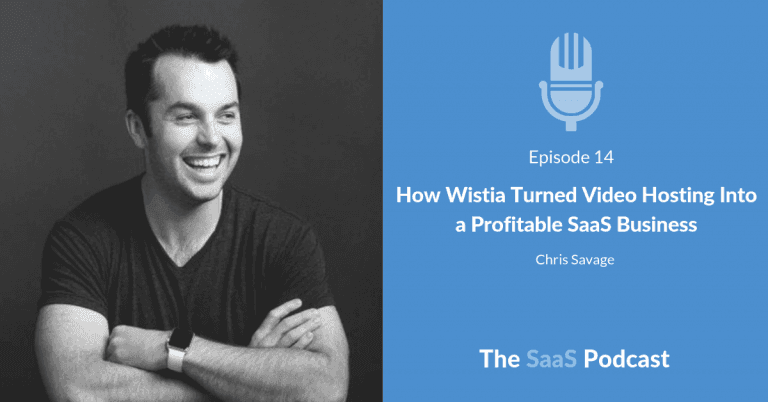
Today's interview is with Chris Savage.
Chris is the co founder and CEO of Wistia, an Internet video hosting and analytics company that enables marketers to track and analyze web video viewers.
Chris and his co founder Brendan founded Wistia in 2006, and in 2009, they were finalists in BusinessWeek's 25 Most Promising US Entrepreneurs under the age of 25.
Chris, welcome to the show.
Chris Savage (00:55.530)
Thanks for having me.
Omer (00:57.130)
So I've told our audience just a little bit about you.
Tell us in your own words a little bit more about you personally and then give us an overview of your product and business.
Chris Savage (01:05.210)
Sure.
So I grew up in Rhode island, the small state in the U.S. the Ocean State, where there's a huge amount of, I think it's, we have the most coastline relative to square footage of a state of any state, if you look at that ratio.
So that's pretty exciting.
And you know, I, it's funny, when I was young, like, I think I always dreamed of, I always dreamed of starting a business or, and actually also like driving or riding a motorcycle by the time I was 25.
And then I kind of like, when I was like, as I started to get in college and stuff, I kind of forgot that.
And then one day when I was 25, I realized, like, I started a company and I was like, that had actually been something that I had always thought about as a kid, but I never started, I never learned how to ride a motorcycle.
And Now I'm like 30 and I feel like I'm too old.
So.
And then Wistia is, yeah, Basically we're a 31 person company, profitable and growing, based in Cambridge, Massachusetts.
We just try to make it, we just try to make it easier for businesses to use video, to market themselves, to be human, to like, learn what their audiences care about and ultimately like make something that's pretty intimidating, I think, hopefully a little bit less intimidating and hopefully more useful.
Omer (02:37.290)
Now, before we dive into more details, we like to kick things off with a success quote to better understand what drives and motivates our guests.
What is one of your favorite success quotes?
Chris Savage (02:47.370)
So I'm not a huge quote guy.
There's not like one quote that pops to my mind.
I think that I, you know, when I think about what entrepreneurship is and I think about like, kind of, like, the history of.
In the history of business, like, how things worked.
Like, I think the people that I really look up to are the people who have been able to work at something really hard for a long time.
You know, I think like most great wealth, most great businesses were built over a long period of time by people who just cared really passionately about what they were doing.
And usually that means that their businesses navigated different markets and totally different products and different ways of communicating with customers.
And I like to think that if you can make the work itself interesting enough and the way that the work is done, the culture of the work, you can make it strong enough that you can get through things that you would never expect.
And I certainly feel that way because I've been doing this eight and a half years.
I thought when we started, this was gonna take eight months or a year and a half, and I thought I'd be rich.
And that's not how this works.
But it turns out that it's been so enjoyable that I think that is part of the reason why we have thrived.
Omer (04:10.380)
Awesome.
So before we talk about.
Let's get into the details, let's give our audience a little bit of a better understanding of Wistia.
So Wistia is primarily targeting businesses and marketers.
Can you talk a little bit about the top pain points that you're trying to solve for those people?
Chris Savage (04:30.380)
Yeah, I mean, I think the biggest pain point is we're just trying to make it really easy to control the experience of video on your website or not on your website and let you see how people are watching it and in a way that you can make better content.
And you can often, like, go from having a video that you don't know if it's working for your marketing to understanding exactly how it's working.
And so that comes in a bunch of different forms.
It comes from our engagement analytics show you how every viewer of your video is watching every single video you have second by second.
So what are they skipping?
What are they rewatching?
What are the trends across your audience?
So what's the stuff that your audience is, in general, always turning off when you present things in a certain way?
I think the other thing that I've learned is that to make videos successful, it has to work with the other parts of your marketing campaign.
Right.
So if you have a video and you can't control what happens at the end of it, or you can't alert people to the right information during the middle of the video, or you can't, like, Capture email addresses so that you can communicate with your audience in the future, not just about video, but about other things.
It becomes harder to make it work.
And if you could do all those things, it becomes a lot easier.
Omer (05:48.720)
Now, some people, when they look at video providers like Wistia, you know, compare that to YouTube and will say, why do I need to pay somebody for video when I can use YouTube?
I think you or pretty much already answered that question.
But can you just kind of hit it home in terms of why Wistia is different?
Chris Savage (06:10.960)
Yeah, absolutely.
I mean, the biggest difference, of course, is that YouTube makes money by putting ads on your content.
And what that means is that everything in their community, everything is set up to encourage people to spend more time watching more videos on YouTube.
They don't care if people are going to your website.
They don't care if people are joining your audience.
They don't care if you're selling more stuff.
Like, that's irrelevant, right?
But for them, they'll provide video hosting for free to anybody.
If you're willing to give up that kind of level of control, what we do is we just give you that control back.
So you own the rights to all your content.
You can change how the player works and how people are interacting with it.
You can customize it to fit your brand.
You can capture email addresses, which of course is extremely different, so that you can actually build an ongoing audience.
You can tie the analytics into all the other marketing and business activities that you're doing.
And you don't have to give up the rights to your content to do all of this.
And what I often see over and over and over is that people who are like, they'll have a simple video strategy of just getting their stuff onto YouTube and then they'll get some views.
Like, Maybe they get 5,000 views, 10,000 views on a video.
And you ask them, like, what was the benefit of that video?
Like, what did it do for you?
And usually all they can say is like, well, it had 5,000 views, so I assume it's good.
Or had 10,000 views.
I'd assume it's good.
But there's not actually any roi.
There's no return that you can bring back to your coworkers or to your boss or to your friend and say, like, this is definitely working for me versus what usually happens with us is people take video, they put it onto their site, and they get nothing but roi.
Like, they see how much traffic they're getting, and it's usually a lot more.
They are, like, getting email Addresses, they are being able to tie actions into conversions.
It's basically just like closes the loop so that you know how effective your video is being.
And then also just like different analytics that actually let you see how to make better videos.
Omer (08:12.320)
Great.
Okay, Chris, let's talk about the early days of Wistia and explore how you got started.
First of all, tell me, where did the idea for Wistia come from?
Chris Savage (08:24.710)
So it definitely didn't come from where we are today.
When we first started, we just saw a major shift happen with online video.
So it used to be the case that to get video to work on the web, you had to be technical, you had to understand how the codecs worked and what the penetration of all the different technologies was.
So how many people are using RealPlayer?
How many people can see QuickTime?
What resolution should this stuff be at?
What is the average download speeds that people have in different areas?
But what percentage of my audience is going to be English speaking?
All these different things you have to factor into just how you encoded the video to put it on your website.
Then we saw what was happening with YouTube, but it was actually happening with a lot of other companies at the same time that were all using open source tools to do the encoding from the video, from any video format to Flash to flash video.
And this is extremely important because it meant that you no longer had to be technical to make online video work.
So Brendan and I looked at each other.
We're like, there's a huge shift and it's happening right now and we need to be a part of this.
Like, we've always talked about starting a company, like this is our moment if we're going to do something.
And so we initially set out to try to help filmmakers and to build a place for filmmakers to build portfolios of their work.
And the reason was I knew a lot of filmmakers and they were all pretty unhappy with YouTube, which was the option at the time, because it wasn't high enough quality and they didn't have control over their content.
And there were ads and all this other stuff that didn't work.
And we started helping businesses about a year into the business.
And the initial use was helping businesses use video to share video privately for training and collaboration, stuff like that.
And over time it took us a while to evolve, but about four and a half years into the business was the first time that you could embed a video.
And then we added analytics and then we pushed farther down that route.
And I would say we've really been focused on marketers for the last two and a half to three years.
And doing that was a huge, huge deal for us.
Omer (10:36.440)
So for four years of Wistia's life, you couldn't embed a video?
Chris Savage (10:42.480)
Yep.
Omer (10:44.080)
And did people say anything to you about that?
Chris Savage (10:48.400)
Well, so at first, you know, people were excited and we thought we could pick this niche that no one was focused on, which was this private video sharing thing.
We're like, this is so small, no one's going to be interested in this.
Like we could own this.
And so people weren't asking for it at first, but then we got to about 30 customers and they liked the UI.
It was useful.
We'd actually built some of the analytics at this point and they're like, hey, you know, it'd be really cool to have these analytics on videos on our website.
And we're like, no, if you want to do that, you should go use YouTube or you should go use Vimeo.
Those things can let you embed video.
We're not trying to help you embed video.
And they're like, nah, like there's something about the control from you guys.
We just want to do it with you.
Like we picked a video platform, we want to use you.
We're like, well, why don't we give you like handmade embed codes?
So we did that for like three months or something.
So if someone emailed them to support and wanted to embed a video, we would make an embed code for them.
And then we realized that that was probably the future of the business and kind of like launched a new version of Wistia that included that.
And it actually was also the first time that you could actually just do a trial and sign up for the product.
Previous to that you had to call us or we would like fact something back and forth to have you sign your agreement.
And it's pretty, pretty game changing it turns out for us.
Omer (12:16.660)
So when you started the business, did you bootstrap it or did you go out and look for investors?
How did things get started for you guys?
Chris Savage (12:26.300)
So when we started, I was 22, my co founder Brennan was 23, and we basically we bootstrapped by living extremely cheaply.
So I and my girlfriend and I moved into the same house that Brennan was living in and also another seven people were living in.
We lived in this 10 person house and so our rent was just so cheap that it meant that like the meager savings we had was going to let us survive for a little while.
And we just did that for about a year and we're running out of money and that we got our first customer, I think, like almost a year to the day, or like a year and two months, or maybe first customer was probably a year to the day after we started.
And then we survived about another.
Almost another year off of, like, still meager savings, but, like, starting to get customers to cover some of our basic costs.
And we raised an angel round.
Two years in the business, so we're about rather profitable.
We raised an angel round.
Omer (13:34.880)
What did you do to acquire your first few customers?
Chris Savage (13:39.600)
So the first customers were.
One of them was a friend who saw what we were doing as we were kind of the portfolio site thing was not really working.
But we'd started to make a way for filmmakers to privately share video.
And the idea was that we thought that video that people were.
That was unfinished, like it was in the editing process.
It would be helpful for people to share it in the web, but, like, do it behind closed doors.
And I dealt with that problem myself because I had a background in film.
So we started building that.
And then our friend worked at a company, and he was like, hey, we need to privately share video.
We never use a filmmaking thing to do it, but we need something like this.
You should come in and talk to us.
And so we talked to them.
They were interested, and we made up a price.
And they said that if the product did what it said it would do, they would pay us a monthly fee.
And we're like, okay, that sounds pretty good.
And so we kind of got those guys.
And then we had something more concrete to bring to people.
So we said, oh, we have a paying customer.
Let's find other people who might privately need to share video or need to privately share video.
And we went to filmmaking companies and big training organizations, and it helped us focus in.
It still took us a long time to get our second customer and a long time to get our third customer.
But that was measured in months, not years, at that point.
Omer (15:08.190)
So at that point, you couldn't just go to wistia.com and sign up to become a customer.
Or you could, but.
But you guys were still going out there.
You were hustling, right?
You were going out.
Chris Savage (15:20.990)
We had no website.
I mean, it was whistle.com just said hello on it.
Yeah, no, we.
You could not go to.
It took years before you go to Wisconsin sign up.
It took years.
Like, it took years before you could pay with a credit card.
Took like four and a half years.
Omer (15:39.520)
So that.
That is such an important lesson, I think, where so many of us get hung up about having a great website and making sure that, you know, it can do 100 things before we feel like we're even ready to go and start that business.
But you guys didn't need any of that.
Chris Savage (15:58.800)
You know, it's funny is that we tried that with the portfolio site and we kept trying to make it the most advanced portfolio site you've ever seen.
And we came up with a business model for it before it had any users, which was a job board.
So we built that.
We felt like we should have everything ready to go.
We just kept building, building, building, building, building, but never launching anything.
And then when we finally launched something, we built so much it was hard to get feedback.
And we just had kind of gone this bizarre direction.
And so when we got going with Wistia was like, you know, maybe we should try to do the minimal amount first and we should try to like solve processes manually before we automate them.
So if we have enough people who say that they want to try Wistia, then we can add a trial button.
But until then we're going to have a phone number.
Omer (16:50.770)
Can you.
Was there a point that you can recall in those early days when you just wanted to give up and go and do something else?
Chris Savage (16:58.760)
I, I never wanted to give up.
But I do remember a time when Brennan and I had a serious conversation about whether or not, like, I should get a job at Starbucks so that we should both get jobs at Starbucks.
So we get health insurance and you only need to work like 20 hours a week and we're working like 90 hours a week.
So it wouldn't be that hard to work 70 and then have a job at Starbucks.
I remember that.
But we both were.
So I don't know.
That's one of the things that it's probably like, we're lucky that we were able to make it work because if we had not been able to make it work, we'd probably be like ruining our lives still trying, like alone in a room in the 10 person house.
Both of us are just probably too driven to our own fault.
And fortunately some of this shit worked like five years in.
Omer (17:57.760)
But you know, most people wouldn't go a whole year without any customers, right?
I mean, most people would give up well before then.
So what kept you guys going?
Chris Savage (18:15.280)
You know, it's funny you say that because, like, well, I'm going to.
What kept us going was it was fun, like, even though we were failing, like, it was fun.
Like, I think, I think how the work, how you do the work, like, really matters.
And while we were struggling, like, it was exciting to try to solve these problems and addicting, because even though we weren't getting revenue, we were at least, like, talking to people and starting to learn stuff, like, faster than, like, I've ever learned anything before.
And it's funny now.
I mean, like, when I look at where we are and I look at where we want to go, I, like, I'm really excited and proud of where we are.
And I also think, like, we're kind of just getting started.
You know, there's so, so, so far for us to go.
And I could look at that and be like, that's really depressing.
Or I could look at that and say, like, this is an incredible opportunity.
And that's why I think it really, at least for me, it just really matters how the work is done.
Because if I can be inspired by the work, if the work can be creative and interesting, and if we can delight customers and delight each other on the team and be willing to fail, basically just build an organization that learns really fast, then NISSL will be able to do it.
It'll stay interesting, and we can build something big.
And I think that that's the crazy part about it is, like, once we started to realize we could help businesses, like, a year in, and that video was, like, an entire medium that is barely used that everybody is, like, afraid of, but, you know, its peers are, like, text and audio.
It's like, wait a second.
There's, like, not that much video stuff at all.
Like, there's, like, very few video companies.
Well, maybe what if we built one of the important ones?
That'd be kind of crazy.
And, like, since that kind of revelation a year in, like, I feel like we've just been steadfast on the same path.
Omer (20:24.940)
So it took you a year to get your first customer, and then after that, you know, slowly you started acquiring more and more customers.
At what point did you feel like you had a business with some potential there?
Chris Savage (20:42.070)
The.
I always thought we had potential, but I was afraid because I didn't want to let our customers down.
I didn't want them to.
I felt like we were being used for this very real reason, and if we went out of business, like, that would really suck.
And I felt like the first time that was truly amazing was after we had launched a version of Wista, where you can embed videos.
We had the embedded analytics.
You could sign up for a free trial yourself, and you could buy with a credit card.
I will never forget the first time someone bought with a Credit card we never talked to.
Because that's the other thing.
Of course, before that, we had to talk to every customer.
And it was actually.
It was like one of those scenarios, like, woke up in the morning and there was a customer.
And I was like, wow, if we can get people using this and signing up and, like, paying to use it while we're sleeping, then I think we.
We have a shot at something, like, big.
And I think once that.
Once that happened, I was like, I think there's real.
I think there's real potential here.
Um, yeah, so.
Omer (22:04.480)
So did you stop going out and.
And trying to
Chris Savage (22:10.440)
sell people?
Omer (22:11.800)
To sell people?
Yeah.
Chris Savage (22:14.120)
No, but I mean, it's.
It was an evolution, right?
Like, we were still trying to do that.
And then at some point, you know, here's the funny thing about sales.
Like, I was having trouble cold calling people because, well, I was cold calling them, but I was having trouble selling them.
And the main objection was that people told us, like, in the early days, like, this sounds like a great idea, but we don't have any video, and I don't know when we're ever gonna have video.
Like, okay, we need better leads is what I kept thinking.
Like, we need better leads.
We need people who need video.
And so we started doing, like, some AdWords and some display advertising and, like, some very small stuff.
We started our first marketing, really.
And I was like, all right, we need to have marketing to have sales.
And so we started doing that, and it started to work.
Like, the first month we ever spent money on ads, we spent $40 on AdWords.
And one of the leads we generated was Cirque du Soleil.
And they signed up.
Yeah, they signed up as a customer for $500 a month.
And it was, like, kind of mind blowing that that happened.
And then pretty quickly, I started to think myself.
Like, I could spin my wheels, like, trying to sell people, or I could put all of my effort into marketing and just make it really easy to buy.
And so that's what we did.
And actually we still do.
We have no sales team today.
It's all marketing that's really easy to buy.
Omer (23:45.820)
So other than AdWords, what other marketing strategies were you using and which ones were working for you?
Chris Savage (23:55.690)
So the early days, I would say most of our advertising was really unsophisticated and just really, like, shotgun style, like you spray and pray.
But it worked, kind of.
And I think it worked because we just were getting our name out there slightly more than we were before, and that the feedback that we got from the People who were finding us was, like, really different.
So before that, we had an interaction with everybody and they would overlook or wouldn't tell us that things were confusing.
And then suddenly when we started doing advertising, people were like, this is confusing.
I don't get it.
And there was nothing that was like, I would look back on and say, like, oh, everyone should do this today.
Because I think, like, I think the landscape of what's possible with marketing has changed dramatically, except for the fact that just getting more awareness means you get more feedback faster, which is a good thing.
Now, the vast majority of our marketing is content marketing, which has taken a while to build up, but has been extremely successful for us.
Omer (25:08.770)
Yeah, I mean, I just love the content that you guys create.
It's.
Yeah, I mean, it's.
It's educational, it's.
It's entertaining.
And I can imagine, you know, you could.
I'm sure you're getting people who probably don't even know about, you know, the services that you offer, but know about the great content that you have, right?
Chris Savage (25:33.570)
I mean, yeah, absolutely.
Omer (25:37.180)
One of my favorite videos that I can remember that you guys put together was on how to use the iPhone to create, you know, high quality video in terms of, you know, if you get the.
If you use a tripod and you get the sound right and the lighting, you can actually create really cool videos with this little iPhone.
And, you know, it was that kind of content that just really.
I just love.
It's really awesome.
Chris Savage (26:00.940)
Yeah, so.
Omer (26:02.710)
So, you know when you say you're starting to grow the company now, often with growth come growing pains.
Tell me about one big challenge that you face as the business started to grow, either on the business or on the product side.
Chris Savage (26:21.030)
Oh, which one should I pick?
I think one of the big challenges was around structure.
So when we were first starting out, like, we had titles, but they really didn't mean anything.
Everyone was just, like, doing stuff and you just work your ass off.
Right.
And I started to believe, especially as we started to focus on culture, that, like, one of our cultural values was that we were flat.
And so when I was hiring people, I would try to convince them to join us and say, look, Wistia is really flat.
Like, you're gonna be in charge of your own domain.
It's gonna be amazing.
Like, this is how we do things.
It's like, different than how other people do things.
Like, all this stuff.
And then I started to realize that, like, flatness had some serious problems, which were that, like, people didn't.
One person could not mentor like, everybody.
And like, people need mentorship to grow, and we need everybody to grow for the company to grow without having any structure.
It actually centralized power to me and Brendan because people didn't want to do big things without talking to us, because even though we said there was no structure, there was structure.
It just wasn't explicitly defined.
And just that we needed to divide up the ownership more because today I have less data than I ever did on, like, the details of certain parts of the business.
And that makes sense, actually, that, like, when you grow, you're gonna have to distribute ownership and distribute data.
But we weren't doing that.
So we.
I started to realize this is a problem.
And we started to.
We kind of broke into teams, and we broke into functional teams, and we had people leading those teams.
And that was definitely, like, hard thing to do because no one knew if it was going to work.
And I certainly didn't know.
But it turns out that it did work.
And one of the ways that it worked so simply that I was just that by creating teams and giving ownership to these different people, suddenly everyone in the company had more ownership.
And I didn't realize that there was two ways to look at structure.
One way is that you should use structure to centralize power, like with the CEO.
And that's what I thought structure was about.
And then I started to realize that actually you can also use structure to decentralize power and to give ownership and power to the right people by putting them into a position where everybody knows what they do.
And that, at least for us, like, that's a much more healthy way for us to go.
And so, yeah, I mean, it was extremely hard to go through that process.
But coming out of the other side, I've just.
It's made me value why, you know, structure is such an important thing for communication and mentorship and guidance and making sure that people don't fall through the cracks and ultimately helping people to be more successful.
Omer (29:33.490)
And so were you and Brendan kind of jointly running the company?
And at what point point did you take on the CEO role?
Chris Savage (29:42.930)
So we made the decision when we raised money that I would be the CEO and he would be the cto.
And we brought on two more guys, one who was the VP of engineering, and other guy was the VP of sales.
So, yes, I realized super, super heavy here on the titles, because I.
That's what we thought we were supposed to do.
But, you know, and I was not in the products.
I was, like, involved in product, but I was certainly not building it.
Brendan was certainly Building the product.
And we divided ownership, like, oh, I was gonna take on marketing and sales and kind of, like managing that other stuff.
But it definitely.
Yeah, I think it's just as we've grown, like, there's more trust that you have for everybody about, like, what they're good at and what job they should be doing.
And we'll have conversations to make sure that we're prioritizing who's doing what properly.
But I don't know, it just kind of evolved over time.
Omer (30:46.790)
Okay, great.
So we started this conversation by going back to where the idea for Wistia came from.
And then we've taken this journey together on how you turn that idea into a successful product.
So let's talk about the business today.
Now, as I understand you don't disclose numbers on your revenue or number of users and so on, but what can you tell me to give our audience a better idea of the scale of your business?
Chris Savage (31:18.010)
I can tell you that every day across our platform, there's about 10 years of video viewing that happens.
How's that?
Omer (31:32.850)
10 years of video viewing every day?
Chris Savage (31:35.650)
Yeah,
Omer (31:38.610)
I'll have to do the math there and figure that out.
Chris Savage (31:41.090)
Yeah, it's.
I mean, that's why you have numbers like that, right?
Because it sounds like.
What does it really mean?
I mean, I can tell you that there's, at this point, there's over 100,000 companies using us.
Omer (31:59.160)
Let's talk a little bit about how you're generating revenue.
Tell me a little bit about the business model.
Chris Savage (32:06.600)
It's pretty simple.
You can use Wisting for free with up to, like, 10 gigs of storage of videos.
Or you can pay.
You get unlimited storage, and then you pay more for More features.
So $25 a month gets you all the, like, fundamental stuff.
It gets you, like, advanced analytics, so you can see engagement.
It gets you more control over the player.
And $100 a month gets you some team features.
And then the price can go up if you have, like, a really huge audience.
But otherwise, like, most people are going to be at 25 bucks a month or 100.
Omer (32:50.230)
So looking at the business today, what is one of the things that you're most excited about?
Chris Savage (33:01.830)
I would say that, like, I am really excited about the fact that we have a team that is very strong that, like, I'm inspired to work with every day.
And we have a lot of customers that seem to be pretty happy.
But when you look around, most of the websites I come to are not using Wistia yet, and that's a big opportunity.
The way that we have really gotten to where we are is through content marketing and through word of mouth around the product, which is really exciting to me because I think the more that we make the product better and the more that we can just, like, help our audience do more with video.
Whether it's through content about how to shoot a video with your iPhone, or scripting, or putting on conferences, which we put on our first conference in May, that stuff all adds up.
And it's kind of fun because it feels like we're in this great.
We have a lot of opportunity, we're in this great spot, and the way that we take advantage of it is like we just are basically completely aligned with our customers.
Omer (34:12.720)
All right, Chris, it's now time for our lightning round.
I'm going to ask you a series of questions, and I'd like you to answer them as quickly as you can.
Are you ready?
Chris Savage (34:20.400)
Yep.
Omer (34:21.680)
What's the best piece of business advice that you ever received?
Chris Savage (34:25.600)
Figure out how to lead by being yourself.
Omer (34:30.080)
What book would you recommend to our audience and why?
Chris Savage (34:34.400)
I recommend Masters of Doom.
And Masters of Doom is a story about the founders of the game, like ID Software, who created Doom and Quake.
And I think it's a phenomenal.
It's a phenomenal book to read because it shows you the power of what can happen when a small number of people are working together well on the right things, how far they can go.
And also.
So it gives you something to shoot for, I think, in terms of how you can work with others, and also talks about, like, what some of the downsides are as you can, as you become more successful.
Omer (35:16.930)
I haven't had that recommendation before.
I'm going to check that one out.
What's one attribute or characteristic in your mind of a successful entrepreneur being really good at learning?
What's your favorite personal productivity tool or habit?
Chris Savage (35:33.520)
I have a lot of those.
Honestly, for me, it's probably working out.
I did not always work out.
Started working out in the morning, and I find that it is a time to clear my head and reflect, and it forces me to not be in front of a computer, and it forces me to do something where I have to slowly improve at it over time, which is basically how you get yourself out of any jam.
And it's kind of like a good thing to realize that that's a skill to be learned, because most of things in life are skills to be learned.
You just don't know it.
Omer (36:12.100)
If you sold Wistia today and you had to start over tomorrow, what type of business.
Would you go and build?
Chris Savage (36:18.660)
I would try to build a business that from the beginning has a plan about the space that we want to prove in the world.
I think that it can be hard to start at that high of a level, and I feel very fortunate we found something like that.
That's extremely motivating.
And I feel like it's easy to fail if you don't have a big goal and a big mission that you can believe in.
Omer (36:44.910)
What's an interesting or fun fact about you that most people don't know?
Chris Savage (36:50.910)
I really love rock climbing and try to do that a couple times a week at least.
And I love the challenge of it and love that it's like a physical and mental puzzle.
Omer (37:04.110)
You've probably answered the last question as well, but I'm not going to let you get off that easily.
What is one of your most important passions outside of your work?
Chris Savage (37:13.230)
I don't know.
I have a lot.
My most important passion outside of work.
Okay.
Said rock climbing.
Not gonna do that one.
I don't know.
I think that probably for me, I would say work and life really bleed together and I spend.
I'm like good friends.
A lot of people at Wistia, My wife will attest to the fact that I don't stop talking about Wistia.
I don't stop talking about other startups.
I don't stop talking about anything that leads to progress.
Like, I think I'm addicted to.
I'm addicted to improving things.
And I would say my outside passions change depending on the season and whatever is the thing that I think needs the most improvement at that particular time.
So, yeah, I don't.
There's.
I love watching movies.
I don't know.
Omer (38:13.780)
So you've talked about having fun at work a few times during this conversation.
And certainly as an outsider, looking at what you guys seem to be doing and the kind of content you're creating, it does seem like you still are having a lot of fun over there.
So, Chris, I want to thank you for joining me today and talking about Wistia.
I really appreciate you sharing your experiences and insights with our audience, and thank you for letting us get to know you a little better personally as well.
If folks want to find out more about Wistia or they want to get in touch with you, what's the best way for them to do that?
Chris Savage (38:49.250)
You can find out more About Wistia@wistia.com you can find out.
You can talk with me on Twitter Savage, or if there's something in particular that requires more than 140 characters.
You can definitely feel free to email me.
I'm ChrisWistia.com I get a lot of email these days, so probably I cannot guarantee a fast response, but I will do my best.
Omer (39:17.500)
Awesome.
Thanks again Chris.
And I wish you continued success with Wistia.
Chris Savage (39:21.900)
Thanks Omer.
Really appreciate it.
And yeah, you have a great, great day and weekend.
Omer (39:28.060)
Thank you.
You too.
Cheers.