Omer (00:11.840)
Welcome to another episode of the SaaS Podcast.
I'm your host Omer Khan and this is the show where I interview proven founders and industry experts who share their stories, strategies and insights to help you build, launch and grow your SaaS business.
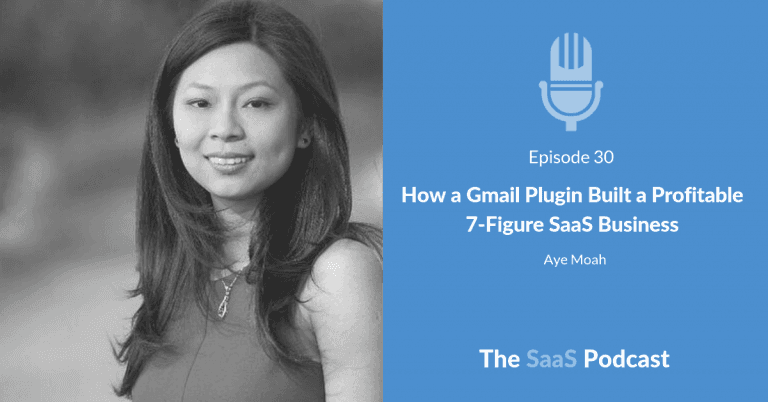
Today's interview is with A. Mo A or Mo, as she prefers to be called, is the co founder and chief of product at Baidin, the maker of productivity tools such as Boomerang for Gmail, a plugin which lets you schedule emails to send later, get email reminders, and track the emails that you send.
Baidin was founded in January 2010 and to date has raised just under $400,000 in funding.
In this interview we talk about how the team at Baydin, which is still just seven people, built the first version of their product in a couple of months and how they've grown that into a profitable multiple seven figures a year business.
It's a great interview and there are some important lessons here on how to take a pain that you're experiencing yourself, build a minimum viable product and get that to market quickly to figure out if anybody else cares about that problem and more importantly, is willing to pay for it.
So with that, let's bring on Mo Mo, welcome to the show.
Aye Moah (01:28.130)
Hi Omar, how are you doing?
Omer (01:29.650)
Great.
Now, before we talk about Beidin and Boomerang, tell our audience just a little bit about yourself.
Aye Moah (01:37.330)
My background?
I grew up in Burma and then I came to the United States for college.
Then I studied computer science at mit, went to different software companies, going from really big companies and they kept going to smaller and smaller companies until I ended up starting my own.
Omer (01:58.650)
Before we dive into more details, we like to kick things off with a success quote to better understand what drives and motivates our guests.
What is one of your favorite quotes?
Aye Moah (02:09.930)
My favorite quote is from Nick Savin, the University of Alabama football coach.
And the quote is focus on the process and what you can control, not the results.
And I believe that's really useful for entrepreneurs.
When you're working on your company, you just need to keep focusing on what you do, what you do best, and what you need to do to be successful every single day.
Rather than being distracted by what's going on with your competitors or what external factors that you don't control.
Omer (02:43.590)
Yeah, I love that.
Now let's start by by giving our listeners a better understanding of Boomerang.
I gave the audience a quick overview, but tell me a little bit more about who your target customers are and what are the main pain points that you're trying to solve.
For them.
Aye Moah (03:06.460)
We don't have a very vertically targeted customer, so we have built a very horizontal product that helps everybody who is busy and everybody who needs to stay on top of their inboxes and make sure they always follow up on important emails.
So the main pain point is people forgetting to follow up.
So you send an email and you hope to get a response and you don't hear back for seven days or two weeks.
You need to be following up.
And people are using all kinds of makeshift tools to solve the problem by putting things down on a piece of paper, marking it on calendar, putting it in a folder, but then forgetting to actually go back and check it.
So we make it so easy for you to make sure that you don't ever forget to follow up on something that's important.
The second pain point is basically making email less synchronous and you can write the email and don't have to get up and remember to send it at 7am Exactly.
Or people are using it to solve a bunch of timing issues.
Right.
So we know that emails that are sent between 7am to 10am has a much higher chance of being open and read than if you send it at 4 to 7pm so that's basically increase your chance of getting your communication notice.
And then there's other teams that are using for across the globe time zone issues.
So you're working with a team in China and you want to make sure your conversations or your information is at the top of their mind.
You try to send it while they're at the office.
Omer (04:56.960)
So where did the idea for Boomerang come from?
Aye Moah (05:01.680)
Mostly from our own personal pain points.
So our CEO Alex Moore, was working at an electrical engineering company, adi, and he was starting to manage projects and he was realizing that there are too many balls in the air.
And if he doesn't have a system that work consistently for him to keep track, things kind of slipped through the cracks.
I was having the same type of issue with, you know, where I was working and starting to understand, hey, sometimes as the, as the project owner or project manager, you have to be the one keep following up with everybody.
And there isn't an easy way to do that that integrates very well with our own email workflow.
So the main advantage of Boomerang is that we wanted to build something that basically doesn't change how you already work, but enhances it to make sure you are not forgetting.
Omer (06:02.250)
Okay, so you know, both you and Alex probably along with, you know, millions of other people who feel the frustration of trying to you know, manage all these, you know, juggling all these balls.
Had this idea that there was an opportunity to create some software.
So what, what happened next?
Did you, did you know Alex at the time?
How did you guys meet?
Aye Moah (06:28.310)
We known each other for a while.
We are also, we were dating at the time.
Now we are married.
He started just prototyping and I was helping out nights and weekends so I still have my full time job.
And he started already working on the plugins and I was helping him design and getting stuff.
And then the main thing was I guess when we launch it we also have Mike, our third co founder.
And then what we did was we just needed to get it out there because we didn't know at the time.
You might be able to guess there are other people who have the same problems but until you put it out on the market there is no proof.
So we decided that we're just going to launch it.
So we went into private beta to try to get our friends and family to start using it and we were starting to get really good feedback that hey, I really need this in my life.
So we actually just contacted a few journalists.
The first one that we contacted was Zenix Web.
They just wrote about Rapportive a few months ago and Rapportive was at the time super hot.
And everybody's like oh my God.
So I just contacted Z on Twitter and said hey, we have a new code Gmail extension that you might want to look at.
And they wrote about it and basically that's how we understood the product Market fit is like just this one short article on the Naics Web just exploded everywhere.
Got on technique at the time Digg was kind of a big deal.
So it went to the front page of Digg.
Then that got picked up by more targeted places like Lifehacker where they have a lot of productivity enthusiasts.
So that's basically it.
We just prototype, put it out on the web, started telling our friends and then realized there might be a market and just hope that we are right.
Omer (08:40.330)
Were you still in private beta when you started getting this media coverage?
Aye Moah (08:46.330)
Yes, we were still doing private beta with the beta code that, that you need a code to get in.
And when we first put it up we didn't think it would have been such big of a deal.
So we didn't actually make a very robust system of invite code and people were hacking around it and starting to host the Chrome extension files on their own servers and stuff.
So we kind of have to scramble around and figure out a more robust system because we didn't know how what our servers can handle at the time.
So we're like, we got to try to a little bit control how many.
We didn't want to just put it out there, have the server crash and have everybody schedule messages disappear
Omer (09:35.680)
at the time.
If I saw the media coverage about Boomerang and I'd click through a link to get to your website, I wouldn't have been able to get access to it.
Would I have been able to sign up to get onto a waiting list or a notification list?
Aye Moah (09:52.060)
Yes.
So we usually when we approach the places like life hacker say hey, give us the beta code.
So usually the article comes with the code itself and we try to get some of the code pre filled into the box if you're coming from the article.
But yeah, if you don't have a code, the beta code or if we're out of the beta code you can put your email address into.
So it was so sketchy.
Right.
We our webpage literally has a Google Docs form embedded.
So if you want to get on the waiting list, you just type into that Google Doc form and it goes into our spreadsheet.
That's how we handle the beta users waiting list management.
Omer (10:39.660)
So you guys weren't expecting much traffic, right?
Aye Moah (10:42.860)
We weren't ready, we weren't sure.
We just wanted to know if there are enough some people out there who want to use it.
Then we were going to iterate and make the product better.
But it's lucky that there are a lot more people.
But at the same time we were very scrappy and just wanted to see if there is a product market fit at all before we invest so much more into building a perfect website and building the perfect beta code management system.
Omer (11:11.640)
How long did it take you guys to build the first version of that product in the.
In the private beta?
Aye Moah (11:18.920)
The first version?
Probably about two.
Two months maybe?
Yeah, about two months.
Because we started early, we started in June and then in August we put it out into the beta program.
Omer (11:32.920)
So and how many people did you have roughly using the product in the beta?
Aye Moah (11:41.130)
I think we have the first 30 days.
We probably got like 70,000 downloads, maybe a little bit more.
So that's.
Omer (11:51.370)
This was in the private beta?
Aye Moah (11:53.290)
Yeah.
Omer (11:54.970)
Wow.
So how did you.
I thought it was just friends and family.
How did you suddenly get that kind of.
Aye Moah (12:00.500)
Well, the private smi.
You can't use it unless you have a code.
The original part with the friends and family, we might have maybe 50 to 100 people.
Omer (12:09.780)
Okay.
And the 70,000 that was after the media coverage hit yes.
Got it.
Okay.
All right.
So you sort of tested the market and not only did people kind of line up to.
To get access to this product, they're also trying to hack it and, you know, trying all kinds of workarounds.
So, you know, you guys obviously feeling a lot better at that point about, you know, the, the product market fit.
Aye Moah (12:43.630)
Right?
Omer (12:44.110)
What did you do next?
Aye Moah (12:46.270)
What do we do next?
We raise money.
We try to raise our seat round and then got our seed funding.
Then we started to figure out and there were a lot of holes in the product itself because we just, you know, built it in two, two and a half months.
And like the first few weeks, like, we found out that, hey there, we.
You need a way to cancel the messages you already scheduled, which wasn't part of our original prototype.
And we're like, oh, right, that we need to build.
So we just build really fast from all the requests that we are getting from the customers.
We had this very passionate early adopters that are telling us we need this.
I can't use this for the cost of this, or I'm using this, but I'm stuck with this.
So all this kind of customer requests that are just pouring in and we just have to prioritize and focus and build really fast to get to a state where it's like, hey, this is actually really a minimum viable product.
Omer (13:47.820)
Were you charging for the product at that point?
Aye Moah (13:50.540)
No, but so we always maintain that we were free while we are in bader.
So when we first pitched, the journalists would ask, why are you going to charge?
How much is it?
And we kept saying, it's free while we are in bader.
But we never said it's just a free product.
And then the customers themselves, the users themselves started telling me that, hey, I want to donate money to you.
You are creating so much value for me.
Give me a button, a PayPal button to donate money to you guys.
And we try to say, I don't want to use the word donate because that signals a bunch of developers just doing it for fun and hobby.
And we wanted to build a business.
So we came up with this term voluntary subscription, and, and just put a box with whatever they want to pay.
So we didn't restrict what they can pay.
And what we said is, if you pay whatever you want, we'll give you one year of free voluntary subscription to Boomerang.
And people started paying us.
And that was really interesting because we started seeing people paying in the multiples of 12.
So we started understanding like they are Thinking in terms of a monthly fee, and, you know, people were paying $36, $48, $60.
So after, like leaving the box for whatever they want, we actually make it okay.
You can pay in these five layers to find the maximum price that people are willing to pay.
And that was a really good move because we found the upper boundary of, you know, how to price our product.
And also it validates.
People are willing to pay because they are getting enough value out of it.
But the main challenge with the pricing was we are a horizontal product, so the value that people get out varies widely.
There are people who told us and still telling us that we are under charging for our product because they are using it for sales or customer development and business development purposes.
So for them, we are saving thousands of dollars every month.
But then there are people who are using it for their personal email or students and teachers, and they are like, your product is too exp.
I can afford it.
So we have to strike the right balance.
And I think we finally have.
Omer (16:13.940)
Okay, so the voluntary subscription is a really interesting idea.
And I've seen some.
Some other types of businesses try that.
Do you.
Do you remember roughly how many people, the percentage of your users who actually started paying you?
Aye Moah (16:33.880)
I don't remember.
I mean, it's at least three or four years ago.
I don't have that figure.
Sorry.
Enough for us to think that, hey, we need to really start charging for it.
Omer (16:49.400)
Okay.
And then how long did you continue to run with this voluntary subscription?
And at what point did you switch to a more sort of structured pricing model?
Aye Moah (17:01.470)
It took us about, so the first, like four to six months after the launch.
We were just focusing on the product and building more things and fixing anything that's not working quite right and adding the things that people desperately need.
After that.
I think we started maybe working on building in the subscription and like the infrastructure for the payment around April of the next year.
So from August, it's about six months.
And then we launch in July with the payment plan and telling our user that, hey, we're going from completely free with voluntary subscription to freemium.
Omer (17:47.820)
Okay, so looking back at those early days, what do you think was one of the biggest mistakes that you guys made?
Aye Moah (17:59.550)
Early, early days?
I'm not sure.
Omer (18:04.430)
I mean, it sounds like it went very well, right?
Aye Moah (18:06.670)
Yes.
I think what we could have done, maybe.
I don't know, that's like, you know, different school of thought.
People who wait until they have the perfect product and launch with the tada, or people like us who just, you know, get it out there just to see if it's even worth pursuing or if it's worth, you know, committing.
And so it's different.
You know, we came up, we come up with crappy website and very minimum product and then just iterate after that.
So we like that approach because it's just we are hackers and that's what we do.
But I don't know if that's the right approach for everybody.
Like it depends on what type of product you have and what type of market you have.
And also at the time we were the first Gmail plugin to do that.
Many advanced features.
So the market is just completely wide open and they just have no other alternative.
So everybody's just breaking it down.
So if you're launching a new Gmail plugin today, you probably can't go with we have two buttons in Gmail.
Omer (19:18.350)
I don't understand.
Tell me why, why, why this is different.
Aye Moah (19:22.620)
So now that we have started, you know, since we've started, there are a lot more competitors out there that are still trying to work on the same problem or just some, you know, straight up clone what we're doing.
So if you're starting something now, it would have to be a lot more big.
Omer (19:41.820)
Oh, I see.
Aye Moah (19:42.780)
Yeah, yeah, got it just very early in the, in the market.
Omer (19:49.100)
Okay, so you've got, you moved to a structured pricing plan.
Let's talk a little bit about what you did to acquire more customers.
Did you have to go out and start doing any kind of marketing?
Where were your users coming from or your customers?
Aye Moah (20:11.580)
Early on we have very strong organic growth because, you know, as I said, because of the big gap in the market and people were, our users were really getting addicted to the products so they were using it every day and they are just really strong advocates.
So we were getting a lot of organic traffic, but we started thinking about how do we make sure we have sustainable traffic that we can get.
And the main challenge is we didn't have much funding.
We raised 400k.
Right.
So we had to be creative and find ways to market our product and grow the user base without spending a ton of money or without spending at the beginning any money at all.
So what we did was we built a lot of the viral loops into the product.
So depending on the feature that you are using, we would prompt you to share what you just did or whatever delight you're having at the moment with the product, with your social network.
And that works really well because we are trying to get people at like a time where they're particularly pleased with the product and that got us pretty good growth from just, you know, sustainable, viral.
And it's slow growing but it keeps going without much effort after the initial building it into the product.
And then we also started doing a lot of SEO related things, mainly because that's free and that's what we can do.
So we started understanding what are people looking for and what are the things that people are searching in Google to find the product and that fits their needs.
Omer (22:02.310)
Did you try testing other kind of strategies like doing more PR or media outreach or Google Adwords or were you just driven by.
Our marketing efforts are going to be driven by whatever we don't have to spend much money on.
Aye Moah (22:22.050)
It was mostly whatever we don't have to spend much money on because we were gunning for profitability and we wanted to be profitable and we wanted to be independent.
So that's why we focus on anything that doesn't cost us money and things that we can build in.
There were some.
After we got to profitability, we have started looking into some pay marketing channels.
But at the time we were mainly driven by how do we reduce costs but still get new users.
The thing about press and media outreach, we were lucky that we have a lot of users.
So we got a New York Times article because our customers were the one commenting on.
The author was asking a question about I want to do this, how do I do this?
And his readers wrote a comment and they are Boomerang users.
And he wrote about it before we even woke up because we were in the west coast and he's in the east Coast.
And we woke up and we were like, we have a New York Times article.
Oh, that's great.
How did that happen?
And we found out it was just our customers telling the journalists.
Omer (23:41.710)
Nice, very nice.
Okay, so this, you know, you'd been, up until now you'd been focusing on this Gmail plugin to help people with their email productivity.
But now you also have a boomerang for Outlook.
You have a boomerang calendar.
Why did you.
You've already got a very horizontal product and a diverse set of users to deal with.
Why did you decide to create additional products instead of just focusing on the one?
Aye Moah (24:20.950)
I think it's mainly because our CEO is very crazy.
He's trying to, you know, like he's trying to obsessed with email and productivity and we're seeing different needs for all these products and they're serving, you know, they're solving different problems and nobody's solving them.
So our company as A whole.
We love solving productivity problems that people have that only we can solve.
Right.
In a way.
So we started building Bloomerang Calendar because we were having scheduling issues ourselves as startup founders trying to raise money or trying to get customers or trying to get business development relationships.
And we realized none of the Calendar solutions out there quite solve the pain that we have.
And we realized they are a little bit of a different set of user base than Boomerang for Gmail.
So we didn't want to muddle the product and combine everything and add features that are not relevant to each other in one big product.
Omer (25:36.250)
Okay, so Boomerang Calendar kind of makes sense because that's sort of an extension for a Gmail user who may want some additional productivity with their Google Calendar and scheduling schedule.
But why Outlook?
I mean, that's a completely different beast.
Doesn't that create more headaches for you guys in terms of a separate code base?
Aye Moah (26:01.300)
Boomer for Outlook comes before Boomerang for Gmail.
So when Alex was prototyping, he started out on Outlook and because we thought it will be the business users that need the most.
Right.
And started the Outlook plugin and tried to see if people will install and write about it and things like that.
What we found was the ollie adopters are not on Outlook.
So that's why we move on to Gene.
Omer (26:31.039)
Okay, so you're doing sort of pretty tactical marketing.
You've got some viral loops built into your product, you're focusing on your SEO.
What did that do?
What kind of traction did you get with attracting customers?
Tell me about one thing that worked well and one thing that didn't work well.
Aye Moah (26:59.380)
I think one thing that worked well, I would say, is really understanding how your users are using the product and knowing what moments are the ones where you are going to ask them to promote for you.
That works really well.
Our paywall is another thing that we did really well.
Instead of a typical freemium product that stops you after you use up your free limits or free messages, we actually build a pretty porous paywall that keeps letting you go a little bit more.
But along the way, during the payroll process, we are asking you to refer Boomerang to your user, your friends and family, or tweet about it.
Like there are different ways for you to keep using the product for free.
If you keep promoting for us, then eventually you do have to pay.
And we have a final paywall screen that has a limerick that tells you that, hey, we are sorry, this is your last message.
So I think that worked really well.
Just Having a personality and having a unique way of asking people to pay.
The one thing that didn't work very well, I think, is our referral program that we built in where if you refer somebody to Boomerang and they signed up for it, you get one month free and they get one month free.
But we also wanted it to be kind of instant gratification.
So we built in this layer of gambling into it.
If you refer somebody to Boomerang and they start.
They installed it, you both get a spin at our referral wheel prices.
So that was.
So you both get a spin and you spend it and, you know, whatever the wheel tells you, you get the price.
So it ranges from like, you know, 25 cents of boomerang credit free month of Boomerang credit to a Kindle Fire or some device.
And it's, you know, when we were concocting it and designing it and building it, we thought, oh, people will love it.
This will, you know, create a lot of buzz because it's just so crazy.
And what we found was it makes it a little bit more complicated for our users to understand, like, what they are actually getting out.
And it doesn't create as much of a bust as we thought it would either.
So I think that was one thing that, like, we invested a lot more time than the payoff.
Omer (29:37.490)
So in hindsight, you think just giving your users a much simpler referral system, which they can just very easily understand, would have been a more effective solution?
Aye Moah (29:51.480)
I believe so.
We haven't tested it out.
We haven't had a chance to go back and, you know, redo it.
So I'm not sure, but that's my guess.
Omer (30:01.400)
Okay.
All right, Mo.
So we started this conversation by going back to where the idea for Boomerang came from.
And then we've taken this journey together on how you turn that idea into a successful product.
Let's talk about the business today.
What sort of revenue are you guys doing?
Aye Moah (30:19.530)
Oh, I don't know how much I can say.
Omer (30:22.370)
I think it's just between you and me.
Aye Moah (30:25.370)
Oh, we're doing mid seven figure revenue.
Omer (30:32.090)
Okay, great.
And in terms of users and customers, like, what sort of scale is the business at?
Aye Moah (30:41.130)
We are in hundreds of thousands of Google Apps domains.
So somebody did basically not even a study.
They just basically compiled who was using Google Apps as the most installed.
And we were number two behind LinkedIn on the number of businesses that are installing a STR things on top of Google Apps.
So that's pretty good.
In terms of users, I don't know we just have so many and so very wide range of customers.
I, I'm not even sure like what will be a typical customer.
Omer (31:19.700)
So how, how do you, I mean that's a really interesting point, right?
Because a lot of the times we, you know, the conventional wisdom says, you know, niche down, focus on a really small segment of the market where you can really understand that user and customer intimately.
It makes it easier to decide which features to build.
It makes it easier to decide how to market to that customer.
And your customer is like everybody who uses email, right?
So how do you handle the challenges that come with figuring out how to prioritize features and how to market to
Aye Moah (31:55.440)
those users for prioritizing features?
We just try to just keep a balance of how many percentage of our users are asking for it and we're pretty analytical about it.
And also there are sometimes we would test out before actually building the feature into the thing or sometime into the pricing grid and see how many people click on it.
And there are parts where we kind of have to use our editorial judgment as a company, what kind of company do we want to be and decide based on that.
Because they're tracking.
So we are in email and a lot of salespeople are using it.
Right.
So there are people who are asking, we want this type of a little bit more intrusive email tracking.
And we decide, we sit together and say, hey, if we do this we'll make a lot more money.
There are people who will say I'll pay you 10x more if you do this.
But we believe email is a two way communication device and you don't want to ruin it for the other people who are not using your product.
So we said that's not who we are and we are not just going to do because it will make us more money.
Omer (33:15.400)
What's the size of your team?
Aye Moah (33:18.280)
We're only eight people.
Omer (33:20.520)
Wow, that's a lot of work for eight people.
Aye Moah (33:25.440)
It is a lot of work.
We are trying, we are hiring right now and we are actually ramping up our hiring and actually having, you know, carving out the time to actually do the hiring.
We've been so busy that we haven't really had time to focus on hiring before and I think it's something we're trying to fix.
Omer (33:45.120)
What's one thing in your business that you're most excited about right now?
Aye Moah (33:50.590)
So I'm really excited about our mobile client.
So we build our Boomerang for Android client and put it out there and this is the first time we get to completely control the experience because we've been on plugins and we've been building on top of Gmail for a while.
So even from aesthetic to where the buttons are and the interaction, we want to make sure it's a seamless experience.
So that means we conform to making sure that we don't break Gmail and making sure we don't break the Gmail's experience.
Now we own the entire client ourselves.
So that's a little bit more freedom in terms of both visual design and interactions.
That's really exciting.
My background is in UX and I do a lot of the product design myself here, so that's been awesome.
Omer (34:44.170)
Is the Android version, the app available now?
Aye Moah (34:47.940)
Yes, it's available on the Play Store and you can just look for Boomerang.
Omer (34:52.180)
Is there going to be an iOS version as well?
Aye Moah (34:54.980)
We're working on it.
It's been our priority.
Omer (35:01.380)
Okay, great.
Aye Moah (35:02.580)
The main thing about the mobile app is that it expands us to.
So we added the Exchange support to our Android app and now we can bring these advanced Boomerang features to Exchange user who are not used to getting much of the email innovation recently.
Right.
So a lot of companies that are coming out with all kinds of new email mobile apps, they usually don't support or they don't usually work on Exchange at all.
So that market is really exciting and there are people who really need it.
Omer (35:36.200)
Now, presumably this opens you up to a whole new category of competitors who maybe have started their product from an app perspective and then maybe have been trying to get into building a plugin.
Now, based on the quote you told me earlier, I'm assuming you guys don't pay much attention to that.
Aye Moah (36:01.050)
We try not to.
I mean, we actually, you know, as a product manager myself, I use competitor products.
Learn what they do well, learn what they don't do well, try to see their point of view.
And that's about it.
We try to focus on what we're going to do and what will make our customers happier and what will increase value for our customers.
Omer (36:26.170)
Great.
Okay, Mo, it's now time for our lightning round.
I'm going to ask you a series of questions and I'd like you to answer them just as quickly as you can.
Are you ready?
Aye Moah (36:35.290)
Yeah.
Omer (36:36.090)
Great.
What's the best piece of business advice that you ever received?
Aye Moah (36:40.960)
I think it's early on in our company history is one of our advisors said you need to focus on one thing at a time.
So that's.
I think it's a very good business advice.
Omer (36:53.840)
What book would you recommend to our
Aye Moah (36:55.800)
audience and why, I would say influence it by.
I'm blanking out on the name.
Follow up with you later on the name of the author.
It's mainly understanding what convinces people, right.
What are the words that you use?
What are the things that.
What are the principles out there that will convince the other person?
And that really is helpful for marketers.
And when you're looking for optimizing your conversion, it gives you a psychological way of thinking about what can I offer, what can I say that will convince people to download or buy or whatever it is that you want them to do for your product?
Omer (37:39.450)
I think that's the one by Robert Cialdini, right?
Aye Moah (37:41.850)
Cialdini.
Yes.
Omer (37:42.850)
Cialdini.
Okay.
Okay.
What's one attribute or characteristic in your mind of a successful entrepreneur?
Aye Moah (37:50.090)
They are, I believe, relentlessly optimistic.
So they actually never give up and they always see the possibility and the excitement and the potentials of whatever they are doing.
So I've seen a lot of successful entrepreneurs and they are all incredibly and relentlessly optimistic.
Omer (38:14.720)
If you had to start over tomorrow, what would you do to go and find that next business opportunity?
Aye Moah (38:25.530)
I don't think I have had time to think about the next things because we're so busy with this company and I think it's going to be multiple, multiple years to come that we are working on this company.
So I don't know.
Omer (38:38.970)
Okay.
Now, apart from Boomerang, what's your favorite personal productivity tool or habit?
Aye Moah (38:46.730)
I would say it's a physical tool, my convertible standing desk.
It always, you know, when I get into a rut or starting to get a slump, I was, you know, put, put it into the standing mode and start working standing up.
And that's been my favorite personal productivity hack.
Omer (39:06.400)
Now, I know you didn't want me to ask you this question, but I'm going to ask you anyway.
What's an interesting or fun fact about you that most people don't know?
Aye Moah (39:15.760)
Most people don't know?
Well, I really don't have anything.
I have never had any bones broken.
Omer (39:29.470)
We'll go with that one.
And finally, what is one of your most important passions outside of your work?
Aye Moah (39:36.670)
Reading.
I read a lot.
I'm trying to read 50 books this year.
I am at 37 or 38, so I need to really catch up in December or I won't make by 50 books goal.
Omer (39:48.970)
Wow.
Well, good luck with that.
Aye Moah (39:51.930)
Thank you.
Omer (39:52.650)
Great answers.
Mo, I want to thank you for joining me today and sharing your experiences and insights.
And thank you for letting us get to know you a little better personally as well.
Now, if folks want to find out about the various Boomerang products or they want to get in touch with you, what's the best way for them to do that?
Aye Moah (40:10.410)
For various products, you can just go to our website baidin b a y--I n.com and then if you just want to install boomerang, it's boomerangmail.
Com to talk to me personally.
I'm on Twitter at A Y e m O A h. Awesome mo.
Omer (40:29.220)
Thank you again and I wish you guys continued success.
Aye Moah (40:32.580)
Thank you.
Omer (40:33.620)
Take care.
Aye Moah (40:34.580)
Bye.