Omer (00:11.840)
Welcome to another episode of the SaaS Podcast.
I'm your host Omer Khan and this is the show where I interview proven founders and industry experts who share their stories, strategies and insights to help you build, launch and grow your SaaS business.
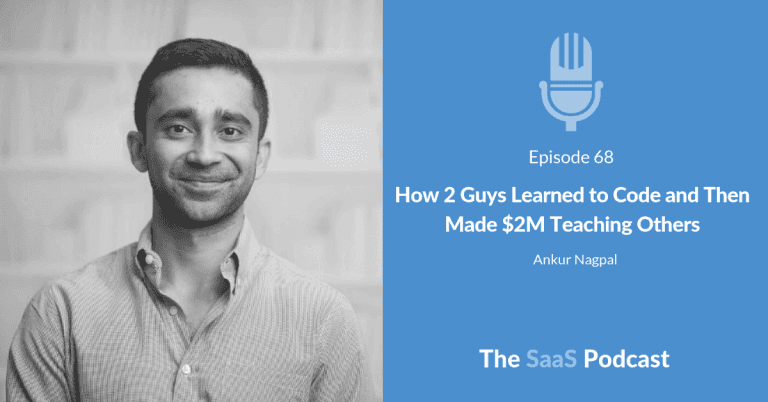
Today's episode is part two of the interview with Ankur Nagpal, the co founder and CEO of Fedora.
Now Fedora is a platform that enables anyone to easily create and sell online courses.
The company was founded in 2013 and to date has raised $2 million in funding.
Prior to launching Fedora, Ankur launched a business while at college building social widgets in between classes, which generated over a million dollars blocks.
Bloomberg Business called him a widget mogul.
In this episode we talk about how you can create an online course even if you're not an expert.
How two guys learned to code and then made $2 million creating an online course how to get positive reviews for your course and deal with negative ones how an online course can help you build authority in your market and how you can use an online course to sell other services or even a SaaS product.
Okay, let's.
Let's get tactical and talk about how someone can go about building an online course.
Now, a lot of people listening to this, and this was something that you and I talked about earlier anyway, was we'll say I'm not an expert.
I don't have anything that I feel enough expertise about to be able to go and teach people.
What's your view on who should be creating online courses, and what's the best way for them to figure out what they can teach people?
Ankur Nagpal (02:10.120)
Yep, I think you nailed it.
That's exactly the biggest reason most people don't end up teaching online is they feel that, you know, the fact that they're not an expert in anything.
To which I say, you know, chances are you probably are an expert on something and you just don't know it.
A great example is very often, very often like Two of our most successful instructors on Fedora are programming teachers.
They run a site called bitfountain, and normally people would make the assumption that, hey, these guys probably studied computer science in school, they're expert developers, they've built so much stuff before, turns out they only recently learned how to code before actually teaching other people how to code.
And that's actually pretty effective because if you're about to teach someone that's never written a line of code before how to complete lesson one, if you've recently gone through the same path yourself, you're in a better position to teach new people how to do that than someone who graduated with a computer science degree 20 years ago.
And that's a very, very powerful effect that, you know, I tell a lot of people about is very frequently students end up becoming the best teachers versus, you know, people that have formal training or qualifications in something.
Omer (03:37.220)
So this is Bit fountain.
Ankur Nagpal (03:39.140)
Yep.
Omer (03:40.180)
So this is.
I can see this on your.
On your homepage@use fedora.com and so, so these guys.
Wow, $2 million in 2014.
Ankur Nagpal (03:49.790)
Yep.
Omer (03:50.190)
From.
From just the.
This course.
Ankur Nagpal (03:52.990)
Several courses.
But yeah, I mean, you know, they're.
I'm not, I'm not gonna lie and say, you know, all our instructors do that well, like, they are the most successful instructors we've had.
But that, that's.
What if that doesn't tell you about the power of online teaching?
I, you know, like, I mean, there are two guys, they're in their mid-20s.
They're spending all their time traveling Europe while, while building online courses on developing mobile apps.
And, you know, this is truly kind of the power that online teaching has.
The fact that, you know, two people that are not even programmers by training.
Not, not to for a second say their courses are not incredibly good.
I mean, the reason they're this successful, their course is incredibly good.
But just the fact that without any formal qualifications, without the idea of issuing certificate certificates or, you know, some kind of any kind of certification, they're still able to command that kind of money, simply building great online courses.
Omer (04:49.560)
Yeah.
I think one insight that I have is that sometimes when you see people who are an expert at something, they become very good at talking about very complex topics or very obscure topics.
But sometimes it's not as easy for them to be able to talk about the basics or the fundamentals because they've taken it for granted for so long that it doesn't even take up much space in their head anymore.
Ankur Nagpal (05:24.530)
Right?
Yep, absolutely.
I think it's really important to be a good teacher and not just, you know, have the subject material, which is one of the things bitsnathon does well.
The other thing that I find that they do well, that a lot of other people don't do is a crazy, crazy commitment to quality.
I know it sounds cliched, but, you know, for instance, when I was.
It was xcode, Apple's developer tool or whatever.
They changed their interface to something that really didn't matter a lot.
Like, functionally it was identical, but they changed their interface so it looked different.
These guys decided to spend the next four days reshooting, like 20 hours of footage so that their students that are already bought the course so they wouldn't be making more money from these people would be able to see the videos and see that it has the same interface as the recently updated change.
So it's that kind of commitment to quality that I find pretty rare.
Even though, you know, we see thousands of courses, not enough people care that deeply about a great student experience.
Omer (06:28.720)
That's awesome.
Okay, so let's say, you know, I have an idea.
I think I have something that I can teach people.
What.
What's the process or the steps that I would go through?
So what's the first thing that I would do to get started?
Ankur Nagpal (06:48.400)
Yeah, absolutely.
I mean, I think the first thing.
The first thing you want to do actually happens before, you know, before.
Before the recording of content, before the teaching is going out and talking to a few people that you think would be interested and one, validating if they're actually interested.
Two, seeing if you can actually find some way to teach people in person offline, and truly refine, you know, your content, your value proposition, and the idea of what you're doing, you know, being valuable.
So even again, to take you back to bitfountain, for example, they started down this path by being offline teachers at General assembly teaching cohorts of people for several weeks before realizing, hey, we're actually pretty good at this, and we can take this online and start scaling this out further.
The first thing I would tell someone to do is go out, teach people in person, maybe see if it can be as simple as finding a few friends, finding a room in your office, calling them after hours, and, you know, teaching them.
Omer (07:56.160)
And what.
What is the.
What is the goal of doing that?
I mean, obviously you want to try and get some validation that there's actually a demand and to figure out what type of content your potential customers are interested in.
But I think there's also.
It sounds like it's also about getting people to almost learn a little bit about their own ability to teach.
Ankur Nagpal (08:23.780)
Yep, absolutely.
It's to make you comfortable with the idea of teaching.
The other big difference in how you approach this depends on your background.
I think the path is very different for people that are content creators already.
And I define that as, you know, I mean, you create a podcast, I would call you a content creator.
So you're at a much further point than someone that's never had a blog, someone that's never had a podcast, and someone that's never created YouTube videos.
So ultimately, if you are a creator, the Path is much quicker.
And you can probably get straight into the tactical stuff because chances are you already have an audience that cares about what you have to say.
And it's more a case of scripting content, recording content, and actually distributing it.
But most of this offline teaching and understanding your value proposition and understanding.
Create.
Creating content applies to people that have never done any of that before.
Omer (09:20.360)
Okay, got it.
Ankur Nagpal (09:21.320)
Yeah.
Omer (09:21.640)
And I think that's an interesting observation that you made that, you know, I mean, I have never, you know, run a startup myself.
Right.
I mean, I spent the vast majority of my career in the corporate world and, you know, 14 years at Microsoft.
But even with this podcast, you know, I think this is going to be.
This is episode 68.
Right.
So even when I look back now at all the conversations that I've had and you start to connect the dots and you learn so much by talking to people such as yourselves, it makes me wonder as well.
It's like, hey, is there something that I have that I've.
I've built over all of these?
I guess, you know, hundreds of hours of talking to people that I can condense and put together in a way that would be valuable for somebody, Right?
I don't know.
Ankur Nagpal (10:12.650)
Absolutely.
I mean, you know, I think, I think of you as a creator.
I mean, you've created something, you know, you have an audience.
If you had to create a course, I think, you know, you could probably distill a lot of great information that you already have in this podcast and create a pretty high quality course.
Omer (10:29.530)
Maybe something to think about.
Yeah, absolutely.
Ankur Nagpal (10:31.770)
I mean, you know, think about, think about it right now.
I mean, how many, how many podcast episodes have you recorded so far?
Omer (10:38.450)
So this is 68.
Ankur Nagpal (10:40.210)
So that's about 60.
68 hours of content.
Omer (10:43.650)
68 hours of content.
Yeah.
Well, maybe a little less than that, but I would say over 50 hours.
Ankur Nagpal (10:49.050)
Yeah, yeah.
I mean, I love you, but I'm not going to listen.
You know, if I wanted, if I found your best today, I'm not going to listen to 50 hours of content.
But if you can distill the best learnings from all of this, package it really well into a two to three hour online course.
I would totally pay money for that.
And you know, that's the kind of thing that a lot of creators are finally starting to understand.
Might it be people that have large YouTube channels, might be people with blogs, people with podcasts?
Is there's an opportunity in taking the right content, packaging it like a large part of what makes an online course work is Packaging it correctly and having the community aspect where people can ask new questions and people can interact with each other.
So very often where people are, people are not necessarily paying for the volume of content.
What they're paying for is the fact that you're packaging it really, really well, and the fact that you're curating the best content so that they can access it in a cohesive manner.
Omer (11:51.770)
Okay, there you go.
So you've made a public commitment.
If I create a course, you're going to buy this customer.
Ankur Nagpal (11:57.210)
You will have one purchase.
Omer (12:00.660)
Okay, so we've kind of gone out and validated it and taught a few people offline.
So what's the next step that somebody would go through?
Ankur Nagpal (12:10.660)
The next step would probably be producing the content.
And again, it depends on what topic you have.
If you have something that's largely technical skill oriented, all you'd really need is a mic.
I mean, you can do what I did where my first course was recorded with my iPhone speakers.
Actually.
Not even the complete worst, but, you know, then it's actually just a case of either having.
Creating slides or, you know, just showing a demo of whatever it is that you're teaching.
Alternatively, you can create a basic home setup, potentially even just with your iPhone, as a video camera where you have the talking head videos, if, you know, you think if that's relevant for the kind of course you're building.
Omer (12:52.350)
And so what type of tools do people use if they want to get a little bit more sophisticated?
So I guess, you know, in terms of just recording the screen, they just.
They just grab, what, something like Camtasia or Screenflow.
Ankur Nagpal (13:05.550)
Precisely.
Camtasia.
Screenflow with, you know, a good, good microphone.
I mean, you probably know microphones better than I do, but, you know, I would say a good microphone and Camtasia is enough if you're not gonna have a talking head video.
Omer (13:20.990)
Okay, any.
I mean, you talked about the quality and, you know, the guys who.
What was the.
What was the name of that?
Ankur Nagpal (13:35.150)
Bitfountain.
Omer (13:36.030)
Yeah, so Bitfountain guys and sort of the obsession of quality that they had.
Is there any other advice that you would give to people as they think about creating this content and mistakes to avoid?
Ankur Nagpal (13:47.150)
So as much as, you know, I talk about the importance of quality, quality content, it's worth noting that people, by quality content, I don't necessarily mean that your content needs to look amazing as much as be really effective.
The state of the online course industry right now is, you know, it's still early days, so people are willing to be forgiving for content that doesn't necessarily look amazing or feel amazing, as long as it's actually really good content.
I mean, even bitfountain.
I mean, you watch their course, they're just screencasts with a nice microphone.
There's nothing in their technology or in their production that's a barrier to entry.
At the same time, the biggest mistake I see people make when it comes to creating online courses is trying to be perfect and trying to, you know, do too much.
My recommendation to someone that wanted to do an online course is pick a very specific deadline.
Maybe something like, I'm going to start working on this on Saturday morning, and I'm going to try and do the best I can by Sunday night and do only this for two days and just have a very firm deadline and do the best you can up until that point.
Otherwise, you'll just get to a place where your course is never finished.
You keep thinking of new things to add to it, and you never actually ship the product.
Omer (15:08.090)
Okay, cool, so we've got some content produced.
So what's next?
Do I go to Fedora or somewhere like that and just publish and get it out there?
Ankur Nagpal (15:20.370)
Now, I think it comes down to whether you already have an audience of some kind or not.
So if you have some kind of audience, and that could just mean like a popular Twitter or a blog or an email list, if you have some audience.
I mean, obviously I'm biased, but I absolutely think it's in your best interest to go to a tool like Fedora, set up an account and either integrate with your website or send it out to your audience and let them buy the course from you.
Alternatively, if you are scared about charging people upfront, you make the first course free with the idea of eventually charging them.
If, on the other hand, you have absolutely no audience, I think you can then look at marketplaces like Udemy as a place to first start building your audience.
But at the same time, if you want to build an online business of any kind, and again, I'm sure you know this, a lot of other people listening to this know that you have to have a strategy for building your own audience, regardless of, you know, regardless of Fedora, regardless of anything on the Internet, if you don't build your own audience, launching any kind of online business is going to be incredibly challenging.
Omer (16:27.780)
Okay, so you made some interesting points there.
First of all, you know, using Fedora, some of the benefits, I guess, is you let me host everything on my own site.
Right?
So tell me a little bit about how that works.
How do I.
How would I use Fedora and how would I get things onto my site?
Ankur Nagpal (16:52.430)
Yeah, absolutely.
So, I mean, one of the several benefits of using Fedora, I think the biggest.
The biggest one is obviously, you know, you retain complete ownership of everything.
You retain ownership on pricing, which does not happen in marketplaces, you know, where they frequently have A$10 and you can buy anything kind of deal, and your course is lumped in.
You retain complete ownership of your brand, which means it's not branded with Udemy, it's branded with your site, your name, your logo, and probably most importantly, you retain complete ownership of your students.
Your audience remains completely yours.
They're not cross sold into other competitive products.
No one else has any access to them.
We don't have shared ownership on them.
It's entirely your audience.
So that's kind of the big thing about what Fedora is all about, which is ownership.
On the other hand, we're people that have backgrounds in running online businesses.
So we have a lot of features catered to actually help teachers make money.
So we have an inbuilt affiliate program that I talked about that we built too early.
But we have the ability to charge for course to have multiple price points per course, which can be very significant because on Udemy, you generally keep courses between $49, between $9 and $199.
But on Fedora, you can have a $5,000 course that meets offline for eight for eight weeks.
So there's a lot of flexibility in what you can do there.
We allow you to set up a monthly subscription.
We like to set up an annual subscription.
You can create a bundle of all your courses and sell it for $49 a month, which you can't really do in any marketplace.
We allow you to sell live classes.
There's a lot of stuff on the commerce side that we really focused on making happen.
Omer (18:35.430)
Okay, so I could take my.
Sorry, I could take my content, upload it to Fedora, and then you provide me what ways to kind of embed this stuff back into my site and then use Fedora as a way to manage the back end.
Is that a way to think about it?
Ankur Nagpal (18:51.830)
Yeah, it works, you know, pretty much similarly to the way WordPress or Shopify would do, where it kind of builds you your own site.
We take care of the technology, but to the end user, it appears like, you know, it's entirely your site.
So if you had your site at, you know, conversionaid.com you could set up a Fedora site that looked like your site@courses.
Conversionaid.com or schoolonversionaid.com or academy.
Conversionaid.com or something along those lines.
Your end user looks like, hey, this is part of Omer's site.
This looks great.
And it's all about your brand.
Omer (19:26.010)
Now you talked about Udemy and how some people have been using that as a way to initially build an audience before they maybe offer something on their own site or a higher price offering.
Can you talk a little bit about that?
Ankur Nagpal (19:42.250)
Yeah, absolutely.
So by Udemy I mean I'm using it as a catch all term for other online learning marketplaces, of which there's Udemy, skillshare, Skill Feed, several marketplaces where you can go upload your course and they have their own audience that can actually take the course.
So if you have no audience at all to begin with, that might be a good strategy just to get started with the process of teaching online.
But ultimately what we find is even once people go to marketplaces and achieve some degree of success, that's when they invest in building their own school with Fedora and, and finally taking ownership of their audience.
I think the other important thing to do if you do decide to do that is have a strategy that you're working on in parallel to build your audience.
I mean, it can be as simple as writing a blog or starting your own podcast or something where you get people to care about who you are.
Omer (20:38.670)
Okay.
Okay, yeah, that makes total sense.
Okay, so two, two possible routes.
If you have an audience already, then consider, you know, using something like Fedora to, to start to build your offering right there as, as part of your own site.
If you don't, then look at some of these other learning marketplaces, try to offer maybe a lower cost offering and try to build a following that way.
What, what advice do you have for people who maybe are worried about, say, negative reviews in these kind of marketplaces?
I mean, obviously if you create a totally crappy product, you deserve to get negative reviews.
But what if, you know, you, you did your best, it's still rough around the edges and maybe you're getting kind of mixed reviews on the product.
What can people do?
Ankur Nagpal (21:46.250)
So the first thing I would tell you is honestly, the quality bar on marketplaces is so low and I think that's one of the problem and why people don't actually use a lot of marketplaces.
The quality bar is so low that some pretty crappy products have great reviews.
And I'll be the first to admit my first couple of courses on Udemy, they're, they're not good Courses, I mean, I finally unpublished them because I look back and I'm embarrassed by kind of, you know, just how poorly done a lot of them are, but they're still rated four plus stars just because the quality bar is not that high.
You know, that's kind of the first thing.
The second thing is obviously, you know, when you're, when you're building, when you're building an online business, you do have to have a thick skin because, you know, if you're either, if you're either very successful or even if you know you're at the point where you're just putting yourself out there, you have to, you have to kind of account for the fact that there will be people that are not happy with what you're doing and just have a thick skin about it.
Omer (22:46.350)
Okay.
Ankur Nagpal (22:47.070)
Yeah.
Omer (22:48.590)
Now, you talked about how with Fedora it's possible for people to offer higher priced offerings or, or maybe there's an offline component to it.
And I was looking at Conrad's user growth boot camp site and Conrad is another case study on your homepage from, you know, from him generating what, 50k a month from, from this.
Can you talk a little bit about how maybe he or other people are kind of using an offline component?
What, what tho, what those kinds of things could be?
Ankur Nagpal (23:27.150)
Yep.
So Conrad went through a path that we see pretty frequently with our teachers where the longer you, the longer you build on, build online courses, the more you kind of move up in price.
A lot of people start off in the, you know, 9 to $49 range and eventually end up selling courses for hundreds of dollars.
Conrad took that to the next next level by starting with, you know, $20 courses and finally ending with a boot camp that went as expensive as $5,000.
So he used Fedora to, you know, create the entire storefront, handle the sales and commerce piece, but also to create an online component to the bootcamp that met in person, where he'd upload the recording from session.
Because a lot of people were, some people were in person and other people were remote where, you know, they needed the video and kind of have a centralized discussion hub where the entire course, you know, right from the readings, the discussions, the comments, the videos, all of it could live in the same place.
And the fact that Fedora allows you to have, you know, differentiated pricing meant that on the same sales page, people could, you know, buy the thousand dollar remote option, the $3,000 in person option, or the $5,000 in person option.
Omer (24:38.320)
Got it.
So you could.
So sort of thinking back to maybe the example that we talked about earlier with, you know, me turning something from a podcast into some content that I guess could maybe an upsell in that example could be maybe, I don't know, some kind of hangout with people where we kind of talk and sort of interact about specific topics and.
Ankur Nagpal (25:04.300)
Yep, great, got it.
I think it's a graduated scale.
So, for example, say you had a course on how to start a podcast.
What you would probably do is have, you know, the basic course available for $49.
Then for a few hundred dollars, what you could probably do is have some kind of mastermind or a community piece where everyone else in that group would hang out together and collectively share strategies.
But where a lot of the magic happens is you could have an even higher price version, probably as high as, well over a thousand dollars, where you actually do most of the work for the person that buys the course.
Because a lot of times people are buying a solution and there's usually an opportunity to create the highest price product where you actually help them achieve the solution versus just teaching them about it.
Omer (25:51.720)
And so in Conrad's example, there's a $3,000 weekly workshop.
Is that an example in New York?
So that would be an example, I guess, of doing something like that.
Ankur Nagpal (26:04.920)
He still falls under the criteria of where even at that price point, he's just spending more time, but he's still educating them.
He's not actually growing their company for them.
But a lot of other instructors we've seen that have been successful, they have a highest price product where they help you accomplish the very goal, almost like a service rather than teaching.
But it's all happening on the same sales page where people can choose between, you know, learning themselves, learning themselves with help, or just like having someone do most of it for them.
Got it.
Omer (26:35.570)
Okay.
Ankur Nagpal (26:36.850)
Okay.
Omer (26:37.570)
So we've, we've, we've published the course.
We've.
We've been building an audience, either an existing audience or, you know, building a new audience through initial small courses on, on, you know, these other marketplaces, maybe through blogging, maybe through a podcast.
Is there anything else that people need to be thinking about?
I think what you talked about earlier was, was pretty good in terms of maybe being aware about keeping the content updated.
Is that important as well?
Ankur Nagpal (27:13.250)
Yeah, I think, I mean, again, to tie back to what I was saying earlier, and I guess a lot of people listening are software people.
So they understand the idea of a minimum viable product is kind of taking that to courses as well, and starting by developing what I like to call you know, the minimum viable course and then taking early people in it, listening to them, talking to them, and then iterating on your minimum viable course to make it something evergreen that can be best in class.
But too many people I see make the mistake of trying to create a best in class product when really they should be thinking of what is the smallest thing I can create that gives value to other people, selling it, and then talking to those paying customers that are always going to give you better feedback than, you know, a free customer and truly iterating on it to build a best in class product.
Omer (28:02.550)
Okay, is there anything else that you think people need to know or any advice you would leave them with that we haven't talked about?
When it comes to creating an online course,
Ankur Nagpal (28:19.100)
I think the biggest thing is just making sure you ship your content fast.
And again, tying back to the first thing you're aggressive about, promoting it.
And you know, you, you get the word out there in as many channels as possible.
So if you are, you know, if you create a course, in addition to hitting up your list, take parts of the course because chances are you've developed a lot of content for the course and just repackage it everywhere.
Once you've done the hard work of developing the content, that means you have enough in there for several blog posts.
You have enough in there to create a slideshare, you have enough in there to write answers on Quora, you have enough in there to create free YouTube videos.
Just take that content, package it everywhere and have it all point towards your course.
Omer (29:05.440)
Oh, so take elements of the content that you've created and repackage that.
Yeah, that's excellent advice.
Yeah.
You don't have to reinvent the wheel.
Ankur Nagpal (29:13.920)
Absolutely.
That's one of the advantages of creating a course.
Even if whatever reason your course doesn't work, you've created so much content that you can then put out over the next months, year maybe in different form factors with you having done the work upfront.
Cool.
Omer (29:30.150)
And using Fedora.
I was just looking.
You have a free plan that folks can get pretty much started with today.
And it's completely based on a transaction fee.
And it looks like the transaction fee gets lower as people can kind of move up to a paid monthly plan.
Ankur Nagpal (29:50.230)
Yep.
You know, I mean, I like to think we're pretty affordable product and you know, to the degree if someone used the free plan and they distribute, distributed their course for free, there would be no charge to them at any point.
You know, at that point we'd actually be losing money on them.
But, you know, I mean, the way we think about it is it's a marketing expense for us, but if you have a free course on the free plan, you would never end up paying us anything.
Omer (30:17.000)
So if you're listening to this and you've got some thoughts about something that you feel, you know, you confident about teaching other people or something that you've learned recently, this could be a really great way for you to turn that into a course and make some money out of it.
So this has really been excellent advice, Ankur.
I really appreciate this.
I think this is going to be an incredibly valuable episode, and I may actually take you up on this advice and create that course.
Ankur Nagpal (30:51.750)
The other.
The other thing, the other thing we're happy to do to anyone listening to this, this podcast is I'll send you a link.
I'll send you a link that you can embed to this.
But anyone listening to this podcast can get any month on a paid plan for free as well.
Omer (31:05.990)
Sweet.
Okay, that sounds great.
Yep, let's do that.
All right, it's time for our lightning round.
I'm going to ask you a series of questions, and I'd like you to answer them as quickly as you can.
Ankur Nagpal (31:20.110)
You ready?
All right, let's do this.
Omer (31:22.750)
All right.
What's the best piece of business advice that you ever received?
Ankur Nagpal (31:27.070)
I think the best piece of business advice, and this was again given to me by, I think naval was.
It's not that different in terms of how much work you have to put in if you are running the local coffee shop or if you are the CEO of Starbucks, which ties into the idea of, you know, think big.
It's as much the amount of work you have to put in to do something massive versus something on a much smaller scale.
Isn't that different?
Omer (31:54.280)
What book would you recommend to our audience and why?
Ankur Nagpal (31:58.520)
This is dated because it's been over 10 years since I read this book.
And, you know, I'm only 26, but I went down this path of entrepreneurship after staying up all night reading Losing My Virginity by Richard Branson.
I have not reread it, so it's a bit of a bold claim, but that book is one of the reasons I'm doing what I'm doing.
So I would have to go with that.
Omer (32:21.170)
I love Richard Branson.
He's one of my heroes.
Okay, what's one attribute or characteristic in your mind of a successful entrepreneur?
Ankur Nagpal (32:31.650)
This is going to sound counterintuitive, but I think not being analytical.
I think you need analytical people on your team and There's a time to be analytical, but being able to take tough gut calls based on nothing, nothing but your gut, I think is incredibly important.
Omer (32:49.660)
What's your favorite personal productivity tool or habit?
Ankur Nagpal (32:54.780)
I think I referred to this briefly while talking about courses, but just the idea of if I'm going to do something, set a stupidly aggressive deadline just to kind of excite yourself into being like, can I do this?
Can I not do this?
And usually you won't accomplish it, but it'll get you so much closer than, you know, something realistic that you slowly scale up to.
Omer (33:15.010)
If you had to start over tomorrow, what type of business or problem or market excites you other than the one you're in?
Ankur Nagpal (33:24.850)
I guess I was like, yeah, this is the least favorite.
Like, this is the most cliched answer.
But I can't imagine, you know, being anywhere else right now.
I mean, the online education space is just so fascinating to me personally that I think, you know, I'd be doing exactly what I'm doing if not if I had to pick something else.
Probably something in the health space just because, you know, because of one.
Having grown up outside America, seeing the way the American healthcare system is run, you realize, you know, things need to change.
Omer (34:01.250)
What's an interesting or fun fact about you that most people don't know?
Ankur Nagpal (34:06.850)
I think it's the fact that, I mean, I'm a technology entrepreneur.
I have a computer science degree, but I'm really, really bad at actually using technology.
I have like three apps on my phone.
I use, like, Safari for everything.
My phone's like, super old.
My computer is old.
Just the fact that I don't really.
I'm not a good technology user.
Omer (34:29.580)
And finally, what is one of your most important passions outside of your work?
Ankur Nagpal (34:35.100)
I think that's an easy one.
I think it's definitely the sport of cricket.
I grew up playing cricket all the time.
I played internationally for a while.
My life goal for a long time was to do cricket.
It's how I started my entrepreneurial career, building a fantasy cricket game.
I've worked with the cricket league in India in the past.
So much of what I do in my life kind of goes back to cricket and I guess sports in general.
That's one of the things I need just to keep me sane.
Omer (35:02.319)
Were you watching the World Cup?
Ankur Nagpal (35:04.399)
I was, I was, but it's not even the World Cup.
Everyone watches the World Cup.
I watch, like, cricket that no one watches, but yeah.
So it's just been such an integral part of my life growing up.
I mean, until Maybe I was 15 that I realized that I'm not good enough to do this for a living.
But until then, I did not accept an alternate reality.
Omer (35:25.800)
Wow.
Ankur, I want to thank you for joining me today and sharing your experiences and insights with our audience.
And thank you for letting us get to know you a little better personally as well.
Now, if folks want to find out more about Fedora, they can go to use fedora.com if they want to get in touch with you.
What's the best way for them to do that?
Ankur Nagpal (35:45.390)
Probably Twitter.
My Twitter handle is my full name, Ankur Nagbal.
That's probably the quickest way to get to me.
Omer (35:51.150)
Okay, great.
And we'll include that in the show notes.
Ankur, thanks again, and I wish you continued success in the future.
Ankur Nagpal (35:57.390)
Sure.
It's been a lot of fun, A lot of fun being on the show.
And yeah, I mean, happy to give anyone listening to this a free month to try any paid Fedora plan.
Omer (36:06.750)
Awesome.
Thanks, man.
Ankur Nagpal (36:07.870)
Cheers.
Take care.