Omer (00:11.840)
Welcome to another episode of the SaaS Podcast.
I'm your host, Omer Khan and this is the show where I interview proven founders and industry experts who share their stories, strategies and insights to help you build, launch and grow your SaaS business.
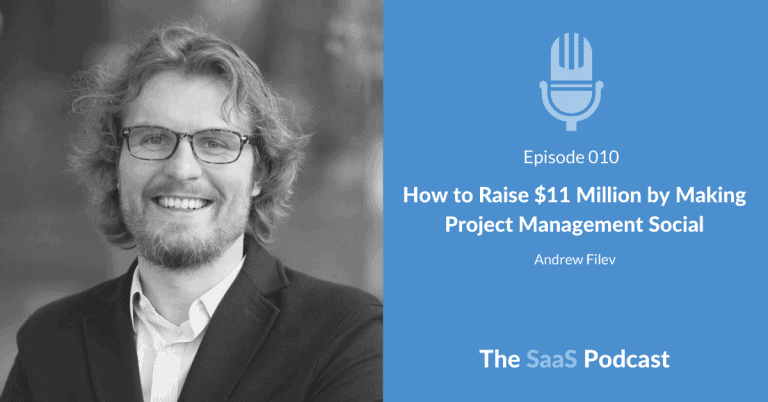
Today's interview is with Andrew Falev.
Andrew is the founder and CEO of Wrike, a provider of social project management and collaboration software that helps co located and distributed teams to get things done together in real time.
Andrew founded the company in 2006 and to date has raised more than $11 million in funding.
Andrew, welcome to the show.
Andrew Filev (00:53.210)
Thanks.
Summer, how are you?
Omer (00:54.570)
I'm great.
So I've told our audience just a little bit about you, Tell us in your own words a little bit about you, and give us an overview of your product and business.
Andrew Filev (01:04.010)
So a couple words about myself.
I'm an engineer by training, software engineer.
I started my first company when I was around 17, 18 years old and it was doing quite well.
And then I moved into building Wrike and this has been my sole passion for the last about last seven years.
And Wrike is a collaborative project management software that helps people work together more efficiently and also helps them do more, get things done and so achieve their own goals.
And we've got customers in more than 50 countries, we've got more than 6,000 paid customers and they range all the way from brand new startups to Fortune 100 companies.
Omer (01:58.920)
Awesome.
Now, before we dive into more details, we like to kick things off with a success quote to better understand what drives and motivates our guests.
What is your favorite success quote?
Andrew Filev (02:09.080)
My favorite one is by Walt Disney.
If you can dream it, you can do it.
Omer (02:15.320)
I love that one.
Can you give me an example of how that quote has helped you in your life?
Andrew Filev (02:21.960)
Well, not necessarily the quote itself, but the aptitude.
I think as an entrepreneur, you face a lot of challenges and you have to keep sort of your side on the end goal.
You know, you want to make, you want to make sure, you want to be sure and be confident, then you can get there.
And that helps you to go through ups and downs and it also inspires you to do greater things, which I think is important because sometimes people have those, you know, have those dreams and desires, but they're, they're shy or afraid and they never pursue those dreams.
And sometimes that's a mistake.
Omer (03:16.000)
Okay, Andrew, let's take a journey together back to your early days and explore how you got started with Wrike.
First of all, tell me where the idea for Wrike came from.
Andrew Filev (03:25.440)
So as I Mentioned before, I started my first company pretty early and it was a software consulting company and it grew rather fast.
So it quickly grew into micro, multinational.
And it was, at some point it was kind of frightening to go from five guys in one room to multiple countries, hundreds of people.
You almost feel their loss of control.
It's not real, but the difference is so big.
Before, the way you operated just a year, two years or three years ago, and the way you're running the business now, and you've got the great team, it works their backs off, they're doing a lot of important things, but the level of visibility is so much different.
And you also see a lot of inefficiencies.
And as the company grows from 100 to 1,000 employees to tens of thousand employees, we all know that in the corporate world those inefficiencies are multiplied even more.
So I was always, I always wanted to make sure that I personally operated my best performance and that everybody around me, my team and their teams are operating at their best performance.
So I was never complacent with those inefficiency.
I was always kind of, I almost have a gut feeling rejection of them.
So I was trying to figure out what's the best solution that would help us work together efficiently.
No matter whether we're in the same room or if we're in different cities, different offices, different countries, it needs to be real time rather than, okay, let's meet once a month or once a week and then we can move forward.
I wanted us to be able to make decisions instantly.
And I also wanted there to be transparency and not just for managers, but for peers and co workers as well.
To know, you know, what John is doing and what's done, what's not done, where do things stand and where I can help him or where he can help me.
So all those questions, and traditionally the way people kind of get support from software is 30, 40 year old technologies is emails and spreadsheets.
And that's pretty frustrating.
And we all know that story where you suddenly wake up one day and you start getting 200 emails a day and you're sending 50 of those by yourself.
And so almost comparable to driving a car with no visibility, like imagine a cardboard instead of a windshield or no dashboard.
So I wanted to create something better.
And I knew that as our software guy, I knew that the technologies would allow you to do so much more these days.
And it was just a matter of putting it together.
And that's what kind of, that's their genesis of wrike.
Omer (06:37.840)
Okay, Great.
So you got this idea, you're personally feeling the pain with the way that you're running your business and you see an opportunity to scratch your own itch here.
Tell me the specific steps you took to start turning this idea into a product and business.
Andrew Filev (06:57.000)
I think for me it was quite pragmatic.
So I just started, well, looking at it.
In my details though, there were some steps.
So first of all, because at first I wanted to solve the problem for myself, I look at the solutions that were out there already.
So I tried different collaboration tools and I tried different project management, work management tools.
And interestingly, at that point of time there were two different markets.
It's later when we kind of, we brought those markets together, which was one of the key insights into building a new product, that work management and the work collaboration are two sides of the same coin and they should go hand in hand.
So I looked at what was there and unfortunately for my first company at that time, and fortunately for me being able to create Trike, I didn't find anything that would kind of reflect my vision of how to make digital work so much more effective.
And so with that vision I also, first and foremost, again by the nature of how I arrived at the problem, I was first of all thinking of how do I solve it for myself?
What are the missing links?
Why doesn't this work for me?
And there were a lot of promises from different vendors like, oh, buy our enterprise collaboration software from, you know, a company in Redmond.
I wouldn't name the company, but we all know what the company is and we all know what that collaboration software is.
And theoretically it should solve all your pains.
But then you install it and like the life continues as it continued before with you just getting more emails and things moving at their own pace.
And so, and the same thing on the work management side, you got this promises that you've got this nice scheduling software and then it's supposed to make you run your projects better.
But you realize that it's not just about scheduling, it's about you working together with your team and you getting real time information about where your business stands.
It's not like plan once and run for the next two years.
It's your business changes every day.
So there were a lot of gaps.
And so I felt them myself, I conceptualized them, I figured out what the solution can be and then the next aha moment was that, well, I'm actually not the only guy with this set of problems.
There are probably about billion people who do digital work and everybody is either manages somebody or is being managed by somebody, or more likely both.
And so it's a huge market.
And so since even before we started writing code, I realized that this is kind of a very big and important problem for a lot of people.
So I decided that we need to create a product that not just kind of internal solution, but a true product that would help people.
And then since it wasn't my first company, I already had some experience in hiring people and I had some money to invest out of my own pocket.
I've.
I got together a team and we started working on the solution.
Omer (10:08.260)
Did you go out and do any kind of validation?
Did you go and talk to potential customers?
Or were you pretty confident that this product needed to be built?
Andrew Filev (10:18.420)
Well, there's some good stories and good lessons.
So in terms of.
Originally, the first thing is I was very confident that something needs to be done right.
It's like, what exactly is a different question.
But I was very confident that there is a problem and there's a huge market and I had an internal desire, an urge to build it.
It wasn't necessarily okay, there's this huge market with a dollar number attached to it.
It was like internally, I don't know how to describe it, but it's like you just want to get it done right.
It's not necessarily something forces you, not necessarily the dollars behind it.
It's like you just want this problem to be solved.
And so that's kind of was the original push.
And I'm not saying that it's good or bad.
I definitely.
I'm a big proponent of talking to customers, and I think we should have done much more of that.
But originally we didn't.
And then when we launched the product, there's kind of another interesting story there.
So a lot of companies, when they first build a product, they go to friends and family.
And for us, we deliberately wanted to make sure that people bought our software because they liked it and needed it, rather than because they knew me personally.
And again, I wouldn't recommend this as an approach, but the way we did it is that we didn't knock on friends and family doors.
We just built the software and launched it at a conference and put it online.
And the first customers that we talked to besides ourselves were people that I've never talked to before.
They actually found our product and they tried it and they liked it and they kind of reached out and we started a conversation and some of them later became friends, but it was their sort of product and need to early customer to friend.
Rather than the other way around.
Friend to product.
Omer (12:32.490)
So from the point you had this idea and you decided that you wanted to go and build this product, how long did it take you to get that first version shipped?
Andrew Filev (12:43.490)
The first version, we called it beta was shipped in less than a year.
And that was the version that we launched at a conference.
And then it took us another six months to get from beta to product that we felt comfortable charging money for.
So the beta product was free.
And then kind of six months later we started charging money for it and we had the formal public launch, public release.
Omer (13:15.340)
Did you do any marketing while you were building that first beta product?
Andrew Filev (13:20.620)
Not while building the beta, but after we launched it at the conference and arguably that's already the beginning of the marketing.
And then when we launched it online, we started doing some online marketing and we started learning it because quite honestly, we knew nothing about it at that point.
And so we, we have to teach ourselves and take it from there.
Omer (13:44.730)
And how many customers did you have using the beta version of the product?
Andrew Filev (13:50.090)
Honestly, I don't remember, but I think it obviously grew month to month, but probably dozens of companies definitely were not in.
You know, thousands of businesses rushed on day one.
We took a more deliberate approach, you know, where we like.
It's not, it's not your typical Silicon Valley VC funded company where you raise 10 million Series A before you build it and then you launch it with a splash and everybody writes about it.
It was more kind of under the radar.
We built great product, we put it out there.
And then slowly, within word of mouth and online marketing, more and more people started joining it.
But the interesting thing is that kind of grew exponentially.
So there, you know, when you start very little, when you double that little, it's still little, right?
And when you double that, it's too little.
But since it's a working machine, you know, it's not just because you threw some money on it or you threw big name into it, it's just because is great, it's working.
And then the law of exponent grows pretty quickly.
So at first it was slow, but it was a continuous growth pace.
And then, and it was a growth pace that was fueled not by some artificial things, but by the nature of kind of solving the right problem with the right tool, if you will.
Omer (15:27.330)
So at the end of this beta period, you told your beta users that, hey guys, we're going to start charging for this product.
Now.
What was the reaction at that point?
Andrew Filev (15:39.650)
We were always very, and still are very considerate about our customers.
So I don't remember the exact dynamics, but we probably grandfathered other existing users.
That's what we always try to do.
And it's very, sometimes it's very expensive, but we try to do it when we can with pricing and we also actually try to do it with product as well.
So, for example, at some point we developed a new version of our product and the interface was so radically different that we didn't want to force people to migrate on day one.
So we actually gave people ability to switch back and forth between the new version and old version for, I believe, more than six months.
And I think that's very unorthodox for software as a service providers and even for consumer tools.
Facebook.
One day you wake up and it's a different Facebook, right?
And in our case, we were always very respectable of our customers.
I always viewed them as our investors, right, in the sense that we lived out of our revenue.
We didn't have a big bank account or investors check to live from.
So we want to make sure that our customers are happy.
And sometimes that meant grandfathering things.
Omer (17:01.740)
So, Andrew, looking back at those early days, what do you think was one of the biggest mistakes that you made?
Andrew Filev (17:09.580)
I don't.
Well, actually, I think you asked about talking to customers, and I think I told you how we approached it.
But looking retroactively, I would do it differently.
I would definitely spend even more time with customers.
And it's kind of interesting because you keep hearing that advice.
So it's obvious, right?
You need to talk to customers and you heard about this from this and that, but there's a different degree to which you can make it.
And when you're in this business day to day, you're distracted by thousand details.
You don't necessarily do that.
Plus, on top of it, if you layer my background and background for a lot of software companies, founders, which is you grew up as an engineer, this sort of introvertural person.
You're a little bit shy, you're afraid of rejection.
You don't necessarily go and try to strike real conversations with your customers.
You just respond to them.
They email you like, hey, there's a problem, or hey, there's this idea.
And you respond to them in a more transactional way.
But what you really need is you.
You need to have several deep conversations where you get on the phone or meet them in person and spend at least 15 minutes with them.
And interestingly, it's like the fear is bigger than.
The problem is because most of your customers, they're actually eager to talk to you, they love you, they're great, they're happy to help you and support you.
So all you need to do is just send them a personal note saying, explaining why you want to talk to them and asking them for 15 to 30 minutes of their time.
And they'll be eager to talk to you.
So you definitely need to.
And then kind of a couple of more tactical advice.
So you need to talk to different groups of your customers.
So first of all you need to talk to your most active customers.
Those are your superstars, your bright spots.
You want to understand why they're using your product and what they're using it for and how they use it.
And you need to talk to a couple of sort of regular customers so that you better understand the difference between those bright spots and the regular customer.
And you also absolutely must talk to customers who abandoned you or chose another solution.
And you need to be brutally honest with yourself.
The goal of those calls is not to put your words into their mouth.
The goal is to shut up and listen to what they have to say to you and try to find, not necessarily kind of prove your point, but maybe you actually thought they're using your product because of one reason and it is important, but they're actually the killer application is slightly different and they're using you for another reason.
Or maybe you thought they abandoned you because you didn't have all those bells and whistles that will take another three years to build versus well, they abandoned you because the core value proposition didn't appeal to them.
So I think for myself kind of as a person with engineering background and being introvertial, that was the biggest mistake.
And I also bring this up because I keep seeing that in a lot of friends and people I know, even the ones that are experienced, even the ones that are not doing it for the first time, just so easy to get kind of to get it over, engaged by the day to day routine and the things that we like to do or that we're used to doing.
And instead of stepping out of our offices and talking to customers, I think that's great advice.
Omer (21:06.770)
I think for anyone who can write any code, it's so much easier and prefer just to kind of go out and build a product than actually having to go out and talk to real people.
Right.
And I also love your advice about going out and talking to different types of customers and really looking for different types of feedback.
Because so often, even if we can go out and talk to customers, sometimes, you know, you may talk to a few and get some Good feedback, because that's what they think you want to hear.
And so you can go away and say, great, you know, we were onto something here.
But it's really about digging deeper and really figuring out what is exactly the problem that they're trying to solve and is your product going to help them do that or not?
Andrew Filev (21:48.570)
You actually brought a couple of great points.
So one is if you have any idea about stats, you know that you need more than one data point.
There's an old math joke that the numbers 1, 2 and 3 are prime, so the rest of them should also be prime.
Right.
So you need a little bit more conversations and you need diverse conversations, as we just discussed.
So that was one thing and another.
I had some other idea, but it honestly slipped off my mind.
So we can just.
Omer (22:25.070)
No problem.
So, Andrew, you've got, you know, you come out of the beta program, you've got some paying customers, it looks like you're onto something and this could turn into a really successful product and business.
What did you do next to start to continue to grow this business?
Andrew Filev (22:40.740)
So putting it in a layperson language, our philosophy in the first stage of the company growth was very simple.
First of all, build the best product, because that's honestly what we knew how to do most of all other things, we knew nothing about marketing or sales or things like that.
So we knew how to build good products.
And, and also I think that's actually a good strategy.
I mean, the whole software market shifted from the position where you needed to have the biggest brand and the biggest and highest paid salespeople to sell something down their sort of enterprise buyer throat in a $2 million, five year contract to a world where people find software on Internet, buy it on their credit cards, bring their own devices, bring their own applications, and where product matters and shines.
So the first pillar was to build great product.
The next pillar, which is also very important, is provide great service around that product.
So something that we always valued a lot.
And as in a lot of startups, I was our first customer success rep in customer service rep.
I spent all that time answering customers emails and getting on the phone with them.
And while not as insightful as deep product conversations, that's kind of one of the best substitutes that you can get, right?
Kind of being on the line and listening to customers, what they need, what they want, what doesn't work for them and feeling their pain, which I think is also very important because if you get into this ivory tower where the customer is somewhere there and you're here like it's not going to work, right?
So that was helping our customers and that was helping myself and our team kind of.
Because when you start with that mindset, you need to just carry it forward as your company grows.
You don't need to reinvent things.
You just want to make sure that whomever kind of picks it up after you shares the same dedication to the customer and quality of service and everything.
So that's kind of the second pillar.
The third one was we quickly realized that it's great that we built great, nice product, but we need to let the world know about it.
Otherwise it's not an innovation until people use it.
It's an innovation when it's in everybody's daily habits.
So we quickly realized that we need to build some either marketing or sales around it.
And we again, as engineers, marketing was closer to our heart than pure sales.
And we were kind of both naive and forward looking in a way that we thought, okay, let's just kind of put it online and figure out how the online marketing works and tons of people will buy it.
And eventually they did.
It's a journey, right?
You have done, as everybody, everything else.
You don't expect to wake up one day, read a book and become a professional software engineer.
And same is true about marketing, right?
It's a discipline with a lot of kind of insights and a lot of experience to be gained over years to become professional at.
So we started online marketing efforts and we both try to put the word out, like try to maybe create an interesting content around project management and we also try to advertise on Google and things like that.
And some of them work, some of them doesn't.
But over, over the years, if you're passionate enough and diligent enough, you kind of quickly figure out what works and what doesn't.
And what works, you then scale and kind of again with the law of exponent, if you keep doubling things up, you grow up pretty quickly.
Omer (26:54.370)
So talking about marketing, what was one of your most successful marketing strategies for acquiring customers?
Andrew Filev (27:03.010)
So we tried different things before.
They're more direct answers.
We tried different things and I think that's what companies should do when it's a brand new area if you're already familiar with the space.
So if there is a playbook that you can borrow from somebody else, like you can make a great hire that worked in a similar company, or you could share a lunch with somebody who's running a similar company but is ahead of you in the game.
So that's kind of the shortcut.
If you don't have that shortcut.
You have to try different things and just see what works and what doesn't.
So we tried trade shows and it didn't work well for us.
We tried this, we tried that.
For us their most effective channel was online marketing.
So its search engine marketing, its great content that we produced and then trying to build connections with some analysts and media.
Although while we were pretty small, the last component was not very fruitful.
It's only kind of these days when we got enough momentum, when we start to get kind of get a lot of return out of it.
But when we were early there stuff that we could control ourselves worked better for us.
And I think content marketing and when we started it wasn't called like that.
Right?
You would call it, I don't even know how you would call it.
You probably could call it SEO, but it's not a. SEO is fairly technical term.
You would just try to create great content for people, create a community around your product.
So that content marketing approach grew on us and grew on the world.
I think this is one of the most effective ways to attract your customers these days.
And it kind of follows a good general philosophy of help others and they'll help you.
So you provide some value to people who might become your buyers.
You give them a good advice, you write a great ebook or something and then they later give back in a way that in giving their attention to your product.
And if it's a good product and if there is a match, then they can become good customers.
Great.
Omer (29:26.970)
So Andrew, we started this conversation by going back to where the idea for Wrike came from.
And then we've taken this journey together on how you turn that idea into a successful product.
You shared a number earlier to say that you have around 6,000 paying customers today.
Can you share any other numbers with us to help us understand where your business currently is?
Andrew Filev (29:49.530)
So in terms of we're not big on vanity metrics like some other players, you know, how many free users who got or whatever.
So we're fairly pragmatic.
So for us this is probably the most important number.
The revenue we keep, we're private companies so we keep that confidential.
But we're not shy to kind of share the number of paying customers.
So the number of Fortune 1000 customers, which I think right now is more than 40 Fortune 1000 companies are using us.
And then in terms of more product oriented metric, I think there are more than 100,000 tasks created each month in our product.
I'm not sure I need to check But I can tell you that probably I'm more proud of a different metric which is we have customers who have five users in their accounts and we have customers who have more than thousand users in their account.
Right.
So the fact that the software can grow with you and scale with you, and we have customers who just start and they got a couple of dozens of tasks and we have companies who literally have thousands of projects in the system, the fact that it delivers on promise and scales and grows with you, that's kind of one of their most the metrics that I'm personally proud of.
Because in this space I don't know if you're familiar with it, but like if you just managing a very one simple task, one simple project, you know, you can do it in a paper, you can do it wherever you want.
It's quite simple there.
The devil's in the details is when you kind of add this real life complexity and you want to make sure that you're, you capture big projects, small projects, they evolve every day.
You plug in a new team member, you plug in a new team, you plug in customer contractor, in turn you kind of add this real life mess and you want your collaboration system and your project management system to grow with you.
And so Brike does that.
And that's kind of one of the metrics that makes me personally sort of happy and proud and everything.
Omer (32:02.380)
Yeah, that was one of the things.
When I was doing research for this interview and I looked at Wrike and the thing that struck me was you have a real diverse set of users from anybody.
You can sign up for Wrike and get a free account and use it to manage your personal project through to you guys having enterprise customers who are probably managing very large projects there.
So it's very, very diverse.
And when you started out, did you build with that in mind or is that just the way things have played out?
Andrew Filev (32:36.120)
So we built with that in mind.
So one of my problems, and again as I discussed, I came to this space with my own background where I was running a very fast growing business.
And so one of my challenges was how do I manage multiple projects and how do I manage diverse projects?
There's no way I would wake up in the morning and go to check 20 different Excel spreadsheets or 20 different Microsoft projects files or 20 different SharePoint websites or something.
I needed a system that captured all that complexity and delivered it in a very, very simple interface to consume.
So I would go and this was a couple of clicks, I would know again what Alice is doing and what's done, what's not done, what she plans to do.
Right from the beginning, I saw big, big, big challenge in scalability.
And we're talking both about technical scalability, how the system correctly handles it, but also product scalability, how the does the system adapt to complexity.
And interestingly, although I was running a fairly small company, you know, it's not Procter and Gamble, but because we were sort of micro multinational and because the company grew so fast and I was managing a very diverse set of things, I was managing delivery of software projects and recruiting, which is a very different activity in this and that and some logistical projects.
So that's very complex.
Every single thing might not be as complex, but when you combine them all together and when they start changing every day, that's a lot of complexity.
So I wanted the system to be able to scale to that sort of natural chaos of real life, so you could tame the chaos if you will.
And then there, I think that's one of the, not one of them, but they're the single most important reason why we got there.
And then there are a couple of additional ones.
One of them is that when we started, I come from the software background and the software industry, project management, it's fairly advanced and you've got all these new trends with agile, which I got exposure pretty early on, about a decade ago or something.
So I got exposure to all those project management theories and different trends, including some brand new ones.
But at the same time, when I designed the product, I deliberately said this is part of the reasons why there were not too many friends and family.
I said, listen, we're building a product that I think is applicable to a lot of people and it should be applicable to a marketing agency.
It should be applicable to university, church, government, anybody who's doing this work online.
And so, and because of those different use cases, if you support them, you naturally get that scalability.
Another contributing factor is kind of again through that diversity and through the fact that it was not the product that enterprise sales guys pushed through the throat to three customers who each paid million dollars.
It was a product that a lot of people on the web that weren't my friends, weren't my family at that time, they just found the product and bought it.
They were very diverse, coming from different industries, different countries, and they all provided their input.
They were like, oh, I want this or this doesn't work for me, or this works great for me.
So each individual request is very simple.
But when you try to build the product that addresses all of them first of all, it's a very hard thing to do.
But if you figure that out, you inherently build a very scalable solution.
It's kind of like leveraging collective intelligence, if you will.
Omer (36:36.450)
Yeah.
And I think you guys have done just that.
All right, Andrew, so it's now time for our lightning round.
I'm going to ask you a series of questions, and I'd like you to answer them as quickly as you can.
Are you ready?
Andrew Filev (36:45.890)
Sure.
Great.
Omer (36:46.890)
Here we go.
What's the best piece of business advice that you ever received?
Andrew Filev (36:51.080)
Stay focused.
So that comes from my business partner, and as a young entrepreneur, I had a lot of ideas and kind of different ideas every day.
But again, an innovation is not just an idea.
An innovation is something that people use day to day.
And it's a long journey that takes a lot of execution to get from the idea to work in product to the product that people use daily.
So staying focused helps you to go through that whole journey rather than just starting and abandoning things.
Because, you know, these days it's trendy.
The word pivot was very trendy in Silicon Valley right now.
It's almost a joke, right?
But, like, they're all the media sort of builds that impatience in new generation of entrepreneurs.
Like, okay, I'm trying to build something, and if I don't have a gazillion users on the next day after I launch, it's probably a failure and I have to build something new and whatever.
But, like, you have to carry through those things.
It takes time to build something great, and it takes time for people to adopt it.
And if you look at a lot of great innovations that really changed the way we live, like antibiotics or electricity or things like that, if people just came up with an idea and threw it away and moved and nobody picked it up, and then, and so on and so forth, we would never get to where we are.
Omer (38:23.020)
What book would you recommend to our audience and why?
Andrew Filev (38:27.740)
I recommend to read a lot, and my favorite service is Audible, which you can listen to in all sorts of different places when you're flying or commuting, but please drive safely or in other scenarios.
So I read or listen to a lot of books.
When I began, the book that I really remember and it stuck in my head was Jim Collins is the author and he has multiple books on business.
And I really loved his advice on leadership and some other things.
So it stays kind of stands out in my head.
But then there are tons of other great books.
And these days you get a lot of stuff on cognitive science and A lot of other kind of interesting things,
Omer (39:20.400)
which was the Jim Collins book Built to Sell.
Andrew Filev (39:24.960)
Built to Last.
You mean built to last.
Omer (39:28.320)
You're right.
Andrew Filev (39:28.760)
Yeah.
Yeah.
It's either that or good to great.
I think most, if not all of his books are good.
I recently read his last one, forgot what its name was, but it actually had a lot of great advice as well.
So pick any, and I think any of them would help.
Or at least you could read an executive summary of it.
Omer (39:53.110)
Okay.
What's one attribute or characteristic in your mind of a successful entrepreneur?
Andrew Filev (39:59.670)
I think perseverance.
And then I think to have it, passion is also important.
Otherwise you're either stupid or insane.
Right.
You, you need to have that patience to go through ups and downs.
But the thing that should carry you is passion.
And it's either your competitive spirit or willingness to help the world or desire to change things, or for some, it could be money.
But whatever it was, you have to be very passionate about your cause.
And through that, you have to be very patient.
Because overnight success takes seven years to build.
Right.
Omer (40:40.190)
What's your favorite personal productivity tool or habit?
Andrew Filev (40:45.310)
My favorite one is called Top five.
So it's both personal and team technique.
You build a weekly cadence of planning where at the beginning of week, you plan five most important things for this week for you to accomplish.
And five is not a magical number.
You can do whatever makes sense at this particular week, like three or four or seven or one.
But the key point there is discipline to do it regularly.
And then another key point is doing retrospective.
So each week you're not just planning this week, but you're also looking at their past week and reporting for yourself and what you've done and what not and why.
And then when it becomes really supercharged is when you also kind of share those top fives across your team.
And it works well in kind of small units.
It's not an activity that hundred people should participate simultaneously, but in a small unit, it helps to put everybody on the same page.
So kind of all of your co workers are aware of who's doing what.
It helps to cross coordinate, it helps to resolve the roadblocks, and it also helps to build execution discipline and kind of this fast pace.
So that's one of my favorite ones.
Omer (42:09.590)
Great.
And if you had to start over tomorrow, what type of business would you build?
Andrew Filev (42:17.510)
I would still build.
Right.
Because there's again, as I mentioned to you, in my opinion, innovation is something that's, that's widely adopted and used daily.
So we've already built great product.
And we already have a lot of great customers who are kind of early in this market.
But everybody who does their work online needs a better tool than email and spreadsheets to work together and to manage that work.
So for me, we're not at the end of that journey.
We're just at the beginning.
So that's kind of one thing.
And then there are more, if you want a more fancy answer, like outside of work, something different.
So I'm.
I'm a big fan of robotics and artificial intelligence.
So whenever I have a minute that's free of work and I want to kind of keep my brain busy, but busy with something different than my day job, I love to dive deeper into those areas.
Machine learning, robotics, artificial intelligence.
I think there will be a lot of big, important innovations that should come to our life from the advancements in those spaces.
And then something more pragmatical.
I think there's an explosion in what I would call marketing technology.
And it's interesting because we're in wrike.
We actually are at the forefront of it.
We've built a lot of stuff internally that we now see whole companies being launched around and actually whole markets being created around, like, things like predictive analytics and other things that we've created internally.
Early days, because they were not available from anybody.
And there are a lot of.
And obviously a lot of companies need those things.
So now they're.
There are a lot of companies productizing those ideas.
Omer (44:16.520)
What's an interesting or fun fact about you that most people don't know?
Andrew Filev (44:22.280)
I train in Brazilian jiu jitsu, which is kind of like judo.
So for a guy, and if you talk to somebody who knew me from high school, I was this nerdy guy who was great at math and computer science and physics and chemistry, and very, very bad at, you know, track and field and soccer and those kind of things.
And so.
And these days I. I train and I even competed.
I competed at Pan American championship at U.S. open.
So it's kind of, kind of interesting.
But I like challenges, so.
And I'm very competitive.
So it's.
At one point I. I started playing squash, and it kind of got me into being more feet.
And then at some point, I picked up on bjj, the Brazilian Jiu jitsu, and so kind of stuck to it as my sort of fitness routine.
Omer (45:12.100)
Awesome.
And the last question, what is one of your most important passions outside of work?
And you may have already told me those.
Andrew Filev (45:18.580)
No, it's actually kids and family.
So I've got two boys and they're lovely.
They're kind of very fun to do stuff with.
And you they kind of learn every day and learn much faster than I do, so I have to catch up in some cases.
And you also get to relive your childhood a little bit and do the stuff that you wanted to do but never done.
So that kind of gives you an excuse as a parent.
You can pretend that you're playing with your kids and play for yourself a little bit.
Omer (45:57.230)
All right, Those are great answers.
Andrew, I want to thank you for joining me today and talking about wrike.
I really appreciate you sharing your experiences and insights with our audience.
If folks want to find out more about WRIKE or they want to get in touch with you, what's the best way for them to do that?
Andrew Filev (46:13.370)
So to learn more, they should go to wrike.com, w r I k e.com you could start the free trial or you can kind of sign up for the free version of the product altogether.
We've got a freemium version.
And then to contact me.
I think LinkedIn is the best way so they can find me there and send their connection request why they want to chat and I'll likely accept it.
Omer (46:42.310)
Awesome.
Thanks again, Andrew, and I wish you continued success.
Cheers.
Andrew Filev (46:47.190)
Thanks a lot.