Omer (00:11.840)
Welcome to another episode of the SaaS Podcast.
I'm your host, Omer Khan and this is the show where I interview proven founders and industry experts who share their stories, strategies and insights to help you build, launch and grow your SaaS business.
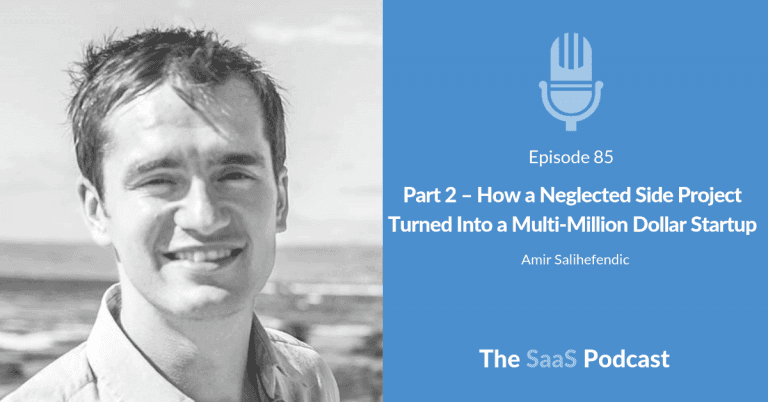
This is part two of the interview with Amir Salihvendich of Duist, the makers of todoist, in episode 84.
In part one of the interview, we talked with Amir about how he actually abandoned Todoist when it was still a side project and he decided to accept a full time job with a startup and how he basically put the product on the shelf for about four years until he recognized that there was actually an opportunity to turn this side project into a real business.
And then we sort of explored how he went from quitting his job and within three short years building a company with generating multimillion dollars in revenue and having over 40 employees.
In this episode we're going to talk about the importance of finding the right distribution channels and how that can help you reach the right users and customers.
We also talk about why Amit believes that building a minimum viable product too quickly can actually be a bad idea.
How he manages his team of 40 people who all work remotely and in an environment where they have very few meetings.
And we also talk about how he manages his own day and priorities and some of the key lessons that you as an entrepreneur can apply in your own life.
So let's get back to the interview.
So I'm kind of intrigued by this.
I had no idea that you had sort of left the Todoist for four years in sort of maintenance mode and it still kept growing.
And so 2012, you come back, you start working on it, you hire that first person, and then it was just a short three years after that.
And where, you know, I know you guys don't disclose revenue, but you did tell me that you're talking about multiple millions of dollars revenue and you're profitable and you've got what, 40, over 40 employees now.
What happened in those three years that just, just things seems to have just exploded?
Amir Salihefendic (02:34.840)
Yeah, I mean, I'm actually, I'm kind of unsure myself.
But I think also, like it's really fueled by also the people that we have hired, the products that we have built, and the amounts of energy that we actually invested in this.
So it's kind of, there's no real formula for this.
It's just like working really, really hard and really trying to put out something that's of great quality and just doing that over and over and over.
Again,
Omer (03:13.220)
did you start doing marketing to drive that growth or was it still organic?
Amir Salihefendic (03:20.100)
Actually, we hired marketing very late in PR, so I think we hired that in 2013.
So it was not really fueled by PR marketing.
Right now we have some amazing people working in marketing in pr and every release we get a lot of publicity, but back then we didn't really do that.
I think one of the most important parts of the Today story is also understanding the distribution channels and I think we nailed that part.
So basically the Google search engine is very important.
But then also we got some really great mobile apps and they are also highly ranked in both the App Store and Play Store and this also generated a lot of traffic to us.
So I would say marketing not in the general sense of getting featured on Test Crunch, but more like marketing in terms of finding the right distribution channels and the right way to reach the users that you are interested in.
Omer (04:33.000)
So, so apart from Google, what.
What else?
What were those distribution channels that really worked for you?
So when you talked about mobile, was it just was.
Did you guys just focus on building a great app or.
Or did you actually do any sort of specific things to.
To try and improve, you know, how that channel worked for you?
Amir Salihefendic (04:56.680)
Yeah, I mean we were just focused on building great mobile apps, but like having great mobile apps open distribution channels.
So like you get new users in that find you via the stores.
So that worked really, really well for us.
And I think that's also probably one of the biggest challenges.
Like the first challenge is building a great product that users actually find useful.
And like the other challenge is like finding the right distribution channels and like reaching out your users.
And probably like the reason why Todoist has grown so much is because we nailed both of these properties.
So like we have a great product, but we also have like a great distribution of it.
Omer (05:40.480)
Yeah, you know, I've seen.
I mean, full disclosure, I'm a Todoist user and customer myself, but yeah, I mean it's available on Android, iOS, Windows, Mac.
It integrates into browsers and I noticed you guys are doing even Evernote integration now as well.
That was something I didn't know about at all.
But it sounds like a lot of work trying to maintain all these different versions of the product.
Amir Salihefendic (06:12.519)
Yeah, I mean that is definitely like it's.
And it's also.
It's a very complex product and it's a very complex problem space because like we are solving the same problems like Dropbox, like synchronization between devices, synchronization of like data, real time Syncing and right now we also have natural language passing built in our mobile apps.
So it's really like getting very, very advanced as well.
And I think that's also something that really is important is like when people think about doing something simply or like MVP or something like that.
I don't really think that is the goal.
The goal is to build something really powerful that's very easy to use.
Omer (07:05.930)
What do you mean about that?
Tell me more about that.
I'm not sure I understood the point.
Amir Salihefendic (07:12.490)
So a lot of the startups I see, especially from new entrepreneurs, is that they go out and their MVP is like some kind of dummy solution that they code in a week or something.
And I think that is probably not the kind of simplicity you want.
You want to build something that's very powerful but is easy to use,
Omer (07:42.970)
if
Amir Salihefendic (07:43.250)
you understand what I mean.
So if you just do a to do list and do it without any kind of advanced features, just a flat to do, you will have no growth there.
You will not solve the main problems that people have.
And to do app is just an example.
Omer (08:04.650)
What was the powerful thing that you built when you created the first version of the product back in 2007?
Amir Salihefendic (08:12.330)
I would probably say like, subtasks were very powerful and like date parsing was very powerful and like even today, like none of our competitors have the subtasks and sub projects that we have.
They don't have the date parsing that we have.
This said, like, I think also this can be very, very dangerous.
And that's something that I really regret that I didn't think enough about the feature set or like the API or how it will work together.
So like right now when we design stuff, we are like much more.
We have a much better design process of doing that.
And I think that is really, really important is really thinking things through before you implement them.
Because, like, right now there's a lot of things that we can change because we have so much legacy and users using this.
While we could have had some better solutions for some of the problems that we have.
Omer (09:16.070)
Let's talk about productivity.
And what does a typical week for you look like?
How do you organize your time and your day?
What's the process that you go through?
Amir Salihefendic (09:33.270)
So actually the thing to note about me is that I'm actually still developing, so it's probably not that I do this, but you know, I really enjoy the development process and you know, hacking around on stuff.
So, like, I spend a lot of time developing stuff, you know, just with a code editor and then I Usually do this in the morning.
So when I wake up I probably spend like three or four hours developing.
And then after that I go in and respond on our team communication app, like Slack or Email or teamcom that we are using.
And then I maybe have.
Omer (10:22.100)
What time do you wake up in the day?
Amir Salihefendic (10:24.900)
I usually wake up like at 8, 8:30.
I'm not like an early riser.
I have never been.
So I start my day pretty late.
It's actually something I want to change, but I have not changed it like in 30 years I would probably not change it.
Omer (10:42.660)
Yeah, I started doing that.
I started waking up at.
I've always been like a night owl.
Never saw myself as a morning person.
And for the last few months I started waking up at 5am and it was really powerful and it was really hard at first and I found myself getting more and more productive just.
Just because there seemed to be these early hours where there was nothing going on.
But I found over the last few weeks I'm falling back into my old pattern of waking up between, you know, around 7 or something like that and.
And I. I don't know, I think.
I think whatever works for you, it doesn't really matter, right?
I mean, it's still the same.
It's still 24 hours with whatever time you wake up, right?
Amir Salihefendic (11:27.270)
Yeah.
Omer (11:28.070)
Okay, so you do the coding and then you focus on the team communication and Slack and sort of what else?
And so do you go into an office or do you always work from home?
Amir Salihefendic (11:40.630)
I usually go into an office.
We have like an office here.
And the reason for this is that I like to have a separate space.
Like home is where I don't work when I come home.
You know, I focus on the home stuff like being with my wife and relaxing, reading stuff and stuff like that.
So I prefer to work from an office.
Omer (12:05.200)
That.
That is great advice.
And I think for me as well, because I left my corporate job last year and work from home and actually that has been one of the biggest challenges for me is that everything has just blurred so much now.
Right.
It's like in terms of the hours that you work and personal life and, and you're doing, you're kind of.
Everything is just so mixed up.
It's much harder to just manage.
Manage your day and get things done and have enough time, as you said, for your.
For your personal life as well, and not find yourself that you're working all the time.
Amir Salihefendic (12:41.130)
Okay.
Yeah, I mean, I would like, if I work from home, I would probably work all the time and you know that is very bad for your, you know, personal life.
So.
Omer (12:51.510)
Yeah.
Okay.
So what else does a typical day or a week look like for you?
Amir Salihefendic (12:58.710)
Well, that is.
That is the typical stuff.
Like, I do actually very few meetings.
Like, I have probably a few meetings per week.
I don't really like meetings that much.
I think they are, like, very unproductive.
Yeah.
And actually, like, in dueist, we have very few meetings, so it's probably not the typical, you know, remote work setup.
Like, what we really care about is producing great work.
And also, like, the communication is mostly written.
Omer (13:35.680)
And so tell me about that.
How do you do that?
Is it.
Amir Salihefendic (13:38.280)
You.
Omer (13:38.440)
You mentioned slack earlier.
Is that the main way you're doing that, or do you have other ways to.
Amir Salihefendic (13:44.340)
No, I mean, that is like the main way.
And actually we are currently doing, like, a team communication app that we also using.
So it's pretty exciting to also build, like, a tool that you're using yourself.
Omer (13:56.900)
Cool.
And presumably you guys are using todoist as well as a big part of the business, right, to run it?
Amir Salihefendic (14:02.180)
Yeah, definitely.
Omer (14:04.820)
Okay.
Amir Salihefendic (14:05.220)
I mean, for me, like, also, the way that I really structure my work is from todoist.
Like, all the emails that are respond to all the meetings go there, all the tasks that I need to do, and I prioritize stuff, you know, so my life is basically, like, controlled outside of todoist.
Omer (14:24.390)
Let's talk about that.
Because, you know, I don't want this to become a, you know, a sales pitch for todoist and.
But I do want to kind of dig into how you use that product and to manage your day because.
So let's start with email.
So, I mean, email is a big thing that takes up a lot of people's time.
How do you deal with email and how does todoist play into that?
Amir Salihefendic (14:57.150)
So basically the thing is I have the Gmail plugin installed and I basically delegate stuff that I need to do.
So I turn emails into tasks, and then I also try to process emails in batches instead of processing it one per time.
I allocate 30 minutes to process all my email, and then the stuff that I can't do right away I turn into tasks.
And then I specify a day I want to do it Monday, Tuesday, depending on the priority it has.
Omer (15:31.450)
Okay.
And how often do.
How many times a day do you check your email?
Amir Salihefendic (15:36.650)
I would say probably like two or three times, depending on what I'm doing.
If I'm doing a lot of coding, I don't check it that often.
Maybe even once per day sometimes so
Omer (15:50.250)
you go through a couple of times, you process the mail, and you kind of are basically trying to get everything out of your inbox and into todoist in some.
Some kind of task.
Amir Salihefendic (16:04.810)
Exactly.
Cool.
Omer (16:06.250)
Okay, so that's email taken care of.
Okay, what's.
What's the next thing?
Because I think for when I think about this, there is.
You have a list of projects.
So do you track all your projects in there as well?
Amir Salihefendic (16:25.460)
Yeah, I mean,
Omer (16:28.740)
how many projects do you have in todoist?
Amir Salihefendic (16:32.100)
I have probably over 100, I think.
Omer (16:35.220)
Wow.
Amir Salihefendic (16:36.500)
And probably thousands of tasks, but, like, some of them are shared as well.
So it's not all my tasks.
Omer (16:45.700)
So that I got to figure this out because I spent a lot of time in the last few years with the sort of the David Allen getting thing done kind of philosophy.
I know there are a lot of people who listen to this show who also are into gtd, but one of the things that I found really difficult is that once you start putting everything into a tool, whatever tool it is, right.
It could be todoist, it could be something else.
You can get to a point where you open up that app and there's like so many things on that list.
Like, I just don't know where to start.
Right.
So what advice would you give somebody like me?
Like, how do you sort of tackle that?
You know, it's great to get all of this thing into a system somewhere, but how do you decide what to actually work on?
Amir Salihefendic (17:48.880)
So basically, like, the thing I use a lot is the calendaring functionality of sudo is.
So basically, I assign tasks on different days, and then I also use priorities to specify what is a top priority for this day.
And then I move stuff around.
So if I can't do make something this day, I postpone it to another day.
So really, for me, that's how I filter stuff.
Like all of these tasks that I have, I only see like a fraction of them and work only on fraction of them and only work on those that have a date, like on Monday.
I want to achieve this, this, and that, and I don't really go into all the data that I have there.
Omer (18:36.810)
Okay, so just if I got this straight, so you're.
You're taking those tasks, you're assigning them to a particular day so you don't see everything at the same time.
And then you're using the.
You're going through and sort of prioritizing them and then sort of starting to work on the things that are at the top of the list.
Amir Salihefendic (18:53.210)
Exactly.
Omer (18:54.010)
Okay, now if you have a hundred projects, how often do you go through all those projects and figure out if there's something that needs to be done in there?
Amir Salihefendic (19:05.140)
Oh, that is a good question.
I mean, I'm also the thing like I worked very specific and very focused on something.
So like it could be just.
I go into a subset of these projects and just like focus on like let's say date passing of todoist and then going too deep into that and you know, that project maybe has a lot of bug reports or whatever or feature requests or whatever.
And then I go into this and the same like with other products.
So I only like zoom in when I think it's important to do that.
Other than that, I don't really go into it.
Omer (19:50.070)
How do.
A lot of times I hear people and I'll talk to.
So I had Rob Ross and on the show, the founder of Time doctor and one of the important points that he made was it's not just about what you work on.
It's also just as important what you say no to.
Do you subscribe to that same philosophy?
Do you actually spend a lot of time like going through and deciding what you're not going to do or, or having a list somewhere where you capture these things that you're never going to work on or how do you tackle that?
Amir Salihefendic (20:29.670)
I think that is a very, very good tip.
So like, we all have very limited times and especially like for very busy people, I think like they have so limited time to work on something and I think it's very important to.
To focus on the essential stuff and ignore everything else.
So definitely we are thinking a lot about what do we want to spend energy on and what don't we want to spend energy on?
Because else your focus will just be all over the place and your energy as well.
Omer (21:05.319)
Yeah.
What else do you do on a weekly or daily basis to.
I'm just.
Amir Salihefendic (21:18.000)
So.
Omer (21:18.360)
So you mentioned some of the things and the more you tell me, the more I sort of start to feel overwhelmed because are you using it also as one place to track all your bugs and feature work as well?
Amir Salihefendic (21:29.840)
Yes.
So.
Omer (21:33.560)
But you guys really do use this for everything.
It's like amazing.
Amir Salihefendic (21:39.040)
Yeah, I mean it's a pretty versed, like it's a great tool.
But the thing is like, we are also trying to improve this aspect of it and I think also in the near future we will do a lot better features for like team usage and business usage.
So currently it's like mostly really, really good for personal usage, but like for team Productivity is not really that great.
So that's what we are trying to improve.
But actually one of the tips I really want to recommend, and this is like, really about team collaboration and working with other people.
And something that has really worked well for us is that we have implemented an OKR system.
I'm unsure if you know what OKR is, but basically I think it was intel who first implemented this.
And it's basically like, here's how we do this.
Like, Google and Intel have very different versions.
R is like super simplified.
So each Monday, each team and each team member post the okrs for this week.
So basically they say, like, what is the biggest objectives for this week?
What did I accomplish last week?
And how do I rate my accomplishments last week?
And this has worked really, really well for us.
And I would recommend to do this.
And I think also, like, some of the things that I will try to do, this is also like, for a personal productivity, like, have an okr, like a weekly and a monthly okr, where you say, okay, this is the most important stuff for this week and for maybe the whole month.
Like, what do you want to accomplish this month?
In our work before we did these okrs, you didn't really know what people were up to and people didn't really reflect over their work.
With okrs, it's very powerful because you specify what you want to achieve, but you also reflect on what you have achieved last week.
And actually right now we have weekly okrs and monthly okrs and I can really recommend this.
Tip.
Omer (23:49.090)
Where do your team post this information?
Amir Salihefendic (23:53.570)
So we are using our own messaging app, but you can do it via an email.
There's also apps that are specific to this.
We have actually checked them out.
We do not recommend or I do not recommend to use them.
It's like much easier to.
You could also do it like inside Slack or email or any kind of a team communication app.
Omer (24:17.310)
Got it.
Amir Salihefendic (24:17.950)
Okay.
Omer (24:18.470)
And then do you actually spend time going through and reading all these okrs every week?
Amir Salihefendic (24:25.230)
Yes.
I mean, that gives me like a very clear picture of like, what everybody is working on.
And also each team member has to specify, like any kind of bottlenecks they are having on some kind of thing.
And maybe somebody else can help them out with this.
Omer (24:43.580)
You know, I come from a culture, a corporate culture where meetings were the way of life.
Right.
I agree that they mostly meetings are a huge waste of time.
And actually I just sometimes when I look back at the hours or years of my life that I wasted sitting in pointless meetings, it just Makes me feel horrible.
But there are often situations where having a meeting actually is really valuable, where you want to have people together, you know, maybe in front of a whiteboard to collaborate and brainstorm how a feature should work, or designing.
Designing a particular aspect of a feature or a product.
If you guys aren't having that many meetings, how do you handle those kinds of situations and sort of collaborating with the team on building the product?
Amir Salihefendic (25:50.600)
I don't really think, like, meetings are the best way to come up with the best solutions.
I think, like, the written form, where you really think carefully about something, where you try out, like, for instance, designers try to mock up stuff, developers try to, like, mock up stuff, like APIs or whatever.
And really, like, I think it's a much more powerful way of reaching a really good solution.
And I think also it depends on the people.
We do have whiteboards and we do occasionally use them.
And you can even have a whiteboard discussion with remote people.
Everybody can have a whiteboard and scribble stuff onto, but it's not really how we work.
We use it sometimes, but most of the time we really go deep into something and then like, for instance, we discuss something, present our view of how things should work, do some mockups, and really have like, a strong design process that's like, careful and not like something that just happens on a whiteboard or like happens in a meeting.
Omer (27:05.700)
So a lot of people listening to this are entrepreneurs.
And from your experience, the time that you've been working in the productivity space, what are some of the common mistakes that you think that you see entrepreneurs making when it comes to managing their time and productivity?
And what are some tips that you think might help people just to become a little bit more productive?
Amir Salihefendic (27:36.690)
Yeah, I mean, I think the biggest tip I can provide is basically having a system that's up to date all the time.
The thing I see a lot of the time is that people commit to some kind of system, but they only commit to it for like a week.
And I think for a system to be efficient, you really need to commit to having it updated and use it all the time.
So you should not freestyle at any point and just do stuff because you want to do them.
Of course, you can allocate time to be creative or whatever, brainstorm and stuff, but that should really be part of your system.
So for me, I have everything inside todoist and that helps me manage stuff, prioritize it, and get an overview or, you know, how am I going to spend my days?
And I can recommend the same thing.
For people.
Omer (28:40.000)
Okay.
Are there any other mistakes that you see people making?
Amir Salihefendic (28:44.720)
I think also, like, the tasks that you add should be actionable and you should really try to write as specific tasks and as small task as possible.
Of course, like, you should not really overdo this, but I think, like, for instance, if you want to get, you know, drop some pounds, then you should not have a task that says lose weight.
Like, you should be much more specific, like, you know, run three times per week or, you know, eat more fruit or three times a week.
Like, very specific tasks that help you achieve this goal instead of having something that's very big and even with features that you want to implement.
Or you should be much more specific on this and you should try to split it up.
So, for instance, if you're a developer, you would like to split things up.
For instance, if you're developing a feature like brainstorm the solution, implement the test suite, implement the actual code, test it, and then this would be like, for a task instead of just one.
And even if you're working on a much more complicated problem, try to split it up into manageable chunks that you can work on.
And I think also having this plan makes it much easier to do stuff because you're doing small chunks that can help you achieve the main goal.
And, you know, you do it one step at a time.
Omer (30:23.980)
Awesome.
Okay, those are really good tips.
Thank you for sharing those.
Amir Salihefendic (30:28.700)
Let's.
Omer (30:29.500)
Let's get onto the lightning round.
I'm going to ask you seven questions and I just want you to try and answer them as quickly as you can.
Amir Salihefendic (30:37.860)
You ready?
Yes, I am.
Omer (30:40.220)
All right, let's do it.
So what's the best piece of business advice that you've ever received?
Amir Salihefendic (30:45.000)
That's very difficult, but I think it's probably to follow your passion and not really think about the business that much.
Just do something that you are really passionate about and that you want to see happen.
Omer (30:59.880)
What book would you recommend to our audience and why?
Amir Salihefendic (31:03.880)
I would actually like.
Given that it's mostly developers, I would recommend some of the design books that are there especially.
I mean, one of the things I really enjoyed was Johnny I've's biography.
I recommend reading that.
And I think like a lot of developers, they are really, like, restricting themselves by not really understanding design.
And right now design is as important as development and the code itself.
Like, if you don't really have great design or great design sense, that will really hurt you.
Omer (31:44.250)
What's one attribute or characteristic in your mind of a successful entrepreneur?
Amir Salihefendic (31:48.970)
I think it's Persistence and not giving up.
If you see the story of todoist, I never gave up on it and I even abandoned it and returned back to it.
But I just kept at it and I didn't really listen to other people that much.
So like just believing in yourself and you know, going after something.
And I think also, you know, success does not really happen overnight.
Like you need to put a ton of time into it and you also have to have a great timing and etc.
So I would say persistence and, you know, just going at it.
And I think also like a lot of people are really, really fast to give up very soon.
Like, you know, you do something, it doesn't have attraction right away, you give up and ignore it.
So I think like persistence.
Omer (32:47.819)
What's your favorite personal productivity tool or habit other than todoist?
Amir Salihefendic (32:54.220)
I would probably say focus.
So like I'm really good at focusing on stuff and I think also shutting everything down like email, twitter, hacker news or whatever else you have and just like focusing on the problem at hand and solving that, that's very important.
Omer (33:11.260)
What's a new business idea that you'd pursue if you had extra time?
What is one of those sort of crazy ideas in your head that you wish you could do but just never have time to pursue?
Amir Salihefendic (33:24.300)
I'm really passionate about artificial intelligence and like AI driven tools.
I think that's going to be like the next revolution.
So I would definitely like to invest a lot more time into that and seeing like how you can integrate AI in different products.
I think, like, if you see the advancements that are happening right now in AI, like Skype, live translation of different languages, which is awesome.
Yeah, I mean that's really amazing.
And I think this is only a start and I think the next step would be trying to integrate this in all the tools that we have and everything that we do.
Omer (34:14.100)
What's an interesting or fun fact about you that most people don't know?
Amir Salihefendic (34:18.500)
Okay.
I don't think many people know this.
Like when I was a teen, I played a lot of Age of Kings and I was actually one of the best players in Europe and I also wasted a ton of time doing that, which I regret right now.
Omer (34:36.080)
Maybe that's why you're making up for it with the productivity.
Amir Salihefendic (34:41.120)
Yeah.
So like it should be said that I was not always that focused on productivity.
Omer (34:48.980)
And finally, what is one of your most important passions outside of your work?
Amir Salihefendic (34:53.940)
I would say like learning and reading.
Like, I spend a ton of my time on reading stuff.
It could be books or articles or like following Coursera courses.
So learning I would say.
And I think also like this is really important for any entrepreneur.
It's really like learning stuff and becoming better in all the aspects.
I have read a lot of books on marketing, on design and I think this gives you a much, much better perspective of everything.
And I think also one of the reasons why Todoist has had so much success like the last couple of years is because I read a lot about it and then implemented this inside the work that we do.
Omer (35:48.140)
Amir, it's been an absolute pleasure talking with you.
Thank you so much for being so generous with your time.
If people want to find out more about Todoist they can go to todoist.com and if they want to get in touch with you, what's the best way for them to do that?
Amir Salihefendic (36:08.990)
Well, it's via Twitter I think.
I usually tweet a lot of stuff.
Omer (36:12.990)
What is your twitter handle?
Amir Salihefendic (36:15.310)
It's amix3k.
Omer (36:19.550)
I'll put that in the show notes.
So if people want to reach out to you, they can do that.
Amir Salihefendic (36:23.310)
Awesome.
And I would also like to thank you for having me here.
I hope this was useful for the people and I must actually also unsure if it was like very technical or if the advice is very good.
I think it was like one of the problems is advice is very subjective and very context driven.
So I'm not sure if people can apply this to their business or to their life.
I hope they can, but everything I think should be taken with a grain of salt.
Omer (36:59.050)
Yeah, well, I think the general, the general test for me really always been is if I find that I'm engaged with the guest and what they're telling me and if I find that I've got some, some good practical tips that I can take away, it's been a very, very helpful thing and that's exactly what I felt here.
So it's been incredibly valuable for me and I'm sure people listening to this will, will find that too.
So thanks again.
It's been a pleasure.
And we didn't do too badly with the sirens.
I know there was a couple of them halfway through, but I think generally we were pretty lucky, so.
Amir Salihefendic (37:36.660)
No, definitely.
I think so as well.
But let's see and hear the playback.
Maybe it's really bad.
Omer (37:47.300)
Awesome, Amir, thank you again.
It's been a pleasure.
All the best.
Amir Salihefendic (37:50.940)
Thank you Omer and really good luck with your project.
I think it's very exciting.
I have actually not heard about it before.
I will sign up and check it out.
Omer (38:03.500)
Thank you so much.
I appreciate that.