Find a Blue Pond, Not a Blue Ocean
Go after a big market. Every pitch deck has the slide: a giant TAM, a land grab, a plan to own the category. VCs push for it because fund math needs outliers. F
How SaaS and AI founders who scaled got their first customers
One email every Thursday. Unsubscribe anytime.
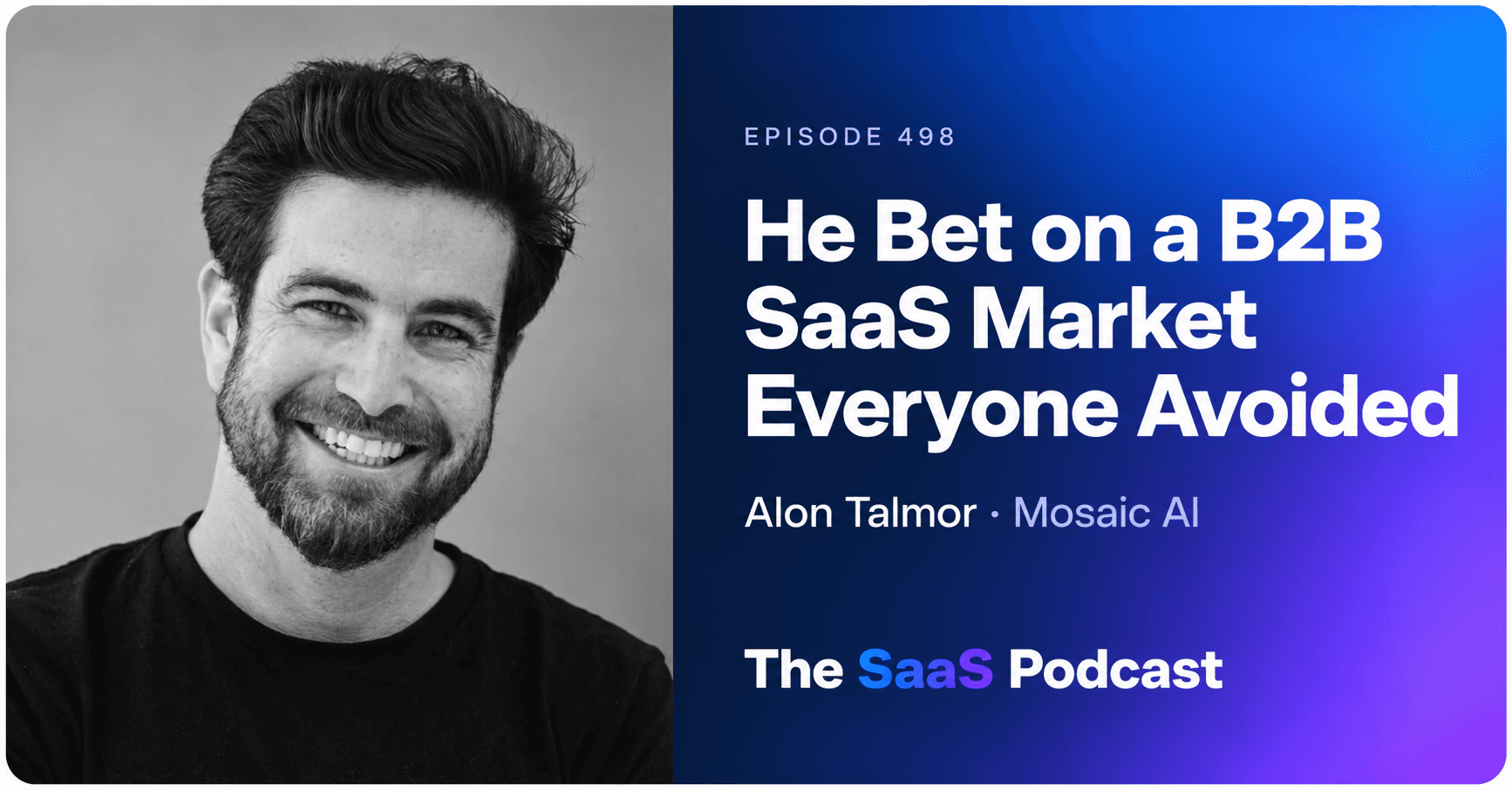
When ChatGPT turned Ask-AI's product into a commodity at close to $1 million in ARR, founder Alon Talmor rebuilt by narrowing into technical support, an underserved market rivals called too hard, and selling measurable cost reduction instead of features. Rebranded as Mosaic AI, the company is now at multiple seven figures in ARR, approaching eight.
In this episode, Alon breaks down how six months of listening to enterprises produced the original product, what he told investors when his co-founder quit in the middle of the seed round, why his number one competitor is customers building it themselves with AI, and the 5-day pilot that closes six-figure deals.
Alon Talmor is the founder and CEO of Mosaic AI, an AI platform for technical support at B2B software companies. The company, formerly Ask-AI, works with around 100 enterprise customers on six-figure contracts and has grown to multiple seven figures in ARR, approaching eight.
Alon sold his first startup, BlueTail, to Salesforce and spent three years there as chief data scientist for Data.com. Instead of starting another company right away, he went back for a PhD in AI and question answering, publishing award-winning research in 2019 alongside the first wave of language models. From inside academia he saw what was coming, and in 2021, a full year before ChatGPT, he founded Ask-AI to bring AI assistants to the enterprise.
The bet worked at first. He spent six months talking to enterprises before pitching a single VC, landed Yotpo as a design partner, raised a $6.5 million seed after his co-founder quit in the middle of the round, and got close to $1 million in ARR with about 25 customers, all founder-led sales. Then ChatGPT launched, and Alon realized what he had built would become a commodity.
Rather than fight the AI giants for the enterprise assistant market, he looked for what he calls a blue pond: a market big enough to matter but too hard for generalists. Technical support, where resolving a case means replicating bugs, reading log files and knowing the product deeply, was exactly that. Mosaic now runs 5-day pilots that convert skeptical enterprise buyers by measuring one number: tickets resolved per support engineer per day.
Alon also shares why his number one competitor today is customers building it themselves with AI, and how he reframes that conversation to win.
When ChatGPT commoditized Ask-AI's enterprise assistant at close to $1 million in ARR, founder Alon Talmor narrowed the company into technical support for B2B software, rebranded it Mosaic AI, and sold measurable cost reduction instead of features. The refocused company reached multiple seven figures in ARR, approaching eight, with about 100 enterprise customers.
Go after a big market. Every pitch deck has the slide: a giant TAM, a land grab, a plan to own the category. VCs push for it because fund math needs outliers. F
Alon Talmor's number one competitor at Mosaic AI isn't another vendor. "Our number one competitor is build versus buy." Now that AI coding is cheap and fun, ent
Most founders validate backwards: raise first, then find out what to build. Alon Talmor did the reverse. Before pitching a single investor for Ask-AI, he spent
End of 2021. Alon Talmor is raising a seed round for Ask-AI with a co-founder lined up as the COO. Mid-round, with investors engaged, that co-founder decides to
What should a SaaS founder do when AI commoditizes their product?
Alon Talmor's answer: narrow into an underserved market too hard for generalists, what he calls a blue pond, and sell measurable outcomes. Mosaic AI refocused from enterprise assistants to technical support and grew to multiple seven figures in ARR.
How did Alon Talmor find the idea for Ask-AI?
He spent six months talking to enterprises before pitching VCs. Yotpo's VP of delivery described knowledge scattered across tools that support and go-to-market teams could not answer from, and that problem became the product.
How did Alon Talmor raise a seed round after his co-founder quit mid-raise?
He told investors the truth immediately. The round closed at $6.5 million, and the lead told him afterwards they preferred backing him solo. His rule: investors sense it when a founder prettifies reality.
How did Ask-AI get its first 25 customers?
Founder-led sales: Alon's own calls, emails and connections plus an SDR service. Of 10 to 20 cold attempts, 2 or 3 took a call. The first sales leader arrived in late 2023, as the company approached $1M ARR.
Why does Mosaic AI focus on technical support instead of all customer support?
Technical support is underserved because it is hard: resolving a case means replicating bugs, reading log files and knowing the product deeply. Conversational AI vendors stay end-user facing, which leaves the segment open.
How does Mosaic AI win the build vs buy conversation?
By changing the metric. Internal builds ship features with no measured result, so Mosaic leads with a diagnostic across the customer's tickets and a 50-70% support cost reduction target, moving the conversation from building to value.
How does Mosaic AI close enterprise deals with a 5-day pilot?
A diagnostic on about 1,000 tickets shows which automations to build and deploy. The pilot then measures tickets resolved per support engineer per day; one customer measured 80% growth in a single week.
Why does Mosaic AI use tickets per engineer per day as its core metric?
Ticket volume rises as customers trust support more, and time-to-resolution misleads because engineers bounce between cases. Throughput per engineer is the number that holds up to buyer scrutiny.
What does Alon Talmor think the enterprise looks like after AI agents?
Agents orchestrating people: systems that see everything happening in the company and tell each person the most important thing to do next. He calls people orchestrating agents the faster-horses version of the future.
Alon Talmor [00:00:00]:
It worked well in the beginning. We're selling to companies like Monday.com and we got close to a million and then ChatGPT came out and we realized that what we built is going to become a commodity. It's just a matter of time. We were going on too big of a market. We saw the LLMs getting funded like crazy.
Alon Talmor [00:00:19]:
OpenAI, you know, Claude. And we thought, okay, if we go for the enterprise AI assistant, they're going to eat our lunch.
Omer Khan [00:00:28]:
Welcome to The SaaS Podcast. I'm Omer Khan and this is the show where I sit down with real founders and dig into how they actually built their SaaS and AI companies. I've had over 500 of these conversations now and I put out a new one every week to help you build and grow your startup.
Omer Khan [00:00:43]:
If that sounds useful, hit subscribe or check out saasclub.io to learn more. My guest today is Alon Talmor, founder and CEO of Mosaic AI, which automates technical support for B2B software companies. He started the company a year before ChatGPT existed and got close to a million in ARR.
Omer Khan [00:01:03]:
Then ChatGPT came out and turned his product into a commodity. Today he's at seven figures, closing in on eight. In this interview, Alon breaks down how he spent six months getting his foot inside enterprises and how those conversations showed him exactly what problem he needed to solve.
Omer Khan [00:01:22]:
He talks about what he told investors when his co founder quit in the middle of a seed round and why his number one competitor is his customers owned dev teams building with AI. And he shares how he uses a five day pilot to turn skeptical enterprise buyers into six figure deals. So I hope you enjoy it.
Omer Khan [00:01:43]:
Alon, welcome to the show.
Alon Talmor [00:01:45]:
Hey, pleasure meeting you. Thanks for having me.
Omer Khan [00:01:47]:
Yeah, same here. So tell us about Mosaic. What does the product do and who's it for?
Alon Talmor [00:01:54]:
Well, Mosaic is essentially an AI platform solution for technical support. What's technical Support? Well, in B2B companies, support is very different than what you're used to, let's say in Uber. In Uber you're used to saying, what's happening with my order? Why is the driver not here?
Alon Talmor [00:02:13]:
And enterprises, or like a family physician, you're trying to solve a pretty big problem for customers, typically troubleshooting, misconfigurations, bugs, stuff like that. And so it becomes hard to do that. You need to replicate the problems, you need to understand the product, you need to connect it to all the company sources.
Alon Talmor [00:02:31]:
So we built a really deep platform to go about that. We're one of the only companies in the world that are looking into technical support and trying to lead this, this segment.
Omer Khan [00:02:41]:
So what type of organization needs a product like Mosaic?
Alon Talmor [00:02:46]:
Well, typically it's an enterprise, probably more than 100 people, even though the ones that are even smaller still have that. And we see that in abundance. And they're typically guys that have a lot of product.
Alon Talmor [00:02:59]:
And we're actually seeing that shift happening more and more today in which companies are building a lot of products because building is, is faster today. R and D teams have faster and faster cycles with AI. Whereas go to market teams in B2B are predominantly human. And that's probably going to stay like that.
Alon Talmor [00:03:17]:
People buy from people, people have empathy, people want support from people. The problem is that the human mind has not gotten bigger with capacity to know more product. And so we need help in order to support these kind of products. And that's the type of companies we go after, the ones that, that have an abundance of product.
Alon Talmor [00:03:37]:
Yeah.
Omer Khan [00:03:38]:
Great. And give us a sense of the size of the business. Where are you in terms of revenue, customers, size of team?
Alon Talmor [00:03:44]:
Yeah, so seven figures approaching to eight and size of team is about 70 to 100 depending on how you count. And we have go to market in Toronto, we have an R and D in Tel Aviv. And yeah, we're mostly hybrid so we kind of perish pretty people working together, hybrid in an office.
Omer Khan [00:04:08]:
And roughly how many customers do you have today?
Alon Talmor [00:04:10]:
Well, it's about 100. It's bigger and bigger customers, pretty much pretty high ACVs. And the reason is that we support pretty big technical support organizations, but we also price per cost reduction. The good thing about support is it's a cost center and you know exactly how much it costs. Typically technical support costs a lot.
Alon Talmor [00:04:35]:
You would find that technical support organizations can cost somewhere between 20 to 50 million annual for companies of size, 1,000 to 5,000 employees. And so even if we reduce by 20, 30% that cost, that's already a very big ROI. So we can charge six figures, almost approaching seven.
Omer Khan [00:04:55]:
Wow. Okay, great. So let's talk about where the idea came from. But before we do that, I think you have an interesting background. Mosaic wasn't your first startup. You initially founded a company called BlueTail, which was acquired by Salesforce. What did that product do?
Omer Khan [00:05:14]:
And just tell me about the journey briefly on how you ended up in Salesforce.
Alon Talmor [00:05:19]:
Sure. So you know, I come from some well known intelligence unit In Israel called a 200, which a lot of startup guys come out of. And then somewhere around 2009 I got with me a few friends and we opened what we call back then BlueTail. We were starting as a bootstrap company way back in 2009.
Alon Talmor [00:05:40]:
Raising funding was not so easy after 2008. But also being bootstrapped was different than today, right? You didn't have cloud code to build everything for you, so you needed to have a side job while you're building. And so the idea was we came from data science background and we learned a lot about aggregating public information. Back then.
Alon Talmor [00:06:04]:
Social media was new, so we built earlier versions of what today is zoom info in which you take all the public data and create profiles that are quote unquote LinkedIn on steroids for salespeople, marketing people and that can help them approach people and know more about their audience.
Alon Talmor [00:06:21]:
We were selling to west coast company like Marketo and we started selling to Salesforce until at some point Salesforce offered to acquire us. They were building data.com and the earlier versions of the data cloud and so yeah, we got sold to Salesforce and I was chief data scientist there for data.com and I was there for three years.
Alon Talmor [00:06:43]:
All my co founders went to open startups I think pretty successful nowadays. And I went to do something a little bit strange for entrepreneur. I went to do a PhD in AI and NLP, found a professor coming back from Stanford. He was randomly lecturing. I was a little bit lost.
Alon Talmor [00:07:01]:
Like I was traveling the world trying to figure out what I want to do. Right? It happens to founders sometimes that, you know, after a big wave there's kind of a drop in tension and then you're trying to figure out who you are. So.
Alon Talmor [00:07:13]:
But I, but I thought, you know, I'm not going to open another data aggregation company. Even though back then it was pretty popular to do that. And the professor came out to the seminar and put on the board a question from another professor called Michael Jordan.
Alon Talmor [00:07:28]:
It's not the same Michael Jordan as an ML professor called Michael Jordan. And the question was, what's the second biggest city in the US that has a river next to it? He said, 2016, if there's going to be an AI that would be able to answer that question in the future, that would be worth billions. He said.
Alon Talmor [00:07:45]:
So back then I thought, wow, for an entrepreneur that's pretty interesting, right? So how do you answer that question with AI? And so it started by like a little bit of research with that professor and eventually it turned out to a full on PhD thesis around reasoning for question answering.
Alon Talmor [00:08:03]:
We even got a best paper with one of the first language models out there called BERT that was 2019 alongside another language model called GPT1. So yeah, we got to know a lot of the people that were involved in the whole revolution and got to see it fortunately in academia. And in 2020, PhD ended.
Alon Talmor [00:08:25]:
We pretty much first saw how chat versions of the GPT is going to be trained. I even talk about it in the theses, how you would get gamifications in people and annotators and try to get that effect. What we didn't foresee is the amount of hype and impact on society and civilization and humanity.
Alon Talmor [00:08:47]:
And so in 2021 we already realized something big is going to hit industry. I was researching in Allen Institute for AI or AI 2 back then and I took with me a bunch of professors and PhDs to open what we called back then Ask-AI. That was about a year before ChatGPT.
Alon Talmor [00:09:04]:
Ask-AI was supposed to be an early version of an enterprise AI assistant. So today we all know Claude and other assistants that we have preference to use. And back then that was pretty new. So we kind of connected to all the enterprise data. We had about 100 connectors.
Alon Talmor [00:09:23]:
We'd be able to adjust all the data, create a context layer, understand the ontology and topology and everything there is to know about the lingo of the enterprise and then on top of that, create an LLM layer that would be able to assist you.
Alon Talmor [00:09:39]:
And we were a little bit generalist in that sense and it worked well in the beginning. We're selling to companies like Monday.com and we got close to a million. And then ChatGPT came out a million in ARR. And once ChatGPT came out, we realized that everything is going to change now.
Alon Talmor [00:09:59]:
And we realized that what we built is going to become a commodity. It's just a matter of time.
Omer Khan [00:10:09]:
So before you go into that a little bit more Alon, because I think that's super interesting. I just want to ask a couple of questions about Ask-AI. You sort of decided you weren't going to solve that City river type question.
Omer Khan [00:10:26]:
You were going to go and help enterprises with all of this information that they had, which on its own is a huge problem to solve anyway. But one thing I noticed was that with BlueTail, I think there were five or six co founders.
Omer Khan [00:10:42]:
And with with Ask-AI, were you, Were you, did you go in there as a solo founder?
Alon Talmor [00:10:47]:
So yeah, we had about four, I think. And yeah, one way to bootstrap is to have a lot of co founders that are bootstrapping with you. Well, that's leverage, right? With Ski, we realized it's going to be timely. So we thought, yeah, this probably go the VC route. I did have a co founder.
Alon Talmor [00:11:11]:
The story is that I tried to have a co founder and back then at the end of 2021 it was a happy startup time. What do I mean? Like, you know, There were like two waves of changes in the VC.
Alon Talmor [00:11:26]:
One of them happened in 2022 and in which raising money became harder and the market changed a little bit. And so back then there were a lot of people that were looking to get into startups saying, oh, money is easy, so maybe I become a founder of a startup. Right. Well, it's obviously easier said than done.
Alon Talmor [00:11:45]:
And then once we were already in a funding round, the co founder that was supposed to be CRO, coo, he decided to continue with the company that he was working in. And I was left pretty much alone and around. So I had to close the round.
Alon Talmor [00:12:06]:
And that was extremely hard because then the VCs already are looking at you with a co founder that just left you in the middle of the round.
Omer Khan [00:12:16]:
Yeah. The interesting thing for me was that maybe some founders under the pressure of closing that round might not have mentioned what happened. But you didn't do that. You went to the VCs and you told them the ugly truth that you had just lost this person. Were you concerned that this might jeopardize the funding?
Alon Talmor [00:12:44]:
For sure. I just don't know a way around it. Right. One is too obvious and so the truth is too obvious. So if you start to go around it, there's one thing investors hate is mistrust.
Alon Talmor [00:12:59]:
I see a lot of founders that have friction with investors and when you look at the relationship there, they tend to try to pretty the reality.
Alon Talmor [00:13:07]:
And investors have seen so many companies that they feel it, they feel when the reality is trying to get too pretty and when the founder is not telling them bad news and when it's not up front. And by the way, I don't think it's just founders versus VCs.
Alon Talmor [00:13:24]:
I think it's every employee with their every boss and every relationship in a company. You want to be bearing bad news sometimes and you want to be real because that's how you really build trust. And then the other person knows not to ask because they trust you that if something goes wrong, you would be upfront about it.
Alon Talmor [00:13:43]:
Right. Actually thought at that point, you know what, maybe I won't close the round. That's reality. But at least if I do, I earn their trust and that's what I try to do. Like, and after the round they told me that they actually, they told me something surprising that they actually preferred that I continued without the confounder.
Alon Talmor [00:14:07]:
So I found that amusing. I don't know if they told me just to make me feel better. Right. But yeah, you never know, right? Investors, you never know what they really think about the situation. You try to pretty reality to them but they are actually sensing they prefer something real always.
Alon Talmor [00:14:34]:
And I see a lot of investors saying, you know, like I see a lot of founders trying to think about what they should say to make me happy. No, same what you want to do that is true. Like that you feel. Because you don't know what would make me happy. Investors said and they're right.
Alon Talmor [00:14:52]:
Like they, they actually look at you and not, you know, have kind of oh, you should have three founders something. By the way, there were investors in that round that told me we don't invest in a single founder, thank you very much. As a rule they told me that and that was a little bit depressing.
Alon Talmor [00:15:08]:
But it is what it is, you know.
Omer Khan [00:15:11]:
Yeah. But you still managed to raise it?
Alon Talmor [00:15:14]:
Yeah, we raised six and a half million from. So yeah, it was one VC that started with four and then they left the term sheet open a little bit and then I found another co lead, Vertex Ventures in Israel and then. And yeah, we closed around six and a half million back then.
Omer Khan [00:15:36]:
Right. So initially with Ask-AI it was like basically a product that could help anyone in the organization. It wasn't focused on support. And you, you had a smaller ACV back then. You were telling me earlier that it took you about 25 or so customers to get to that first million in ARR.
Omer Khan [00:16:01]:
Can you walk through how you found those first couple of customers?
Alon Talmor [00:16:08]:
Oh, that's how we found the whole idea of working with the enterprise. You want to startup is bound to die so you want to minimize the risk of it dying. And the first number one risk is money. And so you want to from day one think about how does your idea. Unfortunately it doesn't sound so romantic. Right.
Alon Talmor [00:16:35]:
But how does your idea make money eventually? And yeah, if you're in a B2C world maybe there's ideas in which you just gain 100 million users and then you figure it out. But in the world of enterprise they're not willing to pay. You don't have anything. Right.
Alon Talmor [00:16:53]:
And so I started by talking not to VCs like six months before I talked to VCs I started talking to Enterprises, a company called Yotpo that was like about 700 employees Monday.com, HiBob, all sorts of bigger startups like that. 1,000 Employees, pretty much 2,000 depending on.
Omer Khan [00:17:17]:
How did you get in the door.
Alon Talmor [00:17:19]:
It was hard. Most of them didn't want to talk to me. You started figuring out, do you have a friend that knows a friend? And you come in as, can I listen to your problems?
Alon Talmor [00:17:31]:
But it's like, okay, so come in with some idea of what you want to do and we need to talk or something like that. But it's hard. You try about 10 to 20. If you do that kind of ideation, you try 10 to 20 and then 2 to 3 take the call.
Alon Talmor [00:17:48]:
And then if you're really lucky, one of them tells you what they need. You just talk to the VP and you ask them, so what do you really need right now, right? Like what would really change how you work or how your business works or change the outcomes for you or something like that.
Alon Talmor [00:18:06]:
And I remember it was the VP of delivery of the OTPO that told me, we have a huge problem internally and it's related to our knowledge. We have so many knowledge bases and so many knowledge sources and even the support ticket have knowledge and the CRM has knowledge and Confluence has knowledge.
Alon Talmor [00:18:23]:
Jira and the Slack has a ton of knowledge inside. And our CSMs and our support people and everyone in a go to market are not able to answer anything at this point. So many products as well. Then I thought, okay, that's an interesting problem. I came from the world of data, right?
Alon Talmor [00:18:39]:
And Salesforce aggregating data was part of what I would do. And so I felt, okay, I know how to bring all this data into one place. And he's talking about asking complex questions, right? So that relates to that question about the, what's the.
Alon Talmor [00:18:55]:
So the translation of that question about the second biggest city in the US with a river is like, what is your second biggest customer that I don't know has an escalation in the last week or something like that, right? So. Or is at risk, right? So you have a clear business translation to that problem, right?
Alon Talmor [00:19:15]:
So then I thought, okay, so we can actually solve his problem. And we built a prototype and he started testing it out internally, obviously for free, obviously as a design partner, right.
Alon Talmor [00:19:27]:
And we were like that for about a year with him for free, but he was saying that he would be willing to pay about 30k annual or something like that. So, so that's how we came to the investors, right, with, with a story. And I think nowadays it's, it's a must.
Alon Talmor [00:19:41]:
Like I, I Think investors would, you may have a good idea. If you have like some insane AI background, maybe investors would, would just invest in that. But investors today are looking for more attraction. I think.
Omer Khan [00:19:55]:
So did you raise the seed round before you got the 30k from this first customer?
Alon Talmor [00:20:00]:
We're pretty much the same time like he, we, we already got the intent to get like a few customers paying and we raised the seed with the customers vouching for that. Right. And then a.
Omer Khan [00:20:11]:
Few months.
Alon Talmor [00:20:12]:
After we got the payment. Yeah,.
Omer Khan [00:20:15]:
Great. So having a design partner is great. The danger always is are you building a solution for one and how did you tackle that?
Alon Talmor [00:20:24]:
You have to talk to five others pretty fast. Like the bigger mistake is go after a big enterprise and well, it's not a mistake. It depends on what you're selling. Some products need to be consumed by bigger enterprises. Right. And they have the problem and not mid market. Right.
Alon Talmor [00:20:45]:
But if you ask me, I prefer mid market because it's easier to get in the door and it's easier to sell. The cycles are faster and you typically get a few. And then once you get a few logos, you see what the common denominator is. Right.
Alon Talmor [00:21:00]:
Whereas when you go for a very big enterprise, they're expecting of you to be some type of subsidiary of theirs, they own you and they expect to have an RFI with a lot of demands and we should build it all because we're going to pay you millions and then you get blinded by oh, millions.
Alon Talmor [00:21:19]:
This is going to cover my oar, so I'm going to go after it and that's the trap. Right. You become their subsidiary, you build a lot of custom things that no one needs and then when you're trying the next customer, they don't need all that. Right. So they need something totally different maybe.
Alon Talmor [00:21:33]:
So that's why I like if you're going for SLG or enterprises in general, go for not the huge ones if possible. And if you are, try to go for a few, even though it's really hard.
Omer Khan [00:21:44]:
So getting to those first 25 customers, was that all outbound?
Alon Talmor [00:21:49]:
Yeah, it's me pretty much either calling myself or emailing myself or connecting myself or. Or an SDR as a service that helped us or a few connections with friends. That's what it was.
Omer Khan [00:22:04]:
And it was all founded at sales. You did the Demos, you.
Alon Talmor [00:22:07]:
Yeah, first 25. Yeah, like my first sales leader came in in end of 2023. So about a year and a half, two years into the business. Yeah.
Omer Khan [00:22:17]:
Okay. And you were already a 7 figure ARR. Business by then.
Alon Talmor [00:22:20]:
Getting close? Yeah, yeah, yeah, we were. Yeah, yeah.
Omer Khan [00:22:25]:
So tell me about the. The emergence of GPT3 and ChatGPT and how that changed what you were doing.
Alon Talmor [00:22:44]:
Well, first of all, we need to understand that this whole world of LLMs is not an invention, it's more of a discovery. We're doing experiments with a combination of compute and data and reward systems, and we're seeing outcomes that we didn't expect. You can go back all the way to what they call deep learning.
Alon Talmor [00:23:08]:
In 2011, Hinton and Ilya trying to build the first Alexnet. And that was also a discovery. Well, you can always argue that Hinton predicted everything, and that's partially true, but it was still a discovery that it can do so well.
Alon Talmor [00:23:31]:
And all you need is to add more layers and a bunch of GPUs to get the compute right. Right. So then move forward eight, nine years later. We talked to Devlin from Google that built Bert alongside GPT1.
Alon Talmor [00:23:46]:
And then he also said, look, it worked pretty well in five layers, but when I added 25 layers to the transformer, it worked way better and we kind of beat every benchmark. So then they asked us, so why did it work? He said, I don't know, it's just a lot of data and it's working, it seems. Right.
Alon Talmor [00:24:04]:
And there's some intelligence emerging from it. Right. It's more than just predicting the next word, the next sentence, the next paragraph and stuff. Stuff. Right. And when ChatGPT came out, it was even better. Right. You know, people get surprised by big data outcomes. I don't know if you know the.
Alon Talmor [00:24:21]:
There's a computer game in the early 2000s called Akinator. It's like a genie that you ask 20 questions and, you know, 20 questions. So you think about a character, anything could be anything, and it just asks you 20 questions and it needs to guess. It's old school AI. It's not like no neural networks, no LLMs.
Alon Talmor [00:24:41]:
And way back in early 2000s, it would able to guess any figure anyone would want to think about anything. Right. And why was it like that?
Alon Talmor [00:24:51]:
Because people would train it with like, every time it would go wrong, they would say what the correct answer is to a point in which the crowdsourcing was so viral, the crowdsourcing was so good that it would just know how to guess any figure. Right. And people got surprised. How does AI so simple get so, so good?
Alon Talmor [00:25:11]:
Well, people train it, right? And so. And when ChatGPT came out, we already predicted that it's gonna, like, there's Gonna be a next next phase. And it's already. GPT3 is already doing some amazing stuff, right? And what we didn't predict is how well it would be able to do tasks that would previously be considered reasoning, like coding.
Alon Talmor [00:25:41]:
And we didn't predict how well and how fast it would do that. And we didn't predict how well it would go about long, long horizon tasks like tasks that demand, like computer use, web use. And so once GPT was out, then you asked about GPT3. GPT3 and a half.
Alon Talmor [00:26:04]:
We realized that this is going to change everything and that the whole enterprise, like building an assistant is just scratching the surface for the enterprise. The enterprise is going to fundamentally change and we're going to fundamentally change. Well, you probably see all the open cloud derivatives, right? From use to instinct to. It's pretty prominent right now, right?
Alon Talmor [00:26:35]:
These are AIs that are able to do complex tasks for consumer go all the way to do your groceries, check in your flights, manage your day. If you look at their architecture, they're not extremely sophisticated by the way, if you want to kind of reverse engineer them.
Alon Talmor [00:26:50]:
But they're doing pretty well and they're starting to impact our life in a meaningful way. Right. And so we thought that would happen in a consumer side.
Alon Talmor [00:26:59]:
But there's a flip side in the enterprise side in which people would not only be able to automate most of their day, but the whole enterprise would suddenly unify everything into one system that would have all the context and would be able to orchestrate you. What do I mean by that?
Alon Talmor [00:27:23]:
Like, you know, we all talk about people orchestrating agents. Like I have a bunch of agents that's wrong in the future and like that's kind of the faster horses version in the analogy of faster horses versus cars. Right? Because that's me doing what I already do faster.
Alon Talmor [00:27:41]:
The car's analogy is there are agents that see everything that's going on in the enterprise and they know what's most important. Who's the customer that's most at risk, what's the deal that I need to attend to?
Alon Talmor [00:27:55]:
What is the outcome from R and D that is happening right now that if I only knew I can tell my customer and he would buy it immediately. I just need to know to do that. Right. So the next phase is agents orchestrating people.
Alon Talmor [00:28:08]:
You would have these kind of call it open claw derivatives for enterprise that would have all the context, connect to all the company data and be able to tell people what is the best thing they can do.
Alon Talmor [00:28:22]:
We started foreseeing that early on and now we're on a journey because that would be what we envision as the enterprise operating system, or aios. It's just going to be extremely hard. If you look at operating system history, it took Microsoft from 1975 to 1995 to build Windows 95, right?
Alon Talmor [00:28:48]:
20 Years it took them to get to that kind of level maturity of an operating system, right. And I don't want to compare because it's very different eras, very different coding, very different tools. I don't want to.
Alon Talmor [00:29:00]:
But it goes to show that, you know, there's some things that in the future that are going to be complex, very complex, that you need to connect to all the data, know all the data structures, bring them all into one place, build a context layer, understand the product deeply, understand the knowledge that's missing, know how to proactively talk to people like.
Alon Talmor [00:29:20]:
But you can imagine that kind of future, right? So we're going there, right? And we saw it like when, in 2023, when ChatGPT came out, we saw that happening. And now we're thinking about what are the stepping stones to get there, right? Because you can't just go all the way there. It's.
Alon Talmor [00:29:37]:
It's too hard today to go all the way there.
Omer Khan [00:29:42]:
But with the excitement around ChatGPT, there's a lot more investment that starts to happen. You're probably seeing new competitors coming out from nowhere and trying to compete in this space.
Omer Khan [00:30:00]:
I'm curious why you went from building this sort of AI assistant for the enterprise and saying, we're going to double down and do that even better than everybody else, to we're going to focus on B2B support as the thing that we're going to do better than everybody else.
Alon Talmor [00:30:21]:
Well, I once read a book that talks about how do you survive in a market that's kind of changing extremely fast. And one, one saying is, there's like the blue ocean, red ocean, but one saying is, find a blue pond and make it blue. And what does that analogy mean?
Alon Talmor [00:30:44]:
We were going on too big of a market and we didn't have so much guns that are that big. We saw the LLMs getting funded like crazy. OpenAI Claude and we thought, okay, if we go for the enterprise AI assistant, they're going to eat our lunch. It doesn't make sense. Right?
Alon Talmor [00:31:04]:
And we won't be able to grow fast enough. Either we raise a trillion dollars, go after this, or we just think about what is our blue pawn.
Alon Talmor [00:31:14]:
And so that's where we started to think about which are in the org, on one hand is underserved, on the other hand is something that is well needed and you can prove the ROI and you can get kind of good returns there. And third, it's a stepping stone towards the enterprise operating system. Why? Because it's something about.
Alon Talmor [00:31:38]:
It needs to know everything about the enterprise to work well. And there's a lot of automation that can happen and it needs to orchestrate people. And so that's how we came about with technical support. So you may say, but still support that also seems to be crowded. Right. It doesn't sound like Lupin. Right.
Alon Talmor [00:32:01]:
Like, there's companies like Sierra decagon. What's up with them? Right. And they're going to be funding like crazy. Well, support is not very mature market. There's different maturity levels. Right.
Alon Talmor [00:32:12]:
Support had a first iteration with what they called chatbots in 2016, 17 and even, you know, our team here in Toronto came out of a good company there called Ada that started kind of the chatbot movement back then. And now there's the new wave of AI. First call it conversational AI agents, but they're mostly focused on B2C.
Alon Talmor [00:32:38]:
The thing is that support was always underserved because it was complex. It's like it feels in your fingertips that you can automate this, but when you look at the problems that demand a lot of knowledge about the product, a lot of, like, there's a lot of processes and a lot of natural language right now.
Alon Talmor [00:32:56]:
There's an opportunity to automate this. And the lowest hanging fruit are the more repetitive problems. Right. And so you see companies like Sierra decagon going after these repetitive problems. There's also a lot of money around automating that. And you can automate that to a very high degree versus when you look at technical support, that's an undefined market.
Alon Talmor [00:33:17]:
There's no player there. But you may say, but they're both support. So maybe Decagon would eat your lunch. Yeah, but that's like saying that Salesforce would eat Gong's lunch. When you think about mature markets, you suddenly see the distinction in what they need to achieve and you stop comparing.
Alon Talmor [00:33:36]:
Yes, Salesforce can eat Gong's lunch, but yet Gong exists.
Omer Khan [00:33:42]:
And it's doing well.
Alon Talmor [00:33:44]:
Well, for now. Right.
Omer Khan [00:33:45]:
In its own space. Yeah,.
Alon Talmor [00:33:47]:
Yeah, yeah, yeah, yeah. Saying, you know, like when markets start maturing, you're starting seeing subsegments that are different from each other. And we saw a big enough difference between technical support and the transactional support to think that technical support is very interesting.
Alon Talmor [00:34:08]:
One good example is Technical support needs a lot of connectors to the internal data, to the product, to the code, to what's going on. Because think about, they're more like physicians, their customers complaining it's not working, they're trying to figure out what is not working. So like a physician, maybe you don't know how to use your body.
Alon Talmor [00:34:32]:
Like you don't know how to use the product. Maybe it's misconfigured. Like I'll give you a pill and I'll fix your configuration or you need to go to R and D or the er, right? Like they need to fix you. I don't know how to fix you.
Alon Talmor [00:34:45]:
Okay, so they're like little doctors and they need to know a lot about the product. They need to know a lot about what's real about the product and what's not. Need to be connected to everything. So they need to have an ontology there.
Alon Talmor [00:34:59]:
And so it's hard, it's a hard problem to solve and you need to be very deeply connected. So we thought we're in a good place to go after that. And that's why we thought technical support is interesting.
Alon Talmor [00:35:10]:
And that's why we thought like these companies are not, they don't have the right DNA because they don't go internally enough to learn about the internals of the company. They stay end user facing most of the time and then they stop there and that creates a barrier for them to go for technical support.
Omer Khan [00:35:29]:
So walk me through how you made that shift. Like you've spent years by this point talking about ask AI as this AI assistant. Nothing about support or technical support. Your website is kind of reiterating that message.
Omer Khan [00:35:48]:
And then suddenly you wake up one day and you're trying to find a customer and tell them we have a different product for a different problem.
Alon Talmor [00:36:00]:
It's either, it's easier done than said. Like you just wake up one day and you can, you can change, you can change what you're doing, you know, like it's not easy because the customers are, you know, you need to explain what the change is.
Alon Talmor [00:36:16]:
But we did it gradually because we were already working with support teams, you know, because selling an enterprise AI assistant, the ones that need it the most, believe it or not, are the support people on the go to market team. So naturally you're already helping them, right? So we were already there.
Alon Talmor [00:36:34]:
And so we gradually started focusing on these Personas and we started building without rebranding. Like we built a self service offering, then we built a knowledge offering, then we built an agent builder and then on top of that agent builder, we built more automations for these teams. Teams and a better assistant.
Alon Talmor [00:36:53]:
And then we started going deeper and deeper. Like we built a log file analysis automation or an automation that can replicate your customers problems. And at some point we gone deep enough to say, okay, this is it, we want to go all the way with this market. And then we decided on the rebranding and refocus.
Alon Talmor [00:37:15]:
And we also pretty much discontinued our previous offering. So we didn't actively fire those customers, but we told them we're not going to invest in enterprise AI assistant, we're going to invest more in technical support. Now.
Omer Khan [00:37:30]:
Walk me through how you convert a skeptical enterprise buyer into a customer. In a market where there isn't necessarily another product that you can compare yourself to,.
Alon Talmor [00:37:47]:
You know what happens, it's actually interesting. First of all, there's a need and there's a void. So people are going to do something. But now when, when AI coding is around, you know what they would do? They would build. And so our number one competitor is build versus buy.
Alon Talmor [00:38:04]:
And it's not surprising because you know, people are not building CRMs. Why are they not building? Well, some are right, but you wouldn't say the vast majority are not right. And you would say why are they not building CRMs internally? So they come in and say, well, it's obvious, it's a solved problem.
Alon Talmor [00:38:22]:
Why would I need to build something for a solved problem? Maybe if there's an AI first CRM that blows my mind, I'll go for it, but I don't see a need to build my own CRM. Right? Whereas in technical support they go building because that argument doesn't hold.
Alon Talmor [00:38:40]:
There is, it's not a solved problem and there is no one really solving it. So they say, okay, so we go and build it. Makes sense, right? And so we now need to kind of say, look, it's not your company's mission, it's our mission.
Alon Talmor [00:38:58]:
At some point we would have a critical mass of value that what you build would not make sense anymore, right? Like at some point we will have this operating system. And what you built is kind of an early version of dos, if you remember early operating systems, right? It would look like that to you and it's obsolete.
Alon Talmor [00:39:18]:
But it doesn't work, right? Because people, there's some joy about building and there's some pride about building. That reasoning doesn't work. And so it's the state of the market right now and we are just coming in and trying to prove overwhelming value because now the bar is high, right? So we come in and say.
Alon Talmor [00:39:41]:
They come in and say, okay, we built an assistant and we even built the self service bot. Then we come in and say we can reduce your support costs between 50 to 70%. Okay, those are two different arguments, right? They build two features and we come in with a full result.
Alon Talmor [00:39:58]:
Then they come in and ask how do you get to 50 to 70% in technical support? It's really hard. A lot of technical tickets with bugs and troubleshooting.
Alon Talmor [00:40:08]:
Well then we come and say, okay, we first have a big diagnostic, we run it on all your tickets and we kind of figure out what are all the automations we can build and where should we put all the automations? What's your knowledge posture?
Alon Talmor [00:40:22]:
We figured that all out automatically and then eventually we deploy all the automations for you. Okay, that's a full platform. And then they go, okay, we're not going to build that. And we need to have that battle time and time again. Right, Because Claude is like is now opium from an masses. It's just fun.
Alon Talmor [00:40:44]:
You know, I love building with Claude. Like everyone loves cursor Claude and playing around and building some cool stuff. Do it and do it internally in the enterprise then why not? Then people get excited and say wow, you built something really nice.
Alon Talmor [00:40:57]:
So you don't want some party pooper to come in and say well what built is going to be replaced by something bigger eventually. So yeah, it's hard, it's really interesting times.
Omer Khan [00:41:09]:
But that's a really useful insight that you didn't go in there and say no, we can build more features than you can with your team. And you know, we, we can whatever. Having that type of discussion versus reframing it completely to.
Omer Khan [00:41:25]:
You can talk about features you're building, we can talk about how much money we can save the business.
Alon Talmor [00:41:31]:
Exactly. Because you're trying to talk to the leadership of the company and you're trying to get them to think about the goal is not building with AI. The goal is transforming your company.
Alon Talmor [00:41:42]:
And once you change that conversation, I think their thinking starts changing and they're thinking more about okay, what's the holistic problem we're trying to solve versus what are the few things that we can show people?
Alon Talmor [00:41:55]:
Because most of the buildings that we see, and we've seen a lot, believe me, most of the buildings that we see come out with no clear end result. The people that are building do not build dashboards to kind of try to quantify what they've built and how good it is et Cetera.
Alon Talmor [00:42:13]:
And so most of the bills that we see, when you ask them, okay, hands down, what were you able to achieve? They say, well, some of them adopted it, but we don't really know what it is. Right, like what happened? And so you want to change that conversation to a conversation of value and overwhelming value.
Alon Talmor [00:42:31]:
And how do you build a roadmap to kind of automate 50, 60, 70% of technical support and then move on? And one of the bigger successes that we saw with a go to market is actually talking to companies that care about that most. And that's typically PE backed companies.
Alon Talmor [00:42:46]:
So private equity, they think more about how do we save money for companies and make them more efficient. And so if you talk to them in that language, they find that very appealing.
Omer Khan [00:43:00]:
I was intrigued when I was researching for this interview that you were running, or maybe you still are running five day pilots and closing deals relatively quickly. And I was like, how can you possibly run a successful pilot with an enterprise in five days? Can you tell us about that?
Alon Talmor [00:43:21]:
Well, one of the, first of all, one of the competitors that we had before building is Salesforce, Agent Force and you know, Zendesk AI and stuff like that. And our edge there is how fast can we go, right?
Alon Talmor [00:43:35]:
And so first of all, if you send us 1000 tickets, we run a diagnostic and we already tell you what we need to build and where can you end and how much automation, how much cost saving, what would happen at the end. So you already get something, right?
Alon Talmor [00:43:52]:
Then we can pretty much in the press of a button, build all those automations today for you and then deploy them for you. Now the pilot is not full deployment, meaning obviously you don't see the full value in day one. That demands adopting, that demands can change management and stuff like that.
Alon Talmor [00:44:11]:
And some of them demand bigger investment in terms of it. You want to put an end user facing or in the product or something like that, so there's deeper integrations there.
Alon Talmor [00:44:22]:
But for internal assistant, let's say I built an internal assistant that pretty much automates most of the ticket until a point that you just approve the answer and press send. How hard would it be for you to realize that this is real? Right?
Alon Talmor [00:44:38]:
Like you see a case coming in, you see an assistant pretty much solving it all for you and then saying, this should be response. This is why, this is the evidence, this is the summary, this is the 360 on a customer, this is the log file that he had, this is the analysis.
Alon Talmor [00:44:53]:
Then you go over and say, you know what this is, right? Okay, send so five days should be enough to see that. Right. So that's why it could be pretty fast when you're able to automate enough. Obviously not everything can be solved so fast, but. Yeah.
Omer Khan [00:45:12]:
So it wasn't necessarily showing them a number at the end of the pilot. It was just showing them.
Alon Talmor [00:45:17]:
There is a number.
Omer Khan [00:45:17]:
How.
Alon Talmor [00:45:18]:
There is a number.
Omer Khan [00:45:19]:
What was that?
Alon Talmor [00:45:19]:
The number is. I was starting to say that it's pretty evident. Right. But even without the evidence, stakeholders are not going to buy. We're just saying anecdotally, it seems to be working. Right. So the number that works better for us in technical support is number of tickets per day.
Alon Talmor [00:45:39]:
You can argue total number of tickets deflected or resolved or even time to resolution, but those are not very good metrics because. Because once you get into this field, you realize that support engineers, they bounce between cases. So if you count time to resolution, that is not very indicative. Also, number of tickets, the support is really good.
Alon Talmor [00:46:01]:
Number of tickets actually goes up because customers have more trust and support and they want to file a ticket that comes back faster and they want the help. Right. So it's pretty counterintuitive. So we found that number of tickets per rep is. Or support engineer is something that we see constantly growth.
Alon Talmor [00:46:17]:
With some customers, we even got an 80% growth in one week. And it's not surprising because you used to go, and you get a case. Imagine how a case looks like in an old world. You get a case. It's just sitting there in Salesforce and Zendesk. It's a bunch of text. You need to read it all.
Alon Talmor [00:46:34]:
It's a lot of text. Typically. Then you need to go in, read a log file, because they send you a log file and print screenshot. Then you need to analyze the log file. It's pretty big, the log file. So you start searching, where's the error in the log file. Then you kind of look, search in internal assistance.
Alon Talmor [00:46:47]:
Okay, what's the entitlements of this customer? What's the 360? What are the past tickets? What's the current situation with them? Okay, now I need to replicate the problem of the customer. Then they go into the customer space and then they start replicating it. Seeing that, okay, it's this problem. Oh, it's a known bug.
Alon Talmor [00:47:03]:
Okay, this known bug number 223, okay, it's going to be solved in Q3. Now you send them back. Okay, this is a known bug. It's going to be. Imagine all that happening automatically. You're getting the whole script of what happened and the result. And all you need to do now is press send.
Alon Talmor [00:47:19]:
So you can imagine now how faster you are. Right. So you don't need a lot of days to just press. Okay, this is good. Okay, this is good. Yeah, this is good. And that's it. You're done. Right.
Omer Khan [00:47:33]:
So that number was the number of tickets per support rep that got resolved or. Okay, awesome.
Alon Talmor [00:47:44]:
Yeah,.
Omer Khan [00:47:45]:
Yeah, that makes a lot more sense now because probably if they're the type of customer that needs a product like Mosaic, they're going to have enough volume to see at least some kind of difference over five days of doing this.
Alon Talmor [00:47:59]:
Oh, for sure. Again, the whole premise here is that your support is costing you a lot and we can shrink that cost. So the cost needs to be seven figure, if not eight. And so it needs to be enough support people and enough support tickets.
Alon Talmor [00:48:13]:
Typically in technical support, the personnel are pretty expensive because these are almost engineers. Right. They know a lot about the product, they know a lot about the coding of the product, et cetera. And so that's why these support organizations become very expensive. Yeah.
Omer Khan [00:48:28]:
Great. Well, look, I'd love to keep chatting, but we should wrap up, so let's get onto the lightning round. I've got five quick fire questions for you.
Alon Talmor [00:48:37]:
Sure.
Omer Khan [00:48:38]:
Okay, what's one of the best pieces of business advice you've received?
Alon Talmor [00:48:42]:
Automate.
Omer Khan [00:48:44]:
Automate?
Alon Talmor [00:48:45]:
Yeah. Now, with AI, everything that you see can be automated in your product, in what you're selling, in your internals. And the faster you realize that, and the faster you confront that, the better you're off. Today, I think.
Omer Khan [00:49:07]:
What book would you recommend to our audience and why.
Alon Talmor [00:49:11]:
Only the Paranoid Survive? You know that one about Andy Grove, 1996. It's extremely relevant and you can actually see the good founders because the market is like a roller coaster right now and you're not going to rest if you're a founder.
Omer Khan [00:49:31]:
What's some of the best money you've spent on your business?
Alon Talmor [00:49:34]:
Best money I spent is on building the go to market team here in Toronto and building it as a team, as like one cohesive team in an office that works hybrid, I think that has like extra value next return in an SLG based company.
Alon Talmor [00:49:56]:
A lot of companies build their go to market very dispersed, but then they don't have like one core of a go to market. Learning from each other, experimenting. And so I think building the office here was really a good investment.
Omer Khan [00:50:09]:
What's your favorite personal productivity habit?
Alon Talmor [00:50:14]:
Well, now it's this kind of instinct. Muse or open cloud derivatives. I'M traveling a lot, and I find it extremely useful. And it can even, you know, bring you back roi. Like I tell it, you know, there's an expensive hotel now every 10 minutes, check if you can find a cheaper one or cheaper tickets or whatever.
Alon Talmor [00:50:36]:
And it just does. It saves me money. Find it pretty useful, and it changes how I work with emails, the calendar, everything. I just tell it, okay, so go do that. If you don't know how to do it, I'll tell you how I typically do it now. You do it so it comes back to automation. But, yeah,.
Omer Khan [00:50:54]:
Love it. And finally, what's one of your most important passions outside of your work?
Alon Talmor [00:50:59]:
I like jogging a lot. Almost every evening, about six to seven kilometers. And I don't have enough time to always do it, so I find that I talk with my teens while I jog sometimes.
Alon Talmor [00:51:10]:
But I really think that, you know, we sit in offices all day and we should have some passion that, you know, gets us to the air, gets us to see humanity, people, gets us to see some life, you know, and use our bodies. So I find that jogging is. Is that.
Omer Khan [00:51:34]:
Yeah, you just made me realize I've got so lazy. I have a standing desk, and I can't remember the last time I used it, which is really embarrassing. But, yeah, we definitely. I think it's just so easy just to sit for 12 hours a day. And.
Alon Talmor [00:51:50]:
By the way, that's why I don't like jogging indoors, because it's the same, like, standing, like you're. You need to be used to be some kind of quest in which you're jogging to somewhere that you don't know how to get there, and you're trying to navigate your way and come back. Right. And then. And then. Yeah,.
Omer Khan [00:52:07]:
Yeah,.
Alon Talmor [00:52:07]:
People and stuff like that. And that, you know, creates extra. Extra, you know, effort and extra commitment out of you. Right. You have to do it. If you don't do it, you don't come back. Right. But if you're next, sit down. Right. It's so easy to stop. Right?
Omer Khan [00:52:25]:
Yeah. Awesome. Well, Alon, thank you so much. It's been a pleasure. If people want to check out Mosaic, they can go to Mosaic AI. And if folks want to get in touch with you, what's the best way for them to do that?
Alon Talmor [00:52:37]:
It's actually getmosaic.ai. And yeah, for me, it's Alon Talmor on LinkedIn or any other connections. Yeah, also Alon at getmosaic.ai.
Omer Khan [00:52:50]:
Awesome. Thank you so much. It's been a pleasure. Thank you so much for sharing your lessons and story and the journey that you've taken so far. And I wish you and the team the best of success.
Alon Talmor [00:53:03]:
Okay. Thank you very much. It was real pleasure.
Omer Khan [00:53:05]:
Yeah, cheers.
Christian Lund, Templafy
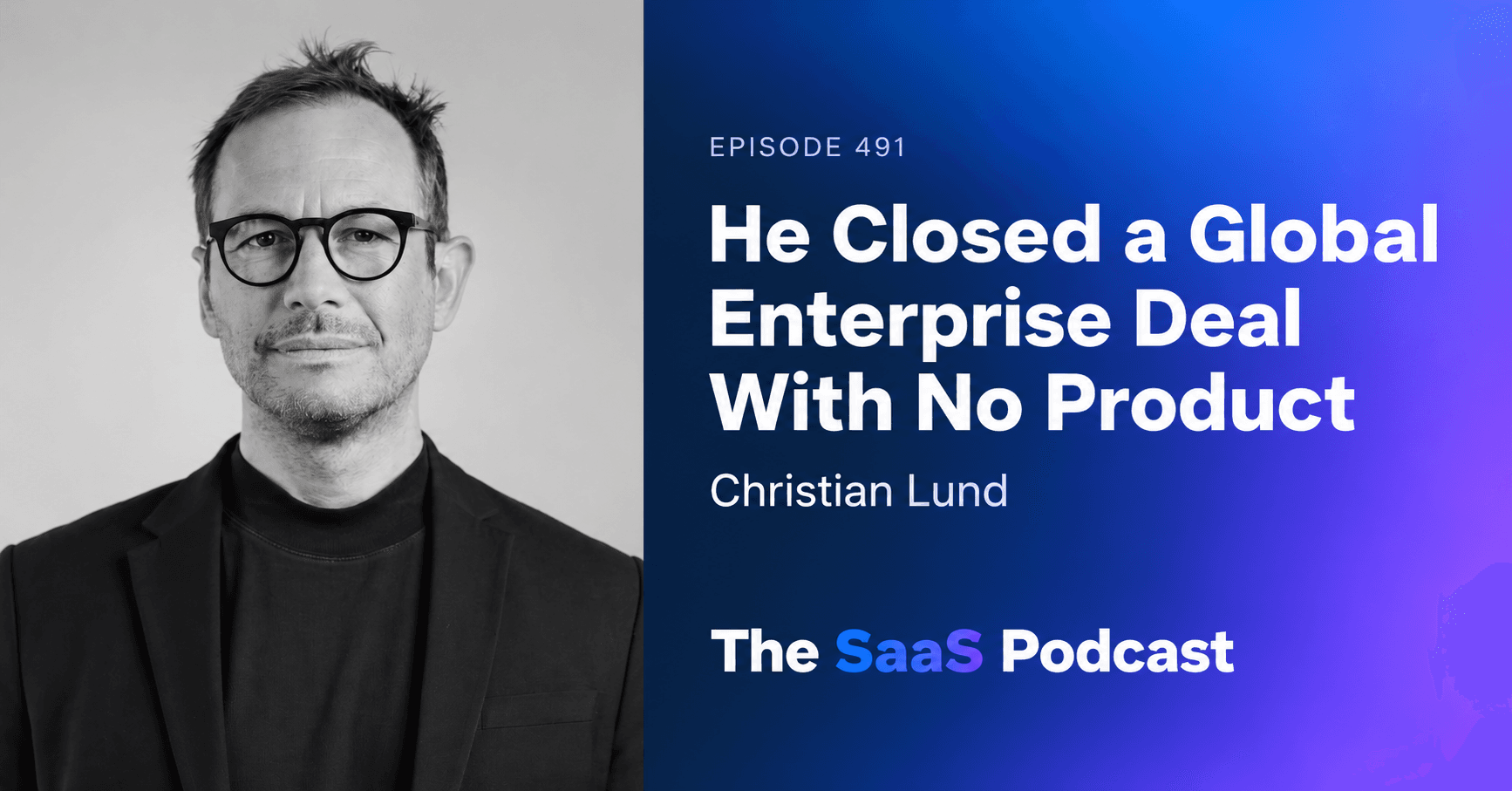
Christian Lund had spent years running an on-premise document business before he saw the cloud shift coming. Rather than retrofit the old product, he and his co-founder spun out Templafy and started over from scratch, with two engineers and no product to sell. What they sold instead was a point of view. Christian identified roughly 800 people worldwide who he thought were mature enough to have the conversation, targeted them with specific messaging, and used those conversations to get in front of enterprises long before there was software to demo. Templafy raised its first funding round close to twelve months before the product existed. That approach landed one of the Big Four accounting firms as the first customer. But the deal nearly went the way most enterprise deals go, with a small pilot for ten people and no defined outcome. Christian pushed back, not by refusing, but by attaching conditions: agree exactly what we are proving, and agree what happens if we prove it. When some prospects later opened the decision up to competing vendors, Templafy had effectively written the evaluation criteria. Templafy now runs at eight figures in revenue with a couple of hundred people. Christian is putting the business through the same reset again for AI, rebuilding the technology foundation from scratch over two and a half years. He is candid that the messaging got ahead of the market, and that being eighty percent ahead instead of fifteen percent cost the company conversations it needed.
Sylvestre Dupont, Parseur
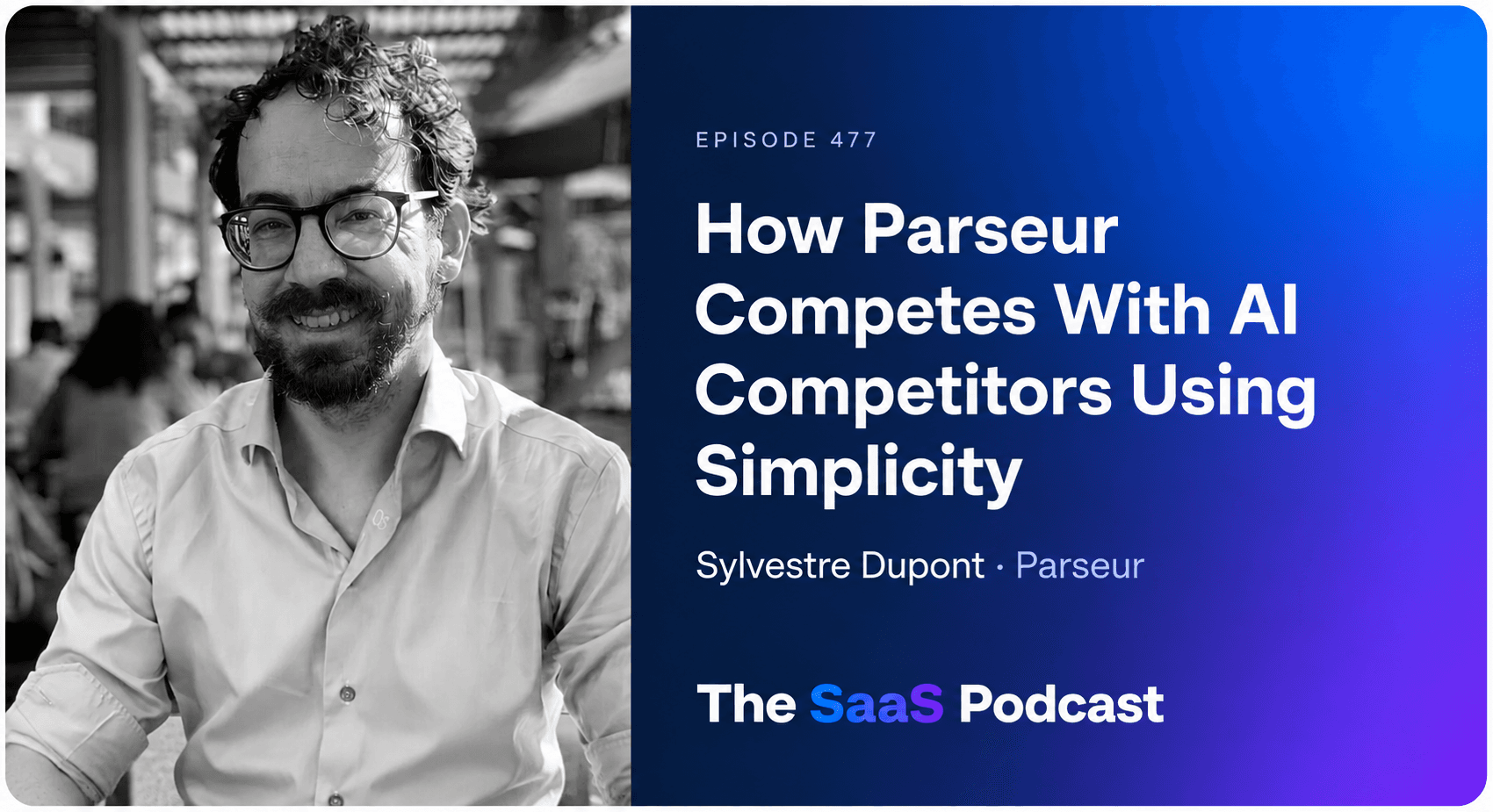
Sylvestre Dupont is the co-founder and CEO of Parseur, a platform that automates data extraction from emails, PDFs, and spreadsheets. The idea started with a side project in 2015. Sylvestre wanted to build a travel map that auto-updated from booking confirmations. He and his co-founder Sylvain, a senior Python developer he'd known for 25 years, saw a bigger opportunity: a general-purpose document parsing tool. They put up a landing page, ran Google Ads, and collected 50 email signups. That felt like enough validation. So they spent the next year heads-down coding. Full features, payment system ready, zero marketing. In December 2016, they launched on Product Hunt and Hacker News. Nothing happened. They emailed the 50 people from a year earlier. Two signed up and quit immediately. So they started from scratch on the marketing side. They began answering questions on Quora, genuinely helping people with document automation problems. That's where their first real customers came from. They also dropped the price from $49 to $9 a month just to get anyone to try it. What set them apart was simplicity. Competitors required users to write complex extraction rules by hand. Parseur let you visually highlight what you wanted. Setup took 10 minutes instead of two hours. That bootstrapped SaaS advantage - simple, self-serve, no sales call required - became the foundation of everything. Growth came slowly through SEO and a Zapier integration that converted at 20 to 30 percent. For the first five years, it was just the two of them. No employees, no investors, no board. Then AI changed the game. ChatGPT could do basic document parsing. VC-funded competitors like UiPath and ABBYY were spending hundreds of millions on AI. Sylvestre had to rebuild his entire product around machine learning - funding the transition from customer revenue, not investors. His bootstrapped SaaS strategy for survival: don't try to out-feature the giants. Be the tool that any business can set up in minutes without talking to sales. Simplicity as a moat, not technology. Today, Parseur generates seven-figure ARR with close to 1,000 paying customers in over 70 countries. A bootstrapped SaaS, still six people, still 100% founder-owned - and still growing.
Vineet Jain, Egnyte
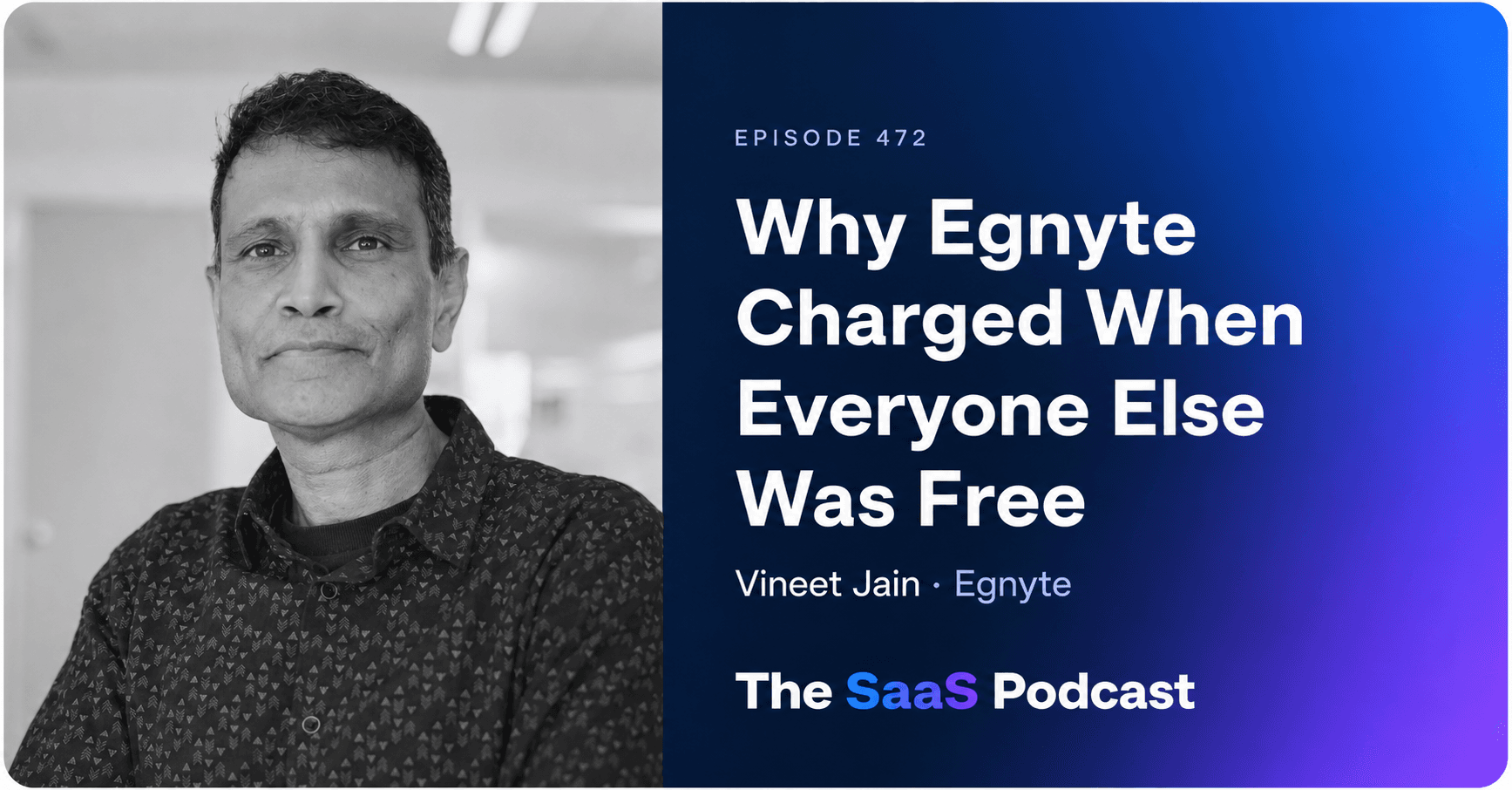
Vineet Jain is the co-founder and CEO of Egnyte, a content collaboration and security platform for mid-market and enterprise businesses. Vineet arrived in the US with $100 and no connections. He spent four and a half years at KPMG learning to sell to everyone from line managers to CEOs. That convinced him he could build something of his own. In 2001, right after the dot-com bubble burst, he co-founded Valdero, a supply chain software company, and raised $7.5 million from Kleiner Perkins. Revenue grew quickly. Then Oracle and SAP moved in. Pricing pressure crushed them. They sold. Investors made money. The 70 employees didn't. That failure stuck with him. In 2007, Vineet and three co-founders rented a small office. No funding. Two did consulting while the other two wrote code. The idea: move the physical file server to the cloud. When they launched, analysts lumped Egnyte in with Box and Dropbox - hundreds of companies chasing the same market. Everyone told Vineet to do freemium. His board pushed back. Analysts questioned how they were different. Vineet Jain built Egnyte to over $300 million in enterprise sales revenue using three strategies: charge from day one, offer hybrid cloud when everyone said go cloud-only, and keep cost of acquisition low with inside sales offices in cities like Spokane and Raleigh instead of Silicon Valley. In 2016, Gartner named Egnyte a leader - a tiny company standing alongside competitors that had raised billions. Today, Egnyte has 23,000 customers, 1,400 employees, and has raised just $137.5 million with no additional funding since 2018.