Consensus Is the Shortest Path to Mediocrity: The 3-Person Decision Rule
Based on this episode
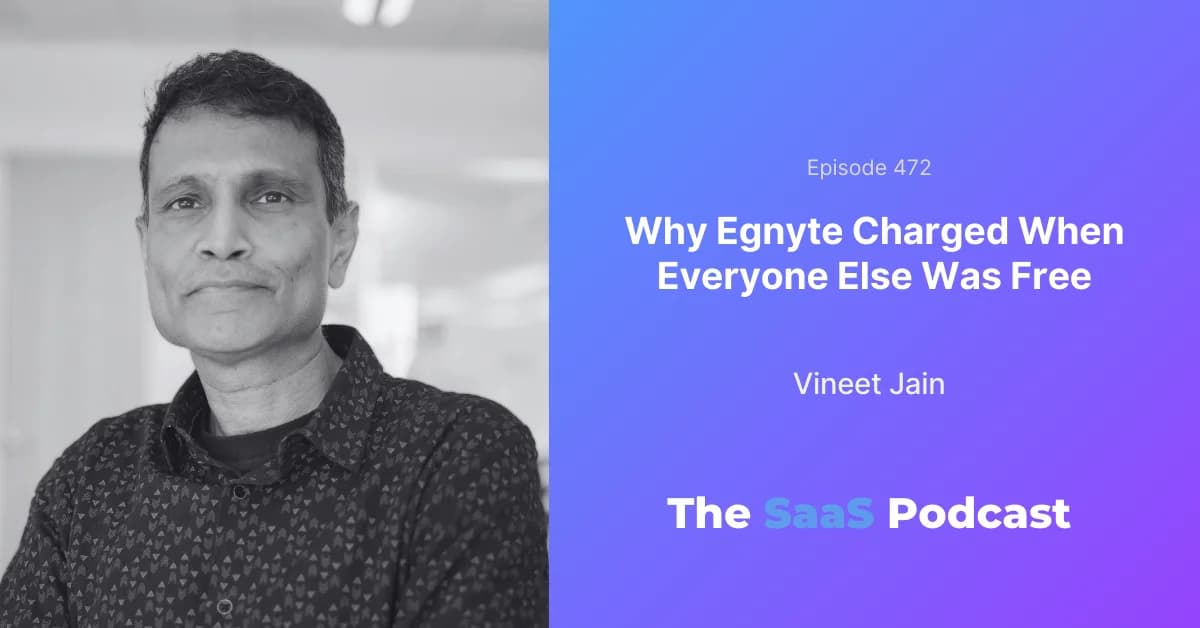
How $6K in SEM Launched an Enterprise Sales Machine
Vineet Jain, Egnyte
The Framework
"Consensus is the shortest path to mediocrity." That's not a theory for Vineet Jain. It's an operating principle he built Egnyte on while scaling from 4 co-founders to 1,400 employees and $300M+ ARR. Most founders start making decisions alone. Then they hire a leadership team and gradually drift into consensus mode. Eight people in a room discussing a topic. Nobody wants to push back too hard. The group gravitates to the safest, least controversial option. That's how companies lose their edge. Vineet's rule is simple: critical decisions get made by 3 people, not 8. Not because other perspectives don't matter, but because small groups move faster and make bolder calls.
The 3 Steps
- Assign clear ownership to small teams. Every critical function at Egnyte has a dedicated owner and a small team driving it. For M&A, it's 3 people in business development led by a senior VP. Not a committee. Not a cross-functional task force. Three people whose only job is to find and evaluate acquisitions. They present findings every 2 weeks. Leadership offers input. But the responsibility stays with the team. The mistake is making everyone responsible, which means nobody is.
- Trust people even when you think you'd do it better. Vineet is direct about this: if you believe you could do a better job than the people you hired, either you hired the wrong people or you don't know how to scale. Delegation isn't assigning tasks. It's giving people full authority over their domain and accepting that 2 out of 10 decisions will be wrong. That's the same failure rate you'd have making those decisions yourself.
- Kill the 8-person meeting. If you're in a room with 8 people discussing a topic and looking for the "lowest common denominator" to move forward, you're doing consensus. Cut the meeting to 3 decision-makers. Let everyone else contribute asynchronously. Decisions get bolder when fewer people need to agree.
Real Numbers
Egnyte's scaling tells you whether this works. 4 co-founders to 1,400 employees across Mountain View, Spokane, Raleigh, Salt Lake City, Reading, and Dubai. Revenue: $300M+ ARR with the path to $400M in sight. Past the rule of 40 on profitability. Total raised: $137.5 million. The last round was $75 million from Goldman Sachs in 2018. They haven't raised since and have been EBITDA positive with improving margins. Sales organization: ~400 people. That's a lot of humans making daily decisions. If every deal needed executive consensus, the company would grind to a halt. Instead, reps and managers own their domains. The compounding effect: 12 years to $100M, 3 years to $200M, 18 months to $300M. You don't accelerate like that with committee-driven decision-making.
When It Fails
This breaks when you're pre-product-market fit and the founder genuinely needs to be in every decision because the company's direction is still forming. It also breaks when the people you've empowered lack context or judgment for their domain. Delegation without calibration is abdication. If someone's been in the role for less than 9 months, they may not have their "sea legs" yet.
Your First Move
Look at your calendar from the past week. Find every meeting with more than 4 people where a decision was made. Could 3 people have made that call faster and bolder? Pick one recurring meeting and cut the attendee list to 3 decision-makers. Watch what happens to speed and quality.
Ready to build your SaaS with founders who get it?
Join thousands of SaaS founders getting weekly insights and proven strategies from real founder conversations.
Free weekly newsletter · No spam