
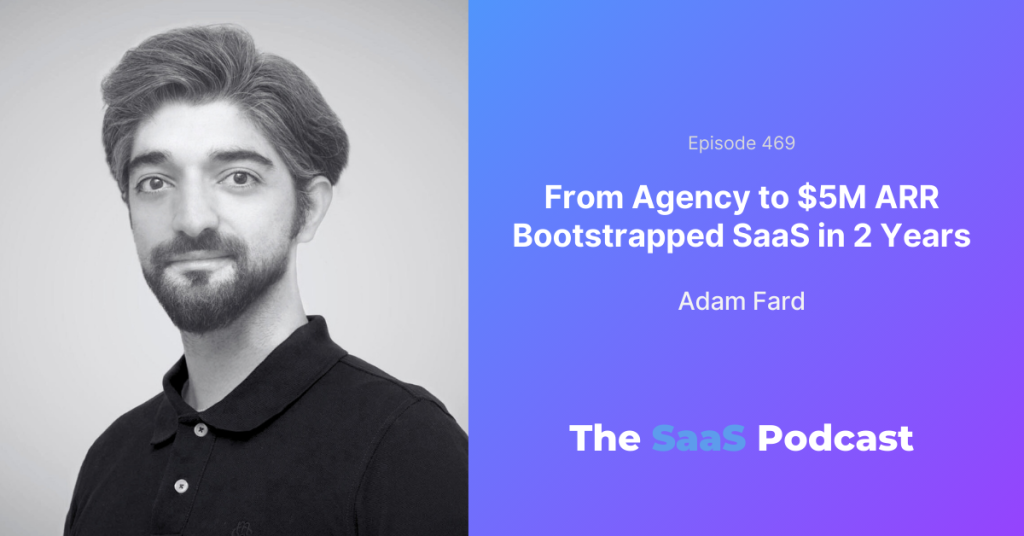
Adam Fard was running a successful UX agency when he spotted a gap in the market. Every wireframing tool claimed to use AI, but they were faking it – just swapping templates and changing copy. The real technical challenge of generating wireframes from scratch was too hard.
So Adam built it himself. He bootstrapped UX Pilot from a Figma plugin side project to $5.3M ARR in under two years – growing from $3M to $5.3M in just 5 months – without VC funding, with 15,000 paying subscribers and a 30-person team.
Adam Fard is the founder of UX Pilot, an AI platform that helps product design teams create and ship great user experiences faster.
In 2023, Adam was running a successful UX agency when ChatGPT and LLMs started taking off. He began experimenting with ways to apply AI to his team's design processes and built a Figma plugin that helped users work through UX frameworks and activities.
Then during a user interview, someone asked a simple question: “I have all these ideas on my canvas, but can I turn them into something visual? Can I create a wireframe?”
That question stuck with him.
He started looking around to see if any tools could actually generate wireframes from text input. He found a few products claiming to do it. But when he tested them, he realized they were faking it. They were just swapping existing templates and personalizing the copy. None of them could truly generate a layout from scratch.
There was a technical reason for that. Creating wireframes with AI was genuinely hard.
So Adam started working on it himself. He explored fine-tuning LLMs, hired AI researchers, and tested component-based approaches. He spent four or five months iterating.
Slowly, things started working. The outputs became stable enough to use. He added Figma integration so designers could bring wireframes into their existing workflow. Within six or seven months of that original user question, UX Pilot hit $10K MRR.
But growth created a new problem. Adam hired too slowly. At $30K MRR, he kept questioning whether this was the ceiling. He added one engineer, waited, added another, waited again. Looking back, he says he should have hired five people at once instead of dragging out the process.
Today, UX Pilot generates over $5 million in ARR with a team of 30 and over 15,000 paying subscribers. All bootstrapped.
In this episode, you'll learn:
- Why Adam initially said he didn't want the product to focus on AI generation, and what changed his mind a few months later
- How he validated the wireframe generation opportunity by testing competitors and discovering they were all faking it
- What happened when Google suddenly deranked all of UX Pilot's landing pages, and how he recovered
- Why talking about product updates in his newsletter drove more engagement than traditional educational content
- How focusing narrowly on design (instead of building another no-code tool) became their biggest competitive advantage
Key Insight
Key ideas
- Validate by testing competitor claims - Adam discovered other products were faking AI generation by just swapping templates, revealing a real opportunity
- Solve genuinely hard problems - spent 6-7 months iterating on fine-tuning LLMs and component-based approaches until the output was stable
- Bootstrap with existing revenue - used agency income to fund product development without pressure to raise VC funding
- Focus beats feature bloat - while competitors built no-code tools that did everything, Adam focused only on design (no backend, no drag-and-drop)
- Hire faster than feels safe - Adam's biggest regret was hiring 1-2 people at a time instead of 5 at once when hitting $30K MRR, costing months of velocity
📖 Chapters
00:00 Introduction
00:24 What UX Pilot does and who it's for
00:46 Revenue, team size, and growth metrics
01:37 Running a UX agency when ChatGPT launched
03:31 The user question that sparked the product idea
05:20 Testing competitors and discovering they were faking AI
07:17 Getting early users to do discovery sessions
09:47 Why creating wireframes with AI was technically hard
12:34 Building an MVP that had nothing in common with the current product
15:56 Exploring fine-tuning LLMs and component-based approaches
18:05 What the first paying customer version looked like
21:27 Building a 600K subscriber newsletter from product signups
24:21 Why talking about product updates got more engagement than education
27:14 Getting to the first million in ARR with LinkedIn, newsletter, and SEO
29:49 Posting 3-4 times per week on LinkedIn
31:50 The mistake of hiring too slowly when bootstrapping
35:25 The inflection point from $3M to $5.3M ARR in 5 months
38:48 Focusing on enterprise teams vs trying to target everyone
41:36 Lightning round
🔑 Key Lessons
- 🎯 Test competitor claims before building: Adam discovered other wireframing tools were faking AI generation by swapping templates, revealing a genuine technical opportunity others couldn't solve.
- 💰 Bootstrap with existing revenue streams: Adam used his UX agency income to fund UX Pilot development, removing pressure to raise VC funding or hit arbitrary revenue milestones quickly.
- 🚀 Focus on one hard problem beats doing everything mediocrely: While competitors built no-code tools that did everything, Adam focused exclusively on AI wireframe generation - no backend, no drag-and-drop, just design.
- 📈 SEO still works for bootstrapped SaaS in 2024: Despite advice that "SEO is dead," Adam got significant traffic from high-intent keywords around "design, UX and AI generation" by being one of the first to target them.
- 🧠 Hire faster than feels safe when bootstrapping: Adam's biggest regret was hiring 1-2 people at a time at $30K MRR instead of 5 at once - the slow hiring process cost months of velocity and prolonged the hiring burden.
- 🛠️ Talk about your product, not just "valuable content": Adam got more newsletter engagement sharing UX Pilot updates and features than sending generic UX education - people want to know what you're building.
- 🔄 Code-first architecture creates competitive moats: By outputting code instead of vector graphics, UX Pilot eliminated conversion steps that plagued Figma-replicating competitors, making it faster and more useful for developers.
- 💡 Find your ICP through experimentation, not assumptions: Adam started without knowing if designers, developers, or non-designers would use UX Pilot. Only after launch did he discover professional product teams at at enterprises were the sweet spot - they had requirements generalist tools couldn't match.
Show Notes
Book Recommendations
- Mapping Experiences by Jim Kalbach
Episode Q&A
How did Adam Fard validate the UX Pilot idea before building it?
During a user interview for his Figma plugin, someone asked if they could turn their canvas ideas into wireframes. Adam searched for tools doing this, tested competitors, and discovered they were faking AI generation by just swapping templates – revealing a genuine market opportunity.
Why were other wireframing tools faking AI generation?
Creating wireframes with AI from scratch was a genuinely hard technical problem. Most products couldn't generate true layouts, so they swapped existing templates and personalized the copy to create the illusion of AI generation.
How did Adam Fard solve the technical challenge of AI wireframe generation?
He spent 6-7 months exploring fine-tuning LLMs, hiring AI researchers, and testing component-based approaches where AI defines the structure blueprint and then replaces pieces with actual components instead of generating everything in code.
How did Adam acquire UX Pilot's first paying customers?
He used his LinkedIn profile (posting 3-4 times per week about product updates and features) and a newsletter built from people who signed up for the product – the newsletter now has 600,000 subscribers.
What was Adam Fard's biggest mistake bootstrapping UX Pilot?
Hiring too slowly. At $30K MRR, he hired 1-2 people at a time and waited months between hires because he feared the revenue might disappear. He should have hired 5 people at once to gain velocity faster.
How did UX Pilot grow from $3M to $5.3M ARR in 5 months?
Extreme focus on professional product design teams at enterprise companies, combined with a code-first approach that lets designers share work directly with developers without conversion steps.
What channels drove UX Pilot's growth to $5.3M ARR?
SEO was the biggest driver (despite claims that “SEO is dead”), followed by LinkedIn content about product updates and a newsletter where Adam shared feature releases instead of generic educational content.
Why did Adam Fard choose a code-first approach for UX Pilot?
Vector-based competitors who tried to replicate Figma with AI didn't get traction. Code-first meant no conversion steps – designers could share code directly with developers who could convert it to any framework.
How did Adam Fard's newsletter strategy differ from traditional advice?
Instead of sending “valuable educational content,” he just talked about UX Pilot updates and new features. People engaged more with product updates than with generic UX education, leading to upgrades and referrals.
Transcript
Omer Khan [00:00:00]:
Adam, welcome to the show.
Adam Fard [00:00:01]:
Hey, thanks for having me here.
Omer Khan [00:00:02]:
My pleasure. Do you have a favorite quote that you can share with us? Something that inspires or motivates you?
Adam Fard [00:00:08]:
I’m not really a quote person, but it would be something around like, I don’t know, action leads to clarity or action first, refine later.
Omer Khan [00:00:21]:
You’re a doer.
Adam Fard [00:00:22]:
Exactly.
Omer Khan [00:00:24]:
Yeah. Love it. So tell us about RXPilot. What does the product do, who’s it for, and what’s the main problem you’re helping to solve?
Adam Fard [00:00:33]:
So UXPod is an AI platform for product design teams and we help them to design and ship great user experience faster. And we are AI native and give.
Omer Khan [00:00:46]:
Us a sense of the size of the business, revenue, size of team, customers, all that stuff.
Adam Fard [00:00:51]:
So right now we are at 5.3 million ARR, bootstrapped, 30 people full time, and we have around 15,000 active paying subscribers.
Omer Khan [00:01:03]:
So weren’t you at like, didn’t you hit like 3 million ARR like last year?
Adam Fard [00:01:08]:
No, it was maybe around four months ago. Five months ago.
Omer Khan [00:01:13]:
So you were at 3 million five months ago and now you’re at 5 million. Okay, that’s going to be an interesting conversation. And you’re bootstrapping it. Love it. So the business was founded in what, 2023?
Adam Fard [00:01:30]:
Officially, yes, but then the product was launched beginning of 2024.
Omer Khan [00:01:37]:
But I guess it starts. The story starts a lot earlier than that with you running your agency. So maybe just tee that up for us. Tell us what were you doing at the time and what led to this idea even sort of coming about. Sure.
Adam Fard [00:01:52]:
So I was running a UX studio, so my own agency. And that was a time where that was kind of the starting of LLMs, ChatGPT and all of that. And I just wanted to see like what we can build, what we can do, or how we can apply AI to our own internal processes just to make things more kind of faster, more efficient. And started brainstorming together with the team, started exploring some ideas, even putting together kind of coded a few things, like things we could apply to our own process. And I would say that’s kind of how it started, by just running all these tiny experiments and having these internal brainstorming sessions. But again, that was completely different from the current product and our current focus.
Omer Khan [00:02:54]:
So if I understood this correctly, you’re running the agency. As you’re seeing this sort of evolution of ChatGPT and all this other stuff going on, you’re starting to think initially about how am I going to run the agency better with this new technology, and then eventually talk about how the idea specifically came about for this mvp. Didn’t somebody ask you if you could build wireframes for them or something like that? What was the moment where you were like, oh, there’s a product idea here?
Adam Fard [00:03:31]:
The first, I would say, closest thing to uxpilot that we built and shipped was a Figma plugin where you could basically prep any kind of UX or customer discovery or UX work there, very much like a workshop or a framework that you could generate, including some instructions. Like, let’s say you want to define your Persona, you want to define first features for your mvp. You don’t want to start right away. You want to follow certain frameworks very much like what we were doing for our clients, but this was more like using AI and being a little bit more targeted towards how you can apply those frameworks or activities to your own product or to your own project and be able to kind of conduct those type of activities using AI. So that was kind of a very early stage, very kind of first touch point that you have, either with clients or with your own internal team. And we had early on some users trying it out, and we kind of started also talking to these people. I remember one interview with one of those users talking about this feature and how they use it and so on. More of a kind of a usability discovery session.
Adam Fard [00:04:51]:
And then I remember the question I was asked was, okay, I have these things on my canvas, I have these ideas, I follow this framework, but can I now turn them into something visual? Can I create a wireframe out of this? And that was like a starting point for me to kind of look around and see, okay, is there actually anything doing that? Are there any other products? Creating wireframes, generating wireframes based on kind of a text input.
Omer Khan [00:05:20]:
Okay, so that original sort of mvp, the Figma plugin, were you charging for that?
Adam Fard [00:05:30]:
I think we were charging something, and then we made certain things for free.
Omer Khan [00:05:35]:
And how were you getting this? How were you acquiring customers or users?
Adam Fard [00:05:39]:
Mainly through my LinkedIn profile and the agency newsletter.
Omer Khan [00:05:47]:
Okay. And when you had people signing up, how easy or hard was it to get these sort of discovery sessions with them? Like, I was just talking to a founder, like earlier today who was like, I’m getting people sign up, but when I kind of follow up with them, they’re not using the product. When I follow up with them, they don’t seem to respond to me. It’s a very common thing that we hear. Right. So I’m Just curious, like how, how engaged were people, how willing were they to talk to you and tell them about, tell you about how they were using the product.
Adam Fard [00:06:20]:
So I think one thing we did that worked really well was through LinkedIn. So we started like talking about the product, the features and so on. And obviously people were interested, they tried the tool. And then through those kind of content we also had one dedicated to we want to test new features, especially if you want to target people who are new to the product and we would give it for free usually, you know, some kind of an incentive to offer them in exchange. If you just want to test the tool before the call or something around that, I think that was one thing that worked really well. But also offering any kind of incentive usually again from past experience doing ux, it can be credits, can be free plans or even gift cards usually helps. But yeah, I agree it’s always challenging no matter the stage of the product.
Omer Khan [00:07:17]:
Yeah. And I know it’s a pretty common practice with ux, but I always wonder, do you attract like the wrong type of people when you or a lot of the wrong type of people when you offer an incentive like that? Because you want people who have the real pain, like they’re experiencing so much pain, they just are desperate to talk to somebody about how to go who listen to them and might have a solution. Right. Versus somebody who kind of has a plane they can live with but kind of likes the idea of buying something on Amazon.
Adam Fard [00:07:50]:
So getting a gift card, it depends how you find those users. I mean again, if you, if it’s just like a public post, then for sure you need to maybe do more qualification there to get the right people. But if they’re already signed up to the product, then you can just maybe target the people who are using the product instead of anyone or even better people who paid for the product. You can go down the line like different stages, but again it’s always challenging for new things, especially if you don’t have any paying customers.
Speaker C [00:08:26]:
The reason we exist is because you cannot stay ahead of all threats. So what we do is we block by default. If it’s not on the list, it cannot run in your environment. And that is our core focus. Zero Trust principles The core of threat locker is zero trust. 24 hour, 365 day a year support. We’ve got some of the most advanced threat intelligence team. And this isn’t an outsourced offshore response.
Speaker C [00:08:47]:
It’s our staff in our offices helping our clients directly who really understand the product and really understand the threats.
Omer Khan [00:08:55]:
Okay, so you had this question like, hey, how do I turn this into a wireframe? And it was sort of like this whole idea of like just, you know, the text generation thing, because there were plenty of wireframing tools already on the market if you want to go and build it step by step yourself and, you know, drag things on the screen. But what did you do next? How did you sort of say, okay, there’s something here, but it’s a sample size of one, right? One person asking you for this right now. And you see there isn’t a lot going on in the market, which could be a opportunity, but it could also be a problem that no one has bothered to solve this because maybe there isn’t a great need for this. So how did you figure out that this is something that I should work on?
Adam Fard [00:09:47]:
So it was definitely a technical challenge, and that’s also why there were not many products doing it. So one thing I did, I just went around search for other products doing something around wireframing, generating wireframes and so on. I also remembered, I went on, I was part of a slack group for content creators, like designers and content creators. And I just mentioned, okay, I decided to work on this feature and explore it. And then I remember some people pasted and one asked me why someone asked, someone else wrote pasted, I think three or four links of similar ish products doing something like wireframe generation and so on. So I started testing those tools and it was very obvious that they were not really doing. They were not generating wireframes, they were just swapping existing content and they would just maybe personalize the text or copy. Because again, at that time with the models, that was easily feasible.
Adam Fard [00:10:53]:
But now creating the whole layout was much more complex. So that was like their tricks to just move things around a little bit, like swap the order of content or blocks you would get and then start maybe changing the copy for what you needed. And it was kind of obvious to me that, okay, there is definitely something to be done there. Even though it was far from being obvious, like how to do it, but it was kind of clear like, okay, you cannot really generate or there is nothing helping you to create something fit for your needs. And there is this opportunity there. And if also you’re familiar with the whole design process, actually wireframing or conception is like where you spend most of your time. You just create wireframes and wireframes and concepts and create more and more and more. So if you can create those faster, then that would be the perfect solution.
Omer Khan [00:11:47]:
Yeah. Also tell me about, like, so this, this MVP that you had with the Figma plugin. It led to an opportunity that you maybe hadn’t. Didn’t have on your radar. But you were trying to solve a different problem as well at the time, Right. In terms of this was kind of like a solution that people would use once in a while versus being like, you know, something they were using daily as sort of recurring revenue. And I’m just curious, like, what you were doing at the time that maybe led to this discussion or maybe, you know, something you were solving in parallel. This is a very common thing where there are two issues that I’m hearing.
Omer Khan [00:12:34]:
I think we would love to sort of pick your brain, see how you. How you navigated your way out of this. Number one is you basically have an mvp, which now you look back and go, yeah, the MVP was really. Didn’t really have anything in common with my product today. And too many founders get hung up on that first MVP and how it’s going to align with the product that they want to build in two years or three years and so on. And it’s less like just there’s a problem in front of you. There seems like people who are engaged just, you’re probably better off just solving that and then figuring out what comes next. And it might not be a sequential thing, you might go back and forth, but ultimately that will help you figure out what’s the right thing to build.
Omer Khan [00:13:16]:
And sounds like you did that. The other thing is kind of getting stuck in this place where you have a product which seems valuable, but you’re like, there’s no subscription recurring revenue model here. And so how can I turn this into a sustainable business? So you were dealing with both of those things, right?
Adam Fard [00:13:34]:
Exactly. And somehow this approach or this kind of wireframe thing was a solution to both of those problems, like be able to. Have a feature that can be used on a daily, weekly basis like wireframe generation. And that’s something that was kind of brought up during at least one of these, these interviews. And that was unique in the market.
Omer Khan [00:14:00]:
And I think it’s interesting that. Was that something you were thinking about yourself or was like it was completely off your radar?
Adam Fard [00:14:06]:
Yeah, no, I remember like we had in one of our sessions, internal sessions, we had like the whole design process mapped out. Like you have research and, you know, you don’t even talk about the product yet, but just analyzing data and so on. Then you start mapping those things out and working with the team to align on how to approach those insights and then you start creating designs and then after designs you test those designs with users again using maybe AI or traditional tools. These were all these ideas and space that we were dealing with or even we went granular into some more specific things like how to talk to stakeholders, how to export certain assets, prep them for developing all these things. And funny enough, actually in one of the first, I think during the first call I said to the team, I don’t want the product to be on the generation side of things. So that was like, I don’t know why I said that. Maybe there was this negative image of gen AI and design and they don’t go well together. And I kind of said that to kind of set the direction for the product.
Adam Fard [00:15:20]:
But then a few months later I was like, wait a minute, there is something here that’s funny.
Omer Khan [00:15:27]:
That’s exactly the direction you end up going where you said, I don’t want to go. Walk me through what happened next. How did you build the product? What did that first version look like? Because now you see the opportunity and you see these existing products aren’t really doing a great job at solving it. But it’s also because there’s a technical barrier or obstacle in your way. So how did you get around that?
Adam Fard [00:15:56]:
So it was not straightforward. So I actually started exploring different options and there were a mix of actually mainly around LLMs because that was basically the technical challenge. So can we fine tune these LLMs? How can we fine tune them? What kind of data do we need? So I went kind of down the route of fine tuning, started talking to AI researchers, had multiple sessions with them, hired contractors to help me with this whole process of fine tuning on the other end. Okay, there are maybe something, maybe one step behind before that, like not necessarily template based, not necessarily from scratch, but maybe can have building blocks like component based approach where AI defines something simpler in terms of structure of the layout and then we replace those things with actual components. So not trying to generate everything in code, but generate piece and kind of a blueprint of the whole thing and then replace those with more granular elements instead of like the whole block. And it was I would say constant iterative process. It was not like oh, I found the solution, but it was like I found something and it was okay, ish working but then facing challenges in certain use cases. Let’s say if you want to generate like a web app, a dashboard, which is much more complex than a website, and then some others would work well for kind of first iteration, but then would break if you would Edit those things over and over.
Adam Fard [00:17:44]:
And that kind of went as kind of an ongoing thing for maybe four or five months. I mean, I was not only doing this, but it was kind of something that was kind of an ongoing thing.
Omer Khan [00:17:56]:
So tell me what the product looked like that enabled you to get your first few paying customers.
Adam Fard [00:18:05]:
It was at some point a mix of all of these techniques and processes together, plus LLMs becoming faster, like smarter LLMs becoming faster where people could type very much what they wanted and then they would get a wireframe very much tailored to their needs. Not like something random, not something generic. And each time they would write a prompt, then they would get the exact layout adapted to the prompt.
Omer Khan [00:18:46]:
Okay, so you’re dealing with these technical problems and you basically got the same challenges that probably all these other products had. And you’re sort of peeling the layers of the onion a little bit at the time and trying to sort of manage scope and offer maybe a partial solution that gets people, you know, sort of part of the way there. What point did you feel like you had sort of got to a point where the product seemed, you felt like that there was, you know, you were.
Adam Fard [00:19:24]:
Getting traction so the output were stable enough so you could really work on a few things and get something decent. That was one part of the thing. And then the ability to bring those things back to figma because many of our users, especially for wireframing stage, were designers. So they wanted to have those wireframes inside figma to be able to then tweak them, work on them, or replace some of those things with their designs or their needs and be able to have these two pieces together. So have the web platform where you can do these generations or edit and then be able to bring them into the figma environment.
Omer Khan [00:20:12]:
Got it. So from the point where this user asks you if you could generate wireframes to getting to. Let’s say. So let’s say you’re doing about, let’s say you’re doing about 10K MRR.
Adam Fard [00:20:30]:
It was maybe six, seven months.
Omer Khan [00:20:32]:
Six, seven months from the time this person asked you whether you could do something and then you going off and figuring out how to deliver on that solution. And then where did these customers come from? How did you acquire them?
Adam Fard [00:20:46]:
Same channels as we started with. So LinkedIn, my own profile newsletter that actually. So we had a newsletter with the agency. Then I started also rolling in. Users coming to the tool have had a kind of a sign up page like there’s this new feature that would come just sign up to get access to kind of page and they would kind of sign up there. And then I started kind of rolling out, kind of telling them that the feature is live and so on. So I think those two channels were the main ones.
Omer Khan [00:21:27]:
Your newsletter is pretty massive, I think. What have you got, like 4 or 500,000 subscribers?
Adam Fard [00:21:35]:
I think we’re at 600K now.
Omer Khan [00:21:37]:
Wow. Yeah. So when you and I were talking earlier, I always imagined that, you know, the, the sort of, the typical thing is a founder thinking about how do I acquire customers. Okay. One thing that I could potentially do is build some kind of email list and I ultimately, you know, maybe a newsletter and then that will help me to acquire customers. And you were doing this the other way around, where people were coming up, discovering UX pilot, signing up for it, and then you were adding them to the newsletter and continuing them to tell, you know, give them updates and tell them what was going on.
Adam Fard [00:22:17]:
How.
Omer Khan [00:22:20]:
How effective did that newsletter has it turned out to be in terms of being a customer acquisition vehicle for you?
Adam Fard [00:22:29]:
It’s a complex question. So I can maybe try to dissect things a little bit to understand what’s happening. So one thing I’ve noticed is my classical understanding of a newsletter that would work is that you send, especially with the agency. At that time we were sending very useful, useful education. Now you’re sending useless. We were sending very useful educational information about ux, about frameworks, about how to handle certain things, how to design certain things, how to talk to user, all these kind of very, very interesting educational materials that were part of the newsletter. And that was the core value. We were not selling things.
Adam Fard [00:23:14]:
But I’ve noticed actually that when I was just talking about uxpilot and the new features and new things, how they could impact the design process, people actually were engaging a lot with it. They were like replying back, they were sharing feedback and the same thing actually on LinkedIn. So usually the casual thing is don’t talk about the product or don’t sell it, talk about provide value. But actually I got a lot of engagement just talking about the product. Like we released this feature and it can help you design faster or you can generate five versions at the same time instead of doing it manually and all of that. And people are very happy about those things that are again, sharing insights. So that was basically the whole strategy, like just talking about all the updates, everything we are working on, answering to feedback through those updates and so on. And that engagement kind of I think to some extent reflected in people staying with the product, people upgrading because they just maybe sign up as a free user or people also referring things to their colleagues and so on.
Omer Khan [00:24:21]:
Yeah, it is a complex question, so thank you for breaking that down. But yeah, there is a lot going on there. Right. Because you’ve got people who are customers who are on the newsletter who hopefully it’s helping retention and you know, just generally helping them get more value out of the product. You’ve got people who are on trials or something that you want extra try to convert. You’ve got people who are never going to sign up for the product but are still there because they like the updates and it becomes a good useful word of mouth type vehicle as well, I guess. And I totally get that because I think there’s a product that I signed up for a trial last week and I thought it was great. It’s just the founder does these videos and tells you about the product and how to use it and they’re actually pretty interesting to watch because it’s clear that this person has really thought hard about how to create a useful experience, a useful product.
Omer Khan [00:25:30]:
And often I sort of watch that and I go, yeah, but you know, can, can there’s this feature, but can it do this? And he’ll say, oh, by the way, we’ve also made this so you can do xyz. And it’s just that next level of thought that they’ve really tried to understand what people would want to use do with the product and have already sort of built that in. And so I’d already decided it’s like, this looks like a cool product. I’m just going to pay like for an annual subscription. I’m not even sure if I’m going to use it much, but I’ll just do it. Haven’t got around to it and it’s on my list to do, but I had an update video come through this morning about, hey, here’s some updates we did over the last month and it was like, oh great, I’m going to watch that. And it was really interesting just going through that. So I guess what I’m saying is I can understand that as being on the receiving end that when someone is doing a good job and putting love and care into a product that really shows and it draws more people in to just, I don’t know, you just feel like you’re on the journey with them.
Adam Fard [00:26:30]:
Yeah, probably that’s the experience people get.
Omer Khan [00:26:34]:
Yeah, let’s just talk a little bit about getting to that first million in ARR. So pretty quickly you’ve turned this opportunity of somebody asking about a potential need into a product and you acquire customers and you get to like whatever 10, roughly 10k in MRR. How long did it take to get to the first million? And was it still a combination of those channels that you talked about, just using LinkedIn as your personal profile and the newsletter and just focusing on Those two?
Adam Fard [00:27:14]:
So LinkedIn newsletter SEO actually helped a lot. I think that’s also one of those things. Especially nowadays people say SEO is dead. Nobody searches on Google, everyone uses ChatGPT and so on. But actually even now we are getting a lot of traffic through SEO, so it’s helped a lot. I think that’s also why. That’s also one of the thing I tried to focus on through the agency. When I was having the agency, I kind of just replicated everything I did there for UXpilot.
Adam Fard [00:27:51]:
Creating content, landing pages, searching keywords around design, UX and AI or generation and all those sort of high intent keywords. And it paid off actually it was very. Some of those things got ranked very quickly just because of everything that was happening around AI and also because we were maybe one of the first few products focusing on those keywords as well. So I think that helped and I believe that were the only channels we used.
Omer Khan [00:28:28]:
So roughly split. Do you have a sense of like out of SEO or your LinkedIn profile or the newsletter, which is the biggest driver of acquiring customers?
Adam Fard [00:28:39]:
I would say back then SEO was actually a big chunk because it was just every day, not when I would create a content, but it was just always there. And I remember I started updating some of our landing pages. Like I started creating more landing pages but copy pasting a lot of elements. And then suddenly Google started deranking, I think all our landing pages. And I remember I took a screenshot and shared that with my cto. Everything dropped suddenly and it was like, oh God. And I started removing things and so on. So it had a big impact.
Adam Fard [00:29:21]:
Definitely LinkedIn was more of a. When I was posting something and it was performing well, then we would get these spikes in traffic for a day or two. So it was a little bit harder to control it. Otherwise I needed to produce more content. So that was a challenge with LinkedIn, but I think those two were the main drivers.
Omer Khan [00:29:49]:
How much effort have you put into LinkedIn over the last year or two? Are you posting every day?
Adam Fard [00:29:55]:
Weekly. The goal is to post three to four times a week and then depending on what’s going on there. I mean now I’m lucky if I need a video of Something I can just ask a colleague to do that. If I need a copy for something specific, then ask someone else. So I’m not always 100% involved in everything. All the aspects are infinite. Look, if I need a graphic for something, then I can just ask someone. But yeah, before that, before having people in place for specific tasks, it was very challenging.
Omer Khan [00:30:34]:
You were doing it all yourself.
Adam Fard [00:30:35]:
Yeah, I needed to block time in my calendar. And sometimes you go through all the updates, you go through the product debugging, answering customers and so on, and then you just have, don’t. You don’t have any energy left to be creative and now start creating content.
Omer Khan [00:30:50]:
Yeah. One of the things that I know that you sort of look back and regret was being a little slow to hire. And that’s always difficult for anybody who’s bootstrapping, because your priority is always, don’t run out of money, like my money. It’s not like investors money. And you’re focused on that. You, you had, I guess, a slightly different situation because the agency was driving the bulk of your revenue for at least initially, and you were using some of that to fund what you were doing here. But you’re still bootstrapping. You still have the same constraints, and hiring people always seems like a very difficult decision to make.
Omer Khan [00:31:43]:
But when you sort of look back now, tell me why you feel like you hired Toothfoldy. What problems did it create?
Adam Fard [00:31:50]:
Well, I think it’s definitely because you don’t know how far you will go. Because I think we were generating 30k a month when we decided to hire more people. But you don’t know. Okay, is it like 30k, the maximum I can do with this product, given everything I know and everything in place, or do I need to. And while I’m bootstrapped? Maybe if I had millions, then that would not be a question. Or can it go to 100k? Can it go to. I don’t know, more than that. You have all these questions, and what happens if tomorrow everything stops? What happens if there is no more users? What happens? You have all these questions.
Adam Fard [00:32:34]:
So what we did is we just tried to do it slowly, like higher one or two people, and then waited a month and then said, oh no, I actually need more and let’s hire one more engineer. And then again the same thing. Wait, wait a minute. Why this thing doesn’t move so why everything is so slowly? Why we can’t move faster? Oh, we need one more person for the back end. So, yeah, I think we could have hired five people. So I don’t at once and then maybe be faster or not lose so much time on the hiring process because it’s also time consuming to go through candidates, interview them, assess them and all of that. But I think that’s always the question, like okay, I generated 30k. Maybe it’s wise to just be two or three inside the team and keep that revenue for as long as possible instead of burning everything overnight.
Omer Khan [00:33:31]:
I mean even if you went back in time, you, if you don’t know for certain that you can get past 30k in MRR, you’re always, it’s always, it’s a, it’s a gamble, right? You’re making a bet that I’m going to hire people and hopefully it’s going to work out, we’re going to keep growing and I’m not going to have to lay off people and get into that sort of situation.
Adam Fard [00:33:53]:
I think there is another thing is like especially founders when you start, even maybe when you start your first startup like product, you always follow other content creators and channels and listen like people especially active in the bootstrapping space. And I think there are many people who are alone growing their product and they say you should not hire, you should just keep the product because if you hire you will lose so much profit and you have to pay this and that and, and at the end you’re actually losing more money even though you have the impression you’re making more. You always have these types of also content and advices out there. So you try to find a balance. Okay, is it really a good idea to hire more? Does it make sense to grow the product? Should it be smaller than that? So I think there’s no straight answer.
Omer Khan [00:34:48]:
So what happens? So you get to the, let’s say you get to the first million in ARR. And since then as a bootstrapped business, you’ve continued to grow pretty quickly.
Adam Fard [00:35:01]:
Right.
Omer Khan [00:35:01]:
Like we just talked earlier, like hey, you know, four months ago we were at like we hit 3 million, now we’re at 5 million. What’s been the biggest driver of that growth? Like what was the inflection point that suddenly got you feeling like, you know, we’re sort of, this business is starting to feel like it’s firing on all cylinders kind of thing.
Adam Fard [00:35:25]:
A mix of different things. So one is focus. So early on we started focusing on this design space totally powered by AI. It’s not a drag and drop thing, it’s not a template based, it’s very flexible. You can generate whatever thing you want. The focus is on design. We are not building backend, we are just generating design so it’s faster, it can be even cheaper, the output quality is better. And.
Adam Fard [00:36:01]:
So I think that kind of resonated with people because everyone was building no code tools at some point. And you know, especially even nowadays there are new companies coming to the space and they had their own competitions, but the whole UX design space was not as competitive. So that helped us a lot. And also people were comparing, especially nowadays they’re comparing different tools and they still see, okay, UX Pilot output is different when you need it, it’s fast, when you need, the quality is higher and all of that. And also early on we decided to go code first. And I remember there were some other companies who tried to replicate Figma vector based plus AI. Like they tried to add AI somehow into the mix to generate vector based designs, but using AI. And they didn’t manage to grow or get enough or the same level of traction because of this approach.
Adam Fard [00:37:09]:
And in our case we were code first. So you don’t need to go back to vector, you don’t need to convert anything, you can just share the code. Then later on with developers, they can convert those into whatever framework they want easily. So I think all these things kind of together helped us to keep growing and still growing. So if we want to kind of simplify it, just having this very focused approach on this design niche, how do.
Omer Khan [00:37:36]:
You think about competitors? Because on the one hand what you’ve just described there is it sounds like you’ve found a place, a positioning that makes sense, that you can differentiate UX Pilot and you can focus on, on a certain smaller set of use cases and just try to do a really good job at those. But then how do you think about all these products that are sort of coming to the market? You’re bootstrapping, but you’ve got well funded competitors out there who have a lot of money. And then you’ve got this situation with AI where it’s kind of like a friend and foe thing where you’re using AI to make UX Pilot better. But then at the same time you’ve got things like Claude code and stuff which is sort of also, you know, kind of coming into your space a little bit. So how much time or energy do you, do you think about competitors? Are you one of those people who just kind of ignores it and just focuses on the users? Or do you sort of, you know, spend some time and energy kind of really using that to help really get clear about your own positioning and how you differentiate the product.
Adam Fard [00:38:48]:
So we spend a lot of time on features that could have an impact for teams on enterprise right now. Because yeah, we do see, like many founders or people, they might use lovable replit and all of that for their side projects, but we also get the feedback that those are not the right tools for professional product teams, for product designers, because of certain things they need in terms of quality, in terms of requirements, in terms of how they would use the tool, the phases where they need the tool to be relevant. And that’s kind of where we put most of our focus because I think that’s also where we can have more edge and be more competitive compared to just going broad and trying to target everyone, trying to create some kind of design or generate something.
Omer Khan [00:39:40]:
And is that the same ICP that you focused on when you started out with?
Adam Fard [00:39:46]:
No. At the very beginning it was actually not even clear if you needed to focus on product people, designers, developers. Because on one hand we were making design easier. So technically you would say, okay, non designers would like the product. On the other hand, we were focusing on this stage of ideation where probably a founder who’s not necessarily UX mature would not spend much time there. Like as a founder, you might just want to build something quickly. And that’s also one of the challenges that people are facing nowadays. But you might kind of do it that way.
Adam Fard [00:40:28]:
So it was kind of a tricky situation to kind of know exactly where to focus on and what’s the. What are the challenges to be relevant to a potential icp. But now we know a little bit better. We know definitely product teams are. And especially in this kind of team environment, enterprise environment, these are people who will use UXpilot and kind of keep using it. And on the single kind of PLG level where kind of single users are coming, these are also people from these orgs coming to the tool, maybe testing tools, maybe coming to the tool for their own projects, or maybe they’re not necessarily allowed to use AI through procurement, so they kind of go and use it on a personal level. And that’s kind of where we spend most of our time and focus now.
Omer Khan [00:41:21]:
Cool, I would love to keep talking. Seems like you’re doing some really interesting stuff, but we are out of time so we should wrap up. Let’s get on to the lightning round but ask you seven quick fire questions. Ready?
Adam Fard [00:41:35]:
Okay.
Omer Khan [00:41:36]:
What’s one of the best pieces of business advice you’ve received?
Adam Fard [00:41:40]:
Focus.
Omer Khan [00:41:41]:
What book would you recommend to our audience and why?
Adam Fard [00:41:44]:
It’s a little bit technical, but I really love this book. It’s mapping experiences because, uh, it’s kind of a way you, you learn how to use, how to use mapping, mapping of processes, mapping of journeys, to focus on people and users and to kind of spot problems, solve problems and find opportunities just by this act of mapping certain, certain browsers or an experience.
Omer Khan [00:42:14]:
What’s one attribute or characteristic in your mind of a successful founder execution?
Adam Fard [00:42:20]:
I think many people are too much focused on ideas, but ideas can be at the very beginning, rough can be very similar. I think a good example is the whole wireframing thing. It was nothing necessarily new at the very early stage, but how you execute, how far you go, and you kind of keep shipping until it works, until you get results. That’s kind of what makes what made a difference.
Omer Khan [00:42:44]:
What’s your favorite personal productivity tool or habit?
Adam Fard [00:42:48]:
I like to block time in my calendar and focus on things that are relevant because I think as a founder, especially as a founder, you might find it productive to jump over a different task and answer all the questions on Slack and answer this email and do a little bit of this and a little bit of that. But I don’t think these are things that will really move the needle and we’ll have a proper impact on your business. But being able to focus on one problem and to do that, just block the time for maybe two or three hours and spend that time on something important.
Omer Khan [00:43:22]:
What’s a new or crazy business idea you’d love to pursue if you had the time?
Adam Fard [00:43:27]:
Yeah, I don’t have any other business ideas as of now. Everything is so heavily UX file focused.
Omer Khan [00:43:33]:
What’s an interesting or fun fact about you that most people don’t know?
Adam Fard [00:43:38]:
I speak four languages, but I rarely mention it.
Omer Khan [00:43:42]:
Wow, what languages you speak?
Adam Fard [00:43:45]:
Persian, French, German, and a little bit of English.
Omer Khan [00:43:53]:
And finally, what’s one of your most important passions outside of your work?
Adam Fard [00:43:57]:
I love traveling, but not just traveling for pleasure, but also really working from different places.
Omer Khan [00:44:06]:
Great. Well, Adam, thank you so much for joining me and unpacking your story. Congratulations on hitting the big five in terms of 5 million ARR as a bootstrapped business and I wish you and the team the best of success. If people want to check out uxpilot, they can go to Uxpilot AI. And if folks want to get in touch with you, what’s the best way for them to do that?
Adam Fard [00:44:35]:
LinkedIn.
Omer Khan [00:44:36]:
Yeah, we’ll include a link to your profile in the show notes as well. Great. Thanks man. It’s been a pleasure and good luck and looking forward to see you hitting that next big milestone. Whatever you set your sights on now.
Adam Fard [00:44:51]:
Thanks a lot.
Omer Khan [00:44:52]:
Cheers.
Recommended Episodes
- Hubstaff: Overcoming Early Struggles to Bootstrap to $22M ARR - with Jared Brown [390]
- Konnect Insights: From 50 Failed Sales to $7M+ ARR - with Sameer Narkar [431]
- Visme: Bootstrapping a SaaS to 18 Million Users - with Payman Taei [343]
- Signeasy: A Founder's Journey from Aha Moment to 7-Figure SaaS - with Sunil Patro [351]
- Lessons on Bootstrapping Three SaaS Startups to $1M+ ARR - with Adam Robinson [411]
- CinchShare: How a Stay at Home Mom Built a $5M ARR SaaS Company - with Jennifer…
- Levanta: From Fiverr Side Gig to $3M ARR SaaS - with Ian Brodie [387]
- involve.me: Bootstrapping a No-Code SaaS to 7-Figures - with Vlad Gozman [386]
- Workforce.com: Bootstrapping a SaaS to Tens of Millions in ARR - with Alex…
- Scaling a SaaS: Lessons from LinkSquares' $40M ARR Growth - with Vishal Sunak [349]