AI changed the SaaS playbook. Don't figure it out alone.

Join a community of real founders building and growing their SaaS together. Proven guidance, honest feedback, zero hype.

Free weekly newsletter ยท No spam

Top 0.5%
Podcast Globally
473+
Founders Interviewed
150+
Founders Coached
2014
Year Founded

Building in an AI World

AI is changing how SaaS gets built, priced, and used. Your playbook needs to evolve too.

Every week, we're talking to founders who are adapting and winning right now. Some are using AI to build faster. Others are rethinking their pricing, positioning, or entire business model. Their real lessons become your advantage.

๐ŸŽ™

Real-Time Lessons from the Front Lines

We interview founders navigating today's SaaS landscape every week. You get their hard-won insights before they hit blogs or headlines.

๐Ÿค

Human Guidance Over Hype

AI can give you answers. But founders who've been in your shoes bring context, empathy, and judgment that only comes from real experience.

๐Ÿงญ

Navigate the Changes Together

The founders pulling ahead are the ones figuring out what works fastest. Get connected to a community actively testing and sharing what succeeds.

Learn from founders who've done it

Every week, we go deep with SaaS founders on what actually worked. Not theory. Real stories from the trenches.

View all episodesโ†’
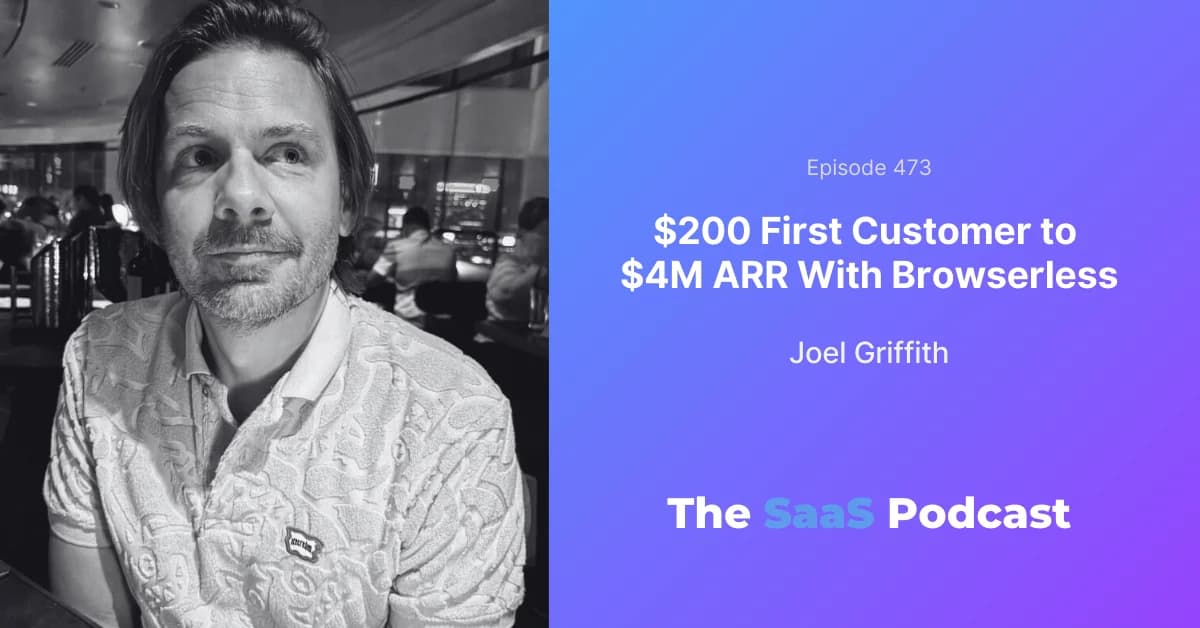
$200 First Customer to $4M ARR Bootstrapped SaaS - Joel Griffith

Joel Griffith, Browserless

$200 First Customer to $4M ARR Bootstrapped SaaS

Joel Griffith is a jazz trumpet player who taught himself to code. Before building his bootstrapped SaaS, he went through five or six failed B2C business ideas. Then he had a realization - the problems he understood best were the ones he dealt with every day as an engineer. The idea came from a side project. He was building a wishlist app and needed to pull product data from retail websites. That meant running a browser in the background to load pages and extract content. It was a nightmare. The browser would crash, run out of memory, and nothing worked reliably. He went to GitHub and sorted issues by most commented. They were all engineers struggling with the same thing. So he pivoted. Instead of building the wishlist app, he'd build the infrastructure to make browsers work reliably for developers. His first customer paid $200 a month. Total infrastructure cost was $50. He was profitable from day one. But growth was painfully slow. He ended his first year at about $1,000 in MRR. It took three years of working nights and weekends, writing blog posts, answering questions on forums, and building in public before he hit $500K in ARR. Even then, he waited an extra six months because COVID hit and he wanted a safety net before going full-time. He ran the business solo, getting to $60K in MRR as a one-person operation. But he eventually hit a wall - he didn't know how to hire, sell, or build a team. So he partnered with a small firm called Polychrome to handle the operational side of the business. Then AI changed everything. Joel had spent years building infrastructure for web scraping and testing. Now AI agents needed browsers to navigate websites, fill out forms, and interact with systems that don't have APIs. A whole new category of demand showed up almost overnight. Today, Browserless is approaching $4 million in ARR with a team of under 10 people. Joel has never raised a dollar. His bootstrapped SaaS survived Google Cloud and a $60M-funded competitor entering his space - his growth didn't even flinch because eight years of content and community had built something no amount of funding could replicate overnight.
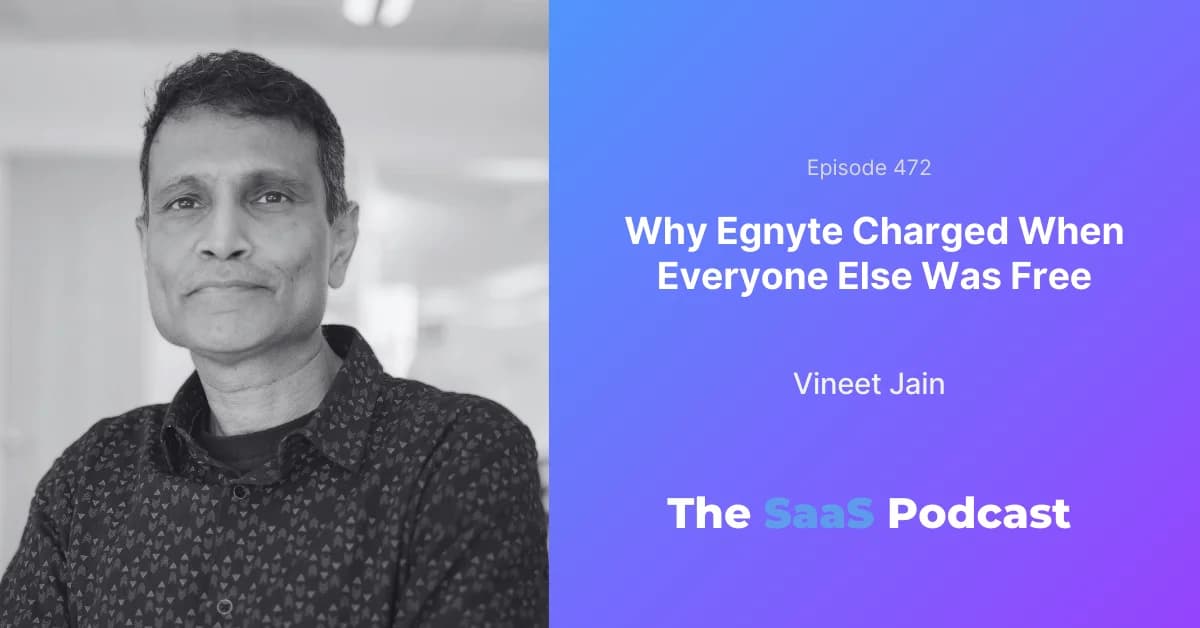
How $6K in SEM Launched an Enterprise Sales Machine - Vineet Jain

Vineet Jain, Egnyte

How $6K in SEM Launched an Enterprise Sales Machine

Vineet Jain is the co-founder and CEO of Egnyte, a content collaboration and security platform for mid-market and enterprise businesses. Vineet arrived in the US with $100 and no connections. He spent four and a half years at KPMG learning to sell to everyone from line managers to CEOs. That convinced him he could build something of his own. In 2001, right after the dot-com bubble burst, he co-founded Valdero, a supply chain software company, and raised $7.5 million from Kleiner Perkins. Revenue grew quickly. Then Oracle and SAP moved in. Pricing pressure crushed them. They sold. Investors made money. The 70 employees didn't. That failure stuck with him. In 2007, Vineet and three co-founders rented a small office. No funding. Two did consulting while the other two wrote code. The idea: move the physical file server to the cloud. When they launched, analysts lumped Egnyte in with Box and Dropbox - hundreds of companies chasing the same market. Everyone told Vineet to do freemium. His board pushed back. Analysts questioned how they were different. Vineet Jain built Egnyte to over $300 million in enterprise sales revenue using three strategies: charge from day one, offer hybrid cloud when everyone said go cloud-only, and keep cost of acquisition low with inside sales offices in cities like Spokane and Raleigh instead of Silicon Valley. In 2016, Gartner named Egnyte a leader - a tiny company standing alongside competitors that had raised billions. Today, Egnyte has 23,000 customers, 1,400 employees, and has raised just $137.5 million with no additional funding since 2018.

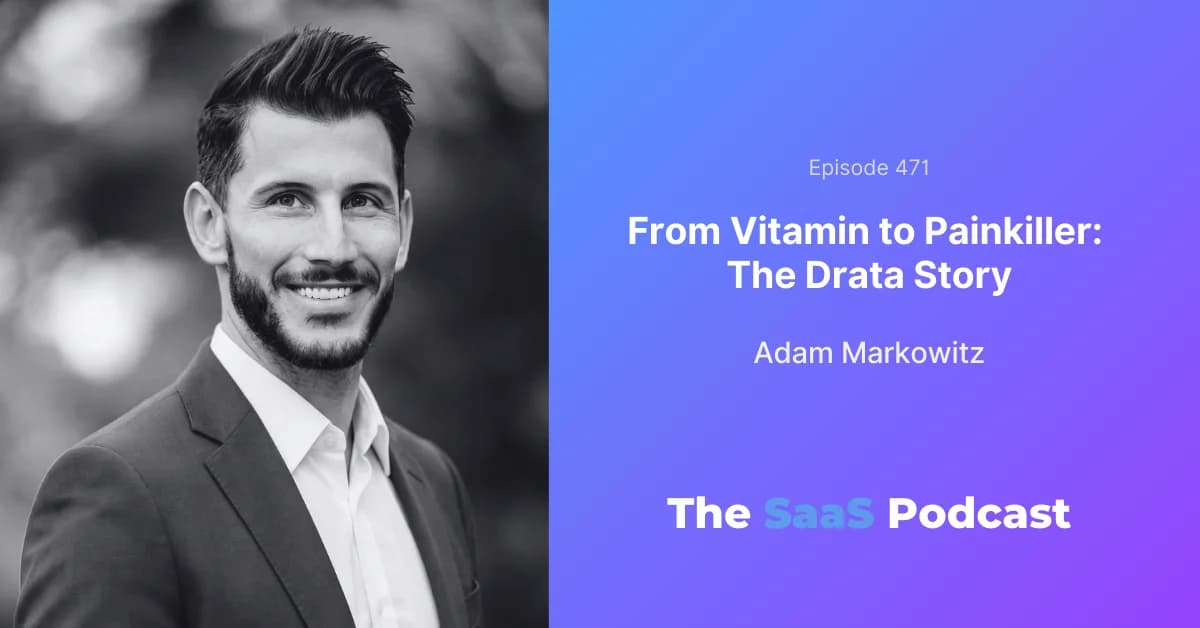
He Sold a Vitamin for 7 Years Then Found Product-Market Fit - Adam Markowitz

Adam Markowitz, Drata

He Sold a Vitamin for 7 Years Then Found Product-Market Fit

Adam Markowitz is the co-founder and CEO of Drata, a trust management platform that helps companies automate compliance, security assurance, and third-party risk management. Adam never planned to be a founder. He wanted to be an astronaut. That led him to aerospace engineering, and in 2008 he landed his dream job working on NASA's Space Shuttle program. Three years later, NASA retired it. So he taught himself to code and built Portfolium, a platform that helped students prove their skills with real project work instead of resume bullet points. It took years, but he eventually got it into over 500 universities. The company was acquired for $43 million. But it was during those long university sales cycles that Adam experienced a moment he never forgot. A CIO at the largest four-year public university system in the country asked him to prove his company's security posture. He couldn't. His entire company was built on the idea of proving things with evidence - and here he was, asking a customer to just take his word for it. That pain became the seed for Drata. After Portfolium's acquisition, Adam got the band back together - same co-founders, same early engineering team. They spent six months building the first version, talking to dozens of companies and auditors to validate the problem before writing code. Then they did something most founders wouldn't: they refused to sell to anyone until they'd used their own product to get SOC 2 compliant first. When they finally launched, product-market fit was immediate. Adam signed 100 customers in six weeks and 1,000 within the first year. The difference from his edtech days was stark - he'd gone from selling a vitamin to selling a painkiller. Adam used three strategies to accelerate Drata's growth to $100M ARR: 1. Dogfooding before selling - using Drata to earn their own SOC 2 gave instant credibility 2. Building an Auditor Alliance that kept auditors independent while making audits faster 3. A "give before you take" AWS partnership that made Drata a top 5 ISV on Marketplace by bringing thousands of new customers to the platform Today, Drata has over 8,000 customers across 60 countries, more than 600 employees, and crossed $100 million in ARR before its fourth birthday. The company has raised over $300 million.

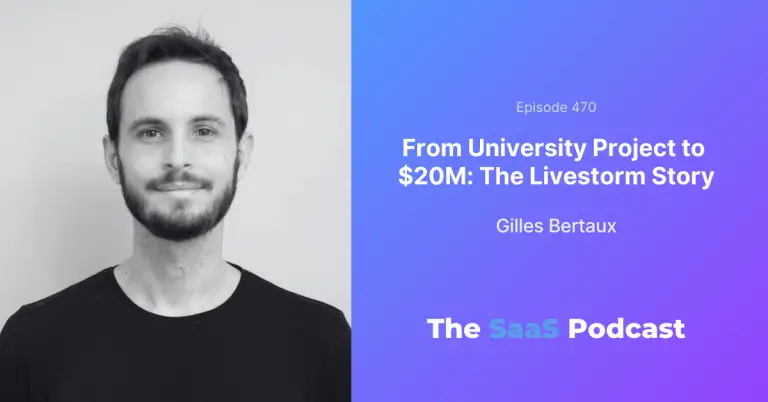
How Livestorm Lost Product-Market Fit at $9M ARR - Gilles Bertaux

Gilles Bertaux, Livestorm

How Livestorm Lost Product-Market Fit at $9M ARR

Gilles Bertaux is the co-founder and CEO of Livestorm, a webinar platform for enterprise marketers. In 2016, Gilles and his three co-founders built Livestorm as a university project. They had two months to build a product, get some users, and present it to a panel. So they built a browser-based webinar tool. On presentation day, they livestreamed all the student presentations. Hundreds of people watched remotely. And they loved it. Even former bosses from internships told them to skip the job hunt and pursue this full-time. They were young with no real responsibilities. So they went for it. They spent weeks collecting leads and hosted a launch webinar to showcase the product. It was a disaster. Gilles tried to bring a marketing exec from a big e-commerce company on screen. Instead, his CTO popped up and said 'I think there is a bug.' Live. In front of everyone. Growth came slowly through SEO, Quora, and partnering with bigger companies to get in front of their audiences. No outbound. No sales team. Gilles wrote three to four articles a day and answered questions on Quora that nobody else was touching. For five years, Quora alone drove 10-15% of total organic traffic. Then COVID hit. In one year, Livestorm went from $2 million to $9 million in ARR. But it was chaos. Support tickets jumped from 200 to 20,000 per month. Servers crashed for an entire day. They had to throw money at AWS just to keep things running, and their margins got crushed. After COVID, things got even messier. They tried building a meeting product, then a sales demo product. Suddenly Livestorm looked like a smaller version of Zoom. Customers had no compelling reason to pick them instead. Livestorm had lost product-market fit. In 2022, they tried to raise a Series C. Investors said no. So Gilles had to flip the company to profitability. That meant going after bigger customers who would pay more and stick around longer. But his sales team only knew how to handle inbound leads. He had to replace almost the entire team. Gilles rebuilt Livestorm's product-market fit by narrowing to enterprise webinars for European marketers in banking and pharma - a niche that most founders would run from. There were moments where he wondered if the product could really make the leap. Part of him questioned whether Livestorm's best days were already behind them. Today, Livestorm generates nearly $20 million in ARR with 3,500 customers and has raised $35 million.

What founders say

โ€œEvery few months there's a blockbuster idea that comes up in our calls that takes my business up a full step. It's paid for itself many times over. Omer brings a powerful combination of deep tactical knowledge and steady strategic thinking. And the community is large enough for diversity but small enough that everyone gets a chance to contribute.โ€

Michael Pinkowski

Michael Pinkowski

Founder, SOPbox

โ€œI was spinning in a losing cycle. Losing money, losing time. Working with Omer helped me get my focus straight and gave me momentum I could never have generated on my own. I learned to stop selling features and start selling how the software makes the customer's life easier. That shift changed everything.โ€

Jordan Jacobs

Jordan Jacobs

Founder, Martin

โ€œJoining Launch was a significant decision, given my concerns about potentially wasting time and money. The outcome exceeded my expectations: I launched my product and secured a $10k customer within months. The coaching sessions were invaluable, offering a space to exchange ideas, face challenges, and receive help.โ€

Kenton Baker

Kenton Baker

Founder, LeadTime

Hi, I'm Omer

Omer Khan

Omer Khan

I've spent the last decade having the same conversation with nearly 500 SaaS founders: what actually worked?

Not the polished version. The real one. What broke, what surprised them, and what they'd do differently if they started again today.

After hundreds of those conversations (and years of coaching founders through the messy middle), I've seen the same patterns play out over and over. SaaS Club exists to put those patterns in your hands, so you don't have to figure everything out alone.

And in a world flooded with AI-generated advice, real human connection matters more than ever. AI can help you build faster. But nothing replaces being surrounded by founders who genuinely empathize with your struggles, support you when things get hard, and push you forward when you're ready to give up.

๐ŸŽ™473+ Episodes
๐Ÿ’ผEx-Microsoft
๐Ÿ“ˆTop 0.5% Podcast
๐Ÿ†150+ Coached

Coaching

Get unstuck faster

Whether you're finding your first customers or breaking through a growth ceiling, there's a path for your stage.

Getting Started

Find product-market fit and your first $10K MRR

You have an idea (or a product) but aren't sure what to do next. Get a clear roadmap, expert coaching, and the lessons from hundreds of founders who figured it out before you.

Explore SaaS Club Launchโ†’
Scaling Up

Break through the ceiling and reach 7 figures

You're generating revenue but growth has stalled. Join a mastermind of founders at your stage, get accountability, and develop the strategy to scale past the plateau.

Explore SaaS Club Mastermindโ†’

Ready to build your SaaS with founders who get it?

Join thousands of SaaS founders getting weekly insights and proven strategies from real founder conversations.