Omer (00:11.840)
Welcome to another episode of the SaaS Podcast.
I'm your host, Omer Khan, and this is the show where I interview proven founders and industry experts who share their stories, strategies and insights to help you build, launch and grow your SaaS business.
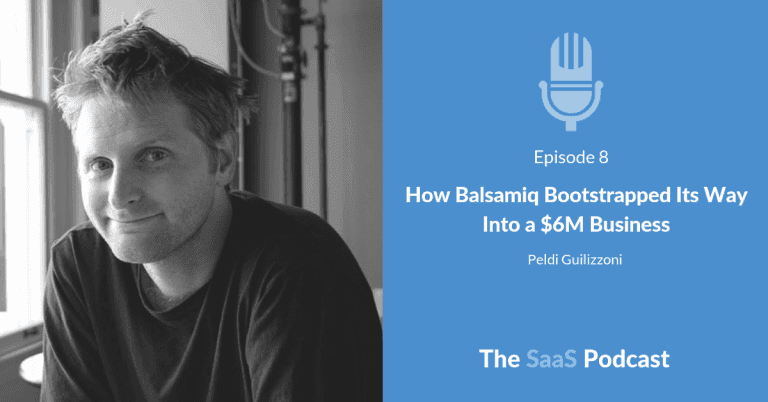
Today's interview is with Peldi Guilizoni.
Peldi is the founder of Balsamiq Studios, which makes Balsamiq Mockups, a tool for creating quick and intuitive user interface mockups.
Peldi launched Balsamiq as a one man software company in 2008, and within 18 months, Balsamiq reached $2 million in revenue.
Peldi, welcome to the show.
Peldi Guilizzoni (00:50.490)
Hello, everybody.
Thank you, Omer, for having me on your show.
Omer (00:54.710)
So I've told our audience just a little bit about you.
Tell us in your own words a little bit more about you personally and then give us an overview of your product and business.
Peldi Guilizzoni (01:03.270)
Sure.
So I am a programmer turned entrepreneur.
I am 39 years old.
I am Italian and I live in Italy, but I lived in San Francisco for about seven years working at Micromedia and then Adobe as a programmer.
And then I have one son who's nine years old.
My wife's name is Mariah and the business is as you described.
I came up with this little tool that I needed in my job for sketching user interfaces.
And basically the idea is to replicate the experience of sketching on a whiteboard, but starting digitally so that it's easier to share with people, it's easier to make changes and collaborate on user interface designs.
I built my little tool and it's been very successful since.
Great.
Omer (02:13.190)
Now, before we dive into more details, we like to kick things off with a success quote to better understand what drives and motivates our guests.
What is your favorite success quote?
Peldi Guilizzoni (02:22.870)
There's a lot, you know, there's a lot of people I look up to, but one that sort of summarizes, you know, that I think about often is by Steve Martin, which is the comedian, well, now banjo player.
And he says, be so good, they can't ignore you.
Basically, if everything you do is really, really good, people, you know, people's tendency is to ignore you because there's just, you know, a new app every five minutes, a new service all the time.
The Internet is a giant place, but if everything you do is really, really good, they won't ignore it.
They won't ignore you.
Dillo.
They'll pay attention and they'll tell your friend, their friends.
And so it's not easy to be very, very good, but it's sort of A great goal to try and achieve.
And so in everything you do, every piece of output that you produce, try to make it as good as, you know, the best that it can be.
And it helps even if you don't get there all the time, be so
Omer (03:27.280)
good so they can't ignore you.
I love that one.
And I know that that actually quote drives a lot of the.
The philosophy and the vision that you have with Balsamiq and, and hopefully we'll be able to talk more about that a bit later.
Now, before we get into talking about Balsamiq, I want to find out a little bit more about you.
So let's take a journey together back to the early days before Balsamiq.
What were you doing before you started working on that business?
Peldi Guilizzoni (03:56.950)
I was a developer at Adobe working on online meeting software and that was my career for good.
Seven years while I was there.
We did this sort of Google Hangout about 10 years before type system with for collaborating online.
It was harder at the time because people didn't have good connections, et cetera, et cetera.
But anyways, so I was a developer there and I loved it.
I have only great memories.
Loved working at Adobe, being surrounded by people smarter than me and learning a lot from them.
So I did that for a long time.
And then one day I was look, you know, often once in a while I would look for a tool to help me to help our team communicate about application, you know, features or, you know, new products better.
And, and I couldn't find one that that was well done.
And so I thought, hey, maybe this is something that I could build for myself.
And that's, that's what started the Balsamiq adventure.
Omer (05:17.970)
Did you, did you know that you would launch your own business when you came up with that idea or you were just looking to solve a problem?
Peldi Guilizzoni (05:30.520)
No, it was sort of.
The idea was to try.
I was ready in my career to try and go solo.
My main goal has been to continue, learn forever, learn as much as I can forever.
And I was noticing that after a few years at Adobe, I had sort of reached the limits of what I could learn because we had a big team.
And so my job was to be a developer.
There were other people that were taking care of marketing, customer support, sales, legal, all that stuff.
And I was really fascinated.
Pricing, I was really fascinated by the whole process and I figured maybe if I go into business by myself, that's the best way to learn all of that stuff.
It's kind of reckless thinking back to it, but so I thought that's why.
Also, I didn't want any co founders because I wanted to, you know, figure out all that it took to create and market and support and sell a software tool.
Omer (06:43.060)
Okay, so you've got this idea.
What did you do next?
You didn't just quit your job, right?
There was a lot of evenings and
Peldi Guilizzoni (06:50.430)
weekends that suddenly became yeah, yeah, yeah.
So I started.
I decided, you know, the product I was working on, my day job was going to ship after maybe eight months.
And so I said, okay, I have one year, let's say, just in case it slips a little, you know, often does.
I have one year to come up with to have something ready to sell.
And so I started selling all of my stock options and I stopped contributing to 401k.
I started to amass as much cash as I could because I wanted to have a cushion at the bank so that I could at least have a year of expenses covered so that I could dedicate my life to this idea for.
For a full year after quitting.
And so for the next seven, eight months, I worked every evening in the kitchen, 8pm to midnight.
And then I would go and do the best that I could at my day job and then I would work Sunday mornings as well.
And I had a two year old at the time, so it was tough.
But, you know, I don't know if I could do it again.
But I have great memories of that period because it didn't feel like it was working.
You know, I was making a dream come true.
It felt like a mission more than anything else.
I enjoyed it a lot.
Omer (08:24.730)
Were there other ideas that you had for a business or a product before Balsamiq?
Peldi Guilizzoni (08:32.060)
Yes and no.
I have a couple of friends who love coming up with possible business ideas.
It's kind of like everybody's favorite hobby in San Francisco.
Everybody has ideas for the next big thing all the time.
And so we were going to lunch and chat about all these ideas and my job, it wasn't my job, but I realized that I was the.
They called me the hole puncher.
I would punch all these holes in their balloons ideas.
I was like, well, I don't think that's going to work because X and Y and Z. I was the skeptical one all the time, maybe even too much.
I probably shut down some ideas that would be fantastic now.
So anyways, so I had lots of ideas, but none that I was eager to go and jump and try to solve by myself.
This wireframing tool was the first one where I thought, hey, this seems like a pretty safe Bet.
Omer (09:29.930)
Now, how long did it take you to get the product shipped?
Peldi Guilizzoni (09:33.770)
Oh, I was.
You know, those six, seven months of nighttime coding, that's what it was.
That's all it took.
I quit on June 15, was my last day, 2008.
And then four days later, I launched, which really just meant I sent a couple of emails to some bloggers begging them to write about me.
Omer (09:57.260)
Now, you did really well in the first few weeks of being in business, right?
Peldi Guilizzoni (10:01.500)
Yeah, it kind of exploded in my face immediately.
Omer (10:06.860)
So tell me what happened there.
Peldi Guilizzoni (10:08.940)
Well, first of all, I said I launched on the 19th, but the first sale actually happened on the 16th, a few days before I was even ready.
And it was funny because I get this email from the payment processor.
I was like, wait, I'm not testing anything.
You know, what's going on?
And so it was somebody who had Googled it up.
The website was live.
Just.
I hadn't told anybody about it, but I guess Google had picked it up and somebody had Googled wireframing tools.
They found my website and they just bought it.
So that sort of started like that, just by itself.
And then after that, you know, some friends and families started giving some telling people about it.
And then the software kind of has a viral component on its own.
The images that you make with Balsamiq mockups are very particular.
They look sketchy, they look kind of ugly on purpose.
And so when you see a mock up made with mockups, immediately you're gonna ask, how did you make that?
That's interesting.
And so it kind of sells itself.
It does word of mouth by itself.
But then I had all these programs, like, I wanted to get feedback because I knew that the product was really rough.
You know, it was brand new.
And so I wanted to know what I should focus on next.
And so I started this program where I said, if you're a blogger, I'll give you a free license just so that you can write a blog post about my tool to give me some good feedback, you know, and to spread the word at the same time.
And that was very successful.
Turns out bloggers love free stuff.
And so I started giving them two licenses, one for them to keep and one to give away to their readers.
And that blew up.
And then all of a sudden, I did it mostly to get, you know, to get this feedback.
But looking back, it was a great idea because all those blog posts linked to my website were good for SEO.
And so that sort of started snowballing from there.
Omer (12:22.950)
So tell me a little bit about the.
Did you do Any marketing before the product launched or was it all after?
Peldi Guilizzoni (12:29.990)
No, it was all after.
I'm old school.
It was way before, you know, Lean Startup was, was a thing.
Landing pages were not, you know, were not popular yet.
Omer (12:44.730)
And did you do any kind of validation during those six or seven months?
Peldi Guilizzoni (12:49.290)
So the only validation was, first of all, I had my own validation where immediately I started using the tool to create the tool as soon as I could.
It quickly became replaced the pen and paper for me and I was like, well, this is a good sign.
And then as I was building it, I couldn't really use it at work, but I was dying to use it.
I work, I'm like, this could be so much faster if I didn't use it myself.
And then I started, I had a little group of friends as a beta testers, you know, first five, then 10, 20, and they were all over it.
They, they just were ready to buy it immediately.
And so those were all great signs to me.
But I didn't do anything for BO other than this.
Omer (13:41.910)
So it sounds too good to be true, right?
I mean, you come up with this idea, you don't have to really do much validation.
You go and build it, you get your first customer before you even launch the product.
Peldi Guilizzoni (13:53.350)
But that's why I was a little hesitant coming on your show because I am like the opposite of most people.
And I know it's very, very lucky.
I think I just stumbled on a completely untapped market.
You know, if there was something good, I would have just bought it and saved myself the effort of writing the tool.
But there just wasn't anything yet.
Maybe just because it was early, I don't know, there were a few tools.
There was like this semi abandoned university project.
There was another tool that just had a million buttons on the screen.
They tried to do too much.
There wasn't much that was simple to use.
And so I kind of found this product market fit by scratching my own itch.
It wasn't really, it wasn't designed to be this giant thing.
My business model was to build this tool as a plugin for Atlassian Confluence, which is an extensible wiki platform.
And that's it.
I didn't want to make a desktop software because, come on, it's 2008. Who uses desktop, right?
But then during the beta, all these people started saying, well, I love the tool, but I don't have Confluence.
Can I just have the tool?
Can I run it on my desktop?
And for a while I was like, no, you can't do that.
Because that's not my business plan.
My business plan is to have few enterprise customers that I can support by myself, because the idea was still to stay by myself and feed my only.
Feed my family, right?
And so I wanted a few custom, few big customers rather than a lot of small customers, just, you know, because they'd be easier to support.
And so if I made a desktop tool, I couldn't make it that expensive.
And so for a few weeks, there were people on the beta just begging me to give it to them as a desktop tool.
And I sort of caved in at some point, and that was the best thing ever, because now the desktop is still 60% of our business.
You know, we're a shareware people.
We're a shareware company.
In 2014.
It's pretty funny with all the SaaS and everything, we, you know, then eventually we added a SaaS module, which is growing gradually.
It's good.
It's all good.
But, you know, that other quote, no business ever survived the first impact with customers and, you know, no business model.
And, you know, the same happened to me.
Omer (16:24.780)
So looking back at those early days, what do you think was one of the biggest mistakes that you made?
Peldi Guilizzoni (16:32.940)
I think I waited too long before hiring somebody.
You know, one I tried.
My idea was do it all, do it all, do it all, do it all by yourself.
But then there were.
It became.
It came to a point after a few months with 3,000 customers, that I was doing sales and technical support, email all week, and then I could only code during the weekend because it was a little more quiet.
And I did that for a good six weeks, Basically no days off.
And then one morning, I woke up sweating bullets, thinking I was gonna die.
If I continue like this, it's gonna be bad news.
And so that's when.
But that's when I started hiring.
You know, I looked to hire the first employee, but, you know, that hurt me and my family and my business.
I could have.
But it was.
It was super scary, right?
The first hire is the scariest because I didn't know if it was gonna last.
You know, it could have been a little thing, but when I got a year of salary, a year of their salary saved up in the bank, then I went to this guy, Marco, a programmer, and I said, listen, I can pay you for the next year.
I know that for sure.
After that, I don't know.
But he took a leap of faith, and so I'm very thankful for that.
So maybe that's one of the big mistakes.
But there's so many mistakes that happen all the time.
The thing is, I don't dwell on those very much.
I like to make mistakes as a way to learn from them.
The important thing is that you react quickly and properly and that you don't do them again.
Mistakes will happen inevitably.
I'm not, I'm not so hard on myself when those happen.
Omer (18:25.430)
Okay, Paul, so you've got to $100,000 revenue in your first five months of business.
Peldi Guilizzoni (18:31.430)
I believe something like that.
Omer (18:34.550)
Let's say the next big milestone is getting to a million dollars.
Whether you have that in mind or not.
How long did it take for you, you to get there?
Peldi Guilizzoni (18:43.080)
Let me see.
I'm trying to remember.
I think the first year, which was really half a year, the revenue was $160,000, which I thought was amazing.
I was ridiculous.
The second year was maybe $600,000.
Then the third year, 1.2 million, then 2.44.
It's been growing and growing and growing.
Now we're in our sixth year.
We just turned six as a company and this year we should be making over $6 million in revenue, which is incredible.
I still can't believe it.
For a tool that was designed to be the smallest thing that I could think of, it just became enormous.
It grew and grew.
Omer (19:33.560)
So did you do anything differently to acquire more customers and change your marketing strategy when you, when you got to that first hundred thousand dollars revenue?
Peldi Guilizzoni (19:45.800)
No.
I mean, the marketing strategy has been, has never been very formalized.
It's sort of, you know, I'm a total rookie.
I do a lot of things.
Gut feeling still.
And so, you know, there's always new ideas that we try out, ideas that we think would be beneficial to our customers.
One thing that I started doing once I started having some more money, I caved in and I signed up for AdWords because at the beginning I didn't want to.
I didn't have any AdWords.
But you know, eight months in, Google sent me the $50 free and I tried it out and it seemed to work.
And so then, now we do that and I always spend a few thousand dollars a month in AdWords spending.
The other thing that I started doing is as I had more cash, I started sponsoring more user experience related events.
And this was an advice that Sarah Allen, one of my advisors gave me, saying, you know, now there's other companies competing with you, but you seem to be becoming the leader now.
You have to show everybody that you're the leader.
So if you have money, spend it on just to put your brand out there so that people see that you're the leader.
And that was very good advice.
So, you know, but these were a few things that started around that time.
You know, that with more budget, you can do more things.
So, of course your marketing strategy should evolve.
Omer (21:25.560)
What did you learn about the product in those first first couple of years?
You know, what kind of growing pains were you experiencing?
Peldi Guilizzoni (21:35.240)
Oh, I mean, lots and lots.
The company just grew.
Even if I didn't want it to grow, I just wanted my little thing, you know, my little tiny corner of the web.
I wanted to just, you know, I have my side business in a way.
Omer (21:51.080)
But that was a good problem to have, though, right?
Peldi Guilizzoni (21:54.360)
Oh, definitely.
Definitely.
I know I feel bad even mentioning this because I know I'm very much aware of how lucky I was.
And so they were always growing pains.
Mostly about hiring a company.
I said once I hired four or five people, I said, okay, that's it.
That's as many as I'm comfortable managing.
That is a perfect size team.
You can do a lot with four or five people.
I even wrote in a blog post, my goal for the next two years is for nothing to change.
And so I was very much wrong, because customers kept coming, questions kept coming.
We wanted to do more and more and more.
You just can't do.
There's only so much you can do with six people.
And so I resisted hiring more for too long, and that was painful.
And so then.
Then I gave in and we hired more people.
But then we needed to all of a sudden have a company culture.
Then we knew we wanted to grow some more after that.
And so we needed a company handbook so that we could have a common voice when we spoke to the customers or common set of values and ways to do different things.
And so that took a long time to define and come up with all the policies and our handbook.
But that was useful because once we had the handbook, we were able to go from 10 people to 16 people in one year.
So there's always growing pains.
And it's funny because from the outside, you don't see any of this.
And it takes a lot of your time and effort.
And so people, sometimes customers are like, you haven't released in two months.
What have you been doing?
Are you just sitting on your laurels?
And meanwhile, we're just dealing with 401k programs.
Growing a company is a giant effort regardless of what your product does.
Omer (23:58.390)
Now, you had a very specific culture in mind for the kind of company you wanted to create and the kind of employees you wanted to hire.
Now, I know that pretty much all your employees work remotely.
Peldi Guilizzoni (24:10.190)
Most of them, yes.
Omer (24:11.310)
And so can you talk a little bit about just the culture that you're trying to build in Balsamiq?
Peldi Guilizzoni (24:16.830)
Well, I mean, from the beginning, it's sort of been on our company page from the beginning, which is we're trying to build a company that we'd like to do business with ourselves.
Right.
We want to be passionate about what we do, work on stuff that we know how to do, be very good at what we do, only bite off what we can chew, be in it for the long haul.
You know, when you're buying a product, you don't just buy it because of the product anymore, you buy it because of the product.
You want to make sure that there's a company behind it that will support you when you need help, that will stay in business.
All these new startups, I'm always worried about trying them out because some of them smell like they've been built just to be flipped to Google or, you know, a big company like that.
And often those.
More often than not, those acquisitions end up destroying the original product.
And so there's always a risk.
So I've always been very open about how we want to stay independent, how this is our life's passion.
And we just, you know, this is it.
This is what we're about, you know, and so basically, being honest, being respectful, caring for our customers, success genuinely, those are the things that I would want other people to do with me.
And so we should try and do it with other people, to other people.
Omer (25:42.260)
So I want to go back to that quote that you shared earlier.
Be so good they can't ignore you and just talk a little bit about how that has.
You've applied that within your business.
Now, when I was doing the research for this interview, one of the things I came across was the experience that you had with updating your eula,
Peldi Guilizzoni (26:07.360)
writing the eula.
So, wait, what are you talking about exactly?
Omer (26:11.680)
I'm talking about the fact that you either you wrote a EULA or you updated it, and you were actually getting people noticing that and giving you positive feedback about the eula.
Peldi Guilizzoni (26:23.120)
Yes, yes.
So there's this concept that I've been calling the golden puzzle.
And the golden puzzle is when somebody writes something or says something online about you, about your company that is not really about your core competencies.
So if anybody writes, you know, our core things are good support and good product.
Right.
If people say good things about the product and support, that's fine.
That's the testimonial.
But if they say a good thing about something else that we do, that's not those two things.
That, to me, counts as a golden puzzle.
And we try to collect as many pieces of the golden puzzle as we can so it goes back to be so good they can't ignore you.
Basically, we want in anything we do, our website, our eula, our pricing model, our, you know, even this interview, I would love for somebody to say that was the best interview that I've heard.
Right?
We're trying to do to be so good that every piece of output is remarkable.
And if people do write about it publicly, we've done our job well.
And that's a piece of the golden puzzle, which we collect and print it out and put it on the wall.
And so it was interesting that if you try to do that, it actually starts happening.
And, yes, what happened was that somebody said, you know, when I had to write my eula, I was panicked because I was like, wait a minute, I know what a EULA is.
Because I accepted a lot of those when installing stuff.
I never actually read one, and now I have to write one.
So it was one of those panic moments at the beginning, which it was perfect.
That's exactly what it's all about.
That's why I went solo, because I wanted to have those challenges.
And so I took.
I started reading all the Eulas that I could find, and I made a Frankenstein copy paste of different from different Eulas and sort of, you know, put it together and had a lawyer look it over.
And then, you know, I thought I took away some stuff that seemed a little bit jerky, a little bit too slanted towards.
Towards the company, you know, things that, as a customer, I would not like to accept.
And so then I published that, and that was it.
I forgot all about it.
Then a few months later, somebody, this guy who has a blog all about Eulas, he's a EULA nerd, loves Eulas.
He posted a little blog post about my Eula saying, that's the best one I've seen in a long time.
Boom.
Golden puzzle piece right there.
So we have a similar one.
I made a Twitter background for our Twitter stream.
I made an image by taking a lot of snapshots of little tweets about us, little estimonials.
I call them tweet, Tweet.
And I did it like, I made this collage of all these different tweets, and I use that as the Twitter background, right?
I get a message from Evan, the inventor of Twitter telling me, hey Balsamiq, nice Twitter background.
You gotta be kidding me.
Even the Twitter background gets a mention, you know, and so, but that's the other thing.
It's because everything we do, we're always thinking, how can we make this interesting?
Remarkable, you know, well done.
Everything we do and something, lots of things I've done, nobody cared about, but some of the things that will work, you know.
Omer (30:23.800)
So what do you think is your secret sauce?
Peldi Guilizzoni (30:27.240)
Oh goodness, I don't know.
You know what's interesting is that.
I don't know, I think we'd really care.
It's probably not enough.
I know there's a lot of people that really care, but we listen very well to our customers, we have a clear vision, but we're not afraid to change that vision based on our customers input.
Some of the best features came from our customers ideas.
We're very focused.
We say no to a lot of things that would be super fun to do.
Like we get approached often about, hey, you should make a version of this for chemistry, you should make a version of this for gardening.
And these are completely untapped markets and you would be able to do this in a month just by tweaking the engine that we already built.
And yes, it's true and it is tempting, but that would mean losing our focus to me.
And so I've been really relentless in saying no to all these very tempting distractions over time.
So maybe our focus and the fact that we've invested a lot in our team, we have a personal development program where people are encouraged to learn things during work time that is very successful.
So it's a one day, my dad, when I, when he saw that I was getting successful, he was like, what if people steal your code?
You know, is that, you know, what is the thing that if people steal it, you go out of business?
Do you have any patents?
And I was like, no.
Is your code really hard?
It's like, no, dad, I wrote it at night when I was tired.
And so what is it that they can steal?
And I was stumped because I don't think that there is a single thing that is the source of our success.
I think if anything, maybe we're successful because we are pretty good at a lot of different things.
Omer (32:58.630)
Yeah, I think that's a great point.
But actually from my perspective, and I've been watching you and Balsamiq for, for many years and I would, I would say that your secret sauce is you right now.
And I'll explain why I say that because you know, I heard a talk that you did some years ago and I was really struck by the, the level of transparency that you had about your business, the culture that you were trying to create within the company and then the.
The community that you were trying to build with your customers.
And I think it was a combination of those things that just said to me, I really like this guy and I really like what this company is trying to do.
And ever since then, I've always recommended.
Every time I hear anybody talking about wireframing or mock ups, Balsamiq is the one that I recommend.
So.
Peldi Guilizzoni (33:54.960)
Well, thank you.
Thank you very much.
But let me tell you, the transparency, all that, none of that is my idea.
I just, you know, I.
What I do is I read a lot and I have a lot of people that I look up to and I try to be just like them.
So I try to maybe put it all together, but it's not like I'm inventing anything.
So.
But thank you.
Thank you for that.
I take that as a great compliment.
Omer (34:19.610)
You're welcome.
So, Peldi, we started this conversation by going back to where the idea for boltonic came from.
And then we've taken this journey together on how you turn that idea into a successful product.
What's the one thing in your business that you're most excited about right now?
Peldi Guilizzoni (34:35.300)
Oh, man, there's not enough hours in the day.
I am so excited to come to work every day.
We are moving off of Flash right now.
We're still a Flash application, which, no, you know, most of our customers, the vast majority of our customers, and we have over 200,000 customers now, they don't care at all what technology we use.
It just has to work.
And our, and our app is solid right now.
It's mature and it works well.
But as developers ourselves, you know, we know we're on a platform that is not, let's say, maybe its best days are behind it.
And so we want to provide a better experience to our customers by going native on all the different platforms, Web and Mac, Windows and Linux and Android and iPad.
We want to build best of class user experiences on each of these platforms.
And so we're rewriting our application in a way that allows us to go native while continuing to share most of the code base, which is a crazy technical challenge.
Not a lot of people have done it yet, but it's coming along.
It seems to be working out very well.
So it's a massive effort, probably going to take over a year.
We've already done a viewer part and now we're going to start working on the editor soon.
So that's the most exciting part.
One, because it's fun work for everybody, and two, because it will provide our customers with the better experience that they've been asking for.
Omer (36:24.700)
Awesome.
Okay, so now it's time for our lightning round.
I'm gonna ask you a series of questions and I'd just like you to answer them as quickly as you can.
Peldi Guilizzoni (36:33.900)
All right, Great.
Omer (36:35.700)
Here we go.
So what's the best piece of business advice that you ever received?
Peldi Guilizzoni (36:41.420)
Do the time.
Don't rush into going into business on your own.
Go and work in a big company.
Learn a lot, build a network.
Before you jump into entrepreneurship, what book
Omer (36:57.610)
would you recommend to our audience and why?
Peldi Guilizzoni (37:00.250)
Can I say two?
Omer (37:01.610)
Sure.
Peldi Guilizzoni (37:02.410)
Okay.
One is Crossing the Chasm.
I know everybody knows it, but it's amazing to me how people don't just read that first.
That will give you the basic of all marketing.
And the second one is one that not many people know.
It's called Growing a Business by Hawken.
And it shows a way to grow a business in a more sort of organic way, respectful of your customers, your employees, and yourself.
It's a little hippie, but I really loved it.
It's called Growing a Business.
Omer (37:41.230)
What's one attribute or characteristic in your mind of a successful entrepreneur?
Peldi Guilizzoni (37:46.670)
The ability to make yourself like everything, anything.
There are a lot of crappy jobs that are required out of the CEO, and the more you are able to treat it as a learning experience or trick yourself into liking the job, the easier time you will have.
Omer (38:07.200)
What's your favorite personal productivity tool or habit?
Peldi Guilizzoni (38:11.920)
Personal productivity tool or habit?
I don't know.
There's a lot.
There's a lot.
I just like to focus and, you know, quit all the software except for what I need to do.
I only have one piece of software open at the time.
Remove distractions.
Omer (38:33.930)
Okay.
If you had to start over tomorrow, what type of business would you build?
Peldi Guilizzoni (38:39.130)
Oh, I have no idea.
I think I got lucky once in my life.
I'm hanging on to this one.
Omer (38:47.210)
So what's an interesting or fun fact about you that most people don't know?
Peldi Guilizzoni (38:53.850)
I'm pretty good at the Wii, the Just Dance game.
Omer (39:01.100)
And what is one of your most important passions outside of your work?
Peldi Guilizzoni (39:06.860)
I love making.
Working with my hands.
I cannot wait until I'm old.
And I have a wood shop.
Woodworking shop.
Omer (39:19.020)
Fantastic.
Okay, great answers, Peldy.
Unfortunately, it's time for us to wrap up.
I want to thank you for joining me today and talking about Balsamiq.
I really appreciate you sharing your experiences and insights with our audience, and thank you for letting us get to know you a little better personally as well.
Peldi Guilizzoni (39:37.490)
Thanks.
Thank you and good luck with the podcast.
Omer (39:39.890)
Thank you.
If folks want to find out more about Balsamiq or they want to get in touch with you, what's the best way for them to do that?
Peldi Guilizzoni (39:46.770)
Balsamiq.com like the vinegar but with a Q instead of a C at the end.
And there's all sorts of information there.
My email is there and lots of ways to reach us.
Omer (39:59.710)
Awesome.
Thanks again, Peldy, and I wish you continued success in the future.
Peldi Guilizzoni (40:03.790)
Thank you.
Thank you.