Omer Khan [00:00:03]:
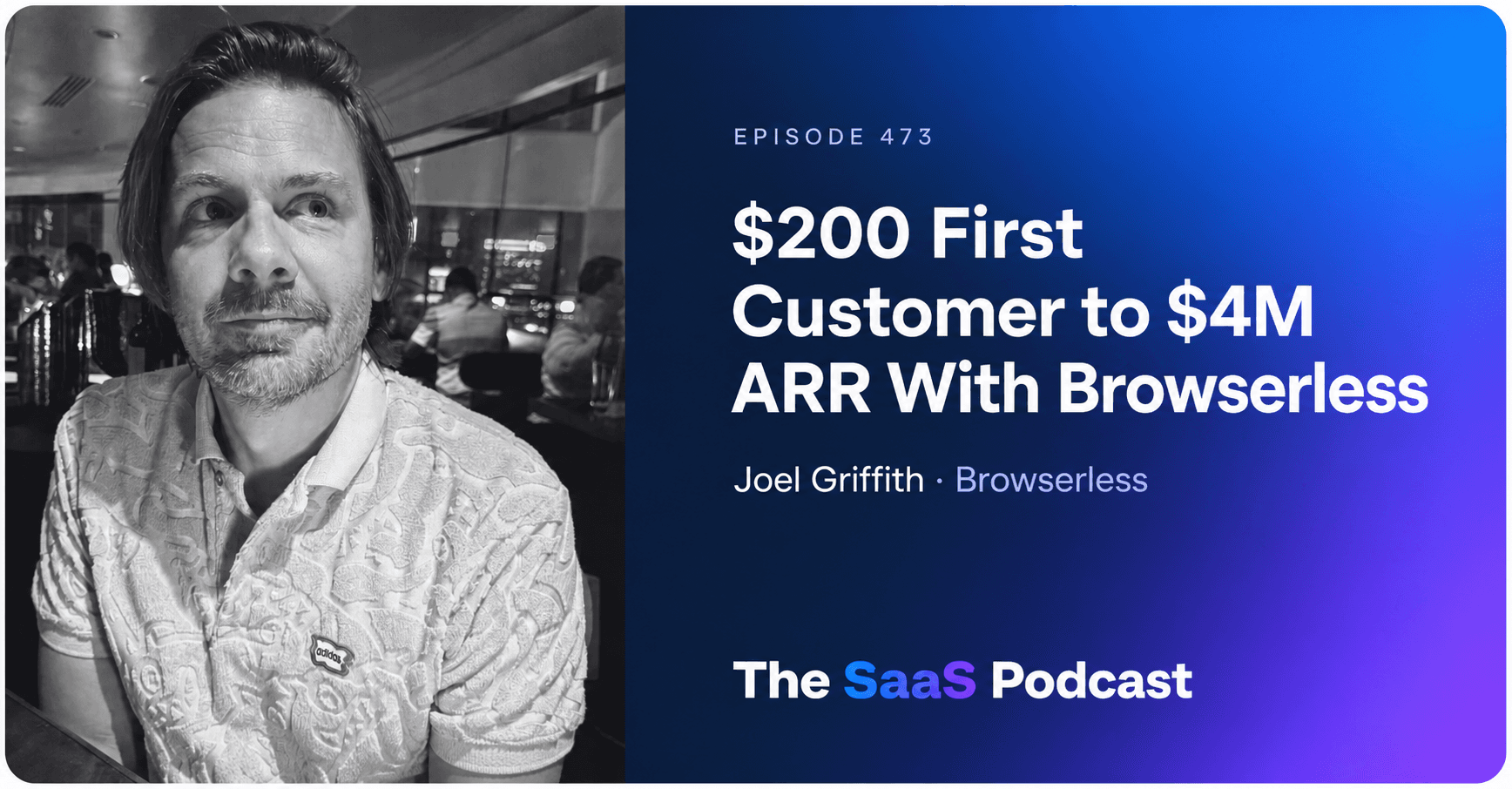
Welcome to the SaaS podcast. I'm your host, Omer Khan. AI has changed the playbook for building and growing SaaS. Every week I talk to founders who are writing the new one. My guest today is Joel Griffith, the founder of Browserless. They let developers run and automate browsers in the cloud. Joel bootstrapped this business to nearly 4 million in ARR with a team of less than 10 people. But it took three years of nights and weekends before he felt safe enough to be able to go full time. Then Google launched a competing product.
Omer Khan [00:00:36]:
A VC-backed startup raised $60 million to compete in his space. And then AI came along and changed everything. Joel, welcome to the show.
Joel Griffith [00:00:47]:
Hey, thanks so much. Thanks for having me. Happy to be here. Excited to talk about Browserless and things.
Omer Khan [00:00:52]:
So yeah, that works for me. So tell us about Browserless. What does the product do, who's it for, and what's the main problem you're helping to solve?
Joel Griffith [00:01:01]:
Yeah, so it's a headless browser. I just shouldn't say headless. It's just browsers as a service. There's just times in engineering organization or even a non-engineering organization and you need to get something automated or done in like a third party system or get data from someplace and you have to use a web browser to do that. Which probably doesn't shock a lot of people that have never worked on a technical problem, but you know, to do that like automatically in the background, you know, not have to go do it yourself, that involves writing code.
Joel Griffith [00:01:32]:
And you got to manage this thing now, this browser process, make sure it gets shut down so you're not spending a lot of money on it. And so we, we kind of take the operational part of that off. So we're like, you could think of it as browsers, as infrastructure, um, but just helping like programmers, engineers automate things that need to get done for their business or personal reasons and don't want to think about babysitting a massive, massive binary, massive process alongside of that.
Omer Khan [00:01:59]:
So you were about to say it's a headless Chrome browser, and then you said, no, I'm not going to say the headless piece. So just explain that because when I kind of, you know, researched the interview, it made sense, right? I mean a Headless Chrome browser is basically a browser without the window that we see that allows people programmatically to go and get something from another website right through the browser. So why did you pause at the. I shouldn't say that.
Joel Griffith [00:02:30]:
Yeah, I think it's partly because people get confused on like well, why are you calling it headless? It's just a browser. There's no head on a browser. So I think people that aren't in the, like, the technical side get, you know, tripped up on that a little bit. Like, what is a headless browser? Why are you saying headless? And it's just. Yeah, it's what you exactly said. It's a browser without a running display. And in like, programming parlance, headless is what we call that. Or, you know, daemonized. That's another word. It runs in the background.
Joel Griffith [00:02:58]:
So programmatic browsers, I think would be a lot better way to put it. But yeah, I don't know why the term never caught on. Headless. Headless caught on for some reason. So that's what all the engineers will say, or developers, you'll hear them say headless.
Omer Khan [00:03:10]:
So, so, so give us a sense of the size of the business. Where are you in terms of revenue, customers, size of team?
Joel Griffith [00:03:15]:
Yeah, so we're hovering right around like three and a half million ARR. Really close to 4 million. So. And we get, I mean, in terms of like daily signups, we, you know, right around 250 to 300 signups a day. And then, you know, percentage of that converts to paid. I think we're probably, if I were to, you know, look at it again as 3 to 4000 paid users and that's, you know, trending upwards. So. Yeah, good, good, healthy numbers. I'm happy. Yeah. With that. So, yeah, it's been a. Been a fun journey to get there.
Joel Griffith [00:03:50]:
But yeah, right. About three and a half million ARR. And then. Yeah.
Omer Khan [00:03:54]:
And how big is the team?
Joel Griffith [00:03:55]:
We're under 10. So it's very small, very focused team. Predominantly, obviously engineers. About half of that is engineering. And then if you count me as well into that equation, probably like 60% of us are. Yeah. Engineering and building stuff.
Omer Khan [00:04:12]:
Let's. Let's talk about, like, where the, the idea came from. And also I shouldn't. We should mention that the business is bootstrapped 100%.
Joel Griffith [00:04:21]:
Yeah. So there's kind of an aha moment that I had. And then, you know, the more I looked into it or thought about when the company started, I was like, oh, there was like this pattern in prior engineering roles that I had were this technology would have helped a lot, you know, but nobody had the time or the effort or thought about it enough just to like, get something off the ground. A lot of technology is a means to an end.
Joel Griffith [00:04:44]:
And so browser was kind of felt like that, but nobody was just Thinking about having a better mean to the end. But I was working on side projects as a full time engineer and was building a simple wish list, like aggregate site for birthdays or anniversaries or whatever. I was tired of just like getting an Amazon wishlist, so I was building one myself for family use and then ran into an issue when I was trying to fetch data from a third party website. I think it was Target at the time.
Joel Griffith [00:05:11]:
And they were running what's called a single page app, which means if you loaded up their page, there would be no content in it until you know, JavaScript runs and then it fetches data and you know, builds up the page. Right. I was like, oh sweet. Puppeteer just came out. I know how Puppeteer works. It'd be great to use Puppeteer to like solve that problem. But then I just had like tremendous issues getting this running in a production environment. You know, like sometimes it would work, sometimes the browser would crash.
Joel Griffith [00:05:39]:
You know, there was like out of memory options. You know, nothing was working in Docker at the time anyway. So I just kept running into this like frustrating issue and I was like, well there's this new technology, I wanted to use it. Certainly other people are probably wanting to use it. Why? How come there's nobody else like servicing this need? And so took a look around and nobody was doing anything meaningful back then. Like, well, maybe I should pivot. Like this seems really obvious to me.
Joel Griffith [00:06:08]:
And as an engineer, like I speak, speak engineering, you know, language and like know their thoughts. And you know, as having been an engineer I think for you know, five years at the time, like maybe I should do this instead. So yeah, kind of did a pivot over into that and yeah, shoot, that was eight years ago. Eight, almost nine years ago. So that's where it started. But you know, again, thinking about it like all these ideas over time, you know, like one, one business I was generating PDFs with the browser that sucked.
Joel Griffith [00:06:38]:
I was running tests in another company with a browser that sucked. Scraping really sucked with the web browser. And just anyways, it's like, yeah, there really is like a pattern I noticed is like, oh, all these businesses, all these organizations relied on this for, you know, critical systems or critical like CI processes or whatever. And just nobody was like thinking about improving that and making it easier for businesses to adopt that as part of their stack. So yeah, that came some years later, but felt it in my bones to a degree.
Omer Khan [00:07:11]:
Often I talk to founders and when you scratch below the surface, you realize this wasn't their first idea. Surprise, surprise. And they went through a ton of other business ideas that failed before they found traction. Was that the case for you and how many ideas did you work on before Browserless?
Joel Griffith [00:07:31]:
Oh, yeah, it definitely was the case. I think it, it's probably a really good trait as a founder to know that you're just trying things over and over again and failing fast moving on to the next one. I probably was on idea number five or six at the time and a lot of it was B2C things that I wanted to use as a person but not necessarily as an engineer.
Joel Griffith [00:07:53]:
And I think that's where I found success was, oh, I want to solve a problem for myself as an engineer because I know that problem space really well. You know, consumers, you know, B2C plays can work, but it's a lot broader of a, of a pool you have to go after. And most if not all of those kinds of projects need some sort of funding to get through all the noise in that market because there's just so much going on. I mean there's tons going on in engineering and you know, development space too.
Joel Griffith [00:08:22]:
But yeah, so worked really hard on that. This as as like a really good first foray into like I'm gonna like target something more niche and, and more in tune with what I would want as an engineer. And I think that's what really kind of pushed me across the, the boundary to like, you know, being able to sustain myself and start to hire eventually. But yeah, like, you know, find success.
Omer Khan [00:08:47]:
How long was this a side project before you started working on it full time?
Joel Griffith [00:08:52]:
That's a great question. I think I was three years. The tricky thing was Covid happened at one point in this project. So I started late 2017. So roughly two years into it, Covid happened. I had a full time job still. I was working on Browserless on the side. 2020 was going to be my cutoff date. I was like, I'm just going to go full time on Browserless. And then for me it was 2019. And then Covid happened and it was like, I should wait. I've got two jobs effectively.
Joel Griffith [00:09:20]:
I have no idea what's going to happen with this pandemic. It's just unclear to me what's going to go on. But I've got two things, so maybe I should just wait and see if one of them fails and I can rely on the other. And then after about six months into it, decided to go full time on Brazos. It's just like things were mostly normalized. Economy hadn't Shifted in an incredible way one way or the other.
Joel Griffith [00:09:41]:
And so actually kind of helped because there was a big in, you know, injection of cash in the VC space to kind of like build grow businesses. The feds weren't charging anything for interest rates, so that kind of helped to be honest. Like there was a lot of money available to businesses that were trying to do something meaningful. And so I got, you know, new contracts, everything from there. But yeah, it was about three years. It was tough to be honest.
Joel Griffith [00:10:04]:
Like I can kind of see why folks, you know, take VC money because it just obviates, you know, having to struggle for years either on ramen profitability, if you've, if you've heard that term, or you know, working two jobs to try to sustain yourself.
Omer Khan [00:10:18]:
So yeah, what, what were you doing in terms of MRR when you went full time?
Joel Griffith [00:10:23]:
I think we had just crossed about a half a million in ARR, which probably could have done it sooner, but I liked having a little bit of headroom, like what happens if there's a sudden contraction that I can't predict or whatever. And like I'm now I got family that relies on this.
Joel Griffith [00:10:41]:
Like I wanted headro, you know, wanted to see like good growth trends over, you know, the prior three, six months just to make sure that things were on a good, good trajectory, nothing was going to regress back and I wouldn't have to go find another job. So yeah, kind of aimed high to be honest, just to make sure, like I felt really confident that this was not going to be a detriment to, you know, my lifestyle or my kids or my wife.
Omer Khan [00:11:02]:
So now you said we were doing about half a million in ARR, but it was just you at the time, right?
Joel Griffith [00:11:11]:
Just me.
Omer Khan [00:11:12]:
You got the business to, as you were telling me earlier, about 60k in MRR as a one person business. How, and that means, you know, you were the developer, the support dude, the marketer, the CEO, doing everything. Like how did you like manage that? Especially during the time when you had a full time job and this business is like doing, you know, some decent early traction there.
Joel Griffith [00:11:47]:
Yeah, it was tough. It was really tough. I just had a son too at the same time who was about six months old to a year old. And so I, I really was, I learned a really good skill which is anytime I'm going to do a stream of work, I need to get like two or three outcomes from it. Like if I'm going to fix a bug or you know, if I'm going to open up in a support issue or talk to somebody about support.
Joel Griffith [00:12:11]:
I'm going to fix whatever the issue was fundamentally, but I'm also going to write a doc on it too, so I don't have to come back and do this again. You really get, like, just aggressively good at, you know, throwing one rocket, hitting two birds, so to speak. So, you know, it was very diligent, very focused on what I wanted to do. And to be honest, there was a lot of ways the business could have gone, but I kept it very like, general purpose. I wasn't really working towards like one vertical or one use case.
Joel Griffith [00:12:40]:
And I think just having a really good sense of what you want the thing to be and how it to operate will help just like, just mentally with the cognitive load of like, oh, should I build this? You know, should I work more towards like a real estate thing or whatever it is? You know, like, there's a lot of like, mental anxiety. You can just get off your plate if you just know what you're going to do right out of the gate and kind of stay true to that.
Joel Griffith [00:13:04]:
So, yeah, to be honest, a lot of it was a blur. I look back now and I was like, man, you really need to be a special kind of stupid sometimes to, to be that. And I've heard this story too, from other founders is like, you know, they get to ask the question, like, knowing now what, you know, would you go back and do it again? They're like, no, absolutely not. Like, so I feel that a little bit is like, I don't know if I could do it again. Like, that was pretty, pretty sinking, tricky.
Joel Griffith [00:13:27]:
And I walked into a blind. But I don't know, when you're in the middle of the throes of it, you know, like, if you're pushing a car out of a ditch, you don't think how you got in there and like, oh, I'll never drive this car into a ditch or I'll never get a flat tire again. It's like, no, I need to get the car off the road and get safe. And so there's kind of that little bit of fight or flight, you know, survival when you've committed to it and now you're in that position.
Joel Griffith [00:13:47]:
So I think part of it was just, to be honest, coming back to your question, it was. It was a little bit strategic. I didn't really know that at the time, but it was just being very focused and diligent. And then just anytime I was doing something, I was trying to get two or three outcomes from it or, you know, fixes from it. So, yeah, I think those are, those are my lessons. And just a lot of caffeine. So much caffeine, of course.
Omer Khan [00:14:10]:
Tell me about how you got your first 10 customers.
Joel Griffith [00:14:15]:
Yeah, so I think this also fed into the story a little bit about pivoting from this Wishlist app over to, you know, browsers as a service. As I was building this wishlist, I was, you know, trying to find help to like productionalize the system and, you know, get Chrome running. And I remember at one point looking at Puppeteers issues and Puppeteers, a headless or browser automation library.
Joel Griffith [00:14:40]:
So I sorted it by most commented to see like, what other challenges am I going to run into trying to get this thing to work, like, what else is, you know, down the road for me a little bit. And they were all about running in, you know, how do I get this to work in Docker, how do I get this to work in Linux, how do I get this to work in, you know, Red Hat or whatever.
Joel Griffith [00:14:58]:
I was like, man, everybody has these issues running in production and you know, there's dialogue and comments on, it's very hot. Like people are in the middle of this problem, we're talking about it. Um, and so that was the first batch of customers my first one user came from. That first 10 was just from GitHub issues on this, this problem. I will caution, everybody that's listening is like, oh, I'm going to go do that. I'm going to go stack overflow, I'm going to go whatever and comment on these things. Like, be careful.
Joel Griffith [00:15:27]:
I got in trouble a few times. You kind of have to bend some rules on like, you know, pitching yourself as a product or pitching your product. Um, I was always really great about answering a direct question. For instance, if something wasn't working in Linux, I would say, yeah, here's the package you need. Like, here's all the other packages you're going to need eventually too. Just so you, just so you know, you have a heads up, get these all installed, you know, and then watch zombie processes.
Joel Griffith [00:15:55]:
So I was showing them how to do it, you know, teaching them how to fish. But at the same time I was also like, if you don't want a fish, or if you don't want to think about gutting and cleaning a fish or whatever, like just you can just use browsers because that's, that's what we do, that's all we do is we just operate Chrome as a service.
Joel Griffith [00:16:12]:
And so, you know, because I was being a good community member, answering the questions and you know, second thought was, you know, use this service if you don't want to deal with it, or I can recommend you kind of get around some of the like community and like self promotion rules. Those are tightened down a lot more today, I would say. But anyways, yeah, first 10 came from, you know, issues in stack Overflow and in GitHub and then even some like subreddit at the time was pretty active on Reddit and answering questions there too.
Omer Khan [00:16:40]:
And those first 10 customers generated what in MRR?
Joel Griffith [00:16:45]:
Well, the first user I had paid for a $200 a month plan and I went immediately into the, into the black, which was amazing. In one month I was profitable, very ramen profitable. I think my total like infrastructure bill was $50 at the time just to kind of keep a bare minimum of everything up and running. And so the first user was $200 a month, which was like our highest paid plan at the time. So great. So great. Like that was.
Joel Griffith [00:17:15]:
You remember those days for the rest of your life, you know, like obviously there's people that pay us much more than that, but yeah, that one always sticks with me. But the first year was tough again, I think I was ahead of the market. You know, this was a new technology. Not everybody was used to it. People were still using a technology called Selenium, which has done well over time and has maintained, you know, progress. But Puppeteer was really a paradigm shift and a big, big deal.
Joel Griffith [00:17:43]:
And so I think the end of the first year, maybe we were, you know, broke a thousand mrr. But it was slow, you know, it was a really slow process. I was trying to scale myself in a lot of ways and work a full time job. So it was definitely some trial by fire. And we, you know, bit by bit we grew to, you know, a thousand mrr. But I think for the first year it was thousand MRR or under, you
Omer Khan [00:18:06]:
know, and then how did you go from a thousand to the first 10k in MRR? Where did those customers come from?
Joel Griffith [00:18:15]:
So a lot of that was when content started to really kick in. You know, for AI. You know, SEO is like a long, a long con of a game. Like you, you put out content over and over again and you know, bit by bit that starts to build up and you know, you get a little bit of like compound, you know, return on that, it grows more. You keep feeding that and it grows more.
Joel Griffith [00:18:41]:
So the first few big customers that were like multi thousand and MRR came to us because of the content we had, you know, like, like what you're thinking about, you know, we have the same sort of problems we're dealing with in, you know, this capacity or this vertical. We'd love to just offload that to you since you seem to be like thinking about and ever present with it. So that was where our first big customers came from, was just good content.
Joel Griffith [00:19:05]:
It's funny because like we've been on the front page of hacker news a few times, been on GitHub, trending, have been called out by like big, you know, developer advocates from like Chrome and Google and like those you see a little nudge and it's fun to see the spike in like analytics from being mentioned somewhere on, you know, Twitter or X now. But like they didn't really materialize necessarily into like mrr.
Joel Griffith [00:19:28]:
Like they kind of got, you mind share a little bit in brand awareness, but it didn't directly translate into like winning the lottery or, you know, whatever. It was just a painfully long game of content blogging, showing up the forums, talking about the problem. Just be present in the space with the people that are, you know, dealing with these issues. And then, you know, over time it just kind of happened. And then I think another signal into that was noticing that people were taking it with them from business to business.
Joel Griffith [00:19:55]:
Like there was a user of ours that started at one company with it and then moved to a different company and brought us with them into the next company. And so you get like these evangelists almost that like, you know, product fans that will take you with them wherever they go. And like that's, oh, that's so cool. It's like, it's all, it's almost like a little salesperson, you know, that brings you along for the ride with, you know, them on their career.
Joel Griffith [00:20:21]:
So and then that kind of like helps kick off more conversations, you know, and then you got the blog stuff on the side that kind of empowers those conversations. And then open source is another one, you know, like it's fun to tell it, tell the story and blogs, whatnot, but to show them, you know, in code, like, yeah, go, go look over here. This is how we did it. You know, like that there's a lot of value in that.
Joel Griffith [00:20:43]:
I think these engineers especially can appreciate, like they can go and read through and see like how you think about things in a model.
Omer Khan [00:20:49]:
So yeah, I want to talk about the open source approach you're taking. Before we do that. You talked about inbound, kicking in and landing a bunch of different types of customers. Can you share that story of how you landed? Indeed, as a Customer.
Joel Griffith [00:21:08]:
Yeah, so indeed signed up in a stealthy way. It was through a Gmail address. So, you know, didn't really like, signal anybody to like, do cold outreach or whatever to them. And yeah, they had started using the product, liked it a lot, you know, for what they were trying to get out of, you know, browser automation. And then cold, cold outreach to us and said like, hey, you know, we signed up under this account, you know, Gmail, but like, we're indeed and we want to like, establish something better and had seen your content posts.
Joel Griffith [00:21:41]:
So like, man, talk about a, like a signal for, you know, you did something right at some point. You know, to have that transpire was pretty crazy. So, yeah, that's, that's the fun story there. And that has happened a few other times in different businesses with different, you know, companies is they'll sign up under personal email. You know, we help them in support. We try not to distinguish too much between like, free and paid.
Joel Griffith [00:22:03]:
We try to treat everybody the same in terms of, like, answer questions, getting back to them in a timely fashion because you never know who's going to be just kind of, you know, masquerading under like a free email or whatever. It could be the next big opportunity. So you kind of have to like, walk into it with that mindset that this could be, you know, a Forbes 5 or 10 or whatever, and we should treat them all the same.
Omer Khan [00:22:26]:
So even Today at almost 4 million in ARR, it's the content engine that you built which is driving the vast majority of your inbound.
Joel Griffith [00:22:37]:
Yeah, almost all of it is obviously, you know, talking on podcasts, going to conferences are all good, but you just get like this, I don't know, long content is still my favorite. You write something once and it just, like, it just works continuously in the background. It's an amazing, amazing thing. And even if the worst things happen, right, like Brazil goes out of business, whatever, all that content we have out there helped somebody. So it's like I feel good about contributing positive, you know, influence into a sometimes hostile or very dark, crazy space.
Joel Griffith [00:23:08]:
You know, I, I sleep better at night knowing that at some point I helped somebody with some problem that they were dealing with. And, you know, I, I hear that a little bit too. But yeah, the content engine I think is probably like, aside from like, you know, building a business, growing a business, like the fact that, like, it's helped so many people, like, there's something like intrinsic value there that I take, you know, a lot of joy out of.
Omer Khan [00:23:29]:
So, yeah, and then so we hear SEO is dead. Are you getting less traffic from Google? Are you getting more from the chat GPTs and, and that kind of thing. Like how, how is that changing?
Joel Griffith [00:23:46]:
Yeah, a little bit. We're seeing a little bit of shift from that, honestly. Like other channels, like YouTube is a good one, short farm stuff. So like TikTok, you know, even X sometimes like more and more we're seeing like AI use that as evidence or leverage to like, you know, they, they train based off of that data essentially. But yeah, it's definitely shifting over.
Joel Griffith [00:24:09]:
I don't think our traffic numbers from Google have, you know, driven down a ton because most engineers, you know, in the space that we're in still want to read the what, what it is from the source it seems like. And I think that's you can kind of look on hacker news and kind of get that sentiment a little bit. There's still this like mild distrust of models and what they recommend.
Joel Griffith [00:24:28]:
Like it's good to get like broad compass, directional sense, but once you kind of gotten that established, it's good to like actually go read somebody that has been in that space for a long time and knows what they're talking about to get all of the color around it and not just like this, you know, potentially hallucinated take on it. So yeah, a little bit I would say, but not a ton.
Joel Griffith [00:24:49]:
And then yeah, it does, it has shifted like kind of how we write content, we tend to go more like question answer format just because that seems to get lifted a little bit better in Chat GPT and other AI startups. Yeah, and Long Tail too. Always come back to Long Tail. You can have some really interesting questions and answers that are targeted to your niche and AI. Absolutely. Would love to, will love to use that over. Just trying to generally surmise it from mountains of data.
Omer Khan [00:25:19]:
Yeah, I think it's interesting you talk about the distrust with LLM models and I thought Anthropic did a really good job at the super bowl with their ads about ironically ads coming to AI and taking a dig at ChatGPT. Because that in many ways blurs that even more. Like if I'm getting a recommendation, is it a real recommendation? Is it some ad driven thing behind it so that I don't know where that's how that's going to play out.
Omer Khan [00:25:56]:
But then on the hallucination and stuff like that, I mean everybody has a horror story to share about Claude Code, right? We hear about how amazing Claude Code is and it is, but there's a lot of horror stories out there as well. Of what it did, and it just comes back with the. You're absolutely right. I shouldn't have deleted your production database. Right.
Joel Griffith [00:26:17]:
It's like, yeah, especially now with like, openclaw or Clawbot. It's really, really poor terminology change. Like, it sounds so close to Claude, but it's not. It's, you know, claw. That scares the living daylights out of me. Because OpenClaw, you install it and like, the first thing you're faced with when you're going through these prompts to install it is give me access to everything. I was like, wait a minute, buddy, hold on.
Omer Khan [00:26:41]:
Right?
Joel Griffith [00:26:42]:
Yeah, I'm a little nervous to do that. Let me go put you in, like an isolated machine over in the corner just so you don't burn down the house. Yeah, I think overall it's definitely improved. Like, my trust with it has improved, especially past December. Like in December. Sorry, thumbs up in December. Like, there was a pretty big paradigm shift with, you know, Claude code. And like, the quality of what it produces is like, substantially better. I think it's like at the level now in my mind where it's kind of like junior mid level engineer.
Joel Griffith [00:27:16]:
It went from junior to mid level. And like, what I noticed with the feature I was working on with it, I was like, okay, like, you, you, you did it right. And there was nothing that was like, superfluous or unnecessary. But, you know, if you dove a little further into the. The packages we use, there's a lot less code you needed to write. Like, if you knew the topology of all the things that we used, you could have written that better. And so, you know, went and did those changes myself.
Joel Griffith [00:27:40]:
But then, you know, our kind of. My partner crime on this, Sean, was like, hey, you should just, you know, write that in a Claude MD file. Oh, you're right. Like, the goal here is to like, make it better at engineering so I don't have to step in as often versus, you know, get it to do 90% of the scaffolding and then I come in and do the 10%. It's like, no, the idea here is to get it to do all of the things for you. But yeah, I don't know.
Joel Griffith [00:28:06]:
Still mildly distrustful to a certain degree. Yeah. It doesn't have obviously every bit of context that I do about the problem space or even like, what we use as technology. So, like, it's not going to be optimal all the time, but it gets you pretty close, which is pretty fascinating to me.
Omer Khan [00:28:23]:
So let's go to. So inbound is the engine mainly driving Growth you, it's a slow journey, but around three years you get to about a half a million in ARR. You decide to go full time working on this business. What were the like, what kind of shock to the system was it for you to go full time on this and how quickly did you start finding help?
Joel Griffith [00:28:55]:
So I think the ultimate like trig change of events was when codepen decided to use us. So codepen is like a online playground for doing like little HTML sites, snippets, whatever and they used us to snapshot pens or like you know, little, little dashboards for like social iconography, whatnot. And I think that was when the aha moment finally happened is like okay, if they're willing to take a bet on me, like I should probably take a larger bet on myself at this point. Right.
Joel Griffith [00:29:26]:
Like if that's, you can't really ask for a strong, stronger signal than that. So that was the ultimate. Yeah. Crossing a crossing of that threshold. Okay, it's, it's time to go full time on this. Um, and then in a similar bow after you know, going full time on and still just being one man team, I had a big company reach out that I can't say who they are, but they reached out. They're like, hey, we're interested in, you know, establishing contract with you, you want to self host, blah blah blah.
Joel Griffith [00:29:56]:
And then all this legal jargon right after that. And I was like, okay, I'm out of my, I'm out of my realm here with Red Lions, MSAs, all this other, you know, things they're asking for. And so I was like, it's, it's time. I had many people knocking on my door to like partner up and do stuff.
Joel Griffith [00:30:15]:
But I was like, okay, it's time to like bring somebody else on that kind of knows this road a little bit better than I do so I don't have to suffer through, you know, trying to hire for the first time and then trying to like fake being a, you know, a salesman. So yeah, that was the other, other signal to like grant you have more,
Omer Khan [00:30:34]:
you solve that by you formed a partnership. Right. Rather than hiring someone immediately.
Joel Griffith [00:30:43]:
Yeah, I venture partnered up with an outfit called Polychrome and they buy in and invest into small bootstrap companies and they were great. They had prior experience at Twilio, other development, you know, software firms and so they kind of knew what was ahead and what to do. And it just takes all of these like open ended questions off of your plate that you, you know, like how am I going to grow To a million? How am I going to grow to 2 million? How do I, you know, start a sales team?
Joel Griffith [00:31:11]:
It's like having somebody come in and be like done it three, four times. Let, let me take it off your plate and just run with it like, oh, that's like a huge, huge burden or beliefs like more and more like being able to leverage the things that you're good at and just like double down on those things that you know, you're, you know, 10x or whatever at. Instead of trying to improve your weaknesses, especially when you're at the moment of growth and things are happening, always pull that lever. Like always pull that lever.
Joel Griffith [00:31:38]:
Just because you're never going to be the best, you know, sales engineer. You're never going to be the best legal person on the side when you're kind of half assing it, you know, full ask the thing you're good at, you know, and get as much, you know, juice out of that squeeze.
Omer Khan [00:31:52]:
And so, so how does that, how does that work? Like what, what did they take on helping you with? And, and like how is that resource? What, who is an employee that you hire versus somebody in their company? Like what, how does that all work?
Joel Griffith [00:32:11]:
Yeah, they were, I mean when they started with me, they were still kind of a young business themselves. There's only three of them and they were super hands on. Like for the first six months to a year we were like talking daily, you know, I was telling them about the product, the space, you know, the market, all that. They took over hiring day one. Like knew how to do that, right? Like knew who to talk to, knew how to get referrals in whatever recruiters going. And so they just took that process over full stop.
Joel Griffith [00:32:37]:
And I told them briefly, I was like, I need like this kind of a candidate, you know, it'd be great for support for engineering, whatever. And they ran with that. So fully offloaded it didn't have to think about it. You know, showed up for interviews, whatever. But I wasn't like syncing with interview or recruiters every day and like reviewing resumes every day, which are really time consuming processes, right? They, they, they took over and ran with that.
Joel Griffith [00:33:00]:
You know, similarly with like finance, they, I'm not a financial wizard, but they took over running finances and the books and taxes and just like all these little things that our death by a thousand cuts and they just like absorbed all of that. So again I could go run with it. But you know, it was a little bit of a balance. Like we tended to just do everything ourselves that we knew how to do.
Joel Griffith [00:33:20]:
And then when we got to a point where one, it was really painful to keep doing that, it was detracting us from something, you know, bigger or better. We would hire or if none of us had expertise and we knew we could get somebody that was really good at it and we would hire. But the struggle is you got to get your MRR growth, you got to get your revenue to a place where you can hire and not lose out on income or whatever.
Joel Griffith [00:33:45]:
So yeah, growth was slow hiring, but those were kind of like the thresholds, I would say, for when to hire and how to hire.
Omer Khan [00:33:53]:
So I think it was in like two years ago that Browser base launched and they raised some crazy amount like from the, like, was it 60, 60, 70 million or something, you know, very well funded, going after your space. What kind of impact did that have on you? Because we're in this sort of classic David versus Goliath situation where you're bootstrapping, you've got some team around you now to help you start to scale this business. But what happened when this very well funded competitor enters the space?
Joel Griffith [00:34:40]:
Yeah, I mean they weren't the first necessarily that kind of tried to directly compete. We had sort of competitors and scraping companies more like Product Point, Product Solutions in the space that we'd always been sort of competing with. So I wouldn't say that it was a huge splash or deal. Like even when they launched, our growth didn't change. We were still growing, same trends, nothing got lost. Maybe we could have grown faster, I guess because they're more in the AI agent side than we were.
Joel Griffith [00:35:11]:
Just like, we're going to make browsers awesome and rock for whatever you're going to use them for. And I think if we can make it better for everybody, including developers, it'll naturally feed into being good for AI agents. I don't know if you need to take an AI agent stake on this. But anyways, a few years before they even launched, Puppeteer or Google Cloud came out and says like, hey, guess what, you can run this in the cloud now. You can run it on GCP and not have to worry about all these other things.
Joel Griffith [00:35:37]:
And I think that was about two years before Browser Base came around. So anyway, that was the first time I was like, that's it, I'm done. Like Google Cloud's doing it, I'm done. Like, there's just no way I can keep up with Google Cloud and their ability to do it. But you know, people, honestly, it's a relationship business at the end of the day they want to know who they're dealing with, who they're talking with, you know, they want to know that you've got some experience in doing this.
Joel Griffith [00:36:01]:
You've been around long enough to know what the stakes are a little bit. And that actually was a lot more valuable than I thought it was going to be, to be honest. So. And that continues to win for us this day. Like anytime we onboard a bear client, like I'm in the shared Slack channel with them, I'm chatting with them, I'll do calls with them like.
Joel Griffith [00:36:20]:
So I think you get, just get better access for, from smaller companies, you know, they're, they're willing to prove themselves a little more and go the extra distance versus like, you know, VC back companies are such like a, a pandemic of themselves. They just got like sprawl everywhere and take over everything. And so you're not going to get the same like level of attention and care from massive, massive companies, you know.
Joel Griffith [00:36:41]:
But honestly there's other things I think that they aren't totally doing 100% right and I know it'll play out eventually in the way that it's going to play out and. Cause I've seen it, it's been, you know, again, almost nine years of doing this and it's like, well that'll, that'll haunt them at some point. We'll, we'll wait and see. But yeah, so I, I hold onto those a little bit too. Like I've been in here for so long, it's, I know what's, what's ahead of them and what struggles are going to happen. So. Yeah.
Omer Khan [00:37:08]:
What do you think is the biggest impact that AI has had on your business so far?
Joel Griffith [00:37:14]:
I think it's two points, to be honest. The first is we use it as consumers. We consume AI models to help with automating things to writing code. That's been a big paradigm shift. You can test an idea and get some vague sense of if it's good or not and actually see it spelled out in code, which is really great. So it's just from idea to like initial mvp. Like that time horizon is just like almost nothing now, which is, which is great.
Joel Griffith [00:37:45]:
I don't know if it, I don't know if we're even well set up as companies today to like fully leverage that and use it like it's such a new thing. But then we're obviously producers in this space as well. Like we are involved with a lot of AI startups. We do a lot of, you know, automation for them, for different things in use cases. It is a crazy time.
Joel Griffith [00:38:06]:
I think back about like the genesis of the Internet and it's like, well, the whole point of the Internet was to have machines connected to one another and share data. So I just feel like this is the next evolution of that to a degree, you know, like it's just another machine in the midst of all the other machines talking to one another. And they just lowered the barrier for entry for people to kind of like participate in that in a meaningful way. So, I mean, it's been a big boom for us.
Joel Griffith [00:38:30]:
Like obviously we've grown a lot because of that. It does feel, I say this a lot. It feels like the geocities area era of the AI Internet. People kind of have an idea of where it could go or where it could pan out. And I'm sure people were having panic attacks in the early Internet, but it's just impossible to predict at this point. And so I don't know, always recommend people like don't, don't stand against the wall and be just anxious about this thing.
Joel Griffith [00:38:56]:
Like this is the time where you can go, like, move it in a meaningful way where you think future civilization will benefit from it. So, and this only happens once, to be honest, like do it now and feel good about that. You tried at least to do it or did something meaningful or, you know, don't do anything at all and regret it five years later when you could have had, you know, involvement but didn't, chose not to.
Omer Khan [00:39:18]:
So yeah, I think you're at an interesting place where you're riding the wave of this new demand that's coming through driven by AI, which is a great place to be. But as you look forward, what do you think is the biggest threat that AI poses to your business?
Joel Griffith [00:39:46]:
I mean, I mean as a browser company, right? Like there's a, there's probably a case where eventually you won't need to do browser automation to automate some aspect of the Internet, right? Like people that are more sophisticated, companies that are more sophisticated will, you know, build mcps or whatever that protocol is in the future to like directly have an agent communicate and work with them effectively.
Joel Griffith [00:40:08]:
And so I think the need for a business like, you know, mine will go down over time, but at the same time, there's old companies out there that haven't changed in years. Third party logistics is a great example of this. Like there's third party logistics sites that have been around forever and they still need us to come in and like automate some part of their system that they just don't have the time or the resources to handle.
Joel Griffith [00:40:31]:
So I think the overall need will, will, will go down, but like it's going to be even more important to the people that need it, you know, and that can't pivot and leverage AI. So like, we'll always be around, you know, I, I feel it's just the shift may change into like use cases for us. I feel like maybe we'll do more PDF generation versus data automation. But again, who knows? It's so early.
Joel Griffith [00:40:58]:
Open up the Internet every day and, and watch it and see what's happening because like, oh, this, we're, we're witnessing history right now and I'm excited for it, but you know, also anxious and scared. But I don't know, it could be fascinating what happens. We'll see.
Omer Khan [00:41:12]:
Yeah, yeah. I think on the one hand you get this. I mean, we all hear about SaaS is dead, but then I go into LinkedIn or especially on LinkedIn, just replace SaaS with whatever is dead. Microsoft Office is dead. So and so is like. I think in many ways those posts, those headlines are kind of getting overused a bit, but it is also representative of like, how things are changing so quickly. But at the same time there's a whole bunch of opportunities out there getting created. And it goes back to what you just said.
Omer Khan [00:41:54]:
You can either immerse yourself in that doom and gloom in a situation where you really don't know how things are going to play out or have much control over, or you can focus on what you do have control over, which is probably focusing on the people that you're serving, the problems that they have, and hopefully hoping that you're going to make some of the right bets along the way.
Joel Griffith [00:42:22]:
Yeah, I mean, everybody's going to have a crisis at some point in their life, right? Like lose a family member or, you know, a technical paradigm shift happens and they lose a job or whatever. And it's like those moments of pressure and trial really will tell you who you are as a person and like how you respond to those events.
Joel Griffith [00:42:42]:
I think there's so much growth you get out of those and like, I've been through several of them in my life and just knowing that through any hardship you have, there's the opportunity to either make it so somebody else doesn't have to experience it or to like, leverage it and build something new and better that obviates that from ever happening again. So I don't know, it's. Sorry, I'm getting a little, little. Howdy in the clouds. A little, little too inspirational on it.
Joel Griffith [00:43:07]:
But like I, I'm old enough now where it's like, I've seen a lot of stuff, you know, experienced a lot of traumas and whatnot. Seeing paradigm shifts happen in the tech ecosystem, you know, you make of it what you will and you know, it's up to you to do what, what you want with the time that you've got. And if you want to be anxious or whatever and doom and gloom, awesome, it's your time. But like you, you could do something meaningful with that too as well and like overcome it, you know.
Omer Khan [00:43:34]:
Totally. All right, we should, we should wrap up, get onto the lightning round. So I've got seven quick fire questions for you. What's one of the best pieces of business advice you've received?
Joel Griffith [00:43:47]:
Build something that you would buy.
Omer Khan [00:43:49]:
What book would you recommend to our audience and why?
Joel Griffith [00:43:52]:
I would say PHP for absolute beginners. Just to like follow an old technology from start to finish and kind of get an idea if you're in the tech, just the way it's presented and goes about is good. 0 to 1 is also really good too. So those two.
Omer Khan [00:44:06]:
What's one attribute or characteristic in your mind of a successful founder?
Joel Griffith [00:44:10]:
Rolls up the sleeves and gets involved when they need to and doesn't delegate everything.
Omer Khan [00:44:15]:
What's your favorite personal productivity tool or habit?
Joel Griffith [00:44:19]:
0 inbox. 100% 0 inbox. I use my inbox as like a to do list almost. And so yeah, zero inbox is like the only way I can be productive anymore.
Omer Khan [00:44:28]:
What's a new or crazy business idea you'd love to pursue if you had the time?
Joel Griffith [00:44:33]:
That's a good one. I want to change how physical mailing addresses work. DNS for physical mail. Let's just put it at that and I'll leave it there.
Omer Khan [00:44:45]:
Actually, I like that idea.
Joel Griffith [00:44:47]:
How many times have you changed addresses and had to do the return addressing? No, just I Want to write griffith.com on an envelope and it knows where to go. We have this for technology, why not for physical mail?
Omer Khan [00:44:58]:
Yeah, I mean I moved a year ago across the country and I'm still having to forward my mail from the old address.
Joel Griffith [00:45:04]:
When does this problem go away? Yeah. Yeah.
Omer Khan [00:45:08]:
What's an interesting or fun fact about you that most people don't know?
Joel Griffith [00:45:12]:
I was not trained in computer science. I'm a jazz trumpet player actually. And it's right even here I haven't with times to practice in between takes. So yeah, not a technologist, just love technology. But yeah, it wasn't my wasn't. Wasn't what I was trained to do.
Omer Khan [00:45:29]:
And finally, what's one of your most important passions outside of your work?
Joel Griffith [00:45:32]:
Definitely family, being able to, like, pave away. And this feeds into the business, too, to be honest. It's like I want to make things better than they were for me and, you know, my kin at the time. I want to make that better for the next generation. And so, you know, always trying to think about that for Browserless, but also for like, my kids. Like, what are some things I can do for my kids now that will set them better up for success than I had when I was a kid?
Joel Griffith [00:45:56]:
So yeah, that one keeps me up a lot tonight for sure.
Omer Khan [00:45:58]:
Well, thanks for joining me, Joel. It's been awesome. Appreciate you walking us through the sort of the journey and going from zero to where you are today. If folks want to check out browserlist, they can go to browserless IO. And if folks want to get in touch with you, what's the best way for them to do that
Joel Griffith [00:46:15]:
joel[at]browserless[dot]io. Pretty simple. Yeah, I'll read it.
Omer Khan [00:46:19]:
Nice and simple. Great. Thanks man. Appreciate you making the time and wish you and the team the best of success.
Joel Griffith [00:46:26]:
Awesome. Thank you so much and yeah, enjoyed it. Thanks.
Omer Khan [00:46:28]:
Cheers.