Consensus Is the Shortest Path to Mediocrity: The 3-Person Decision Rule
Vineet Jain caps critical decisions at 3 people. Larger groups default to lowest common denominator. Delegation means trusting people to own their domain, even
How SaaS and AI founders who scaled got their first customers
One email every Thursday. Unsubscribe anytime.
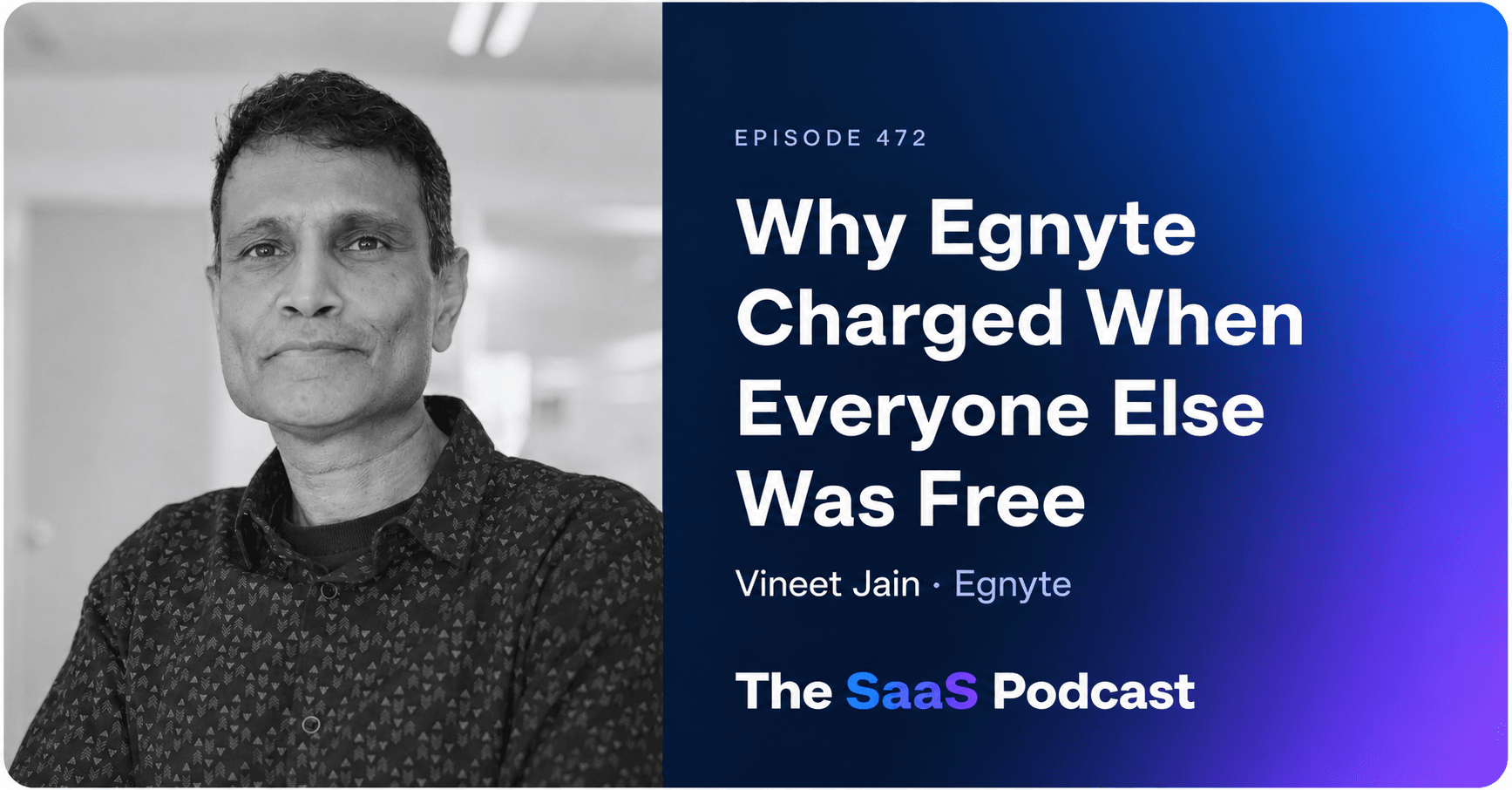
Vineet Jain arrived in the US with $100. His first startup got crushed by Oracle and SAP. His second, Egnyte, launched into a market where analysts counted hundreds of competitors - all backed by massive funding and freemium models.
Vineet refused to follow the playbook. No freemium. Enterprise sales only. A hybrid cloud approach nobody believed in. It took 12 years to hit $100M - then just 3 more to reach $200M and 1.5 to hit $300M.
Vineet Jain is the co-founder and CEO of Egnyte, a content collaboration and security platform for mid-market and enterprise businesses.
Vineet arrived in the US with $100 and no connections. He spent four and a half years at KPMG learning to sell to everyone from line managers to CEOs. That convinced him he could build something of his own.
In 2001, right after the dot-com bubble burst, he co-founded Valdero, a supply chain software company, and raised $7.5 million from Kleiner Perkins. Revenue grew quickly. Then Oracle and SAP moved in. Pricing pressure crushed them. They sold. Investors made money. The 70 employees didn't. That failure stuck with him.
In 2007, Vineet and three co-founders rented a small office. No funding. Two did consulting while the other two wrote code. The idea: move the physical file server to the cloud.
When they launched, analysts lumped Egnyte in with Box and Dropbox - hundreds of companies chasing the same market. Everyone told Vineet to do freemium. His board pushed back. Analysts questioned how they were different.
Vineet Jain built Egnyte to over $300 million in enterprise sales revenue using three strategies: charge from day one, offer hybrid cloud when everyone said go cloud-only, and keep cost of acquisition low with inside sales offices in cities like Spokane and Raleigh instead of Silicon Valley.
In 2016, Gartner named Egnyte a leader - a tiny company standing alongside competitors that had raised billions. Today, Egnyte has 23,000 customers, 1,400 employees, and has raised just $137.5 million with no additional funding since 2018.
Egnyte grew from $0 to $300M+ in enterprise sales revenue by rejecting freemium in a market where Box and Dropbox dominated with free tiers and billions in funding. Vineet Jain spent $6,000 on SEM in month one, landed a Fortune 86 customer within the first 25 deals as a 12-person startup, and built inside sales offices in low-cost cities to keep CAC low while scaling to 400 sales staff.
🏢 Enterprise sales can outperform freemium in a crowded market: Egnyte refused to offer freemium while Box and Dropbox gave products away and raised billions. Charging from day one built a sustainable business now generating several hundred million in revenue on just $137.5M raised.
💰 Start your enterprise sales pipeline with SEM before building a sales team: Vineet spent $6,000 on SEM in month one to build Egnyte's first demand funnel. That systematic digital marketing approach scaled to millions per quarter and still drives 60% of pipeline through inside sales today.
🎯 Lead with compliance and security to win enterprise deals as a tiny startup: Egnyte landed a Fortune 86 customer within its first 25 deals by focusing on enterprise certifications, content governance, and compliance - capabilities that made the 12-person team credible against massive competitors.
📉 Use failure to build defensible differentiation: Vineet's first startup Valdero got crushed by Oracle and SAP after raising $7.5M from Kleiner Perkins. That taught him to build capabilities at Egnyte that giants could not easily replicate, like hybrid cloud architecture.
🧠 Replace consensus with small teams of 3 for faster decisions: Vineet believes consensus is the shortest path to mediocrity. At Egnyte, critical decisions are owned by dedicated teams of 3 with full accountability, not committees chasing the lowest common denominator.
🛠️ Build hybrid when the market says go cloud-only: About 30% of Egnyte customers use hybrid deployment for use cases where pure cloud fails - like construction sites needing LAN-speed access to 65,000-page design files. This became a key enterprise sales differentiator.
🚀 Scale inside sales in low-cost cities to keep CAC low: Egnyte built offices in Spokane, Raleigh, and Salt Lake City instead of expensive tech hubs. This kept cost of acquisition low while growing to 400 sales staff with strong LTV-to-CAC ratios.
Vineet Jain caps critical decisions at 3 people. Larger groups default to lowest common denominator. Delegation means trusting people to own their domain, even
Product-market fit is incomplete without distribution. Egnyte started with $6,000/month SEM, then systematically built inside sales offices across locations, ke
While Dropbox and Box were growing with freemium, Vineet Jain insisted on charging enterprise customers from the start, despite board pressure. It worked becaus
Every CEO in the room at a Kleiner Perkins event admitted they should have fired someone sooner. The trap: you fall in love with the hire you made, like holding
How did Vineet Jain land a Fortune 86 customer when Egnyte had only 12 employees?
The company found Egnyte through search engine marketing. When they wanted to visit the office, Vineet was nervous about the tiny team - but Egnyte's enterprise security credentials, content governance capabilities, and compliance certifications convinced them. They stayed and bought more.
Why did Vineet Jain refuse to offer freemium when Box and Dropbox were growing with it?
Vineet believed freemium was right for consumers and prosumers but wrong for enterprise sales. He stuck to his conviction despite board pushback because enterprise buyers needed security, compliance, and hybrid capabilities that free tiers could not deliver.
How did Egnyte's Gartner Magic Quadrant recognition change the company's enterprise sales?
In 2016, Gartner named Egnyte a leader alongside competitors that had raised billions more. Board criticism stopped. The question "how are you different from Box and Dropbox?" became irrelevant. It opened upmarket enterprise sales deals that were previously out of reach.
How did Vineet Jain build Egnyte's first enterprise sales pipeline with only $6,000?
Egnyte started with $6,000 in search engine marketing targeting small and mid-market customers. That first SEM investment generated enough pipeline to fuel early growth. Today, the same systematic approach drives millions per quarter in digital marketing spend.
What is Egnyte's hybrid cloud approach and why do enterprise customers prefer it?
The control plane lives in the cloud, but data can live both in the cloud and on-prem. For construction companies with 65,000-page design files, on-prem caching gives LAN-speed access on job sites while changes sync to the cloud - something pure cloud competitors cannot match.
How did Vineet Jain's failure at Valdero shape his enterprise sales strategy at Egnyte?
Valdero raised $7.5M from Kleiner Perkins and grew revenue quickly, but Oracle and SAP crushed them with pricing pressure. That failure taught Vineet to build defensible differentiation rather than compete head-on with giants who can undercut on price.
Why does Vineet Jain say consensus is the shortest path to mediocrity?
Critical decisions at Egnyte are made by dedicated teams of 3 people with full ownership, not large meetings chasing the lowest common denominator. Each function has a small team responsible for driving outcomes without waiting for company-wide consensus.
How did Egnyte scale enterprise sales from $100M to $300M ARR in under 5 years?
It took 12 years to reach $100M, then 3 years for $200M, and just 1.5 years to hit $300M. The acceleration came from enterprise sales compounding through dollar-based net retention, inside sales scaling across multiple offices, and Gartner validation opening upmarket deals.
How does Vineet Jain keep enterprise sales cost of acquisition low at Egnyte?
Instead of building field sales teams in expensive hubs, Egnyte built inside sales offices in Spokane, Raleigh, and Salt Lake City. Even at 400 sales staff, 60% of pipeline management runs through inside sales to maintain strong LTV-to-CAC ratios.
[00:00:00] Omer Khan:
Vineet, welcome to the show.
[00:00:01] Vineet Jain:
Thank you, Omer. Glad to be here.
[00:00:03] Omer Khan:
My pleasure. Do you have a favorite quote, something that inspires or motivates you?
[00:00:08] Vineet Jain:
It's funny, I write these one-liners or quotes I hear from people I read. And one of my favorite ones, which I try to tell too many people, whether they want to listen to me or not, is it's simply stated. It says, I've had many crises in my life and most of them never happened.
[00:00:27] Omer Khan:
Yeah. I was talking to somebody about that the other day and they were talking about these worst-case scenarios that could play out. And I was like, if you're just imagining this stuff, why don't you imagine good stuff? Because you'll probably feel better about that. But I'm just as guilty as well. It's like, it's so easy to sort of fall into that trap. So tell us about Egnyte. What does the product do? Who's it for? And what's the main problem you're helping to solve?
[00:00:54] Vineet Jain:
Sure. So, Egnyte is a company that I started with 3 others. We are 18 years into our operation, still private, but growing stronger by the day. Around 23,000 customers. By most standards, we are a sizable company, around 1,300, 1,400 people, but being in the Valley, you're fairly small given that you're surrounded by Google and Facebook and VMware. And in terms of what we do is what I started with versus how it's evolved was fundamentally, it's a core infrastructure play for businesses. We don't cater to the consumers or prosumers from a go-to-market perspective. Of course, it'll work for them.
[00:01:32] Vineet Jain:
And the idea was to take the underpinnings of a physical file server and build that or move that into a multi-tenanted hosted architecture, which people call the cloud. And that over time became a content collaboration platform, which is the foundation of the company. And on top of that, we added the second layer, imagining a two-layer sandwich, the bottom one being content collaboration. The second one is content security governance. So how do you manage, protect, and then of course address a lot of compliances, whether they're industry-specific or geography-specific, all in this one platform? So we go after our classical target base is what we call is the mid-market, which from a seat perspective, which is how we always sold in the past, although that model is changing, is 100 seats to around 7,500 seats is our sweet spot. We have some very, very large accounts. You would put them in the Fortune 2000, whether it's a Red Bull deployment worldwide or IKEA or names that people recognize. They inbound to us the product skills, but we don't chase the big blue whales or the elephant, pick your animal of choice, purely from the economics of the business because the TAM in the mid-market is very large.
[00:02:44] Omer Khan:
And give us a sense of the size of the business. Where are you in terms of revenue?
[00:02:48] Vineet Jain:
We are well north of, I would say, given that I'm private, I can't share the exact numbers, but we are in several hundred million dollars. Just to give you some ranges, it took me 12 years to get to $100 million. It took me 3 years to get to $200 million. It took me a year and a half to get to $300 million. And the path to the next milestone, which is $400 million, is in sight.
[00:03:18] Omer Khan:
That's awesome. And I think you've raised $137 million to date, or as you earlier corrected me, $137.5 million to date.
[00:03:27] Vineet Jain:
I mean, the reason I was so precise is being in the Valley, it's almost like a rite of passage that companies in our space would raise around every 18 months. I never did that. And in fact, the last time we raised financing was in 2018 when Goldman gave us a check of $75 million, which to me is still a very large part of money. And that was the last time. And we never raised money since then. We have been EBITDA positive, improving EBITDA margins. In fact, one metric that the value fixates on is the rule of 40. We are past the rule of 40.
[00:04:01] Omer Khan:
So I want to talk about, you know, how you started this business, where the idea came from. But before we get into that, I want to talk about how your background, where things started for you, at least in terms of this startup journey. And why I think it's so significant and relevant is that a lot of the times I hear founders saying, I don't have Silicon Valley connections. I don't know anybody. How do how do I, I get traction? How do how do I, I raise money? How do I do all these things? And your story is sort of always stood out to me is that you arrived in the US with like $100 to your name. Is that true?
[00:04:44] Vineet Jain:
I had $100 in my pocket and I had $2,300 in my Barclays account in UK, which is where I'd come from. But I had a job in hand. So I landed and I started working. And of course, the first paycheck was super critical for me to take care of my expenses. But indeed, that is true. The reason we exist is because you.
[00:05:03] Omer Khan:
Cannot stay ahead of all threats.
[00:05:05] Vineet Jain:
So what we do is we block by default. If it's not on the list, it cannot run in your environment. And that is our core focus.
[00:05:11] Omer Khan:
Zero trust principles.
[00:05:12] Vineet Jain:
The core of ThreatLocker is zero trust.
[00:05:14] Omer Khan:
24-Hour, 365-day-a-year support.
[00:05:17] Vineet Jain:
We've got some of the most advanced threat intelligence team.
[00:05:19] Omer Khan:
And this isn't an outsourced offshore response. It's our staff in our offices helping you. Helping our clients directly who really understand.
[00:05:26] Vineet Jain:
The product and really understand the threats.
[00:05:30] Omer Khan:
So how did you, I mean, you arrive, you didn't have a network, you didn't know anybody. How did you go about meeting people and starting to connect with folks?
[00:05:46] Vineet Jain:
So first of all, when I landed here, I had a job at Bechtel. Which I did for a year. Then I got hired at KPMG where I was there for 4.5 years. And of course, KPMG to me was a great, great grounding experience where you're dealing with customers in different parts of the world, within the US, customers in down south versus middle America versus the Valley, very different styles. And you have to learn to calibrate on how you can relate to them, whether it's a line-level manager or a CIO, or sometimes you present to the CEO. So that for me was giving me a fairly unique ability to think on my feet and being able to hold a conversation at different levels. And then I always had this, in honesty, the itch to scratch was I'm an immigrant in the Valley. I still think like an immigrant, although I'm an American citizen.
[00:06:43] Vineet Jain:
Was to say, can I build a company, a software company in the heart of the beast? And with that sort of, I would call it slightly foolish optimism where you don't know all the answers, but you have a strong conviction. I jumped into the deep end where it was like, okay, we are going to build a startup. And I didn't know anybody, as you said. I didn't know how the VC circuit worked. I didn't know anyone on Sand Hill Road, but through some 2, 3 degrees of separation, I managed to get my first meeting with Vinod Khosla when he was still at Kleiner Perkins. And I went and pitched to him an idea with 2 of my fellow current co-founders. And the idea must have resonated to the point they gave us over time $7.5 million of Series A. And that was my starting point.
[00:07:30] Vineet Jain:
And then we raised $23.5 million from Kleiner, Roger McNamee at Integral, More Davidow Ventures, Trinity and all of that. That was my first company prior to Egnyte called Valero, which was in supply chain software. But that's where I truly cut my teeth. Now, as a co-founder or a founder, I must say my self-awareness was very high that I knew that I didn't have the chops to be a CEO. I called my ex-boss from KPMG and I said, why don't you come and join and run the company? He was surprised. He became the CEO. I was the head of engineering. And we built that company and ran it over around 3.5 to 4 years.
[00:08:13] Omer Khan:
You raised money for Valdero and then you exited, but you described that exit as not great and you felt like a bit of a failure. Can you explain that? Like what happened? What went wrong?
[00:08:29] Vineet Jain:
Absolutely. Yeah. Two things actually. One is The lesson I learned is, and not to get too cute to say when others zig, you zag, but we were raising money right around after the dot-com bubble had burst. And everyone in their sage advice was, this is a bad time. Nobody's going to give you funding. And sometimes, as I say, ignorance is bliss. We were like headstrong.
[00:08:55] Vineet Jain:
We went in and you can raise money if you have a viable idea. No matter what the secular trends are, you will be able to raise money if that's what you're going after. And we proved that. Our first round came in in early 2001, and then we built up from there. But to go to the crux of your question, we were pitching and building our supply chain management solution for very large enterprises. So our first year after the product got released, we had a meteoric rise. We had customers like Motorola, Juniper Networks, LeapFrog, Polycom, this and that. And the next 2 years were heady.
[00:09:33] Vineet Jain:
The revenue ramp was like beautiful. Around end of year 3, we started seeing a slowdown because big behemoths, particularly Oracle and SAP, had moved into this turf with advanced planning solutions. And we were dealing with not only these well-funded and large public players, but also the pricing pressure was intense. And at the end, Ray Lane, who sat on my board, he came through Kleiner. He made a call. He said, look, we should sell the company. And quite frankly, we sold it and we made some money for investors. But to be very honest, to me, it's a failure.
[00:10:13] Vineet Jain:
We did not generate wealth for— there were 70 employees at that time. I was the head of engineering, not the CEO, but I sat on the board. So to me, it was a personal failure that I failed my investors. I failed my employees. And that fire still burns in my heart to say never again.
[00:10:28] Omer Khan:
Was that one of the big drivers for you as you set out to build Egnyte?
[00:10:34] Vineet Jain:
Yes. After we sold the company, Valdero, I had made up my mind that I'm going to try another one. And fortunately, the two other co-founders from my previous company had the same mindset. And then we had the fourth one join who we had hired at Paldero from KPMG, Chris. And full transparency, we took an office, a small office, keeping the rent in check. We had a semblance of an idea, but sometimes form over function. So I incorporated a company, I set up payroll, and we would show up at the office on the whiteboard, think of ideas. And quite frankly, we were still trying to figure out, okay, what exactly are the problems that excite us.
[00:11:24] Vineet Jain:
And after a span of like 2.5 to 3 months, this idea, which is the germination of Egnyte, started taking sort of strength in our thinking to say, this is the problem we ran into, which is a physical file server. It is inside the firewall. You have to do VPN for accessing information. A lot of data is locked away where inter-enterprise or intra-enterprise collaboration is difficult. And we basically started building and we did some consulting to fund it. We didn't raise money for a while. It was me and another founder of mine, Rajesh. We were doing consulting.
[00:12:04] Vineet Jain:
The other two were building the code. And that's how we took this company off the ground.
[00:12:09] Omer Khan:
So when you launched the first version of Egnyte, As you and I were talking earlier, certainly from an analyst perspective, it was seen as in the same category as a Dropbox or a Box. And when you launched, those guys were really making you freemium, know, a very famous thing and they were kind of growing aggressively that way. But you took a contrarian approach. You decided that number one, We're going to focus on enterprise from day one. And two, we're going to charge for the product. What drove those decisions and what kind of, you know, were VCs telling you you're crazy? Why are you not doing this and figuring out how to grow faster and so on?
[00:12:59] Vineet Jain:
So indeed, when we launched the company and then we raised Series A, Series B, all the way to Series C. It's interesting that we were growing very well. That's why we were raising financing from Polaris and Mike Maples and Floodgate Series A. Series B was Kleiner Perkins. Series C was Google Ventures. So tier 1 VCs. But the inevitable question would be posed to us to say, how are you different than these two companies? In fact, to make it more colorful, when we would try to talk to the Gartners or the Forresters, it's like, hey, you're amongst a few hundred companies doing what you're doing. So what makes you stand out? And we would literally stand up from the rafters and say, oh no, no, we are enterprise only.
[00:13:42] Vineet Jain:
We don't cater to consumer prosumer. I also had this point of view, which is still relevant. In fact, my Twitter handle is very evocative of that, that while the control plane could move to the cloud, not all data could move to the cloud, or you would still need some data cached locally, either for, speed or, issues, you know, there's certain applications that don't work very well with the cloud. So the word hybrid was very core to how we offered. In fact, my Twitter handle is CloudNotEnough, which still resonates, oddly enough. It it was, was a challenging time. We would get questioned by analysts and the press while the business is growing, as indicated by successful fundraising rounds with increasing valuation. But truly speaking, Omer, you can be as brilliant and as hardworking as you think you can be, but you also need what I call as the third dimension.
[00:14:37] Vineet Jain:
You can call it luck or divine help or whatever it might be. Market trends do break your way. In 2015, this whole category, which initially was coined as Gartner speak, EFSS, Enterprise File Sync and Share, it amplified to content collaboration. Again, Gartner speak. They keep inventing these. And we came in our prime because of our enterprise jobs. We were not doing any freemium. We had an element of freemium, 15-day trial, but we would not offer unlimited or free of anything to anybody because it was good for consumers, prosumers, not for enterprises.
[00:15:13] Vineet Jain:
And I indeed had to deal with my board to say, why aren't you doing it? Why are you trying to swim upstream? But I stuck to my conviction. And 2015, a very interesting thing happened. The category amplified to content collaboration. And on top of it, when the Gartner MQ came out, the Magic Quadrant, we were in the top right in '16 and '17. This small company in terms of the money raised, we were in the leader pack and suddenly it changed everything about Egnyte. Of course, customers, it helps with customer validation, especially as you go upmarket. But even in my own board, the chatter around why aren't you doing what those other guys are doing? And then Since then, when we raised a Series D and E, the question about how you're different than these two became less and less relevant. And today, uh, we don't see either of these two as competition.
[00:16:04] Vineet Jain:
Maybe Box to some extent in certain use cases, but we have outdistanced ourselves from most of the players. In fact, most of them are not around. But it was also sticking to our conviction and being able to execute on it. It's good to have a belief, but can you prove it? And the best indicator is revenue growth, know, you your dollar-based retention rate, your gross margin improvement. And we are beating all of these companies for the last 4 years in all those metrics.
[00:16:32] Omer Khan:
So back then there was, you know, everyone was rushing to get onto the cloud. And you mentioned this hybrid approach where, where you were doing cloud and on-prem. Did you get a lot of criticism from investors or analysts about taking that approach? Why aren't you going all in on the cloud? And did that hybrid approach make it easier to sell to enterprise customers or was it kind of more confusing for them?
[00:17:02] Vineet Jain:
Actually, first of all, even though for an outside-in perspective when everyone is going gaga about the cloud, we didn't get any pushback from our investors or even the analysts. They really appreciated the point of view because it was based on not just having this approach being contrarian for being a contrarian sake. It was demonstrated by the fact that while there was more and more data going to the cloud, whether our cloud or somebody else's cloud, the role of on-prem was becoming more specialized and the use cases were very relevant depending on the industry and the application type. So I'll give you a good example. Let's say if you're in construction engineering and you're building Dallas-Fort Worth $2 billion airport extension project, one of the, in fact, the general contractor there, the design files that you have, if you were to print them, would be 65,000 pages. Now on the site, Somebody has to make a change to the file. Trying to do that in the cloud would be quite a challenge because they are on the 15th floor of that building with an iPad. Try doing that.
[00:18:17] Vineet Jain:
The laws of physics get in the way in terms of latency. But instead, if on the ground floor, on the job site, in the shed, there was a small NAS device running our software, and these are commercial NAS devices. We don't provide hardware, but we burn our software on this. Imagine you could pull up the file using a typical network drive letter like XYZ, whatever you like. You pull the file on a LAN speed, you make the change, the change is done and the block level delta gets synced to the cloud across all sites. You can pull it off your mobile application or whatever application interface you use. That was one of the use cases which we had patented to say the role of hybrid is almost similar to, remember the word paperless office? I was looking up in Wikipedia, Businessweek claims to have invented that term in 1975, paperless office. It still is a mythical concept.
[00:19:07] Vineet Jain:
There is paper, but less paper. It's more specialized. And that was the bet I placed that the role of data would become more and more specialized in terms of you might need on-prem. So you can have cloud-only solution and most of our customers are cloud-only, but a good 30% love the hybrid because it gives them the flexibility and the security of having data available locally.
[00:19:33] Omer Khan:
That's interesting because when you talked about hybrid, I sort of assumed it was either you can go cloud or you can can grow, you go on-prem. But there's an interesting space in between, which you just described with that use case where you can update on-prem, but then still sync to the cloud?
[00:19:55] Vineet Jain:
Yeah, so to be very clear, the control plane is always the cloud. The data plane can be completely cloud or cloud and on-prem. And the cloud should always be treated like that elastic infinite disk in the sky.
[00:20:09] Omer Khan:
Yeah, got it. So we talked about, you know, you targeted enterprises from day one, but when you set out, you didn't have any customers, you didn't have a track record, logos you could talk about, and you're selling a product which requires a high level of trust for the enterprise to have whatever these sensitive documents are. How did you land that first enterprise customer? Can you just tell me about how easy or hard that was?
[00:20:45] Vineet Jain:
So initially, as you're rightfully pointing out, there was no brand name. The category itself was quite nascent, and there were just 4 of us as the people who started the company. I still remember we were looking at, okay, how do you build a demand funnel? And one of the things that I would advocate to anyone who cares to listen to me is we put a lot of focus on product-market fit, which is supremely relevant. Like, you can't build a product if there's no market need, otherwise it's just an R&D exercise. But the one third component which is super critical is if the two dimensions of the product market fit, the third intersecting dimension is distribution. How do you scale? How do you build the funnel? How do you build the pipeline? Do you have multiple pipelines? Can you build a systematic machine-like approach? So initially we were targeting fairly small customers, the SMB. And we started playing with, quite frankly, experimenting with search engine marketing, SEM. Of course, we had a website and we would try to leverage search engine optimization, but we were so new that your SEO is practically nothing.
[00:21:58] Vineet Jain:
And I still remember the very first month we spent $6,000 on SEM and I was like, holy shit, that's a lot of money. Now today, We spend, I won't be too precise, but we spend a few million dollars on digital marketing on a quarterly basis. And the throughput is still there. So the initial pipeline building approach was using digital marketing. And then as we matured, as the customer base grew, as the market matured, then we started building inside sales offices with people, with sales reps, but inside sales. Nobody's out in the field. So my first inside sales office was in Spokane. Then of course, initially it was Mountain View, then Spokane, then it was Raleigh.
[00:22:51] Vineet Jain:
Then we added Salt Lake City. And then of course we have offices overseas now, including Reading and the Middle East now in Dubai. And then as we got further up the food chain in terms of the class of customers, we now have field salespeople strewn across different parts of, let's say in the US, you might have 2 people in Chicago, 1 in Minneapolis, but our predominant go-to-market motion, no matter how the top of the funnel is built, whether it's through field marketing, digital marketing, or account-based marketing, different elements, we still have 60% of the funnel management is done with an inside sales approach to keep the cost of sales low and keep looking at the unit economics of profitability of the business. And the term that people use is the CAC. What is your cost of customer acquisition? If you have a very good LTV to CAC ratio, it's a viable business. And that's what we have been focusing on.
[00:23:51] Omer Khan:
So those first 5 or 10 customers, did they all come through the search engine marketing you were doing or was it a combination of that and outbound?
[00:23:59] Vineet Jain:
No, initially it was all of them. And in fact, I'll give you an amusing anecdote. In the first 25 customers, I don't know how we managed to get a Fortune 86 company. And I can name them. They're well, mean, I the Fortune 86 in the US, it's a well-known name. And then we got a note from their IT director to say, hey, I will, they were based in New York. We'll be visiting the this person, he'll be visiting Silicon Valley. We would like to pay you a visit.
[00:24:31] Vineet Jain:
And also, can you arrange for a visit to the data center? And we were supremely nervous because we were like such a teeny little company catering to a Fortune 86. And we said, if they come here and they see it's just a bunch of people, will they cancel the contract? I mean, that was a big fear.
[00:24:47] Omer Khan:
Was it still 4 of you at the time?
[00:24:49] Vineet Jain:
No, we'd grown to around 12 people.
[00:24:52] Omer Khan:
Okay.
[00:24:53] Vineet Jain:
But still, 12 people for a Fortune 86, they'll be like, hey, what the heck? But we managed it. We were, we had focused on content security and governance and compliances besides, you know, your typical ISO certification and SOC this and SOC that compliance. We had given our enterprise chops. All 4 of us come from the enterprise background. So we handled it well. And it was good to see that they went back and they started buying more. Of Egnyte. So we must have done it well.
[00:25:23] Omer Khan:
That's always a fear, isn't it? When you're a small startup and you're selling to a big customer and you're not trying to necessarily deceive them, but you're also not highlighting the fact that you're this tiny operation. So let's talk about a little bit about you as a leader and the culture. That you try to create in the organization. We always hear the common wisdom is customers always come first. You reject that. You talk about employees coming first. Tell me about what that means to you and in reality, how does that play out in terms of the day-to-day running of the business?
[00:26:14] Vineet Jain:
So what I mean by that is, first of all, I do say that employees come first because if your employees are not happy, satisfied, how can you have happy customers? How can you, even if you get the initial deal with the customer, one of the big metrics that in our industry, in SaaS in particular, is dollar-based retention rate. Like if you sold me If it's 118, that means I sold you $100 in the first year, another $18 in the second year. And the higher it is, that means you're sticky, you resonate, you grow. That cannot be possible purely on the back of just a great technology. You have to have customers who trust you. You build a relationship with a rapport with, and for that to happen, people at Egnyte who are working with them in post-sales as CS people, customer success or support, They have to be happy in where they are. Now, when I say happy, I'm not going this far to say at Egnyte, I will never offer you a free haircut or a free car wash. I lost one person.
[00:27:17] Vineet Jain:
I still remember this is lots of years back. I think the values also changed quite a bit because we are next door to Google and Facebook and this and that. I remember the senior director in ops, he came to me and he said, I'm leaving. And we were like, he was very good. And I did an exit interview. I said, why are you leaving? He said, There's bigger growth opportunities. You can't argue with that. He said, I'm also going to get free, was it dry cleaning a week? And when he said that, I won't say it on this podcast.
[00:27:49] Vineet Jain:
I used a couple of cuss words. I said, power to you, man. You should go to that company. We do take care of employees in terms of, we give them free food. It's more in terms of for lunch and all, because it makes it more efficient. People can work and not take a 1-hour break and all. But I've also believed that if you treat most people, if you treat them as grown-ups, most people will not abuse the system. A lot of these big company policies are designed for the bottom 2-5% abusers.
[00:28:23] Vineet Jain:
Why tax on that? Why not put the faith in the people, more often than not, you'll be rewarded. And my belief always has been that treat people, your employees, with respect. People leave for two reasons. One, comp, but comp is secondary. It's always about growth. Am I having a personal growth curve here? Whatever that growth means for them. As long as you can strive to provide that path, and it gets difficult, Omar, as you get bigger and bigger. There was a time I would know every employee by name.
[00:28:56] Vineet Jain:
Now we are almost 1,400 people. I don't know everyone by name. But honesty and sincerity is number one. And one thing which I will say, and I'm not trying to be preachy or pontificate here, I'm as capitalist as anyone at heart. People should be treated with respect, but you as a leader should be thinking for the goodness of the whole and not just yourself or for a select few. The more you democratize whatever success is in terms of bonuses, in terms of whatever the things are, the better off you will be. You will scale better. And the other thing which people talk about, you talk about customers.
[00:29:41] Vineet Jain:
One of the things I say to salespeople, and our sales team has grown, we have around 400 people in sales now, both account carrying, quota carrying reps and pre-sales and post-sales. Or slightly over NCS. It's like if you talk about a customer as a prospect or an install-based customer where you're trying to upsell, if you do communication within the four walls of the company, whether an email, Slack, or across the cubicle, and if the customer could read it or hear it and you were not embarrassed about it, then it's right. But don't treat a customer like a bank that you have to constantly rob.
[00:30:16] Omer Khan:
You've also said that decisions shouldn't be made by consensus. How does that actually work? How do you encourage that? And then also, how do you basically get buy-in if you're trying to not be in this sort of everything is sort of consensus-driven type of.
[00:30:39] Vineet Jain:
You.
[00:30:39] Omer Khan:
Culture?
[00:30:40] Vineet Jain:
Know, that's one of my pet topics. Consensus is the shortest path to mediocrity. The thing which I'm also learning, and I make mistakes less as we grow, but still make mistakes, the power of delegation. You have to learn to trust people at different levels for different parts of the business. You cannot— when you were 20 people versus 200 versus 1,400 in our case, you have to have these small, small sectors of excellence in the respective groups in different department functions where you trust people, even if you think as the manager that I could do a better job than them, then either you've hired wrong people or you don't know how to scale. So learning to delegate, learning to trust, knowing very well that whether it's you or whether it's them, out of 100 things to do or 10 things to do, 8 will work, 2 will fail. And that dispensation is available to you and as well as to them. If you don't do finger-pointing, you'll collectively move fast forward faster than if you were to have a top-down hierarchical approach, which a lot of companies do.
[00:31:50] Vineet Jain:
And I do not like to be in any meeting where there are 8 people discussing a topic and then you're looking at what is the lowest common denominator to move forward with. Because as I said, that is the consensus-driven approach. Most of the critical decisions in the company for respective roles at the respective levels are done between 3 people, in my opinion.
[00:32:09] Omer Khan:
How do you define that? Like, who— what do you mean by that, by 3 people?
[00:32:13] Vineet Jain:
It depends. Like, for instance, let's look at M&A. It's very relevant for my company. We have not done any significant acquisition. We've done technology tuck-ins, like a million there, a million to there, 2 million there. Now we have the wherewithal, both from a financial perspective and the ability to absorb it from a go-to-market perspective of a company that could be $50 to $100 million ARR. We could buy that. We are on the hunt for it.
[00:32:41] Vineet Jain:
Now, while that function reports to Stan, who's my chief operating officer, who then ultimately reports to me, he's got a team of 3 people, core corp development, or sorry, business development people who are in charge. And there's one guy there who's running the show. So his, he and his team's job is to drive that function to the point every 2 weeks they present their findings. I'll offer my opinion. Other people will offer their opinion. Product people will come in. But the responsibility for driving that acquisition is with that particular team. So Am I the person who's calling them to say, no, no, no, this is what you should look at? Once in a while, of course I will.
[00:33:25] Vineet Jain:
But that's the purity of their job. They don't focus on anything else. And for anyone in my E staff to say M&A should be part of my remit doesn't work. Those are the 3 dedicated people with a very senior VP-level person driving M&A. And you can then apply that to across different groups. If they're looking into FP&A on how to manage Sales finance. I'm not going to go tell them what needs to be done. They're smarter than I am.
[00:33:51] Omer Khan:
You've also said that one of your biggest mistakes was holding on to people for too long. So this is relevant. I mean, for you, I'm sure today, but also for an early stage founder who is making his initial hires. So what are some of the.
[00:34:14] Vineet Jain:
Early.
[00:34:14] Omer Khan:
Warning signs that you look for that might tell you that this person is not going to work out?
[00:34:21] Vineet Jain:
I wish it was such a science, but I can tell you the one thing I've learned over the years, and I hear it from others also, is in fact, I was in a very interesting event which was run by Kleiner Perkins lots of years back at Pebble Beach. And they had one of these Peter Drucker types person there. I won't name who it was. There were 200 CEOs in the room. I was one of them. And this guy asked the question, how many of you think from a senior leadership hiring perspective that you should have hired the person sooner than when you actually hired them? Some hands went up. Then he said, how many of you think you should have fired that person, whatever that person was, Sooner than you actually fired them, all hands went up. And that is symptomatic of this problem that we, obviously we all believe we are hiring people.
[00:35:15] Vineet Jain:
You do 7 interviews, back channels, formal references. Nobody thinks they're hiring a loser, and yet some people don't work out. And then you fall in love with the idea that you hired them. It's a turnaround. It's like buying a stock. Even if you can see the stock is going down, you hold onto it. Some people do, some don't. It's a challenge to look at the warning signals and act faster than what you have done before.
[00:35:39] Vineet Jain:
I think I've gotten better at that. Now, you can't pull the trigger too quickly on people because then it's so mercenary. Anyone who comes in needs, depending on the nature of their job or the role, a good couple of quarters to get their feet wet, or rather their toes wet, not even their feet wet. It takes a good leader, depending again on the role, around 9 months to a year to truly get their sea legs. And you can see the signs, are they ramping up? And again, as I said, Omer, it's not a science. It depends on the role and at what level are they operating. But now I've become more dispassionate about cutting my losses. And in that process, mistakes will be made.
[00:36:17] Vineet Jain:
I can't tell you, oh yeah, yeah, it's a completely foolproof process. We winnow out the wheat from the chaff. No, you still make mistakes.
[00:36:24] Omer Khan:
Let's talk a little bit about AI. You launched Egnyte Copilot, I think it was last year. So like many SaaS companies, you're integrating and building AI into the product. What do you, as you sort of look over the future, the next few years, what do you think are the biggest opportunities as well as the biggest threats in your space?
[00:36:51] Vineet Jain:
Obviously we couldn't have finished this conversation without talking about AI. So the one comment I'll make is the hype cycle on AI is the highest it's ever been. And interestingly, every software vendor, what they're sold, if they don't have any AI capability, they are toast. And in the last few days, you're seeing the software stocks, especially the application tier guys getting a hammering because AI will come and eat their job. Last 2 days, this legal tool from Anthropic is supposedly going to eat the lunch of the likes of LegalZoom and a bunch of others. And while that is partly true, you will always need system of records. You'll still need the raw primitives for AI to work effectively. But coming back to our so case.
[00:37:37] Omer Khan:
We—.
[00:37:39] Vineet Jain:
Now, AI, as when people talk about it, is a reference to generative AI. Machine learning and AI has been done for a long time. We have had it baked into our product, especially in the secure and governed layer for things like anomalous user behavior detection, identifying sensitive data, data classification, extraction, blah, blah, blah. But generative AI is what people refer to as AI. So needless to say, last year Q3, we are on a fiscal calendar, we basically rebirthed or rather launched 3 plans, plan types, which we call as NGP. Next generation plants, each of them have a plethora of these AI capabilities. And surprising to me in a positive way, for what we had budgeted in terms of what we'll end up selling in Q3 and Q4, we were running twice as hot, meaning we are able to sell more than what we had planned. And fortunately, that trend continues unabated.
[00:38:41] Vineet Jain:
But having said that, I'm going to say now two very countercultural things. One is, Everything and anything that people are building today, including Egnyte, leave aside the foundational model providers who themselves are in an arms race. It's a fungible area. Everything we are all building will increasingly become a commodity. You will be expected to have that baked into your product. So be smart about it. Don't leave money on the table, but don't get too greedy and price yourself so high that when it comes to one-year renewal, you'll get thrown out. That's one.
[00:39:19] Vineet Jain:
Second, while the noise level is very high, most of the initial AI capabilities, especially in the enterprise— I'm not talking about ChatGPT for a consumer, or, you know, people using lately, you know, all the noise around Claude bot and all that stuff. My point of view is that you will have an evolution of your capabilities from what AI has done is basically enhanced natural language search, enhanced search. You can run a query across copious amounts of data, unstructured, structured, and AI can give you good answers. The next thing everyone's talking about is agents. I mean, not a single day goes by without somebody talking about agentic this and agent that, which is true. Now, Most of these agents will be taking parts of typical workflow, whether it's industry-specific or department-specific, and you can automate parts of it. But my point of view is the technology is not at a point where you can avoid the human in the loop, especially in the enterprise. You cannot have critical decisions being automated completely with AI, whether you call it, you know, superintelligence and what have you.
[00:40:34] Vineet Jain:
So the evolutionary path of AI from my perspective is it'll get increasingly sophisticated, but this fear about it'll replace humans, again, I'm talking about businesses, is overblown. And instead of seeing this problem as AI causing reduction in workforce, I think it's an amplification of the existing workforce. You make people smarter. In fact, my CTO, my fellow co-founder, he wrote a very nice blog which was featured in VentureBeat a couple of weeks back. He said, we are still hiring a lot of junior engineers. Now people would say, oh, with wipe coding, with Cursor, with Augment, and with this and that, with Cloud Code, why do you need junior engineers? You still need people to write stuff, production quality. You can do wipe coding and quick prototyping and a quick app, but that's not good for the enterprise. From a security perspective, from a scale perspective, you still need a human in the loop.
[00:41:28] Vineet Jain:
So it's the current state we are in. Things will evolve. And just like any new technology, this one of course has long legs. This won't come and go or disappear in terms of the noise it's able to attract, like IoT or Web3, which none of them disappeared, but they're not something we talk about on a regular basis other than crypto. This one has a long multi-decade impact in our lives. So it's real. But where it's today, it's not replacing human beings is my point of view.
[00:42:00] Omer Khan:
I like that. Great. Well, thank you for sharing that. Let's wrap up and get onto the lightning round. I've got 7 quickfire questions for you. You ready?
[00:42:10] Vineet Jain:
Sure. Go for it.
[00:42:11] Omer Khan:
What's one of the best pieces of business advice you've received?
[00:42:15] Vineet Jain:
Trust your instincts, but learn to delegate.
[00:42:18] Omer Khan:
What book would you recommend to our audience and why?
[00:42:21] Vineet Jain:
One of my favorite books is Bill Walsh's The Score Will Take Care of Itself.
[00:42:25] Omer Khan:
Great book. What's one attribute or characteristic in your mind of a successful founder?
[00:42:30] Vineet Jain:
Highest level of integrity. You've got to be very truthful with all the concerned parties, employees, customers, partners, press. Don't bullshit people.
[00:42:39] Omer Khan:
What's your favorite personal productivity tool or habit?
[00:42:43] Vineet Jain:
I run in the morning, early mornings when it's dark. Every other day without any headphones or anything, and I run out in the open. It clears up my mind and gives me time to think and sometimes problem-solving.
[00:42:58] Omer Khan:
What's a new or crazy business idea you'd love to pursue if you had the time?
[00:43:03] Vineet Jain:
I have always been fascinated with nuclear physics, and you lately, know, with small modular reactors, all the energy deficiency with all these data centers, nuclear is back in business. If I had no other things to do, that'll be one area I'd try to poke my head into and say, what can I do here? It's always been fascinating to me. I was fascinated in physics. I'm an engineer, mechanical though.
[00:43:25] Omer Khan:
What's an interesting or fun fact about you that most people don't know?
[00:43:31] Vineet Jain:
We all think so highly of ourselves. I actually do a lot of gardening. I'm blessed to have a lot of fruit trees in my backyard. And while I get the gardener for taking care of the lawns and all, all the fruit trees, their fertilization, if they have any infestation, and they're big-ass trees, I take care of them myself. In fact, I have a project for this weekend.
[00:43:52] Omer Khan:
Cool. And finally, what's one of your most important passions outside of your work and gardening?
[00:43:58] Vineet Jain:
You know, I'm in California and in the Valley, and if you're an outdoors person, Omar, there's no better place. In my opinion. Like within a 50-mile radius for one year, I could take you hiking to a new place without repeating it. So outdoors, hiking, running, and sometimes depending on the time, some mountain biking, not too much lately. That's one area that it always puts me in a good mood.
[00:44:25] Omer Khan:
That's a great way to spend your time in the outdoors. So Vineet, thank you so much for joining me. It's been an absolute pleasure. If folks want to check out Egnyte, they can go to Egnyte.com. That's E-G-N-Y-T-E.com. And if folks want to get in touch with you, what's the best way for them to do that?
[00:44:43] Vineet Jain:
They can send me an email directly. It's my first initial V, last name Jain[at]egnyte.com. I'll always respond as long as you're not pitching me a lot of stuff to buy.
[00:44:57] Omer Khan:
Yeah, of course. It's been an absolute pleasure. Thank you so much. And I wish you and the team the best of success.
[00:45:04] Vineet Jain:
Thank you, Omer. A pleasure to speak with you. Take care.
[00:45:07] Omer Khan:
Cheers.
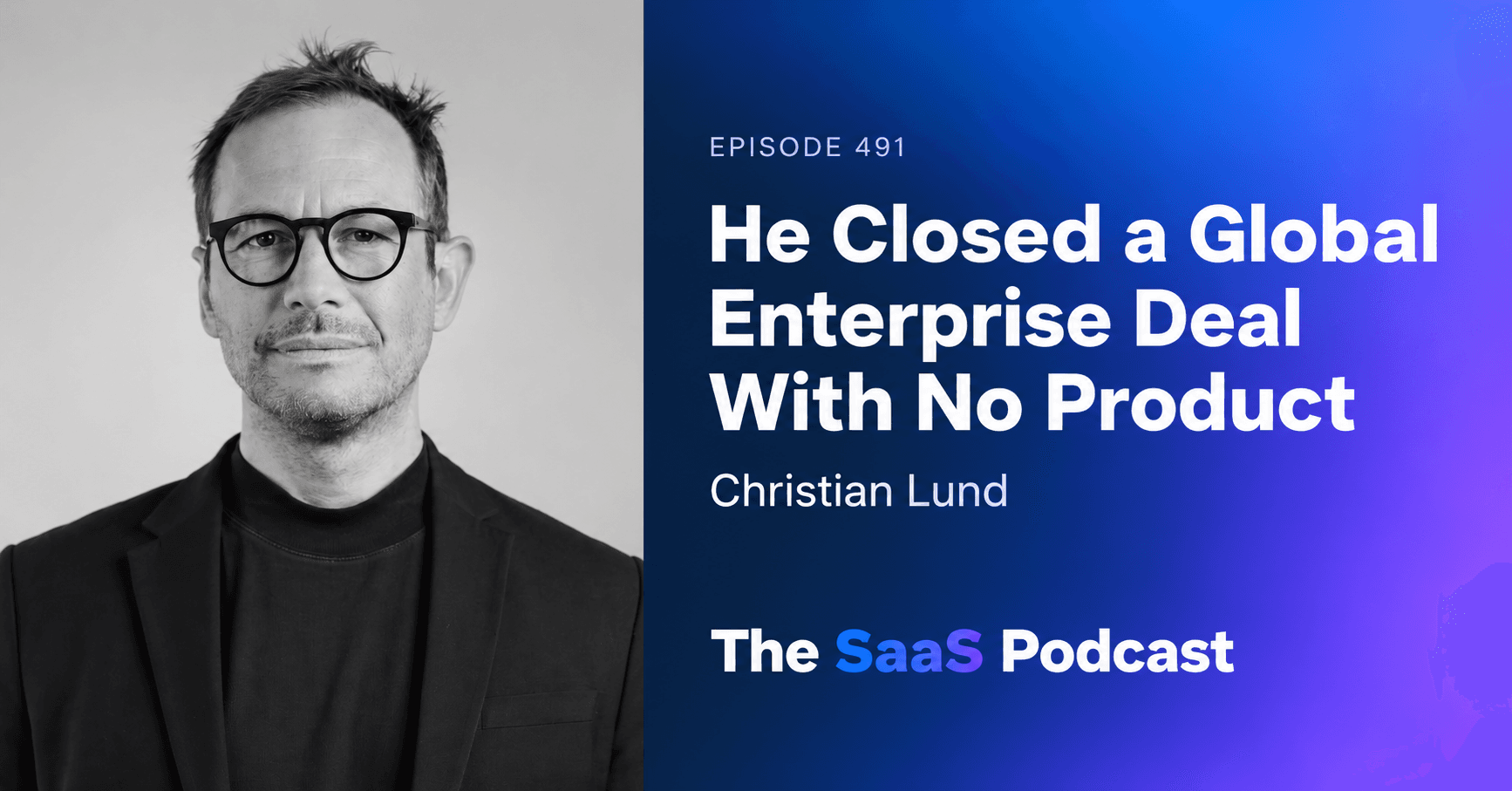
Christian Lund, Templafy
Christian Lund had spent years running an on-premise document business before he saw the cloud shift coming. Rather than retrofit the old product, he and his co-founder spun out Templafy and started over from scratch, with two engineers and no product to sell. What they sold instead was a point of view. Christian identified roughly 800 people worldwide who he thought were mature enough to have the conversation, targeted them with specific messaging, and used those conversations to get in front of enterprises long before there was software to demo. Templafy raised its first funding round close to twelve months before the product existed. That approach landed one of the Big Four accounting firms as the first customer. But the deal nearly went the way most enterprise deals go, with a small pilot for ten people and no defined outcome. Christian pushed back, not by refusing, but by attaching conditions: agree exactly what we are proving, and agree what happens if we prove it. When some prospects later opened the decision up to competing vendors, Templafy had effectively written the evaluation criteria. Templafy now runs at eight figures in revenue with a couple of hundred people. Christian is putting the business through the same reset again for AI, rebuilding the technology foundation from scratch over two and a half years. He is candid that the messaging got ahead of the market, and that being eighty percent ahead instead of fifteen percent cost the company conversations it needed.
Rami Tamir, Salto
Rami Tamir is the co-founder and CEO of Salto, a platform that helps teams manage and automate the configuration of enterprise SaaS apps like Salesforce, NetSuite, and Okta. Rami had already built and sold three startups to Cisco, Red Hat, and Oracle. But building Salto brought a whole new set of challenges for him and his co-founders. The idea came from a problem he kept running into at his last company. Making changes in tools like Salesforce should have been simple, but instead it was slow, frustrating, and full of errors. At first he thought it was his team's fault. Later, he realized almost every company using modern enterprise SaaS tools was dealing with the same thing. He and his co-founders self-funded the early product and started showing mockups to potential customers. The feedback was enthusiastic - one prospect even said she wanted to hug him. But when they came back with a working product, the excitement disappeared. It was not what people thought they were going to get. That was a critical product-market fit lesson even for a serial entrepreneur: early feedback can send you in the wrong direction when you are pitching a vague idea. People fill in the gaps with their own imagination, and when the real product arrives, it does not match. Once they had a real product to sell, they hit a new problem. Even though the pain was real, most buyers were not looking for a solution - Salto was creating a new enterprise SaaS category. Every deal was a grind because there was no line item in the budget for what they were selling. Rami's approach was to target discretionary budgets - pricing the product so a director-level buyer could approve it without a lengthy procurement process. This let them land fast and then expand into more applications and teams. Just as they started to gain traction, the 2023 downturn hit. Budgets vanished. Deals stalled. Even happy customers churned. Salto made tough changes - they raised prices, focused on larger companies, and rebuilt their sales motion for a longer enterprise cycle. Eventually, that pivot paid off. Today, Salto is an 8-figure ARR business with hundreds of enterprise customers and $69 million in funding from Bessemer, Lightspeed, Excel, and Salesforce Ventures.
Onur Alp Soner, Countly
Onur was working as a C++ developer at Huawei in 2013 when he noticed there was no good open-source alternative for mobile analytics. He started building Countly as a side project, hosting the code on SourceForge before GitHub was the default. There was no validation phase. No customer interviews. No landing page test. Onur just started building and put the open-source SaaS code out there. It didn't start with a business plan - it started with curiosity and a gap in the market. Then something unexpected happened. Intel found Countly's open-source code and reached out asking for an enterprise version - before one even existed. That pattern repeated. Large companies would evaluate the free version, realize they needed support and compliance features, and ask to buy something that didn't exist yet. The open-source SaaS was being pulled into the enterprise market by its own users. A blog post about leaving his comfort zone as a C++ developer and learning Node.js hit the front page of Hacker News. That single piece of content drove a wave of attention that brought more enterprise buyers to their door. All without a single outbound sales call. But the journey wasn't smooth. Countly's first attempt at a SaaS product - Countly Cloud - failed. It looked identical to Mixpanel and Google Analytics with no clear differentiator. It hit a revenue ceiling and couldn't grow. Instead of pushing harder, Onur killed it and refocused on the enterprise model that was actually working. When they tried SaaS again with Countly Flex, they built it differently. Each customer gets a dedicated server in their chosen region, turning privacy from a marketing claim into technical architecture. That open-source SaaS differentiation gave Countly a reason to exist alongside much larger competitors. The hardest chapter came when a co-founder dispute that had been building silently for four years finally erupted. The breakup took eight months and nearly destroyed the company. Neither founder fully controlled the business during that period, and the tension paralyzed the entire team. Twelve years in, Countly is profitable, growing, and still bootstrapped. Onur believes the patience that comes from not having VC pressure is what allowed them to survive the failed product, the co-founder split, and the slow grind of enterprise sales.