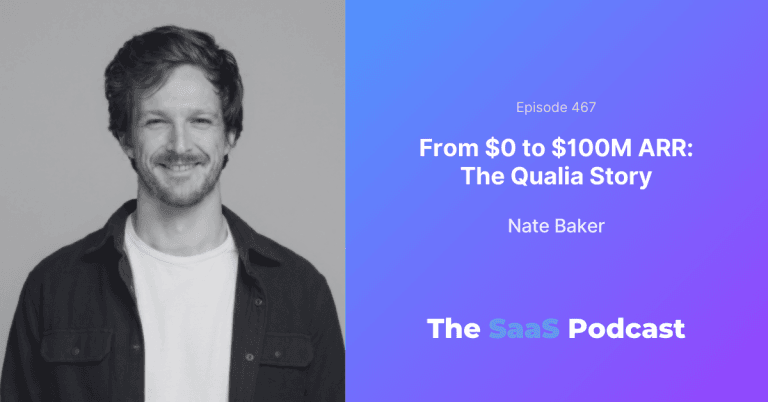
[00:00:00] Omer:
All right, Nate, welcome to the show. My pleasure. Do you have a favorite quote, something that inspires or motivates you?
[00:00:02] Nate Baker:
Thanks for having me.
[00:00:08] Nate Baker:
don't have a quote for you, I'm sorry.
[00:00:10] Omer:
That's a good answer. We'll just we'll take that and move on. So tell us about Qualia. What does the product do? Who's it for? What's the main problem you're helping to solve?
[00:00:21] Nate Baker:
Quali is a software company for title businesses. So if you buy a house, title company is organizing escrow, all the documents and really facilitating the transaction between the real estate agent, the lender, the buyer, the seller. That's our customer and we're core workflow software for them. Crazy stat about this market is half of people cry during the process of buying a house. So it's like, when you think about the NPS score,
of the service that our category provides is quite low. And so we're building tools to make that better.
[00:01:00] Omer:
You're building tools to help people stop crying. Yeah.
[00:01:03] Nate Baker:
Yeah, and I think that, you know, if you bought a house before, it's an emotional, it's inherently emotional and complex. And I think there's a limit to how good it can be, but it can be a whole lot better than it is today.
[00:01:16] Omer:
Yeah. Yeah. I mean, we just, we, we just bought a house, moved across the country, like nine or 10 months ago and incredibly stressful process, like right down to the end, when we were like moved out of an Airbnb ready to move into the house and we get a call saying, yeah, this might not happen today because something didn't go through. you're like, what the hell, you know,
Anyway, that's another story. So give us a sense of the size of the business. Like where you're in terms of revenue, customer, size of team.
[00:01:48] Nate Baker:
you know, we're, we're over a hundred, growing quickly and 600 people. and yeah, and, yeah, just trying to, trying to do a lot of really cool AI stuff right now. We just launched a product called clear, which we're excited about and, generally trying to build on top of the platform that we've, we've built.
[00:01:55] Omer:
over 100 million ARR.
[00:02:12] Omer:
Great. And I think you've raised north of 200 million so far, including a Series D. Great. And if that wasn't enough, you also have another venture you're working on, which is called Fractal.
[00:02:16] Nate Baker:
Yeah. Yeah.
[00:02:27] Nate Baker:
Yeah. Yeah. So five years ago, we basically started a business called Fractal to launch vertical SaaS companies in industry, basically America's most important industries that are in our view, under invested in and need better software. And so we've, we've launched over 145 companies now in all sorts of niche categories, like scrapyard software, rehab clinic software, things like that.
And yes, it's been going really well, but it's modeled off of the type of stuff Qualia has done.
[00:03:04] Omer:
Got it. And you were telling me you have a CEO running that business. So it's not like, you know, you're, kind of jumping between the two every single day. Or maybe you are.
[00:03:14] Nate Baker:
Correct. Yeah. Quite, quite, quite my full-time thing.
[00:03:18] Omer:
Great. So I think the business Qualia was founded in 2015 and you went through an interesting process to decide that this was the industry, this was the problem that you were going to go and solve. And you didn't have any real estate experience and you were I think 21 at the time. How did you, how did you come up with the idea? How did you decide this was the thing you were going to work on?
[00:03:47] Nate Baker:
Yeah, that, mean, that's the number one question we get in the industry and with new hires is how on earth did you end up doing title software? Um, I had started a company in college at a very small scale and through that ended up working at eight VC, which is an adventure fund. Um, and you know, my boss there at the time started Palantir. And so we were spending a lot of time trying to answer the question of what, what is a, what's like the best.
What is the best category to go after to go build a enduring software business? At the time, there were a lot of Snapchat and stuff like that growing really fast. it was annoying to me and my co-founders to be focused on all these kind of more. It felt like a consumer products where you weren't sure if you put all this work in, if it would produce value for anyone. So we were really oriented around.
B2B workflows where there's actually a significant amount of pain in how that workflow is done and trying to find things that had a lot of good properties. So I put together a list of 10 selection heuristics to identify the market that we wanted to go after. And they were things like, you know, we want to build a platform, not a feature. You know, we want to build something with the potential for network effects.
something where you can continue building it more more value over time because you're in the flow value, things like that. And we narrowed it down to three finalist ideas. Life insurance broker software, property and casually adjusting workflow software, and Qualia, which we obviously picked. But they all have the similar property of being
An industry that most engineers don't wake up and decide to do. They're kind of like boring sounding, but fundamentally quite important. There's an emotional aspect of buying those products as a consumer. They're really difficult and just like not optimized. There's principal agent problems in the distribution channel for all of these products.
[00:06:11] Nate Baker:
And so we were looking for things that had that type of characteristic. And ultimately, that led us to Qualia, where I think the competitive set was also more interesting than the other categories.
[00:06:25] Omer:
And then so was this like just an exercise you were doing like just researching online or were you going out and talking to people?
[00:06:33] Nate Baker:
It was entirely academic process. it was, it was not engaged with reality in an important way. And I would, I would actually caution against it. I think we got very lucky by getting the right answer without that. But, but even I remember
[00:06:35] Omer:
Hehehehe
[00:06:53] Nate Baker:
In the very early days, some after we'd started the company, some of our foundational assumptions about the unit economics and the business model just ended up being completely wrong. Um, and so I think that, uh, one of the 10 things was that, uh, you want to pick something that has multiple paths to revenue so that you're robust to false hypotheses, because you're going to make fully wrong assumptions in some key areas and.
Yeah, that kind of helped protect us from some of those issues at that point.
[00:07:28] Omer:
So you went through this academic exercise and identified that this business that you were going to build, the product you were going to build, the problem you're going to solve. Did you then go out and talk to people or did you then just start building something? Love it.
[00:07:44] Nate Baker:
We then just started building. So yeah, it's interesting. And this is kind of the opposite of what I would recommend to everybody. And also what we do now with all the fractal companies is you need to have customers as fast as possible and you need to be building for them for the real pain, the real problem as fast as possible. But we sort of had a view early on that, okay, we're going to like divine the correct.
cancer here. And it just, I think as a result, we probably wasted a solid like three or four months in the beginning of the company before we actually found customer number one. And that's when we really started making good progress. During that time, we built some stuff we ultimately threw away, but we also started to interact more with the
integration partners, the ecosystem of vendors start to understand who's who. And I don't think it was truly wasted time, but it could have been a lot faster.
[00:08:52] Omer:
Now, one of the things that I came across when I was researching was that on the face of it, you would think, real estate, maybe they're just not, you know, they're kind of behind in technology. And it's just about kind of automating what's there. And maybe that was true to some degree, but it sounds like the real problem.
that you identified and you were solving was this coordination with all of these multiple parties and stakeholders involved in the buying process. And it strikes me that initially trying to solve that problem with your V1 seems like a really difficult thing to do. So how did you decide where you were gonna focus? What specific problem you were gonna solve first?
[00:09:41] Nate Baker:
To start with, we just went with the core system of record. think ultimately what we solve now and where we wanted to get to is more of this ecosystem of products that helps solve the communication workflow across the entire transaction, which has many different constituents and many different people who are working on it. But our view was that to solve that, you need to start with the core. And so that's what we did in building Qualia.
started with the core accounting systems, the core workflow and document and all this, you know, the meat and potatoes of a lot of vertical software systems have some of these same constituent parts.
[00:10:25] Omer:
But who were you building for at the time? Who was your initial ICP? Were you trying to solve it for a bunch of different end users?
[00:10:35] Nate Baker:
We were solving for the title company. So the very first user is a title company or real estate attorney, depending on where in the country it is, it's the same type of business. And more specifically, we were solving for Barry Feingold, customer number one. And I think at that stage in the company, we were really overfitting for the first couple of customers in a way which I think
was appropriate, but also has drawbacks. We actually very nearly closed one of the very largest companies in the space as our first customer. And I think I'm so glad we didn't do that because it would have been a disaster. We would have overfit this kind of super enterprise type of customer segment. And instead we started with more of like a mid-market, it like 50 employee type of customer.
[00:11:31] Omer:
Okay, so tell me about the first customer. How did you find them?
[00:11:38] Nate Baker:
Yeah. So we found the first customer in probably July of 2015. So a couple of months after starting and we got extremely lucky with Barry. So one of our investors had told my co-founder Lucas, Hey, you should wear your Stanford sweatshirt when you go to this, this, this conference. And we did, and he did, and Barry walked up to him like five minutes in was like, do you go to Stanford? Yes. Did you, are you suffering? Yes.
Okay, I'm like, I'll be a customer. And so we were like, this is so easy. This is just, this is going to be, this is going be great. Everyone's going to want this product. And we really realized that Barry, Barry was singular. And because early on taking, taking a bet to be like a core system of record, it's kind of like, yeah, it's like, Hey, I started a new bank. Do you want to be a first customer? It's like, it's like,
[00:12:11] Omer:
What?
[00:12:35] Omer:
Right.
[00:12:38] Nate Baker:
All you need to do is send me all of your money and I'll hold it. And you're like, what's the upside? There is no upside. Maybe in five years, it'll be like a better experience. And so that was, that was really challenging in the early days because it's such a core system of record. It's, it's complex, to get it implemented. It's difficult, painful. And so we got really lucky in finding a customer who shared the vision of what could be done in this industry.
and he made an investment in our sea ground, which helped. but it was, yeah, it was, it was really essential to find that, that one person.
[00:13:18] Omer:
So Barry is a senator, what was he doing at the time when you met him?
[00:13:22] Nate Baker:
State Senator,
[00:13:27] Nate Baker:
So Barry is state senator in Andover, Massachusetts, near there. he is a real estate business and a title like real estate law firm. And so he was kind of the perfect customer. after Barry signed himself up to be a customer, the team basically rotated through living in his basement for about the next two years. yeah, so it's a...
[00:13:52] Omer:
What?
[00:13:56] Nate Baker:
I probably spent a total of a year living in his basement. And, you know, if you signed up to be a new team member, if you're in like the first maybe 25 people at Qualia and you're starting Monday morning, you get a call from me Sunday night. Like, I'm so sorry I forgot, but you actually, here's some plane tickets. Your onboarding is actually in Andover. You're going to live in Barry's basement.
for the next two weeks, he's going to teach you title. He's going bring you to work. It's going to be awesome. You're going to have meals with his family. You have to tutor his kids in math. That's part of the deal. Yeah, so that's what we did. And we worked out of his office because I think that to actually understand what your customer does, you just have to be so in it. And I think where I've seen companies fail with
[00:14:36] Omer:
Are you kidding?
[00:14:54] Nate Baker:
with fractal is that they're just like, they're not sufficiently in it. and
Yeah, because that's the only way you're going to actually make something better than it is.
[00:15:08] Omer:
So you're going to explain that me. Like, why would Barry want a bunch of tech folks living in his basement and eating out of his house? how did that even happen?
[00:15:20] Nate Baker:
It is amazing.
And on one hand, like he's singular, but also like he's the type of guy who's always trying to do stuff. Like he really, you know, I like, I want to be like Barry, you know, it's like, he's a, he's trying to be in the mix. He's trying to make things happen. He actually cares about his industry deeply and improving things. and he was, he's always just been irritated that he can't deliver an even better service to his client because his software is holding him back.
And so, yeah, a lot of the energy came from him. And I think...
Finding Barry's hard, but if you're trying to go build a software product for an end market that is actually revolutionary, you need to be able to someone like Barry in your category who gets it. And I think that was the key unlock for us because once we were there, had a sufficient push to get live.
story you might find interesting is as we were getting close to getting live, the software platform that Barry was using at the time basically got upset with Barry that he was working with us on building this new tool and shut him off. And they mailed him a thumb drive with all of his user data.
[00:16:57] Nate Baker:
and shut them off on the platform, which is crazy. it was very scary because our software is title and escrow software. That's what people call it in the industry. But we did not yet have the title or escrow portions of the software built. But that became the most productive month in the history of the company.
[00:16:59] Omer:
Wow.
[00:17:24] Nate Baker:
because we had to be there for Barry because he was taking his bet on us and he needed us at that moment. And so we were able to get live. But that was really harrowing. And I think it ultimately was the most important thing in accelerating our progress.
[00:17:42] Omer:
So how long did it take for you to eventually ship the first version of the product?
[00:17:49] Nate Baker:
It's kind of a difficult question because I would say maybe two years, something like that. But what that was versus what it takes to get live today is so different because the landscape has just changed massively.
[00:18:07] Omer:
Mm Yeah, yeah. And during that time, what were you doing? Were you focused purely on Barry as your one customer? Or were you signing up additional customers and also going and living in their basements or something?
[00:18:23] Nate Baker:
We, we basically focused exclusively on Massachusetts as our first market. Um, it was probably one of, it was a good state to focus on, but it is, it has a little bit of strangeness versus, uh, the rest of the industry for us. So it was, it was a good state to focus on. Um, one thing which is interesting, maybe for some of your, your listeners is we kind of were thinking about particular.
competitors that we wanted to compete against and using that as a way to pick a geographic wedge, which I think was really helpful because there were ways we could differentiate more easily.
Yeah, we basically just stayed focused for pretty much a year in Massachusetts. Betsy Kelly, the one person operation, was our second customer. then Mark Kanner is our first paying customer after that. yeah, that was maybe six months after getting Barry live that we actually started to have a paying customer.
[00:19:33] Omer:
So many founders are worried that when they pick a market, they're going to pick, it's going to be too small. And when, how did you think about this when you had like zero revenue and you're staying very focused on, on geography and Massachusetts compared to what it's turned out to be today?
[00:19:57] Nate Baker:
Yeah. I guess we knew the national expansion was built in. We also believed we could sell more products on top of the core platform that we're offering and build more of an ecosystem over time, which we've proven out. So we weren't, we weren't that focused on it. We were also not spending very much money. We're trying to be really, really, really efficient. I think at the time the top paid person in the company was paid 80K a year and
And a lot of people were taking a lot less than that. So it was a very lean operation. Even though we had raised a fairly significant amount of money, everyone was incentivized with equity and we were really going for it. Eventually we did start to make more of this national expansion push over the next year. We went down the East coast and then across the country.
And that starts to make the TAM math make more sense from an investor perspective. But yeah, we really still approached it very state by state.
[00:21:08] Omer:
Walk me through some of those early customer conversations. I'm curious to know what were what were title companies asking you for or problems that were telling you about and how close was that to what they actually needed?
[00:21:31] Nate Baker:
That's a very interesting question because.
In a space like ours, there's an infinite number of things you could build. And if you sat with a customer, they could give you, they could describe to you a roadmap for the next hundred years, with each customer. And so I think the, the real challenge that we had was trying to bridge bridge that and figure out how do you actually deliver value? and so we were very focused on what, do people vote with their money? Like.
what's actually valuable to people based on what they're willing to pay for. Because that's just a very good signal for what's actually valuable. We built plenty of big speculative products that no one wanted. And it was usually because of that. We heard a lot of noise in the market. Everyone said they wanted it. We thought it was necessary because we also had a view on maybe driving a network effect or adding some expansion area. And then it just didn't work. And so...
where we've had the most success, it's where we try to actually charge for something at the beginning of the cycle of building the first version of that product, because then people are like, oh yeah, this is valuable, I wanna pay for this because I'm excited about the direction you're building here. And so I think that's how we've tried to solve that question.
[00:22:58] Omer:
So if there was, excuse me. So if, if a founder is in that situation today, I know there's often this reluctance to ask for money, especially if you don't have anything to deliver yet. How, how would you, how would you suggest that they ask those questions, how they pitch this, how they frame it in, a way where they can get some commitment? while at the same time, not
you know, being transparent with the fact that they don't have anything right now.
[00:23:34] Nate Baker:
I think the best tool for early stage SaaS founders, particularly vertical markets and the fractal companies employed us really well. It was really important to quality early on is annual upfront contracts or multi-year contracts upfront, like all the cash upfront. Because you can go to a customer and say, like, I will build all this stuff. I'm really committed to you and I give you an amazing price, but I need
multiple years upfront now and you're the value that you're getting. There's a kind of a, maybe they pay five years, but it looks like a cost of one year. And the value there is that it actually makes it easier to get this mutual buy-in. Um, and it's really meaningful revenue. you're pretty million revenue, like I remember we, we closed a contract when we had 45 K of ARR.
That was a 20K annual deal, but it was five years paid upfront. And that was actually really nice because the cashflow was meaningful to us at the time. The customer liked it because they got an amazing deal for the next five years. It was a lot of confidence. They believed in us. They wanted us to succeed. And then we knew they were very likely to stick around. And so I think that
those sort of incentives are underutilized.
[00:25:06] Omer:
Maybe walk me through like how you actually did that because in principle, makes total sense. You're basically pre-selling the product. You're generating some revenue through customers. They're basically funding your development. But I can sense like a whole bunch of objections. Are you guys going to be around next week? Five years seems like a huge commitment to make.
What exactly am I getting? Like what were you showing them? So I'm just kind of curious like if you were having if you were kind of going through this process pitching that to them, what were you showing them and What did you have to do to get them to a point where this became a no-brainer to say yes to?
[00:25:54] Nate Baker:
Yeah, so I guess with this particular customer, just to get really specific because it probably is more helpful. This is one of Barry's top competitors at the time. The office was maybe 10 miles away and Barry introduced us.
[00:26:15] Omer:
to his competitor. Cool. Nice.
[00:26:16] Nate Baker:
to his competitor, Barry and I would drive around and they'd go knock on title companies and just go do door to door sales basically. so.
It was coming from a position of, know, this is, this is what's going to happen in this local market. It felt competitively relevant because his main competitor had it, but it also was a bit more de-risked because, you know, he knew a couple other people that were using the software. And so that's why we were really focused geographically. And we actually had.
We had at that time, you for the first couple of months, more salespeople in Massachusetts than, than we do now, because we were really focused on just this local ecosystem. And I think that's the, that's the key unlock because then you start to know everyone, you can get intros and you can, you can be relevant in that local market, even if you're small nationally. and that.
And then you also understand the competitive dynamics against selling against the local competitors or against the stuff they're using and how it works in their local market. And that was really helpful to us early on.
[00:27:37] Omer:
So this one, this competitor, what was the pitch? What did you show them?
[00:27:45] Nate Baker:
It was, it was as much a pitch about what we had as like a vision for the, where the company is going. think it's actually at the time we were truly terrible at sales. It's interesting. we, uh, we ultimately hired a VP of sales, probably like a couple months after that. Um, so when we were, we went from 45 K of ARR to three and a half million in 12 months of ARR.
[00:27:57] Omer:
You
[00:28:13] Omer:
Wow.
[00:28:14] Nate Baker:
And so that was like a very fast period of growth for us, but it was because
[00:28:18] Omer:
Is that when you, when you hire the salesperson? That was the. Okay.
[00:28:21] Nate Baker:
Yeah, we hired a VP of sales and then we scaled up to 30 reps in like four months. and, it was the VP of sales. was his fifth role of that type. And he said to us, I've never seen such a gap between great product and incompetent sales execution. and I think that was really right. And because at the time we were a company of like,
[00:28:27] Omer:
Wow.
[00:28:50] Nate Baker:
Software engineers all about the craft of software engineering. Even today, if you ask like what is quality as competitive advantage, it's we are a team of software engineers that respect the craft of software engineering that are building amazing software. But at the time we really didn't have sufficient respect for you can be good at other things. And you can be, you can like build a skill and an expertise and
Yeah, and we really figured out the inside sales motion at the time. And it just, it just clicked for us.
[00:29:26] Omer:
And did you sort of, did you anchor the pricing in some way with this customer by saying, you know, this is what we are going to be charging. This is what, why, you know, okay. but again, even like five years seems like a long, really long time to commit. They got a re they must've been something they really liked about you guys to do that.
[00:29:37] Nate Baker:
Yeah, they understood they're getting a deal.
[00:29:52] Nate Baker:
I think they were getting probably more than an 80 % discount versus what they were paying. So it's like, probably didn't, it probably felt like I'm going to pay one year of software and then I get four years free. but we didn't really have the ability to charge that type of price point at that time. and so it, kind of bridges the gap and aligns the longer term incentives. and then also just brings cashflow forward, which matters a lot at that time. And then puts you in a position to.
[00:30:02] Omer:
Okay.
[00:30:22] Nate Baker:
Then that guy wants to make intros. He wants to be reference. He wants to help out. And that actually ended up playing out over the next few years and yeah, made a big difference for us.
[00:30:34] Omer:
Did you get most of your leads through intros versus like the door to door or was it kind of not not like which which worked better which was the thing that you leaned into the most?
[00:30:51] Nate Baker:
I would say for your first 10 customers, it has to be in network sales. Like you can maybe get a couple outbound cold calling, but even if you outbound cold call someone, you're going to close them because of some network thing. Like, I know that person. We're working on this thing that you like. After that, I think it's the volume and velocity of just like your typical inside sales motion.
is going to overwhelm the effect on the network side. But you do have to supplement it with a lot of more network oriented and partnerships and channel sales and that sort of stuff. the inside sales should overwhelm the efficiency in most SaaS businesses.
[00:31:40] Omer:
Now, I know you mentioned you were grateful that you didn't land one of the biggest players in that space early on and why it turned out to be a good thing. But as you started to move a little bit more up market with bigger targets, what were the objections that you were hearing over and over again?
[00:32:07] Nate Baker:
think the number one thing for us was always like, you don't understand Tennessee. You don't understand Texas. You don't understand whatever state it was. The reality is in our industry, every state is wildly different. And it's like an incredibly large lift to get over the nuances. so that was, the thing was people were correct in saying that. And actually,
we had a customer in Texas maybe six years ago, churn because we didn't understand Texas and they were the first one and it went really badly. And they were, I think quite reasonably very upset with us. they came back recently and are happy customer now, but it, it took that amount of time to really get things dialed in. and so as you go up market, you deal with more customers that operate.
in a more diverse set of jurisdictions with a different type of transactions. so the complexity of this goes up a ton. And, you know, like right now, our largest customer is Old Republic Title, which we just, we just announced a deal a couple months ago and you know, they're massive national scale. And so you have to be able to roll all that stuff up, which, you know, just gets more and more more more complicated over time to be able to handle that out of the box.
But early on, we wanted to make it like a very simple to use platform that you can just turn on. And that's a little bit at odds with this like enterprise extreme customization. And so it's been an interesting tension of how do you make it sufficiently easy to use, but also sufficiently flexible.
[00:33:56] Omer:
So often I see, excuse me. Okay. so often I see founders who maybe take a similar approach where they maybe target a geography, a local market, and then they want to expand. And that's where some of the challenges often come in. Do I do it this way? Do I kind of, you know, go this direction? And it sounds like you were getting similar challenges where
the objections where you don't understand Tennessee, you don't understand Texas and so on. And so what was your strategy for solving that? What did you decide to do? Like just go deeper in Massachusetts or like pick the next easiest market and try that? What did you do?
[00:34:46] Nate Baker:
We were very much selling, we were at the time, I think, just trying to go boil the ocean and just try to get sufficient coverage that we could support each state sufficiently well, and then really build up. that it probably would have been better if we had said, okay, we're going to only limit it to, you know, these 25 states and then go after that. Um, but I don't know at the same time, like you, you want to be able to support these.
the national customers. And so I think we, had to go figure it out and, ultimately you're going to be a national platform. And so you just need to go, you just need to go do it. so yeah, we actually just, it was very time intensive ordeal going and staying with customers, not in their basements this time around, but, but actually going and spending, you know, months with them to actually figure out what's different about this geography.
And I think Texas is probably the one that took the longest, that was most complicated because it's like a, an entirely different regulatory framework and is, is generally difficult. Yeah, it's, it's a, our industry is at the intersection of mortgage and insurance regulation. So it's kind of regulated by both, both of them. And as a consequence, it's just like very detail oriented and very complex.
[00:36:17] Omer:
Yeah. So how big was the company at the time? Like, were you the guy going in and, and, you know, going to Texas or, were you able to like have someone on the team take, take over on that sort of stuff?
[00:36:31] Nate Baker:
By that time we had a sales team that was doing a lot of the regional sales, but again, that was inside sales, not on the ground. And then we had a product team that was primarily actually interfacing with the customers locally. I was lucky that my co-founder Joel was extremely oriented on that exact problem. And so he was traveling a lot with our product team.
[00:37:00] Omer:
Okay, got it. You know, I mean, today, I don't know, like, like how many home closings does Qualia handle, of the total market? It's pretty significant, I guess.
[00:37:12] Nate Baker:
Millions, yeah, a significant number.
[00:37:15] Omer:
Yeah. So at what point, like, did you, did you realize that you had like real traction, like, you know, product market fit? I'm just curious, like, were there like, you know, some false signals sort of early on that felt like you'd found product market fit, but you hadn't?
[00:37:39] Nate Baker:
I would say our, my confidence and concern, like I think at the beginning we were unreasonably confident. Like we really didn't understand the scope of the problem, how long it take. If you told me the trajectory of Qualia, then I would have been like, that's terrible. That takes way too long, way too slow. And so I think our expectations have
like moderated as we've built a business to be more real. I remember in our first board meeting, I was presenting to, Joe Lonsdale, who was, had started Palantir and was my old boss. And he said, you know, if you hit these numbers, you'd be the fastest growing company of all time. And I didn't appreciate that he was trying to say you're an idiot. but
[00:38:12] Omer:
Mm-hmm
[00:38:34] Omer:
Mm-hmm
[00:38:36] Nate Baker:
I think it took us a while to realize that like, need to actually, dealing with all this stuff, it's very difficult to build a business and you actually have to go out and build it incrementally. And so I would say.
Now looking out and thinking about forecasts and thinking about where we're going, I think we just have a more calibrated understanding of how difficult actually building anything is.
[00:39:07] Omer:
Yeah. So given where you are now with the business compared to, you know, living in Barry's basement all those years ago, how, how has your outlook changed about the market and the opportunity ahead?
[00:39:22] Nate Baker:
Yeah. So I think that the reality is that the process of buying a house, it sounds like you actually had a bad one yourself. It's terrible. It's extremely expensive. It could be massively better. And so I think the opportunity is bigger and is as clear as ever. So the outlook for us is making the home buying process simple. And there's a huge amount of runway on
I'm doing that. The thing that's changed tremendously for companies like Qualia is we are the correct delivery mechanism for all this AI stuff that's coming out. And we have some incredible products that are growing really fast. Qualia Clear is our AI platform. Sort of like a cloud code style thing that can plan and execute on top of Qualia and all the systems our customers use. These are in
incredible opportunities for businesses in all these different end markets to build like actually useful stuff at a rate that's never been seen before. And so I'm extremely bullish on not just quality, but just the category of workflow software businesses in general right now, because there's a really good starting point for deploying AI, because you need to understand like
the nuances of the local market, the nuances of how does a scrapyard actually work and to be able to implement these tools and drive really, really fast revenue. But we're seeing across our portfolio and also just in the market, just incredible growth rates on all these AI SaaS businesses.
really niche B2B enabled, AI enabled B2B use cases. So yeah, I'm pretty excited right now.
[00:41:23] Omer:
That's awesome. It's like, I wish somebody could do something for car buying like you've done for home closing. Cause that, that's another area that still just seems like a lot more painful than it has to be. So maybe when you're bored one day, one afternoon, you can go and solve that.
[00:41:39] Nate Baker:
That's a busy market. There's a lot of stuff going on in that market actually. It's interesting. Yeah, I think the next two years, this category of B2B software is just going to be turned on its head. It's going to be really existential moment for a lot of companies if they don't react.
[00:41:59] Omer:
Yeah, it's an exciting time.
[00:42:02] Nate Baker:
yeah, best time ever to be building anything. I'm having a great time.
[00:42:03] Omer:
yeah yeah all right let's wrap up let's get on to the lightning round so I've got seven quick fire questions for you ready what's one of the best pieces of business advice you've received
[00:42:12] Nate Baker:
Okay, yes.
[00:42:19] Nate Baker:
Make customers money. I think that that kind of gets lost. That's that's for my grandpa and you know he.
People forget to do that. think they're thinking about all this strategy and they think about all this stuff. It's like, no, there's only one point. You got to make your customers money. If you're a B2B business.
[00:42:42] Omer:
What book would you recommend to our audience and why?
[00:42:46] Nate Baker:
Nate Baker (42:51.982)Reading a really interesting book, which is a Tyler Cohen recommendation recently called Peasants into Frenchmen, which I highly recommend, History of Rural France and how it became like France.
[00:43:04] Omer:
Interesting. I've got to do that more. just like, I've got to this point where it's like, yeah, business books are great, but sometimes when you just go and read something completely different, it's like your neurons get rewired in a way that that makes you think better. So it's pretty cool. What's one attribute or characteristic in your mind of a successful founder?
[00:43:28] Nate Baker:
I think that they need to be pretty aggressive in general on actually getting things implemented and making their view of reality actually happen. Because of Fractal, we've seen 150 different CEOs now that we've hired and CTOs and who's done well and who hasn't. A couple takeaways, they have to be in person in the same city five days a week. Huge statistical significance on outcome.
PMs do a lot worse than finance people. And if you hire like PMs, they might have a good ideas on what to build. But in my experience, looking across all our data, they actually are a lot worse at getting stuff done and making all the trade-offs and driving the business and being more emphatic about making things happen. So yeah, that's...
That's maybe one of the hot takes.
[00:44:30] Omer:
What's your favorite personal productivity tool or habit?
[00:44:39] Nate Baker:
I mean recently I've been talking to Chachibutti all the time about all my ideas. And I mean that's a new one but it's a...
Yeah, I'm just like a five hours a day in in Claude right now. Just doing stuff and if you're not doing that, like what are you even doing right now?
[00:45:00] Omer:
Although my teenage daughter wasn't impressed, I went to pick her up and I was like having a conversation with Chad GPT. And she was like, my God, you're talking to Chad GPT again. That's so sad.
[00:45:14] Nate Baker:
Yeah, exactly. I mean, I get it, but it's still just, it's so useful.
[00:45:18] Omer:
Yeah, absolutely. What's a new or crazy business idea you'd love to pursue if you had the time?
[00:45:26] Nate Baker:
I-
I really think that there needs to be a better marketplace for small businesses to sell. You'd have to, the big reason this hasn't happened historically is doing the accounting kind of reconciliation to standardize everything is impossible. And so it's like too much work, but potentially that barrier is coming down and all of the like M &A diligence is just too much on a business that's only doing like 500 KB per job. if.
If the fixed cost of that diligence shifts, you could actually unlock a marketplace for the first time. That would be amazing. And I think there's this generational transition that's happening. yeah, I think things like that are super interesting right now.
[00:46:14] Omer:
Yeah, I think it was maybe the book by Cody Sanchez. Something about mains. I can't remember what the title of the book is, but there was something interesting there that a lot of these smaller businesses, because they can't sell, or it's an easy way to do that, they just end up shutting down the business when people retire and nothing happens.
[00:46:33] Nate Baker:
Totally.
Totally. Yeah. And I own a Dairy Queen with my dad and I'd be fifth generation in the ice cream business. And there's just a lot of businesses of that type that are generational change. People are looking to retire and it's very hard to transact. Title companies are another example. There's a large number, maybe 800 title companies a year that sell and there's not an efficient marketplace for that.
[00:46:55] Omer:
Yeah.
[00:47:05] Omer:
Yeah, well, what's an interesting or fun fact about you that most people don't know?
[00:47:13] Nate Baker:
I love chess. I don't know if there's something like that. Play a ton of chess.
[00:47:17] Omer:
And you lived in Barry's basement, which I thought was pretty impressive one that, you know, for a year, this is crazy. And finally, what's one of your most important passions outside of your work?
[00:47:23] Nate Baker:
Yes.
[00:47:32] Nate Baker:
I think aside from vertical sass, I'll just leave it with chess and we can keep it there. Thank you. I appreciate you having me on. Take care.
[00:47:35] Omer:
Love it. Nate, thank you for joining me. It's been a pleasure. Yeah. Hold on. So if folks want to find out more about Qualia, they can go to qualia.com. And if folks want to get in touch with you, what's the best way for them to do that?
[00:47:53] Nate Baker:
nate at quality.com send me an email
[00:47:56] Omer:
nice and simple. Thanks man. Wish you all the best. Appreciate it. Take care. Bye.
[00:47:58] Nate Baker:
Thank you. Appreciate it. Bye.