[00:00:00] Omer:
Hey Richard, welcome to the show.
[00:00:01] Richard:
Hey, thanks for having me.
[00:00:03] Omer:
My pleasure. Do you have a favorite quote, something that inspires or motivates you that you can share with us?
[00:00:07] Richard:
I have a bunch. I think probably the most work appro, like work related one is Eisenhower quote about planning. Plans are worthless, but planning is everything.
[00:00:15] Richard:
Which I think we, we look we idolize a lot here at Fathom 'cause we are very much a planning light kind of culture. We try to move pretty nimbly.
[00:00:23] Omer:
Cool. Tell us about Fathom. What does the product do? Who's it for and what's the main problem you're helping to solve?
[00:00:29] Richard:
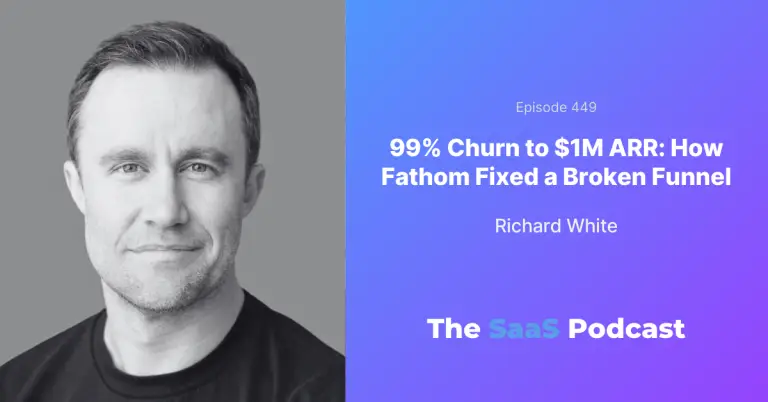
Yeah. Fathom is the number one rated AI note taker.
[00:00:32] Richard:
So joins your meeting, summarizes 'em for you. It's really for anyone who's on meetings a lot, which is a pretty big tam and got started with it because I had this problem myself, right? I was in a lot of meetings four or five years ago and just struggling to. Talk to people and take notes at the same time.
[00:00:48] Richard:
Clean up those notes after the meeting, look at those notes two weeks later and still not know who was what. And so we built Fathom really to solve that problem. And I think one of the key things for us is we wanted it to be something for everyone. And so one of our big kind of go-to-market strategy was to make a really good version of Fathom that's completely free.
[00:01:04] Omer:
And give us a sense of the size of the business. Where are you right now in terms of revenue, customers size of team?
[00:01:11] Richard:
Yeah, it's about a 80% team. We're about eight figures, we, mid eight figures. We had 175,000 companies that use Fathom any given month.
[00:01:20] Omer:
Okay, great. So the business was founded in, as you said, I think 20, 24 or five years ago.
[00:01:26] Omer:
And we'll you took, you touched on, I guess where the idea. Came from. Before we get deeper into that you have a really interesting background and when you and I were talking earlier I told you that, when I first came across Fathom, I was like, oh who's the founder of Fathom?
[00:01:42] Omer:
I found your LinkedIn profile. Started reading that, and then the thing that always stuck with me was the. The, your, the thing at the bottom of the profile, which was a product you'd worked on initially, and you'd said a crappy piece of software that taught me more than all my college CS classes combined.
[00:02:00] Omer:
And then I was like, this is a really interesting guy. It's seems very down to earth. It definitely, it seems like a conversation that we should have. It's taken me, it's taken a long time to get this scheduled and mostly that was my fault. But I'm glad we're finally doing it.
[00:02:11] Omer:
So why don't we just. Get the audience up to speed and just tell us what that product was and then what other things you did before getting started with Fathom.
[00:02:23] Richard:
Yeah. I was very fortunate that my, I got into computers at a real young age and my parents very much fostered that or tearing apart computers putting back together.
[00:02:31] Richard:
I remember in. High school. I was running like a cheat codes website for like PlayStation games. My, it was the number one website for PlayStation cheat codes. My, my best friend ran the number one website for video game cheat codes, like PC cheat codes, and I was always a little bummed. He was always about 50% larger.
[00:02:47] Richard:
I. Gross traffic than me, but I remember my getting, a check in the mail every month for 400 bucks for ad revenue and my parents being thoroughly confused. From a young age, had entrepreneurial parents and got really into big computers, so was doing websites, was I think I wrote some software for the TI 83 calculator that ended up being like some standard software for all the calculus classes and the.
[00:03:08] Richard:
The city I grew up in, in Raleigh, North Carolina. So always kinda had this bug. And yeah, on my, on LinkedIn it mentions this company I made in college that was like basically software. If you ever go into a hospital back in the day and they have all these channels to teach you about, here's how to deal with diabetes or you have a newborn.
[00:03:26] Richard:
And it was, my stepdad had a company that sold. Software sold stuff to like technology, equipment to hospitals. And I learned that what drove all of those TV channels back in the day was like VHS tapes. Like racks and ratchet of VHS players and there's all these old servos that were like, click play, click rewind, click play again, type thing.
[00:03:45] Richard:
I was like, that's insane. And so I made some software that like. Basically digitized all that. And it was terrible software. I didn't even know what a database was back then. I was like, I skipped the database classes in cs, so I didn't even use the database. It was just like a flat file. It was terrible.
[00:03:59] Richard:
I think it got used by one hospital, but I learned a lot in building it. And kinda set me on the path to continue this kind of journey of entrepreneurship.
[00:04:05] Omer:
Cool. And then you built, actually then you started working as a product design lead at Kiko, and that's an interesting story as well about how you landed that role.
[00:04:15] Richard:
Yeah, I was I, went to school for computer science. I was very much a, an engineer programmer, but I really wanted to be a product designer more than a, than an engineer. Early wanted, do both. And I remember this was back, I'm gonna really date myself. This is back when Gmail had come out.
[00:04:30] Richard:
When Gmail comes out, everyone wants to make everything desktop. Let's put it in a web browser, right? And the next obvious thing to build is the calendar. And so I was talking to my coworkers like, oh, I wish I really wanna build kind of Gmail for calendar. And Google Calendar wasn't even out yet.
[00:04:44] Richard:
And one day my colleague came, wrote to me, say, oh, bummer. Someone just built it and showed me a TechCrunch article. These guys had built this like really robust kind of web calendar, which. It didn't really exist at that day and age. And I remember playing around with it and first I was really bummed.
[00:04:57] Richard:
I was like, Ugh. Like it's someone beat me to it, right? And then I played with it more. I was like, oh, but it's crappy. Like it's like technically really impressive, but the design is terrible and like it's doing all these things that are unintuitive. And so I just cold emailed the guys and I was like, Hey, saw your product.
[00:05:11] Richard:
It's super cool. You're doing lots of innovative things. Design is terrible, and. Then I went on I wanna help you. Like I'll help you fix the design. I wanna be a designer, da. And first of all, huge kudos to them to even opening that email and replying to it. But they were replied, they're like, okay, like EC would be better.
[00:05:27] Richard:
And so that kind of random cold email ended of me. Quitting my job and working with those guys full time. They were in this whole program called Y Combinator, which I had never heard of up in Boston. I was over in North Carolina, and so I was flying up to Boston for half the month, freezing my butt off in the winter and working on this office with the founders of Reddit and the founders of some other startups.
[00:05:46] Richard:
And it was like. At the time I had no idea what was happening. I was just, oh, this is cool. We're just like hacking on something. Turns out it's like the most formative thing that ever happened to me. 'cause it's I got into the slipstream of really amazing entrepreneurs. The guys I did Kiko with, the founders were Justin Khan Sheer who went on duty, Twitch, and obviously we know how Reddit turned out and stuff like that.
[00:06:03] Richard:
And so that kind of was like my sliding doors moment that got me from, call it the minor leagues of entrepreneurship where I was in North Carolina hacking on stuff on my own into oh great. Now I'm surrounded by some of the. You know now some of the best entrepreneurs in the world, and that got me from Boston to California.
[00:06:17] Richard:
And there we go.
[00:06:18] Omer:
That's so cool. And then you worked on a couple of other products and then eventually you launched user voice.
[00:06:25] Richard:
Yeah. And so I actually, I think through that experience on Kiko, I wrote down like three or four different ideas around problems we were having running Kiko.
[00:06:32] Richard:
I. And one of them was trying to gather, we were three person team and we had thousands of users, and we were trying to gather feedback. And so I was like, oh, Reddit for customer feedback. Like, why don't we get users to basically crowdsource their feedback to us. I don't have to spend all day trying to figure out, what's the most important thing and that.
[00:06:48] Richard:
Instead of going to work on Twitch, which maybe I should have done I had said, went to work in Serve my own company called Uservoice, which is basically that, which is basically like a Reddit for customer feedback. And did that, worked that company, ran that company for about 10, 12 years.
[00:07:01] Richard:
And really learned a lot. 'cause we did everything that business we started off bottom up PLG, by the time I left it was basically an enterprise company. We'd actually pivoted. We were, pM product. We were a customer store product and we're a PM product again, and so I got to experiment with different markets, different business models, like it was a kind of I call it like my finish finishing school for entrepreneurship.
[00:07:20] Richard:
Are you still involved with user voice today? I'm still on the board. Yes.
[00:07:23] Omer:
Okay. And so was it an acquisition or is it still a privately held thing?
[00:07:27] Richard:
Yeah it's still a profitable, privately held company.
[00:07:30] Omer:
Cool. Okay. And then, all right, so you're doing well with that. It's growing you you're serving enterprises.
[00:07:37] Omer:
And so you talked about the pain that, that you identified with Fathom, but what, what pushed you to say, okay, I'm not gonna spend the next five, 10 years of my life now I'm building this product.
[00:07:47] Richard:
I asked myself every year kind of two questions when I was running user voice. One, am I uniquely learning from this company?
[00:07:54] Richard:
And two, am I uniquely qualified to. Pushed this company to the next level. And for the first time in 2019, I said no to both those questions. And I was like, okay. Like I think I know, right? It's time for me to find something new. I felt like I'd done all I could do to put my vision into that company.
[00:08:11] Richard:
It was time to put someone else's vision into that company. And yeah. And so that's around the time started thinking about new products and new ideas, and that's pandemic happens. We're all on Zoom, this idea predates the pandemic a little bit, but obviously pandemic happens now everyone's on Zoom meetings, and the value of building something that can, take notes automatically on Zoom meeting just becomes so obvious.
[00:08:29] Omer:
So how did you get, how did you get started with Fathom? A lot of founders or aspiring founders have these ideas. Some can start, building a product. Maybe that's a curse if you start building a product too soon. Others, have their own sort of. Challenges, but just getting started with it, what were the initial steps you took here?
[00:08:49] Richard:
I think, Fathom looked very different than the first days of user voice, right? First days of user voice. I'm a first time founder. I've never raised funding. And I'm like basically falling asleep on my laptop coding day and day out, right? And I wrangle a few other people into following that same sort of crazy lifestyle.
[00:09:06] Richard:
And, I think we. Got some friends and family money, like a hundred K. That got us a year and a half of runway sort of thing. Fathom is very different. Fathom. I basically started with four of the best engineers from user voice. 'cause we actually worked on some stuff at User Voice and actually spun it out of user voice.
[00:09:21] Richard:
So I got to take some of my top engineers. So I kinda started on second base, if you will, of Fathom, where I've got four amazing engineers from day one. At this point now I've raised some money. I've built a, multimillion dollar business I can raise for my network, I can raise from folks.
[00:09:34] Richard:
And so we've, raised money on day one, literally just on the strength of the idea. So very different starting pattern. And I think in general, a lot of what we've done Fathom feels like I call it like speed running a video game we've played before. And I use a lot of video game analogies when.
[00:09:49] Richard:
Thinking about startups, but my favorite one is like playing Minecraft. Like I think when you're doing your first startup, it's like you getting dropped into Minecraft for the first time and you have no idea what to do, right? It takes you half an hour to figure out, I gotta punch a tree to get some wood, and then, like it, it doesn't tell you what the rules are.
[00:10:02] Richard:
It doesn't seem to be any rules. It seems to be completely open-ended. If you've watched 10,000 hours of Minecraft or played 10,000 hours of Minecraft, it's a very different experience than the first hour, than the first hour. You've got a moat, you've got a castle, all these things. And that's what it feels like.
[00:10:14] Richard:
I think doing kind of the second startup, right? You know all these things that felt like open-ended questions are actually like multiple choice questions when you really boiled them down. And so I think that's what was fun with Fathom is we had to kinda start and be like, okay. We know what our go-to-market model is gonna be for this stage.
[00:10:28] Richard:
We know what we're building. We know that's a big enough market. Like we've done the research sort of thing. But at a high level, as a product, I knew I could use myself. I knew. That it's solved a problem. I have, I tested, I talked to, all of our sales team at User Royce.
[00:10:41] Richard:
I talked to the CS team at User Royce. Yeah. I just, everywhere I went, I found people like, oh my gosh, I'd love to have that. And there were some people in the space, there's a company called Gong that was doing call recording specifically for sales teams. And we looked at that and we interviewed about a hundred different.
[00:10:56] Richard:
People that use Gong Managers ics and that gave us a really strong conviction of ah, okay. I see where the weaknesses in that model. It's a very expensive product in a, because the inputs were used to be really, transcript used to be really expensive. Transcripts get really cheap, so you don't really need to charge $150 per seat anymore.
[00:11:12] Richard:
In fact, we can give away for free. And it's more than just sales. Yeah, sales definitely benefits from this, but again, so can product, so can marketing, so can cs, everyone in meetings benefit from this? We did some market research, got the engineering team, and so really it felt like we really started with a pretty strong plan and sense of conviction around what we were doing and how.
[00:11:31] Omer:
So what was what did that first version of the MVP look like? What did it do?
[00:11:36] Richard:
The first version, actually, all it did was it recorded a meeting and then after I could go into the transcript and I can like highlight sections of it and turn that into kinda like a highlight reel very quickly.
[00:11:46] Richard:
It was obvious to me as like the personal user, the last thing I wanna do after I have a meeting is wait a half an hour for the recording and then go back through it and do all the, like it shifted from one work kind of work to a different kind of work. And so from that we came up with we need to make it really fast.
[00:11:59] Richard:
And or the engineering team telling the engineering team, like it needs to be faster. And they're like, how much faster, like in terms of getting you the content after the meeting and it's I don't know, just keep making it faster and all. Tell you when it's fast enough. And I think we had to about 30 seconds.
[00:12:11] Richard:
I was like, okay, this is fine. This is, this feels almost instant. And then we did some work so that instead of me having to highlight things after the meeting, I could do it in the meeting. I click a button and it'd be like, oh, remember, that's an important segment. And we always knew though that was like a kind of a bridge.
[00:12:27] Richard:
Like we basically built this whole company with the assumption of two things. One, the transcriptions gonna become free, and two, the AI was gonna get really good and the hard part of this business was actually not the AI or the transcription. It was building a reliable recording architecture that sits on top of Zoom and Google Meet Microsoft teams.
[00:12:45] Richard:
'Cause there's no actual APIs for doing that. They're all, it's an undocumented kind of API. And so we're like, we're gonna spend a year just basically building the recording infrastructure that's highly scalable, real time fast. We'll build in some AI features. You can highlight things, but we're really building this business for the day when AI gets really good and we can drop that as like a new engine into an old car type of thing.
[00:13:04] Omer:
So initially you focused on doing, just supporting Zoom users. And what were some of the challenges there? Even today at, I mean in my personal experience like trying to use Zoom APIs and there is, I can see documentation. But it's like it's really frustrating.
[00:13:23] Richard:
That was the number one thing we saw is we, we saw that there were some people back in 2020 that were building some products in the space.
[00:13:30] Richard:
I. And the reviews on all of them were, it works. It works most of the time, right? And for a product like this, if it's, if you're trying to replace something as consistent or reliable as note taking, whether it's with a Google Doc or pen and paper, it has to be reliable, right? It can't be, oh, I'm gonna commit to using this tool and it works 80% of the time.
[00:13:46] Richard:
It needs to work a hundred percent of the time. And to your point, the challenging thing is there's probably easily 50 to a hundred different scenarios. Where you might join a Zoom meeting, or it might be operating right? It might be, you're the host, you're not the host, you're on, a bad connection, you're on a good connection, you're da and so you know, you joined after the start time, you joined ahead of it.
[00:14:06] Richard:
You after, there's all these scenarios and what you realize that working versus not working is like the perception of the user, right? Like I am sure all these other products actually were working in the very specific way. They were to build, but it felt like it wasn't working.
[00:14:21] Richard:
If it shows up late, it feels like it's not working right. If it leaves early, it feels like it's not working. There is no definition of what's, what working is except for what the user thinks it is. And so we actually, I think the hardest thing we had in the beginning was I.
[00:14:40] Richard:
There's no like specific API. The only way we could figure out is this thing working is we literally paid people after their first experience to tell us how it went.
[00:14:51] Omer:
Usually at this point I'm digging to figure out how you got your first 10 customers, and one of the things that you had said earlier was, our first 10 customers weren't nearly as important as our first 10 stable users.
[00:15:06] Omer:
Can you just explain what you mean by that and why that was important?
[00:15:08] Richard:
I'm a big fan of kind of attack your core metrics in serial. And so like some people try to like, Hey, launch your product and when you launch your product and you're trying to monetize and you're trying to acquire customers and you're trying to retain them, like you're trying to figure out all three of those metrics at once.
[00:15:21] Richard:
And I find that's like really challenging and hard to do because they all confound each other. And so I tend to kinda look at it as what's the riskiest metric, what's start there and work our way down the least risky metric. And so for us, the riskiest metric was retention, was user retention.
[00:15:33] Richard:
Can we just get, can we just build a product, not even a multiplayer version. Just a single player version that people used day in, day out. And we knew at some point we would monetize and we'd monetize by selling a version that's to a manager, right? That's like a different value prop, right?
[00:15:49] Richard:
You wanna roll this out to your team. But I had high confidence that like if we could get to a point where we had really good retention and then we were really good at acquiring customers and they got really good at referring other folks 'cause they're in a meeting and our products. In the meeting we built this like really good kind of viral flywheel engine and then we monetized on top of that.
[00:16:08] Richard:
I'd already run, a, a high seven-figure SaaS company. I wasn't super interested in doing that. Again, I only wanted to this company if we could really get escape velocity. And so we really just focused first and foremost on let's just prove that we can make a killer experience for folks.
[00:16:22] Richard:
Because I've always believed that if you can build a killer experience and folks and they use it day in day out, you almost always can find a way to monetize it. They only use it once a month. Maybe more challenging, but if you can find something people use every day.
[00:16:35] Richard:
If there's not a product I don't know of that doesn't find a way to monetize that.
[00:16:41] Omer:
And what were some of the challenges with getting those users? Using the product or activating them. I know trust was an issue in the early days, right? 'cause this was this completely unknown product and AI note takers weren't that common.
[00:16:55] Richard:
Right. Yeah. So I think I. Yeah, most of the people, when we were getting those first 10 users, it was almost all me reaching out to folks on LinkedIn, friends of friends being like, Hey, will you tried this product sort of thing.
[00:17:09] Richard:
And so that, that feeds back into that having a feedback loop and like I said, what bit paying people for their feedback.
[00:17:20] Richard:
And so we saw that too. And a lot of our feedback was like, oh, how's your first call go? Oh, I just met with myself to try to see how this thing would work.
[00:17:35] Richard:
And it actually doesn't work that when you meet with yourself.
[00:17:49] Richard:
And so we built out this pretty cool apparatus that allowed you to have a test call if they call with a recording.
[00:18:03] Richard:
And again, get the trust to understand how it works before they bring it to a meeting with their colleagues or customers.
[00:18:17] Omer:
It's funny you say that because I had a identical experience this morning…
[00:18:49] Omer:
And if I had a bot who had come along to that meeting, that would've been super helpful.
[00:19:04] Richard:
Yeah, so the way our app worked is like you had to…
[00:19:11] Richard:
Now add Fathom to the meeting.
[00:19:29] Richard:
Because they're now locked in…
[00:19:43] Richard:
And so we're like, this is a huge problem for activation.
[00:20:01] Richard:
That was like one of those things that like, took, it was like a 10 x metric improvement.
[00:20:15] Omer:
So beyond those initial 10 users…
[00:20:31] Richard:
Yeah, so I think it took us about.
[00:20:49] Richard:
And then you gotta get lucky on the timing of some things.
[00:21:04] Richard:
And so it was like us and 50 established companies launching on day one.
[00:21:26] Richard:
And that was true.
[00:21:57] Richard:
And then at the end of the first month we had 100 DAU.
[00:22:15] Richard:
And we went back through the data.
[00:22:49] Richard:
And so obviously we weren't this.
[00:23:08] Richard:
Even those users are not the best users.
[00:23:20] Richard:
And usually that's a hard thing for Sharp to do.
[00:23:33] Richard:
Thankfully we were getting thousand signups a day.
[00:23:49] Richard:
That really served us going forward.
[00:24:02] Omer:
So did you have to change anything…
[00:24:13] Richard:
We basically have lobbying Zoom…
[00:24:39] Richard:
That would've worked.
[00:24:45] Omer:
Yeah. It feels at the time…
[00:24:49] Richard:
Yeah, exactly.
[00:24:50] Omer:
And also around that time…
[00:24:59] Richard:
So I mentioned I don't like, to do things in serial…
[00:26:07] Richard:
But then the bottom falls outta the market…
[00:26:40] Omer:
Yeah. Yeah. Let's talk about that…
[00:26:57] Omer:
And then I'm curious…
[00:27:03] Richard:
And this is the thing I was most afraid of…
[00:27:48] Richard:
We always knew, no, we don't wanna charge the sales rep…
[00:28:20] Richard:
But I felt always the right thing to do…
[00:29:56] Omer:
So you had this outbound sales motion…
[00:30:07] Richard:
No. So there's no individual paid plan…
[00:30:40] Omer:
So I remember when I first came across.
[00:31:23] Omer:
But you went down a different route…
[00:31:35] Richard:
Yeah. We had a couple of the features…
[00:31:48] Omer:
Zoom I, was like your big I…
[00:31:59] Richard:
At this point, it was Zoom…
[00:33:08] Richard:
By giving 'em, we're gonna give you this really good product…
[00:34:24] Omer:
So I'm guessing when you started…
[00:34:37] Richard:
Yeah, I think you mentioned like our two core hypotheses.
[00:35:41] Omer:
What about, zoom itself…
[00:35:53] Richard:
Yeah, so we were exclusive to Zoom…
[00:37:42] Omer:
So the businesses doing eight figures…
[00:37:58] Richard:
Before we put really AI into the core…
[00:38:46] Omer:
We should wrap up…
[00:39:47] Richard:
Yeah. Again, I think I was very fortunate…
[00:41:04] Omer:
Love it. All right…
[00:41:11] Richard:
Not really advice…
[00:41:43] Omer:
It's funny how some…
[00:41:50] Richard:
I love The Score Takes Care of Itself…
[00:42:09] Omer:
What's one attribute…
[00:42:13] Richard:
I guess I'll refer back…
[00:42:20] Omer:
What's your favorite…
[00:42:23] Richard:
right now?
[00:42:46] Omer:
Yeah, me too…
[00:43:01] Richard:
This might be surprising…
[00:43:34] Omer:
Cool. What's an interesting…
[00:43:37] Richard:
I guess maybe I…
[00:44:16] Omer:
I once worked with…
[00:44:42] Richard:
Your favorite video games…
[00:45:07] Omer:
And finally, what's one…
[00:45:10] Richard:
I am addicted to skiing…
[00:45:19] Omer:
Love it, Richard…
[00:45:33] Omer:
People listening…
[00:45:47] Richard:
Just ping me on LinkedIn.
[00:45:48] Omer:
Awesome. Thanks again…
[00:45:52] Richard:
Thank you so much.
[00:45:53] Omer:
Cheers.