Omer Khan [00:00:09]:
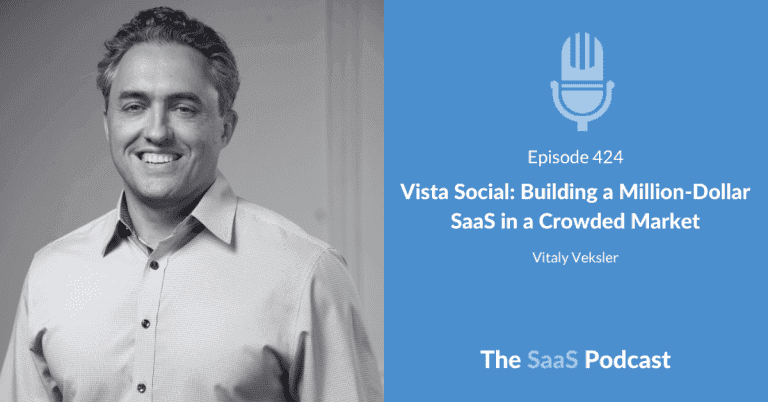
Welcome to another episode of the SaaS podcast. I'm your host, Omer Khan and this is a show where I interview proven founders and industry experts who share their stories, strategies and insights to help you build, launch and grow your SaaS business. In this episode, I talk to Vitaly Veksler, the founder and CEO of Vista Social Media, a social media management platform for brands and agencies. In 2010, while working in corporate tech, Vitaly decided to build a social media management tool.
Omer Khan [00:00:38]:
It was his first entrepreneurial venture, and over the next nine years, he learned some tough lessons about building a startup. The biggest lesson, he spent years building advanced analytics features when his customers really needed a complete social media management tool. It took him years to realize that and finally start getting some traction. Vitaly also had to learn everything himself. Marketing, sales, customer support, you name it. His persistence eventually paid off when he sold the business in 2019.
Omer Khan [00:01:05]:
In 2020, he decided to take another shot with Vista Social, but this time in a much more competitive market. He and his small team faced a huge challenge. They had to build a product that could compete with the big players out there. And creating all the core features customers expected was a massive undertaking. But remarkably, they got it done in about 12 months and that bet paid off. Vista Social reached the first million in ARR in less than two years. Today, the company has over 10,000 customers and a team of 15 people.
Omer Khan [00:01:36]:
In this episode, you'll learn how Vitaly's experiences and mistakes from his first startup helped him make better strategic decisions with Vista Social. What specific strategies and tactics Vitaly used to successfully enter and compete in an established market with lots of competitors. How targeting customers who hated their existing tools became a key growth strategy for Vista Social in a crowded market.
Omer Khan [00:02:00]:
The key differences in how Vitaly built customer relationships and support systems the second time round with Vista Social and why focusing on a specific customer segment early on helped vistasocial gain traction faster than the established competitors. So I hope you enjoy it. Vitaly, welcome to the show.
Vitaly Veksler [00:02:19]:
Thanks for having me.
Omer Khan [00:02:20]:
My pleasure. Do you have a favorite quote, something that inspires or motivates you that you can share with us?
Vitaly Veksler [00:02:25]:
Yeah. So Arnold Schwarzenegger once was asked, how does he sort of manage to get everything done? He said, listen, I used to wake up at five, go to gym, then I went to work, then I went to the gym again. Then I went to the acting school, then I had a job. And then the next day I just repeated, people just asked me, arnold, how do I do this? I'm tired. And Arnold said, sleep faster. So I just love the sleep faster part.
Omer Khan [00:02:54]:
Sleep faster. Love it. Great. So for people who don't know, tell us about Vista Social. What does the product do, who's it for and what's the main problem you're hoping to solve?
Vitaly Veksler [00:03:07]:
Yeah. Vista Social is a social media management tool which essentially means that any brand, business agency, anybody really with any reasonable purpose on social media can use our tool to effectively manage their social schedule content, respond to conversations, run reports, customize things. So quite literally it's every business out there who uses social media for marketing needs our product and that's why we built it. Great.
Omer Khan [00:03:34]:
And give us a sense of the size of the business. Where are you in terms of revenue, customers, Size of team.
Vitaly Veksler [00:03:42]:
Yeah. So we are in our third year, third year of operation. We have well over a thousand sort of customers on our platform. 10,000, I'm sorry, pull over 10,000 customers on our platform. We are in a sort of a 7 figure ARR range which we crossed into about a year ago. Size of team. I think we are right around 15 people all globally spread out around the world. Great.
Omer Khan [00:04:07]:
And did you raise money or are you bootstrapping this business?
Vitaly Veksler [00:04:11]:
I've bootstrapped it myself because I did had a prior sort of exit success which allowed me to kind of have the funds necessary to fund the early parts of the business. Although I have to say super frugal operation to start. It was not a big lift to kind of finance some of the early development and preparation work.
Omer Khan [00:04:30]:
Great. So let's talk about that first product which was Social Report and this was something that you also bootstrapped and it was also a social media management platform. So in many ways you're doing this another time round. But it from, from when you and I were talking earlier you said it took was like five or six years to get to like the first million in. In ARR.
Vitaly Veksler [00:05:01]:
Took a long time. Yes.
Omer Khan [00:05:02]:
And there was a bunch of, you know, now you look back and there was a bunch of mistakes that you made. And then the second time around when you did this with Vista Social, you went from zero to the first million in I guess like two years.
Vitaly Veksler [00:05:16]:
Less than two years. Yeah, just about two years. Right.
Omer Khan [00:05:18]:
So. So I think just that on its own is sort of, you know, great because it's, it's almost like you know, a founder being able to get a second chance to build a very similar type of product and business but know what they shouldn't do and what they do need to be doing. So let's talk about that like why? And you said, you know, eventually you exited the business but why do you think was the main reason that it took you five or six years to get to the first million in ARR?
Vitaly Veksler [00:05:56]:
Just not knowing how to run a business. When I started the Social Report I had probably around 10, 12 years of just corporate America sort of experience. I was a techie, had a very successful career at that was really good. And I think this going into the startup, building the product, I kind of went in thinking that I know how to do it. And a lot of the things that I've attempted to do were really based on nothing.
Vitaly Veksler [00:06:24]:
It was based on just presumption that I know how to operate, how to build a product, how to operate a product, how to bootstrap the product. And as a result a lot of things I've tried really didn't work. Everything from the product that was not built in a way that users would use it, to the support of the product that was not done in a way that the users would keep on using it to the marketing which was sort of non existent to begin with.
Vitaly Veksler [00:06:51]:
So there was a lot of things, there are a lot of things that are part of operating a product that I just didn't have experience with back in the day. And even though again the unfortunate part, I came into it with too much confidence. Right. Because I had that corporate background, I had that experience. So that confidence did not help the cause at all.
Omer Khan [00:07:10]:
Yeah, yeah, because I think, you know, I mean I came from the corporate world as well and you learn a lot and it's a very, I think a very enriching experience. But then once you sort of leave that, you realize that, you know, it's a whole different ball game and there are a lot of skills that you can apply but there's. I don't know, it's just. Why don't you tell me?
Vitaly Veksler [00:07:42]:
Yeah, yeah. So it's sort of like think about, let's say you are an electrician, I don't know and you know how to do the electrical wiring. But the, but the next project is to build entire home and let's say it's a five story building, let alone the home, right? Try it. I mean foundation along is probably a massive subject that probably people go to school to learn how to do, right. So you can't quite transfer your specific skills. In my case these were a lot of technical skills. I was a developer, an architect.
Vitaly Veksler [00:08:11]:
Yes, some of it was useful. But business, logistics, operations, marketing, hiring people, even the product side, figuring out what is it that the product needs to look like. Mind you that a lot of these things are fairly straightforward. For example, on the product side, have a system in place to look at what the competitors do. Right. Have a system in place to interview some of the prospect customers.
Vitaly Veksler [00:08:37]:
Put that on a piece of paper, look at it, try to build your tool off of that versus something that you perceive as being the necessary product and feature set.
Omer Khan [00:08:47]:
So when you started building that product, you. You focused on analytics as like the one core thing that you were going to solve.
Vitaly Veksler [00:08:57]:
Correct.
Omer Khan [00:08:58]:
And we'll talk about this. And it turned out that that's not what your prospective customers wanted or needed the most. But where did that idea for analytics come from?
Vitaly Veksler [00:09:12]:
A good friend of mine, his name is Mark, had a bar side conversation with a marketer. This must have been 2010, right? And the marketer basically said, listen, this whole social media thing is, you know, is a thing. And we are now having to. This is, again, this is over a decade ago, but there are no tools, there are no tools to tell us how are we doing on marketing. Right. So, and my readout of that conversation was somewhat limited. Right. So I view that as an analytical kind of a problem.
Vitaly Veksler [00:09:38]:
They don't have the analytics in play. And that's why the name social report came about. It was a lot of reporting and subsequently that's kind of what we kept on building without realizing that it's the complete set of features relating to the management of social that the customers really wanted, where the analytics were just one of the pieces of the puzzle. But unfortunately for us, it took quite a bit of time to sort of come to that realization.
Omer Khan [00:10:09]:
How long did it take for you to get your first 10 customers with social Report?
Vitaly Veksler [00:10:13]:
I wouldn't remember. It was pretty quick. Again, social media was a hot issue. I mean, it still is. And a product out there that does stuff for social media is still sort of in a hot enough of a space for you to be found. So I think finding the first subscribers was not a huge deal. Preserving them was a much bigger challenge because again, the feature set was incomplete. Not to mention that even from the standpoint of my background, a lot of companies that I worked with, they were in the financial space.
Vitaly Veksler [00:10:48]:
So I knew quite a bit about that. I knew nothing about marketing, I knew nothing about social media. So it's also likely that even the analytical product that we were building was not really even in the right ballpark as to what was required. So I think again, getting those few customers initially was not that difficult, but preserving them, I think we almost had 100% churn for the first 12 to 24 months just because again, people sign up, but then they quit right away.
Vitaly Veksler [00:11:16]:
So, again, getting them into the door at that time was not as difficult as it is perhaps today with how crowded the space has become.
Omer Khan [00:11:24]:
So, spoiler alert, things changed for the business, and you started to get traction when you realized that customers didn't just want the analytics, they wanted everything else that comes with a social media, media management tool, scheduling, all of that stuff that we've come to expect. I think it sounds like the challenge was that on the one hand, it wasn't like you weren't selling the product, so you're getting customers. So that is almost like a false positive in terms of, yeah, we've got the right product because people are buying it.
Omer Khan [00:12:04]:
And then when they're churning, you're like, okay, there must be something wrong with the onboarding or something. And it's about improving the product so you're. You're kind of more focused on retention. And it's kind of like this, this. This situation where I think a lot of founders can very easily get into, where it's not that obvious. It's not like, oh, I put this thing out there and it's like nobody's buying it, so I go and do something different. You were kind of growing, and just slowly people are buying, things are improving.
Omer Khan [00:12:41]:
How long did it take for you to get to that point where you were like, no, there's a whole bunch of stuff missing in this product?
Vitaly Veksler [00:12:47]:
Yeah, unfortunately, it took solid four to five years, because you're right, there's this false sense of progress because you're kind of getting customers, but then they're quitting in droves. The churn is high. You're kind of spending time trying to figure out as to why that's happening. But the elephant in the room is that fundamentally the product is not what users need. And just to give you perspective, the end product, 10% analytics, 90%, everything else. So basically, I had 10% of the product, hoping that I have enough. That's the scale.
Vitaly Veksler [00:13:31]:
That's the magnitude of the missing link here. And what makes it remarkably painful is that the writing was on the wall throughout that time. So all I had to do is a speak to my customers and have a system of collecting that feedback. Exit surveys. Why are you canceling? Even while they were using, trying to talk to them more in terms of what they needed. Simply looking at my competition and seeing what is it that they offer. So the painful experience here is that there is this presumptuous disregard for that.
Vitaly Veksler [00:14:12]:
And instead one is relying on my own, my personal view of what I need to do. Right. So I think it's that sort of hyper realism. Whereas your reality, you don't make the reality. Reality exists. You can ignore it at your own expense, but the longer you do it, the longer you'll end up paying, the more you end up paying for it. Right. So this was a completely unnecessary loss of time, loss of effort. One would argue that I've learned a lot and very expensive education, right? Very expensive.
Omer Khan [00:14:48]:
And I think the other thing is that in many ways you are doing what conventional wisdom would say is the right thing to do. Don't go and build a product that has feature parity with everybody who's been doing this for the last 10 years or whatever. Focus on a slice of that, do that really well, and then kind of build up from there. Because if you try to build everything, you might be, you know, spending the next three, four, five years trying to catch up with them.
Omer Khan [00:15:19]:
And so in many ways, it was like, you know, it kind of sounded like you were doing the right thing.
Vitaly Veksler [00:15:24]:
Right? But I think it's the defensive reaction, right? You're right, because you look at the competition and you're like, oh, my God, it will take me like three years to build it. So oh, my God means, Vitaly, you need to stop, you need to go out, you need to raise some money, and that's what you need to do. But instead, I was probably telling myself, hey, there's probably still a way to compete. Let me build that subset of features. Let me build.
Vitaly Veksler [00:15:51]:
So the minute I stopped doing that, the minute I stopped kind of telling myself that I can build half of the product and be successful, is when good things began to happen. Right? But it is kind of scary, right, because you're looking at this and you're like, These people spend 2, 3, 4, 5 years in a team of 50 people doing this. Here you are, if you're lucky, with maybe a couple of people by your side trying to compete with that monster.
Vitaly Veksler [00:16:14]:
It's very daunting to just see the path in front of you and realize that it's going to take so much sweat and blood to get there. And it's very daunting. And the natural reaction is to just ignore it.
Omer Khan [00:16:26]:
Yeah. So for those first four years when customers were churning, were you not doing anything? Any exit surveys or conversations or follow ups?
Vitaly Veksler [00:16:34]:
I think it took me probably four to five years to even learn the word churn. That that's kind of what was happening again, just not enough of a system in place to turn that information into concrete strategic decisions. So a lot of the anecdotal evidence that I was gathering was probably being put into more tactical solutions to the problem. But the strategic shift happened year four, year five, when I quite literally stopped and I said, listen, that's the direction, that's what we need to do.
Vitaly Veksler [00:17:10]:
And within probably, I would say three to six months, as we made that extra kind of progress with the feature set, everything just began to change. Things were just kind of normal after that.
Omer Khan [00:17:23]:
What gave you that aha moment? How did you come to that realization?
Vitaly Veksler [00:17:30]:
Exhaustion. Like physical exhaustion. There just came a point where you're doing it for a few years and you're just physically exhausted. And at that point you either give up or you just have to somehow change it. So it wasn't through some introspection or reflection or. No, it was just physically I was physically exhausted and a very blunt question was asked and, and very blunt response was received. And then it was either that or quit.
Omer Khan [00:17:59]:
Okay, so now you've got a new challenge, which is you've been investing years building a very specific product around analytics and selling that and marketing it and messaging and all that stuff. And now you're like, okay, I'm going to try to do that feature parity game. And in many ways it's still a bet because you know, success isn't guaranteed, right? That's, that's a bet you're making that this is what I need to do next.
Omer Khan [00:18:27]:
But then how did you deal with this, you know, like this kind of feeling of overwhelm in terms of when you look at competitors and say, how am I going to catch up and get all of these features into this product in a, in a realistic amount of time.
Vitaly Veksler [00:18:42]:
So lucky for me, that's the one thing that I was good at. I was good at tech. So getting into the feature parody was actually kind of a walk in the park. Once I got sort of like on the way. Just the one thing that I know how to do is tech and building stuff done. Like that was just sort of done. But certainly the loss of time and you know, so just.
Vitaly Veksler [00:19:09]:
I think there is a phrase, I think that hockey goaltenders are being told by their coaches, you got to have a five second memory. You can't have that if you miss it. If you're going to continue reminiscing on things you didn't do, well, you're just going to continue getting those pucks into your goal. So I think once it was realized, it was a brand new day, it was just a brand new full throttle. This is what we're going to do. But in terms of having guarantees, on one hand you're right, there are no guarantees.
Vitaly Veksler [00:19:45]:
But on the other side, think about it this way. If you can build something that's already proven to be successful by others, and at that point I was playing the catch up game, and if it works for them, it'll work for you. Maybe not at that same scale, but you're guaranteed an outcome which is sort of almost like a remarkable thing. It's almost like saying, hey, if you can build another car, people will drive it. If you can build another Gmail, people will use it. Right. Will there be millions of users? No.
Vitaly Veksler [00:20:15]:
Will there be a few thousand? Without a doubt. That's one of the more remarkable things I think about building SaaS products is that you're pretty much guaranteed an outcome. It's really just the size of that outcome. Right. Is like, can you get from five figures to six figures to seven? And obviously the further out you go, the more challenging things become.
Omer Khan [00:20:34]:
The other thing we didn't mention was that for the first couple of years you were working full time and doing this as I guess like a side project before you went full time. And I think that's kind of normal because for a lot of founders, when they're bootstrapping, they have no revenue when they launch a product and things aren't moving as fast as they would like. You don't want to quit your job and just jump in and do this thing. You want to have a certain level of confidence.
Omer Khan [00:21:09]:
But the trouble is the other side of it is that if you don't do that, it's really hard to focus. Right. Because you're trying to juggle so many different things. What was kind of the pivotal point for you that got you to jump in full time? Because that was only kind of like two years in. So you're still in that kind of four year window of things kind of moving really slowly and trying to figure things out. But what happened at that point where you decided, okay, I'm going to go all in?
Vitaly Veksler [00:21:42]:
Yeah. So I think not doing it full time initially is totally expected. Right. So it becomes first it probably was like a weekend project, then it was an evening project, then it was morning project, and then just sort of. Then it consumes you. Very difficult to make a switch. Right. Because it's the unknown. Right. I mean, you venture down to the space, right? I mean, here you are on the golden leash, going to work every day, guaranteed to make that mortgage payment. So it's a psychologically very difficult decision to make, first of all.
Vitaly Veksler [00:22:15]:
But ultimately I think I probably made the switch not until the point where there was a little bit of a money. So I kind of figured that I can probably last a couple of years between some savings and some of the initial money that was coming in. I think we've gotten to a low, maybe five figure kind of space where I had a bit of money. So I think the decision was made even when I kind of reached that point. But I think more importantly,
Omer Khan [00:22:46]:
you may
Vitaly Veksler [00:22:46]:
be confident in yourself that while having another job you can kind of put in enough effort and that's totally fine if however you have partners or if you have people you rely on and they have that issue. So that could be a lot more detrimental. So I think one thing that I did do really quickly is that I've hired a developer to help me with this and developer was full time. Luckily he was from an offshore kind of destination and it was affordable, but he was full time.
Vitaly Veksler [00:23:17]:
So quite early I had somebody full time dedicated to the product building that I could rely on and then I kind of joined. So yeah, so I think that's pretty natural, I think, for teams, for people.
Omer Khan [00:23:31]:
So I think it was like 2019, 2018, 2019, the business gets acquired.
Vitaly Veksler [00:23:41]:
Correct.
Omer Khan [00:23:42]:
And then a few Years later in 2020, you decided to launch Vista Social. And I want to kind of understand like why you did that, because we've got to kind of set the context with the landscape as well. Because when you were doing this the first time around, as you mentioned earlier, there's a, you know, it's kind of a hot space, it's still early days, things are evolving, new stuff is coming along.
Omer Khan [00:24:13]:
And 2020, you're in probably a very crowded market to then say, okay, I'm going to go in and do this again with another product. So what kind of drove you? Why did you decide that this was something you wanted to do and this was the type of product you wanted to build?
Vitaly Veksler [00:24:35]:
Yeah, it was more extreme. There was actually a three year break there, which probably only made the idea of launching another smms as even more problematic. So I think we didn't launch until 2020, early 2022, early in the year, the space is more crowded. Right.
Vitaly Veksler [00:24:51]:
But basically there was one trigger that caused the whole idea of building another SMM SaaS sort of come to fruition in my head and it's a Little nuanced in our space, but there was a time when Meta used to be Facebook had quite a few features limited to only partners access, which effectively essentially what they have done, I don't know if they knew that they were doing it, but by doing that there was actually for quite a few years they restricted new SaaS, SMM SaaS from being built.
Vitaly Veksler [00:25:31]:
So I think that feature had to do with video publishing to Instagram, which is very fundamental to any SMM tool. Well, that feature was only available to partners, I want to say from like 2018 to 2021 or so 22, maybe even essentially you couldn't build another SaaS because if you do, you're not going to, you know, you're not going to have Instagram. Video publishing can't compete.
Omer Khan [00:25:54]:
I remember that there was like back in that time there were like tools doing things like you can schedule your Instagram video, but then they send you a notification to go and manually publish it when it was time or something like that.
Vitaly Veksler [00:26:06]:
There were tools that scraped Instagram. I think a lot of them were based in Eastern Europe. Sketch was one of them, I think. And then Cambridge Analytica blows up the whole business of the privacy and the data. Congressional hearings ensue. So landscape is slowly shifting and I think by like 2021 either Facebook just noticed that they had that restriction. I'm not even sure that they realized, makes no sense that that restriction existed, but they lifted it and they're like, okay, API is fully open.
Vitaly Veksler [00:26:42]:
And by then I was free of my contractual obligations and I just decided to do it again. And yeah, and you know, we, you know, started and we launched in 2022 and you know, and here we are.
Omer Khan [00:26:57]:
So this time you, you got to the first million in ARR in under two years. You didn't pick a slice, you went all in trying to get feature parity as quickly as possible. How long did it take you to build that product?
Vitaly Veksler [00:27:16]:
I think we had feature parity within 12 months. There was, the first product was built by half of me basically in a full time person, so person and a half. This one was built by three people, all full time, including me, who kind of knew all the nuances of what needs to be done. So clearly much easier undertaking. Obviously the technical challenges still existed. Obviously the tech has changed. Right. Mind you, the first product is being built in 2010. The other product is built in 22.
Vitaly Veksler [00:27:51]:
But we have all sorts of cloud tech which makes development that much faster. So I think we've gotten to a feature parity quickly. I think partial feature parity, like maybe 90%, probably within a year, 100% plus within two years. And it showed. It showed in a sense that the customers would sign up, not quit.
Omer Khan [00:28:17]:
Right.
Vitaly Veksler [00:28:17]:
Which made the growth that much faster. Like I said, you're pretty much guaranteed to acquire customers just simply because this is a proven space. There are tools out there doing the same thing. Yes. You're not unique.
Omer Khan [00:28:29]:
Yes.
Vitaly Veksler [00:28:30]:
You're doing what others are doing. Yes. It's difficult to differentiate. You're not going to win over thousands upon thousands of customers, but a few hundred you're guaranteed to have. And that's your entry point. That's how you get the features tested. This is how you get concepts proven. That's how you set up the team. That's how you pay the bills initially.
Omer Khan [00:28:46]:
So the product took, you said kind of a large part of it about 12 months. What point did you launch the product and start selling it? Was it at the end of the 12 months or earlier than that?
Vitaly Veksler [00:28:59]:
No, early. I am. I'm a very incremental sort of thinker and operator, which is sometimes, in most of the cases, it's good. There are certainly times when you kind of need to go and only live when things are complete. So we launched very early because we sort of understood that scheduling is by far sort of the most important feature getting the content out there. So the scheduling with the light analytics was probably like the alpha version. But pretty quickly we had the inbox, pretty quickly we had the listening. Things were just getting added.
Vitaly Veksler [00:29:35]:
The type of product that SMMs are, it's almost like a Christmas tree that you just keep on dressing up and dressing up and dressing up, and there's just no end to the dressing up of the tree. Yet a tree in a room with a couple ornaments on it is still a tree in a room with an ornament on it. Right. So there is like this bare minimum that was launched very early.
Omer Khan [00:29:57]:
So there's some interesting challenges that I can see. So once you get to the point where you have feature parity, you then have to figure out, how do I market this and give potential customers a reason to buy my product instead of all the other products out there, like, what makes us different and so on. But when you launch with just a subset like scheduling, I think a lot of early stage founders would be very uncomfortable with that because they'd be like, well, all of these products out there do 100 things.
Omer Khan [00:30:30]:
I'm going out there with one or two features that, yeah, they're important, but why would Anybody pick my product when?
Vitaly Veksler [00:30:40]:
Fantastic question. So we knew exactly that to be the problem. Right. And for that reason, we didn't go after the ICP in question, ICP that we wanted to eventually. Instead, we went for a completely different ICP for whom the feature parity with the bigger products would be not as significant. Right. In our case, the ICP that we wanted would be like the agencies of the world or social media managers, people that operate social accounts for others, for example. That's probably our target ICP. Right.
Vitaly Veksler [00:31:16]:
But initially we knew that a lot of SMBs out there just looking to schedule content very simply to their socials. A lot of creators out there just looking to get their content out for their own brands. And that was the initial ICP that we targeted and they were perfectly happy. Our pricing point was negligible. It was a very cheap product with a basic set of features.
Vitaly Veksler [00:31:36]:
And that's probably within the 12 months as the product matured, we introduced new payment plans, the new features went on to the higher tier plans, and we got an agency plan in there. And that's how we started approaching the icps in question as well.
Omer Khan [00:31:50]:
How did you figure out who those initial target customers were going to be?
Vitaly Veksler [00:31:56]:
So this is where the experience comes into play. So all of my time at Social Report, you know, I knew who the customers are and the nuance differences Right. Among them, and that's invaluable information. Unfortunately for me, early on with the first company, I didn't have that right. So it took me a while to really appreciate the differences in the ICP because they seemed almost negligible, because you can say they all need the tool, but they need the tool in perhaps similar ways to entirely different outcomes.
Vitaly Veksler [00:32:33]:
There are certain customers that don't need certain features, that care about a certain subset of features. Right. And there is even in the demo, as you are presenting the product, depending on the icp, you'll be basically telling different stories depending on who you're talking to. So I think not having detailed and in depth understanding of the ICP and their needs and categorize, being able to sort of classify them could lead to a lot of mistakes.
Omer Khan [00:33:02]:
Yeah, I think in many ways you had five or six years of great training to deeply understand the market.
Vitaly Veksler [00:33:11]:
Yeah, experience is always king. Right. So you can read all you need. But I've probably done easily thousand demos to customers during my social report days, maybe even more before we've scaled our support team.
Vitaly Veksler [00:33:26]:
Because had I had the support team and not spoken to a thousand customers, I probably would not have such intimate understanding, right, as to what an agency business is like or what an SMB is like, for example, that hey, in the case of a small business, the owner actually views social as something that he has to do but doesn't have time for, versus in an agency situation, the agency actually cares a lot more about renewing their contract than the success of their customer.
Vitaly Veksler [00:33:57]:
It's remarkable how nuanced it could get because on the surface you might think that the agency really cares for the outcome of the business. They do, certainly, but only after the renewal of that contract. So what can you do in terms of features to make sure that the contract gets renewed, that the customer is happy?
Omer Khan [00:34:13]:
Now, in terms of those early customers and acquiring them, in terms of marketing
Vitaly Veksler [00:34:20]:
growth,
Omer Khan [00:34:22]:
what was the playbook that worked for you? What was the growth channel that eventually clicked and helped you acquire these types of customers?
Vitaly Veksler [00:34:32]:
Good question. Because initially you can do paid media easily because obviously the ROI on that is going to be just disastrous. So you're going to have to rely on organic. Right? And again, to my sort of theory that you don't need to do much to acquire initial customers, just the basics of SEO and the basics of social, just a few useful hashtags, just a basic community engagement out there will get you initial customers, right?
Vitaly Veksler [00:35:04]:
It's how you then scale that out to kind of go from initial 50 customers to then 500 customers to subsequently to 5,000 customers. That's the difficult part, but I think it's not going to be. It sort of seems kind of remarkable. You build something and all of a sudden something is coming through and registering and signing up. But we live in such a noisy space where it's not going to take too much time for you to kind of plant some seeds of who you are out there and see some initial sort of response to that.
Vitaly Veksler [00:35:34]:
It's the scale. That response could be there, but it may not result in much if you don't someh harness that.
Omer Khan [00:35:41]:
Okay, so a year later, the product has evolved, you're close to feature parity with a lot of the competitors out there. And so you start targeting your icp, right? The customers that you actually wanted to go after initially. How easy or hard was it to convince them to use Vista Social versus ABCD XYZ product out there?
Vitaly Veksler [00:36:13]:
Yeah, that's actually. It's a great question because it sort of points at a slight oversight that I had going into this again, experience, right? Once you do one company, two companies, one product, two products, third product, you kind of have the Ins and outs of what could go wrong. And I think I did overlook slightly the fact that this time around the social media management space is much more established that if the first time around we were talking to customers about signing up for a great new way of managing Social. Right.
Vitaly Veksler [00:36:43]:
Something that some of them didn't even know existed. So this time around we're talking to customers that are sort of. Our users are well aware of SMMs. They've used all of them or some of them in many instances, actually in most instances. And that's actually part of our recipe for success and is that they pretty much hate their SMMs. And that kind of what helps us quite a bit. But we are now in terms of marketing, talking to people about switching, why we are better versus why SMMs exist.
Vitaly Veksler [00:37:14]:
Which if you think about it is interesting also because your marketing is no longer focused on educational aspect as to what SMM is like. The world has already done that job. Everybody knows what SMM is, right? You are now focusing purely on differentiation, new ways of doing things. You're focusing on that delta on that sort of the next tier.
Vitaly Veksler [00:37:35]:
But it is a bit of an oversight early on for Vista Social where we did kind of went on to talk about the product a little bit too much without realizing that everybody knows what SMM is and they're just needing a reason to switch.
Omer Khan [00:37:52]:
What was or what were the reasons that you gave them? So you said a lot of them hated their existing product. So did you focus on some kind of feature differentiation? Was it more about the way that you were marketing and the messaging? I know support was an area that you felt was really important to invest in and get right. So how did you, how did you figure out that differentiation? What was the reason for them to switch?
Vitaly Veksler [00:38:26]:
First of all, I think it's still ongoing process. So I don't think we fully figured out and attracted good enough of a majority of SMM users out there. So I think the road is still ahead of us. But the few things that we are focusing on are things like the, the fact that a lot of our competitors, especially the older ones, they are layered cakes. Basically. They've existed for over a decade, Social has evolved and they kept on layering and layering and patching and paging, which makes their system very behemoth.
Vitaly Veksler [00:39:03]:
Like they're very inflexible, they're very rooted in a lot of things that don't even exist any longer. Right. It's very difficult for them to readjust and a lot of customers who are using them have found themselves using data tools, not having all the latest features, for example. Right. So we're certainly positioning ourselves as just a modern solution to. It's a very clean cut, no archaic nonsense of link shorteners or whatever else used to exist right within this space and was considered to be important. We're just a more modern, clean tool. Right.
Vitaly Veksler [00:39:40]:
So that's sort of one angle. The other angle is obviously price. As I've pointed out, there was a time when no new SMMs could be built and that lasted for a few years, which allowed a lot of our competitors to just hike up their prices. Pricing is a bit tricky because at certain level a lot of customers don't care about the pricing too much. Larger companies, et cetera. But there is a significant portion of the customers that does. And I think pricing is an important distinction and also the complexity of our world.
Vitaly Veksler [00:40:14]:
And I think as listeners kind of listen to this. I think SMM is on one hand fairly straightforward as a business, but the challenge is that we are hostage to what the networks do and allow us to do. And what makes our position worse is that their native functionality will always be better than whatever that is that we build. So essentially we can never build a perfect tool that matches the native experience. Right. And it's helping the customer through that imperfect experience.
Vitaly Veksler [00:40:53]:
Both a, making sure that you do as much as humanly possible on the product side to close the gaps. But when all you've done, all you could do, and it's purely now a matter of customer experience and customers having issues connecting profiles or whatever else exists in our world in terms of very systemic type problems, the fact that a lot of our competitors don't handle support well plays to our advantage. Right. And I think support is one of the areas that we've really taken, in my opinion, to another levels. Right.
Vitaly Veksler [00:41:27]:
Understanding the questions, responding to questions, caring about the questions. Like, I have such negative experiences contacting support for a variety of products. In many cases, I would dread even contacting support just because I know that it's going to take me like 3, 4 emails just for somebody to even look at my question. Right? Big companies can afford that. For the smaller company, each customer question is a relationship building, right? So you can build that relationship. You can solve the problem. Customer will be the loyal customer.
Vitaly Veksler [00:41:56]:
Like, it's expensive and it's laborious, but it's one of the things that sort of stands out as fairly key to our success here.
Omer Khan [00:42:05]:
When you said that a lot of potential customers you spoke to hated their existing products, what was the Main reason for that? Was it just the complexity of the products? Was it the kind of, the poor support? All of the above.
Vitaly Veksler [00:42:19]:
Perhaps all of the above. With a different product, one of those could maybe be at the higher level. Certainly support is key. A lot of products just don't provide one on one support. Very difficult to get through people. But I think fundamentally, again within the SMM space. So for example, if I build an email tool, if I build a banking app, it'll be perfect, it'll never miss a dollar in your account, the email will always be delivered. Right. Versus if you build an SMM and a user needs a feature, but it's just not possible, right?
Vitaly Veksler [00:42:53]:
Just not possible. Because that social network or that social network did not make it available. Or for example, that you've done all you could but there's a failure on the side of, let's say meta because just because they're having a bad day, right? So it's a complex experience that we're in. And frankly, looking at this, if I build a third company, I'm definitely gonna build, I'm definitely gonna try to find a simpler space. So we've certainly picked a space that's very complex to get right.
Vitaly Veksler [00:43:22]:
And I think that is what more seasoned customers that we have, they've been using tools, they understand the complexity and they appreciate the fact that it will never be perfect and they kind of accept that as a. But obviously a lot of customers kind of view that differently. So not everybody has the patience.
Omer Khan [00:43:43]:
Once you've persuaded a customer that they should switch and try Vista Social. And as you said, for a lot of companies that's just an ongoing thing. When we talk about differentiation, it's an easy word, but actually executing is much harder than most people think. But once you get them to say, yeah, I'm willing to switch, then you've got the challenge about, okay, how much work is actually involved in moving over. And often that is one of the reasons why a customer may not.
Omer Khan [00:44:18]:
It depends on what the switching costs are like, you know, yeah, it's fine to sign up and connect your social media accounts, but what about all the stuff I've already set up in the previous system and whatever? So what did you do to try and overcome some of that?
Vitaly Veksler [00:44:35]:
So more strategically what we've done is that as we were building Vista, we really looked at a lot of competitors to make sure that we don't reinvent the wheel when it comes to navigational aspects. So we don't reinvent the wheel when it comes to structural aspects. Because again, SMMs have existed for a while. A lot of things are fairly standard, terminology wise, layout wise, calendars, inbox, people expect to find things. So we're trying to kind of do things in a way that's not going to be just a startling difference when people come around.
Vitaly Veksler [00:45:08]:
So that's one aspect of it. And the other one, we know where the exodus is happening. So we know that there is this competitor or that competitor. We have plenty of documentation, plenty of onboarding material, plenty of willingness for us to train people in that regard. So frankly, the effort is not significant in my opinion, for people to switch. It's a hassle. It's retraining, it's the evil that, you know, it's the it works for me mentality, right? So yes, it's an imperfect product that I have, but it works for me.
Vitaly Veksler [00:45:47]:
A lot of factors and I think a lot of personalities, a lot of considerations when it comes to switching, but yeah, so it's a daily battle for us to convince more and more users to switch over.
Omer Khan [00:46:02]:
So now, having gone through that entire journey from doing this once and then kind of building it a second time and reflecting back on some of the mistakes about not paying enough attention to what customers, or maybe not asking the right questions or listening to customers, and maybe not paying enough attention to competitors, what do you do differently these days when it comes to, you know, customers or how much time you spend looking at what competitors are doing?
Vitaly Veksler [00:46:36]:
On the product side, I pay really a lot of attention to what is it that we're building, because once you reach the future parity, what do you build beyond that? So do you stop building? Do you continue building? So we spent a lot of time, now that we have the luxury of time because we're no longer chasing our tails trying to build stuff, we can really try to perfect a lot of things that are considered to be dead end, impossible to perfect areas of our system. Video processing.
Vitaly Veksler [00:47:07]:
Majority of our competitors would not be able to process some of the videos that we are able to process. That video processing stuff that we have is terribly complex and we keep on reinvesting in it to make it even better. So trying to perfect the system instead of trying to make it bigger because bigger is problematic. We can get into say a CRM business or some content management business as well, right? Some payment processing, store support, inventory. Listen, we get these ideas. We have the suggestion box where users are recommending things.
Vitaly Veksler [00:47:45]:
If we're not careful, we can easily dilute our attention away from things that truly matter. So I think that's my day to day challenge, is to kind of keep an eye on things that matter and keep us away from things that don't matter. Because it's very easy to get diluted, it's very easy to get too big. So that's sort of on the product side of things. And obviously as our aspirations kind of go beyond the seven figure MRR and now we're looking at, okay, so how do we get to the eight figures?
Vitaly Veksler [00:48:18]:
That requires almost a complete rethinking of the processes. So this more natural, organic stuff, it works, it produces decent outcomes. It even produces a fairly remarkable growth. But remarkable growth over small outcomes is still small. So even if you can show, in our case we're 5% every month, increase is amazing, but over something pretty small. So if you look at the trajectory, it's still not quite at the right level. So right now my challenge, and our challenge is to how do we become a much bigger company, how do we achieve much bigger results?
Vitaly Veksler [00:48:56]:
And it does mean a lot of structural system changes. And this is where yet again, now I'm entering because with social reporting you have that problem because we exited earlier. Now that we haven't exited and now that the business is growing, now we're going to have to figure out the scaling aspect of it. Something that I will no longer have the backing of my first company to help me with Discover. So this will be a brand new effort, brand new world.
Omer Khan [00:49:23]:
Yeah. Yeah, that's great. I think in many ways focus is about exactly that, right? As a leader, it's about being able to not figure out what more to do, but what to say no to. So you can keep everybody focused on what really matters. And it's very, very easy, especially if you're a product guy, to come up with a whole bunch of ideas on what you could add into a product. Right.
Vitaly Veksler [00:49:45]:
And listen, and I have luckily, and also that I need to be careful about. I have the team, especially the technical team that is to build all that stuff. And this team will literally do anything you want them to do, which is both powerful but also dangerous because you can easily ask them to do things that are just going to overcomplicate the product or turn us into something that's hard to explain, hard to demo, because one of the criteria that we have for our product. Can we Demo it another 30 minutes?
Vitaly Veksler [00:50:24]:
I think we still can. Although I do get criticized that I sound like an auctioneer from like a Texas. You know, sometimes when I'm doing it I can, but that's kind of like a good indicator, like, can you explain your product, like in under 30 minutes and can it make sense to the user? I think for us, the answer is still yes. Although again, as I'm doing these demos, I keep on telling the users, like, listen, it's a quick overview. There is always an opportunity to come back for more demos.
Vitaly Veksler [00:50:50]:
And I still kind of get involved in demos from time to time. I even, like, make my schedule available because I really want to hear what people are saying about our products because a lot of stuff could get lost in translation. And again, we have our processes where we get reporting on issues that customers are reporting and we try to build some systems around it, priorities and things like that. But it's not until you actually get. Get in there and do a demo for the customer and try to complete functions.
Vitaly Veksler [00:51:18]:
And it's only then when you're really kind of like me as a founder and as a leader here to really have the appreciation. I think I'm not the only one who does this. I think Steve Jobs, I remember reading about him, he would have some of the customer support calls wired to his home so he can quite literally pick up a phone and talk to the customers on how to reprogram the ipod or something.
Omer Khan [00:51:40]:
Yeah, yeah, yeah. Never lose touch with the customers. All right, we should wrap up. Let's get onto the lightning round. I've got seven quick fire questions for you. You ready? Okay. What's one of the best pieces of business advice you've received?
Vitaly Veksler [00:51:56]:
I think when it comes to product, the best advice I had was that whatever you build has to feel like a toy. You have to feel excitement of playing with the toy. And if you do, your customers would love it, like it.
Omer Khan [00:52:10]:
What book would you recommend to our audience and why?
Vitaly Veksler [00:52:13]:
Freakonomics was a book that essentially allowed me to sort of understand that conventional wisdom is not a good guide in life. That, you know, a lot of conventional stuff is really more of a misguidance than help.
Omer Khan [00:52:30]:
I was talking to somebody about that book, book, like last week. I think it's still a great, great read. It just opens your eyes a lot, I think. What's one attribute or characteristic in your mind of a successful founder?
Vitaly Veksler [00:52:43]:
Tenacity and acceptance that you're going to be the only one putting in all the effort, as crazy as that is. So you can't expect the same level of tenacity out of people who you're going to hire, and you're going to have to be okay with that. So it's a difficult thing to Accept.
Omer Khan [00:53:01]:
What's your favorite personal productivity tool or habit?
Vitaly Veksler [00:53:04]:
Routine. So having a routine in place is extremely helpful. Without a routine, this becomes a never ending, never stopping sea of information and tasks. So get up at five, exercise at four, pick up a kid at six, read a book at eight that keeps you sane.
Omer Khan [00:53:29]:
What's a new or crazy business idea you'd love to pursue if you had the time?
Vitaly Veksler [00:53:33]:
Listen, I would love one day to have a farm, but my true spirit, I think I grew up in a fairly humble farm like surroundings and I would not mind. It's a lot of work, but I would not mind trying that out one day.
Omer Khan [00:53:49]:
What's an interesting or fun fact about you that most people don't know?
Vitaly Veksler [00:53:53]:
I was born in a country that does not exist. Although maybe some people do kind of know where that is. But USSR has ceased to exist when I was 12 and it kind of sucks to be from a country that's no longer there.
Omer Khan [00:54:05]:
Yeah, that's interesting. I mean I grew up and. Yeah, you know, it's funny, I wonder how many people even know what the USSR is these days. It's like. And finally, what's one of your most important passions outside of your work?
Vitaly Veksler [00:54:20]:
I like to work out. I like the sports, I like the active lifestyle, whether it's the bikes or the weightlifting or whatever that is, but I like to divert the energy. I feel like my day to days are full of energy diversion but it's the different kind of energy. So I like to divert my physical energy as well. And that in my line of work it takes a very special dedication. It's pretty easy to spend the day working, coding, doing the startup stuff and then just go to bed. Right.
Vitaly Veksler [00:54:55]:
But you haven't diverted that physical part of your sort of energy.
Omer Khan [00:55:00]:
Thank you, thank you so much for joining me. It's been great conversation. I appreciate you kind of looking back over the last, God, 10 actually 14 years.
Vitaly Veksler [00:55:12]:
14 years almost. Yeah.
Omer Khan [00:55:13]:
And I think it's particularly interesting with your story to have basically gone through once building a social media management product, made some mistakes, eventually figured out how to solve them, and then had the opportunity the second time to basically avoid making those same mistakes. So I think it's a lot of valuable lessons that I think even if somebody is working on a different area that has nothing to do with social media, I think there's still a lot of valuable lessons here. So I appreciate you you sharing those with us.
Omer Khan [00:55:48]:
If people want to check out Vista Social they can go to vistasocial.com and if folks want to get in touch with you. What's the best way for them to do that?
Vitaly Veksler [00:55:58]:
LinkedIn is probably going to be the best option. I think. There's a form on the website to contact our team as well, so either way.
Omer Khan [00:56:06]:
Yeah. We'll include a link to your LinkedIn profile in the show notes. Other than that, thank you. Invitaly. It's been a pleasure and I wish you and the team the best of success for the future.
Vitaly Veksler [00:56:15]:
Thank you. Thanks for having me today.
Omer Khan [00:56:17]:
My pleasure. Cheers.