Omer Khan [00:00:00]:
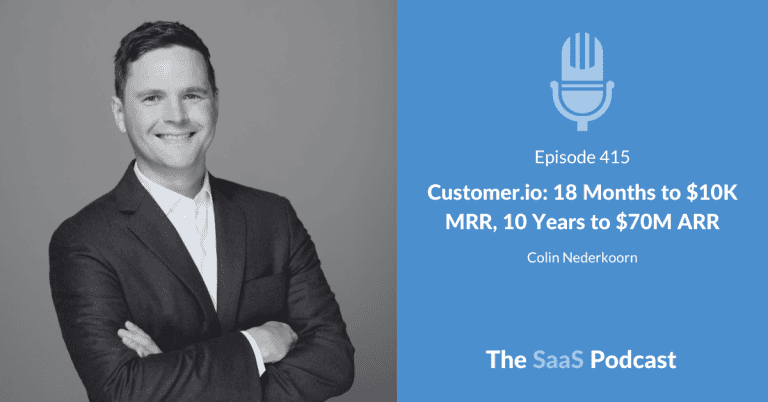
Welcome to another episode of the SaaS podcast. I'm your host Omer Khan and this is a show where I interview proven founders and industry experts who share their stories, strategies and insights to help you build, launch and grow your SaaS business. In this episode I took to Colin Nederkoorn, the co founder and CEO of Customer IO and a platform that helps businesses send personalized messages to their customers based on their behaviors and actions. In 2012, Colin and his co founder John, while working at a startup, decided to build their own product.
Omer Khan [00:00:41]:
Their goal was simple get five customers paying $10 a month before they would quit their jobs. With limited technical expertise and little knowledge of email marketing, they faced significant challenges from the start. Their first version was pretty basic and required manual setup for each customer's campaign and the early days were tough. Growth was painfully slow and they struggled to gain traction to make ends meet. Colin and John lived off savings and credit cards for years, constantly worrying about their finances. Finding product market fit was another major hurdle.
Omer Khan [00:01:12]:
They struggled with positioning and messaging, making it difficult to attract and retain customers. But they persevered, focusing on educating potential customers through content while continuously improving their product. A pivotal moment came during a meeting with Ramit Sethi, a personal finance expert and media personality. When Sethi asked what they were doing with their launch email list, they embarrassingly admitted they weren't doing anything. But this realization hit hard. Spurred by this wake up call, Colin immersed himself in learning, conversion, copywriting and began sharing valuable insights with their growing email list.
Omer Khan [00:01:47]:
By focusing on educating their audience, they built credibility in the email marketing space even before officially launching Customer IO. Despite their efforts, it took about 18 months to reach 10k in monthly recurring revenue, which is a significant milestone for the struggling founders. But this was just the beginning of their remarkable growth story. Today, Customer IO serves over 7,000 companies, generates 70 million in annual recurring revenue, and has a team of 250 people across 30 countries and they've raised just over 30 million in funding to date.
Omer Khan [00:02:20]:
In this episode you'll learn how Colin and John validated their idea and acquired the first customers using only a bare bones product. Why content marketing and education played a pivotal role in overcoming early growth challenges how focusing on organic growth strategies shaped the company's long term marketing approach. We talk about what key decisions fueled the founder's transition from a six figure to a multi million dollar SaaS business, and why perseverance through financial struggles and slow growth periods became crucial to their eventual success. So I hope you enjoy all right, Colin, welcome to the show.
Colin Nederkoorn [00:02:58]:
Great to be Here, do you have
Omer Khan [00:02:59]:
a favorite quote, something that inspires or motivates you that you can share with us?
Colin Nederkoorn [00:03:03]:
Yeah. So recently I've been really enjoying. There's a TV show called the Bear and I just, I love food. I'll probably mention food again at some point during our conversation today, but there's this episode where cousin, his cousin Richie is apprenticing at this very high end restaurant. And in the restaurant, in the prep area in the kitchen, there's a sign on the wall and it's underneath the clock and it says every second counts. And that, that idea or that concept features really prominently in that episode.
Colin Nederkoorn [00:03:39]:
And I just have that, that visual of the clock and the sign etched into my brain now. And I think about it a lot and I just, I love the double meaning of that quote and that sign on the wall.
Omer Khan [00:03:52]:
You mean like the urgency in the kitchen and then just sort of like just generally with life?
Colin Nederkoorn [00:03:57]:
Yeah, absolutely.
Omer Khan [00:03:58]:
It's like you seem a pretty chill guy.
Colin Nederkoorn [00:04:00]:
I don't think.
Omer Khan [00:04:01]:
You don't come across as like, let's go, go, go kind of person.
Colin Nederkoorn [00:04:05]:
Yeah, I mean, I think for me it's about doing things that are worthwhile in the end, not filling every minute of the day. That's the meaning that I take from it.
Omer Khan [00:04:17]:
I like that.
Colin Nederkoorn [00:04:18]:
Cool.
Omer Khan [00:04:18]:
You know, I've heard of that show for so long and I've never watched it. And then earlier today I looked at one of the trailers and I just thought to myself, why have I not watched this show before? So it's something I'm going to start this week. So looking forward to that.
Colin Nederkoorn [00:04:41]:
There's this real journey that they go through from season one to season two. And I think you find yourself really cheering for all of the characters there and there's something to admire and some struggle that they're all going through and it makes it a really, I don't know, it's a life enriching show is probably the way that I would describe it.
Omer Khan [00:05:02]:
That's a high bar. Good. I'm looking forward to it even more now. So let's Talk about Customer IO. Tell us, what does the product do, who's it for and what's the main problem you're helping to solve?
Colin Nederkoorn [00:05:16]:
So the problem that we're looking to solve is that people are bombarded with emails and notifications every day and most of those go ignored. And so if you're a company who's trying to reach your customers, we help you cut through that noise by leveraging the first party data that you have to send more targeted and relevant messages. Today we've been around for 12 years and today there are over 7,000 companies who use Customer IO and a typical customer of ours is a mid market company that has a digital experience.
Colin Nederkoorn [00:05:53]:
So, so an example might be a web and mobile based elearning platform or a mobile banking app or a B2B SaaS product on the web. And the companies that use us typically have dedicated folks on the marketing team in roles like lifecycle or growth marketing. And so I guess what's different about us or what's special about us is we've taken this technology which traditionally is extremely complex. Traditionally it exists in multiple systems that a business might use and it's reserved for the largest enterprises.
Colin Nederkoorn [00:06:31]:
And we've made it accessible to many more companies through the platform that we built. And so with customer IO our clients can connect to their data sources, they build personalized customer journeys and then they use our templates and creation tools to make maintain their brand consistency all in one place. They're doing things like sending reminder emails to improve student outcomes in elearning, they're using push notifications to nudge users to link their bank accounts or complete account setup and banking or they're showing in app notifications to onboard new users into software applications.
Omer Khan [00:07:08]:
So this is a lot more complicated than emails triggered based on which webpage they visited or kind of which part of the app they used. Can you, you sort of touched on that. Can you just give the listeners a sense of like the complexity, like what are the types of data sources that you're hooking into?
Colin Nederkoorn [00:07:28]:
Yeah, I mean we today we can hook into Salesforce, we can hook into a data warehouse, we can, or our customers can instrument their application directly via our SDK or via the web as well via JavaScript. So we're aggregating information from all of these different places that our customers are storing data about their customers. We're building that unique profile that gives you this full picture of every way someone's interacted with your business. And that lifecycle marketer is setting up these rules for when, when those people get messages. And so it is, it is really sophisticated.
Colin Nederkoorn [00:08:15]:
I think one of the, when we started the, the thing that we, the problem we took on, which I think we only did because we were so naive, was trying to send messages when people don't do something because to be confident that you, you know, someone didn't do something, you need 100% certainty over everything they did. Otherwise you look like a fool. Right. When you're Sending when you're saying, hey, it looks like you didn't complete your account sign up, but someone did, then that, that looks really bad.
Colin Nederkoorn [00:08:51]:
And so it was really important to architect the system in a way that didn't drop data. It didn't, it didn't sort of approximate things and say, oh, these people probably did this stuff. No, like we have to know with certainty, otherwise the whole promise doesn't work. It's complex.
Omer Khan [00:09:14]:
Give us a sense of the size of the business. Where are you in terms of revenue, number of customers, size of team?
Colin Nederkoorn [00:09:20]:
Yeah, so I mentioned we're 7,000 plus companies who are using US 70 million ARR and 250 people on the team in over 30 countries.
Omer Khan [00:09:33]:
And have you raised like I think you raised about 10 million, is that right? At least that's the Crunchbase number that I saw.
Colin Nederkoorn [00:09:40]:
Yeah, Crunchbase is a little wrong and I tend not to correct them. I think the. I don't know the exact number off the top of my head, but it's in the mid-30s. We did like a round in 2022 with Spectrum Equity and that was a larger round for us where we added some cash to the balance sheet to help us grow.
Omer Khan [00:10:03]:
Got it. I was blown away when I realized you were doing 70 million in ARR. I mean, I knew you were an eight figure business, but I thought, I was thinking, oh, maybe 20 million. That was kind of my guess, but wow, I was way off.
Colin Nederkoorn [00:10:16]:
Yeah, I mean, I think if you're starting out today, if you're pretty early in the journey, I think the only thing you need to solve for is, is to have your business continue to grow at a certain percentage. And if you can maintain the percentage growth rate over a long enough time horizon, you get really big and it starts to happen very quickly. Once you're compounding 50% year over year, 80% year over year, and you're starting from 20 million, let's say, or 10 million. Like those numbers get really big really quickly.
Colin Nederkoorn [00:10:56]:
But it seems like, you know, who cares when you're at 100k adding, you know, 80% year over year or 150% year over year. Eh, no big deal. But if you can sustain that, it gets massive really quick.
Omer Khan [00:11:12]:
I love that. That's a great way to think about that. Let's talk about where the idea for Customer IO came from. And what I think is really interesting about your story is that earlier you told me that if we had stuck with the original idea, you and I wouldn't be having this conversation today. So let's start there. Like, what was that idea and how did you come up with it?
Colin Nederkoorn [00:11:41]:
So my co founder and I were working at a startup together. He was head of engineering, I was head of product. And we were excited to go and try something on our own and started exploring a few ideas together. And when we decided, yeah, let's go and try and make a go of this, one of the first things we did was made some wireframes and started talking to people about our idea. And we knew we were interested in doing, doing something around data.
Colin Nederkoorn [00:12:14]:
We felt like we had the technical skills to go and build a system and that would create and doing a hard thing in data would create a little bit of a moat around the business. That was hard. It was harder for someone else to replicate that. But our initial idea was to build a more sophisticated analytics product. So Google Analytics was on the market, it was free at this point. And I think it was either in their terms or in the way the product worked.
Colin Nederkoorn [00:12:46]:
You couldn't see like unique sessions and you didn't know who was using the website and what they were doing. And so our idea was if someone logs into a website, we would show you their unique activity within the website and you would log in and you would get this sort of digital CRM for like a modern company where the way you're interacting with your customers is through a web product. And when we started showing people screens of that, they weren't interested.
Colin Nederkoorn [00:13:20]:
They told us, hey, I've got 10 products that show me what people are doing on my website. What I really need is something that will help me influence their behavior. When people sign up and they don't end up converting and they leave, I don't have a way to get them back. And if you can help me get people over the hump, that's money for my business. And when we heard that feedback a few times, we realized, hey, this business was a bad idea.
Colin Nederkoorn [00:13:51]:
But if we tweak it a little bit, we can still lean on our skills. We just need to figure out how to build a rules engine on top of this data that's coming in.
Omer Khan [00:14:01]:
How many prospective customers did you talk to at the time when you took these wireframes and started showing it to people? There's always a question for founders in the early stages, like, should I be talking to 10 people? 50, 100? Like, how do I know when I've got to a point where I've really validated this idea?
Colin Nederkoorn [00:14:21]:
Yeah, I mean, I think I don't completely remember exactly how many people we talked to, we tried to put ourselves in situations where we could be efficient about it. And one of the places I remember going was there was a nighttime coworking meetup called New York Night Owls and we went to that and I remember showing it to multiple people who happened to also be working on their side hustle or trying to get something going and just getting their feedback on the wireframes.
Colin Nederkoorn [00:14:53]:
So I think it would have been probably 10 to 15 people who we pitched this original idea, maybe showed them wireframes and then talked to them about it before we realized that there was enough signal to modify the idea.
Omer Khan [00:15:12]:
One of the things I often see founders struggle with is they either take a. Well, actually the easier path probably is they take a market first approach where they might say, we're going to build a product for procurement people in X companies and we're going to go and talk to 50 or 100 of these procurement people and figure out what problem exists that we can solve and then we're going to build a product for that. Right, that's example one.
Omer Khan [00:15:43]:
But more often what happens is founders sort of start with sort of an idea, sort of a problem, and they kind of say, well, okay, they start building a solution and then they're in this place where they're looking for, trying to figure out which market to serve, who's their icp. Do they actually have this problem and you're kind of, you gotta, you've got the sort of the chicken and egg and I've got a problem and I don't really have a clear problem. I don't have a really clear market. How do I figure that stuff out?
Omer Khan [00:16:14]:
When you guys were starting out, did you have a general idea of the type of customer or the market that you were going to sell to? And were those the people that you were talking to or was it like, let's go get feedback from anybody. It doesn't really matter who they are right now, as long as we're getting anybody who will kind of pay attention to us.
Colin Nederkoorn [00:16:34]:
Yeah, I mean, I think what we did, and I wish I could dig this up, I don't know where this is, but we came up with characteristics of the business that we wanted to build. One of them was, and you know, I think there's like the B2B versus B2C thing. Where do you want to try to build the next Twitter or some kind of social app? Or do you want to build something where you're selling to businesses? And I think for us, some of the decision points were we wanted to build something for our peers.
Colin Nederkoorn [00:17:06]:
And if you remember, I'm head of product, I'm working in tech already, my co founder is an engineer. We wanted to build something for our peers. So that narrowed it down. We wanted it to be. There's these frameworks to think about, like are you a painkiller or a vitamin and stuff like that. It was important to us that the business was close to revenue. And maybe we backed into this after the fact when we heard that feedback that nobody wanted to buy our, our analytics product.
Colin Nederkoorn [00:17:40]:
But I think we, we realized before fully committing that we, we wanted to be close to revenue either. And either we had to be really compelling and that we would save people a ton of money or we would make people more money. And I thought it would be. And I think that's the like painkiller, vitamin thing. And, and I thought it would be great that we can do both.
Colin Nederkoorn [00:18:00]:
Our product could be used to do either of those things, but ideally it's about conversion and getting more people to pay you, more people from free to paid in a product. So that's what we focused on. It had to be. What else? Oh, I think we initially were really inspired by mailchimp. So we wanted it to be self service, not enterprise. We didn't want to build a sales organization and we changed that over time. But at least at first it was all about self service, so we needed to get good at that.
Colin Nederkoorn [00:18:38]:
I forget some of the. There's probably a couple other criteria, but I think that's really helpful if folks are just starting out. Think about what your strengths are and what your desires are. If you succeed and you build a business that you hate, is that success? And so for us it was defining like if we're dramatically successful and we want to do this for a long time, what are the characteristics of the business that we would want to be running? Oh, I think another one was it had to be technically interesting.
Colin Nederkoorn [00:19:07]:
Technically challenging enough that it would keep our interest for a while. So not a simple crud SaaS app like crud being crude. Create, read, update, delete. So we had some criteria like that and then we evaluated ideas against that criteria.
Omer Khan [00:19:26]:
I love that. I think that's such a great way to think about it. You're just laying out what you care about, what's important to you, what you think would make sense for a business that you want to be involved with for not just one year, but five years or 10 years, or in your case, 12 years. Um, and I know it's. And it's kind of worked out because I know that you're still excited to get up every day and work on this business most days. Right.
Omer Khan [00:19:52]:
Um, and I occurred to me when you were talking about this that sometimes it's not that easy to come up with this list, but it's easy to come up with a list of things you don't want to do. I don't want to do this, I don't want to do that. Well, maybe that's what you start with and then just turn them into positives. It's like, I don't want to work with these type of people and I want to work with these type of people people instead.
Omer Khan [00:20:16]:
But either way, I think it's great to have a list like this because just it gives you something to evaluate this sort of journey that you're on because you're going to see lots of potential opportunities and it's going to be so easy to follow some short term opportunity. And if you can just go say, oh, wait a minute, no, it doesn't kind of match this list that we put together, it at least lets you question whether that's the right way to go.
Colin Nederkoorn [00:20:44]:
And I 100% agree that starting with what you don't want is an. Is an easier way to get going and then turning it into, well, that means that we should build this type of business.
Omer Khan [00:20:55]:
Yeah, so you heard loud and clear, hey, the analytics thing is not an interesting enough opportunity. How did the, the sort of, the next idea, how did you come up with that? And then, you know what, what kind of validation did you do before you start building the product?
Colin Nederkoorn [00:21:18]:
So we, what was interesting at this time was there weren't solutions like ours that existed in the market, but there were. We were starting to see people talking about the, the pain point that they were having. There was a blog post by this guy, Paul Stamateau, and I think the blog post is titled User Retention as a Service. And he was building Pickplum at the time and wished it was a photo sharing app, I think.
Colin Nederkoorn [00:21:54]:
And he wished that something existed that would help him with automating messages to his users in order to retain them and help them be successful in the product. And so we saw that as really strong validation that we were on the right track. And we started to see conversations on, on Twitter as well where people were saying similar things. And I think that, that, that through having conversations or reaching out with those folks, that's how we started to gain confidence in what we were building or at least the need we would Serve.
Colin Nederkoorn [00:22:34]:
And then as we started to build out the product, we aggregated the demand that we were aware of and then started talking to those folks to make sure what we were building was going to meet the needs that they had.
Omer Khan [00:22:51]:
Let's talk about. And I think we should clarify that you and your co founder, John were doing this while you were still working. And then you set yourself a goal of getting a certain number of paying customers before you would go all in with this business. What was that goal?
Colin Nederkoorn [00:23:13]:
So maybe to back up a little, we decided together that we, we were working full time at, at this company and we would see each other every day. So we were talking about these ideas during lunch and, and then when we realized, hey, I think we have something here, it happened to be right around the end of the year. So we went away for holidays and then came back and we were both thinking like, do we want to go all in on this and, and take the leap?
Colin Nederkoorn [00:23:47]:
And so when we came back, we decided, yes, we would do that. We told our, our boss that we were going to be leaving. And so this was like first few days of January and we said that we were going to stay until April 1st. So we had this four month period essentially to get, get everything in order to leave and then help transition out because we were pretty critical to the organization. Like it was a small company. We were both in senior roles within our disciplines and didn't want to leave with short notice.
Colin Nederkoorn [00:24:30]:
But it worked out well for us because it gave us time to prepare. And the task we set ourselves out to, or we set out for ourselves was to have five paying customers by April 1. By the time that we were full time and we put up, you know, we started talking to people and what we were asking for from them was like, put down a credit card and pay US$10 a month. And when I think we started collecting these signups in March, so the product was sort of functional, but barely.
Colin Nederkoorn [00:25:12]:
And what people were really signing up for was the promise that this thing would solve their problem in the future. And in the meantime, we could kind of help them with a sliver of the problem. And what was amazing is I was actually looking back at this and one of those first five customers is still our customer today. And it's wild. It's totally wild.
Omer Khan [00:25:35]:
To me, that's some nice retention.
Colin Nederkoorn [00:25:38]:
Yeah. The person who committed is no longer at that company and probably the two people after them are probably no longer there. They've moved on to other things, but we're still doing a good enough job for them and we're a critical part of their product that it's amazing that they're still with us.
Omer Khan [00:25:59]:
So basically your goal was if we can get to $50 a month or $50 MRR, we're going to go do this thing.
Colin Nederkoorn [00:26:09]:
Sounds too low and it absolutely was too low. From a, you know, how do we replace our income from our, from our full time job with our startup revenue? And it took way longer than we expected to get from 50 to anything meaningful to pay our salaries. But I think again, this is where being totally naive and just taking the plunge was the right move, even though it was totally foolish.
Omer Khan [00:26:42]:
Tell me about that first version of the product. Because you're charging $10 a month, presumably that's because you just want some money, some validation, but you also feel like the product is still sort of a half baked thing. We have this vision, there's all this stuff that we could be doing, but right now it doesn't do that much. So what did it actually do? The initial version?
Colin Nederkoorn [00:27:10]:
Yeah. So someone would log into the product and they would click a button that says create a new campaign. They would type into a box to explain what they wanted the campaign to do. And then my co founder would write a MapReduce query which he would sort of look at what data they were sending us because they had done the data integration at this point, so they had installed our JavaScript and were sending us data.
Colin Nederkoorn [00:27:42]:
And then my co founder would look at the data flowing in to figure out could he write a query that would actually do what they wanted to happen. And then I think we could, I don't know. Even though if we had delays and a sequence of messages at this point, it might have just been one message you could send and then you could. I think we had a simple WYSIWYG editor where you could like bold text and stuff like that. But it was very basic at the time.
Colin Nederkoorn [00:28:13]:
And essentially if the MapReduce query found people who met the conditions, we could trigger a message and you could see sent messages to your customers. So it was functional. But the hard part was really we talked about him being like the wizard behind the curtain to make it actually do the hard stuff.
Omer Khan [00:28:37]:
Yeah, I think they actually call that a Wizard of Oz MVP now. Right. This idea that maybe you coined it and you didn't even know that back then. Right. So he was writing custom queries for every time somebody created a campaign and said I want to be able to do this. And if that query didn't exist, he would go and figure out how to write it.
Colin Nederkoorn [00:29:01]:
Yeah. So Google invented this thing, MapReduce, which sort of is helpful for finding needles in a haystack. And if you remember, one of the things that we were. One of our promises was we could tell you who didn't do something. And so in order to do that, we had to look through the entire history of the data that the customer had sent to us to verify that that particular user didn't do something in order to trigger the message.
Colin Nederkoorn [00:29:32]:
And he had like a little admin interface where he would type out the queries and then I think, I'm sure he had a way to test it, hopefully. But we were gating who could sign up for the product. So it wasn't like anyone could sign up on their own. I was talking to every single signup at this point and then setting expectations.
Omer Khan [00:29:57]:
Yeah. And it would have been very easy to not launch until you had all this figured out in the back end. Right.
Omer Khan [00:30:05]:
And I think there's a really important lesson here in terms of what you guys did that, you know, we often hear the stuff about being embarrassed about the product and all those things, but really what you did here was you sort of combined some code, some human element, and said, okay, if we could put this together in a manageable way, what's the soonest we can get something out of the door and start testing if people will pay for it?
Omer Khan [00:30:33]:
And that's a much more valuable thing to do than spending six months writing more code to find that you couldn't even get five people to sign up.
Colin Nederkoorn [00:30:42]:
Yes, it's absolutely important to launch when you're still embarrassed by your product. I think the thing that we really focused on was what's the value that customers are trying to get from us? And, and can we deliver that value to customers without necessarily building the nice ui? Like, what's, what's the way that they can get that? And that enabled us to, you know, take, take shortcuts in some, in some areas of the product.
Colin Nederkoorn [00:31:15]:
Because the thing we wanted to prove was this stuff actually worked, and it helped companies convert more people or, you know, retain more people and actually move the needle on their business. So, you know, we, I believe we, we had a sense of a conversion and one of the promises here, you know, traditional email marketing products at the time, they couldn't tell you if your messages actually did anything in, in a product. So, you know, you'd be sending these messages and they tell you opens and clicks.
Colin Nederkoorn [00:31:47]:
Well, we came in and said, look where you're instrumenting your product in order to send these messages. We can tell you if they convert. You don't need to do anything funny. We have all the data. If you want to move this number, we can tell you if it moved. And so that was a big. I think when we could complete the loop, we took the shortest path to demonstrating the value and then later came back to make it so that customers could actually configure their own campaigns.
Colin Nederkoorn [00:32:19]:
And we had to build our segmentation builder and all of that stuff, but we did it later.
Omer Khan [00:32:26]:
How did you find those first five paying customers, by the way?
Colin Nederkoorn [00:32:30]:
I was looking back at the list, and there were definitely a couple who we knew beforehand who sort of took a bet on us. There's one person I've never met or talked to since then. I think, like, they're. They're in the. We were in New York at the time, and this. There was a. There was a company in the New York, you know, tech ecosystem. They're no longer around, but somehow they found out about us and they. They took a bet. And then, yeah, another. Another person I've, like, known.
Colin Nederkoorn [00:33:07]:
I didn't even realize I'd known this person for a long time. And I didn't realize they were one of the first five customers. But it was just. I think it was a moment where clearly there was this latent demand for a product like this. And so there was a lot of interest when we said we were working on it, that people sort of signed up for our list and for updates, and we picked a few people to test the product early with us.
Omer Khan [00:33:36]:
Let's talk about that. That launch page you created, because you had a page up where you were telling people about your upcoming launch and you were collecting email addresses and then just tell us that story of you meeting Ramit.
Colin Nederkoorn [00:33:53]:
Yeah, so we had this launch page up, and. In the background, I'm trying to figure out, okay, we're collecting email addresses. We're getting a little bit of attention. How do we make sure. What else do we need to be doing? How do we make this thing successful? And a friend of mine introduced me to Ramit Sethi, who's a master marketer. He's incredible, and he runs I will teach you to be rich. I think he has Netflix shows now and all this stuff.
Colin Nederkoorn [00:34:29]:
And so Ramit kindly met us for coffee and asked us to describe what we're doing and asked about this list that we were building and what we were doing with all these email addresses. And I looked at him, I said, nothing right now. We're going to email them when this launches in six months. I don't know exactly what he said, but what I took from it was, you guys are idiots.
Omer Khan [00:35:01]:
A polite way of being told that.
Colin Nederkoorn [00:35:03]:
Yeah, I'm sure he was, like, totally polite. And what he said to us was, look, you have all these people who say they're interested in this problem. Find a way to provide value to them before you launch. Otherwise they're not going to remember who you are. You're going to send this, like, one email which says you probably changed your name three times between now and launch. And so they're going to get this weird email from this company they don't recognize that says, hey, we launched. Come sign up and pay us money now.
Colin Nederkoorn [00:35:37]:
And they're not going to care about you then. And so find a way. Find, you know, something that they care about and talk to them about it between now and then and build excitement and interest ahead of your launch. And. And then you're going to have a much better outcome if you do that. And so I scratched my head. I went away from that. I felt sad, probably, and then I scratched my head a little bit and realized that I didn't come from an email background.
Colin Nederkoorn [00:36:10]:
And so the thing that I had no idea how to do was probably something that a lot of our audience was learning as well, which was like conversion copywriting, right? You're sending these messages to in order to get people over some hump, get them back to your product, get them to convert from free to paid. What should those messages say? And that was like this, like, light bulb moment where I realized if I went deep and learned everything I could from all these great copywriters, and. And then I've applied those lessons to email.
Colin Nederkoorn [00:36:46]:
If they weren't email copywriters or I learned from email copywriters, I could teach these lessons to our audience while we're building the product, and then we can later sell, you know, we can teach them how to write these messages and then sell them the tool to send the messages. And that was such a. Such an amazing piece of advice that we got, which I think tremendously helped us get off the ground.
Omer Khan [00:37:15]:
I think that's a really good example, and I think you were very fortunate to get that feedback. Then one of the things that I've often heard founders talk about is, I'm not an expert in this market. What could I possibly write about or teach my target customers? And number one, what you did was you found a problem, a need, and said, okay, I'm going to focus on helping them with this because their goal wasn't to be able to send emails. Right.
Omer Khan [00:37:51]:
Their goal was to be able to change some kind of behavior or persuade people to do something, as you said. So that's really the kind of the core of what they wanted to do. And, and then, you know, kind of just. I'll kind of give credit to a couple of like online sort of digital writers that I follow, like Dickie Bush and Nicholas Cole.
Omer Khan [00:38:12]:
And one of the things I learned from these guys was you can either be an expert, somebody who's gone out and done something and then you're sharing that experience of this is how I do something, or, you know, did something or whatever, or you can be a curator where you're just saying either you're sharing resources or you're saying, look, I'm not the expert, but I'm learning and I'm sharing what I'm learning with you.
Omer Khan [00:38:38]:
And if you position it that way, it's easier to do that because you don't feel like a fraud or I'm not an expert because you're not pretending to be one. You're just there and saying, I learned something useful and I'm sharing this with you because it might help you too. And it sounds like that's exactly what you were doing.
Colin Nederkoorn [00:38:56]:
Yeah. And I, I think that's, that's a really, really good nuanced take on it. I think I, I felt really uncomfortable to go and say, hey, you should listen to me. I know everything when I really felt like I didn't. But I was sharing the lessons that I learned along the way. And I think the key thing for people who are, who are nervous about starting that is you don't, you don't need to be an expert. But I think it's important to be honest about that.
Colin Nederkoorn [00:39:28]:
You're not an expert and you just need to be smarter than the people you're sharing and digesting this information for. Right. You are more knowledgeable about it. And most people are not going to spend an hour to go deep on a topic, but if you spend an hour, two hours on something and then synthesize it into a 30 second tweet. Right. Like, people really value the curation and the digestion of information.
Omer Khan [00:39:56]:
Definitely. I think I follow a lot of people who are exactly in that position where they're not pretending to be experts, they're just sharing what they're learning on the journey. But it's super helpful, you know, and just to be able to follow that and for somebody to Just give it to you in a digestible way. Let's talk about another growth strategy that helped you, which was finding people online. We often say, figure out where your customers hang out and go there.
Omer Khan [00:40:23]:
And often it's communities, or it could be Reddit or Facebook groups or something like that. Where did you find some of these people and how did you get on the radar or get their attention?
Colin Nederkoorn [00:40:40]:
I mentioned that we were fortunate in that there were people talking about this problem online. And I ended up setting up alerts for terms like user retention or lifecycle emails. And one of the most amazing superpowers you can have is saying that you're not selling someone something, and even going a step further saying, I can't sell you anything. I have nothing to sell you. And so I would reach out to people and say, hey, my co founder and I are working on this problem that you're talking about.
Colin Nederkoorn [00:41:16]:
I would love to understand what an amazing solution would look like to you. I can't sell you anything right now. I have nothing to sell you. Would you be willing to talk to me? And the difference between I'm trying to sell you something, would you be willing to talk to me and I have nothing to sell you, Would you be willing to talk to me? Is tremendous. You will get a much higher success rate of people responding when you have nothing to sell them. And then you make a good impression. They're on your list.
Colin Nederkoorn [00:41:50]:
They want to know when you've solved their problem. And then. So you then have this other opportunity to reach out when you in the future have something to sell them. But you have this tiny window of when you start working where you can actually say that and be honest about it. And it's amazing how disarming it is for folks.
Omer Khan [00:42:13]:
I love that. I've often said to founders in that situation, you know, be clear that, you know, you're not selling anything right now because, you know, maybe you don't have a product. But I love the way you put it, which was, I can't sell you anything even if I wanted to. Right. And I think it's like a lot of us, you know, if you get an email like that, you want to help people in that situation. Right. It's just like people are sort of showing a bit of vulnerability. And it's like, you know, I should.
Omer Khan [00:42:40]:
I should do something, but.
Colin Nederkoorn [00:42:42]:
But it's not even. I mean, I get a lot of emails like, I'm a student, so. And so. And I'm doing. I'm compiling this data on SAS or whatever. I don't respond to those because I don't have, like, they're not so, you know, they're not in a position. I don't have time to respond to all of those. But, like, I think the. My point is it's like, so aligned. Right? Someone's said they have a problem. You're coming along and you're saying, I can't.
Colin Nederkoorn [00:43:09]:
I'm not going to, like, be sneaky and try to sell you something, but I care about the fact that you have this problem. I want to hear you. I want to hear about it. I want to know what you have to say. I want to know the pain you're feeling, because I'm going to work on solving that pain. But I don't have anything right now.
Omer Khan [00:43:24]:
Yeah, yeah, that's. That's. That's a great way to put it. Okay. In terms of growth, the other thing you tried to do was ads spending money on that. That didn't work out too well, which I think sometimes it's just founders maybe in a position where they don't really know the nuances of how to run paid ads. But for you, I think it was a bigger problem than that, right?
Colin Nederkoorn [00:43:47]:
Yeah, I mean, I think so. I definitely hadn't run a ton of paid ads before, got a little bit of coaching from people who were more experienced than me. But what I ran into in our space, and every space is going to be different. In our particular space, the prospective buyers of our product, we didn't have a vocabulary yet.
Colin Nederkoorn [00:44:11]:
And the words that we were using, like segmentation or triggered messages or even email marketing, is such a broad category that it was inefficient spent for us to buy ads for any of those terms because people were not or didn't know what to search for at this point in time, I think the market is more defined and we have an ad program now that's pretty effective. But in the very early days, all of our spend ended up attracting really, like, people who are not the right buyer for our product at that time.
Colin Nederkoorn [00:44:57]:
So we ended up. We ended up turning it off.
Omer Khan [00:45:00]:
Did you spend a lot of money?
Colin Nederkoorn [00:45:01]:
It's probably a lot of money at the time. I would say it's in, you know, in. In the thousands a month, but not, you know, not in the hundreds. Yeah, not in the hundreds of thousands a year at that point.
Omer Khan [00:45:14]:
It's interesting. It's just I rarely come across someone who says, you know, ads. I got ads working in in those early days. But I'm sure there's something There.
Colin Nederkoorn [00:45:27]:
Yeah. I mean, I think if you're selling a product that's on Instagram and. And you know, you have these, like, paid Instagram ads. And I think for. For us, the thing was, there was this education step, and what we didn't figure out until later is that you get that initial interest and you've got to educate the person before they're ready to buy. Otherwise, they don't know what they're buying, they don't know what product they're signing up to try. And if they make it into the trial, they're confused.
Colin Nederkoorn [00:46:02]:
Whereas I think, yeah, there's so many things that I buy on Instagram where I'm like, that looks amazing. This ad is like, awesome. I want to buy that thing and I go do it. Our product is not one of those.
Omer Khan [00:46:15]:
Yeah, yeah. Okay. I would love to keep talking, but we're going to wrap up, so let's move on to our lightning round. I've got seven quick fire questions for you. Just try to answer them as quickly as you can.
Colin Nederkoorn [00:46:28]:
Okay.
Omer Khan [00:46:29]:
What's one of the best pieces of business advice you've received?
Colin Nederkoorn [00:46:32]:
Yeah, so this is. This is from Chris Savage, the CEO of Wistia. When we were really early on, there was this. I was really frustrated because we were running out of money and was stressing about fundraising. And so he. He posed the question to me, do you need more time or do you need more money? And as I thought about it, like, the answer was time. I didn't actually need money. I needed.
Colin Nederkoorn [00:47:00]:
I needed to extend our Runway so that my co founder and I could figure out the business and figure out the product and get further along. And so I think in the earliest stages, your job as a founder is to figure out, do you actually need money or do you need more time? Because there's creative ways to solve for the time thing, but the money thing, if you raise too much money, you actually shorten the amount of time you have to figure it out.
Omer Khan [00:47:29]:
Chris is actually one of my OGs. He was a guest on episode 15 almost 10 years ago when I had no audience, and he still agreed to come on and be a guest. So I'll always be grateful to him and those other people. What book would you recommend to our audience and why?
Colin Nederkoorn [00:47:45]:
So there's a book, Turn the Ship around by L. David Marquette. It's a really great read. But we have taken the idea, unless I hear differently, which is talked about in that book, and it's a great way to empower folks in your company to bias toward Action. So something's going to happen. Unless I hear differently.
Omer Khan [00:48:10]:
What's one attribute or characteristic in your mind of a successful founder?
Colin Nederkoorn [00:48:14]:
Perseverance. You got to be able to survive long enough. If you can survive, you can probably build a good business.
Omer Khan [00:48:22]:
What's your favorite personal productivity tool or habit?
Colin Nederkoorn [00:48:26]:
Piece of paper. I've tried all the productivity software, all of the promises it makes, but I find that when I'm super stressed and I declare bankruptcy on what's on my to do list, I just take a piece of paper and I scribble it all down and then I get to check it off and I feel that sense of accomplishment.
Omer Khan [00:48:45]:
I'm so digital, but there's something so magical about paper. Never stop doing that. Yeah, totally with you. What's a new or crazy business idea you'd love to pursue if you had the time?
Colin Nederkoorn [00:48:55]:
So we probably don't have enough time to get deep into talking about it, but I love, like, all of. I would love to solve all of these systems that people have in their homes and make them like one unified thing rather than all of these disparate systems that all kind of fight against each other and don't really work together.
Omer Khan [00:49:16]:
What's an interesting or fun fact about you that most people don't know?
Colin Nederkoorn [00:49:19]:
When I was in my late 20s, I rode my bicycle from San Francisco to Boston.
Omer Khan [00:49:25]:
Wow. How long did that take?
Colin Nederkoorn [00:49:27]:
It's like 57 days of riding. It's a long way.
Omer Khan [00:49:32]:
Yeah. And finally, what's one of your most important passions outside of your work?
Colin Nederkoorn [00:49:37]:
Yes, we started with food. Let's maybe end with food. So I love food and I just appreciate how much goes into making food good. And so I live in Portland, Oregon, and we've got some incredible food options to eat out. And I love learning to cook dishes at home as well.
Omer Khan [00:49:55]:
Awesome. Colin, thank you so much for joining me. It's been a pleasure. It was nice to pick your brain and sort of unpack some of those early days and how you went from basically an idea to another idea to a seven figure business. And then, you know, there's a whole story that we haven't uncovered yet in terms of what happened beyond that. But I appreciate you making the time to join me.
Omer Khan [00:50:18]:
If people want to check out Customer IO, they can go to Customer IO and if folks want to get in touch with you, what's the best way for them to do that?
Colin Nederkoorn [00:50:26]:
I'm Alpha Colin on X, which that never feels right to say it, but. Or you can just email me Colin, Customer IO.
Omer Khan [00:50:38]:
Awesome. Thank you so much. I appreciate the time. I wish you and the team the best of success.
Colin Nederkoorn [00:50:44]:
Thanks so much, Omer.
Omer Khan [00:50:45]:
Cheers.