Omer (00:09.760)
Welcome to another episode of the SaaS Podcast.
I'm your host Omer Khan and this is a show where I interview proven founders and industry experts who share their stories, strategies and insights to help you build, launch and grow your SaaS business.
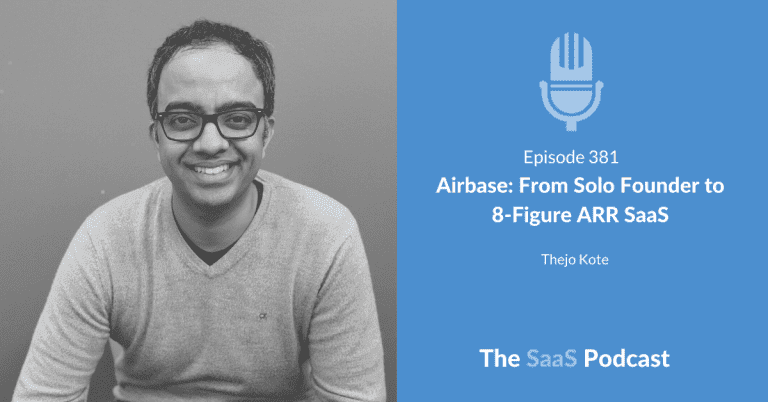
In this episode, I took to TheJo Cortex, the founder and CEO of Airbase, a spend management platform for mid market and enterprise companies.
In 2016, following a successful exit of his previous startup, Automattic, Thajo began brainstorming ideas for his next startup venture.
At Automattic, managing company spending had been a major challenge, so this led him to explore potential solutions to this widespread problem.
But instead of diving right into building a new product, Thaja spent six months interviewing CFOs to validate his idea and ensure it was a problem worth solving.
He hired a freelance designer to create software mockups which he used to get feedback.
And after each interview, he'd iterate and improve the designs.
Once his initial product was built, Feijo was ready to start his sales outreach.
Now, despite his previous startup success, he faced struggles as potential customers were still apprehensive about trusting an unknown startup.
And it took significant persistence and hustle for Thayjo to get those initial customers.
But fast forward to today and Airbase has surpassed eight figures in ARR, grown to around 300 employees and has raised over $100 million in funding.
In this episode you'll learn how Thayjo balanced creating the product while also taking the lead in sales and the key decisions that helped him land the first big customers.
How zeroing in on exact customer problems and solving a significant industry challenge laid the foundation for Airbase's early growth.
We talk about how Thagio guided Airbase through a crowded market filled with well funded rivals and the tactics that effectively helped to set them apart.
How Thagio prioritized building a sustainable business, consciously slowing down growth and resetting stakeholder expectations.
And we talk about why Thajo started Airbase as a solo founder, breaking the usual startup rule, and why he thinks not having a co founder is sometimes a better choice.
So I hope you enjoy it.
All right, Tejo, welcome to the show.
Thejo Kote (02:34.020)
Thank you for having me over.
Omer (02:35.860)
Do you have a favorite quote or something that inspires or motivates you or gets you out of bed every day?
Thejo Kote (02:41.700)
Look, ultimately what gets me out of bed every day is doing something that I kind of love and enjoy.
And I've been an entrepreneur for the better part of like what, 12, 13 years now.
And this is my second business and either of those businesses I've never actually paid Myself really well.
And so it's been very important that, you know, the money is not the motivation, of course, it ultimately is.
You're building a business that's a scorecard, revenue value creation and all that kind of stuff.
But personally for me, what I care most about is, would I do this even if nobody paid me?
Like, am I kind of being challenged in the right ways?
Am I growing in the right ways?
Have I set some goals and targets for myself?
And is there that personal satisfaction of working towards it?
And increasingly so, as I've learned about the company building process, am I doing it with the right people that I genuinely enjoy working with and the culture of that company?
And so those are the things that get me out of bed in the morning.
And so I've been lucky enough to have built and exited one company and I'm trying to kind of bring a lot of those lessons to Airbase.
Omer (03:45.190)
Awesome.
So tell us about Airbase.
What does the product do, who's it for and what's the main problem you're helping to solve?
Thejo Kote (03:51.510)
So, very broadly speaking, Airbase is a spend management platform and we sell to the office of the CFO in terms of specific kind of Personas, I.e.
the controller or the CFO, accounting teams.
Increasingly, procurement professionals are typically in the office of the cfo and we tend to target mid market, early enterprise companies.
Our sweet spot is say 100 employees to a few thousand employees.
And that's generally who we target.
And the North Star problem that we are trying to solve ultimately is if you think about all of the money that a business spends, you can put it in two buckets, payroll, which is salaries, and then there's the non payroll or everything else.
Right.
And so if you dig into how the everything else part of spending money as a business works is very complex and messy.
Right.
And so there are many different areas and both workflows and payments and money movement, you know, all of those are complex and challenging.
And as you grow as a business and become a mid market business, you know, the front end of that problem is largely a collaboration problem.
How do you decide whether you can spend money?
An employee wants to spend money, but in a business, the moment that process starts, lots of people have to get involved.
Right.
So finance and accounting from a budget perspective, it people have to get involved, legal people have to get involved, security checks have to happen, so on and so forth.
So it's a complex collaboration problem.
So that is one element that we solve on the front end, but then, you know, on the back end, you're receiving invoices and there's an AP automation problem.
Employees are spending their own money and then getting it reimbursed and that's an expense management problem.
And you have corporate cards where company money is being spent.
And that's a whole other problem.
And so you know, our North Star goal is to say how do we bring all of this non payroll spending workflows and payments globally?
No matter where employees are, where subsidiaries are, how do you bring it all into one system and one platform from the typical many different five or six different silos and systems that companies tend to use.
Right.
And so that's the key USP and value that we offer.
Omer (05:49.550)
Okay, give us a sense of the size of the business.
Where are you in terms of revenue, number of customers, size of team?
Thejo Kote (05:56.110)
Look broadly speaking, well into eight figure millions of ARR.
And then in terms of employees, about 300 employees.
We are a globally distributed, fully remote team and we have been that way since the very first day of the business, way before the pandemic.
And our employees are currently in about 16 different countries.
Omer (06:19.670)
Got it.
And I think you've raised total of about 250 million by now, right?
Thejo Kote (06:27.090)
Yeah.
So it's about 100 plus million is a little more than 100 million is equity and the rest of it is a deadline for a specific product that we have which actually we don't offer anymore.
So on the equity side it's a little more than $100 million.
And I've been fortunate enough to work with some really good investors like Menlo Ventures, Bain Capital Ventures and First ARM Capital and folks like that.
Omer (06:48.690)
So I want to talk about where the idea for Airbase came from.
I mean what you've just described, there is such a gnarly, messy problem that there's no clear cut place to start solving that type of problem.
Right.
So I'm curious how you approach that.
But before we do that, maybe let's talk a little bit about your background and what you were doing.
You mentioned you you had a previous startup with a successful exit.
I think you started your career as an engineer and then this previous startup, Automatic Labs was founded back in I think 2010.
Thejo Kote (07:30.310)
So it was, yeah, 2011 or late 2010 is when my co founder and I started working on it.
We committed to it in 2011.
We went to Y Combinator in the summer of 2011 and had a very, I guess, you know, Silicon Valley kind of journey.
Omer (07:46.070)
But yeah, and then, so tell us about that business.
What was Automatic Labs?
Thejo Kote (07:50.590)
So Automatic was actually a Connected car platform.
It was very different than Airbase and the business that we're building now.
And the fundamental thesis of that business was that, you know, essentially cars are computers, but the vast majority of them on the road, at least back then, they weren't connected to the Internet.
And the key part of the thesis is that if you can get the data in this big moving computer up into the cloud and you could convert it into a usable form, there's a very big ecosystem that is the automotive ecosystem worth trillions of dollars just in the US that could benefit from that data if you kind of pulled it out and converted it into something useful.
Now the question is, how would you do it?
And we ultimately ended up doing something very complicated where we had a consumer hardware product that we sold and now in the Apple Stores and Best Buy and Amazon, all these retail places.
And eventually we wanted to kind of parlay that into an enterprise business, which we did in the second half.
But honestly it was all very complicated.
Right.
And so I would not recommend kind of having a consumer business model and revenue model and having an enterprise business and revenue model.
And you know, that's a big lesson I took away from Automatic is kind of simplification of your business model and also don't do hardware.
I think that's the other lesson.
But yeah, largely it was not SaaS, the enterprise part of the business, we moved it into a SaaS like model, but for the most part of the business it was not a pure SaaS business.
But it was during that journey of building that connected car platform and ultimately we sold it to cdsxm, which is a connected, kind of the radio and satellite radio company.
So it was during that journey that I learned about the problem of spend management and the struggle of companies as they continue to grow and scale.
And of course I couldn't do anything about it back then.
I was building a different company, but it went into my ideas notebook to look into when I had the time and happy to dig into that journey.
Omer (09:49.530)
Yeah, yeah.
So SiriusXM acquired the company 2016, early 2017 for a whopping 115 million.
So that was a nice chunk of change to exit from that startup.
And then I think it wasn't that long after that when you started Airbase, maybe within a year of that exit.
And so was it mainly just from your, your, your personal experience of spend management that that drove you to go and solve this problem next, or was that, was there some other something else that you did in terms of, you know, validation, going out and talking to other people and trying to get a better assessment of what was going on out there.
Thejo Kote (10:40.240)
Yeah.
So I learned about the problem while building Automatic.
Right.
And as it turned out, I'm an engineer by training, I'm a product person, and I didn't know the first thing about finance or accounting when I started working on my previous company.
I didn't know the difference between cash accounting and accrual accounting.
What is ap?
What is AR Like?
Nothing.
Right.
And because I had this bright idea of building hardware that complicates things.
Right.
And now if you want to build hardware, you have to now think about inventory and then forecasting and demand planning and all that kind of stuff.
And as a venture funded company, I didn't do ever want to be in the situation where we did a bad job of that and then dramatically overbuilt inventory or whatever.
And then I had to go back to my board and say, oops, we screwed up and I need you to bridge me for some more time and that kind of stuff.
So I made the effort to learn, I made the effort to be involved in what was happening.
And over time I built out our finance and accounting functions and that kind of gave me visibility.
I asked lots of dumb questions along the way.
All of the what is ap, what is ar?
What is the monthly close and what?
And all that kind of stuff.
And so learned about the problem along the way.
And that I think is an important aspect to any problem.
Right.
It's just if you have experienced facets of the problem day to day, you can identify solutions.
And this is something that I've heard said before, which I think is true, which is if you tend to build expertise in two different areas, then you can kind of bring those together to ultimately build solutions.
And what happened in this case was that I was an engineer who knew how to build products, but I learned about finance and accounting and figured out a bunch of things that were broken, especially in terms of how businesses spend money.
So how they get visibility, how they get control and how archaic a whole bunch of those processes were.
And for some good reasons because financial infrastructure was not as mature back then and all that.
But like I said earlier, I didn't have the time to kind of go do something about it back then, but it went into my ideas notebook.
I still do that.
I feel like pretty much everything is broken.
Right.
And if you want startup ideas and ideas to solve, especially in the B2B realm, if you keep your eyes and ears open as you're working in any business, you will see 10 of them lying around.
But the only question then is, okay, how big is this opportunity?
Can this actually scale to be a venture fundable business and a public company?
Not all of the problems that you run into fall under that category.
So when I finally was done with Automattic and I was thinking about what I was going to do next, I started digging into a few of these ideas that I had identified over the course of my experience building Automattic.
And eventually of course, I honed into Airbase and the spend management problem.
But as I was learning about it, I spoke with dozens of CFOs and accountants and controllers and people who do the job day in and day out because I had a hypothesis about what the problem was, how it could be solved.
I wanted to validate if that was right.
And those conversations actually made me a lot smarter about the problem.
And I understood all the layers and nuance that exist in the problem.
But that journey, which took maybe the better part of six months, then gave me the confidence that I can commit to building another company.
And I also had identified at a high level characteristics of that next business that I wanted to build if and when I did it.
And it had high level things like has to be a big market, has to be a SaaS kind of product delivery mechanism, didn't want to do hardware and things like that.
Exactly.
And it had to be something that could be a system of record for an important functional area of the business, so on and so forth, like I had identified.
And if you look at all of the public companies, technology, public companies out there, SaaS businesses especially, you can kind of distill out certain characteristics that exist with all of them.
And I was like, okay, you really want to go after that kind of an opportunity, right?
And so I was kind of filtering the problems I had identified through that lens.
And the more I spent time, you know, in this area of spend management, the more convinced I became that, look, it checks a lot of those boxes that I care about and I can commit maybe another 10, 15 years of my life building another one.
So that's how I kind of got started.
But of course I didn't start building the product, writing code.
If it is interesting, I can talk a little bit about the mistakes I've made as a founder, especially as an engineer who just jumps into it and starts building, building stuff and writing code and why I didn't do that with Airbase.
Omer (15:25.280)
Yeah, yeah, we love talking about mistakes here, so please share as many as you like.
Thejo Kote (15:30.640)
Yeah, so look, even the early days the tendency that I've had in the past, I've made that mistake is you think you have identified a problem and instead of spending a lot of time validating it, speaking to actual customers, the tendency is to just go start building, right?
I think I know the problem, I'll build a solution for it.
And then you try to put it in the hands of customers and then you learn like a lot of these products don't survive first contact with the market, right.
And so, you know, and then you also have this tendency to kind of, it's a sunk cost, right.
And you don't want to change it or throw it away.
You've invested a lot of time, energy, effort in it, so you end up going just down the wrong direction.
And so the lesson I've taken away, which I still, which new products that we build, try to follow the same approach, is after I had all these conversations, you know, about the problem and the pain in the area of spend management, I had even honed it down to a narrower area because you need.
The problem I talked about that we solved today is pretty broad, right?
So we do a lot of things, a lot of modules.
It's taken us years to kind of systematically build into the vision that we've always had.
At least I had when I started working the business.
But in the early days it was narrower.
You need a veg to get into it, you need to solve some smaller problem in a 10x way to even get people to consider you.
Omer (16:55.150)
So what was that problem that you
Thejo Kote (16:56.390)
picked for us, the one I picked?
Of all the different non payroll spend areas, the first one I picked was corporate card spend management.
My thinking was to reimagine a corporate card from this piece of plastic that you put in an envelope and send to a bunch of employees to a software workflow driven product.
Right.
And that's a much more common approach that a bunch of other companies also do today.
But I'm pretty certain Airbase was the first to do this back then.
Where what if you think?
And that was also now made possible because of improvements in financial infrastructure, card issuing platforms.
As a startup, it was now possible for software companies to issue cards and issue visa branded cards, MasterCard branded cards and wrapped software workflows around how spending happened on cards.
And that was a huge pain point for controllers, especially of more mature companies.
All these employees who have cards are running around and spending money on it and I don't have visibility, I don't have control.
I just get the statement at the end of the month and it was painful, right?
And clearly there were opportunities to add preapproval workflows and vendor specific cards and lots of controls over spend and automation of accounting as those transactions were happening on the cards.
There were all of these things that you could do to solve that problem really, really well.
Right?
And of course today it's like one part of our overall platform.
But you know, I ultimately had honed in on that and once we had identified that is the problem and then I went back, I kind of sketched out a solution, workflows and worked with a designer, a part time designer, made high fidelity mockups.
And I took that back to all of a lot of these early customers and said, look, we talked about the problem, now let me show you how I'm thinking of solving it.
Walk them through the mockup and then iterated through that as I got feedback on that.
And ultimately the conversation was if you had this tomorrow, would you sign up for it and use it?
And until I had about 10 to 12 customers who were like, I would totally use this tomorrow if you kind of had it, I didn't start building, right?
So once we got to that stage and of course I didn't ask them to sign contracts or whatever this was relationships and handshake deals saying that if I bring this to you, you're going to use it.
What also helped was that, you know, finance people will look at a high fidelity mock up and go, this is almost done, right?
Like you can, this almost lives.
And obviously then it's like, okay, I'll come back to you in a few months.
It's going to take me a few months to go build this and, and.
But I essentially had a set of customers waiting to use the product.
I had de risked, you know, as much of that as possible in terms of getting the early adopters and you know, that would be how I recommend everybody, you know, follow kind of the process of discovery.
And then when do you start building?
Because the most expensive thing you can do is to commit something to code, right?
Is to build something and then you get vetted to it.
And there are all of these kind of emotional reasons why you just can end up going down the wrong direction.
But of course I had a lot more confidence that I had customers waiting and then went and built it, put it back in their hands.
Obviously when you do that, you learn 100 new things.
And so that's when you iterate very rapidly and the motion of the company in the very early days has to be completely focused on those initial design partners.
How do we listen to them?
How do you iterate very, very rapidly and quickly and be responsive and improve the product?
Because what you're doing in those very early days is you're seeking product market fit, right?
And so you don't have it.
And then what does it look like?
And you can define in advance, which I think is a good habit to say, okay, what are kind of the characteristics at a high level that I want to see, which will give me confidence that I have product market fit.
Right.
And that might be slightly different for different products.
It might be, you know, the degree of adoption, it might be the degree of engagement.
It might be if you're a kind of product that has a payments element to it, the volume of payments processed through the platform, so on and so forth.
Right.
So, you know, that is an element.
It is the degree of engagement by the stakeholders and the excitement and the pull that you see.
It might be, you know, the willingness to pay.
There are all of these milestones that I think you can define to get to product market fit.
And that was kind of the journey for the better part of the first 12 to 18 months.
Omer (21:11.750)
Right.
And so from the point where you started to go out and have these conversations with people where you said, I've got this idea, I want to go and talk to CFOs and people like that to really understand if this problem is a real problem that's worth solving, to the point where you felt like you had got these high fidelity designs, to a point where you had Potentially your first 10 customers ready to sign up, but you still hadn't written a line of code, how long did that take?
Process take?
Thejo Kote (21:45.660)
Like I said, that initial part where I was ready to make the decision to start writing code and commit to actually working on the startup and building, it was six months.
Of course, I wasn't working on it fully for six months.
In the middle of that six months, my wife and I, you know, after Automatic was sold, we, you know, traveled around the world for a couple of months and all that kind of stuff.
So it wasn't like six months, six months full time, you know, walk, but it was a course of, from, from late 2016 to say middle of 2017.
Over that period of time when I was having those conversations, doing the back and forth, identifying the, the, the core problem, working on the solution, going back to them, all that kind of stuff happened mostly over the course of the first half of 2017.
Omer (22:28.940)
Okay, so then you're ready to start building the product.
Was that something that did you you know, how, how big of a team did you start building, building around you?
Thejo Kote (22:38.920)
Initially it was just me.
So I built the first early version of the product and as I started getting deeper and deeper into it, I brought on other full time engineers.
And for the most part, I think the first eight employees of Airbase were all engineers.
And that's partly the reason why I decided I didn't need a co founder for this startup.
Happy to talk about that choice if you think it's useful.
Because the things that I needed to do to get the business to product market fit, I felt like I had those initial skills.
I could be the product manager, I could be the engineer building it for the most part.
But then of course, as the scope and size of the product started to grow larger, obviously I needed more help.
And that's when I started adding other engineers.
And as other engineers started to join the team, I was part tech lead, part engineering manager, part product manager and spent the first few months after I truly started building the product.
That was most of my time.
But at some point, month four, five, six, when we had that initial product, then I started to go back to being market facing where half my time was building the product and half my time was onboarding some of these early customers, supporting them, listening to them, talking to them and bringing that back and iterating and building and shipping.
And so yeah, so a lot of those business roles I just played in the early days and the PM role I just played, we didn't even have a full time designer for the first 18 months of the business.
I had like a really strong part time designer that I was working with and that was good enough for us to build the nature of the product because the whole other element is, you know, I chose to fund the business myself.
I didn't raise a round of funding partly because I felt like I wanted to take the business to that early product market fit phase, which would then allow me to get more value for the business and take less dilution and that kind of stuff, right?
So clearly I was motivated.
It doesn't matter if it's your own money, invest your money.
I think you should.
Until you find product market fit, you gotta be a cockroach, right?
It's like, don't die, keep the burn as low as possible.
Because you have no idea.
In a lot of cases is the process of finding product market fit going to take six months, a year, two years, three years?
You don't really know, right?
And you know, you don't want to put yourself in a Place where you just run out of money on a promising idea when all it needed was a little bit more time to get to that product market fit, which would then allow you to raise that next round of funding and keep building.
Omer (25:13.090)
So when you started building the, the product in the first few months, you were the guy mainly building the product, being the pm, working with your part time designer, and then eventually you were also the sales guy, right?
Thejo Kote (25:32.360)
Yes.
Omer (25:33.400)
How many of those initial customers came through just you going out and selling the product?
Thejo Kote (25:38.520)
About 15 to 20.
I hired our first head of sales after I sold the first 15, 20 customers.
Omer (25:46.690)
I'm curious, like, what was the general response?
Like when you're going out there and you're trying to validate this and get to the point where you feel like some of the criteria you described earlier in terms of how much they're engaged, how much the willingness to pay and so on, how easy or hard was that process?
And I think one of the reasons I ask is that sometimes I've seen founders who, who go through this process and you can see when you kind of look objectively at the situation that something hasn't quite clicked because people kind of seem interested in the problem, people kind of seem willing to give you some time, but it's still really painful to convince someone to actually get excited enough to pay for the product versus once you've nailed the problem, you've really understood it, you've figured out the right solution, things seem to flow a lot better, a lot more easily.
People seem to lean in, they're more engaged, they're almost like, you know, badgering you in terms of, like when they can get access to the product.
So I'm curious, like, how, how easy or hard was it for you to get to that point?
Because initially you were, I guess you were in the same situation, right?
You had this broad problem and no real solution at that point.
And you, you described the process you went through in terms of how to narrow that down.
Thejo Kote (27:24.830)
Was it easy those initial days when you don't have a lot of value to add to a potential customer?
Those are the hardest kind of parts of the process.
Because you don't have anything to give yet you are basically taking value back from the people who are giving you their time.
Right.
And so a few lessons that I take away.
Look, with Airbase, I definitely had the unfair advantage where I had a network, had a bunch of founder friends.
And so at least some of the people I spoke with, it was mostly, hey, can you introduce me to your head of finance And a lot of these friends that I had were other founders who had like scale companies, mid market companies.
And so they had like finance teams already.
They had a finance head of controller.
I'm like, hey, make the introduction and I'd like to spend time with them.
And so that happened in some cases.
So having a network, having relationships and those kinds of things that you can bring in and leverage is certainly a bit of an unfair advantage.
And I did that as I kept going, because at some point, one of the steps in building confidence around product market fit is that you don't want to just sell to the people you know or have a relationship with, because that might have a bias that then they're like, I don't want to make him feel bad.
And then so they might kind of sign up for it and not give you like honest kind of feedback.
So you want to really cold kind of call and pitch and get in front of people who don't have a relationship with you, who don't care about you, who don't mind telling you to your face that this is useless and because that's the feedback you really need to hear.
Right.
And so when I went got to that phase after the first few customers, a kind of, you could call it, tactic that I used was I usually positioned it as, look, I'm building a problem to the solution at a higher level.
I think this is a problem that most companies have and given your experience, I think you could be super helpful.
I'd love your advice, I'd love your input on how you think about this.
So at least back in 2017, 18, when I was getting going, there were very few finance accounting tools in the first place.
And controllers and folks like that, they never got this spotlight and they didn't have anybody reaching out to them and saying, hey, I think your knowledge, it's actually a hard technical kind of field and you need a lot of skill, training, technical knowledge to be successful in those roles.
But it's seen as this back office function or whatever.
But when I reached out to people with that framing is also true, you know, and, and a lot of them were happy to help, right?
A lot of them, you know, yeah.
In some ways you're playing to your ego, right?
In that you're the expert here.
You know, I'm, I'm kind of getting going, trying to build this product to solve a particular pain point that you have.
You know, my intention is not to sell you anything, but, you know, listen to your expertise and get your feedback and, and there will be People who enjoy that process, Right.
Because even during the kind of any new category product, whatever it is, it goes to that adoption curve in the market.
Right.
And in the early days you really want to identify as many people as possible who enjoy being an early adopter, who enjoy providing feedback, who enjoy kind of participating in the process of creation of a solution to the problem they have.
Right.
And so trying to kind of connect with as many of them as possible and identifying them, you know, and if they engage with you, they also make the best customers.
Right?
In, in, in the grand scheme of things, yeah, there are lots of people out there who might be the buyer for your kind of solution, but their attitude is, I only buy from public companies.
Right.
So are you a startup?
Are you not established?
Then I don't even want to talk to you.
Omer (30:55.480)
Right.
Thejo Kote (30:55.680)
Because I have no appetite for risk.
I want something super established in the market, which is all fine.
But what you are trying to do is to find the people who enjoy that process of engaging with early stage customers and you're looking for that Persona.
And you're going to get lots of no's, right?
You're going to get lots of no responses.
You're going to get, you know, you should reach out to people on LinkedIn, you should reach out to people in the network and beg, borrow, steal, hustle, do what you have to do.
But the job is to kind of get in front of, you know, as many of these people as possible and get them to engage with you.
Omer (31:25.990)
Right?
Yeah.
I want to go back to something you said a little earlier about why you decided this time with this startup you didn't need a co founder.
Conventional wisdom, you know, we always hear you have to have a co founder.
If you were, you know, doing this for the first time and taking Airbase through yc, they'd be saying, tejo, get a co founder.
So why did you feel that that wasn't necessary this time?
Thejo Kote (31:56.890)
Look, it was a very rational, logical kind of thought process which led me to that decision.
And for my first company, for example, I have no regrets, you know, having a co founder, we, you know, worked well together and we brought in the early days, especially complementary skill sets that I think were important to the business.
That's all fine, right?
It was all good and I think that was the right choice for that business.
But for Aimbase, as I went through this process of kind of, do I need a co founder?
What are the reasons typically that you might want to have a co founder?
One is you just don't have all the skills, right?
So you might be an engineer, good at building products, but you're not that good at selling and selling a vision, getting those early customers and all that kind of stuff because they are in some ways two separate skill sets.
Or you might be a good salesperson, but you can't really build the product at all.
Then you just, if you want to build a technology product, guess what, you need an engineer, right?
And so, you know, it is not having all the skill sets that you need to get the company to a certain stage is one reason to go get co founders.
Another one is you can argue, especially if you're a first time founder, sharing the emotional burden and the ups and the downs of building, you know, business, that's another important reason I think, you know, you should consider having a co founder.
And those are typically the two biggest ones, right?
It's a skill set, it's need of the business, it is carrying kind of and sharing the emotional burden.
But my decision was that on the emotional burden side, I'd gone through this journey once before, right.
And I felt like I didn't need anybody to share that emotional burden with me and that I would be fine partly because I had made a bunch of mistakes building, you know, my first company where the business was an extension of me, right?
It was, it was an extension of, you know, my personality.
And every failure of the business was my failure.
I was a failure if something didn't work out.
And, and so I had kind of gone through that process and at some, you know, level mature to the degree where, you know, I think I am better this time around to kind of distance the business from my own sense of self worth and, you know, all of that.
And, and so I didn't feel like I needed somebody to kind of share that emotional burden of the ups and the downs and the challenges of building the business.
And on the skills side of things, for example, in the first business we built hardware and I didn't really have some of those skills and things like that.
And this time it was a SaaS business software product.
I knew how to build that product, I knew how to sell that product.
And so I'm like, you don't really need, I didn't need a co founder for that reason.
Omer (34:39.350)
Right.
Thejo Kote (34:39.510)
And so, you know, as I was ultimately going through those list of reasons, I'm like, okay.
And look, also from a purely tactical perspective, I think what every founder needs to understand is that the greatest dilution you will take in the value you create ultimately for your business is likely on Day one when you start the business, right?
So if you are two co founders who are splitting, you know, 50, 53 co founders splitting a third each, guess what?
You know, in terms of the dilution that you take in the ownership in the ultimate value that you create, that's greatest from day one.
Right.
And so I don't think it should be kind of a de facto, you know, reason or assumption that you absolutely need a co founder.
So I would think, you know, it's a case by case thing, you know, ask yourself why.
Ask yourself if it's definitely necessary.
But what I did instead was that, you know, I just was the sole founder, but for the first kind of set of employees who joined the company, I was extra generous with the equity grants that they got relative to what was market, right.
In terms of the first, second, third, fourth, fifth employees so that you can attract really good ones.
So it is a thing that as the company scales, you want to have incredibly invested people.
The thing about founders always is that last line of defense, you can't complain about anything.
You're the last line of defense and you ultimately have to own whatever problem comes up.
And so you want to have as many people like that in the business as possible.
And how do you do that?
And you can still be generous relative to this stage of risk that they're taking.
And I've always done that even as I've hired executives and things like that.
And that's worked out.
So purely in very tactical terms.
Yes, I think I'm going to ultimately get to keep more of that value that I've created over the years.
That's, that's one of the reasons, and maybe the one other reason you should keep in mind is that, you know, I don't know if this is statistically accurate, but the number one reason, or very close to number one reason why startups fail is co founder conflict.
Right.
And while I was lucky in my previous startup that I didn't have to deal with that, you know, any major problems in that area, I've seen friends and other folks who've built companies who had their company is destroyed and all that kind of stuff because the co founders couldn't get along with each other.
So that's always a big kind of thing that is hanging over a business, especially as it grows and matures, because the chances of every single co founder scaling with the business as if it actually becomes successful is actually pretty low.
Right.
And one of them might, the CEO might, or it might be the CEO who's not scaling and Then the CTO actually can do the job for a really long time.
And however you're splitting it, chances are fairly high that one or more of the co founders will not scale.
You will not agree with each other about the strategic direction and things like that.
And those are all like way more emotionally taxing compared to having somebody to, in my opinion, share that emotional burden of the business as you're building it.
So considering all of that, it's a trade off, like every other kind of decision.
And my call was to say I don't think I need a co founder and I have zero regrets about that.
I'm about five, six years into building AWS now and no regrets.
Omer (37:53.240)
Yeah, that's a very thoughtful answer.
I love the way you broke down the thought process in terms of when should it make sense.
And again, kind of going through that list, I guess it was a lot clearer to you at the time that right now it didn't seem to make a bunch of sense.
And I guess every time you took a step forward and the business got some more and more traction, it was like, okay, still makes sense, I can still keep going, and so on.
So, okay, so that was one piece of conventional wisdom that you didn't follow.
Let's go back to the journey to the first million in ARR.
So we talked about you doing sort of founder led sales, getting the first 15 or so customers.
The other, I guess conventional wisdom we often hear is, okay, once you've kind of done the founder led sales, bring in some AES, build maybe potentially some junior people around you, people who can grow into maybe potentially senior roles and so on.
But don't go and hire a VP of sales.
And you hired a VP of sales?
Thejo Kote (39:04.540)
Yeah, my first full time sales hire was my VP of sales.
And that decision, by the way, is tied to my decision to not have co founders.
Right.
So typically I think it's fine to follow this advice that, you know, do founder led sales initially.
I think that's absolutely important.
I think in the early days, founders should spend a lot of time talking to customers, right?
Like, you know, if you as a founder are hiding behind conversations with customers, company's going to fail.
Like high probability.
Right.
And so you have to kind of take the punches, listen to the tough feedback like whatever it might be, you know, and expose yourself to the pain, you know, every day, even today, you know, we're a growth stage company and lots of customers, all that kind of stuff.
But I spend multiple hours every week speaking to customers.
Right.
Because there is nothing more Valuable than speaking to customers about their pain and how you're doing and what you could be doing better and things like that.
Right?
And so that's one thing.
But now going back to the who should you hire first from a sales perspective, if you have somebody, one of the co founders who's like fully focused on sales and somebody else is fully focused on building on the product, iterating on the product, all that kind of stuff, I think that makes sense.
Effectively that co founder is your VP of sales, right?
And so they can go and hire your first couple of AES and make those account executives successful.
Write the playbook initially for how you move from a founder led sales model to an AE led sales model.
And you can start that process and you can write the initial version of that playbook and at some point you can bring in a VP of sales who can scale that playbook.
How do I take from go from two A's And I know there's a model that's working and so how do I add more capacity and how do I build more pipeline and blah blah blah.
How do you kind of take it to the next level?
But in my case, if I had done that, then I would now be the VP of sales and I would be the VP of engineering and I would be kind of the one responsible for fully building the product and moving that side forward and I would be the one responsible for managing the go to market kind of effort for the business.
And that would not have been a good idea.
I would not be setting the company up for success if I try to do both.
So my call there was I'm going to find a VP of sales.
Because it's also true that a true kind of very mature, experienced VP of sales will likely not want to come and be the first kind of employee at a business.
It requires at least most VP of sales will not want to do that in the market because they have options.
They just want to go in where the risk is the lowest for them.
And they just want to go in when the playbook has been figured out.
You have a bunch of customers, you have product market fit.
Okay, I will now scale it, right?
And so because good VPs of sales have those options, that's what they choose to prefer.
But there are a smaller number of sales leaders out there who want to write the playbook and not just take over a playbook and refine it.
Right.
And so my attempt, which I ultimately succeeded at, was to find a VP of sales like that who wanted to get in early, who did not mind getting their hands dirty.
Who, you know, wanted to kind of write that initial version of that playbook as it moved from fund bullet sales to, you know, a sales organization taking it and scaling it.
And you know, I was lucky that I kind of found that kind of a person.
And so it worked out.
Right.
And you know, that sales leader got us past our first 100, 120 customers or something like that.
And it's a whole other conversation for how sales leaders scale and grow and fit for different stages of maturity of the business and that kind of stuff.
But, but again, the lesson I've taken away with a lot of these decisions is don't take advice in a cookie cutter manner.
Right.
Because a lot of advice may not really apply to you.
Try to think of things from a first principles perspective and why, why does somebody recommend a certain thing and does that advice apply to, does that conventional wisdom apply to you?
A lot of times it does.
Right.
But you know, if you think about something from first principles, which should also apply to your product, by the way.
Right.
And so you should really think about the problem from a first principle's perspective and then the solution to that problem from a first principle's perspective.
And, and you know, that's a whole other, I guess, conversation.
But you know, a lot of these quote unquote, conventional wisdom kind of aspects, you know, if you really ask yourself if that applies to you and if you're thinking about it from first principle, sometimes the answer is no.
And so I think that's kind of what happened in my journey in those early days.
Omer (43:41.520)
What was the average contract value like typically for a new customer?
Thejo Kote (43:47.440)
It started off on average being say in the 10 to 20k range, but the overall kind of range ranged from 10 to 50k, but the average was somewhere in the 10 to 20k range overall.
But over time, obviously that's grown.
In the initial days, it reflected the maturity of the product.
Right.
And as we added more capabilities, as we were able to go after larger customers, more use cases, all that kind of stuff that has kind of continued to grow over time.
Omer (44:14.620)
Right.
So the first 15 or so customers that you got got you the first, you know, few hundred thousand in ARR.
You've got the VP of sales that comes on, helps you get to the first million.
What was the main growth channel?
Was it just a lot of, you know, outbound cold emailing?
Is that the primary way that you grew to the first million?
Thejo Kote (44:37.920)
So I think your go to market strategy really depends on, you know, the segment you're targeting.
I think the first thing I think you should not try to do, at least my opinion, I know some companies try to do it is to try to be everything to everybody, right?
Like hey, I'm going to, you know, sell my product to a two person company, a 200 person company, a 2,000 person company and a 200,000 person company I will be, I will serve everybody, depending on, at least in our space.
If it's deeply workflow oriented products, especially in the finance domain, I cannot point to a single very successful business that has done that like basically serving the needs of every segment.
So one thing I think you should typically do is pick a segment and you should also form an opinion and that's what the early part of founder led selling and what is the value you're delivering, what is the willingness to pay?
You know, some of these things come up where you will find out and this is part of the reason why you should not invest a bunch of money and hire salespeople and try to scale that model until you have a fairly good idea of what's my ACV going to be.
How much can I actually charge for this thing?
So to get to a million dollars, can I charge thousand dollars a year and you know, do I have to go acquire a thousand customers or can I charge like $10,000 and acquire a hundred customers?
Or is it, can I just charge a hundred thousand dollars and get 10 customers?
Because how you acquire 10 or 100 or thousand customers, the strategies for that will differ wildly sometimes.
Omer (46:03.750)
Right.
Thejo Kote (46:03.950)
And so the difference between what you're going to do to get 10 customers is so different than what you're going to do to get a thousand customers.
Thousand customers is likely product led growth.
It's likely kind of marketing driven and demand generation and things like that Inbound mostly.
But if it's 10 companies that you're trying to land, they're not going to come and find your tiny company website somewhere and pay you $100,000.
It has to be outbound.
This is a whole other motion that you have to follow to build the pipeline and generate the demand for that.
Whereas we were somewhere in the middle, right?
And so what we ended up doing was because getting to that first hundred customers, at least in my opinion, that's more.
I was more focused on finding product market fit and the strength of product market fit than I was on answering questions about go to market fit.
Right.
I think those are two different things.
Right.
So do you have kind of a scalable go to market engine that you can put More money behind and scale.
That answers the go to market fit question.
But the product market fit question is largely about you're solving a real problem, you know.
And that whole I know VCs like to ask the vitamin versus painkiller question, right?
Are you a vitamin or a painkiller?
Yes.
A bit of a cliche, but yes, you want to be a painkiller, especially in bad kind of macro environments and all that.
You don't want to be the vitamin that gets cut and you want to be important enough to the business.
So you're trying to figure out those things, right?
So am I, you know, a painkiller?
Am I, you know, a system of record?
Am I seeing the right kind of adoption and usage?
And when I ask questions like, hey, if you just lost this tool tomorrow, like would you be really disappointed?
And the NPS like questions that you're trying to build confidence around.
Getting to the right answers there and intellectually honest answers there was what I was focused on getting to those first hundred customers.
And for us it was not trying to make it programmatic or scalable.
It was a lot more about just beg, borrow, steel, hustle.
A lot of those customers came through the network, right?
So my network, other employees, networks, investors network and a bunch of customers came that way, word of mouth.
We also focused in the early days what we thought of as the give, give, get kind of model, right?
Like how do you give value first?
And so you just don't want to reach out to somebody and say, hey, buy this thing for me that I want to sell to you, right?
It's how do you just give value?
And we did things like create a finance community and today that Slack community has about 5,000 people in it and it's kind of a no sale zone and people can come and connect to each other and yes, they know it's an airbase community and all of that, but how do you give value?
Right?
I mean that kind of a community didn't exist for finance and accounting professionals.
And we also started this webinar interview series called Path to Becoming a cfo.
Like this is another way to add value where using my network and investor Networks, I interviewed CFOs from Salesforce and Twitter and Zendesk and HubSpot and Robinhood and all of these well known companies because that was value to our target audience.
Because as a founder I have consumed a lot of content of founders and CEOs and folks further along the journey from me and I've learned from it.
And so that's Aspirational.
I want to build companies like them and I want to build a public company, hopefully someday.
And so I've kind of found that kind of stuff interesting.
So my question was, okay, to my buyer, once you have an identified buyer, how can you create useful aspirational content?
And for our buyer controllers and CFOs of smaller companies, becoming a CFO for recognizable brand name, public company was aspirational.
And so their life stories, how they got there.
And so that was kind of useful.
And so that allowed us to reach out to people, just offering them value and to get the positive brand association going.
So we did stuff like that for the most part, right.
And so yeah, we had a bunch of these experiments around paid kind of marketing and all that kind of stuff.
But for the most part it was try a whole bunch of stuff largely focused on kind of providing value back to folks first.
And that included organizing dinners.
And as it turned out, at least back then, controllers are not the Persona that is invited to lots of dinners and networking events and all that kind of stuff.
And sales leaders and marketing leaders are bombarded with lots of asks and requests and invitations and things like that, but the controller is not.
And so those kinds of things helped.
And we found that they really wanted to network and they wanted to kind of participate in some of these events and they got value, especially if it was a useful discussion at a forum that you created.
And so that allows us to kind of connect and talk about the problem we were solving and build relationships and stuff like that.
And so I think all of these tactics helped us get to the kind of first hundred plus customers.
Omer (51:00.450)
Right?
Yeah, that's great.
I want to talk a little bit about competition.
You get to the 100 customers or so is probably, you know, breaks you through the first million in ARR.
You feel like you validated the idea, you've gone out and and proven it in terms of generating sales and getting customers that you've got product market fit here great.
And then I think there was at one point you realized that this opportunity that you had discovered and started to build this business around, suddenly everybody was making a kind of, I guess gold rush to get into spend management.
Can you just help us understand like what, what was that realization?
How big of a problem was this?
Thejo Kote (51:50.940)
Yeah, look, I think this is something that any valuable idea in a big market or a solution to a valuable problem in a big market, in some ways you're going to end up there, right?
And it's going to become competitive.
You have to have some massive Technology more to advantage your network of effect or something like that, you know, strategic advantage.
But let's be honest, in SaaS there is no moat or strategic advantage.
The big thing you have is, you know, execution, right?
And so that's how you win.
And for the most part in the early days, so what happened in our space was that, you know, I've always had this vision of spend management, consolidation of all the non payable spending in one platform, end to end kind of workflows and payments and all of that.
Corporate cards was one small piece of it.
That was the initial wedge that we went into market with.
Then we launched an AP automation product and we launched an expense management product and earlier this year we launched a guided procurement product.
As we've gone up market, that front end collaboration problem of how decisions to spend money are made, that's a whole new module and product that we've launched.
And so we have methodically gone after all of these areas over the years.
And of course, you know, the improvements in financial kind of infrastructure, fintech infrastructure, card issuing and all of that, that has also led to the proliferation of corporate card companies.
Like that was a whole thing for a while, like hey, corporate card, like I'm going to compete with Amex and all of that, right?
But very quickly some of those companies realized that oh, there's no business model here, There was a zero interest rate kind of period where money was dumped into a lot of these companies even though they had like 15, 20% gross margin revenue, those kinds of things, growth was all that mattered.
The quality of the revenue and business model didn't really matter.
And a bunch of these companies raised huge amounts of money.
But over time as the pandemic hit, and especially over the last, say 18 months as the recession started, all that, some of those companies started to realize that oh shit, this corporate car thing is not the long term business kind of opportunity here.
And I would like to think that a bunch of them looked at us and went, wait, I think everybody has the right idea of how to think about this opportunity.
The long term sustainable business model.
For example, we have always thought of ourselves as a SaaS business.
First that we charge subscription fees for and then the fintech element of it is an important enabler.
But a lot of other companies, they're lending companies, the fintech element is all there is and stuff like that.
So if you look at that corporate card segment and then there's the whole travel companies that during the pandemic got a big scare and they decided that I need Something else to sell to the office of the CFO if something like this ever happens again and my revenue falls to zero.
And so they started coming into the spend management space because they were seeing clear traction and the solution to that problem was obviously resonating with the market.
So they came in there, some HRIs providers started launching their own spend management solution.
So, you know, it's gotten noisy, right?
And, and, you know, a bunch of these companies have raised, you know, lots of money.
The funny thing, of course, is like, a lot for a lot of these companies, if you look at where they were three or four years ago and where they are today, a number of things from their messaging, their positioning, their business model and how they monetize, increasingly, it's looked more and more like Airbase, right?
Omer (55:12.800)
And so, I mean, that's a founder's worst nightmare, that you're happily going along building a business and then suddenly everybody wakes up and decides they want a piece of what you're the pie.
And not only that, but you've got these very well funded competitors entering the space.
So just break that down for us.
How did you approach that?
Thejo Kote (55:39.380)
The value number one for Airbase has always been control your own destiny.
Right?
And so that goes back to my experience building my first company where I didn't do a very good job of that, and I spent more time than I wanted to on Sandhill Road with a begging bowl, trying to raise money unsuccessfully and all that kind of stuff.
And so as I was asking myself, like, the kind of business I wanted to build, it was incredibly important to me that I control my own destiny.
And I think we've done that
Omer (56:05.230)
over
Thejo Kote (56:05.550)
the course of Airbase, controlling our own destiny, being super frugal, the kind of culture we have as a company, these things have all been.
We haven't had to do a big layoff over the last 18, 24 months, partly for that reason, right?
It's because we've been very, very careful about how we have historically deployed capital, the sustainability of our business model and those kinds of things.
But it is also true that you have to live in an environment where a huge amount of excess capital is being kind of dumped in the market, and we are still to a certain extent, living through that.
Where many of these companies have raised at, frankly, ridiculous, unsustainable, unattainable valuations, but they also have raised a whole bunch of money.
And so to live up to some of these valuations, they feel the pressure to grow into it and to grow at a faster rate.
And so they Spend that money very inefficiently and then to kind of create that noise in the market that.
And I know it does make sense to go toe to toe with, you know, some of that kind of inefficient spending.
But the choice we have made in strategic areas is to reposition, refocus, you know, go a lot more focused on a particular segment of the market as long as it's large enough.
You know, the whole thing about don't try to be everything for everybody.
But even in the initial segment that we targeted, while I said that we tend to target on the 100 to a few thousand employees within that, we are increasingly more and more focused on the, you know, 500 to kind of of a few thousand employee segment.
And that's where a lot of investment continues to go.
And so those are some of the things that you can do that you can control, right?
And yes, you might have to make some sacrifices along the way and then that's the expectation you set with the board and every stakeholder, important stakeholder in the business that maybe we will give up on growth.
Partly that's the right thing to do in the macro environment.
We were growing at better than the T2D3 kind of pace that you look at for SAS companies.
Triple, triple, double, double, double.
We were doing much better than that.
But at some point last year, it became a lot more important to say we have to control our own destiny.
We want Runway for a number of years.
We don't want to put ourselves in a position where we want or have to raise more money.
So what gives?
Growth gives.
And so you're okay with slowing down on the growth side and but sticking with the need to do something that is sustainable.
That's what we have done, right?
And so, but look, along the way we've made mistakes too, right?
And towards end of 2021, for example, while we had that discipline of we're going to always charge for software and things like that, I was looking at the craziness of the market in 2021 of how look, everything is free and I just make money from the interchange.
And you know what, investors in the market were actually buying this upside down business model.
There were companies that were raising between a few companies, they raised billions of dollars, right.
And so our whole thinking at that point, at least mine, I should take kind of responsibility for that, is that look, if this persists, it doesn't make sense, but if it persists, we're going to get crushed at some point, right?
But these companies are going to raise so much money that we're just not even going to be able to compete.
So we decided we're going to launch our own free tier and kind of work on acquiring more of that card based interchange revenue.
Low margin revenue that apparently was being valued at 100, 150x.
And that's fine if that's just the world's gone bonkers, but let's just go do it too.
And in hindsight that was a mistake, right?
And so I think we spent the better part of last year unwinding that whole kind of experiment.
And so that was, like I said, in many ways a mistake.
And I should have stuck to my intuition and gut feel that we are on the right path.
And like I said, a lot of those companies where everything was free, okay, they're all doing a bait and switch now on their customers and saying, hey, you now have to start paying for this product that I promised you for free forever.
Guess what?
I need to have a business model, so please pay me now.
Right?
And so that whole thing is happening and all of that, which is all fine, but it's just a different degree of inefficiency and unsustainable behavior in the market that we have to deal with now.
If two years ago it was, I don't even need a business model, everything is free, let's go.
That was the business model.
Now it is, I'm going to ask you for money, but still an amount that is in no way helps you build a sustainable business.
Right?
And so now you have to deal with that and so it will evolve.
Right?
And so the question is, you've got to in many ways just survive through the process of madness.
Omer (1:00:57.050)
Goes back to the cockroach, right?
Thejo Kote (1:00:59.210)
Exactly.
So be a cockroach.
You have to survive through some of that inefficiency and continue to control your own destiny and not put yourself in a place where you just run out of money.
And by the way, that has happened to a few folks in our space too, right?
In that, you know, they could not continue to operate efficiently enough.
They do try to do inefficient things and I don't think some of those companies are going to survive.
And I'd like to think, you know, we have put ourselves in a good enough place that and we've been willing to make some hard trade offs in terms of expectation setting with the board and investors on what we're going to give up to actually do what we think is the right thing long term.
And I've been very happy and Fortunate to have, like, a mature set of investors.
And that's the other lesson is to really pick investors who, you know, who don't give you the highest valuation, but who are actually going to be good partners during the difficult kind of phases of building a company.
Omer (1:01:59.380)
All right, we should wrap up.
Let's get onto the lightning round.
I've got seven quick fire quick questions for you.
Just try to answer them as quickly as you can.
What's one of the best pieces of business advice you've received?
Thejo Kote (1:02:12.650)
Look, there's a lot, but maybe the.
The one that quickly comes to mind is what I mentioned up front, which is just make sure you enjoy the thing that you're doing day in and day out.
Otherwise, you know, building a company is a grind in, in its own way, in a lot of ways.
And if you don't like the thing you're doing, oh, my God, that.
That's like an order of magnitude was grind.
Right.
So make sure you pick something that you would work on even if nobody paid you.
Right.
Omer (1:02:39.080)
What book would you recommend to our audience and why?
Thejo Kote (1:02:41.640)
There are lots of good books, and I've gone through phases of the kinds of books I've read, but if you're an entrepreneur, if you just want to get this visceral feel of persistence and hard work over a long period of time, like one of the books I read a couple three years ago is the Shoe Dog by the autobiography of the Nike founder.
I just thought that was a really awesome book.
But more lately, because I spent so many years just reading business books, I've been more on science fiction, Bender.
And the most recent book I can recommend that I liked, that I just finished reading a couple of weeks ago is this book called the Last Day of Night.
And it's the story of Edison and Tesla and Westinghouse and that period in the late 1800s where the light bulb was invented and there was competition between AC and dc, which would kind of become this kind of the default kind of mode of power distribution and.
Sounds a little nerdy, but it's a fun book.
I can recommend it if you like historical fiction.
Right?
Omer (1:03:43.830)
Love it.
Okay, what's one attribute or characteristic in your mind of a successful founder?
Thejo Kote (1:03:48.870)
Persistence.
A lot of people think, look, absolutely.
There's luck involved in a lot of this.
Right place, right time, luck, all that kind of stuff.
But I think so much of it is about persistence and just being willing to grind through tough situations for long periods of time and having the stamina to do that.
And I think, at least in My view that matters.
Omer (1:04:16.740)
What's your favorite personal productivity tool or habit?
Thejo Kote (1:04:20.580)
I've honestly given up on a lot of these things.
I used to be this inbox zero person for many years.
Right now, let me look at my inbox.
I have 5,300 emails.
So what, what, what I have ultimately landed at is, you know, I've gotten better at asking myself what matters in life.
Right.
Obviously Airbase work, you know, keeping my team unblocked, all that kind of stuff.
I also have a 5 year old daughter and an 18 month old son and you know, my wife who's been wonderfully patient through all of my kind of, you know, adventures.
And so I tend to have clarity at my.
Try to have clarity around what really matters and you know, just ignore everything else.
Omer (1:05:04.800)
That's a good attitude.
What's a new or crazy business idea you'd love to pursue if you had the time?
Or what's an idea we can steal from your ideas notebook?
Thejo Kote (1:05:15.650)
There are many and I don't know how many of them are actually scalable businesses, but one of them, there are a bunch related to how distributed remote teams work.
I think in the process of building Airbase, I've identified some of them.
There are various takes on that.
I've tried a bunch of them.
I don't think they all get them right.
I don't think there's any tool that's really taken off in terms of helping other than zoom and some tools like that to do basic stuff.
But I think that's a whole mine that is rich with possibilities that at some point maybe I'll have the time to look into it.
But also from a product development perspective, how do product product managers, designers, UX writers, engineers all collaborate effectively, efficiently, you know, to build and ship a product.
Clearly there are a number of products in the market, but I think there are opportunities to just do a better job there.
Again, don't really know if that's a public company on its own, but it's broken.
It's broken in lots of ways from my experience.
Right.
Omer (1:06:32.740)
What's an interesting or fun fact about you that most people don't know?
Thejo Kote (1:06:35.460)
I think that somebody asked this question in the sales kickoff we had two weeks ago for our Q4 and my answer then was that I ride a motorcycle that's £550 and it's a BMW R12 50GS.
It's a lot of fun.
It's one of those, my wife thinks it's one of those middle age crisis things, but I used to ride a motorbike back in India.
When I was growing up, it was just a mode of commuting and hadn't done that for about 10, 12 years after I came to the US and recently started doing it again.
Omer (1:07:12.100)
Love it.
And finally, what's one of your most important passions outside of your work?
Thejo Kote (1:07:16.260)
You know, reading.
I just, I've always enjoyed reading.
I mean, I came from a family of academics and all that kind of stuff.
Growing up I had a library of 3,000 books at home, so might seem like a cop out answer, but honestly, with Airbase and kids and all of that, I barely get time for anything else.
So the time that I do get for myself, I try to kind of read because it's just fun.
And like I said, I stopped reading business books for a while.
Now I'm mostly, for the last two, three years, have almost exclusively just been reading know good fiction of all sorts.
Omer (1:07:55.620)
Well, thank you so much for joining me.
It's been a pleasure talking and thank you for, you know, taking us back over the years and sharing, you know, your both your journey in terms of how you built this business, but also I think a ton of useful insights for many, many early stage founders who are probably going through a lot of those challenges today.
So I think it was really helpful how you broke down a lot of that, you know, those ideas and how to think about, you know, conventional wisdom and whether that's the right thing for you or not.
So totally appreciate you doing that.
If people want to check out Airbase, they can go to airbase.com and if folks want to get in touch with you, what's the best way for them to do that?
Thejo Kote (1:08:37.579)
You can find me on LinkedIn and please feel free to connect with me and tell me that you heard about me and Airbase on Omer's podcast and I'd be happy to connect.
And thank you so much for having me.
Omer (1:08:51.500)
My pleasure.
I wish you and the team the best of success.
Thejo Kote (1:08:54.700)
Thank you.
Omer (1:08:55.420)
Cheers.