Omer (00:09.760)
Welcome to another episode of the SaaS Podcast.
I'm your host, Omer Khan and this is a show where I interview proven founders and industry experts who share their stories, strategies and insights to help you build, launch and grow your SaaS business.
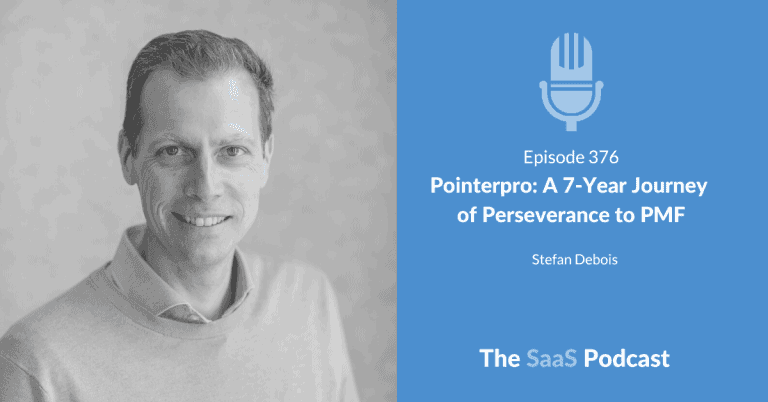
In this episode, I talked to Stephane Debois, the co founder and CEO of Pointer Pro and a software platform for professional services firms to create online assessments and automatically give personalized advice.
In 2012, Stefan was feeling stuck.
After working for 15 years in consulting, he wanted to start his own company, but he didn't have a great business idea.
While still in his 9 to 5 job, Steffen made an iPad quiz app for his daughter's birthday party.
It was just for fun, but it turned out to be a big hit.
And this gave Stefan an idea.
What if he made this quiz app better and put it online for free?
So he spent his weekends improving the app and then released it, not expecting much.
But then something unexpected happened.
The app quickly gained popularity.
Teachers were using it in classes, and even folks at AT&T were using it for HR events.
Steffen saw a potential business and started interviewing his users to find out what they liked and didn't like about the app.
Once he was confident about the app's business potential, Stefan quit his job.
He worked hard for three months to add a way to accept payments and was thrilled when some free users converted into paying customers.
But despite some early success, business growth was slow.
Stefan struggled for seven years to find product market fit.
Eventually, in 2019, he had a significant breakthrough.
He realized many customers wanted personalized reports.
So he doubled down on that one thing and changed the app's focus to help professional services firms.
Today, Pointer Pro has surpassed $3 million in annual recurring revenue and grown to a team of 28 people.
The company is still entirely bootstrapped.
In this episode, you'll learn why it took Stephan seven years to find his killer use case and how you can avoid making some of the same mistakes.
How Stefan attracted important early customers outside of his network to validate his business idea.
We also talk about how Stefan established credibility and social proof despite being an unknown startup and founder.
The importance of customer feedback in Stefan's journey to find product market fit and the lessons from that experience and why Stefan believes that perseverance above all else, led to his success and helped him push through the difficult years.
So I hope you enjoy.
Okay, Stefan, welcome to the show.
Stefan Debois (02:46.930)
Thank you for having me.
Omer (02:48.010)
Omer, do you have a favorite quote?
Something that inspires or motivates you that you can share with Us.
Stefan Debois (02:54.550)
Yeah, I have something from Yoko Willink.
It's an ex Navy SEAL who has written some books and also give some business advice.
And that's, you know, what you have to do, you just have to make yourself do it.
That's the quote.
So that refers to that.
I think in business and in SaaS certainly that strategy is often not the most difficult part.
The most difficult part is execution.
Like really oftentimes we know what to do, but the execution is difficult part.
Omer (03:35.220)
Yeah, totally.
Okay, so tell us about Pointer Pro.
What does the product do, who's it for, and what's the main problem you're helping to solve?
Stefan Debois (03:45.140)
PointerPro is an assessment platform for professional service providers and we help those companies with digitizing their advice flow.
So we have assessments with personalized advice reports.
And you have to think for example about cyber security maturity assessments.
Or you could ask questions in the assessments like do you have already antivirus on your PC?
Yes or no, things like that.
And if you answer no on that question, then probably you will be maturity level 1, the lowest maturity level and so on.
I mean, you get the point.
And then afterwards you can get a report or the respondents can get a report where it says like for example, congratulations, you have maturity level three.
But here is what you have to do to go to the next maturity level.
Here, some personalized advice.
And that report can be text, but also like graphs and can be branded in the logo and colors of the customer.
So in that way we are really automating the advice delivery for the consultant or for the professional service provider.
And it's advice delivery.
It's especially transactional advice.
What we call transactional advice is something that has to be repeated oftentimes with many customers or prospects.
We will not quickly replace the strategic consulting from McKinsey, for example, with our tool Transactional advice.
And cybersecurity is actually a good example of that.
The basics from cybersecurity can provide perfectly automate that with our tool with the advantage of course, that consultants can work on more strategic tasks, more on implementation, on discussing the results of the assessments with the customer and how to implement it and thereby generating more business.
Omer (05:45.750)
So I think cybersecurity is a great one.
Can you give us one or two other examples of how it's being used?
Stefan Debois (05:51.420)
When you say assessments, you typically think about hr, of course, and it's also a use case for us.
It's not the only one, but it is certainly one like psychologically or psychological assessments where people are put in a certain category.
And then for example different teams or different persons of the management team take the assessment.
And then if you are in category one and the other one or your colleague is in category two, then it also explains how to how you can deal with that type of colleague, what you have to do.
That's again the personalized advice.
These things can also be put in our tool.
We have also like financial assessments.
We have, for example, a US client of ours has the website freefinancialplan.com and there you can.
It's an ex private banker in fact, and he has democratized financial advice because for private banking you have to have a lot of money.
But for his service, which is online, you can also access it when you have limited assets, so to say.
And it asks like how much you earn and how much assets you have and a bunch of other questions and then gives a personal advice.
Reports with personal financial advice.
That's also a possibility.
It's important that the content of the assessment is not made by us.
We make the software to do it.
And the content like which questions to ask in a financial advice or which advice to give in the cybersecurity report.
This content is coming from our customers 100%.
Omer (07:39.700)
Right.
So you're basically giving them an easier way to take their expertise and help more clients or customers at scale, while also freeing up their time to be able to do more strategic, higher value work.
Stefan Debois (08:00.260)
Exactly, yeah.
By digitizing their expertise like in the assessment, then they have, instead of having the expertise in their heads, they can put it in a digital asset and then sell that asset.
Just instead of assigning the expertise in the time and material way, for example, which is more interesting of course, it gives more possibilities.
Omer (08:20.820)
That's great.
Okay, can you give us a sense of the size of the business?
Where are you in terms of revenue, number of customers, size of team?
Stefan Debois (08:28.500)
So we are 29 people now.
We're based in Antwerp, Belgium.
Most of the people are also there, not all of them.
And then in terms of business, we just passed the 3 million euro annual recurring revenue milestone.
So that's a nice thing.
Omer (08:50.349)
Of course that puts you at probably just in terms of dollars.
It's probably just a little bit higher, right?
Stefan Debois (08:56.229)
Yeah, mostly 3.233, something like that.
And we have also some services, so the actual revenue is a bit higher because we have also one time services that we do for our clients.
Again not for consulting them on which what to put in the assessment or so, but more technical things like design or connecting the results to their system, making a dashboard or so.
And This I think important to be able to combine the service and the software to have like one stop shop for our customers.
Omer (09:33.480)
And you raised around a million dollars basically debt financing a couple of last year, I think.
Stefan Debois (09:41.940)
Yeah, last year.
Omer (09:43.780)
But beyond that, for the first 10 years this has been a totally bootstrapped business.
Stefan Debois (09:50.260)
Yeah, totally bootstrapped.
In the beginning it was like, I mean, not really our choice because we were growing too slowly to raise venture capital.
And then as from.
Because in the beginning we were doing surveys.
And then in 2019 we made a switch to assessments, which is not completely different, but it is more interesting.
Niche, smaller market, but more interesting and also higher ticket value.
And as from then the growth begin to kick off.
But by then we already were used to the bootstrapped life to be really careful before spending the money.
And also with higher ticket size, we had annual contracts which are prepaid.
So that's easier, that makes financing easier, also the services.
So we never really considered venture capital.
And then at the end of 2022, so last year we have launched a new product and therefore we needed the debt financing.
In fact, by then our MRR was already high enough to convince the banks that we could pay off the debt.
So we went for traditional debt financing and then we were able to develop that product faster, basically.
Omer (11:22.600)
I love the story of how you came up with the idea for this business.
It was in a very unexpected way.
Can you share that with our audience in terms of where this idea came from?
Stefan Debois (11:36.730)
Yeah.
In the beginning I was thinking to do something else because I've been in Consulting for 15 years.
I was thinking do something with CRM, customer relationship management.
But then I needed some hobby projects to catch up with technology because in all those years technology had evolved quite significantly.
So I made a tablet quiz on the iPad for my dog's birthday.
And we used a technology called sensatouch for that.
It's a framework that makes it easier to make those things.
And it went pretty well.
Then as a result of that, I also created a website called Tablet Quiz where people could create their own quizzes for iPad but without technical knowledge.
They just could do it by just configuring the questions and the answers and so on and that I made it available online just for free.
And that kicked off.
Well, we had some interesting use of that, of course, some personal use from people who want to do a quiz about their dog or cat or so that's not that interesting.
But we had also like, remember then, for example, AT&T, the US telecom company, making use of it at HR events.
Then also.
Yeah, some others.
Also some.
A lot of teachers, which was maybe less interesting, but yeah, good traction, basically.
Well, not enormous, but enough to get to collect some feedback and to see what the potential was.
And then we decided to launch the actual product, which was.
Then we added in the surveys also.
We did both surveys and quizzes at
Omer (13:36.560)
that time, so I love that.
So the idea started basically with your daughter's birthday.
And when you created this tool, you published this and made this available for free.
Were you thinking of this as a potential business opportunity at that time, or was this more like a hobby?
Just something fun.
Put it out there and just see what happens.
Stefan Debois (14:02.020)
Yeah, first it was like just the hobby thing, but then it was not like from one day to the other, but slowly it evolved.
When I saw the reactions coming in, then I realized that there was more potential than just quizzes for fun.
And I realized also that fun is.
Of course you would think that it's not sellable because it's just for personal use and for birthday parties and things like that.
But fun means also engagement.
So when you apply it to a company context and engagement, like employee engagements and you do quizzes at HR events, that's important.
People are ready to pay for that if they have a nice activity on the HR event.
Same in market research.
Market research was really like boring quizzes or boring surveys at that moment.
When you can gamify that and add more engagement, you will also collect more and better data.
So there is certainly, or there was certainly a use case and some potential there.
Omer (15:20.250)
So when you realize that there was this opportunity, you and your co founder.
It's Mark, right?
Stefan Debois (15:27.050)
Yeah.
Omer (15:28.330)
So did you guys go out and say, okay, we should go and validate this more, we should interview people, we should figure this out.
Or did you look at the kind of organic usage that was happening and like, wait a minute, we've got people at AT&T coming along and using this product.
Maybe that's enough validation for us to start building something.
How.
How did you get to a point where you felt confident enough to invest some serious time and money into this?
Stefan Debois (15:54.700)
Yeah, it's more the second.
Like we interviewed the.
The people that used our tool, asked them why they used it, how they found us, what they thought was good about our tool or not so good.
So that's the way that we approached it.
We had also a lot of traction because it was also for free.
We had more users than initially expected.
So, yes, that's the way we moved forward.
But then when we of course, when we made a paying product, then I used also my personal network to get the first customers, not only the people that came in via the online channels.
Omer (16:45.380)
So how much development did you have to do on the product once you two decided that this was going to be a product that you were going to sell?
Was it as simple as, hey, we can take what we already have and let's put, you know, kind of stripe integration there and see what happens?
Or did you have to say, no, no, this was kind of a fun thing, but we need to go back and, you know, redevelop the product before we go out there?
Stefan Debois (17:10.590)
Yeah, we added some, like, features that we like from the feedback interviews that we thought that were needed.
Also the payments, of course, because it had to be like, paid, the payment integration, but was not really that much time because we.
I quit my job in July, beginning of July 2012.
And then I think end of September 2012, we launched a paid version that was pretty quick.
So we didn't have to do, like, so, so much development.
We only do then.
But then afterwards, of course, when it was launched, then we still, I mean, we still developed it.
We never stopped, of course.
Omer (17:55.550)
So I'm curious, you said you got a lot of traction with the free product, which kind of makes sense if you're offering something, it solves a problem or meets a need and it's free, there's going to be lots of people lined up to use it.
Once you added some of the additional features and you started charging for the product.
I'm curious, in terms of, let's say, your first 10 customers, how many of them were people you converted from the free plans versus people you got through your personal network?
Stefan Debois (18:25.110)
Yeah, that's a good question.
In number of customers, it could be about 50, 50, I think.
But in value, the ones that come from the network were more valuable.
So in revenue.
So we had only in the beginning, in the very beginning, we had only 5 to 10 customers per month from the online channels and maybe about the same or a bit less from the personal network.
But I mean, at that time, these were also small amounts.
We are talking about $29 per month.
And we had a plan of $49 per month.
And the highest plan was $99 per month.
So even for the personal network, it was not really scalable because the cost of acquisition to go there and to convince them was too high for the, for that kind of price.
But in the beginning, you have to do it because otherwise you need your first customers.
And in the beginning you don't have to worry too much about scalability.
You just need customers and then you can develop them, you can ask them feedback, and some will churn, but then it's important that you learn why they churned and then adapt your product or your product approach based on that, and then you move on.
And that's the way to do it.
Omer (19:54.600)
So the business is founded in 2012.
I believe you hit the first million in ARR in 2019.
So we're talking about seven years to get there.
Since then, growth has accelerated more and you're hitting each incremental million in ARR much faster.
But I'm curious, when you look back at those first seven years, what would you, if anything, have done differently to try and hit that first million faster?
Stefan Debois (20:26.710)
Yeah, in the beginning we were like doing surveys or software for surveys.
And like I said, our value proposition was to focus on the respondent experience to make it more fun and use gamification, interactivity, conversational elements to make it more interesting for the respondent and thereby also collecting better and more data.
So in the beginning that worked pretty well, but then there were others like Typeform and other tools that did the same, basically, and it was a pretty crowded market.
So we knew, and we also knew the theory that you have to start with the niche and then expanding from that.
So we knew that we had to find something else, something more like smaller but less competition and easier to position ourselves as a unique offering.
And we tried some things, like we tried things like around training and gamification, we tried things about, like being on trade shows and scanning QR codes with a small survey behind it that is then sent to the CRM system and so on, like different use cases.
But none of these really worked very well.
Some of them worked not at all.
Some a little bit.
But we spent each time, quite a lot of time in developing that.
And sometimes we had to develop separate features for that.
You have to test it, you have to find use cases and to collect feedback.
So that's certainly a struggle.
And that's why it took so long to find the killer use case.
Then that if we do it again, I would probably try to do that faster, try to decide faster whether some use case or some parts that you have chosen is the right one or not, and then also not be afraid to stop it and to pursue another path if it's not the right one.
So not trying to do everything for everyone, it's easier said than done, but okay.
But then in 2019, if we developed the assessments, there Also, it was not like a genius master plan or so it was just listening to customers, the PDF reports that are now part of the functionality.
We first developed it for customers a couple of times and then if new customers ask, can you develop a PDF report for me?
And then again another customer is asking the same, then you should come to the conclusion that you have to build a product for that, which we did in 2019.
Omer (23:15.310)
When you focused on assessments, was that also the point where you stopped the other or took away the other features like the surveys?
Stefan Debois (23:27.000)
Yeah, we didn't really stop it because we still had a lot of customers.
The first million, of course, but still a million in ARR, which we needed to pay the salaries and some other details.
We didn't stop those features because they were working and okay, it requires some maintenance.
We did stop some of the features that were like maybe less frequently used, but most of them we kept and then we had to maintain those two type of customers in parallel.
As I said, it's not completely different because in the assessment you have also the questionnaire editor.
In the survey you have also the questionnaire editor.
Like the fact that you can have a multiple choice question with different choices also possibilities.
It's the same in an assessment as in a survey.
So it's only the reporting, the customized report that was added with the assessment and some other functionalities like scoring and some more complex things.
But yeah, some of the survey functionalities were also needed for the assessment, so we didn't really stop them.
Omer (24:34.840)
And so does that functionality still exist today?
Like, are there people who are still just using surveys and not using assessments in the product?
Stefan Debois (24:42.120)
Yeah, it's the minority because yeah, for new customers, most of the new customers, it's about assessments because also in our marketing and paid acquisition and so we don't focus anymore on the surveys, but still sometimes they use it for both or sometimes there's also like.
Yeah, what's in the name?
Sometimes you have like a survey which is a little bit mixed with an assessment.
Like a survey between some feedback report, but limited or so.
I mean there's some mixed use cases, but most of them use it for assessments now.
Omer (25:20.920)
Yeah, yeah, I think that's interesting that you, I mean initially it sounds like you had a product that did a lot of things.
You were a potential solution for a wide variety of potential markets and customers.
And it's not like you weren't generating revenue in those first seven years.
You were getting customers, you were getting recurring revenue.
It just wasn't happening as perhaps fast as you would have liked.
And even this thing about finding the use case that you are going to focus on and the type of customer which today I think is professional services.
Both of those came from just listening to customers.
Stefan Debois (26:11.380)
Yeah, exactly.
And that's what I would advise to other SaaS founders.
Also, it's nothing magical or so, but yeah, you have to listen systematically to customers.
Also ways to ask questions in the right way, like asking what their situation is, what their problem is instead of really explaining your solution right off the bat.
So yes, and also the professional services for us because we have also some other types of customers like AstraZeneca pharmaceutical company who is doing automation of medical advice VR tool.
So those are like different use cases but you have to choose one.
And we discussed like quite a also after doing a lot of customer interviews.
So how to position ourselves.
So we are now we position ourselves not anymore as survey software, but assessment software for professional services.
But also assessment software that like enable those professional services people to create their own assessments.
Create their own assessments to automate their advice process.
And that's a unique positioning that no one else has really.
Like the other tools are more assessments for HR and for recruiting.
And often they are also mixed with content.
So that means that you buy the software, but that you buy also the content of the assessments, like psychological assessments or something else.
But our customers don't want that because they have their own content and they want to put their own content in our tool.
Omer (27:50.230)
Yeah.
The fact that when I look at your website today, it's clear that you're focused on professional services, people who have a certain type of expertise.
And if you had still had surveys as part of your marketing message, I think there was always a danger that people would start comparing you with very.
You'd be back in the compared with type form and jotform and all of these.
Whereas now I think you are clearly differentiated and there's a clear reason why, you know, yeah, you can do surveys, but that's not the main reason why somebody would pick you.
But there is a specific use case and specific customer that you're targeting.
So I think that makes, that makes a lot of sense.
Tell me about in terms of getting to that first million in ARR.
So we talked about like 2019, aside from your personal network, listening to customers.
I think SEO and content marketing were also a big driver of your growth then.
And you know, when you and I were chatting earlier, you said, hey, you know, outbound didn't really work for us.
Maybe, maybe we weren't doing it the right way, you know, who knows?
I think that's always interesting because the conventional advice for anybody who's in the early stages of building a SaaS business would probably be the other way around, which would be, sure, do SEO and content marketing, but don't expect that to do much for you in the short term.
Instead do outbound.
That's going to get you customers faster.
But it sounds like your experience was very different.
So tell us about what happened with you guys.
Stefan Debois (29:43.110)
Yeah, we started, as you said, with the personal network, but then quickly afterwards we started to do content marketing and SEO.
We used also the references from the customers that require through the personal network to put like the locals on our sites.
And so like for example, we had like a big kbc, a big Belgian bank here as customers, which of course helps.
And where the SEO was successful, I think because back in the day it was easier than now, I think, like with a lot of things.
Maybe that's one reason.
But the other reason is Also that like tabletquiz.com like the previous website, like the hobby project, was already around for more than one year, like the free site and had a lot of traffic not only from SEO but also from articles on other websites that I reach out to.
And I said, okay, I have a free tool to create quizzes and they linked to my site.
So it gave like SEO value and also referral traffic in certain cases.
That helped of course to jump start like the SEO and content marketing.
And then beside that, we had a pretty good SEO consultant back then who advised us to create landing pages for different use cases based on keywords and do also link building.
And the link building is something that we also did a bit more profoundly, I think, than what is typically done.
So we even created a special Facebook group which is called B2B Bloggers Boost Group to collaborate between content marketers or bloggers and to exchange links, but in a meaningful way.
Not just spamming or things that do not make sense, but always in the benefit of the of the audience.
For example, if I have an article about 10 marketing tactics or 10 unconventional marketing tactics to bring new traffic to your site, for example, one of these could be related to your tool.
And then next time that you write an article, I could add a meaningful paragraph to your article which links then to one of my content resources.
But of course only if you think as the author that it makes sense for your audience.
And in that way we were the founder of that group.
In that way we got also of course, a lot of link opportunities inbound and we also on our site gave some links to other companies in return, but again only if it makes sense in the context of the article.
And then the same with guest blocks, of course, because at that time our domain authority was not yet that high.
So giving a link on a guest block was worth more than giving a link on our site.
Omer (32:56.170)
Tell me a little bit about Outbound.
What did you try and what kind of.
What do you feel the biggest challenge there was in terms of not being able to get that to work?
Stefan Debois (33:09.890)
We tried different things.
A couple of years ago we did a campaign that really had some short form content, a little bit personalized and just trying to explain the benefit of our tool, like one of two sentences and then the question of whether they want to book a meeting.
And we actually had quite some meetings from that, but not a lot of customers.
And I think the targeting was not 100% okay.
And then we redid it last year or.
Yeah, or beginning of this year.
And now we didn't have a lot of response.
Even no meetings or like a few meetings.
Not really enough to make it profitable or with a positive return.
And I don't know really the reason, but what I can see only is in the last compared to five years ago in my inbox, it's really getting crazy, all these emails.
So I guess it's becoming more difficult also to stand out.
You have to be very personalized and relevant.
I would first now go now that we have a decent client base already.
I would first now go to the land and expand to go for.
I mean we have beautiful clients like Deloitte, Manpower, AstraZeneca, where we have relatively small ticket size to try to expand in these clients.
Before doing outbound with to unknown clients.
Omer (34:53.209)
I know you had a number of other challenges in addition to outbound.
You tried partnerships and trade shows and those didn't work that great either.
Or as well as SEO and content marketing was one of the other struggles that you had told me about was building credibility with potential customers.
Now you're going to upmarket, you're not talking to somebody who's creating something for their birthday party, you're talking to somebody at Deloitte.
How easy or hard was it to get them on board and willing to trust using your product?
I mean you're an unknown, you don't have a brand.
So how easy or hard was it and what were some of the things you were doing to build more credibility?
Stefan Debois (35:46.960)
In the beginning it was hard because I come from companies like for example, PwC, IBM, which are obviously big brands, very known, very well known, but then all of a sudden you're just you, I mean, without the brand or with your personal brand.
But that was nothing compared to those big brands.
So yeah, pretty difficult certainly if you have to acquire within new customers that don't know you.
And the solution for that is I think, to go first with your own network and then try to from your own network.
It's not magical solution in the sense that everybody from your own network will automatically turn into a customer, but at least you will have normally a first meeting.
And they will do a first meeting, maybe not with them or with a colleague at their company that could be interested in your product.
If you have the first meeting, it's always a good thing because either they will become a customer or they will just say no.
But then they will also explain why they said no.
And that can also be valuable.
But eventually you will have some customers and those could be bigger brands like the, the Belgian bank that I talked about.
And you can use that as credible references to acquire new customers outside your network.
Then I think you have to go as quickly as possible outside your network.
The first really moment of celebration, of course when you have a new company is when you have the first customer.
But the second moment is even more important I think is when you have the first customer that came outside your network, from outside to network.
So then for example, a customer from Australia who came on the website, just did the trial, was happy with products and then signed up for the paying plan without any interaction, without any intervention, without him knowing us or knowing us personally.
So that's another, that's really the even nicer moment of celebration.
Because if it's one customers that can be acquired like that, I mean, why couldn't it be 10, 100,000?
So that's very nice to see.
Omer (38:21.220)
Yeah.
So you, you use your personal network as the way to kind of get initial momentum, some traction and obviously going through your network people, they may not be your ideal customers, they may not be interested in buying your product, but they're more likely, it's going to be easier to get in the door and they're more likely to listen and hear, you know, what you have to offer.
When you started to get your first one or two bigger customers, how are you using that, that customer as a way to build credibility with other customers?
I mean, you know, were you putting the logo on the website?
Were you trying to figure out, you know, creating a case study or getting a testimonial or putting something into sales Collateral.
If you were going out and presenting to bigger customers, what were some of the ways that you try to leverage that one or two customers that you had to build some credibility?
And how well did they work?
Stefan Debois (39:36.860)
We first made sure that they were happy with the tool so that of course they could be candidate for reference.
And then we.
Yeah, we typically ask for the.
For the maximum or for the maximum I think is a case study on your website where they get interviewed even on video sometimes.
And you can use that in different ways, like via quotes or you can send case study to prospects.
You can talk about it in sales calls and so on and so on.
But if they don't want to spend the time or they are not allowed to do that from their company, sometimes in larger companies it's difficult.
Then we ask something smaller, like quotes or just like logos on the website.
In the beginning, now we are more careful.
But in the beginning we just did it.
And it was also in our terms and conditions.
I think that we could do it unless we made.
We had negative advice from them.
So we didn't ask it, we just do it.
Also surveys that are public on the public website.
If the survey is on the public domain, then everybody can see the survey.
So why should we not say that it's made with our tool and that customer is a customer of ours.
So you have to take a little bit calculated risk there.
We had once that customer said like the logo is on your website, I've seen it, but you have no authorization to do that.
And then you just remove it and that's okay.
But I would always ask for the maximum and then use it in different ways.
Omer (41:25.700)
I think that's an interesting strategy as well, that if you ask somebody for a testimonial, they may not give it.
But I don't know if you go for the bigger ask first and then they say no, and then you come back and ask for a testimonial.
It seems like a relatively small ask then, right?
Compared to what you were just asking for.
And I don't know if it becomes easier for people to say yes.
Was that the reason why you went for the bigger ask first?
Stefan Debois (41:54.510)
Yeah, because then you can always ask for a little bit less and they will be more willing to approve that then you have at least that if you ask the smaller thing first and then they say no, then you can end up with nothing.
Basically.
You have also to see what is in it for them.
And oftentimes they can use the case study to shine in their own company also.
Maybe with Some modifications, because then maybe that can leave out some things that are specifically for our company, about our company.
But oftentimes, I mean, there are also internal publications where they can publish interesting cases and so on.
So that could also be different.
So the right to reuse all these things internally should certainly be included.
Omer (42:49.440)
So just to recap, we talked about the idea and the journey to get to the first million that took about seven years.
Then the next million.
Getting to the 2 million ARR was probably a couple of years after that.
Three million came a couple of years after that.
So things like you and I were talking, we say, hey, it's not quite a hockey stick, but it's getting shorter and shorter in terms of how quickly you're hitting each of these milestones.
Do you feel like the growth channels that you have today are sufficient to get you to say, you know, 5 million ARR?
What are some of the challenges that you're now starting to face as you look at some of these bigger milestones?
Stefan Debois (43:31.910)
Yeah, the challenge now, the main challenge now is that the existing acquisition channels are kind of, I would not say exhausted, but the code potential is more limited.
I mean, we're talking about organic search and also like paid search, like Google Ads, but there are only so many monthly search queries for keywords that are interesting.
For us, that's just an external factor which you cannot influence.
We still can optimize.
It's not that there's no potential at all, but to have real growth in the coming years, we have to look for new channels.
And then I look at two things.
The first thing I already mentioned, that's more in sales land and expand.
So existing customers, we have a lot of interesting customers like Deloitte, like manpower.
We have to expand our footprint there, other divisions, other geographical areas.
I mean, that's easier than just going for new customers, of course.
And then also the second thing is more from a marketing point of view that we go for top of funnel marketing, which means that you also have to reach the people who are not really having a need for your tool yet.
So making sure that people who don't need you know you or they know you before they need you before the ones that are in our target audience, of course.
And yeah, you can do that by thought leadership, maybe an overused word, but I think it's still important and something that we have to do.
Thought leadership, not about our products, because of course we know everything about our product, but more about the overarching content area, I would say, which is linked to our Products.
So in our case, it's the digitization of professional services, which can be our product, just one piece of the puzzle in that area.
But we can talk about other things.
Of course, also.
And the system is always the same.
When people see that you have interesting content, they get to know you, you build trust and then at the moment that they will need a product like yours.
I mean, they will come to you and you will be first on the list.
Like I said, it's something that is not new.
Other companies have done it successfully, but it still takes a lot of effort and energy to do it.
Omer (46:17.450)
Yeah.
Okay, so it sounds like you're continuing to work the channels that are working for you today and keep acquiring new customers.
In addition to that, this land and expand strategy is really about.
I mean, you've got some big customers that are potentially huge opportunities, right, in terms of contract value, lifetime value, that kind of thing, if you can figure out what it is exactly that they need and are willing to pay for it at scale.
So I think that's also an interesting thing.
And then the top of the funnel approach is more like, well, that's not going to pay off tomorrow or next week.
But when we think of the business strategically and we are in this business for the long term, then at some point in the future that is going to pay off as well because you're going to be reaching a lot of potential customers earlier on in the buying journey when they don't even know that they potentially want to buy a product like yours.
Okay, we should wrap up, get onto the lightning round.
So I've got seven quick fire questions for you.
Just try to answer them as quickly as you can.
What's one of the best pieces of business advice you've received?
Stefan Debois (47:37.310)
It's to start your personal brand as early as possible.
Also, when you maybe still are in a job as an employee, when you have an aspiration or dream to be an entrepreneur one day.
So start building your personal brands and do it by using your skills to help people outside your regular network.
So like in communities or maybe also, I mean online communities or physical communities depending on your specialization area.
Try to help strangers, I mean people you don't know and then you will build a personal brand.
Omer (48:18.280)
And I think that's awesome advice.
It's like you already have a skill set.
You have skills that can help people and often that's how many founders stumble across a product idea by just going out there and helping people.
All right, what book would you recommend to our audience and why?
Stefan Debois (48:37.960)
I think it's epic Content Marketing from Joe Paluzzi.
So the quite well known author and also the founder of Content Marketing World?
I think so, yeah.
Because I think content marketing will be the only marketing.
I don't know from who that quote is, but I'm kind of supporting it.
So that's also linked to the aspiration of being like the thought leader in digitization of professional services.
That is our content marketing like focus area.
And I've learned from him and from that book that your content marketing should be like something more like wider than just your product, basically.
And I think that technique, like I said, it's done by a lot of other companies, like HubSpot for example.
It still works.
And it can also be done by smaller companies like us, certainly.
Omer (49:43.940)
What's one attribute or characteristic in your mind of a successful founder?
Stefan Debois (49:48.980)
I think it's perseverance.
Never give up.
Because in the seven years that we experimented and tried different things before finding product market fit, if I would not have had that perseverance, then probably the company would not exist anymore today.
Omer (50:12.910)
What's your favorite personal productivity tool or habit?
Stefan Debois (50:17.230)
It's maybe not that spectacular, but it's like listening to podcasts, which I do also, since a long time, since before podcasts became very popular.
But the advantage of course that you can, I mean you can listen it while commuting, while doing workouts.
I think you always learn in a fun way.
I think because I like the interview style, I like also your podcast, I listen to many episodes.
So I mean the most interesting for me simply listen to stories of people who are where I want to be in two years.
That's of course interesting because they have done what I should do now.
So that's the most interesting for me.
Omer (51:11.220)
What's a new or crazy business idea you'd love to pursue if you had the time?
Stefan Debois (51:14.980)
Maybe not concrete idea, but it would have to do with scaling human relationships with technology or with AI.
Like matching people and trying to find opportunities between strangers, people who don't know each other, using data and AI and try to bring those people together.
And then yeah, if that can be done in a sophisticated way, then when bringing these people together there will always be a positive outcome.
I think maybe not that concrete, but I think you got the point.
Like technology will never replace the human relationship, but technology can be used to have better relationships with more people.
I think.
Omer (52:05.810)
Yeah, that's a great idea.
What's an interesting or fun fact about you that most people don't know?
Stefan Debois (52:11.010)
I used to like and I still like, to.
To study geographical maps.
I mean, back in the day, because I'm already pretty old.
I mean, these are paper maps.
And instead of like someone else would read a book before going to.
Going to sleep, I looked at maps from everywhere, like, even roadmaps.
And so in our.
I also still do that.
I have a book with old maps from the Middle Ages.
And so I like looking at it.
Omer (52:52.280)
That's cool.
It's a very unique thing.
And finally, what's one of your most important passions outside of your work?
Stefan Debois (52:58.759)
Yeah, I think it's sports.
Also my family, of course, but then also sports, and then especially cycling and kite surfing.
So especially cycling now more recently both mountain biking and road bike.
So I'm really passionate about that.
Omer (53:16.770)
Great.
Well, Stefan, thank you so much for joining me.
It's been a pleasure chatting.
If people want to find out more about Pointer Pro, they can go to pointerpro.com and if folks want to get in touch with you, what's the best way for them to do that?
Stefan Debois (53:31.490)
Yeah, you can just go to LinkedIn.
I think LinkedIn is the social network I'm most active on.
You can connect with me on LinkedIn and you can also write me a message.
We'll be happy to exchange experiences with listeners here.
Omer (53:51.260)
Great.
We'll include a link to your LinkedIn profile in the show notes.
Thank you again for making the time.
I know you've got a busy job, you're a dad.
I think you have three kids.
Stefan Debois (54:02.390)
Yeah, exactly.
Omer (54:03.910)
And so I appreciate you staying up late to talk with me and record this for our audience.
And I wish you and the team the best of success.
Stefan Debois (54:14.950)
Thank you.
And also congrats with your podcast.
Really like it.
And also, yeah, wish you a lot of success with it.
Omer (54:24.150)
Thank you very much.
Appreciate that.
Cheers.