Omer (00:09.760)
Welcome to another episode of the SaaS Podcast.
I'm your host Omer Khan and this is a show where I interview proven founders and industry experts who share their stories, strategies and insights to help you build, launch and grow your SaaS business.
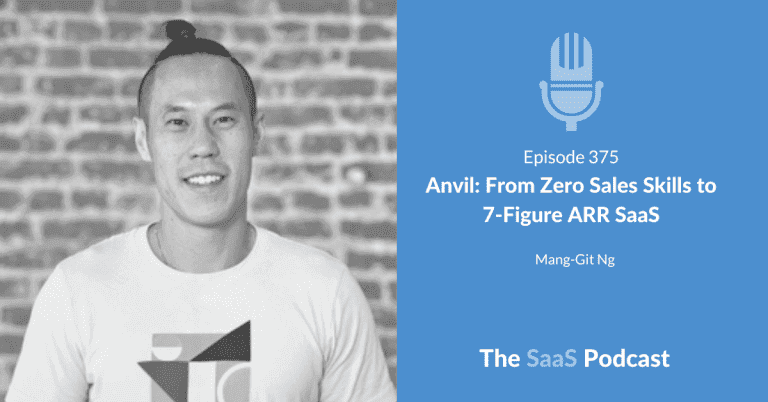
In this episode, I talk to Mangit Ng, the co founder and CEO of Anvil and an automation platform that helps businesses build simple online workflows for cumbersome paperwork processes.
In 2017, while struggling through a frustrating mortgage application process that involved exchanging PDF documents over email, Mangit had an aha moment.
He realized that moving all this paperwork to online forms could solve a massive pain for companies across many industries.
So he and his co founder Ben spent months interviewing people.
Once they were confident that that they were solving a real problem, they built their initial product.
But then they made a classic founder mistake trying to sell to anyone and everyone with no sales experience.
Mangit also struggled with crafting cold outreach emails.
He'd obsess over each one, often taking 25 minutes or more per email, but barely got any responses.
Adding to their struggles, they also attracted the wrong early customers.
Many of them were excessively demanding and created a huge distraction from for the founders.
Fast forward to today.
Anvil is now a multiple 7 figure ARR SaaS company that's raised $10 million so far.
In this episode you'll learn how the founders finally found product market fit by niching down and identifying their ideal customer profile.
After initially trying to serve everyone, what strategy the founders pivoted to when cold emailing prospects wasn't generating results that allowed them to start reaching the right customers.
We talk about how Mangit and Ben pushed past their lack of sales experience and knowledge to master selling skills critical for founders, why referrals became an essential growth channel and how the founders successfully drove these valuable word of mouth referrals.
And we talk about how SEO and content marketing became Anvil's most effective growth channels and their specific content strategy to attract and convert their ideal customers.
So I hope you enjoy it.
All right, Mangate, welcome to the show.
Mang-Git Ng (02:27.140)
Thanks for having me.
Omer (02:28.580)
Do you have a favorite quote, something that inspires or motivates you that you can share with us?
Mang-Git Ng (02:32.340)
I do.
I had to dig really deep for this one because I'm usually not a quotes person, but the quote I came up with was harnessing and leaning more into the idea of being completely screwed and working through it.
It's by this ultra distance runner called Jim Walmsley.
Um, he actually just won the utmb, which is the Mont Blanc race, and there's a scene in a, in a video where he's like 45 miles in 10,000ft of elevation and he's just destroyed and he's like, but I keep pushing and somehow you finished the race.
So that's, that's a, that's a quote that inspires me.
Love it.
Omer (03:08.030)
Love it.
So for people who don't know anything about Anvil, can you tell us what does the product do, who's it for, and what's the main problem you hoping to solve?
Mang-Git Ng (03:17.060)
Absolutely.
So Anvil is the infrastructure that's used by product and development teams.
So people who are building software to build software that automates paperwork.
So whether that means, you know, quickly building and deploying an online web form for data capture, generating documents, sending it through E Signature, Anvil kind of provides all of the components at a kind of like product grade level.
Something that you would actually then provide to your consumers and then you can embed it and customize it pretty heavily.
So there are quite a few startups out there in large companies that use us to effectively build their product because they're trying to bring an offline process online.
Omer (03:59.010)
Great.
And can you give us a sense of the size of the business?
Where are you in terms of revenues, number of customers, size of team?
Mang-Git Ng (04:05.890)
Yeah, so Anvil is about 13 people.
We're a Series A funded company, low seven figures in recurring revenue, and then customers.
It really depends on how you measure it.
We have a lot of people that sign up, use our product, kind of self serve.
Depends on which month they might, may or may not be using this.
So 10,000 plus people signed up and at one point use this.
Omer (04:27.450)
Okay, so let's go back to, you know, when you launch, like where did the idea for this business come from?
Mang-Git Ng (04:36.990)
It really was a combination of a lot of things.
But I would say if I had a point to one specific moment, it was 2017, I must say, I think it was 2017.
My partner and I were applying for mortgages to buy an investment property and the process was just terrible.
You know, we'd reach out to local bankers, try to get the best rate, and every one of them would just email us a PDF and say, fill this out.
That was extremely painful.
It was all the same information and they wanted us to send it over email back to them.
So it's like your name, your social, your bank account number, your mom's maiden name, everything was just, just in there.
So that was kind of the aha moment.
I was like, wait, TurboTax exists?
Why is this not like TurboTax.
And then that combined with some, some other things that were happening.
Like I was at Flexport at the time.
Flexport is a digital freight forwarding technology company.
And there was just a lot of manual data entry work that had to happen.
But once it was digital, that was really great.
Everything could be automated, but getting the data from an unstructured document based format into a structured format is the challenge.
And so the idea kind of came like, hey, how do we create a set of tools for anybody to be able to turn a offline document based paperwork heavy process and bring it online, make it mobile friendly, structured data and it just generates all the documents for you, sends it through esignature for you and then powers downstream tasks.
Right.
So that was really how a lot of things came together at the same time.
Omer (06:24.880)
Great.
So you're a developer by trade.
I know you were at Dropbox for some years.
You worked at Dialpad.
You just mentioned Flexport.
So great, you've got the technical chops and presumably once you have an idea, it doesn't take much to start building something, at least the kind of the initial idea.
So a couple of things I want to understand from that is what you just described there in terms of a problem.
It feels like a very, very broad problem.
And I don't know how many use cases there could be.
Right.
So how did you figure out what was the thing that you were going to initially focus on in terms of whatever that first, first version of the product or the MVP was going to be?
And did you start coding or did you spend time like going out and talking to potential customers and trying to validate this idea more?
Mang-Git Ng (07:26.610)
Yeah, how did I figure that out?
Poorly.
That's how I figured it out.
Just kind of stumbled my way through it, I'll be honest.
Yeah, I would say we.
So my co founder and I, we deliberately did not build anything for the first couple of months.
We just tried to talk to as many people as possible in as many industries as possible.
And you're correct, Anvil, because paperwork is kind of like the standard by which business is done or how you interact with the government or how you interact with anybody really.
It does cover a lot of bases.
There's a lot of areas where it can apply and that's what's exciting to engineers.
It's like, oh, I'm solving a infrastructure problem.
I'm not solving one tiny little problem for one little sliver.
I'm like solving a massive problem.
But we spent a lot of time talking to like I was talking to wealth advisors a lot at that point in time.
When we started, the company was right around when Dropbox had filed their S1.
And so it was really easy for me to get on the phone with a wealth advisor.
You just say, hey, a company I worked at is ipoing.
Do you want to talk?
And they just spend the whole time asking them about their problems.
We also talked to the insurance agents, we talked to some bankers, and in the end, we really kind of initially dove into the financial services sector and was like, hey, we think we can build something for this vertical.
There's a lot of paperwork, There's a lot of required documentation.
There's a lot of just compliance that needs to happen.
So that's kind of how we started with kind of trying to figure out what we wanted to build.
Omer (09:05.120)
Okay, great.
So you didn't build anything initially.
You went out and talked to a bunch of people.
You narrowed it down to, you know, kind of financial sector or finances as the area you were going to focus on.
And then what did that first version of the product look like?
Like, what did it do?
Mang-Git Ng (09:26.300)
It was very naive, I will say.
I think our.
Our hypothesis was really just like, take data and fill out a PDF.
Like, how do we go from a web form to a PDF and vice versa?
Right?
Like, how do you take your existing document, your existing PDF, upload it into a system, and then quickly build a web form that replicates it in the digital world?
And that was pretty much it when we first started.
And what we quickly realized, you know, one of the first customers we sold to was a fairly large, they call it tamp, turnkey, asset manager management platform.
They were effectively opening accounts on behalf of wealth advisors who are, you know, servicing their clients.
So a client would go to a wealth advisor and say, help me manage my wealth.
The wealth advisor would say, I think you should open up an Iraq, a 401k, blah, blah, blah.
Then they would go to this tamp and say, help me process all the paperwork to open that account at TD Ameritrade.
Or now it's Charles Schwab, right?
What we realized was that our understanding of what paperwork is was extremely naive.
You think it's just putting data onto a document, but that's the easy part.
The hard part is really understanding which document to fill out, how to fill it out, what are the rules around it, what are the compliance requirements?
And so we sold this customer and it was.
I mean, we had to build the plane as we were flying it, honestly, we had to reconfigure and rebuild everything to accommodate for those edge cases.
Omer (11:09.730)
So give me an example of what happened when you got this product that you feel like, hey, you thought you'd figured out the solution.
You sell the product and then you realize actually there's a whole bunch of stuff that we don't really know yet.
Is there a specific example of what happened with a particular customer?
Mang-Git Ng (11:33.680)
Yeah.
So again, kind of going back to this tamp customer, they're great.
First ascent.
They are still customers of ours and you know, they were really patient.
We worked with them to understand what the rules were.
And this was actually pretty tedious, I will say, because a lot of the rules are just tribal knowledge.
It's not written down.
It's like you submit the paperwork to TD Ameritrade and they're like, nope, rejected.
You're like, why?
And they're like, because you checked this box wrong.
And like, I didn't realize that box mattered.
Or you missed this page.
Or it's all these rules.
And I kind of.
Maybe a more relatable experience is like trying to understand the tax code, right?
Like there's documents to fill out for, for taxes, but like most people don't understand the tax code and you need to understand the tax code to then fill out the documents correctly.
Right.
This is what Anvil was trying to build for this customer.
It's like you needed to understand the financial account opening document rules in order to open the accounts properly.
So we sat down with them and we solutioned and it was many, many kind of bi week, like twice weekly meetings.
And we'd build something, we show it to them, they'd say, well, can it do this?
And like, sure, go build it quickly.
And iterate.
And iterate.
And so with the whole time, I think one thing that we did kind of emphasize to them was, was it's extremely important for Anvil to only build features that we think are broadly applicable.
We're not building custom features for you as a customer and we're also not building custom features, generally speaking, for a specific vertical.
We want to solve the root paperwork problem, not paperwork for financial services or paperwork for insurance.
So they were very understanding.
And yeah, I think for me, the big lesson there was there's just a lot to.
There's a lot underneath the initial surface layer.
And when you ask somebody to describe their process to you, it's so ingrained in them that oftentimes they don't even realize they're skipping steps.
They don't even realize that there are things that they do.
Instinctually that is not natural to somebody who is new to it.
And so codifying all of that into a single workflow that can capture the data dynamically, select the right documents, fill out the documents correctly, send it through esignature was a lot of work, but
Omer (14:09.020)
we got there, so that's interesting.
So you get the product out there, you realize that there's a whole bunch of stuff that you hadn't really thought about the nuances of paperwork.
Who would have thought paperwork would be that complicated?
Right?
But when you start thinking about specific use cases, yeah, there's a whole bunch of stuff that I guess sort of complications and specific needs that people are going to have.
So it's encouraging that customer is still a customer today.
So you obviously did something right.
But the other side of the coin I want to talk about as well is like there were other customers when you were trying, you know, when you were trying to land those initial customers, that created a lot of stress for you and turned out to be not the kind of customers you wanted to keep long term.
Can you tell us about that?
Mang-Git Ng (15:09.030)
Yeah, absolutely.
I think this is kind of like a realization of our, of Anvil as a product as well as just like who we're trying to serve.
Anvil, because of how we handle all of the complexity of documents, all the complexity of paperwork, it can be quite a technical product, right?
It can also be a very simple product.
If you have a simple process, you can do it without any code in aml.
But if you have a very complex process that requires calculations and math and kind of taking a bunch of information to then make a decision, that's very complicated and requires some level of technical acumen, I think, in trying to sell Anvil, I guess step back here.
We don't explicitly sell to financial services anymore.
This is a learning that we got out of this situation.
And we sell more so to organizations that do have some level of technical acumen, whether it's an IT department, a developer, it's a startup that's a tech startup, because those are the people that can really get high leverage out of Anvil's product that can build 10 times faster, they can scale 10 times faster.
So back to your original question.
Early on, we were trying to sell to anyone and everyone, and some of the customers were just.
They weren't necessarily the early adopters.
I would say they.
They're somebody who might need some help in understanding how to use DocuSign or something that is exists out there today.
And so it was just a lot of handholding they wanted a point solution.
They wanted something that it was like, click here and everything's done, you know, and by Anvil's configurable nature, that just isn't the product that we provide.
We are the infrastructure layer.
We're not one stop shop account opening or one stop shop tax filing.
We are build your tax filing business on our system because it scales and goes with you.
So those customers we found were very demanding.
They would take a lot of time.
They often were used to paying very low SaaS subscription fees for whatever service $5 a user a month.
And really it just wouldn't work for us if our team was spending 30, 40 hours helping build this workflow for them, helping train them, and they only wanted to pay US$5 a month.
I wouldn't even be able to eat ramen, let's put it that way.
Right.
So that was a lesson that we learned.
It's like really identify who you're selling to and make sure you choose wisely.
Omer (17:59.130)
Yeah, I guess one of the challenges is that in the early days when you're trying to get customers, you really don't want to turn anybody away.
Right?
I mean you just desperately, any opportunity, anybody who's interested in like, you're just grateful that they're willing to give you a product to try and pay for it.
But I think a lot of times intuitively we know when somebody isn't a good fit for the product.
But maybe it's hard to acknowledge that in the moment, but I think, you know, and having talked to a bunch of founders about this, I think when you look back it's pretty clear, right.
In terms of who is a good customer and, you know, who wasn't.
But yeah, I think it's a, it's a very difficult thing to do in the early days.
Let's talk about kind of growing and getting beyond, you know, the initial 10 or so customers.
What's been the, the number one growth channel for, for Anvil?
What, what has helped you acquire, you know, most, most customers in the last few years?
Mang-Git Ng (19:15.720)
I would say SEO, kind of like content marketing.
SEO coupled with like just referrals is probably our like most successful channel, I will say.
So Anvil's customer base is really broken up into two, two segments.
We have self serve people that sign up and use Anvil and then we have people who want to talk to sales and then they buy a, you know, upfront yearly package.
And the majority of our revenue comes from these upfront yearly packages, like the vast majority.
And they are great Customers.
A lot of those come through word of mouth or a Google search.
They're searching for a solution to a problem.
They have Anvil ranks pretty highly for, for things like PDF filling.
And so they find us, they, they land on our website and then from there we try to connect with them.
I think if it's an engineer, often they don't want to talk to us.
Totally understand.
I was an engineer as well.
If they're more on the product side, on the business side, then oftentimes we do get in front of them, we do get to talk to them, help them.
And then this is where we can really peel back those layers and understand the underlying problem like I described earlier.
And that's when Anvil really shines.
It's like, hey, did you know Anvil can actually solve all of this for you in a way that is scalable, that you can really quickly train up a team to help you with this.
And so that's our biggest channel.
It's really kind of word of mouth.
SEO, content marketing.
We do have some really great engineering focused content out there that's written by our engineering team and that always just lends a level of credibility to us from a developer centric kind of product perspective.
Omer (21:00.530)
So can you tell me a little bit more about the type of content that you're creating and if there's, you know, particular types of content that, that seems to perform better in terms of attracting the right types of customers?
I mean, I'm guessing there aren't a lot of people searching for, you know, how to automate paperwork or something, right?
There's more specific things that, that people are looking for.
So are you basically having to find these kind of more like long tail type things that people are trying to do or are they kind of like some kind of bigger keywords or types of content that people are really going out and looking for?
Mang-Git Ng (21:47.550)
That's a great question, Omar.
I think if I knew the answer to that, or if you know the answer to that, you should come work at Anvil, because I think the content that has historically worked well for us now this doesn't necessarily mean it translates into large accounts.
I think it just kind of like general brand awareness kind of content is well written engineering content.
Typically it's something that one of our engineers encountered in building a feature or in building a product and then they can sit down and write thoughtfully about it.
Tutorials also help a lot like tutorials around how to embed E signatures into your product.
Anvil has a bunch of tutorials because that's what we do.
I think if you think about Anvil, we really compete in a couple spaces.
If you know, in terms of paperwork automation, there's the web form space, there's the E signature space, and then there's like the document management space.
Right.
All of which are pretty saturated, I would say.
And so part of the big value that Anvil provides is like you're not stitching together three separate things to make it work or building it from scratch to make it work.
Anvil is kind of like customizable, embeddable and helps you build your product.
But nobody is really searching for paperwork automation like you identified.
So it's hard to like rank high for that and get lots of interest.
So we're trying, you know, you have to kind of try to skim off each of these, these verticals with like an, maybe some way of describing yourself or describing the value add that Ammo provides on top of that existing market.
And I will say it's a constant iteration.
I don't, I don't, I don't think we've fully crack the nut yet.
And something that we're always, always trying to do better.
Omer (23:42.030)
Yeah, I mean, you mentioned E signatures.
Wasn't there a case where, you know, you focus a bit more, you know, you had some success with E Signature type content but then ended up getting the wrong types of customers turning up?
Mang-Git Ng (23:59.470)
Yeah, no, absolutely.
I think, you know, and this still exists today, Anvil offers a free E Signature page.
You can go to Anvil, upload a docum and send out for signature.
Two people.
I think it's one document.
But what we ended up getting was a lot of consumers, people that just needed their kids, field trip documents signed or just wanted to sign this neighborhood letter or something like that.
And those people really never converted into Anvil customers because it was a one and done.
And for a lot of people, paperwork is very episodic.
They go through life with long periods where they don't really have to do paperwork and then they have to do a lot of paperwork.
Whereas the customers that we're really looking for are the ones that are trying to tackle the source of that paperwork, I guess.
Right.
The banker, the mortgage banker has to deal with a hundred people on a daily basis trying to apply for mortgages.
So they're managing a lot of paperwork, but the individuals only applying to buy a house once every what, eight, 10 years.
And so how do we get to those people?
That was the question.
And I would say running a bunch of ads saying free E signatures was not the solution.
Omer (25:19.390)
Yeah, yeah.
Again, I think it goes back to what I said earlier, is that you've got so many potential markets where a solution like Anvil would make sense, which is good, but it's also bad because in terms of go to market and messaging and all that stuff, and then you've got these three different types of offerings within the product, which on their own, yeah, maybe you get the right people, maybe you don't.
So it's certainly a challenging situation.
I know that you also use LinkedIn to at least, you know, raise awareness and potentially generate some leads.
How well is that working for you?
And we're talking about, like, just organic LinkedIn, right?
We're not talking about LinkedIn advertising or anything like that.
Mang-Git Ng (26:08.940)
We've dabbled very lightly in LinkedIn advertising, something we probably want to dig more into.
But organic, it's really posted from either the Anvil account or from my own personal account.
Those have been doing really well.
And in a lot of ways, I think posting frequently, posting organically, posting about things that are not necessarily about your business or just tangentially related, really just drives engagement, drives awareness.
People see your name, see Anvil out there.
I think one of my most popular posts, I had like 20,000 impressions in a week or something.
Like, that was literally a post that I did when I was stuck in the elevator at work on a Sunday because I decided to swing by the office to do something, and then I got stuck in the elevator for two hours.
So I was just, like, sitting there.
I was like, what am I going to do?
I guess I'll post on LinkedIn about this.
And it just drives a lot of engagement and people I like, you know, you tag stuck in the elevator at Anvil, blah, blah, blah.
And, like, and that.
That just.
I think that helps.
And it also makes it more human.
I think.
You're.
You're not just a corporate face, you're an actual person out there that's just trying to build your business.
Omer (27:25.250)
Was the post about being stuck in the elevator or you were in the elevator while you were writing a post about something else?
Mang-Git Ng (27:31.890)
The post was about being stuck in the elevator.
I literally got stuck in the elevator, called the building, and they're like, we'll be there an hour and before dinner time.
And my wife was downstairs in the car waiting for me.
Like, nope, I'm calling 91 1.
Next thing I know, you know, you know, big shout out to the SF Fire department.
Three, four brawny guys, like, break down the elevator door.
And I had to climb out in between floors.
But that was, that was pretty, pretty fun.
Fun, yeah.
Omer (28:06.000)
It reminds me of.
What's the name of that.
That book I was looking at the other, A Story Worthy.
Have you come across that book?
Mang-Git Ng (28:14.820)
I have not, no.
Omer (28:16.340)
Yeah.
And I think the big takeaway that I got from that was when somebody says, tell me a story, most of us freeze up because we think it's got to be a story, like a fairy tale or something with some amazing, you know, thing that's going to happen.
And you realize that stories, like, we experience stories every day of our lives and these are little things.
I mean, obviously getting stuck in an elevator is probably a little bit more exciting.
It depends how you look at it.
But yeah, I think it was this idea of that.
Look, you just go through your day and you're having these experiences, you're learning things, you're discovering things.
And those are all stories in terms of not just the thing that you learned or whatever, but how it happened or some of the mistakes you made along the way.
And I kind of trying to train myself as well in terms of do more of that because I think that's what makes it more interesting, right?
Because like, it's so easy to write stuff which is like just like 99% of other content out there.
And I think when you, once you bring in your.
Your own personal stories, it makes it so much more real and authentic.
And the other thing I would say is like, one thing I've heard over and over from, from so many people who create content is the number of times like they'll have.
They'll create something which took them, I don't know, like 15 minutes because they were in a rush and they just wanted to publish something and seeing it do really well, and then they do something else and they spend like, you know, five hours and perfecting it and like they publish it and no one cares.
And they're like, what?
Mang-Git Ng (30:16.470)
Like, I think that's a great lesson.
And just, you know, in a lot of company building, it's like, good enough, good enough.
Get it out there.
Like, the longer you wait, the more you try to perfect it.
It's only perfection in your mind.
You don't know if perfection in the user's mind.
And the only way to get to that perfection, the user's mind, is to let them play with it, right?
Let them read it, let them touch it, feel it, whatever it is.
I totally agree.
I think that's a big lesson.
Omer (30:47.520)
Have you done any outbound as well?
Or has it just all been inbound marketing in terms of getting customers.
Mang-Git Ng (30:55.320)
We have done a little bit of outbound, and it's honestly kind of hit or miss outbound in the traditional sense of cold emailing.
I'm pretty confident that just doesn't work anymore.
I think early days when I was doing it manually, I would test everything from, you know, my changing my name to be more English, more.
Omer (31:20.980)
More.
Mang-Git Ng (31:21.260)
More Anglicized.
Right.
And, you know, but I think, like, we're just all so inundated by emails these days that nobody, nobody really reads it, you know, and more often than not, like for myself, it's very easy to filter out what's like a cold inbound email because, you know, they spell my name wrong and that's a pretty great, pretty great feature of my name.
But I would say in terms of outbound, like in person outbound, going to conferences, like inviting somebody to a dinner, those have worked much better for us.
And fortunately for Anvil, our kind of like average contract sizes warrant that kind of kind of interaction.
Omer (32:02.180)
And so are there particular events that work well?
Like, I guess the bigger lesson here is if you're doing in person selling, that's great.
And I do agree, I think cold email is getting harder and harder because in many ways there are so many tools out there that are making it easier to send crappy emails at scale.
And so you kind of eventually just get to a point where once you receive so much of this stuff, you just start to just tune out and then it just becomes harder for everybody.
I think in person is very different.
Obviously it's a lot harder.
You can't sell to 100 people in an hour or something like that.
It's about relationship building and getting to know people and stuff like that.
But if somebody is in a kind of situation today where they're saying, I really.
I feel like in person selling is something I want to be doing.
I feel like that would be a good way to move forward with my business.
But how did you figure out which events to go or how to find these people?
What's the lesson there that I think maybe we can learn from you on that, or did you just go to any event and just like.
Mang-Git Ng (33:28.120)
No.
We were somewhat selective.
I think early days, pre Covid, when we're still selling financial services, we went to like, financial services event and didn't have much success there and like, oh, wrote off.
So we wrote off in person events.
Coming out of COVID we had kind of changed who we're selling to.
We're really selling to.
Again, like I mentioned earlier, the kind of like technical organizations, organizations that had some technical DNA in them.
And the person was oftentimes a senior level engineering manager, product manager, the founder, somebody who has a vision of what they want to build and are looking for ways to build it faster.
And so what we started going to were these kind of like industry specific tech events.
So one of them that I went to was called Blueprint.
It just happened in Vegas this year.
Again, it's for technology companies building software in the built world.
So real estate, property, stuff like that.
There was another one called itc.
That's huge.
It's massive.
I don't even think this is tech specific.
It's just like everybody goes to it, but it's the insurance one, that one.
All of the insurtech companies are there.
And so for us, what we do, because we're not really selling to the attendees, we're selling to the people at the booths.
We just buy a ticket and then we go walk around.
And then you have like a cornered market, like they can't leave their booth, they have to stay at the booth and you can just talk their ear off.
And typically you can find a product manager or, or some kind of senior level technical person there.
Because the booth isn't just salespeople, it's a bunch of people and like senior, senior leadership is there to really wine and dine their, their high value customers.
So that has been great in terms of just building relationships.
And a lot of times it becomes just like a longer term process.
You build a relationship, you build the rapport, you help them with some of their problems that they might bring to you and then maybe they'll buy anvil down the road.
But it is a little bit longer than kind of like a click in, put in your credit card kind of process.
Omer (35:42.450)
That is a great insight.
I had never thought about events in that way.
Like even after having done almost 400 of these interviews.
Right.
That whenever I think about events I think about who are the people attending the events or which events are your ideal customers going to.
But what you just said there I think is gold in terms of which events are your ideal customers selling at.
Right.
Because you're right.
I mean that's another great way to target them and turn up.
And honestly I think in many of these events when you're at a booth and most people are trying to go past and avoid making eye contact with you, anyone who comes up and talks to you is like great.
They have that conversation.
It's a great opportunity to, to get some facetime with the right people.
Mang-Git Ng (36:40.280)
It is.
And it's interesting because like again, Anvil's really kind of one step removed from the consumer in most situations.
Right.
Like we sell to the person building something that they then resell.
And so, you know, it's not that we don't care about the end customer, is that they're just not the buyer.
They're not the ones spending money on Anvil.
It's the, it's the, the, it's the B2B to C. We're selling to the second B.
Omer (37:07.810)
Right.
You mentioned earlier that there are 2 paths to a lead or 2 types of customers.
You've got the self serve customer will come in, sign up, try the product, buy it, never need to talk to you, many don't want to talk to you.
All good.
But a big bulk of the revenue coming from the types of customers, the, the enterprise type.
Customers who expect to have conversations, who want to go through a sales process.
Yeah.
And you said this was a big, big part of your revenue.
Does the selling come easy or natural to you as a founder?
Mang-Git Ng (37:46.640)
Absolutely not.
I would say I think I've generally been, you know, I'm a fairly sociable person.
I like talking to people, I'm outgoing.
But selling is not something that I've ever, you know, learned.
I would say I wasn't in a sales organization.
I think, you know, being an immigrant or first generation, not immigrant, my parents were immigrants, but first generation American.
Growing up in the Midwest, it was always just like, keep your head down, do the work, put in the effort and you know, the results will pay for itself or like show itself.
And I think sales is like, there's some of that.
It's like you got to do the hard work, you got to do the outreach, you got to do the customer discovery, you got to do all the follow ups.
But it is also about one confidently presenting what you've built and sharing that with the customer, but also to really spending time to unpack for the customer what their problem is.
Right.
And those are two things that like as an engineer, you don't oftentimes as an engineer, by the time you're building something, sales has gone to the product team and said, hey, we're hearing this in the field.
And the product team then went and did user research and then it's like, this is what we're building.
And then it comes to you and you're like, I guess we're building this.
How do I technically solve this problem?
So I think that was something that was definitely learned Fortunately, I have been lucky enough to be a part of several early stage startups.
And even though I was not on the kind of product or sales or marketing side, just being in a small team, a little bit of that bleeds in.
So I did get to see a little bit of it.
But running a sales organization is very different than running a engineering organization.
Omer (39:42.020)
Yeah.
So how did you learn to sell?
Like, did you just start, you know, kind of responding to leads that were coming in and kind of learning on the fly?
Were there books that, that, that helped you figure that out?
Did you find a sales mentor?
Like, what were some of the things that you did that you feel now, you know, maybe if you're feeling more comfortable about the selling process now, it's like what helped you to get there?
Mang-Git Ng (40:08.870)
I think one was just getting over, getting over yourself.
I think like I remember sitting there in the early days and like just sweating over every single email I wrote and like taking 25 minutes for like a basic outreach, hey, my name is Mangot, I do this kind of email.
And just getting over yourself, it's, it's repetition also helps you get better at that.
I think the other thing was after our funding round in 2020, our VC firm Gradient, put us in touch with their internal sales mentor.
And he was very, very helpful in just kind of helping me understand how to unpack a customer's questions or like what questions to ask the customer to kind of keep driving at a potential sale, general process even.
And then I think even when we did hire our first salespeople, relying on them a little bit because they've been in those processes and talking to them and learning and just being open to kind of like their experiences and translating that into something that you can implement at Anvil or at your business.
Omer (41:22.530)
Yeah, I think when it comes to learning about sales for founders, I think process is one part of it.
There's also the kind of the do's and don'ts about how to go and sell and maybe the mistakes to avoid making and that sort of stuff.
And then I think there's about mindset, right.
That many times people, including myself, I used to tell myself, I don't know how to sell, I don't want to learn how to sell.
That's what car salesmen do.
And I don't want to be like that, like selling things to people that they don't need or whatever.
And then I remember someone saying to me, like, well, you like solving problems, right?
Do you like helping people solve problems?
I was like, oh yeah, that's love that.
Right.
And so he's like, you like, going and talking to them and figuring out what their problem is and what possible solutions they could kind of use to solve those problems.
It's like, oh, yeah, that's stuff easy.
That's fun.
I was like, well, that's really what sales is about.
I was like, you know, I'd never kind of thought about it like that.
Mang-Git Ng (42:33.170)
Right.
Omer (42:33.450)
But, you know, yeah, you can be the used car salesman as well and.
Right.
But ultimately I think it's like that mindset of just saying, you know, I've got a solution.
I believe it's going to help people if I can.
If I can go out and help people solve problems or figure out whether their problems, my product can help solve that problem.
And that's a good thing.
But I think it's hard to do.
It's easy to talk about now.
Mang-Git Ng (43:01.760)
I think it's also just that actually goes a really long way in building real trust with their customer, actually saying, no, we can't do that.
I'm not going to sell you this, or, no, this is not something that we offer.
But here is somebody we work with that does offer that builds a lot of respect and trust with the customer.
Because, you know, like you said, you don't want to sell people things that they innately.
If you don't want to sell people things that they don't need or don't want, then, like, then don't sell them something they do need and they do want.
And if it aligns with your, what your business is or what your product is, then then great.
And if not, then it's okay.
You built a relationship there that maybe one day they, you know, for Anvil, we believe that one day they will find a use case for Anvil because it's so broad and so that's a big part of it.
And then so much more respect for salespeople, I would say, is that like, as a founder, you kind of have this secret weapon in your back pocket, which is you understand the product and you kind of can dictate what you're going to do with the product.
So if somebody's like, hey, we want to do this, and you're like, yeah, okay.
So then that night you go home and you build it or you work with a team to build it.
When you're just in a strict sales function, you kind of don't have as much of that power.
You're limited by what the product is or how it is built.
And any feedback you provide will Take a quarter, if you're lucky to be rolled out.
And so that's some skill and art there.
Right?
Like threading that needle and really understanding, providing both value, but also understanding, like, where you can push internally.
That's skill.
Omer (44:53.400)
Yeah, yeah, yeah.
No, definitely.
I think that you're right.
That's a huge advantage.
Like being able to go into that meeting and a customer says, well, can you do that?
And you're like, ask me again tomorrow.
Right.
Or next week.
Right, Right.
So it's kind of like a superpower you have that ultimately you hire the right sales people.
They don't need that.
Mang-Git Ng (45:19.010)
Right.
Omer (45:19.690)
They're good enough at their jobs that they can get results without having to the need to customize the product.
They'll sell what's there and do that well.
All right, we should wrap up.
Let's get on to the lightning round.
So I've got seven quick fire questions for you.
Mang-Git Ng (45:34.190)
Okay, let's do it.
Omer (45:35.710)
All right.
What's one of the best pieces of business advice you've received?
Mang-Git Ng (45:40.270)
Building the product is easy.
It's the distribution in the go to market that's hard.
So focus on distribution.
Go to market.
Omer (45:47.550)
Yeah, totally.
What book would you recommend to our audience and why?
Mang-Git Ng (45:51.790)
I actually have two here, Amp it up.
I just recently read it.
I think it really speaks to a lot of what could be done better in kind of like tech culture.
And then High Growth Handbook, which is a collection of short stories with founders and leaders by Elad Gill.
That was really nice just to know that you're not going through these challenges yourself.
Everybody else has the same challenges.
Omer (46:16.270)
What's one attribute or characteristic in your mind of a successful founder?
Mang-Git Ng (46:21.630)
I would say grit kind of goes back to the quote at the top of the session.
Um, just got to push through sometimes.
Omer (46:29.090)
What's your favorite personal productivity tool or habit?
Mang-Git Ng (46:32.610)
For me, I go to the gym almost every day of the week.
Usually I do it before work if I can.
That way I have no excuse at the end of the day, you know, one more email or this one thing needs my attention.
But, you know, I've already done my workout, and that keeps me, you know, feeling good.
Omer (46:49.330)
What's a new or crazy business idea you'd love to pursue if you had the time?
Mang-Git Ng (46:54.340)
This one I struggled with, I will say, because I'm so heads down in anvil.
But I did at one point had like, a fleeting thought around licensing using blockchain.
And the idea really came to me because you have all these digital books now, these e books.
But what's the licensing model for a library, for a school, for an individual.
How do you track and manage that in a distributed manner?
Obviously, when there's a physical item, it's easy, but when it's a digital item, it can be replicated a thousand times.
So how do you create structures in code to really support an entire ecosystem of licensing?
Omer (47:38.990)
Interesting.
What's an interesting or fun fact about you that most people don't know?
Mang-Git Ng (47:44.990)
My coffee name is wifi, which is the name of my dog.
It's a lot easier than my personal name.
Omer (47:51.990)
So say they ask you for your name, and you say wi fi.
Mang-Git Ng (47:54.470)
And then they stare at me and they go, like, how do I spell that?
I'm like.
Like the Internet.
You know, I get some funny ones.
I've had, like, W, H, Y, F, Y before.
I'm like, you really went deep there.
Omer (48:07.750)
So, you see, the thing is, people like you and me could pull that off because, you know, we're Asian and we kind of, you know, we.
We kind of have unusual names.
Right.
So people could buy that.
Right.
It's like, oh, yeah, WI fi.
Mang-Git Ng (48:24.960)
First English word I ever learned.
Right?
I don't know.
Yeah.
Omer (48:28.880)
And I know I heard a story about some guy going in and.
And saying his name is Spartacus.
Mang-Git Ng (48:34.000)
Oh, interesting.
Omer (48:35.840)
Did you watch the movie?
Mang-Git Ng (48:36.880)
Yeah, I have.
Omer (48:37.680)
I'm Spartacus.
Like, like.
Okay.
And finally, what's one of your most important passions outside of your work?
Mang-Git Ng (48:45.240)
I will say it's my dog.
And I love you, my wife, but it's really my dog, and she knows it.
You know, she is my running companion.
I spend.
She comes to the office with me.
I'll say, every weekend, I take the dog.
This is a Covid thing.
Really.
Every weekend, I'll take the dog out for a trail run.
We'll do like 10 to 12 miles, and it's just us in the middle of nowhere.
And that's pretty awesome.
And, yeah, she's been my running partner since I got her six years ago, and I've only missed three runs without her.
Omer (49:22.850)
Wow.
That's nice.
Nice.
Love that.
All right, well, thank you so much for joining me.
It's been a pleasure chatting and unpacking the story of Anvil and some of the lessons, the mistakes and.
And successes you've had along the way.
That's awesome.
If people want to check out Anvil for themselves, they can go to useanvil.com and if folks want to get in touch with you, what's the best way for them to do that?
Mang-Git Ng (49:50.690)
Yeah, they can email me directly spell my name right and I might open the email, but it's mangotusamil.com.
Omer (50:01.650)
i get that, too.
It's like, I always wonder, how can people type in my email address correctly but not my name?
Okay.
Anyway, thanks, Mike.
It's been a pleasure, and thanks for time, and I wish you and the team the best of success.
Mang-Git Ng (50:21.040)
Awesome.
Thank you.
Thanks for having me.
Omer (50:23.200)
My pleasure.
Cheers.