Omer (00:09.760)
Welcome to another episode of the SaaS Podcast.
I'm your host, Omer Khan and this is a show where I interview proven founders and industry experts who share their stories, strategies and insights to help you build, launch and grow your SaaS business.
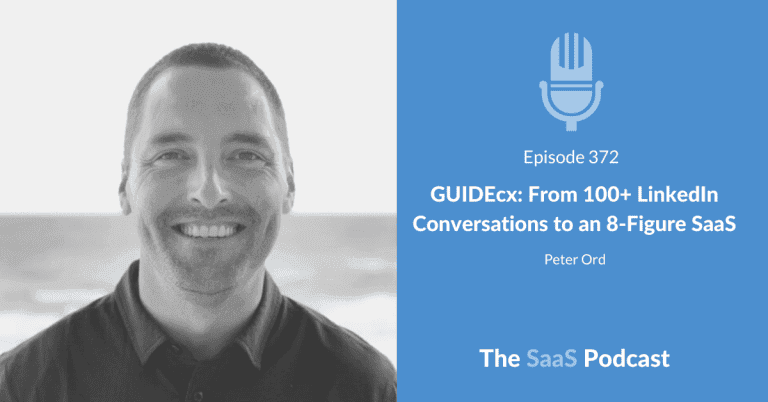
In this episode, I talk to Peter Ordinary, the founder and CEO of Guide CX, a client onboarding and implementation platform.
In 2017, Peter launched Guide CX.
He had seen firsthand the problems with customer onboarding at a previous job and wanted to help companies make it better for their clients.
He kicked things off by talking to more than 100 people who manage customer onboarding.
He wanted to make sure that there was a real need for specialized software.
Once he was confident that there was, he put together an early version of the product to show potential customers.
In the beginning, Peter made some key decisions that set Guide CX on the path to success.
For example, he raised his pricing pretty early on, which helped him attract better customers who valued what he was offering and were willing to pay for it.
But it wasn't all smooth sailing.
During the first year, two team members quit.
They were half of his team back then and left because the business was growing too slowly.
After losing those two people, Peter had an important decision to make.
Was he going to build a lifestyle business and continue to grow slowly or was he going to go all in, raise money and build a fast growing startup?
He chose the latter.
Today, Guide CX has hundreds of customers, has hit the 10 million ARR mark and raised over $40 million to date.
In this episode you'll learn how Peter used LinkedIn to create a list of 116 people to interview and successfully converted nine into earning customers.
We talk about the tactics Peter used to secure early pilot agreements offering a no risk way for clients to experience the product while also fine tuning its market fit.
How Peter overcame a sudden trademark cease and desist that forced a complete rebranding in his first year and just two days before Christmas.
We also talk about why Peter chose to raise his prices despite initial sales challenges.
And how this shift attracted more committed and higher customers.
And how Peter overcame early credibility challenges to start landing enterprise customers and bigger deals.
So I hope you enjoy it.
All right, Peter, welcome to the show.
Peter Ord (02:40.520)
Stoked to be here.
Thank you for having me.
Omer (02:42.560)
My pleasure.
Do you have a favorite quote?
Something that inspires or motivates you that you can share with us?
Peter Ord (02:47.720)
Yes.
So one of my favorite movies is the Greatest Showman.
It came out actually right as I was starting GuideCX, the company I founded, and it's comfort is the enemy of progress.
Omer (03:00.130)
Love it.
So tell us about GuideCX.
What does the product do, who is it for?
And what's the main problem you're helping to solve?
Peter Ord (03:09.650)
Yeah, so our mission at GuideCX is to help people work better together.
The problem we're solving is to answer kind of three main questions for individuals that are going through an implementation experience, a workflow, an onboarding process, any experience that involves an external party trying to provide a product or good or service to you that requires some handholding.
Oftentimes the receiver of the product good or service has three questions.
It's what did I buy?
When am I going to get it?
And where am I at in the process?
And those are the three questions you hate to get when you're providing the product.
A customer calls you and says, when am I going to get it?
I think the greatest companies in the world do things so customers don't have to call them like Amazon.
When my package is late, they tell me it's late and I have the Amazon package tracker to tell me.
And so essentially what we've done is we've built a proverbial package tracker for B2B software companies.
And also we've now since expanded in addition to software professional services and so on.
If you have a repetitive process that involves an external party that needs needs to be kept up to date, we're the solution.
Omer (04:19.810)
Got it.
So you described Guide cx, at least on the website, as, you know, everything to do with onboarding.
Now in the SaaS world, when someone says onboarding, we're thinking about the software that guides users through step by step, how to use the product.
That's not what we're talking about here.
Right.
You've got a broader vision of how you define onboarding.
Peter Ord (04:47.370)
Yeah, I very much think there's kind of two core use cases in SaaS.
You have the product led growth motion where I can go to a website, start a free trial and start using the product right away.
And then you have a more robust motion that happens when you're buying a CRM application at ERP Solution point of sale solutions.
Something that requires a robust setup process before value can be 1.
I think both processes can benefit from guidecx because we more focus on, hey, how do you manage the change management that has to occur in order for your customer to display the behaviors necessary in order to get value out of the product?
As an example, we bought Slack when we started using it the next day after we bought it, my CFO wanted to cancel it because he didn't feel like it was better than email.
But then we hired a few individuals from other organizations that, you know, brought us some best practices.
They helped us change our behavior, change how we use the product, and ultimately we became a sticky customer because of that.
And so I think that point at which you kind of identify, all right, what behaviors do I need to change and how do I hand hold that customer through that behavioral evolution, that's very much the use case we're catering towards.
Some people call it onboarding, some people call it implementation.
But that's our primary use case we market to.
But our viral effect kind of pushes us into procurement.
We have a few home builders using our product.
We have, you know, T Mobile's our biggest customer using our product.
They're not SaaS.
So a lot of cool things we've learned.
Omer (06:25.090)
So just quickly give me an example of how one use case of how T Mobile is using Guide cx.
And then we also mentioned Stripe.
So maybe as a contrast, how is Stripe using the product?
Peter Ord (06:37.460)
Yeah, so T Mobile, they use this for their enterprise onboarding and implementation motion.
One of their customers is they onboard their product to law enforcement agencies.
And one of the things I learned the other day is a police car has 22 LTE connections in it.
Wow.
Yeah.
You have like the radar detector, you have the gps, you have, you know, all, you know, they're.
They're walkie talkie.
I don't think they call it that anymore.
But you see all these antennas kind of stick up outside of police cars.
And it's a robust process to switch law enforcement agency over from, let's say AT and T over to T Mobile.
And you're talking about just one car with all those connections.
And then multiply that across 100 vehicles, across a whole fleet.
That's one example of how T Mobile would use this, managing that, that kind of, that workflow that has to occur.
There's certain responsibilities that fall on T Mobile side to be able to provide.
There's other responsibilities that fall into law enforcement agencies side.
And then you have third parties that are involved that neither party manages.
Right.
And the hardest part about any project is managing people you don't manage.
So that's kind of, that's one use case.
T Mobile.
T Mobile also has a lot of other different types of customers.
Alaska Airlines and all sorts of other entities they cater to.
On the stripe side, you have payment processing.
When you set up payment processing, there's a long checklist of items that need to occur to connect either your billing or your invoicing platform to their payment or the ability to receive payments in their engine.
So they have kind of a lighter process and they have a more robust process based on how complex their customers that they're onboarding.
Omer (08:23.060)
Give us a sense of the size of the business.
Where are you in terms of revenue, number of customers, size of team?
Peter Ord (08:30.060)
Yeah, so about 500 plus customers.
We have about 100 employees, well, 80 to be exact.
And then we just kind of crossed that eight figure mark.
Our next big milestone will be that 20 million.
Omer (08:42.849)
And you've raised, I think just a little over $40 million so far.
Peter Ord (08:47.809)
Yeah, yeah.
Great partners, great investors.
Omer (08:50.849)
But the story starts back in 2017 where you started this business as a solo founder and bootstrapped the company for the first year and a half.
So I think that's a good place to start.
A lot of people who listen to this will be saying, yeah, there are all these guys that come on the show and they talk about raising all this VC money and these big ARR numbers, but I'm just bootstrapping.
But that's how you started.
So tell us first of all, where did the idea come from and, and how did you get started?
Peter Ord (09:31.140)
Yeah, just to piggyback really quick off of that thought process you just shared.
I remember going to founder networking events and people would ask me, well, how much money have you raised?
And I'd say well, zero.
And they'd say, really, why?
We've raised 10 million.
And my question to them would always be, well, how much revenue?
How many customers do you have?
And we're pre revenue and I had like 100k in revenue that I was proud of.
But I understand there are certain markets, certain companies that require a large amount of investment before, but I decided to go the other way.
So the idea started with my previous company.
We sold software to the automotive dealership market.
Automotive dealers are very hard to engage.
We not only had to set up and implement our solution with automotive dealer, but we had to integrate our product with their manufacturer, with their website providers, with their inventory management tools, a lot of moving parts.
Dealers would always ask, hey, when are we going to be able to use your tool as a CRM product?
And we always had to give a range of time like well it'd be about four to eight weeks.
And that wasn't good enough.
Right.
Because there was planning that needed to occur, there was previous products that needed to be canceled, there was training that needed to be scheduled, people needed to fly out and so very, very complex process to manage when all of our checklist items were just internal facing.
And our biggest challenge was getting the dealer in this particular example to engage in understand what the critical path looked like and what would push out the date and what would accelerate the planned end date or the launch date.
And we tried to use generic project management tools to solve that problem.
But car dealers didn't understand what a Kanban board was.
They didn't for that matter didn't even know or have any training on how to project manage on their side.
And so I went on the search for a product that can answer three questions like, hey, I want a product that can tell me when I'm going to deliver a good product or service based on the velocity of the project.
I want it to eloquently tell me who has to do what in this process and when they have and when they have to do it.
And then the third thing is, was an interesting problem.
It was what did I buy?
And I can't tell you the number of welcome calls I got on with my previous company's customers.
And they'd say, well like who are you?
You're a CRM.
Like, well we already have a CRM.
Didn't Jim know that?
You know, we didn't need this product.
And it kind of put our implementation manager in this awkward position of having to resell the product all over again.
There was that challenge and then, you know, people that joined a process midstream like, like an IT manager needed to like help us authenticate our domain with their DNS.
And the IT manager always wants to know, well, what is, why do you need to do that?
Like what's, what's the process?
And so building kind of that last component of having kind of a thoughtful, eloquent manner of helping all individuals on a project know what the finishing, finish line look looks like.
And enabling our guide CX customers to be able to kind of pitch the vision to all those people that didn't participate in the sales process.
Omer (12:50.880)
So you've experienced this pain firsthand and you know, presumably you see that there's an opportunity to go and build a business around this, but making the leap to actually doing that and then also figuring out like what you just described is a very complex process.
It's not like I'm building a, I don't know, a calendar scheduling app or something, right?
I mean even that actually can be quite complicated with time zones, anything.
But anyway, right?
It's like you've got this complicated solution in mind.
What did you do next?
Like did you still go out and try to validate this with, with other customers outside of the automotive space.
And what did you do?
What was the plan at that point in terms of building a product and how you were thinking about approaching that.
Peter Ord (13:46.710)
So this is going to be like me talking about one of my kids.
So you feel free to stop me.
I get passionate about this.
I'm a girl dad of four girls.
So this is my fifth child guide cx.
I decided to leave my previous company having not side gigged or done any of work to kind of move this project forward, if you will.
And really the straw that broke the camel's back is I kind of had some time off.
My phone would not stop ringing.
And the common question that I kept on getting from my customers was when are we going to launch?
And so I know it's a complex problem to solve, but I relegated it to I want to build a B2B pizza tracker.
Right.
Like Domino's tells me when my pizza's coming out of the oven.
I want to provide that same experience for my customers when I'm trying to handle them through a process.
And so we essentially just started with that and I got on so LinkedIn, I searched second level contacts.
You know, I had this idea in my head.
I searched second level contacts with people that had implementation in their title so they could be implementation manager, implementation consultant, just someone that delivered products, goods or services.
I found 116 people.
I asked them all the same 16 questions about how they delivered their products or goods or services.
And that helped me understand that most people were solving this problem with generic project management.
And they all had a common complaint of the inability of them to have a purpose built product to provide a transparent view into how they were, you know, building, building the product good or service.
Omer (15:24.110)
I want to just pause there for a second.
Had you done any outbound before you started doing this in your previous roles?
Peter Ord (15:30.590)
Yeah.
So that's very much my DNA.
At my previous company we built an outbound machine.
I even partnered with the automotive dealerships associations to do their market research surveys on an annual basis.
And I would ask them, hey, I'll ask your questions, but I want to ask five more so that I can build a propensity to buy model of all the members in your community.
And so I came into this with kind of outbound muscles.
I get that's what drives me.
Omer (16:02.050)
Okay, great.
Because many founders would start off by saying, I'm going to build a list and I'm going to cold email people.
You went after second degree connections on LinkedIn.
Just spell that out.
Why?
That's easier than contacting completely cold connections.
Peter Ord (16:19.580)
So there's three books I read during this process, one of which was the Mom Test.
I also read the Lean Startup by Eric Reese.
And then there's the user method that kind of focuses on the Henry Ford example of someone who iterates and innovates and builds something customers aren't asking for, but they know they want.
The Mom Test was an interesting one for me.
It was written by Rob Fitzpatrick, who's on your show.
I believe he talks a lot about, hey, you need to get outside of your network to get good feedback.
Like, and this is if my mom was the mom that was sitting in the stands in a football stadium, that if the quarterback threw me a pass and I dropped it, she would be the one saying, well, it wasn't a good spiral.
Like, it's not your fault.
Right?
Like, great mom.
Yeah, exactly.
And so I kind of, I really related to the concept of that book, which is the reason I searched the second level contacts on LinkedIn.
Pretty easy to do and kind of their search criteria area.
I wanted to get outside my network.
Omer (17:18.320)
And then were you using the mutual connections as a way to get intros?
Peter Ord (17:23.280)
No, just cold outbound messaging.
I wasn't even a LinkedIn.
I don't know what they called their paid service, but I just reached out to them, befriended them.
One of the things I've learned throughout this process is most people are willing to help.
Maybe a more optimistic view in humanity than maybe most people do in these days.
I think most people are good.
They're willing to dive in.
We only hear about the bad on the news.
And so I was elated.
Like, there are so many people throughout this whole journey that have helped with no expectation of anything.
Omer (17:57.590)
And then were you just sending a LinkedIn message or a connection request to these people with a note?
Peter Ord (18:03.670)
Yeah, yeah, you could personalize your invitation.
You know, once I got him on the phone I had hired before, kind of I started this process.
I hired a UX UI designer.
I kind of set a budget of 20 grand that I was willing to spend to build some high fidelity mockups.
I'm not a designer or an engineer by trade.
I'm more of a salesperson and sat with his individual after every interview and kind of said, all right, what if we tweak this based on what I learned?
And this would just give me something to show during the call.
And so I'd advertise that piece of like, hey, I have a B2B pizza tracker.
I have a, a portal on designing or unrelated parties can work together.
Would you like to see it?
Omer (18:45.970)
And that was it.
It was as simple as that.
Peter Ord (18:48.130)
Yeah, yeah.
And I had a lot of people on the phone.
Omer (18:51.090)
And when you got these people on the phone, did you just jump into demoing these, I guess this prototype that you were building or were you also going through and digging into their problems and doing some of the thing that Rob describes in the mom test in terms of, you know, do they really have these problems?
So how did you use that time?
What did you ask them?
Peter Ord (19:16.050)
Yeah, so before I showed any of the product, I, I still have the spreadsheet today, I, I, I asked them all the same 16 questions and those questions revolved around, hey, how long is your implementation process?
How many people are involved?
How many assets are traded back and forth during the process?
How many meetings do you have during your implementation process before you recognize or receive revenue?
These were all pain points that we had in our previous company that I wanted to validate that other people had.
I knew that the car dealership space was a hard user to engage.
I didn't have a confident feeling that like fintech would be very hard or that ERP solutions would be hard or that you know, point of sale solutions.
And thankfully I found out that hey, a lot more than the dealership industry has this challenge of engaging users after a sale.
And that gave me the confidence to green light it, hire engineers and then move on to that next step.
Omer (20:13.690)
How many people did you find through these second degree connections on LinkedIn?
Peter Ord (20:17.530)
I have 116 people on my list.
Omer (20:19.610)
And how many of them agreed to get on the phone with you?
Peter Ord (20:22.730)
Probably roughly half.
And then of those half, I signed 14 of those connections to pilots and nine of those customers, nine became paying customers.
So I guess fast forward a little bit, you know, after getting validation, I had an offered them to participate in a free pilot.
But being a part of this free pilot process, I wanted them to sign an agreement.
And that agreement essentially said that hey, in June of 2018 I'm going to tell you how much this is going to cost.
I'm going to have the product ready like a usable product March of 2018.
So you have some time to evaluate it, to help me iterate on it.
I actually, in the agreement I actually asked and made them commit to 30 minutes a week.
Right.
I wanted them to devote time to me.
And then by July 1, after I told them how much it would cost on June 1, because I didn't really know how much I was going to charge for it.
I would give them the option to become a paying customer.
And so the cool thing is we signed nine up on July 1st that kind of totaled about 80k in revenue.
And four of those customers today are still on our product, which is really cool.
Five years later.
Omer (21:37.170)
That's awesome.
Yeah.
After all of these years, I'm curious why you delayed that pricing announcement and said, on this date, I'll tell you what it's going to cost versus while you were having these conversations, like just throwing out a number and seeing the reaction and using that as an indicator of what you should be charging these people.
Peter Ord (21:59.350)
Yeah, it was more.
I didn't know what the pricing driver would be.
I had a lot of ideas around, hey, do I charge it based on just billable users?
Do I make it usage based?
That seemed to be a popular theme back in the day.
It still is.
So there's one is like, how do I monetize that?
I didn't want that to, okay, I guess, cloud the judgment of the customer's real problem.
I didn't really know how valuable the problem was if solved to the customer.
And so I think dollarizing it too early was, in my mind would be a mistake.
I wanted to prove that value going forward.
And what was interesting is the average ACV of those early adopters was, you know, 6, 7K.
But going forward, after I sold the solution, after that I had a hard time selling the solution for a thousand dollars a month.
And it was kind of interesting because I had spent so much time with these early customers and they valued that time such that they kind of overpaid.
Not overpaid, but they paid me more, knowing that, like, hey, they're getting more than just the product.
They're getting someone who's going to continue to work with them, iterate on this process and build a product that's going to be more and more valuable in the months to come.
And then when you start selling new customers, they don't have that experience.
And so the interesting evolution of identifying, all right, if people will have confidence in not only the product, but if they have confidence in you, they will pay a premium like they pay for the experience.
Omer (23:33.130)
So how did you overcome that beyond those initial customers?
Because yeah, you could continue spending a lot of time and creating this high touch experience with every new lead and customer that comes along, but at some point you've got to let the thing start running itself to some degree.
So how did you handle that resistance that you started seeing to people paying that Sort of number.
Peter Ord (24:06.610)
Well, we asked for more simply, you know, like I remember.
I mean, I'm not saying it's easy, like, and we battled for our first couple of years.
I mean, we're category creation.
Our product did not exist in the tech stack of the customer before we built it.
People were using other products and services before we came along.
And so there wasn't budget for our line item.
And so it was a battle.
But we have always priced our product at a premium and it forces the conversation of validation.
Right.
And if we would have just charged what these generic project management tools were charging at five bucks a user or what have you, one is that wasn't going to work.
I didn't have the money to do mass marketing to make that pencil.
And so I had no other choice but to ask for.
It was $100 a user is what we started with.
We had no minimum and we charged for the project manager license.
Now we've grown since then because our product has evolved, our market has evolved, and we have a brand that we've grown.
We have a bit of a reputation.
But asking for more, I think that's the biggest mistake a lot of early founders make is they don't push that conversation because you never know how much you're really worth until you get that first.
No.
Omer (25:25.740)
Yeah.
And I think there's also something about increasing your prices that often attracts a higher quality customer.
Not necessarily one that has more money, but one that actually cares more about spending to solve this problem that your product helps with.
Peter Ord (25:50.210)
Yeah, it's a real problem to them.
They had to have a conversation with an upper manager to actually get it approved.
They couldn't just put it on their credit card.
And that's a hard process.
It's almost like easy come, easy go.
If it's really easy to sell your product and kind of add a ton of users, I think they're going to be fast to leave.
But if you build that momentum early on, and they always say, choose the hard, life gets easy.
Choose the easy, life gets hard.
I think charging more for your product, asking for more early on is choosing the hard.
And then it makes everything easier downstream because you do have a much more engaged, committed customer.
Omer (26:26.300)
So we talked about the process you used to get to the first roughly 10 or so customers.
I think that's a great.
There's almost like a playbook there that, you know, it won't work for every type of business.
But what you just described there is a really good way that I think many founders could tackle you know, finding those early customers and doing this validation and so on.
So in many ways the first 10 is often the hardest.
But then you have the next challenge coming along and you're thinking, okay, I've now got to start to set my eyes on can this be a million dollar a year business?
And I think most of that growth for you still came from outbound, but you started taking different approaches.
So what did you do there to then start to figure out how you could get to seven figures?
Peter Ord (27:19.780)
Well, I guess just to remind you and the audience, like I was still bootstrapping at the stage and so I was optimizing for efficiency.
And when it's your money in your bank account, you tend to make decisions much more carefully than I think you otherwise would have.
I don't want to give my investors the sentiment that I'm belligerent now, but it is true.
It's like money clouds judgment at the early stages.
And so we were very deliberate or I was very deliberate as to how we spent that money.
Money a challenge that we had was, you know, two of my first four employees left and they were extremely talented.
The lack of growth and the lack of speed drove them away to another company.
They use Guide CX at their companies now and I'm still, I still have a phenomenal relationship with them.
But I learned a hard lesson of, you know, like I can't, this can't.
I need to decide whether this is going to be a lifestyle business or a growth oriented business.
And to answer your question, what helped me decide to take external money was, I guess two things were happening with the business.
One is our product is viral in nature, meaning that it's an external customer portal that our customers put in front of their customers.
And so we have this kind of awareness motion of users that are in our product that don't, aren't customers of ours, but they, they know who we are.
Because there's some discrete branding of Guide cx.
We started to see lots of those second degree individuals like customers of customers signing up for Guide cx.
So that was a very like exciting motion, a confidence inspired motion that I felt like, wow, if we could start selling this, that Lighthouse accounts big companies that are running thousands of projects a month, they can invite all their customers to this product.
Then like the wheel starts spinning a lot faster.
So there's a bit of a model, you know, you know, some early signs that we can accelerate growth if we had the means to do so.
Then the next thing that started to happen was people were expanding their licenses so our net dollar retention, it's easy to spike your net dollar retention when you're super early, right?
It's easy to kind of take a, you know, a hundred dollar a month customer up to a thousand.
But we did, we saw lots of expansion growth within teams that helped us continue to evolve and that was another big sign.
So I guess the viral motion was working and our customers were expanding.
That's where I felt like, hey, I could go to an outside investor and look them straight in the eyes and know that I can model out this business for the next 12 to 18 months and provide some pattern centric opportunities here that we can double down on.
Omer (30:02.570)
So the two out of four employees that you lost was in the first year.
Do you think looking back if they had stuck around and been happy with the pace of growth, that maybe you may have taken longer to raise money or do you feel like you were going down that path anyway?
Peter Ord (30:22.570)
Well, I think the lesson learned was if I were to do this again, I wouldn't have been as stubborn in trying to do this all on my own as long as I did.
We got this business to 400k of ARR before we accepted a outside dollar.
We had patterns before that and I could have been a little more aggressive at raising which would then, then would have accelerated the growth and help these individuals that were with me at previous organizations make the money and be a part of something that was growing faster than something that they were part of before.
Omer (30:55.990)
You described earlier how you looked at your second degree connections on LinkedIn, found people with implementation in the title had a decent list to go out and reach.
When you start thinking about go to market motions and you've got a product which is fairly horizontal.
So where do you focus your energy now?
The whole world is potentially your customer.
So what did you do there to at least get more focused on where you were going to make your place your bets and which type of customer you were going to go after next?
Peter Ord (31:30.560)
So we looked at the SaaS market as our most viral coefficient customer, meaning that most SaaS customers could be our customers.
The antithesis would be we have a few home builders using our product now to guide homeowners through a process of the home design build process.
Those homeowners won't be buyers of guide CX.
That would be a non viral use case.
But SaaS companies oftentimes provided us that viral nature.
And so we identified SaaS companies as our early ICP that's expanded since.
But that was the first step is identify like hey, what Companies do we want to chase?
The second step was to build an outbound machine emotion that can start hitting people at the right time.
And there was three groups of people that we prospected, companies that have recently funded people whose job titles on LinkedIn have changed that had implementation manager in their title.
So we were kind of targeting that as well.
And then third is lookalike customers.
And we still run the same playbook today, but we've overlaid a lot of other strategies.
But that literally got us to our Series B. I think I could call it maybe if I were to do this all over again, I probably would have invested in demand gen a lot earlier.
You know, we didn't have a professional marketer until really 12 months ago.
And so we built this outbound engine and we probably sacrificed some efficiency early on, but it worked.
We were able to pick and choose the customers we wanted to chase.
And I think that's helped us kind of create a great base of evangelists that has helped us get our next 1,000 customers or we have 500 today.
But our customers love us and I'm grateful for them.
I think a lot of it has to do is we picked and choose them.
Whereas when you run an inbound motion early on you're kind of at the mercy of who you get target, but people are knocking on your door and oftentimes you don't know who's knocking.
Omer (33:36.960)
Once you raised your first round, which I guess was about 18 months in, did you then hire someone to do all the outbound or was that still a big part of how you were spending your time?
Peter Ord (33:52.410)
Yeah.
So my co founder that I added about 18 months in LED a sales team at my previous company.
He was an outbound machine as well.
His expertise was managing SDR teams.
And so that's, that's how we built it.
And we were essentially the AES for the next 12 months.
These SDRs were feeding us and we were perfecting that process and then we started hiring AES probably about eight months after we started building this SDR outbound engine and then we just continued to add.
Omer (34:25.840)
So let's go back to this.
What you said about not investing in demand gen.
Seriously, until your Series B, you look back at that and say, okay, maybe that was a mistake, maybe there were some lost deficiencies there, but maybe.
Can you give us an example of how that maybe hurt you or the business?
Because on the face of, doesn't sound like a big deal when I hear
Peter Ord (34:54.530)
it now,
Omer (34:57.309)
you're an eight figure ARR business and doing Pretty well.
So what was the impact of delaying that decision and making that investment?
Peter Ord (35:09.469)
Monday morning?
Quarterback.
Right?
Like you always kind of.
I'm experiencing the benefit of having a robust marketing department today and seeing how much our demand gen engine is helping us fuel our inbound effort.
And I always think to myself, man, what if I could have done that three years ago?
And then you have to be fair with yourself.
Well, were we mature enough to do it, would we have been ready to do that?
I think we would have.
And that's why I kind of call it a mistake not to do it earlier.
We focused a lot more on brand vs demand gen.
When I look at marketing leaders, I kind of look at them in two scopes.
I think there's brand centric marketing leaders and then there's demand centric marketing leaders.
We tackled the brand first and I believe that was a mistake because brand doesn't drive revenue right away.
Like it doesn't.
Brand does not provide the tailwinds to the business until you're at scale.
But we wanted cool shirts like we wanted to feel proud about where we worked.
And I think there's some value there.
But looking back on it, I think we would have moved forward with a demand centric marketing org marketing, I should say marketing strategy because we outsource our marketing after it for a long time.
Demand centric marketing strategy a lot earlier than we did.
Omer (36:31.650)
Yeah.
I mean brand marketing has its place especially if you're an organization with a very large marketing budget and things are.
The businesses is growing well.
But in your situation, having the focus more on demand and being able to basically tie back your investments in terms of attribution, like every dollar you're spending, what are you getting for it is super important.
Peter Ord (37:03.680)
Yeah, it forces a discipline.
Omer (37:05.280)
So let's talk about hiring.
I know that that was another area that you felt that, you know, you could have done differently.
You, you, you raised money, you started hiring and building a team around you.
But where did, where did things sort of start to get difficult there?
Peter Ord (37:26.530)
Yeah, I think every stage of the business is interesting.
I think the first 50 employees, normally you can source friends and family, close people in your network, people that know you to come work for you.
And I think that's a huge value as a CEO is like how, how good are you at getting people to follow you, getting investors to follow you, getting customers to follow you, but more importantly like getting your team, your, your employees who you're going to be shoulder to shoulder with, working with you.
And when we started to surpass 50 customers or 50 employees.
We made the mistake not to hire a recruiter soon enough.
And what happened is it put too much weight on the shoulders of our leadership team.
Like over 50% of their time was spent recruiting.
Now we were growing quickly and still are, but we sacrificed a lot of growth and probably customer experience to be honest, because our leaders were only doing half of their.
Half of their day was spent helping, you know, their customers and their employees and their role and the other half was recruiting.
Just a lot of, a lot of bandwidth that was sucked up.
Once we hired a recruiter post series B, it was like, oh man, why don't we do this sooner?
This is like having a SDR for the company, right?
Someone that can go out and source good talent.
And we tried a few recruiting agencies, had some success with certain roles, not so much other roles.
But you know this.
Those first 50 employees were, I won't call it easy but you know, you're hiring friends and family and you're able to optimize for the skills that you're trying to hire for which we kind of termed as like I wanted empathetic people, I wanted kind people, I wanted hardworking people, I wanted people that were self aware, that had good judgment.
But you don't care so much about the skills.
You care more more about like who the people are because those are the people that the whole culture is going to be built off of.
It's hard to nail it every time when you get past 50.
Omer (39:34.130)
Let's talk a little bit about.
You mentioned Lighthouse customers and you've got some nice logos on your site.
Things like Amazon T Mobile, stripe.
We've talked about who was your first big customer and when did you, when did you land them?
Peter Ord (39:53.240)
LogMeIn who has since branded to Goto we landed them about 18 months in.
There are some connections.
I knew a couple employees that worked for them that used to work for a previous organization I worked for.
Logmean also purchased a company in Utah which is where we're located.
A company called Jive who had since has rebranded into and assimilated into the log me and culture and that was our first 100k plus logo.
Omer (40:25.980)
I'm curious, was that a relatively difficult deal to close or was it all the different factors that you've got the sales background, you've brought on a co founder who's got the same DNA, you've got some connections at the company.
I just wonder how that affected things.
I interviewed a founder a couple of months back who around that time, similar time he was about to close a big deal with a big customer.
And then they started asking all of these questions and they wanted to do a whole bunch of stuff around security and compliance and whatever and they're getting bombarded with stuff.
And he was like, yeah, sure, we'll do this.
And it was the first time they'd ever done it.
But just wanted you to know that we are a small company.
And they were like, well, how small?
And I was like there's two of us.
Like oh.
And it would kind of just kill the deal there.
I just, just this thing about do we really want to trust, you know, a tiny company at this point?
So what was your experience in, in landing a bigger customer?
Peter Ord (41:32.720)
Definitely similarities.
You talk to lots of investors during the process, this process.
And the first thing an investor says, well, if you could sell 100k plus customer, why can't you sell 10?
Like why do you build emotion around this?
And we kind of bought into that process and we did so probably earlier than we were ready for.
And to your friends or your conversations point, like SOC 2 compliance, like we didn't have our SOC 2 report.
We didn't have robust administrative features.
We excelled with groups of 10/plus users in our product that were teams.
But we didn't have a hierarchy to support multiple teams and multiple business units within our product.
Gratefully now we do.
But we started chasing bigger like we, we started our enterprise motion, our account account based marketing motion.
I hesitate to say earlier than what we should have, but we learned a lot from it and it pushed the business forward.
And I think this is, it's kind of a catch 22 with every small company you can it, you can build a product for your core group of customers and perfect that and do a really good job at it.
But there's kind of a fine line between hey, do you want to go up market and are you going to become a billion dollar organization with the customers you have today or do you need to increase your deal size?
Do you need to attract the Fortune one hundreds?
And so it's kind of this fine line of building a product for customers you don't have today, but still catering to your current customers.
That was us.
We had four enterprise AES thinking that we were ready based on kind of the things investors were telling us, like hey, you don't know how good you really are, like why don't you just go try?
And we hired four and then we ended up letting go of three and kept one and then we built the team again.
But hiring those four helped us Learn what we needed to do to excel with the bigger logos.
So you could say it all happened in its right time brain, but it was a painful process.
Omer (43:31.460)
So we should wrap up in a minute and get onto the lightning round.
I do want to talk about one other thing before we do that.
You know, I talk to a lot of very early stage founders and I often get asked, should I get, should I trademark what I'm doing?
And you know, I'm kind of a little bit flippant about my answer at that point.
It's like, yeah, you could waste time doing that, but right now you just need to prove that you're solving a problem that people care about.
You need to think about getting customers first.
And you're so small, no one's going to care about trademark and stuff like that.
But you've faced exactly a trademark issue very early on with your business.
Tell us a story what happened there.
Peter Ord (44:22.860)
Yeah, so this was about a year in.
We were previously named.
Beyond is the name I chose for the company.
I wanted a short URL.
I wanted something that could be a verb.
Like all the common themes of, like, when you're naming a company, this is how you should choose your name.
Beyond was spelled B, E, Y, N, D. So on the phone we'd always have to say, yeah, we're beyond, but without the oh.
And the reason that we didn't have the O is because Bed, Bath and Beyond had that, that URL.
But anyways, we chose that name.
We were, you know, we were growing the business.
And then I got served with a FedEx envelope on my doorstep two days before Christmas.
And there's a company out in Ohio called Beyond Software.
They didn't really necessarily do what we did, but phonetically we sounded the same.
And that CEO had an issue with it.
And we actually, we got served.
I ended up finding the CEO's number on the phone.
The papers came from their law firm.
And I kind of, I searched on LinkedIn who the CEO was and I reached directly out to that individual and I told him, I'm like, hey, listen, there's no malicious intent here.
I don't think we're in the same market.
We're not confusing our customers.
But we're going to take this opportunity to rebrand.
Can you give me three months to do so?
And so we took January, February, and then on March 22nd of 2019, we switched to guide CX.
Learned a lot about, like, we hired a trademark attorney.
We, you know, we learned a lot about that whole process.
And I agree, like Your money and your funds are so limited in the early stage, the last thing you should do is spend thousands of dollars on a trademark attorney.
But there are ways.
There's things I could have done.
Like I could have done a test search on the government website and kind of done a little homework on my own to give me some level of confidence that the name I chose wasn't conflicting with any other company in the space.
But I didn't made a mistake there.
Omer (46:29.520)
That's the last thing you want.
Well, especially before a couple of days before Christmas, you're like, I quit my job.
I'm trying to build this business.
I'm trying to find customers, and you throw this on me.
Peter Ord (46:40.970)
But it forced us to run like a robust messaging exercise.
Kind of forced us to define a mission statement.
Like, we went through all the kind of more professional motions of, how do you pick a company name?
What's your mission statement?
What's your brand essence?
You know, as we start hiring, we want everyone singing towards the same tune.
So what's our elevator pitch?
It forced a lot of good behaviors.
So looking back on it, I'm glad it happened.
I love the name we have now.
It's more indicative of the problem we're solving.
But, man, another type two fun moment, right?
You looked at.
You don't want to live it again?
Omer (47:16.500)
Totally.
All right, let's get on to the lightning round.
I've got seven quick fire questions for you.
Just try to answer them as quickly as you can.
What's one of the best pieces of business advice you've received?
Peter Ord (47:28.260)
So my father, great man.
Passed away three years ago.
Absolutely.
Just learned a ton from him.
I grew up hearing this quote over and over again, and I applied it to the business world as well.
The greatest offense is to take offense when no offense was intended.
I think you follow that mindset and you become liberated.
Omer (47:47.340)
Did I read somewhere that he was an entrepreneur as well?
Peter Ord (47:49.660)
Yeah, he was a home builder.
And what was cool about him is he lost everything he had in his life three times.
He took a lot of risks, but his demeanor never changed.
Failure didn't define him.
Failure was temporary.
It wasn't permanent.
So, yeah, I could go on and on about the lessons I've learned from him.
Omer (48:10.230)
You already mentioned a few books, but is there one book that you would recommend to our audience?
And if so, why?
Peter Ord (48:16.550)
A recent book I just read is Predictable Revenue by Aaron Ross.
He kind of built the customer success motion for Salesforce.
Great book.
Omer (48:24.550)
Agree.
What's one attribute or characteristic in your mind of A successful founder, I think
Peter Ord (48:30.670)
one that can instill confidence and team members and employees and customers and investors.
Anything you do and say should always be designed to build confidence.
And that doesn't mean you're an eternal optimist all the time.
It doesn't mean you're not realistic.
But I think people that instill confidence in others are magnets.
Omer (48:50.330)
What's your favorite personal productivity tool or habit?
Peter Ord (48:54.010)
I'll choose a habit morning workout routine.
My mind is clear when I can get in the gym and kind of get a good, good workout in before the day.
When I don't.
When that doesn't happen, my day is not productive.
Omer (49:07.940)
What's a new or crazy business idea you'd love to pursue if you had the time?
Peter Ord (49:11.700)
Virtual ea.
You know, I'm kind of nearing this moment where a lot of my mentors that are at the same stage I am at, I'm at companies, they have executive assistants and they always battle with, like, if you hire the right one, they are priceless.
I said, well, what are the qualities of the right one?
And I always think, well, can't we have virtual?
Can't we automate that process a little more?
Can't someone look at my calendar and automatically know what I want to prioritize and how best I can use my time?
Omer (49:43.590)
It might happen, especially these days with what's going on with AI.
It'd be pretty interesting.
What's an interesting or fun fact about you that most people don't know?
Peter Ord (49:54.270)
I majored in construction management.
I grew up framing homes.
My dad was a home builder.
Lots of people think that, hey, you're running a software company.
Like, you majored in information systems or have a software background.
I don't.
Omer (50:06.990)
You didn't have a background in software or development or design, and you've still been able to build this great business.
And I think in many ways, often I think I talk to people who assume that maybe not having the technical skills is a big disadvantage and maybe in some ways it is.
Looking at leadership and founders and what makes great founders.
I think it's much more like a holistic picture.
And I think people like you are a great example of you don't have to be a coding geek to go and build this type of business.
Peter Ord (50:50.040)
Yeah.
And you need to be friends with those individuals.
Omer (50:52.760)
Definitely.
Peter Ord (50:54.040)
Yeah, I agree.
Omer (50:56.520)
And finally, what's one of your most important passions outside of your work?
Peter Ord (51:00.200)
So I'm a girl, dad.
Right now my life is going to dance recitals, gymnastics, soccer, you name it.
That's my nightlife but aside from that, I love building things.
I love working with my hands.
I still love kind of that construction, that tangible ability to.
I finished the basement in every home I've lived in.
I've built all my sheds in my backyard.
I mean, I just like to build things.
Omer (51:28.430)
Peter, thank you so much for joining me.
It's been a real pleasure talking about what you have done over the last, I guess, seven years now.
You know, thank you for sharing the lessons and you know, you've learned along the way.
I think there's a lot of stuff that you talked about which will hopefully be inspirational or maybe even actionable for people who are a little earlier in their journey.
So I appreciate you taking the time to do that.
If people want to learn more about GuideCX, they can go to guidecx.com and if folks want to get in touch with you, what's the best way for them to do that?
Peter Ord (52:07.100)
Peteridecx is my email.
You could also reach out to me on LinkedIn.
I would love to help you.
Please reach out.
People have helped me.
If I could do anything unrelated to GuideCX, please don't hesitate.
Omer (52:18.140)
Awesome.
Thank you so much.
It's been a pleasure.
Congratulations on hitting the eight figure ARR mark and I wish you and the team the best of success as you drive towards that next big milestone.
Peter Ord (52:33.020)
Cool.
Thank you Omer.
Appreciate you having me.
Cheers.